


Nutrition ensures good health throughout the entire life course, but it is particularly important during adolescence, when individuals have increased nutrient needs to meet the demands of physical and cognitive growth and development. With adolescents, particular nutritional concerns include higher than recommended amounts of saturated fat and Na, inadequate amounts of fruits, vegetables and fibre, and low intakes of Ca and Fe-rich foods, which are especially important for adolescent girls( Reference Story and Alton 1 ).
Sri Lanka, like many low- to middle-income countries, is experiencing a rapid economic, demographic and epidemiological transition( 2 , Reference De Silva 3 ) and a double burden of under- and overnutrition( Reference Wickramasinghe, Lamabadusuriya and Atapattu 4 , Reference Katulanda, Jayawardena and Sheriff 5 ). Within the population there is a high prevalence of metabolic syndrome( Reference Katulanda, Ranasinghe and Jayawardana 6 ), diabetes( Reference Katulanda, Constantine and Mahesh 7 ) and undernutrition( Reference Hettiarachchi, Liyanage and Wickremasinghe 8 , Reference Rathnayake, Wimalathunga and Weech 9 ).
Consuming a high-quality diet is a challenge globally, but it is particularly difficult for individuals living in environments where nutrient-dense foods, such as those from animal sources or fresh fruits or vegetables, are unavailable or unaffordable( Reference Ruel, Harris and Cunningham 10 ). According to a 2013 study, only 3·5 % of adults in Sri Lanka consumed the recommended five daily portions of fruits and vegetables, over a third of the population consumed no daily dairy products and nearly 70 % consumed over fourteen portions of starch daily( Reference Jayawardena, Byrne and Soares 11 ).
One of the challenges that researchers working in low- to middle-income country contexts face relates to quantifying diet quality. In many studies, proxy measures such as the ‘number of daily fruits and vegetables’ or ‘number of sugary drinks’ are used to characterise diets. However, in certain instances, such as modelling exercises, it may be useful to have a quantitative estimate that characterises multiple aspects of dietary quality. The use of composite indices to summarise overall diet quality is becoming increasingly popular in nutrition and health research, with a marked increase in the number of studies using diet quality indices tailored to specific purposes and populations( Reference Fransen and Ocké 12 ). Compared with single nutrient measures, composite measures provide a more comprehensive means of assessing variability and overall diet quality. Composite measures have been found to be associated with diet-related biomarkers( Reference Hann, Rock and King 13 ) and may be more strongly associated with health outcomes than a single nutrient( Reference Kant, Schatzkin and Ziegler 14 , Reference Kennedy, Ohls and Carlson 15 ). By providing a predefined summary measure of overall diet quality, diet quality indices can be used to monitor overall dietary changes based on a wide selection of foods and nutrients that are considered important for health( Reference Fransen and Ocké 12 , Reference Vandevijvere, Monteiro and Krebs‐Smith 16 ).
At the same time, there is some controversy surrounding the utility of diet quality indices. Waijers et al. reviewed the literature on twenty predefined indices of overall diet quality and concluded that many correlations between the dietary components are not adequately addressed( Reference Waijers, Feskens and Ocké 17 ). A second review by Arvaniti et al. also reviewed dietary indices and concluded that the majority of these indices fail to recognise the various interrelationships between their components( Reference Arvaniti and Panagiotakos 18 ).
Another issue related to diet quality indices is the fact that there are many options; a review by Marshall et al.( Reference Marshall, Burrows and Collins 19 ) identified 119 studies using eighty different diet quality indices to assess diet among children and adolescents. For the present study, we decided to use the Diet Quality Index–International (DQI-I). The advantage of this index is that it considers issues related to both undernutrition (e.g. variety and adequacy) and overnutrition (moderation and balance), which is important when working in environments experiencing a nutrition transition. Many of the other dominant diet quality indices were not appropriate due to their focus on populations living in high-income countries where the primary health concern relates to overnutrition( Reference Marshall, Burrows and Collins 19 ).
The purpose of the current work was to describe the diet quality of adolescents in rural Sri Lanka using the DQI-I. Additionally, it aimed to examine how DQI-I scores related to dietary consumption in terms of types of foods consumed, macronutrient composition and micronutrient intakes. Finally, using multilevel analysis to account for the clustered sampling methods, it aimed to examine associations between sociodemographic characteristics and diet quality. We hypothesised that DQI-I scores would be positively associated with nutrient intakes and that scores would vary according to sociodemographic characteristics such as maternal education.
Methods
Data collection
Data were collected as part of the ‘Integrating Nutrition Promotion and Rural Development’ project, a quasi-experimental study funded by the World Bank which aimed to evaluate the feasibility of promoting healthy diets in rural Sri Lanka through a range of multisectoral activities. Data were collected from three districts: Ampara, Moneregala and Kurunegala.
Schools and students were sampled from the three districts using three-stage cluster sampling methods based on district, school type and whether or not the school was involved with the ‘Integrating Nutrition Promotion and Rural Development’ project. These methods resulted in a sample of fifty schools. Students were selected from schools using probability proportional to size, to ensure that every student had an equal chance of being selected. Students between the ages of 12 and 18 years attending secondary school were eligible to participate. According to WHO recommendations, study participants aged 12 years or above are eligible to give informed consent( 20 ). We excluded students under the age of 12 years, those diagnosed with long-term medical conditions and those who were attending private or international schools.
A week before the data collection, each participating school sent students’ parents a letter providing detailed information about the project and instructions for opting out of the survey. On the day of the survey, students who had not opted out of the project were invited to participate. Those who agreed to participate provided written informed consent. Even after providing consent, participants were notified that at any point after giving written informed consent, they were eligible to opt out of the study. Ethics approval was granted from the Oxford Tropical Research Ethics Committee, University of Oxford and the Ethical Review Committee, University of Colombo.
On the day of the data collection, students completed a validated FFQ( Reference Jayawardena, Swaminathan and Byrne 21 ). Demographic data were collected using the WHO Global School-based Health Survey( 22 ). Data from the FFQ were transcribed from the paper surveys and analysed in NutriSurvey( 23 ). The FFQ data were then used to generate a modified DQI-I score, which created a composite measure summarising diet quality in terms of nutritional variety, moderation, balance and adequacy. Due to limited data availability, several modifications to the original DQI-I had to be made related to the allocation of points for creating moderation and balance scores: the points for total fat and cholesterol were modified from the original maximum of 6 points to a new maximum of 9 points due to the lack of data on saturated fat (a component which was included in the DQI-I for a maximum of 6 points). Additional modifications were made for the ‘Overall balance score’. The original DQI-I included a component related to the fatty acid ratio (PUFA:MUFA:SFA). We did not have these data, so we increased the value of the other ‘Overall balance component’ which was based on the macronutrient ratio. Originally, the maximum score was worth 6 points in the DQI-I, but we increased it to be worth 10 points (Table 1). The FFQ data provided a description of how many grams of food were consumed according to food group (e.g. rice, vegetables, grains, etc.). These amounts in grams were converted into daily intake of serving sizes using serving sizes from the Daily Sri Lankan Dietary Recommendations, which provide estimates of the serving sizes of rice/breads, vegetables, fruits, beans, meats and dairy products. A full description of the Sri Lankan serving sizes is provided in the online supplementary material, Supplemental Table 1.
Diet Quality Index–International (DQI-I) components, scores, cut-off points and baseline proportions (adapted from Kim et al.( Reference Kim, Haines and Siega-Riz 25 ))
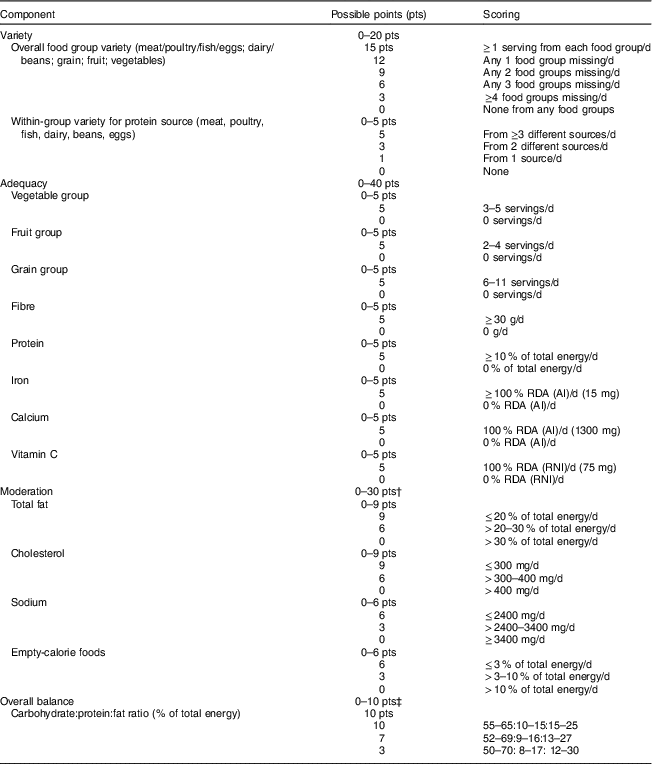
AI, Adequate Intake; RNI, Reference Nutrient Intake.
† The points for total fat and cholesterol were modified from the original maximum of 6 points to a new maximum of 9 points due to the lack of data on saturated fat (a component which was included in the DQI-I for a maximum of 6 points).
‡ Additional modifications were made for the ‘Overall balance score’. The original DQI-I included a component related to the fatty acid ratio (PUFA:MUFA:SFA). We did not have this data, so we increased the value of the other ‘Overall balance component’ which was based on the macronutrient ratio. Originally, the maximum score was worth 6 points in the DQI-I, but we increased it to be worth 10 points.
Trained researchers weighed and measured students without their shoes and wearing only light clothing on a standard physician’s beam scale (SECA 803, Hamburg, Germany) and a stadiometer (SECA 213, Hamburg, Germany). Measured height and weight were used to generate age- and sex-adjusted body weight categories (these are categories which account for the individual’s age and sex when determining whether or not his/her BMI falls within a category) according to standards from the International Obesity Task Force( Reference Cole and Lobstein 24 ). These categories are underweight, normal weight and obese, which are extrapolated from the adult BMI cut-offs for overweight (25 kg/m2), obesity (30 kg/m2) and three grades of thinness (BMI of 16, 17 and 18·5 kg/m2). It combines nationally representative survey data from the UK, USA, Netherlands, Brazil, Singapore and Hong Kong (covering the age range 2–18 years). We created a three-category body weight measure: underweight (International Obesity Task Force thinness grades 1, 2 and 3), normal weight and overweight (overweight and obese).
Based on our population’s nutritional profile and the variables that were available in our data set, the DQI-I was the most suitable index for summarising diet quality among adolescents in Sri Lanka. Its suitability was based on several factors. First, the DQI-I has been validated for use internationally and it focuses on concerns related to both chronic disease and undernutrition( Reference Kim, Haines and Siega-Riz 25 ). Second, the DQI-I was compatible with the data output from the FFQ that we used in the present study( Reference Jayawardena, Byrne and Soares 26 ).
The DQI-I assesses dietary quality according to four components: its variety, adequacy, moderation and overall balance. The DQI-I is an adaptation of the original DQI, which was developed in 1999 to reflect the dietary guidelines of the time in the USA. The DQI-I was developed as a way to provide an index that would be appropriate for all countries. The index is based on worldwide and individual national dietary guidelines from the WHO( 27 ) and the US Department of Agriculture( 28 , 29 ). More details regarding the rationale for developing the index are documented elsewhere( Reference Kennedy, Ohls and Carlson 15 , Reference Patterson, Haines and Popkin 30 , Reference Haines, Siega-Riz and Popkin 31 ).
The normality of continuous variables was evaluated using Shapiro–Wilk tests and normality distributions. Correlations between food or nutrient intakes and DQI-I scores were evaluated using Pearson or Spearman correlation coefficients.
We compared the means of DQI-I components by individual characteristics (sex, age, BMI category, district) using t tests for binary variables or ANOVA for categorical variables. When categorical variables violated the homogeneity of variance assumption, we used the F* test to examine differences in DQI-I components between groups. Bonferroni corrections were used to account for the increased risk of type I errors related to multiple significance comparisons.
To examine associations between sociodemographic factors and total DQI-I score, we used multilevel modelling. Multilevel modelling was important due to the hierarchical structure of the data set (children nested within schools).
Results
Just over half of the students were female, with age ranging from 12 to 18 years (Table 2). About 43 % of the sample fell into the normal weight range, while 35 % were underweight. About 42 % of students reported that their mothers had passed GCE/O levels (General Certificate of Education/Ordinary levels) or above, while the remaining majority reported that their mothers had an education below GCE/O level. The majority of participants identified as Sinhala (86 %), but about 9 % identified as Sri Lankan Moor and 5 % as Sri Lankan Tamil.
Demographic characteristics and BMI of the study participants: adolescents (n 1262) aged 12–18 years living in rural Sri Lanka, ‘Integrating Nutrition Promotion and Rural Development’ project, August/September 2015

GCE/O level, General Certificate of Education/Ordinary level.
The percentages for each section may not add up to 100 % due to observations with missing answers, which are not shown.
The mean values of servings of food groups consumed according to quartile of the DQI-I score are presented in Table 3. The consumption of foods (servings/d) for all food groups (including foods high in sugar, fat and salt) increased with increasing DQI-I score. DQI-I score was positively correlated with the percentage of energy coming from protein and fat, but was negatively correlated with the percentage of energy coming from carbohydrates. DQI-I score was positively associated with mean nutrient consumption values (Table 4).
Differences in consumption of daily food servings by Diet Quality Index–International (DQI-I) score categories among adolescents (n 736) aged 12–18 years living in rural Sri Lanka, based on data from the ‘Integrating Nutrition Promotion and Rural Development’ project, August/September 2015

Differences in energy, macronutrient and micronutrient intakes by Diet Quality Index–International (DQI-I) score categories among adolescents (n 736) aged 12–18 years living in rural Sri Lanka, based on data from the ‘Integrating Nutrition Promotion and Rural Development’ project, August/September 2015

Table 5 summarises the mean values of the DQI-I component scores (variety, balance, adequacy and moderation) and the total DQI-I score according to sex, age, district, maternal education and ethnicity. After Bonferroni corrections for multiple testing, the analyses indicated that males had a significantly higher variety score compared with females, but there were no significant differences in total score. There was a significant difference in moderation score by ethnic group, with Indian Tamils having the highest moderation score.
Diet Quality Index–International (DQI-I) component scores and total DQI-I score, by demographic characteristics, among adolescents (n 736) aged 12–18 years living in rural Sri Lanka, based on data from the ‘Integrating Nutrition Promotion and Rural Development’ project, August/September 2015

GCE/O level, General Certificate of Education/Ordinary level.
**P<0·01.
Results from multilevel modelling indicated that after accounting for the hierarchical nature of the data set (children nested within school), total DQI-I score was significantly associated with sex, district and maternal education. There was no significant association between total score and age or ethnicity (Table 6).
Sociodemographic factors associated with Diet Quality Index–International total score among (n 736) aged 12–18 years living in rural Sri Lanka, based on multilevel modelling of data from the ‘Integrating Nutrition Promotion and Rural Development’ project, August/September 2015

GCE/O level, General Certificate of Education/Ordinary level.
*P<0·05.
DQI-I component scores and total DQI-I score by BMI status are presented in the online supplementary material, Supplemental Table 2. There was no significant difference in DQI-I score according to BMI.
Discussion
The modified DQI-I indicated that there were significant differences between male and female secondary-school students in Sri Lanka, with males having significantly higher variety, adequacy and total DQI-I scores compared with females. Multilevel analyses indicated that sex, district and maternal education were all significantly associated with diet quality.
Results from the present study indicate suboptimal dietary intakes: carbohydrates provided over 70 % of energy, protein provided about 10 % and the remaining energy came from fat. These findings are compatible with data collected from adults( Reference Jayawardena, Thennakoon and Byrne 32 ). Higher DQI-I score corresponded to a lower proportion of carbohydrates and higher proportions of protein and fats in the diet. Similarly, research among Sri Lankan adults showed that higher BMI and obesity were associated with higher dietary diversity and variety scores( Reference Jayawardena, Byrne and Soares 33 ). We observed that girls had a lower energy intake than boys, which corroborates findings from a study with Sri Lankan adults indicating that women had lower energy intake than men, mainly due to smaller portion sizes( Reference Jayawardena, Thennakoon and Byrne 32 ).
Differences in dietary nutritional quality according to sex have been observed before. Qualitative data collected prior to the current project suggested concern with maintaining a low body weight among subsets of this population, which may contribute to some of the observed differences in diet quality among males and females( Reference Townsend, Williams and Wickramasinghe 34 ).
We found that maternal education, too, was significantly associated with diet quality score. This is consistent with other findings, including that maternal education is important in reducing the risk of anaemia and Fe deficiency and increasing children’s consumption of animal-source foods( Reference Choi, Lee and Jang 35 ) and that dietary diversity is associated with child nutritional status( Reference Arimond and Ruel 36 ). Research also suggests that maternal education is one of the most important factors in explaining differentials in child health outcomes( Reference Frost, Forste and Haas 37 ).
The present study had several strengths and weaknesses. To the best of our knowledge, while work has been done to evaluate diets using the DQI-I in a wide range of countries, including China( Reference Kim, Haines and Siega-Riz 25 ), Spain( Reference Tur, Romaguera and Pons 38 ) and Canada( Reference Florence, Asbridge and Veugelers 39 ), the DQI-I has never been applied to data from Sri Lanka. This is important because it allows for comparison between populations. DQI-I allocates higher scores to diets that are low in fat and high in carbohydrates. However, recent evidence suggests that high-carbohydrate diets (rather than diets high in fats) are associated with increased risk of CVD( Reference Dehghan, Mente and Zhang 40 ).
Limitations of the study include the fact that the FFQ that we used was validated for adults, but it was not validated for use with adolescent populations( Reference Jayawardena, Byrne and Soares 26 ). We observed wide variation in dietary outcomes between students, which was reflected by high standard deviations. For example, twenty-three students reported to consume more than 20 servings of vegetables. Relying on self-reported data, it was not possible to verify the accuracy of these reports. Additional work is needed to identify the best methods for assessing dietary intake among adolescents.
Additionally, the present study was limited by the lack of data on saturated and trans fats in the diet, which meant that the scoring may have been weakened because it could not differentiate between healthy and unhealthy fats. An additional limitation is related to the scoring methods used in the DQI-I, which employed binary measures for categories such as adequacy, where participants could get 0 points for inadequate consumption or 5 points for adequate consumption. An improved score might give participants, for example, 2 or 3 points if they almost meet recommendations.
Conclusion
In conclusion, our findings indicate that DQI-I score among adolescents in Sri Lanka is positively associated with micronutrient consumption and negatively associated with the percentage of total energy coming from carbohydrates. This finding is important, especially in a context where individuals may face food insecurity and, given the lack of affordable, nutrient-dense foods such as fruits, vegetables, dairy and other proteins, may resort to energy-dense micronutrient-poor sources of food.
Our findings indicate important differences in DQI-I score according to sex and maternal education. Further work is needed to explore why diet quality is poor among females; qualitative work by Townsend et al. indicates that, as in many parts of the world, adolescent girls in rural Sri Lanka are preoccupied with maintaining a low body weight, and this may come at the expense of getting adequate nutrition. It is also possible that females have a lower DQI-I because they eat less, owing to lower nutritional needs than boys.
The finding that low maternal education may have an adverse effect on dietary quality suggests that interventions must target low socio-economic groups, and community-based methods which promote education to both adolescents and their families may be an important intervention. The association between district and dietary quality suggests that a ‘one size fits all’ approach may not be optimal, and interventions may need to be targeted for specific districts.
To improve diet quality, interventions must increase the availability and affordability of healthier foods through programmes that provide food at school or those that target economic development. Interventions will require involvement from many stakeholders from within the government, non-governmental organisations and other community groups.
Acknowledgements
Financial support: This project was funded by the Integrating Nutrition Promotion and Rural Development (INPARD) project, which was supported by the South Asian Food and Nutrition Security Initiative (SAFANSI) Trust Fund of the World Bank. J.W. is supported by a DPhil scholarship from the Nuffield Department of Population Health, University of Oxford. K.W. and N.T. are supported by a grant from the British Heart Foundation (006/P&C/CORE/2013/OXFSTATS). The authors thank INPARD partners, data collectors and Re-awakening Project Staff, and acknowledge school principals who participated in the study and education authorities who granted permission for school staff to take part in this project. The funders had no role in the design, analysis or writing of this article. Conflict of interest: None. Authorship: K.W., S.M., P.K., N.T., M.R., R.J. and J.W. conceived of and designed the study and acquired the data. J.W. analysed the data and drafted the manuscript. K.W., S.M., P.K., N.T., M.R. and R.J. revised the manuscript critically for intellectual content. K.W., S.M., P.K., N.T., M.R., R.J. and J.W. approved the version of the manuscript to be published. Ethics of human subject participation: This study was conducted according to the guidelines laid down in the Declaration of Helsinki and all procedures involving human subjects were approved by the Universities of Oxford and Colombo. Written informed consent was obtained from all subjects.
Supplementary material
To view supplementary material for this article, please visit https://doi.org/10.1017/S1368980019000430



