


Introduction
In recent decades, political parties in Germany – as well as across Europe – have faced declining membership, putting pressure on their own organisational capacity as well as the functioning of party democracy as a whole (van Biezen and Poguntke, Reference Van Biezen and Poguntke2014; Scarrow, Reference Scarrow2015). Young people in particular are increasingly disengaging from conventional forms of participation, which risks their early exclusion from decision-making and leaves young voters without peers advocating for their interests (García-Albacete, Reference García-Albacete2014; Stockemer and Sundström, Reference Stockemer and Sundström2022; Kurz and Ettensperger, Reference Kurz and Ettensperger2024).
In this context, academic interest has increasingly focused on party youth wings (PYWs), sometimes also labelled youth organisations, factions, or youth parties. PYWs are formal party sub-organisations, led by young members, and typically open to individuals within a limited age range (de Roon, Reference De Roon2020). They can fulfil vital functions for parties, such as socialising and mobilising young activists, recruiting and training candidates and future leaders, campaigning, and representing the interests of younger generations (Hooghe et al., Reference Hooghe, Stolle and Stouthuysen2004; Mycock and Tonge, Reference Mycock and Tonge2012; Jungblut and Weber, Reference Jungblut and Weber2017; Ohmura et al., Reference Ohmura2018). Approximately 80% of parties in Western Europe maintain PYWs, making them the most prevalent form of party sub-organisation (Allern and Verge, Reference Allern, Verge, Scarrow, Webb and Poguntke2017: 119). This also applies to Germany, including to the rather new Alternative for Germany (Heinze, Reference Heinze2025).
So far, research has focused primarily on PYW members’ attitudes, motivations, and ideological preferences (Ammassari et al., Reference Ammassari, McDonnell and Valbruzzi2023; Bolin et al., Reference Bolin, Backlund and Jungar2023; McDonnell et al., Reference McDonnell2024). Recent studies indicate that PYWs often adopt more radical positions than their mother parties (McDonnell et al., Reference McDonnell2025; Kolltveit and Karlsen, Reference Kolltveit and Karlsen2026), and that these ‘ideologically purer’ positions are one reason why politicians listen to PYWs (Seeberg, Reference Seeberg2026: 598). However, we still know relatively little about how PYWs translate their preferences and organisational capacities into concrete policy-seeking strategies within party decision-making processes – that is, how they act strategically under varying organisational conditions.
This article addresses this gap by examining German PYWs and how they pursue policy-seeking strategies and which organisational conditions structure variation in these strategies. Even when PYWs perceive their impact on party policies as limited, their strategic practices are analytically relevant, as they reveal the conditions, constraints, and relational mechanisms through which youth interests are articulated within parties. Theoretically, the study bridges literature from party organisation and PYWs, focusing on three analytically distinct organisational factors: the PYW’s (V1) formal organisation, which defines institutional access; (V2) mobilisation potential, reflecting collective capacity for coordinated action; and (V3) leadership, capturing the strategic capacity of incumbent PYW leaders to act as brokers vis-à-vis party elites through personal authority and informal access.
Methodologically, the study draws on semi-structured interviews with 19 leaders of German PYWs at both national and subnational levels, complemented by official PYW and party documents. Germany constitutes a most-likely case due to the long-standing institutionalisation of PYWs across all major parties and the availability of theoretically relevant within-country variation in organisational integration, mobilisation capacity, and leadership embeddedness within a shared party system. Focusing on a single-country case allows for analytical depth and avoids conflating organisational mechanisms with cross-national institutional differences.
The findings suggest that while all three organisational factors matter, mobilisation potential and leadership-based informal access tend to feature more prominently than formal organisational integration in shaping the scope and assertiveness of policy-seeking strategies. Overall, the study offers exploratory and analytically grounded insights into the role of PYWs for intra-party democracy in Germany, highlighting how strategic action, organisational resources, and relational embedding jointly shape youth policy-seeking. By distinguishing formal organisation, mobilisation, and leadership as analytically distinct but interrelated dimensions of institutional access, collective capacity, and individual-level strategic agency, the article provides a framework for understanding variation in policy-seeking strategies within a single-country context and offers a foundation for future comparative research.
PYWs’ policy-seeking – a complex task requiring organisation, mobilisation, and leadership
Previous research has shown that PYWs – similar to other organised actors – seek to advance policy-related positions within the organisational context of their mother parties (Seeberg, Reference Seeberg2026: 589–590). Political parties, in turn, interact with various social groups – including youth, women, and senior citizens – as part of their representative function (Poguntke, Reference Poguntke, Luther and Müller-Rommel2002; Allern and Verge, Reference Allern, Verge, Scarrow, Webb and Poguntke2017). According to Seeberg (Reference Seeberg2026: 597), politicians listen to their PYWs not merely because of ‘who they are’, but more importantly because of ‘what they say’. PYWs are thus often perceived less as long-term allies and more as ‘ideological watchdogs’, capable of signalling reputational risks or emerging intra-party conflicts. At the same time, they remain valuable organisational assets for parties, particularly with regard to candidate recruitment, mobilisation, and campaigning (ibid.: 10–11).
Importantly, PYWs are not monolithic actors. Like their mother parties, they encompass diverse ideological preferences and strategic orientations. A substantial body of research suggests that PYWs tend to adopt more radical positions than their parties (e.g., Hooghe et al., Reference Hooghe, Stolle and Stouthuysen2004). McDonnell et al. (Reference McDonnell2025) show that radical members often constitute the largest group within PYWs, particularly on the centre-left, while Kolltveit and Karlsen (Reference Kolltveit and Karlsen2026) find that PYW elites are, on average, more ideologically extreme than both party elites and voters. However, these patterns vary across parties and issues. On climate change, for instance, PYW elites and young voters express substantially higher levels of concern than parliamentary candidates and older voters, whereas on immigration, PYW elites tend to align more closely with party candidates despite being more liberal than the electorate (ibid.: 6).
While this literature provides important insights into preferences and positional differences, it primarily focuses on what PYWs want rather than on how they seek to realise these objectives within intra-party arenas. We therefore know comparatively little about how PYWs attempt to translate programmatic preferences and organisational presence into concrete policy-seeking practices, and which organisational constraints they encounter in doing so. Much of the existing research relies on survey data or party documents, shedding light on attitudes and responsiveness but leaving the organisational and strategic practices linking preferences to policy-seeking largely unexplored.
In this article, policy-seeking strategies are defined as recurrent and purposive patterns of action through which PYWs seek to shape policy positions, agenda-setting processes, or decision-making outcomes within their mother parties. Strategies thus refer not to isolated acts, but to routinised modes of engagement that reflect deliberate assessments of opportunities, constraints, and available resources (Harmel and Janda, Reference Harmel and Janda1994). Empirically, such strategies become visible in recurring practices described by PYW leaders, including preferred access routes, typical forms of interaction with party elites, and established repertoires of mobilisation or negotiation.
This understanding resonates with research on interest group politics, where strategies are conceptualised as patterned modes of influence, commonly distinguished as ‘inside’ strategies based on privileged access and negotiation, and ‘outside’ strategies relying on public mobilisation and pressure (Binderkrantz, Reference Binderkrantz2005; Beyers et al., Reference Beyers, Eising and Maloney2008). However, PYWs differ fundamentally from interest groups. Rather than lobbying external decision-makers, they operate within party hierarchies and are simultaneously embedded insiders and potential challengers. Their strategic options are therefore structured by intra-party rules, leadership overlaps, and degrees of organisational integration, which makes organisational conditions central to understanding variation in their behaviour.
To understand youth policy-seeking within intra-party democracy, it is thus necessary to examine the organisational conditions under which particular strategic repertoires become available, feasible, or constrained. Distinguishing between different strategy types matters because they rely on distinct access logics, organisational resources, and risk profiles – for instance, whether influence is pursued primarily through formal participation rights, collective mobilisation, or leadership-based network embeddedness.
Broadly speaking, PYWs may pursue their policy-seeking objectives through two interconnected channels: (a) internal policy work within party arenas and (b) personnel overlaps between PYWs and their mother parties – for example, when PYW members simultaneously hold party offices (Jungblut and Weber, Reference Jungblut and Weber2017: 136). I argue that both channels are shaped not only by ideological alignment but also by organisational conditions that structure access, collective capacity, and leadership networks within party decision-making. Building on the literature on party organisation, intra-party democracy, and PYWs, I therefore distinguish three analytically distinct, though empirically interrelated, organisational conditions: (V1) formal organisation, (V2) mobilisation potential, and (V3) leadership.
The (V1) formal organisation of PYWs within their mother parties defines the institutional framework within which policy-seeking can take place. Early research on intra-party groups emphasised statutory recognition and the associated participatory rights as key dimensions of organisational integration (Hülsken, Reference Hülsken2023: 144; see also Poguntke, Reference Poguntke2000; Detterbeck, Reference Detterbeck2002). However, the degree and form of formal relationship between PYWs and their mother parties continue to vary considerably across cases (Seeberg, Reference Seeberg2026). While official recognition as the party’s PYW is typically the first step – and rarely contested (Heinze, Reference Heinze2025) – subsequent forms of integration range from close institutional embedding to relatively loose organisational ties (Volkmann, Reference Volkmann, von Alemann, Morlok and Godewerth2006).
From a policy-seeking perspective, participatory rights – such as seats on party boards, voting rights at party conferences, or representation in other key decision-making bodies (Allern and Verge, Reference Allern, Verge, Scarrow, Webb and Poguntke2017; Scarrow et al., Reference Scarrow, Webb and Poguntke2017) – constitute formal access points that specify where and through which procedures PYWs may articulate policy-related claims. Crucially, however, formal organisation structures opportunities for participation rather than determining strategic behaviour.
At the same time, close organisational integration may also entail constraints. Dependence on the mother party can increase the scope for organisational control or sanctioning, particularly when PYWs deviate from party leadership positions. In several cases, conflicts between PYWs and their mother parties have escalated into severe organisational crises, including splits or dissolutions, as observed in Norway and Sweden (Jungar, Reference Jungar, Heinisch and Mazzoleni2016; Jupskås, Reference Jupskås, Heinisch and Mazzoleni2016). Even where such outcomes remain exceptional, party leaders in Germany and the Netherlands have occasionally used the threat of organisational intervention as a disciplining instrument (de Jonge, Reference De Jonge2021; Heinze, Reference Heinze2025). Formal organisation thus delineates institutional parameters for policy-seeking without predetermining how PYWs act within them.
A second organisational condition shaping PYWs’ policy-seeking strategies is their capacity to (V2) mobilise internal support. What Grunden (Reference Grunden, von Alemann, Morlok and Godewerth2006: 126) terms a PYW’s ‘quantitative mobilisation potential’ – its potential voting weight within a party – becomes relevant in decision-making bodies such as party conferences. Unlike formal organisation, mobilisation potential does not derive from statutory rights but from the ability to activate and coordinate members in pursuit of shared objectives.
Activating this potential requires internal coordination, discipline, and issue-based coherence. Party research suggests that organisational size tends to increase internal fragmentation (Harmel and Svåsand, Reference Harmel and Svåsand1993). PYWs face distinct challenges in this regard. Their membership bases are often more fluid and pluralistic than those of mother parties, comprising members with varying motivations – ranging from moral and social to professional (Ammassari et al., Reference Ammassari, McDonnell and Valbruzzi2023; for young party members, see Bruter and Harrison, Reference Bruter and Harrison2009). Age limits and high turnover further complicate continuity and collective action. Mobilisation potential therefore captures a collective organisational resource that is analytically distinct from formal organisation: PYWs may possess extensive participatory rights without being able to mobilise effectively, or, conversely, engage in mobilisation-based policy-seeking despite limited formal integration. While mobilisation potential captures collective capacity for coordinated action, it does not account for how strategic priorities are set, represented, or communicated vis-à-vis party elites.
A third organisational condition concerns the role of (V3) leadership, understood as the capacity of a small group of incumbent PYW leaders, by virtue of their organisational position, to coordinate internal strategy and to link the PYW to the mother party (Poguntke, Reference Poguntke, Luther and Müller-Rommel2002; Poguntke et al., Reference Poguntke, Scarrow and Webb2026). In this article, leadership is conceptualised narrowly as an organisational and relational resource, rather than as an individual trait, leadership style, or career outcome. PYW leaders occupy a structurally central and gatekeeping position within their organisations and, compared to rank-and-file members, typically invest more time and resources and are more directly involved in agenda-setting, strategic coordination, and intra-party negotiation (for young party members, see Bruter and Harrison, Reference Bruter and Harrison2009).
Leadership constitutes a distinct organisational condition insofar as it operates primarily through personal authority, reputational capital, and informal communication channels rather than through statutory powers or collective mobilisation. When PYW leaders simultaneously hold party or public offices at the national, subnational, or local levels (Binderkrantz et al., Reference Binderkrantz2020), they gain privileged access to decision-making arenas and informal networks, which may enhance their capacity to shape strategic interactions between the PYW and the mother party.
Personnel overlaps between PYWs and parties are therefore common and often intentional, reflecting the broader role of PYWs as recruitment pools for political careers (Gruber, Reference Gruber2009; Ammassari et al., Reference Ammassari, McDonnell and Valbruzzi2023; Hülsken, Reference Hülsken2023). However, these career pipelines are analytically distinct from leadership as such. Rather than constituting leadership per se, biographical linkages and shared career trajectories function as enabling mechanisms that may strengthen leaders’ informal access and credibility within the party. In this sense, leadership influence is not reducible to individual career ambitions but rests on the strategic position of incumbent PYW leaders and their ability to leverage personal networks for organisational goals. Where senior party leaders themselves have a background in youth activism, such biographical ties may further facilitate informal channels for articulating youth-related policy positions, even in contexts where formal or mobilisation-based strategies are constrained.
Taken together, I conceptualise PYWs’ policy-seeking as shaped by three analytically distinct organisational conditions: (V1) formal organisation, which structures institutional access; (V2) mobilisation potential, which captures collective capacity for coordinated action; and (V3) leadership, which reflects the strategic capacity of incumbent PYW leaders to act as brokers between the organisation and party elites through personal authority and informal access. While these dimensions may overlap and reinforce one another in practice, distinguishing them analytically allows us to disentangle institutional access, organisational capacity, and individual agency without conflating them conceptually.
The empirical analysis that follows uses this framework to compare how German PYWs navigate opportunities and constraints within their parties and how they combine formal and informal strategies in practice. Importantly, this perspective does not assume that policy-seeking necessarily translates into policy change, but treats organisational strategies as observable expressions of how PYWs position themselves within intra-party power structures.
Case selection and methodological approach
To examine how PYWs pursue policy-seeking strategies within their mother parties, this qualitative study triangulates original data from semi-structured interviews with leaders of German PYWs and official PYW and party documents. This design allows for an in-depth analysis of organisational practices, strategic considerations, and perceptions of intra-party decision-making across different organisational contexts within the same country.
Germany constitutes a most-likely case due to its long-standing and highly institutionalised system of party-affiliated PYWs, which are embedded in intra-party decision-making, leadership recruitment, and candidate selection processes (Gruber, Reference Gruber2009; Jungblut and Weber, Reference Jungblut and Weber2017; Hülsken, Reference Hülsken2023). The federal structure generates meaningful regional variation in organisational strength and ideological positioning, particularly between eastern and western Germany (Poguntke, Reference Poguntke2000; Volkmann, Reference Volkmann, von Alemann, Morlok and Godewerth2006). While eastern German branches tend to be organisationally weaker (Niedermayer, Reference Niedermayer2024), the Left Party, for example, tends to adopt more moderate policy positions in eastern Germany (Bräuninger et al., Reference Bräuninger2020). These differences have contributed to distinct regional party strongholds, such as the Left Party’s continued electoral relevance in eastern Germany and the dominance of the CDU and SPD in parts of western Germany (Gross et al., Reference Gross, Heinze, Jun and Oppelland2025).
This study does not aim to cover all German PYWs or state-level branches, but to explore theoretically relevant variation under shared legal, institutional, and political conditions. The analytical leverage of the most-likely case lies in its ability to examine how organisational embeddedness, mobilisation capacity, and leadership structures shape policy-seeking strategies while holding constant key contextual features such as party families, electoral rules, and legal frameworks (Flyvbjerg, Reference Flyvbjerg2006; Gerring, Reference Gerring2007). The study thus prioritises analytical depth and the exploration of organisational mechanisms and strategic repertoires over representativeness or cross-national generalisation.
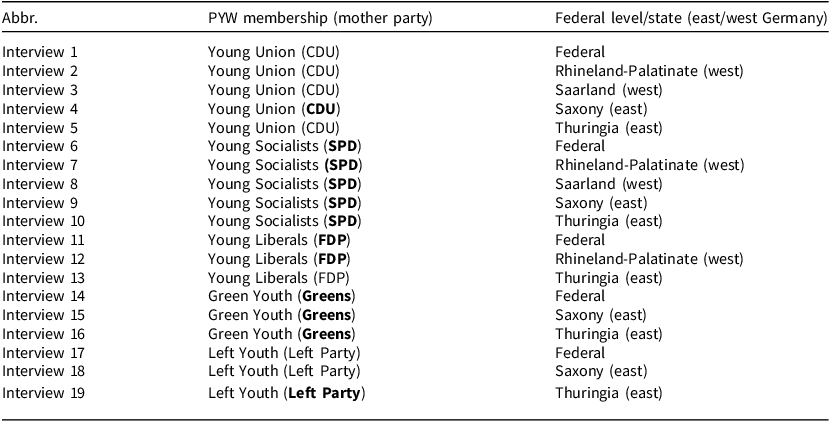
Empirically, the study draws on 19 semi-structured interviews with leaders from five major German PYWs, conducted at both the federal level and in two eastern and two western German states (see Table 1). Organisations and state-level branches were selected using purposive, theory-guided sampling to capture variation in ideological orientation, party dominance, and regional context. Interviewees were members of PYW executive boards (typically 7–25 individuals) and were selected for their leadership roles and presumed ‘operational knowledge’ (Kaiser, Reference Kaiser2021: 48). The study focuses on leaders’ perceptions and strategic reasoning rather than mapping the full range of viewpoints or providing representative coverage. Interviews lasted approximately 60 minutes and were conducted between December 2023 and July 2024, either in person (15, mostly in PYW offices) or online (4). Anonymity was guaranteed for all participants, including gender; accordingly, all interviewees are referred to as ‘she’.
List of interviewees

Table 1. Long description
The table presents a list of interviewees categorised by their membership in various party youth organisations (PYWs) and their respective federal level or state in Germany. It includes 19 interviews, with columns for abbreviations, PYW membership (mother party), and federal level or state (eastern or western Germany). The PYW memberships include Young Union (CDU), Young Socialists (SPD), Young Liberals (FDP), Green Youth (Greens), and Left Youth (Left Party). The states mentioned are Rhineland-Palatinate, Saarland, Saxony, and Thuringia, along with the federal level. Each row lists an interview number, the corresponding PYW membership, and the federal level or state.
Source: Own illustration; marked in bold = mother party in government responsibility (07/2024).
The interview guide (see online Appendix) was structured around three organisational conditions derived from the theoretical framework: (V1) formal organisational integration and statutory rights, (V2) mobilisation potential and internal coordination, and (V3) leadership and strategic coordination, including dual mandates and access to personal networks. Questions explored how leaders perceive their organisation’s opportunities, constraints, and strategic practices, with emphasis on organisational processes and dilemmas rather than measurable policy outcomes. No internal material could be obtained from the Young Alternative, as it declined all interview requests.
Interview transcripts were analysed using a theory-guided, deductive-inductive qualitative content analysis that combines deductive category application with inductive refinement (Mayring, Reference Mayring2022; Kuckartz and Rädiker, Reference Kuckartz and Rädiker2024). The three organisational conditions (V1–V3) and the dependent dimension of policy-seeking strategies served as deductively defined main categories, providing a structured analytical framework for systematic comparison while avoiding both a purely data-driven or strictly theory-testing design.
The analysis followed a clearly defined stepwise procedure. First, all interviews were coded deductively along the four main analytical dimensions (V1–V3 and policy-seeking strategies). This initial coding established a common comparative structure across organisations and federal levels. Second, within each main category, subcategories were developed inductively through iterative reading and constant comparison within and across interviews. This process allowed specific organisational practices, strategic considerations, and perceived mechanisms of influence (e.g., forms of informal access, mobilisation strategies, network-based coordination) to emerge from the data. Third, the inductively generated subcategories were reviewed, refined, and consolidated into analytically coherent higher-order categories. Overlapping or weakly differentiated codes were merged, clarified, or discarded to ensure internal coherence and mutual exclusivity. Fourth, these consolidated categories were subjected to systematic cross-case comparison to identify recurring strategic patterns and organisational constellations across PYWs and federal levels. This stage involved analytical generalisation beyond individual cases by linking observed practices to combinations of organisational conditions.
Throughout the process, coding decisions and category definitions were documented and iteratively revised to enhance transparency and analytical consistency. Triangulation with PYW and party documents contextualsed interview statements and corroborated formal organisational features such as statutory rights, delegate rules, and leadership overlaps. The aim was not to quantify category frequencies, but to reconstruct organisational mechanisms and strategic logics underlying PYWs’ policy-seeking behaviour.
Although the number of interviews may appear modest at first glance, the sample is comparatively strong for elite-level qualitative research, given the interviewees’ leadership positions and the well-documented access constraints inherent to elite interviewing (Mikecz, Reference Mikecz2012). In combination with document analysis, this research design enables a systematic and comparative exploration of organisational mechanisms and strategic repertoires across selected PYWs and federal levels. The findings should therefore be interpreted as exploratory and empirically oriented, capturing how selected PYW leaders perceive and navigate organisational conditions shaping policy-seeking strategies, rather than as representative assessments of policy outcomes or causal effects. This approach foregrounds actors’ perceptions and strategic reasoning while transparently acknowledging the constraints of a single-country, small-sample design. By doing so, it establishes a foundation for future comparative research on PYWs, intra-party democracy, and party organisation.
Analysis
This section examines how German PYWs pursue policy-seeking strategies within their mother parties and how these strategies vary across organisations and contexts. The analysis focuses on strategy repertoires – that is, the formal and informal actions PYWs employ – rather than on the measurable success of these strategies in terms of policy outcomes. Findings are therefore exploratory and based on leaders’ perceptions. By comparing organisations across parties and federal states, the analysis highlights how combinations of organisational integration, mobilisation potential, and leadership networks shape variation in policy-seeking strategies. Rather than treating each organisation as a stand‑alone case, the section proceeds comparatively, identifying recurring strategic patterns and the organisational configurations under which they emerge.
Policy-seeking strategies: shared tools, divergent strategic logics
Across all cases, PYW leaders describe a broadly similar toolkit of policy‑seeking practices. Formal strategies include motions, amendments, and participation in party bodies; informal strategies centre on negotiations with high‑ranking party officials and intra‑party coordination outside official arenas. Differences across organisations arise less from the availability of these tools than from how they are combined, prioritised, and publicly performed.
A first comparative distinction concerns the visibility and confrontational style of policy‑seeking. Centre‑right and liberal PYWs tend to prioritise low‑visibility coordination and informal negotiation, whereas socialist and green PYWs more readily combine formal participation with public criticism and external pressure. These differences reflect strategic choices rather than divergent goals: all organisations articulate the ambition to shape party positions while remaining embedded within the party framework.
Coordinative strategies and backroom diplomacy
The Young Union and Young Liberals exemplify a coordinative approach centred on informal negotiation and sequential escalation. In both organisations, dense personal networks linking youth leaders to senior party figures constitute a key strategic resource. Across interviews, Young Union leaders repeatedly referred to intergenerational ties that allow direct and informal access to senior party officials, which were described as the ‘easiest and quickest option’ for advancing policy demands (Interview 2; similarly Interviews 1, 5). Informal agreements are often reached before formal decisions are taken, allowing potentially controversial demands to be integrated into party programmes with limited public conflict. For instance, Young Union interviewees described how compromises are frequently negotiated informally before being formalised through amendments at party conferences (Interview 2).
Strategic escalation, when used, tends to follow a stepwise logic across federal levels: the Young Liberals often build support at the state level before advancing issues at the federal party conference. Young Liberals leaders similarly emphasised that internal criticism of the FDP can be ‘quite clear’, while external unity is strategically prioritised (Interview 12). Interviewees characterised the relationship with FDP elites as a reciprocal ‘give and take’, noting that personal contacts – often rooted in shared PYW backgrounds – facilitate access even in contentious situations (Interviews 11–13). In both organisations, leaders stressed that open confrontation is avoided not because of a lack of policy ambition, but because public dissent is perceived as electorally risky and strategically inefficient. The resulting strategy combines formal programme work with informal coordination and selective pressure, illustrating how strong leadership networks can substitute for public mobilisation even under comparatively weak formal integration.
Confrontational and publicly visible strategies
By contrast, the Young Socialists pursue a more openly confrontational strategy that combines formal participation with sustained public pressure. Interviewees consistently framed policy-seeking as a long-term process requiring persistence, repeated mobilisation, and a willingness to engage in visible intra-party conflict. These processes were repeatedly described as ‘marathon negotiations’ (Interview 7) that require maintaining pressure over extended periods (Interview 8).
The Young Socialists’ long-standing effort to push the party to distance itself from a highly controversial welfare reform (‘Hartz IV’) exemplifies this approach. As one interviewee put it: ‘we openly sought conflict, failed quite often, and eventually got it into the party programme’ (Interview 6). Rather than portraying these episodes as linear success stories, leaders emphasised strategic endurance and organisational cohesion as preconditions for maintaining pressure over time. Engagement with civil society and protest actors was framed as part of a broader ‘dual strategy’ that extends policy-seeking beyond internal party arenas (Interview 6; see also Jusos, 2025).
Compared to the coordinative strategies described above, this approach relies less on shielding conflict from public view and more on transforming internal minorities into party-wide majorities at party conferences (Interviews 6–7). At the same time, interviewees across organisations stressed that programme decisions do not automatically translate into government action, particularly in coalition contexts (Interviews 6–7, 10), underscoring the distinction between policy adoption and implementation.
Strategic reorientation under constrained conditions
The Green Youth and Left Youth currently exhibit more ambivalent and fluid strategic profiles. In both cases, interviewees described processes of strategic reorientation driven by internal fragmentation, governing responsibilities, or broader party crises. While formal participation and informal contacts remain part of their repertoires, leaders frequently portrayed their room for manoeuvre as constrained by factors beyond immediate organisational control.
In the Green Youth, tensions between pragmatic and more fundamentalist currents have intensified since the party entered federal government, reducing the effectiveness of both confrontational and coordinative strategies (Interviews 14–16). The Left Youth, particularly at the federal level, faces weak informal ties and limited coordination following organisational crises within the party (including the party split in 2024, when Sahra Wagenknecht founded her own party with more culturally conservative stances; Interview 17). In eastern German state associations, however, relations are often more cooperative (Interviews 18–19), illustrating how regional contexts mediate strategic options even within the same organisation.
Taken together, these patterns suggest two ideal‑typical strategic profiles – coordinative backroom diplomacy and confrontational public pressure – alongside more unsettled strategies shaped by organisational fragmentation and strategic uncertainty. The resulting variation reflects strategic choice under specific organisational conditions rather than differences in policy ambition.
(V1) Formal organisation
To explain variation in policy-seeking strategies, I first examine PYWs’ (V1) formal organisational integration and statutory representation rights within their mother parties. This dimension captures the degree of institutional embedding through formal rules, recognised participatory rights, and access to official party arenas, including conferences, executives, and working groups. While formal arrangements shape the framework for policy-seeking, they do not fully determine strategic choices. Closer organisational integration can expand access to institutionalised channels but may also constrain autonomy and limit confrontational approaches. Conversely, weaker formal integration may increase independence while reducing guaranteed access to decision-making processes.
Legally, the Young Socialists are the most integrated, functioning as a ‘working group’ within the SPD, which can formally dissolve them in cases of ‘serious violations’ (SPD, 2024: 44). The Young Union and Green Youth are recognised as ‘associations’ within their parties, with only partial personnel overlap (Grüne, 2022: 18; CDU, 2024: 29). The Left Youth and Young Liberals are the least integrated, with limited rights to submit motions or send delegates to party conferences (especially in the case of the Young Liberals; Linke, 2024: 13; FDP, 2025: 11, 25).
The interviews suggest that formal rights are not the main factor shaping strategy. For example, the Young Socialists interviewees noted that, despite the SPD’s formal authority to dissolve them ‘with a board resolution’, the organisation maintains a ‘strong power base within the party’ and that ‘so many people would freak out’ if this were to happen (Interview 6; similarly Interview 8). Although they cannot formally submit motions to the party executive, their proposals are often adopted in practice (Interview 6). Most Young Socialists reported feeling well represented at the state level, while simultaneously seeking deeper involvement in ongoing decision-making beyond party conferences (Interviews 7–8, 10).
Unlike the Young Socialists, the other PYWs emphasised their organisational independence. Interviewees from the Green Youth reported that potential funding restrictions were largely irrelevant for strategic considerations (Interview 14), and in Thuringia, they even ran an independent election campaign (Interview 16). The Young Liberals similarly highlighted autonomy from the FDP despite reduced financial support (Interview 11). The Left Youth in eastern Germany valued both independence and formal representation, for example through youth policy spokespersons (Interviews 18–19).
Overall, while PYWs differ substantially in formal organisational integration, no consistent relationship emerges between statutory rights and the type of policy-seeking strategy adopted. Formal integration defines the institutional context in which PYWs operate, but does not predetermine whether strategies are cooperative, confrontational, or mixed. This suggests that formal organisation constitutes a necessary but insufficient condition for understanding variation in PYWs’ strategic behaviour.
(V2) Mobilisation potential
A second factor that may explain variation in PYWs’ policy-seeking strategies is their (V2) quantitative mobilisation potential, understood as the capacity to mobilise members collectively and sustain coordinated action. Unlike formal organisation, this dimension reflects collective resources and organisational capacity rather than statutory rights or institutionalised access.
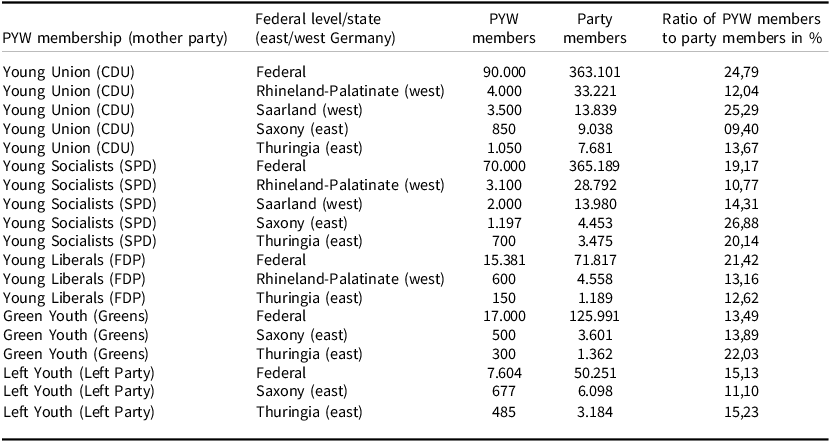
Membership figures provide a first indication of mobilisation potential. As no official data exist, I rely on self-reported numbers from the interviews, noting two limitations: first, figures may be inflated or calculated differently across organisations, for instance due to varying rules for removing inactive members or strategic incentives to portray organisational strength (Scarrow and Gezgor, Reference Scarrow and Gezgor2010). Second, formal membership rules strongly shape PYW size. In the Young Socialists, Green Youth, and Left Youth, party members up to a certain age (27 or 35) automatically become PYW members unless they opt out (Grüne, 2022: 7; Linke, 2024: 13; SPD, 2024: 17). No such automatic membership exists for the Young Union or Young Liberals.
Table 2 shows that the Young Union reports the largest federal membership (90.000), followed by the Young Socialists (70.000), with smaller PYWs including the Green Youth (17.000), Young Liberals (15.381), and Left Youth (7.604). These numbers suggest favourable conditions for mobilisation in larger PYWs, but interview data reveal a more nuanced picture.
PYW memberships

Table 2. Long description
The table presents data on PYW memberships for various party youth organisations in Germany, categorised by federal and state levels in eastern and western Germany. It includes columns for PYW members, party members, and the ratio of PYW members to party members in percentage. The Young Union (CDU) has the largest federal membership with 90.000 PYW members and 363.101 party members, resulting in a ratio of 24,79 percent. The Young Socialists (SPD) follow with 70.000 PYW members and 365.189 party members, a ratio of 19,17 percent. Smaller organisations include the Green Youth with 17.000 PYW members and 125.991 party members, a ratio of 13,49 percent, and the Young Liberals (FDP) with 15.381 PYW members and 71.817 party members, a ratio of 21,42 percent. The Left Youth has 7.604 PYW members and 50.251 party members, a ratio of 15,13 percent. Notable trends include higher PYW memberships in western states compared to eastern states for most parties, and varying ratios of PYW members to party members across different organisations and regions.
Source: own research based on interview data; self-reported party membership figures for 2023 from Niedermayer (Reference Niedermayer2024).
Leaders of the Young Socialists, Green Youth, and Left Youth highlighted that many members are passive, especially automatic members who rarely engage in PYW activities (Interviews 6, 14, 16–17). By contrast, Young Liberals leaders reported higher activity levels, up to 40% in Thuringia and 33% in Rhineland-Palatinate (Interviews 11–13). While possibly overestimated, these patterns align with previous research showing variation in youth participation (in both PYWs and parties) across organisations and contexts (Bruter and Harrison, Reference Bruter and Harrison2009: 1276; Jungblut and Weber, Reference Jungblut and Weber2017: 128).
Mobilisation potential also depends on organisational capacity. Several eastern German PYW leaders noted that low membership limits their ability to participate in working groups, staff committees, or policy development (Interviews 13, 16). Importantly, these constraints are not confined to smaller PYWs: even the Young Union reported difficulties in maintaining functioning organisational structures in some eastern German states due to personnel shortages (Interview 4).
At the same time, strong and cohesive PYWs can expand strategic options. The Young Socialists highlighted internal unity, nationwide coordination, and professionalised debate as enabling them to transform minority positions into majorities at party conferences (Interviews 6–7). Similarly, the Young Liberals emphasised the importance of coordinated mobilisation during election campaigns and programme negotiations, ensuring their inclusion in programme commissions (Interview 11). The Young Union likewise stressed presenting unified positions and managing internal disagreements to maximise strategic coherence (Interviews 3, 5).
In contrast, mobilisation potential is more constrained in the Green Youth and Left Youth. Green Youth interviewees repeatedly referred to internal factional conflicts that dilute collective action and strategic focus (Interviews 14, 16). The federal-level Left Youth struggles with a lack of internal consensus, whereas eastern state associations benefit from closer party alignment, facilitating cooperation (Interviews 17–18).
In sum, mobilisation potential strongly shapes PYWs’ policy-seeking strategies. Low membership, inactivity, and internal fragmentation constrain proactive, coordinated engagement, while cohesion and organisational capacity expand strategic opportunities.
(V3) Leadership
Finally, I examine how (V3) leadership structures and personal networks shape PYWs’ policy-seeking strategies. This dimension captures relational embeddedness, informal access to party elites, and strategic positioning beyond formal rights or collective capacity. Interview data reveal that while all PYWs rely on personal relationships, the density, stability, and strategic utility of these networks vary considerably.
The Young Union and Young Socialists exhibit dense, continuous networks with senior party members, many of whom have PYW backgrounds themselves (Interviews 1–9). These ties enable coordinated strategic action, access to decision-making arenas, and effective management of intra-party conflicts. In the Young Union, relations have been especially harmonious under Friedrich Merz, compared to more conflictual relations during Angela Merkel’s leadership (Interview 1; similarly Interviews 2, 5). In contrast, the Young Socialists benefit from ideologically coherent and strategically aligned relationships within the SPD.
The Young Liberals maintain moderately dense networks, which provide access to FDP decision-makers – sometimes with PYW backgrounds – but regional variation is pronounced (Interviews 11–13). In Thuringia, limited overlap with former Young Liberals activists and FDP elites constrains access to central decision-makers, a situation exacerbated by political conflict following the 2020 election of Thomas Kemmerich as Prime Minister with votes from the CDU, FDP, and AfD. Despite these constraints, the Young Liberals leverage personal ties for coordinated mobilisation during campaigns and programme negotiations.
In contrast, the Green Youth and Left Youth face structural limitations. Green Youth networks provide access to younger MPs and former PYW activists, yet tensions arising from governing responsibilities reduce strategic effectiveness (Interview 14). The Left Youth appears to have the weakest federal-level networks, reflecting broader party fragmentation, though state-level relationships, particularly in Thuringia, are more cooperative (Interviews 17, 19). Interviewees explicitly recognised this gap as a potential resource and aim to rebuild ties with former PYW members now holding party or parliamentary offices (Interview 17).
An analysis of official data on personnel overlap confirms these patterns: it is highest in the Young Union and Young Socialists, moderate among the Young Liberals, lower in the Green Youth, and lowest in the Left Youth.
Taken together, dense and ideologically aligned leadership networks – often grounded in shared PYW biographies – enhance informal access and strategic coordination, whereas weak or fragmented networks constrain policy-seeking, especially at the federal level. Leadership thus operates as a relational amplifier or bottleneck of strategic capacity, depending on network density and alignment.
Summary
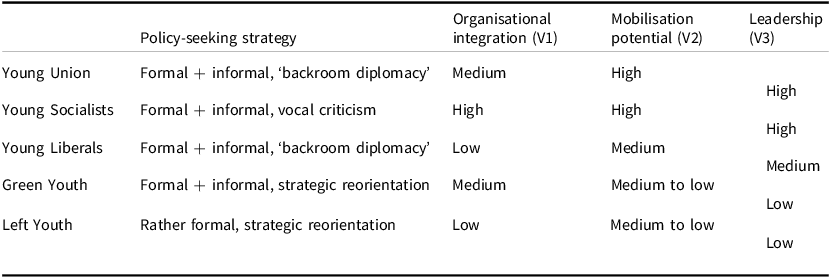
Table 3 summarises the central findings by relating PYWs’ policy-seeking strategies to three organisational conditions: (V1) formal organisation, (V2) mobilisation potential, and (V3) leadership networks. The table should be read combinatorially. Rather than attributing strategic outcomes to single variables, it highlights how specific constellations of organisational conditions correspond to distinct patterns of policy-seeking.
Summary

Table 3. Long description
The table presents a comparison of policy-seeking strategies employed by various party youth organisations, focusing on Young Union, Young Socialists, Young Liberals, Green Youth, and Left Youth. It details their approaches such as formal and informal strategies, backroom diplomacy, vocal criticism, and strategic reorientation. The table is structured with five rows representing different youth organisations and four columns indicating policy-seeking strategy, organisational integration, mobilisation potential, and leadership. Each cell provides specific attributes like medium, high, low, and medium to low, illustrating the varying levels of integration, potential, and leadership across the organisations. The data highlights how different combinations of these factors influence the policy-seeking strategies of each group.
The identified strategy types differ not only in their visibility, but also in their primary mode of influence and underlying access logic. Some rely predominantly on informal elite networks and negotiation (‘backroom diplomacy’), others combine institutional participation with public pressure (‘vocal criticism’), while still others reflect adaptive repositioning under organisational constraints (‘strategic reorientation’). In this sense, the strategies range from predominantly insider-oriented approaches to mixed insider–outsider repertoires and adaptive repositioning under organisational constraints.
Across cases, (V1) formal organisation appears to have the weakest explanatory power. While formal integration structures institutional access to party arenas, it does not determine whether PYWs adopt cooperative, confrontational, or mixed strategies. Highly integrated organisations such as the Young Socialists frequently engage in vocal public criticism, whereas more weakly integrated PYWs such as the Young Liberals tend to pursue quieter, informal forms of policy-seeking. Formal organisation thus constitutes a background condition that defines access points but does not shape strategic orientation on its own.
More explanatory leverage emerges from the combination of (V2) mobilisation potential and (V3) leadership networks. Table 3 suggests three recurring constellations:
First, high mobilisation potential combined with strong leadership networks is associated with assertive and sustained policy-seeking. The Young Union pursues coordinated backroom diplomacy, while the Young Socialists combine institutional engagement with vocal public criticism. In these cases, mobilisation capacity enables collective action, while dense leadership networks secure informal access and facilitate conflict management.
Second, moderate mobilisation and leadership capacity corresponds to low-visibility, informal strategies. Despite weak formal integration, the Young Liberals compensate through selective mobilisation and personal ties, favouring negotiation and programme-level influence over public confrontation.
Third, low mobilisation potential combined with weak leadership networks is associated with strategic reorientation and constrained policy-seeking. The Green Youth and Left Youth face internal fragmentation, limited activation capacity, and weak access to party elites, which restricts sustained engagement and reduces the feasibility of confrontational strategies. Where cooperation occurs, it is often situational and more pronounced at the state than at the federal level.
From this perspective, Table 3 does not simply show that mobilisation and leadership ‘matter more’ than formal organisation. Instead, it illustrates that specific combinations of collective capacity and relational access structure the range of viable strategies, while formal organisation remains a necessary but insufficient condition.
Taken together, the findings indicate that PYWs’ policy-seeking strategies emerge from the interaction of (V1) institutional embedding, (V2) collective capacity, and (V3) leadership networks. Mobilisation potential and leadership determine whether and how available channels are used, shaping the intensity, visibility, and sustainability of strategic engagement, whereas formal organisation primarily defines the institutional terrain on which these strategies unfold.
Conclusion
This article addressed a central puzzle in the study of PYWs: although they are increasingly analysed in terms of their policy positions, generational representation, or policy impact, we know comparatively little about how they strategically pursue policy-seeking within their mother parties and how organisational conditions structure these strategies. By shifting the analytical focus from outcomes to policy-seeking strategies, the study advances a more actor-centred perspective on PYWs in intra-party politics.
Theoretically, the article developed a conceptual framework centred on three analytically distinct variables: (V1) formal organisation, (V2) mobilisation potential, and (V3) leadership. This framework moves beyond approaches that treat organisational embeddedness or autonomy as the primary explanatory factor. Instead, it highlights how different organisational resources interact to shape strategic action, thereby contributing to a growing body of research that conceptualises PYWs as strategic actors rather than merely attitudinal or representative extensions of youth preferences.
Empirically, the study examined the German case based on semi-structured interviews with selected PYW leaders and an analysis of official party and PYW documents. The findings should be interpreted as exploratory and empirically oriented rather than as claims of causal generalisation. They show that German PYWs draw on broadly similar repertoires of policy-seeking strategies, combining formal mechanisms such as motions and party conferences with informal practices, including personal networks and direct negotiations with party elites. At the same time, there is considerable variation in how openly and confrontationally PYWs position themselves vis-à-vis their mother parties.
The analysis suggests that (V1) formal organisational integration plays a more limited and indirect role than is often assumed. While formal rights and legal embeddedness shape institutional access to party arenas, they do not determine strategic orientation. Highly integrated PYWs such as the Young Socialists can adopt confrontational approaches, whereas more autonomous organisations like the Young Liberals may favour less public, negotiation-oriented strategies. This finding nuances simplified assumptions about dependence and compliance in intra-party settings.
By contrast, (V2) mobilisation potential emerges as a particularly salient condition for sustained policy-seeking. The capacity to activate members, maintain internal cohesion, and coordinate collective action shapes whether PYWs can engage proactively and persistently in intra-party debates. Organisational discipline and unity enhance strategic leverage, whereas fragmentation and unresolved ideological conflicts constrain it.
Finally, (V3) leadership proves central not only for internal coordination but also for securing access within party organisations. Leadership-based networks, often rooted in shared biographical trajectories within the PYW, function as informal organisational resources that complement formal rights and mobilisation capacity. Leadership continuity and elite linkages can thus broaden or narrow the strategic room for manoeuvre within parties.
Overall, this study contributes to a reconceptualisation of PYWs as organisational actors whose strategic behaviour cannot be reduced to formal status or generational representation alone. While empirically grounded in a single-country context, the proposed framework offers a transferable analytical lens for examining PYWs in other institutionalised party systems characterised by multiple parties, established PYWs, and intra-party democracy. By bridging research on party organisation and PYWs, the article shows how organisational resources, mobilisation capacity, and leadership networks jointly structure strategic action within parties.
Several limitations qualify these conclusions. The analysis is based on a single-country case and a qualitative sample of interviews, and it does not assess the effectiveness of different strategies. Future research could build on this framework through longitudinal designs, differently structured samples, and cross-national comparisons. Process-tracing approaches or interviews with representatives of mother parties may further illuminate how youth-wing interventions are interpreted and processed within party decision-making arenas. Given their potential role in articulating generational interests and contributing to party change, PYWs warrant continued scholarly attention.
Supplementary material
The supplementary material for this article can be found at https://doi.org/10.1017/S1755773926100563.
Data availability statement
The interview guide is available in the Appendix.
Acknowledgements
I would like to express my sincere gratitude to the four anonymous reviewers for their constructive comments, as well as all colleagues who provided valuable feedback on earlier drafts of this paper, particularly Kira Renée Kurz and Manès Weisskircher. I am also grateful to the participants of the German Political Science Association (DVPW) conference panel on party youth wings in Göttingen (2024) […] and the research colloquium at the University of Mainz (2025), led by Kai Arzheimer, for their helpful comments and suggestions. Special thanks go to Fabian Klimasch for his support with data collection and to Julia Hardt for her research assistance.
Financial support
This work was supported by the Volkswagen Foundation under Grant ‘NurtureDEMOS’ and by Trier University with a Research Grant.
Competing interests
The author reports there are no competing interests to declare.
Ethical standards
The research relied exclusively on voluntary, anonymised interviews and did not involve any experimental intervention. Accordingly, formal ethics board approval was not required under applicable institutional and ethical guidelines.


 Open access

