

The study of race and politics in the United States concerns the contradiction between egalitarian ideals versus racial inequality and whether minority groups choose coalition or competition (McClain and Stewart Reference McClain and Stewart1995). The question of how minority groups navigate political landscapes marked by both shared marginalization and intergroup tension remains urgent, particularly within contexts of perceived democratic deterioration wherein social trust appears increasingly fragmented. Whereas shared marginalization theoretically should unite minority groups, competition for resources often divides them instead. Which everyday behavioral patterns accompany this division? This study argues that political distance has a physical, measurable correlate: the spatial distance that individuals maintain from one another in shared public spaces.
This study argues that political distance has a physical, measurable correlate: the spatial distance that individuals maintain from one another in shared public spaces.
Contemporary scholarship demonstrates that positive cross-group interaction requires proximity as a fundamental prerequisite (Pettigrew and Tropp Reference Pettigrew and Tropp2006). Yet, meta-analytic evidence reveals substantially weaker intervention effects for adult racial prejudice compared to other forms of bias, suggesting particular challenges in racially diverse settings (Paluck, Green, and Green Reference Paluck, Green and Green2019). Spatial proximity matters. Changes in geographic exposure to outgroups can shift policy attitudes and voting behavior toward exclusion (Enos Reference Enos2017). Exclusion extends to everyday public spaces where individuals actively maintain distance from certain groups—even in formally integrated settings (Dietrich and Sands Reference Dietrich and Sands2023; Zhang, Gereke, and Baldassarri Reference Zhang, Gereke and Baldassarri2022).
To examine intergroup avoidance at scale, this study analyzed 428 dyadic encounters on Seattle’s Link Light Rail platforms using a sequential arrival protocol to measure interpersonal spacing as a behavioral indicator of intergroup comfort. In doing so, the study advances the agenda that McClain and Stewart (Reference McClain and Stewart1995) established, moving from documented attitudes to measured everyday behavior. Individuals of multiple backgrounds maintain significantly greater distance from Black first-arrivers, a pattern that Black individuals do not reciprocate. Intergroup avoidance extends across interminority encounters, thereby providing behavioral evidence consistent with competitive rather than coalitional dynamics.
THEORETICAL FRAMEWORK: THE POLITICAL DILEMMAS OF INTERGROUP AVERSION
This section develops the theoretical case for treating spatial behavior as a political variable and then derives competing predictions about interminority avoidance from four frameworks: contact theory (Allport Reference Allport1954), racial threat (Blalock Reference Blalock1967), racial hierarchy (Kim Reference Kim1999), and linked fate (Dawson Reference Dawson1994). The study expands on McClain and Stewart’s (Reference McClain and Stewart1995) foundational framework by examining how everyday spatial avoidance may reflect the dual dilemmas of racial inequality and interminority competition. The first dilemma highlights the gap between democratic ideals and racial inequality, which manifests in what might be termed “behavioral segregation.” This is defined as interpersonal actions through which individuals create and maintain intergroup distance across racial lines. The second dilemma asks whether minoritized groups choose cooperation or competition, a question that centers on grassroots trust and perceived commonality. Physical distancing in public spaces therefore may represent a microlevel behavioral indicator relevant to understanding democratic fragmentation.
Why should political scientists be concerned about interpersonal spacing on train platforms? Physical distance is a revealed behavioral preference governed by implicit social norms (Goffman Reference Goffman1963; Hall Reference Hall1966) that is less susceptible to social desirability bias than survey-based approaches. Experimental evidence validates interpersonal distance as an indicator of racial attitudes. Participants maintain greater physical distance from Black than white interaction partners (Word, Zanna, and Cooper Reference Word, Zanna and Cooper1974), and implicit but not explicit racial attitudes predict this spatial positioning (Amodio and Devine Reference Amodio and Devine2006; Dovidio, Kawakami, and Gaertner Reference Dovidio, Kawakami and Gaertner2002; Dovidio et al. Reference Dovidio, Kawakami, Johnson, Johnson and Howard1997). These proxemic patterns predict subsequent discriminatory action (Dotsch and Wigboldus Reference Dotsch and Daniël2008), emerge early in development across multiple racial groups (Muñoz et al. Reference Muñoz, Enright, Gaither, Halim, Pauker, Olson and Dunham2025), and are causally modifiable. Repeatedly practicing physical approach rather than avoidance toward Black people reduces implicit prejudice and increases interpersonal immediacy in subsequent encounters (Kawakami et al. Reference Kawakami, Phills, Steele and Dovidio2007). Physical spacing captures affective orientations toward outgroups that self-report measures routinely miss (Mehrabian Reference Mehrabian1968). This makes naturalistic observation of interpersonal distance well suited to studying intergroup dynamics operating beneath conscious awareness.
Given this empirical foundation, the political stakes of spatial behavior become clear. In diverse democracies, shared space and sustained interaction foster the conditions for positive encounters required for coalition building (McClain and Stewart Reference McClain and Stewart1995); political friendship (Allen Reference Allen2004, Reference Allen2023; Allen and Somanathan Reference Allen and Somanathan2020)Footnote 1; bridging social capital (Putnam Reference Putnam2000); and democratic deliberation (Gutmann and Thompson Reference Gutmann and Thompson2004). Persistent cross-group social connections predict economic mobility and civic participation (Chetty et al. Reference Chetty, Jackson, Kuchler, Stroebel, Hendren, Fluegge and Gong2022). Yet, contact-based interventions reveal more limited effects for adult racial prejudice than for other forms of bias (Paluck, Green, and Green Reference Paluck, Green and Green2019), which raises the question of what intervenes between proximity and prejudice reduction. When intergroup avoidance is systemic, it may foreclose the low-stakes interactions through which cross-group familiarity develops before structured contact can take hold. This study does not attempt to directly establish those downstream consequences. Instead, it documents the spatial patterns themselves, establishing a behavioral baseline against which future research can assess how everyday intergroup encounters relate to larger political dynamics.
The First Dilemma: Behavioral Segregation in Integrated Spaces
The first dilemma presents as interpersonal behavioral segregation. These aversive practices reconstruct social boundaries within formally integrated environments. Theories of statistical discrimination (Becker Reference Becker1957), racial threat (Blalock Reference Blalock1967), and systemic racism (Banaji, Fiske, and Massey Reference Banaji, Fiske and Massey2021) identify these behaviors as heuristics for perceived threat or social risk. Allen (Reference Allen2004) argued that such aversive interactions erode the everyday civic trust on which democratic life depends. The behavioral data in this study allow us to begin assessing this claim empirically.
This study’s measurement of physical distance expands directly on McClain et al.’s (Reference McClain, Carter, Soto, Lyle, Grynaviski, Nunnally, Scotto, Kendrick, Lackey and Cotton2006) concept of “racial distancing.” They demonstrated that Hispanic immigrants systematically expressed greater social distance from Black Americans than from white Americans, revealing strategic positioning within perceived hierarchies. Whereas McClain et al. (Reference McClain, Carter, Soto, Lyle, Grynaviski, Nunnally, Scotto, Kendrick, Lackey and Cotton2006) measured psychological distancing through attitudinal surveys, this study operationalizes distancing through observable spatial behavior.
The convergence of psychological and physical distancing suggests that social hierarchies manifest not only in stated preferences but also in the micro-geography of everyday life. McClain et al.’s (Reference McClain, Carter, Soto, Lyle, Grynaviski, Nunnally, Scotto, Kendrick, Lackey and Cotton2006) finding that Hispanics engaged in racial distancing from Blacks despite sharing marginalization experiences demonstrated that minority groups actively navigate and reproduce racial hierarchies. The spatial patterns documented in this study are consistent with McClain and colleagues’ (1995, 2006) attitudinal findings: that is, physical avoidance may represent a behavioral parallel to the psychological distancing they identified.
The Second Dilemma: Interminority Avoidance and Coalition Fragility
Whether minoritized groups pursue cooperation or competition hinges on grassroots trust and perceived commonality (Kaufmann Reference Kaufmann2003; McClain et al. Reference McClain, Carew, Walton and Watts2009; McClain and Stewart Reference McClain and Stewart1995). Existing scholarship largely infers these orientations from survey attitudes or electoral coalitions, leaving the behavioral microfoundations underexamined. Various theoretical frameworks generate competing expectations about interminority spatial dynamics. Contact theory predicts that shared public settings should reduce avoidance over time (Allport Reference Allport1954; Pettigrew Reference Pettigrew1998; Pettigrew and Tropp Reference Pettigrew and Tropp2006). In contrast, racial-threat theory predicts that outgroup presence instead should heighten avoidance across group lines (Blalock Reference Blalock1967; Enos Reference Enos2017). Scholarship on racial hierarchy predicts that this avoidance should be directional: non-Black minorities should distance specifically from Black Americans to claim relative position within existing racial orders (Kim Reference Kim1999; McClain et al. Reference McClain, Carter, Soto, Lyle, Grynaviski, Nunnally, Scotto, Kendrick, Lackey and Cotton2006). Linked fate complicates all three of these predictions by suggesting that shared structural standing may generate solidarity rather than distance. However, whether this solidarity extends beyond Black Americans and whether it manifests spatially are key questions that this research explored (Dawson Reference Dawson1994; Sanchez and Masuoka Reference Sanchez and Masuoka2010).
Black exceptionalism sharpens predictions about hierarchical relations. This framework posits that Black Americans occupy a uniquely devalued position in perceived racial hierarchies, generating patterns of exclusion distinct from those facing other minoritized groups (Bonilla-Silva Reference Bonilla-Silva2004; Leslie and Sears Reference Leslie and Sears2022; Sears Reference Sears, Forgas, Fiedler and Crano2015; Sears and Savalei Reference Sears and Savalei2006). If Black exceptionalism operates spatially, avoidance should concentrate specifically on Black individuals rather than distributing evenly across outgroup encounters. Moreover, this avoidance should be asymmetric: that is, directed at Black individuals by others but not reciprocated. The directionality of avoidance thus provides theoretical leverage. If Black individuals maintain normative proximity whereas others distance, the pattern would be more consistent with hierarchy enforcement than with mutual wariness. This suggests that racial hierarchies may be reproduced through microlevel spatial decisions rather than existing only as structural residues.
Intragroup dynamics provide a theoretical baseline against which to interpret intergroup patterns. Reduced avoidance within racial and ethnic groups would be consistent with bonding social capital, which is the affective cohesion and ingroup trust that facilitates collective action (Putnam Reference Putnam2000). If individuals maintain close proximity with co-ethnics but actively distance from outgroup members, this pattern would indicate group-specific boundaries rather than generalized social withdrawal or individual-level dispositions. The magnitude of intragroup–intergroup differentials provides analytical leverage: if all groups simply prefer co-ethnics, avoidance should be approximately symmetrical across outgroups. Deviations from this baseline—whether in magnitude or directionality—would suggest that something beyond general homophily is at work.
The theoretical stakes extend beyond any single dyad. Hispanic–Asian spatial dynamics may follow distinct logics: rather than vertical hierarchy maintenance, these encounters may reflect lateral positioning because both groups navigate simultaneous status as beneficiaries and victims of the model-minority construct (Kim Reference Kim1999; Lee Reference Lee2002; Xu and Lee Reference Xu and Lee2013). Middle Eastern and North African (MENA) individuals represent a theoretically distinct case as well. Despite historical classification as white for US Census purposes, some MENA individuals experience racialization through religious and cultural markers, and perpetual foreigner stereotypes compound this racialization (Jamal Reference Jamal, Jamal and Naber2008; Maghbouleh Reference Maghbouleh2017; Samari Reference Samari2016).
Gender crosscuts these racial dynamics in ways that intersectionality scholarship predicted (Collins Reference Collins2000; Crenshaw Reference Crenshaw1991). Race and gender do not operate as independent axes of social evaluation; rather, they combine to produce distinct perceptions of specific race–gender combinations. Racialized masculinity—particularly Black masculinity—carries documented associations with perceived physical threat that may amplify spatial avoidance beyond what race alone predicts (Eberhardt et al. Reference Eberhardt, Goff, Purdie and Davies2004; Mowatt, French, and Malebranche Reference Mowatt, French and Malebranche2013). Women may exercise greater baseline caution in shared public settings regardless of the first-arriver’s race, which reflects rational responses to gendered vulnerability (Gardner Reference Gardner1995; Valentine Reference Valentine1989). An intersectional lens suggests that these effects may compound: avoidance from male first-arrivers who belong to groups that are stereotyped as threatening could exceed what either race or gender predicts independently.
DATA AND METHODS
This section describes the observational protocol used to capture interpersonal distancing on Seattle train transit platforms, the demographic and geographic characteristics of the study sites, and the analytical strategy for estimating the association of racial composition with spatial behavior. The research design centered on sequential arrival: each observation records the position of the second individual to enter an otherwise empty platform relative to the first person already present, thereby allowing estimation of behavioral responses to perceived race. This approach captured enacted social preferences in situ and therefore was less susceptible to distortions from self-reporting or social-desirability bias. Train platforms serve as controlled social landscapes where basic principles of intergroup relations can be observed. The coding protocol systematically identified the dyadic sequence of arrival as well as perceptions of race and ethnicity, extracting continuous measures of distance between them.
Data Collection
Video and photographic data were collected by trained research assistants positioned at discrete observation points on each train platform during regular operational hours. Recording equipment was stationed at fixed vantage points to provide full platform visibility while maintaining passenger anonymity through camera angle and distance. All observations occurred in public spaces with no legal expectation of privacy and with clear signage of video recording. Protocols received Institutional Review Board approval (Protocol #STU00216392), data were stored on encrypted devices and deleted after coding, and full disclosure was made to Sound Transit before data collection.
The core outcome variable was distance, measured in feet, that the second-arriver maintained after stabilizing for at least five seconds. This threshold ensured that behavior reflected intentional positioning rather than transitional movement. Spatial distances were extracted via video using mapped platform distances between static objects and consistent 1-foot tiles. The measurement protocol focused on second-arriver behavior to avoid endogenous response bias. First-arrivers had stabilized before the second-arriver entered, and cases in which first-arrivers moved after the second-arriver entered (occurring in less than 7% of the observations) were excluded entirely. This ensured that measured distances reflected second-arrivers’ spacing decisions in response to first-arrivers’ fixed positions.
Observations were restricted to cases in which (1) platforms contained zero or only one person; (2) individuals arrived separately (not in a group); (3) arrivals were separated temporally (>5 seconds); and (4) the second-arriver position stabilized 5+ seconds before additional passengers entered the platform. Coders marked cases as invalid if groups arrived simultaneously or temporal sequence was ambiguous.
Platform emptiness varied by time and station. Data collection occurred during off-peak hours when platforms regularly cleared: weekday mid-mornings (10 am–2 pm) and early evenings (7 pm–9 pm) as well as weekend middays (9 am–3 pm). During these windows, trains run every 10–15 minutes and platform dwelling times between departures frequently dropped to zero or only one person. Off-peak sampling was a deliberate research design choice: during peak hours, high platform density constrains spatial positioning, compressing interpersonal distances regardless of preference. Off-peak conditions allow second-arrivers to position themselves anywhere on a mostly empty platform, making observed distances more likely to reflect unconstrained spatial preferences rather than crowding artifacts. Off-peak riders may differ demographically from peak commuters; however, the theoretical mechanisms examined—threat perception, ingroup affinity, and hierarchical positioning—should operate similarly across rider types.
Measurement validity was bolstered through systematic reliability testing. A random 20% subsample (N=100) was double-coded independently by two trained coders who viewed the same footage without communicating. Cohen’s Kappa statistics for perceived racial identity were Black (κ=0.90), white (κ=0.92), East Asian (κ=0.91), Latin/Hispanic (κ=0.82), and MENA (κ=0.78), which indicates strong agreement exceeding conventional thresholds (κ>0.70; Landis and Koch Reference Landis and Koch1977). Observations for which consensus was not reached were not included in the analysis.
Data Collection and Setting
Seattle’s Link Light Rail connects diverse neighborhoods where multiple groups encounter each other daily. Five stations (i.e., Roosevelt, Westlake, Beacon Hill, Mount Baker, and Columbia City) span the demographic variation as follows: Roosevelt (76% white), Beacon Hill (38% Asian and 19% Hispanic), and Columbia City (47% white and 21% Black). This diversity, combined with Seattle’s progressive reputation, made it a “most-likely” case for positive intergroup behavior (King, Keohane, and Verba Reference King, Keohane and Verba1994); avoidance suggested widespread patterns.
White individuals appear to be slightly underrepresented in the transit sample (i.e., 54% versus 60% citywide) due to higher automobile-commuting rates among affluent white residents (Seattle Department of Transportation 2019). The sample thus captured transit-dependent and transit-choosing populations who cannot avoid diversity through private-vehicle use. The final analytic sample comprises 428 valid dyadic observations (Corona Reference Corona2026).
Analytical Strategy
The analysis used linear regression models with relational dummy variables that directly measured distance in specific dyadic encounters. Each coefficient represents additional feet of distance maintained relative to all other encounter types. Interaction models decomposed these patterns into general positioning tendencies (i.e., main associations) and dyad-specific dynamics (i.e., interaction terms). This tested whether observed patterns reflected baseline positioning, active avoidance, or ingroup proximity counteracting systematic exclusion.
The models controlled for perceived gender composition (i.e., male/female status of both arrivers), historic violent-crime rates (i.e., 2008–2024 aggregated from Seattle Police Department data for census tracts surrounding stations), weather conditions, and direction of travel. Gender controls accounted for baseline comfort differences. Crime controls ensured that racial patterns reflected intergroup dynamics rather than rational safety responses. Weather conditions may affect both platform occupancy patterns and interpersonal comfort with proximity. Rain reduces discretionary travel and may compress waiting populations into covered areas, whereas clear conditions permit greater spatial dispersion. Direction of travel was a proxy for neighborhood of origin and destination, capturing the possibility that northbound riders—who are traveling from South Seattle’s more diverse neighborhoods toward downtown—differ systematically in demographic composition from southbound riders. Station fixed effects absorbed all time-invariant characteristics, including platform design, lighting, and neighborhood demographics. This approach ensured that estimates isolated dyadic behavioral responses from environmental confounds. Standard errors were clustered by station to account for within-station correlation in dyad composition and behavioral responses (Abadie et al. Reference Abadie, Athey, Imbens and Wooldridge2023). Although the small cluster count raises inference concerns, clustering aligns with the theoretical claim that social distance reflects structured intergroup dynamics rather than independent individual decisions.
Table 1 reveals significant within-group homophily across all racial categories (r=0.09–0.24, all p<0.05) but near-zero, nonsignificant cross-group correlations, which indicates that observed avoidance patterns cannot be attributed to confounded co-occurrence driven by neighborhood sorting.
Ethnoracial Correlation Report: Arrival 1→Arrival 2

Table 1 Long description
Starting from the top row, the table lists ten ethnoracial dyad pairs in the Pair column: Black1 to Black2, E Asian1 to E Asian2, Latin Hispanic1 to Latin Hispanic2, M E N A1 to M E N A2, White1 to White2, Black1 to E Asian2, Black1 to Latin Hispanic2, Black1 to M E N A2, Black1 to S Asian2, and Black1 to White2. For each pair, columns provide Pearson R, R squared, t Statistic, D F, p Value, Confidence Interval, Covariance, and Gamma. Within-group pairs (top five rows) show positive Pearson R values: Black1 to Black2 (0.1505), E Asian1 to E Asian2 (0.0899), Latin Hispanic1 to Latin Hispanic2 (0.1091), M E N A1 to M E N A2 (0.1313), and White1 to White2 (0.2441), all with statistically significant p values below 0.05 and confidence intervals excluding zero, indicating co-ethnic clustering. Gamma coefficients for these pairs range from 0.2927 to 0.7749. Cross-group pairs (bottom five rows) display Pearson R values near zero or negative: Black1 to E Asian2 (0.0057), Black1 to Latin Hispanic2 (0.0380), Black1 to M E N A2 (0.0466), Black1 to S Asian2 (minus 0.0652), and Black1 to White2 (minus 0.0850), with p values above 0.05 and confidence intervals including zero, indicating no significant intergroup correlation. Gamma coefficients for cross-group pairs range from minus 1.0000 to 0.2895. The table footnote explains that Pearson correlations test whether the racial identity of the first arriver predicts the second, with significant within-group correlations indicating co-ethnic clustering and near-zero cross-group correlations showing no confounding by neighborhood sorting. Gamma coefficients report ordinal association strength. N equals 501 dyadic observations, and confidence intervals are at the 95 percent level.
Notes: Pearson correlations tested whether the racial identity of the first arriver predicted the racial identity of the second arriver. Significant within-group correlations (top panel) indicate co-ethnic clustering by station and time; near-zero cross-group correlations (bottom panel) indicate that intergroup dyad composition was not confounded by neighborhood sorting. Gamma coefficients report ordinal association strength. N=501 dyadic observations (pre-exclusion sample). Confidence intervals are 95%.
Addressing Confounding Concerns
Several research design features mitigate confounding concerns. All stations were approximately 400 feet/~122 meters long. Station fixed effects compared dyads within stations, controlling nonparametrically for neighborhood-level characteristics. The sequential-arrival protocol captured second-arrivers responding to first-arrivers already present, which differs fundamentally from simultaneous co-presence. Nevertheless, omitted variable bias remains possible. For example, appearance-based class markers correlated with both race and spacing could generate spurious associations. However, including perceived class indicators coded from visible markers—including clothing condition, professional attire, and personal effects—did not attenuate the racial coefficients (see online appendix table A2). The consistency of asymmetrical patterns provides evidence against pure confounding. Truly confounded relationships should produce symmetrical patterns. The models estimated baseline distance for all nonspecified pairings as the intercept. Dyadic coefficients measured deviations from this baseline. Interaction terms quantified additional distance when both specified categories were present, beyond what main associations predicted.
RESULTS: TOGETHER ON A PLATFORM, APART IN PRACTICE
The results proceed in three stages. First, descriptive statistics summarizing mean distances across all dyad types established the core asymmetrical pattern. Second, relational dummy regression models estimated additional feet of distance for specific pairings relative to a pooled baseline. Third, interaction models decomposed encounters involving Black individuals, revealing the offsetting dynamics masked by aggregate coefficients.
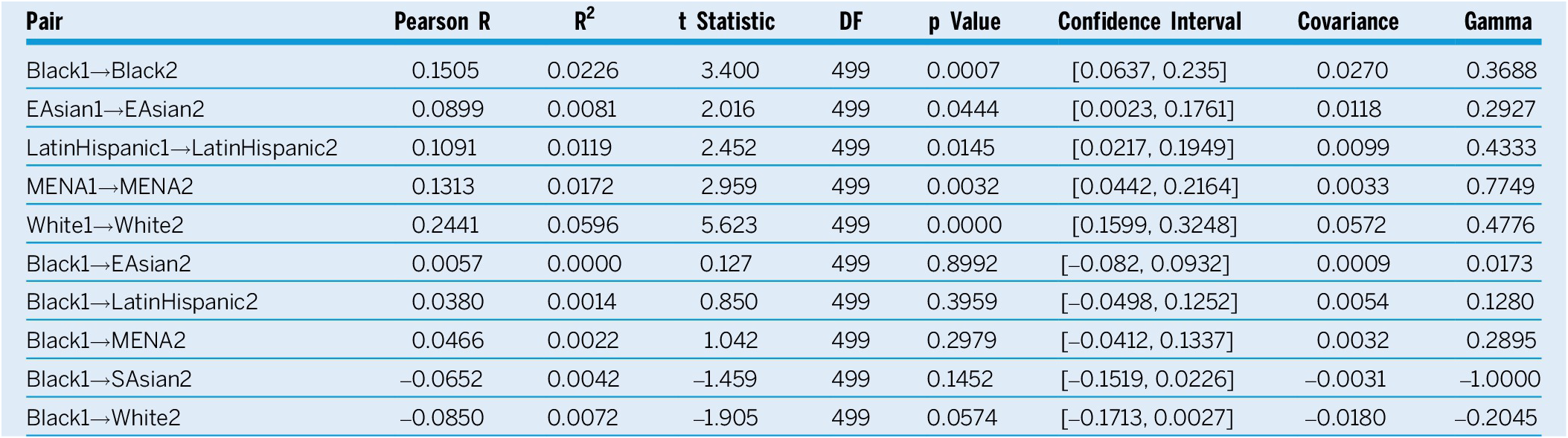
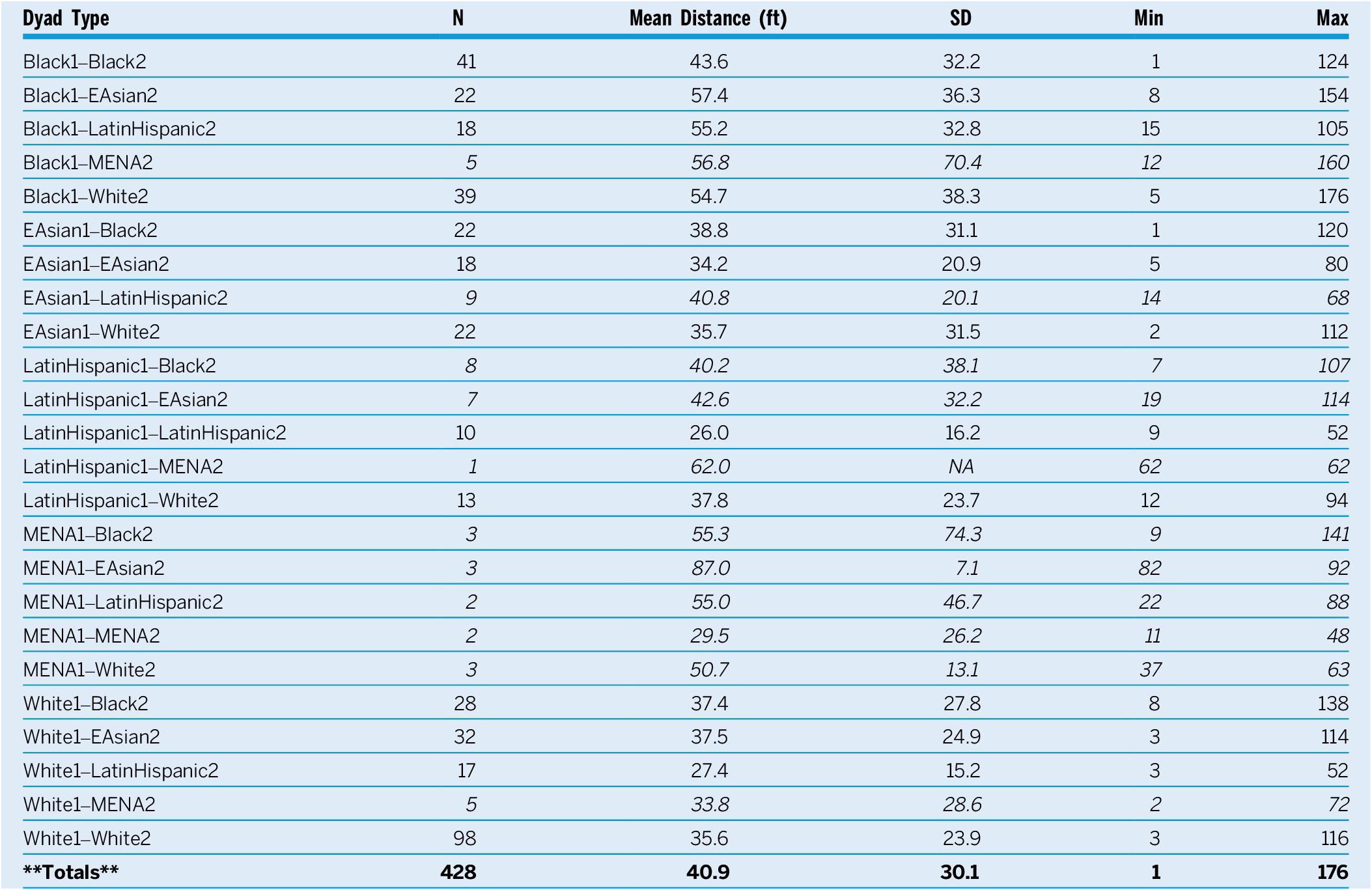
Table 2 summarizes the core descriptive pattern. Black first-arrivers experienced elevated distances—57.4 feet from East Asians (N=22), 55.2 feet from Hispanics (N=18), and 54.7 feet from whites (N=39)—all of which exceeded the 40.9-foot mean. This pattern was nonreciprocal: Black second-arrivers maintained near-baseline distances (i.e., 38.8, 40.2, and 37.4 feet, respectively), creating 15- to 20-foot asymmetries. Same-race dyads revealed shorter distances, with Hispanic–Hispanic encounters the closest (26.0 feet, N=10) and Black–Black dyads showing high variance (43.6 feet, SD=32.2) that interaction models decomposed.
Sample Sizes and Descriptive Statistics by Dyad Type
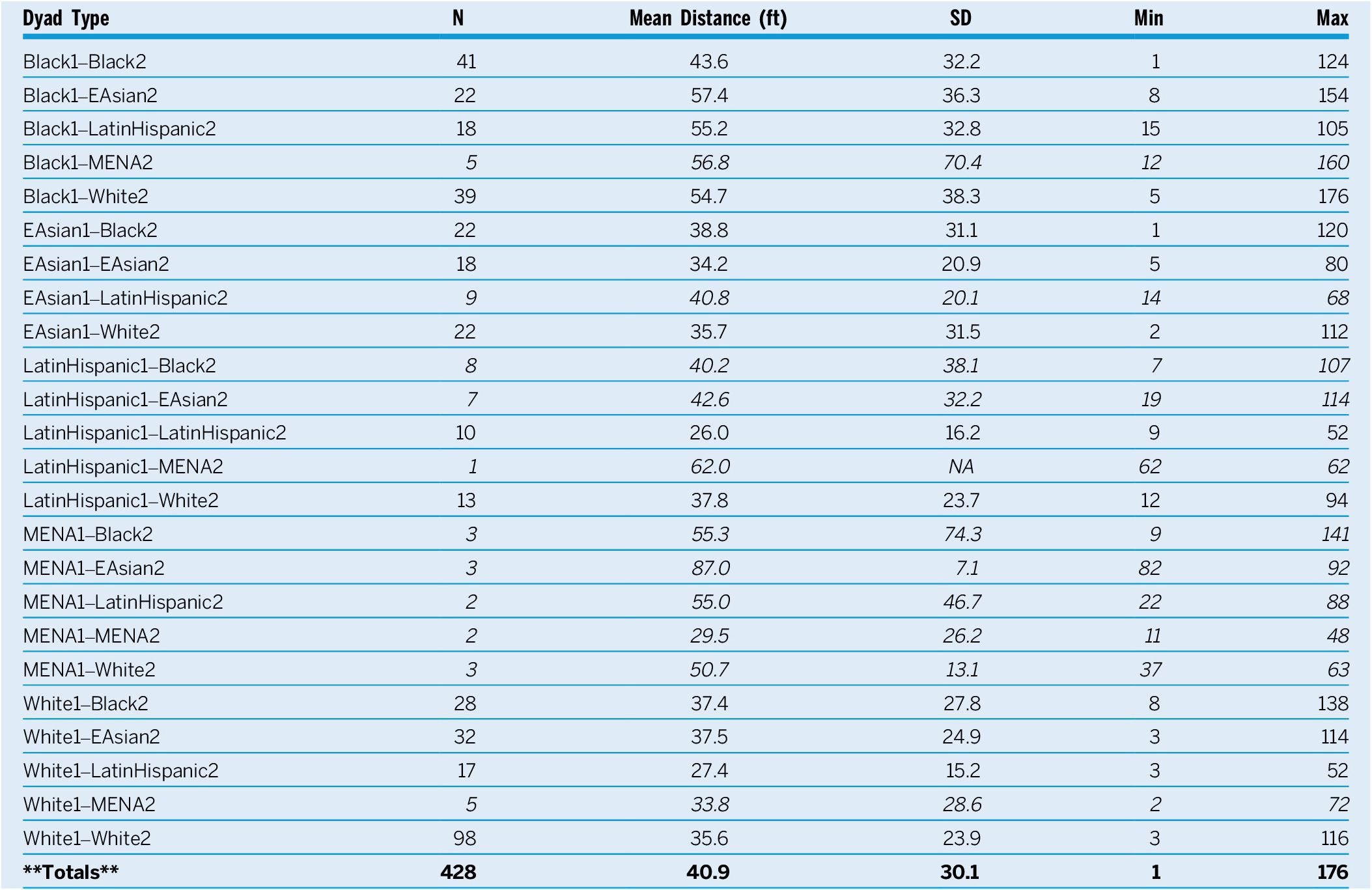
Table 2 Long description
Beginning at the top row, the table lists dyad types in the first column, followed by sample size (N), mean distance in feet, standard deviation, minimum, and maximum values. Dyad types include Black1–Black2 (N 41, mean 43.6, S D 32.2, min 1, max 124), Black1–EAsian2 (N 22, mean 57.4, S D 36.3, min 8, max 154), Black1–LatinHispanic2 (N 18, mean 55.2, S D 32.8, min 15, max 105), Black1–MENA2 (N 5, mean 56.8, S D 70.4, min 12, max 160), Black1–White2 (N 39, mean 54.7, S D 38.3, min 5, max 176), EAsian1–Black2 (N 22, mean 38.8, S D 31.1, min 1, max 120), EAsian1–EAsian2 (N 18, mean 34.2, S D 20.9, min 5, max 80), EAsian1–LatinHispanic2 (N 9, mean 40.8, S D 20.1, min 14, max 68), EAsian1–White2 (N 22, mean 35.7, S D 31.5, min 2, max 112), LatinHispanic1–Black2 (N 8, mean 40.2, S D 38.1, min 7, max 107), LatinHispanic1–EAsian2 (N 7, mean 42.6, S D 32.2, min 19, max 114), LatinHispanic1–LatinHispanic2 (N 10, mean 26.0, S D 16.2, min 9, max 52), LatinHispanic1–MENA2 (N 1, mean 62.0, S D N A, min 62, max 62), LatinHispanic1–White2 (N 13, mean 37.8, S D 23.7, min 12, max 94), MENA1–Black2 (N 3, mean 55.3, S D 74.3, min 9, max 141), MENA1–EAsian2 (N 3, mean 87.0, S D 7.1, min 82, max 92), MENA1–LatinHispanic2 (N 2, mean 55.0, S D 46.7, min 22, max 88), MENA1–MENA2 (N 2, mean 29.5, S D 26.2, min 11, max 48), MENA1–White2 (N 3, mean 50.7, S D 13.1, min 37, max 63), White1–Black2 (N 28, mean 37.4, S D 27.8, min 8, max 138), White1–EAsian2 (N 32, mean 37.5, S D 24.9, min 3, max 114), White1–LatinHispanic2 (N 17, mean 27.4, S D 15.2, min 3, max 52), White1–MENA2 (N 5, mean 33.8, S D 28.6, min 2, max 72), White1–White2 (N 98, mean 35.6, S D 23.9, min 3, max 116). The final row displays totals (N 428, mean 40.9, S D 30.1, min 1, max 176). Dyad types with N less than 10 are italicized. Notes clarify that EAsian1–MENA2 had zero valid observations and sample sizes varied due to population occurrence rates and strict inclusion criteria.
Notes: Dyad types with N<10 shown in italics. EAsian1–MENA2 had zero valid observations meeting double-blind coding agreement criteria. Sample sizes varied due to natural-occurrence rates in the population and stringent inclusion criteria requiring sequential arrival, platform emptiness, and intercoder agreement.
Observation density varied across stations, reflecting neighborhood demographics: Westlake (N=132) and Beacon Hill (N=131) contributed the most observations, followed by Mount Baker (N=112), Columbia City (N=48), and Roosevelt (N=21). Black first-arriver encounters appeared at all five stations, with Westlake contributing 26 such dyads despite its predominantly white ridership. This indicates that the core finding was not driven by any single site.
Aggregate Patterns: Black First-Arrivers Face Asymmetrical Aversion
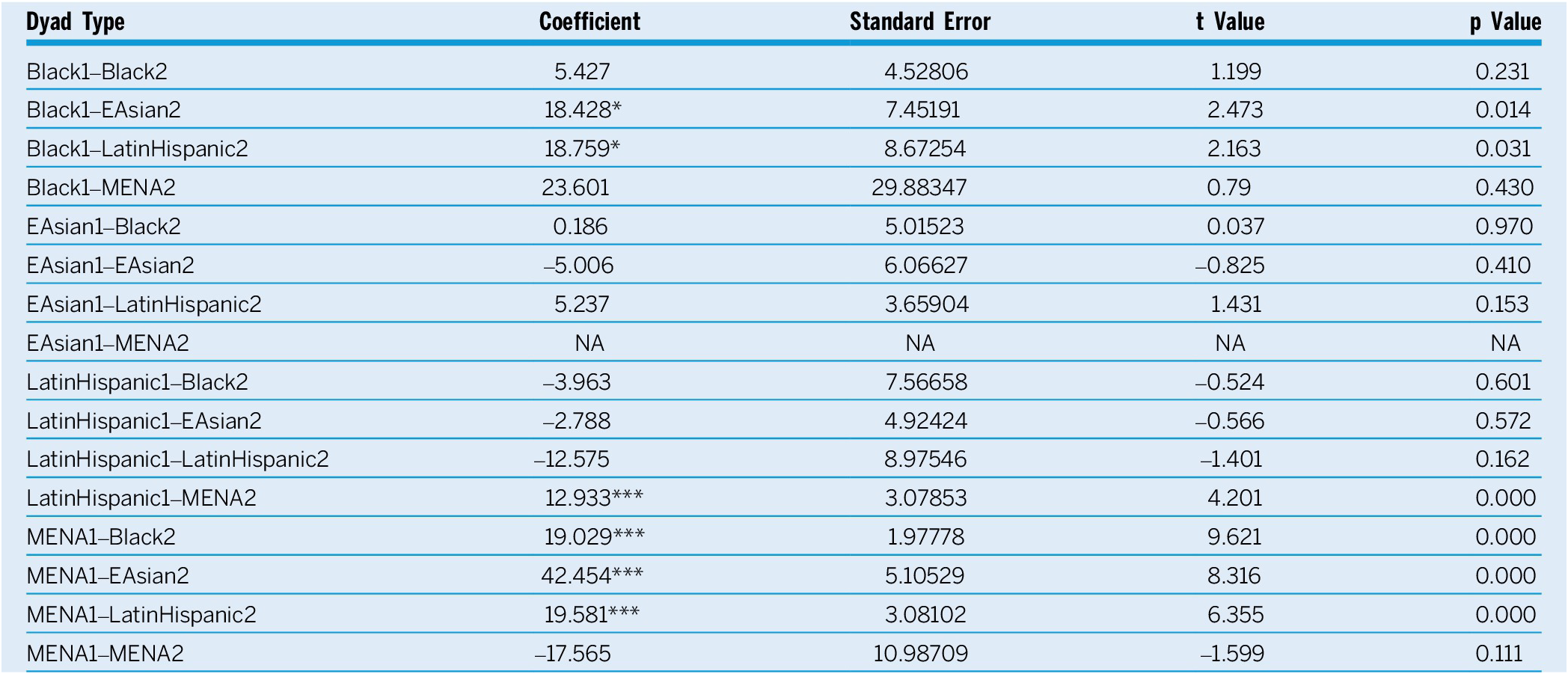
Table 3 presents coefficients from relational dummy variables measuring interpersonal distance for specific dyad pairings. Each coefficient represents additional feet of distance relative to the pooled baseline of all unspecified pairings. Negative coefficients indicate closer-than-baseline positioning rather than negative distance.
Association of Racial/Ethnic Composition on Interpersonal Distance

Table 3 Long description
Beginning at the top row, the table lists dyad types in the leftmost column: Black1–Black2, Black1–East Asian2, Black1–Latin Hispanic2, Black1–MENA2, East Asian1–Black2, East Asian1–East Asian2, East Asian1–Latin Hispanic2, East Asian1–MENA2, Latin Hispanic1–Black2, Latin Hispanic1–East Asian2, Latin Hispanic1–Latin Hispanic2, Latin Hispanic1–MENA2, MENA1–Black2, MENA1–East Asian2, MENA1–Latin Hispanic2, MENA1–MENA2. For each dyad, the next columns to the right display coefficient, standard error, t value, and p value. Significant coefficients are indicated with asterisks: one for p less than 0.05, three for p less than 0.001. Notable significant positive coefficients include Black1–East Asian2 (18.428, p 0.014, one asterisk), Black1–Latin Hispanic2 (18.759, p 0.031, one asterisk), Latin Hispanic1–MENA2 (12.933, p 0.000, three asterisks), MENA1–Black2 (19.029, p 0.000, three asterisks), MENA1–East Asian2 (42.454, p 0.000, three asterisks), and MENA1–Latin Hispanic2 (19.581, p 0.000, three asterisks). East Asian1–MENA2 is marked as N A in all columns due to zero valid cases. Negative coefficients appear for East Asian1–East Asian2, Latin Hispanic1–Black2, Latin Hispanic1–East Asian2, Latin Hispanic1–Latin Hispanic2, and MENA1–MENA2, but none are statistically significant. Standard errors, t values, and p values are provided for each dyad. The table footnotes explain clustering by station, inclusion of fixed effects and controls, and significance thresholds.
Notes: Standard errors are clustered by station. Models include station fixed effects and controls for gender composition (Male1, Female2), historic violent-crime rates, weather conditions (Clear, Cloudy), and direction of travel (North, South). N=423 observations.
East Asian1–MENA2 omitted due to zero valid cases meeting inclusion criteria after double-blind coding. Significance: †p<0.10, *p<0.05, **p<0.01, ***p<0.001.
Black first-arrivers faced consistently greater spatial distancing from multiple outgroups. East Asian second-arrivers maintained 18.4 additional feet from Black first-arrivers (SE=7.452, p=0.014) and Hispanic second-arrivers maintained 18.8 additional feet (SE=8.673, p=0.031). These patterns did not reverse: when East Asian or Hispanic individuals arrived first, Black second-arrivers positioned themselves at baseline distances (EAsian₁–Black₂: +0.2 feet, p=0.970; LatinHispanic₁–Black₂: −4.0 feet, p=0.601). The Black₁–Black₂ coefficient (+5.4 feet, p=0.231) was statistically indistinguishable from zero. This null finding masks the dynamics that interaction models revealed. MENA first-arrivers showed large-point estimates for spatial exclusion (i.e., 42.5 feet from East Asians, 19.6 feet from Hispanics, and 19.0 feet from Blacks), but these were derived from only two or three dyads per cell and cannot support firm inference.
Decomposing Black Encounters: Proximity Counteracts Exclusion
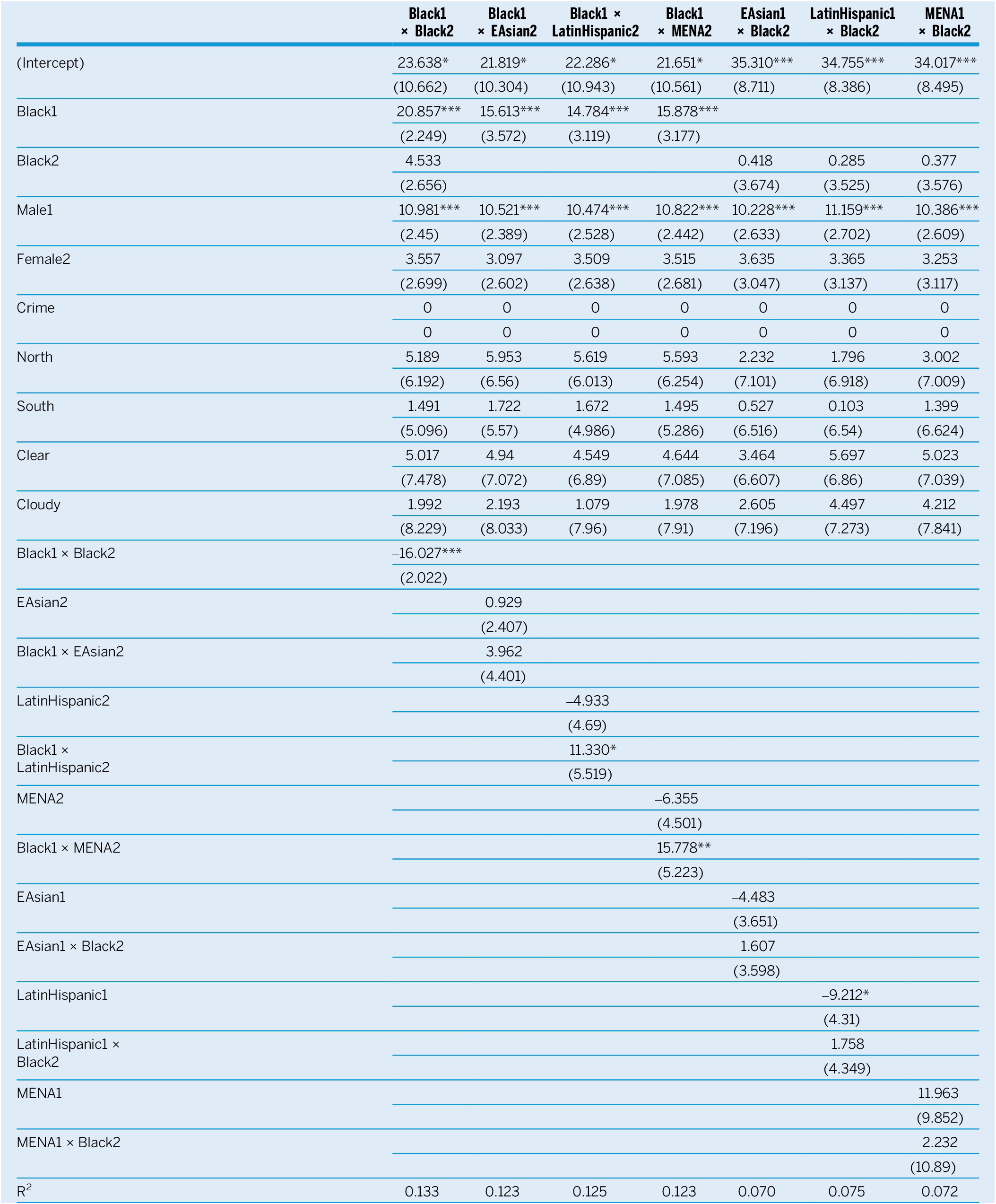
Table 4 presents seven interaction models that examine encounters involving Black individuals. The Black₁ × Black₂ model decomposed the null finding from table 3 into constituent forces. The Black₁ main association indicates substantial baseline exclusion: +20.9 feet (SE=2.249, p<0.001). The Black₁ × Black₂ interaction runs in the opposite direction: −16.0 feet (SE=2.022, p<0.001). The net association (20.9−16.0=4.9 feet) aligns with the +5.4-foot aggregate coefficient from table 3. The null finding represented offsetting forces: exclusion directed at Black first-arrivers from all second-arrivers, counteracted by closer proximity when the second-arriver also was Black.
Models of Interpersonal Distance with Black Individual as First or Second Arriver

Table 4 Long description
The table consists of seven columns, each representing a separate regression model for interpersonal distance. The first four columns model Black individuals as the first arrivers paired with Black, East Asian, Latin Hispanic, or MENA second arrivers. The last three columns model Black individuals as second arrivers paired with East Asian, Latin Hispanic, or MENA first arrivers. Each column lists coefficients and robust standard errors (in parentheses) for the following variables: (Intercept), Black1, Black2, Male1, Female2, Crime, North, South, Clear, Cloudy, interaction terms (e.g., Black1 times Black2), and R super 2. Significant coefficients are marked with asterisks, with triple asterisks indicating p less than 0.001. For Black1 as first arrivers, intercepts range from 21.651 to 23.638, and Black1 coefficients are all highly significant, ranging from 14.784 to 20.857. For Black2 as second arrivers, intercepts are higher, ranging from 34.017 to 35.310, and Black2 coefficients are small and not significant. Male1 coefficients are consistently positive and highly significant across all models, ranging from 10.228 to 11.159. Female2 coefficients are positive but smaller, ranging from 3.097 to 3.635. Crime coefficients are zero in all models. North and South coefficients vary, with North ranging from 1.796 to 5.953 and South from 0.103 to 1.722. Clear and Cloudy weather coefficients are positive, with Clear ranging from 3.464 to 5.697 and Cloudy from 1.079 to 4.497. Interaction terms show significant negative associations for Black1 times Black2 (minus 16.027) and positive associations for Black1 times MENA2 (15.778). R super 2 values range from 0.070 to 0.133, indicating modest model fit. All models include station fixed effects and controls for gender, crime, weather, and direction.
Notes: Each column represents a separate interaction model. Robust standard errors are clustered by station shown in parentheses. All models include station fixed effects and controls for gender composition (Male1, Female2), historic violent-crime rates, weather conditions (Clear, Cloudy), and direction of travel (North, South). Models 1–4 specify Black first-arriver interactions; Models 5–7 specify Black second-arriver interactions. N=423 observations. Significance: †p<0.10, *p<0.05, **p<0.01, ***p<0.001.
The Black₁ × EAsian₂ interaction (+4.0 feet, p>0.05) did not reach significance, indicating that East Asian avoidance of Black first-arrivers reflects general positioning rather than dyad-specific aversion in this sample. The Black₁ × LatinHispanic₂ interaction did reach significance: +11.3 feet (SE=5.519, p<0.05). Hispanic second-arrivers maintained additional distance beyond baseline anti-Black avoidance, contrasting with the proximity pattern in Black–Black encounters. The Black₁ × MENA₂ interaction revealed the largest point estimate (+15.8 feet, SE=5.223, p<0.01); however, only five dyads informed this coefficient. Models 5–7 examined encounters in which Black individuals arrived second. None of the interaction terms reached significance. Black second-arrivers did not elicit the avoidance that Black first-arrivers faced.
Arrival Order and Gender
The asymmetry between first-arriver and second-arriver results held across both race and gender. Male₁ reached significance in all seven models (+10.2 to +11.2 feet, p<0.001) whereas Female₂ did not, which is consistent with the arrival-order framework. Female second-arrivers drive the Male₁ coefficient by distancing from male first-arrivers, paralleling the racial pattern in which first-arriver characteristics determined spatial outcomes. Model fit reinforced this: Black first-arriver specifications explained 12.3% to 13.3% of variance versus 7.0% to 7.5% for Black second-arriver specifications. Contextual controls (i.e., crime, direction, and weather) showed no significant associations.
Three empirical patterns emerged. First, Black first-arrivers faced significant spatial exclusion from East Asian and Hispanic second-arrivers (i.e., 18–19 additional feet) that Black second-arrivers did not reciprocate. Second, the apparent neutrality of Black–Black encounters masks offsetting dynamics: 21 feet of baseline exclusion counteracted by 16 feet of intragroup proximity. Third, interminority encounters showed no analogous outcome; the Black₁ × LatinHispanic₂ interaction added distance rather than reducing it.
DISCUSSION: DILEMMAS FROM INTERGROUP AVOIDANCE
In a society in which racial identity carries no weight in everyday encounters, individuals would position themselves at approximately similar distances regardless of with whom they shared public spaces. The data reject this baseline. Intergroup avoidance varied systematically by racial composition, concentrated on Black first-arrivers on train platforms, and reversed only when the second-arriver shared their racial identity. The gap between the society that these data describe and the one that equal standing would predict is the empirical terrain documented by this study.
Intergroup avoidance varied systematically by racial composition, concentrated on Black first-arrivers on train platforms, and reversed only when the second-arriver shared their racial identity.
The spatial patterns documented in this article provide behavioral evidence bearing on both of McClain and Stewart’s (Reference McClain and Stewart1995) foundational dilemmas. The first dilemma posits a persistent contradiction between democratic ideals and racial exclusion. This contradiction manifests in the 18–19 feet in dyad-specific models and the approximate 21 feet in the pooled specification of additional distance that East Asian and Hispanic second-arrivers maintain from Black first-arrivers. The formal integration of public transit has not produced informal integration of public space.
The second dilemma asks whether minoritized groups choose coalition or competition. The spatial evidence is consistent with competition rather than coalition: the 16-foot reduction in distance that Black second-arrivers extend to Black first-arrivers has no interminority equivalent, and the Black₁ × LatinHispanic₂ interaction adds 11 feet of dyad-specific aversion rather than closing it. Shared marginalization does not translate into shared space. Whether we view these patterns as a cause of political fragmentation, a symptom of preexisting group hierarchies, or a behavioral correlate of attitudinal divides, the documented asymmetries provide an empirical window on interminority dynamics that other methods cannot provide.
The findings of this study are inconsistent with two competing predictions. The expectation of contact theory that shared public settings reduce avoidance found no support: formally integrated transit platforms exhibit behavioral segregation along racial lines. A racial-threat account, which would predict elevated but symmetric outgroup avoidance, also was inconsistent with the data: avoidance was directional, concentrated on Black first-arrivers rather than distributed across outgroups. The asymmetric pattern was most consistent in racial-hierarchy frameworks (Kim Reference Kim1999; McClain et al. Reference McClain, Carter, Soto, Lyle, Grynaviski, Nunnally, Scotto, Kendrick, Lackey and Cotton2006) and Black exceptionalism (Sears Reference Sears, Forgas, Fiedler and Crano2015), which predict that avoidance would specifically target Black Americans. Within-group proximity among Black dyads was consistent with linked fate (Dawson Reference Dawson1994); however, that framework was developed to explain attitudinal solidarity rather than spatial behavior, and the mechanism connecting the two remains unestablished.
The First Dilemma Revisited: Exclusion Without Law
The first dilemma predicts that racial inequality will persist despite formal commitments to equality. The behavioral evidence was consistent with this prediction, revealing a pattern that can be described as a conditional exclusion triggered by incumbency. Black individuals who arrived second did not tend to avoid others beyond baseline expectations or social norms. Black individuals who arrived first, however, faced systematic exclusion from multiple outgroups. Black exclusion appears conditional on arrival order: it attaches to being present first rather than to mere group co-presence. The mechanism behind this asymmetry remains unclear, but the pattern carries theoretical weight. Democratic citizenship presumes equal entitlement to occupy public space. This pattern raises the possibility that intergroup avoidance reflects and perhaps contributes to unequal standing in public life. If this is true, then the first dilemma may operate not only through legal barriers but also through the accumulated small decisions that individuals make about where to position themselves. In aggregate, these behavioral decisions may reproduce racial boundaries within formally integrated settings.
The Second Dilemma Revisited: Proximity’s Boundaries
The second dilemma asks whether minoritized groups will form coalitions based on shared structural position or compete for relative advantage within existing hierarchies. The disaggregation of Black–Black encounters revealed that social proximity exists—but only within racial boundaries. The null coefficient for Black₁–Black₂ in table 3 masked two countervailing forces of almost equal magnitude: 21 feet of exclusion that Black first-arrivers faced from all second-arrivers, offset by 16 feet of proximity when the second-arriver also was Black. This pattern is consistent with the ingroup solidarity logic underlying linked-fate theory (Dawson Reference Dawson1994); however, that framework was developed to explain shared political attitudes rather than physical co-presence. Whether the same underlying mechanism drives both spatial proximity and political attitude formation is still unknown. Black second-arrivers closed the distance that exclusion opened, positioning themselves closer to Black first-arrivers in ways that erased the baseline penalty. This intragroup proximity could reflect several dynamics: counter-exclusion in response to outgroup avoidance, bonding social capital, culturally specific norms around interpersonal space, and other currently unknown mechanisms.
The critical finding for the second dilemma is that this proximity did not extend across racial lines—at least not in this setting. Hispanic second-arrivers did not close ranks with Black first-arrivers; instead, they added to the distance (+11.3 feet, p<0.05). McClain et al. (Reference McClain, Carter, Soto, Lyle, Grynaviski, Nunnally, Scotto, Kendrick, Lackey and Cotton2006) documented this pattern attitudinally and found that Hispanic immigrants expressed greater social distance from Black Americans than white Americans. The findings in this study suggest a spatial parallel: the psychological distancing previously measured through surveys appeared as physical distance on train platforms.
Spatial Patterns and Coalition Formation
These patterns may illuminate a behavioral dimension relevant to the difficulty that multiracial coalitions sometimes face despite shared policy preferences among minoritized groups (Pastor and Marcelli Reference Pastor and Marcelli2003; Vaca Reference Vaca2004). Coalition formation requires what Allport (Reference Allport1954) termed “acquaintance potential”: that is, the repeated, low-stakes interactions through which intergroup trust develops. Spatial avoidance limits these interactions. Black individuals did not reciprocate the avoidance that they received. Black second-arrivers positioned themselves at baseline distances from East Asian, Hispanic, and MENA first-arrivers. Exclusion flowed in one direction, meaning that any coalition seeking would have required Black individuals to bridge a distance that potential allies did not reciprocate.
Exclusion flowed in one direction, meaning that any coalition seeking would have required Black individuals to bridge a distance that potential allies did not reciprocate.
Contemporary social-capital theory (Putnam Reference Putnam2000) provides one lens for interpreting the stakes. The 16-foot Black–Black proximity is consistent with bonding capital. The 11-foot Black–Hispanic aversion is consistent with its absence. Whether these spatial patterns cause, reflect, or simply correlate with the bridging deficit that intergroup coalitions require (Chetty et al. Reference Chetty, Jackson, Kuchler, Stroebel, Hendren, Fluegge and Gong2022) remains an open question, but the behavioral pattern is clear.
Implications for Democratic Practice
These findings may inform ongoing debates about the conditions under which intergroup contact reduces prejudice. Paluck, Green, and Green (Reference Paluck, Green and Green2019) demonstrated that contact-based interventions reveal notably weaker effects for adult racial prejudice compared to other forms of bias, which raises questions about what distinguishes settings where contact succeeds from those where it does not. The spatial patterns documented in this study suggest that one underexamined variable may be whether proximity in shared settings is sustained or preempted by avoidance before meaningful interaction can occur. To the extent that these patterns reflect broader intergroup dispositions, they also raise questions for coalition-building scholarship (McClain et al. Reference McClain, Carew, Walton and Watts2009; McClain and Stewart Reference McClain and Stewart1995). Any assumptions that shared policy preferences should translate into intergroup coalitions may overlook behavioral dynamics operating beneath the threshold of conscious deliberation.
Limitations and Future Directions
These documented patterns between racial composition and spatial distance may reflect unmeasured confounds correlated with both. Off-peak sampling captured transit-dependent and transit-choosing populations but may not represent rush-hour commuters; however, the theoretical mechanisms well may operate similarly across rider types. The analysis in this study controlled for perceived gender and found that Male₁ was consistently significant (i.e., +10–11 feet across all models), which suggests that gendered dynamics operate alongside racial dynamics. Future research with larger samples should explicitly model these intersections. Small samples for MENA dyads (i.e., N=2–5 across pairings) limited our conclusions about this group. Point estimates suggest that MENA first-arrivers faced severe exclusion, but these estimates derived from observations insufficient to support firm inference. Future research should oversample MENA individuals to assess whether the patterns suggested in this study replicate with adequate statistical power.
Seattle’s progressive political context and modern, well-lit transit infrastructure may reduce observable avoidance relative to other cities; conversely, the city’s distinctive racial geography and visible inequality may intensify avoidance along certain dimensions. The documented patterns therefore should be interpreted as context-specific estimates that may function as lower bounds for some forms of behavior and upper bounds for others. Replication across diverse urban contexts would assess generalizability. Whether mechanisms operate similarly in other settings including workplaces, organizing spaces, and political events must be examined empirically.
Future research could link observational data to precinct-level political outcomes, testing whether neighborhoods with greater spatial avoidance reveal weaker interminority electoral coalitions. Longitudinal designs could assess whether spatial patterns diminish as communities develop the optimal contact conditions that Allport (Reference Allport1954) specified. Experimental manipulations of public-space design could test whether environmental modifications reduce avoidance and facilitate coalition building.
CONCLUSION
The approximately 19 feet of exclusion that Black first-arrivers faced from Hispanic second-arrivers and the 16 feet of proximity that Black second-arrivers provided to Black first-arrivers quantify a behavioral dimension of intergroup relations that existing measures do not capture and that may bear on democratic coalition building. McClain and Stewart (Reference McClain and Stewart1995) asked whether minoritized groups would choose coalition or competition. Thirty years later, the behavioral evidence suggests that intergroup distance persists in forms that operate beneath conscious deliberation. The micro-decisions that individuals make about where to stand during routine encounters are uncaptured by survey measures, but they reveal systematic patterns with potential political significance.
The ingroup proximity that characterized Black spatial behavior in these data did not appear across racial lines, regardless of the underlying cause. The first dilemma posits that democratic ideals coexist with racial exclusion (McClain et al. Reference McClain, Carew, Walton and Watts2009; McClain and Stewart Reference McClain and Stewart1995). This study suggests that formal integration of public spaces does not eliminate racially patterned avoidance. The second dilemma asks whether minoritized groups choose coalition or competition (McClain et al. Reference McClain, Carew, Walton and Watts2009; McClain and Stewart Reference McClain and Stewart1995). The spatial evidence was consistent with competition rather than coalition: interminority encounters produce additional distance rather than the proximity that within-group encounters demonstrate is possible. If these patterns generalize beyond train transit platforms, they identify a behavioral dimension for which scholarship on intergroup coalition building may need to account.
SUPPLEMENTARY MATERIAL
To view supplementary material for this article, please visit http://doi.org/10.1017/S1049096526102170.
ACKNOWLEDGMENTS
I am grateful to Benjamin Page, Brian Libgober, and Reuel Rogers for their guidance throughout this study. James Druckman provided valuable feedback and continued support. Jaye Seawright offered important methodological counsel. For comments on previous versions, I thank Laura Sjoberg, Paul Poast, Yphtach Lelkes, Hannah Ridge, Davin Phoenix, Jennifer Lin, Jair Moreira, and Molly Offer-Westort. I thank Dillon Scheuer for excellent research assistance. Paula McClain’s foundational scholarship inspired this study. I am grateful for her time and encouragement, which left a lasting impression. Previous versions were presented at the annual meetings of the Midwest Political Science Association and the American Political Science Association; I thank participants and discussants at those conferences for their feedback. I am grateful to the editors of this special issue and to three anonymous reviewers whose constructive feedback substantially improved the article. I thank Sound Transit in Seattle for their cooperation with this research. This research received support from the Institute for Humane Studies (Grant No. IHS017352).
DATA AVAILABILITY STATEMENT
Research documentation and data that support the findings of this study are openly available at the PS: Political Science & Politics Harvard Dataverse at https://doi.org/10.7910/DVN/3V9RG0.
CONFLICTS OF INTEREST
The author declares that there are no ethical issues or conflicts of interest in this research.


 Open access

