


Introduction
Conserving species necessitates halting extinctions, recovering depleted populations and maintaining viable populations (Akçakaya et al., Reference Akçakaya, Bennett, Brooks, Grace, Heath and Hedges2018). The Convention on Biological Diversity has set a clear and ambitious target for halting extinctions and reversing declines of the most threatened species by 2020 (Aichi Biodiversity Target 12; CBD, 2010). Progress towards this target is limited (CBD, 2014; Tittensor et al., Reference Tittensor, Walpole, Hill, Boyce, Britten and Burgess2014) and it is critical, therefore, that there is significant improvement in the efficiency and effectiveness of approaches and actions that are put in place to reverse declines and restore populations of threatened species. There is a need to deploy resources (e.g. time and money) wisely across an increasing number and range of species requiring intensive management.
The potential for ex situ management to contribute to species conservation has been a source of contention for many years (e.g. Balmford et al., Reference Balmford, Mace and Leader-Williams1996; Snyder et al., Reference Snyder, Derrickson, Beissinger, Wiley, Smith, Toone and Miller1996; Conde et al., Reference Conde, Flesness, Colchero, Jones and Scheuerlein2011; Pritchard et al., Reference Pritchard, Fa, Oldfield and Harrop2011; Fa et al., Reference Fa, Gusset, Flesness and Conde2014). Article 9 of the Convention on Biological Diversity describes a role for ex situ management in pursuing the Convention's objectives, primarily to complement in situ conservation (CBD, 1992). In the 25 years since the Convention was adopted, ex situ management has been applied in a wide range of contexts and for a diversity of stated purposes. Some of these are well documented (Maunder & Byers, Reference Maunder and Byers2005) but others are not, making it difficult to evaluate the extent to which ex situ management has contributed to the Convention's aims in particular and species conservation goals and targets more generally (but see Olive & Jansen, Reference Olive and Jansen2017 for an approach addressing this question). This, in turn, gives rise to a range of debates about the usefulness of ex situ management, including those concerned with using resources most efficiently to avoid extinctions and achieve species recovery targets (Tribe & Booth, Reference Tribe and Booth2003).
To inform decisions about the use of ex situ management to pursue particular species conservation goals and targets, it is important to understand better its contribution to date. This is because of the large number of species that are maintained in captivity for various stated purposes, uncertainty about their contribution to species conservation (Balmford et al., Reference Balmford, Kroshko, Leader-Williams and Mason2011), and the mismatch between resources available and needed in species conservation. IUCN has published guidelines on the use of ex situ management for conservation purposes (IUCN/SSC, 2014; McGowan et al., Reference McGowan, Traylor-Holzer and Leus2016). As a further step in improving the effectiveness and efficiency of ex situ management in species conservation, it is important to understand the extent to which this high profile and relatively well resourced activity has benefitted species conservation.
As with other conservation interventions, there is limited information on ex situ management activities available in a format that allows success to be assessed, and to answer questions about whether this was the best use of resources or what the status of species would have been without intervention. Here we explore in which cases ex situ management is considered to have had a positive conservation impact for terrestrial vertebrate species. As there is no single source of information on ex situ management programmes and projects we did this by (1) reviewing published literature, (2) examining where ex situ management has contributed to the downlisting of a species on the IUCN Red List and (3) surveying a global network of ex situ management practitioners, the IUCN Species Survival Commission's Conservation Breeding Specialist Group (now Conservation Planning Specialist Group).
Methods
We focussed on terrestrial vertebrate species (birds, reptiles and terrestrial mammals) because zoos generally prefer to keep charismatic species (Conde et al., Reference Conde, Flesness, Colchero, Jones and Scheuerlein2011). Vertebrate species are therefore often the targets of ex situ management programmes and as such are relatively well-studied.
Literature review
We conducted a literature search to identify studies that reported successful outcomes of ex situ conservation programmes for vertebrate species. Specifically, we searched the Web of Science for scientific articles published in English during 1992–2017. We selected records from 1992 onwards because the text of the Convention on Biological Diversity, including Article 9 stating the intent for ex situ management to have a conservation role, was published in 1992 (CBD, 1992) and we expected this to have increased the focus on ex situ management within the conservation community.
We identified three sets of search terms to retrieve articles reporting on the success of an ex situ conservation programme: (1) success terms: success* OR benefit* OR progress* OR downlist* OR recover* OR reassess*, (2) ex situ terms: ex situ OR captive* OR zoo, and (3) programme terms: breed* OR manag* OR program* OR conserve*. We combined these sets of search terms using the AND Boolean operator. Searches were restricted to relevant disciplines using the Web of Science Research Areas: Zoology, Environmental Sciences & Ecology, or Biodiversity & Conservation. We then excluded further Research Areas from within these search results to reduce the number of irrelevant articles (see Supplementary Table 1 for excluded Research Areas). We selected search terms and Research Areas to focus on terrestrial vertebrates.
We assessed the articles retrieved for relevance, in two stages. Firstly, we screened the articles by title and considered articles to be relevant, and thus retained them, if they provided information on an ex situ management programme that had been carried out (i.e. not just proposed) for vertebrate species. Articles with ambiguous titles were retained at this stage. Secondly, we searched article abstracts for the keywords ‘success’, ‘recover’ and ‘benefit’ to identify articles dealing specifically with successful programmes. We excluded articles that did not contain at least one of these keywords in the abstract. Finally, we read the remaining articles to determine how the benefit to the species of ex situ management was reported, and included only articles that reported evidence demonstrating a benefit in the further analysis.
From studies that reported a benefit to species of ex situ management, we extracted information regarding (1) the species managed, (2) the intended ex situ role (following the Guidelines on the Use of Ex Situ Management for Species Conservation; IUCN/SSC, 2014), (3) the scale of success (i.e. no conservation benefit to species; downlisted threat category on the IUCN Red List; expanded in situ population census numbers, with evidence of reproduction; establishment of additional, reproducing, in situ populations; expanded geographical range into suitable habitat; reversal or substantial reduction of in situ population decline; reduction of extinction risk/probability of species extinction (including sustainable rescue or insurance populations), and (4) the definition of success used by the author. If articles lacked explicit statements of intention for ex situ management roles, we considered the programme successful if at least one of the conservation benefits listed under (3) was reported.
IUCN Red List analysis
The IUCN Red List categorizes species’ extinction risk based on population and/or range size criteria (Mace et al., Reference Mace, Collar, Gaston, Hilton-Taylor, Akçakaya and Leader-Williams2008). Red List categories are, in order of increasing extinction risk, Least Concern, Near Threatened, Vulnerable, Endangered, Critically Endangered, Extinct in the Wild and Extinct. Species without sufficient information to make an assessment are categorized as Data Deficient. Species are reassessed periodically and may be recategorized as a result of an improvement (downlisting) or deterioration (uplisting) of their conservation status.
We extracted data on genuine downlistings (i.e. reduced extinction risk as a result of actual changes in species populations or distributions, as opposed to changes in Red List category that have resulted from new data) for vertebrate species during 2007–2017 from the IUCN Red List summary statistics (IUCN, 2017). To identify whether ex situ management had contributed towards the species’ downlisting, we searched for ‘captive’ and ‘reintroduct’ within the full accounts for each genuinely downlisted terrestrial vertebrate species. We then assessed the strength of the evidence provided to demonstrate that ex situ management had contributed to the downlisting, as (1) strong evidence (provision of numerical data demonstrating the contribution made by ex situ management towards meeting criteria for improved IUCN Red List categorization; e.g. ‘meets any of the criteria A–E for Vulnerable’), (2) moderate evidence (some numerical data provided but not fully clear on the extent to which ex situ management has contributed towards species being downlisted), or (3) weak evidence (absence of numerical data or missing information regarding the role and consequent contribution of ex situ management towards conservation of the species; e.g. account does not state the source of reintroduced individuals).
Practitioner survey
We used an online survey to gather information on the extent to which practitioners considered that ex situ management had contributed to species conservation. The survey collected information on the species under ex situ management, the intended role of the ex situ management programme, whether this role was achieved, whether monitoring occurred and evidence was available to demonstrate success. We also collected information on the scale of any benefit, whether results had been published, and how long the ex situ programme had been running. Participation in the survey was voluntary and respondents were informed that their responses would be used in academic research and would be anonymized. Survey questions and response options are in Supplementary Material 1.
We distributed the survey to 260 members of the Conservation Planning Specialist Group (a specialist group within the IUCN Species Survival Commission, formerly the Conservation Breeding Specialist Group), to collect information directly from ex situ practitioners. Conservation Planning Specialist Group members were selected as potential respondents to provide information on non-cooperative zoo breeding programme projects (explicitly excluding cooperative breeding programmes such as European Endangered Species Programmes, Species Survival Plans and Australasian Species Management Programs, which are managed and reported on by regional zoos and aquariums), and to represent a range of organizations from various countries tackling a diversity of conservation issues. Survey respondents that had been involved in ex situ projects for more than one species were asked to complete the survey for each individual species. We encouraged respondents to forward the survey to others outside the zoo community who may be aware of ex situ conservation projects. The survey was distributed by email and was open during 26 July–10 August 2017.
Cross-referencing among data sources
To explore the consistency of reporting among sources, we cross-referenced the lists of species obtained from each source (scientific literature search, Red List and practitioner survey) and identified species that were reported across multiple sources.
Results
Literature review
The literature search returned 1,085 articles. Screening based on titles excluded 751 articles, and screening based on abstracts excluded a further 186 articles. A further 36 articles were not accessible and so were excluded. This left 112 articles that reported on the ex situ management of vertebrate species. Of these, 61 articles did not demonstrate evidence of conservation benefit to the species (including two that had not been running long enough to provide evidence of conservation benefit) and so were excluded. One further article was excluded as the study species was a fish, leaving 50 articles that reported evidence of a conservation benefit of ex situ management to terrestrial vertebrate species (Supplementary Fig. 1).
The number of articles published in which evidence was provided to demonstrate successes of ex situ management and the consequent contribution to species conservation generally increased over time (Fig. 1a). The majority of species for which ex situ conservation success was reported were mammals, followed by birds (Fig. 1b). Only three articles on reptiles provided details of successful ex situ management programmes.
Results from the search of published scientific literature. (a) The number of articles published during 1993–2017 that presented evidence of conservation benefit to vertebrate species as a result of ex situ management. (b) The number of species within each vertebrate class for which, according to these articles, there was some form of conservation benefit.

Multiple ex situ management programmes had more than one ex situ role; the role reported in the largest number of articles and for the largest number of species was of ex situ populations acting as a source for population restoration to re-establish the species in part of its former range (Table 1; Supplementary Table 2). The conservation benefit reported in the largest number of articles and for the largest number of species was that ex situ management resulted in expanded in situ population census numbers with evidence of reproduction for the managed species (Table 2; Supplementary Table 2).
Results from the search of the published scientific literature for articles reporting on conservation benefits to terrestrial vertebrate species of ex situ management programmes. The number of articles that reported each type of ex situ role (definitions of roles from IUCN/SSC, 2014), and the associated number of species are given. Each article (and therefore species) may be associated with more than one ex situ role. See Supplementary Table 2 for details.

Results from the search of published scientific literature. The number of articles demonstrating each type of conservation benefit achieved by ex situ management programmes, and the number of terrestrial vertebrate species that benefitted, are given. Each article (and therefore species) may be associated with more than conservation benefit. See Supplementary Table 2 for details.

IUCN Red List analysis
During 2007–2017, 71 terrestrial vertebrate species underwent genuine downlisting (lower extinction risk categorization upon re-assessment). Of these, ex situ management contributed to the downlisting of 18 species (25%; Supplementary Table 3). The majority (13) of these species were mammals, followed by birds (four species), with one species of reptile (Fig. 2a).
Results from the analysis of the IUCN Red List. The number of vertebrate species on the IUCN Red List that were downlisted during 2007–2017 and that had strong, moderate or weak evidence that ex situ management contributed towards their improved conservation status, by (a) the species class, and (b) the number of Red List categories that the species was downlisted.

The majority (14) of these species were downlisted by one category, and the strength of evidence for the role of ex situ management in downlisting was spread across weak, moderate and strong (Fig. 2b). Evidence for the contribution made by ex situ management was moderate or strong for the three species downlisted by two categories, and evidence was strong for the two species downlisted by three categories (Fig. 2b).
Practitioner survey
The survey received 46 responses from 27 Conservation Planning Specialist Group members (10% response rate) and provided information on ex situ management programmes for 55 named species. Eight responses were excluded because they provided information on multiple species, and a further nine responses were excluded because they provided information on amphibians, invertebrates or plants. We excluded three more responses because the managed species was not reported to have obtained some form of conservation benefit as a result of ex situ management. This left 26 responses providing information on ex situ management programmes that had resulted in a conservation benefit to 25 vertebrate species (two respondents reported on ex situ programmes for the same species, Neophema chrysogaster; Supplementary Table 4).
The majority of species reported to have obtained conservation benefit were mammals (Fig. 3a). Five programmes were reported to have been running for 0–10 years, 11 for 11–20 years and 10 programmes for ≥ 21 years (Fig. 3b).
Results from the survey of conservation practitioners. The number of ex situ programmes for vertebrate species reported by survey respondents that resulted in the species receiving conservation benefit from ex situ management by (a) species class, and (b) the number of years that the ex situ programme had been in place.

Most respondents (25 of 26) reported that ex situ programmes had been monitored to identify the effects of ex situ management on the species, although four respondents did not provide supporting evidence of conservation benefit to the species. According to respondents, information had been published in 22 of 26 cases, but only five provided references to peer reviewed journals or book chapters. The remaining respondents stated that information had been published (including in internal reports, n = 1; government reports, n = 2; or in the media, n = 1) but did not provide references. Two respondents did not know whether information on the ex situ programme had been published.
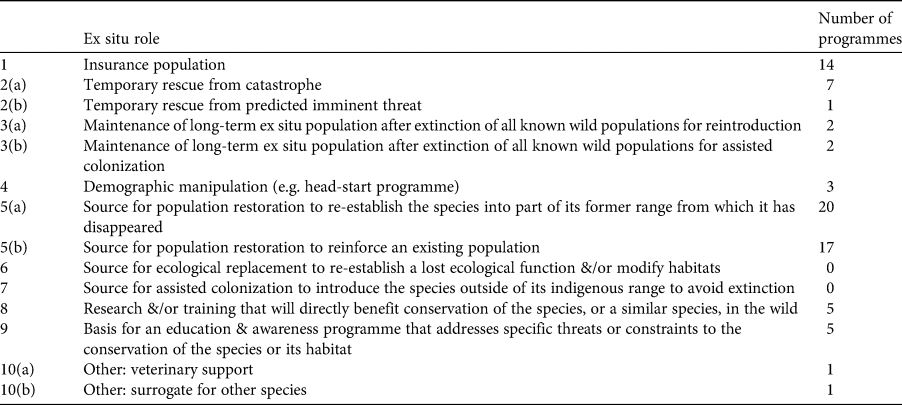
The most common reported role of ex situ management was to form a source population for restoration, to re-establish the species in part of its former range from which it had disappeared and/or to reinforce existing populations (Table 3). The second most common role was for the ex situ population to act as an insurance population.
Results from the survey of conservation practitioners. The number of ex situ management programmes for terrestrial vertebrate species with differing ex situ roles, according to survey respondents, is given. An individual programme may have multiple ex situ roles. See Supplementary Table 4 for details.
The most common reported conservation benefit to species as a result of ex situ management was a reduction of extinction risk (Table 4). This was followed by the establishment of additional populations and expanded population census numbers. Two respondents reported that ex situ management contributed towards species being downlisted on the Red List; one species (Porcula salvania) was reported to be in the process of being downlisted, and one subspecies (Macropus eugenii eugenii) was reported as having been downlisted locally in South Australia.
Results from the survey of conservation practitioners. The number of ex situ management programmes in which vertebrate species obtained each conservation benefit, according to survey respondents, is given. An individual ex situ programme may achieve multiple conservation benefits. See Supplementary Table 4 for details.

Cross-referencing among sources
In total, across all three sources, there were 76 species of terrestrial vertebrates reported as having gained a conservation benefit from ex situ management (Supplementary Table 5). Only six of these species appeared in more than one source. No species appeared across all three sources. One species (Sarcophilus harrisii) was reported from both the scientific literature and the survey of practitioners, although none of the references given by survey respondents were captured by the search of the scientific literature. One species (Leporillus conditor) was reported from both the Red List and the survey. Four species (Equus ferus, Mustela nigripes, Oryx leucoryx and Urocyon littoralis) were reported from both the scientific literature and the IUCN Red List.
The analysis of the Red List covered a shorter time period than the search of the scientific literature (because of a lack of information on genuine Red List category changes prior to 2007); we therefore expanded the cross-referencing of these two data sources by searching the full Red List accounts of those species identified in the literature search for evidence of a contribution of ex situ management to improved species conservation status on the Red List. We identified a further two species (Lutra lutra and Nipponia nippon) for which ex situ management had contributed to their downlisting on the Red List (all six species that were obtained from the search of the literature and that were downlisted are presented in Supplementary Table 6).
Discussion
The evidence we gathered from multiple sources showed that ex situ management has contributed to improvements in conservation status for a range of vertebrate species. However, evidence for the success of ex situ species management activities is currently scattered and of variable quality, making it challenging to determine the extent to which ex situ programmes successfully contribute to improving species conservation status. The most common role of ex situ management was reported to be the provision of individuals to increase in situ population numbers, both to re-establish populations in areas where they were previously present, and to reinforce existing populations. Ex situ management has also been reported as contributing to the downlisting of 18 species on the IUCN Red List over a 10-year period. The strength of evidence for the impact of ex situ management, however, varies within and among sources, suggesting that documentation of intended and actual benefits needs to be improved for the role of ex situ activities in conservation to be understood and realized fully.
Evidence from the three sources considered (the scientific literature, IUCN Red List and a survey of practitioners) builds a picture of ex situ management activities and their impacts. Across all three sources, the vertebrate taxonomic group most commonly reported to have benefited from ex situ management activities was mammals, followed by birds. This reflects the bias towards charismatic species that is generally present in zoos (Conde et al., Reference Conde, Flesness, Colchero, Jones and Scheuerlein2011) and the taxonomic bias that has been found in reintroduction programmes globally (Seddon et al., Reference Seddon, Soorae and Launay2005), and may result in a mismatch between conservation need and conservation response.
Previous studies have assessed the number of species contributed by zoos to translocation programmes (Brichieri-Colombi et al., Reference Brichieri-Colombi, Lloyd, McPherson and Moehrenschlager2018) and to captive breeding, reintroduction and head-starting programmes (Gilbert et al., Reference Gilbert, Gardner, Kraaijeveld and Riordan2017; Olive & Jansen, Reference Olive and Jansen2017). However, the success of such programmes has not been assessed. Sparsity of evidence in the scientific literature for the impact of ex situ management on species conservation does not mean that ex situ programmes have not had positive impacts; rather, it reflects the lack of standardization and varying quality and public availability of documentation of the outcomes of ex situ activities. Our survey of practitioners showed that, although monitoring occurred in 96% of programmes reported and outcomes were published in 85% of cases, publication was not necessarily in the scientific literature and programmes varied in what they reported. In addition, the scientific publications cited by practitioners were not retrieved in our literature search, suggesting that publications that do arise are not necessarily discoverable or accessible. Good monitoring practices are fundamental to establishing programme success, and good practice in the reporting of monitoring outcomes is required to build an evidence base that can be used to inform future management decisions (Sutherland et al., Reference Sutherland, Pullin, Dolman and Knight2004). Guidelines exist on when and how to apply ex situ conservation (McGowan et al., Reference McGowan, Traylor-Holzer and Leus2016), and evidence from existing ex situ activities could help provide the information required to assist this decision-making process.
The difficulty in collating evidence for the contribution of ex situ programmes to species conservation is demonstrated by the fact that previous studies that have aimed to quantify the contribution of zoos and aquaria to in situ species conservation have relied on techniques such as surveys and interviews to collect data (Gusset & Dick, Reference Gusset and Dick2010; Olive & Jansen, Reference Olive and Jansen2017). A study by Brichieri-Colombi et al. (Reference Brichieri-Colombi, Lloyd, McPherson and Moehrenschlager2018) made use of a database of ex situ management programmes compiled from a thorough literature search; however this database is probably missing a considerable amount of ex situ work that remains unpublished and may never be published. We aimed to provide as broad an overview as possible of the contribution of ex situ management by applying both of these data collection methods, and additionally reviewing evidence from the Red List database. Even in the case of the compiled Red List data, we found that the strength of the evidence (i.e. the supporting data provided) was variable. This suggests that an agreed reporting protocol and reporting mechanism that follows the ex situ guidelines framework and facilitates ex situ programme documentation from conception through to completion could help improve reporting and evidence synthesis. Such a mechanism could encourage good monitoring and reporting practices, as well as recognition of the achievements of ex situ programmes, and offer opportunities for more rapid sharing of lessons learned than is possible at present. For example, by encouraging an adaptive management approach that responds to unexpected outcomes and changing needs, programmes that do not achieve their original targets would not be considered failures, but would instead provide learning and knowledge-sharing opportunities. Although evidence from the scientific literature showed an increase over time in the number of publications reporting successful outcomes of ex situ management programmes, the volume of scientific publications and number of ex situ management programmes have also increased, meaning that it is not possible to infer a change in reporting rates. The issue of under-reporting of programme outcomes could be addressed by adopting an adaptive management approach to encourage more frequent and more transparent reporting, and the sharing of lessons learned.
Our study has highlighted under-reporting as prevalent. This is a potential barrier to increasing the contribution of ex situ management programmes to species conservation. We considered a select range of data sources and maintained a narrow taxonomic focus; a more comprehensive study could yield further insights. An analysis of the cooperative breeding programmes managed by regional zoos and aquariums (such as European Endangered Species Programmes) could be insightful and may offer scope for considering the rate of success, rather than the strength of evidence for success that we focussed on here.
Although we found the evidence for the impact of ex situ management programmes on the conservation status of species to be of variable strength, our findings show that ex situ activities can make an important conservation contribution, particularly by providing a source population for the re-establishment or reinforcement of in situ populations. Improved monitoring and documentation would allow the value, and targeting, of ex situ programmes to be realized fully, which would benefit not only the organizations involved in ex situ programmes but also the wider conservation community through increased knowledge for decision-making and conservation planning. Ex situ management is resource intensive and thus unlikely to make a substantial contribution to the conservation of a large number of species, compared with the numbers of threatened species that require conservation measures (there are currently 4,791 Endangered and Critically Endangered vertebrate species on the IUCN Red List). It is important, therefore, that ex situ management is targeted towards those species where it can complement in situ conservation, or produce conservation benefits that other interventions cannot, such as for species that have critically small in situ populations or that are extinct in the wild. We suggest that, although there may be limited scope for increasing the scale of ex situ management to large numbers of species, better reporting of the purpose and implementation of ex situ management should lead to its more targeted use, so that ex situ activities make a measurable contribution towards achieving global species conservation targets.
Acknowledgements
We thank the Conservation Planning Specialist Group and its members for distributing and responding to the practitioner survey, and Onnie Byers, Kristen Leus and Kathy Traylor-Holzer for helpful comments during the design of the survey and preparation of this article.
Author contributions
Study design: PJKM, JRG; data collection and analysis: JRG, LM; writing and revision: all authors.
Conflicts of interest
None.
Ethical standards
This research abided by the Oryx guidelines on ethical standards. Ethical approval for the survey of practitioners was obtained from Newcastle University.


 Open access

