

Government bureaucracies in Canada are characterized by a skilled and professional public service system, appointments to which are to be based on merit, and with safeguards against classical political patronage that disburses the rewards of electoral victory disproportionately to party loyalists and supporters. However, the proliferation of agencies and arm's-length bodies in recent decades has provided new opportunities for elected governments to reassert political control in an increasingly fragmented public service framework. Media coverage of various governments across the country identifies examples of appointed governance boards and agency leadership staffed by partisan-identified individuals for whom a similarly ranked position within the professional public service would be largely unavailable to them.
For example, the British Columbia New Democratic Party (NDP) came to power in 2017 after sixteen years in opposition and appointed their prior party leader Joy MacPhail as chairperson of one of the largest Crown agencies in the province—the Insurance Corporation of British Columbia (ICBC) from 2017-2022—and then subsequently as chairperson of BC Ferry Corporation in 2022. The premier noted at the time of appointment that this individual, as with the other appointments at the time, “…will work hard to ensure the organizations they are responsible for are well managed, properly governed and well aligned with the government's mandate…” (Smart, Reference Smart2017). Pointing out the appointments of MacPhail to these high-profile agencies is not to claim that she is not a meritorious figure, or specifically that she is not equipped to govern effectively, but rather that she is a trusted hand from the perspective of the governing party. There are various other examples of this with the BC NDP government, but also the prior BC Liberal government, signalling that this is not a phenomenon limited to particular political parties: a recent BC Liberal premier appointed one of her key election advisors Brad Bennett as chairman of BC Hydro, perhaps the most important Crown corporation in the province. These governments revealed that they value close, trusted hands in the ostensibly arm's-length agencies and authorities in the province.
Anecdotes like these can be told in every province (MacLeod, Reference MacLeod2006; Simpson, Reference Simpson1988), as well as the federal government (Jeffrey, Reference Jeffrey2015), in Canada. Governments can also use their appointment powers to arm's-length agencies and authorities in the days leading up to anticipated electoral defeats to try to extend their grip on decision making into the future. For example, Prime Minister Stephen Harper (2006-2015) made over 70 appointments earlier-than-due to important federal boards, tribunals and agencies in the remaining days in office before the 2015 campaign, with terms that extended beyond the first mandate of the subsequent Trudeau government (National Post, 2015). This “maneuver hamstrung [the Trudeau government],” as many of the positions command six-figure salaries that would have to be bought out to the sum of up to $18.5 million if they did not volunteer to exit, as requested (CTV News, 2015).
At the same time, one can identify appointments to key arm's-length agencies and authorities that carry little indication of partisan attachment, but for which specific skill sets and experience appears to motivate their selection. Indeed, the federal government and nearly all provincial governments in Canada have created offices within the professional bureaucracy responsible for vetting and publishing all government appointments to such agencies and authorities to signal a regime of merit above all else. Yet the governing party retains ultimate authority to appoint whomever they wish to the authorities that are delegated power and, as evident from the examples above, in some instances when the party in power finds it desirable, they will get their preferred candidate in key positions important to the government.
At this time, we have little basis to make systematic claims about the political impartiality of agencies in Canada. This study addresses this gap by drawing on the Government of Canada's Staffing and Non-Partisanship Survey (SNPS) micro data from 2018 and 2021, which surveys all employees in 76 departments and agencies on a host of questions related to how staff and leadership are hired, their political impartiality and that of the organization generally and the political activities of those working in the organization. Using data from these surveys, we are able to explore the following research question: Do employees in agencies in the Government of Canada report a climate of less political impartiality than those working in conventional departments? The data assembled in this study is separable by departments and agencies (as well as differentiated by type of agency) and includes a host of variables for which we can control. The quasi-experimental method of Mahalanobis distance matching (MDM) on the survey micro data is used in this study to estimate the “agency effect” on various measures of politicization within the organization.
This article proceeds by introducing the relevant literature that explores organizational autonomy and politicization of agencies in the public administration literature. The article then introduces the survey data from 2018 and 2021 in Canada used to test key theoretical propositions. The third section describes the results of the analysis, demonstrating that employees in agencies in the Government of Canada are less likely than those in conventional departments to view their units as being politically impartial, though this tends to be most acutely driven by those in enforcement agencies. The final section identifies limitations to this study and charts out future research opportunities to further explore the dimensions of politicization in arm's-length agencies and authorities.
Literature review
Agencification
Government agencies and arm's-length authorities—entities structurally separated from departments and with distinct governance and leadership frameworks to enable greater autonomy—are widespread in Canada yet are not commonly studied today. These entities play multifaceted roles in Canadian society, ranging from service provision (for example, Canada Post) to industry regulation (for example, Canada Energy Regulator, Canadian Radio-Television and Telecommunications Commission), adjudication of claims or disputes (for example, Immigration and Refugee Board), law enforcement (for example, Canadian Border Services Agency) and consumer protection (for example, Canadian Food Inspection Agency), among others. The creation of an agency or arm's-length entity may at first blush seem like a narrow matter of public administration, but they often emerge as a product of interest group dynamics, a desire to shield expert decision making from electoral pressures, or a deliberate tactic to mitigate political repercussions or evade accountability. In other words, the development and evolution of the administrative state are shaped by a deeply political set of factors.
The proliferation of arm's-length agencies and authorities in Canada, as in other jurisdictions, has been notable since the 1990s (Bernier et al., Reference Bernier, Juillet and Deschamps2022; Hall, Reference Hall2021). This surge is largely attributed to the emergence of new public management (NPM) and neoliberal ideologies, which sought to dismantle conventional public administrative structures in favour of a more agile, responsive and efficiency-driven governance model. The phenomenon of “agencification”—the increasing delegation of departmental functions to arm's-length authorities—has been scrutinized with considerable urgency across various democratic contexts, including Europe, the United States, Oceania and Asia (Andrews, Reference Andrews, Walker, Boyne and Brewer2010; James, Reference James2003; Overman and van Thiel, Reference Overman and Van Thiel2016; Yamamoto, Reference Yamamoto2006). However, despite the extensive cross-national analyses, Canada remains conspicuously absent from this discourse, despite evidence suggesting a substantial increase in agencification within the Canadian context, with some provinces attributing over 50 per cent of their annual government operating expenditures to agencies (McCrank et al., Reference McCrank, Hohol and Tupper2007).
Despite the burgeoning presence of agencies at all levels of government in Canada over recent decades, agencification has received scant sustained attention and systematic analysis (Bernier et al., Reference Bernier, Juillet and Deschamps2022; Hall, Reference Hall2021). While sporadic research efforts have been made, particularly during the 1970s-1990s, focusing on accountability deficits within agencies (Eichmanus and White, Reference Eichmanus and White1985; Hodgetts, Reference Hodgetts1973; Schultz, Reference Schultz and Dwivedi1982) and on specific agency types like Crown corporations (Bird, Reference Bird2022; Tupper and Doern, Reference Tupper and Bruce Doern1981), comprehensive scholarship on the broader development and evolution of arm's-length agencies in Canada remains sparse. Fitzpatrick and Fyfe (Reference Fitzpatrick and Fyfe2002) provide a noteworthy exception, documenting a shift toward larger service delivery bodies and agencies with greater distance from administrative and political oversight. Notable examples of such agencies established in Canada during the 1990s-2000s include the Canadian Food Inspection Agency (CFIA), Canada Revenue Agency (CRA) and Canada Border Services Agency (CBSA). Furthermore, Bilodeau et al. (Reference Bilodeau, Laurin and Vining2007) conducted a comparative analysis of eleven cases of agencification in Canada, demonstrating increased service outputs, cost-efficiency and employee productivity following the transition to agency status within both federal and Quebec government organizations.
Unlike conventional departments in the core institutions of the bureaucracy, some degree of organizational autonomy is a defining characteristic of agencies and other arm's-length authorities. Organizational autonomy typically emerges from structural-legal differentiation from traditional government departments by elected officials (that is, they create an agency through law), but autonomy may also be enhanced by reputational capital built up by the agency or authority itself (Aulich et al., Reference Aulich, Batainah and Wettenhall2010; Pollitt et al., Reference Pollitt, Caulfield, Smullen and Talbot2004). Notwithstanding the considerable organizational autonomy we observe in agencies around the world, no agencies in democracies have full statutory independence from a parent department or ministry that is ultimately accountable to an elected official. Agencies thus tend to have more autonomy from traditional government departments to perform a public function, but remain arm's-length to elected leadership which conducts oversight and broad steering functions of its mandate.
As discussed above, most attribute the growth of agencies and other arm's-length authorities to the new public management (NPM) movement that first took root in the early 1990s in the US and UK (Pollitt et al., Reference Pollitt, Caulfield, Smullen and Talbot2004; Van Thiel and Yesilkagit, Reference Van Thiel and Yesilkagit2014), but others identify a parallel development of the depoliticized or technocratic regulatory state (Bach and Jann, Reference Bach and Jann2010). There is no doubt that many agencies were ostensibly created to pull public good provision out from the traditional public service bureaucracy, purporting to free them to innovate, as managers and leadership would be given more autonomy and nimbleness to respond to client and stakeholder needs (Osborne and Gaebler, Reference Osborne and Gaebler1992). Evaluations and debates about the extent these promises were realized are plentiful in the literature (Overman and van Thiel, Reference Overman and Van Thiel2016) and will not be covered here. Yet Bach and Jann (Reference Bach and Jann2010) also argue that other agencies were seemingly created not primarily to more efficiently deliver services to the public in the spirit of the new public management (NPM) philosophy, but rather to separate the regulatory state from political actors and into the hands of “experts” or those with technical expertise, with the aim to reduce the potential for arbitrary or politicized ministerial interventions.
Agencification of the regulatory state therefore emerges out of a long-standing problem in democratic policymaking: the credible commitment of policy direction to affected interests that the rules established will be operationalized for a reasonably long-term horizon (Christensen and Lægreid, Reference Christensen and Lægreid2007). That is, regulatory matters will tend to not swing wildly with the change of governments. One way to smooth out regulatory regimes is to devise agencies with autonomy from direct political control or at least structured friction to changing the rules. Therefore, politicians can signal credible commitment by ceding some of their regulatory-making authority to non-majoritarian bureaucratic agents with high levels of autonomy (Ennser-Jedenastik, Reference Ennser-Jedenastik2015). However, agency autonomy also creates incentives for those same elected officials to appoint ideologically like-minded individuals to agency leadership and staff as a means to continue to exert influence through indirect means. Agencification puts elected officials responsible for public decision making in a difficult position: we want agencies and their managers to efficiently and effectively deliver services and regulate sectors, but elected officials are still ultimately held accountable by the public and are reluctant to surrender control of the policy agenda (Peters and Pierre, Reference Peters, Pierre, Peters and Pierre2004). This tension incentivizes elected officials to seek to compensate for their loss of some degree of control over agencies through appointment politicization (Lewis, Reference Lewis2008; Niklasson, Reference Niklasson2013; Pollitt and Bouckaert, Reference Pollitt and Bouckaert2017). The section below connects the concepts of classic patronage within agencies to the more modern political appointment practices that may adhere to a “compensatory logic of politicization.”
From classic patronage to compensatory logic of politicization
The politicization of the core institutions of bureaucracies has long been a focus of inquiry for scholars across administrative traditions (Peters and Pierre, Reference Peters, Pierre, Peters and Pierre2004; Wilson, Reference Wilson1887), including in Canada (Colwell and Thomas, Reference Colwell and Thomas1987; Cooper, Reference Cooper2018, Reference Cooper2021; Noel, Reference Noel1987). Rouban (Reference Rouban, Peters and Pierre2004) defines politicization in this context as the appointment, retention, promotion or dismissal (if possible) of bureaucrats based on political criteria rather than merit. The norms shaping the appointment of senior bureaucratic officials among elected governments are indeed quite different, with the Germanic and Napoleonic traditions more tolerant of political appointments to key positions in the bureaucracy and other public institutions, whereas the Nordic and Westminster traditions generally demonstrate more adherence to the merit principle. And of course, norms and practices within traditions shift over time. Early Canada was certainly characterized by raw political patronage and clientelism, with John A Macdonald describing it as the “political glue” of the country (MacLeod, Reference MacLeod2006). Public administration reforms that sought to displace patronage with the merit principle (Juillet and Rasmussen, Reference Juillet and Rasmussen2008) have not eliminated it in the modern era, but have changed the venues of potential political appointments.
The Mulroney era at the federal level was one with heightened attention to political appointments, in part because of his stated intention to eliminate the practice he accused Pierre Trudeau of shamelessly deploying, but also received notice because he nevertheless revealed himself to be committed to the practice (Simpson, Reference Simpson1988). Under Mulroney, “all but a handful of Liberal-appointed directors on the boards of such crown corporations as Petro-Canada, CNR, Via Rail, and Air Canada were replaced by loyal Conservatives,” and he joked with Conservative audiences that once in office “there will be jobs for Liberals and NDPers too, but only after I have been prime minister for 15 years and I can't find a single living, breathing Tory to appoint” (Colwell and Thomas, Reference Colwell and Thomas1987: 165). Most governments are more strategic now, learning from Mulroney and others, who faced increased scrutiny and controversy with long lists of appointment announcements, allowing the media to focus on them and identify their partisan attachments. More typical today is to announce them piecemeal and spread them more widely among diverse identity groups.
Colwell and Thomas (Reference Colwell and Thomas1987) helpfully differentiate political patronage—positions of responsibility given to political friends—from political appointments—attention to both the merit of candidates and their political orientation. Bald political patronage has not been completely eliminated, but politicians tend to face intense media and opposition scrutiny if the appointee has no meritorious link to the position. Political appointments, however, are very much present in the modern era. Just as there are administrative traditions around the world, there are also political cultures relating to political appointments and their associated clientelism within Canada. MacLeod (Reference MacLeod2006) powerfully illustrates the deeply embedded culture of clientelism in Nova Scotia, for example, demonstrating that the Savage government in the 1990s faced an internal rebellion within the Liberal Party for not being sufficiently attentive to distributing the spoils of power via political appointments within the party and affiliated interest groups. For MacLeod (Reference MacLeod2006), the lesson emerging from the Nova Scotia reformer premier was that “blindness to clientelism,” especially in a political culture accustomed to it, can yield a high political cost (566).
Even in heavily clientelist political contexts, the patterns can evolve over time, with MacLeod (Reference MacLeod2006) documenting that “blue collar patronage” (for example, awarding highway construction contracts) was reduced with public administration reforms such as open bids, while “white collar patronage” (for example, political appointments to agencies, boards and commissions, etc.) remains. Writing in 1987, Noel similarly argued that far from going away, political appointments were only growing, owing to the “ever-expanding realm of quasi-government: the appointments, perks, per diems […] that flow forth from the Crown corporations, agencies, boards and commissions that have so hugely proliferated in the modern era” (82). Cooper (Reference Cooper2021) shows with comparative survey data of experts that Canadian appointment practices are consistent with the Westminster administrative tradition that prizes meritorious appointments in the core institutions of the bureaucracy over political and personal connections. Yet the questions posed in the survey used by Cooper (Reference Cooper2021) refer to the appointment of “senior public servants” within the core bureaucratic institutions of government, not arm's-length agencies and authorities that are the focus of this inquiry as it relates to politicization.
An inquiry focused on agencies of the government is especially relevant to these questions because of their structured autonomy. Agency autonomy creates incentives for those selected officials to appoint ideologically like-minded individuals to agency leadership and staff as a means to continue to exert influence through indirect means (Lewis, Reference Lewis2008; Niklasson, Reference Niklasson2013; Peters and Pierre, Reference Peters, Pierre, Peters and Pierre2004; Pollitt and Bouckaert, Reference Pollitt and Bouckaert2017). Formal or informal independence for an agency represents a loss of control and therefore may incentivize elected officials to use informal channels of influence via politicization of leadership or staffing, and is referred to as the “compensatory logic of politicization” in the literature. That elected political leadership may seek to “compensate” for their loss of direct control over semi-autonomous agencies by seeking alternative mechanisms of influence, such as through appointment power, follows a clear logic well-articulated in the literature. For example, writing in a U.S. context, Lewis (Reference Lewis2008: 208) argues that elected leaders know they govern for a limited period of time and confront an institutional context (for example, statutory independent agencies) that limits their ability to control the agenda, and recognize that “personnel is an important part of any political control strategy.” Bertelli and Feldmann (Reference Bertelli and Feldmann2007) go further by arguing that this compensatory logic may result in elected officials appointing individuals with more extreme views than their own to offset the influence of organized interests or opposition figures on agency decision making.
For Peters and Pierre (Reference Peters, Pierre, Peters and Pierre2004), the choice of personnel for agency leadership is more likely to be politicized as the autonomy of the agency in the implementation process increases. Ennser-Jedenastik (Reference Ennser-Jedenastik2016) demonstrate this empirically by reviewing 700 top-level appointments in over 100 regulatory agencies in 16 Western European countries between 1996-2013, showing that those with ties to a government party are much more likely to be appointed as formal agency independence increases. De Kruijf and van Thiel (Reference De Kruijf and van Thiel2018) find through case study analysis of 11 indirectly controlled agencies in the Netherlands that political controls are stronger than expected, negatively affecting their supposed autonomy. They are focused on managerial autonomy—for finances, human resources, how to carry out their mandate—and find that high demand for the services provided by the agency, as well as the political salience of their work, explain the level of political control in Dutch agencies.
This produces a paradoxical development: reform movements like NPM that sought to weaken the role of political leaders by separating policy from administration with agencification may have resulted in greater political intervention as elected leaders search for a means of influence and control over the public sector for which they are held responsible. Indeed, Niklasson (Reference Niklasson2013) finds that countries that most eagerly embraced NPM reforms that sought to structurally separate policy from administration in agencies appear to be characterized by more politicization of senior bureaucratic leadership. It is a “counterattack by politicians” to the reformers who advocated separating organizations from the usual lines of ministerial accountability to ensure these agencies comply with the agenda of the government; politicization of appointments is one of key mechanisms to do so (Peters and Pierre, Reference Peters, Pierre, Peters and Pierre2004: 285).
This literature seeking to explain the rapid growth of agencies and related authorities in the contemporary period is therefore one that foregrounds the political motivations of governance reform (Mueller, Reference Mueller2006). In particular, that agencification represents an opportunity for governments to break from the constraints of the civil service and place important functions in agencies and authorities that, through their appointment power, allow elected officials to retain significant control over activities (de Kruijf and van Thiel, Reference De Kruijf and van Thiel2018). This literature challenges the assumptions that now-standard public appointments commissions have reduced political appointments where it matters, and points to high-profile cases of agencies created only to be immediately politicized through closely connected appointments of executive leadership and board membership to the government of the day. Recent comparative arm's-length agency analysis in Ontario and British Columbia by Jennifer Hall (Reference Hall2021) notes that their arm's-length relationship to government is often more of a myth than a reality. Brooke Jeffrey (Reference Jeffrey2015) likewise documented how the Harper government made concerted efforts, albeit not uniquely, to seize control of supposedly arm's-length authorities like the CRTC, Statistics Canada and National Energy Board, when they posed an active threat to the implementation of his government's agenda. Yet an important caveat is that discovering “politicization” in an agency does not necessarily imply the erosion of the rule of law or bureaucratic competence in that organization, but rather is an empirical concept to measure and evaluate.
Yet other comparative research challenges the thesis of the “compensatory logic of politicization,” whereby more autonomy for an organization is compensated by more politicized appointment of leadership, and instead suggests that governments are more likely to use management instruments as alternative mechanisms of exercising political control over bureaucracy (Bach et al. Reference Bach, Hammerschmid and Löffler2020). That is, political control of agencies can be retained to some degree through reporting requirements and legislative oversight mechanisms rather than through agency leadership or staffing co-optation. The mixed findings of this theoretical explanation, coupled with the absence of systematic empirical analysis from Canada, present a promising opportunity to contribute to an important contemporary scholarly debate with significant practical implications for governance and accountability.
Based on the compensatory logic of politicization theory identified in the literature above, this study examines the following hypothesis with respect to organizational type. If proponents of the compensatory logic are correct, we should find evidence of the following:
H1: Employees in agencies are less likely to report that their organizations are politically impartial than those in conventional departments.
With the literature reviewed and hypothesis articulated, the next section describes the methods used to assess whether the compensatory logic of politicization exists for agencies in the Canadian context, which have not been examined systematically as in other comparator countries.
Methods
Much of the existing literature concerned with the politicization of agencies has examined appointment data in agencies to measure the level of politicization of the organization (for example, Brock and Shepherd, Reference Brock and Shepherd2022, look at the political or demographic connections of those appointed to agency boards or leadership; also see Miljan and Romualdi, Reference Miljan and Romualdi2022). It would be an extraordinary time and resource-intensive enterprise to collect complete appointment data and cross-reference political affiliations and histories of appointees to analyze politicization this way at a systematic level so as to make general claims. Another angle of inquiry could instead survey how citizens or stakeholders of agencies think about the organization's political impartiality, though this method faces scaling problems as few agencies are known closely to a broad array of citizens and stakeholders, as both would be differentially interested in particular agencies. There are alternative existing data sources to explore agency politicization from yet a different angle, however: by measuring the perceptions and experiences of employees within the organization regarding the political impartiality of colleagues and the organization as a whole. The Government of Canada provides an opportunity to explore agency politicization in this manner with its new Staffing and Non-Partisanship Survey (SNPS).
The SNPS has been conducted for two years (2018, 2021) to measure federal government employees’ perceptions about their workplace, including staffing processes, the political impartiality of employees and units and the nature of the political activities of those in the organization. The rationale for the survey is “to identify current and emerging trends at government-wide and organizational levels, to inform potential improvements to staffing policies and practices, and to better target efforts to safeguard non-partisanship within the federal public service” (Statistics Canada, n.d.). The 76 participating organizations are those in conventional departments as well as agencies under the Public Service Employment Act (PSEA), but there are very important agencies or Crown corporations excluded, such as the Bank of Canada, Canada Mortgage and Housing Corporation, Canada Post, and Elections Canada, in addition to over one hundred smaller agencies or authorities who choose not to participate for risk of revealing the identities of respondents given the nature of the questions. Thus, the dataset cannot be considered a complete representation of the federal public service in Canada, but it does constitute a very large portion of it.
There are a number of questions within the SNPS that can serve as credible estimates of organizational politicization relevant for arm's-length agency analysis: employee awareness of responsibility to be politically impartial, their assessment of how politically impartial their colleagues are in conducting their work and the degree to which the organization keeps employees informed of their duties to conduct their work in a politically impartial manner. Each of these questions allows us to explore political impartiality from various angles (for example, a personal reflection of impartiality, a judgement about colleagues and a judgement about the organizational culture), thereby, on the one hand, allowing us to isolate dimensions of agency politicization while also not relying on a single question phrasing to draw conclusions.
The survey is especially powerful to leverage on these questions given the large response size (N = 200,000+) and the ability to easily separate and analyze responses from those working in conventional government departments from those working in various types of agencies. The primary focus of the analysis on all variables is to compare employee responses in departments versus agencies in the Government of Canada. However, there is wide variation among agencies in terms of their central tasks, and thus an analysis that collapses all respondents from agencies together in a comparison with respondents from departments would potentially miss important nuances about those work environments. As such, the analysis of agencies will be separated into theoretically informed categories based on mandate: administrative, adjudicative, regulatory, parliamentary and enforcement agencies. The data in the SNPS is generally presented in Likert-style ordinal responses of degree of agreement, and as such the main statistical strategy is ordinal regression of individual response data of the variables described above. There are a host of data collected in the survey that can serve as controls for the analysis, including gender, years in the public service, region and occupational group.
As introduced above, there are multiple measures of political impartiality we draw on from the survey to explore the extent of agency politicization. The main measure is from a question that asks the respondent to indicate their level of agreement with the statement: “in my work unit, employees carry out their duties as a public servant in a politically impartial manner” (EMP_IMP). This is a particularly useful question because it is asking respondents about other people and their organization in general, which may lead to forthright responses. An alternative measure of political impartiality is a more personal question, asking employees to indicate their level of agreement with the statement: “I understand my responsibilities to be politically impartial in carrying out my duties as a public servant” (RESP_IMP). A further alternative measure for political impartiality of the organization comes from a question that asks for agreement on the following statement: “My organization keeps me informed of my responsibilities to be politically impartial in carrying out my duties” (INFORM). This is an indicator of the commitment of the organization to cultivate a culture of political impartiality.
The quasi-experimental method of MDM is utilized in this study, which is increasingly applied in the analysis of large government employee surveys (Kim and Lee, Reference Kim and Lee2020). Quasi-experimental methods such as matching are useful for examining the effect of a particular experience (for example, working in an agency) when a randomized experiment is not feasible. We cannot randomly assign employees to agencies (treatment) and departments (control) to compare their experiences of politicization within these organizations, but we can use matching methods to find individuals in departments who are most similar to each “treated” individual on several observable characteristics (Stuart, Reference Stuart2010). Therefore, we are creating counterfactuals by identifying and matching control respondents in departments who are most comparable to treated respondents in agencies through a systematic process of matching via theoretically relevant observable attributes. Matching is a powerful research design approach to reduce model dependence and bias (Ho et al., Reference Ho, Imai, King and Stuart2007).
The attributes used to match respondents in the case of this study are the following, transformed into dummy variables: gender, years in the public service, region and occupational group; these are detailed further in the Appendix. MDM will select a control respondent for each treated respondent in such a way that the distance (that is, difference) between them is as small as possible, such that the treatment and control groups are balanced in terms of observable characteristics, which simulates the conditions of random assignment in experimental studies. This allows for relatively simple modelling of the outcomes of interest (in our case, level of political impartiality experienced within these organizations), such that the average difference in outcome of interest is an estimate of the impact of being treated (that is, working in an agency). Matching was conducted in R using the MatchIt package created by Ho et al. (Reference Ho, Imai, King and Stuart2007).
Data
The data used in this study is from the 2018 and 2021 SNPS, designed and administered by Statistics Canada, with 214,269 and 245,455 responses respectively. Both survey waves are used and compared to be confident that any observed patterns are robust over time, and not a function of the particular time in which they were completed. The COVID-19 pandemic marks one key difference between the two waves of the SNPS, though the key dependent variable of interest—political impartiality—is not expected to be uniquely affected by the pandemic. The political party in charge of the government (the Liberal Party of Canada) did not change in between these survey intake periods. In any case, the survey data waves are reported separately in the event there is a period effect, and more data can allow for greater confidence that any relationships discovered over time are robust.
The data for the main dependent variable of political impartiality follow a skewed distribution, and understandably. Given the professional context and norms under which public servants in Canada work, it would be alarming if any more than a small fraction suggested that their organizations were “not at all” or “to a minimal extent” politically impartial. The vast majority of respondents indicated that their organizations are generally politically impartial, as shown in Figure 1. However, there are sufficient respondents indicating low political impartiality that allow for meaningful statistical analysis to explore any relationship to organizational type (that is, conventional department versus agency). That is, given the large number of respondents to these surveys, 1 per cent of respondents is still thousands of respondents.
Example Descriptive Data for POL_RESP_IMP Variable, One Measure of Dependent Variable “Political Impartiality”
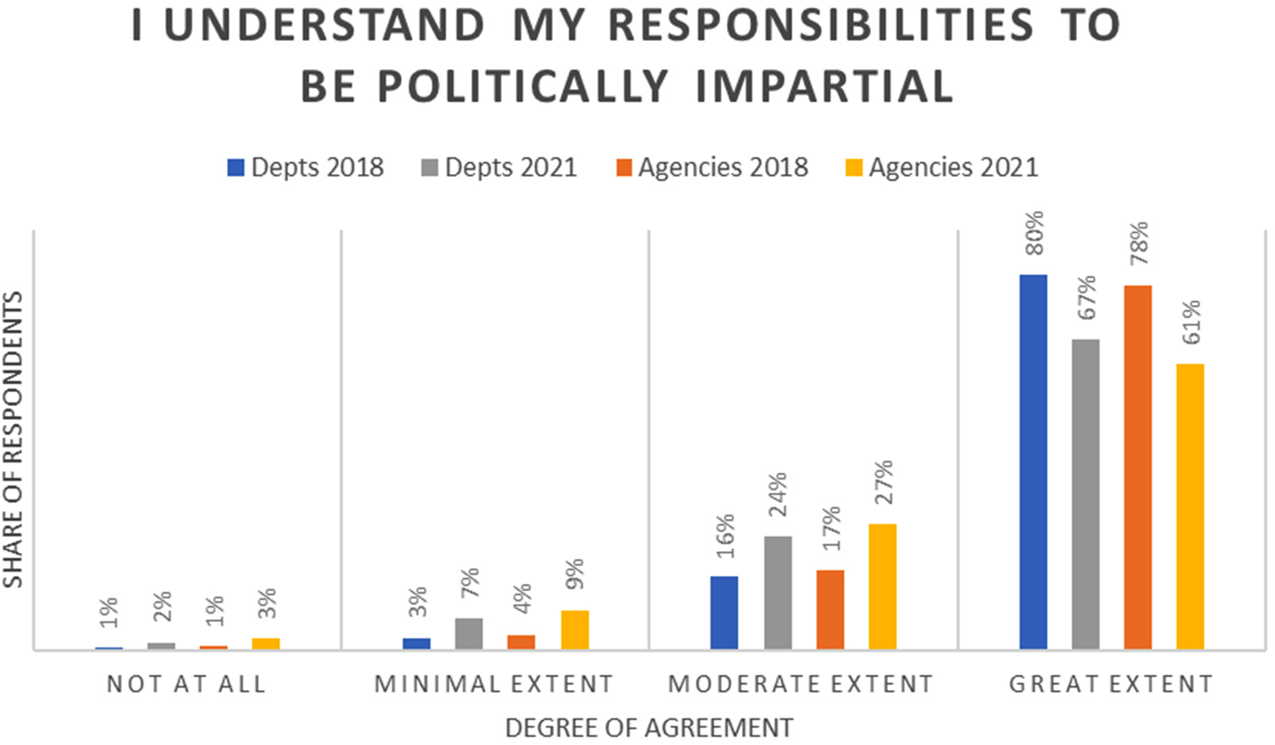
In Figure 1, we see that in both survey years, there is a higher share of respondents from conventional departments in the “to a great extent” category than those in an agency. That is, more of those in departments claim that they have a clear understanding of their responsibilities to be politically impartial. Similarly, on the other pole, we see that there tends to be a greater share of respondents in agencies that tell us, in response to the question prompt about their understanding of their responsibilities to be politically impartial, “not at all” or to a “minimal extent” than those in departments. Consistent across respondents in both conventional departments and agencies is a slip down the scale from 2018 to 2021—that is, a greater share than the prior survey year citing less understanding of their responsibilities to be politically impartial in carrying out their duties. This trend is mirrored in the two other measures of political impartiality, the descriptive data for which is found in the Appendix.
Analysis
Logistic regression is used to isolate the agency effect on the dependent variables of interest. The raw data is Likert-style, but we are less concerned with what explains the movement from one level to the other on this continuum of experience, and more concerned with what explains those who identify moderate-to-great politicization from those who report minimal-to-none. Variables for control are gender, years in public service, region (of Canada) and occupational group. These variables are not of primary theoretical interest in this study but may nevertheless connect to experiences of political impartiality in an organization and therefore ought to be controlled. For example, how an employee may conceive of the concept of “political impartiality” may be systematically different for those in their first year in public service from those in their 20th year (Natarajan and Nagar, Reference Natarajan and Nagar2011); Christensen and Lægreid (Reference Christensen and Lægreid2007) also find that the experience that public servants acquire in the course of their career is significant for various indicators of attitudes and behaviours. Likewise, those working in the National Capital Region (Ottawa) may feel leadership dynamics differently than those working outside the capital (Veselý, Reference Veselý2014; Wellstead and Stedman, Reference Wellstead and Stedman2010), as perhaps would those in executive roles versus junior policy roles (Shaw and Eichbaum, Reference Shaw and Eichbaum2020). These are not the primary analytical focus of this study and therefore are used as controls in the analysis to isolate the effects of the agency form on our measures of political impartiality.
Recall that the main thrust of the hypothesis stems from the “compensatory logic of politicization” thesis, a counter-intuitive notion that those in agencies will report less political impartiality than those in conventional departments, as governments have incentives to find ways to shape decisions in public organizations with which they have less day-to-day control.
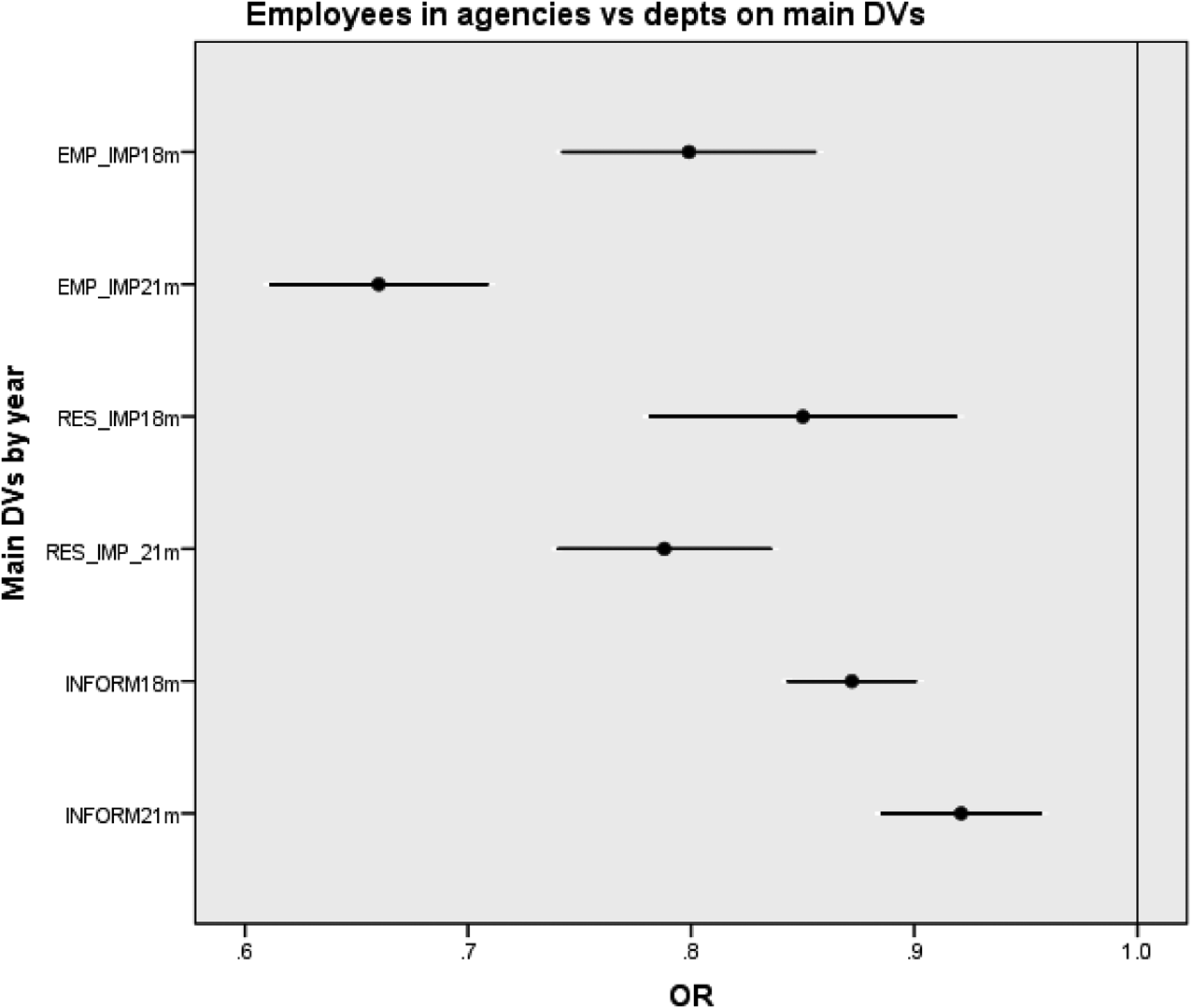
Figure 2 provides a summary of the results of the regression analysis on the main dependent variables of interest. The first regression is a basic division of agencies from conventional departments, and the data show that those in agencies are systematically less likely to report that colleagues in their organization act politically impartially in carrying out their duties, that they themselves understand their responsibilities to be politically impartial and feel like their organization keeps them informed of such responsibilities—than those in conventional departments (the base case in the regression, fixed to 1.0 in the graph below). These results conform to the “compensatory logic of politicization” thesis—that public organizations ostensibly farther from the direct control of elected officials are more likely to be politicized. These results are consistent over the two survey waves in 2018 and 2021. Full regression data tables for Figure 2 are provided in the Appendix.
Summary of Logistic Regression Results for Agencies on Main Dependent Variables
Note: Odds ratios reported, and conventional departments are reference category. Notation for variables is as follows: for e.g. “EMP_IMP18m”, Employees in unit carry out duties in impartial manner, 2018 survey year, m is for matched data.
Informed from prior work in Canada (Doberstein, Reference Doberstein2022; Reference Doberstein2023), agencies are clearly not all the same in terms of mandate, interaction with stakeholders and performance, and collapsing them together would obscure important differences among them. Therefore, in the next step of the analysis, they are separated into theoretically relevant categories according to their mandate. The agency types differentiated in the analysis below are: administrative, regulatory, enforcement, adjudicative and parliamentary.
Figure 3 reports the regression results for the first dependent variable measure—how respondents think about employees in their organization carrying out duties in a politically impartial manner (EMP_IMP)—differentiated by agency type. What we observe in the regression results that differentiate by organization type is that much of what appears to be driving the observation that those in agencies have political impartiality problems comes from a single agency type: enforcement agencies. These agencies powerfully skew the initial regression results because the number of employees in these agencies is a large share of the sample (approximately 18 per cent of the total sample, 58 per cent of all agency employees in the sample). Examples of enforcement agencies in Canada are the Royal Canadian Mounted Police (RCMP), Canada Border Services Agency (CBSA) and the Correctional Service of Canada (CSC). Respondents from these agencies systematically assess the political impartiality of employees in their organization as lower than those in other agencies and conventional departments (the base case in the regression, fixed at 1.0 in the graph below), a difference robust over the two survey waves of 2018 and 2021. The story for other agencies is less clear, as employees in adjudicative and regulatory agencies appear to have slipped from a superior standing (compared to departments) on political impartiality in 2018 to a weaker position in 2021. Those in administrative agencies are consistently more likely to report higher political impartiality than those in conventional departments.
Agencies Differentiated by Type on whether Respondent Believes Employees in their Organization Carry Out their Duties in a Politically Impartial Manner.
Note: Odds ratios reported, and conventional departments are the reference category. Confidence intervals vary widely from the regressions because sample sizes vary substantially (i.e., many more respondents in enforcement agencies than adjudicative, regulatory and parliamentary agencies because the latter are small organizations).
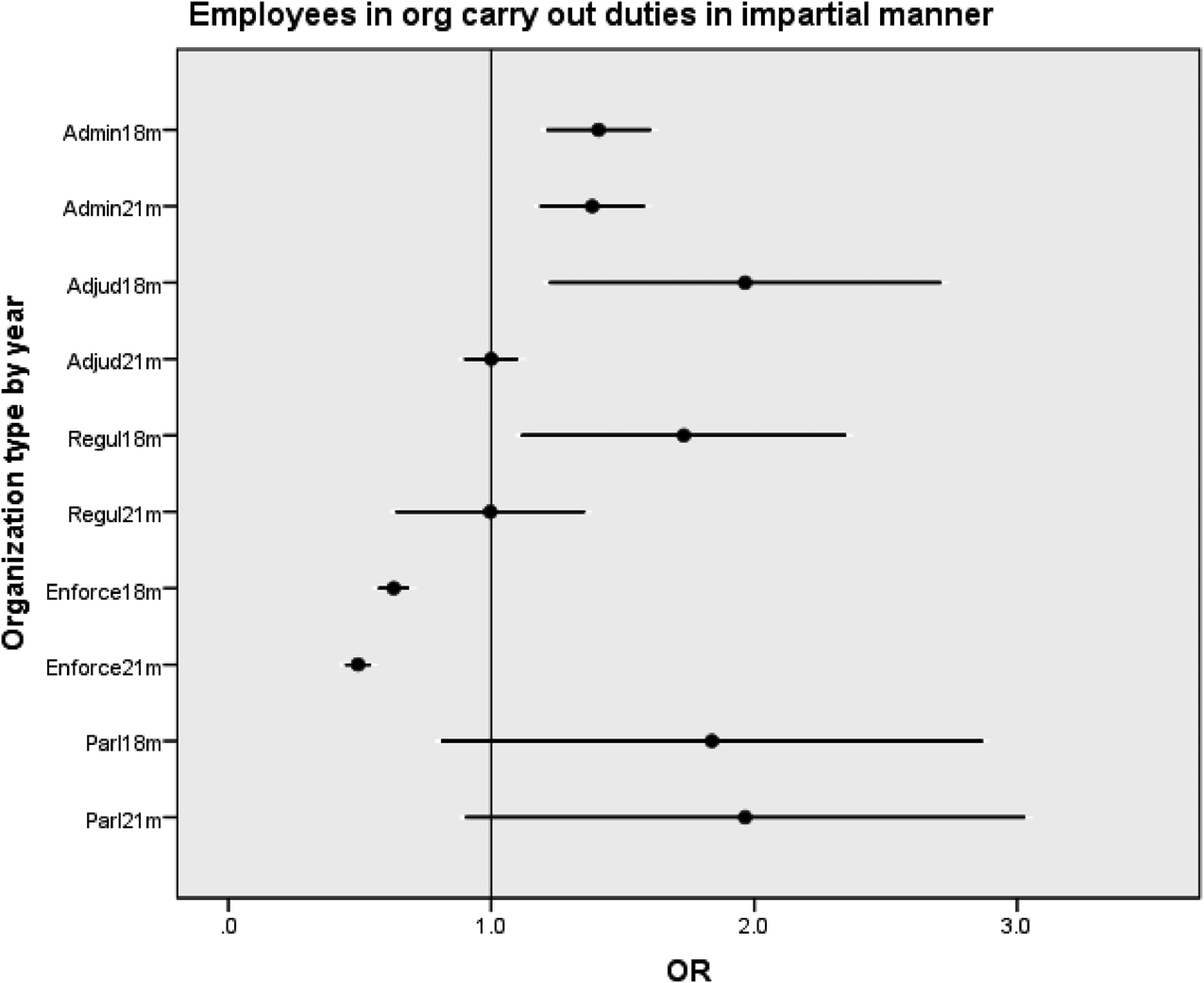
Figure 4 reports the summary regression results for the second dependent variable measure of political impartiality—how respondents assess their own understanding of their responsibilities to carry out their duties in a politically impartial manner (RESP_IMP)—differentiated by agency type. Given that this is an inwardly focused question about the respondent, one might anticipate evidence of a degree of social desirability bias; that is, respondents may feel more inclined to answer this question affirmatively given that it is assessing their understanding of their responsibilities regarding political impartiality (as opposed to the first measure above which was about other people's actions regarding political impartiality in their organization). Yet even assuming this expected dampening effect of the question, we still see that those in enforcement agencies report that they themselves are less likely to say they understand their responsibilities regarding political impartiality compared to other agencies and the conventional departments (the base case in the regression, fixed at 1.0 in the graph below). The other agencies are not statistically different from departments in a patterned way across the two survey waves, though there are hints of a decline in understanding responsibilities to be politically impartial among most other agencies from 2018 to 2021.
Agencies Differentiated by Type on whether Respondent Understands their Responsibilities to be Politically Impartial in Carrying Out their Duties as a Public Servant.
Note: Odds ratios reported, and conventional departments are the reference category.
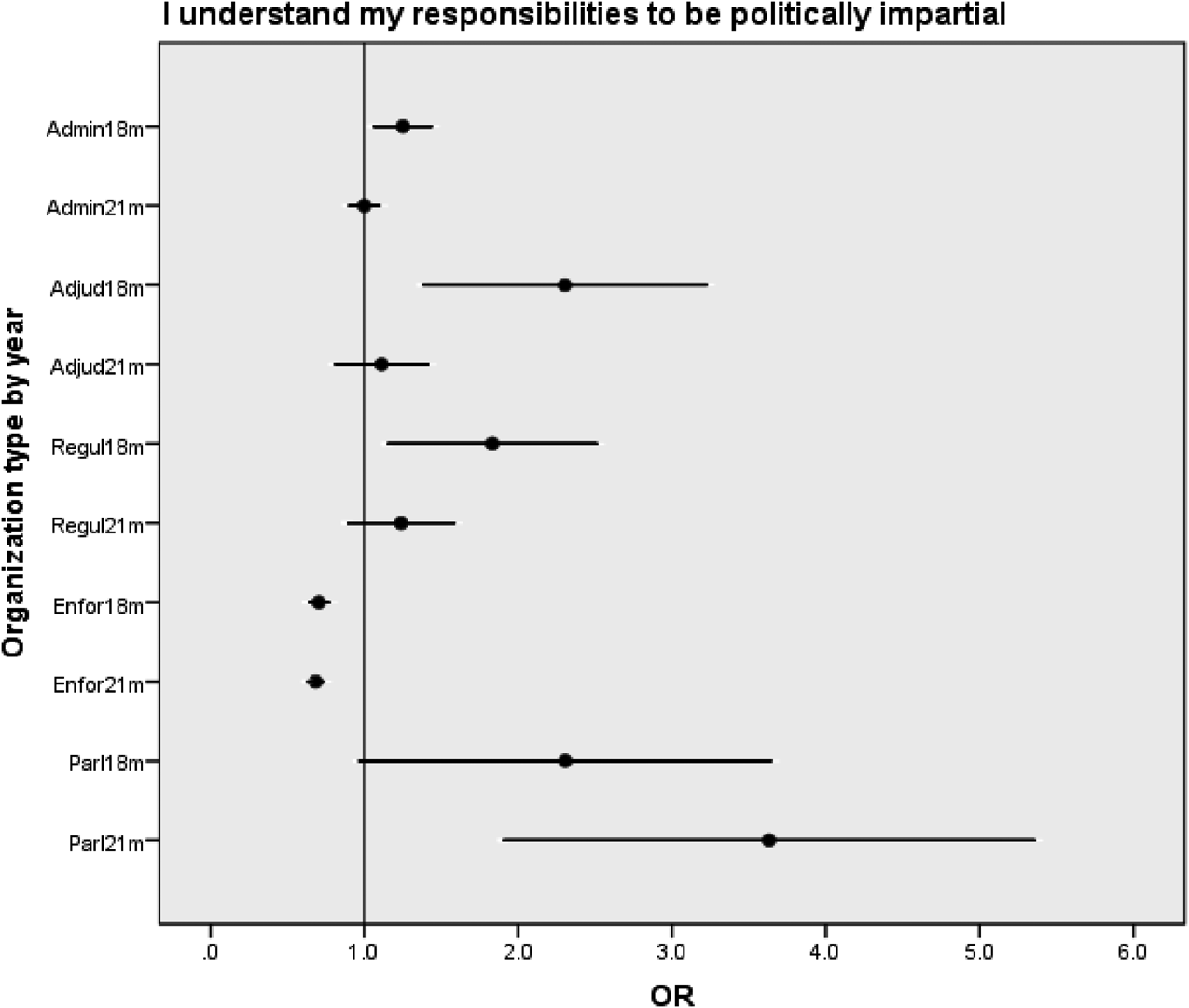
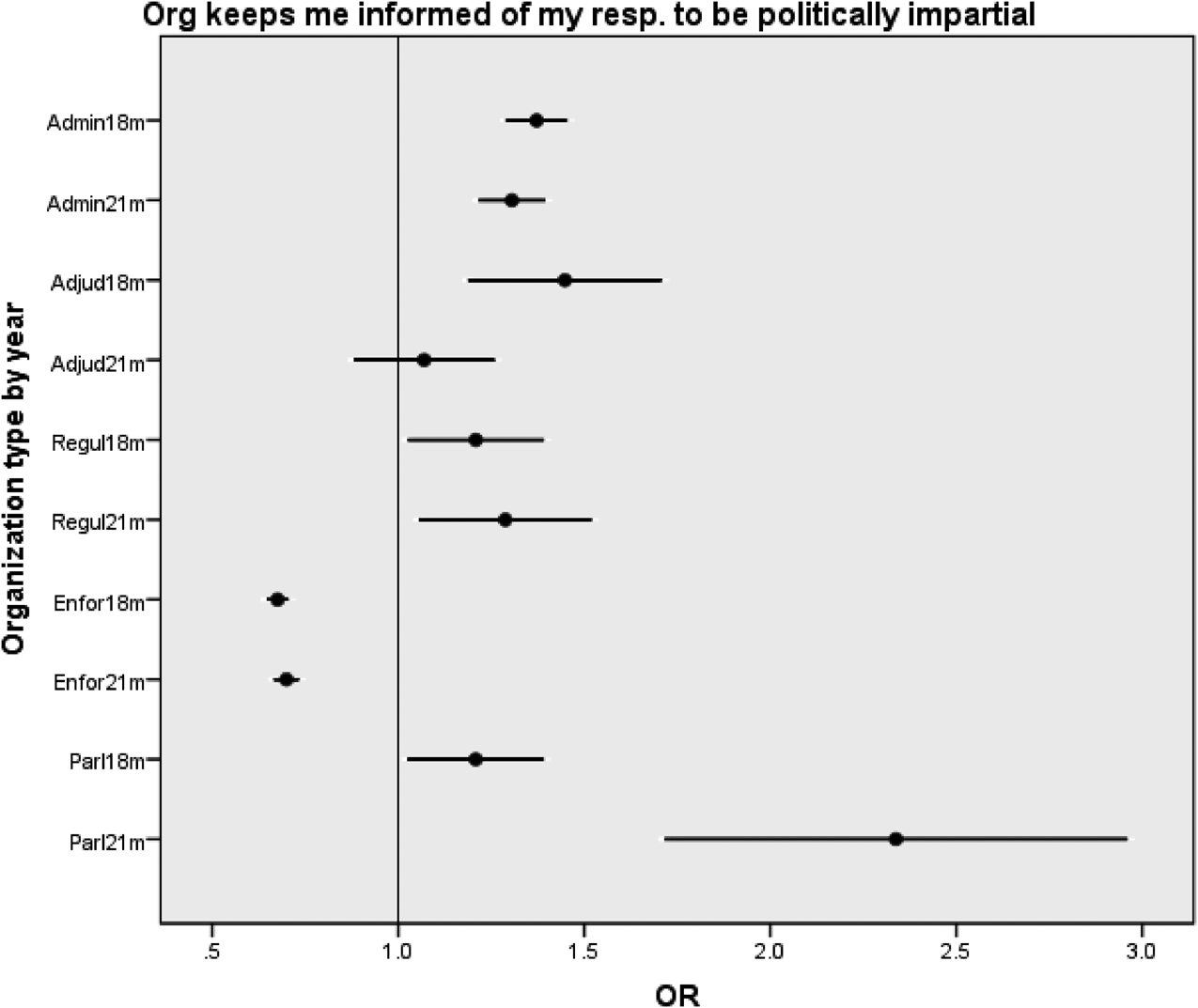
Figure 5 reports the summary regression results for the third dependent variable measure—how well respondents report their organization keeps them informed of their responsibilities to be politically impartial in carrying out their duties (INFORM)—differentiated by agency type. This can be thought of as a measure of the department culture regarding political impartiality. Consistent with the other measures of political impartiality, we see that employees in enforcement agencies are less likely than those in departments to report that their organization keeps them informed of their responsibilities to be politically impartial in carrying out their duties. For the most part, it appears as though employees in other agencies, however, are more likely to report a politically impartial organizational culture than those in conventional departments.
Agencies Differentiated by Type on whether Respondent Reports that their Organization Keeps them Informed of their Responsibilities to be Politically Impartial in Carrying Out their Duties.
Note: Odds ratios reported, and conventional departments are the reference category.
Discussion
Returning to the main theoretical proposition at the heart of this study—the “compensatory logic of politicization” thesis—a counter-intuitive claim that public organizations ostensibly farther from the direct control of elected officials are more likely to be politicized. We observe in Canadian data that this logic is present in some types of agencies, namely enforcement agencies. The main enforcement agencies surveyed under the SNPS are the Royal Canadian Mounted Police (RCMP), the Canada Border Services Agency (CBSA) and the Correctional Service of Canada (CSC). As mentioned earlier when introducing the survey, Statistics Canada access rules for this data prohibit releasing descriptive data on specific organizations, but we can draw on secondary data and literature to explore why these agencies and not others? The challenges within enforcement agencies in Canada have long been documented (Perrott and Kelloway, Reference Perrott and Kevin Kelloway2011); the nature of the work, the history and culture of the organizations and the unique pressures on those deliverables for any government make the work of these organizations especially challenging. The work of enforcement agencies is always “political” in some sense, in that the very nature of the mandate means the work very often has high political salience, even as we expect it ought not to be partisan in operation.
Yet until now, we have not observed a systemic political impartiality deficit compared to other public organizations. That enforcement agencies stand out poorly on the question of political impartiality is perhaps surprising, given that these are the very agencies we might normatively wish to be assiduously politically impartial. These are agencies tasked by the state to uphold the rule of law and ensure equal treatment under it, regardless of the political dynamics at play. Political impartiality is critical among those entrusted in these roles, as it fosters public trust, safeguards against the abuse of power and maintains the integrity of law enforcement. Yet this work is challenging in that it is often highly politically salient, consists of diverse and competing interests and activists, and is work that comes with high stakes and therefore potential for intense negative public attention (Atak et al., Reference Atak, Hudson and Nakache2019). The work conducted by these agencies tends to be reactive in nature as well, involves considerable discretion given the mandate and therefore may be more subject to ad-hoc ministerial intervention. This may all add up to a work environment and organizational culture, given the enforcement mandate, that attracts particular employees with law and security educational backgrounds, and a further unique professional socialization compared to others in government (Côté-Boucher and Paquet, Reference Côté-Boucher, Paquet and Dauvergne2021).
Additionally, the era under investigation is one ripe with particular controversies and changing norms around enforcement. All of the main enforcement agencies in the SNPS survey have faced considerable public controversies. The RCMP has leaped from scandal to scandal with the Murdered and Missing Indigenous Women political mobilization, the 2020 Nova Scotia murder spree and a series of Commissioners of the RCMP who have struggled to balance the mandate from government and the expectations of the force members (Leuprecht, Reference Leuprecht2017; Palango, Reference Palango2008; Perrott and Kelloway, Reference Perrott and Kevin Kelloway2011). Other surveys of RCMP members have revealed alarming morale metrics, signalling major disconnects and anger between front-line officers and management in Ottawa (Perrott and Kelloway, Reference Perrott and Kevin Kelloway2011). The Correctional Service of Canada (CSC) and Canada Border Services Agency (CBSA) have also been subject to Auditor General and Special Investigator probes, revealing systemic problems that may help contextualize the SPNS data examined in this study. For example, since its creation in 2003, the mandate of the CBSA has evolved away from matters of customs and economic protectionism to counter-terrorism and immigration enforcement (Atak et al., Reference Atak, Hudson and Nakache2019). It has also been separated from other aspects of immigration and refugee policy through a focused mandate on enforcement, which has created an organizational culture and skewed perception of the target population of the agency (Côté-Boucher and Paquet, Reference Côté-Boucher, Paquet and Dauvergne2021). The politics of border enforcement belie a sense of an arm's-length status, with their work always top of mind for governments, whether it was the Harper government establishing unrealistic, aggressive performance metrics for refugee and asylum decisions (Atak et al., Reference Atak, Hudson and Nakache2019), or Justin Trudeau's infamous #WelcometoCanada rhetoric in January 2017 that Canada was a safe refuge from the incoming Trump Administration (Paquet and Schertzer, Reference Paquet and Schertzer2020).
The findings in this study are useful for their descriptive character: this is comparative data of the experience within agencies that have thus far not been analyzed and reveals a pattern relating to the perceived political impartiality of government organizations by those working in them that has not previously been identified. More research needs to be conducted to tease out the plausible explanations for the uniquely concerning levels of political impartiality within enforcement agencies in Canada reflected in SNPS data, as well as the numerous case studies and media coverage that aligns with this data. On the other hand, the Canadian data tells us that other agencies—administrative, adjudicative, regulatory, parliamentary—tend to exhibit greater (or not statistically different) political impartiality to those in conventional departments, as measured from employees within the organizations. In this way, the compensatory logic of politicization is not observed in the data for most agencies in Canada. Employees in these agencies appear to assess themselves and their colleagues as often displaying superior levels of political impartiality, which is consistent with the traditional justification of agencies as requiring space from day-to-day political intervention in order to provide credible policy commitments on, say, regulatory matters. That is, with greater political impartiality within regulatory bodies, regulatory decisions will not swing wildly with the change of governments. More study is required to tease out why some agency mandates and types may display a compensatory logic of politicization and others not. Further evidence of the compensatory logic of politicization ought to be gathered by examining appointment data for board members or senior leadership of organizations and tracing their political connections, ideologies and other policy commitments.
The data used in this study is derived from the Government of Canada's Staffing and Non-Partisanship Survey (SNPS), a rich resource given that it is a census of employees in participating public organizations and therefore is not merely a sample of public servants. The high number of respondents (200,000+) allows for confident estimates of phenomena measured and methods of analysis like matching that benefit from a large number of respondents. However, there are limitations to this study that stem from the data source.
First, we are not the authors of the survey and therefore must accept the survey design as it was conducted. The survey instrument does not allow us to know what exactly the respondents are thinking when they are asked about “political impartiality.” It is possible that some public servants, in some organizational contexts, think about this concept differently, perhaps systematically. For example, if we ask a policy analyst in the Department of Finance about political impartiality, they might be thinking about their use of data and analysis in briefing documents and reports as not derived with partisan favour, but if we ask a regional manager in the Canada Border Services Agency about political impartiality, they may be thinking about how the organization deals with political asylum seekers at their local border crossing. Only with control over the survey instrument could the researcher make choices that tried to drill down at the possible different conceptions of political impartiality in different contexts.
Second, this survey contains detailed and sensitive data from public servants, and as a result, the Government of Canada has established rules on the use and disclosure of the data for researchers who have been granted access to the micro data in their authorized facilities. One such rule is that the researcher cannot publicly share any patterns in political impartiality for specific organizations, and therefore the level of analysis must stay at the level of organizational type. This is simply a trade-off one must make in order to access the otherwise rich survey data. We can, however, list how each organization was categorized in the data analysis in Table A1 of the Appendix. A third limitation is that the purpose of the SNPS is to identify and track staffing and other human resources issues in the public service, at the same time as they attempt to measure public service norms and values like impartiality. It is not, therefore, primarily conceived as a tool to measure politicization more broadly in the public service. As such, this survey data ought to be complemented with other researcher-designed surveys that aim to directly measure politicization, possibly with a list experiment methodology, which is useful for getting respondents to respond honestly when asked about controversial topics.
A final limitation is not with respect to the survey methodology or data, but the endogenous elements that may shape the outcomes of interest. Chief among them is the possibility of a self-selection bias in terms of employees within certain agencies, and enforcement agencies in particular. There may be unobserved aspects that are correlated to political impartiality that are not controlled by matching and regression analysis. That is, there might be something about the people who seek employment in enforcement agencies that differentiates them from most other public servants. And furthermore, we might anticipate that those in enforcement agencies are less likely to move around the public service like others; a border guard, corrections official, policing professional, etc. have particular skills applied in this domain, unlike the general policy analyst who can apply their skills in various departments over their career. Therefore, to the extent that there is a self-selection bias for entry into enforcement agency positions, there is also less mobility in and out of these organizations that might serve to counter such a bias. We do not have data at this time that can measure the extent of the self-selection bias in public sector agencies, but future research ought to gather information to examine this.
Conclusion
This research provides insight into politicization in modern public sector organizations by harnessing data from a unique internal government survey in Canada. Given strong norms of neutrality and impartiality in public bureaucracies and organizations, and particular sensitivities to these traits, it can be challenging to study bureaucratic politicization. At the same time, we understand that elected leaders use personnel and organizational structures to enable them to execute their policy agenda, all of which is broadly accepted. Control of the bureaucracy and administrative institutions is a priority for all elected leaders, yet scholars have observed agency creation and growth as potential vehicles to further politicize the public service. Empirically, in Canadian federal agencies, there are systematic differences between some agencies and their departmental counterparts with regard to political impartiality. Researchers need to study this phenomenon more to understand if “political impartiality” in this context is merely capturing the feeling of the policy agenda of the elected government being operationalized, or whether the work is “politicized” in the sense of being exercised in problematic ways.
Supplementary Material
The supplementary material for this article can be found at https://doi.org/10.1017/S0008423924000453.
Competing interests
The author declares none.


 Open access

