


The importance of historical-ecological approaches for supplementing biodiversity research is increasingly recognized (Navarro et al., Reference Navarro, Armstrong, Changeux, Frisch, Gil-Romera and Kaim2025). These approaches include gathering data from previously underutilized sources, such as oral and linguistic sources, pictorial representations and scientific collections (Bartomeus et al., Reference Bartomeus, Stavert, Ward and Aguado2018; Tribot et al., Reference Tribot, Faget, Richard and Changeux2022; Biró et al., Reference Biró, Molnár, Öllerer, Szilágyi, Babai and Molnár2024). Additionally, unstructured written materials such as travellers’ accounts can be a useful source of information, providing qualitative and quantitative data on species richness and abundance (Scholte, Reference Scholte2011). By utilizing these historical sources, we can potentially learn more about biodiversity baselines and changes in fauna and flora over time (McClenachan et al., Reference McClenachan, Rick, Thurstan, Trant, Alagona and Alleway2024).
Around 70 years ago, Sir David Attenborough and colleagues developed a series of television programmes (and for all but the first series in Sierra Leone, accompanying books were published) for the BBC that would eventually constitute the Zoo Quest expeditions (Attenborough, Reference Attenborough1956, Reference Attenborough1957, Reference Attenborough1959, Reference Attenborough1960, Reference Attenborough1961, Reference Attenborough1963). Over the course of these expeditions, Attenborough travelled to various tropical and subtropical locations to seek animals, plants and human cultures that in many cases had rarely, if ever, been captured on film. Through his own training in natural history, and assisted by colleagues and local experts, Attenborough’s observations of species may have additional importance because we now know many of the locations he visited are in biodiversity hotspots (Myers et al., Reference Myers, Mittermeier, Mittermeier, da Fonseca and Kent2000).
Here, I assess how the observations Attenborough made during the Zoo Quest expeditions provide a novel source of historical biodiversity data. I reviewed the six original books documenting the Zoo Quest expeditions: Zoo Quest to Guiana (Attenborough, Reference Attenborough1956), Zoo Quest for a Dragon (Attenborough, Reference Attenborough1957), Zoo Quest to Paraguay (Attenborough, Reference Attenborough1959), Quest in Paradise (Attenborough, Reference Attenborough1960), Zoo Quest to Madagascar (Attenborough, Reference Attenborough1961), and Quest Under Capricorn (Attenborough, Reference Attenborough1963). Each book was published within at most 3 years of the expeditions, and within each book I recorded the animal species observed (typically mentioned by common name), either directly or through unambiguous recent indicators of the species’ presence. Often taxa were referred to generally, and I only included as much taxonomic information about each species as I could reasonably identify based on the name, description and geographical location. If identified to species, I then searched the IUCN Red List for the species, and where possible recorded data on the species’ geographical range and current status (IUCN, 2025). This enabled me to compare the approximate locations in which species were observed with their current geographical ranges, and further determine the extent to which the species observed were threatened (i.e. categorized on the Red List as Critically Endangered, Endangered or Vulnerable).
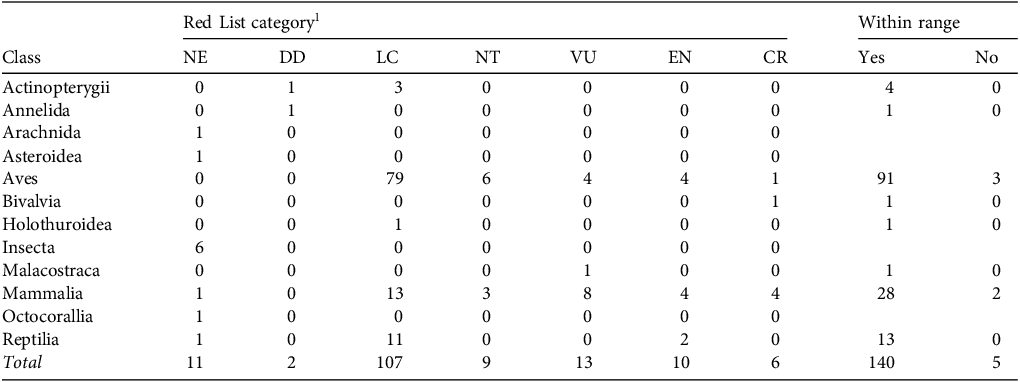
Overall, I found that Attenborough recorded observations of 375 taxa across locations in 10 countries: Guyana (Zoo Quest to Guiana), Indonesia (Zoo Quest for a Dragon), Argentina, and Paraguay (Zoo Quest to Paraguay), Papua New Guinea (Quest in Paradise), Madagascar (Zoo Quest to Madagascar), and Australia, Fiji, Tonga and Vanuatu (Quest Under Capricorn) (Fig. 1). This included 21 classes, 82 orders, 152 families, 170 genera and 158 distinct species (eight species were recorded more than once across multiple expeditions, so in total 167 taxa were actually identified to species). The greatest number of species were recorded in Guyana (41), followed by Madagascar (35), Paraguay (29), Indonesia (20), Australia (18), Papua New Guinea (13), Argentina (7), Fiji (5) and Tonga (1). Of the 147 species for which some information is available on the IUCN Red List, six are Critically Endangered, 10 are Endangered, 13 are Vulnerable, nine are Near Threatened, 107 are Least Concern and two are Data Deficient (Table 1).
The countries where animal observations were documented during Sir David Attenborough’s Zoo Quest expeditions: Guyana (Zoo Quest to Guiana), Indonesia (Zoo Quest for a Dragon), Argentina and Paraguay (Zoo Quest to Paraguay), Papua New Guinea (Quest in Paradise), Madagascar (Zoo Quest to Madagascar), and Australia, Fiji, Tonga and Vanuatu (Quest Under Capricorn).

Counts of species observations in the Zoo Quest expeditions by class, and by current IUCN Red List category, and whether the observation was made within the species’ current geographical range as documented on the Red List. No species observed are categorized as Extinct in the Wild or Extinct.

1 NE, Not Evaluated; DD, Data Deficient; LC, Least Concern; NT, Near Threatened; VU, Vulnerable; EN, Endangered; CR, Critically Endangered.
I compared location data for 145 of the species with information on the Red List (two species were observed in captivity); 140 of these species appeared to have been observed within their current geographical ranges as described on the Red List, but there were discrepancies with the observed locations of five species (Table 1). Two were mammals observed in Argentina and three were birds observed in Madagascar; none of them are categorized as threatened on the Red List. Attenborough observed both the Brazilian lesser long-nosed armadillo Dasypus septemcinctus and plains viscacha Lagostomus maximus in Corrientes Province, Argentina (Attenborough, Reference Attenborough1959). Both observations seem accurate, but according to the Red List the Brazilian lesser long-nosed armadillo’s presence at this location is uncertain, and the plains viscacha’s range does not appear to extend this far (IUCN, 2025). However, Attenborough wrote that the plains viscacha was reportedly rare locally when he made his observation, which likely explains this discrepancy (Attenborough, Reference Attenborough1959). The Mascarene swiftlet Aerodramus francicus, pitta-like ground-roller Atelornis pittoides and Sakalava weaver Ploceus sakalava were all observed in various locations throughout Madagascar (Attenborough, Reference Attenborough1961). The most questionable of these observations is that of the Mascarene swiftlet around the Linta River in south-west Madagascar. This bird is endemic to the islands of Mauritius and Réunion, c. 1,000 km east of Madagascar (IUCN, 2025). It is possible that subsequent changes in usage of common names could mean these were Madagascar swifts Apus balstoni, which have a much wider distribution across Madagascar. Attenborough described seeing the pitta-like ground-roller around Ankarafantsika in western Madagascar (Attenborough, Reference Attenborough1961). On the Red List this species’ range is limited to eastern Madagascar (IUCN, 2025), but records from the eBird citizen-science database suggest Attenborough’s observation is plausible (eBird, 2025). Similarly, Attenborough observed the Sakalava weaver around Perinet in eastern Madagascar (Attenborough, Reference Attenborough1961). Although this conflicts with the species’ range documented on the Red List, largely being limited to western Madagascar (IUCN, 2025), this observation is also supported by citizen-science data (eBird, 2025).
These results further demonstrate the potential value of travellers’ accounts for informing biodiversity baselines and trends (Scholte, Reference Scholte2011; Navarro et al., Reference Navarro, Armstrong, Changeux, Frisch, Gil-Romera and Kaim2025). Overall, 19.7% of species observed are categorized as threatened on the Red List, which highlights the enduring conservation relevance of these works. Although the vast majority of species observed during the Zoo Quest expeditions appear to have been within their currently described geographical ranges, as Attenborough writes in his recent revised and condensed collections of the associated books, much has changed in the locations he visited since the expeditions took place (Attenborough, Reference Attenborough2017, Reference Attenborough2018). Therefore, these observations still provide useful spatial and temporal comparisons, and confirm that travellers’ accounts from the modern era outside mainstream scientific databases can also be a valuable source of biodiversity data.
As is typical with historical sources of biodiversity data, there are some potential limitations to quality (Díaz & Corti, Reference Díaz and Corti2025). The original species identifications are likely accurate given the expertise of Attenborough and his colleagues. But for some species, especially those described only with common names, there is a possibility that subsequent common name changes could have led to misidentification. Additionally, I was generally only able to discern approximate locations where species were observed. Species experts will likely be able to better assess the reliability of any of my questionable species observation locations. Also, the numbers of species observed do not necessarily reflect the biodiversity of a given location, because each expedition had a different focus; later expeditions in particular were more focused on recording human cultures than animals and plants.
Attenborough’s impact on the conservation community is extensive. His award-winning programmes and books have helped to catalyse conservation narratives around the world, and he has taxa ranging from plesiosaurs (Attenborosaurus conybeari) to pitcher plants (Nepenthes attenboroughii) named in his honour. The present study shows that his works also provide novel sources of historical biodiversity data. There are likely additional useful biodiversity data to gather from the accompanying Zoo Quest television programmes, and other Attenborough books and programmes, as well as from the works of other natural history authors, broadcasters and educators.
Acknowledgements
I am grateful to Chris Anderson for his expertise in identifying some of the chameleon species, and to Martin Fisher, Daniel Prior and an anonymous reviewer for their thoughtful comments. The views expressed in this article are mine alone and do not necessarily represent the views of Defenders of Wildlife.
Conflicts of interests
None.
Ethical standards
This research abided by the Oryx guidelines on ethical standards.
Data availability
The data that support the findings of this study are available in the OSF Data Repository at doi.org/10.17605/OSF.IO/B6R9F.


 Open access

