

1 INTRODUCTION
The transformation of the Chinese Communist Party (CCP) from a small group of intellectuals to an immensely powerful ruling party is reflected in changing norms of succession within the Party. For much of CCP history, political advancement was the product of shifting alliances, Comintern involvement, arrests, and even violent action. More recently, the implementation of rules and regulations governing power transfer seems to have led to greater political stability and norm-based mobility. Careful qualitative work has framed our understanding of the changes in individual political trajectories, power transfers, and factional ties brought on by this shift, but systematic studies are needed to better understand larger patterns and structural changes in the Party.
We shed light on such trends by first compiling a new, as complete as possible, set of partially ranked lists of the Party leadership at each Party Congress. Next we develop and apply a methodology for quantifying changes in the composition of the Party leadership from one time to another. Underlying each application of our method is a choice of metric on (a measure of difference between) ranked lists. When applied to our dataset, these metrics capture important political developments, from the irregular leadership change of the early years to the subsequent transformation of the CCP into a more institutionalized polity, a broadly recognized phenomenon. Furthermore, they supplement our understanding of anomalous leadership transitions, intra-Party dynamics, and systemic change in the CCP, by revealing novel, or at least much less well-known, differences in the dynamics of change among the top leadership and within the larger Central Committee. In order to formulate informed policies toward China, international political actors must be aware of these developments and their implications for political stability and policy direction in the CCP. Given the role leaders play in producing policy and the reciprocal impact of divisive policy issues on political relationships, understanding patterns of elite movement contextualizes current policy positions and helps predict future policy change.Footnote 1
Political institutionalization is an important piece of this puzzle, but the development of an increasingly regulated political order has not obviated the role of informal mechanisms in transformations of the elite. Although our methodology is applied within the formal substructures of the CCP, with appropriate data it could also provide insight into the informal workings of the Party. Consequently, our methodology has the potential to provide unique, quantitative, commentary on factional politics and general patterns of political mobility in the CCP from its founding in 1921 to the most recent leadership transition in 2012.
In a broader context, our methodology can also be used to analyze the political elite of other regimes. We do not extend our analysis past the Communist Chinese elite in this paper, but applying our methods to leaderships as diverse as the Communist Party of the Soviet Union and the United States Senate would be a straightforward process, contingent upon data availability. Thus, our methods add a novel quantitative dimension to the study of elite transformation.
2 POLITICAL DEVELOPMENT OF THE CHINESE COMMUNIST PARTY
In recent decades, the CCP has implemented rules that regulate intra-Party succession and privilege formal power over informal influence.Footnote 2 This process of institutionalization has important implications for political stability, regime legitimacy, and factional politics in China.
In his 2003 analysis of the authoritarian resilience of the CCP, Andrew Nathan conceptualizes four major aspects of institutionalization in the Party. First, political succession has become increasingly subject to rules and regulations. Second, the influence of personal ties on promotion has fallen while that of merit has risen. Third, departments are now staffed with specialists and given greater autonomy. Finally, the population is now given more, albeit limited, opportunity to participate in local affairs. Describing the 2002 succession at the 16th Party Congress, Nathan explains how these four aspects of institutionalization have increased stability: “It is the most orderly, peaceful, deliberate, and rule-bound succession in the history of modern China …” (Nathan Reference Nathan2003, 7).
Xiaowei Zang (Reference Zang2004) agrees that political stability is grounded in institutional development: weak institutions produce a political system in constant flux, as leaders use extra-legal means to secure and maintain power. On the other hand, strong institutions characterized by functional differentiation and term limits lead to a system in which political ascent is gradual and the political system is stable.
Political stability reinforces regime legitimacy, so by regulating elite change and setting the foundation for inner-Party democracy, the CCP is authenticating its rule without giving up its prodigious political power.Footnote 3 Although Deng Xiaoping initiated reforms to govern political processes and succession in the Party, the stabilizing effects of such rules did not emerge until the Jiang era.Footnote 4 Indeed, the Mao and Deng eras, characterized by tumultuous paths to power, contrast dramatically with the subsequent Jiang, Hu, and Xi generations, whose members “ascended by rising through the bureaucracies and by not offending people” (Fewsmith Reference Fewsmith2002, 23).
Informal activity and factional politics were significant determinants of political order during the CCP's early years and remain important in Chinese politics today.Footnote 5 In 1973, Nathan proposed a comprehensive model of factionalism to explain the informal nature of elite conflict in the CCP. He defines a faction as a political structure “based upon personal exchange ties rather than authority relations” (Nathan Reference Nathan1973, 42) and posits that no faction can maintain a permanent position of singular power (Nathan Reference Nathan1973, 46).
Tang Tsou, while generally agreeing with Nathan's conception of a faction, disagrees with his assessment that factions coexist. Tsou (Tsou and Nathan Reference Tsou and Nathan1976; Tsou Reference Tsou1995) puts forward an opposing “winner-takes-all” model in which one faction wins complete power. Despite this disagreement, there is consensus that informal ties have historically played a large role in Chinese elite politics by catapulting some to power and leading to the inexorable purging of others. In recent decades, institutionalization has constrained factional politics and transformed elite relations, although there are differing opinions regarding the extent to which formal position supersedes informal power, or vice versa, and the scope of powerful factional interests in determining promotions and demotions.Footnote 6
In the following sections we describe and apply a new approach to understanding elite change as a product of institutional development and informal activity, based on quantification of such change, explaining in detail several theoretical frameworks that are supported by our results. We go on to show that our results are also consistent with the historical record. Lastly, we demonstrate the potential for further, novel, quantitative analysis of elite change in the CCP and in other political systems.
3 QUANTIFYING ELITE CHANGE
3.1 PRIOR WORK
Vilfredo Pareto's seminal conception of elite circulation asserts that “the governing élite is always in a state of slow and continuous transformation,” with the occasional “sudden and violent disturbances” (Pareto Reference Pareto, Livingston, Bongiorno, Livingston and Rogers1935, 2056). Elite circulation in the CCP has primarily been explored through qualitative analyses. These focused studies delve into specific instances, mechanisms, and consequences of change. There have been only a relatively small number of studies that contribute to a systematic understanding of larger trends in elite circulation.
In one such analysis, Zhiyue Bo (Reference Bo2002) conducts a detailed, yet wide-ranging, empirical study of provincial leadership in China. He formulates five quantitative measures of mobility for provincial leaders. Mobility is defined as the movement of a political leader from one post to another and is calculated by measuring the proportion of provincial leaders promoted (upward mobility) and demoted (downward mobility). Stability is calculated according to the proportion of provincial leaders remaining in their positions and horizontal mobility is calculated according to the proportion of provincial leaders transferred to comparable positions in different localities. Lastly, a measure of retirement is calculated. Bo then uses these five measures to sketch a picture of political mobility over time.
Cheng Li and Lynn White also take a systematic approach in their broad analysis of demographic change in the national leadership. In their Reference Li and White2003 study they calculate the proportion of new members in each Congress to identify trends in elite change. Jang-Hwan Joo (Reference Joo2013) similarly uses the proportion of members replaced in each Central Committee to better understand elite circulation. In fact, measures of turnover—the proportion of new or returning leaders—are the usual quantitative tools used to better understand political development, mobility, and demographic change in the CCP.Footnote 7
These studies demonstrate the potential of applying quantitative methods to these complex political phenomena and lay the framework for further quantitative analysis. While turnover is an important marker of change, however, it cannot in itself capture the complexity of change in the Chinese political elite. It fails to address several highly relevant aspects of leadership change in the CCP—change within each political body, the magnitude of such change, and the importance of each change to Party structure and policy. The metrics upon which our method is based incorporate each of these features and thus offer a more comprehensive picture of elite change.
3.2 METRICS ON RANKED LISTS
Power in the CCP is consolidated in the Central Committee (CC), where each member is ranked hierarchically. The Politburo Standing Committee (PSC) is the most powerful political body within the CC and its members are the highest-ranked political leaders in China. Politburo members, Politburo alternates, CC members, and CC alternates comprise the rest of the CC and are ranked in that order. The ranked list changes at each Party Congress, and oftentimes at plenary sessions between Party Congresses, as members are promoted, demoted, retire, or pass away.
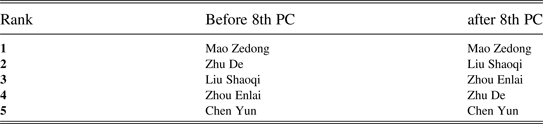
As an example, Table 1 shows the ranks of PSC members immediately before and after the 8th National Party Congress. Mao stayed at the top rank, and Chen at the bottom, but the other three members changed ranks.
Ranks of PSC Members Before and After the 8th National Party Congress

More generally, of course, the set of PSC members (or Politburo members or CC members) changes from one National Party Congress to the next. In this case, the PSC after the 7th National Party Congress included Ren Bishi, but not Chen Yun, who was only promoted to the PSC after Ren died. As we noted in the previous section, it has been common to quantify the change from one PSC (or Politburo or CC) to the next by counting the number of individuals included in one but not the other, and in some cases comparing the ratios of this number to the size of the whole list.Footnote 8 Our goal is a more refined measure of change, one that depends on all the changes in ranks of individuals, not just their changes in group membership. Such a measure would, for example, assign a non-zero difference to the two ranked lists in Table 1, even though the turnover is 0.
The difference between two ranked lists of the same N items can be quantified by a metric, or distance function, on the set S N of such lists. Perhaps the most common in statistics is Kendall's (Reference Kendall1938) tau, but we find it more natural, and more useful, to add the absolute changes in rank for each item (person). Slightly more generally, the ℓp metrics are defined by
 $${\ell ^p}({\sigma _1},{\sigma _2}): = {\left( {\sum\limits_{i = 1}^N \vert {\sigma _1}(i) - {\sigma _2}(i{{) \vert} ^p}} \right)^{1/p}},$$
for σ k ∈ S N (and σ k(i) denoting the rank of i in the list σ k). When p = 1 this is just the sum of the absolute changes in rank for all the items, so the difference (ℓ1 distance) between the two ranked lists in Table 1 is 0 + 2 + 1 + 1 + 0 = 4. When p = 2 this is like the familiar Euclidean distance; applied to the same example the ℓ2 distance is  $\sqrt {{0^2} + {2^2} + {1^2} + {1^2} + {0^2}} = \sqrt 6 $.
Thus, our ideal data set would include ranked lists of the leadership at each Party Congress and each intermediate plenary session. In reality, however, only less complete data are available. People's Daily Online, a state-owned media outlet, publishes Party documents for each Party Congress, which include membership lists, and scholars have pieced together others.Footnote 9 We draw on these sources to construct a set of ranked lists for the 1st Party Congress in 1921 to the 18th Party Congress in 2012 (see Appendix 1). For some Party Congresses, we have fully ranked lists in which each member of the CC is given a distinct rank. For the remaining congresses, we have partially ranked lists in which some members are given distinct ranks and others are tied at a given rank. For example, if we know the 15 members that comprise the part of the Politburo not in the PSC, but we do not know how they rank in relation to each other, we assign them a tied rank that places them below the PSC and above the rest of the CC.
This means that we must generalize metrics on S N to deal with the case of tied ranks; this will also suffice to handle the situation in which two top elite lists do not include the same members—we take them to provide only partial information, with unlisted people assumed to be ranked equally, but below listed ones. In Appendix 2 we explain the details of how to do this mathematically.
We need to do more than this, however, because without further elaboration these metrics fail to capture a crucial feature of changes in political rankings—namely that a change in rank from 2 to 1 is more important than a change in rank from 102 to 101—since both changes would contribute equally to the ℓp distance between two rankings. To include this aspect of political reality into our formalism, we introduce a rank transform function, the details of which are explained in Appendix 2. The resulting formulae capture both aspects of changes in rank within the elite hierarchy: the magnitude of each change—a move from rank 15 to rank 1 contributes more to the distance than a move from rank 15 to rank 10; and the location of each change—change at the top of the list is weighted more heavily than change lower on the list. Although both of the scenarios above represent a rank change of 1, change in the top echelons of power has a greater impact on policy and stability than a similar change lower in the hierarchy, and thus the former contributes much more than does the latter to the distances we compute.
The choice of p in the ℓp metric can help distinguish the nature of leadership change at each transition. Our standard choice will be p = 1, which weights each change in (transformed) rank equally; since it sums these equally weighted changes for each person, we will refer to it as the Total distance, and denote it by T. We also compute distances with p = 2, which weights large changes in (transformed) rank more heavily than small changes. To understand the practical implications of this difference, consider the following scenarios: in the first scenario one person's rank changes by 9 and in the second scenario 9 people's ranks each change by 1. The (untransformed) ℓ1 metric, by weighting each change equally, gives the same distance, T = 9, for each scenario. The (untransformed) ℓ2 metric, however, gives a larger distance ( $\sqrt {{9^2}} = 9$) for the former than for the latter ( $\sqrt {{1^2} + \cdots + {1^2}} = \sqrt 9 = 3$): using p = 2 maximizes distance when leaders are given especially large promotions or demotions and minimizes distance when leadership change is more uniformly distributed across leaders. Since it weights larger changes (jumps) more heavily, we will refer to the ℓ2 metric as the Jump distance and denote it by J. Thus, by comparing the T and J distances, we identify total change as well as the distribution of change at each leadership transition.
Separate measures of change can be calculated for the entire list of CC members, just for those comprising the Politburo, and finally just for the exclusive PSC. In this way we isolate change in particular political bodies and study the ways in which leadership change varies between them. Empirically, each of these three bodies draws from a different sized top set of the entire Party membership. Although we might set N to be the total number of Party members,Footnote 10 this would imply unrealistic promotion possibilities! Rather, for the PSC we use N = 236, the largest number of members in a CC (the 12th), since no one has ever been promoted to the PSC at a National Party Congress without having been a member of the prior CC.Footnote 11 In the same vein, for the Politburo we use N = 376, the largest number of members and alternates in a CC (the 18th).Footnote 12 Finally, for the CC we use N = 2270, the largest number of delegates to a National Party Congress (the 18th). In fact, the distance formula (4) we derive in Appendix 2 depends only weakly on N, so any numbers close to these would give essentially the same results.
For fixed N we can, and do, normalize the distances by dividing by the largest possible distance between two ranked lists of length N, namely the distance between any list and its reverse. Thus, in the following plots the distances are less than or equal to 1.
Finally, the metrics can be disaggregated to analyze patterns of upward and downward mobility separately. To do this, the distance formula is applied selectively to those promoted or demoted at each leadership transition, and thereby computes separate measures of distance for upward and downward movement. Applying the metrics in this way can help us isolate variation in patterns of political entry and promotion from patterns of demotion and political exit.
4 LARGE SCALE PATTERNS
4.1 STABILITY AND TRANSITION
Deng Xiaoping implemented age and term limits for certain leadership positions, a system of regular meetings, and multi-candidate elections in an effort to institutionalize succession.Footnote 13Figure 1 illustrates how these reforms, which were extended and strengthened by subsequent leaders, led to more predictable patterns of elite mobility during the Jiang, Hu, and Xi eras.Footnote 14 These later decades follow an episodic pattern of change that did not exist earlier: the CC plot shows that major leadership change occurred at the 14th, 16th, and 18th Party Congresses (T = 0.68, 0.77, 0.74)Footnote 15 when new generations of leadership came to power as the previous generations retired en masse, and significantly less change occurred at the intermediate15th and 17th Party Congresses (T = 0.51, 0.48). This pattern is also pronounced when looking only at the Politburo (T = 0.52, 0.59, 0.59 versus T = 0.31, 0.21) and PSC (T = 0.37, 0.56, 0.49 versus T = 0.11, 0.13). Thus, our plots show a recently developed regularity with Congresses at which substantial leadership transition occurs alternating with ones at which there is very little change; this is consistent with the prevailing view that the development of regulations governing promotion and retirement contributes greatly to order and stability (albeit not in the form of unchanging leadership) in the political system.Footnote 16
An episodic pattern of change emerges at the 14th Party Congress, evident in both the T (solid) and J (dotted) distances, but amplified in the latter
Before norms of power transfer were established, leaders captured and maintained political power through informal mechanisms and shrewd political scheming. During this time factional ties were paramount and sweeping purges were common. Take, for example, Deng's political trajectory. Purged and rehabilitated three times in the course of his political career,Footnote 17 he emerged in 1978 with significant informal influence, which he used to defeat formal holders of power and become supreme leader.Footnote 18 Successive generations of leadership, led by Jiang, Hu, and Xi, have followed a strikingly different pattern. The transition to each of these regimes was relatively smooth, peaceful, and occurred while the predecessor was still alive. This shift is illustrated in Figure 1, which clearly shows the development (post-Deng) of regular intervals that delimit each generation's time in power and help us predict when large-scale change will occur. Predicting such change would have been far more difficult when it was highly volatile and brought on by informal activity.
4.2 STEP-BY-STEP PROMOTION
A stable political system is characterized by the gradual promotion of individuals within the system, as “promotions given too often or too quickly, or promotions involving a disproportionate increase in rewards, threaten the legitimacy of the entire system” (Zang Reference Zang2004, 107). Due to the progressive institutionalization of the CCP, we would expect to see later generations of leadership generally experience more measured ascent through the ranks and earlier generations experience larger and relatively unanticipated promotions and demotions. We test this expectation by comparing Total and Jump distances.
In the CC, the periodicity of the T distances for the last five congresses is magnified in the J distances: the high points are higher and the low points are lower (Figure 1). Separately, each metric highlights the emerging norm of time-dependent generational change, but together the two metrics reveal the nature of promotion practices at each transition. We see that the J values are significantly lower than the T values at the 15th and 17th Party Congresses (J = 0.36, 0.30 versus T = 0.51, 0.48), indicating that not only is there little leadership change at these transitions, but the change that does occur is distributed relatively equally throughout the leadership. In contrast, J values are much higher than T values at the 14th, 16th, and 18th Party Congresses (J = 0.85, 0.89, 0.90 versus T = 0.68, 0.77, 0.74). This indicates that leadership change at each of these transitions is distributed unequally across the leadership: some leaders experience large rank change while others experience little to no rank change. This suggests that political movement is gradual for all but top leaders and future top leaders, who experience significant political movement at pre-determined moments of transition.
Indeed, we can confirm that leaders at the highest levels are those experiencing large rank change by comparing the Total and Jump distances for the Politburo and the PSC (Figures 2 and 3, respectively). As with the CC, we see Jump distances are significantly higher than Total distances at the 14th, 16th, and 18th Party Congresses for both the Politburo (J = 0.79, 0.86, 0.86 versus T = 0.52, 0.59, 0.59) and PSC (J = 0.78, 0.84, 0.81 versus T = 0.37, 0.56, 0.49). In fact, this pattern not only holds for the Politburo and PSC, but is actually magnified as the difference between the T and J distance at each of these congresses is greater for the Politburo and PSC than it is for the CC. Thus, we can confirm that change in the top leadership, caused by strict retirement rules and rapid promotion for select leaders, is especially large when compared to the rest of the leadership.
Politburo J distances are significantly higher than T distances at moments of great transition
PSC J distances are significantly higher than T distances at moments of great transition
Analyzing the political bodies of the CCP separately and together reveals some of the large scale patterns in the circulation of the CCP elite. Further insight into promotion practices in the Party can be obtained by separating out the effect of retirements or removals from our measures of distance. The metrics we are using aggregate both upward and downward political movement. Figure 4, however, shows distance values computed only with upward movement and therefore depicts promotion practices as opposed to overall change. This plot of upward mobility shows how the erratic promotion practices of the early years have transformed into a clear cyclical pattern during the last five congresses. Although we cannot be sure that future transitions will continue to follow this pattern,Footnote 19 the metric shows the development of an unpredictable political system into one with increasingly regulated leader entry and promotion.
Upward mobility follows a clear cyclical pattern during the last five congresses
Our metrics thus provide insight into the outcomes of political development in the CCP. By disaggregating them we empirically verify the development of step-by-step promotion as a political norm, with two important caveats. The first is that promotion practices are time-dependent: they are gradual, relatively equal, and follow a step-by-step pattern during intermediate congresses, but vary significantly during moments of generational change. The second is that top leaders, and future top leaders, experience more substantial movement than the rest of the leadership at select Party Congresses.
5 TRACING HISTORY
These metrics characterize elite circulation at various points in CCP history, and in doing so, trace leadership change over time. They show large scale patterns of leadership change and reveal the nature of such change, but are not designed to incorporate the details and motivations of specific changes. The metrics are therefore most useful in assessing the impact of major internal developments and external events on the magnitude and scope of leadership change in the CCP. In the following sections we use our metrics in conjunction with the historical record to better understand these broad changes in the political elite over time.
5.1 THE EARLY YEARS: 1921–1928
The survival of the CCP was far from certain at the time of its founding and during the first several congresses. The Party was very small and its leadership did not exceed fifteen members until the 5th Party Congress, when it increased threefold. Consequently, the leadership change between the 5th and 6th Congresses is a defining transition in the early history of the CCP.
The T metric characterizes this transition as one of moderate change. The J distances, however, register much higher values for change in the CC (J = 0.85 versus T = 0.43), Politburo (J = 0.87 versus T = 0.48), and PSC (J = 0.89 versus T = 0.53) as shown in Figures 1–3, respectively. This means that some leaders experienced very dramatic change during this transition. Indeed, events in 1927 led to a reshuffling of top Party personnel. Perhaps most importantly, Chen Duxiu, co-founder of the CCP and its highest-ranking leader at the time, was blamed for the failed CCP–KMT (Kuomintang) alliance and was forced to resign by the Comintern.Footnote 20 At the 6th Party Congress a member of the CC, Xiang Zhongfa, replaced him.Footnote 21
5.2 MAO'S ASCENT: 1928–1956
The metrics successfully capture the substantial change in leadership that occurred between the 6th and 7th Party Congresses (Figure 5). The J distances are much larger than the T distances at the 7th Party Congress and indicate that some leaders experienced more dramatic rank change than others (J = 0.92 versus T = 0.64 for the CC, J = 0.90 versus T = 0.57 for the Politburo, and J = 0.83 versus T = 0.43 for the PSC). We know, of course, that the seventeen-year-long 6th Congress was a time of great turmoil and rapid leadership change due to KMT-CCP conflict, factional struggles, and Comintern involvement.Footnote 22 Every position of power was vulnerable to changing circumstances during this tumultuous time. It is in this context that Mao ascended to unparalleled power: he was appointed to the five-person Secretariat in 1935, endorsed by the Comintern in 1938, and made chair of the Secretariat and Politburo in 1943.Footnote 23
Significant leadership change at the 7th Party Congress contrasts dramatically with limited change at the 8th Party Congress
The subsequent shift between the 7th and 8th Party Congresses, in marked contrast, registers a very small amount of change in all three political bodies using both the Total and Jump metrics (J = 0.26 and T = 0.29 for the CC, J = 0.27 and T = 0.24 for the Politburo, and J = 0.23 and T = 0.13 for the PSC); see Figure 5. In fact, there was very little leadership change between these two congresses, especially in the top leadership. As we saw in Table 1, the same six men (with the exception of Ren Bishi, who died) are at the top of both the 7th and 8th Party Congress lists.Footnote 24
The reason for such little change becomes clear as we study the leadership dynamics of this period. Most importantly, none of the leaders had consolidated overriding power and the top leadership held a diversity of perspectives. Although all were guided by socialist ideals, Mao and his opponents, including Liu Shaoqi, Zhou Enlai, and Deng Xiaoping, disagreed about the mechanisms of change and the rate of progress necessary to realize those ideals.Footnote 25 Mao, however, was not powerful enough at this time to remove his opponents from power, as exemplified by events at the 8th Party Congress. Liu Shaoqi, Zhou Enlai, and Deng Xiaoping were given highly significant roles during this Party Congress, and perhaps more indicative of Mao's limited power, delegates to the Party Congress adopted a resolution that changed the guiding principle of the CCP from Mao Zedong Thought to Marxism-Leninism.Footnote 26 Thus, Mao did not have the political power to change the top leaders around him and they remained essentially unchanged between the 7th and 8th Party Congresses.
5.3 THE CULTURAL REVOLUTION: 1966–1976
The next two transitions occurred in the midst of the Cultural Revolution and the metrics reflect the turbulence of this period (Figure 6). Mao's hold on power was much stronger by this time and he was able to orchestrate significant leadership change. He initiated the Cultural Revolution in an attempt both to regain dominance of the Party and to put the country on a path of proletarian revolution.Footnote 27 The ramifications for CCP leadership were significant as Mao restructured political bodies and supplanted top leaders with his allies. The most visible changes in the top leadership were, undoubtedly, the removal of Liu Shaoqi and Deng Xiaoping from power and the designation of Lin Biao as Mao's new successor.Footnote 28 The Total metric, however, shows greater change in the Politburo (T = 0.42) and the CC (T = 0.61). In fact, the violence and anarchy of the Cultural Revolution led to the death or demotion of party members at all levels of leadership.Footnote 29 Moreover, Mao himself initiated considerable change in the CC at the 9th Party Congress by promoting members of the military, leaders of the Cultural Revolution, and other leaders loyal to him.Footnote 30
Leadership change during the Cultural Revolution is especially large in the CC
The “Lin Biao Affair” and the expansion of the PSC between the 9th and 10th Party Congresses led to moderate change at the highest levels of the party (T = 0.29). There is again more substantial change in the CC (T = 0.54), however, where the “Lin Biao Affair” had significant repercussions: “the key aspect of the new CC was that the number of military cadres on the CC dropped by almost half, the majority of those who disappeared having some form of association with the disgraced Lin Biao” (MacFarquhar and Schoenhals Reference MacFarquhar and Schoenhals2006, 363). Moreover, this was the first major transition following the end of the Cultural Revolution and a number of former CC members were thus rehabilitated at this time.Footnote 31
5.4 THE DENG ERA: 1977–1987
The significant leadership change that took place between the 10th and 11th Party Congresses is illustrated in Figures 1–3. Although the 10th Congress was only four years long, from the Cultural Revolution and purge of the Gang of Four to Mao's death and pre-mortem promotion of Hua Guofeng to rank 1, it was a time of remarkable change. In fact, only one member from the PSC of the 10th Congress was included in the subsequent PSC.Footnote 32 Moreover, such dramatic change characterized each leadership transition from the 11th Party Congress to the 14th Party Congress: the difference between the J and T distances at each of these transitions, for the PSC (J = 0.83, 0.76, 0.77, 0.78 versus T = 0.44, 0.30, 0.43, 0.37) and the Politburo (J = 0.89, 0.82, 0.86, 0.79 versus T = 0.57, 0.46, 0.59, 0.52), underscores the significance and unevenness of leadership change during this time (Figures 2 and 3, respectively).
Although Deng maintained a stronghold on political power during this time, he was not officially rank 1. Rather, he chose top leaders and exercised power through them. Before the 12th Party Congress, Deng demoted his political rival Hua Guofeng and in his place promoted Hu Yaobang, with whom he had a personal tie, to Party Chief.Footnote 33 Under Deng's direction, Hu Yaobang continued to reorganize the leadership and oversaw the large-scale retirement of older leaders and the subsequent promotion of younger, more reform-minded leaders.Footnote 34 In fact, Barnett (Reference Barnett1986) finds that “of the 348 regular and alternate members of the CC chosen at the 12th Party Congress in 1982, 210—three-fifths of the total—were new members, and seven new members replaced an equal number of super-annuated leaders in the new 22-member Politburo (20 regulars and two alternates).”Footnote 35 This massive transition was part of Deng's effort to regulate succession and create a strong central leadership.Footnote 36 Deng continued to organize large-scale change and both the Total and Jump distances show the extent of this change at each of the Party Congresses he presided over (T = 0.73, 0.76, 0.62, 0.68 and J = 0.91, 0.82, 0.63, 0.85).
Although Deng sought to institute succession mechanisms and norms, he does not appear to have disavowed informal politics himself. At the end of the 12th Congress in 1987, Deng agreed to “half-retirement,” retiring from the PSC but keeping his position at the Central Military Commission.Footnote 37 Despite this relinquishment of significant formal power, Deng continued to influence the direction of the Party. For example, Hu Yaobang lost his position after losing Deng's support and was replaced by Zhao Ziyang.Footnote 38 Even though Deng did not adhere fully to the regulations he himself instituted, he clearly used his power to institute procedural norms (as discussed in Section 4) and to make far-reaching changes to the composition of the Party. The massive leadership change he directed is reflected in the distances computed with our metrics and testifies to the ambition of his reform programs.
We stop our historical analysis here, at the 14th Party Congress, as the post-Deng trend of increasing institutionalization was discussed in Section 4.
6 DISCUSSION
We have compiled a substantially complete set of partially-ranked lists for the 1st through 18th Chinese Communist Party Central Committees. To analyze changes from one Party Congress to the next, we have introduced a novel family of metrics on partially ranked lists that assign greater significance to changes at the top of the ranking than to changes lower down. Applying these metrics to the data we observe large scale patterns that confirm previous qualitatively based theoretical frameworks for understanding the increasing institutionalization of Chinese Communist Party politics, and which are consistent with detailed analyses of the history of individual Party Congresses. Furthermore, they supplement the common understanding of anomalous leadership transitions, intra-Party dynamics, and systemic change in the CCP, by revealing novel differences in the dynamics of change among the top leadership and within the larger Central Committee.
Should partially ranked lists from intermediate plenary sessions become available, the metrics also will be able to reveal change that occurred during Congresses in addition to between them. Similarly, applying the metric to ranked leadership lists tagged with demographic and factional information would enhance quantitative analyses of elite prediction, informal activity, and broader elite theory.
More sophisticated measures of change not only contribute to a better understanding of past trends, but have the potential also to improve predictive capabilities. Hsin-hao Huang's Reference Huang, Kou and Zang2014 study is a good example of this type of application. Huang uses “Qualitative Comparative Analysis” to develop a set of conditions that are either required or merely favorable for promotion into the Politburo from the CC for the 15th to 17th Congresses. In his work he explains, “Projection of CCP Politburo appointments is based on understanding its turnover scale” (Huang Reference Huang, Kou and Zang2014, 26). In this regard, the nuanced measures of change we have constructed should be even more instructive than a simple calculation of turnover. Our metrics can be applied separately to leaders with particular demographic characteristics (education, age, military experience, etc.) and to the leadership as a whole. A comparison of the results would then identify factors correlated with promotion and demotion.
Our measures of leadership change have the potential to complement quantitative analysis of informal power as articulated by Victor Shih, Christopher Adolph, and Mingxing Liu (Reference Shih, Adolph and Liu2012). Shih et al. assign factional ties between top leaders and CC members in the 12th to 16th Congresses based on shared birth, education, and work experiences. They then use a Bayesian model to estimate the impact of factional ties on the rank of CC members. They find “considerable evidence that factional affiliation played a large role in political advancement” (Shih et al. Reference Shih, Adolph and Liu2012, 175), as officials connected to top leaders in power were ranked significantly higher than comparable officials without connections. The metrics we develop in this article can be selectively applied to specific factions. We can then see how upward and downward mobility patterns for each faction compare to mobility patterns for the rest of the leadership. This approach would analyze rank change as a result of factional ties, whereas Shih et al. conduct a more static analysis of factional ties on rank at a given point in time.
Broadly speaking, our metrics can be applied to any leadership lists that are officially or informally ranked. Thus, they enable quantitative analysis of elite circulation in a number of individual states and establish a strong foundation for the quantitative study of elite change in diverse political systems around the world.
APPENDIX 1: COMPILING THE DATA
In this appendix we provide a detailed description of how we compiled the partially ranked data on members and alternates of the Politburo Standing Committee, Politburo, and Central Committee for the 1st through 18th National Party Congresses of the CCP.
Our primary sources include documents at People's Daily Online and Wolfgang Bartke's Biographical Dictionary and Analysis of China’s Party Leadership 1922–1988.
People's Daily Online, a state-owned media outlet, publishes news as well as a number of official documents detailing party history and the composition of top political bodies in the CCP. In some cases these lists are ordered by rank; in others they are not, in which case we record the members of that body as tied. The 7th and 8th Central Committee members and the 7th, 8th, and 12th–18th Central Committee alternates are listed in ballot order with tied members and alternates listed in “stroke order.” As the documents do not include the numbers of votes, nor indicate which of the members are tied, we apply the following procedure to create partially ranked lists in these cases:
1. When a leader's name comes after, in stroke order, the following leader's name on the list, we know they cannot be listed in stroke order and must be listed in ballot order, so we rank the former above the latter. Conversely, when a leader's name comes before, in stroke order, the following leader's name, we cannot know if they did or did not receive the same number of ballots, so we assign them the same rank.
2. In making these decisions, we use the following rules regarding stroke order:Footnote 39
• Order by the number of strokes of the first character of the family name;
• If numbers of strokes are the same, then order by the type of first stroke, from horizontal (横, héng), vertical (豏/竖, shù), left-falling (撇, piӗ), right-falling (捺, nà), to turning (折, zhé) strokes. The dot (黟/点, diᾰn) stroke is considered a sort of right-falling stroke, so it is ranked ahead of turning strokes. This rule is from The Manual of Elections of Communist Party of China, which can be downloaded for a fee at http://www.docin.com/p-224635986.html;
• If both the numbers of strokes and types of the first strokes are the same, then order by the structure of the character, from left-right structure (左右结构), top-bottom structure (上下结构) to unitary structure (整体字);
• If the first characters of the family names are the same, then order by the next characters of family name;
• If the family names are the same, order by the characters of first name.
• The Manual of Elections of Communist Party of China orders (almost all) last names, even those with same number/type of strokes and the same structure, but does not explain the criteria beyond structure. We use this ordering.
Bartke provides membership lists for each political body, but does not rank leaders within these political bodies. Thus, we often use his lists to confirm the membership of a particular political body rather than a specific ranking within that political body. It is important to note that Bartke does not provide specific sources for his leadership data, but indicates when “some sources,” “youngest sources,” or “Chinese sources” disagree with his placement of specific leaders.
In some cases our primary sources disagree about a leader's position in the party apparatus. In these cases we use biographies or other detailed sources to supplement our understanding of the history and to make a final decision regarding the leader's placement in our dataset. In the following, when possible we mention the original source of the data, but we cannot always verify independence of sources. A full list of sources is provided at the end of this appendix.
Finally, this dataset reflects the leadership at the beginning of each Congress. Thus, leaders added to a particular political body after the first Plenum of each Congress will not be included and leaders promoted from one political body to another after the first Plenum will be listed in their original position. In the future we hope to create a more detailed dataset of leaders that includes leadership change at intermediate Plenums.
We use the following abbreviations as we refer to specific documents downloaded from People's Daily Online and listed at the end of the discussion of each Congress in the following: Politburo Standing Committee (PSC), Politburo (P), Central Committee (CC), Central Bureau (CB), Central Executive Committee (CEC); English (En), Chinese (Ch).
1ST CONGRESS
CENTRAL BUREAU
People's Daily Online provides consistent lists of the Central Bureau leadership.
1.CB.En: “The 1st National Congress,” retrieved from http://english.cpc.people.com.cn/206972/206981/8188307.html.
1.CB.Ch.1: “Diyi jie zhongyangweiyuanhui (1921 nian 7 yue – 1922 nian 7 yue),” retrieved from http://cpc.people.com.cn/GB/64162/139962/8437288.html.
1.CB.Ch.2: “Zhongguo gongchandang shezhi zhongyang ju,” retrieved from http://cpc.people.com.cn/GB/64162/64168/64553/4427944.html.
2ND CONGRESS
CENTRAL EXECUTIVE COMMITTEE
People's Daily Online provides consistent membership lists for the CEC, but the rankings differ. Moreover, Bartke includes two leaders, Li Dazhao and Xiang Jingyu, not included in any of the People's Daily Online sources (Bartke Reference Bartke1990, 470). We review the placement of each disputed leader below.
• Deng Zhongxia: 2.CEC.En and 2.CEC.Ch.1 list Deng Zhongxia at rank 5 while 2.CEC.Ch.2 lists him at rank 2. We place Deng at rank 5 because Bartke lists Deng as an alternate member, which would place Deng at the bottom of the list and is therefore consistent with two of the three People's Daily Online sources (Bartke Reference Bartke1990, 470).
• Xiang Jingyu: Bartke (Reference Bartke1990, 470) lists Xiang Jingyu as a CEC alternate while none of the People's Daily Online documents include her as a CEC member or alternate. Although it is clear that Xiang was influential and involved with the highest levels of the party, we do not include her in our dataset, as prejudice against women likely precluded her official placement as a member or alternate (McElderry Reference McElderry1986, 110–111; Gilmartin Reference Gilmartin, Saich and van de Ven1995, 40–45).
• Li Dazhao: None of the People's Daily Online documents lists Li Dazhao as a CEC member. Bartke lists Li Dazhao as a member while acknowledging that he is not listed as such in some sources (Bartke Reference Bartke1990, 470). Although Li Dazhao is widely extolled as a founding member of the Party, we do not include him in the 1st or 2nd Congress. He is not officially ranked in the 1st Congress leadership because he was not physically present there and instead had Zhang Guotao serve as his representative (Lew and Pak-wah Leung Reference Lew and Leung2013, 117; Sullivan Reference Sullivan2012, 102). He may not be officially ranked in many sources discussing the 2nd Congress leadership because of his work for the KMT during the emerging CCP–KMT alliance of the time (Pantsov and Levine Reference Pantsov and Levine2007, 119; Alexander Reference Alexander1991, 204).
2.CEC.En: “The 2nd National Congress,” retrieved from http://english.cpc.people.com.cn/206972/206981/8188344.html.
2.CEC.Ch.1: “Dier jie zhongyangweiyuanhui (1922 nian 7 yue–1923 nian 6 yue),” retrieved from http://cpc.people.com.cn/GB/64162/139962/8437287.html.
2.CEC.Ch.2: “Zhongguo gongchandang dierci quanguo daibiao dahui jianjie,” retrieved from http://cpc.people.com.cn/GB/64162/64168/64554/4428161.html.
3RD CONGRESS
GENERAL NOTES
Institutional changes were made to the structure of the CCP during the 3rd Congress. Specifically, the Central Executive Committee (CEC) was established as the official policy-making body and the Central Bureau, to be elected by the CEC, was given the authority to act for the CEC and issue announcements in its name (Saich Reference Saich1996, 9; Van de Ven Reference Van de Ven1991, 136–138).
CENTRAL BUREAU
People's Daily Online documents rank CB members inconsistently (3.All.Ch.1 and 3.All.Ch.2 differ from 3.CB.En). We take the Chinese language sources to be more authoritative and thus use their ranking.
CENTRAL EXECUTIVE COMMITTEE
3.All.Ch.1 and 3.All.Ch.2 list one member, Zhu Shaolian, and two alternates, Zhang Lianguang and Li Hanjun, not included in Bartke (Reference Bartke1990, 470). Conversely, Bartke (Reference Bartke1990, 470) lists one member, Qu Qiubai, and two alternates, Xiang Jingyu and Zhang Tailei, not included in either People's Daily Online source. We use the People's Daily Online list because a letter from Dutch Comintern Executive Committee (ECCI) member Henk Sneevliet, writing under the pseudonym Maring to the ECCI, Profintern, and the Vladivostock Bureau (dated 25 June 1923 and available in the Sneevliet Archives) confirms its list of members and alternates (Saich Reference Saich1996, 94n24).
3.CB.En: “The 3rd National Congress,” retrieved from http://english.cpc.people.com.cn/206972/206981/8188346.html.
3.All.Ch.1: “Disan jie zhongyangweiyuanhui (1923 nian 6 yue–1925 nian 1 yue),” retrieved from http://cpc.people.com.cn/GB/64162/139962/8437285.html.
3.All.Ch.2: “Zhongguo gongchandang disanci quanguo daibiao dahui jianjie,” retrieved from http://cpc.people.com.cn/GB/64162/64168/64555/4428209.html.
4TH CONGRESS
CENTRAL BUREAU
People's Daily Online documents rank CB members inconsistently (4.All.Ch.1 and 4.All.Ch.2 differ from 4.CB.En). We take the Chinese language sources to be more authoritative and thus use their ranking.
CENTRAL EXECUTIVE COMMITTEE
Bartke (Reference Bartke1990, 470) lists one member, Li Lisan, and one alternate, Deng Zhongxia, not included in the Chinese language People's Daily Online documents. Moreover, Bartke acknowledges that some sources do not list these two leaders in the 4th Congress. We confirm this with Saich (Reference Saich1996, 267n13), who cites Wang Jianying's Zhongguo Gongchandang Zuzhishi Zilao Huibian.
4.CB.En: “The 4th National Congress,” retrieved from http://english.cpc.people.com.cn/206972/206981/8188347.html.
4.All.Ch.1: “Disi jie zhongyangweiyuanhui (1925 nian 1 yue–1927 nian 5 yue),” retrieved from http://cpc.people.com.cn/GB/64162/139962/8437283.html.
4.All.Ch.2: “Zhongguo gongchandang disi ci quanguo daibiao dahui jianjie,” retrieved from http://cpc.people.com.cn/GB/64162/64168/64556/4428254.html.
5TH CONGRESS
GENERAL NOTES
The 5th Congress altered the organizational structure of the CCP. The new leadership structure included a Central Committee (formerly the Central Executive Committee), which elected the Politburo (formerly the Central Bureau), which in turn elected the Politburo Standing Committee (Saich Reference Saich1996, 116; Sullivan Reference Sullivan2012, 101; Van de Ven Reference Van de Ven1991, 224).
POLITBURO STANDING COMMITTEE
People's Daily Online documents rank PSC members Chen Duxiu, Zhang Guotao, and Cai Hesen consistently. Other sources include these three as well as two more leaders, Qu Qiubai and Li Weihan, on their PSC lists (Saich Reference Saich1996, 117, 269n42; Sullivan Reference Sullivan2012, 101). We use the lists from the People's Daily Online documents, as the PSC of the 5th Congress originally had three members and was only later expanded to five members (Wang Jianying, ed., Zhongguo Gongchandang Zuzhishi Zilao Huibian, 30, cited in Van de Ven Reference Van de Ven1991, 224).
POLITBURO
People's Daily Online provides consistent membership lists for the Politburo, with the exception of Zhou Enlai. The three Chinese People's Daily Online documents diagree, however, with the English People's Daily Online document in ranking Politburo members. We take the Chinese language sources to be more authoritative and thus use their ranking of Politburo members.
• Zhou Enlai: 5.All.Ch lists Zhou Enlai as both a Politburo member and an alternate. Bartke (Reference Bartke1990, 337) and the other two Chinese People's Daily Online documents list Zhou Enlai as a full Politburo member. Sullivan's Historical Dictionary of the Chinese Communist Party confirms Zhou's position as a member (Sullivan Reference Sullivan2012, 590).
The People's Daily Online documents and Bartke provide inconsistent lists of Politburo alternates; we review the placement of each disputed leader below.
• Zhou Enlai: See above.
• Mao Zedong: Bartke lists Mao Zedong as a Politburo alternate while acknowledging that some of the youngest sources do not include him in this position (Bartke Reference Bartke1990, 337). Moreover, none of the People's Daily Online documents include Mao in this position. Mao: The Real Story, a detailed biography on Mao's life, also does not include Mao as an alternate member of the Politburo, but instead includes him as an alternate member of the CC at Rank 32 (Pantsov and Levine Reference Pantsov and Levine2007, 180–181). This ranking is consistent with 5.All.Ch so we include Mao as a CC alternate and not as a Politburo alternate.
• Zhang Tailei: Bartke (Reference Bartke1990, 337, 470) includes Zhang Tailei as a CC member, but all three Chinese People's Daily Online documents include him as a Politburo alternate. Saich confirms his position as a Politburo alternate (Saich Reference Saich1996, 269n42).
CENTRAL COMMITTEE
5.All.Ch and Bartke (Reference Bartke1990, 470) provide slightly different membership lists for the CC.
5.All.Ch lists one CC alternate, Lin Yunan, not included in Bartke. Bartke lists five CC members, Hui Daiying, Luo Dengxiang, Ruan Xiaoxian, Wang Ruofei, and Wang Yifei, not included in 5.All.Ch. Bartke acknowledges that four of the five (Hui Daiying, Ruan Xiaoxian, Wang Ruofei, and Wang Yifei) are not included in the CC in some sources. Moreover, 5.All.Ch indicates that the fifth inconsistent leader (Luo Dengxiang) was added during an intermediate Plenum. We thus use the People's Daily Online list.
5.P.En: “The 5th National Congress,” retrieved from http://english.cpc.people.com.cn/206972/206981/8188349.html.
5.All.Ch: “Diwu jie zhongyangweiyuanhui (1927 nian 5 yue–1928 nian 7 yue),” retrieved from http://cpc.people.com.cn/GB/64162/139962/8437282.html.
5.PSC + P.Ch.1: “Zhongguo gongchandang diwu jie zhongyang lingdao jigou,” retrieved from http://cpc.people.com.cn/GB/64162/64168/64557/4428292.html.
5.PSC + P.Ch.2: “Zhongguo gongchandang diwu ci quanguo daibiao dahui jianjie,” retrieved from http://cpc.people.com.cn/GB/64162/64168/64557/4428291.html.
6TH CONGRESS
POLITBURO STANDING COMMITTEE
The People's Daily Online documents do not rank the PSC members consistently. We focus here on the Chinese documents as we take the Chinese language sources to be more authoritative.
6.PSC+P.Ch.1 and 6.PSC+P.Ch.2 provide the same ranking of PSC members and alternates. 6.All.Ch, however, provides a different ranking. Saich's The Rise to Power of the Chinese Communist Party confirms the ranking of PSC members and alternates in 6.All.Ch (Zhao Pu, “Zhongguo gongchandang diliuci daibiao dahui,” Dangshi Yanjiu, 70, cited in Saich Reference Saich1996, 282).
POLITBURO
The People's Daily Online documents rank the Politburo members and alternates consistently. Bartke (Reference Bartke1990, 339) lists the same leaders as Politburo members or alternates but also includes Gu Zhunzhang, Mao Zedong, and Wang Kequan, while acknowledging that some Chinese sources do not include these three. Saich's The Rise to Power of the Chinese Communist Party confirms the lists of Politburo members and alternates in the People's Daily Online documents (Zhao Pu, “Zhongguo gongchandang diliuci daibiao dahui,” Dangshi Yanjiu, 70, cited in Saich Reference Saich1996, 282).
CENTRAL COMMITTEE
6.All.Ch and Bartke (Reference Bartke1990, 470–71) provide somewhat different lists of CC members and alternates.
6.All.Ch lists one CC member, Wang Zaowen, not listed in Bartke. Bartke lists eight CC members, Cai Chang, Chen Tanqiu, Dong Biwu, Fang Zhimin, Li Weihan, Liu Shaoqi, Wang Zaohuo, and Xia Xi, and one CC alternate, He Mengxiong, not included in 6.All.Ch.
According to 6.All.Ch, six of the eight contested CC members listed in Bartke (all but Cai Chang and Wang Zaohuo) were added during an intermediate Plenum. Song's Biographical Dictionary of the People's Republic of China confirms that Cai Chang was not a CC member at the 6th Congress (Song Reference Song2013, 23). So we list Wang Zaowen and not Wang Zaohuo as a CC member for three reasons: First, we were unable to find historical commentary regarding Wang Zaohuo in Song's Biographical Dictionary of the People's Republic of China or in any other source. Second, it is possible Wang Zaohuo was not on the list at the time of the first Plenum, as has been confirmed for six of the eight anomalous cases. Third, Bartke may have mistakenly transliterated Wang Zaowen as Wang Zaohuo (it is possible that the Chinese character 文 (wen) was confused with the character 火 (huo)). Nevertheless, we keep Wang Zaohuo in our codebook and may revise if additional information comes to light.
The final inconsistency concerns He Mengxiong, who is listed as a CC alternate by Bartke, but is not included in 6.All.Ch. He Mengxiong was a powerful CCP member who was an important leader of the Jiangsu Provincial Committee and the Shanghai District Committees, but not a member or alternate of the CC (Sullivan Reference Sullivan1985, 80; Stranahan Reference Stranahan1998, 72).
6.PSC.En: “The 6th National Congress,” retrieved from http://english.cpc.people.com.cn/206972/206981/8188357.html.
6.All.Ch: “Diliu jie zhongyangweiyuanhui (1928 nian 7 yue–1945 nian 6 yue),” retrieved from http://cpc.people.com.cn/GB/64162/139962/8437281.html.
6.PSC+P.Ch.1: “Zhongguo gongchandang diliu jie zhongyang lingdao jigou,” retrieved from http://cpc.people.com.cn/GB/64162/64168/64558/4428361.html.
6.PSC+P.Ch.2: “Zhongguo gongchandang diliu ci quanguo daibiao dahui jianjie,” retrieved from http://cpc.people.com.cn/GB/64162/64168/64558/4428360.html.
7TH CONGRESS
POLITBURO STANDING COMMITTEE
The People's Daily Online documents rank the PSC members consistently.
POLITBURO
The People's Daily Online documents rank the Politburo members consistently, and Bartke's list is consistent (Bartke Reference Bartke1990, 341).
CENTRAL COMMITTEE
7.All.Ch provides a list of CC members and alternates in ballot order with ties listed in stroke order. As described at the beginning of this appendix, we use this list to create a partially ranked list of CC members and alternates. Bartke provides a consistent list of CC members and alternates (Bartke Reference Bartke1990, 471).
7.PSC+P.En: “The 7th National Congress,” retrieved from http://english.cpc.people.com.cn/206972/206981/8188358.html.
7.All.Ch: “Diqi jie zhongyangweiyuanhui (1945 nian 6 yue–1956 nian 9 yue),” retrieved from http://cpc.people.com.cn/GB/64162/139962/8437280.html.
7.PSC+P.Ch.1: “Zhongguo gongchandang diqi jie zhongyang lingdao jigou,” retreived from http://cpc.people.com.cn/GB/64162/64168/64559/4442094.html.
7.PSC+P.Ch.2: “Zhongguo gongchandang diqi ci quanguo daibiao dahui jianjie,” retrieved from http://cpc.people.com.cn/GB/64162/64168/64559/4612416.html.
8TH CONGRESS
POLITBURO STANDING COMMITTEE
The People's Daily Online documents rank the PSC members consistently. Bartke's list is consistent (Bartke Reference Bartke1990, 360).
POLITBURO
8.All.Ch, 8.PSC+P.Ch and Bartke (Reference Bartke1990, 343) provide consistent membership lists for the Politburo. The two People's Daily Online documents, however, rank the members differently. We use the ranking in 8.PSC+P.Ch, as it lists Politburo members according to election results, while 8.All.Ch does not explain the order of its Politburo list. Bartke's list is consistent (Bartke Reference Bartke1990, 343).
These People's Daily Online sources rank the Politburo alternates consistently. Bartke's list is consistent (Bartke Reference Bartke1990, 343).
CENTRAL COMMITTEE
8.All.Ch provides a list of CC members and alternates in ballot order with ties listed in stroke order. As described at the beginning of this appendix, we use this list to create a partially ranked list of CC members and alternates. Bartke provides a consistent list of CC members and alternates (Bartke Reference Bartke1990, 471–472).
8.PSC.En: “The 8th National Congress,” retrieved from http://english.cpc.people.com.cn/206972/206981/8188361.html.
8.All.Ch: “Diba jie zhongyangweiyuanhui (1956 nian 9 yue–1969 nian 4 yue),” retrieved from http://cpc.people.com.cn/GB/64162/139962/8437279.html.
8.PSC+P.Ch: “Zhongong ba jie yi zhong quanhui xuan chu xin di zhongyang jigou,” retrieved from http://cpc.people.com.cn/GB/64162/64168/64560/65343/4442029.html.
8.PSC.Ch: “Zhongguo gongchandang diba ci quanguo daibiao dahui jianjie,” retrieved from http://cpc.people.com.cn/GB/64162/64168/64560/65452/4441997.html.
9TH CONGRESS
POLITBURO STANDING COMMITTEE
People's Daily Online documents provide consistent membership lists for the PSC. 9.All.Ch and 9.PSC+P.Ch rank Mao Zedong and Lin Biao as the top two PSC members and then go on to list the remaining PSC members in stroke order. Thus, we place Mao and Lin at rank 1 and rank 2, respectively, and assign rank 3 to the other three PSC members. Bartke's list is consistent (Bartke Reference Bartke1990, 360).
POLITBURO
9.All.Ch, 9.PSC+P.Ch, and Bartke (Reference Bartke1990, 345) provide consistent lists of Politburo members and alternates.
CENTRAL COMMITTEE
9.All.Ch and Bartke (Reference Bartke1990, 472–473) provide consistent lists of CC members and alternates.
9.PSC.En: “The 9th National Congress,” retrieved from http://english.cpc.people.com.cn/206972/206981/8188364.html.
9.All.Ch: “Dijiu jie zhongyangweiyuanhui (1969 nian 4 yue – 1973 nian 8 yue),” retrieved from http://cpc.people.com.cn/GB/64162/139962/8437276.html.
9.CC.Ch: “Zhongguo gongchandang dijiu jie zhongyangweiyuanhui weiyuan he houbu weiyuan mingdan,” retrieved from http://cpc.people.com.cn/GB/64162/64168/64561/4429448.html.
9.PSC+P.Ch: “Zhongguo gongchandang dijiu zhongyangweiyuanhui diyici quanti huiyi gongbao,” retrieved from http://cpc.people.com.cn/GB/64162/64168/64561/65363/4429469.html.
10TH CONGRESS
POLITBURO STANDING COMMITTEE
The People's Daily Online documents list the chairman and the five vice-chairmen consistently. The five vice-chairmen comprise the top level of leadership, after Chairman Mao, and Wich confirms their order in the People's Daily Online documents to be rank order (Wich Reference Wich1974, 235). 10.PSC.En, 10.All.Ch, 10.PSC+P.Ch, and Wich (Reference Wich1974, 235) then list the three remaining members of the PSC. Thus we place Mao at rank 1, the five vice-chairman at ranks 2–6, and the remaining PSC members at rank 7. Bartke provides a consistent list of PSC members, but does not distinguish vice-chairmen from regular members (Bartke Reference Bartke1990, 360).
POLITBURO
10.All.Ch, 10.PSC+P.Ch, and Bartke (Reference Bartke1990, 347) provide consistent lists of Politburo members and alternates.
CENTRAL COMMITTEE
10.All.Ch and Bartke (Reference Bartke1990, 474–475) provide consistent lists of CC members and alternates.
10.PSC.En: “The 10th National Congress,” retrieved from http://english.cpc.people.com.cn/206972/206981/8188369.html.
10.All.Ch: “Dishi jie zhongyangweiyuanhui (1973 nian 8 yue–1977 nian 8 yue),” retrieved from http://cpc.people.com.cn/GB/64162/139962/8437273.html.
10.PSC.Ch: “Zhongguo gongchandang dishi ci quanguo daibiao dahui jianjie,” retrieved from http://cpc.people.com.cn/GB/64162/64168/64562/65450/4429426.html.
10.PSC+P.Ch: “Zhongguo gongchandang dishi zhongyangweiyuanhui diyici quanti huiyi gongbao,” retrieved from http://cpc.people.com.cn/GB/64162/64168/64562/65366/4429435.html.
11TH CONGRESS
POLITBURO STANDING COMMITTEE
The People's Daily Online documents rank the PSC members consistently. Bartke provides a consistent list of PSC members (Bartke Reference Bartke1990, 360).
POLITBURO
11.All.Ch, 11.PSC+P.Ch, and Bartke (Reference Bartke1990, 349) provide consistent lists of Politburo members and alternates.
CENTRAL COMMITTEE
11.All.Ch and Bartke (Reference Bartke1990, 475–477) provide consistent lists of CC members and alternates.
11.PSC.En: “The 11th National Congress,” retrieved from http://english.cpc.people.com.cn/206972/206981/8188373.html.
11.All.Ch: “Dishiyi jie zhongyangweiyuanhui (1977 nian 8 yue–1982 nian 9 yue),” retrieved from http://cpc.people.com.cn/GB/64162/139962/8437272.html.
11.PSC.Ch: “Zhongguo gongchandang dishiyi ci quanguo daibiao dahui jianjie,” retrieved from http://cpc.people.com.cn/GB/64162/64168/64563/65449/4441879.html.
11.PSC+P.Ch: “Zhongguo gongchandang dishiyi zhongyangweiyuanhui diyici quanti huiyi xinwen gongbao,” retrieved from http://cpc.people.com.cn/GB/64162/64168/64563/65369/4441892.html.
12TH CONGRESS
POLITBURO STANDING COMMITTEE
The People's Daily Online documents rank the PSC members consistently. Bartke provides a consistent list of PSC members (Bartke Reference Bartke1990, 360).
POLITBURO
12.All.Ch, 12.PSC+P.Ch, and Bartke (Reference Bartke1990, 351) provide consistent lists of Politburo members.
12.All.Ch and 12.PSC+P.Ch provide consistent, ranked lists of Politburo alternates. Bartke provides a consistent list of Politburo alternates (Bartke Reference Bartke1990, 351).
CENTRAL COMMITTEE
Bartke (Reference Bartke1990, 477–478) and 12.All.Ch provide consistent lists of CC members with one exception: Bartke lists Li Dongye as a CC member while 12.All.Ch does not. We exclude Li Dongye from the CC under the hypothesis that he was not on the list at the time of the Party Congress, but may have been added later. Nevertheless, we keep his name in the codebook and may revise if additional information comes to light.
12.All.Ch provides a list of CC alternates in ballot order with ties listed in stroke order. As described at the beginning of this appendix, we use this list to create a partially ranked list of CC alternates. Bartke provides a consistent list of CC alternates (Bartke Reference Bartke1990, 479).
12.PSC.En: “The 12th National Congress,” retrieved from http://english.cpc.people.com.cn/206972/206981/8188374.html.
12.All.Ch: “Dishier jie zhongyangweiyuanhui (1982 nian 9 yue–1987 nian 11 yue),” retrieved from http://cpc.people.com.cn/GB/64162/139962/8437271.html.
12.PSC+P.Ch: “Dishier jie zhongyangweiyuanhui diyici quanti huiyi gongbao (diyi hao),” retrieved from http://cpc.people.com.cn/GB/64162/64168/64565/65376/4429537.html.
13TH CONGRESS
POLITBURO STANDING COMMITTEE
The People's Daily Online documents rank the PSC members consistently. Bartke provides a consistent list of PSC members (Bartke Reference Bartke1990, 360).
POLITBURO
13.All.Ch, 13.PSC+P.Ch, and Bartke (Reference Bartke1990, 353) provide consistent lists of Politburo members. Each of these sources lists only one Politburo alternate, Ding Guangen, who is thus ranked below Politburo members and above CC members.
CENTRAL COMMITTEE
13.CC.Ch.1 and Bartke (Reference Bartke1990, 480) provide consistent lists of CC members.
13.CC.Ch.2 provides a list of CC alternates in ballot order with ties listed in stroke order. As described at the beginning of this appendix, we use this list to create a partially ranked list of CC alternates. Bartke provides a consistent list of CC alternates (Bartke Reference Bartke1990, 481).
13.PSC.En: “The 13th National Congress,” retrieved from http://english.cpc.people.com.cn/206972/206981/8188377.html.
13.All.Ch: “Dishisan jie zhongyangweiyuanhui (1987 nian 11 yue–1992 nian 10 yue,” retrieved from http://cpc.people.com.cn/GB/64162/139962/8437270.html.
13.CC.Ch.1: “Shisan jie zhongyangweiyuanhui weiyuan mingdan (175 ren),” retrieved from http://cpc.people.com.cn/GB/64162/64168/64566/65447/4441806.html.
13.CC.Ch.2: “Shisan jie zhongyangweiyuanhui houbu weiyuan mingdan (110 ren),” retrieved from http://cpc.people.com.cn/GB/64162/64168/64566/65447/4441807.html.
13.PSC+P.Ch: “Dishisam jie zhongyangweiyuanhui diyici quanti huiyi gongbao,” retrieved from http://cpc.people.com.cn/GB/64162/64168/64566/65383/4441834.html.
14TH CONGRESS
POLITBURO STANDING COMMITTEE
The People's Daily Online documents rank the PSC members consistently. MacFarquhar confirms this ranking (MacFarquhar Reference MacFarquhar2011, 603).
POLITBURO
14.PSC+P.Ch.1 and 14.PSC+P.Ch.2 list Politburo members in stroke order and Politburo alternates in ballot order. MacFarquhar confirms the list of Politburo members and the ranking of Politburo alternates (MacFarquhar Reference MacFarquhar2011, 603).
CENTRAL COMMITTEE
14.CC.Ch provides a list of CC members in stroke order. It also provides a list of CC alternates in ballot order with ties listed in stroke order. As described at the beginning of this appendix, we use this list to create a partially ranked list of CC alternates.
14.PSC.En: “The 14th National Congress,” retrieved from http://english.cpc.people.com.cn/206972/206981/8188380.html.
14.CC.Ch: “Shisi jie zhongyangweiyuanhui zhongyang weiyuan mingdan,” retrieved from http://cpc.people.com.cn/GB/64162/64168/64567/65446/4441684.html.
14.PSC+P.Ch.1: “Dang de shishi jie yi zhong quanhui chansheng zhongyang lingdao jigou,” retrieved from http://cpc.people.com.cn/GB/64162/64168/64567/65393/4441736.html.
14.PSC+P.Ch.2: “Zhongguo gongchandang dishi si jie zhongyangweiyuanhui diyici quanti huiyi gongbao,” retrieved from http://cpc.people.com.cn/GB/64162/64168/64567/65393/4441737.html.
15TH CONGRESS
POLITBURO STANDING COMMITTEE
The People's Daily Online documents rank the PSC members consistently. MacFarquhar confirms this ranking (MacFarquhar Reference MacFarquhar2011, 603).
POLITBURO
15.PSC+P.Ch lists Politburo members in stroke order and Politburo alternates in ballot order. MacFarquhar confirms the list of Politburo members and the ranking of Politburo alternates (MacFarquhar Reference MacFarquhar2011, 604).
CENTRAL COMMITTEE
15.CC.Ch provides a list of CC members in stroke order. It also provides a list of CC alternates in ballot order with ties listed in stroke order. As described at the beginning of this appendix, we use this list to create a partially ranked list of CC alternates.
15.PSC.En: “The 15th National Congress,” retrieved from http://english.cpc.people.com.cn/206972/206981/8188382.html.
15.CC.Ch: “Shiwu jie zhongyangweiyuanhui weiyuan, houbu weiyuan mingdan,” retrieved from http://cpc.people.com.cn/GB/64162/64168/64568/65445/4429246.html.
15.PSC+P.Ch: “Zhongguo gongchandang dishiwu jie zhongyangweiyuanhui diyici quanti huiyi gongbao,” retrieved from http://cpc.people.com.cn/GB/64162/64168/64568/65400/4429281.html.
16TH CONGRESS
POLITBURO STANDING COMMITTEE
The People's Daily Online documents rank PSC members consistently. MacFarquhar confirms this ranking (MacFarquhar Reference MacFarquhar2011, 604).
POLITBURO
16.PSC.Ch lists Politburo members in stroke order and lists one Politburo alternate. MacFarquhar confirms the list of Politburo members and the Politburo alternate (MacFarquhar Reference MacFarquhar2011, 604).
CENTRAL COMMITTEE
16.CC.Ch.1 provides a list of CC members in stroke order. 16.CC.Ch.2 and 16.CC.En provide a list of CC alternates in ballot order with ties listed in stroke order. As described at the beginning of this appendix, we use this list to create a partially ranked list of CC alternates.
16.PSC.En: “The 16th National Congress,” retrieved from http://english.cpc.people.com.cn/206972/206981/8188385.html.
16.CC.Ch.1: “Shiliu daxuan chu ming zhongyang weiyuan (fu mingdan),” retrieved from http://cpc.people.com.cn/GB/64162/64168/64569/65444/4429139.html.
16.CC.Ch.2: “Shiliu daxuan chu ming zhongyangweiyuanhui houbu weiyuan (fu mingdan),” retrieved from http://cpc.people.com.cn/GB/64162/64168/64569/65444/4429137.html.
16.CC.En: “List of alternate members of 16th CPC Central Committee,” retrieved from http://news.xinhuanet.com/english/2002-11/14/content_630188.htm.
16.PSC+P.Ch: “Zhongguo gongchandang dishiliu jie zhogyangweiyuanhui diyici quanti huiyi gongbao,” retrieved from http://cpc.people.com.cn/GB/64162/64168/64569/65409/4519016.html.
17TH CONGRESS
POLITBURO STANDING COMMITTEE
17.PSC.En and 17.PSC+P.Ch rank PSC members consistently. MacFarquhar confirms this ranking (MacFarquhar Reference MacFarquhar2011, 604).
POLITBURO
17.P.En and 17.PSC+P.Ch provide consistent lists of Politburo members. MacFarquhar confirms this list (MacFarquhar Reference MacFarquhar2011, 605).
CENTRAL COMMITTEE
17.CC.Ch.1 lists CC members in stroke order. 17.CC.Ch.2 and 17.CC.En provide a list of CC alternates in ballot order with ties listed in stroke order. As described at the beginning of this appendix, we use this list to create a partially ranked list of CC alternates.
17.PSC.En: “List of members of Standing Committee of Political Bureau of CPC Central Committee,” retrieved from http://english.people.com.cn/90002/92169/92187/6288260.html.
17.P.En: “List of Political Bureau members of 17th CPC Central Committee,” retrieved from http://english.people.com.cn/90002/92169/92187/6288257.html.
17.CC.Ch.1: “Zhongguo gongchandang dishiqi jie zhongyangweiyuanhui weiyuan mingdan,” retrieved from http://cpc.people.com.cn/GB/64162/64168/106155/106156/6426830.html.
17.CC.Ch.2: “Zhongguo gongchandang dishiqi jie zhongyangweiyuanhui houbu weiyuan mingdan,” retrieved from http://cpc.people.com.cn/GB/64162/64168/106155/106156/6426827.html.
17.CC.En: “List of alternate members of 17th CPC Central Committee,” retrieved from http://news.xinhuanet.com/english/2007-10/21/content_6917679.htm.
17.PSC+P.Ch: “Zhonggong dishiqi jie zhongyangweiyuanhui diyici quanti huiyi gongbao,” retrieved from http://cpc.people.com.cn/GB/64162/64168/106155/106157/6426791.html.
18TH CONGRESS
POLITBURO STANDING COMMITTEE
18.PSC.En and 18.PSC+P.Ch rank the PSC members consistently.
POLITBURO
18.P.En and 18.PSC+P.Ch provide consistent lists of Politburo members.
CENTRAL COMMITTEE
18.CC.Ch.1 and 18.CC.En.1 provide a list of CC members in stroke order. 18.CC.Ch.2 and 18.CC.En also provide a list of CC alternates in ballot order with ties listed in stroke order. As described at the beginning of this appendix, we use this list to create a partially ranked list of CC alternates.
18.PSC.En: “List of members of Standing Committee of Political Bureau of 18th CPC Central Committee,” retrieved from http://english.people.com.cn/90785/8021037.html.
18.P.En: “List of Political Bureau members of 18th CPC Central Committee,” retrieved from http://english.people.com.cn/90785/8021028.html.
18.CC.Ch.1: “Zhongguo gongchandang dishiba jie zhongyangweiyuanhui weiyuan mingdan,” retrieved from http://cpc.people.com.cn/18/n/2012/1115/c350823-19583622.html.
18.CC.Ch.2: “Zhongguo gongchandang dishiba jie zhongyangweiyuanhui houbu weiyuan mingdan,” retrieved from http://cpc.people.com.cn/18/n/2012/1115/c350823-19583623.html.
18.CC.En.1: “List of members of the 18th CPC Central Committee,” retrieved from http://news.xinhuanet.com/english/special/18cpcnc/2012-11/14/c_131974817.htm.
18.CC.En.2: “List of alternate members of 18th CPC Central Committee,” retrieved from http://news.xinhuanet.com/english/special/18cpcnc/2012-11/14/c_131974821.htm.
18.PSC+P.Ch: “Zhongguo gongchandang dishiba jie zhongyangweiyuanhui diyici quanti huiyi gongbao,” retrieved from http://cpc.people.com.cn/18/n/2012/1115/c350824-19590700.html.
APPENDIX 2: MATHEMATICAL DETAILS ON METRICS
As noted in section 3.2, the formula (1) for the ℓp distance between permutations (totally ranked lists) must be generalized to handle partially ranked lists (ranked lists with ties). A partially ranked list is consistent with any totally ranked list that breaks the ties, but does not change any other ranks. Thus, each partially ranked list is equivalent to a subset of S N comprised of all the totally ranked lists with which it is consistent. The Hausdorff distance is a good definition of the difference between subsets A, B ⊂ S N:Footnote 40
 $${d_{\rm H}}(A,B): = \max \{ \mathop {\max} \limits_{a \in A} \mathop {\min} \limits_{b \in B} d(a,b),\mathop {\max} \limits_{b \in B} \mathop {\min} \limits_{a \in A} d(a,b)\}, $$
where d is any metric on S N. To apply this to define the distance between two partial rankings π 1 and π 2, let A ⊂ S N consist of all total rankings consistent with π 1, and similarly for B and π 2. Computing d(π 1, π 2): = d H(A, B) using equation (2) requires optimizing over possibly large sets of total rankings consistent with π k; nevertheless there is a (relatively) simple formula for the result once we introduce some notation: Following Fagin et al.,Footnote 41 for any partial ranking π on N items, let its reverse,  $\bar \pi $, be defined by $\bar \pi (i) = N + 1 - \pi (i)$; and for any two partial rankings π and ρ on N items, define the ρ-refinement of π, ρ*π, to be the partial ranking with ties in π broken by ρ. That is, if π(i) < π(j), then (ρ*π)(i) < (ρ*π)(j); and if π(i) = π(j), then (ρ*π)(i) and (ρ*π)(j) have the same order as ρ(i) and ρ(j). Notice that if ρ is a total ranking, then so is ρ*π. In this notation equation (1) simplifies to give:
 $${\ell ^p}({\pi _1},{\pi _2}) = \max \{ {\ell ^p}({\kappa _1},{\mu _2}),{\ell ^p}({\mu _1},{\kappa _2})\}, $$
where  ${\kappa _1}: = \rho *{\bar \pi _2}*{\pi _1}$, ${\mu _2}: = \rho *{\pi _1}*{\pi _2}$, κ 2 and μ 1 are defined by interchanging 1 and 2 in the previous definitions, and ρ is an arbitrary complete ranking.Footnote 42
The definition (2) and the formula (3) for calculating the difference between two partial rankings provide almost all the tools we need. They fail to capture, however, the crucial feature of changes in political rankings that we noted in section 3.2—namely that a change in rank from 2 to 1 is more important than a change in rank from 102 to 101—since both changes would contribute equally to the ℓp distance between two rankings. To include this aspect of political reality into our formalism, we introduce a rank transform function f : ℝ → ℝ which is monotonic increasing, f′ > 0, and concave, f″ < 0; for the calculations in this paper we use the harmonic transform, f(r) = −1/r.Footnote 43 Concavity ensures that changes in high (small) ranks are more significant than changes in low (large) ranks, when we define the rank-transformed metrics  $\ell _f^p ({\sigma _1},{\sigma _2}): = {\ell ^p}(f \circ {\sigma _1},f \circ {\sigma _2})$. We have shown that (3) also holds for these rank-transformed metrics, and can be simplified further when π k partially ranks the top elite in D k ⊂ X, where |X| = N.Footnote 44 Let $D = {D_1} \cap {D_2}$; let ${L_1} = {D_1}\backslash {D_2}$ and ${L_2} = {D_2}\backslash {D_1}$. Consider the first distance ℓp(κ 1, μ 2) in equation (3). Notice that κ 1(L 1) = {1 ≤ r 1 < · · · < r |L 1| ≤ |D 1|} and μ 2(L 2) = {1 ≤ s 1 < · · · < s |L 2| ≤ |D 2|}. Then
 $$\eqalign {& {\ell ^p}({\kappa _1},{\mu _2}) = \Bigg (\sum\limits_{i \in D} \vert f\,({\kappa _1}(i)) - f\,({\mu _2}(i{)) \vert ^p} + \sum\limits_{\,j = 1}^{ \vert {L_1} \vert} \vert f\,( \vert {D_2} \vert + j) - f\,({r_j}{) \vert ^p} \cr & \quad+ \sum\limits_{\,j = 1}^{ \vert {L_2} \vert} \vert f\,(N + 1 - j) - f\,({s_j}{) \vert ^p} + \sum\limits_{r = 1}^{N - \vert {D_1} \vert - \vert {L_2} \vert} \vert f\,( \vert {D_2} \vert + \vert {L_1} \vert + r) - f\,( \vert {D_1} \vert + r{) \vert ^p}{\Bigg)^{1/p}},} $$
and similarly for ℓp(μ 1, κ 2).