




Within the rolling hills of the Pentlands, south of Edinburgh, lie some of the most fossiliferous rocks of the Silurian System (Fig. 1a). The first fossils were discovered in the early 19th Century, but knowledge of the rocks and their rich biotas was generated by two geologists, the enigmatic Archibald (Archie) Lamont (1907–1985) and the charismatic and inspirational Euan Clarkson (1937–2024).
(a) Location of the Silurian inliers across the Midland Valley of Scotland. (b) Location of the inliers within the Pentland Hills. (c) Outcrop of the Silurian formations; in ascending order: the Reservoir (R), Deerhope (D), Cock Rig (CR), Wether Law Linn (WL) and Henshaw (H) formations. After Gallagher & Harper (Reference Gallagher and Harper2024).

The inliers of the Pentland Hills are part of the Midland Valley Terrane, a rift valley developed on the margin of Laurentia during the Early Palaeozoic (Bluck Reference Bluck1985; Williams & Harper Reference Williams and Harper1988, Reference Williams and Harper1991). The steeply dipping tectonic structures of the Highland Boundary Fault to the northwest and the Southern Upland Fault to the southeast delimit the terrane (Fig. 1a). The Silurian rocks are succeeded to the northwest and southeast by the lower part of the Lanark Group (upper Silurian) within the Old Red Sandstone Supergroup, overlain by the lower Carboniferous (Clarkson & Harper Reference Clarkson and Harper2016). A number of authors have discussed the Pentland Hills within the context of the chain of inliers stretching from south of Edinburgh to the west of Ireland (Doyle Reference Doyle1989; Doyle et al. Reference Doyle, Harper and Parkes1990, Reference Doyle, Höey and Harper1991). There are also similarities with faunas in the Oslo Region (Cocks & Worsley Reference Cocks and Worsley1993), whereas Cocks & Rong (Reference Cocks and Rong2019) reviewed the biogeography and biodiversity of Telychian brachiopods globally, assigning the Pentlands assemblages to the southern margin of the Midland Valley of Scotland (op. cit., fig. 1). The margin of the Midland Valley of Scotland during the Silurian was located just north of 30° S latitude, within the subtropics. Much of the globe was generally warm in contrast to the higher latitudes of the Anglo-Welsh area situated on the Avalonian Terrane. The position and setting of this terrane were thus quite different from those of the Anglo-Welsh area and their contrasting biotas is not unexpected.
We document here the biotas of the Silurian rocks of the Pentland Hills, their occurrence, setting and significance through the lens of Euan Clarkson’s remarkable journey, navigating their fossils, and citing many colleagues he encouraged and met on the way (Clarkson Reference Clarkson2000).
1. The type Llandovery series
The formative studies on the Silurian System were enmeshed within the Grauwacke debate, and are summarised in Bassett (Reference Bassett1985). By international agreement during the International Geological Congress in Oslo (1960) the so-called Transition Rocks were designated the Silurian System in keeping with Murchison’s original concept described 150 years previously. Investigations were focused on the Anglo-Welsh area that became the historical type area for the system. Following the establishment of the International Commission on Stratigraphy (see Cohen et al. Reference Cohen, Harper, Gibbard and Car2025) a much greater precision was required in both the definition and correlation of the bases of chronostratigraphic units. The bases of these units (e.g., systems, series and stages) must be defined by a Global Boundary Stratigraphic Section and Point (GSSP), fulfilling a set of criteria (Harper et al. Reference Harper, Bown, Coe and Coe2022). The first GSSP was defined in 1972 for the base of the Devonian System, at Klonk in the Czech Republic.
The term Telychian was first introduced for the upper part of the upper Llandovery based on a section in the farm of Pen-lan-Telych within the type area of the Llandovery Series (Cocks et al. Reference Cocks, Toghill and Ziegler1970). The base of the stage was defined at a point above the last occurrence of the brachiopod Eocoelia intermedia in a collection which also contains Stricklandia lens progressa. The stage was thus characterised by the total ranges of E. curtisi and E. sulcata together with the arrival of S. laevis and the lower range of Costistricklandia lirata within a Pentamerus community (Cocks et al. Reference Cocks, Toghill and Ziegler1970). The Telychian as defined included the C4–C6 beds of previous usage (e.g., Williams Reference Williams1951) obviating the need for a stage between it and the base of the Wenlock. In the absence of graptolites the base thus relied on brachiopods for correlation. In detail, the original definition of the boundary stratotype (GSSP) for the stage in the Cefn-cerig Road Section, Wales, UK (Cocks et al. Reference Cocks, Woodcock, Rickards, Temple and Lane1984) within the Wormwood Formation [Grid reference: 51.9700°N, 3.7900°W] was ratified by the International Union of Geological Sciences (IUGS) in 1985. The boundary correlates with the base of the Monograptus turriculatus graptolite Biozone (Bassett Reference Bassett1985) but there is a lack of graptolites anywhere near the base of the stage (Cocks et al. Reference Cocks, Woodcock, Rickards, Temple and Lane1984; Temple Reference Temple1988). Moreover, mapping by the British Geological Survey subsequently demonstrated that the GSSP was positioned within a sedimentary melange and thus unsuitable for the definition and correlation of a stadial boundary (see Loydell et al. Reference Loydell, Gutiérrez-Marco, Štorch and Frýda2025 for summary).
Following a global search for a replacement, the Spanish El Pintado section 1 (Loydell et al. (Reference Loydell, Gutiérrez-Marco, Štorch and Frýda2025) was recently ratified, unopposed, by the IUGS as replacement GSSP for the base of the Telychian Stage. The section has a continuous sedimentary record through upper Aeronian–lower Telychian strata, is graptolitic throughout, and the abundant and diverse faunas have been intensively studied, together with its δ13Corg chemostratigraphy. The base of the Telychian is marked in the section by the first appearance datum (FAD) of helically spiral Spirograptus and the onset of diversification of Streptograptus (the FAD of S. picarrai). Paradiversograptus runcinatus appears 0.4–0.6 m above the base of the Telychian and the ‘Rumba low’ negative δ13Corg excursion culminates 1.4–1.6 m above the base of the Telychian. The GSSP for the Telychian Stage had now moved from the classic type area in Wales (Avalonia) to peri-Gondwana. Both sections, one in a shelly facies and one in a graptolitic facies, hosted very different facies and faunas from those of the Pentlands on peri-Laurentia.
Little attention was paid to the diverse and highly fossiliferous Silurian rocks of the southern part of Scotland, particularly those cropping north and south of the Girvan Valley and in the Pentland Hills. Many of the major reviews of the early 20th Century (e.g., Jones Reference Jones1938) paid scant attention to southern Scotland and especially the Pentland Hills. The region appeared beyond the pale for stratigraphers. Nevertheless, the rocks merited brief mentions in summaries of the Silurian of Britain and Ireland (e.g., Cocks et al. Reference Cocks, Holland, Rickards and Strachan1971, Reference Cocks, Holland and Rickards1992; Clarkson & Taylor Reference Clarkson, Taylor, Wyse Jackson, Parkes and Wood2002a, Reference Clarkson, Taylor and Aldridge2002b). By the mid-late 20th Century there may have been an undue emphasis on the historically significant classic Silurian sections in Wales and the Welsh Borderlands at the expense of sections elsewhere in the search to address the modern criteria for a GSSP.
2. Stratigraphy
The stratigraphy of the Silurian rocks of the Pentlands has been summarised briefly in a number of publications (e.g., Cocks et al. Reference Cocks, Holland, Rickards and Strachan1971, Reference Cocks, Holland and Rickards1992) and more recently in detail by Clarkson & Taylor (Reference Clarkson and Taylor2007) together with Clarkson & Harper (Reference Clarkson and Harper2016). These rocks occur in two main inliers (Fig. 1b), currently assigned to five formations (Fig. 1c); in ascending order, the Reservoir, Deerhope, Cock Rig, Wether Law Linn and Henshaw formations (Robertson Reference Robertson1989; Clarkson et al. Reference Clarkson, Harper and Taylor2001). Each of the units, their lithologies and distribution were described in detail by Clarkson & Taylor (Reference Clarkson and Taylor2007); their fossil content described and illustrated in Clarkson et al. (Reference Clarkson, Harper, Taylor and Anderson2007) and Gallagher & Harper (Reference Gallagher and Harper2024) for the abundant and diverse brachiopod fauna. The strata range from the Aeronian Stage (Reservoir Formation) into the lower Wenlock (Henshaw Formation) and represent a marine regression from distal turbidite facies in the Reservoir Formation to the continental deposits in the Henshaw Formation (Clarkson & Taylor Reference Clarkson and Taylor2007). This regression can be tracked along the Silurian belt exposed in the inliers stretching from the Pentland Hills to the mountains of counties Galway and Mayo in western Ireland (Williams & Harper Reference Williams and Harper1988, Reference Williams and Harper1991; Clarkson & Harper Reference Clarkson and Harper2016) supported by a commonality of sedimentary facies across the inliers extending to the west of Ireland. The Telychian strata, specifically the Wether Law Linn Formation, are very fossiliferous, with shelly and graptolite faunas allowing its correlation.
3. Discovery
While the laser focus of Sir Roderick Murchison and others was on the Silurian rocks of the Anglo-Welsh area, much farther north the search for fossils in the Pentland Hills had already commenced in the early 1800s. Thomas Davidson (Reference Davidson1868, p. 2), the eminent brachiopod monographer, resident in Edinburgh, noted: ‘As early as 1813, the then young and zealous French geologist, M. Ami Boué, was diligently exploring the Pentland Hills, ….’. Unfortunately, the expatriate Monsieur Boué did not spot a single fossil, but his efforts were not wasted as he did report the ‘nearly vertical transition beds’ and the overlying unconformable Old Red Sandstone, thus recognising rocks older than the Devonian. Thomas Davidson and R. J. H. Cunningham explored the area in 1835 and also noted the absence of fossils (in Cunningham Reference Cunningham1838). However, shortly after their excursion, Charles MacLaren, a one-time editor of The Scotsman and an energetic amateur collector, visited the Pentland Hills and discovered the orthide brachiopod Orthis Maclareni [sic] together with an orthocone cephalopod, which was then considered to resemble a Wenlock species. MacLaren included descriptions of this material together with his descriptions of Silurian and Old Red Sandstone rocks in his publication (MacLaren Reference MacLaren1838).
By 1858 the Geological Survey had commenced mapping the area for the first time, and Geikie (in Howell & Geikie Reference Howell and Geikie1861) considered the Silurian rocks to be equivalent to the Ludlow strata of England, and the overlying, essentially red, strata to be of ‘Lower Old Red Sandstone age’. The survey’s palaeontologist John William Salter (op. cit.), in the appendix of the same memoir, included some 40 species of fossils. It was, however, David Brown, George Haswell and John Henderson from the Edinburgh Geological Society who completed the first detailed investigation of the North Esk Inlier. Haswell produced a modest publication, essentially a field guide, entitled ‘On the Silurian Formation of the Pentland Hills’ in 1865, where he described the geology and figured 55 species of fossils. Thomas Davidson later accompanied Haswell and Brown on an excursion to the Pentland Hills in 1866 and concurred with their findings. A few years later, Henderson & Brown (Reference Henderson and Brown1867) published the first detailed map of the inlier and identified eight fossiliferous horizons, A to H, a number of which were described as highly fossiliferous. Horizons A to E were correlated with the Wenlock Series, and F to H the Ludlow Series. Robert Etheridge (Reference Etheridge1869) studied the rocks in more detail and constructed a stratigraphical column while making a substantial collection of fossil material.
Davidson (Reference Davidson1867) published the first illustrated monograph of the brachiopods of the Pentland Hills, the most abundant taxon in the faunas. Davidson (op. cit.) figured and described in detail 26 species of brachiopod from the North Esk Inlier (1869) and commented that one or two additional species may be present in the many fragmented specimens also collected. Malcolm Laurie (Reference Laurie1892, Reference Laurie1899), who excavated and collected material together with John Hardie of Bavelaw Castle, described and illustrated the eurypterids from the Gutterford Burn.
As part of their meticulous geological survey of the Southern Uplands of Scotland, Peach & Horne (Reference Peach and Horne1899) provided a very thorough description of the geology of the Pentland Hills and comprehensive faunal lists, but the brachiopod faunas were still considered to be of Wenlock and Ludlow age. In the early part of the 20th Century the starfish fauna was described (Spencer 1914–1940); otherwise the trail went cold.
4. Development
Despite these early studies, the Pentland faunas remained largely unknown until the researches of Dr Archibald (Archie) Lamont FRSE (Fig. 2). Lamont was a controversial Scottish geologist and palaeontologist, a poet and writer, and an ardent Scottish Nationalist, who retired after a short academic career to the village of Carlops where he spent some 50 years of his life in the shadow of the Pentland Hills (Clarkson Reference Clarkson1986, Reference Clarkson2007, Reference Clarkson2000; Waterston Reference Waterston1986) and its fossiliferous strata (Fig. 3). Lamont worked for a short time at the University of Edinburgh as a Carnegie Research Fellow and University Research Fellow from 1945 to 1951. Owing to his deteriorating health (asthma) and also having disagreements with the then Professor, Arthur Holmes (Clarkson Reference Clarkson2007), Lamont retired and remained in his cottage in Carlops, becoming increasingly more eccentric and isolated from the national and international palaeontological community. He disregarded engagement with referees, avoided scrutiny of his published work, and encountered problems with editors. The resulting papers flouted the rules of taxonomic nomenclature set by the International Commission on Zoological Nomenclature and many of his taxa were thus deemed invalid (Candela & Crighton Reference Candela and Crighton2019). From 1965 he edited, printed and was largely the only contributor to his Scottish Journal of Science, published from Jess Cottage in Carlops. Not surprisingly, his later scientific papers lacked the rigour and significance of his earlier publications. Many of his initial publications were of a good quality. He made contributions, for example, to the palaeoecology of the brachiopods (Reference Lamont1934) and his investigation of the Drummuck Group, Girvan (Reference Lamont1935) presented a new map, revised stratigraphy and faunal analysis (including the erection of the widespread brachiopod genus Hirnantia) for this critical area of Upper Ordovician geology (see also Harper Reference Harper1981, Reference Harper1982). He monographed Silurian brachiopods from England (Lamont & Gilbert Reference Lamont and Gilbert1945) and edited and published posthumously B. B. Bancroft’s (1949) study on Welsh Valentian brachiopods (see also Cocks Reference Cocks2019).
A party of colleagues from Lund University visit the Pentland Hills (22nd May 1977). From left to right, Archie Lamont, Louis Liljedahl, Euan Clarkson and Jan Bergström. Photo courtesy of Per Ahlberg.

Lamont, in a series of papers (e.g., 1947, 1952), was the first to suggest that the fossiliferous marine sedimentary successions of the North Esk Inlier were in fact correlated with the Llandovery and not Wenlock or Ludlow. He identified the graptolite Monoclimacis crenulata from the Gutterford Burn and assigned the brachiopod assemblages to the Upper Gala-Tarrannon, now known to correlate with the Llandovery Series. He used the brachiopod fauna to support this correlation, highlighting the presence of such index fossils for the upper Llandovery as Dalejina pentlandica (Davidson) and Pentlandella pentlandica (Haswell). Significantly, many taxa appeared endemic to the Pentland Hills. This is particularly true of the recently described fossil sponge fauna (Botting Reference Botting2007; Botting et al. Reference Botting, Candela and Crighton2019).
It was not surprising that Lamont (Reference Lamont1952) erected the Pentlandian as a new division between the Llandovery and the Wenlock to explain why some of the fossils found appeared to be unique to the North Esk Inlier while others were too cosmopolitan and long-ranging to be of any use in further refining the stratigraphy and its detailed correlation; this interval appeared to fill a gap between the Llandovery and Wenlock series. This new division was not embraced by the geological community and is now accepted as a bioregional and facies variant of the Telychian Stage of the Llandovery Series; the Pentlandian is no longer in common usage as a chronostratigraphic term, regionally or globally.
Lamont’s magnus opus (1978), which coincided with the initial work on the Pentlands trilobites by Clarkson and associates, presented a phenomenal number of new genera, 40 in all, many emphasising the inimitable character of the Pentlandian biota, and building on his earlier hypothesis of the individuality of this Scottish assemblage. Many of Lamont’s specimens have been now located in the palaeontological collections of the Department of Natural Sciences, National Museums Collection Centre, by the second author (Fig. 4: molluscs and cnidarians; Fig. 5: trilobites; Fig. 6: brachiopods, machaeridians and a sponge). This was Lamont’s last hurrah published against the background of a new wave of research and researchers led by a newly appointed lecturer in the Edinburgh department, Dr Euan Clarkson.
Pentland Hills: (a) The Wether Law Linn; the most fossiliferous sites are located on either side of the linn. (b) Euan Clarkson instructs a party of colleagues visiting the Pentlands during an IGCP excursion to southern Scotland in September 2006.

Selection of molluscs and cnidarians from the Pentland Hills, originally described in Lamont (Reference Lamont1978), alongside their respective labels with Lamont’s handwriting, in the collections of the National Museums of Scotland. (a–b) Fingala galea Lamont; (a) normal view of specimen NMS G.1876.42.71.1 and (b) label with locality, age and publication details. (c–d) Gyronema cuthberti Lamont; (c) lateral view of specimen NMS G.1982.20.2 and (d) label with locality, age and publication details. (e–f, j) Oriostoma polymetis Lamont; (e, j) apical and lateral views of the specimen NMS.G.1876.42.59 and (f) label with locality, age and publication details. (g–h) Metaconularia sowerbyi var. galaensis Lamont; (g) specimen NMS G.1876.42.73.2 and (h) label with publication details. (i, m) Pitcairniellus rebel Lamont; (i) normal view of specimen NMS G.1979.77.3 and (m) label with locality, age and publication details. (k–l) Mirmor andreae Lamont; (k) original external mould (latex cast is figured in Lamont Reference Lamont1978, pl. XXXII, fig. 1) of specimen NMS G.1979.45.1 and (l) label with horizon and publication details. (n–o) Scotokionoceras naxa Lamont; (n) specimen NMS G.1979.77.11 and (o) label with locality, age and publication details. Specimens (a) from the Wether Law Linn Formation; specimen (k) from the lower Deerhope Formation; all other specimens, horizon non-specified. Scale bars represent 1 mm (e, j); 2 mm (a, c, h–i, o); 5 mm (k).

Selection of trilobites from the Pentland Hills, described or redescribed in Lamont (Reference Lamont1978), alongside their respective labels with Lamont’s handwriting in the collections of the National Museums of Scotland. (a–b) Scotoharpes domina Lamont; (a) close-up of cephalon of specimen NMS G.1978.61.547 and (b) label with locality details. (c–d) Youngia douglasii (Lamont); (c) dorsal view of glabella of specimen NMS G.1979.77.39 and (d) label with locality, age and publication details. (e–f) Eskaspis phylax Lamont; (e) cephalon of specimen NMS G.1979.77.36 and label with locality and publication details. (g–h) Aytounella scotica Lamont; (g) glabella of specimen NMS G.1979.77.37 and (h) label with locality, age and publication details. (i–j) Cuchulainn lugi Lamont; (i) complete mould of specimen NMS G.1979.77.34 and (j) label with locality, age and publication details. (k–m) Acidaspis (Bruxaspis) dealgach Lamont; (k–l) partial cephalon and pygidium of specimen NMS G.1979.77.45.1 and (m) label with locality and publication details. Specimen (i) from the Deerhope Formation; specimens (k–l) horizon not specified; all other specimens from the Wether Law Linn Formation. Scale bars represent 1 mm (c, e, g–h); 2 mm (i, k); 5 mm (a).

5. Revival
Two years prior to Euan Clarkson’s arrival in Edinburgh, Mitchell et al. (Reference Mitchell, Tulloch and Wilson1962) published their Survey Memoir on the geology of Edinburgh and the surrounding area, and within it Mykura & Smith provided further evidence of the strata in the inlier being of pre-Wenlock age. Euan commenced a vigorous research programme that would continue until his death in parallel with his investigation of vision in trilobites, the ecology and evolution of Cambrian trilobites from southern Scandinavia, the Carboniferous of the Midland Valley and much more. His research in the Pentlands attracted and inspired both undergraduate and graduate students, colleagues and friends (including ourselves) together with a cast of international experts (Fig. 6).
Selection of brachiopods, machaeridians and sponge described by Lamont (Reference Lamont1978) or redescribed (Candela & Crighton Reference Candela and Crighton2015; Candela et al. Reference Candela, Harper and Crighton2017) or newly described (Botting et al. Reference Botting, Candela and Crighton2019) in the collections of the National Museums of Scotland. (a–c) Leptaena mauseae Lamont; (a) internal mould of ventral valve of specimen NMS G.1885.24.86.1; (b–c) labels with locality, age, publication details, and etymology of Lamont’s new species. (d–e) Coolinia applanate augusta Lamont; (d) internal mould of dorsal valve of specimen NMS G.2016.4.1 and (e) associated label. (f–g) Eoghanospongia carlinslowpensis Botting et al.; specimen NMS G.2010.38.1 and counterpart NMS G.2010.38.2. (h–k) Plumulites ruskini Lamont; (h–i, k) internal mould of various shell plates and (j) label with publication details. Specimen (a) from the Deerhope Formation; all other specimens from the Wether Law Linn Formation. Scale bars represent 1 mm (h–i, k); 2 mm (d); 5 mm (a); 10 mm (f–g).

John Tipper, Euan’s first PhD student, was recruited in 1970 and was encouraged to investigate the faunal assemblages of the Pentlands; his interest was in numerical methodologies and these he applied to their study. Although it was clear the rocks were pre-Wenlock in age, a precise correlation with global chronostratigraphy was lacking. The presence of Eoplectodonta penkillensis Reed was cited as an indication of a late Llandovery age, and R. B. Rickards (in Tipper Reference Tipper1976) observed that the available Pentland Hills graptolites are ‘most likely to be of pre-Wenlock age’; a correlation with the crenulata Biozone was noted by Robertson (Reference Robertson1989); graptolite evidence was further discussed by Bull (Reference Bull1987) together with Bull & Loydell (Reference Bull and Loydell1995). Tipper (Reference Tipper1976) redefined the stratigraphy, establishing four formations: in ascending order, the Reservoir, Deerhope, Wether Law Linn and Henshaw formations. He was the first to recognise the presence of a volcanic ash band within the Wether Law Linn Formation, reaching up to 265 m thick at its maximum development and marking a distinct faunal change in the formation. Batchelor & Clarkson (Reference Batchelor and Clarkson1993) formally identified the ash band as a metabentonite, probably of rhyodacitic composition, and discussed the change from a highly diverse brachiopod-dominated fauna stratigraphically below the bentonite to a sparse low-diversity fauna stratigraphically above.
Gary Robertson (Reference Robertson1989), following Tipper’s work, mapped in detail the three inliers of the Pentland Hills, constructing sedimentary logs and adding a fifth formation stratigraphically above the Deerhope and below the Wether Law Linn formations, which he named the Cock Rig Formation. He extended the work of Tipper (Reference Tipper1975) on the development of palaeocommunities (Robertson Reference Robertson, Boucot and Lawson1999), expanding the scope of the work higher into the Wether Law Linn Formation. He referred the marine strata to the Telychian Stage of the Upper Llandovery Series and the Monoclimacis crenulata Biozone, with the possibility of the lowermost Henshaw Formation being of griestoniensis Biozone (early Wenlock) age. Moreover Robertson (Reference Robertson, Boucot and Lawson1999) graphically illustrated the majority of the palaeocommunities, many brachiopod-dominated, through the succession. The graptolite succession was examined by Elizabeth Bull who published on the dendroids (Reference Bull1987, Reference Bull1996a, Reference Bull1996b) and the graptoloids (Bull & Loydell Reference Bull and Loydell1995). The work continued across a range of fossil groups, gradually confirming the uniqueness of the succession and its biotas.
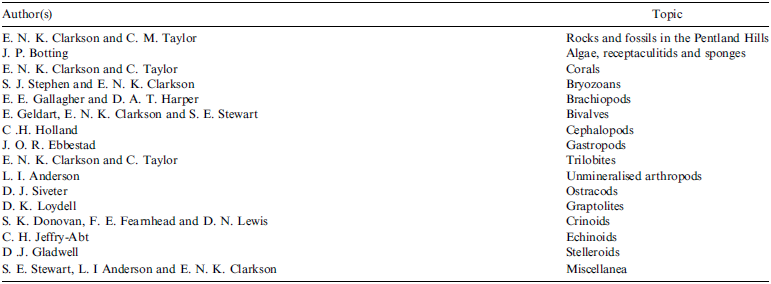
Many studies have been published on the biotas, the majority of them in the Palaeontological Association’s Field Guide to Fossils 11 (Clarkson et al. Reference Clarkson, Harper, Taylor and Anderson2007). In 18 chapters all aspects of the North Esk Inlier were considered (see Table 1); Euan Clarkson participated in seven of the chapters and led the editorial team. Following the publication of this remarkable compendium of the Pentlands fossil biota, new discoveries continue to be made. These complement the body of work already published. Candela & Crighton (Reference Candela and Crighton2015, Reference Candela and Crighton2017) reviewed and updated the machaeridian fauna, erecting a new species in honour of Dr Lamont (Plumulites lamonti Candela & Crighton Reference Candela and Crighton2017). Candela et al. (Reference Candela, Harper and Crighton2017) dealt with the brachiopods, previously overlooked or designated nomina dubia, and described by Lamont (Reference Lamont1978) in a separate chapter entitled ‘Length to breadth proportions in brachiopod palaeoecology’. Candela & Crighton (Reference Candela and Crighton2019) revised, discussed and properly illustrated all the taxa described in Lamont (Reference Lamont1978). Finally Botting et al. (Reference Botting, Candela and Crighton2019) described an endemic new hexactinellid sponge discovered recently, emphasising again the uniqueness of the Pentland Hills faunas.
Overview of the contents of ‘Silurian Fossils of the Pentland Hills’ (Clarkson et al. Reference Clarkson, Harper, Taylor and Anderson2007).

The most abundant element of the faunas is the Brachiopoda (Figs 7, 8). To date, the most comprehensive and up-to-date study since Davidson (Reference Davidson1868) is that of Gallagher (Reference Gallagher2003), which formed the basis for Gallagher & Harper (Reference Gallagher and Harper2007) who briefly described and illustrated the 20 most common and distinctive taxa in the field guide to the fossils of the Pentland Hills (Clarkson et al. Reference Clarkson, Harper, Taylor and Anderson2007). Cocks (Reference Cocks1978, Reference Cocks2019; see also Reference Cocks2008) noted many of the Pentland’s taxa in his reviews of British and Irish Lower Palaeozoic brachiopods and in his description of Llandovery brachiopods from England and Wales. Currently over 50 brachiopod species are now known from the Silurian rocks in the Pentland Hills, with the most recent descriptions and illustrations in Gallagher & Harper’s Palaeontographical Society Monograph (Reference Gallagher and Harper2024).
Pie chart displaying the numbers of taxa from the Silurian of the Pentland Hills identified in Clarkson et al. (Reference Clarkson, Harper, Taylor and Anderson2007).

Selection of the most common brachiopod taxa in the Pentland Hills from the collections of the National Museums of Scotland. (a–b) Pentlandina tartana (Bancroft); (a) internal mould of ventral valve, NMS G.2006.40.2; (b) internal mould of dorsal valve, NMS G.2015.35.5. (c–d) Leptaena eska Gallagher & Harper; (c) external mould of dorsal valve, NMS G.2006.40.6.1; (d) internal mould of ventral valve, NMS G.1876.42.91.3. (e) Skenidioides lewisii (Davidson), internal moulds of ventral and dorsal valves, NMS G.2006.40.17. (f–g) Eoplectodonta (Eoplectodonta) penkillensis (Reed); (f) internal mould of ventral valve, NMS G.2006.40.9; (g) internal mould of dorsal valve, NMS G.1876.42.97.1. (h, k) Isorthis (Ovalella) clarksoni Gallagher & Harper; (h) internal mould of ventral valve, NMS G.2006.40.19; (k) internal mould of dorsal valve, holotype, NMS G.2006.40.18. (i–j) Coolinia pecten (Linnæus); (i) internal mould of ventral valve, NMS G.2015.35.27; (j) internal mould of dorsal valve, NMS G.2015.35.28. (l–m) Visbyella visbyensis (Lindström); (l) internal mould of ventral valve, NMS G.1876.42.89; (m) internal mould of dorsal mould, NMS G.2015.35.42. (n–o) Dicoelosia paratenua Gallagher & Harper; (n) internal mould of ventral valve, NMS G.1876.42.88.1; (o) internal mould of dorsal valve, NMS G.1876.42.88.2. Specimens on (a–g, i–j, l–o) from the Wether Law Linn Formation; specimens on (h, k) from the Deerhope Coral Bed, Deerhope Formation. Scale bars represent 1 mm (e, o); 2 mm (a–b, f–n); 5 mm (c–d).

6. The biotic succession
Life in the Silurian sea inhabited by the Pentland Hills fauna was summarised by Clarkson & Harper (Reference Clarkson and Harper2007). The Pentland Hills fauna is distinctive, being dominated by orthide and strophomenide brachiopods, whereas the more typical Silurian elements, for example the atrypides, athyridides and spiriferides, are generally less common, although some are locally abundant; they are more characteristic of Anglo-Welsh assemblages. There are very few representatives of the brachiopod lineages commonly used for correlation with the Llandovery shelly facies (Cocks et al. Reference Cocks, Woodcock, Rickards, Temple and Lane1984) requiring other means to effect correlation. As a whole, the faunas are most similar to the deeper-water Dicoelosia palaeocommunities (Watkins et al. Reference Watkins, Coorough and Mayer2000) that inhabited the more amphicratonic habitats of the Silurian palaeocontinents, commonly associated with more siliciclastic, fine-grained facies. Robertson (Reference Robertson1985, Reference Robertson1989, Reference Robertson, Boucot and Lawson1999) expanded the palaeocommunity description and interpretation of the succession, first established by Tipper (Reference Tipper1975), defining four main associations, outlined below, in ascending order. These are quite different from the assemblages in the Anglo-Welsh area where more typical Silurian faunas dominated by Eocoelia and Stricklandia lineages are prevalent. The term Isorthis mackenziei – pelmatozoan Association has been changed to the Isorthis clarksoni – pelmatozoan Association to take account of the revised taxonomic status of the dalmanelloid taxon (Gallagher & Harper Reference Gallagher and Harper2024).
Isorthis clarksoni – pelmatozoan Association is dominated by the dalmanelloid brachiopods Isorthis (Ovalella) clarksoni Gallagher & Harper, Visbyella visbyensis (Lindström) and Pentlandella pentlandica (Haswell) together with species of Dictyocaris and Ptilodictya; the most dominant element is the ostracode Craspedobolbina (Mitrobeyrichia) impendens (Haswell) together with cystoporate bryozoans and the trilobite Encrinurus expansus Haswell. Tipper (Reference Tipper1974, Reference Tipper1975) named this assemblage the Isorthid – Glassia Community, based on the misidentification of Pentlandella as Glassia. The association occurs within the upper Cock Rig Formation and uppermost part of the Lower Member of the Wether Law Linn Formation.
Skenidioides lewisii – Cyrtia exporrecta Association is synonymous with Tipper’s (Reference Tipper1974, Reference Tipper1975) Skenidioides – Dicoelosia Community. In terms of brachiopods the association is dominated by Skenidioides lewisii (Davidson) and Cyrtia exporrecta (Wahlenberg) together with Coolinia applanata (Salter) and Eoplectodonta penkillensis (Reed) accompanied by a species of Oglupes.
Eoplectodonta penkillensis Association is overwhelmingly dominated by two brachiopod taxa, Eoplectodonta penkillenis (Reed) and Visbyella visbyensis (Lindström).
Liospira ? simulans – Synek Association. In terms of brachiopods the association is dominated by Coolinia pecten (Linnæus) and Eoplectodonta penkillensis (Reed) but much of the diversity is represented by molluscs such as the abundant Liospira? simulans (Salter) and a species of Synek? together with the ostracode Craspedobolbina (Mitrobeyrichia) impendens (Haswell).
The first three associations are associated with relatively deep water evolving against a background of regression, culminating in the shallowest-water Liospira? simulans – Synek Association. All four are strongly linked by the common occurrence of orthide and strophomenide taxa. In contrast to the faunas with more typical Silurian elements in the Anglo-Welsh area (Copper Reference Copper2004), with the exception of Eocoelia sulcata (Prouty), members of the key Eocoelia, Pentameroides and Stricklandia-Costistricklandia lineages (Rong & Bassett Reference Rong and Bassett2002) have never been reported; neither have any of the eponymous elements of the Eocoelia, Pentamerus, Costistricklandia and Clorinda communities (Ziegler et al. Reference Ziegler, Cocks and Bambach1968).
7. Palaeobiogeography
During the Telychian a range of different brachiopod communities evolved, associated with the varied sedimentary environments and the separations of the main continents; many genera were widespread, forming a substantial faunal province that was virtually ‘cosmopolitan’ (e.g., Rong & Bassett Reference Rong and Bassett2002; Cocks & Rong Reference Cocks and Rong2019). Across the highest palaeolatitudes, associated with southern-hemisphere Gondwana, the Clarkeia Fauna, the precursor of the late Silurian and Devonian Malvinoxhosan Realm (Penn-Clarke & Harper Reference Penn-Clarke and Harper2021, Reference Penn-Clarke and Harper2023) developed. In the northern hemisphere, there was the origin of the Tuvaella Faunal Province in the northernmost part of Siberia at that time. Both bioregions continued beyond the end of the Silurian and into the Devonian.
Brachiopods are the most abundant taxon within the biota and as noted above have been recently described and illustrated in detail (Gallagher & Harper Reference Gallagher and Harper2024). These authors presented multivariate analyses, using non-metric multidimensional scaling (NMDS) and network analysis, that indicated, not unexpectedly, the mutual closeness of the Pentlands associations. The NMDS plot presents a cluster of the three deep-water associations from the North Esk Inlier separated from those elsewhere including the type Llandovery, giving some credence to their inclusion within a distinctive Pentlandian assemblage (Lamont Reference Lamont1947, Reference Lamont1952). The stress value of 0.16 indicated on the Shepard plot is adequate for this analysis. Network analysis (using Gephi) of groups is revised and presented here (Fig. 9); the sites are placed according to interactions between common taxa with the diameter of each node proportional to the diversity at that locality. A similar clustering is apparent for the same three faunas with the addition of the shallower-water Liospira?-Synek association.
Network analysis, using Gephi software, of a selection of later Llandovery brachiopod faunas from adjacent sites. Graph modified from Gallagher & Harper (Reference Gallagher and Harper2024), text-fig. 6. Data sources: the following sites with sources are displayed: Isorthis-Pelmatozoan, Skenidioides-Cyrtia, Eoplectodonta, Liospira?-Synek, associations from the North Esk inlier (Robertson Reference Robertson1985, Reference Robertson1989, Reference Robertson, Boucot and Lawson1999; Gallagher & Harper Reference Gallagher and Harper2024), OsloPorsgruun3, Oslo Porsgruun9, OsloPorsgruun22, OsloBruflat14 and OsloBruflat16 from named formations in the Oslo Region, southern Norway (Cocks & Worsley Reference Cocks and Worsley1993), Canastan from Canastan, Pembrokeshire (Watkins & Boucot Reference Watkins and Boucot1978), Llandovery (Cocks et al. Reference Cocks, Woodcock, Rickards, Temple and Lane1984), L-Kilbride and M + U-Kilbride from the Kilbride Formation in western Ireland (Doyle Reference Doyle1989 and pers. obs.) and Quebec (Watkins & Boucot Reference Watkins and Boucot1978). The plot indicates the coherence of the Pentlands deeper-water marine faunas.

8. The Pentlandian: a key Llandovery biotic complex
The Pentlandian is a regional term and although proposed by Lamont (Reference Lamont1952) as a chronostratigraphic unit between the Llandovery and Wenlock it never gained traction. Subsequent research has shown that the Pentlandian is equivalent and correlatable with part of the Telychian. Potentially it has the status of a regional chronostratigraphic stage but the unit and its faunas have not been readily identified elsewhere and thus the Pentlandian was never adopted by the national or international community. Nevertheless, its distinctive biotas deserve recognition for evolving in a deep shelf ecosystem to include the evolving ecosystems of the Deerhope, Cock Rig and Wether Law Linn formations. In palaeontology, a ‘biotic complex’ refers to the interconnected network of living organisms (both plants and animals) and their interactions within a specific environment or ecosystem, as represented in the fossil record. The term has been widely used particularly for Devonian assemblages (e.g., Penn-Clarke and Harper Reference Penn-Clarke and Harper2021, Reference Penn-Clarke and Harper2023). The term Pentlandian Biotic Complex (Fig. 10) seems an appropriate term, capturing too the researches of both Archie Lamont and, especially, Euan Clarkson.
The Pentlandian Biotic Complex (indicated in blue) based on text-fig. 4 in Gallagher & Harper (Reference Gallagher and Harper2024).

Acknowledgements
We extend our sincere thanks to Annalisa Ferretti and Jin Jisuo for thoughtful reviews, together with Alan Owen for his careful editorial work. All three improved our manuscript. We also thank Euan for his encouragement and inspiration, supporting the many researchers, including ourselves, who he attracted to the Pentland Hills.
Competing interests
The authors declare no competing interests.




 Open access

