





1. Introduction
Microfluidic technologies have revolutionised particle manipulation, offering a diverse array of capabilities including transportation, separation, trapping and enrichment (Pratt et al. Reference Pratt, Huang, Hawkins, Gleghorn and Kirby2011; Sajeesh & Sen Reference Sajeesh and Sen2014; Lu et al. Reference Lu, Liu, Hu and Xuan2017). Fundamentally, manipulation strategies force particles to cross streamlines so that they do not passively follow the flow. This essence of controlled manipulation, encompassing both passive (synthetic) or active (e.g. biological cells) particles, is implemented today in lab-on-a-chip processing as well as in the diagnosis of biological samples and biomanufacturing processes (Pamme Reference Pamme2007; Ateya et al. Reference Ateya, Erickson, Howell, Hilliard, Golden and Ligler2008; Nilsson et al. Reference Nilsson, Evander, Hammarström and Laurell2009; Gossett et al. Reference Gossett, Weaver, Mach, Hur, Tse, Lee, Amini and Di Carlo2010; Xuan, Zhu & Church Reference Xuan, Zhu and Church2010; Puri & Ganguly Reference Puri and Ganguly2014), drug discovery and delivery systems (Dittrich & Manz Reference Dittrich and Manz2006; Kang et al. Reference Kang, Chung, Langer and Khademhosseini2008; Nguyen et al. Reference Nguyen, Shaegh, Kashaninejad and Phan2013) or self-cleaning technologies (Callow & Callow Reference Callow and Callow2011; Kirschner & Brennan Reference Kirschner and Brennan2012; Nir & Reches Reference Nir and Reches2016). Many techniques of precise control of suspended microparticles rely on the particle response to external forces including electrical (Xuan Reference Xuan2019), optical (Lenshof & Laurell Reference Lenshof and Laurell2010; Ashkin et al. Reference Ashkin, Dziedzic, Bjorkholm and Chu1986; Grier Reference Grier2003; Chiou, Ohta & Wu Reference Chiou, Ohta and Wu2005) and magnetic (Van Reenen et al. Reference Van Reenen, de Jong, den Toonder, Jaap and Prins2014; Crick & Hughes Reference Crick and Hughes1950; Wang, Butler & Ingber Reference Wang, Butler and Ingber1993; Gosse & Croquette Reference Gosse and Croquette2002) techniques. However, not all particles are susceptible to these, prompting a continuous interest in manipulation strategies solely based on hydrodynamic forces. In practical applications, these approaches use customised flow geometries, such as channels or pillars (Lutz, Chen & Schwartz Reference Lutz, Chen and Schwartz2006; Tanyeri et al. Reference Tanyeri, Ranka, Sittipolkul and Schroeder2011; Wiklund, Green & Ohlin Reference Wiklund, Green and Ohlin2012; Petit et al. Reference Petit, Zhang, Peyer, Kratochvil and Nelson2012; Shenoy, Rao & Schroeder Reference Shenoy, Rao and Schroeder2016; Kumar et al. Reference Kumar, Shenoy, Li and Schroeder2019; Chamolly, Lauga & Tottori Reference Chamolly, Lauga and Tottori2020). In recent years, many such techniques have leveraged particle inertia (Di Carlo et al. Reference Di Carlo, Irimia, Tompkins and Toner2007; Di Carlo Reference Di Carlo2009) particularly from oscillatory flow (Wang et al. Reference Wang, Jalikop and Hilgenfeldt2011, Reference Wang, Jalikop and Hilgenfeldt2012; Thameem, Rallabandi & Hilgenfeldt Reference Thameem, Rallabandi and Hilgenfeldt2017; Agarwal, Rallabandi & Hilgenfeldt Reference Agarwal, Rallabandi and Hilgenfeldt2018) and have prompted an advance of theoretical frameworks beyond long-standing approaches (Maxey & Riley Reference Maxey and Riley1983; Gatignol Reference Gatignol1983) to include new important effects (Agarwal et al. Reference Agarwal, Chan, Rallabandi, Gazzola and Hilgenfeldt2021; Agarwal Reference Agarwal2021; Rallabandi Reference Rallabandi2021; Agarwal et al. Reference Agarwal, Upadhyay, Bhosale, Gazzola and Hilgenfeldt2024).
Inertial effects are not present in the Stokes limit $($
Reynolds number
$($
Reynolds number $Re\rightarrow 0)$
, where hydrodynamic effects on particles are notoriously long-range and have been described in fundamental detail (Happel & Brenner Reference Happel and Brenner1965; Brady & Bossis Reference Brady and Bossis1988; Kim & Karrila Reference Kim and Karrila2013; Pozrikidis Reference Pozrikidis1992, Reference Pozrikidis2011; Rallabandi, Hilgenfeldt & Stone Reference Rallabandi, Hilgenfeldt and Stone2017), while systematic modulation of particle trajectories in Stokes flow has not been the subject of a detailed study. Fundamentally, this is because of the instantaneity and time reversibility of Stokes flow that at first glance seems to preclude lasting particle displacements, despite the success of deterministic lateral displacement (DLD) in sorting particles by size, forcing them onto different trajectories through the interaction with a forest of pillar obstacles at very low
$Re\rightarrow 0)$
, where hydrodynamic effects on particles are notoriously long-range and have been described in fundamental detail (Happel & Brenner Reference Happel and Brenner1965; Brady & Bossis Reference Brady and Bossis1988; Kim & Karrila Reference Kim and Karrila2013; Pozrikidis Reference Pozrikidis1992, Reference Pozrikidis2011; Rallabandi, Hilgenfeldt & Stone Reference Rallabandi, Hilgenfeldt and Stone2017), while systematic modulation of particle trajectories in Stokes flow has not been the subject of a detailed study. Fundamentally, this is because of the instantaneity and time reversibility of Stokes flow that at first glance seems to preclude lasting particle displacements, despite the success of deterministic lateral displacement (DLD) in sorting particles by size, forcing them onto different trajectories through the interaction with a forest of pillar obstacles at very low $Re$
(Huang et al. Reference Huang, Cox, Austin and Sturm2004; Krüger et al. Reference Krüger, Holmes and Coveney2014; Kabacaoğlu & Biros Reference Kabacaoğlu and Biros2019; Hochstetter et al. Reference Hochstetter, Vernekar, Austin, Becker, Beech, Fedosov, Gompper, Kim, Smith and Stolovitzky2020; Lu et al. Reference Lu2023; Aghilinejad et al. Reference Aghilinejad, Aghaamoo and Chen2019; Davis et al. Reference Davis, Inglis, Morton, Lawrence, Huang, Chou, Sturm and Austin2006).
$Re$
(Huang et al. Reference Huang, Cox, Austin and Sturm2004; Krüger et al. Reference Krüger, Holmes and Coveney2014; Kabacaoğlu & Biros Reference Kabacaoğlu and Biros2019; Hochstetter et al. Reference Hochstetter, Vernekar, Austin, Becker, Beech, Fedosov, Gompper, Kim, Smith and Stolovitzky2020; Lu et al. Reference Lu2023; Aghilinejad et al. Reference Aghilinejad, Aghaamoo and Chen2019; Davis et al. Reference Davis, Inglis, Morton, Lawrence, Huang, Chou, Sturm and Austin2006).
Size-based particle sorting in a typical DLD set-up is determined by whether a particle can cross separating streamlines (row-shift). Inglis et al. (Reference Inglis, Davis, Austin and Sturm2006), Kulrattanarak et al. (Reference Kulrattanarak, Van Der Sman, Schroën and Boom2011), Pariset et al. (Reference Pariset, Pudda, Boizot, Verplanck, Berthier, Thuaire and Agache2017), Cerbelli (Reference Cerbelli2012) and Aghilinejad et al. (Reference Aghilinejad, Aghaamoo and Chen2019) heuristically developed critical length scales for particle size above which lateral displacement by this row-shifting happens. Modelling approaches for the interaction of particles with individual obstacles generally appeal to contact forces or other strong short-range forces (Lin & Han Reference Lin and Han2002; Dance, Climent & Maxey Reference Dance, Climent and Maxey2004) that break the time reversibility of the Stokes flow and the hydrodynamic forces following from it. In particular, Frechette & Drazer (Reference Frechette and Drazer2009), Balvin et al. (Reference Balvin, Sohn, Iracki, Drazer and Frechette2009) and Bowman, Drazer & Frechette (Reference Bowman, Drazer and Frechette2013) modelled the effects of a non-hydrodynamic repulsive force originating from surface roughness (Ekiel-Jeżewska et al. Reference Ekiel-Jeżewska, Feuillebois, Lecoq, Masmoudi, Anthore, Bostel and Wajnryb1999) and its dependence on particle size. This approach has been informed by similar ideas in the modelling of suspension rheology (Da Cunha & Hinch Reference Da Cunha and Hinch1996; Metzger & Butler Reference Metzger and Butler2010; Blanc, Peters & Lemaire Reference Blanc, Peters and Lemaire2011; Pham, Metzger & Butler Reference Pham, Metzger and Butler2015; Lemaire et al. Reference Lemaire, Blanc, Claudet, Gallier, Lobry and Peters2023).
Contact forces almost invariably contain an ad hoc element (Ekiel-Jeżewska et al. Reference Ekiel-Jeżewska, Feuillebois, Lecoq, Masmoudi, Anthore, Bostel and Wajnryb1999), fundamentally because in strict Stokes flow, there is no surface contact in finite time (Brady & Bossis Reference Brady and Bossis1988; Claeys & Brady Reference Claeys and Brady1989, Reference Claeys and Brady1993). A recent study by Li et al. (Reference Li, Bielinski, Lindner, du Roure and Delmotte2024) shows that fibres passing over a triangular obstacle can show net displacements in Stokes transport flow even when not experiencing direct contact. The fibres are extended, non-spherical objects and their interactions with obstacles are modelled by effective forces (Dance et al. Reference Dance, Climent and Maxey2004), leaving open the question as to whether rigorously described hydrodynamic interactions can cause net displacement. Very recent work by Liu, Das & Hilgenfeldt (Reference Liu, Das and Hilgenfeldt2025) describes particle motion in internal (vortical) Stokes flow and finds that purely hydrodynamic interactions with confining channel walls can indeed result in lasting displacements through repeated wall encounters. Such vortex flows have, however, not been practically implemented yet for this purpose. The present work, by contrast, aims at a rigorous hydrodynamic description of particle motion in Stokes flow external to an obstacle (the elementary process of DLD), establishing the required geometry of flow and obstacle to effect a lasting displacement, as well as bounds on its magnitude.
2. Hydrodynamic formalism of particle–wall interaction in Stokes flow
Microparticles placed in a background Stokes flow around an interface experience forces at varying distances from the boundary. Even at large distances (in bulk flow), particle trajectories deviate from the background flow because of Faxén’s correction (Happel & Brenner Reference Happel and Brenner1965), but close to the interfaces, the hydrodynamic interaction between boundaries is dominant.
Different situations can be addressed in the modelling of particles in Stokes flow (Brenner Reference Brenner1961; Goldman et al. Reference Goldman, Cox and Brenner1967a ,Reference Goldman, Cox and Brenner b ), particularly (i) the forces on a particle moving at a given speed, (ii) the forces on a particle held fixed in a certain location or (iii) the motion of a force-free particle. The present work focuses on the third scenario, which is particularly relevant for density-matched particles (absent the effects of gravity) in microfluidic devices. Setting thus the total force on the particle to zero, we quantify the modification of the particle velocity due to the effects of nearby boundaries altering particle motion in both the wall-parallel and the wall-normal directions.
A detailed analysis of the motion of force-free particles with wall-normal velocity corrections has been provided by Rallabandi et al. (Reference Rallabandi, Hilgenfeldt and Stone2017). Other work has described wall-parallel velocity corrections far from and close to the wall (Ekiel-Jeżewska & Wajnryb Reference Ekiel-Jeżewska and Wajnryb2006; Pasol et al. Reference Pasol, Martin, Ekiel-Jeżewska, Wajnryb, Bławzdziewicz and Feuillebois2011). In our very recent study on particle motion in internal Stokes flow (Liu et al. Reference Liu, Das and Hilgenfeldt2025), we have constructed uniformly valid expressions for all particle–wall distances from this precursor work. Here, we extend the formalism to determine particle trajectories transported over an obstacle, representing a boundary whose orientation and curvature near the particle both change as the particle moves.
2.1. Problem set-up
Reflecting common situations in microfluidic set-ups with structures that span the entire height of a channel, we here describe two-dimensional Stokes flows $\boldsymbol{u}(\boldsymbol{x})$
in a Cartesian coordinate system
$\boldsymbol{u}(\boldsymbol{x})$
in a Cartesian coordinate system $\boldsymbol{x}=(x,y)$
. Although any two-dimensional Stokes flow around an obstacle is subject to the Oseen paradox (Proudman & Pearson Reference Proudman and Pearson1957) and does not exist as a consistent solution to arbitrary distance from the obstacle wall, a unique background Stokes flow exists in the vicinity of the obstacle, and the range and accuracy of that solution can be arbitrarily increased by lowering the Reynolds number. We place a spherical, force-free inertialess particle in such a flow
$\boldsymbol{x}=(x,y)$
. Although any two-dimensional Stokes flow around an obstacle is subject to the Oseen paradox (Proudman & Pearson Reference Proudman and Pearson1957) and does not exist as a consistent solution to arbitrary distance from the obstacle wall, a unique background Stokes flow exists in the vicinity of the obstacle, and the range and accuracy of that solution can be arbitrarily increased by lowering the Reynolds number. We place a spherical, force-free inertialess particle in such a flow $\boldsymbol{u}(\boldsymbol{x})$
as sketched in figure 1(a).
$\boldsymbol{u}(\boldsymbol{x})$
as sketched in figure 1(a).
(a) Schematic of a small spherical particle of radius $a_p$
located at
$a_p$
located at $\boldsymbol{x}_p=(x_p,y_p)$
in the vicinity of an obstacle boundary of radius of curvature
$\boldsymbol{x}_p=(x_p,y_p)$
in the vicinity of an obstacle boundary of radius of curvature $R(\boldsymbol{x})$
. The particle is immersed in a density-matched Stokes background flow
$R(\boldsymbol{x})$
. The particle is immersed in a density-matched Stokes background flow $\boldsymbol{u}(\boldsymbol{x})$
. (b) Sketches of fore–aft symmetric obstacle–flow geometries with a circular cylinder or a symmetrically placed elliptic cylinder. This fore–aft symmetry breaks in (c), where the flow has non-trivial angle of attack
$\boldsymbol{u}(\boldsymbol{x})$
. (b) Sketches of fore–aft symmetric obstacle–flow geometries with a circular cylinder or a symmetrically placed elliptic cylinder. This fore–aft symmetry breaks in (c), where the flow has non-trivial angle of attack $\alpha$
. Also sketched is the elliptic coordinate system
$\alpha$
. Also sketched is the elliptic coordinate system $(\xi ,\eta )$
. (d) An example of wall-normal particle velocity as a function of the gap coordinate
$(\xi ,\eta )$
. (d) An example of wall-normal particle velocity as a function of the gap coordinate $\varDelta$
at an angular position
$\varDelta$
at an angular position $\eta =20^\circ$
using variable expansion modelling (cf. (2.12)) with
$\eta =20^\circ$
using variable expansion modelling (cf. (2.12)) with $\varDelta _E=3$
showing a smooth transition to the particle expansion for large
$\varDelta _E=3$
showing a smooth transition to the particle expansion for large $\varDelta \gtrsim 1$
and to the wall expansion (inset) for
$\varDelta \gtrsim 1$
and to the wall expansion (inset) for $\varDelta \ll 1$
.
$\varDelta \ll 1$
.

We consider particle radii $a_p$
much smaller than the radius of curvature of the obstacle wall
$a_p$
much smaller than the radius of curvature of the obstacle wall $R(\boldsymbol{x})$
. The unit vector
$R(\boldsymbol{x})$
. The unit vector $\boldsymbol{e}_\perp (\boldsymbol{x_p})$
normal to the wall pointing towards the particle centre
$\boldsymbol{e}_\perp (\boldsymbol{x_p})$
normal to the wall pointing towards the particle centre $\boldsymbol{x}_p$
defines the closest distance
$\boldsymbol{x}_p$
defines the closest distance $h(\boldsymbol{x_p})$
between particle centre and boundary. Tracking the particle trajectory under the influence of the obstacle needs careful modelling of the corrections to both the wall-parallel and the wall-normal velocity components of the particle particularly close to the obstacle, where the effects are most prominent. In such proximity, we have verified that effects of finite obstacle curvature (quantified in Rallabandi et al. (Reference Rallabandi, Hilgenfeldt and Stone2017)) are small and do not alter the outcomes presented here (see Appendix D for details), so that we restrict ourselves to the flat-wall approximation
$h(\boldsymbol{x_p})$
between particle centre and boundary. Tracking the particle trajectory under the influence of the obstacle needs careful modelling of the corrections to both the wall-parallel and the wall-normal velocity components of the particle particularly close to the obstacle, where the effects are most prominent. In such proximity, we have verified that effects of finite obstacle curvature (quantified in Rallabandi et al. (Reference Rallabandi, Hilgenfeldt and Stone2017)) are small and do not alter the outcomes presented here (see Appendix D for details), so that we restrict ourselves to the flat-wall approximation $(a_p/R\rightarrow 0)$
here.
$(a_p/R\rightarrow 0)$
here.
Far from any walls, the motion of a spherical, neutrally buoyant particle is described by
 \begin{equation} \boldsymbol{v}_{p,{far}} =\boldsymbol{u}(\boldsymbol{x}_p(t))+\boldsymbol{u}_{\textit{Faxen}} (\boldsymbol{x}_p(t)), \end{equation}
with the effect of streamline curvature on the length scale of the particle size addressed by the Faxén correction:
 \begin{equation} \boldsymbol{u}_{\textit{Faxen}} (\boldsymbol{x})=\frac {a_p^2}{6}{\nabla} ^2\boldsymbol{u}(\boldsymbol{x}). \end{equation}
The presence of an obstacle imposes wall effects, and thus an additional velocity correction, $\boldsymbol{W}$
. With no inertia, the particle equation of motion remains a first-order dynamical system:
$\boldsymbol{W}$
. With no inertia, the particle equation of motion remains a first-order dynamical system:
 \begin{equation} \frac {{\rm d}\boldsymbol{x}_{p}(t)}{{\rm d}t}=\boldsymbol{v}_{p} (\boldsymbol{x}_p(t))=\boldsymbol{u}(\boldsymbol{x}_p(t))+\boldsymbol{u}_{\textit{Faxen}} (\boldsymbol{x}_p(t))+\boldsymbol{W}(\boldsymbol{x}_p(t)). \end{equation}
In the far-field limit, $\boldsymbol{W}$
must decay to zero, leaving only the Faxén correction in effect. Decomposing the ambient velocity field
$\boldsymbol{W}$
must decay to zero, leaving only the Faxén correction in effect. Decomposing the ambient velocity field $ \boldsymbol{u}= u_{||} \boldsymbol{e}_{||} + u_\perp \boldsymbol{e}_{\perp }$
in the wall-parallel and wall-normal directions, we write
$ \boldsymbol{u}= u_{||} \boldsymbol{e}_{||} + u_\perp \boldsymbol{e}_{\perp }$
in the wall-parallel and wall-normal directions, we write
 \begin{align} \boldsymbol{v}_{p||} &= \left (\boldsymbol{u} + \frac {a_p^2}{6}{\nabla} ^2\boldsymbol{u}\right )\boldsymbol{\cdot }\boldsymbol{e}_{||} + W_{||}, \end{align}
 \begin{align} \boldsymbol{v}_{p\perp } &= \left (\boldsymbol{u} + \frac {a_p^2}{6}{\nabla} ^2\boldsymbol{u}\right )\boldsymbol{\cdot }\boldsymbol{e}_{\perp } + W_{\perp }, \end{align}
and quantify in the following the particle velocity corrections parallel to $(W_{||})$
and normal to
$(W_{||})$
and normal to $(W_{\perp })$
the wall. While we largely quote results from previous work (Liu et al. Reference Liu, Das and Hilgenfeldt2025), we point out where the present problem requires particular care and greater modelling effort.
$(W_{\perp })$
the wall. While we largely quote results from previous work (Liu et al. Reference Liu, Das and Hilgenfeldt2025), we point out where the present problem requires particular care and greater modelling effort.
2.2. Wall-parallel corrections to the particle velocity
The components of $\boldsymbol{W}(\boldsymbol{x}_p)$
depend on the wall distance, conveniently described by the dimensionless parameter
$\boldsymbol{W}(\boldsymbol{x}_p)$
depend on the wall distance, conveniently described by the dimensionless parameter
 \begin{equation} \varDelta =\frac {h(\boldsymbol{x}_p)-a_p}{a_p}, \end{equation}
which is the surface-to-surface distance relative to the particle radius (Rallabandi et al. Reference Rallabandi, Hilgenfeldt and Stone2017; Thameem et al. Reference Thameem, Rallabandi and Hilgenfeldt2017; Agarwal et al. Reference Agarwal, Rallabandi and Hilgenfeldt2018). The wall-parallel velocity correction $W_{||}$
slows down the wall-parallel velocity of a force-free particle by a fraction
$W_{||}$
slows down the wall-parallel velocity of a force-free particle by a fraction $f(\varDelta )$
, so that (2.4) takes the form
$f(\varDelta )$
, so that (2.4) takes the form
 \begin{equation} v_{p||}(x_p,y_p) = \left [\left (1-f(\varDelta )\right )\left (\boldsymbol{u} + \frac {a_p^2}{6}{\nabla} ^2 \boldsymbol{u}\right )\boldsymbol{\cdot }\boldsymbol{e}_{||} \right ]_{\boldsymbol{x}_p}. \end{equation}
A uniformly valid expression for $f(\varDelta )$
was obtained in Liu et al. (Reference Liu, Das and Hilgenfeldt2025) by systematic asymptotic matching of results from Goldman et al. (Reference Goldman, Cox and Brenner1967b
) for
$f(\varDelta )$
was obtained in Liu et al. (Reference Liu, Das and Hilgenfeldt2025) by systematic asymptotic matching of results from Goldman et al. (Reference Goldman, Cox and Brenner1967b
) for $\varDelta \gg 1$
and Williams, Koch & Giddings (Reference Williams, Koch and Giddings1992) for
$\varDelta \gg 1$
and Williams, Koch & Giddings (Reference Williams, Koch and Giddings1992) for $\varDelta \ll 1$
(including the lubrication limit), and is reproduced in Appendix A.
$\varDelta \ll 1$
(including the lubrication limit), and is reproduced in Appendix A.
2.3. Wall-normal corrections to the particle velocity
Employing a quadratic expansion of the background flow about the spherical particle’s centre, a general expression for the normal component of the hydrodynamic force on a spherical, neutrally buoyant particle was obtained by Rallabandi et al. (Reference Rallabandi, Hilgenfeldt and Stone2017). In the case of a force-free particle of interest here, this yields the wall-normal correction $W_\perp$
and thus the particle wall-normal velocity:
$W_\perp$
and thus the particle wall-normal velocity:
 \begin{align} v_{p\perp }^{PE}(x_p,y_p)&= \left [\left \{\boldsymbol{u} + \frac {a_p^2}{6}{\nabla} ^2 \boldsymbol{u} - a_p\frac {\mathcal{B}}{\mathcal{A}}(\boldsymbol{e_{\perp }}\boldsymbol{\cdot }\boldsymbol{\nabla }\boldsymbol{u}) + \frac {a_p^2}{2}\frac {\mathcal{C}}{\mathcal{A}}(\boldsymbol{e_{\perp }}\boldsymbol{e_{\perp }}:\boldsymbol{\nabla }\boldsymbol{\nabla }\boldsymbol{u}) \right .\right . \nonumber \\ &\quad \left .\left . +\frac {a_p^2}{2}\left (\frac {\mathcal{D}}{\mathcal{A}}-\frac {1}{3}\right ){\nabla} ^2 \boldsymbol{u}\right \}\boldsymbol{\cdot }\boldsymbol{e}_{\perp } \right ]_{\boldsymbol{x}_p}. \end{align}
The full analytical expressions for the $\varDelta$
-dependent functions
$\varDelta$
-dependent functions $\mathcal{A}$
,
$\mathcal{A}$
, $\mathcal{B}$
,
$\mathcal{B}$
, $\mathcal{C}$
and
$\mathcal{C}$
and $\mathcal{D}$
are provided in Rallabandi et al. (Reference Rallabandi, Hilgenfeldt and Stone2017). For arbitrarily large separations
$\mathcal{D}$
are provided in Rallabandi et al. (Reference Rallabandi, Hilgenfeldt and Stone2017). For arbitrarily large separations $(\varDelta \rightarrow \infty )$
,
$(\varDelta \rightarrow \infty )$
, $ {\mathcal{B}}/{\mathcal{A}}\to 0$
,
$ {\mathcal{B}}/{\mathcal{A}}\to 0$
, $ {\mathcal{C}}/{\mathcal{A}}\to 0$
and
$ {\mathcal{C}}/{\mathcal{A}}\to 0$
and $ {\mathcal{D}}/{\mathcal{A}}\to 1/3$
, so that
$ {\mathcal{D}}/{\mathcal{A}}\to 1/3$
, so that $W_{\perp }\to 0$
. We use the superscript
$W_{\perp }\to 0$
. We use the superscript $PE$
(‘particle expansion’) to emphasise that all background flow velocities and derivatives are evaluated at
$PE$
(‘particle expansion’) to emphasise that all background flow velocities and derivatives are evaluated at $\boldsymbol {x}_p$
.
$\boldsymbol {x}_p$
.
As the particle approaches the wall $(\varDelta \ll 1)$
this particle expansion formalism becomes inaccurate – note that (2.8) is not guaranteed to vanish when the particle touches the wall
$(\varDelta \ll 1)$
this particle expansion formalism becomes inaccurate – note that (2.8) is not guaranteed to vanish when the particle touches the wall $(\varDelta =0)$
. If instead we employ Taylor expansion of the background flow field
$(\varDelta =0)$
. If instead we employ Taylor expansion of the background flow field $\boldsymbol{u}(\boldsymbol{x})$
around the point on the wall closest to the particle,
$\boldsymbol{u}(\boldsymbol{x})$
around the point on the wall closest to the particle,
 \begin{equation} \boldsymbol{x}_w =\boldsymbol{x}_p -a_p\boldsymbol{e}_{\perp }(\boldsymbol{x}_p), \end{equation}
as suggested by Rallabandi et al. (Reference Rallabandi, Hilgenfeldt and Stone2017), the no-penetration condition is enforced (‘wall expansion’). The resulting particle velocity is linear in $\varDelta$
to leading order:
$\varDelta$
to leading order:
 \begin{equation} v_{p\perp }^{WE} = 1.6147 a_p^2\kappa (\boldsymbol{x}_p)\varDelta +O(\varDelta ^2). \end{equation}
Here $\kappa (\boldsymbol{x}_p)=\partial _{\perp }^2u_{\perp }(\boldsymbol{x}_w)$
is the background flow curvature at the wall point
$\kappa (\boldsymbol{x}_p)=\partial _{\perp }^2u_{\perp }(\boldsymbol{x}_w)$
is the background flow curvature at the wall point $\boldsymbol{x}_w$
from (2.9). Although (2.10) accurately determines the particle wall-normal velocity for
$\boldsymbol{x}_w$
from (2.9). Although (2.10) accurately determines the particle wall-normal velocity for $\varDelta \ll 1$
, we find that it does not smoothly transition to (2.8) when
$\varDelta \ll 1$
, we find that it does not smoothly transition to (2.8) when $\varDelta \sim 1$
. We therefore generalise and refine the wall-expansion procedure in this intermediate region by constructing second-order expansions of
$\varDelta \sim 1$
. We therefore generalise and refine the wall-expansion procedure in this intermediate region by constructing second-order expansions of $\boldsymbol{u}(\boldsymbol{x})$
around variable expansion points
$\boldsymbol{u}(\boldsymbol{x})$
around variable expansion points $\boldsymbol{x}_E=\boldsymbol{x}_E(\boldsymbol{x}_p)$
, i.e.
$\boldsymbol{x}_E=\boldsymbol{x}_E(\boldsymbol{x}_p)$
, i.e.
 \begin{align} \boldsymbol{u}^{VE}(\boldsymbol{x}) = \boldsymbol{u}|_{\boldsymbol{x}=\boldsymbol{x}_E} + (\boldsymbol{x}-\boldsymbol{x}_E)\boldsymbol{\cdot }(\boldsymbol{\nabla }\boldsymbol{u})_{\boldsymbol{x}=\boldsymbol{x}_E} + \frac {1}{2}(\boldsymbol{x}-\boldsymbol{x}_E)(\boldsymbol{x}-\boldsymbol{x}_E):(\boldsymbol{\nabla }\boldsymbol{\nabla }\boldsymbol{u})_{\boldsymbol{x}=\boldsymbol{x}_E}. \end{align}
Replacing $\boldsymbol{u}$
by
$\boldsymbol{u}$
by $\boldsymbol{u}^{VE}$
in (2.8) gives the generalised expression
$\boldsymbol{u}^{VE}$
in (2.8) gives the generalised expression
 \begin{align} v_{p\perp }^{VE}(x_p,y_p) &= \left [\left \{\boldsymbol{u}^{VE} + \frac {a_p^2}{6}{\nabla} ^2 \boldsymbol{u}^{VE} - a_p\frac {\mathcal{B}}{\mathcal{A}}\bigl(\boldsymbol{e_{\perp }}\boldsymbol{\cdot }\boldsymbol{\nabla }\boldsymbol{u}^{VE}\bigr) + \frac {a_p^2}{2}\frac {\mathcal{C}}{\mathcal{A}}\bigl(\boldsymbol{e_{\perp }}\boldsymbol{e_{\perp }}:\boldsymbol{\nabla }\boldsymbol{\nabla }\boldsymbol{u}^{VE}\bigr) \right .\right . \nonumber \\ &\quad \left .\left . +\frac {a_p^2}{2}\left (\frac {\mathcal{D}}{\mathcal{A}}-\frac {1}{3}\right ){\nabla} ^2 \boldsymbol{u}^{VE}\right \}\boldsymbol{\cdot }\boldsymbol{e}_{\perp } \right ]_{\boldsymbol{x}_p}, \end{align}
where the derivatives and resistance coefficients are still evaluated at the particle centre.
The functional form of the expansion point $\boldsymbol{x}_E(\boldsymbol{x}_p)$
is constructed for (2.12) to obey the WE and PE limits, i.e
$\boldsymbol{x}_E(\boldsymbol{x}_p)$
is constructed for (2.12) to obey the WE and PE limits, i.e $\boldsymbol{x}_E\to \boldsymbol{x}_w$
for touching particles
$\boldsymbol{x}_E\to \boldsymbol{x}_w$
for touching particles $(\varDelta \to 0)$
and
$(\varDelta \to 0)$
and $\boldsymbol{x}_E = \boldsymbol{x}_p$
for all
$\boldsymbol{x}_E = \boldsymbol{x}_p$
for all $\varDelta \geqslant \varDelta _E$
. For simplicity, we choose the linear relation
$\varDelta \geqslant \varDelta _E$
. For simplicity, we choose the linear relation
 \begin{equation} \boldsymbol{x}_E=\boldsymbol{x}_p-a_p\left (1-\frac {\varDelta }{\varDelta _E}\right )\boldsymbol{e}_{\perp } \end{equation}
for $\varDelta \leqslant \varDelta _E$
and
$\varDelta \leqslant \varDelta _E$
and $\boldsymbol{x}_E=\boldsymbol{x}_p$
otherwise. Here,
$\boldsymbol{x}_E=\boldsymbol{x}_p$
otherwise. Here, $\varDelta _E$
denotes a specific choice of
$\varDelta _E$
denotes a specific choice of $\varDelta$
that ensures a smooth interpolation between
$\varDelta$
that ensures a smooth interpolation between $v_{p_\perp }^{WE}$
and
$v_{p_\perp }^{WE}$
and $v_{p\perp }^{PE}$
as shown in figure 1(d) for
$v_{p\perp }^{PE}$
as shown in figure 1(d) for $\varDelta _E=3$
. We adopt this choice for subsequent sections, while carefully checking that the results are robust against other
$\varDelta _E=3$
. We adopt this choice for subsequent sections, while carefully checking that the results are robust against other ${\mathcal O}(1)$
choices of
${\mathcal O}(1)$
choices of $\varDelta _E$
(Appendix C).
$\varDelta _E$
(Appendix C).
Using (2.7) and (2.12) in the dynamical system (2.3) constitutes our formalism for computing particle motion in the presence of wall effects for arbitrary Stokes background flow.
3. Symmetry-breaking inertialess transport around an obstacle
We apply the modelling detailed above to particles transported towards and past an obstacle. If a particle’s approach to and departure from the interface on its trajectory occur in a symmetric fashion, the gradients normal to the wall cancel out during approach and departure, so that no net displacement (relative to the streamline on which the particle starts) will be observed. This is clearly the case for a single circular cylinder obstacle (figure 1
b). However, if the combined geometry of the boundary and the flow field breaks this symmetry, net displacement and thus meaningful manipulation of particle transport are possible. We investigate here the case of an elliptic cylinder obstacle with aspect ratio $\beta = {b}/{a}$
(with
$\beta = {b}/{a}$
(with $a$
and
$a$
and $b$
the major and minor axes, respectively) placed in a uniform Stokes flow
$b$
the major and minor axes, respectively) placed in a uniform Stokes flow $U$
whose direction makes an angle
$U$
whose direction makes an angle $\alpha$
with the major axis. This situation is shown in figure 1(c) together with associated Cartesian and elliptic coordinate systems. Note that symmetry arguments again preclude net displacement if
$\alpha$
with the major axis. This situation is shown in figure 1(c) together with associated Cartesian and elliptic coordinate systems. Note that symmetry arguments again preclude net displacement if $\alpha =0$
or
$\alpha =0$
or $\alpha =\pi /2$
(figure 1
b).
$\alpha =\pi /2$
(figure 1
b).
We use the single elliptic obstacle as the simplest case study of fore–aft symmetry breaking, which in traditional DLD set-ups is achieved by inclining a forest of circular pillars relative to the uniform stream. The Stokes background flow around the elliptic cylinder is known analytically as a solution to the biharmonic equation ${\nabla} ^4\tilde {\psi }_B=0$
for the streamfunction
${\nabla} ^4\tilde {\psi }_B=0$
for the streamfunction $\tilde {\psi }_B$
. We choose the semimajor axis
$\tilde {\psi }_B$
. We choose the semimajor axis $a$
and the uniform flow speed
$a$
and the uniform flow speed $U$
as our length and velocity scales, so that
$U$
as our length and velocity scales, so that $\tilde {\psi }_B$
is non-dimensionalised by
$\tilde {\psi }_B$
is non-dimensionalised by $aU$
.
$aU$
.
The Oseen paradox restricts this solution to an inner region in the vicinity of the obstacle surface. It is implicit in the work of Berry & Swain (Reference Berry and Swain1923) and was explicitly derived by Shintani, Umemura & Takano (Reference Shintani, Umemura and Takano1983) in elliptic coordinates $(\xi ,\eta )$
as the infinite sum
$(\xi ,\eta )$
as the infinite sum $\tilde {\psi }_B=\sum _{n=1}^\infty \tilde {\psi }_n$
with
$\tilde {\psi }_B=\sum _{n=1}^\infty \tilde {\psi }_n$
with
 \begin{align} \tilde {\psi }_n&= \frac {1}{(\ln Re)^n}\bigl[\varLambda _n \bigl\{(\xi -\xi _0)\cosh {\xi } + \sinh \xi _0 \cosh \xi _0\cosh \xi - \cosh ^2\xi _0 \sinh \xi \bigr\}\cos \eta \nonumber\\&\quad -\varOmega _n \bigl\{(\xi -\xi _0)\sinh \xi -\sinh \xi _0\cosh \xi _0 \sinh \xi + \sinh ^2 \xi _0 \cosh \xi \bigr\}\sin \eta \bigr]. \end{align}
Here $x=\sqrt {1-\beta ^2} \cosh \xi \cos \eta$
and
$x=\sqrt {1-\beta ^2} \cosh \xi \cos \eta$
and $y=\sqrt {1-\beta ^2} \sinh \xi \sin \eta$
relate Cartesian and elliptic coordinates, and
$y=\sqrt {1-\beta ^2} \sinh \xi \sin \eta$
relate Cartesian and elliptic coordinates, and $\xi =\xi _0= ({1}/{2}) \ln [({1+\beta })/({1-\beta })]$
defines the elliptic cylinder surface. The prefactors
$\xi =\xi _0= ({1}/{2}) \ln [({1+\beta })/({1-\beta })]$
defines the elliptic cylinder surface. The prefactors $\varLambda _n$
and
$\varLambda _n$
and $\varOmega _n$
are functions of
$\varOmega _n$
are functions of $\alpha$
and
$\alpha$
and $\beta$
obtained from asymptotic matching (Kaplun Reference Kaplun1957; Proudman & Pearson Reference Proudman and Pearson1957). The analytical form of (3.1), by construction, does not contain fluid inertia except an implicit dependence on Reynolds number
$\beta$
obtained from asymptotic matching (Kaplun Reference Kaplun1957; Proudman & Pearson Reference Proudman and Pearson1957). The analytical form of (3.1), by construction, does not contain fluid inertia except an implicit dependence on Reynolds number $Re$
which defines the Oseen distance – the range of validity of the solution around the obstacle which is
$Re$
which defines the Oseen distance – the range of validity of the solution around the obstacle which is $1/Re$
(Proudman & Pearson Reference Proudman and Pearson1957; Batchelor Reference Batchelor2000), and can be made arbitrarily large by choosing a very small
$1/Re$
(Proudman & Pearson Reference Proudman and Pearson1957; Batchelor Reference Batchelor2000), and can be made arbitrarily large by choosing a very small $Re$
. Since our goal is to investigate the wall effect on particle trajectory and effective particle–wall interaction always occurs in the proximity of the obstacle, this flow description reflects reality to a well-defined degree of accuracy. In the limit
$Re$
. Since our goal is to investigate the wall effect on particle trajectory and effective particle–wall interaction always occurs in the proximity of the obstacle, this flow description reflects reality to a well-defined degree of accuracy. In the limit $Re\rightarrow 0$
, the
$Re\rightarrow 0$
, the $n=1$
term of (3.1) is dominant, and we scale out the
$n=1$
term of (3.1) is dominant, and we scale out the $Re$
dependence by defining the rescaled background flow as
$Re$
dependence by defining the rescaled background flow as
 \begin{align} \psi _B&=(-\ln \textit{Re})\tilde {\psi }_{n=1}\nonumber\\&= \varLambda _1 \bigl\{(\xi -\xi _0)\cosh {\xi } + \sinh \xi _0 \cosh \xi _0\cosh \xi - \cosh ^2\xi _0 \sinh \xi \bigr\}\cos \eta \nonumber \\&\quad -\varOmega _1 \bigl\{(\xi -\xi _0)\sinh \xi -\sinh \xi _0\cosh \xi _0 \sinh \xi + \sinh ^2 \xi _0 \cosh \xi \bigr\}\sin \eta , \end{align}
with $(\varLambda _1,\varOmega _1) =\sqrt {1-\beta ^2} (\sin \alpha , \cos \alpha )$
. This analytical expression agrees with the description of Stokes flow over an inclined elliptic fibre by Raynor (Reference Raynor2002). It could be improved in accuracy by taking into account terms of higher
$(\varLambda _1,\varOmega _1) =\sqrt {1-\beta ^2} (\sin \alpha , \cos \alpha )$
. This analytical expression agrees with the description of Stokes flow over an inclined elliptic fibre by Raynor (Reference Raynor2002). It could be improved in accuracy by taking into account terms of higher $n$
successively smaller by powers of
$n$
successively smaller by powers of $1/|\ln {Re}|$
, but we take (3.2) to allow for clearer analytical scaling results. Figure 2(a) shows streamline contours
$1/|\ln {Re}|$
, but we take (3.2) to allow for clearer analytical scaling results. Figure 2(a) shows streamline contours $(\psi _B)$
for an angle of attack
$(\psi _B)$
for an angle of attack $\alpha = 30^\circ$
and obstacle aspect ratio
$\alpha = 30^\circ$
and obstacle aspect ratio $\beta =0.5$
. Lastly, in order to isolate and explicitly quantify the wall effect on particle motion only, we use as our reference streamfunction the sum of
$\beta =0.5$
. Lastly, in order to isolate and explicitly quantify the wall effect on particle motion only, we use as our reference streamfunction the sum of $\psi _B$
and the Faxén streamfunction
$\psi _B$
and the Faxén streamfunction $\psi _{\textit{Faxen}}= {a_p^2}/{6}{\nabla} ^2\psi _B$
, i.e.
$\psi _{\textit{Faxen}}= {a_p^2}/{6}{\nabla} ^2\psi _B$
, i.e.
 \begin{align} \psi = \psi _B+\psi _{\textit{Faxen}}. \end{align}
We have confirmed (see Appendix B) that particle displacement effects from the Faxén correction are negligible compared with those from particle–wall interaction at small $\varDelta$
, while they are absolutely small when
$\varDelta$
, while they are absolutely small when $\varDelta \gg 1$
and thus do not affect our findings on net displacement resulting from particle–obstacle encounters.
$\varDelta \gg 1$
and thus do not affect our findings on net displacement resulting from particle–obstacle encounters.
(a) Fore–aft asymmetric Stokes flow (dashed blue streamline contours from (3.2)) impacting on an elliptic obstacle ( $\beta =1/2$
) under an inclination
$\beta =1/2$
) under an inclination $\alpha =30^\circ$
. Here
$\alpha =30^\circ$
. Here $W_\perp$
is positive in the purple shaded zone and is negative in the orange shaded zone indicating particle repulsion from the obstacle and attraction towards the obstacle, respectively. The separating streamlines
$W_\perp$
is positive in the purple shaded zone and is negative in the orange shaded zone indicating particle repulsion from the obstacle and attraction towards the obstacle, respectively. The separating streamlines $\psi =0$
are indicated in dashed brown. (b) The sign changes of the quantity
$\psi =0$
are indicated in dashed brown. (b) The sign changes of the quantity $\partial _{\perp } u_{\perp }$
reflect, to leading order, those of
$\partial _{\perp } u_{\perp }$
reflect, to leading order, those of $W_{\perp }$
(shading). This quantity is measured along the green dashed line in (a), locations at a distance
$W_{\perp }$
(shading). This quantity is measured along the green dashed line in (a), locations at a distance $\varDelta = 1$
, here for
$\varDelta = 1$
, here for $a_p=0.1$
, where
$a_p=0.1$
, where $\partial _{\perp } u_{\perp }$
dominates the corrections of particle motion. (c) The background flow curvature
$\partial _{\perp } u_{\perp }$
dominates the corrections of particle motion. (c) The background flow curvature $-\kappa =-\partial ^2_{\perp }u_{\perp }$
evaluated at the obstacle wall determines normal particle motion in the wall expansion model (2.10) for
$-\kappa =-\partial ^2_{\perp }u_{\perp }$
evaluated at the obstacle wall determines normal particle motion in the wall expansion model (2.10) for $\varDelta \ll 1$
. The upstream zero of this quantity,
$\varDelta \ll 1$
. The upstream zero of this quantity, $\eta _c$
, indicates a point of closest approach to the obstacle as discussed in § 4.3.
$\eta _c$
, indicates a point of closest approach to the obstacle as discussed in § 4.3.

4. Results and discussion
The hydrodynamic formalism of § 2 is now applied to compute the particle trajectory of transport around an elliptic obstacle in the inertialess flow $\psi$
from (3.3). The equations of motion (2.7) and (2.12) use the background flow velocity
$\psi$
from (3.3). The equations of motion (2.7) and (2.12) use the background flow velocity $\boldsymbol{u}$
derived from
$\boldsymbol{u}$
derived from $\psi$
in (3.2) via
$\psi$
in (3.2) via $u_\eta (\xi ,\eta )=-g\partial _\xi \psi _B$
,
$u_\eta (\xi ,\eta )=-g\partial _\xi \psi _B$
, $u_\xi (\xi ,\eta )=g\partial _\eta \psi _B$
, where
$u_\xi (\xi ,\eta )=g\partial _\eta \psi _B$
, where $g=g(\xi ,\eta )=[(1-\beta ^2)(\cosh ^2\xi -\cos ^2\eta )]^{-1/2}$
is the scale factor of the elliptic coordinate system (Shintani et al. Reference Shintani, Umemura and Takano1983; Raynor Reference Raynor2002). For numerical computations, we transform all equations into Cartesian reference coordinates, while for some analytical arguments, we use elliptic coordinates directly.
$g=g(\xi ,\eta )=[(1-\beta ^2)(\cosh ^2\xi -\cos ^2\eta )]^{-1/2}$
is the scale factor of the elliptic coordinate system (Shintani et al. Reference Shintani, Umemura and Takano1983; Raynor Reference Raynor2002). For numerical computations, we transform all equations into Cartesian reference coordinates, while for some analytical arguments, we use elliptic coordinates directly.
Qualitatively, the particle is transported towards the obstacle surface on the upstream side and away from it on the downstream side. If the initial position of the particle leads to a very close approach to the obstacle wall (or even a hypothetical overlap with passive transport), $W_{\perp }$
will act to repel the particle from the wall on the upstream side. Conversely,
$W_{\perp }$
will act to repel the particle from the wall on the upstream side. Conversely, $W_{\perp }$
represents an attraction downstream. Figure 2(a) confirms these observations and shows that for non-trivial
$W_{\perp }$
represents an attraction downstream. Figure 2(a) confirms these observations and shows that for non-trivial $\alpha ,\beta$
the zones of repulsion and attraction are strongly asymmetric.
$\alpha ,\beta$
the zones of repulsion and attraction are strongly asymmetric.
We will be most interested in particle trajectories that follow the obstacle outline closely, i.e. where $\varDelta$
is not large. It can be verified that at
$\varDelta$
is not large. It can be verified that at $\varDelta \sim 1$
, the magnitude of
$\varDelta \sim 1$
, the magnitude of $W_{\perp }$
is dominated by the first normal derivative term
$W_{\perp }$
is dominated by the first normal derivative term $-a_p({\mathcal{B}}/{\mathcal{A}}) \partial _{\perp }u_{\perp }$
in (2.8). Indeed, figure 2(b) confirms that the sign of
$-a_p({\mathcal{B}}/{\mathcal{A}}) \partial _{\perp }u_{\perp }$
in (2.8). Indeed, figure 2(b) confirms that the sign of $-\partial _{\perp }u_{\perp }$
determines total attraction
$-\partial _{\perp }u_{\perp }$
determines total attraction $(-)$
or repulsion
$(-)$
or repulsion $(+)$
to good accuracy for points at a distance of
$(+)$
to good accuracy for points at a distance of $h=2a_p$
from the wall (
$h=2a_p$
from the wall ( $\varDelta =1$
).
$\varDelta =1$
).
In the limit $\varDelta \to 0$
, the net effect of
$\varDelta \to 0$
, the net effect of $W_{\perp }$
on the particle motion is determined to leading order of
$W_{\perp }$
on the particle motion is determined to leading order of $\varDelta$
by the wall flow curvature
$\varDelta$
by the wall flow curvature $\kappa =\partial _{\perp }^2 u_{\perp }$
(cf. (2.10)). Figure 2(c) demonstrates that
$\kappa =\partial _{\perp }^2 u_{\perp }$
(cf. (2.10)). Figure 2(c) demonstrates that $\kappa$
changes sign in very similar angular positions as the full
$\kappa$
changes sign in very similar angular positions as the full $W_{\perp }$
. We focus on information about
$W_{\perp }$
. We focus on information about $W_\perp$
here, as its effect dominates particle streamline crossing, while
$W_\perp$
here, as its effect dominates particle streamline crossing, while $W_\parallel$
mainly serves to slow down particles on their path.
$W_\parallel$
mainly serves to slow down particles on their path.
We illustrate particle trajectories and displacements in the following with particles that travel from left to right ‘above’ the obstacle, where the repulsion region $(+)$
, encountered first, is shorter than the attraction region
$(+)$
, encountered first, is shorter than the attraction region $(-)$
. All behaviour of particles travelling ‘below’ the obstacle can be inferred by symmetry as discussed later. The cases ‘above’ and ‘below’ have two separating streamlines (
$(-)$
. All behaviour of particles travelling ‘below’ the obstacle can be inferred by symmetry as discussed later. The cases ‘above’ and ‘below’ have two separating streamlines ( $\psi =0$
) as boundaries, representing a remaining flow symmetry: because of time reversibility of the Stokes flow (and the resulting hydrodynamic effects, which are linear in the Stokes flow), no particle can cross over these separating streamlines, which intersect the obstacle at the angular coordinate
$\psi =0$
) as boundaries, representing a remaining flow symmetry: because of time reversibility of the Stokes flow (and the resulting hydrodynamic effects, which are linear in the Stokes flow), no particle can cross over these separating streamlines, which intersect the obstacle at the angular coordinate $\eta ^{sep}=\arctan (\beta \tan \alpha )$
downstream and
$\eta ^{sep}=\arctan (\beta \tan \alpha )$
downstream and $\pi +\eta ^{sep}$
upstream, respectively.
$\pi +\eta ^{sep}$
upstream, respectively.
4.1. Particle trajectories with net displacement
The equation of motion of the particle is solved numerically to obtain the trajectory $\boldsymbol{x_p}(t)$
. We define a complete journey of a particle from left to right as starting from an initial
$\boldsymbol{x_p}(t)$
. We define a complete journey of a particle from left to right as starting from an initial $x=x_i$
position and ending at
$x=x_i$
position and ending at $x_f=-x_i$
position. It is important to note that:
$x_f=-x_i$
position. It is important to note that:
-
(i) The inherent linearity in Stokes flow causes the wall effects $\boldsymbol{W}$
to be fully time-reversible, meaning that particles will come back exactly to their starting points in reversing the flow.
$\boldsymbol{W}$
to be fully time-reversible, meaning that particles will come back exactly to their starting points in reversing the flow. -
(ii) Stokes flow does not possess any memory from inertia. Thus, the effect on the particle trajectory by
$\boldsymbol{W}$
is instantaneous, and an initial particle position determines the full trajectory. -
(iii) Because of the anti-symmetry of the flow about the separating streamlines, a trajectory transported above the obstacle from an initial streamfunction value
$\psi =\psi _i$
is equivalent to a trajectory starting at
$\psi =-\psi _i$
that is transported below in the opposite direction.


For empirical computations, unless otherwise stated, we choose $a_p=0.1$
and track the particle centre positions to get pathlines. Two representative trajectories are shown in figure 3(a): one (in orange) never gets close to the obstacle (as
$a_p=0.1$
and track the particle centre positions to get pathlines. Two representative trajectories are shown in figure 3(a): one (in orange) never gets close to the obstacle (as $\varDelta \gt 1$
throughout), while the other particle (in red) spends the majority of time creeping around the obstacle at very small gap values (
$\varDelta \gt 1$
throughout), while the other particle (in red) spends the majority of time creeping around the obstacle at very small gap values ( $\varDelta \ll 1$
), a trajectory called a ‘dive’ in porous media literature (Miele et al. Reference Miele, Bordoloi, Dentz, Tabuteau, Morales and de Anna2025). Figure 3(c) shows the dynamics of the gap
$\varDelta \ll 1$
), a trajectory called a ‘dive’ in porous media literature (Miele et al. Reference Miele, Bordoloi, Dentz, Tabuteau, Morales and de Anna2025). Figure 3(c) shows the dynamics of the gap $\varDelta$
. The inset magnifies the closest approach of the dive trajectory towards the wall (position C), and verifies that the dynamics there is closely approximated by the leading-order wall expansion model (2.10).
$\varDelta$
. The inset magnifies the closest approach of the dive trajectory towards the wall (position C), and verifies that the dynamics there is closely approximated by the leading-order wall expansion model (2.10).
(a) Two computed trajectories (orange and red) of an $a_p=0.1$
particle above an obstacle (
$a_p=0.1$
particle above an obstacle ( $\beta =0.5$
) and
$\beta =0.5$
) and $\alpha =30^\circ$
inclined Stokes flow (
$\alpha =30^\circ$
inclined Stokes flow ( $\psi$
isolines in dashed blue). Red shading indicates the exclusion zone for the hard-sphere particle centre. (b) Magnified downstream view shows that the final streamline the particle asymptotes to is lower than its initial streamline (
$\psi$
isolines in dashed blue). Red shading indicates the exclusion zone for the hard-sphere particle centre. (b) Magnified downstream view shows that the final streamline the particle asymptotes to is lower than its initial streamline ( $\psi _f\lt \psi _i$
). (c) Particle–wall gap
$\psi _f\lt \psi _i$
). (c) Particle–wall gap $\varDelta$
as a function of travel time. The orange trajectory stays far from the wall (
$\varDelta$
as a function of travel time. The orange trajectory stays far from the wall ( $\varDelta \gt 1$
), while the red trajectory remains very close (
$\varDelta \gt 1$
), while the red trajectory remains very close ( $\varDelta \ll 1$
). The inset shows good agreement around the minimum with computations using the wall expansion model (2.10) (red dashed line). (d) Local value of streamfunction on the trajectories as a function of angular position
$\varDelta \ll 1$
). The inset shows good agreement around the minimum with computations using the wall expansion model (2.10) (red dashed line). (d) Local value of streamfunction on the trajectories as a function of angular position $\eta$
. The orange trajectory remains essentially undeflected, while the red trajectory shows the effects of strong deflection away (1–2) and towards (2–3) the obstacle. Asymmetry of the flow ensures a net change in streamfunction
$\eta$
. The orange trajectory remains essentially undeflected, while the red trajectory shows the effects of strong deflection away (1–2) and towards (2–3) the obstacle. Asymmetry of the flow ensures a net change in streamfunction $\Delta \psi =|\psi _f-\psi _i|$
.
$\Delta \psi =|\psi _f-\psi _i|$
.

With an initial condition far from the obstacle (a situation common in microfluidics devices; we take $x_i=-5$
, although results are insensitive to this choice), at first the particle moves along its initial streamline
$x_i=-5$
, although results are insensitive to this choice), at first the particle moves along its initial streamline $\psi =\psi _i$
(stage (1) in figure 3). When closer to the obstacle, the wall-normal correction counteracts the background flow still pointing towards the obstacle. At position C, the normal flow velocity
$\psi =\psi _i$
(stage (1) in figure 3). When closer to the obstacle, the wall-normal correction counteracts the background flow still pointing towards the obstacle. At position C, the normal flow velocity $u_{\perp }$
and the wall effect
$u_{\perp }$
and the wall effect $W_{\perp }$
cancel, so that the particle normal velocity
$W_{\perp }$
cancel, so that the particle normal velocity $v_{p\perp }=0$
and the particle–obstacle gap
$v_{p\perp }=0$
and the particle–obstacle gap $\varDelta$
reaches its minimum
$\varDelta$
reaches its minimum $\varDelta _{\textit{min}}$
(figure 3
c).
$\varDelta _{\textit{min}}$
(figure 3
c).
Proceeding further in the dive stage (2), the wall effect $W_\perp$
becomes negative (cf. Figures 2
b and 2
c) and thus pushes the particle towards the obstacle while the background flow causes transport away from the wall. This continues until the particle ends its travel downstream on a well-defined final streamline
$W_\perp$
becomes negative (cf. Figures 2
b and 2
c) and thus pushes the particle towards the obstacle while the background flow causes transport away from the wall. This continues until the particle ends its travel downstream on a well-defined final streamline $\psi =\psi _f$
(stage (3) in figure 3). For the situation depicted here (
$\psi =\psi _f$
(stage (3) in figure 3). For the situation depicted here ( $\alpha \lt \pi /2$
), we see that the phase of inward pull is of greater extent than that of outward repulsion, and that indeed there is a net downward displacement of the particle (
$\alpha \lt \pi /2$
), we see that the phase of inward pull is of greater extent than that of outward repulsion, and that indeed there is a net downward displacement of the particle ( $\psi _f\lt \psi _i$
; see figure 3
b).
$\psi _f\lt \psi _i$
; see figure 3
b).
It is convenient to quantify displacements by changes of the instantaneous streamfunction value of the particle position. Figure 3(d) shows $\psi$
as a function of angular elliptic coordinate
$\psi$
as a function of angular elliptic coordinate $\eta$
. While the trajectory staying far from the obstacle (orange) shows negligible changes, the dive trajectory (red, very small
$\eta$
. While the trajectory staying far from the obstacle (orange) shows negligible changes, the dive trajectory (red, very small $\psi _i$
) registers a rapid increase of
$\psi _i$
) registers a rapid increase of $\psi$
in the dive phase up to C, and then a gradual decrease to a lasting displacement with well-defined
$\psi$
in the dive phase up to C, and then a gradual decrease to a lasting displacement with well-defined $\Delta \psi = |\psi _f-\psi _i|$
, which quantifies the strength of net deflection due to the symmetry-broken flow geometry.
$\Delta \psi = |\psi _f-\psi _i|$
, which quantifies the strength of net deflection due to the symmetry-broken flow geometry.
At first glance, this implies larger $\Delta \psi$
as
$\Delta \psi$
as $\psi _i$
decreases. However, when the initial position approaches the separating streamline
$\psi _i$
decreases. However, when the initial position approaches the separating streamline $\psi _i\rightarrow 0$
, this tendency cannot continue: particles cannot cross the separating streamline for symmetry reasons (see above), so
$\psi _i\rightarrow 0$
, this tendency cannot continue: particles cannot cross the separating streamline for symmetry reasons (see above), so $\psi _f\to 0$
is required and also the (downward) deflection must vanish,
$\psi _f\to 0$
is required and also the (downward) deflection must vanish, $\Delta \psi \to 0$
. This reasoning guarantees a characteristic maximum value of net displacement
$\Delta \psi \to 0$
. This reasoning guarantees a characteristic maximum value of net displacement $\Delta \psi$
for a particular
$\Delta \psi$
for a particular $\psi _i$
. In the following subsections we systematically describe this surprising effect both numerically and analytically.
$\psi _i$
. In the following subsections we systematically describe this surprising effect both numerically and analytically.
4.2. Analysis of net displacements
4.2.1. Integrating the dynamical system
Numerical integration of the particle trajectory was performed as described in § 2 for varying initial conditions. We fix $x_i=-5$
and vary
$x_i=-5$
and vary $y_i$
in
$y_i$
in $\psi _i=\psi (x_i,y_i)$
. The final streamfunction value is then assessed as
$\psi _i=\psi (x_i,y_i)$
. The final streamfunction value is then assessed as $\psi _f=\psi (-x_i,y_f)$
when the particle’s
$\psi _f=\psi (-x_i,y_f)$
when the particle’s $x$
position reaches
$x$
position reaches $x_p=-x_i$
. We choose
$x_p=-x_i$
. We choose $|x_i|$
large enough that it does not influence the result, i.e. changes in
$|x_i|$
large enough that it does not influence the result, i.e. changes in $\psi$
for particle positions
$\psi$
for particle positions $x\lt x_i$
or
$x\lt x_i$
or $x\gt x_f$
are negligible.
$x\gt x_f$
are negligible.
Figure 4(a) shows the variation of the deflection measure $\Delta \psi$
with
$\Delta \psi$
with $\psi _i$
for
$\psi _i$
for $\beta =1/2, \alpha =30^\circ$
. Particles that start far away from the separating streamline (
$\beta =1/2, \alpha =30^\circ$
. Particles that start far away from the separating streamline ( $\psi _i \gtrsim 1$
) experience minimal wall interaction throughout and
$\psi _i \gtrsim 1$
) experience minimal wall interaction throughout and $\Delta \psi$
remains nearly zero. Particles accumulate meaningful wall effect, and thus net displacement, as they encounter the obstacle in
$\Delta \psi$
remains nearly zero. Particles accumulate meaningful wall effect, and thus net displacement, as they encounter the obstacle in $\varDelta \lt 1$
when starting at smaller
$\varDelta \lt 1$
when starting at smaller $\psi _i$
. The computations confirm the general argument above, showing a prominent maximum in
$\psi _i$
. The computations confirm the general argument above, showing a prominent maximum in $\Delta \psi$
at a small value of
$\Delta \psi$
at a small value of $\psi _i$
. The inset highlights three initial conditions before (green), at (purple) and beyond (red) the maximum. In figure 4(b) we show the changes in
$\psi _i$
. The inset highlights three initial conditions before (green), at (purple) and beyond (red) the maximum. In figure 4(b) we show the changes in $\psi$
and
$\psi$
and $\varDelta$
on these three particle trajectories.
$\varDelta$
on these three particle trajectories.
Particle net displacement results for $(\alpha ,\beta ,a_p) = (30^\circ ,0.5,0.1)$
. (a) Plot of displacement
$(\alpha ,\beta ,a_p) = (30^\circ ,0.5,0.1)$
. (a) Plot of displacement $\Delta \psi$
for particle trajectories released from different initial streamlines
$\Delta \psi$
for particle trajectories released from different initial streamlines $\psi _i$
. The inset magnifies the region around the maximum value
$\psi _i$
. The inset magnifies the region around the maximum value $\Delta \psi _{max}$
. (b) Variation of
$\Delta \psi _{max}$
. (b) Variation of $\psi$
with
$\psi$
with $\varDelta$
along the trajectories corresponding to the coloured points in (a), including the
$\varDelta$
along the trajectories corresponding to the coloured points in (a), including the $\Delta \psi _{max}$
trajectory in purple. (c) The solid line depicts
$\Delta \psi _{max}$
trajectory in purple. (c) The solid line depicts $\Delta \psi (\psi _i)$
from the analytical model (4.5) for small
$\Delta \psi (\psi _i)$
from the analytical model (4.5) for small $\psi _i$
. Both the magnitude of
$\psi _i$
. Both the magnitude of $\Delta \psi _{max}$
and its location
$\Delta \psi _{max}$
and its location $\psi _{i,max}$
are in good agreement with the empirical calculations.
$\psi _{i,max}$
are in good agreement with the empirical calculations.

The dynamical system is solved in Mathematica with controlled accuracy, which for initial positions $\psi _i \lesssim 0.005$
become computationally too demanding. The maximum in
$\psi _i \lesssim 0.005$
become computationally too demanding. The maximum in $\Delta \psi$
is, however, well resolved and we show below that we can understand the behaviour for
$\Delta \psi$
is, however, well resolved and we show below that we can understand the behaviour for $\psi _i\to 0$
analytically. The value of the maximum,
$\psi _i\to 0$
analytically. The value of the maximum, $\Delta \psi _{max}$
, and the corresponding initial position
$\Delta \psi _{max}$
, and the corresponding initial position $\psi _{i,max}$
are main results of the current work that characterise the maximum net deflection that can be expected from a given symmetry-broken obstacle.
$\psi _{i,max}$
are main results of the current work that characterise the maximum net deflection that can be expected from a given symmetry-broken obstacle.
We stress that the streamfunction changes quantified here are with respect to the reference flow $\psi$
from (3.3) and thus explicitly quantify wall effects only. The Faxén term in the reference flow describes the bulk flow curvature effects on particle trajectories (relative to passive transport in the background Stokes flow). We confirm in Appendix B that deflection by the Faxén term in the absence of the wall is at least one order of magnitude smaller than the wall effect, so that we isolate the main physics here.
$\psi$
from (3.3) and thus explicitly quantify wall effects only. The Faxén term in the reference flow describes the bulk flow curvature effects on particle trajectories (relative to passive transport in the background Stokes flow). We confirm in Appendix B that deflection by the Faxén term in the absence of the wall is at least one order of magnitude smaller than the wall effect, so that we isolate the main physics here.
4.2.2. Analytical formalism
In this section, we develop a method of predicting $\Delta \psi _{max}$
, particularly in the limit
$\Delta \psi _{max}$
, particularly in the limit $\psi _i\to 0$
, which proves computationally challenging. We shall see that only information directly derived from the background flow field is needed.
$\psi _i\to 0$
, which proves computationally challenging. We shall see that only information directly derived from the background flow field is needed.
All trajectories for $\psi _i\lesssim \psi _{i,max}$
are of the ‘red’ type in figure 3, i.e. they (1) approach the obstacle in close proximity of the upstream separating streamline (the angular particle position is
$\psi _i\lesssim \psi _{i,max}$
are of the ‘red’ type in figure 3, i.e. they (1) approach the obstacle in close proximity of the upstream separating streamline (the angular particle position is $\eta _i\approx \pi +\eta ^{sep}$
), (2) accumulate meaningful deflection while moving along the obstacle surface maintaining very small gaps
$\eta _i\approx \pi +\eta ^{sep}$
), (2) accumulate meaningful deflection while moving along the obstacle surface maintaining very small gaps $\varDelta \ll 1$
(‘dives’; Miele et al. Reference Miele, Bordoloi, Dentz, Tabuteau, Morales and de Anna2025) and (3) leave on a final streamline again close to the downstream separating streamline (
$\varDelta \ll 1$
(‘dives’; Miele et al. Reference Miele, Bordoloi, Dentz, Tabuteau, Morales and de Anna2025) and (3) leave on a final streamline again close to the downstream separating streamline ( $\eta _f\approx \eta ^{sep}$
). To good approximation, the important ‘dive’ phase is described by the wall expansion model (2.10) (see the inset of figure 3
c). Noting
$\eta _f\approx \eta ^{sep}$
). To good approximation, the important ‘dive’ phase is described by the wall expansion model (2.10) (see the inset of figure 3
c). Noting $v_{p\perp }=a_p {\rm d}\varDelta /{\rm d}t$
, and dividing by
$v_{p\perp }=a_p {\rm d}\varDelta /{\rm d}t$
, and dividing by ${\rm d}\eta /{\rm d}t$
along the trajectory, we write
${\rm d}\eta /{\rm d}t$
along the trajectory, we write
 \begin{equation} \frac {{\rm d}(\log \varDelta )}{{\rm d}\eta }=1.6147\frac {a_p\kappa }{{\rm d}\eta /{\rm d}t}, \end{equation}
an equation we want to integrate from a starting point at the end of phase (1) $(\varDelta _i,\eta _i)$
to an end point at the start of phase (3)
$(\varDelta _i,\eta _i)$
to an end point at the start of phase (3) $(\varDelta _f,\eta _f)$
. As particle displacements are strongly dominated by phase (2), the results are insensitive to the choice of
$(\varDelta _f,\eta _f)$
. As particle displacements are strongly dominated by phase (2), the results are insensitive to the choice of $\varDelta _i$
and
$\varDelta _i$
and $\varDelta _f$
, as long as both are
$\varDelta _f$
, as long as both are $\ll 1$
. In particular, we can choose
$\ll 1$
. In particular, we can choose $\varDelta _i=\varDelta _f=\varDelta ^*$
and thus require
$\varDelta _i=\varDelta _f=\varDelta ^*$
and thus require
 \begin{equation} \int _{\eta _i}^{\eta _f} 1.6147 \frac {a_p\kappa }{ {\rm d}\eta /{\rm d}t} {\rm d}\eta = 0 . \end{equation}
To make analytical progress, we observe that ${\rm d}\eta /{\rm d}t$
along the trajectory is the rate of change in the
${\rm d}\eta /{\rm d}t$
along the trajectory is the rate of change in the $\eta$
direction of a particle moving at a distance of
$\eta$
direction of a particle moving at a distance of $\approx a_p$
from the obstacle surface, which translates to the wall-parallel particle velocity
$\approx a_p$
from the obstacle surface, which translates to the wall-parallel particle velocity $v_{p \parallel }$
, and further to the
$v_{p \parallel }$
, and further to the $\eta$
component of the background velocity
$\eta$
component of the background velocity $u_\eta$
as defined in § 4:
$u_\eta$
as defined in § 4:
 \begin{align} \frac {{\rm d}\eta }{{\rm d}t} &= g(\xi _{a_p},\eta ) v_{p \parallel } = g(\xi _{a_p},\eta ) (1-f(\varDelta )) u_{\parallel } = g(\xi _{a_p},\eta ) (1-f(\varDelta )) u_{\eta }(\xi _{a_p},\eta )\nonumber \\&=-g^2(\xi _{a_p},\eta ) (1-f(\varDelta ))\partial _\xi \psi _B(\xi _{a_p},\eta ). \end{align}
These equations, accurate to relative ${\mathcal O}(a_p^2)$
, contain the scale factor of the elliptic coordinate system
${\mathcal O}(a_p^2)$
, contain the scale factor of the elliptic coordinate system $g =g(\xi ,\eta )$
and the
$g =g(\xi ,\eta )$
and the $\xi$
derivative of the background streamfunction
$\xi$
derivative of the background streamfunction $\psi _B$
(cf. §§ 3 and 4) both evaluated at
$\psi _B$
(cf. §§ 3 and 4) both evaluated at $\xi _{a_p}(\eta ) = \xi _0 + a_p g(\xi _0,\eta )$
, representing points a distance
$\xi _{a_p}(\eta ) = \xi _0 + a_p g(\xi _0,\eta )$
, representing points a distance $a_p$
from the obstacle wall. The factor
$a_p$
from the obstacle wall. The factor $f(\varDelta )$
from (2.7) depends very weakly on
$f(\varDelta )$
from (2.7) depends very weakly on $\varDelta$
over the range of interest here, so that we replace it by a constant average value
$\varDelta$
over the range of interest here, so that we replace it by a constant average value $\tilde {f}={\mathcal O}(1)$
. The choice of this constant
$\tilde {f}={\mathcal O}(1)$
. The choice of this constant $\bar {f}$
is irrelevant for solving (4.2). Combining the constants into
$\bar {f}$
is irrelevant for solving (4.2). Combining the constants into $\mathcal{S}=- {1.6147}/({1-\tilde {f}})$
, the integrand of (4.2) becomes
$\mathcal{S}=- {1.6147}/({1-\tilde {f}})$
, the integrand of (4.2) becomes
 \begin{equation} \phi (\eta )=\mathcal{S}\frac {a_p\kappa }{g^2 \partial _\xi \psi _B}, \end{equation}
which is now entirely defined by the background flow, and is a function of $\eta$
only. Its behaviour is discussed in more detail in Appendix E.
$\eta$
only. Its behaviour is discussed in more detail in Appendix E.
Introducing for convenience the indefinite integral $I(\eta )\equiv \int ^\eta \phi (\tilde {\eta }){\rm d}\tilde {\eta }$
, the condition (4.2) becomes
$I(\eta )\equiv \int ^\eta \phi (\tilde {\eta }){\rm d}\tilde {\eta }$
, the condition (4.2) becomes
 \begin{equation} I(\eta _f)=I(\eta _i), \end{equation}
relating valid pairs of initial and final $\eta$
coordinates. These translate into initial and final streamfunction values:
$\eta$
coordinates. These translate into initial and final streamfunction values:
 \begin{align}& \psi _i^*=\psi (\varDelta =\varDelta ^*,\eta =\eta _i), \end{align}
 \begin{align}& \psi _f^*=\psi (\varDelta =\varDelta ^*,\eta =\eta _f). \end{align}
The results of this calculation are insensitive to the precise value of $\varDelta ^*$
as long as it is
$\varDelta ^*$
as long as it is $\ll 1$
(see Appendix C for a discussion). Figure 4(c) uses
$\ll 1$
(see Appendix C for a discussion). Figure 4(c) uses $\varDelta ^*=0.05$
and shows good agreement with the small-
$\varDelta ^*=0.05$
and shows good agreement with the small- $\psi _i$
trajectory data from figure 4(a). It is remarkable that this small-
$\psi _i$
trajectory data from figure 4(a). It is remarkable that this small- $\psi _i$
theory not only yields an asymptote for
$\psi _i$
theory not only yields an asymptote for $\Delta \psi \to 0$
, but also captures the position of
$\Delta \psi \to 0$
, but also captures the position of $\Delta \psi _{max}$
.
$\Delta \psi _{max}$
.
4.2.3. Scaling laws for
$\Delta \psi _{max}$

The analytical approach in § 4.2.2 is successful, but still evaluates the necessary functions and integrals numerically. In order to understand systematically how maximum deflection depends on the parameters of the particle–obstacle encounter, we employ further simplifications. First, we replace $\psi$
by
$\psi$
by $\psi _B$
in the definition of
$\psi _B$
in the definition of $\Delta \psi$
(cf. (3.2)), again using
$\Delta \psi$
(cf. (3.2)), again using $\xi =\xi _{a_p}$
, and furthermore expand
$\xi =\xi _{a_p}$
, and furthermore expand $\psi _B$
in small
$\psi _B$
in small $\xi -\xi _0$
(these approximations are consistent with
$\xi -\xi _0$
(these approximations are consistent with $a_p\ll 1$
).
$a_p\ll 1$
).
To leading order in $a_p$
, the simplified background streamfunction reads
$a_p$
, the simplified background streamfunction reads
 \begin{equation} \hat {\psi }_{B}(\eta )=(\sin \eta \cos \alpha -\beta \cos \eta \sin \alpha )a_p^2g^2(\xi _0,\eta ). \end{equation}
This streamfunction expression is used to evaluate initial and final values $\hat {\psi }_{i,f}=\hat {\psi }_B(\eta _{i,f}$
) for given angular arguments, and also to obtain simplified versions of the functions
$\hat {\psi }_{i,f}=\hat {\psi }_B(\eta _{i,f}$
) for given angular arguments, and also to obtain simplified versions of the functions $\phi \to \hat {\phi }$
from (4.4) and
$\phi \to \hat {\phi }$
from (4.4) and $I\to \hat {I}$
resulting in an algebraically simplified analogue of (4.5):
$I\to \hat {I}$
resulting in an algebraically simplified analogue of (4.5):
 \begin{equation} \hat {I}(\eta _f)=\hat {I}(\eta _i). \end{equation}
To directly compute the maximum of $\Delta \psi (\hat {\psi }_i)$
, we need to derive a second equation. The monotonicity of
$\Delta \psi (\hat {\psi }_i)$
, we need to derive a second equation. The monotonicity of $I(\eta )$
and
$I(\eta )$
and $\psi (\eta )$
around
$\psi (\eta )$
around $\Delta \psi _{max}$
(see Appendix E) allows us to first write the maximum condition as
$\Delta \psi _{max}$
(see Appendix E) allows us to first write the maximum condition as
 \begin{equation} \frac {\partial \Delta \psi }{\partial \hat {I}}=0, \end{equation}
and further, defining $\zeta (\eta )\equiv \partial _{\eta }\hat {\psi }_B/\hat {\phi }$
, we conclude that (4.10) implies
$\zeta (\eta )\equiv \partial _{\eta }\hat {\psi }_B/\hat {\phi }$
, we conclude that (4.10) implies
 \begin{equation} \zeta (\eta _f)=\zeta (\eta _i). \end{equation}
Solving (4.9) and (4.11) simultaneously yields a pair of values $(\eta _i,\eta _f)=(\eta _{i,max},\eta _{f,max})$
that determine
$(\eta _i,\eta _f)=(\eta _{i,max},\eta _{f,max})$
that determine $\Delta \psi _{max}$
from
$\Delta \psi _{max}$
from $\psi _{i,max}=\hat {\psi }_B(\eta _{i,max})$
and
$\psi _{i,max}=\hat {\psi }_B(\eta _{i,max})$
and $\psi _{f,max}=\hat {\psi }_B(\eta _{f,max})$
. To make analytical progress, it is crucial to acknowledge that the upstream and downstream angular positions
$\psi _{f,max}=\hat {\psi }_B(\eta _{f,max})$
. To make analytical progress, it is crucial to acknowledge that the upstream and downstream angular positions $\eta _i$
and
$\eta _i$
and $\eta _f$
are not equidistant from the separation streamlines, but that in writing
$\eta _f$
are not equidistant from the separation streamlines, but that in writing $\eta _i=\pi +\eta ^{sep}-\Delta \eta _i$
and
$\eta _i=\pi +\eta ^{sep}-\Delta \eta _i$
and $\eta _f=\eta ^{sep}+\Delta \eta _f$
, the angular deviations have a leading-order asymmetry
$\eta _f=\eta ^{sep}+\Delta \eta _f$
, the angular deviations have a leading-order asymmetry $\delta = \Delta \eta _i-\Delta \eta _f$
(see Appendix E), which vanishes as
$\delta = \Delta \eta _i-\Delta \eta _f$
(see Appendix E), which vanishes as $\alpha \to 0$
. Consistent expansion in small
$\alpha \to 0$
. Consistent expansion in small $\alpha$
or equivalently in small
$\alpha$
or equivalently in small $\sin 2\alpha$
yields the leading-order expressions
$\sin 2\alpha$
yields the leading-order expressions $\delta =\delta _1 \sin 2\alpha$
and
$\delta =\delta _1 \sin 2\alpha$
and $\eta ^{sep} = (\beta /2)\sin 2\alpha$
. Substituting into (4.9), (4.11) and further expansion in the small quantities
$\eta ^{sep} = (\beta /2)\sin 2\alpha$
. Substituting into (4.9), (4.11) and further expansion in the small quantities $a_p$
and
$a_p$
and $\Delta \eta _f$
results in a system of two equations that can be solved for
$\Delta \eta _f$
results in a system of two equations that can be solved for $\delta _1$
and
$\delta _1$
and $\Delta \eta _f$
as detailed in Appendix E, yielding
$\Delta \eta _f$
as detailed in Appendix E, yielding
 \begin{align}& \Delta \eta _f=\frac {a_p\beta ^2\left[\left(2-\beta ^2\right) E\left(1 - \frac {1}{\beta ^2}\right)- K\left(1 - \frac {1}{\beta ^2}\right)\right]}{\left(1-\beta ^2\right)\left(6a_p+\beta ^2\right)} , \end{align}
 \begin{align}& \delta _1=\frac {6a_p^3\beta [(2-\beta ^2) E(1 - \frac {1}{\beta ^2})- K(1 - \frac {1}{\beta ^2})]^2}{(1-\beta ^2)(6a_p+\beta ^2)^2} . \end{align}
Here $K$
and
$K$
and $E$
are the complete elliptic integrals of the first kind and second kind, respectively.
$E$
are the complete elliptic integrals of the first kind and second kind, respectively.
The same consistent expansions in $\hat {\psi }_B$
eventually provide an analytical expression for
$\hat {\psi }_B$
eventually provide an analytical expression for $\Delta \psi _{max}$
in terms of
$\Delta \psi _{max}$
in terms of $\delta _1$
and
$\delta _1$
and $\Delta \eta _f$
, namely
$\Delta \eta _f$
, namely
 \begin{equation} \Delta \psi _{max}=a_p^2 \left [\frac {\delta _1}{\beta ^2}+\frac {2\left(1-\beta ^2\right)}{\beta ^3}\Delta \eta _f^2+\delta _1\frac {\left(-6+5\beta ^2\right)}{2\beta ^4}\Delta \eta _f^2+O\left(\Delta \eta _f^3\right)\right ]\sin {2\alpha }. \end{equation}
Plugging (4.12) and (4.13) into (4.14) allows for evaluation at arbitrary $\beta$
values. For
$\beta$
values. For $\beta \ll 1$
, this expression has a much simpler limit:
$\beta \ll 1$
, this expression has a much simpler limit:
 \begin{equation} \Delta \psi _{max}= \frac {4}{9}\frac {a_p^3}{\beta ^3}\sin 2\alpha \qquad (\beta \ll 1). \end{equation}
Remarkably, we find that for our preferred study case $\beta =1/2$
the small-
$\beta =1/2$
the small- $\beta$
solution (4.15) still reproduces trajectory data very accurately, as demonstrated by the red curves in figure 5. Figure 5(a,b) shows that (4.15) compares very well with direct trajectory calculations varying flow angle of attack
$\beta$
solution (4.15) still reproduces trajectory data very accurately, as demonstrated by the red curves in figure 5. Figure 5(a,b) shows that (4.15) compares very well with direct trajectory calculations varying flow angle of attack $\alpha$
and particle size
$\alpha$
and particle size $a_p$
. The expansions in small
$a_p$
. The expansions in small $\sin {2\alpha }$
,
$\sin {2\alpha }$
, $a_p$
and
$a_p$
and $\beta$
behind the analytical expression maintain good accuracy beyond their strict limits: the leading-order angle dependence
$\beta$
behind the analytical expression maintain good accuracy beyond their strict limits: the leading-order angle dependence $\sin 2\alpha$
appears valid for all angles, and is indeed the expected dependence from the elliptic symmetry of the obstacle geometry. Particle sizes as large as
$\sin 2\alpha$
appears valid for all angles, and is indeed the expected dependence from the elliptic symmetry of the obstacle geometry. Particle sizes as large as $a_p=0.2$
still yield good agreement. Figure 5(c) does find that approximating displacements around near-circular obstacles requires the full scaling theory (4.12)–(4.14), but the displacement effect is also dramatically smaller as
$a_p=0.2$
still yield good agreement. Figure 5(c) does find that approximating displacements around near-circular obstacles requires the full scaling theory (4.12)–(4.14), but the displacement effect is also dramatically smaller as $\beta \to 1$
and the obstacle fore–aft symmetry vanishes. The surprisingly strong
$\beta \to 1$
and the obstacle fore–aft symmetry vanishes. The surprisingly strong $\beta ^{-3}$
dependence in (4.15), and its accuracy for
$\beta ^{-3}$
dependence in (4.15), and its accuracy for $\beta =1/2$
, suggests that employing even slightly more eccentric obstacles could strongly enhance particle deflection. For much smaller
$\beta =1/2$
, suggests that employing even slightly more eccentric obstacles could strongly enhance particle deflection. For much smaller $\beta$
, however, effects of obstacle surface curvature on the hydrodynamic wall corrections ((D1) in Appendix D) will likely become important and modify the results.
$\beta$
, however, effects of obstacle surface curvature on the hydrodynamic wall corrections ((D1) in Appendix D) will likely become important and modify the results.
Scaling of $\Delta \psi _{max}$
with (a) flow angle
$\Delta \psi _{max}$
with (a) flow angle $\alpha$ $(a_p=0.1,\beta =0.5)$
, (b) particle size
$(a_p=0.1,\beta =0.5)$
, (b) particle size $a_p$
$a_p$ $(\alpha =30^\circ ,\beta =0.5)$
and (c) aspect ratio
$(\alpha =30^\circ ,\beta =0.5)$
and (c) aspect ratio $\beta$ $(a_p=0.1,\alpha =10^\circ$
and
$(a_p=0.1,\alpha =10^\circ$
and $30^\circ$
). The red lines are obtained from the analytical scaling theory (4.15) for
$30^\circ$
). The red lines are obtained from the analytical scaling theory (4.15) for $\beta \ll 1$
. In (c), the small-
$\beta \ll 1$
. In (c), the small- $\beta$
theory is successful even for
$\beta$
theory is successful even for $\beta =0.5$
, but to capture displacements for near-spherical obstacles (
$\beta =0.5$
, but to capture displacements for near-spherical obstacles ( $\beta \lesssim 1$
), the complete theory of (4.12)–(4.14) is needed (blue lines).
$\beta \lesssim 1$
), the complete theory of (4.12)–(4.14) is needed (blue lines).

4.2.4. Particle size separation
We now compare the impact on particle separation by size due to the hydrodynamic effects modelled here with that inferred from the detailed modelling of short-range roughness effects (Frechette & Drazer Reference Frechette and Drazer2009). The present work treats interaction of a single particle and obstacle, and thus cannot provide critical particle sizes for crossing separating streamlines between multiple obstacles in a DLD array, but we can ask by how much the particle–obstacle interaction makes the trajectories of two particles of different sizes deviate from each other, setting up further downstream separation. We choose typical dimensional microparticle radii $a_{p1}=4$
μm and
$a_{p1}=4$
μm and $a_{p2}=8$
μm, interacting with obstacles of circular cross-section with
$a_{p2}=8$
μm, interacting with obstacles of circular cross-section with $r=32$
μm. In Frechette & Drazer (Reference Frechette and Drazer2009), the obstacles are themselves spherical and the interaction depends weakly on the symmetry-breaking surface roughness – we assume an experimentally relevant scale of
$r=32$
μm. In Frechette & Drazer (Reference Frechette and Drazer2009), the obstacles are themselves spherical and the interaction depends weakly on the symmetry-breaking surface roughness – we assume an experimentally relevant scale of ${\sim}100$
nm (Smart & Leighton Jr Reference Smart and Leighton1989; Yang, Zhang & Hsu Reference Yang, Zhang and Hsu2007; Hülagü et al. Reference Hülagü, Tobias, Dao, Komarov, Rurack and Hodoroaba2024). The results in Frechette & Drazer (Reference Frechette and Drazer2009) then allow for an evaluation of the displacements of the two particles when they are initially on the same streamline. Among all initial conditions, the maximum expected difference for the example parameters above is
${\sim}100$
nm (Smart & Leighton Jr Reference Smart and Leighton1989; Yang, Zhang & Hsu Reference Yang, Zhang and Hsu2007; Hülagü et al. Reference Hülagü, Tobias, Dao, Komarov, Rurack and Hodoroaba2024). The results in Frechette & Drazer (Reference Frechette and Drazer2009) then allow for an evaluation of the displacements of the two particles when they are initially on the same streamline. Among all initial conditions, the maximum expected difference for the example parameters above is $\Delta n_{12}\approx 1.4$
μm perpendicular to the uniform flow direction. Evaluating by comparison the hydrodynamic effects of encountering an elliptic cylinder, we choose scales of
$\Delta n_{12}\approx 1.4$
μm perpendicular to the uniform flow direction. Evaluating by comparison the hydrodynamic effects of encountering an elliptic cylinder, we choose scales of $a=40$
μm and
$a=40$
μm and $b=20$
μm (resulting in nearly the same cross-sectional area as the circular obstacle), and a flow angle of attack
$b=20$
μm (resulting in nearly the same cross-sectional area as the circular obstacle), and a flow angle of attack $\alpha =30^\circ$
. At a distance of
$\alpha =30^\circ$
. At a distance of $\sim a$
behind the obstacle, we find a maximal displacement difference of the same particle sizes normal to the far-field flow of
$\sim a$
behind the obstacle, we find a maximal displacement difference of the same particle sizes normal to the far-field flow of $\Delta n_{12}\approx 0.9$
μm. Thus, the short-range roughness interactions for symmetric obstacles and the hydrodynamic effects modelled here for symmetry-breaking obstacles have a comparable effect on particle separation by size. We emphasise here that our work does not invalidate the existing DLD explanation through non-hydrodynamic short-range interactions. Rather, we argue that both effects can naturally coexist and should both be taken into account when modelling DLD and when designing DLD devices, as we expect significant quantitative changes when obstacle cross-sections are made asymmetric.
$\Delta n_{12}\approx 0.9$
μm. Thus, the short-range roughness interactions for symmetric obstacles and the hydrodynamic effects modelled here for symmetry-breaking obstacles have a comparable effect on particle separation by size. We emphasise here that our work does not invalidate the existing DLD explanation through non-hydrodynamic short-range interactions. Rather, we argue that both effects can naturally coexist and should both be taken into account when modelling DLD and when designing DLD devices, as we expect significant quantitative changes when obstacle cross-sections are made asymmetric.
4.3. Closest approach and sticking
Our formalism finds the strongest net deflections of particles when particles follow the obstacle surface very closely, i.e. $\varDelta \ll 1$
along a significant part of the trajectory (‘dives’; Miele et al. Reference Miele, Bordoloi, Dentz, Tabuteau, Morales and de Anna2025). Necessarily, the minimum gap
$\varDelta \ll 1$
along a significant part of the trajectory (‘dives’; Miele et al. Reference Miele, Bordoloi, Dentz, Tabuteau, Morales and de Anna2025). Necessarily, the minimum gap $\varDelta _{\textit{min}}$
on such trajectories becomes very small, and with typical microfluidic scales of obstacle and particle sizes,
$\varDelta _{\textit{min}}$
on such trajectories becomes very small, and with typical microfluidic scales of obstacle and particle sizes, $\varDelta _{\textit{min}}$
can easily translate to submicrometre distances. In the presence of short-range attractive interactions between the surfaces (London forces, van der Waals attraction, etc.) this can lead to sticking (capture) of the particles, an effect important in fouling and cleaning (Rajendran et al. Reference Rajendran, Devi, Subikshaa, Sethi, Patil, Chakraborty, Venkataraman and Kumar2025; Kumar & Ismail Reference Kumar and Ismail2015; Gul, Hruza & Yalcinkaya Reference Gul, Hruza and Yalcinkaya2021), porous-media filtration (Miele et al. Reference Miele, Bordoloi, Dentz, Tabuteau, Morales and de Anna2025; Mays & Hunt Reference Mays and Hunt2005) or elimination of pathogens (Nuritdinov et al. Reference Nuritdinov2025; Sande et al. Reference Sande, Çaykara, Silva and Rodrigues2020; Uttam et al. Reference Uttam, Sudarsan, Ray, Chinnappan, Yaqinuddin, Al-Kattan and Mani2023). Particles used for size-based sorting, selecting and trapping applications are often a few micrometres in size, so that a typical
$\varDelta _{\textit{min}}$
can easily translate to submicrometre distances. In the presence of short-range attractive interactions between the surfaces (London forces, van der Waals attraction, etc.) this can lead to sticking (capture) of the particles, an effect important in fouling and cleaning (Rajendran et al. Reference Rajendran, Devi, Subikshaa, Sethi, Patil, Chakraborty, Venkataraman and Kumar2025; Kumar & Ismail Reference Kumar and Ismail2015; Gul, Hruza & Yalcinkaya Reference Gul, Hruza and Yalcinkaya2021), porous-media filtration (Miele et al. Reference Miele, Bordoloi, Dentz, Tabuteau, Morales and de Anna2025; Mays & Hunt Reference Mays and Hunt2005) or elimination of pathogens (Nuritdinov et al. Reference Nuritdinov2025; Sande et al. Reference Sande, Çaykara, Silva and Rodrigues2020; Uttam et al. Reference Uttam, Sudarsan, Ray, Chinnappan, Yaqinuddin, Al-Kattan and Mani2023). Particles used for size-based sorting, selecting and trapping applications are often a few micrometres in size, so that a typical $\varDelta _{\textit{min}}=O(10^{-3})$
corresponds to a gap of a few nanometres, easily close enough for short-range attractions to be important.
$\varDelta _{\textit{min}}=O(10^{-3})$
corresponds to a gap of a few nanometres, easily close enough for short-range attractions to be important.
Figure 6(a) plots $\varDelta (\eta )$
along a dive trajectory, showing a well-defined closest approach point
$\varDelta (\eta )$
along a dive trajectory, showing a well-defined closest approach point $(\varDelta _{\textit{min}},\eta _{\textit{min}})$
. Changing
$(\varDelta _{\textit{min}},\eta _{\textit{min}})$
. Changing $\psi _i$
, figure 6(c) shows that
$\psi _i$
, figure 6(c) shows that $\varDelta _{\textit{min}}$
is very sensitive to initial conditions, but
$\varDelta _{\textit{min}}$
is very sensitive to initial conditions, but $\eta _{\textit{min}}$
is not. In fact, it follows from the wall-expansion approximation (2.10) that the closest approach is always determined by the point on the wall where
$\eta _{\textit{min}}$
is not. In fact, it follows from the wall-expansion approximation (2.10) that the closest approach is always determined by the point on the wall where $\kappa (\eta _c)=0$
, a function of background flow only. However, for finite particle size the angular position
$\kappa (\eta _c)=0$
, a function of background flow only. However, for finite particle size the angular position $\eta _{\textit{min}}$
of the particle where the dynamics is governed by
$\eta _{\textit{min}}$
of the particle where the dynamics is governed by $\eta _c$
is slightly different, as illustrated in figure 6(b). It is easy to show that
$\eta _c$
is slightly different, as illustrated in figure 6(b). It is easy to show that
 \begin{equation} \eta _c-\eta _{\textit{min}}\sim a_p^2 \end{equation}
to leading order, so that even as $\psi _i\to 0$
, a finite difference between
$\psi _i\to 0$
, a finite difference between $\eta _{\textit{min}}$
and
$\eta _{\textit{min}}$
and $\eta _c$
remains. For
$\eta _c$
remains. For $a_p\ll 1$
, practically relevant trajectories nevertheless have a very well-defined point of closest approach, to within a few degrees of
$a_p\ll 1$
, practically relevant trajectories nevertheless have a very well-defined point of closest approach, to within a few degrees of $\eta _c$
(figure 6
c), and thus a well-defined location where sticking is most likely follows directly from the background flow wall curvature
$\eta _c$
(figure 6
c), and thus a well-defined location where sticking is most likely follows directly from the background flow wall curvature $\kappa$
. The angular position
$\kappa$
. The angular position $\eta _c$
changes with the flow angle of attack
$\eta _c$
changes with the flow angle of attack $\alpha$
but not very widely. Figure 6(d) demonstrates that this point is located near the major-axis pole of the elliptic cylinder for all
$\alpha$
but not very widely. Figure 6(d) demonstrates that this point is located near the major-axis pole of the elliptic cylinder for all $\alpha$
.
$\alpha$
.
(a) Gap size $\varDelta$
as a function of
$\varDelta$
as a function of $\eta$
along a ‘dive’ trajectory creeping around the obstacle (inset). (b) Close-up sketch near
$\eta$
along a ‘dive’ trajectory creeping around the obstacle (inset). (b) Close-up sketch near $\eta _c$
demonstrating that the particle centre angular coordinate at closest approach
$\eta _c$
demonstrating that the particle centre angular coordinate at closest approach $\eta _{\textit{min}}$
cannot coincide with
$\eta _{\textit{min}}$
cannot coincide with $\eta _c$
if
$\eta _c$
if $a_p\gt 0$
. (c) Closest approach coordinates
$a_p\gt 0$
. (c) Closest approach coordinates $(\varDelta _{\textit{min}}, \eta _{\textit{min}})$
for different trajectories in the
$(\varDelta _{\textit{min}}, \eta _{\textit{min}})$
for different trajectories in the $\psi _i\rightarrow 0$
limit. Dashed line represents
$\psi _i\rightarrow 0$
limit. Dashed line represents $\eta _{\textit{min}}(\varDelta _{\textit{min}}=0)$
. While
$\eta _{\textit{min}}(\varDelta _{\textit{min}}=0)$
. While $\varDelta _{\textit{min}}$
varies by orders of magnitude,
$\varDelta _{\textit{min}}$
varies by orders of magnitude, $\eta _{\textit{min}}$
stays close to the value
$\eta _{\textit{min}}$
stays close to the value $\eta _c$
where flow curvature
$\eta _c$
where flow curvature $\kappa$
vanishes. Here
$\kappa$
vanishes. Here $\varDelta _{\textit{min}}=O(10^{-3})$
represents a particle-to-surface wall gap of a few nanometres for a typical microparticle. Short-range intermolecular forces activate in this range and restrict particle movement. (d) Variation of
$\varDelta _{\textit{min}}=O(10^{-3})$
represents a particle-to-surface wall gap of a few nanometres for a typical microparticle. Short-range intermolecular forces activate in this range and restrict particle movement. (d) Variation of $\eta _c$
with
$\eta _c$
with $\alpha$
for
$\alpha$
for $\beta =1/2$
, showing that particle sticking is always most likely near the major-axis tip of the ellipse.
$\beta =1/2$
, showing that particle sticking is always most likely near the major-axis tip of the ellipse.

In the case of internal Stokes flow confined by flat walls (Liu et al. Reference Liu, Das and Hilgenfeldt2025), the approach to minimum gap distance is well described by a single exponential, as predicted by theory (Brady & Bossis Reference Brady and Bossis1988; Claeys & Brady Reference Claeys and Brady1989, Reference Claeys and Brady1993). In the present case, the strong variation in $\kappa (\eta )$
with obstacle topography precludes such a simple behaviour. The direct comparison between our full (variable expansion) formalism and a pure wall expansion calculation in the inset of figure 3(c) confirms, however, that the decrease of
$\kappa (\eta )$
with obstacle topography precludes such a simple behaviour. The direct comparison between our full (variable expansion) formalism and a pure wall expansion calculation in the inset of figure 3(c) confirms, however, that the decrease of $\varDelta$
over orders of magnitude in proximity to
$\varDelta$
over orders of magnitude in proximity to $\eta _c$
is governed by
$\eta _c$
is governed by $\kappa$
. The rapid approach in the presence of a variety of short-range forces will reliably lead to sticking at this predefined location. Pradel et al. (Reference Pradel, Delouche, Gigault and Tabuteau2024) in their latest research on particle accumulation in transport flow through porous media (similar to the asymmetric set-up of obstacles in a DLD device) emphasise the role of hydrodynamics to arrest a microparticle on the surface of a pore but did not establish any concrete mechanism on defining a specific location of single-particle capture. In this context, our mechanism offers valuable strategies for microfluidic filtration and particle capture in transport flow through porous media (Spielman Reference Spielman1977; Pradel et al. Reference Pradel, Delouche, Gigault and Tabuteau2024; Miele et al. Reference Miele, Bordoloi, Dentz, Tabuteau, Morales and de Anna2025).
$\kappa$
. The rapid approach in the presence of a variety of short-range forces will reliably lead to sticking at this predefined location. Pradel et al. (Reference Pradel, Delouche, Gigault and Tabuteau2024) in their latest research on particle accumulation in transport flow through porous media (similar to the asymmetric set-up of obstacles in a DLD device) emphasise the role of hydrodynamics to arrest a microparticle on the surface of a pore but did not establish any concrete mechanism on defining a specific location of single-particle capture. In this context, our mechanism offers valuable strategies for microfluidic filtration and particle capture in transport flow through porous media (Spielman Reference Spielman1977; Pradel et al. Reference Pradel, Delouche, Gigault and Tabuteau2024; Miele et al. Reference Miele, Bordoloi, Dentz, Tabuteau, Morales and de Anna2025).
5. Conclusions
The goal of our study has been to isolate the purely hydrodynamic displacement effect on a single force-free spherical particle encountering a cylindrical obstacle interface in zero-inertia transport flow. We show that one such encounter can indeed have a net displacement effect on particles when the geometry of the flow and obstacle breaks fore–aft symmetry. An exemplary case is an elliptic obstacle placed in a uniform flow with non-trivial angle of attack. Somewhat non-intuitively, there is a particular initial condition for given parameters for which the net displacement is maximal. For the practical case of particles much smaller than the obstacle ( $a_p\ll 1$
), this initial condition is very close to the separating streamline associated with the obstacle, and the maximum displacement (in terms of changes of streamfunction) is proportional to
$a_p\ll 1$
), this initial condition is very close to the separating streamline associated with the obstacle, and the maximum displacement (in terms of changes of streamfunction) is proportional to $a_p^3$
for eccentric obstacles. The effect is thus small, but also strongly dependent on particle size. A quantitative comparison with the effects of short-range roughness modelling shows comparable influence of obstacle symmetry breaking on the ability to separate microparticles by size. Thus, obstacle shape should be taken into account in set-ups pursuing such goals.
$a_p^3$
for eccentric obstacles. The effect is thus small, but also strongly dependent on particle size. A quantitative comparison with the effects of short-range roughness modelling shows comparable influence of obstacle symmetry breaking on the ability to separate microparticles by size. Thus, obstacle shape should be taken into account in set-ups pursuing such goals.
We find that the hydrodynamic displacement effects can be maximised by choosing a flow angle $\alpha = \pi /4$
and by decreasing the aspect ratio
$\alpha = \pi /4$
and by decreasing the aspect ratio $\beta$
of the ellipse, though corrections from obstacle surface curvature must be taken into account for very eccentric ellipses. These results do not contradict time reversibility: if time is reversed, all hydrodynamic forces also change sign together with the background flow, and particle paths are traced backwards.
$\beta$
of the ellipse, though corrections from obstacle surface curvature must be taken into account for very eccentric ellipses. These results do not contradict time reversibility: if time is reversed, all hydrodynamic forces also change sign together with the background flow, and particle paths are traced backwards.
While the present work puts the elementary hydrodynamic effects behind DLD on a firm footing, the practical DLD set-ups consist of many circular cylinders (pillars) arranged in an array under an inclination angle to the flow direction. One could approximate the effects on the flow of groups (e.g. two) of these circular cylinders by those of an effective elliptic cylinder, as the geometric motivation for symmetry breaking remains the same. We remark here that an analogous treatment of deflection from two circular cylinders should be possible, as flow solutions and trajectory geometry can be described in bipolar coordinates similar to the present-case elliptic coordinate system. Separating streamlines connecting two obstacles then become crucial boundaries that particles of different sizes do or do not cross, leading to DLD-like separation of particle paths by row-shifting, which has not been a subject of the present study.
The two-dimensional flow geometry in the present work was chosen both for simplicity and for its fundamental importance in a large class of microfluidic set-ups. Many other applications of force-free, inertialess particle manipulation use three-dimensional geometries, particularly in porous media filtration (Davis et al. Reference Davis, Inglis, Morton, Lawrence, Huang, Chou, Sturm and Austin2006; Bordoloi et al. Reference Bordoloi, Scheidweiler, Dentz, Bouabdellaoui, Abbarchi and De Anna2022; Miele et al. Reference Miele, Bordoloi, Dentz, Tabuteau, Morales and de Anna2025). We remark that the modelling of boundary interactions employed here would be unchanged in this three-dimensional case as long as the particle sizes remain much smaller than both radii of curvature of the three-dimensional obstacle geometry. In order to quantitatively model a particular three-dimensional flow situation, though, it will be advantageous to connect the fundamental hydrodyamic interaction formalism developed here with a numerical Stokes flow simulation, which could deal with arbitrary geometries and also address challenges like noise and fluctuations.
In a microfluidic application with many particles, the present single-particle formalism is implicitly applicable to dilute concentrations. An important extension of this approach would be to incorporate particle–particle interactions, allowing for the assessment of non-inertial effects in particle-laden flows, which are crucial for many practical applications (Guha Reference Guha2008). Another valuable generalisation of the current approach is to treat non-spherical particles, whose additional degrees of freedom allow for a wider range of qualitative trajectory behaviours (Yerasi, Govindarajan & Vincenzi Reference Yerasi, Govindarajan and Vincenzi2022; Li et al. Reference Li, Bielinski, Lindner, du Roure and Delmotte2024; Liu Reference Liu2025). In all cases, taking symmetry-breaking hydrodynamic interactions with boundaries into account will add a previously overlooked component to particle manipulation in any viscous flow situation.
Acknowledgements
The authors acknowledge valuable and inspiring conversations with J. Brady, B. Delmotte, C. Duprat, A. Lindner, B. Rallabandi and H. Stone.
Declaration of interests
The authors report no conflict of interest.
Appendix A. Wall-parallel correction factor
$\boldsymbol{f(\varDelta )}$

As developed in Liu et al. (Reference Liu, Das and Hilgenfeldt2025) by systematic asymptotic matching, the wall-parallel velocity correction factor $f(\varDelta )$
takes the following form:
$f(\varDelta )$
takes the following form:
 \begin{equation} f(\varDelta )=1-\frac {(1+\varDelta )^{4}}{0.66+3.15\varDelta +5.06\varDelta ^2+3.73\varDelta ^3+\varDelta ^4-0.27(1+\varDelta )^{4} \log \left (\frac {\varDelta }{1 + \varDelta }\right )}. \end{equation}
Figure 7(a) illustrates the agreement with the asymptote at $\varDelta \gg 1$
(Goldman et al. Reference Goldman, Cox and Brenner1967a
) as well as the logarithmic approach to the lubrication-theory limit
$\varDelta \gg 1$
(Goldman et al. Reference Goldman, Cox and Brenner1967a
) as well as the logarithmic approach to the lubrication-theory limit $f\to 1$
at
$f\to 1$
at $\varDelta \to 0$
(Williams et al. Reference Williams, Koch and Giddings1992; Williams Reference Williams1994). Equation (A1) is derived for a linear wall-parallel background velocity profile, which is asymptotically accurate for small
$\varDelta \to 0$
(Williams et al. Reference Williams, Koch and Giddings1992; Williams Reference Williams1994). Equation (A1) is derived for a linear wall-parallel background velocity profile, which is asymptotically accurate for small $\varDelta$
, the case of primary interest in this study.
$\varDelta$
, the case of primary interest in this study.
(a) Wall-parallel velocity correction factor $f(\varDelta )$
as a function of non-dimensional gap
$f(\varDelta )$
as a function of non-dimensional gap $\varDelta$
showing good agreement with Goldman et al. (Reference Goldman, Cox and Brenner1967b
) in the far-field limit (
$\varDelta$
showing good agreement with Goldman et al. (Reference Goldman, Cox and Brenner1967b
) in the far-field limit ( $\varDelta \gg 1$
) and with Williams et al. (Reference Williams, Koch and Giddings1992) (inset) near the wall (
$\varDelta \gg 1$
) and with Williams et al. (Reference Williams, Koch and Giddings1992) (inset) near the wall ( $\varDelta \ll 1$
), including the regime of lubrication theory. (b) Comparison of displacement effects (difference between final and initial streamfunction values along a trajectory) with the Faxén contribution subtracted out (
$\varDelta \ll 1$
), including the regime of lubrication theory. (b) Comparison of displacement effects (difference between final and initial streamfunction values along a trajectory) with the Faxén contribution subtracted out ( $\Delta \psi$
) or taken into account (
$\Delta \psi$
) or taken into account ( $\Delta \psi _B$
). Faxén effects are only noticeable for trajectories travelling at larger distances from the obstacle (having larger
$\Delta \psi _B$
). Faxén effects are only noticeable for trajectories travelling at larger distances from the obstacle (having larger $\psi _i\gtrsim 1$
), where displacements are very small. For smaller initial conditions
$\psi _i\gtrsim 1$
), where displacements are very small. For smaller initial conditions $\psi _i$
the displacements caused by the Faxén term alone (with no wall correction, grey) are insignificant compared with those caused by the wall effect. Here
$\psi _i$
the displacements caused by the Faxén term alone (with no wall correction, grey) are insignificant compared with those caused by the wall effect. Here $(a_p,\alpha ,\beta ) = (0.1,30^\circ ,0.5)$
.
$(a_p,\alpha ,\beta ) = (0.1,30^\circ ,0.5)$
.

Appendix B. Effect of the bulk Faxén correction
We have quantified the displacement along particle trajectories by streamfunction changes $\Delta \psi$
with respect to the reference flow
$\Delta \psi$
with respect to the reference flow $\psi$
from (3.3) in order to explicitly quantify the wall effects only. Even without wall effects, the presence of the Faxén term (the effects of bulk flow curvature) can lead to changes along the particle trajectory between the initial and final background streamfunction values,
$\psi$
from (3.3) in order to explicitly quantify the wall effects only. Even without wall effects, the presence of the Faxén term (the effects of bulk flow curvature) can lead to changes along the particle trajectory between the initial and final background streamfunction values, $\Delta \psi _B=\Delta \psi _{B,i}-\Delta \psi _{B,f}$
. Figure 7(b) shows that this Faxén contribution has a noticeable effect only for initial conditions that keep the particle far from the obstacle
$\Delta \psi _B=\Delta \psi _{B,i}-\Delta \psi _{B,f}$
. Figure 7(b) shows that this Faxén contribution has a noticeable effect only for initial conditions that keep the particle far from the obstacle $\varDelta \gtrsim 1$
throughout; yet in these cases, the displacement remains extremely small. For initial conditions of smaller
$\varDelta \gtrsim 1$
throughout; yet in these cases, the displacement remains extremely small. For initial conditions of smaller $\psi _i$
, which yield the important displacement effects discussed in the present work, the Faxén effect is at least one order of magnitude smaller than the wall effects.
$\psi _i$
, which yield the important displacement effects discussed in the present work, the Faxén effect is at least one order of magnitude smaller than the wall effects.
Appendix C. Robustness of results against choice of modelling parameters
As mentioned in § 2.3 of the main text, the general approach to determining the wall-normal correction of the particle velocity at moderate to large $\varDelta$
involves expanding the background velocity field around the particle centre position, cf. (2.8), while when the particle gets very close to touching the obstacle (
$\varDelta$
involves expanding the background velocity field around the particle centre position, cf. (2.8), while when the particle gets very close to touching the obstacle ( $\varDelta \to 0$
) the description asymptotes to (2.10), where the velocity is expanded around a point at the obstacle wall. In order to smoothly transition from one description to the other, we introduce the variable expansion formalism (2.12), moving the expansion point continuously with the value of
$\varDelta \to 0$
) the description asymptotes to (2.10), where the velocity is expanded around a point at the obstacle wall. In order to smoothly transition from one description to the other, we introduce the variable expansion formalism (2.12), moving the expansion point continuously with the value of $\varDelta$
, an approach already utilised in our recent study on particle dynamics in internal Stokes flows (Liu et al. Reference Liu, Das and Hilgenfeldt2025). We tested the robustness of this approach in the present case against changing the functional form of the expansion point dependence (2.13) to various nonlinear forms and found that variations are small as long as the overall smoothness of the transition is preserved. In figure 8(a), we show small quantitative differences upon changing the transition parameter
$\varDelta$
, an approach already utilised in our recent study on particle dynamics in internal Stokes flows (Liu et al. Reference Liu, Das and Hilgenfeldt2025). We tested the robustness of this approach in the present case against changing the functional form of the expansion point dependence (2.13) to various nonlinear forms and found that variations are small as long as the overall smoothness of the transition is preserved. In figure 8(a), we show small quantitative differences upon changing the transition parameter $\varDelta _E={\mathcal O}(1)$
in (2.13), demonstrating that the displacement effect as a whole, and its maximum magnitude, are insensitive to such modelling changes. Our quantitative choice of
$\varDelta _E={\mathcal O}(1)$
in (2.13), demonstrating that the displacement effect as a whole, and its maximum magnitude, are insensitive to such modelling changes. Our quantitative choice of $\varDelta _E$
is motivated by evaluating the smoothness of the dependence of
$\varDelta _E$
is motivated by evaluating the smoothness of the dependence of $W_\perp$
on
$W_\perp$
on $\varDelta$
. This quantity is informed by flow gradients, which are locally stronger in the present case of external Stokes flow than in our previous work (in Liu et al. (Reference Liu, Das and Hilgenfeldt2025) we used
$\varDelta$
. This quantity is informed by flow gradients, which are locally stronger in the present case of external Stokes flow than in our previous work (in Liu et al. (Reference Liu, Das and Hilgenfeldt2025) we used $\varDelta _E=1$
), so that a slightly longer transition region of
$\varDelta _E=1$
), so that a slightly longer transition region of $\varDelta _E=3$
works best here.
$\varDelta _E=3$
works best here.
(a) Changing the value of the modelling parameter $\varDelta _E$
in the variable expansion approach by
$\varDelta _E$
in the variable expansion approach by ${\mathcal O}(1)$
factors only weakly affects the outcome of particle displacement. (b) Results for
${\mathcal O}(1)$
factors only weakly affects the outcome of particle displacement. (b) Results for $\Delta \psi (\psi _i)$
computed from (4.5)–(4.7) with different choice of
$\Delta \psi (\psi _i)$
computed from (4.5)–(4.7) with different choice of $\varDelta ^*$
according to the methodology discussed in § 4.2.2. Black dots are the results obtained from direct numerical analysis of trajectories (cf. § 4.2.1). Coloured symbols identify the positions of
$\varDelta ^*$
according to the methodology discussed in § 4.2.2. Black dots are the results obtained from direct numerical analysis of trajectories (cf. § 4.2.1). Coloured symbols identify the positions of $\Delta \psi _{max}$
. All results are for
$\Delta \psi _{max}$
. All results are for $(a_p,\alpha ,\beta ) = (0.1,30^\circ ,0.5)$
.
$(a_p,\alpha ,\beta ) = (0.1,30^\circ ,0.5)$
.

As part of establishing the analytical model of $\Delta \psi$
from (4.5), we need to specify a gap value
$\Delta \psi$
from (4.5), we need to specify a gap value $\varDelta ^*$
to compute
$\varDelta ^*$
to compute $\psi ^*_i$
and
$\psi ^*_i$
and $\psi _f^*$
from (4.6) and (4.7), respectively, as described in section § 4.2.2. We see from figure 8(b) that the choice of
$\psi _f^*$
from (4.6) and (4.7), respectively, as described in section § 4.2.2. We see from figure 8(b) that the choice of $\varDelta ^*$
in evaluating
$\varDelta ^*$
in evaluating $\psi ^*_i$
and
$\psi ^*_i$
and $\psi ^*_f$
only weakly affects the ultimate displacement
$\psi ^*_f$
only weakly affects the ultimate displacement $\Delta \psi =\psi ^*_i- \psi _f^*$
, as long as
$\Delta \psi =\psi ^*_i- \psi _f^*$
, as long as $\varDelta ^*\ll 1$
, as the wall-expansion modelling formalism needs
$\varDelta ^*\ll 1$
, as the wall-expansion modelling formalism needs $\varDelta \ll 1$
throughout on trajectories. In particular, the existence and position of a maximum in
$\varDelta \ll 1$
throughout on trajectories. In particular, the existence and position of a maximum in $\Delta \psi$
are robust against that choice. This motivated the simplified analytical treatment in § 4.2.3, where most quantities are evaluated at a distance of
$\Delta \psi$
are robust against that choice. This motivated the simplified analytical treatment in § 4.2.3, where most quantities are evaluated at a distance of $a_p$
from the obstacle, i.e. at
$a_p$
from the obstacle, i.e. at $\varDelta =0$
.
$\varDelta =0$
.
Appendix D. Effect of wall curvature
The results presented in the main text are obtained from wall corrections assuming a flat wall (Rallabandi et al. Reference Rallabandi, Hilgenfeldt and Stone2017), which is self-consistent in the limit of small gaps, $\varDelta \lt 1$
. While it is intuitive that the majority of the wall interaction effects happen under this condition, one has to verify whether interactions at larger
$\varDelta \lt 1$
. While it is intuitive that the majority of the wall interaction effects happen under this condition, one has to verify whether interactions at larger $\varDelta$
accumulate to appreciable deflections and, if so, whether obstacle curvature must then be taken into account.
$\varDelta$
accumulate to appreciable deflections and, if so, whether obstacle curvature must then be taken into account.
To address the first point, we present in figure 9(a) computations of $\Delta \psi$
along the ‘purple’-type trajectory in figure 4 (exhibiting maximum displacement) where we only activate the wall effects for
$\Delta \psi$
along the ‘purple’-type trajectory in figure 4 (exhibiting maximum displacement) where we only activate the wall effects for $\varDelta \lt \varDelta _c$
, setting
$\varDelta \lt \varDelta _c$
, setting $W_\perp$
to zero for larger distances. The data presented in the main text are for
$W_\perp$
to zero for larger distances. The data presented in the main text are for $\varDelta _c\sim 50$
(wall effects are activated everywhere, larger purple circle). The figure shows that wall effects are negligible for
$\varDelta _c\sim 50$
(wall effects are activated everywhere, larger purple circle). The figure shows that wall effects are negligible for $\varDelta _c\gtrsim 1$
, confirming that (i) the vast majority of wall effect displacement happens at small
$\varDelta _c\gtrsim 1$
, confirming that (i) the vast majority of wall effect displacement happens at small $\varDelta$
and (ii) the modelling of a distant elliptical obstacle at large distance as a flat wall does not introduce significant errors.
$\varDelta$
and (ii) the modelling of a distant elliptical obstacle at large distance as a flat wall does not introduce significant errors.
(a) Computation of $\Delta \psi$
for
$\Delta \psi$
for $\psi _i$
corresponding to the ‘purple’ trajectory
$\psi _i$
corresponding to the ‘purple’ trajectory $(\Delta \psi _{max})$
in figure 4 with wall effect
$(\Delta \psi _{max})$
in figure 4 with wall effect $W_{\perp }$
turned on for
$W_{\perp }$
turned on for $\varDelta \lt \varDelta _c$
; for results in the main text
$\varDelta \lt \varDelta _c$
; for results in the main text $W_{\perp }$
was turned on everywhere (purple circle on the right). The wall effects accumulated at
$W_{\perp }$
was turned on everywhere (purple circle on the right). The wall effects accumulated at $\varDelta \gtrsim 1$
have negligible effect on the displacement, as choosing
$\varDelta \gtrsim 1$
have negligible effect on the displacement, as choosing $\varDelta _c\gtrsim 1$
does not affect the final outcome appreciably while a very late activation of
$\varDelta _c\gtrsim 1$
does not affect the final outcome appreciably while a very late activation of $W_{\perp }$
misses some important effects. (b) Therefore, we recomputed
$W_{\perp }$
misses some important effects. (b) Therefore, we recomputed $\Delta \psi$
for trajectories with
$\Delta \psi$
for trajectories with $\varDelta _{\textit{min}}\lesssim 1$
taking wall curvature into account. Plotted is the relative error
$\varDelta _{\textit{min}}\lesssim 1$
taking wall curvature into account. Plotted is the relative error $\text{RE}=(\Delta \psi _{curved\, wall}-\Delta \psi _{flat\, wall})/\Delta \psi _{curved\,wall}$
for two particle sizes,
$\text{RE}=(\Delta \psi _{curved\, wall}-\Delta \psi _{flat\, wall})/\Delta \psi _{curved\,wall}$
for two particle sizes, $a_p=0.1$
in black and
$a_p=0.1$
in black and $a_p=0.05$
in orange (magenta data correspond to
$a_p=0.05$
in orange (magenta data correspond to $\Delta \psi _{max}$
for
$\Delta \psi _{max}$
for $a_p=0.05$
). Ignoring wall curvature when the wall effect is important
$a_p=0.05$
). Ignoring wall curvature when the wall effect is important $(\varDelta _{\textit{min}}\leqslant \varDelta _c)$
underestimates the deflection, but RE remains small
$(\varDelta _{\textit{min}}\leqslant \varDelta _c)$
underestimates the deflection, but RE remains small $(\lt 10\,\%)$
in computing the maximum deflection. The control parameters are
$(\lt 10\,\%)$
in computing the maximum deflection. The control parameters are $(\alpha ,\beta ) = (30^\circ ,0.5)$
.
$(\alpha ,\beta ) = (30^\circ ,0.5)$
.

For the parts of the trajectory where $\varDelta \leqslant \varDelta _c$
, is it important to model the finite curvature of the obstacle wall? We recomputed
$\varDelta \leqslant \varDelta _c$
, is it important to model the finite curvature of the obstacle wall? We recomputed $\Delta \psi$
for the trajectories with
$\Delta \psi$
for the trajectories with $\varDelta _{\textit{min}}\leqslant 1$
using the curved-wall formalism developed for spherical obstacles in Rallabandi et al. (Reference Rallabandi, Hilgenfeldt and Stone2017) by evaluating the radius of curvature
$\varDelta _{\textit{min}}\leqslant 1$
using the curved-wall formalism developed for spherical obstacles in Rallabandi et al. (Reference Rallabandi, Hilgenfeldt and Stone2017) by evaluating the radius of curvature $R$
of the wall point closest to the particle by
$R$
of the wall point closest to the particle by
 \begin{equation} R = \frac {1}{\beta }\left (\beta ^2 \cos ^2{\eta }+\sin ^2{\eta }\right )^{3/2} . \end{equation}
Figure 9(b) shows that the relative error in $\Delta \psi$
using the flat-wall formalism sharply drops for particles passing the obstacle at very close distance (in particular for trajectories near maximum deflection), while it becomes small throughout for smaller particles. Note that this computation likely overestimates the influence of curvature, as Rallabandi et al. (Reference Rallabandi, Hilgenfeldt and Stone2017) describe the effect of a nearby spherical obstacle (two radii of curvature); qualitatively, our computation indicates that the displacements are slightly enhanced by curvature. However, because the curvature formalism is computationally expensive and does not introduce large errors, we use the flat-wall formalism for all computations presented in the main text.
$\Delta \psi$
using the flat-wall formalism sharply drops for particles passing the obstacle at very close distance (in particular for trajectories near maximum deflection), while it becomes small throughout for smaller particles. Note that this computation likely overestimates the influence of curvature, as Rallabandi et al. (Reference Rallabandi, Hilgenfeldt and Stone2017) describe the effect of a nearby spherical obstacle (two radii of curvature); qualitatively, our computation indicates that the displacements are slightly enhanced by curvature. However, because the curvature formalism is computationally expensive and does not introduce large errors, we use the flat-wall formalism for all computations presented in the main text.
Appendix E. Scaling of
$\boldsymbol{\Delta \psi _{max}}$
with parameters

The central quantity on which analytical computation of displacement hinges is the function $\phi (\eta )$
from (4.4) depicted in figure 10. We know that
$\phi (\eta )$
from (4.4) depicted in figure 10. We know that $\phi$
must be symmetric with respect to
$\phi$
must be symmetric with respect to $\eta =\pi /2$
when
$\eta =\pi /2$
when $\alpha =0$
, and proceed to expand it for small
$\alpha =0$
, and proceed to expand it for small $\alpha$
. Consistent to leading order, we choose
$\alpha$
. Consistent to leading order, we choose $\sin 2\alpha$
as our expansion parameter, which conforms with the expected behaviour at larger
$\sin 2\alpha$
as our expansion parameter, which conforms with the expected behaviour at larger $\alpha$
. Expanding as far as
$\alpha$
. Expanding as far as $\phi =\phi _0+\phi _1\sin 2\alpha$
, (4.5) reads
$\phi =\phi _0+\phi _1\sin 2\alpha$
, (4.5) reads
 \begin{equation} \int _{\eta _f}^{\eta _i}(\phi _0+\phi _1\sin {2\alpha }) {\rm d}\eta =0. \end{equation}
Making use of the simplified background streamfunction (4.8) and consistent evaluation of the terms in (4.4) at $a_p$
distance to the obstacle (
$a_p$
distance to the obstacle ( $\varDelta \to 0$
), we obtain analytically integrable versions of the two leading-order functions in (E1), namely
$\varDelta \to 0$
), we obtain analytically integrable versions of the two leading-order functions in (E1), namely
 \begin{align} \hat \phi _0 &=\frac {(1-\beta ^2)\left (3 \beta ^2-1+\left (1-\beta ^2\right ) \cos {2 \eta }\right )}{ \left (1-\left (1-\beta ^2\right ) \cos {2\eta }+\beta ^2\right )^{5/2}\tan {\eta }}\nonumber \\&\quad \times \left (\cos {2 \eta }-\cosh \left (\frac {2\sqrt {2} a_p}{\sqrt {1-\left (1-\beta ^2\right ) \cos {2 \eta }+\beta ^2}}+2\tanh ^{-1}\beta \right )\right ) \end{align}
and
 \begin{align} \hat \phi _1&=\frac {\beta (1-\beta ^2) }{(1-(1-\beta ^2 )\cos {2 \eta }+\beta ^2)(1-\cos {2\eta })}\nonumber \\&\quad \times \left (\cos {2 \eta }-\cosh \left (\frac {2\sqrt {2} a_p}{\sqrt {1-\left (1-\beta ^2\right ) \cos {2 \eta }+\beta ^2}}+2\tanh ^{-1}\beta \right )\right )\!. \end{align}
The analytically integrable function $\hat {\phi }$
as introduced in section § 4.2.3 is in excellent agreement with the
$\hat {\phi }$
as introduced in section § 4.2.3 is in excellent agreement with the $\phi$
function (4.4) developed in section § 4.2.2. We expand
$\phi$
function (4.4) developed in section § 4.2.2. We expand $\hat {\phi }$
in
$\hat {\phi }$
in $\sin {2\alpha }$
as
$\sin {2\alpha }$
as $\hat {\phi }=\hat {\phi }_0+\hat {\phi }_1\sin {2\alpha +O(\sin ^2{2\alpha })}$
where the leading-order term
$\hat {\phi }=\hat {\phi }_0+\hat {\phi }_1\sin {2\alpha +O(\sin ^2{2\alpha })}$
where the leading-order term $\hat {\phi }_0$
is antisymmetric but the first-order term
$\hat {\phi }_0$
is antisymmetric but the first-order term $\hat {\phi }_1$
is symmetric around
$\hat {\phi }_1$
is symmetric around $\eta =\pi /2$
. Here
$\eta =\pi /2$
. Here $(a_p,\alpha ,\beta )\equiv (0.1,30^\circ ,0.5)$
.
$(a_p,\alpha ,\beta )\equiv (0.1,30^\circ ,0.5)$
.

As can be seen in figure 10, $\hat \phi _0$
is odd and
$\hat \phi _0$
is odd and $\hat \phi _1$
is even with respect to
$\hat \phi _1$
is even with respect to $\eta =\pi /2$
(and the sum of both terms is an excellent approximation of
$\eta =\pi /2$
(and the sum of both terms is an excellent approximation of $\phi$
). However, integration over
$\phi$
). However, integration over $\hat \phi _0$
from
$\hat \phi _0$
from $\eta _i=\pi +\eta ^{sep}-\Delta \eta _i$
to
$\eta _i=\pi +\eta ^{sep}-\Delta \eta _i$
to $\eta _f=\eta ^{sep}+\Delta \eta _f$
does not respect these symmetries for two reasons:
$\eta _f=\eta ^{sep}+\Delta \eta _f$
does not respect these symmetries for two reasons: $\eta ^{sep}\not = 0$
and
$\eta ^{sep}\not = 0$
and $\delta =\Delta \eta _i-\Delta \eta _f\not = 0$
. Both quantities do vanish as
$\delta =\Delta \eta _i-\Delta \eta _f\not = 0$
. Both quantities do vanish as $\alpha \to 0$
; from its definition we have
$\alpha \to 0$
; from its definition we have $\eta ^{sep} =(\beta /2)\sin 2\alpha$
to leading order and we write
$\eta ^{sep} =(\beta /2)\sin 2\alpha$
to leading order and we write $\delta =\delta _1 \sin 2\alpha$
with
$\delta =\delta _1 \sin 2\alpha$
with $\delta _1$
to be determined. Applying these definitions in (E1), all non-zero terms are proportional to
$\delta _1$
to be determined. Applying these definitions in (E1), all non-zero terms are proportional to $\sin 2\alpha$
and we obtain an explicit equation for
$\sin 2\alpha$
and we obtain an explicit equation for $\delta _1$
:
$\delta _1$
:
 \begin{equation} \delta _1=\frac {\int _{\eta =\Delta \eta _f}^{\eta =\pi -\Delta \eta _f}\hat \phi _1 \,{\rm d}\eta }{\hat \phi _0(\eta =\pi -\Delta \eta _f)}+\beta . \end{equation}
Furthermore, we expand (E4) in small $a_p$
and small
$a_p$
and small $\Delta \eta _f$
to obtain
$\Delta \eta _f$
to obtain
 \begin{align} \delta _1&=2\bigg [ a_p\frac {(2-\beta ^2) E\left (1 - \frac {1}{\beta ^2}\right )- K\left (1 - \frac {1}{\beta ^2}\right )}{\beta }\Delta \eta _f \\&\quad -\frac {\bigl(1- \beta ^2\bigr) \left(\beta ^2 + 3 a_p\right)}{\beta ^3}\Delta \eta _f^2+O\left(\Delta \eta _f^3\right)\bigg ]+O\left(a_p^2\right) \end{align}
with the complete elliptic integrals of first ( $K$
) and second (
$K$
) and second ( $E$
) kind.
$E$
) kind.
Equation (E5) computes $\delta$
, and thus
$\delta$
, and thus $\eta _i$
, from a given
$\eta _i$
, from a given $\Delta \eta _f$
, and thus
$\Delta \eta _f$
, and thus $\eta _f$
. To isolate the values for maximum particle deflection, we start with the definition of the extremum:
$\eta _f$
. To isolate the values for maximum particle deflection, we start with the definition of the extremum:
 \begin{equation} \frac {\partial \Delta \psi }{\partial \psi _i}=0 \end{equation}
and using the chain rule and the simplified streamfunction $\hat {\psi }_B$
from (4.8) to obtain
$\hat {\psi }_B$
from (4.8) to obtain
 \begin{equation} \frac {\partial \Delta \psi }{\partial \hat {\psi }_B}=\frac {\partial \Delta \psi }{\partial \hat {I}}\frac {\partial _\eta \hat {I}}{\partial _\eta \hat {\psi }_B}. \end{equation}
One can find that both $\partial _\eta \hat {I}=\hat {\phi }$
and
$\partial _\eta \hat {I}=\hat {\phi }$
and $\partial _\eta \hat {\psi }_B$
are non-zero over the range of
$\partial _\eta \hat {\psi }_B$
are non-zero over the range of $\eta$
of interest for evaluating the maximum, so that we can instead use (4.10) as the maximum condition.
$\eta$
of interest for evaluating the maximum, so that we can instead use (4.10) as the maximum condition.
We here define $\zeta (\eta )\equiv \partial _{\eta }\hat {\psi }_B/\hat {\phi }$
(see § 4.2.3) and rewrite (4.11) as
$\zeta (\eta )\equiv \partial _{\eta }\hat {\psi }_B/\hat {\phi }$
(see § 4.2.3) and rewrite (4.11) as
 \begin{equation} \zeta (\eta _i=\pi +\eta ^{sep}-\Delta \eta _f-\delta )=\zeta (\eta _f=\eta ^{sep}+\Delta \eta _f). \end{equation}
Employing the same expansion in small $\delta$
as above, we find
$\delta$
as above, we find
 \begin{equation} \delta =\delta _1\sin {2\alpha }=\frac {\zeta (\eta =\pi +\eta ^{sep}-\Delta \eta _f)-\zeta (\eta =\eta ^{sep}+\Delta \eta _f)}{\partial _{\eta }\zeta |_{\eta =\pi +\eta ^{sep}-\Delta \eta _f}}, \end{equation}
and expansion of the right-hand side in small $\eta ^{sep}$
again yields terms proportional to
$\eta ^{sep}$
again yields terms proportional to $\sin 2\alpha$
. Expanding in small
$\sin 2\alpha$
. Expanding in small $a_p$
and
$a_p$
and $\Delta \eta$
results in another leading-order expression for
$\Delta \eta$
results in another leading-order expression for $\delta _1$
:
$\delta _1$
:
 \begin{equation} \delta _1=\left [6a_p\frac {1-\beta ^2}{\beta ^3}\Delta \eta _f^2+O\left(\Delta \eta _f^3\right)\right ]+O\left(a_p^2\right)\!. \end{equation}
Solving (E5) and (E10) simultaneously for $\delta _1$
and
$\delta _1$
and $\Delta \eta _f$
, we obtain the expressions (4.12) and (4.13). These equations can be evaluated in the limit of
$\Delta \eta _f$
, we obtain the expressions (4.12) and (4.13). These equations can be evaluated in the limit of $\beta \ll 1$
to yield
$\beta \ll 1$
to yield
 \begin{align} \Delta \eta _f&=\frac {\beta }{3}, \end{align}
 \begin{align} \delta _1&=\frac {2}{3}\frac {a_p}{\beta }, \end{align}
which after insertion in (4.14) obtains the analytical limit of $\Delta \psi _{max}$
for small
$\Delta \psi _{max}$
for small $\beta$
as given in (4.15). Note that only the
$\beta$
as given in (4.15). Note that only the $\delta _1$
terms in (4.14) contribute in this limit.
$\delta _1$
terms in (4.14) contribute in this limit.


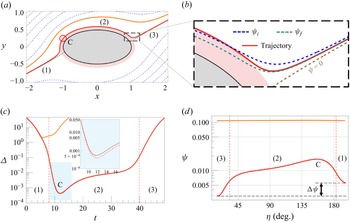


 Open access

