




1. Introduction
When children start school, they have to learn a highly codified writing system, but many children around the world also face the task of learning to speak a standard variety that is fairly different from the variety spoken in their community. This type of second dialect acquisition (SDA) has predominantly been examined with respect to morphology, syntax, and the lexicon, but in this study, we address the lesser-studied aspect of pronunciation. We follow longitudinally primary-school children in Albania whose first dialect (D1), Gheg, differs from Standard Albanian (SA), the variety they have to learn as a second dialect (D2). Our goal is to uncover whether learning a D2 at this stage of language development has an effect on D1 speech features. Carrying out such an empirical study has implications for our understanding of later language development, but also for the design and implementation of language teaching curricula. In the following sections, we review relevant literature on: the acquisition of a standard variety during primary school; the status of SA and Gheg in Albania; and the speech features selected for this study.
1.1. Acquiring a standard variety in primary school
In contexts where there is a structural gap between the national standard and the variety spoken locally, children enter school with different levels of familiarity with the standard, ranging from full proficiency to limited passive exposure. For children without full proficiency, primary school years are thus characterized by a process of SDA. For adults, the process of SDA typically results in hybrid linguistic systems mixing features of the first (D1) and second dialects (D2) as well as variants intermediate between those of the D1 and D2 (e.g. Evans & Iverson, Reference Evans and Iverson2007; Munro et al., Reference Munro, Derwing and Flege1999; for reviews, see Nycz, Reference Nycz2015; Siegel, Reference Siegel2010). The focus of most SDA studies is on the assumed replacement of D1 features by D2 features, not so much on the development of bidialectalism, where the two dialects are analogous to two different styles which can be used with different interlocutors in different communication situations (cf. Love & Walker, Reference Love and Walker2013). For children, however, the process of SDA is different than for adults, but not fully understood, especially when SDA takes place beyond early childhood in educational contexts. Our goal here is to understand whether the phonetic features of Albanian children’s D1 are influenced by the acquisition of a standard variety as D2 during primary school. In this section, we review literature addressing whether SDA in childhood could result in two separate linguistic systems, as well as SDA in educational contexts.
Children are usually considered to have the cognitive plasticity and linguistic skills necessary for them to rapidly achieve native-like competence in the D2, in a way that adults cannot (Lenneberg, Reference Lenneberg1967; Siegel, Reference Siegel2010). Within childhood, the earlier children begin to acquire the D2, the more likely they are to reach native-like competence, especially when the speech features to be acquired are linguistically complex, for instance, lexically conditioned phonological rules or new phonological oppositions (e.g. Chambers, Reference Chambers1992; Kerswill, Reference Kerswill1996). Some studies have suggested that SDA in early childhood could lead to bidialectalism, where the D1 and D2 are comparable to two speech styles that children learn to use in different contexts (Chevrot, Reference Chevrot, Asahi, D’Arcy and Kerswillin press; Kobayashi, Reference Kobayashi, Dale and Ingram1981). This is consistent with the literature suggesting that the ability to differentiate between speech styles begins very early in language development. For example, starting in utero, babies learn to differentiate their mother’s voice from other voices (Ockleford et al., Reference Ockleford, Vince, Layton and Reader1988; Webb et al., Reference Webb, Heller, Benson and Lahav2015) and, as infants, they show a preference for familiar voices and accents over unfamiliar ones (Butler et al., Reference Butler, Floccia, Goslin and Panneton2011; Purhonen et al., Reference Purhonen, Kilpeläinen-Lees, Valkonen-Korhonen, Karhu and Lehtonen2005). As they grow, in part due to the diversity of exchanges they are exposed to, children start making associations between variation in speech and characteristics of the speaker or communication situation (Jeffries et al., Reference Jeffries, Lawyer, Cole and Vega2025; Kinzler & DeJesus, Reference Kinzler and DeJesus2013; Nardy et al., Reference Nardy, Chevrot and Barbu2013). In production, some studies have found that children as young as 3–4 years old alternated between standard and nonstandard features in certain types of communication situations (Kushartanti, Reference Kushartanti2014; Smith et al., Reference Smith, Durham and Richards2013). For example, play and routine interactions tended to trigger more nonstandard features than teaching and discipline interactions (Smith et al., Reference Smith, Durham and Richards2013).
However, even if such differentiation skills appear early on, they are still far from adult-like, and they keep developing well after early childhood. In a pivotal review paper of 39 different studies on the acquisition of phonological variation, Nardy et al. (Reference Nardy, Chevrot and Barbu2013) concluded that more systematic alternations between standard varieties in formal situations and nonstandard varieties in less formal situations were rarely observed before the age of 6 years old. For SDA, this suggests that for many years of child language development, the difference between D1 and D2 may not be clear-cut, giving rise to a range of scenarios where children could have hybrid systems, alternate between D1 and D2 within a given interaction, adopt intermediate variants, or use exclusively the D1 or the D2 irrespective of the speaking situation (Berthele, Reference Berthele2002). This high variability adds to the well-known tendency for child speech to be generally more variable than adult speech and often characterized by nonlinear and U-shaped developmental trajectories (Kohn & Farrington, Reference Kohn, Farrington, Wagner and Buchstaller2018; Lee et al., Reference Lee, Potamianos and Narayanan1999; Pinker & Prince, Reference Pinker and Prince1988; Rumelhart & McClelland, Reference Rumelhart, McClelland and MacWhinney1987; Vorperian & Kent, Reference Vorperian and Kent2007). For example, in a longitudinal study of three Canadian children acquiring (York) British English as a D2, Tagliamonte and Molfenter (Reference Tagliamonte and Molfenter2007) observed a nonlinear, gradual process spanning a few years which resulted in a high, but noncategorical, production rate of a D2 speech feature. In another study of English-speaking American children in 3rd, 5th, and 7th grades, Isaacs (Reference Isaacs1996) measured a significantly increasing use of standard variants over time for five morphosyntactic features, but also reported production rates of the standard variants, which, by 7th grade, had not necessarily reached categoricity, that is, between 8% and 100%. For one feature, the increase was more marked between 3rd and 5th grades than between 5th and 7th grades, two features showed the opposite pattern, while one feature exhibited a U-shaped increase. Using a composite dialect density measure (DDM) in a series of studies on African American children between preschool and 5th grade, Craig and Washington (Reference Craig and Washington2006) observed a significant decrease in DDM scores (i.e. a decreasing production of nonstandard variants) for morphosyntactic features between preschool and 1st grade, followed by relative stability. For phonological features, the most pronounced decrease in DDM scores was observed between 2nd and 3rd grades. Wolfswinkler and Harrington (Reference Wolfswinkler and Harrington2023) also documented a situation of cross-dialectal phonetic influence where the acoustic distinction between standard (D2) and dialect (D1) seemed to diminish over time in the speech of school-age children. In their longitudinal study of 1st-, 2nd-, and 3rd-grade children whose D1 was West Central Bavarian, some vowels were found to be increasingly influenced by Standard German (D2) over time, even though these vowels still qualified as West Central Bavarian. These studies, especially the latter, suggest that D2 might not be acquired as a fully separate system that leaves D1 intact, but instead that D2 could influence D1 for several years of middle childhood.
When children start acquiring a D2 in school, most commonly a standard national variety (Siegel, Reference Siegel2010), explicit teaching, or at least metalinguistic commentary from teachers, is involved. Explicit teaching can be beneficial to the SDA process, for instance, in helping children identify linguistic differences between the D1 and D2. Among the variety of didactic approaches to SDA reviewed by Siegel (Reference Siegel2010, pp. 156–218), a comparative approach used in Singapore where children progressively built on their knowledge of Singapore Colloquial English (D1) to learn Singapore Standard English (D2) resulted in high pass rates at standard language exams by the end of primary school (Gupta, Reference Gupta1994; Siegel, Reference Siegel2010; see also Steele, Reference Steele2020 for a recent applied study). In Isaacs’ (Reference Isaacs1996) study of five morphosyntactic features among English-speaking American children from 3rd to 7th grades, in addition to an increasing use of standard variants over time, differences observed in 3rd grade between African American and White children had evened out by 7th grade. However, Siegel (Reference Siegel2010, p. 220) mentions that both teaching programs and studies on SDA in educational contexts typically focus on lexical and morphosyntactic features, less so on phonological features, partly because failing to produce standard lexical and morphosyntactic forms in writing leads to objectively measurable errors. Consequently, such teaching programs of standard varieties may not have fully fledged sections devoted to pronunciation, leaving teachers with few other resources than their intuitions, while the development of children’s speech features in this context has been little researched.
To summarize, the literature reviewed in this section suggests that in SDA contexts, children above the age of 6 years old might not fully distinguish between their D1 and D2, possibly because they have not yet acquired the sociolinguistic skills to use the two dialects as two different styles. However, there are far fewer studies on this stage of language development than on early childhood, and few studies on the acquisition of D2 speech features in educational contexts, in particular how D2 may affect the phonetic characteristics of D1. In this study, we contribute to filling these gaps by investigating how D1 speech features of Albanian children learning SA as a D2 develop between 1st, 2nd, and 5th grades. In the next sections, we provide details about the Albanian context which allow us to formulate specific aims and hypotheses.
1.2. Standard Albanian and Gheg
Albanian is a language of the Indo-European family with an estimated 7 million speakers worldwide. In this study, we are concerned with Albanian spoken in Albania, which comprises two main dialects, Gheg and Tosk. Traditionally, Gheg is spoken in the central and northern parts of Albania, including in the capital city Tirana, whereas Tosk is spoken in the south (Gjinari et al., Reference Gjinari, Beci, Shkurtaj, Gosturani and Dodi2007). While usually mutually intelligible, Gheg and Tosk exhibit numerous differences in their lexicon, morphosyntax, and pronunciation. The vowel inventory of Tosk is composed of seven short oral vowels, /i y u e ə o a/ (Gjinari et al., Reference Gjinari, Beci, Shkurtaj, Gosturani and Dodi2007, p. 86). The inventory of the variety of Gheg spoken in and around Tirana is larger, with 12 oral vowels, /i iː y yː u uː e eː o oː a aː/, and five nasal vowels, /ĩ ỹ ũ ẽ ɑ̃/ (Gjinari et al., Reference Gjinari, Beci, Shkurtaj, Gosturani and Dodi2007, p. 86).
Since 1972, there has also been an official Standard Albanian variety (SA), of which the grammar, orthography, and pronunciation were established during the National Congress of Orthography of Tirana (Byron, Reference Byron1976). It is widely agreed that SA is predominantly based on Tosk, with only a few Gheg features incorporated (Byron, Reference Byron1976). The use of SA in the public sphere was strictly enforced under the communist regime (1946–1992), with such measures as a ban on Gheg publications; in the education system, all educational materials were only provided in SA, teachers were obliged to use it, and children were punished for using nonstandard features (Pipa, Reference Pipa1989). The fall of communism in 1992 brought about many changes in Albania, but the use of SA in the public sphere remained more or less the same. To this day, educational materials are still only offered in Tosk-based SA, and, importantly for this study, children are expected to speak it in class. While children growing up speaking Tosk have few, if any, adjustments to make to their pronunciation when they enter school, those speaking Gheg have to learn SA as a D2. Albanian teachers are expected to teach these children SA pronunciation along with the rest of the grammar, but they receive no particular training or instructions to do so, and the national curricula, which set educational objectives for children across the country, make no specific mention of pronunciation (MAS, 2017). Teachers are left to their own resources to identify speech features that differ from SA and to teach SA as a D2. As witnessed by the second author during field trips in primary schools located in Gheg areas, this tends to result in teachers constantly correcting “wrong pronunciations,” an approach which in other contexts has been labeled “a waste of time” (Cheshire & Edwards, Reference Cheshire, Edwards, Egan-Robertson and Bloome1998, p. 199) and likely targets Gheg speech features that are particularly salient and stigmatized.
In line with these observations, Albanian adults have been found to hold less positive attitudes toward Gheg than toward Tosk and SA (Morgan, Reference Morgan2015; Riverin-Coutlée et al., Reference Riverin-Coutlée, Kapia and Gubian2024). In attitude studies, participants typically describe Gheg as rural, backward, uneducated, or harsh; but Tosk and/or SA as soft, calm, or educated. Riverin-Coutlée et al. (Reference Riverin-Coutlée, Kapia and Gubian2024) further showed that Albanian adults were not equally sensitive to all Gheg variants, with some being more readily noticed and negatively judged than others (see next section for details). Riverin-Coutlée et al. (Reference Riverin-Coutlée, Kapia and Gubian2024) connected these findings with those of another study (Riverin-Coutlée et al., Reference Riverin-Coutlée, Kapia, Cunha and Harrington2022), which investigated dialect leveling in some of the same features and showed that Gheg speakers living in the capital city, Tirana, produced fewer dialect variants than Gheg speakers living in a rural environment (in the village of Bërzhitë located 15 km from Tirana). The leveling observed in Tirana was attributed to high contact of Tirana Gheg speakers with SA and Tosk speakers, in contrast to low contact in Bërzhitë, and concerned two Gheg variants which were also negatively evaluated in the attitude study by Riverin-Coutlée et al. (Reference Riverin-Coutlée, Kapia and Gubian2024). On the other hand, one Gheg variant, found to resist leveling even in Tirana, was not identified as Gheg and was positively evaluated in the attitude study. In the leveling study, Riverin-Coutlée et al. (Reference Riverin-Coutlée, Kapia, Cunha and Harrington2022) also compared adult productions with those of first graders, showing that while leveling was slightly more advanced among children, they replicated the main patterns found in adults: first graders living in Bërzhitë produced more dialect variants than those living in Tirana.
In the current study, we investigate the four features also considered by Riverin-Coutlée et al. (Reference Riverin-Coutlée, Kapia and Gubian2024) to find out whether Albanians’ sociolinguistic attitudes toward Gheg are reflected in how Gheg children’s speech develops during primary school. D1 features that tend to undergo leveling and trigger negative sociolinguistic evaluations could be more prone to change, especially if they are targeted and corrected by teachers. Moreover, since Riverin-Coutlée et al. (Reference Riverin-Coutlée, Kapia, Cunha and Harrington2022) showed differences in production rates of Gheg variants between first-graders growing up in a high-contact city versus a low-contact village, we investigate D1 development during primary school in two different groups of Gheg-speaking children, one living in a high-contact city, the other in a low-contact village, expecting different acquisition tracks given that they have different starting points.
1.3. Selected features
The four pronunciation features selected are the same as those investigated in the attitude study by Riverin-Coutlée et al. (Reference Riverin-Coutlée, Kapia and Gubian2024). Here, we briefly describe the linguistic conditioning of these features in Gheg (D1) and SA (D2), as well as how these were rated on a dialect identification scale (Gheg – ToskFootnote 1) and a status scale (educated–uneducated) by the participants in Riverin-Coutlée et al. (Reference Riverin-Coutlée, Kapia and Gubian2024). Based on this, predictions about the development of these features during primary school are formulated in the following section.
The four vowel features are found in stressed syllables, with the main correlates of stress being a longer duration, a higher fundamental frequency, and, less systematically, a higher intensity than those measured in unstressed syllables (Coretta et al., Reference Coretta, Riverin-Coutlée, Kapia and Nichols2023). The first feature is rounding of /a/ (Çeliku, Reference Çeliku1968; Gjinari et al., Reference Gjinari, Beci, Shkurtaj, Gosturani and Dodi2007). In (Southern) Gheg (D1), stressed /a/ has two allophones: rounded [ɔ]Footnote 2 when the vowel is preceded by a nasal consonant, for example, mal “mountain” [mɔl]; and unrounded [a] elsewhere, for example, ɡal “jackdaw” [ɡal]. The rounded allophone was identified as Gheg and judged to sound more uneducated than educated on the status scale by the participants in Riverin-Coutlée et al. (Reference Riverin-Coutlée, Kapia and Gubian2024). In contrast, in SA (D2), unrounded [a] is found in all phonetic contexts, for example, mal “mountain” [mal], ɡal “jackdaw” [ɡal].
The second feature is vowel nasality (Gjinari et al., Reference Gjinari, Beci, Shkurtaj, Gosturani and Dodi2007). The phonological inventory of Gheg (D1) comprises several nasal vowels which (in synchrony) may or may not be surrounded by nasal consonants, for example, mpi “numb” /pĩ/, hënë “moon” /hɑ̃n/. Gheg thus features minimal pairs such has mpi “numb” /pĩ/ versus pi “to drink” /pi/. Nasal vowels triggered the most extreme ratings from the participants in Riverin-Coutlée et al. (Reference Riverin-Coutlée, Kapia and Gubian2024), who clearly identified the feature as Gheg and rated it as “uneducated,” which was interpreted as evidence that it was a stereotyped feature within Labov’s (Reference Labov1972, p. 314) tripartite division between stereotypes, markers, and indicators. The phonological inventory of SA (D2) has no nasal vowels; where Gheg has nasal vowels, Tosk has oral vowels instead, the quality of which is often the “oral counterpart” to the Gheg nasal vowels, for example, /i/ instead of /ĩ/ in mpi “numb” /mpi/. However, where Gheg has /ɑ̃/, SA has instead /ə/, for example, hënë “moon” /hənə/ (produced as [hən] or [ˈhənə]).
The third feature is monophthongization (Gjinari, Reference Gjinari1968; Gjinari et al., Reference Gjinari, Beci, Shkurtaj, Gosturani and Dodi2007). In certain lexical items where SA (D2) has diphthongs (or vowel sequences), Gheg (D1) has instead monophthongs, typically corresponding to the first vocalic component of the SA diphthongs. For example, duar “hands” is /duɽ/ in Gheg but /duaɽ/ in SA; fyell “flute” is /fylˠ/ in Gheg but /fyelˠ/ in SA. Thus, SA has (near-)minimal pairs opposing diphthongs and monophthongs, where Gheg does not. In the above-mentioned attitude study, monophthongization was identified as Gheg and judged relatively uneducated, similar to rounding of /a/.
The fourth feature is contrastive vowel length (Beci, Reference Beci1995; Çeliku, Reference Çeliku1971). The phonological inventory of Gheg (D1) comprises long vowels, which can form minimal pairs with short vowels of the same quality, for example, plakë “an old man” /plaːk/ versus plak “an old woman” /plak/. SA (D2) has short vowels only, occasionally causing homophony (e.g. [plak] for both plakë “an old man” and plak “an old woman”), which does not exist in Gheg. Contrary to the other features, long vowels were not identified as Gheg by the participants in Riverin-Coutlée et al.’s (Reference Riverin-Coutlée, Kapia and Gubian2024) study. They were also rated as educated pronunciations, a judgment which participants normally reserved for Tosk features. This was interpreted as evidence that contrastive vowel length is an indicator, that is, a feature described by linguists but unnoticed by the speech community (Labov, Reference Labov1972).
1.4. Aims and hypotheses
This study is concerned with SDA in primary-school-age children. We investigated the influence that acquiring a standard variety as a second dialect (D2) has on these children’s first dialect (D1) speech features. The study follows in 1st, 2nd, and 5th grades Albanian children whose D1, Gheg, differs from SA, the D2 they are expected to learn in school. Focusing on four speech features, we tested whether D1 variants that are stigmatized in the Albanian adult population are more prone to change than nonstigmatized variants as primary school children acquire SA as a D2. We investigated these issues in two groups of children with a Gheg background, one group living in a (low-contact) village, the other living in a (high-contact) city, the latter producing less traditional D1 variants already in 1st grade.
Based on the literature outlined in the previous sections, we formulate the following hypotheses:
-
1) Children’s D1 will have changed toward D2 by the 5th grade.
-
2) The gap between children living in the village and those living in the city will have narrowed by the 5th grade.
-
3) Stigmatized D1 variants (rounding of /a/, vowel nasality, monophthongization) will be more prone to change than the nonstigmatized one (contrastive vowel length).
-
4) There will be substantial variability and nonlinearity in developmental trajectories.
2. Methods
2.1. Participants
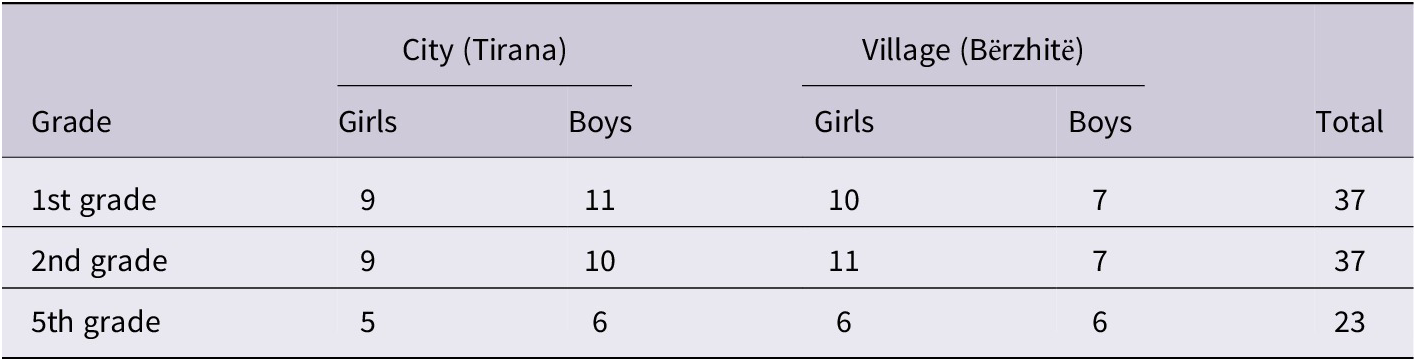
The participants in this study were 48 Albanian children who attended primary schools in the city of Tirana and the nearby village of Bërzhitë (both in Tirana county, one school per location) and were screened for known language or hearing disorders. They were all native speakers of Albanian with a Gheg dialect background, that is, their parents and grandparents spoke Gheg (specifically, the Southern Gheg subvariety spoken in Tirana county). Twenty-one (21) participants were recorded three times, that is, in 1st, 2nd, and 5th grades; five participants were recorded in 1st and 2nd grades; two participants were recorded in 2nd and 5th grades; 11 participants were recorded in 1st grade only; nine participants were recorded in 2nd grade only. Our sample thus combined longitudinal and cross-sectional data. In 1st grade, the children were aged 6–7 years old; in 2nd grade, 7–8 years old; and in 5th grade, 10–11 years old.Footnote 3 Sociodemographic characteristics of the participants are shown in Table 1.
Main sociodemographic characteristics of the 48 participants in this study

No information related to the socioeconomic status of the participants’ caretakers was collected. First, it is not clear how socioeconomic status has developed in Albania, a former communist country, and still today one of the weakest economies in Europe. Broadly speaking, children attending a given school came from comparable families. However, the city/village division is tied to some differences in lifestyles, which may approximate differences in socioeconomic status. Compared to Tirana, Bërzhitë retains a more traditional way of life centered around self-sufficiency from farming, little commuting, and fewer opportunities for higher education (see Riverin-Coutlée et al., Reference Riverin-Coutlée, Kapia, Cunha and Harrington2022, pp. 464–467).
2.2. Procedure
Speech was elicited by means of a picture-naming task that was accessible to the first graders, who were not proficient readers yet, and which made possible a collection of enough speech data from each speaker for a quantitative analysis without interference from orthography, which is transparent and aligned on SA (D2). The vocabulary and pictures were familiar to primary school children and culturally meaningful, as validated in an unpublished pilot study conducted with 10 Albanian children. The experiments took place in quiet rooms of the primary schools attended by the participants. The instructions were the same every year: the experimenter (the second author, who was born and raised in a Southern Gheg-speaking area) asked the participants to name what they saw as they would at home. The experimenter spent time in the classrooms before testing the children, including showing the images that would be used in the task. Despite these precautions, the experiment remained an unusual activity, and we cannot expect that the children expressed themselves as freely as they would when, for example, playing with peers.
Fifty-four (54) images were included in the experiment, each of which was presented four times over four different blocks separated by short breaks, with items randomized within each block. The images were shown on a computer monitor using SpeechRecorder software (Draxler & Jänsch, Reference Draxler, Jänsch, Lino, Xavier, Ferreira, Costa and Silva2004), and the recordings were made with a head-mounted microphone (Beyerdynamic TG H54c) connected to a digital preamplifier (Tascam US-2 × 2; 44.1 kHz, 16 bits).
2.3. Acoustic analyses
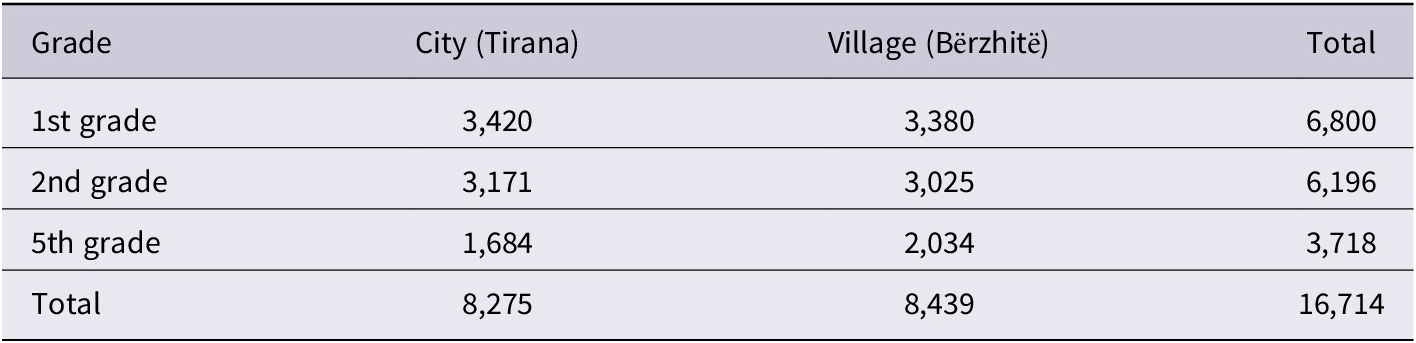
Of the 54 target words included in the picture-naming task, 42 were analyzed in the current study (see Supplementary Materials for the word list; see Table 2 for numbers of retained tokens per grade and origin). These 42 words comprised either one of the four speech features of interest, or one of the six oral monophthongal vowels /i y u e o a/ elicited for the purpose of determining the vowel space of each child at each sampling point. This baseline vowel space was used as a set of anchors against which the features of interest were compared and normalized (Kohn & Farrington, Reference Kohn, Farrington, Wagner and Buchstaller2018).
Number of vowel tokens analyzed per grade and origin

The recordings were forced-aligned with WebMAUS (Kisler et al., Reference Kisler, Reichel and Schiel2017), then structured into a speech database in the EMU environment (Winkelmann et al., Reference Winkelmann, Harrington and Jänsch2017). Where needed, boundaries between vowels and adjacent segments were hand-corrected by a trained analyst based on the following criteria: vowels were identified as portions of the signals that had a well-defined formant structure, a higher intensity than adjacent segments, and/or a periodic waveform. Ambiguous cases were verified by a second analyst. Formant frequencies of vowels were estimated with Burg’s algorithm for linear predictive coding, with five formants to detect under 7000 Hz, and hand-correction of tracking where needed. The first two formants (F1 and F2) were linearly time-normalized to 11 time points between the acoustic vowel onset and offset. By-speaker normalization was applied to all formant frequencies with Lobanov’s (Reference Lobanov1971) method, given that there were roughly equal numbers of vowel tokens across the vowel space and that this method was found to perform well on longitudinal child data (Kohn & Farrington, Reference Kohn and Farrington2012, Reference Kohn, Farrington, Wagner and Buchstaller2018). For the normalization procedure, participants recorded multiple times were treated as different individuals each year.
The analysis of the first feature, rounding of /a/, seeks to verify whether Gheg [ɔ] changes toward SA [a] in words like mal “mountain” during primary school. This was operationalized as the relative distance, in the speakers’ vowel space, between target vowels in mal-type words and baseline /a/ and /o/: SA (D2) pronunciations of mal should be closer to /a/ than to /o/. Selecting normalized F1 and F2 measurements at the vowels’ temporal midpoint, we first calculated the Mahalanobis distance between target vowels and the distributions of /a/ and /o/ (i.e. target to /a/ and target to /o/), for each year separately. Mahalanobis distances were chosen because, in contrast to Euclidean distances, they model the extent and direction of the variance (see Riverin-Coutlée et al., Reference Riverin-Coutlée, Roy and Gubian2023 for further technical details on Mahalanobis distances). For each token of mal-type words, two Mahalanobis distances were thus obtained: one distance to the distribution of /a/ and one distance to the distribution of /o/; after which a ratio was calculated by dividing the distance to /a/ by the distance to /o/. Ratios were log-transformed, a common operation for left-bounded and right-skewed distributions like those of raw distances or durations. This resulted in: a value of 0 corresponding to an equal distance between /a/ and /o/; positive values to tokens closer to /o/; and negative values to tokens closer to /a/. Log-ratios were set as response variable in a statistical model described in the following section.
For the vowel nasality feature, the question we address is whether Gheg /ɑ̃/ changes toward SA /ə/ in words like hënë “moon” during primary school. Nasality is known to affect in complex ways the acoustics of vowels. In an evaluation of 22 acoustic features potentially correlated to vowel nasality, Styler (Reference Styler2017, p. 2470) warned that the most robust feature found in his study, A1-P0 (where A1 is the amplitude of the harmonic closest to F1, and P0 is the amplitude of a low-frequency nasal peak, typically around 250 Hz), was less reliable for “speakers with exceptionally short vocal tracts,” which is precisely the case of our participants. Therefore, we chose to rely on formant frequencies, knowing that the change from D1 /ɑ̃/ to D2 /ə/ involves not only the loss of nasality, but also a substantial change in quality which brings vowels closer to the center of the vowel space. We first computed for each speaker the average coordinates of corner vowels /i u a/ at their temporal midpoint in the normalized F1 × F2 space. Based on these coordinates, the center of the triangle formed by corner vowels /i u a/ was computed. Then, we calculated the Euclidean distanceFootnote 4 between the target tokens and the center of the vowel space, the premise being that D2 /ə/ should have a smaller distance to the center than D1 /ɑ̃/. Euclidean distances were log-transformed and set as response variable in a statistical model described below.
For monophthongization, our analysis addresses the question of whether Gheg monophthongs change toward SA diphthongs in words like duar “hands.” Three D2 diphthongs were considered: /ye/, /ue/, and /ua/, the corresponding D1 monophthongs being /y/, /u/, and /u/ respectively. For this analysis, the entire trajectories of F1 and F2 from vowel onset to offset were included in two statistical models.
The analysis applied to the fourth feature, contrastive vowel length, aims at verifying whether Gheg long vowels change toward SA short vowels during primary school. We measured the duration of phonologically long and phonologically short vowels, assuming that the difference between the two categories would disappear if children adopted D2 length. Vowel duration was log-transformed and set as the response variable in a model explained in the following section.
2.4. Statistical analyses
The statistical analyses were used to test whether the children’s D1 speech features changed from 1st to 5th grades, to compare the acquisition tracks of city and village children, to assess variability and nonlinearity of acquisition trajectories, while also adapting our analyses to the acoustic indices extracted for each of the four features (see previous section). For the three features where a given token was represented by a single numerical value, that is, rounding of /a/ (log-Mahalanobis distance ratio), vowel nasality (log-Euclidean distance), and contrastive vowel length (log-duration), we opted for distributional regression models predicting both the mean and the dispersion of the response variable depending on fixed and random predictor terms. By allowing the modeling of dispersion (or variance), and not just the mean as is most common, distributional models made it possible to test our hypothesis of variability in developmental trajectories (see Klein, Reference Klein2024 for a review of distributional models). These generalized linear mixed-effect regressions were fitted to the data using the glmmTMB package (McGillycuddy et al., Reference McGillycuddy, Warton, Popovic and Bolker2025) in R (R Core Team, 2025), as well as emmeans to compute estimated marginal means and pairwise comparisons (Lenth, Reference Lenth2025).
In all three models, the same predictor structure was used to estimate both parameters of the response distribution, that is, the mean and the dispersion. Fixed terms included the participants’ origin (2 levels: city, village), the participants’ grade (3 ordered levels: 1st grade, 2nd grade, and 5th grade), and their interaction (see Supplementary Materials for R syntax of all models). Linear and quadradic trends were estimated from the ordered factor grade; the null hypothesis for the linear trend is a flat line between the ordered levels of the factor, while the null hypothesis for the quadradic trend is a straight line (no curvature or U-shape). Estimates for quadratic trends were used to test our hypothesis of nonlinear developmental trajectories. For contrastive vowel length, the model included three fixed factors: length (2 levels: short, long), origin, and grade. Participants and words Footnote 5 were random factors with slopes for origin, grade, and length where appropriate.
For monophthongization, generalized additive mixed-effect models (GAMMs) were fitted separately to F1 and to F2 using the mgcv and itsadug packages (van Rij et al., Reference van Rij, Wieling, Baayen and van Rijn2017; Wood, Reference Wood2017). In both cases, a parametric term with 18 levels was formed from the interaction of participants’ origin (2 levels: city and village), participants’ grade (3 levels: 1st grade, 2nd grade, and 5th grade), and diphthong (3 levels: /ye/, /ue/, and /ua/). The models also included a smooth term for the interaction between this factor and normalized time; and random smooths for participants and words over time. Model inspection led us to refit the models with scaled-t distributed residuals and an autocorrelation term. Longitudinal change in this feature and differences between origins were assessed in a qualitative manner by observing the estimated formant trajectories’ length, shape, and starting and ending points in the vowel space.
3. Results
Results for each feature are presented in a dedicated subsection. Interpretation of these results in relation to our hypotheses can be found in the discussion.
3.1. Rounding of /a/
The focus here was on whether Gheg [ɔ] changed toward SA [a] using Mahalanobis distance ratios. Figure 1 shows the location of [ɔ] in the F1 × F2 space relative to baseline /a/ and /o/ (top), and the value of the computed ratios (bottom). While the [ɔ] ellipses largely overlap with /a/ and most ratios have a value below 0, suggesting more /a/−like tokens across the board, Figure 1 also shows that the village children have more spread distributions than city children. Small changes across grades are observed, generally away from extremely high F1 values, and in the case of city children, toward more /o/−like tokens in 5th grade.
Top: F1 × F2 plots showing the distribution of [ɔ] relative to /a/ and /o/; the phonetic symbols correspond to the center of the ellipses, which encompass 95% of the data. Bottom: density plots of Mahalanobis distance ratios, where 0 marks equal distance to distributions of /a/ and /o/.

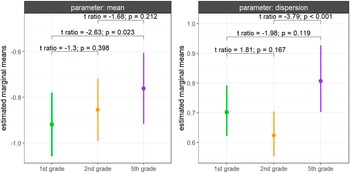
The results of the statistical analysis indicate significant effects of origin and grade on mean ratios, but no interaction between the two terms (see Supplementary Materials for full model summaries). In general, city children had lower ratios (i.e. tokens closer to /a/) than village children (z = 4.00, p < 0.001). For the grade effect, only the linear trend was significant (linear: z = 2.63, p = 0.008; quadratic: z = 0.35, p = 0.729), meaning that the change over time is not U-shaped. This is illustrated in the left part of Figure 2, which shows a gradual linear increase of estimated marginal means from 1st to 5th grade. While only the difference between 1st and 5th grades was significant (see statistics printed in Figure 2), the trend was toward less /a/−like tokens over time.
Estimated marginal means for the mean (left) and dispersion (right) parameters, with t ratios and p-values computed for each grade pair.

The results for the dispersion parameter also indicate significant effects of origin and grade, but no interaction. In general, village children had higher dispersion (i.e. more variability) than city children (z = 2.46, p = 0.014). For the grade effect, both the linear and the quadratic trends were significant (linear: z = 1.98, p = 0.048; quadratic: z = 3.34, p < 0.001). These trends are illustrated in the right part of Figure 2, which shows that dispersion increases between 1st and 5th grades after a dip in 2nd grade. Only the difference between 2nd and 5th grades is significant.
To summarize, city children produced more D2-like and less dispersed [ɔ] tokens than village children. Over time, [ɔ] became slightly less D2-like and more dispersed.
3.2. Vowel nasality
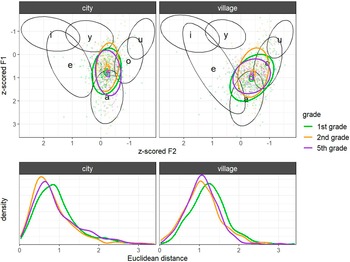
Euclidean distance to the center of the vowel space was analyzed to determine whether Gheg /ɑ̃/ changed toward SA /ə/. Figure 3 shows the location of /ɑ̃/ in the F1 × F2 space relative to the oral vowel system (top), and the value of the computed Euclidean distances (bottom). Tokens produced by city children appear more central than those of village children. Density plots (bottom) suggest a greater distance from the center of the vowel space for the 1st grade.
Top: F1 × F2 plots showing the distribution of /ɑ̃/ relative to oral vowels; the phonetic symbols correspond to the center of the ellipses, which encompass 95% of the data. Bottom: density plots of Euclidean distances to the centre of the vowel space, where a distance of 0 corresponds to the center.

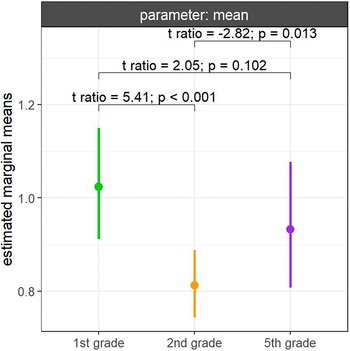
The results of the statistical analysis indicate significant effects of origin and grade on mean distances, but no interaction between the two terms. City children’s tokens were significantly closer to the center of the vowel space than village children (z = 4.24, p < 0.001). For the grade effect, only the quadratic trend was significant (linear: z = −0.59, p = 0.554; quadratic: z = 4.05, p < 0.001), meaning that estimates for 1st and 5th grades are similar, but the trajectory between them is U-shaped. This is illustrated in Figure 4, in which 2nd grade exhibits a significantly lower estimated Euclidean distance to the center than 1st and 5th grades.
Estimated marginal means for the mean parameter, with t ratios and p-values computed for each grade pair. Estimates on the logarithmic scale were exponentiated for interpretability.

For the dispersion parameter, the effect of origin was significant, but not that of grade or their interaction. The city children’s tokens were significantly more dispersed than those of village children (z = −4.46, p < 0.001).
In summary, city children produced /ɑ̃/ tokens that are more D2-like and more dispersed than village children. There is no straightforward change toward D2 over time, but instead a U-shaped developmental trajectory tending toward D2.
3.3. Monophthongization
The question addressed in this section is whether formant trajectories suggest that Gheg monophthongs /y/, /u/, and /u/ change toward SA diphthongs /ye/, /ue/, and /ua/. Figure 5 shows these vowels’ mean formant trajectories in the F1 × F2 space as estimated with GAMMs. For the city children, small changes are observed in trajectory lengths: /ye/ becomes progressively longer from 1st to 5th grade; /ue/ is slightly shorter in 5th grade; and /ua/ is shorter in 2nd and 5th grades compared to 1st grade. For village children, substantial changes can be seen when comparing 5th grade with 1st and 2nd grades. The trajectories of all diphthongs are longer in 5th grade, especially that of /ua/. All trajectories also become much more similar to those of the city children than they were in 1st and 2nd grades.
F1 × F2 plots showing the estimated F1 and F2 trajectories of vowels which are diphthongal in SA (D2) relative to baseline /y/, /u/, and /o/, with arrowheads corresponding to vowel offset. The phonetic symbols correspond to the center of the ellipses encompassing 95% of the data.

Children in 1st grade tended to produce vowels with more curved formant trajectories than children in 2nd and 5th grades, which is better visualized in Figure 6. These dynamic trajectories, however, do not necessarily point to more diphthongized qualities. For instance, village children’s /ua/ and /ue/ may look highly dynamic in Figure 6, but in Figure 5, these vowels remain within a limited zone of the F1 × F2 space between onset and offset. This could be due to less controlled vowel articulation and/or a greater coarticulatory influence of neighboring segments in younger children.
GAMM-based estimates of F1 and F2 trajectories of vowels that are diphthongal in SA (D2). Shading corresponds to 95% confidence intervals.

To summarize, city children seemed to already produce D2 diphthongs in 1st grade. By 5th grade, village children have caught up with their city peers. We also observe that articulatory variability seems greater in younger children.
3.4. Contrastive vowel length
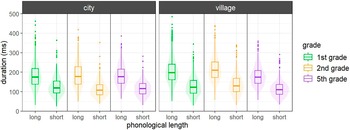
The analysis carried out in this section focuses on duration to test whether Gheg long vowels change toward SA short vowels. It is quite clear from Figure 7 that the contrast between phonologically short and long vowels is maintained by city and village children across grades.
Box and violin plots showing the distribution of vowel durations in phonologically short and long vowels.

The results of the statistical analysis show a significant interaction between origin, length, and the linear trend of grade on mean durations (see top of Figure 8, as well as model summary and pairwise comparison table in the Supplementary Materials). The reason for this interaction is that the city children’s durations of both short and long vowels remain roughly the same between 1st and 5th grades; whereas the village children’s vowel durations decrease between 1st and 5th grades, and more so for long than short vowels. In other words, by 5th grade, the village children’s long vowels are much more similar to those of the city children than they were in 1st grade. The quadratic trend of grade significantly interacted with length only. This is explained by a U-shape in long vowels, where 2nd grade exhibits longer durations than 1st and 5th grades, but no U-shape for short vowels. Aside from these interactions, one important result is the main effect of length, where short vowels are significantly shorter than long vowels (z = −6.11, p < 0.001).
Estimated marginal means for the mean (top) and dispersion (bottom) parameters. No t ratios or p-values are printed to ensure readability of the figure. Estimates for the mean parameter were exponentiated.

For the dispersion parameter, the results of the statistical analysis indicate a significant interaction between origin, length, and the linear trend of grade; while the quadratic trend of grade is neither significant on its own, nor in interaction with any other factor. The reason for the interaction (Figure 8, bottom part) is a downward trend in the dispersion of village children’s long vowel durations, but no significant change between 1st and 5th grades for their short vowels; while for city children, there is a significant increase in the dispersion of their short vowels, but no change for their long vowels.
In summary, children did not acquire D2 length. Over time, the duration of village children’s vowels decreases and becomes comparable to the duration of city children’s vowels. Dispersion fluctuates in a rather unpredictable manner.
4. Discussion
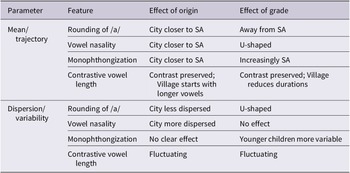
The aim of this study was to investigate the extent to which D1 speech features from two groups of Gheg-speaking children were influenced by their acquisition of SA as a D2 during primary school. Vowels produced during a picture-naming task by 48 Albanian children in 1st, 2nd, and 5th grades were analyzed acoustically and statistically with distributional regression models and GAMMs. We now discuss the results, summarized in Table 3, in relation to our four hypotheses.
Summary of the main results, separated per parameter, feature, origin, and grade

4.1. Back to the hypotheses
The first hypothesis was that the children’s D1 would have changed toward SA by 5th grade. Results from the monophthongization feature support this hypothesis: village children produced more SA-like diphthongal vowel trajectories in 5th grade (Figure 5). For the vowel nasality feature, there was also a trend toward SA, which was more marked in 2nd than in 5th grade (Figure 4). On the other hand, results for rounding of /a/ exhibited a tendency away from SA: tokens of [ɔ] were slightly closer to /o/ in 5th grade than they were in 1st and 2nd grades, as well as more dispersed (Figure 2). Overall, though, even in 5th grade, the mean location of [ɔ] was still closer to /a/ than to /o/. Finally, no change toward SA was observed for the contrastive vowel length feature. While our first hypothesis is at least partially supported, our results show that D1 speech features are not influenced by the D2 in equal measure, that is, each of the four investigated features followed its own acquisition path (see e.g. Isaacs, Reference Isaacs1996; Wolfswinkler & Harrington, Reference Wolfswinkler and Harrington2023 for similar findings).
Our second hypothesis was that phonetic differences between children living in the village and those living in the city would have narrowed by 5th grade, taking into account that city children produced less Gheg features already in 1st grade (Riverin-Coutlée et al., Reference Riverin-Coutlée, Kapia, Cunha and Harrington2022). For monophthongization, this was found to be the case: village children exhibited more similar formant trajectories to those of city children in 5th grade than in 1st and 2nd grades (Figure 5). Results for the contrastive vowel length feature also showed that in 1st and 2nd grades, village children produced longer vowels overall than city children (Figure 8). This difference disappeared by the 5th grade, although both groups of children clearly preserved the vowel length contrast. For the rounding of /a/ and vowel nasality features, however, village children’s productions remained less SA-like than city children’s productions across grades. These last results are not fully compatible with those of Isaacs (Reference Isaacs1996), who reported that differences in production rates of Standard American English morphosyntactic features observed in 3rd grade between African American and White children had evened out by 7th grade. Here, our participants were a bit younger (5th grade) than those in Isaacs (Reference Isaacs1996), and the investigated features were phonetic, whereas Isaacs’ (Reference Isaacs1996) were morphosyntactic. Moreover, a major difference between our study and Isaacs’ (Reference Isaacs1996) is that the African American and White participants in her study were in regular contact with each other, unlike our participants from the city and the village (see also Craig & Washington, Reference Craig and Washington2006). This suggests that at this stage of language development, formal education does not influence children’s D1 in the same manner that peers’ input does (Chevrot, Reference Chevrot, Asahi, D’Arcy and Kerswillin press), irrespective of whether peer influence leads to producing fewer standard features (Nardy et al., Reference Nardy, Chevrot and Barbu2014) or more standard ones (Isaacs, Reference Isaacs1996).
The third hypothesis was that Gheg speech features, which are stigmatized in the adult population – rounding of /a/, vowel nasality, and monophthongization – would be more prone to change than contrastive vowel length, which is not stigmatized (Riverin-Coutlée et al., Reference Riverin-Coutlée, Kapia and Gubian2024). Not all stigmatized features appeared particularly prone to change, but the hypothesis was still partly supported. The results clearly showed that contrastive vowel length – the non-noticed, nonstigmatized D1 feature – was preserved by both groups of children across grades. Moreover, the largest measured change toward SA was for one of the stigmatized features, that is, monophthongization. Stigmatized variants were also those for which city children were found to have more D2-like acoustic characteristics than village children already in 1st grade, a difference that persisted up to 5th grade in two out of three features. There is some consistency between our findings on changing features and those showing that sociolinguistic knowledge is acquired quite early in child speech (Chevrot, Reference Chevrot, Asahi, D’Arcy and Kerswillin press; Nardy et al., Reference Nardy, Chevrot and Barbu2013; Smith et al., Reference Smith, Durham and Richards2013). It could also be that stigmatized features which are part of the public metalinguistic discourse (Morgan, Reference Morgan2015) are most available to teachers and most prone to be corrected in the absence of official guidelines or didactic materials specific to teaching SA pronunciation (MAS, 2017). Contrastive vowel length, which qualifies as an indicator (Riverin-Coutlée et al., Reference Riverin-Coutlée, Kapia and Gubian2024) – a type of feature that is not normally discussed in the speech community (Labov, Reference Labov1972) – probably remains unnoticed and undiscussed by teachers. The absence of any corrective strategy may be one contributing factor in explaining why Gheg contrastive vowel length persists throughout primary school, but it is probably not the only factor, as argued in the preceding paragraph, while the presence of corrective strategies or stigma does not necessarily lead to change.
Our fourth hypothesis was that there would be substantial variability and nonlinearity in developmental trajectories. The results for all features provided some support for this hypothesis, but in different ways depending on the feature, as illustrated by the examples hereafter (see also Table 3). The analysis applied to rounding of /a/ showed an increase in estimated dispersion accompanying the change away from SA in 5th grade (Figure 2). Dispersion estimates for that same feature were also found to be U-shaped, since the high dispersion of 5th grade followed a dip in 2nd grade. For vowel nasality, the most D2-like measurements were obtained in 2nd grade, while in 5th grade, these had retracted to levels similar to 1st grade (Figure 4). The long vowels of city children also exhibited a (reversed) U-shape, with slightly longer estimated mean durations in 2nd grade than in 1st and 5th grades (Figure 8). However, there are inconsistencies across the features: for example, city children produced significantly less dispersed tokens than village children for rounding of /a/, whereas the opposite was found for vowel nasality. Another example is the three-way interaction between origin, length, and grade for the estimated dispersion of contrastive vowel length measurements, where dispersion was found to either increase or decrease or remain stable over time, depending on vowel length and the participants’ origin (Figure 8). The analyses of the monophthongization feature in 1st-grade village children showed highly dynamic formant trajectories that were more similar to heavily coarticulated monophthongs than to diphthongs (Figures 5, 6): this could be because of a form of variability inherent in child speech attributable to immature speech motor control (Lee et al., Reference Lee, Potamianos and Narayanan1999; Vorperian & Kent, Reference Vorperian and Kent2007). Thus, the results supported the fourth hypothesis, while also exposing a complex picture which may partly be accounted for by change toward D2, knowing that change brings about instability and variability (Labov, Reference Labov1972; Siegel, Reference Siegel2010), but also change in vowel acoustics due to children’s physical growth between 1st and 5th grade (Kohn & Farrington, Reference Kohn and Farrington2012, Reference Kohn, Farrington, Wagner and Buchstaller2018), as well as acoustic and articulatory variability inherent in child speech (Lee et al., Reference Lee, Potamianos and Narayanan1999; Vorperian & Kent, Reference Vorperian and Kent2007).
4.2. Contributions and future directions
The findings in this study contribute in several ways to our understanding of language development beyond early childhood in providing insights into how speech skills, cognition, social knowledge, formal education, and language change are at the foundations of SDA, a linguistic process that many children worldwide go through during primary school years. First, our study shows that, at least in the first 5 years of SDA through formal education, different features develop in different directions and at different rates. While studies on SDA during childhood have discussed differences in the acquisition of features belonging to different language modules (Chambers, Reference Chambers1992; Kerswill, Reference Kerswill1996), here we find that even though all four features were phonetic/phonological in nature, they showed a variety of developmental patterns over time, from stability, to change toward D2, to retraction from D2. The study found that these different patterns could not be fully explained by the sociolinguistic value of the features in the adult community. This type of feature-specific behavior is frequent in adult SDA (Nycz, Reference Nycz2015), but perhaps less expected in the case of children who presumably have the cognitive plasticity necessary to learn all features (Lenneberg, Reference Lenneberg1967; Siegel, Reference Siegel2010). Feature-specific behavior in child SDA is resonant with long-standing questions about language change, in particular the actuation problem: from a pool of features with the potential to change, only a few do, but why these? We do not provide an answer to this question here, but we suggest that SDA in school provides an opportunity to investigate it, as SDA in school develops quickly among a small-scale community of individuals in close contact with each other, who already possess some sociolinguistic knowledge, who can easily be tracked for a few years, and whose contribution to certain types of language changes has been hypothesized before (Trudgill, Reference Trudgill2008). Feature-specific behavior is also evident through the U-shaped developmental trajectory with age, where productions were more D1-like in 1st grade, D2-like in 2nd grade, and D1-like in 5th grade (see results for vowel nasality). While a deeper insight into the dynamic nature of U-shaped development in this context merits further investigation, one possible explanation for this pattern could be the adoption of novel processing strategies for D2, which might initially result in a cognitive overload and in temporary losses of processing capacity (Werker et al., Reference Werker, Fennell, Corcoran and Stager2002). Age-grading is another phenomenon leading to U-shaped trajectories over the lifespan, but as far as language variation and change are concerned, it is mainly associated with the “adolescent peak” when using innovative or nonstandard variants (Tagliamonte & D’Arcy, Reference Tagliamonte and D’Arcy2009), which our participants are probably too young to exhibit.
Second, some studies have suggested that SDA in early childhood could lead to bidialectalism, where D1 and D2 are comparable to two speech styles that children learn to use in different contexts (Chevrot, Reference Chevrot, Asahi, D’Arcy and Kerswillin press; Kobayashi, Reference Kobayashi, Dale and Ingram1981), raising the question of whether D2 is acquired as a separate system from D1 by older children. Some literature suggests that children above the age of 6 years have sufficient sociolinguistic knowledge to alternate between styles (Nardy et al., Reference Nardy, Chevrot and Barbu2013), yet other studies report evidence of cross-dialectal influence and long-lasting hybrid systems (Craig & Washington, Reference Craig and Washington2006; Tagliamonte & Molfenter, Reference Tagliamonte and Molfenter2007; Wolfswinkler & Harrington, Reference Wolfswinkler and Harrington2023). In line with the latter studies, our results show some influence of D2 on D1, thereby supporting the idea that D1 and D2 do not develop as two entirely separate linguistic systems between the ages of 6–11 years. Children may come to master the linguistic and sociolinguistic knowledge necessary for them to alternate more accurately between D1 and D2 at an even later stage of language development (not investigated here), which would point to stability of D1 in the community. In the opposite case, where D1 would be permanently influenced by D2, then it would seem that, under certain circumstances, language change may emerge from children not learning to style-shift.
Our results also advance our understanding of language development in Albanian-speaking children, as well as the role of formal education for learning SA. The finding that some of the differences observed in 1st grade between village and city children were still present in 5th grade suggests other influences than formal education on child speech. Peers appear to be particularly influential at this stage of language development (Chevrot, Reference Chevrot, Asahi, D’Arcy and Kerswillin press). Several studies have highlighted the importance of peers during childhood and adolescence for abandoning certain family norms, linguistic innovations, or the persistence of nonstandard features (e.g. Nardy et al., Reference Nardy, Chevrot and Barbu2014; Tagliamonte & D’Arcy, Reference Tagliamonte and D’Arcy2009), but social mixing also leads to standardization (Isaacs, Reference Isaacs1996). In Albania, children growing up in homogeneous linguistic communities like the small village of Bërzhitë could face significant challenges in achieving the educational goal of acquiring SA because they do not learn SA from their peers. In contrast, children growing up in linguistically heterogeneous Tirana may more easily acquire SA because they can learn it from both formal education and some of their peers. Research on SDA in educational contexts also stresses the necessity for sustained teaching efforts adapted to children’s D1 in order for them to effectively distinguish D1 from D2 (Gupta, Reference Gupta1994; Siegel, Reference Siegel2010; Steele, Reference Steele2020). In the Albanian context, this would mean that teaching strategies need to be adapted to children’s D1 and its differences with D2, which calls, among other things, for a more exhaustive documentation of the linguistic characteristics of modern-day Albanian.
A recurring finding in work on child speech, including this study, is pervasive variability (Kohn & Farrington, Reference Kohn, Farrington, Wagner and Buchstaller2018; Lee et al., Reference Lee, Potamianos and Narayanan1999; Pinker & Prince, Reference Pinker and Prince1988; Rumelhart & McClelland, Reference Rumelhart, McClelland and MacWhinney1987; Vorperian & Kent, Reference Vorperian and Kent2007; etc.). Given this, we have made analytical choices allowing modeling of at least part of this variability. First, as recommended by Kohn & Farrington (Reference Kohn, Farrington, Wagner and Buchstaller2018, p. 124), we have included in our models the possibility to accommodate nonlinear developmental trajectories. Quadratic terms and smooths have indeed proven useful, revealing several cases of nonlinear changes. Second, we made use of distributional models in which not only the mean of the response distribution was estimated, but also its dispersion (or variance). The increasing availability of such models in both frequentist and Bayesian frameworks (Klein, Reference Klein2024) opens up new possibilities for more systematic quantitative investigations of variability in child speech. In this study, however, we could not always provide precise explanations for the fluctuating degrees of variability observed, given our focus on the group level. We intend to address this limitation in future work, where individual developmental trajectories of the 21 children who were recorded three times, in 1st, 2nd, and 5th grades, will be examined more closely. Another future direction would be to consider other speech production contexts. There were numerous methodological advantages to choosing a picture-naming task, as explained in the relevant section, but it did not allow the participants’ full stylistic range to be expressed. The children engaged in a task asking them to use their D1, but their performance when asked to use their D2 remains to be explored. Lastly, we chose to focus on developmental patterns along the urban/rural divide, but we cannot exclude the contribution of other social factors in explaining language variation, change, and acquisition in Albania. In particular, gender-based differences are explored in a growing number of developmental studies (see e.g. Chevrot, Reference Chevrot, Asahi, D’Arcy and Kerswillin press). This factor merits investigation in Albanian as well; however, we currently lack sufficient data for its further investigation.
5. Conclusion
Our study on SDA in primary school has shown that children at this later stage of language development did not fully distinguish between their two spoken varieties. Further development may follow at least two possible trajectories: either these children will acquire the sociolinguistic knowledge to use their two dialects in different situations at an even later stage, or acquiring the standard will have permanently affected the way they speak. More work addressing this issue beyond primary school is necessary to figure out which of the two scenarios is most probable. We also think it is necessary to carry out similar studies in a wider range of linguistic and social contexts (Chevrot, Reference Chevrot, Asahi, D’Arcy and Kerswillin press), as identifying and factoring out context-specific patterns is essential to attain a better understanding of universal processes in child language development.
Supplementary materials
The supplementary materials for this article can be found at http://doi.org/10.1017/S0305000926100610.
Acknowledgments
We thank the participants in this study, their parents and teachers, and our research assistants for their help over the years. Our thanks also go to guest editors Ciara O’Toole and Ana Lúcia Santos and to two anonymous reviewers for their feedback. This research was funded by European Research Council grant no. 742289: Human interaction and the evolution of spoken accent. Author EK also acknowledges the support of DFG grant no. 499336853 and of a grant from Agjencia Kombëtare e Kërkimit Shkencor dhe Inovacionit in Albania (https://nasri.gov.al/).
Competing interests
The authors declare none. The authors also declare that no AI tool was used during the preparation of the manuscript.






 Open access

