

Introduction
The benefit of body condition score (BCS) as a dairy herd management tool is dependent on accurate quantification of marginal differences in BCS at critical periods of the inter-calving interval on overall profitability. Furthermore, the greater energy costs associated with heavier cows must be assessed with consideration of any additional benefits, economic or otherwise, accruing from heavier cows such as higher milk production (Sieber et al., Reference Sieber, Freeman and Kelley1988) or increased carcass weight.
Several studies on dairy cows have quantified the effect of BCS on health (Markusfeld et al., Reference Markusfeld, Gallon and Ezra1997; Berry et al., Reference Berry, Macdonald, Stafford, Matthews and Roche2007), fertility (Gillund et al., Reference Gillund, Reksen, Gröhn and Karlberg2001; Roche et al., Reference Roche, Macdonald, Burke and Berry2007b) and calving performance (Gearhart et al., Reference Gearhart, Curtis, Erb, Smith, Sniffen, Chase and Cooper1990) as well as milk yield (Waltner et al., Reference Waltner, McNamara and Hillers1993; Ruegg and Milton, Reference Ruegg and Milton1995; Domecq et al., Reference Domecq, Skidmore, Lloyd and Kaneene1997) and milk composition (Treacher et al., Reference Treacher, Reid and Roberts1986; Holter et al., Reference Holter, Slotnick, Hayes, Bozak, Urban and McGilliard1990; Pedron et al., Reference Pedron, Cheli, Senatore, Baroli and Rizzi1993). Although not consistent across all studies there was a general tendency for an improvement in cow reproductive performance with increased BCS and/or reduced BCS loss (Roche et al., Reference Roche, Macdonald, Burke and Berry2007b). Associations between BCS and health are less consistent with over fat cows being more prone to metabolic diseases (Gillund et al., Reference Gillund, Reksen, Gröhn and Karlberg2001) while associations between BCS and udder health are generally parity dependent (Berry et al., Reference Berry, Macdonald, Stafford, Matthews and Roche2007).
Studies relating BCS to milk production have provided inconsistent results with some (Pedron et al., Reference Pedron, Cheli, Senatore, Baroli and Rizzi1993; Ruegg and Milton, Reference Ruegg and Milton1995; Domecq et al., Reference Domecq, Skidmore, Lloyd and Kaneene1997) reporting no significant effect of BCS at calving on subsequent milk production while others (Waltner et al., Reference Waltner, McNamara and Hillers1993; Markusfeld et al., Reference Markusfeld, Gallon and Ezra1997; Roche et al., 2007a) reported the contrary. Garnsworthy and Jones (Reference Garnsworthy and Jones1987) speculated that the quality of diet post-calving may influence the association between BCS at calving and milk production. Nonetheless, the impact of greater BCS loss on higher milk production is more consistent across studies (Ruegg and Milton, Reference Ruegg and Milton1995; Domecq et al., Reference Domecq, Skidmore, Lloyd and Kaneene1997; Roche et al., 2007a) with high milk production associated with greater BCS loss in early lactation.
Previous studies have also related live weight (WT) to reproduction (Roche et al., Reference Roche, Macdonald, Burke and Berry2007b), health (Berry et al., Reference Berry, Macdonald, Stafford, Matthews and Roche2007) and milk production (Sieber et al., Reference Sieber, Freeman and Kelley1988) in dairy cattle. Associations with WT are generally similar to associations with BCS owing to the moderate correlations between BCS and WT (Berry et al., Reference Berry, Buckley, Dillon, Evans, Rath and Veerkamp2002). Heavier cows tended to have improved fertility (Roche et al., Reference Roche, Macdonald, Burke and Berry2007b) although the effect was not as consistent as that for BCS. Berry et al. (Reference Berry, Macdonald, Stafford, Matthews and Roche2007) reported greater somatic cell counts in heavier cows (even following adjustment for differences in milk production) with the effect greater in Jersey compared with Holstein-Friesian cows. Sieber et al. (Reference Sieber, Freeman and Kelley1988) reported a positive correlation between WT and milk production of 0.20 while they also reported a weak positive correlation (0.09) between WT and milk fat concentration.
Nonetheless, most research reports currently available on the impact of BCS or WT on milk production are from predominantly Friesian cows (Treacher et al., Reference Treacher, Reid and Roberts1986; Garnsworthy and Jones, Reference Garnsworthy and Jones1987), fed predominantly total mixed rations (Pedron et al., Reference Pedron, Cheli, Senatore, Baroli and Rizzi1993; Domecq et al., Reference Domecq, Skidmore, Lloyd and Kaneene1997) and/or from either one research farm (Garnsworthy and Jones, Reference Garnsworthy and Jones1987; Holter et al., Reference Holter, Slotnick, Hayes, Bozak, Urban and McGilliard1990; Roche et al., 2007a) or a small number of commercial farms (Pedron et al., Reference Pedron, Cheli, Senatore, Baroli and Rizzi1993; Ruegg and Milton, Reference Ruegg and Milton1995; Markusfeld et al., Reference Markusfeld, Gallon and Ezra1997). Research on the effect of BCS or WT at calving on subsequent milk production in grazing dairy cows is scarce (Stockdale, Reference Stockdale2001; Roche et al., 2007a). Therefore, the objective of the present study was to quantify, using commercial farm data, the association between BCS, WT, and subsequent milk production. The farms included in the present study operated compact spring calving systems of milk production where cows were fed predominantly grazed grass during lactation. Results from this study, in combination with other studies relating BCS and WT to health and fertility, are vital to derive the optimum BCS and WT at critical periods of the inter-calving interval to maximise profitability.
Material and methods
Data
The data used in the present study originated from a large on-farm study carried out in 1999 and 2000 across 75 commercial and four research herds in the south of Ireland. Details of the herds and procedures of recording are described in more detail by Berry et al. (Reference Berry, Buckley, Dillon, Evans, Rath and Veerkamp2002). In summary, trained personnel visited the farms up to nine times annually. Only 76 farms had records for BCS and WT and thus only they were retained. Visits were carried out at 2.5- to 4-weekly intervals, with visits being more frequent in early lactation. During visits all cows in the herd were recorded for WT and BCS. WT was recorded electronically using a portable weighing scale. BCS was recorded simultaneously on a scale of 1 (thin) to 5 (fat) in increments of 0.25 (Edmonson et al., Reference Edmonson, Lean, Weaver, Farver and Webster1989). A total of 103 318 BCS records and 115 006 WT records from 12 692 lactations on 8353 cows were available for inclusion in the analysis. Additionally, cow test-day milk volume and composition was recorded every 4 weeks on all farms. A total of 92 701 milk test-day records from 12 370 lactations were available for inclusion in the analysis.
Data editing
Several BCS, WT and milk production variables were generated using the test-day records available. BCS and WT pre-calving was taken to be the BCS and/or WT record nearest in time to 56 days (i.e. 8 weeks) pre-calving but between 46 and 66 days pre-calving. Where two records were available equidistant from 56 days pre-calving the first record in time was retained. BCS at calving was defined as the nearest BCS record to the calving date but within 10 days. Where two records were available equidistant from the calving date the first record in time was retained. WT at calving was the first WT record post-calving but within 10 days post-calving. Days to nadir BCS and WT was assumed to be the interval post-calving to the first appearance, within lactation, of the lowest BCS and WT record, respectively. Nadir BCS and nadir WT was determined to be the BCS and WT at that day. In order for a lactation to be included in the analysis of nadir BCS or BW, at least five test-day records for BCS or BW had to be available. Change in BCS or WT between time periods was calculated as the first record in time less the second record in time. Thus, a negative value is indicative of a loss while a positive value indicates a gain between the two time periods.
Cumulative 60-day milk yield was calculated for each lactation as the average of at least two test-day records in the first 60 days of lactation multiplied by 60. Mean milk fat and protein concentration was derived as the mean of the respective test-day records in the first 60 days post-calving for lactations where at least two test-day records existed within this time period. Cumulative 305-day milk yield was calculated as the average of at least five test-day records, with at least one test before 50 days in milk (DIM) and one test after 200 DIM, multiplied by 305. Mean 305-day fat and protein concentration was also calculated using the same criteria. Furthermore, lactations with at least seven test-day milk yield records, the first of which had to be within 25 days post-calving with at least one test-day record after 220 DIM were retained and the Wilmink exponential function (Wilmink, Reference Wilmink1987) fitted to each lactation separately using PROC NLIN (Statistical Analysis Systems Institute, 2006). The Wilmink function is described as

where milkt represents milk yield (kg) at day t of lactation while, a, b and c are estimated parameters relating to the height of the lactation profile, the rate of increase post-calving, and the subsequent phase of decline (i.e. persistency), respectively. The first derivate of the Wilmink function with respect to time (dMilk/dt) for each lactation was set equal to zero and solved for DIM to determine DIM at peak milk yield. Peak milk yield was the predicted yield from the Wilmink function corresponding to DIM at peak.
Parity was re-coded as 1, 2, 3+. Fortnight of the calendar year at calving was determined for each lactation with the 1st day of the first fortnight falling on the 1 January in each year.
Analysis
Mixed model methodology in ASREML (Gilmour et al., Reference Gilmour, Cullis, Welham and Thompson2006), with cow included as a random effect was used to determine the effect of BCS or WT on milk production. Each of the milk production variables was individually included as the dependent variable. Class variables considered for inclusion in the model as confounding factors were herd, year, fortnight of the year at calving and parity. Preliminary analyses revealed no significant two- or three-way interactions between any of the class variables. Significance was declared at P < 0.05 based on the F statistic and the appropriate degrees of freedom. Each BCS and WT variable was separately included in the model as a continuous covariate. Higher-order terms for BCS and WT were tested for significance as well as possible two-way interactions with parity.
Results
The number of lactations as well as the mean and variation in each of the variables analysed are summarised in Table 1. Average 305-day milk production was 6877 kg with a mean of 3.4% protein and 3.9% fat. The coefficient of variation for BCS and WT at different stages of lactation varied from 11% to 13%. The coefficient of variation for the milk production traits, excluding days post-calving to peak and the Wilmink parameters, varied from 6% to 29%. For the non-normally distributed traits, median (interquartile range) days post-calving to BCS and WT nadir were 53 days (27 to 101 days) and 38 days (22 to 66 days), respectively.
Number of lactation records and summary statistics for body condition score (BCS units; scale 1 to 5), live weight (kg), milk yield (kg) and composition (%) variables analysed in the present study
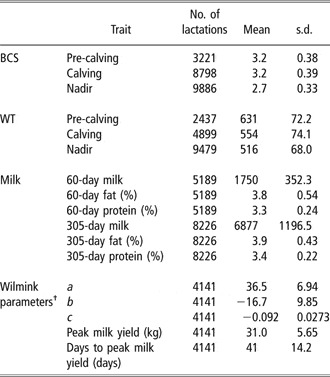
Abbreviations are: s.d. = standard deviation, BSC = body condition score, WT = live weight.
†a, b and c are estimated parameters of an exponential function (milkt = a + be −0.05t + ct) relating to the height of the lactation profile, the initial phase of post-calving incline to peak and the subsequent post-peak decline phase, respectively.
Body condition score
Increased BCS at calving was associated with a higher milk lactation profile (i.e. a parameter of the Wilmink function) and reduced lactation persistency (i.e. c parameter of the Wilmink function), which was reflected in higher peak (Table 2), 60-day and 305-day milk yield (Table 3). However, a non-linear relationship between BCS at calving and 305-day yield was evident with 305-day yield maximised at a calving BCS of 4.25 units (Table 3). Nonetheless, cows calving at a BCS of 3.50 units yielded, on average, only 68 kg less than cows calving at a BCS of 4.25 units. Cows calving at a BCS of 3.25 units and 3.00 units yielded a further 50 and 114 kg less, respectively, than cows calving at a BCS of 3.50 units. The non-linear effect of BCS at nadir on the height of the milk lactation profile (i.e. a parameter of the Wilmink function) manifested itself as an optimum BCS at nadir of 2.00 BCS units. Increased BCS at nadir was also associated with a slower rate of increase to peak (i.e. b parameter of the Wilmink function) and greater persistency (i.e. c parameter of the Wilmink function). The curvilinear effect of nadir BCS on the height of the milk lactation profile was evident also for cumulative 60-day and 305-day milk yield (Table 3) with a nadir BCS of 2.00 and 2.50 units, respectively, being optimum.
Effects of body condition score (BCS) and BCS change at different stages of lactation on parameters of the lactation curve (s.e. of the regression coefficients for each BCS variable when included individually in the model are in parentheses)Footnote †
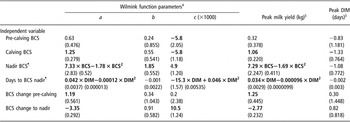
Abbreviations are: BCS = body condition score, DIM = days in milk.
† Solutions of factors that significantly (P < 0.05) affected the dependent variable are in bold.
‡a, b and c are estimated parameters of an exponential function (milkt = a + be −0.05t+ ct) relating to the height of the lactation profile, the initial phase of post-calving incline to peak and the subsequent post-peak decline phase, respectively.
§ Peak milk yield and DIM to peak milk yield are derived from the fitted Wilmink function.
¶ Quadratic regression term was significant and thus linear and quadratic solutions are reported.
Effects of body condition score (BCS), BCS change, live weight (WT), WT change at different stages of lactation on 60-day and 305-day milk yield (s.e. of the regression coefficients for each BCS and WT variable when included individually in the model are in parenthesis)Footnote †
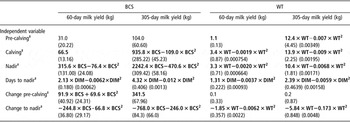
Abbreviations are: BCS = body condition score, WT = live weight, DIM = days in milk.
† Solutions of factors that significantly (P < 0.05) affected the dependent variable are in bold.
‡ Quadratic regression term was significant and thus linear and quadratic solutions are reported.
BCS gain pre-calving was associated with a higher lactation profile, a higher peak milk yield and a greater quantity of milk produced in the first 60 and 305 days of lactation. A greater loss of BCS post-calving was linearly associated with a higher lactation profile, lower persistency and higher peak milk yield. Cumulative milk produced in the first 60 and 305 days of lactation increased with BCS loss post partum up to a loss of 1.75 units and 1.5 units, respectively, after which the marginal change in milk yield was negative. Non-linear associations were evident between DIM to BCS nadir and height of the lactation profile, persistency, peak milk yield, and 60-day and 305-day lactation. Maximum 60-day and 305-day milk yield was observed in cows with a DIM to nadir BCS of 177 and 173, respectively.
Greater BCS at calving and nadir was linearly associated with greater milk fat (Table 4) and protein (Table 5) concentration in early lactation. Average 305-day milk fat and protein concentration was lowest at a BCS at calving of 2.75 and 3.00 units, respectively. Milk fat and protein concentration in the first 305 days of lactation increased linearly with BCS at nadir, the effect on protein concentration being significantly different across parities with first parity cows exhibiting the greatest marginal response. BCS change pre-calving had no significant effect on fat concentration but 60-day average protein concentration was greater in cows gaining condition immediately prior to calving. Average 60-day fat concentration increased by 0.1 percentage units per unit increase in BCS loss to nadir. Milk protein percentage during the first 60 and 305 days was lowest in cows that lost 1.00 or 1.50 BCS units, respectively.
Effects of body condition score (BCS), BCS change, live weight (WT), WT change at different stages of lactation on average milk fat concentration in the first 60 and 305 days of lactation (s.e. of the regression coefficients for each BCS and WT variable when included individually in the model are in parenthesis)Footnote †

Abbreviations are: BCS = body condition score, WT = live weight, DIM = days in milk.
† Solutions of factors that significantly (P < 0.05) affected the dependent variable are in bold.
‡ Quadratic regression term was significant and thus linear and quadratic solutions are reported.
Effects of body condition score (BCS), BCS change, live weight (WT), WT change at different stages of lactation on average milk protein concentration in the first 60 and 305 days of lactation (s.e. of the regression coefficients for each BCS and WT variable when included individually in the model are in parenthesis)Footnote †
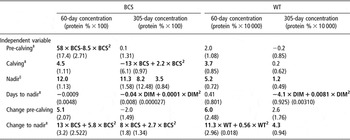
Abbreviations are: BCS = body condition score, WT = live weight, DIM = days in milk.
† Solutions of factors that significantly (P < 0.05) affected the dependent variable are in bold.
‡ Quadratic regression term was significant and thus linear and quadratic solutions are reported.
§ A significant two-way interaction with parity existed so solutions presented are, from left to right, representative of parity 1, 2, 3+, respectively.
Live weight
Table 6 summarises the effect of WT and WT change on descriptors of the milk lactation profile. The height of the lactation profile (i.e. a parameters of Wilmink function) as well as 60-day and 305-day milk production increased consistently (Table 3), although not always at the same rate, with increased WT pre-calving, calving and at nadir. Lactation persistency tended to decrease with WT while peak milk yield increased with WT. Concurrent with an increase in milk yield with cow WT, milk fat and protein concentration in early lactation increased linearly with WT (Tables 4 and 5).
Effects of live weight (WT) and WT change at different stages of lactation on parameters of the lactation curve (s.e. of the regression coefficients for each WT variable when included individually in the model are in parenthesis)Footnote †

Abbreviations are: WT = live weight, DIM = days in milk.
† Solutions of factors that significantly (P < 0.05) affected the dependent variable are in bold.
‡ a, b and c are estimated parameters of an exponential function (milkt = a + be−0.05t + ct) relating to the height of the lactation profile, the initial phase of post-calving incline to peak and the subsequent post-peak decline phase, respectively.
§ Peak milk yield and DIM to peak milk yield are derived from the fitted Wilmink function
¶ Quadratic regression term was significant and thus linear and quadratic solutions are reported.
¥ A significant two-way interaction with parity existed so solutions presented are, from left to right, representative of parity 1, 2, 3+, respectively.
WT change pre-calving did not significantly affect any of the milk production variables investigated with the exception that cows gaining WT pre-calving had a higher milk protein concentration in early lactation. A greater amount of WT loss from calving to nadir was associated with a higher lactation profile, increased lactation persistency, a higher peak milk yield and a shorter interval to peak milk yield; amount of WT loss to nadir did not significantly affect the rate of increase in milk yield to peak. Greater WT loss to nadir resulted in greater milk fat concentration throughout lactation but lower milk protein concentration.
The height of the lactation profile was positively associated with the interval to nadir WT (Table 6). Furthermore, cows with longer intervals to nadir WT had lower lactation persistency but greater peak milk yield (Table 6). Additionally, DIM to peak milk yield decreased at an increasing rate with DIM to nadir WT. These differences in lactation profiles resulted in greater 60-day and 305-day milk production at 178 and 202 DIM, respectively (Table 3).
Discussion
The motivation for this study was to accurately quantify the effect of BCS and WT on milk yield and composition. Strong, significant associations were evident between BCS, WT and milk production, although the effects were not always linear. Results from this study provide target BCS and WT at critical periods of the inter-calving interval to maximise milk production in a seasonal-calving grass-based system of milk production.
Milk yield and lactation profiles
The positive effect of BCS at calving on overall milk production is at odds with some previous studies (Pedron et al., Reference Pedron, Cheli, Senatore, Baroli and Rizzi1993; Ruegg and Milton, Reference Ruegg and Milton1995; Domecq et al., Reference Domecq, Skidmore, Lloyd and Kaneene1997) that failed to identify any significant effect of BCS at calving on subsequent milk production. In direct contrast but in agreement with the present study, others (Waltner et al., Reference Waltner, McNamara and Hillers1993; Markusfeld et al., Reference Markusfeld, Gallon and Ezra1997; Roche et al., 2007a) reported a significant increase in milk production with BCS at calving. Garnsworthy and Jones (Reference Garnsworthy and Jones1987) speculated that the quality of the diet post-calving may impact the association between BCS at calving and milk production, since on energy dense diets, the greater intake of cows in low BCS at calving may be sufficient to meet energy requirements. In contrast, thin cows fed with low-energy diets may not be able to ingest sufficient quantities of energy and as a consequence, milk production, as well as other bodily functions, may suffer. Furthermore, Waltner et al. (Reference Waltner, McNamara and Hillers1993) hypothesised that overly fat cows may have depressed appetite due to their expected rapid catabolism of body tissue (Roche et al., Reference Roche, Macdonald, Burke and Berry2007b) and the subsequent effect of circulating free-fatty acids on intake (Garnsworthy and Topps, Reference Garnsworthy and Topps1982); this indicates an intermediate optimum for BCS at calving. In the present study, grazed grass was the predominant energy source throughout the lactation. Grazed grass is generally of lower energy density compared with total mixed rations (Berry et al., Reference Berry, Buckley, Dillon, Evans, Rath and Veerkamp2002) and dry-matter (DM) intake on grazed grass is lower than on total mixed rations (Kolver and Muller, Reference Kolver and Muller1998). Total mixed rations were fed in the studies of Domecq et al. (Reference Domecq, Skidmore, Lloyd and Kaneene1997) and Pedron et al. (Reference Pedron, Cheli, Senatore, Baroli and Rizzi1993), both of which failed to identify a significant association between BCS at calving and milk production. Herds used in the study of Ruegg and Milton (Reference Ruegg and Milton1995) fed pasture for some period of the year but the relative importance of pasture in the diet of the cows was not clearly outlined in the study. Stockdale (Reference Stockdale2001) speculated that because the maximum energy concentration of Australian pastures does not exceed 11 MJ/kg DM, cows calving in better body condition are likely to produce more milk that cows calving in poorer BCS, unless concentrate supplementation regimes are implemented.
Another potential factor affecting the inconsistencies of results between studies may be the variation present in BCS at calving. Few studies provided sufficient statistics to calculate indices of variation. Calculations on the reported results of Ruegg and Milton (Reference Ruegg and Milton1995) who showed no significant effect of BCS at calving on milk production revealed a coefficient of variation of 13%. A coefficient of variation of 15% was observed in the multiparous cows in the study of Markusfeld et al. (Reference Markusfeld, Gallon and Ezra1997) who reported a significant association between BCS and milk production. Nonetheless, the coefficient of variation for BCS in the present study was less than 13% suggesting that this may not be the only factor affecting the likelihood of identifying a significant association. Finally, genotype by environment interactions (Falconer, Reference Falconer1989) may also be a contributing factor to potential differences between studies using different genotypes and/or different environments.
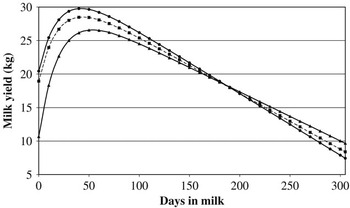
The effect of BCS at calving on 305-day milk yield in the present study was attributable to changes in the lactation profile for cows calving at different BCS (Figure 1). In contrast to the present study which showed a greater post-peak milk yield decline in cows of greater BCS at calving, Markusfeld et al. (Reference Markusfeld, Gallon and Ezra1997) reported no significant effect in primiparous or multiparous cows. Pedron et al. (Reference Pedron, Cheli, Senatore, Baroli and Rizzi1993) also failed to identify a significant association between BCS at calving and rate of decline in post-peak milk yield. BCS at calving did not significantly affect the time of peak milk yield in the present study which corroborates previous findings (Markusfeld et al., Reference Markusfeld, Gallon and Ezra1997).
Average milk yield lactation profile for cows calving in a body condition score (BCS) of 2(▴), 3 (▪) or 4 (●) BCS units.
The similar effects of BCS pre-calving and nadir on milk production as observed for BCS at calving is an artefact of the strong correlations between BCS at different stages of the inter-calving interval (Berry et al., Reference Berry, Buckley, Dillon, Evans, Rath and Veerkamp2002; Roche et al., Reference Roche, Macdonald, Burke and Berry2007b) or in other words the high repeatability of BCS (Roche et al., Reference Roche, Macdonald, Burke and Berry2007b). Strong correlations among stages of lactation and high repeatability estimates have also been reported for WT (Roche et al., Reference Roche, Macdonald, Burke and Berry2007b). Furthermore, the moderate correlation between BCS and WT previously reported (Berry et al., Reference Berry, Buckley, Dillon, Evans, Rath and Veerkamp2002; Roche et al., Reference Roche, Macdonald, Burke and Berry2007b) resulted in a generally similar trend of associations between WT and milk yield as observed between BCS and milk yield; heavier cows tended to produce more milk, although the marginal effect per kg WT tended to decrease within increased WT for the majority of the milk yield traits.
The greater milk yield in cows that lost more BCS post-calving is in general agreement with most previous studies (Roche et al., 2007a). Although Domecq et al. (Reference Domecq, Skidmore, Lloyd and Kaneene1997) reported significantly higher 120-day milk production in multiparous cows that lost more condition in the first 4 weeks of lactation, the effect was not significant in primiparous cows. Nonetheless, the non-linear association between BCS loss to nadir and milk yield reported in the present study indicates that the marginal increase in milk yield per unit BCS loss decreased as the amount of condition lost increased with the marginal response in milk yield reversing when cows lost more than 1.5 to 1.75 BCS units. This is similar to trends reported by Waltner et al. (Reference Waltner, McNamara and Hillers1993) that high rates of loss may be associated with diminished yields. Substantial BCS loss post partum has been associated with a greater incidence of metabolic or other disease (Ruegg and Milton, Reference Ruegg and Milton1995; Gillund et al., Reference Gillund, Reksen, Gröhn and Karlberg2001) which may have repercussions for subsequent milk yield (Block, Reference Block1984). Furthermore, the poorer fertility in cows that lose more condition in early lactation (Roche et al., Reference Roche, Macdonald, Burke and Berry2007b) may also have implications via the effect of pregnancy on milk yield in late lactation (Roche, Reference Roche2003) with higher yields expected in non-pregnant cows.
Similarly, cows that lost more WT to nadir, on average, produced more milk which is in agreement with previous studies (Pedron et al., Reference Pedron, Cheli, Senatore, Baroli and Rizzi1993). Cows in the present study that lost 100 kg from calving to nadir yielded 139 kg more milk in the first 60 days of lactation than cows that lost 50 kg from calving to nadir.
Milk composition
The higher fat concentration in early lactation milk yielded by fatter cows corroborates previous studies (Treacher et al., Reference Treacher, Reid and Roberts1986; Holter et al., Reference Holter, Slotnick, Hayes, Bozak, Urban and McGilliard1990; Stockdale, Reference Stockdale2001). This is attributable to the greater predisposition of fatter cows to lose condition in early lactation (Pedron et al., Reference Pedron, Cheli, Senatore, Baroli and Rizzi1993; Stockdale, Reference Stockdale2001; Roche et al., Reference Roche, Macdonald, Burke and Berry2007b) which may be used for milk fat synthesis. Pedron et al. (Reference Pedron, Cheli, Senatore, Baroli and Rizzi1993) reported a higher concentration of short-chain fatty acids and a lower concentration of long-chain fatty acids and unsaturated fatty acids in the milk of cows calving at a lower BCS. Short-chain fatty acids are produced from acetate in the rumen while long-chain fatty acids are generated either from body fat or ingested lipids (Payne et al., Reference Payne, Trigg, Rattray, Nicoll and Smeaton1979).
The non-linear association between BCS at calving and milk fat concentration across the entire lactation period implies that cows calving at a BCS of 3.00 units had the lowest 305-day fat concentration. Disagreeing with most previous studies (Treacher et al., Reference Treacher, Reid and Roberts1986; Garnsworthy and Jones, Reference Garnsworthy and Jones1987; Holter et al., Reference Holter, Slotnick, Hayes, Bozak, Urban and McGilliard1990) milk protein concentration in early lactation increased linearly with BCS at calving. However, following the review of the available literature, Broster and Broster (Reference Broster and Broster1998) suggested that the association between BCS at calving and milk protein content was dependent on actual protein content with a positive effect observed in studies with low protein content and a negative association evident in studies with high protein content; average 305-day milk protein concentration in the present study was 3.40%. Similar trends were summarised for the association between BCS at calving and milk fat concentration (Broster and Broster, Reference Broster and Broster1998). Nonetheless, the lower milk protein content in cows that lost one condition from calving to nadir compared with cows that lost no condition corroborates the review of Broster and Broster (Reference Broster and Broster1998), although the association between BCS loss and protein concentration reversed when cows lost greater than one BCS unit in the present study.
The linear increase in milk fat concentration with WT is consistent with previous reports (Sieber et al., Reference Sieber, Freeman and Kelley1988) albeit the regression coefficients reported by Sieber et al. (Reference Sieber, Freeman and Kelley1988) for fat concentration on WT were near zero. This is in contrast to negative genetic and herd correlations reported by Liinamo et al. (Reference Liinamo, Ojala and Van Arendonk1999) between WT and milk fat concentration in Finnish Ayrshire cows, although the residual correlation was positive.
Conclusions
Results from the present study indicate a significant and sometimes curvilinear association between BCS at calving or nadir and milk production. Cows that lost more condition in early lactation produced more milk of greater fat and protein concentration, although a negative marginal effect was observed in cows that lost large amounts of condition post-calving. Milk yield increased with WT with the marginal effect decreasing as cows got heavier. Milk composition in early lactation also increased with WT pre-calving, calving and nadir, although WT did not significantly affect average lactation milk fat and protein concentration.
Acknowledgements
The authors wish to acknowledge with gratitude Allied Irish Bank, the Artificial Insemination Managers Association, the Holstein-Friesian Society of Great Britain and Ireland, Dairy Levy Farmer Funds and EU Structural Funds (FEOGA) in financing the research programme. The technical assistance of D. Cliffe, T. Condon and J. Keneally, and the guidance of Professor Dorian Garrick in the initial stages of the study are also acknowledged.



