





Introduction
The demographic transformation and the increasing need for long-term elderly care emphasize the importance of addressing the impacts of informal care giving on families and primarily on women. A significant share of informal elderly care providers continues to care for their children, facing a double care burden. The objective of this study is to explore the relationship between informal care provision to elderly parents and caregiver women’s economic participation by analyzing whether this double care burden can be associated with women’s labor force participation patterns as well as their work hours in Turkey.
In 2020 the elderly population aged sixty-five and over was 727 million, constituting 9.3 percent of the global population, and is projected to be 16 percent (at 1.5 billion) in 2050 (UN DESA 2020). An aging population is a major policy concern for governments. Except for the few countries known as the “formal care countries” of northern Europe, governments in Western Europe and even more so in the Mediterranean “family care countries,” turn to families and informal care as their primary cost-saving strategy (Da Roit et al. Reference Da Roit, Hoogenboom and Weicht2015; Tokunaga and Hashimoto Reference Tokunaga and Hashimoto2017).
Turkey is no exception to the global trends in demographic transformation. It even has a relatively faster aging trend. The elderly population is projected to increase beyond the world average soon, and reach 20.86 percent in 2050 (UN DESA 2019). Yet, the policies that are in place are far from being sufficient to respond to the long-term elderly care needs, the institutional and public care provided remains limited and inadequate, and so informal family care is reinvented as the most effective strategy. The Turkish welfare regime carries the typical characteristics of the Mediterranean family-based care model, with its own peculiarities stemming from the neoliberal and neoconservative policy framework (Acar and Altunok Reference Acar and Altunok2013; Buğra and Keyder Reference Buğra and Keyder2006). Backed by patriarchal social norms and the obligations of intergenerational reciprocity, family had been assigned an important role for social support even before the neoliberal restructuring of the welfare regime. The role of the family has become even more central with the welfare regime change, which began in 1980 under the International Monetary Fund (IMF)-supervised measures and intensified after the 2001 crisis, as the state withdrew from its promises to provide social rights. The neoliberal transformation of the welfare regime is accompanied by a neoconservative discourse that nurtures the three generational “strong Turkish family” as a counter to the imagined “Western,” or nuclear, family, promoted as part of the modernization of the Turkish Republic. Unsurprisingly, the new definition of true femininity naturalizes the caring role, bringing it to the forefront and rendering it central to the “strong Turkish family” construct.Footnote 1 However, changing demographics, norms, and requirements of work life, with long workdays and a high degree of informality, do not align with such a construct. Hence, insisting on a family-oriented policy framework comes at a cost to the care-receivers, which is mostly not recognized by policymakers or the market.
Informal family care provisioning by adult children and its outcomes for caregivers, in terms of employment prospects, health, and well-being have received well-deserved attention in the Western literature (Broe et al. Reference Broe, Jorm, Creasey, Casey, Bennett, Waite and Grayson1999; Carmichael and Charles Reference Carmichael and Charles1998; Gallicchio et al. Reference Gallicchio, Siddiqi, Langenberg and Baumgarten2002; Heger and Korfhage Reference Heger and Korfhage2020; Prieto and Jiménez-Martín Reference Prieto and Jiménez-Martín2015; Wilson et al. Reference Wilson, Courtney, Stearns and Clipp2007). A rather new focus emerged in research on the double care burden of adult children who provide care for their elderly (parents/parents-in law or grandparents) and also care for their children (Burke Reference Burke, Ronald and Calvano2017; De Rigne and Ferrante Reference De Rigne and Ferrante2012; Grundy and Henretta Reference Grundy and Henretta2006; Williams Reference Williams2004). Termed as the “sandwiched generation” or “sandwiched caregivers,” this demographic group has been growing globally. Most of the adult children, especially daughters, juggle different caring roles and their work responsibilities (Miller Reference Miller1981; Mitchell Reference Mitchell2014). Brody (Reference Brody1981) refers to adult women, who are typically middle-aged and who are expected to provide intergenerational care as “women in the middle.”
The double care burden along with the paid work activities of the sandwiched generation is also a topic of concern in Turkey. The rapid aging trend is accompanied with delays in having children. A growing share of the population has to encounter and respond to the care needs of their elderly while their children are still part of the household. Turkish women too are caught in the middle of multiple roles as mothers and daughters, paid and unpaid work responsibilities, and different identities, with a government that actively promotes a traditional gender division of labor (Buğra and Yakut Çakar Reference Buğra and Yakut-Çakar2010). The empirical research and evidence obtained shows that the absence of an adequate care policy that provides affordable and accessible formal care services for children and the elderly, and an unyielding gender division of labor within the household in terms of care provision are the primary determinants of women’s strikingly low labor force participation and fragile attachment to the labor market in Turkey. Household responsibilities keep more than half of women—55.6 percent—outside the labor force (TurkStat 2019). Moreover, due to a lack of affordable care services, most women continue to care for the children, the ill, and the elderly themselves even when they are employed. Among employed women, 86.9 percent care for their children younger than fifteen years old and 64.1 percent care for their children above the age of fifteen as well as the ill and elderly in the household (TurkStat 2018). Thus, caring responsibilities not only determine women’s ability to engage in paid employment but also can limit their working hours. Nearly 17.2 percent of women (aged fifteen and older) point to their caring responsibilities as the reason for working part-time; conversely, such a concern does not exist at all for men in their choice of type of work (TurkStat 2019).
The sandwiched generation framework provides the opportunity for a holistic assessment of the relationship between the total care-giving burden and economic participation. It also enables us to discuss the coping mechanisms of families in meeting their care needs, and how time and other resources are shared between the generations. This framework is especially critical for the developing world, where the literature is still scanty and where the family functions as a buffer institution in coping with the increasing insecurities in the labor market as well as the further retreat of the social spending of their already immature welfare regimes (Buğra and Keyder Reference Buğra and Keyder2006; Eder Reference Eder2010). Especially in countries where adequate child care is not widely accessible, this double caring role not only carries significant threats, but also entails potential reciprocities that can facilitate the labor force participation of the sandwiched caregiver. If the cared-for elderly parent is still capable of providing “help” in the form of watching children or helping with the household chores, this “help” can be vital for their adult children. On the other hand, if the elderly parent is above a certain age and the intensity of their care need is high, the absence of formal care support or institutional care services can no longer be tolerated and the negative employment-related impacts on the caregiver is more severely felt.
This study addresses an important gap in the empirical literature on Turkey by exploring the relationship between elderly care provision and economic participation of women sandwiched between double caring responsibilities. With an analysis based on a country-wide representative time-use dataset, we hope to provide empirical evidence for policy discussions regarding the relevance of considering the potential costs levied on the informal caregivers.
Here we seek to understand whether and how elderly care can be related to the sandwiched women caregivers’ participation in the labor market or their mean duration of paid working hours in Turkey. Using the 2014–2015 Turkish Time Use Survey (Turkish-TUS), we focus on women aged between thirty and forty-nine and explore the association between elderly care and employment hours, controlling for various potential factors, including different household characteristics and individual characteristics. Additionally, assuming that decisions on participation in employment and the duration of work are simultaneously determined based on the same determinants, we take into account the joint determination of the two decisions and control for variables such as working conditions and job status.
In the following section, we discuss the elderly care provision by the sandwiched generation, and provide background information on the structure of the aging population, formal care services, transformation of the welfare regime, and the peculiarities of the Turkish context. We also reflect on the related discussions on the labor market participation impacts of informal care provision. The third section presents the empirical analysis. In this section we provide information on the data set and descriptive statistics, explain our methodology, and present our estimation results. Finally, we discuss our findings, with an assessment of related current policies. The Appendix provides a summary of estimates obtained by our empirical exploration.
Sandwiched between generations: double care burden, work-family conflict and the welfare regime change in Turkey
Several global tendencies that created the conditions of the sandwiched generation emerge from a change caused by cumulative factors. Primarily, the coexistence of multiple generations, globally rising divorce rates, and low fertility increase the importance of extended family relationships, leading to ‘longer years of shared lives’ (Grundy and Henretta Reference Grundy and Henretta2006). Secondly, decreasing fertility rates limit the potential of having siblings to share the informal care responsibility of elderly parents. Finally, children continue to be part of the household as they are still young due to delayed onset of parenthood. In addition to these factors, the maturing children face difficulties in becoming economically independent and tend to remain longer in the household. Due to the rising risks and economic insecurity, with low employment prospects, and lack of decent working conditions, older children are more likely to extend their student statuses and/or postpone leaving their parents’ home as they cannot afford to live independently (Grundy and Henretta Reference Grundy and Henretta2006; Pierret Reference Pierret2006).
Clearly care giving not only takes the form of time and energy transfer, but may also entail co-residing and financial transfers (Boaz et al. Reference Boaz, Hu and Ye1999; Couch et al. Reference Couch, Daly and Wolf1999). The International Labour Organization (ILO) incisively points out that all these intertwined factors address a global trend that calls for a rethink of the interdependency between generations. The demographic (age) dependency ratio is no longer an accurate indicator because even though the old age dependency ratio is increasing, it is pulled down by the decrease in the child dependency ratio. In addition, due to economic conditions and increasing longevity worldwide, more and more of the elderly continue to participate in the labor force. In this regard, the ILO proposes that the economic dependency ratio be seen as a more informative indicator, especially in the absence of a well-developed social security system and in times of increasing economic insecurity. The estimates show that economic dependency ratios double the age dependency ratios, pointing to the importance of financial transfers alongside time and energy transfers across generations (Harasty and Ostermeier Reference Harasty and Ostermeier2020). Pressing care and financial responsibilities in these times of economic insecurity in particular deprive adult children of time and income resources, and families try to cope with these challenges by pooling their means (Argyle Reference Argyle2001; Peek et al. Reference Peek, Coward and Peek2000).
Turkey’s aging population structureFootnote 2 suggests a rapid increase of the elderly in the total population in the next decades. Since women live on average five years longer than men, one-fifth of the male and a quarter of the female population are projected to be aged above the age of sixty-five by 2060 (see Table 1). The majority of the elderly population lives in urban areas (86.6 percent) (MLFS 2020a, 82) and in couple households (62.3 percent). Just 10 percent of elderly men live alone versus 24.6 percent of elderly women.

In addition to the aging trend in Turkey, fertility rates and delayed parenting also show similarities with global trends. Fertility rates have decreased from 2.38 in 2001 to 1.76 in 2020, and this certainly will have implications in terms of the possibility of sharing elderly care with siblings. Statistics on delayed parenthood shows that the highest fertility ages have moved from the twenty to twenty-four to the twenty-five to twenty-nine age group and the mean age of mothers giving birth shifted from 26.7 in 2007 to twenty-nine in 2020 (TurkStat 2021).
Data reveal that the long-term elderly care need is a major concern for a significant portion of households, and increasing care responsibilities as well as greater economic insecurity leads to socio-economic patterns in coping mechanisms. Nearly a quarter of households (23.5 percent) include at least one person above the age of sixty-five (MFLS 2020b, 12). According to the latest Research on Family Structure in Turkey (Türkiye Aile Yapısı Araştırması, TAYA 2016) which is repeated every five years, 14 percent of all households includes at least one elderly member who requires care to be provided (MLFS 2016). The figure is as high as 26 percent for extended families. An unusual pattern, when compared to the Western countries, is that rather than the adult children of the elderly (daughters, 23 percent and sons, 14 percent), it is mostly daughters-in-law (28 percent) who provide care. The prevalence of elderly care by daughters-in-laws is significantly higher in traditional extended families, where 44 percent of daughters-in-law are the primary caregivers (MLFS 2016, 194–195). Furthermore, the number of the elderly with care needs is higher in lower socio-economic groups (MLFS 2016, 194). This may be due to the negative income impact of having elderly people in the household. Or alternatively, low-income families may be driven to live as extended families so as to pool their resources. Living in lower income households and living in households with elderly persons who need care may feed into each other, and as a result a larger percentage of those households declares that they face great difficulty in making ends meet (Arun and Holdsworth Reference Arun and Holdsworth2018, 344).
On top of the growing need for caring services and support mechanisms, the restructuring of the welfare regime is characterized by more reliance on families. The level of strain families have had to shoulder is more severe in a developing country context where the initial version of welfare provision offered significantly less than the mature welfare states. The literature on the informal elderly care provided by the sandwiched generation under different types of care regimes and cultural contexts provides ample evidence on this (Albertini Reference Albertini2016; Mitchell Reference Mitchell2014; Pagani and Marenzi Reference Pagani and Marenzi2008; Spiess and Schneider Reference Spiess and Schneider2003; Zhang and Goza Reference Zhang and Goza2006). As a country with cultural and political peculiarities, especially due to the current neoliberal and neoconservative programs, Turkey is an interesting case in point. The welfare regime, which was dismantled in the 1980s, was fragmented and hierarchically corporatist. It resembled a familialist Mediterranean welfare regime (Buğra and Keyder Reference Buğra and Keyder2006, 221–228) which provides social insurance welfare schemes yet mostly relies on the family for any service or income that the market and the state fail to provide. However, with the implementation of neoliberal policies after 1980, the gradual withdrawal of the state from pension provision and from the employer role left large segments of the population with an increasingly unbearable burden.
The transformation of the welfare regime has been intensified after the 2001 crisis. In the provisioning of social care, the government returned to the family to ease the care and expenditure burden on the state and justified this policy orientation by presenting it as a part of its conservative family rhetoric which constitutes a fundamental aspect of the AKP’s political identity (Yazıcı Reference Yazıcı2012). The state’s neoliberal policies require it to withdraw from its role of provider and the neoconservative ideology reiterates the state’s presence by assigning it a moral role supported by the discourses of patriotism, religiosity, and tradition which increasingly interferes in citizens’ lives in a way that undermines rights, equality, and liberty-based demands (Acar and Altunok, Reference Acar and Altunok2013). Especially after 2007, patriarchal and moral values, often supported by religion, started to become dominant in AKP’s policy discourse. A conservative vision of “femininity” is defined based on religious and classical patriarchal perspectives. Demands for equality and struggles for basic human rights are ridiculed by referring to the different and complementary nature of men and women.Footnote 3 Government authorities’ popularizing of the caregiver role carried out by women further hinders women’s significantly low participation in paid work outside the home and also does not help with the already shrinking tax base (Duben Reference Duben2013).
The government promotes a three-generation extended family model in which children, parents, and grandparents live in the same household, and both children and elderly parents are taken care of by the sandwiched generation women, that is, the bride of the family. The glorified family form carries norms and values inherited from the “classical patriarchal family system,” described by Kandiyoti (Reference Kandiyoti1988) as the family structure carried over from the Ottoman era and preserved until the 1950s in rural Turkey. Moreover, the government often adopts ‘family decline’ rhetoric to blame the modern nuclear family for cultural degeneration in which adult children live away and neglect their caring responsibilities towards their elderly parents. In this regard, the three generational family model is presented as the counter to the nuclear family form which was idealized as part of the modernization project in the early years of Republican Turkey (see, for example, Durakbaşa and İlyasoğlu Reference Durakbaşa and İlyasoğlu2001; Kandiyoti Reference Kandiyoti and Tekeli1995; Özbay Reference Özbay and Tekeli1995; Sirman Reference Sirman, Frangoudaki and Keyder2007). These contrasting images of family serve to generate and sustain a cultural polarization often used to consolidate the AKP’s religious political base, and draws attention to the government’s distinctiveness from its secular predecessors, national political rivals, and an imagined negative image of the “West” that suffers from weakening of family ties (Yazıcı Reference Yazıcı2012).
Behind this strong family rhetoric, the government recedes to a limited provision of public care services. Policies are shaped by its half-hearted and inconsistent tightrope walk in-between EU regulations and its conservative discourse (Dedeoğlu Reference Dedeoğlu2013), and their primary objective is to sustain the family in its caring function (Akkan Reference Akkan2018). Implemented care policies have mainly been targeted at the elderly, based on cash transfers and institutional services. Financial support and services are provided primarily on the basis of need, albeit at a lower rate. Institutional care has remained marginal compared to the size of the elderly population with long-term care needs. Care capacity for the elderly in 2020 was limited to just 37,070 people in the total of 442 public institutions (MLFS 2020a, 97). The second major elderly care policy is ‘cash for care,’ which was introduced in 2006 to financially support informal caregivers. The eligibility criteria for the scheme includes both a minimum of a 50 percent disability threshold and an income threshold. The cash for care scheme considers that the informal caregivers in the family (who are nearly all women) are employed in the services sector and this artificially boosts women’s employment numbers (Özateş Gelmez Reference Özateş-Gelmez2016). Recently, preventive policies—that is, for active and healthy aging that also aim for increasing independence of the elderly—are becoming increasingly integrated into the policy discourse. However, the incorporation of this broader perspective into the policies in place remains very limited for now.
Despite limited home-based care provision and the negative reputation of institutional care among the public, perceptions regarding informal family care do not stay the same. When people are asked about their preferences for elderly care, 29 percent prefer home-based formal services, 11 percent would opt to stay in an institution, and 37 percent want to co-habit with their children, of whom 28.4 percent would prefer to stay with their sons (MLFS 2016, 201–202). The social code and norms that dictate that it is the son’s duty to take care of his parents (provide financial resources and have them taken care of by their wives) once they age is still prevalent. This preference is observed more commonly among the population with lower access to education and adequate standards of living, with 48 percent of people with no schooling preferring to cohabit with their sons. University graduates and higher socio-economic groups’ preference for home based or institutional formal service is higher. Education level is often used as an indicator of socio-economic status and cultural mobility. In this regard, the differences in preferences based on education reflect that people with lower education levels are likely to live in extended families due to their traditional value system and/or to the higher economic insecurity they are likely to face in their old age. This mirrors the socio-economic patterns in generational care and support mechanisms in extended family form discussed above. Moreover, there is also a growing tendency to acknowledge the change in family structures and lifestyles, and the time pressure work and city life imposes. Thus, a significant share of the population wishes to avoid the pressure that informal care responsibility would place on their children (MLFS 2016, 204).
Promoting the three generational extended family also overlooks the economic and social processes behind the evolution of family structures. As demonstrated through a well-established literature, mostly based on sociological and anthropological studies, the family structure, and along with it, power relations and organization of care provision within the family and women’s economic participation have greatly evolved alongside the economic and structural transformations in the Turkish economy (Durakbaşa and İlyasoğlu Reference Durakbaşa and İlyasoğlu2001; Kandiyoti Reference Kandiyoti and Tekeli1995; Sirman Reference Sirman, Frangoudaki and Keyder2007; Tekeli Reference Tekeli and Tekeli1995; Yaras and Yiğit Reference Yaras and Yiğit2018). These studies help us unpack images of the family, thereby providing insights into understanding and conceptualizing the current dynamics in care provision.
Research on the distribution of unpaid care responsibilities shows that there is no simple and one-to-one relationship between women’s labor force participation and changes in domestic relations and roles (İlkkaracan Reference İlkkaracan2012; Kongar and Memiş Reference Kongar, Memiş, Connelly and Kongar2017). The distribution of paid and unpaid work within the family across the life cycle of households is determined by gender relations that are shaped and reshaped under context-specific physical, social, ideological, and psychological structures (Gerson and Peiss Reference Gerson and Peiss1985). In a rather early study, Bolak (Reference Bolak1997) investigates the impact of the increasing involvement of women in employment and provides a culturally situated analysis of how the division of roles in working class families in an urban setting translates into the domestic division of labor and relations. In the dynamics that impact men’s attitude, subjective constructions of perceived fairness in allocation and, most importantly, the importance of having a mother’s support in sustaining these roles become critical. The availability of same sex intergenerational support mechanisms within extended families limits men’s contribution to family work, but it is the relatively easier short-cut that enables women’s economic participation without openly challenging patriarchal norms. Can (Reference Can2019) addresses the importance of this “intergenerational and interfemale mechanism of care transfer” provided by grandmothers to support and facilitate the younger generation of women in their uneasy work-life balance dynamics. Furthermore, evidence exists regarding the changing perceptions of mothers-in-law as well as mothers who are willing to show solidarity with their daughters or daughters-in-law that they did not receive in their youth.
The support received from grandmothers is addressed as the dual impact of intergenerational care on the sandwiched generation. On the one hand, providing elderly care decreases the probability of women participating in the labor force and, on the other hand, the support of the elderly with household duties or child care can facilitate the labor supply of women. To what extent the grandparents’ role in care provision for their grandchildren influences labor market outcomes of the sandwiched care provider depends on the country policy context in terms of child care services and parental leave regulations (Bordone et al. Reference Bordone, Arpino and Aassve2017). In countries where the public provision of child care is limited or is too expensive, the extended family fills the care gap (Ghezzi Reference Ghezzi2012; Van Gameren and Naranjo Reference Van Gameren and Naranjo2015). Pagani and Marenzi (Reference Pagani and Marenzi2008) address this dual impact and demonstrate the importance of reciprocity of caring, when the cared-for elderly can also provide support, thus enabling women’s labor force participation. As discussed before, a lack of accessible and affordable child care is the primary reason preventing women’s labor force participation, so for large segments of the society that cannot afford private care services, kin-based same-sex support plays a critical role (Alıçlı Mottram and Hortaçsu Reference Alıçlı and Hortaçsu2005).
The empirical studies on the impacts of informal care provision on caregivers’ participation in paid work show that, depending on the availability of supportive or comprehensive public care services and the differences in social codes on intergenerational duties, the intensity of the impact as well as the strain of the double care burden on the sandwiched generation varies. Wider availability of formal elderly care to support informal caregivers provides options and helps sandwiched caregivers in managing their multiple caretaking roles or in responding to the increasing intensity of care needs when necessary. In countries with better care systems and higher usage of formal care services, when the provision of informal elderly care starts, work hours are affected. But in these countries, once carers have arranged their work hours after they start providing care, they are better situated to cope with the changes in the intensity of care compared to the caregivers in countries without adequate formal care service support. Spiess and Schnieder (Reference Spiess and Schneider2003) compare countries with better care systems to countries that rely on families for elderly care and document the difference in the working arrangements of mid-life women who are informal caregivers. In formal care countries, it is significantly easier to make work-care arrangements and cope with increasing intensity of care. Pireto and Jimenez-Martin (2015) address this issue in a diverse set of European countries and conclude that in the absence of adequate formal care support, the probability of informal care provision increases by nearly 40 percent and leaving employment to take up caring responsibilities also increases by 5.77 percent. Similarly, other comparative analyses that address the implications of care policies in European countries conclude that in family care countries, both employment probability and the health of the informal caregiver are relatively more adversely affected (Di Novi et al. Reference Di Novi, Jacobs and Migheli2015; Heger Reference Heger2014).
On a different front, studies on East Asian countries such as China and Japan underline the significance of culture in attitudes to intergenerational care provision. In these countries, the dominant familialistic culture informs the expectations regarding elderly care, and adult children expect to provide caregiving, thus they tend to be more prepared and do not consider it an unforeseen change (Ho et al. Reference Ho, Friedland, Rappolt and Noh2003; Mitchell Reference Mitchell2014; Tokunaga and Hashimoto Reference Tokunaga and Hashimoto2017; Zhang and Goza Reference Zhang and Goza2006). Although expecting to provide care may help, to an extent, with modern lifestyles and demanding work lives, trying to fulfill traditional familialistic roles may become too demanding and also lead to extra stress and excessive self-sacrificing tendencies.
Focusing on the Turkish case here facilitates the opportunity to contribute to the literature by exploring the economic participation impacts of informal care provision in a developing country context where intergenerational solidarity is central in coping with increasing economic insecurity and care needs. The Turkish context also provides an interesting case study due to the transformation of the welfare regime and the interplay between this transformation and the public discourse on the role of the family, which occurs within a larger neoliberal-neoconservative project. To the best of our knowledge, the literature in Turkey on the impacts of informal care provision is still sparse, with small samples that mainly focus on caregiver characteristics, caregiving activities, perceived care burden, well-being, and life quality of the caregiver (Akyar et al. Reference Akyar, Dionne-Odom and Bakitas2016; Gök Metin et al. Reference Gök Metin, Karadaş, Balcı and Cankurtaran2019; İnci and Kartal Reference İnci and Kartal2014; Kalınkara and Kalaycı Reference Kalınkara and Kalaycı2017). Hence there exists a gap in the literature on Turkey in terms of research that specifically addresses the labor force participation and employment shifts of women in relation to their caregiver roles and which includes large samples and more generalizable findings. Our research aims to fill this gap by exploring the relationship between care provision and labor market participation of carer women as well as the conditions of this participation based on a nationally representative time use dataset, which entails a separate module on elderly care in Turkey. Our earlier research, based on the same survey (Turkish-TUS 2014–2015), explored the employment-related impacts of informal care provision with a larger sample addressing men and women in the thirty to sixty-four age group (Memiş and İzdeş Reference Memiş, İzdeş and Ünlütürk Ulutaş2018). There, we found that elderly care provision for women in the thirty to sixty-four age group does not affect their employment, instead negatively impacting their work hours, whereas men’s work hours remain unaffected by elderly care provision. In this study we explore the question of care dynamics within the families and conduct a more focused analysis on the sandwiched generation women.
Data, empirical methodology, and analysis
Data and descriptive statistics
The data we use here come from the national time use survey in Turkey, Turkish Time Use Data (TUS), conducted by the Turkish Statistical Institute (TurkStat) in 2014–2015. Time use data of 25,109 individuals aged ten and above living in 9,073 households were collected through interviews and daily diaries. Household members provided data for two specified days (one for a weekday and one for a weekend day) when they recorded their daily activities in ten-minute intervals for twenty-four hours of the day. For the first time the questionnaire form included a specific module on elderly care (those aged sixty-five and older) designed to estimate the size and nature of the care needs of the elderly in Turkey.
All days of the week were surveyed in equal proportions and postponement of diary days was allowed for a maximum of two weeks. All members of the household kept their diary on the same day. If the respondent did more than one activity simultaneously, one of these activities was determined as the main activity. The data showed the distribution of the time spent on the main activity in twenty-four hours. Daily activities were classified according to the Eurostat (2000) activity coding list. We used whole-week information. The paid work time was defined as work hours based on market employment-related activities, including employment hours as well as time for employment-associated activities such as travel time to and from work, breaks at work, and time spent on job search activities. Unpaid work hours correspond to the sum of two main subcategories: (1) household work, and (2) unpaid care work. Household work activities refer to housework and maintenance such as food preparation, dishwashing, cleaning, laundry, ironing, gardening, repairing, shopping, etc. Care activities include caring for household members, including elderly care, caring for a dependent adult household member as well as child care. The Turkish Time Use Data (TUS) 2014–15 presents a unique data source that enables us to identify who the elderly care providers are within a nationally representative sample. The elderly care module of the questionnaire starts with a question that asks whether the respondent has provided unpaid care or assistance to an elderly person (aged sixty-five and over) who needed help during the last four months. The elderly person could be a household member, a relative, or neither. If the answer is yes, then the respondent is asked about number of the elderly they have taken care of and the frequency of the assistance (i.e. daily/a couple times per week/weekly/monthly or less). In cases where the respondent has been providing care to more than one elderly person, they report their answer according to the person to whom they give the most care or assistance.
Mean duration figures for time use patterns for women by different age groups inform us about the sandwiched generation women (see Table 2). The longest total workload (paid work plus time spent on care and housework) is observed in the thirty to forty-nine age group in Turkey (07:21 hrs/day). The figure is nearly two hours less for younger women, and the difference is more than two hours than the elder demographic group. Overall, even though they are the prime working age group, these women spend 76 percent of their total work time on unpaid work. The thirty to forty-nine age group in particular on average spend the longest time on the care needs of both small children and elderly members of the households (05:35 hrs/day). Note that both personal time (11:09 hrs/day) and time spent on leisure activities, including social entertainment, sports, communications, hobbies, and games (04:09 hrs/day in total), are lower for women at this life stage.
Women’s work hours and leisure by age groups (hrs/day)
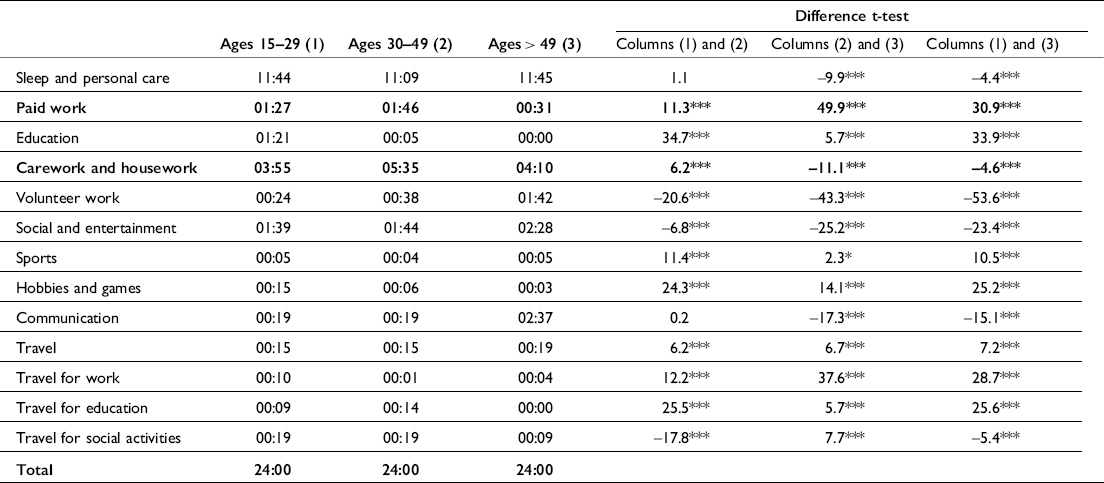
Source: TurkStat, Turkish TUS 2014–15. ***, **, * denote statistical significance at the 1, 5, and 10 percent levels, respectively.
Secondly, we calculated the prevalence rate of being a caretaker of the elderly for women and men aged fifteen and over with respect to age groups (see Table 3). The proportion of women caring for the elderly is higher than men in almost all age groups. The gender gap in prevalence rates reaches its peak in the thirty-five to thirty-nine age group.
Elderly caretakers proportion by age groups and labor force participation rates

Source: TurkStat, Turkish TUS 2014–15. PR (prevalence rate)-gap and LFP (labor force participation)-cap are calculated by taking the percentage differences between the rate for men and that of women. ***, **, * denote statistical significance at the 1, 5, and 10 percent levels, respectively.
Women’s labor force participation reaches its peak in the twenty-five to twenty-nine age group, which is also the age group with the highest fertility rates (TurkStat 2021, 4–5).The fall in the labor force participation rate in the thirty to thirty-four age group and a slight increase in the thirty-five to thirty-nine age group can be explained with the typical M-pattern observed in the labor force participation of women who have children. The M-pattern reflects the behavior of women who leave employment after having children and return to the workforce once their children reach a certain age and they feel secure about going back to the workforce. We observe that the thirty-five to thirty-nine age group, which has the highest gender gap in elderly care, also corresponds to a life phase of women when their participation in the labor market has started a continuous, decreasing trend. The gender gap in labor force participation rates between women and men reaches a plateau higher than 50 percentage points between the thirty to thirty-four and forty-five to forty-nine age groups.
Despite the fact that part-time employment in Turkey is not very common, the prevalence of part-time employment among women (19.5 percent) is twice as high compared to men (9.5 percent) (TurkStat, 2020). In order to check whether the reasons for being employed part-time in the thirty to forty-nine age group show a specific pattern or not, we had to use a different data source as this information is not available in time use data. The Turkish Household Labor Force Survey (HLFS), which holds the greatest representative sample of the status and conditions of the labor market at the national level in Turkey, was used as the alternative data source as it provides information on the main reasons for working part-time by age groups. Based on HLFS statistics, we observe that 14.6 percent of women in the thirty to forty-nine age group report caring for children as the second main reason for working part-time, which is a significantly higher rate compared to other age groups (see Table 4). Given that HLFS provides information about a much larger sample than simply women who provide forms of care other than the child care, the share of women who declare “caring for adults” and “caring for adults as well as children in the family” as the reason for working part-time remains limited: it is just 2.6 percent of women in our focus age group. However, this is still almost double the rate reported by younger or older women compared to this group. However, it is important to note that the gendered review of the HLFS reveals that women tend to under-report care provision to members of the family as they consider their caring role to be an inherent part of their gender roles, unlike household chores. The critique of questions highlights this risk of under-reporting and suggests a restructuring of the HLFS questionnaire in order to overcome this bias (Ministry of Family and Social Policies 2014, 63).
Reasons for being employed part-time by age groups

Source: HLFS, 2019.
Table 5 presents summary characteristics of the sandwiched group of women (column 4) juxtaposed with other subsamples who provide care for the elderly only (column 3), for small children only (column 2), and all women (column 1) within the thirty to forty-nine age group. Figures in Table 5 present how women in this group differ from their own cohort with respect to several demographic and employment characteristics regarding the number of observations and population size. The proportion of all women (ages thirty to forty-nine) are presented, along with subsamples grouped by different caring commitments (i.e. caring for children only; caring for elderly only; caring for both the elderly and children). We compare each group with the specific group caring for both children and the elderly by the age groups, labor force status, employment type, health status, and by the frequency of being busy during the week variable.
Demographic and employment characteristics—Proportions (%)

Source: TurkStat, Turkish TUS 2014–15. ***, **, * denote statistical significance at the 1, 5, and 10 percent levels, respectively.
The proportions by age groups show that those in the sandwiched group are different from their peers. When compared to the sandwiched women, there is a higher percentage of women in younger age groups caring for children only. On the other hand, the sandwiched group involves a much younger group of women than women who are caring for the elderly only. In order to test for differences in proportions, we also provide the results obtained by the goodness-of-fit tests below each sub-section of the table. The statistics that support survey designs based on the approach by Rao and Scott’s (Reference Rao and Scott1981) version of Pearson’s χ2 test statistics (χ2 = 5.4 and χ2 = 3.2) and the likelihood ratio χ2 statistics developed by Jann (Reference Jann2008) reject the null hypothesis of no difference between each subsample with sandwiched group women.
When we look at the proportions by their labor force status, a higher proportion of the sandwiched generation group are out of the labor force (68 percent) compared to the overall average of women at their age group (61 percent). In line with that, their employment rate is lower (29 percent) than the overall group of women (36 percent). Part-time employment is more prevalent among the sandwiched generation than women overall (24 percent versus 13 percent). According to the test statistics, we cannot reject the null hypothesis of difference for the sandwiched group of women caring for small children (p=0.99). On the other hand, distributions by the employment type (full/part-time) show that the proportions of the sandwiched group are statistically different than all-group peers (column 1) and women caring for small children only (χ2 = 5.1 and χ2 = 3.4 respectively).
The differences observed between the caregivers and their peers are not limited to labor-market related ones. In accordance with the literature, in our sample the health status numbers present the potential adverse impacts of providing informal elderly care as well as care for small children on women’s health status. The share of women who report “very well” in this group are significantly lower compared to the rest of their demographic group. Test statistics for difference in proportions reject the null hypothesis for all women in the same age group and for women caring for small children. Sandwiched caretakers present a similar proportional distribution with women caring for the elderly only based on their health status.
Caregivers suffer from a constant feeling of time pressure (Kızılırmak and Memiş Reference Kızılırmak and Memiş2009), which degrades their quality of life by causing social isolation and leaving no time for oneself (Beeson et al. Reference Beeson, Horton-Deutsch, Farran and Neundorfer2000; Broe et al. Reference Broe, Jorm, Creasey, Casey, Bennett, Waite and Grayson1999; Galicchio et al. Reference Gallicchio, Siddiqi, Langenberg and Baumgarten2002; Wilson et al. Reference Wilson, Courtney, Stearns and Clipp2007). In addition to this selected list of the descriptive statistics, respondents were also asked how often they are busy. The sandwiched caretakers report “never” or “once a month” at a much lower rate than the overall population. Additionally, the proportion who report that they are busy every day or on the weekends are higher among women with small children who also care for the elderly. Furthermore, the difficulties and complexity of care giving, which entails managing multiple roles without sufficient support often leads to stress and affects the psychological and physical health of the sandwiched caregivers (Pinquart and Sörensen Reference Pinquart and Sörensen2006; Brenna Reference El2020). Except for the women providing care for the elderly only, all the tests for proportional difference reject the ‘no difference’ null hypothesis, providing evidence for the specificities of the sandwiched caretakers compared to other subsamples of women belonging to the same age group.
Methodology and findings
Our aim was to conduct an analysis on two inter-related dimensions of work: i) participation in the labor market, and ii) duration of employment if the respondent is employed. We mainly followed the empirical methodology developed by Sugawara and Nakamura (Reference Sugawara and Nakamura2014), but we made adaptations given peculiar characteristics of our data source, which does not allow for an analysis over time and provides a truncated variable for work time.
A typical model to estimate the impact of providing elderly care on the labor force participation of women can be formulized as a model for women’s labor force participation decision (Equation 1). lfi stands for labor force participation of the respondent and if the respondent participates in the labor market (employed or looking for a job), lfi equals to 1; otherwise it is 0.Footnote 4 Further, θ is the vector of parameters for elderly care variables and β presents the vector of parameters for the control variables Zi, which stand for the individual and household characteristics that could affect participation in the labor market, other than that of providing informal elderly care. ζi stands for the error term with standard normal distribution.
 $$l{f_i} = I\;\left[ {{C_i}\theta + {Z_i}\beta + \;{\zeta _i} \ge 0} \right]$$
However, it is important to note that identifying the relation between labor force participation and providing elderly care could be a challenge if we take into account potential endogeneity between participation in the labor market and providing elderly care. Based on the discussions in the literature, it would also be very restrictive to assume being a caretaker of the elderly is an exogenous regressor (Heitmueller Reference Heitmueller2007). There could even be a reverse relation in-between, that is, women’s (non)participation in the labor market could be a determining factor behind their decision for being an elderly caretaker.
Endogeneity could be addressed by the instrumental variables technique if the dataset included potential instrument variables which satisfy “good instrument criterion” and have a strong correlation with being an elderly caretaker without being correlated with a decision about labor force participation. Unlike surveys specifically designed for elderly care needs and informal provisioning of elderly care, a time use survey is limited in terms of instrumental variables. We do not have detailed information on the availability of other relatives (siblings) who may also provide assistance or help for the elderly person, other than the respondent we observe. Furthermore, we do not have access to necessary detailed information on the health and living conditions of the elderly persons being taken care of.
Additionally, even if we could employ instrumental variables techniques, our results would still be prone to two additional issues. First, instrumental estimation techniques are found to be consistent only if the endogenous regressors are continuous. However, our endogenous regressor (Ci is a binary variable, which could not be addressed by a single participation decision equation model (Edon and Kamionka Reference Edon and Kamionka2016). The second one is an omitted variable issue, which could reflect unobserved confounding factors. In other words, beyond the binary endogenous regressor, here we face an issue in identifying the impact of the regressor on two inter-related but limited dependent variables which may be influenced by unobserved confounding factors. An approach that might provide a solution to both issues could be a two-equation model that identifies a joint-decision: labor force participation and being an elderly caretaker. However, that would again require a panel data source to be able identify the relation between the respondent’s joint decision. The available information in the elderly care module of the Turkish-TUS questionnaire is limited and does not allow us to employ the benefits of a panel data structure specifically addressing the issue.
However, time use data have other benefits for our purposes, which lead us to solve the aforementioned issues using an alternative approach. We tried to identify the relation between caregiving and participation by making use of the actual time spent in various activities, including the respondents’ work time; we took into account the joint decision to participate and the number of employment hours together. Here we assumed while providing elderly care can directly affect women’s decision on how much time to spend in the labor market, it can also indirectly influence the number of work hours through their decision to participate in the labor market.
As is pointed out in the literature, being a caretaker may have both direct and indirect impacts on the employment hours of women. While caring commitments may hinder women from full-time employment, it may also have indirect effects on work hours through its impacts on the labor force participation decision. In fact, the existence of a strong link between the decision on labor market participation and the decision on employment duration is an old debate in labor economics literature as a general argument (Zabel Reference Zabel1993). Given the fixed work hour regulations, it is observed that people usually decide whether to work or not, but cannot choose how much time to spend in the labor market. When one considers women’s decision process in entering the labor market, it is usually the case that they decide to enter only if their care commitments allow them to spend the required time at work. Moreover, it is possible to say that theoretical arguments for the strong relationship are more open to question today. Norms around a typical job have been changing rapidly, which may allow one to work less than traditional work hours. As can be seen in Equation 2 below, making use of the information on the actual work hours provided by the time use data, we can estimate the equation for the determining factors of work hours, including being an elderly caretaker. Hi stands for work time hours by the respondent i conditional on being employed:
 $${\rm{(}}{H_i}{\rm{|}}\;l{f_i}=1) = {C_i}\partial + { \times _i}{\rm{\;}} \propto {\rm{\;}} + \;{\varepsilon _i}$$
Here, ∂ presents the parameters for the variables related to elderly care and ∝ presents parameters for ×i, which stands for the control variables, that is, the individual and household characteristics. εi stands for the error term. We note that a large number of respondents report zero value for paid work time, even though they participate in the labor market (lfi). Time use datasets with truncation require specific methods (Wooldridge Reference Wooldridge2009). One can use tobit empirical specification given the censored outcome variables as presented in Equation 2 and estimate Hli, which is the latent variable that stands for work time hours by the respondent and Îi is the error term. The observed work time variable Hi is related to the corresponding latent variable as shown in Equation 4.
 $${\rm{(}}{H^l}_i\;{\rm{|}}\;l{f_i}=1) = {C_i}\partial + \!{ \times _i}{\rm{\;}} \propto {\rm{\;}} + \;{ \in _i}$$
 $${H_i} = {H^l}_i\;if\;{H^l}_i\,& gt;\,0\;{H_i}=0\;otherwise$$
Given that taking care of elderly persons may have a direct and indirect impact on work time through participation, making use of the time use data in hand, here we proceed with possible joint-decisions model estimation techniques. A potential method could be a two-step technique like the Heckman selection model or a simultaneous estimation model. In the former, the participation equation is treated as the selection equation; here we include caring for the elderly among the selection variables and work hours are determined as the outcome. The Heckman specification enables us to correct sample selection bias for nonrandom samples to prevent bias in the estimates. The residuals of the selection equation (termed as lambda) are used to construct a variable for the outcome variable, correcting for the bias due to the effects of all unmeasured characteristics. However, the Heckman specification assumes normal distribution and the outcome variable is a continuous one. What we need here is a model that allows us to take into account the issue of the binary endogenous regressor and binary dependent variable in the participation decision equation which is interrelated with the truncated dependent variable in the case of employment hours. Therefore, for our empirical analysis, we proceed with a mixed process estimation technique that tolerates each equation’s model to vary by observations. The conditional mixed process (cmp) allows for estimation with different sample sizes in each equation. Unlike the bivariate estimations or the Heckman type techniqueFootnote 5 , which uses a subset of the selection sample, a conditional mixed process estimates with varying samples and thus holds potential efficiency gains to Heckman two-step estimation conducted. In addition, it facilitates the exploration of the effect of providing informal elderly care on women’s time spent in the labor market and their participation therein, depending on the assumption that unobserved factors that influence work time and labor force participation might be correlated (Sugawara and Nakamura Reference Sugawara and Nakamura2014). Hence, the joint determination of work time and labor force participation allows us to analyze the correlations between error terms of the equations, which reflect the correlations in the decision to participate and work hours, and that may not be accounted for by other explanatory variables.
The empirical specification is a mixed activity that involves two processes, one with a probit lfi, and one with a tobit Hi specification, in which lfi as the dependent variable in one equation appears on the right side of Hi equation. The estimation technique employed here includes two separate processes, that is, tobit and probit specifications but also addresses the endogenous regressor with different samples. This approach relies on the maximum simulated likelihood (MSL) method (Greene Reference Greene1999, Reference Greene2008), based on the Geweke–Hajivassiliou–Keane (GHK) simulator. Similar to Seemingly Unrelated Regression technique, cmp enables us to explore whether there are any relationships among the dependent variables based on two independent equations but with correlated errors.
We present the results of the cmp estimates obtained at this stage in Table 6 and the summary findings can be seen in Table A1 in the online Appendix. The explanatory variables include the respondent’s age, educational attainment, the household type (the couples with/without children, the extended family, and other household types), the number of children living in the household by age groups (0–5 years, 6–11 years, 12–14 years, 15–19 years old), and the degree of the care need constructed based on the duration of care. The degree of care need is interacted with a variable constructed as a dummy variable, taking the value equal to 1 if there is at least one child younger than ten years old living in the household and equal to 0 if the children are not taken care of by any of the household members. We also included the information on whether the elderly person is living in the same place with the respondent or not. Time use surveys ask the respondents for whom they provide elderly care, and this is a question asked for each elderly person taken care of by the caregiver. We constructed a dummy variable compiling all the information, with the dummy variable taking the value 1 if there is at least one elderly person living in the same place as the respondent, and the value 0 if otherwise. Finally, we also implement robustness checks by adding and subtracting observations, which can be seen in Table 6 for the sample twenty-five to forty-nine age group (Columns 1 and 2) and for thirty-five to forty-nine age group (Columns 5 and 6). A statistically significant relation regarding employment hours can only be seen among the sandwiched group of women identified. This provides additional empirical support for the arguments on the labor market outcomes of the double care burden of the potentially sandwiched generation of women (thirty to forty-nine years) in the literature in the Turkish context.
Work time and labor force participation estimation results based on conditional mixed framework

Note: The educational attainment, age groups, number of children by their age group, household income level in ranges are controlled in all estimations.
Standard errors in parentheses. ***, **, * denote statistical significance at the 1, 5, and 10 percent levels, respectively.
Our results show that providing elderly care has a statistically significant and negative impact both on women’s work time and on the probability of labor force participation. These results are only confirmed for women aged between thirty and forty-nine who are identified as the sandwiched group in Turkey. We controlled for all the other demographic and household characteristics that may potentially determine women’s participation and work time decisions while analyzing the relation between being an elderly caretaker and work time.
The relation between providing elderly care and labor force participation is observed consistently with respect to the signs of the estimates, even when the sample is changed (Table 6, Columns 2, 4, and 6). We also observe this consistency for the child care variable. However, for elderly care, a significant relation regarding employment hours can only be seen among the sandwiched generation women.
Reciprocity in the provisioning of care and receiving of care support from the elderly is observed in our sample as well. Evidence on the relation between the age group of the elderly cared for and the labor participation of the caregiver supports this argument. Elderly between the ages of seventy-five and eighty affect the labor force participation of women positively, as shown in Columns 2, 4, and 6.
Additionally, the effects of demographic variables used as control variables, household structure, and the degree of the care needs of the elderly presented in Table 6 also provide evidence which can be interpreted as indications of same-sex kin-based generational support elaborated in the literature. The degree of need variable is used to describe the intensity of care needs based on the duration of long-term caretaking ranging from 0–5 months, 6–11 months, one year, to longer than one year. Interacting the degree of care need variable with the presence of a small child with care needs in the household, we find that if there is at least one small child (PC = 1) and if the duration of elderly care is for at least a year or longer, the impact on the labor force participation of women is positive. Our findings indicate that as the intergenerational care turns into a continuous relationship, the lives of the caregiver and caretaker become more integrated. As Can (Reference Can2019) underlines, this intergenerational same sex support carries both gender-related habitual acceptance of caring responsibilities by women and also involves intentional solidarity in resisting the challenges women have to face to be able to work.
When we consider the isolated relation between the household types and labor force participation of women, we find that living in an extended household type plays an important role within household division of labor in Turkey. In extended family households, the prevalence rate of informal care taking was found to be 45 percent higher than in nuclear families, yet the association with women’s employment was still statistically significant and positive (Memiş and İzdeş Reference Memiş, İzdeş and Ünlütürk Ulutaş2018). This reflects the fact that living in an extended household does not necessarily mean living with elderly people with high care needs. On the other hand, controlling for variations in household types, including living with the elderly cared-for members in the same place, matters for women’s participation but not for their employment hours. We observe a negative influence of the variable living with the elderly cared-for when compared to their counterparts who live in separate houses (see Table 6).
Further to this, we also find that living in a household where at least one member receives a pension income positively impacts women’s labor force participation. This may suggest the complementarity between child and elderly care that may co-support each other in terms of household division of labor, that is, the time women spend on child care is substituted by elderly members’ time for their grandchildren. However, the impact of pension income on labor force participation of daughters could be negative or positive. It may suggest the fact that pension income partly provides income security for the households so that women are not forced to enter into the labor market or it could also suggest that the pension income provides additional income that facilitates affording child care services, enabling women’s labor force participation. Nevertheless, the evidence here reveals the positive impact on labor force participation of women, indicating the common tendency of pooling of time and income resources, and increasing interdependency within families due to increasing care needs and economic insecurity documented in the literature (Argyle Reference Argyle2001; Peek et al. Reference Peek, Coward and Peek2000).
In sum, the evidence from our analysis shows that the double care burden comes with its costs for the sandwiched generation women. However, the results also show indications of the same-sex kin-based generational support elaborated in the literature. Sirman (Reference Sirman and Tekeli1995) presents how women develop coping strategies in different contexts and existing social relations. Lacking adequate public care services for both children and the elderly, grandmothers, when they are relatively younger, take up this slack and support their daughters or daughters-in law to work thus building up a care reciprocity along their life cycles (Alıçlı Mottram and Hortaçsu Reference Alıçlı and Hortaçsu2005).
Conclusion
Research on the Turkish welfare system and the care regime raises issues that will become more significant in the near future given the socio-economic and institutional transformations of recent decades. Existing policies in elderly care mainly foresee families providing the needed services. Added to that, existing social norms and commitments assume intergenerational reciprocity within every household. However, the caring workload is not shared equally among household members. In fact, Turkey is among the countries where we observe very high levels of gender gaps in unpaid care work. Lacking the alternatives such as institutional care services, the interdependency and reciprocity results in the transfer of caring labor among women of different generations. Research on care work and its impacts on women’s economic participation predominantly focuses on child care needs and provisioning. Analysis of the patterns of the elderly care is a relatively recent development and is rare in Turkey.
The current study, with its aim to explore the relation between elderly care provision and caregivers’ economic participation, shows its significance specifically for women who are juggling paid employment and facing the care challenges of looking after small children as well as caring for the elderly. Using the 2014–2015 Turkish Time Use data, we analyzed the association between informal elderly care provision, on the one hand, and labor force participation and employment hours of women, on the other. Our sample was limited to women in the thirty to forty-nine age group, identified as the generation sandwiched between their aging parents and growing children. Empirically, we analyzed the relationship between care provision and the labor force participation of women as well as employment hours, controlling for various potential factors, including different household and personal characteristics. We assumed that the participation in employment and the duration of work are simultaneously determined based on the same determinants. Results obtained provide additional evidence from Turkey on the negative and significant impact of being an elderly caretaker on participation in the labor market and on working hours, which is more severe for the sandwiched generation women. Additionally, the analyses also revealed care reciprocity among generations. If the elderly cared-for do not require too much assistance and care and are not too old to support their children by helping them with household chores or caring for their grandchildren, their support can enable the labor market participation of the sandwiched generation women. The findings of the study reveal that there is no simple relationship between women’s economic participation and changes in their domestic roles and responsibilities. A culturally situated discussion of the findings helps us to acknowledge how women mediate between their roles as workers and carers via inter-female intergenerational care support along their life cycles.
However, for policymakers, it is essential to acknowledge the limits and costs of relying on the informal care provision by the family, that is, by women. The state’s retreat from care provision is supported through a neoconservative discourse that addresses families and women as the natural and best care providers. Returning to family in social policies and as a discursive tool entail redefining women’s role by referring to classical patriarchal relations and adds to the challenges women face in participating in paid work.
The increasing longevity trend pointed out by the World Health Organization also indicates that a significant portion of the elderly will live out the last years of their lives with severe disabilities, and hence the need for institutional and professional care will increase further. Developing a structured elderly care policy that provides adequate institutional care, with a combination of alternative care services that support informal caregivers and elderly, is essential to respond to the pressing needs of a growing segment of the population. The findings of this research clearly address how the costs of insufficient care services are borne unevenly by women and how this is in conflict with increasing women’s economic participation, especially for those who have double care responsibilities. Providing care service options to families and the elderly is the way to enable women’s economic participation and a decent experience of aging.
Supplementary material
To view supplementary material for this article, please visit https://doi.org/10.1017/npt.2022.12
Conflicts of interest
None.


 Open access

