

Introduction
The 2018–2022 election cycles have demonstrated an increase in the emergence of Muslim American candidates running for and winning political office. During this timeframe, between 50 and 80 Muslim Americans have entered political office each year, with a record number of Muslim Americans on ballots during these election cycles (Abdelaziz Reference Abdelaziz2022; Bennett Reference Bennett2022; Molina Reference Molina2022). Despite these record increases in Muslim American political representation, the literature on minority candidate emergence has not explored religion’s role in minority legislators’ potential emergence or how it affects their likelihood of winning office in contemporary political environments. Additionally, robust analysis has not been conducted on how the presence of co-ethnics, the racial composition, and the overall district ideology affect the odds of a Muslim American candidate winning their race.
Previous research on minority candidate emergence has primarily examined the performance of Black, Hispanic, and Asian American candidates, focusing on how ethno-racial demographics, particularly the percentage from their own racial group, affect both their likelihood of emerging and obtaining office (Juenke & Shah, Reference Juenke and Shah2016; Juenke, Reference Juenke2014; Shah, Reference Shah2014; Voss & Lublin, Reference Voss and Lublin2001, Lublin & Wright, Reference Lublin and Wright2024; Raychaudhuri & Kistner, Reference Raychaudhuri2025). Recent theories of minority candidate emergence examine Hispanic and Black candidates and find that Hispanic and Black candidates perform similarly to their white counterparts in majority-white areas, signaling that the lack of minority candidate emergence is a supply problem rather than a result of poor electoral performance (Juenke & Shah, Reference Juenke and Shah2016; Juenke, Reference Juenke2014; Shah, Reference Shah2014; Voss & Lublin, Reference Voss and Lublin2001). Past research attributes the blame to party elites viewing minority candidates as at risk of underperforming in white districts, which restricts the supply of minority candidates (Juenke, Reference Juenke2014).
However, this strand of political science research has not examined religion’s role in hampering minority candidate supply and demand. Incorporating minority candidates’ religious identities into scholarly discussions helps identify unique barriers and biases toward minority candidates when they harbor a salient and identifiable minority religious identity, offering a fuller picture of the challenges and barriers faced by minority candidates across sociopolitical contexts.
Emerging work and experiments find that Muslim American candidates face reduced voter support, are rated lower on desirable leadership qualifications, and are often deemed untrustworthy by the American public (Kalkan et al., Reference Kalkan, Layman and Green2018; Madrid et al., Reference Madrid, Merolla, Yanez Ruiz and Schroedel2022; Calfano et al., Reference Calfano, Lajevardi and Michelson2021). These past studies, however, have not examined how Muslim American candidates perform in actual electoral contexts nor whether district characteristics predict Muslim Americans running for office or winning their electoral contests. Filling this gap in the research is essential, as it allows the field to better understand the structural and contextual factors that shape the political representation of Muslim Americans and to assess whether the biases observed in experimental settings translate into tangible electoral disadvantages.
The record number of Muslim Americans running for and obtaining office presents an opportunity to fill this gap in several ways. First, it allows examination of where Muslim American candidates run and whether their identity impacts candidate demand. Second, it allows for an analysis of demand in a real-life electoral context of political candidates from a diverse minority group whose salient identity in the U.S. is religion-based (Pew Research Center, 2017). Third, it sheds light on whether specific political and demographic environments foster Muslim Americans to run for or win office and how these compare to coethnic voting environments for other minority candidates. Fourth, Muslim Americans offer a helpful case of the intersection between religious and racial minority status that impacts candidate demand.
In order to fill these gaps in the literature, this paper asks the following questions: How do racial composition, the presence of Muslim Americans, and district ideology influence the emergence of Muslim American candidates (Candidate Supply), and what are the chances of a Muslim American candidate winning their race (Candidate Demand)? This exploratory manuscript adds to both the minority candidate emergence literature and emerging work on Muslim American candidates by examining how a district’s racial and political composition impacts the probability of a Muslim American emerging and winning office.
This paper builds on Kalkan et al.’s “bands of others” theory and applies it to hypotheses on Muslim American candidate supply and demand through an analysis of Muslim American state legislative candidates. For both supply and demand, this paper tests how district ideology, racial makeup, and the size of the Muslim population shape Muslim American emergence and the likelihood of winning.
To assess these arguments, I use data from the 2018 Candidate Characteristics Cooperative list of all state legislative candidates who ran in both primaries and general elections to assess Muslim American candidate supply, and data from the Reflective Democracy Campaign to examine general-election state legislative Muslim American candidates from 2012–2020 for an assessment of Muslim American candidate demand (Fraga et al., Reference Fraga and Hassell2021; Reflective Democracy Campaign, 2021).
On the supply side, I find that increases in the white population share in a district and conservative districts decrease the likelihood of a Muslim American candidate running. On the demand side, I find that Muslim American state legislative candidates are 15–20% less likely to win their general-election races than non-Muslim Americans and have lower success rates than other racial minority candidates. In both analyses, I find that once the population share of persons reporting ancestry from a Muslim-majority country surpasses 20–40% in a state legislative district, Muslim Americans are much more likely to run and win general elections in those districts. Compared to other predictors, the Muslim population share is the strongest and most significant predictor for both Muslim American candidate supply and demand.
These results indicate that Muslim American candidates perform worse than both non–Muslim American candidates and non–Muslim racial minority candidates, and they suggest that the minority candidate emergence literature ought to consider how the dual status of being both a religious and an ethnic minority shapes candidate emergence and electoral performance. The key findings from this paper are that Muslim Americans face supply-side barriers to running for office in conservative, majority-white districts and experience an electoral demand penalty compared to non-Muslim American candidates. However, increases in the share of Muslim Americans in a district help mitigate this negative effect.
Minority Candidate Emergence
Recent work on minority candidate emergence focuses on the dynamics of how minority candidate supply and demand impact minority candidate representation (Juenke & Shah, Reference Juenke and Shah2016; Juenke, Reference Juenke2014; Shah, Reference Shah2014; Voss & Lublin, Reference Voss and Lublin2001). Minority candidate supply is defined as the willingness of minority candidates to run for political office (Norris & Lovenduski, Reference Norris and Lovenduski1995). Minority candidate supply encompasses many dimensions, such as recruitment and social networks that influence prospective candidates to run, candidate political ambition, financial capital, and willingness to run for office. In this paper, minority candidate supply is defined as who runs for office, since examining observational data can reveal who runs under certain district and demographic factors, but not the causal mechanisms that shape ambition and the screening process.
Regarding the literature on candidate supply, Juenke & Shah (Reference Juenke and Shah2016) do not find evidence that the presence of white voters decreases the odds of candidates of color running. Furthermore, new research claims that past literature underestimates the likelihood of Latino candidates winning in white districts and observes that Latino and Black candidates have similar odds of winning compared to white candidates when partisanship is accounted for (Juenke & Shah, Reference Juenke and Shah2016; Juenke, Reference Juenke2014; Shah, Reference Shah2014; Voss & Lublin, Reference Voss and Lublin2001). This does not mean that voter bias does not exist for minority candidates, as previous research shows that race is a heuristic voters use to make stereotypical assumptions about candidates (McDermott, Reference McDermott1998; Wu & Huber, Reference Wu and Huber2024). While these biases do exist, voter demand is often mediated by party or partisan loyalty, and previous research indicates that overall, when party and ideology are accounted for, vote share gaps between minority and white candidates largely disappear (Highton, Reference Highton2004; Fraga & Hassell, Reference Fraga and Hassell2021). This strand of literature suggests that the lack of minority candidates is not a candidate-demand problem but a candidate-supply issue.
Having covered the literature on candidate supply, I turn to an examination of minority candidate demand. Minority candidate demand is defined as voters’ electoral support and preference for minority candidates (Norris & Lovenduski, Reference Norris and Lovenduski1995). Dimensions of minority candidate demand include voters’ preferences for candidates, electability perceptions, and descriptive representation preferences from the masses. For the purposes of this paper, minority candidate demand is defined as winning office, as this observational data allows for the examination of whether voters support Muslim American candidates across different electoral contexts.
Foundational literature on minority candidate emergence argues that demographics shape minority candidate demand. For example, early research contends that prejudice in white areas plays a strong role in dissuading minority candidates, such as Black and Latino candidates, from running and obtaining office (Terkildsen, Reference Terkildsen1993). Furthermore, past literature shows that the presence of co-ethnic shares in a district increases support and emergence for the minority candidates (Barreto, Reference Barreto2004; Barreto, Reference Barreto2007; Bobo & Gilliam, Reference Bobo and Gilliam1990; Casellas, Reference Casellas2011; Fraga, Reference Fraga2016; Grose, Reference Grose2011; Juenke & Shah, Reference Juenke and Shah2015; Lublin, Reference Lublin1997; Shah, Reference Shah2014; Voss & Lublin, Reference Voss and Lublin2001). As stated before, once party and ideology are accounted for, minority and white candidates have similar electoral performance (Highton, Reference Highton2004; Fraga & Hassell, Reference Fraga and Hassell2021).
This raises the question: Why does minority candidate supply remain constrained? Previous literature indicates that minority candidates, face a lack of encouragement, political socialization barriers that delay political socialization for first-generation immigrants, and perceived discrimination they may encounter if they decide to run for office (Carlos, Reference Carlos2021; Cho, Reference Cho1999; Fox & Lawless, Reference Fox and Lawless2005; Kasinitz et al., Reference Kasinitz, Mollenkopf, Waters and Holdaway2008; Lajevardi et al., Reference Lajevardi, Mårtensson and Vernby2024; Humphries et al., Reference Humphries, Muller and Schiller2013). These barriers contribute to the low supply of minority candidates (Norris, Reference Norris2004; Fox & Lawless, 2004).
Parties also play a strong role in limiting minority candidate supply. Previous literature indicates that parties often overlook candidates of color, who are perceived as “risky” and therefore receive less elite support, financial backing, and integration into informal party networks (Juenke, Reference Juenke2014; Ocampo & Ray, Reference Ocampo and Ray2019; Juenke & Shah, Reference Juenke and Shah2016; Doherty et al., Reference Doherty, Dowling and Miller2019; Grumbach & Sahn, Reference Grumbach and Sahn2020).
As stated before, literature on minority candidate emergence has not thoroughly examined the role that identification with a minoritized religious group may play in candidate emergence. How could a candidate’s religious orientation impact their chances of obtaining office, especially among minority candidates? Previous work suggests that racially resentful voters may support minority candidates if those candidates display behavior that counters negative stereotypes about their group or emphasize adherence to perceived American values (Hood & McKee, Reference Hood and McKee2015; Karpowitz et al., Reference Karpowitz, King-Meadows, Monson and Pope2021). Being part of a religious minority group may complicate this dynamic, especially if a candidate is also a racial minority, as it adds another layer of differentiation from the average American that can make it harder for religious minority candidates to “play up” American values. This may mean that religious minority candidates face more stereotypes to counter because of their distance from the “American mainstream.” Therefore, they must do more to counter stereotypes regarding their ethnic and religious backgrounds. The increase in negative stereotypes that these candidates must combat can make it more challenging to appeal to voters and secure support from the American public. Additionally, these layers of stereotypes could lead to candidates who are negatively viewed for both their religious and ethnic identities, thereby incurring a demand penalty.
Muslim American candidates illustrate how this argument applies and highlight the need for research on minority candidate emergence to examine the unique barriers that intersecting minority identities (such as ethnicity and religion) may impose on candidate supply and demand. While other racial-minority candidates may employ strategies such as counter-stereotypical behavior and the portrayal of adherence to American values to win elections and appeal to conservative and white voters, Muslim American candidates may not have the same luxury (Hood & McKee, Reference Hood and McKee2015; Karpowitz et al., Reference Karpowitz, King-Meadows, Monson and Pope2021; Juenke & Shah, Reference Juenke and Shah2016; Juenke, Reference Juenke2014; Shah, Reference Shah2014). Given the negative biases against Muslims and the countries from which Muslim Americans may originate, Muslim Americans may have to display a higher degree of counter-stereotypical behavior than other racial minority candidates.
Regarding candidate supply, Dancygier (Reference Dancygier2013) argues that the Labour Party in the UK was less likely to select Muslim candidates in certain contexts due to fears of those candidates losing. Furthermore, Islamophobia may inhibit the supply of Muslim American candidates, given that minority candidates may not run because of perceived discrimination (Lajevardi et al., Reference Lajevardi, Mårtensson and Vernby2024). Muslim Americans are also more likely to be first- or second-generation immigrants; therefore, there may be additional barriers to political socialization (Carlos, Reference Carlos2018; Cho, Reference Cho1999; Kasinitz et al., Reference Kasinitz, Mollenkopf, Waters and Holdaway2008). Additionally, if parties already view racial-minority candidates as too risky to run, the negative perceptions of Muslim Americans, both from racial and religious standpoints, may also inhibit integration into party networks and reduce elite support for these candidates (Kalkan et al., Reference Kalkan, Layman and Uslaner2009; Dancygier, Reference Dancygier2013; Doherty et al., Reference Doherty, Dowling and Miller2019; Juenke, Reference Juenke2014).
Views of Muslim Americans
To build a theory on how being Muslim American impacts candidate supply and demand, it is essential to examine how the public perceives Muslim Americans. Public perceptions play a strong role in shaping electoral support or preference for minority candidates. What are the public’s views of Muslim Americans? Post-9/11 saw increases in hate crimes and Islamophobic rhetoric by elites and the media (FBI, 2001; Lajevardi et al., Reference Lajevardi, Mårtensson and Vernby2024; Panagopoulos, Reference Panagopoulos2006; Pew Research Center, 2017; Southern Poverty Law Center, 2016). One facet of these negative biases toward Muslim Americans is the characterization of them as a cultural threat. Islamophobia is often fueled by the construction that Muslims are an incompatible “other” with the Western world and values (Said, Reference Said1978; Cesari, Reference Cesari2004; Lajevardi et al., Reference Lajevardi, Mårtensson and Vernby2024). This sentiment corresponds to results from the 2017 Pew Research Center poll, which finds that among all major religions, Islam ranked the lowest with an average feeling thermometer of 48 out of 100, and that a majority of respondents claimed Islam was incompatible with democracy and more likely to drive its followers to commit violence (Greenwood, Reference Greenwood2017). Feeling thermometers of Muslim Americans differ based on party as well, with only 29% of Democrats agreeing with the statement that Islam is more likely than other religions to encourage violence, while 70% of Republicans agreed with the statement (Pew Research Center, 2017).
This stereotyping has led to portrayals of Muslims as foreign, violent, and untrustworthy, associating them with terrorism, and is reinforced in the U.S. population through media depictions and coverage (Kalkan et al., Reference Kalkan, Layman and Uslaner2009; Lajevardi et al., Reference Lajevardi, Oskooii, Saleem and Docherty2023; Lajevardi et al., Reference Lajevardi2020; Saleem et al., Reference Saleem, Yang and Ramasubramanian2016). Kalkan et al. (Reference Kalkan, Layman and Uslaner2009) conceptualize these threat perceptions as based on religion and argue that they place Muslim Americans in a “band of others” category (groups outside the American mainstream). They further note that Muslim Americans occupy both the “religious minority” band and the “cultural minority” band, meaning they face societal prejudice from multiple sources and layered stereotypes, making acceptance more challenging compared to other minority groups.
These perceptions of a cultural threat have significant policy ramifications. One dimension is the fear that Muslims might impose a religious order in the U.S. through “Sharia law,” which has spurred the passing of anti-Sharia law bills across the country (Southern Poverty Law Center, 2018). Furthermore, individuals harboring anti-Muslim sentiment are more likely to support policies such as banning the construction of mosques, surveillance of mosques and Muslim areas, and other discriminatory measures against Muslim Americans (Kalkan et al., Reference Kalkan, Layman and Uslaner2009).
While the effects of Islamophobia in contemporary society and how they are propagated have a rich and robust literature, work on Muslim American candidates is still in its early stages. Emerging research on Muslim American candidates has been conducted primarily in experimental settings. While these experiments offer valuable insights into the causal mechanisms through which biases against Muslim Americans may emerge, an analysis of how Muslim Americans perform in real-world political contexts and how they compare to their peers is crucial to understanding the practical implications of these biases. Such an examination is essential, as relying solely on experimental settings may obscure how Muslim Americans perform across different demographic contexts, political environments, and electoral systems, and how religion may shape overall candidate demand.
It is also important to examine which district factors may predict the success and emergence of Muslim Americans. This paper aims to bridge that gap. These experiments provide a foundation for understanding how Muslim Americans may perform. Kalkan et al. (Reference Kalkan, Layman and Green2018) find that respondents with high levels of “outgroup cultural antipathy” exhibit decreased voter support for a hypothetical Muslim candidate. Braman & Sinno (Reference Braman and Sinno2009) find no difference in voter behavior between Muslim and Christian candidates for state attorney general and U.S. senator positions, unless the Muslim candidate represents a district with a high Muslim share, in which case voters worry that the Muslim candidate will be lax on prosecuting terrorism. Calfano et al. (Reference Calfano, Lajevardi and Michelson2021) show through a randomized survey experiment that even when a Muslim or Muslim-Arab leader demonstrates pro-social behavior, respondents find them less trustworthy than non-Muslim leaders. Moreover, this effect is absent when the leader is described solely as Arab, indicating a bias specifically tied to being Muslim.
In contrast, when Muslim Americans view political leadership by Muslims in a video vignette experiment, they show more warmth toward political participation and potentially running for office (Lajevardi et al., Reference Lajevardi, Mårtensson and Vernby2024). This suggests that the number of Muslim American candidates could increase, despite negative views toward Muslim Americans, through a role model effect. However, parties may play a gatekeeping role in dissuading Muslim candidates from running, as evidenced by the Labour Party in the UK viewing Muslim candidates as too risky in certain contexts (Dancygier, Reference Dancygier2013). Past literature on the harsh negative views the American public holds of Muslim Americans offers evidence on how it may decrease candidate demand, while party gatekeeping helps explain why the supply of Muslim American candidates is restricted.
Theories of Muslim American Candidate Supply and Demand
This exploratory manuscript examines three theoretical questions regarding Muslim American candidate supply and demand. First, where are Muslim American candidates running? Second, what district factors predict the presence of a Muslim American candidate on the ballot? Third, how do a candidate’s Muslim American identity and district characteristics affect the likelihood of electoral victory? The first two questions address supply, while the third focuses on demand.
Regarding supply, past surveys show that Republican and conservative respondents consistently report low feeling-thermometer scores toward Islam and Muslim Americans (Pew Research Center, 2017; Kalkan et al., Reference Kalkan, Layman and Uslaner2009). White respondents likewise report lower average scores toward Muslims than minority respondents (Pew Research Center, 2017). Lajevardi et al. (Reference Lajevardi, Mårtensson and Vernby2024) demonstrate that minority candidates are less likely to run for office when they perceive high levels of discrimination. Consequently, conservative and less diverse districts may create environments that discourage potential Muslim American candidates from entering electoral contests. Therefore, I hypothesize:
Supply Hypothesis 1: Districts that are ideologically conservative or have a high white share of the population are less likely to have a Muslim American running for office.
An ideologically conservative or predominantly white environment is likely perceived as hostile by Muslim Americans, leading them to choose not to run.
Prior research on minority candidate emergence, centered largely on Hispanic and African American candidates, shows that under-representation is primarily a supply problem: when minority candidates run, they tend to perform as well as their white counterparts, but various barriers deter them from entering races in the first place (Juenke & Shah, Reference Juenke and Shah2016; Juenke, Reference Juenke2014; Shah, Reference Shah2014; Voss & Lublin, Reference Voss and Lublin2001). I contend, however, that Muslim Americans also face a distinct demand problem. Kalkan et al. (Reference Kalkan, Layman and Uslaner2009) “bands of others” framework groups communities perceived as outside the American mainstream. They identify two bands: one comprising religious and ethnic minorities, another comprising cultural minorities whose practices challenge traditional norms. Prior research on minority candidate emergence, centered largely on Hispanic and African American candidates, shows that under-representation is primarily a supply problem: when minority candidates run, they tend to perform as well as their white counterparts, but various barriers deter them from entering races in the first place (Juenke & Shah, Reference Juenke and Shah2016; Juenke, Reference Juenke2014; Shah, Reference Shah2014; Voss & Lublin, Reference Voss and Lublin2001). I contend, however, that Muslim Americans also face a distinct demand problem. Kalkan et al. (Reference Kalkan, Layman and Uslaner2009) “bands of others” framework groups communities perceived as outside the American mainstream. They identify two bands: one comprising religious and ethnic minorities, another comprising cultural minorities whose practices challenge traditional norms.
Next, Kalkan, Layman, and Uslaner’s (Reference Kalkan, Layman and Uslaner2009) framework has limitations because the measures they rely on do not include questions that tap into Islam-specific stereotypes or beliefs central to contemporary Islamophobia (e.g., perceptions of Muslims as culturally incompatible, disloyal, or supportive of imposing Sharia law), as noted by Oskooii et al. (Reference Oskooii, Dana and Barreto2019). Instead, they show how general outgroup orientations structure evaluations of Muslims, but this approach cannot directly adjudicate the role of Islam-specific belief content that later work argues is central to anti-Muslim prejudice (Oskooii et al., Reference Oskooii, Dana and Barreto2019). This is also a limitation of relying only on the idea of multiple bands of otherization, because not all Muslims are racial minorities. Furthermore, there are many other examples of non-Muslim candidates who are racial and religious minorities and may not experience the same form of prejudice. However, contemporary literature and polling demonstrate that negative perceptions of Muslim Americans are often grounded in Orientalism and in the belief that Islam makes Muslim Americans unassimilable, associated with terror, and prone to violence (Said, Reference Said1978; Kalkan et al., Reference Kalkan, Layman and Uslaner2009; Oskooii et al., Reference Oskooii, Dana and Barreto2019; Saleem et al., Reference Saleem, Yang and Ramasubramanian2016; Lajevardi et al., Reference Lajevardi, Oskooii, Walker and Westfall2020; Lajevardi et al., Reference Lajevardi, Oskooii, Saleem and Docherty2023). Given that Muslim Americans are often perceived as both cultural outsiders and targets of Islam-specific stereotypes that frame them as at odds with Western society, I argue that Muslim American candidates will be less likely to win their elections compared to non-Muslim candidates.
Additionally, previous work indicates that racially resentful voters are willing to vote for minority candidates if they present anti-stereotypical behavior and display adherence to perceived American values (Hood & McKee, Reference Hood and McKee2015; Karpowitz et al., Reference Karpowitz, King-Meadows, Monson and Pope2021), but Islam-specific stereotypes tied to cultural incompatibility and threat, along with belonging to multiple bands of otherization, may make this type of value signaling more difficult for Muslim American candidates to utilize effectively. For example, given the prevalence of Christianity within these minority communities, Black and Hispanic Christian candidates may confront ethnic stereotyping but may be less likely to face religion-specific stereotypes as well. Additionally, given the literature’s evidence of Muslim American-specific stereotypes of cultural incompatibility, and polling showing Islam as the most negatively viewed compared to other religions in the U.S., I expect Muslim American candidates to have more stereotypes associated with their religion compared to other racial minority candidates (Greenwood, Reference Greenwood2017; Kalkan et al., Reference Kalkan, Layman and Uslaner2009; Lajevardi et al., Reference Lajevardi, Oskooii, Walker and Westfall2020; Oskooii et al., Reference Oskooii, Dana and Barreto2019; Pew Research Center, 2017; Saleem et al., Reference Saleem, Yang and Ramasubramanian2016). This leads me to argue that Muslim American candidates will be less likely to win their elections compared to other non-Muslim racial minority candidates. Thus, I propose:
Demand Hypothesis 2A: Muslim American candidates are less likely to win elections compared to non-Muslim candidates.
Demand Hypothesis 2B: Muslim American candidates are less likely to win elections compared to other racial-minority candidates.
Additionally, conservative and white districts should impose a larger electoral penalty on Muslim American candidates. Therefore, I hypothesize:
Demand Hypothesis 3: Muslim American candidates are more likely to lose races in conservative or predominantly white districts.
Comparative politics research shows that Muslims often give preferential votes to Muslim candidates (Azabar et al., Reference Azabar, Thijssen and Van Erkel2020). Areas with large Muslim populations may therefore be more hospitable and reduce perceptions of discrimination. Party elites may also see these districts as less risky for supporting Muslim American candidates. Hence, I hypothesize:
Demand Hypothesis 4: Muslim American candidates are more likely to win races in districts with a large Muslim population.
Supply Hypothesis 5: Muslim American candidates are more likely to run in districts with a large Muslim population.
Methods
This paper’s examination of Muslim American supply and demand uses the 2018 and 2020 Candidate Cooperative datasets on state-legislative candidates for the supply side, and the Reflective Democracy Campaign dataset from 2012 to 2020, covering state legislators, for the demand side (Fraga et al., Reference Fraga and Hassell2021; Reflective Democracy Campaign, 2021). State legislators were selected because more Muslim and other minority candidates run for state office than for federal office. Focusing on state legislatures, rather than statewide executive offices, also provides a larger number of seats and thus a more robust empirical analysis. The 2018 Candidate Cooperative data cover both primaries and general elections, so they capture every Muslim American who chose to run in that year and allow identification of the districts that fielded Muslim American candidates (Fraga et al., Reference Fraga and Hassell2021). The Reflective Democracy Campaign dataset lists all state-legislative candidates in general elections from 2012 to 2020. Although it does not include primaries, it is one of the few resources that identifies candidates’ racial and ethnic backgrounds across multiple cycles, increasing sample size (Reflective Democracy Campaign, 2021).
With these data, I conduct two separate analyses. For candidate supply, I use the Candidate Cooperative data and estimate a logistic regression predicting whether a candidate in a given district is Muslim American. The sample is limited to districts that contain at least some residents from Muslim-majority countries, because Muslim Americans must be present to run. The dependent variable is coded 1 if a candidate is Muslim American and 0 otherwise. This analysis tests Hypotheses 1 and 5.
For candidate demand, I run two models. The first compares Muslim American and non-Muslim American candidates in districts where at least one Muslim American ran in the general election; restricting the sample in this way avoids an excess of zeros and enables a direct group comparison. This model tests Hypotheses 2A, 3, and 4. The second model limits the sample to Muslim American and other racial-minority candidates to test Hypothesis 2B. In both demand models, the dependent variable is whether the candidate won.
Candidates were classified as Muslim American through surname matching with Dr. Rahman’s Dictionary of Muslim Names; matches were coded 1, non-matches 0. Each positive match was then hand-verified using campaign materials, social-media profiles, and public statements. Potential false negatives were checked against Jetpac and CAIR lists of Muslim American candidates and officeholders (Council on American-Islamic Relations, Jetpac, & MPower Change, 2021).
District ideology scores come from the American Ideology Project (Warshaw & Tausanovitch, 2022).1 Because the U.S. Census does not record religion, the share of Muslim residents is proxied by the percentage of individuals reporting ancestry from a Muslim-majority country.2 Although not every person with such ancestry is Muslim, this measure captures most Muslims in a district and also residents with close cultural ties. More direct alternatives, such as the U.S. Religion Census or mosque counts, are too coarse for district-level analysis and would introduce extensive missing data. Moreover, individuals from Muslim-majority countries may see Muslim American candidates as culturally similar and thus be less likely to “otherize” them. While imperfect, this proxy is the most suitable available.
Additional covariates include five-year American Community Survey (ACS) estimates of district racial composition (White, Black, and Asian shares, with Hispanic share as the baseline) (U.S. Census Bureau, 2020). Because most Muslim American candidates run as Democrats, the demand models also control for the candidate’s party to isolate the effect of Muslim identity.
Descriptives
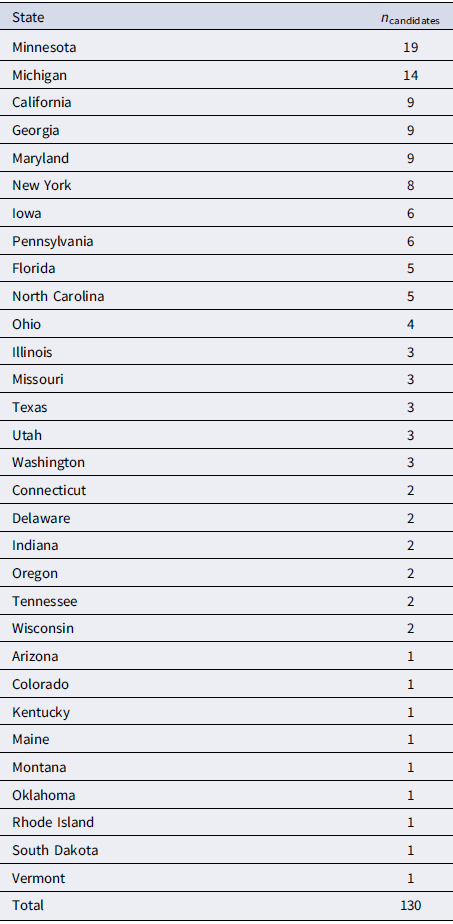
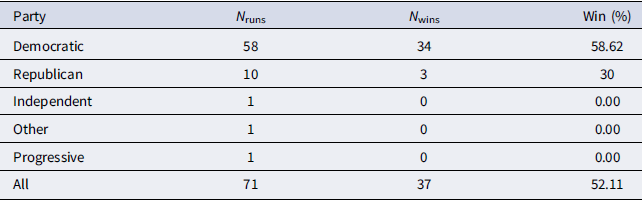
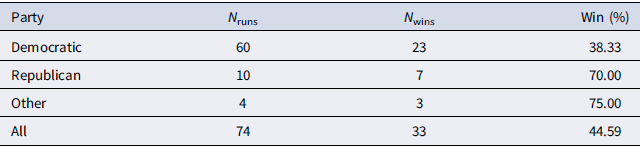
Before examining findings on Muslim American candidate supply and demand, it is essential to show descriptively where Muslim American state-legislative candidates are running. I created these descriptives utilizing both the Candidate Characteristic Cooperative data and the Reflective Democracy campaign dataset. Figure 1 and Table 1 display the number of Muslim American candidate races in both datasets and identify the states in which they occur; Table 2 reports the number of unique Muslim American candidates by party.
Spatial distribution of Muslim American candidate runs by state.

Number of Muslim American candidates by state

General elections (Muslim American candidates): runs and win percent by party

Figure 1 and Table 1 indicate that Michigan, Minnesota, New York, and Georgia host the most Muslim American campaigns. Minnesota’s leading position is unsurprising: the state has the country’s largest Somali community, and most Somali Americans are Muslim. This community has helped elect Somali state legislators such as Omar Fateh, Hodan Hassan, and Neva Walker who are all included in this dataset. Minnesota also elected Keith Ellison, the first Muslim American in Congress, and Ilhan Omar, one of the first Muslim American women in Congress.
Michigan’s high ranking reflects the presence of Hamtramck and Dearborn. Hamtramck has the first majority-Muslim city council in U.S. history, and its mayor, Amer Ghalib, is Yemeni Muslim American. Dearborn is the first majority Arab city in the United States and also has a Muslim American mayor, Abdullah Hammoud. Abdullah Hammoud is also in this dataset, as he ran and won the Michigan 15th District House seat in 2016, before becoming mayor of Dearborn. Rashida Tlaib, one of the first two Muslim American women elected to Congress, represents Michigan’s 12th District, which includes Detroit and Dearborn.
Although Georgia does not have a large statewide Muslim population, counties such as Gwinnett and DeKalb, and parts of the Atlanta metro area are diverse and include significant Muslim communities. Georgia has seen the emergence of Sheikh Rahman, the first Muslim American to win a seat in Georgia’s state legislature, and Nabilah Islam Parkes, the first Muslim woman elected to that body.
New York consistently ranks among states with the largest Muslim populations. This community has helped elect state legislative officials such as Nader Sayegh, Robert Jackson, Sharif Street, and Zohran Mamdani, who recently won the Democratic primary against Andrew Cuomo in the New York Mayoral election. Zohran Mamdani is also included in this dataset as well, as he won the New York State House District 36th in 2020.
Tables 2 and 3 showcase Muslim American candidates by party affiliation, split by general and primary elections. Additionally, these tables display the win rate of Muslim American candidates by party in both the primary and general election stages. Most Muslim American candidates run as Democrats, which aligns with survey evidence that Democrats report warmer attitudes toward Muslims than independents and Republicans. Regarding these Democratic Muslim American candidates, without considering covariates, they appear to win around 58 percent of the time in general elections; however, they struggle in Democratic primaries, winning only 38 percent of the time. Republican Muslim American candidates, interestingly, appear to win 70 percent of the time in Republican primaries, but they struggle to win general elections, winning only around 30 percent of the time. However, given the low number of Republican Muslim American candidates, it is difficult to draw definite conclusions from these descriptive statistics. Interestingly, the only Muslim American Republican to win a general election race in this specific dataset is Aboul Khan, a Bangladeshi Muslim American who has represented a New Hampshire State House district since 2012. It is essential to focus on Muslim American candidates like Aboul Khan. Additionally, given the Muslim American community’s conservative views on social policy, its high support for George W. Bush in the 2000 presidential election (pre-9/11), and evidence of increased Republican vote share among Muslim Americans in the 2024 presidential election, more Muslim American candidates like Aboul Khan may emerge in future election cycles (Council on American-Islamic Relations, 2024; Farivar, Reference Farivar2016; Mohamed & Kallo, Reference Mohamed and Kallo2025).
Primary elections (Muslim American candidates): runs and win percent by party

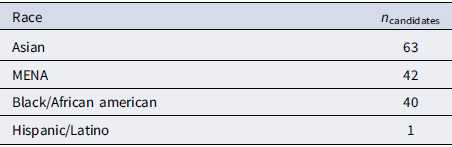
Table 4 showcases the racial background of Muslim American candidates. Muslim American candidates who are Asian (all Desi with ancestry in Pakistan, India, and Bangladesh) are the most prevalent in this dataset, followed by MENA candidates and Black candidates.
Number of Muslim American candidates by race

Supply Side Results
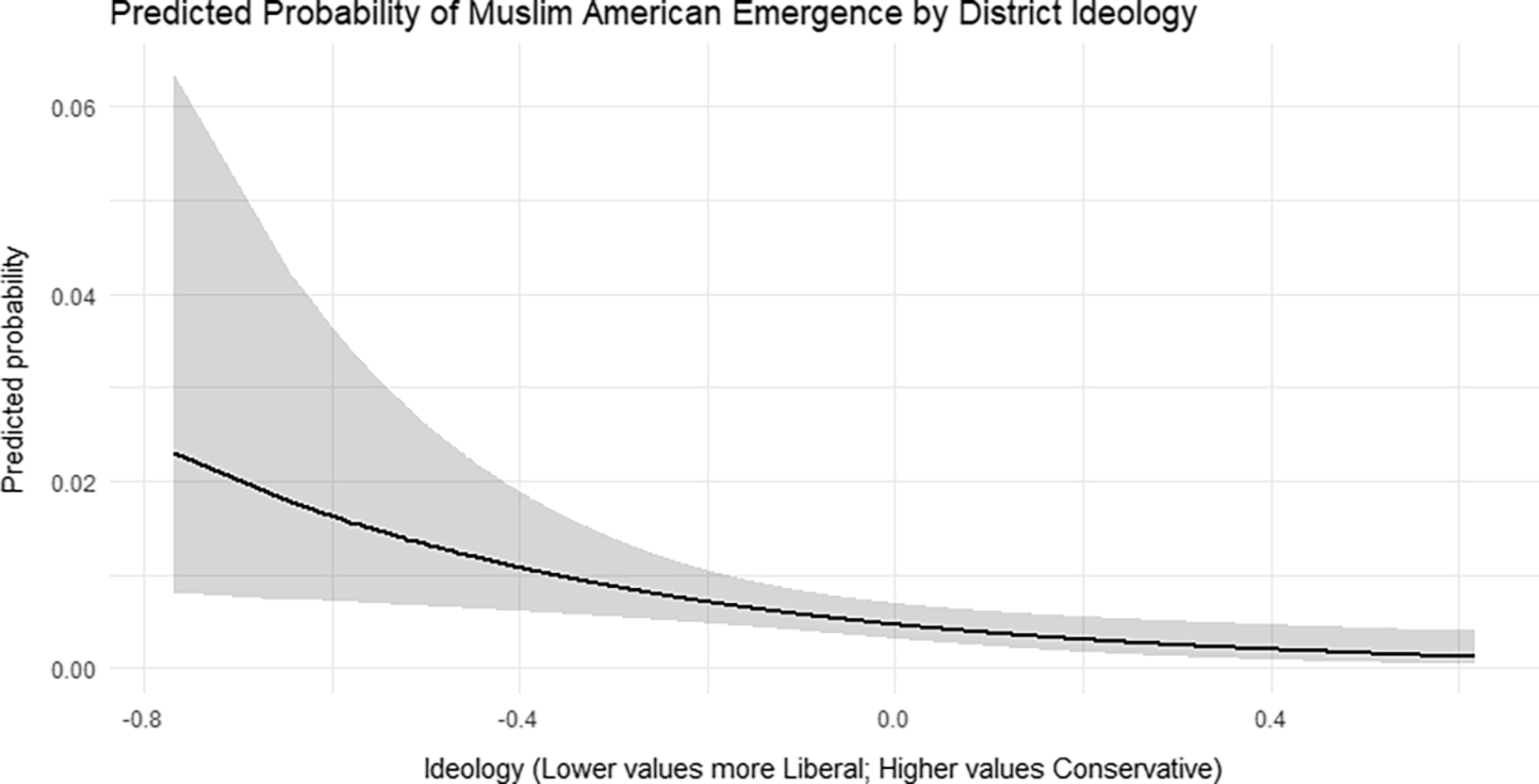
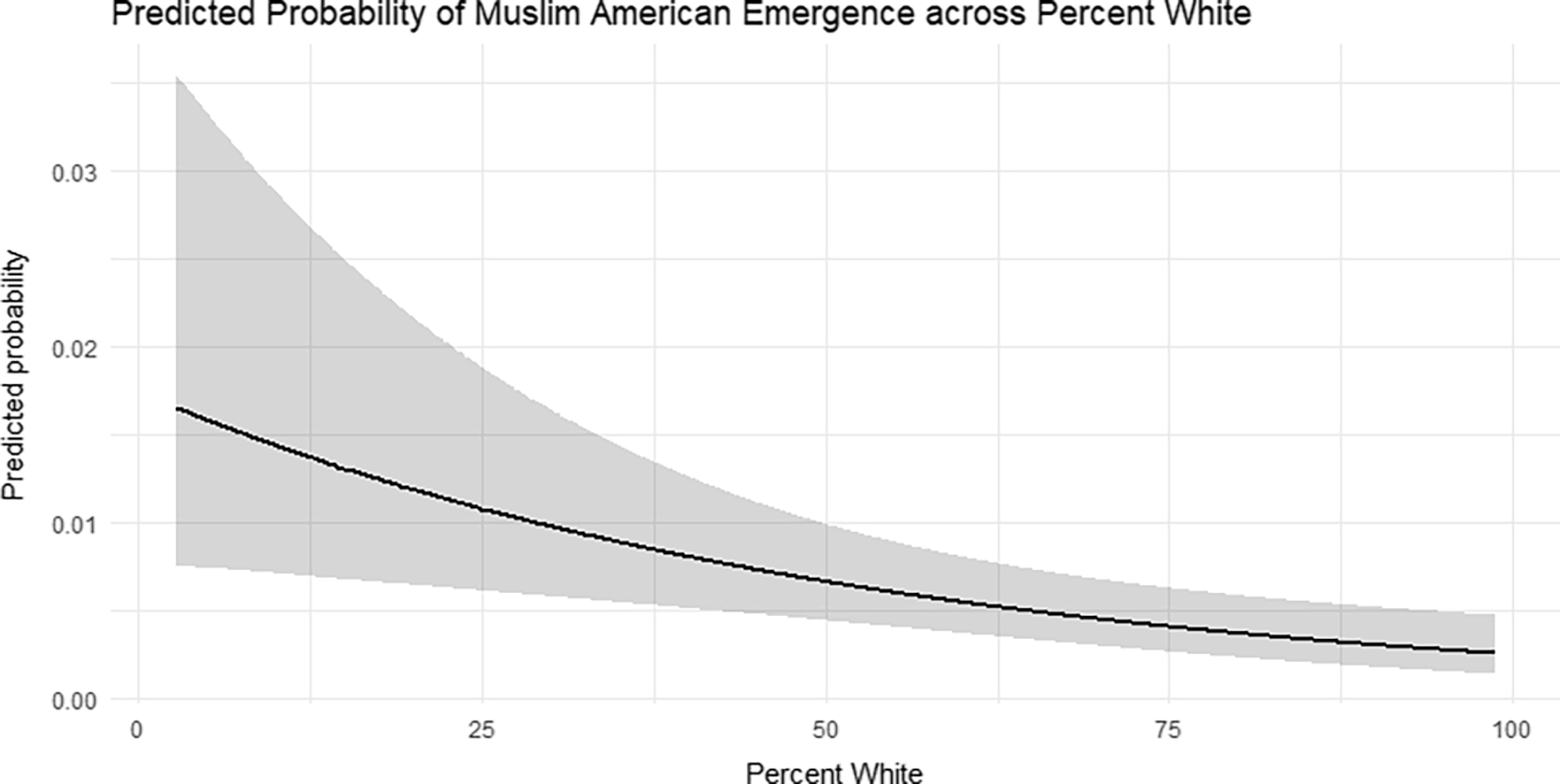
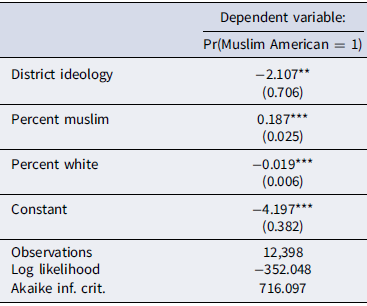
Table 4 and Figures 2 and 3 show the probability that a Muslim American candidate will run in a state district at varying levels of district ideology and White population share. The results indicate that as districts become more conservative and Whiter, the probability of a Muslim American candidate running there declines. The predicted probability of a Muslim American candidate running for office is around 1.5 percent to 1.7 percent at its highest in low percent White state legislative districts. However, as the White percentage exceeds 50 percent, the predicted probability of a district having a Muslim American candidate decreases to around 0.7 percent to 0.8 percent, and is around 0.3 percent to 0.4 percent as the White percentage in a district approaches nearly 100 percent. For the most liberal districts in this sample, the predicted probability of a Muslim American candidate running for office is at its highest, at 2 percent to 2.3 percent. However, in districts with a moderate ideology score (0), the probability of a Muslim American running for office decreases to around 0.6 percent and remains between 0.3 percent and 0.4 percent as the districts become more conservative. The low predicted probabilities overall, even in diverse districts and liberal districts, reflect how rare it is for a district to have a Muslim American run for office, despite surges in recent election cycles. This finding supports Hypothesis 1: in districts that contain larger groups reporting low feeling thermometer scores toward Muslims, such as Republicans and White respondents, Muslim Americans are less likely to enter races. The evidence suggests that conservative and heavily White districts pose a supply-side barrier to Muslim American representation. Although the analysis is predictive, it raises questions about causal mechanisms. For example, whether Islamophobia and anticipated discrimination discourage potential Muslim American candidates from running.
Predicted probability of Muslim American candidate emergence by district ideology.

Predicted probability of Muslim American candidate emergence by percent White.

Figure 4 plots the probability that a Muslim American candidate will run as the share of residents reporting ancestry from Muslim-majority countries increases. Once that share reaches roughly 20 percent, the probability of a Muslim American candidacy rises from near 0 percent to around 15 percent to 20 percent. In contrast, compared to Figures 2 and 3, the effect sizes here are quite large, which indicates that the percentage of Muslims in a district is a potent driving force for the emergence of Muslim American candidates. These findings confirm Hypothesis 5: robust Muslim American communities appear to encourage candidacies, perhaps by reducing expected discrimination and creating a more hospitable environment (Lajevardi et al., Reference Lajevardi, Mårtensson and Vernby2024).
Predicted probability of Muslim American candidate emergence by Muslim-ancestry share.

In sum, Muslim American candidates are much less likely to run in districts that are more conservative and Whiter, demonstrating a clear supply-side barrier. Future work should explore the causal pathways, such as fear of discrimination, that discourage candidacies in these contexts. Conversely, districts with larger Muslim populations see higher rates of Muslim American candidacy, suggesting that co-ethnic or co-religious communities can mitigate supply barriers and foster political ambition among Muslim Americans. These results are the first of their kind to examine how electoral district factors predict Muslim American candidate emergence.
Muslim American Demand
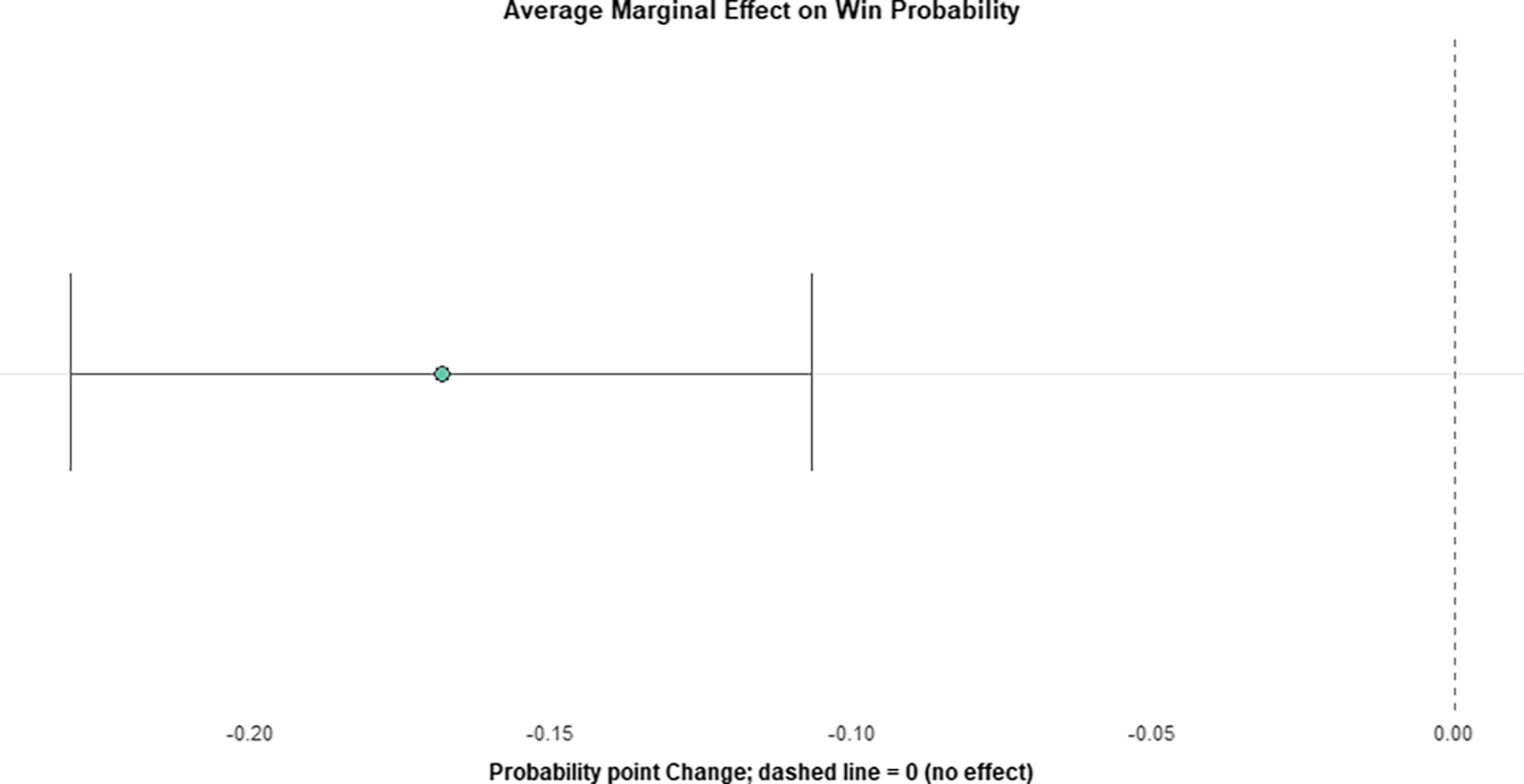
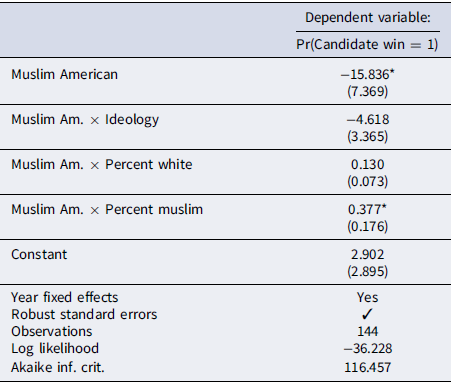
Table 5 compares the predicted probability of winning for Muslim and non-Muslim American state legislative candidates, and Figure 5 displays the average marginal effect of being a Muslim American candidate on winning. These results were generated from the Reflective Democracy Campaign dataset, whose sample includes Muslim American candidates and the opponents they faced. Table 5 demonstrates that Muslim Americans are less likely to win their elections than non-Muslim candidates. Figure 5 shows that being a Muslim American candidate carries an average marginal penalty of 16 percentage points in win probability. These results affirm Hypothesis 2A and demonstrate that Muslim Americans face unique electoral penalties relative to non-Muslim Americans.
Logistic regression of Muslim American identification (supply side results)

Note: *p < 0.05; **p < 0.01; ***p < 0.001
Average marginal effect of Muslim American identity on victory probability.

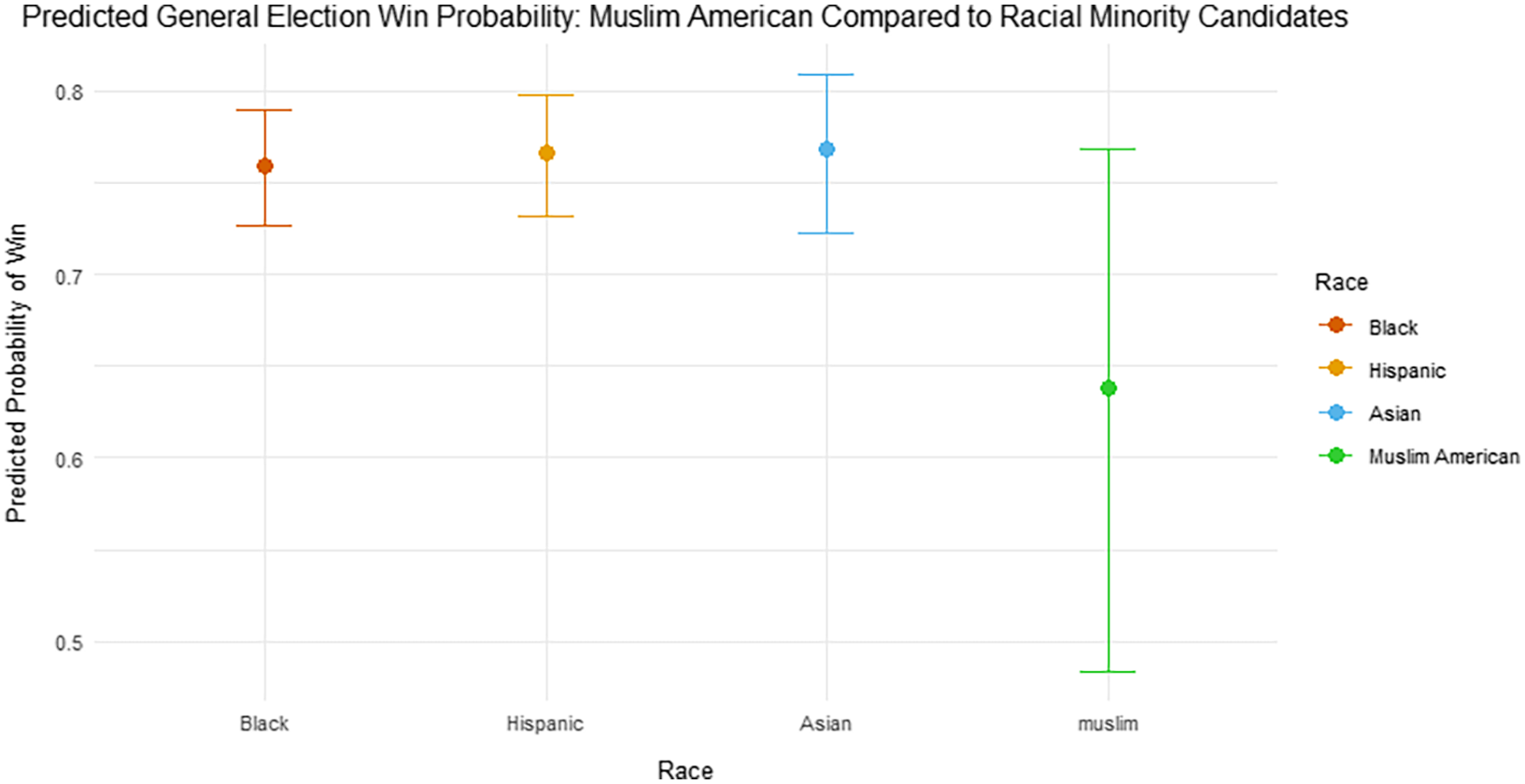
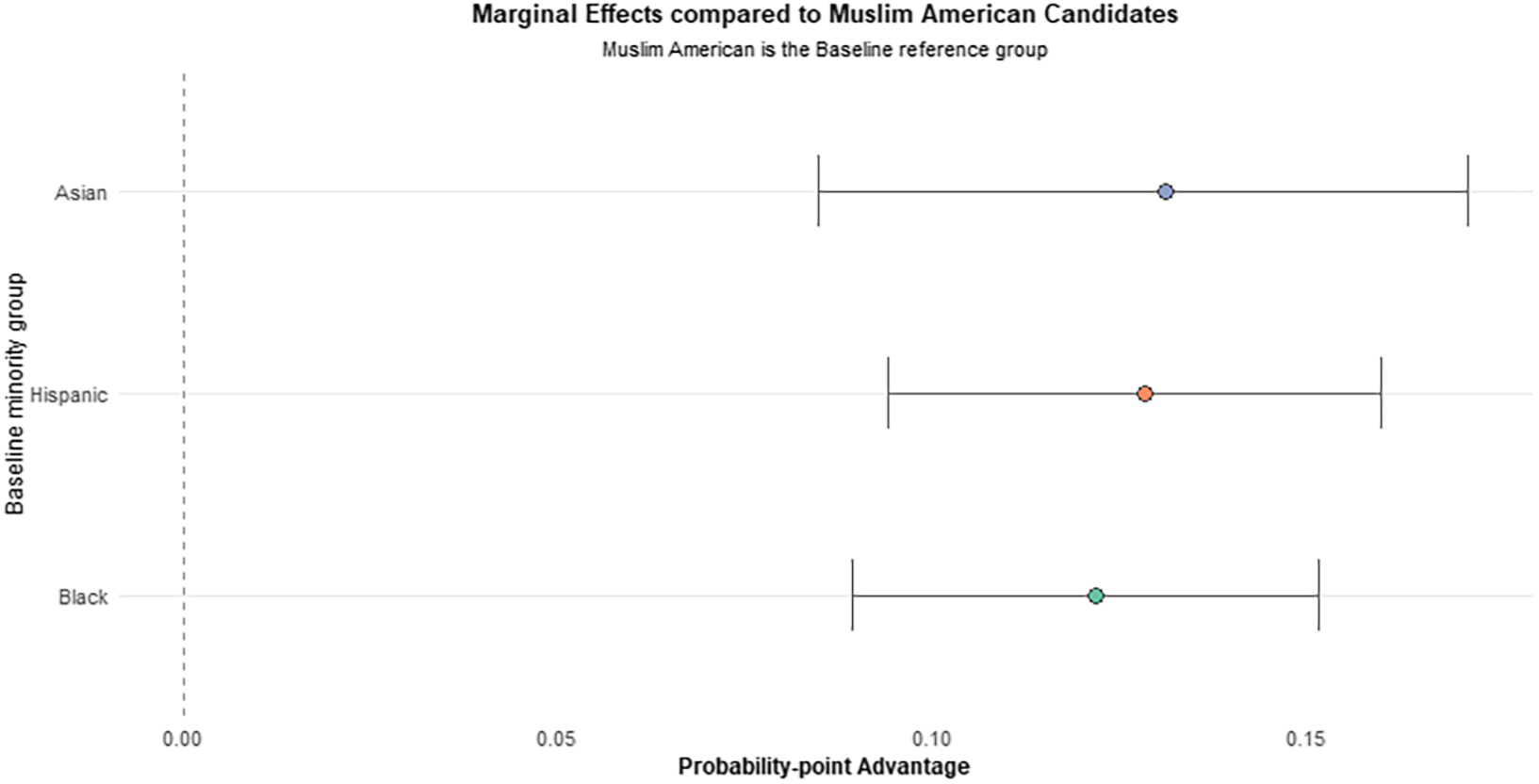
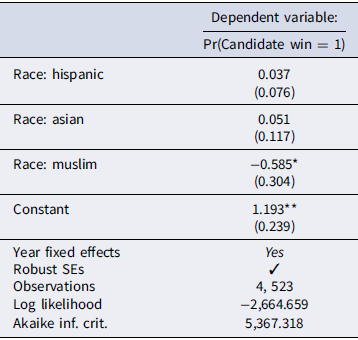
Figures 6 and 7, along with Table 6, compare Muslim Americans with other racial- minority candidates. To do a comparison with other racial minority candidates, I replace the Muslim candidates’ race with “Muslim” to allow for a comparison between Muslim candidates and racial minority non-Muslim candidates. Figure 6 plots the predicted probability that each candidate group will win their general election race. Overall, other racial minority candidates have a predicted probability of around 75–78 percent of winning their election, while Muslim American candidates have a predicted probability of around 65 percent. To determine whether this difference is statistically significant, Figure 7 calculates the average marginal difference between Muslim American general election performance and that of racial minority candidates by comparing their model-predicted chances of winning and plotting the average gap (in probability points) with 95 percent confidence intervals, using Muslim American candidates as the reference. For all racial minority groups, the effect sizes are positive, and the confidence intervals do not cross 0, indicating that racial minority candidates have an approximately statistically significant 10–15 percentage-point higher predicted probability of winning their general election race compared to Muslim American candidates. These results support Hypothesis 2B. These findings suggest that the penalties observed in experimental studies also appear in actual elections and invite further research into the mechanisms behind them. This finding is an essential step in the literature exploring the experiences of Muslim American candidates in the contemporary world and the tribulations they face in obtaining office.
Predicted probability of victory: Muslim Americans compared to other racial-minority candidates.

Average marginal effect of Muslim American identity vs. other racial minorities.

Logistic regression of candidate victory (demand-side results)

Note: *p < 0.05; **p < 0.01; ***p < 0.001
Logistic regression, minority candidates only (demand-side results)

Note: *p < 0.1; **p < 0.05; ***p < 0.01
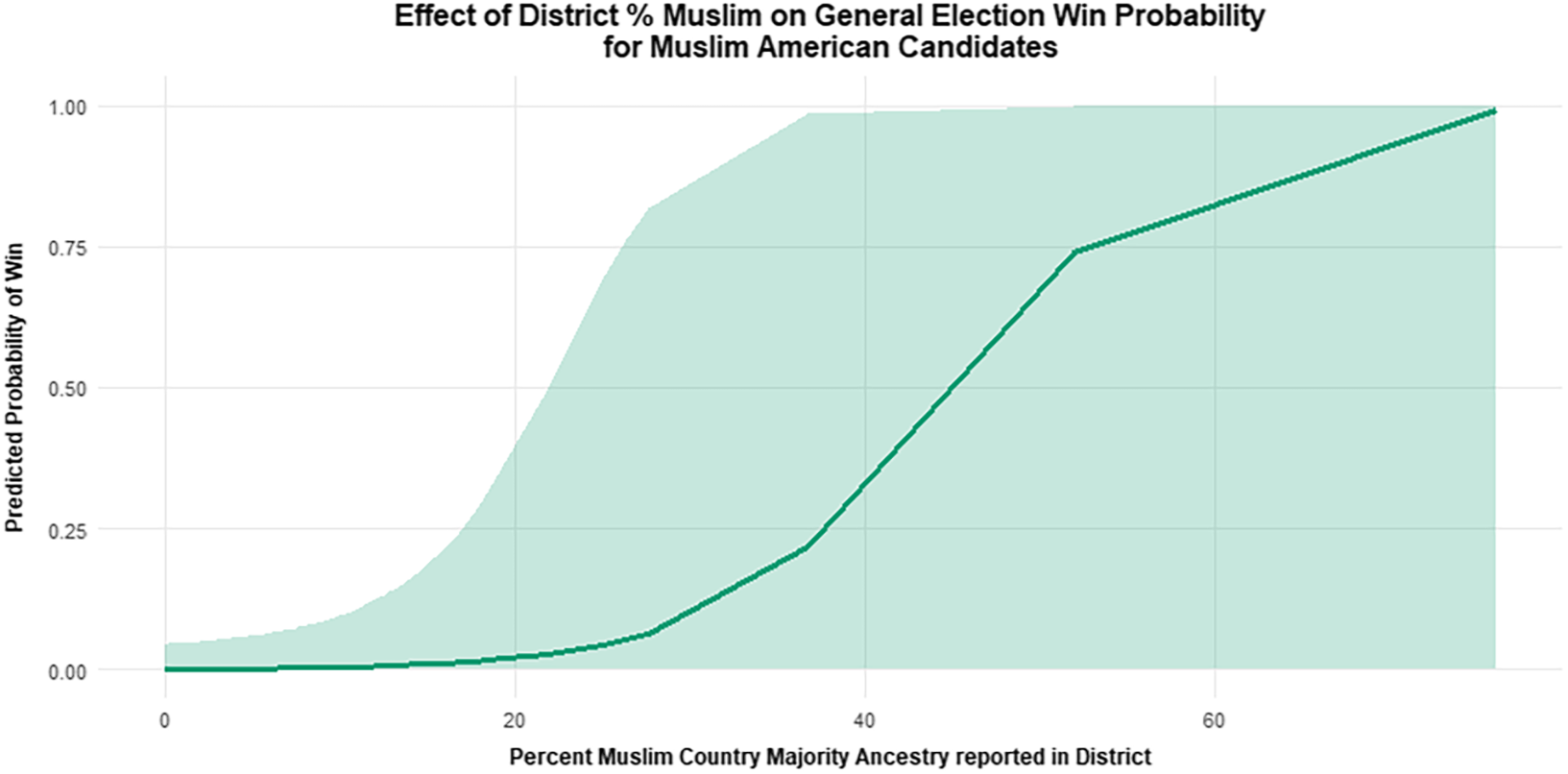
Figure 8 plots the predicted probability that a Muslim American will win as the share of residents from Muslim-majority countries increases. Once that share surpasses roughly 20–40%, the probability of victory rises sharply by around 20%, and at a 60% Muslim district share, Muslim American candidates have around a 75% chance of winning their general election. This pattern mirrors the candidate-emergence findings. This pattern suggests that co-ethnic or co-religious communities help offset the “bands of otherization” penalty.
Predicted probability of Muslim American victory by Muslim-ancestry share.

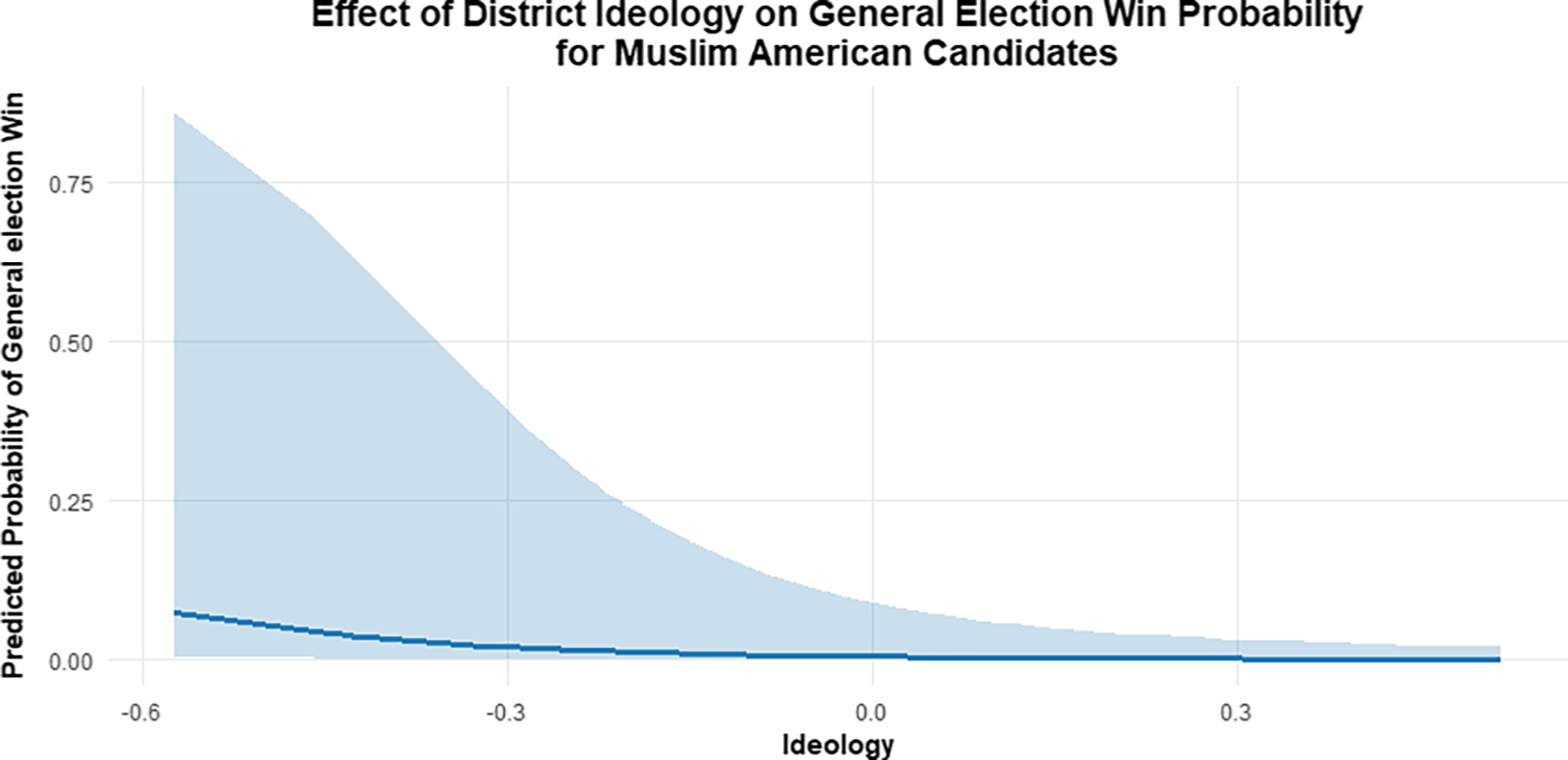
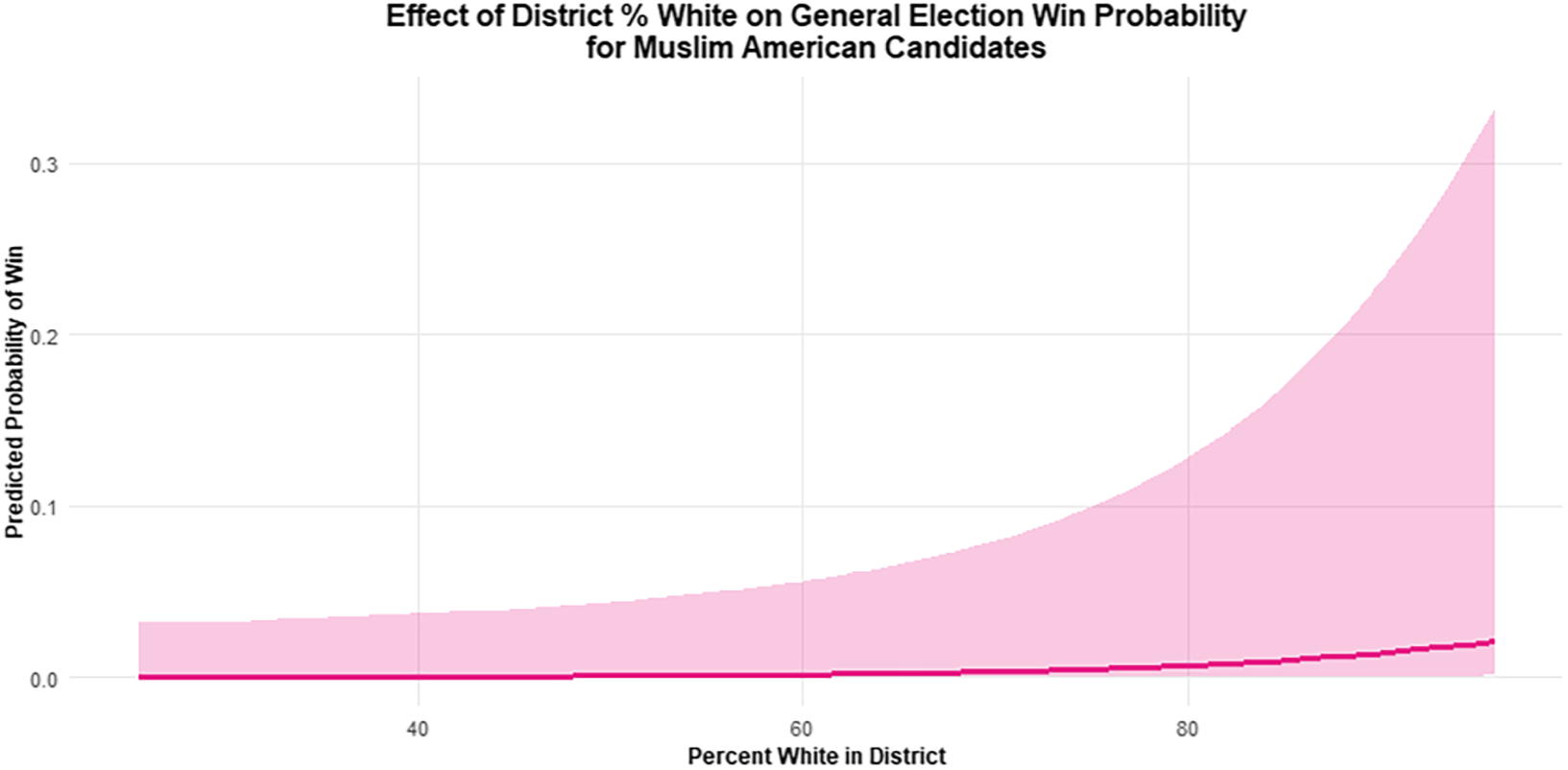
Figures 9 and 10 show that Muslim Americans are least likely to win in conservative districts and most likely to win in liberal districts, paralleling public-opinion data. Although the interaction between Muslim American status and district ideology narrowly misses statistical significance9, the pattern is consistent with the theory that conservative voters view Muslim Americans less favorably. Interestingly, a higher White share in this subsample has a slight positive effect, perhaps because many Arab Americans identify as White in census data.
Predicted probability of Muslim American victory by district ideology.

Predicted probability of Muslim American victory by White population share.

In sum, Muslim American candidates perform worse than both non-Muslim Americans and other racial-minority candidates in real elections. A larger Muslim-ancestry population substantially improves their chances, while conservative contexts diminish them. Both of these results follow the experimental results offered by Lajevardi’s (Reference Lajevardi2020) hypothetical candidate experiments in Chapter 4 of her book Outsiders at Home. These candidate experiments find a statistically significant 10% lower likelihood that respondents choose to vote for a Muslim candidate compared to a White candidate (Lajevardi, Reference Lajevardi2020, p. 75). Additionally, these candidate experiments find that religion, not race, is the key trigger for lower vote choice and perceived electability of hypothetical Muslim American candidates (Lajevardi, Reference Lajevardi2020, p. 83). The observational results from this section confirm these experimental findings by utilizing real-life electoral outcomes over time and solidify the Muslim American electoral penalty as a feature of real-world U.S. elections. These findings highlight the importance of considering intersecting identities, race, religion, and community context when studying minority candidate emergence and success.
Robustness Check
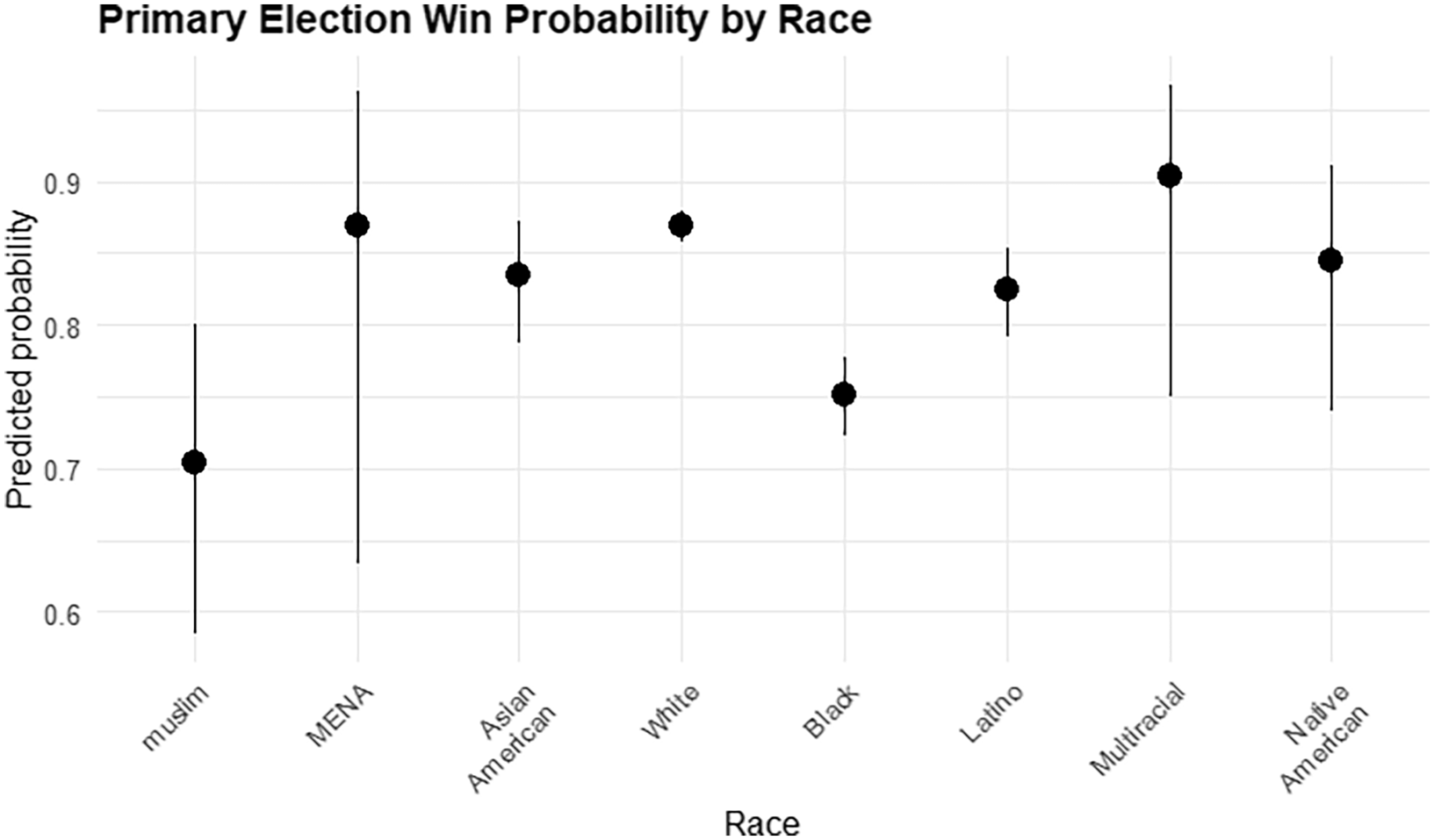
One potential concern with this analysis is that Muslim American candidates may not face an electoral penalty because of their religion per se; instead, the penalty could stem from being identified as Middle Eastern and the stereotypes attached to that identity. Although MENA stereotypes contribute to Islamophobia and the broader stereotyping of minority candidates, previous experiments show that simply labeling a candidate as Muslim adds an extra penalty regardless of race (Kalkan et al., Reference Kalkan, Layman and Green2018). To reinforce this finding in real-world electoral contexts, I compare the predicted win probability of Muslim American candidates to that of non-Muslim Middle East and North Africa (MENA) candidates using the 2018 Candidate Cooperative Characteristics (C3) primary-election data. I rely on the C3 dataset because, unlike the Reflective Democracy Campaign data, it explicitly codes candidates as MENA. This dataset has 76 Muslim candidates, and 16 Non-Muslim MENA candidates. This analysis aims to disentangle the effect of Muslim identity from MENA ethnicity, demonstrating that being a Muslim American uniquely lowers the likelihood of winning elections.
Figure 11 shows the results. Muslim Americans are about ten percentage points less likely to win their elections than non-Muslim MENA candidates. Consistent with earlier analyses comparing Muslim Americans with other racial groups, these findings indicate that the electoral penalty is tied specifically to Muslim identity, whereas non-Muslim MENA candidates, likely situated in only one “band of otherization,” perform better. Additionally, since most of this paper’s sample are Muslims who are Asian American, interestingly, Muslim American candidates are also around 15% less likely to win their primary race compared to Non-Muslim Asian Americans. This offers further evidence that the demand penalty is tied to the Muslim identity.
Predicted probabilities of victory: Muslim American vs. non-Muslim MENA candidates.

Discussion
This paper is the first to identify which state district factors predict both the emergence of Muslim American state legislative candidates and their likelihood of winning general elections. It also lays a foundation for future work that can test the causal mechanisms linking district characteristics to Muslim American emergence and electoral success across contexts. Overall, Muslim Americans are less likely to emerge in conservative and majority-White districts, and there is modest evidence that they are also less likely to win in conservative districts. Because conservative and majority-White electorates typically report the lowest feeling-thermometer scores toward Muslims, such districts pose barriers to Muslim American candidacy. Additionally, further research should investigate the causal pathways that deter Muslim Americans from running—whether heightened expectations of discrimination, day-to-day Islamophobia, or party gatekeeping in districts where elites anticipate a loss. For example, Muslim Americans may choose not to run if they expect high levels of discrimination from conservative or White voters. Thus, like other racial minority candidates, Muslim Americans may decide not to seek office when they anticipate significant bias (Lajevardi et al., Reference Lajevardi, Mårtensson and Vernby2024).
Future work could also examine how this dynamic relates to debates about whether Islamophobia spurs greater political engagement among Muslim Americans (Jalalzai, Reference Jalalzai2011; Takyar, Reference Takyar2019; Lajevardi et al., Reference Lajevardi, Oskooii, Walker and Westfall2020). Experiences of Islamophobia might increase political interest, yet parties may still withhold the resources needed to run in White or conservative districts. Because candidacies depend on integration into formal and informal party networks, these results suggest that party elites may deem it too risky to back Muslim Americans in very conservative, very White areas. Given Kalkan et al.’s (Reference Kalkan, Layman and Uslaner2009) description of Muslims occupying multiple “bands of others,” parties may view these candidates as even riskier than other minorities. When a district’s demographics or political climate seem unfavorable, conservative and White contexts become supply-side barriers, limiting the pool of Muslim American candidates.
Overall, this paper shows that conservative and majority-White districts present clear supply-side barriers to Muslim Americans and provides modest evidence that these districts may also reduce their chances of winning office.
Conversely, when a district’s residents are 20–40 percent or more from Muslim-majority countries, Muslim American candidates are far more likely to emerge and to win. This variable is the strongest and most significant predictor of Muslim American electoral success identified here. A robust Muslim community appears to encourage candidacies and supply a supportive voter base. These new results on predicting Muslim American emergence are a necessary first step for future work to further delve into the mechanisms by which district factors affect Muslim American emergence. Future research should test whether Muslim Americans run in such districts because of role-modeling effects, active community encouragement, or party calculations that these races are less risky. The presence of Muslim civic leaders, which is more common in strong Muslim communities, may create a role model effect that boosts civic engagement (Lajevardi et al., Reference Lajevardi, Mårtensson and Vernby2024). Because many Muslim Americans are first- or second-generation immigrants, place and environment are vital tools of political socialization (Carlos, Reference Carlos2021; Humphries et al., Reference Humphries, Muller and Schiller2013; Raychaudhuri, Reference Raychaudhuri2025). Scholars should also explore whether U.S. parties are more willing to invest resources in Muslim American candidates in these districts and whether Muslim voters cast preferential ballots for co-religious candidates (Azabar, Thijssen, & Van Erkel, Reference Azabar, Thijssen and Van Erkel2020). Finally, researchers might investigate why Muslim Americans may require higher concentrations of co-ethnics to succeed, compared with other minority groups.
The demand-side analysis shows that Muslim American candidates are less likely to win elections than non-Muslim Americans and less likely than other racial-minority candidates. A robustness check further indicates that Muslim Americans fare worse than non-Muslim MENA candidates. These findings deepen our understanding of minority candidate dynamics by highlighting how intersecting identities, such as religion and race, shape both emergence and success. They also confirm that the harsh evaluations of Muslim American candidates documented in experiments appear in real elections (Kalkan et al., Reference Kalkan, Layman and Green2018; Madrid et al., Reference Madrid, Merolla, Yanez Ruiz and Schroedel2022; Calfano et al., Reference Calfano, Lajevardi and Michelson2021; Lajevardi, Reference Lajevardi2020). Given that these results also demonstrate that Muslim American candidates are around 10–15 percent less likely to win their general election race compared to non-Muslim racial minority candidates, scholars should also examine the specific mechanisms that produce this additional electoral penalty, such as Islamophobic stereotyping, outgroup perceptions based on religion, and specific elite and media cues that may uniquely depress support for Muslim American candidates. Additionally, given that Muslim American candidates are racially diverse as well, as shown by Table 3, additional focus should be placed on examining if unique penalties exist for Muslim American candidates across racial backgrounds.
Future research could use case studies to examine whether Muslim American candidates adopt distinct campaign strategies to overcome these hurdles or whether opponents exploit anti-Muslim attitudes. Scholars might also study how voter perceptions of Muslim Americans vary across contexts or according to a candidate’s ideology. For example, do Muslim American candidates who display counter-stereotypical behavior still fail to persuade voters because they face multiple layers of stereotyping? If other minority candidates engage in anti-stereotypical behavior with success in getting elected, do Muslim American candidates also engage in the same behavior, with different success compared to non-Muslim racial minority candidates (Hood & McKee, Reference Hood and McKee2015; Karpowitz et al., Reference Karpowitz, King-Meadows, Monson and Pope2021)? Additionally, future research can examine if Muslim Americans face harsher penalties than other groups and if they pursue different strategies to mitigate this disadvantage. Moreover, when opponents run against Muslim American candidates, do they deploy tactics that draw on stereotypes from each “band of otherization” to shape voter perceptions?
Finally, future research should also examine the challenges and backlash Muslim Americans face once they are elected to office. If Muslim American candidates are perceived negatively by the public, are they then more likely to be attacked by political opponents or critiqued by colleagues who, theoretically, represent the public? A contemporary example of this dynamic at play is that Ilhan Omar and Rashida Tlaib, two of the four Muslim Americans in Congress, are often harshly attacked by Republican elites and Donald Trump. For example, in the case of Ilhan Omar, Donald Trump has stated that she should be deported, attacked her with an ad that showed the September 11th attacks, and spread false claims that Ilhan Omar praised Al Qaeda (Rosenberg & Epstein, Reference Rosenberg and Epstein2019; Luscombe, Reference Luscombe2025; Siegel, Reference Siegel2019). In contrast, despite Zohran Mamdani receiving immense backlash and Islamophobic attacks from conservative elites and critiques from Donald Trump, Trump has also complimented Mamdani by saying, “I think you’re going to have, hopefully, a really great mayor” (Walsh, Reference Walsh2025). These examples illustrate not only the need to see if Muslim American officeholders are more likely to receive backlash from political opponents once elected, but also the need to examine whether the probability of being the recipient of these attacks varies by the Muslim American officeholder’s gender, race, and sexuality.
Supplementary material
The supplementary material for this article can be found at http://doi.org/10.1017/S1755048326100297.
Data availability
Replication materials will be deposited upon publication to Harvard Dataverse.
Acknowledgements
Special thanks to Tanika Raychaudhuri, Melissa Marschall, Nathan Kar Ming Chan, the Rice Americanist Workshop, and MPSA’s “Race, Candidates, and Counter-stereotypic Politics” panel for their insightful comments. Special thanks as well to Kishan Bhakta, Conner Joyce, Maranda Joyce, Tabitha Koch, and Sierra Malvitz for their advice and encouragement. Thank you to Paru Shah and the rest of the C3 team for granting me access to the 2020 C3 data used in the descriptives section of this paper.
Financial support
None.
Competing interests
No competing interests.
Syed Kashif Naqvi is a PhD candidate in Political Science at Rice University. His research focuses on race and representation, candidate emergence, and religion in American politics.




 Open access

