



Parents’ perceptions may play an important role in the development of childhood obesity( Reference Birch and Davison 1 , Reference Lindsay, Sussner and Kim 2 ). Overweight and obese parents, and parents of overweight and obese children, tend to perceive their children as thinner than they really are( Reference Rietmeijer-Mentink, Paulis and van Middelkoop 3 ). These parental misperceptions may hamper interventions dealing with childhood obesity( Reference Warschburger and Kroller 4 ).
Previous cross-sectional studies of parental body image perception and children’s weight( Reference Mitchell, Wake and Canterford 5 , Reference Olvera, Suminski and Power 6 ) did not address the temporal sequence of these associations; thus, it is unknown whether parental body image dissatisfaction (BID) predicts childhood obesity or vice versa. Because BID can be ameliorated through interventions( Reference Corning, Gondoli and Bucchianeri 7 ), we investigated whether maternal BID predicted children’s weight changes in a longitudinal study.
Methods
Study population and field methods
The present study was part of the Bogotá School Children Cohort, which is described in detail elsewhere( Reference Arsenault, Mora-Plazas and Forero 8 ). In brief, 3202 children from 2981 households were recruited in February 2006 to represent children from all primary public schools of Bogotá, Colombia. At enrolment, parents filled out self-administered questionnaires (82 % response rate) inquiring about demographic and socio-economic characteristics. Maternal BMI was calculated either from physical measurements of height and weight in 42 % of the mothers or from self-reported data. The household socio-economic status corresponded to the scale used by the local government for tax and planning purposes (1=lowest to 6=highest; maximum 4 in the sample).
Maternal perceptions of her body and of her child’s body were obtained using a Stunkard figure rating scale( Reference Stunkard, Sorensen and Schulsinger 9 ) and a child-adapted scale( Reference Mciza, Goedecke and Steyn 10 ), respectively. These visual tools depict nine (adult) or eight (child) silhouettes in increasing order of body girth from thinnest to heaviest. Mothers were asked to identify their perceptual body image, i.e. the silhouette that most resembled the way they currently looked, and their attitudinal body image, i.e. the silhouette that represented the image they desired to have. Next, they were asked to indicate the perceptual and attitudinal body images in reference to their children. Research assistants visited schools and measured children's height and weight using standard protocols( Reference Lohman, Roche and Martorell 11 ) at the time of enrolment, in June and November 2006, and annually thereafter for a mean follow-up of 27·9 (sd 7·2) months.
The study was conducted according to the guidelines laid down in the Declaration of Helsinki. Prior to enrolment, informed consent was obtained in writing from parents or primary caregivers of all children. All procedures involving the participants were approved by the Ethics Committee of the National University of Colombia Medical School. The Health Sciences and Behavioral Sciences Institutional Review Board at the University of Michigan approved the use of data from the study.
Data analysis
Information on maternal body image perception and attitude was available for 1591 children. Of them, 1523 had valid anthropometric measurements at baseline and one or more follow-up assessments, and constituted the analytic sample. Maternal perception of herself was available for 1377 mothers to 1485 children, whereas 1385 children had available information on maternal perception of the child’s body. There were some differences between children included in the study and the cohort participants who were excluded. Compared with those excluded, the 1523 children studied were younger (mean age of 8·7 v. 9·0 years, P=0·001), had higher mean baseline height-for-age Z-score (−0·73 v. −0·84, P=0·002), were more likely to have been born in Bogotá (90 % v. 86 %, P=0·003), and had mothers with more years of education (9·2 v. 7·9 years, P<0·0001), less parity (2·6 v. 2·8 children, P<0·0001) and higher BMI (24·3 v. 23·8 kg/m2, P=0·01). They also had longer median duration of follow-up (30·1 v. 28·5 months, P<0·0001). There were no significant differences with regard to child’s sex, BMI or household socio-economic status.
A body image dissatisfaction (BID) score was conventionally calculated as the silhouette number indicated as desired (attitudinal) subtracted from the silhouette number indicated as current (perceptual), according to the mother’s ratings of the figurine scales. A negative BID score represented a desire for a larger body; a zero BID score represented satisfaction with body image; whereas a positive BID score reflected a desire for a thinner body. The two exposures considered were maternal BID with her child and with herself. Sex- and weight status-specific average BMI-for-age growth curves were estimated for each BID category, using mixed-effect models for repeated measurements with restricted cubic splines( Reference Durrleman and Simon 12 ). In these models, BMI was the outcome and predictors included indicator variables for BID categories, linear and spline terms for child age in decimal years, and their interaction terms. We included random effects for the intercept and the slope to account for within-child correlations of repeated BMI measurements in the estimation of variances( Reference Diggle, Heagerty and Liang 13 ). A random effect accounting for within-family correlations among siblings was included in the analyses of mother’s BID with herself. Adjusted differences in estimated BMI change from age 6 to 14 years between BID groups were computed from the growth curves. This population-level estimation is valid even if not all individuals contributed observations to the full interval under the assumption of no birth cohort effects, which was fulfilled in the present study. Previously reported correlates of overweight in this population( Reference McDonald, Baylin and Arsenault 14 ) were introduced into the adjusted models as potential cofounders. Since both BID and weight trajectories depend on weight status of the child, all analyses were stratified by sex and baseline weight status. To this end, we estimated BMI-for-age Z-scores (BAZ) from baseline measurements according to the WHO growth references( Reference de Onis, Onyango and Borghi 15 ) and classified children as thin (BAZ<−0·5), normal-weight (BAZ≥−0·5 and <0·5) or heavy (BAZ≥0·5). While these cut-off points do not correspond to those conventionally used to define thinness or overweight, they were chosen to carefully separate normal-weight children from the groups of thinner and heavier children. All analyses were conducted using the statistical software package SAS version 9·2.
Results
Children were 8·7 (sd 1·7) years old, on average; 49 % were boys. Mean BAZ at baseline was 0·14 (sd 1·04). Mean score of maternal dissatisfaction with the child’s body was −0·6 (sd 1·2). Forty-seven per cent of mothers desired a larger body for their children, 39 % were satisfied and 14 % desired a thinner body for their children. Mean score of mother’s dissatisfaction with her own body was 0·7 (sd 1·3). Fifteen per cent of mothers desired a larger body size for themselves, 27 % were satisfied and 58 % desired a thinner body. The correlation (Spearman) between maternal dissatisfaction with her own body and dissatisfaction with her child’s body was 0·14 (P<0·0001).
Heavy boys whose mothers desired a thinner child gained 1·7 kg/m2 significantly more BMI than heavy boys whose mothers were satisfied with their child’s body (P=0·04; Table 1). In contrast, among normal-weight boys, those whose mothers desired a thinner child gained 1·8 kg/m2 significantly less BMI than those whose mothers were satisfied with the child’s body (P=0·02). Among girls, maternal dissatisfaction with the child’s body was related to BMI trajectories only in those who were thin at recruitment. Those whose mothers desired a thinner child gained 2·4 kg/m2 significantly less BMI (P=0·004) compared with thin girls whose mothers were satisfied with the child’s body.
Estimated BMI change (kg/m2) from age 6 to 14 years in school-age children according to maternal dissatisfaction with her child’s body imageFootnote *, stratified by weight status of the child at baseline; Bogotá School Children Cohort, Colombia
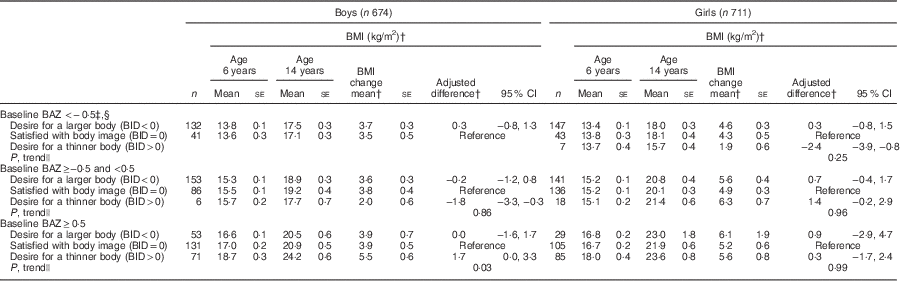
* Body image dissatisfaction (BID) was calculated as the desired body image subtracted from current body image, according to the mother’s ratings on child-adapted Stunkard scales.
† Values are estimated from BMI-for-age growth curves obtained with restricted-cubic-spline mixed models, with BMI as the outcome and spline terms for age, indicator variables for BID, and their interaction terms as predictors. Differences in change and 95 % confidence intervals were adjusted for maternal age, BMI and marital status at baseline, and for household socio-economic status. Robust estimates of variance were used in all models.
‡ BMI-for-age Z-score, according to the WHO 2007 growth reference( Reference de Onis, Onyango and Borghi 15 ).
§ The category ‘Desire for a thinner body’ (BID>0) was omitted among boys because of small sample size (one boy).
|| Test of linear trend when a variable that represented the ordinal categories of BID was introduced into the growth curve models as continuous (Wald test).
Among heavy boys, a mother’s desire for a larger body for herself was related to a 4·6 kg/m2 lower estimated BMI gain (P=0·0008), whereas a desire for a thinner body was associated with a 1·8 kg/m2 lower estimated BMI gain (P=0·03), compared with heavy boys whose mothers were satisfied with their own body image (Table 2).
Estimated BMI change (kg/m2) from age 6 to 14 years in school-age children according to maternal dissatisfaction with her own body imageFootnote *, stratified by weight status of the child at baseline; Bogotá School Children Cohort, Colombia
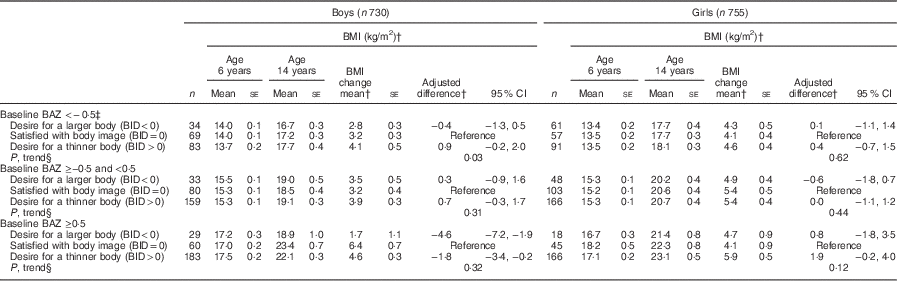
* Body image dissatisfaction (BID) was calculated as the desired body image subtracted from current body image, according to the mother’s rating on the Stunkard scale.
† Values are estimated from BMI-for-age growth curves obtained with restricted-cubic-spline mixed models, with BMI as the outcome and spline terms for age, indicator variables for BID, and their interaction terms as predictors. Differences in change and 95 % confidence intervals were adjusted for maternal age, BMI and marital status at baseline, and for household socio-economic status. An unstructured covariance matrix was specified to account for within-family correlations among siblings.
‡ BMI-for-age Z-score, according to the WHO 2007 growth reference( Reference de Onis, Onyango and Borghi 15 ).
§ Test of linear trend when a variable that represented the ordinal categories of BID was introduced into the growth curve models as continuous (Wald test).
Discussion
The role of maternal BID on BMI trajectories of children had not been studied before. Existing evidence was limited to cross-sectional investigations showing positive correlations between maternal and child’s body image perceptions( Reference Mitchell, Wake and Canterford 5 ) and suggesting that parents tend to underestimate the weight status of overweight or obese children( Reference Mitchell, Wake and Canterford 5 , Reference Olvera, Suminski and Power 6 , Reference Dammann, Smith and Richards 16 , Reference Killion, Hughes and Wendt 17 ). In our longitudinal investigation, maternal dissatisfaction with her own or her child’s body was significantly associated with differences in the BMI trajectories of children during follow-up, depending on the child’s sex and weight status at the time of recruitment. A maternal desire for a thinner child was associated with a greater BMI gain among heavy boys, whereas it was related to a lower BMI gain in normal-weight boys and thin girls. Maternal dissatisfaction with her own body image was significantly associated with lower BMI gain in heavy boys, whereas a desire for a thinner self was related to higher BMI gain in girls.
We noted that maternal dissatisfaction with her own body was only weakly correlated with her dissatisfaction with the child’s body. In addition, the associations of each exposure with the outcomes differed from each other. This suggests that these exposures represent different constructs. Potential effects of maternal dissatisfaction with herself on the child’s growth trajectories might be mediated through weight-related concerns that reflect on child feeding practices( Reference Scaglioni, Salvioni and Galimberti 18 ) and family weight-talk( Reference Neumark-Sztainer, Bauer and Friend 19 ). Maternal BID might also result in child’s BID and lead to sedentary behaviour( Reference Morano, Colella and Capranica 20 ), social isolation, depression( Reference Ali, Fang and Rizzo 21 ) or weight-related anxiety, all of which may induce excessive weight gain( Reference Lynch, Liu and Wei 22 ). The potential effect of maternal BID may seem paradoxical since a desire to be thin was related to higher weight gain in girls. However, mother’s dissatisfaction with her own body may lead to attempts to over-control the daughter’s eating behaviours, which, in turn, may result in dietary overconsumption and excessive weight gain. It is also possible that the sole presence of BID, regardless of its direction, worsens the child’s ongoing growth trajectory towards thinness or obesity. Thus, BID is unlikely to work as an effective mechanism to compensate altered BMI trajectories. Among heavy boys, maternal BID in either direction was related to lower BMI gain. Explanations to this finding are speculative. Any maternal BID might reflect heightened concern about the child’s weight status and lead to implementation of controlled feeding practices specifically when the child is objectively overweight.
We also found that maternal dissatisfaction with her child’s body was related to differences in BMI trajectories over time. Of note, whereas maternal dissatisfaction with self was, on average, positive, representing a desire to be thinner, maternal dissatisfaction with the child’s body was, on average, negative. This suggests that mothers may prefer a larger body for their children than what they want for themselves even though children in this population have a mean BMI-for-age above the international reference. Possible reasons to desire a ‘larger’ child may include economic conditions, lack of health knowledge and influences of sociocultural traditions associating heaviness of the child with better health and physical appearance( Reference Contento, Basch and Zybert 23 ). This maternal preference for larger body sizes in their children could be specifically deleterious on the children’s BMI trajectories. Among normal-weight boys, not only was maternal desire for a larger body of the child highly prevalent, but a desire for a thinner body was related to less weight gain. Similarly, among thin girls, a maternal desire for a thinner child resulted in lower BMI gain. Thus, maternal BID with the child might worsen any ongoing trends toward thinness.
There are several strengths to our study. First, its prospective design allowed us to examine the directionality of the associations between maternal BID and weight gain. Second, we separately investigated two distinct maternal BID types as predictors of BMI change. Third, it was conducted in a setting where urbanization and exposure to mass media are increasing( Reference Khan, Khalid and Khan 24 ) while knowledge of the role of BID is scant. Finally, we used advanced analytical methods to estimate BMI trajectories. There are also some limitations. We relied on a single baseline measurement of BID. If maternal BID did not remain constant during the follow-up period, reverse causation could contribute to explain the findings. Second, the generalizability of findings may be affected because children included in the study differed in several sociodemographic characteristics from the underlying population they represented. Also, children from the highest socio-economic strata were not included. Third, some subgroups in the stratified analyses consisted of a relatively small number of participants and this could have decreased estimates’ precision. Additional limitations include possible residual confounding by unmeasured common causes of BID and BMI change, and the lack of formal evaluation of the child-adapted Stunkard scale in our population, although it has been validated in comparable settings( Reference Mciza, Goedecke and Steyn 10 , Reference Stevens, Story and Becenti 25 ).
Conclusion
In conclusion, maternal BID was associated with child’s BMI trajectories in a sex- and weight-specific manner. Future studies are needed to determine whether interventions aimed at ameliorating parental BID can affect the growth process of children during pre-adolescence years.
Acknowledgements
Financial support: The study was supported by the ASISA Research Fund at the University of Michigan. The funding source had no role on the design, conduct, analyses, interpretation or writing of this manuscript. Conflict of interest: None. Authorship: O.D. conducted the data analysis, interpreted the results and wrote the first draft of the manuscript. C.M. and M.M.-P. contributed to study implementation and data collection in the field. E.V. designed the study and participated in data analysis and interpretation. All authors contributed to the manuscript write-up. Ethics of human subject participation: The research was conducted in accordance with guidelines laid down by the Declaration of Helsinki. The study protocol and procedures were approved by the Ethics Committee of the National University of Colombia Medical School. The Health and Behavioral Sciences Institutional Review Board at the University of Michigan approved the use of data for the study.



