



Over one in five US children of pre-school age is overweight or obese( Reference Ogden, Carroll and Kit 1 , Reference Skinner and Skelton 2 ). Although obesity determinants are multiple and complex, widespread marketing and consumption of energy-dense, nutrient-poor foods contribute substantially to the obesity epidemic( 3 , 4 ). Fast-food (FF) restaurants account for the greatest food advertising exposure among children aged 2–11 years( Reference Powell, Szczypka and Chaloupka 5 – 9 ). In 2009, the FF industry spent $US 583 million on child-directed marketing( 9 ). Children’s consumption of FF is associated with increased intakes of total energy, fat and sugar, making FF consumption an important risk factor for obesity( 3 , Reference Bowman, Gortmaker and Ebbeling 10 , Reference Powell and Nguyen 11 ).
Television (TV) is the predominant medium through which young children are exposed to FF advertising( 8 , 9 , Reference Kelly, Halford and Boyland 12 ). Of the top ten FF restaurants (also known as quick-service restaurants in the food industry because of their fast food preparation and lack of table service), data obtained from Kantar Media indicated that three advertised on children’ TV channels in 2013: McDonald’s, Subway and Wendy’s. A recent study showed that McDonald’s accounted for 70 % of televised FF commercials (ads) aimed at young children, far exceeding Subway and Wendy’s advertising( Reference Bernhardt, Wilking and Adachi-Mejia 13 ). McDonald’s also surpasses Subway and Wendy’s in terms of sales. In 2013, McDonald’s US sales revenue topped $US 35 billion, compared with approximately $US 12·7 billion for Subway and $US 8·6 billion for Wendy’s( 14 ).
Young children do not have the cognitive ability to understand or recognize the persuasive intent of advertising and thus may be highly susceptible to food industry marketing tactics( Reference Carter, Patterson and Donovan 15 – Reference Strasburger, Wilson and Jordan 19 ). Experimental studies demonstrate that food marketing directly influences young children’s food and taste preferences( Reference Borzekowski and Robinson 20 – Reference Robinson, Borzekowski and Matheson 24 ), their requests to purchase advertised foods( Reference Stoneman and Brody 25 ) and their short-term consumption of advertised foods( Reference Kotler, Schiffman and Hanson 26 – Reference Boyland, Nolan and Kelly 29 ). Many studies have demonstrated an association between TV viewing and adiposity or less healthy dietary choices among children( 28 , Reference Andreyeva, Kelly and Harris 30 – Reference Boyland and Halford 34 ). In these studies, TV viewing time is often used as a proxy measure for exposure to food advertising, presumably because of the difficulty of assessing children’s exposure to TV advertising outside a laboratory setting( Reference Lee, Kim and Lee 35 ). However, this type of approach makes it difficult to isolate the effects of food advertising from other risk factors associated with TV viewing, such as snacking. In a longitudinal study, Zimmerman and Bell found that commercial TV viewing by children under 6 years of age predicted higher BMI, whereas non-commercial TV viewing did not( Reference Zimmerman and Bell 36 ). Additionally, a study of 4- to 12-year-old children in the Netherlands found TV advertising exposure was positively associated with consumption of advertised food brands among low-income children( Reference Buijzen, Schuurman and Bomhof 37 ). Despite extensive research documenting the content of TV food advertising in the USA( Reference Harris, Sarda and Schwartz 7 , 9 , Reference Powell, Schermbeck and Chaloupka 38 – Reference Speers, Harris and Schwartz 40 ) and high levels of concern about children’s exposure to this advertising, there is a surprising lack of empirical data examining the impact of food advertising on children’s dietary intake in non-experimental, real-world settings( Reference Kraak and Story 41 ).
In the present analysis, we used data from a larger study of electronic media use and diet in children of pre-school age to determine whether exposure to child-targeted FF TV advertising is associated with young children’s FF intake.
Methods
Study design
Between April 2013 and March 2014, trained research assistants were stationed in the waiting rooms of paediatric outpatient and Women, Infants, and Children (WIC) clinics located in Manchester and Nashua, New Hampshire, USA. Research assistants recruited participants by inviting parents to complete a survey about ‘children’s media use and food choices’. Surveys were pre-tested with a demographically comparable sample for comprehension, face validity and completion time. Eligibility for study participation included children’s age (3–5 years) and parents’ ability to complete a written survey in English or Spanish. If parents had multiple age-eligible children, we selected the child present for an appointment. Computer-generated random number lists were used to randomly recruit one child when multiple age-eligible siblings were present for an appointment. Parents received a $US 10 gift card and children received a toy for participating.
Of the 1349 parents approached, 516 were not eligible, 241 declined and 592 enrolled. The primary reason for not participating was insufficient time (44 % of refusals). For the present analysis, we included data from 548 parents who completed the 136-item survey between April and December 2013, which corresponded to our advertising data time period. The analysis focused on three FF restaurants – McDonald’s, Subway and Wendy’s (MSW) – that met the following criteria: ranked in the top ten quick-service restaurants based on annual sales( 14 ); at least one outlet located in each recruitment area; and advertised on children’s TV channels during the last three quarters of 2013.
Measures
Fast-food consumption
Consistent with measures used in prior population-based studies( Reference Longacre, Drake and MacKenzie 42 – 44 ), we asked parents: ‘In the past 7 days, did your child have something to eat or drink from (McDonald’s; Subway; Wendy’s)?’ (responses: yes/no/don’t know for each). For MSW consumption, responses were combined into a dichotomous outcome indicating whether a child had eaten at any of the three FF restaurants during the past 7 d. We also examined children’s consumption of McDonald’s food and beverages separately, using parent responses to this question, because of its prominence in sales and child-targeted advertising.
Fast-food television advertising exposure
Children’s exposure to child-targeted MSW TV ads was based on parental report of children’s viewing time and channels watched. First, we asked: ‘On average, how many days a week does your child do the following activities: watch TV (regular, cable or satellite)? (0, 1–2, 3–4, 5–6, 7 days)’. We then asked: ‘On days when your child does the following activities, about how much time does your child spend: watching TV (regular, cable or satellite)? (0 to 6+ hours with 30 minute segments)’. For channels, we asked: ‘In the past 7 d, has your child watched any of the following TV channels? (Boomerang; Cartoon Network; The Disney Channel; Disney Junior; Disney XD; The Hub (now called Discovery Family); Nickelodeon; Nick Jr.; Nicktoons; PBS Kids; Sprout)’. For each child, we calculated weekly TV viewing time by multiplying the number of days per week by the number of hours per day the child watched TV. We then estimated each child’s weekly exposure to specific TV channels by dividing weekly viewing time by the number of children’s channels the child watched in the past 7 d. This exposure measure was based on previously validated measures developed to examine children’s exposure to tobacco use in electronic media( Reference Sargent, Beach and Dalton 45 – Reference Sargent, Worth and Beach 47 ).
Lists of child-targeted FF advertising by channel for April–December 2013 were obtained from Kantar MediaTM, a company that tracks TV ads on an hourly basis. For each day, we calculated channel-specific averages of the number of MSW or McDonald’s ads aired per hour between 06.00 and 23.00 hours or during child programming. For example, we did not include ads aired during Nick-at-Nite, which begins as early as 20.00 hours and shares channel space with Nickelodeon, because its programming is aimed at older audiences. We then multiplied each child’s channel-specific weekly exposure time by the average number of MSW or McDonald’s ads aired per hour on that channel during the 7 d prior to each survey. The resulting advertising exposure scores approximate the mean number of child-targeted MSW or McDonald’s ads each child was exposed to during the week prior to the survey. Based on the distribution of the data, we categorized the scores to provide roughly comparable groups in terms of sample size as follows: none (0), low (<1), moderate (1–3) and high (>3).
Covariates
In the parent survey, we assessed demographics (child gender, race and age) and socio-economic status (parent education and household income). We assessed children’s other screen time (DVD/videos, streaming, apps, Internet use and electronic games) using the TV viewing question format. To assess parent FF intake we asked: ‘How often do you have something to eat or drink from a fast food restaurant? (never to 5 or more times a week)’.
Statistical analysis
We tabulated MSW/McDonald’s ad exposure and covariates and compared the likelihood of MSW/McDonald’s consumption among different subgroups using χ 2 tests. We used Poisson regression with robust variance estimates to estimate the risk ratios of eating at MSW or McDonald’s in the past 7 d for each level of MSW/McDonald’s ad exposure( Reference Huber 48 , Reference Zou 49 ). The fully adjusted models included all measured covariates. To maximize the sample size, we used multiple imputation by chained equations( Reference Azur, Stuart and Frangakis 50 ) to impute values for all variables in the multivariate models with missing data (0·2–5·8 % per variable). All analyses were conducted in the statistical software package Stata version 12.
Results
Sample characteristics
Children’s mean age was 4·4 (sd 0·8) years and 51·6 % were female. Seventy-two per cent were non-Hispanic white; the majority (59·4 %) of the others were Latino. Most (86·7 %) participating parents were mothers. Approximately half (52·7 %) the parents reported an annual household income of $US 50000 or less; 48·5 % reported ‘high school or less’ as their highest level of education. The study sample was slightly more diverse and had a lower household income than the underlying populations of our recruitment cities (in Manchester and Nashua, respectively: 82 % and 79 % non-Hispanic white; median household incomes of $US 54320 and $US 65671).
Fast-food advertising
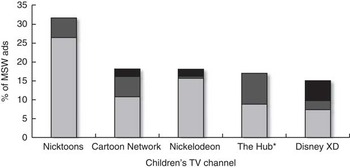
Overall, 17311 MSW ads were identified for the current analysis. Only five of the eleven children’s channels aired MSW ads during the study period (Fig. 1). Almost one-third (31·7 %) of all MSW ads were aired on Nicktoons. Sixty-nine per cent of the ads were for McDonald’s, 21·7 % for Wendy’s and 9·1 % for Subway. Almost two-thirds of all McDonald’s ads were aired on Nickelodeon and Nicktoons.
Percentage of McDonald’s ( ), Subway (
 ) and Wendy’s (
 ) commercials (ads) out of the total number of McDonald’s, Subway and Wendy’s (MSW) ads aired on children’s television (TV) channels between 06.00 and 23.00 hours or during child programming, USA, April–December 2013. *Currently known as Discovery Family
Children’s television viewing
Children’s overall screen time averaged 21·5 (sd 19·9) h/week. TV viewing (regular, cable or satellite) represented nearly half (47·7 %) of their overall screen time and averaged 9·3 (sd 8·3) h/week. Eighty-nine per cent of children watched at least one children’s TV channel during the week before the survey and these children viewed a mean of 3·6 (sd 2·0) children’s channels. Children’s channels aired between 0 and 1·2 MSW ads/h (Table 1).
Percentage of pre-school children who watched children’s television (TV) channels and mean number of McDonald’s, Subway and Wendy’s (MSW) commercials (ads) aired per hour by channel during the 7 d preceding each survey, Manchester and Nashua, NH, USA, April–December 2013
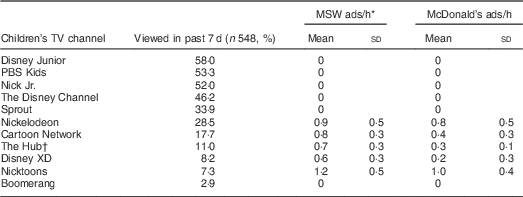
* Only ads aired between 06.00 and 23.00 hours or during child programming (for Nickelodeon and Cartoon Network) were included.
† Currently known as Discovery Family.
Fast-food advertising exposure
More than half of the children watched only children’s channels without MSW advertising. Based on children’s TV viewing during the past 7 d, 59·2 % were not exposed any to child-targeted MSW ads whereas 40·8 % were exposed to at least one. Among the exposed, 23·3 % had low exposure (mean 0·57 (sd 0·26) ads), 34·2 % moderate (mean 1·92 (sd 0·58) ads) and 42·5 % had high exposure (mean 6·71 (sd 3·83) ads). Among those exposed to McDonald’s ads, 33·8 % had low exposure (mean 0·54 (sd 0·29) ads), 34·2 % moderate (mean 1·84 (sd 0·60) ads) and 32·0 % had high (mean 5·36 (sd 2·59) ads). On average, McDonald’s ads accounted for 73·6 (sd 23·5) % of children’s overall exposure; Wendy’s accounted for 17·4 (sd 20·7) %; and Subway accounted for 9·0 (sd 14·6) %. Children’s MSW ad exposure was positively associated with the following child characteristics: male gender (P=0·03), non-white race (P<0·001), hours of TV viewing (P<0·001) and hours of other screen time (P=0·02); inversely associated with household income (P=0·002) and parent education (P<0·001); and not significantly associated with child age and parent FF consumption. Children’s McDonald’s ad exposure showed similar associations and also was positively associated with child age (P=0·02).
Children’s fast-food consumption
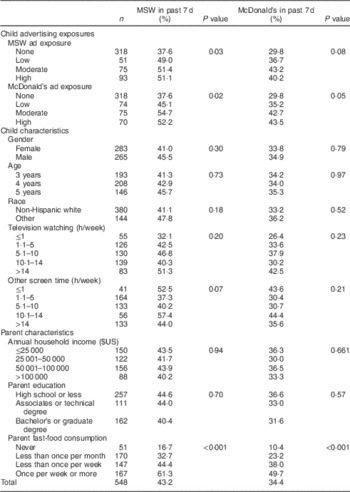
Forty-three per cent (n 228) of children ate at MSW in the past week: 34·4 % ate at McDonald’s, 9·9 % at Wendy’s and 5·1 % at Subway. Most (88·2 %) children ate at only one of these restaurants. Children’s MSW consumption was significantly associated with their MSW ad exposure (Table 2). The association between McDonald’s consumption and ad exposure was marginally significant. Children’s MSW and McDonald’s consumption were positively associated with parent FF consumption, but not significantly associated with overall hours of TV viewing, hours of other screen time or other sociodemographic characteristics.
Pre-school children’s consumption of McDonald’s, Subway, and Wendy’s (MSW) in the past 7 d by child and parent characteristics, Manchester and Nashua, NH, USA, April–December 2013
Associations between children’s fast-food consumption and exposure to advertising
After adjusting for demographics, socio-economic status and other screen time, children with moderate MSW ad exposure were 31 % (95 % CI 1·12, 1·53) more likely to have eaten at MSW in the past week compared with children with no MSW ad exposure (Table 3). Children with high MSW exposure were 26 % (95 % CI 1·13, 1·41) more likely to have eaten at MSW in the past week compared with children with no MSW ad exposure. Children with moderate and high levels of McDonald’s ad exposure were 38 % (95 % CI 1·17, 1·62 and 95 % CI 1·09, 1·76, respectively) more likely to have eaten at McDonald’s in the past week compared with children with no exposure. Low MSW or McDonald’s ad exposure was not significantly associated with increases in consumption. In the adjusted models, none of the covariates were significantly associated with children’s MSW or McDonald’s consumption. Although parent FF consumption significantly predicted children’s MSW and McDonald’s consumption, adding it to the adjusted models did not change the findings substantially.
Risk ratios (RR) for pre-school children’s consumption of McDonald’s, Subway or Wendy’s (MSW) in past 7 d, Manchester and Nashua, NH, USA, April–December 2013
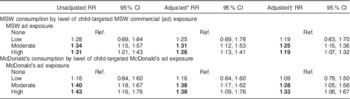
Ref., reference category.
Significant results are indicated in bold font.
* Adjusted for child gender, age, race, other screen time, household income and parent education.
† Adjusted for child gender, age, race, other screen time, household income and parent education plus parent fast-food consumption.
Discussion
The present study is the first to demonstrate a significant positive association between exposure to child-targeted FF TV advertising and FF consumption among children of pre-school age in a non-experimental setting. To some degree, this association is expected, especially considering FF industry expenditures on child-targeted advertising. However, demonstrating it empirically is challenging due to the broad nature of the exposure. Children’s MSW and McDonald’s consumption were significantly associated with their ad exposure, but not overall hours of TV viewing or other screen time. This supports the specificity of our measure and suggests our findings do not merely reflect differences among children who watch a lot of TV. Our results extend the findings of previous studies that have identified TV viewing as a risk factor for adiposity or unhealthy dietary choices( 28 , Reference Andreyeva, Kelly and Harris 30 , Reference Singh, Kogan and Van Dyck 32 – Reference Boyland and Halford 34 , Reference Zimmerman and Bell 36 , Reference Emond, Bernhardt and Gilbert-Diamond 51 ) by identifying advertising as a possible mechanism for this association. It also demonstrates that food marketing influences observed in highly controlled, experimental settings with children( Reference Boyland, Nolan and Kelly 29 ) are consistent with associations observed in uncontrolled, non-experimental settings with greater external validity, and that this is the case even for pre-school children. Empirical evidence of the association between children’s exposure to food marketing and their intake of advertised products, such as that noted in the present study, is critical to supporting and strengthening the recommendations of numerous public health authorities to limit marketing of low-nutrient foods to children( 3 , 4 , 28 , 52 ).
Much of the prior literature examining food marketing to children has focused on school-age children( Reference Boyland, Nolan and Kelly 29 , Reference Lee, Kim and Lee 35 ). The results of the current study further illustrate that the influence of food marketing may begin as young as 3 years of age. Many have raised substantial concern about marketing that targets young children due to their cognitive inability to discern the persuasive intent of marketing( Reference Harris, Brownell and Bargh 16 – Reference Calvert 18 ). However, major food companies claim that their advertising is not intended for children under 6 years of age as they do not advertise on TV channels directed primarily to pre-schoolers (i.e. Nick Jr., Disney Junior)( Reference Kolish, Enright and Oberdorff 53 ). Although the pre-school channels offer commercial-free programming choices for young children, these are not the only children’s channels children are watching. Our results suggest that a substantial minority (40·8 %) of 3–5-year-olds are nevertheless being exposed to child-targeted ads via TV channels widely viewed by both younger and older children (e.g. Nickelodeon, Cartoon Network) and that this exposure is associated with their intake of the advertised foods.
In the USA, child-directed food marketing is self-regulated by a voluntary body of the Council of Better Business Bureaus, called the Children’s Food and Beverage Advertising Initiative (CFBAI). Food and beverage companies who voluntarily join the CFBAI must agree to only include products that meet CFBAI’s own uniform nutrition criteria in their child-targeted advertising( Reference Longacre, Drake and Titus 54 ). Additionally, many CFBAI members commit not to target their advertising to young children at all. Subway and Wendy’s are not members of the CFBAI. McDonald’s is a member, but is the only signatory company that has failed to pledge not to directly advertise to children under 6 years of age( Reference Jenkin, Madhvani and Signal 55 ). A recent analysis suggests that over 90 % of FF products approved by the CFBAI as being appropriate for advertising on children’s TV programming exceed governmental standards for recommended nutrients to limit( 56 ). In 2013 when our data were collected, McDonald’s committed to improving the quality of its kids’ meals and related advertising in cooperation with the Alliance for a Healthier Generation and the Clinton Global Initiative( 57 ). Prior research demonstrated that most of McDonald’s child-targeted advertising emphasized the Happy Meal brand, rather than specific food components( Reference Bernhardt, Wilking and Adachi-Mejia 13 ). A more current content analysis of McDonald’s Happy Meal ad content is necessary to determine whether this emphasis has changed since its commitment went into effect.
Forty-three per cent of the pre-school children in the current study consumed food from at least one of the three FF restaurants during the past week. Among these, most (79·4 %) ate at McDonald’s. McDonald’s also predominated children’s FF ad exposure, accounting for seven of every ten MSW ads viewed. McDonald’s ads use child-appealing marketing strategies focusing primarily on toys and utilizing links with licensed cartoon characters( Reference Bernhardt, Wilking and Adachi-Mejia 13 , Reference Boyland and Halford 34 , Reference Kraak and Story 41 , Reference Longacre, Drake and Titus 54 , Reference Jenkin, Madhvani and Signal 55 ). Thus, in addition to the frequency of exposure, the enticing content of McDonald’s ads may have contributed to the higher prevalence of McDonald’s consumption among children exposed to ads. Although we did not examine pester power as a mediator in this analysis, online survey research with a national US sample indicates that 15 % of pre-school children ask their parents to go to McDonald’s every day( 56 ). Wendy’s and Subway accounted for only one-fifth of MSW consumption and one-quarter of MSW ad exposure. Thus, our sample was too small to examine these restaurants separately. Of the two restaurants, only Subway used child-appealing strategies in its ads in 2013, such as tie-ins with popular children’s movies( 57 ). Additional research is needed to determine if the observed associations extend to FF restaurants other than McDonald’s.
On average, parents reported that their children spent 1·3 h daily watching TV (regular, cable or satellite) and about 3 h daily on overall screen time. Over half (54·8 %) of children in the present study averaged more than the daily 2 h of screen time recommended by the American Academy of Pediatrics( 58 ). Notwithstanding, our estimates of TV viewing time are lower than estimates using Nielsen (a US-based company that tracks TV viewing patterns) data( 59 , 60 ). Although parents likely have a better sense of children’s electronic media use during the pre-school years compared with when children are older, it is possible that parents underestimated children’s screen time. Our estimate, however, is consistent with other research using parental report of children’s screen time( 61 – Reference Loprinzi and Davis 63 ). Almost 60 % of the children viewed only channels that did not air MSW ads during child programming times (Boomerang, Disney Junior, Nick Jr., PBS Kids, Sprout and The Disney Channel). We do not know whether parents intentionally limited children’s TV viewing to commercial-free channels, or whether parents and/or children preferred these channels because they have programming for children of pre-school age. Of the five channels with MSW ads, Nickelodeon was the most frequently viewed.
For children of pre-school age, parents are the primary gatekeepers for their exposure to food marketing and access to FF. Although the current study included parental consumption of FF as a covariate, we did not examine the potential influence of parents’ attitudes or beliefs about food marketing. This may be a particularly important direction for future work, given existing research indicating that parents’ favourable social norms regarding FF consumption mediate the relationship between exposure to food marketing and consumption of FF in children( Reference Grier, Mensinger and Huang 64 ). Further, parents of pre-school children could reduce their child’s exposure to FF ads by ensuring that their child only watches age-appropriate programming, rather than programming aimed at older children. Paediatricians, WIC educators and others with the opportunity to promote children’s healthy media use and diet are in an ideal position to make these recommendations.
Our analysis included about half (51·4 %) of all FF advertising on children’s channels because we excluded ads shown between 23.00 and 06.00 hours or outside child programming, and we focused on only three of the top ten national chain FF restaurants with locations in our catchment area. Due to these analytic restrictions, our estimate of children’s MSW ad exposure is notably lower than estimates of overall FF ad exposure using Nielsen data( Reference Powell, Szczypka and Chaloupka 5 – Reference Harris, Sarda and Schwartz 7 , Reference Powell, Schermbeck and Chaloupka 38 , Reference Powell, Schermbeck and Szczypka 39 ). Child-targeted ads account for only one-quarter to one-half of children’s overall FF TV ad exposure( Reference Harris, Sarda and Schwartz 7 , Reference Powell, Schermbeck and Chaloupka 38 ). Thus, examining the impact of children’s exposure to FF ads on general audience channels is important for future work.
Our findings are also notable because we assessed and controlled for parental covariates, including parent FF consumption, that could have confounded the observed associations. In all instances, adding parent FF consumption to the model attenuated the adjusted risk ratios by less than 10 %. This indicates the associations between children’s ad exposure and consumption of MSW or McDonald’s were not substantially confounded by the frequency of parent FF consumption. Surveying parents about children’s TV viewing and matching their responses with advertising data enabled us to develop an advertising exposure measure that was independent of parent or child recall of specific ads; thus, eliminating bias based on participants’ receptivity to MSW. Our sample was socio-economically diverse, although our results show that socio-economic status was not associated with children’s FF intake.
Our study also had several limitations. Most obviously, the cross-sectional study design limits our ability to draw causal inferences. To the extent that children’s TV viewing in the past week reflects their overall TV viewing patterns, our results likely suggest that children’s ad exposure prompts MSW and McDonald’s consumption. However, these results require replication using longitudinal methods that can establish causality. Because we did not collect data on what children actually consumed at MSW, we do not know whether MSW ad exposure was associated with less healthy food choices. Our regional sample was limited in racial/ethnic diversity. In light of research suggesting that black and Hispanic children view more FF advertising than white children, this research should be replicated in more urban settings with greater racial/ethnic representation( Reference Fleming-Milici, Harris and Sarda 6 ). Finally, because we did not ask parents to report children’s viewing time by channel, we assumed children’s overall weekly viewing was equally distributed across channels watched. Future research using even more precise estimates of children’s viewing time of individual children’s TV channels will be important.
Conclusions
The current study demonstrates a positive association between children’s exposure to child-targeted MSW TV ads and consumption from these restaurants. McDonald’s accounted for almost three-quarters of TV advertising exposure and an even greater proportion of children’s MSW consumption. These results are particularly sobering given that participating children were less than 6 years old and therefore are cognitively unable to defend against advertising( Reference Harris and Graff 17 , Reference Calvert 18 ). Our findings highlight the vulnerability of young children to persuasive advertising and support the recommendations of numerous others to limit child-directed FF marketing( 3 , 4 , 28 , 52 ).
Acknowledgements
Financial support: This study was supported by the National Institutes of Health (grant number R01HD071021). The National Institutes of Health had no role in the design, analysis or writing of this article. Conflict of interest: None. Authorship: M.A.D., M.R.L., K.H. and L.J.T. designed the study; L.P.C. was responsible for acquisition of the data; M.A.D. and K.M.D. analysed the data; M.A.D., M.R.L. and K.M.D. drafted the manuscript; J.L.H. and L.J.T. critically revised the manuscript; all authors had input on the interpretation of the data and approved the final version of the manuscript. Ethics of human subject participation: This study was conducted according to the guidelines laid down in the Declaration of Helsinki and all procedures involving human subjects were approved by the Committee for the Protection of Human Subjects at Dartmouth College. Written informed consent was obtained from all subjects.



