




1. Introduction
In this article, I present an account of the different uses of the Italian adverb pure ‘also’, and investigate their functional distribution and their relationship with the post-modal domain.Footnote 1 Beside its prototypical use as an additive focus adverb, pure displays secondary uses which involve categories such as concessivity, speech act marking, and illocutionary modification. These categories have been associated with the post-modal domain by different authors (see van der Auwera and Plungian Reference van der Auwera and Plungian1998; Narrog Reference Narrog2012, Reference Narrog, Hengeveld, Narrog and Olbertz2017). As a consequence, the issue arises of how to account for the relationship between additivity, the secondary uses of pure, and other post-modal meanings.
Describing the different uses of pure allows us to identify that they share additivity as a semantic feature, and highlights the adverb’s role in expressing specific discursive and intersubjective functions. By taking advantage of the typology of additive markers proposed by Forker (Reference Forker2016) and Faller (Reference Faller2020), the functions of pure are connected to each other in a semantic map, which can in turn be connected to the semantic map of modality. Subsequently, focusing on illocutionary modification, the comparison with post-modal meanings is reconsidered in order to assess to what extent this category fits into the post-modal domain and to detect different development paths leading there. Thus, the article also contributes to a comprehensive treatment of illocutionary modification as a grammatical category (Hengeveld Reference Hengeveld, Booij, Lehmann and Mugdan2004, Hengeveld and Mackenzie Reference Hengeveld and Mackenzie2008).
The article is structured as follows. After this introduction, section 2 briefly presents the notion of post-modal domain and discusses different theoretical perspectives on it. Section 3 offers a description of the different uses of pure based on selected corpus examples. By reviewing the typological literature on this issue, section 4 further investigates the role of additivity across functions and proposes a semantic map for pure. Section 5 is dedicated to illocutionary modification and its relationship with the post-modal domain. Section 6 sums up my conclusions.
2. The post-modal domain
In this section, I will briefly review two essential research works to set out the theoretical coordinates of this paper. I will first present the notion of post-modal domain as proposed by van der Auwera and Plungian (Reference van der Auwera and Plungian1998), and then discuss the role of illocutionary modification in the model of modality elaborated by Narrog (Reference Narrog2012). This discussion will be used to point out different ways of understanding post-modality.
2.1 Post-modal meanings in van der Auwera and Plungian (Reference van der Auwera and Plungian1998)
The label post-modal domain appears several times in van der Auwera and Plungian’s (Reference van der Auwera and Plungian1998) account of modality. Their study draws on previous research on the evolution of modal expressions that identified recurring development paths cross-linguistically (see Bybee et al. Reference Bybee, Perkins and Pagliuca1994, among others). Elaborating on this data, van der Auwera and Plungian (Reference van der Auwera and Plungian1998) put together different development paths and organized them into maps consisting of three domains. At one end, the pre-modal domain includes lexical source expressions that – through processes of grammaticalization and semantic change – enter the modal domain proper. The modal domain is represented by linguistic constructions marking various declinations of necessity, possibility, epistemicity, and so on. At the other end, the post-modal domain includes a wide range of elements that no longer carry modal meaning.
Among the post-modal meanings listed by van der Auwera and Plungian (Reference van der Auwera and Plungian1998) are categories such as concession, condition, complementation, future, imperative, optative, interrogative, and quotative. This list constitutes a rather heterogeneous set of meanings, which span from the expression of tense and mood to evidentiality, illocutionary functions, and discourse relations. Given their focus on the central domain of proper modality, van der Auwera and Plungian (Reference van der Auwera and Plungian1998) do not discuss in depth either specific features of post-modal meanings or the connections between them. As a consequence, the very concept of post-modal domain remains somewhat vague and lends itself to different (although closely related) interpretations.
On the one hand, this concept may denote the endpoint of different development paths undertaken by lexical source expressions that enter the modal domain and then move beyond it. This seems to be the interpretation suggested by van der Auwera and Plungian (Reference van der Auwera and Plungian1998), and puts the focus on the diachronic evolution of single linguistic forms. On the other hand, the concept can be used to refer to an abstract functional space placed beyond modality in a layered model of grammar (Hengeveld Reference Hengeveld1989, Hengeveld and Mackenzie Reference Hengeveld and Mackenzie2008).Footnote 2 This interpretation of post-modality puts the focus on the internal structure of the post-modal domain and the relationship between the different categories that are part of it.
Since the adverb under scrutiny in this article does not strictly represent a case of development from the modal to the post-modal domain, I will elaborate on this second interpretation of post-modality. I primarily aim at discussing some connections between post-modal meanings and neighbouring categories, and at better describing the internal structure of the post-modal domain itself. In particular, I will discuss the place of illocutionary modification within this domain. This grammatical category does not explicitly appear in van der Auwera and Plungian (Reference van der Auwera and Plungian1998); in order to properly introduce it, I will refer to the model of modality elaborated by Narrog (Reference Narrog2012).
2.2 Illocutionary modification in Narrog (Reference Narrog2012)
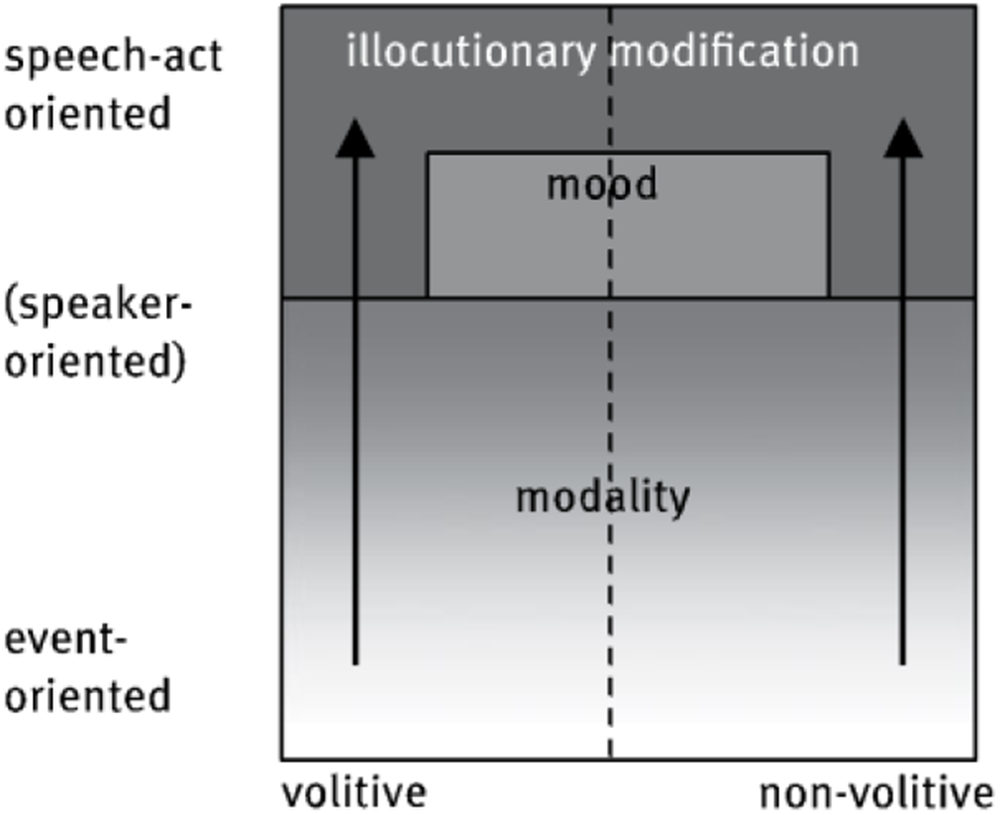
Narrog (Reference Narrog2012; see Narrog Reference Narrog, Hengeveld, Narrog and Olbertz2017 for a shorter summary) distinguishes modal categories on the basis of two overarching features: volitivity and speech-act orientation.Footnote 3 Diachronic processes in the domain of modality are argued to share a comprehensive directionality of change towards increased speech-act orientation, which consists of one or more of the following three tendencies (Narrog Reference Narrog2012, Reference Narrog, Hengeveld, Narrog and Olbertz2017): (i) increasing orientation towards the speaker’s perspective, (ii) increasing orientation towards the speech situation including the hearer, and (iii) increasing orientation towards discourse itself. This is represented in Figure 1, taken from Narrog (Reference Narrog2012: 112).
A model of modality and related categories.

Narrog (Reference Narrog2012) discusses in detail the differences between this model and the one proposed by van der Auwera and Plungian (Reference van der Auwera and Plungian1998). For the purposes of this article, the crucial feature of Narrog’s model is the explicit inclusion of illocutionary modification (hereafter IM) as a grammatical category bordering the domain of modality: “A further step beyond modality and mood are illocutionary force and illocutionary (force) modification (IM), i.e. the expression of the communicative purpose of an utterance, such as making a statement, a promise, or a prediction, and its modification” (Narrog Reference Narrog2012: 13). This category is not strictly modal (IM does not usually change the factuality of a sentence), and it is further up the scale of speech act orientation than modality: IM mainly concerns the interaction of speaker and hearer in discourse and the management of intersubjective meanings.Footnote 4 Narrog (Reference Narrog2012) does not use labels such as post-modal domain or post-modal meanings, but it seems beyond doubt that IM can be considered a post-modal category in this model (“a further step beyond modality” in the quote above).
With respect to the development path leading from modality to IM, Narrog (Reference Narrog2012) gives two examples. The first one is represented by the Hebrew adverb כulay ‘perhaps’. In Biblical Hebrew, the adverb כulay was a common form for expressing epistemic possibility. In Modern Hebrew, along with the expression of epistemic possibility, it has acquired an additional function as an illocutionary force marker. Consider example (1):

In this example, (1a) is a normal question, a genuine request for information, while (1b) – other things being equal – signals a suggestion or request, that is, a specific type of directive speech act. Moreover, with first person plural, the addition of כulay results in a hortative utterance. This example represents a case of development involving adverbial expressions that leads from epistemic modality to illocutionary modification and speech act marking.
The second example is represented by the Japanese particle daroo ‘probably; I assume’, which is the most frequent epistemic marker of Modern Japanese: it basically expresses an inference about a state of affairs, the factuality of which is unknown (Narrog Reference Narrog2012 labels it speculative). In addition to this, daroo also has an IM function as a marker that signals request for confirmation (roughly comparable to the function of some tag questions in English):

As Narrog (Reference Narrog2012: 135) points out, in (2) the factuality of the state of affairs expressed in the clause is beyond doubt: someone has actually come, and the speaker pushes the argumentative point that they have already made this claim, but the hearer did not believe it. This way, daroo contributes to managing the speaker-hearer link in interaction, marking an utterance whose truth value is already decided but rhetorically presented as if it were still undecided.
These examples illustrate the case of two adverbial elements that develop from expressing modal meanings to marking illocutionary functions, and thus confirm the status of IM as a post-modal category.Footnote 5 This way, in Narrog’s (Reference Narrog2012) model, IM is firmly envisioned as part of a grammatical system and involved in the change processes affecting it. In the next section, I will move to the description of some uses of the Italian adverb pure, including specific illocutionary uses. Although they do not represent post-modal meanings in a narrow sense (pure is not a modal element in its prototypical use), the analysis of these uses will provide further evidence on IM, contributing to a better understanding of its features, its position in a grammatical system, and its relationship with other post-modal categories.
3. The functions of pure
The polyfunctionality of pure ‘also’ in contemporary Italian has not yet been studied in a systematic way, especially as regards the non-focusing uses of this adverb.Footnote 6 In this section I will describe three different uses of pure: uses as a focus adverb, illocutionary uses, and concessive uses. The examples in the following pages come from three corpora of contemporary Italian: I used the LIP corpus and the KIParla corpus for extracting spoken language data and the La Repubblica corpus for extracting written language data.Footnote 7
3.1 Additive uses
In its prototypical use, pure is an additive focus adverb.Footnote 8 One of the distinctive properties of focus adverbs is their interaction with the focus structure of an utterance: it is the information structure that determines the semantic contribution of focus adverbs to the utterance, and variations in the information structure correspond to variations in their semantic contribution (see König Reference König1991). Besides the functional value of operators on the focus of a sentence, focus adverbs also have a lexical meaning: they do not only signal a pragmatic relation, but enrich it with specific semantic values. According to the description proposed by König (Reference König1991) for additive focus adverbs, there are two features that play a crucial role in the semantic analysis of these expressions. The first is the quantification effect, through which the value of the focused expression is related to a set of alternatives. Consider (3):


A sentence like (3a) can be described as the sum of two propositions, represented here by sentences (3b) and (3c). The sentence Giorgio only bought apples contains the assertion that Giorgio bought apples and builds on the presupposition that Giorgio bought something else (which is outside of the scope of the negation, cf. It is not true that Giorgio also bought apples, activating the same presupposition), thus suggesting that apples are part of a larger set of elements (depending on the context) and that at least one of the possible alternatives satisfies the relevant open sentence. Focus adverbs contribute quantificational force to the meaning of a sentence: they quantify over the set of possible alternatives to the value of the focused expression. The meaning contribution of pure is to include these alternatives as possible values for the open sentence in their scope, while at the same time asserting the validity of the sentence it has scope over.
In addition to the selection of alternatives, some focus adverbs may induce a ranking into the set of possible alternatives, meaning that they induce scalar structures in the domain of quantification. In this case, the alternatives and the focus value are part of a set that is hierarchically arranged. Some adverbs can, by themselves, induce a scalar ordering (e.g., English even and Italian persino ‘even’); others (like pure) are compatible with a scalar reading when this is suggested by the context. Consider example (4), on the following page. In this kind of context, scalar focus adverbs activate an evaluation inference connected to the scalar ordering – that is, the value of the focus is characterized as ranking “high” or “low” on the scale. In the case of pure, the inference is often connected with a scale of expectation in discourse, whereby the referent it has scope over can be said to be more or less expected in that context. Thus, when used in a scalar way, pure activates the inference that the focus value ranks lower than the alternative values on the scale of expectation.
More broadly, in specific syntactic contexts, the additive and/or scalar value of pure can be downsized and exploited for discourse dynamics rather than for highlighting a referent. This typically happens when pure appears just after the finite verb form, a position from where it can operate on different sentence constituents.Footnote 9 Consider (5) and (6).

In (5), the narrow domain of association of pure is the NP i suoi difetti ‘its flaws’, but its scope extends on the whole utterance, which is marked as a concessive premise before introducing a contrast (marked by the connective però ‘but’). In (6), it is not easy to identify a single element associated with the focus adverb: pure marks the whole utterance without evoking a real set of alternatives, but it is used for the argumentative purpose of marking the whole utterance as salient. These uses could be thought of as peripheral instances of pure as a focus adverb. In fact, they share certain features with the illocutionary and concessive uses of pure (first of all, the syntactic position), which will be described in the next subsections.Footnote 10
3.2 Illocutionary uses
The fact that focus adverbs can undergo semantic change and come to express illocutionary functions has been already pointed out by König (Reference König1991) and investigated by a number of works (see among others Duvallon and Peltola Reference Duvallon and Peltola2017, Modicom and Duplâtre Reference Modicom, Duplâtre, Gautier, Modicom and Vinckel- Roisin2018, Favaro Reference Favaro, Modicom and Duplâtre2020).Footnote 11 By illocutionary uses, I refer to those contexts of use where focus adverbs express functions related to the modification of a speech act and its illocutionary force. These cases, whereby the association with the focus structure of the utterance is lost (bleached focus constructions), can be considered one of the possible endpoints of what Eckardt and Speyer (Reference Eckardt, Speyer, Caroline and Ishihara2016) call focus cline:Footnote 12
The pathway of focus change starts where words develop into focus sensitive particles and associate with focus, it continues where they foster into conventionalized alternative-based constructions, and it ends where reference to alternatives or focus-background structure is lost. We will refer to the later stages as bleached focus. (Eckardt and Speyer Reference Eckardt, Speyer, Caroline and Ishihara2016: 503)
In the case of pure, the adverb has developed new functions in association with specific types of speech acts. In the following examples, in contrast with its use as a focus adverb, pure does not have scope over sentence constituents but on the whole utterance. In this way, its semantic contribution does not lie at the sentence level, but rather at the speech act level. Specifically, the adverb can operate on three different types of speech acts.
In directive speech acts, most typically expressed by imperative sentences, pure operates on the illocution carried by the verb and – depending on the case – it gives the directive the specific character of an invitation or permission to do something. As a pragmatic side effect, the directive sounds more polite/mitigated. Consider (7):

In this kind of construction, pure modifies the illocutionary type directive, changing the conventional aspects of the construction so that it can be used in a specific kind of context and with different underlying conditions. In particular, directives with pure are common in conversational contexts where it is self-evident that the addressee has the possibility of performing some action that lies in the speaker’s control area (see Waltereit Reference Waltereit2006) but it is not certain that they will do so. On the speaker’s side, the ordinary interpretation of these contexts is that the hearer is waiting for an explicit signal to act. Directives marked by pure are not orders coming out of the blue, but rather invitations that seek to meet certain expectations. In this way, pure specifies the aim with which the speech act is performed: the illocutionary point is adapted according to the common ground and the context of interaction.
A semantically bleached pure can also appear in sentences with the subjunctive mood to mark specific types of illocutionary forces, namely optatives (8) and hortatives (9), which are sometimes described as subcategories of directive constructions (König and Siemund Reference König, Siemund and Shopen2007). In optative contexts, the speaker indicates to the addressee their wish that the positive situation evoked by the communicated content should come about. In hortative contexts, the speaker encourages themselves or an addressee together with themselves to carry out the action evoked by the communicated content (see Hengeveld and Mackenzie Reference Hengeveld and Mackenzie2008).


Finally, illocutionary uses of pure can also be found in declarative sentences expressing assertions. Since they occur with indicatives, it is more difficult to clearly separate these uses from instances of pure as a focus adverb – the illocutionary context being mostly the same. In fact, it is better to think of them as a continuum of uses rather than a clear-cut divide (see (6) above). In this kind of context, pure contributes to emphasizing the illocutionary force. Consider (10). In this example, the presence of pure gives the assertion a prominent position in the conversational exchange. Specifically, it contributes to projecting the assertion against a set of possible alternative assertions. These assertions, however, do not represent alternative referents or states of affairs (as happens when pure works as a focus adverb) but rather contextual assumptions, including what the speaker assumes about the addressee’s beliefs, which are backgrounded by the illocutionary use of pure. In this manner, the assertion marked by the adverb does not represent one alternative among others, but the most relevant within the actual context.Footnote 13

Given that they specify particular illocutionary features of the speech acts within which they occur, these uses of pure can be argued to fall within the grammatical category of IM as defined above. In particular, they “fine-tune” (Detges Reference Detges, Cornillie and Pietandrea2015) the performance of speech acts by specifying the intentions expressed by the speaker and adapting them to the conditions of the interactional context. Moreover, what most of these uses have in common is their intersubjective nature, as they evoke a viewpoint that is not simply ascribed to the speaker alone, but, crucially, also involves the hearer. Thus, “they provide clues as to how the speaker’s assertion ties in with the addressee’s world- and discourse knowledge as hypothesized by the speaker” (Detges and Gévaudan Reference Detges, Gévaudan, Pons Bordería and Lamas2018: 308). In this perspective, these uses of pure can be analyzed as modal particles, adverbial elements that express different illocutionary and intersubjective functions (see among others Abraham Reference Abraham and Abraham1991, Waltereit Reference Waltereit2001, Zimmerman Reference Zimmermann, von Heusinger, Maienborn and Portner2011, Artiagoitia et al. Reference Artiagoitia, Elordieta and Monforte2022).
3.3 Concessive uses
A different development path involving pure calls into play another category that has been associated with the post-modal domain, namely concessivity. Specifically, the adverb appears as a collocation in a series of non-compositional constructions that express concessive meanings. A first set is represented by concessive uses of the Italian future, which have been discussed in detail by Squartini (Reference Squartini2012), both in terms of the interplay of epistemicity and evidentiality in their interpretation and of their specific role in interaction. This last aspect is the most relevant for the purposes of this article. Consider (11). It is not possible in (11) to analyze pure as a normal instance of focus adverb: it retains its additive semantics, but there is no marked focus constituent and no set of alternatives is evoked, thus resulting in a bleached focus construction as in the definition given above (section 3.2). Its (residual) additive semantics can be successfully exploited as soon as concessivity is used in discourse. By using the concessive future with pure, the speaker concedes an additional point which is exploited to mitigate a contrast in conversation: this combination represents a commonly used argumentative move (Anscombre and Ducrot Reference Anscombre and Ducrot1983). The conceding move is thus introduced to acknowledge the validity of a first statement or point, before going on to claim the validity of a potentially contrasting second statement or point (Squartini Reference Squartini2012).

A second set of concessive uses of pure is represented by conventionalized constructions such as sia pure (12) and che pure (13). The collocation sia pure (12) is composed of the third person singular, present tense, of the verb essere ‘to be’ in the subjunctive mood followed by pure. It functions as a routinized concessive-conditional marker – similar to the conjunction anche se ‘even if’ – but it does not introduce a subordinate sentence, since it can only hold nominal constituents and not verb phrases. The collocation che pure (13) is composed of a relative marker followed by pure: in most cases, it introduces an appositive relative clause.Footnote 14 In fact, the additive semantics of pure lends itself well to appearing in an appositive relative clause, which has the function of adding information about the nominal constituents it refers to. However, in these contexts pure cannot be analyzed as an additive focus adverb, as it rather enriches the relative clause with a contrastive-concessive semantics.Footnote 15


4. Additivity across functions
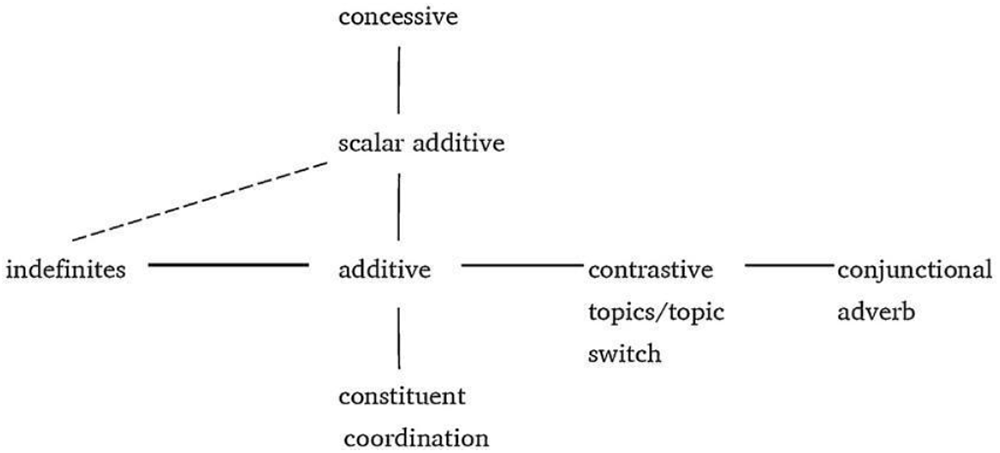
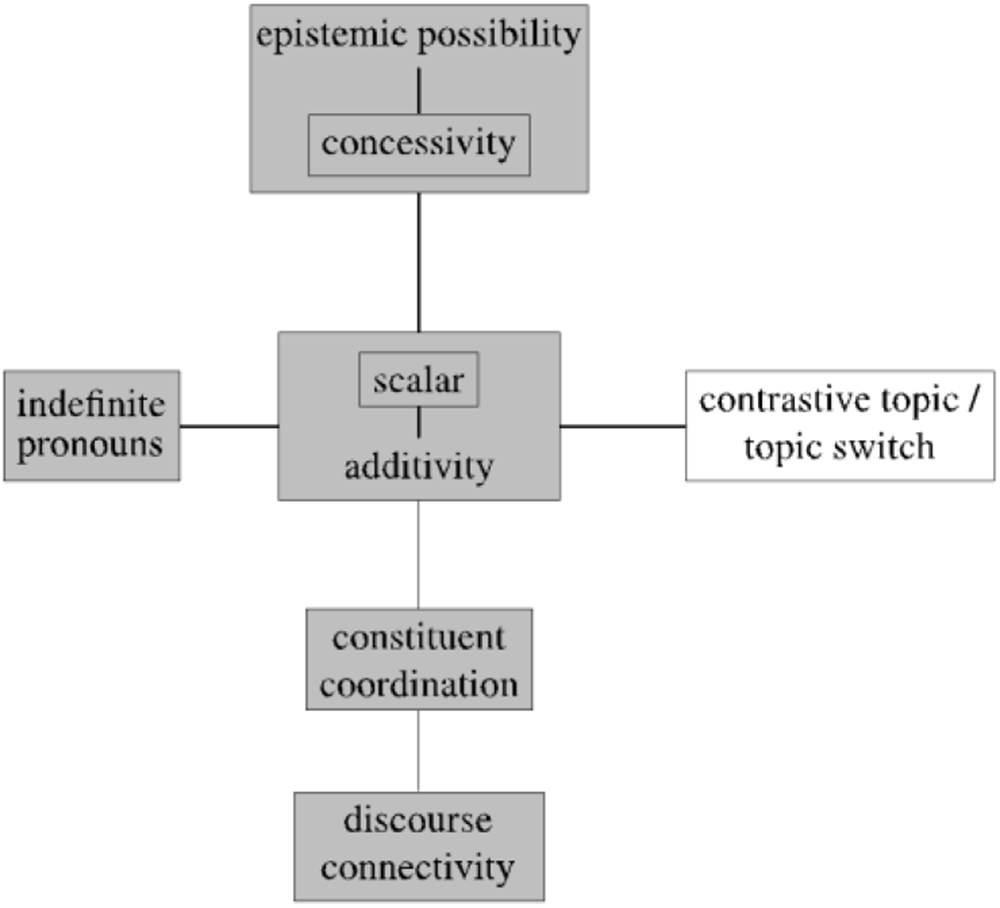
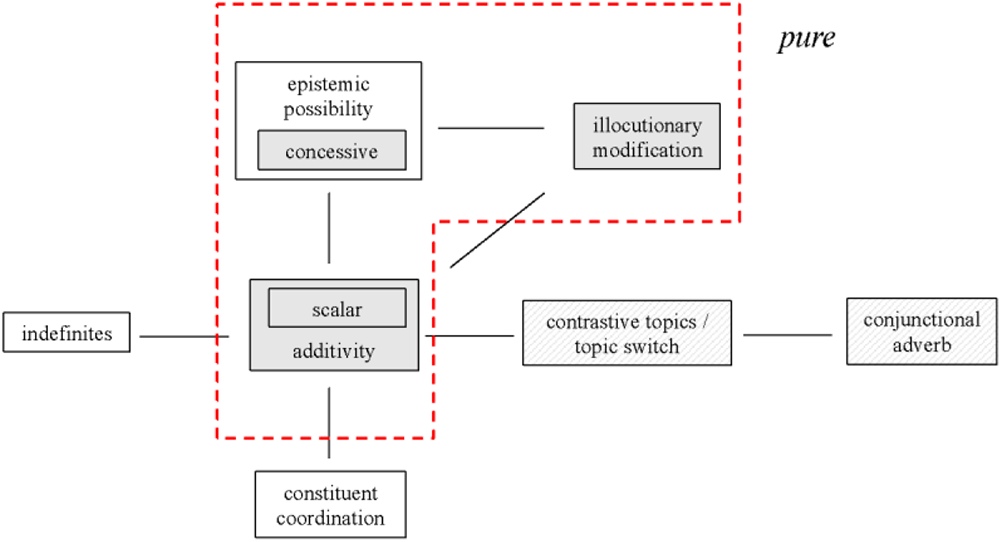
Given this description of the different functions of pure, one can try to arrange them on a semantic map.Footnote 16 Recently, two papers proposed a semantic map for additive markers: Forker (Reference Forker2016) and Faller (Reference Faller2020). Based on a typological survey of 42 languages, Forker (Reference Forker2016) built a semantic map for additive markers that comprises seven main functions: additivity and scalar additivity, indefinites, concessivity, constituent coordination, topic switch, and conjunctional adverb. Faller (Reference Faller2020) proposed a modified version of this map based on her study of the Cuzco Quechua additive marker =pas. These two maps can be found in Figure 2 and Figure 3 below.
A semantic map for additive markers (Forker Reference Forker2016: 87).

A semantic map for additive markers with the functions of Cuzco Quechua =pas shaded in grey (Faller Reference Faller2020: 31).

The two maps present a few differences. First, following König (Reference König1991) and Gast and van der Auwera (Reference Gast and van der Auwera2011), Faller (Reference Faller2020) considers scalar additivity as a subtype of additivity and includes the two categories in the same box. Secondly, based both on her data of Cuzco Quechua additive marker =pas and a review of the data discussed by Forker (Reference Forker2016), Faller (Reference Faller2020) links discourse connectivity (corresponding to conjunctional adverb in Forker’s map) to constituent coordination instead of topic switch. Lastly, Faller (Reference Faller2020) includes the epistemic use of Cuzco Quechua =pas in her map, noting that semantic maps for modality link epistemic possibility to concessivity (van der Auwera and Plungian Reference van der Auwera and Plungian1998). By doing so, she points out that the map of additivity can be connected to that of modality via concessivity. In particular, following van der Auwera et al. (Reference van der Auwera, Petar, Vittrant, Hogeweg, de Hoop and Malchukov2009), Faller (Reference Faller2020) treats concessivity as a subtype of epistemic modality, and the two categories are included in the same box in Figure 3. For the purposes of this article, it is not necessary to discuss the details of the subcategories employed by Faller (Reference Faller2020). However, this last consideration is highly relevant because it explicitly links the semantic map of additive markers to both the modal domain (epistemic possibility) and the post-modal domain (concessivity).
With reference to the functions of pure, the link between additivity and concessivity is also shown by the data described above. However, what is still missing from the picture is illocutionary modification. In fact, even though this category does not appear in either of these two versions of the semantic map of additivity, Forker (Reference Forker2016) mentions several examples of semantic extensions of additive markers that could be interpreted in this way. A case in point is the Finnish additive =kin, which, in specific contexts, can be used by the speaker to express subjective attitudes such as pleasant surprise or disappointment, to indicate that some expectation has been fulfilled, or to strengthen an exclamation. Other cases include additive markers that convey emphasis or mitigation (see the examples cited by Forker Reference Forker2016). The illocutionary uses of pure as a speech act modifier can be included into this latter group. The functions covered by pure are represented on the semantic map for additive markers in Figure 4.
A semantic map for additive markers with the functions of Italian pure shaded in grey.

The semantic map in Figure 4 closely resembles the one proposed by Faller (Reference Faller2020), but it follows Forker (Reference Forker2016) in linking discourse connectivity (conjunctional adverb) to topic switch, as I find that Faller’s (Reference Faller2020) changes on this issue are not fully convincing.Footnote 17 Apart from this, the main change here is the inclusion of the IM node in the map, as suggested both by the illocutionary functions of pure discussed above and by the examples reported in Forker (Reference Forker2016): this provides evidence for the link between additivity and IM. Moreover, recalling the two examples discussed by Narrog (Reference Narrog2012) presented in section 2, it is necessary to link IM to epistemic modality as well. From van der Auwera and Plungian’s (Reference van der Auwera and Plungian1998) perspective, this link would represent the shift from the modal to the post-modal domain. In the next section, capitalizing on the issues addressed so far, I will go back to the topic of IM to further discuss its features and its position in a layered model of grammatical categories.
5. Illocutionary modification as a grammatical category
One of the main reference points of this article was Narrog’s (Reference Narrog2012, Reference Narrog, Hengeveld, Narrog and Olbertz2017) model of modality and related categories. A crucial feature of that model is its explicit inclusion of IM, which is treated as a functional domain placed beyond modality in a layered model of grammatical categories. In this perspective, referring to van der Auwera and Plungian’s (Reference van der Auwera and Plungian1998) terminology, IM can be considered a post-modal category. Other categories, such as concessivity and clausal moods (imperative, hortative), represent further contact points between these two models of (post-)modality (see van der Auwera and Plungian Reference van der Auwera and Plungian1998, Narrog Reference Narrog2012). Concessivity, speech-act marking, and IM are among the functions expressed by pure described above, a fact that has motivated the comparison between the functional developments of this adverb and the categories that van der Auwera and Plungian (Reference van der Auwera and Plungian1998) and Narrog (Reference Narrog2012) included in the post-modal domain. But while the double link of concessivity with modality on the one hand and additivity on the other is well researched (see Baranzini and Mari Reference Baranzini and Mari2019, Rossari and Smirnova Reference Rossari, Smirnova, Baranzini and de Saussure2021, Faller Reference Faller2022, to name just a few recent studies), the status and the features of IM have received much less attention and deserve a closer look.
In linguistic theory, the notion of illocution refers to the grammatical domain where communicative intentions are coded onto conventionalized linguistic expressions: “The basic illocution of a sentence can be defined as the conversational use conventionally associated with the formal properties of that sentence which together constitute a sentence type” (Hengeveld Reference Hengeveld, Booij, Lehmann and Mugdan2004: 1190–1191). Basic illocutions are represented by categories such as declarative, interrogative, and imperative, while the notion of illocutionary force is used to distinguish among specific types of speech acts, such as statements, requests, orders, warnings, or permissions (see Searle Reference Searle1969, Levinson Reference Levinson and Huang2017). In this respect, the notion of illocutionary modification refers to the various grammatical means that modify the illocutionary force of a speech act and further differentiate between communicative intentions. IM has not yet acquired an established position in language descriptions: until now, it has been mainly used by researchers working with functional approaches to grammatical categories (Hengeveld Reference Hengeveld, Booij, Lehmann and Mugdan2004, Hengeveld and Mackenzie Reference Hengeveld and Mackenzie2008, Narrog Reference Narrog2012). Besides that, it has been occasionally used to describe the functions of modal particles and similar elements (i.e. Jacobs Reference Jacobs and Abraham1991, Waltereit Reference Waltereit2006, Coniglio Reference Coniglio, Abraham and Leiss2012). Nevertheless, it has neither received an adequate theoretical treatment nor been consistently applied to the functional description of linguistic constructions.
The case study in this article aims to represent a further step towards a comprehensive handling of IM as a grammatical category. The illocutionary uses of pure showed that at least two functions can be subsumed under this label. On the one hand, pure as a modal particle specifies the communicative intention expressed by the relevant speech act: in particular, directive speech acts are specified as invitations and permissions. On the other hand, the use of pure as a modal particle allows the management of contextual inferences: pure marks directives that redundantly meet certain expectations on the part of the hearer, and thus contributes to integrating the speech act with the relevant common ground. This feature has been observed in the description of other modal particles and related constructions too (see Hansen Reference Hansen1998, Waltereit Reference Waltereit, Davidse, Breban, Brems and Mortelmans2012, Detges and Gévaudan Reference Detges, Gévaudan, Pons Bordería and Lamas2018, Favaro Reference Favaro, Modicom and Duplâtre2020), and should be taken into account when defining the specific properties of IM. According to this view, the linguistic constructions which code this category express two distinct but related functions. First, they operate on the conditions under which the speech act is performed: that is, they integrate the speech act with the common ground and contribute to managing the information flow with respect to the knowledge shared by the interlocutors. Second, they specify the intentions with which speech acts are performed: that is, they contribute to refining the illocutionary point of the speech act in an interpersonal perspective.
Moreover, the examples discussed in this article pointed out that different development paths can lead to illocutionary modification, which has been shown to be closely connected to other grammatical categories (epistemic modality, additivity). In this perspective, it represents not only one of the possible endpoints in the development of modal expressions, but also a functional domain with a specific position in a layered model of grammatical categories (see Hengeveld Reference Hengeveld1989, Reference Hengeveld, Hengeveld, Narrog and Olbertz2017; Hengeveld and Olbertz Reference Hengeveld and Olbertz2018), which at least partially overlaps with what van der Auwera and Plungian (Reference van der Auwera and Plungian1998) called the post-modal domain.
6. Conclusion
In this article, I have described the different uses of the Italian adverb pure ‘also’, identifying three main functional categories to group them: additivity, concessivity, and IM. This functional distribution has been discussed in the light of the debate over the evolution of modal expressions and the internal structure of the post-modal domain, within which both concessivity and IM can be included (van der Auwera and Plungian Reference van der Auwera and Plungian1998, Narrog Reference Narrog2012). By reviewing previous works on the semantics of additivity (Forker Reference Forker2016, Faller Reference Faller2020), the data on pure have been reappraised in order to further explore the relationship between these domains. I have shown that, apart from being post-modal meanings, both concessivity and IM are connected to the evolution of additive expressions as well. Thus, both categories represent contact points between the semantic map of modality and the semantic map of additivity. On the one hand, these results contribute to the description of the internal structure of the post-modal domain and neighbouring domains. On the other hand, they contribute to a better understanding of IM as a category in grammar, the functions subsumed within it, and its position in a layered model of grammatical categories. Future research will study further examples of expressions that followed the development paths leading from modality and/or additivity towards IM, and will investigate in more detail the specific features of this category and the connections between different post-modal meanings.

 Open access

