


In Europe, diets and lifestyles have undergone dramatic changes in recent decades. Increasing levels of energy intake, in particular from fat and sugars, together with decreasing levels of physical activity are recognized as being the underlying causes of the epidemic of overweight and diet-related non-communicable diseases(1). The prevalence of adult overweight shows large variation in the WHO European Region (ranging from 32 % to 79 % in men and from 28 % to 78 % in women) but, more alarmingly, obesity and overweight rates in children are increasing rapidly(Reference Branca, Nikogosian and Lobstein2). At the same time, various countries have developed national action plans on nutrition and physical activity. While only six of the fifteen member states of the European Union (EU) before its enlargement in 2004 had a national action plan on nutrition(Reference Lachat, Van Camp, De Henauw, Matthys, Larondelle, Remaut-De Winter and Kolsteren3), all of those fifteen countries and most new member states currently have a policy document at hand.
As out-of-home eating has become part of modern life, the catering sector has a central role to play in ensuring healthy diets. This is acknowledged in the Global Strategy on Diet, Physical Activity and Health of 2004(4) and the Second WHO European Action Plan for Food and Nutrition Policy 2007–2012(5). Evidence is emerging that out-of-home eating is correlated with higher energy intakes or poor nutritional intakes not only in Europe(Reference Kearney, Hulsof and Gibney6–8) but also in the USA(Reference French, Harnack and Jeffery9–Reference Thompson, Ballew, Resnicow, Must, Bandini, Cyr and Dietz14) and Australia(Reference Burns, Jackson, Gibbons and Stoney15). The key mechanism is believed to be higher energy densities(Reference Prentice and Jebb16, Reference Bell and Swinburn17) or larger portion sizes(Reference Diliberti, Bordi, Conklin, Roe and Rolls18, Reference Ledikwe, Ello-Martin and Rolls19). Lin et al. showed that, in the period from 1977 to 1995, foods consumed out of home in the USA contained more saturated fat and Na but less Ca, fibre and Fe compared with foods consumed at home. Similar trends were reported for fast foods and foods consumed in restaurants and schools(Reference Lin, Guthrie and Frazao11, Reference Lin, Guthrie and Frazao20). Orfanos et al. showed in Europe how out-of-home eating is associated with higher energy intakes and physical inactivity. Across Europe, higher educated people were more likely to have a considerable share of their energy from out-of-home foods and drinks compared with less educated peers(Reference Orfanos, Naska and Trichopoulos21). A crucial point regarding catered foods is the limited ability of individual consumers to adjust the composition of their intake owing to partial information and little influence on what is offered.
The process of defining the role, functioning and regulation of the various stakeholders involved in food and nutrition varies between countries. Benchmarking can therefore be an efficient way of sharing learned lessons. The objective of the present study was to review how countries of the WHO European Region address issues related to the catering sector in their nutrition policy plans.
Methodology
A literature review of food and nutrition-related policy documents of Member States of the WHO European Region was conducted in March 2007 by a multidisciplinary research team comprising experts in food science, public health nutrition and social sciences. Electronic documents were obtained from the WHO electronic policy database(22) and some documents were provided in hardcopy format for the purpose of the study by WHO. The database is an inventory as part of a comparative analysis of food and nutrition policies in the WHO European Region in 2005(23). The literature review was completed with an Internet search to identify missing documents or updates. This was done in Google with the search strategy (name of the country AND (catering OR out of home eating) AND (obesity OR overweight) AND (nutrition policy OR nutrition plan).
A previous review showed that nutrition policy may take shape in various policy documents such as a Resolution of the National Assembly in Slovenia(24), a Consumer Protection Action Plan or Policy Report as issued in Germany(25, 26), obesity action plans (e.g. Poland(27)), a Nutrition and Health Programme like in France(28) or a Food and Nutrition Policy like in Malta(29). We did not restrict our analysis with regard to the terminology used and considered all policy documents related to nutrition as included in the 2006 WHO nutrition policy database. For the purpose of the present paper, all documents are referred to using the generic term ‘nutrition policy documents’ consistent with the WHO terminology in the nutrition policy database. We restricted our analysis to national policies, i.e. no policy documents describing regional initiatives were considered.
A matrix for data extraction was designed on the basis of recurring themes identified during a first reading round of documents. Those themes were: strategies for catering; labelling; staff training; evaluation structures; dialogue structures; and advertising regulations. During a second reading round, the policy plans were reviewed specifically for these themes and a score was added to appraise how the themes were addressed in the policy plans. An ‘A’ mark was given if strategies for the catering sector were explicitly mentioned and if specific actions for the catering sector were outlined. A ‘B’ mark was given if the catering sector was mentioned but no specific public health nutrition strategies were documented. A third mark, ‘C’, was allocated when no reference was made to the catering sector for that particular theme. In order to highlight practical issues related to nutrition policies on the one hand and important mechanisms and difficulties linking policy makers and catering professionals on the other, we present two case studies. The main criterion to select the cases was the availability of both policy and secondary documents describing a particular issue of interest. The Netherlands was selected because its policy document contains an explicit strategy on regulation and degree of government control over the private catering sector and secondary documents are available providing insight into this process. Finland was chosen as a second case study for its long, researched and well-described experiences with nutrition policy and mass catering.
Results
We reviewed nutrition policy documents from thirty-three countries (62 %) of the fifty-three Member States of the WHO European Region (Table 1).
Prevalence of a nutrition policy plan (NPP) and specific strategies towards the catering sector in the WHO European Region

* Proportion of the fifty-three Member States of the WHO European Region.
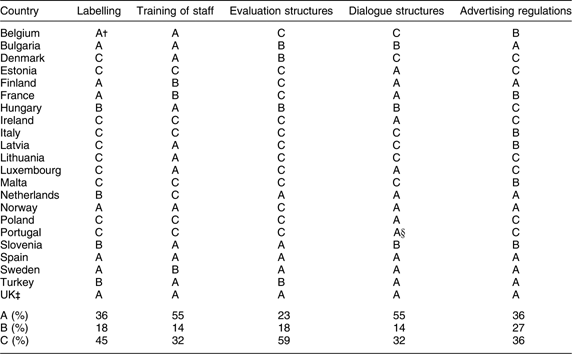
No reference to nutrition policy documents were found for eight countries, namely Andorra, Azerbaijan, Kyrgyzstan, Monaco, Montenegro, Republic of Moldova, San Marino and Turkmenistan. Although eleven countries (Croatia, Cyprus, Czech Republic, Israel, Kazakhstan, Romania, Russian Federation, Slovakia, Tajikistan, Ukraine and Uzbekistan) reported to have a nutrition policy in the WHO policy database, those documents were unavailable for review. The nutrition policy document for Belarus was in Russian and therefore it was not included in the analysis. In total, seventy-nine nutrition policy documents were evaluated. Table 2 shows an overview of the issues addressed for the catering sector in the nutrition policy plans in the WHO European Region.
Overview table of strategies and involvement of the catering sector in nutrition policy in the WHO European RegionFootnote *
* List of Member States of the WHO European Region as included on the WHO Europe website (http://www.euro.who.int/AboutWHO/About/MH, accessed June 2007).
† A = plan that mentions public health nutrition strategies for the catering sector; B = plan that mentions the catering sector without specific public health nutrition strategies; C = plan that does not mention the catering sector as a partner.
‡ The United Kingdom of Great Britain and Northern Ireland.
§ Not present in the policy documents but launched recently.
Nearly 67 % (22/33) of the countries document specific strategies for the catering sector. What is understood by ‘catering’ and related stakeholders varies widely between policy documents. Catering is seen mainly in a context of public catering, in particular in schools. On the contrary, Spain has a very comprehensive view of the catering sector. In this country, the catering sector includes the public one, the food industry, the agricultural sector, distributors, restaurants, different vending outlets and professional associations like the bakery sector.
Most of the policy plans highlight the need for improved public catering, in particular in schools and hospitals, and see the development of dietary guidelines for mass catering as the main strategy to do so. In The Netherlands, a practical set of guidelines to promote and monitor healthy school catering have been published(Reference Snel, Reitzema and Engelhardt30) and also the Greek guidelines on school catering(31) and the Latvian school regulation(Reference Balandina32) are important milestones for regulations of contract catering in Europe.
Few member states (apart from Belgium(33), Estonia(34), Ireland(35, 36), The Netherlands(37), Spain(38) and Sweden(39)) include specific strategies for the private catering sector such as restaurants or fast-food outlets. In Spain, the respective contributions of each stakeholder have been identified for every policy objective. In The Netherlands also a large panel of stakeholders was involved in a Covenant (see case study 1(40, 41)). Regulations for vending machines, commonly the restriction of accessibility to energy-dense foods in schools, were put forward by a number of member states such as Belgium(33), France(28), Ireland(35, 36), Luxembourg(42), The Netherlands(37), Norway(43) and Sweden(39). A different focus is found, for instance, in Estonia(34) and Slovenia(24) where strategies for the catering sector have been developed as a means to promote local food and rural tourism. All analysis below thus refers to the twenty-two countries that specifically considered the catering sector in their nutrition policy plan.
Box 1 Case study 1: Self-regulation v. control in The Netherlands
The Netherlands identifies a healthy lifestyle as a joint responsibility of citizens, government, social organizations and private actors(37). The Ministry of Health, Welfare and Sport calls upon the private sector to take up its social public health responsibility in a self-regulative way. Provision of healthy food, smoke-free bars and restaurant advertisements for children are given as examples. If this is not done adequately the government would intervene with ‘relevant measures’. In 2005, a Covenant on Overweight and Obesity was signed between the relevant ministries and private partners such as the Dutch food industry, including the association of Dutch Catering Organizations (VENECA)(40). The main objectives were to halt the increasing incidence of adult overweight and to reduce the incidence of child overweight by 2010. In the framework of this Covenant a more concrete action plan entitled ‘Energy in balance’ was issued wherein different action domains are identified and guidelines formulated for the covenant partners.
Following creation of the Covenant, a multitude of activities have been taken by the Dutch catering sector at both the national and private level to initiate and further stimulate healthy lifestyles in the population. Examples at national level include the introduction of a digital evaluation system that allows caterers to better analyse their food and meal supplies and to compare these with the recommendations made by the Dutch Food Centre. A more active collaboration in the form of group discussions with the Dutch Heart Foundation and the Food Centre was achieved. A ‘healthy company’ award will be used to motivate their members to participate in the programme. A practical manual on ‘eating good and healthy in company restaurants’ has been made that forms part of the sector curriculum and guides personnel working on location. The healthy food and eating policy in the curriculum also includes an ISO Certified Schedule Contract for Catering(41).
In the Covenant, the multidisciplinary nature of overweight is acknowledged by both government and the private sector, which is a first important step in the general mobilization of public opinion and inter-sectional action. Clearly, the open call of the Covenant as proposed by the Dutch policy plan has resulted in creative and active responses by the catering sector. Although the voluntary responses from the private sector are commendable, care should be taken that this finally delivers a clear and objective message to the consumer. The wide variety of mainly uncoordinated and unregulated actions runs the risk of transferring an inconsistent message to the population. In addition, we found no monitoring or impact evaluation systems of the activities from the Covenant, which leaves room to question the effectiveness of the undertaken interventions. Overall, a Covenant on overweight with a more formal government mandate as director and monitor instead of a facilitator and moderator would arguably be more effective.
Labelling of foods and prepared meals
A possible strategy to inform catering consumers is the use of convenient labels that indicate if a dish is corresponding with dietary recommendations. Thirty-six per cent (8/22) of the countries aim to develop a specific label that refers to the nutritional contents of foods and prepared meals. However, only the Swedish nutrition policy document provides specific information, i.e. describes the development of the ‘Keyhole’ label, a well-known Swedish label for pre-packed foods and meals.
Training of health and catering staff
A key issue put forward for the catering sector is to provide training to improve knowledge on nutrition, health and food preparation of catering staff, i.e. those preparing and handling food. Estonia, for instance, highlights that the competence of manufacturers and caterers will be key to provide healthy food. Publications on food in school and for children have been issued for use by school caterers and advanced courses have been organized(34). Latvia stipulates that staff untrained in the preparation and use of ‘healthy nutrition’ would no longer be employed in school cafeterias(44).
Evaluation structures
A quarter of the countries plan to monitor the compliance of the catering sector with policy recommendations. Among those, four provide no specifications on responsible bodies, methods and timing. At the other end of the spectrum, the UK constitutes a neat example of a very comprehensive monitoring plan: data sources, evaluation questions and institutions responsible for evaluation were identified during the planning phase(45). In Scotland, it is considered that encouragement should be given to promote self-evaluation by schools and education authorities to complement monitoring by the Scottish Executive(45, 46). On another side, Finland illustrates the difficulty of attaining policy objectives when a weak monitoring of the implementation of recommendations is combined with a voluntary and not compulsory participation of the catering sector (see case study 2(47–Reference Milio and Helsing51)).
Participation of the catering sector
More than half the countries refer to the need for an overall intersectoral coordination of activities where the catering is identified as a full stakeholder. Most of these references are hinted towards public catering, especially in schools. In some countries more formal partnerships or platforms are created at national level involving the catering sector as an important stakeholder. Examples of national platforms involving the catering sector as a stakeholder are the Covenant on Overweight and Obesity in The Netherlands(40), the Scottish Diet Action Group(52), the National Taskforce on Obesity in Ireland(35, 36), the Health Promotion Networks in Estonia(53) and the newly launched platform in Portugal(54). A good example of local platforms is the Communities for Health in the UK. Although this approach is essentially a comprehensive community-based and bottom-up approach for health, some of the communities have initiated activities on healthy catering and training of catering staff(55).
Case study 2: The Finnish paradox
At first sight, Finland appears a model with regard to the involvement and regulation of the catering sector within the frame of a healthy nutrition policy(47). The country indeed presents many assets, as displayed in the following table.
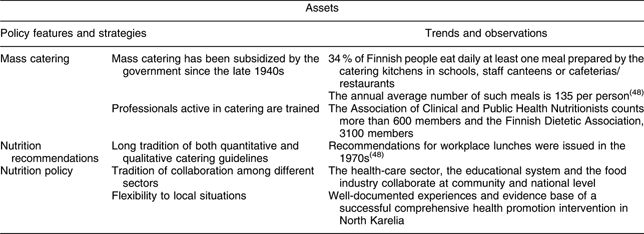
These assets have certainly contributed to the positive changes observed in food habits (‘less hard fat, less salt, more vegetables’) and the remarkable reduction of CVD observed since the 1970s(Reference Pekka, Pirjo and Ulla49). However, the global picture of nutrition-related health is blurred. Although energy intake and cholesterol levels have decreased, the prevalence of obesity has increased dramatically in all age ranges, including schoolchildren(47, Reference Borg and Fogelholm50). This Finnish paradox is often explained by a massive reduction of physical activity in everyday life. This is fair, but might be only part of the explanation. In the 1970s, the main objective was set to curb the incidence of CVD and the content of the nutrition recommendations was defined appropriately. It appears now that policy makers and nutrition professionals have been blinded by this important, but narrow, objective. In 1972, the mean BMI in adult males was already around 26 kg/m2, while new nutrition recommendations addressing the problem were only issued in 1998. Today, fats provide 33–37 % of energy intake and sugar more than 10 % of carbohydrate intake. Sixty-seven per cent of men and 54 % of women are overweight or obese(Reference Borg and Fogelholm50). Specific weaknesses relating to catering are displayed in the table below.
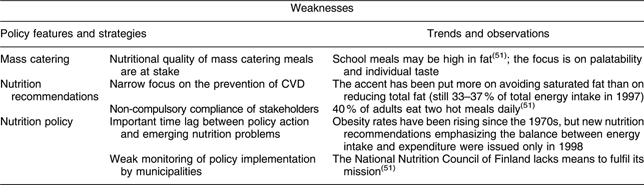
Further attention on healthy catering in Finnish nutrition policy may prove to be a leverage to ensure healthy eating for many.
Advertising
Thirty-six per cent (8/22) of the countries describe specific strategies to regulate advertising of food. Norway and Sweden are the countries where the most stringent strategies for advertising are proposed. In Norway the consumption of energy-rich foods and drinks intends to be discouraged by increasing value-added taxes and marketing restriction towards children and adolescents. Advertisements for food are not allowed before and after children’s programmes and may not try to capture the attention of children younger than 12 years of age(43). The Norwegian authorities envisage being a driving force in creating European regulations and would impose regulations unilaterally if no European directives are issued. A specific measure of the Swedish policy is to work at the level of the EU to ensure that television food advertising targeted at children is banned throughout the EU(39). This stands out against the approach in The Netherlands, in which the private sector is called upon to take responsibility to ensure healthy living by regulating food advertising towards children. If the actions taken are insufficient, the government would intervene(37). What is meant by insufficient is not specified but the practical arrangements are to be laid out in a Covenant with the private sector(40).
Discussion
The present findings show that the catering sector, and particularly the public one, is a formally acknowledged stakeholder in national nutrition policies in about two-thirds of countries of the European region. Thus, although catering is an essential and rapidly expanding sector providing food to large populations, many member states of the WHO European Region have no explicit strategies in place to promote healthy catering. Moreover, when the catering sector is addressed, important policy fields are poorly developed such as strategies for stimulating and monitoring actual implementation of policies. Others are simply lacking, such as strategies to ensure affordability of healthy out-of-home eating or to enhance accountability of stakeholders. It is also striking that policy plans focus very much on public catering but strategies for the private sector and in particular small food outlets or fast-food restaurants are rarely developed.
Another poorly developed policy field is labelling for the catering sector. While we found little specific reference to it in our review, a search of the secondary literature shows that over the past years there has been a proliferation of labels based on nutrient and meal profiles issued by non-governmental and public–private certification organizations to the commercial catering sector. Labels like the ‘Gustino label’ in France, the ‘Geniet gezond’ (Enjoy healthily) label in Belgium or the ‘Fourchette Verte’ (Green Fork) label in Switzerland indicate the more healthy and/or balanced choices on a restaurant menu. The type, criteria and objectives of the labels vary considerably from country to country. Some schemes are country-specific, while others are specific to a catering company, producer, retailer, consumer organization or even health magazine. The criteria underpinning the labels vary greatly in nature and some are more explicit than others. Some labels are based on criteria that reflect the variety of a meal, while others are based on the more analytical nutrient profile. This diversity is likely to generate more confusion than information. Filling the legislative vacuum at national level and harmonization at European level should be considered a priority with respect to labelling. At the same time, it remains unclear to what extent labelling can be instrumental in promoting healthy choices for the catering sector. There is a general lack of high-quality studies on the topic and the use of healthy logos has yielded mixed responses(Reference Cowburn and Stockley56). A review of consumer understanding of nutrition labelling showed how the relationship between labelling and diet quality remains largely unclear and how very little is still known about subgroups, in particular minorities or disadvantaged socio-economic groups(57). Specific work on labelling in the catering sector also highlighted the demand and lack of knowledge on usefulness of labelling for healthy eating(Reference McKevith, MacEvilly, Sadler and Buttriss58). In summary, the labelling example illustrates two important challenges with regard to nutrition policy development: (i) trends in catering production, marketing and consumption should be monitored carefully to allow timely and adequate policies; and (ii) such policies should be based on enough evidence and proper evaluation of actions implemented. However, some authors consider that policy, decisions and legislation usually lag behind because politicians are more influenced by feedback from their constituency than by expert statements(Reference Pekka, Pirjo and Ulla49).
What seems fundamentally at stake in monitoring the implementation of policy recommendations is the underlying conception of public authority and accountability of partners. This conception varies between self-regulation, statutory regulation and legislation. The Dutch case illustrates this complexity well. Every country tries to address this by a monitoring (or absence of monitoring) that fits its political background and tradition of collaboration between social partners. At the same time, the experiences in Finland should be kept in mind when deciding where to place the policy monitoring structures. Regardless of the long tradition of collaboration among different sectors at national level, a great level of flexibility at grass roots level and arguably poor accountability of stakeholders resulted in a weak monitoring of policy implementation at lower levels. Despite the fact that the public catering sector is subsidized predominantly by public funds, there are currently claims regarding the quality of food served in canteens(Reference Milio and Helsing51).
Outlining regulations on advertising of food clearly appears to be another challenging task for policy makers, because evidence that marketing and advertising contribute to adverse diets particularly in children is accumulating and a policy response is urgently needed(Reference McGinnis, Appleton Gootman and Kraak59). Most countries, apart from Norway and Sweden, call for self-regulatory measures on advertising to children and the correctness of advertisement messages. However, as seen in the UK House of Commons Health Committee Report(45), this does not seem to work well. Sweden has taken a more direct position in legislating and restricting advertising for food to young children. Getting more sectors involved and being more directive is not a top priority in many policy papers.
The present documentary analysis is restricted to national nutrition policy documents available in Dutch, English, French, German or Italian. Some countries, such as Belarus and Finland, have made only some of the policy documents available in English so we might have had an incomplete picture and missed important details. Also, policy documents for regional or local initiatives were not reviewed and the analysis did not look at the implementation of the national policies. As a result, the findings may be incomplete at the level of some individual countries. However, since our reading materials are a comprehensive and an exhaustive list of policy documents available for the WHO European Region, we are confident that our findings present a global and genuine state-of-the-art of strategies to involve the catering sector in nutrition policy in Europe as described in the policy documents available at the time of review. The main issues with regard to involvement of the catering sector in nutrition policy identified in the present study comply remarkably well with the strategies for the private sector proposed in the WHO Global Strategy on Diet, Physical Activity and Health(4). The need for proper nutritional labelling and advertising, training of professionals, improved impact evaluation and stakeholder participation approaches are all recognized as key challenges and part of the resolution’s recommendations for the international community, policy makers and the private sector.
Conclusively, despite the fact that many countries value stakeholder participation in their nutrition policy, few tools are documented to measure or monitor public–private partnership and its impact. In general, there is a great need to support the development of instruments and conceptual frameworks for participatory planning and evaluation of stakeholders in public health nutrition policy in most member states. Finland, with its longstanding experience, exemplifies opportunities not to be missed regarding the participation of the catering sector in the fight against obesity to: (i) define a comprehensive policy, i.e. based on in-depth analysis of nutrition challenges; (ii) allocate sufficient means to implement and monitor interventions; (iii) be responsive to trends in health parameters and behaviours; (iv) favour the cross-involvement of sectors (e.g. no health officials sit on the board of the State Catering Centre of Finland); (v) effectively monitor the implementation of policy recommendations; and (vi) make partner sectors accountable for the services provided.
Acknowledgements
The authors wish to thank Kristin Rieken (Technische Universität München), Dr Sekula Wlodezimierz (National Food and Nutrition Institute, Poland) and Johanna Varjonen (National Consumer Research Centre, Finland) for their valuable comments and suggestions. FERCO, the umbrella organization for the catering sector in Europe, kindly provided secondary materials to support this review. The policy documents reviewed here were kindly made available by the WHO Regional Office for Europe.
Declaration of interest: The authors declare that they have no conflict of interest. This manuscript was commissioned by the WHO Regional Office for Europe, Nutrition and Food Security Unit, as a background document for the Second Action Plan for Food and Nutrition Policy 2007–2012.
Author contributions: C.L., D.R. and P.K. designed the study. C.L. drafted the manuscript. All authors participated in the documentary analysis, contributed to the interpretation and discussion of the study results, and critically revised the drafted manuscript.



