




Introduction
Living in environments characterised by sharp seasonal changes, the Indigenous Sámi of northern Fennoscandia and north-west Russia have developed logistically organised subsistence strategies, well adapted to arctic and sub-arctic climate conditions (Bergman et al. Reference Bergman, Zackrisson and Liedgren2014). Traditional economies, such as hunting, fishing, reindeer herding and farming, follow an annual cycle with a high degree of flexibility in land use. Knowledge passed down from generation to generation is applied to cope with the varying environmental conditions. Yet landscapes include dimensions other than the mere physicality of natural elements (Taylor & Lennon Reference Taylor and Lennon2011); they are laden with cognitive elements of social and religious significance that are assigned cultural meaning by those affiliated with the land. Religious and mythical aspects of landscape formation are reflected in place names, such as Áhkábákkte (the rock of the goddess Áhkka in Pite Sámi language). Bassegielas (the holy heath), Ájlesvárre (the holy mountain) and Siejdátj (the small lake with a sacrificial object, a säjjde) mark sacred grounds, while Guobasvárre (the mountain of the female shaman) marks a location associated with the activities of a shaman. These places of cultural significance range from sites linked to conspicuous natural features, to sites with wooden platforms or circular or semi-circular constructions of stones. Säjde (plural form, Pite Sámi language), generally in the form of naturally shaped stones or wooden objects representing deities, were placed either at sites with constructions or singly at a locality of particular importance (Manker Reference Manker1957; Mebius Reference Mebius1968).
Today, only a small number of sites retain the visible remains of the religious activities that once took place there. During the seventeenth century AD, the ambition of the Christian Church to convert the Sámi of Norway, Sweden and Finland intensified. With the encouragement of clergymen, ritual sites were destroyed and shaman drums were confiscated (Rydving Reference Rydving1993). Individuals practising the Indigenous religion were brought to court and punished (Rydving Reference Rydving, Ahlbäck and Bergman1991). During the eighteenth and nineteenth centuries, ritual sites were looted of reindeer antlers for their use in glue production and, in a process that continues today, säjde and archaeological objects have been collected by museums and private individuals and thus removed from their original locations.
Significant objects that are part of the living landscape have also been removed or destroyed. Historical sources and ethnographical accounts worldwide make reference to living trees as objects of veneration and religious practice (Cummings & Whittle Reference Cummings and Whittle2003; Shutova Reference Shutova2006; Dreslerová & Mikuláš Reference Dreslerová and Mikuláš2010; Spry et al. Reference Spry2020; Bergman & Östlund Reference Bergman and Östlund2022; O'Connor et al. Reference ÓConnor2022). In the northern boreal forests, however, they have received little scholarly attention. Unlike other sacred objects, standing trees are not easy to collect and they have generally eluded the ambitions of the Church to wipe out any trace of Indigenous religion. Nevertheless, within Sápmi (the traditional Sámi settlement area) there are few documented sacred trees (Bergman & Östlund Reference Bergman and Östlund2022). In part, this may be explained by the natural loss of old trees and by a break in knowledge transfer among community members over time, but extensive deforestation in connection with the forest industry has played a leading role. In northern Sweden, areas of old forest have reduced dramatically as a result of logging and modern forestry over the last 100 years (Östlund et al. Reference Östlund, Zackrisson and Axelsson1997; Linder & Östlund Reference Linder and Östlund1998) and, today, ancient Scots pine (Pinus sylvestris L.) trees are mainly found in natural forest reserves.
In this study, we aim to identify ancient Scots pine trees with incised markings, in particular X-marks and geometric patterns, and to analyse their distribution. The research questions we want to answer are: 1) What is the significance of old trees with X-marks and geometric patterns? 2) In what contexts do these trees occur? 3) How can trees with such marks be interpreted with respect to culturally and socially coded information? 4) What are the current threats to these trees?
The interpretative framework is based on archaeological records dating back to prehistoric times, historical information and ethnographic accounts. Trees and incised marks are analysed in relation to contemporary land use strategies and social structures. The empirical data include trees recorded in connection with forest historical and archaeological surveys in the Árjepluovve (Arjeplog) and Suorssá (Sorsele) municipalities of northern Sweden. In addition, the study includes trees identified by local people from the Sámi village communities concerned. In the Árjepluovve/Arjeplog area, investigations have focused on the Vattme forest reserve (330km2) consisting of old-growth Scots pine forest (Josefsson et al. Reference Josefsson, Gunnarson, Liedgren, Bergman and Östlund2010a) that encompasses a large number of archaeological sites covering a time span from prehistory to the beginning of the twentieth century AD (Liedgren et al. Reference Liedgren, Östlund and Josefsson2009; Josefsson et al. Reference Josefsson, Gunnarson, Liedgren, Bergman and Östlund2010a). In the Suorssá/Sorsele area, joint archaeological and forest historical surveys were carried out in a coordinated manner, targeting a number of different localities rather than a large and coherent area.
The archival and material sources for the study
As efforts to convert communities and suppress Indigenous religious activities intensified in the seventeenth century, many practices went ‘underground’ to avoid exposure and punishment by the Church. However, the Church also gathered information and written descriptions of Sámi religious beliefs and activities, thereby providing a unique source material for the analysis of ritual practice, specifically in relation to trees (Schefferus Reference Schefferus1956 [1673]; Högström Reference Högström1980 [1747]); Rheen Reference Rheen and Wiklund1983 [1671]; Graan Reference Graan and Wiklund1983 [1672]). Despite a programme of Christian conversion, aspects of the Indigenous religion continued to be practised into the late nineteenth and early twentieth centuries, and later transformed into an oral tradition. In this study, we include ethnological accounts based on information provided by elderly Sámi during the late nineteenth and early twentieth centuries (Kolmodin Reference Kolmodin1914; Ruong Reference Ruong1945; Haglund Reference Haglund1978) as well as our own interviews with informants. In addition, archaeological remains such as rock paintings, säjde and värromuora (wooden sacrificial objects, plural form, Pite Sámi language)—including symbols and marks resembling those carved into trees—provide information about the context and duration of the use of specific symbols and signs. Empirical data consist of trees with X-marks and other geometric patterns recorded in connection with forest historical surveys.
Results
Archaeological evidence, written information and oral traditions
In 2014, rock paintings were discovered in the high mountain area of Árjepluovve/Arjeplog municipality. Geometric and abstract patterns painted in red ochre cover a steep south-facing cliff close to the northern shore of Lake Gaskávvre (Figure 1). Comparison with other sites with rock paintings in northern Sweden, as well as in Finland and Norway, suggests the Gaskávvre paintings date to the period c. 4000–3000 BC (Ramqvist et al. Reference Ramkvist, Bergman and Liedgren2016). Prehistoric rock art is known from a large number of sites in northern Fennoscandia (for example, Alta in northernmost Norway). The art generally comprises representative images of animals and humans and only rarely includes abstract motifs, thus making the Gaskávvre site unique. The panel includes different sections, each with a characteristic set of abstract patterns. The sectionalised structure suggests that the site had been visited on different occasions and that the repeated motifs, following a given repertoire, had a deeper meaning than simply a decorative ad hoc painting.
A c. 6000-year-old painting of geometric figures found close to the shore of Lake Gaskávrre, in the mountainous area of Árjepluovve/Arjeplog municipality (photograph by Ingela Bergman, Insarc/Silvermuseet).

The two säjde within the study area, worshipped in late historical times by the Sámi, are substantially younger in age. The stone säjdde (singular form) from Lusspiesulla/Laisholm in Lusspie/Storuman municipality has the shape of a bird with two ‘X’-marks carved on either side and a third X-mark on the back (Manker Reference Manker1957). The värromuorra (singular form) from Suorssá/Sorsele municipality is made of birch (Betula sp.) and has anthropomorphic features including a head and two arms. There are two X-marks on the ‘chest’ that have been cut using an axe (Manker Reference Manker1957). The X-marks on both the säjdde and the värromuorra are distinct, underlining the significance of this particular mark in a religious context. A depiction dating to the seventeenth century AD shows a Sámi sacrificial altar with four wooden anthropomorphic sacrificial objects placed on a platform; all have X-marks on their chests (Rheen Reference Rheen and Wiklund1983 [1671]) (Figure 2).
Depiction of a sacrificial altar showing three idols with cross marks on their chests (after Rheen Reference Rheen and Wiklund1983 [1671] on page 36).

In the Sámi oral tradition, cross signs remained symbols of importance. In an interview conducted in 1969, an informant from Árjepluovve/Arjeplog reveals that, as a precautionary measure, small crosses made of wooden sticks were put on piles of fuel wood to protect the community from Christmas spirits that might otherwise have caused trouble (Kjellström Reference Kjellström1969). In 1992, another informant from the Árjepluovve/Arjeplog area mentioned that it was still common practice to carve an X-mark on the inside of one antler when butchering a reindeer (Lars-Erik Ruong pers. comm.). The possibility of a substantial temporal trajectory for this practice is indicated by an elk antler with a distinctive X-mark carved into it that was recovered from a grave in the southernmost part of Sápmi dating to the period c. 200 BC–AD 200 (Ambrosiani et al. Reference Ambrosiani, Iregren and Lahtiperä1984). Written records from the eighteenth century also mention symbols including X-signs in connection with ritual practices that would not leave any tangible objects. For instance, in connection with the killing of a bear, men and women would use the red blood-like sap of alder (Alnus sp.) bark to smear a cross-sign on their forehead or over their own eyes as part of the strict protocol related to the Bear Feast (Fjellström Reference Fjellström1981 [1755]).
The studied culturally marked trees
Among the trees documented as ‘culturally marked’ in the Suorssá/Sorsele community, there are two X-marked pine trees that demonstrate a clear connection to the division of Sámi taxation lands (designated resource areas used by individual households) as they are displayed on a map dating to AD 1671 (Gedda Reference Gedda1671) (Figure 3). One tree forms part of a trail of stone piles that marks the boundary line between two neighbouring lands. The X-signed blaze on this tree is contemporary with the 1671 map, according to a dendrochronological analysis. The other X-marked tree is located at a point in the landscape where, according to the map, three taxation lands belonging to the Ume Sámi district (Ume lappmark) met with taxation lands from the Pite Sámi district (Pite lappmark). This was clearly a point of great significance with respect to land use rights as the boundaries warp so as to meet at the tree (Figure 3). A third pine tree with X-signed blazes is located close to the shore of a narrow cove, well known for its productive fishing. The marks are more than 300 years old and the distinct signs, made with an axe, may relate to fishing rights.
Map dating to 1671 showing the boundary lines between taxation lands within the Ume Sámi district (Ume lappmark) and the boundary between the Ume and Pite Sámi districts (red line). The red dot, which corresponds with a ‘kink’ in the boundary line, marks the location of a tree (pictured to the right) with four distinct X-marks made with an axe. The tree is partly damaged by a chain saw (map after Gedda Reference Gedda1671, photograph by Ingela Bergman, Insarc/Silvermuseet).

In the Árjepluovve/Arjeplog area, a Scots pine tree with multiple blazes and inscribed geometric patterns was recently observed by reindeer herder Petter Sjaggo of the Luokta-Mávas Sámi community. The tree is standing on a narrow headland by a bend in a small stream, in terrain with dense forest that is difficult to survey. Around the stem are a number of small and large blazes, with either plain or complex geometric patterns made with an axe (Figure 4). The blazes and marks were made on different occasions. In contrast to the more prominent location of the X-marked trees in the Suorssá area, this tree occupies a hidden location rather than an exposed one. Altogether, the repeated visits to the tree, the diversity of signs and the hidden location point to the tree being the object of religious activity and thus the site is interpreted as a ritual site.
A Scots pine tree marked with several crosses and geometric patterns (photographs by Lars Östlund, Swedish University of Agricultural Sciences).

Many thousands of culturally marked trees have been recorded in a forest reserve in the north-eastern part of the Árjepluovve/Arjeplog area (Josefsson et al. Reference Josefsson, Gunnarson, Liedgren, Bergman and Östlund2010a; Rautio et al. Reference Rautio, Josefsson and Östlund2014). The official name of the reserve is Tjieggelvas, but among the local Sámi it is referred to as the Vattme area. This forest reserve, encompassing more than 300 square kilometres and located in the foothills of the Fennoscandian mountain range, is one of the most precious natural Scots pine forests remaining in northern Fennoscandia. Due to its size, varied topography and the fact that it has never been commercially logged, it contains unique ecological qualities with both living and dead pine trees of great age (Östlund & Norstedt Reference Östlund and Norstedt2021). Furthermore, the forest encompasses several historic Sámi taxation lands (Josefsson et al. Reference Josefsson, Bergman and Östlund2010b) and archaeological investigations of settlement sites show that the area has provided productive grounds for reindeer herding, fishing, hunting and the collecting of plants for food since prehistoric times.
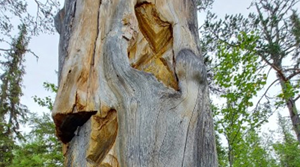
Many trees, both living and dead, and down logs in the Vattme forest have X-marks and geometric patterns carved into their wood. On the south side of Lake Hålgåsjávvre, an old Scots pine tree exhibits an intricate geometric pattern (Figure 5). Approximate dendrochronological analysis indicates that the carving was made before AD 1720, at a time when the animistic pre-Christian religion probably dominated among the Sámi communities in this region. The tree is situated in the centre of an area containing numerous blazed trees and stone markers (typically smaller stones placed on top of large boulders). At other locations within the Vattme area such systems indicate old trap-lines (Josefsson et al. Reference Josefsson, Bergman and Östlund2010b). No oral tradition persists regarding this tree or the meaning of the carvings, suggesting that they relate to conceptions and signals that have now been forgotten. The tree was still alive in 2006 (when it was found), but has since died and a woodpecker has started to destroy the pattern.
Knife cut geometric pattern on a Scots pine near Lake Hålgåsjávvre (photograph by Lars Östlund, Swedish University of Agricultural Sciences).

East of Lake Hålgåsjávvre, the forest includes more than 1000 pine trees with bark-peeling scars (Rautio et al. Reference Rautio, Josefsson and Östlund2014). Scots pine inner bark was an important part of the regular Sámi diet, providing vitamins, carbohydrates and minerals, and was harvested in June/July when the pines were sapping (Bergman et al. Reference Bergman, Östlund and Zackrisson2004). Within the Hålgåsjávvre area, bark peelings cover a time span from AD 1583 to 1995 (Rautio et al. Reference Rautio, Josefsson and Östlund2014). In addition, trees are marked with almost identical geometric patterns at regular intervals within the harvest area (Figure 6, upper right).
Marked Scots pine trees: upper left) a dead tree with an X-mark; upper right) a live tree with a geometric pattern; and below) a down log with a geometric pattern (photographs by Lars Östlund, Swedish University of Agricultural Sciences).

The mountain of Gállakvárre, 5km south of Lake Hålgåsjávvre, reaches nearly 600m above sea level. A series of pine trees with blazes form a semi-circle around the summit. The blazes are plain except for one tree that is marked with double X-marks (Figure 6, upper left). Dendrochronological dating shows that the tree was blazed before AD 1700. There is neither written nor oral information about Gállakvárre marking the boundary between different taxation lands. Furthermore, boundary marks generally consisted of individual marks such as a standing stone, a stone cairn or a blazed tree strategically positioned in the terrain, rather than a semi-circular formation of marked trees.
Discussion
Based on the seventeenth- and eighteenth-century records, the practice of carving cross-marks on värromuora seems to have been an important element in ritual practice, as was smearing X-marks of reindeer blood on wooden sacrificial objects (Schefferus Reference Schefferus1956 [1673]; Leem Reference Leem1975 [1767]; Högström Reference Högström1980 [1747]). Written records also mention that in connection with offerings made to trees, particularly at Christmas, ritual gestures included the carving of X-marked-signs on the trunks of the trees (Högström Reference Högström1980 [1747]). This tradition persisted into recent times, although as a somewhat altered version. The significance of geometric signs in ritual practice, and X-signs in particular, is underlined by the many forms of their expression spanning thousands of years—on rock paintings, stone säjde and in oral tradition—and is confirmed by contemporary observers of the Sámi use of X-signs. These were obviously powerful signs carrying meaning and transmitting coded information.
The significance of Scots pine trees with X-marks and geometric patterns
The Scots pine trees with X-marks and geometric patterns carry an important cultural legacy in the north boreal forest. In prehistoric and historic times, the landscape below the mountains was forested, with Scots pine as the dominant tree species. Individual trees can live for up to at least 700 years (Andersson & Niklasson Reference Andersson and Niklasson2004), and old Scots pine trees carry history across many generations of people living in and utilising northern forest ecosystems (Östlund et al. Reference Östlund, Zackrisson and Hörnberg2002). Pines can survive repeated forest fires and each tree is shaped by the events it has experienced over time, whether it be lightning strikes, severe storms or fungal and insect attacks. They not only provide excellent building material but are also food; the inner-bark formed an important part of the regular diet of the Sámi, and trees with bark peelings bear witness to a harvesting tradition reaching back to prehistoric times (Bergman et al. Reference Bergman, Östlund and Zackrisson2004; Östlund et al. Reference Östlund, Bergman and Zackrisson2004).
According to seventeenth-century records of Sámi religious practice, specific Scots pine trees were the direct objects of veneration and some functioned as mediators of offerings dedicated to deities (Bergman & Östlund Reference Bergman and Östlund2022). In a more secular context, pine trees were blazed using an axe to mark trails or boundaries between different taxation lands. In addition, areas surrounding sacred places could be marked by boundary lines (Schefferus Reference Schefferus1956 [1673]). Traditional Sámi land use covered extensive areas. Reindeer herding, hunting and fishing follow an annual cycle with landscapes changing shape from one season to another. A certain level of knowledge is needed to travel safely in these dynamic environments and prior to modern digital-mapping technologies, geographic points of reference, either man-made or natural features, were crucial for orientating within and navigating through landscapes. In winter landscapes, reference points had to reach above the snow cover and trees with marks would fulfil this requirement. Thus, trees with X-marks or other geometric patterns may be interpreted not only as markers of individual places of specific significance, but also in a wider context of landscape perception and navigation (Dreslerová & Mikuláš Reference Dreslerová and Mikuláš2010; Spry et al. Reference Spry2020; O'Connor et al. Reference ÓConnor2022).
We interpret the culturally marked Scots pine trees on the south and east side of Lake Hålgåsjávvre as markers signifying hunting grounds and harvest sites of an individual hunter or family; the intricate geometric pattern expresses and underlines the spiritual connection to the land. The distribution of blazed trees on the top of the mountain Gállakvárre, particularly given its prominent location, suggests that this was regarded as a holy place. According to a seventeenth-century record, ritual sites on holy mountains included a designated area belonging to the god in question that was marked to prevent women from entering the sacred space (Rheen Reference Rheen and Wiklund1983 [1671]). In a corresponding way, oral accounts from the nineteenth century indicate that trees were blazed to mark sacred areas surrounding certain säjde to prevent women from approaching them (Drake Reference Drake1979 [1918]). Today, Gállakvárre is not known as a holy place but, as the blazes were made more than 300 years ago, before Christianity gained influence, its former meaning may have been lost.
The loss of marked trees: natural processes, traditional land use and modern forestry
The boreal and sub-arctic forests of Fennoscandia are affected by natural eco-system processes including the loss of old trees due to forest fires, wind-throw, insects and wood fungi. The diameter growth of trunks can also encroach on and cover incised markings so that they are not visible anymore. Although dead pines can persist for centuries, they finally decay and any markings they carry will deteriorate beyond interpretability (Figure 6, lower). However, the most crucial threat to old forests and culturally marked trees is posed by historical and current large-scale forestry enterprises. During the latter part of the nineteenth century, a timber-frontier swept over the northern forests of Scandinavia (Östlund & Norstedt Reference Östlund and Norstedt2021). Logging was directed towards the largest and thus oldest Scots pine trees. Although trees with ‘damage’, such as blazes with carvings, were not ideal as timber, they were nevertheless felled if large enough. This high-grading forestry occurred across almost all forests in northern Sweden (including most of the current forest reserves and national parks) and only very limited parts were spared (Cosatti Reference Cosatti2022). In addition, a large number of dead trees were cut for the construction of float-ways on log-driving rivers (Törnlund & Östlund Reference Törnlund and Östlund2002) and the logging of dead trees intensified during both world wars, when there was a general shortage of fuelwood.
Altogether, the large-scale exploitation of old forests during the nineteenth century represented a first step in the loss of culturally marked trees. The second step, which was much more dramatic, started in the mid-twentieth century with the introduction of ‘modern’ forest management characterised by clear cuttings over large areas. All trees in old forests were (and are) cut and replaced by forest plantations. With the exception of national parks or forest reserves in the westernmost areas (mostly low-productivity forests in remote locations), clear-cutting affects most of the traditional Sámi cultural landscape. Forest corporations (state-owned and private) are currently engaged in disputes with nature conservation organisations and Sámi reindeer herding communities over the logging rights of remaining old forests that, despite having been high-graded in the past, still contain old trees. Finally, the culturally modified trees with different marks contained within these landscapes are important witnesses of the Sámi heritage, and are also important legal contributions in the present land disputes in Sápmi (Östlund et al. Reference Östlund, Bergman, Sandström, Brännström and Turner2020). This research contributes to an increased awareness of the uniqueness of low-intensity Indigenous presence and use of northern ecosystems.
Conclusions
As with other Indigenous peoples, traditional Sámi land use is characterised by low-impact socioeconomic strategies and a focus on the long-term maintenance of crucial landscape qualities for subsistence. Culturally marked trees bear silent witness to (pre)historic land use, movement patterns and sacred spaces (Östlund et al. Reference Östlund, Zackrisson and Hörnberg2002; Cummings & Whittle Reference Cummings and Whittle2003; Shutova Reference Shutova2006; Dreslerova & Mikuláš Reference Dreslerová and Mikuláš2010; Spry et al. Reference Spry2020; Bergman & Östlund Reference Bergman and Östlund2022; O'Connor et al. Reference ÓConnor2022). They were a means of internalising cultural landscapes in the past and maintain a role of transmitting cultural values today. We estimate that, prior to the start of the twentieth century, there were thousands of trees with X-marks and other carved-out patterns within the Árjepluovve and Suorssá areas. These trees formed integral parts of the natural environment, but they were also the bearers of coded information about land use, traditions, legal principles, social relations and religious beliefs. Together with features related to the more concrete practices of everyday life, such as dwellings, reindeer corrals and hunting traps, marked trees constituted an aspect of the Sámi cultural landscape. Following the suppression of Indigenous religious practices in the seventeenth century, marked trees were successively removed during the late nineteenth and early twentieth centuries and modern forestry management has seen the fragmentation and loss of Sámi landscapes. As a consequence, the process of transmitting experience and knowledge from generation to generation is being obstructed and the X-marked trees and their contexts are deprived of their significance as the bearers of culture and history. Therefore, there is an urgent need for the documentation, interpretation and protection of all remaining culturally marked trees. This is a responsibility for the forest owners and state agencies, with the aid of local communities in the north.
Acknowledgements
We thank Petter Sjaggo, for providing important information regarding X-marked trees and invaluable help during fieldwork, and Jelle van Zanten, for editing and proof-reading the final draft of the manuscript.
Funding statement
This study was funded by a grant from the Swedish Research Council (2021–02936).


 Open access

