




1. Introduction
As Pusch (Reference Pusch and Deardorff2009) notes, education plays a crucial role in shaping individuals who can skillfully navigate intercultural interactions – a vital ability in today’s globally connected world. The development of intercultural competence (ICC) has long been a focus in education, with researchers primarily approaching it through the lens of language learning (e.g. Bennett, Reference Bennett and Paige1993; Byram, Reference Byram and Byram2008). Responding to the growing need for culturally competent individuals, Zhang (Reference Zhang2007) introduced the concept of “intercultural foreign language education” in China. This reflects a rising demand for graduates who not only possess a global mindset but also understand international norms and engage confidently in cross-cultural exchanges (Huang, Reference Huang2017). Over the past two decades, Chinese scholars have made efforts to promote ICC in foreign language education (e.g. Wu, Fan & Peng, Reference Wu, Fan and Peng2013; Zhang, Reference Zhang2007). However, recent studies continue to highlight gaps in the ICC of Chinese university students (Mu & Yu, Reference Mu and Yu2023).
In parallel, the rise of digital learning has opened new avenues for acquiring language and cultural knowledge. Chinese EFL learners increasingly engage with English through digital platforms and online resources, gaining access to authentic language input and culturally rich contexts – both essential for deepening their understanding of English and its global contexts. Past research has explored the role of self-efficacy in intercultural settings, including its links to communication apprehension (Jing & Zhang, Reference Jing and Zhang2019), intercultural communication (Kabir & Sponseller, Reference Kabir and Sponseller2020), and ICC (Genkova, Schreiber & Fässler, Reference Genkova, Schreiber and Fässler2023). While the relationship between self-efficacy and ICC has been well examined, the role of grit – a learner’s perseverance and passion for long-term goals – remains underexplored. Some studies (e.g. Lee & Lee, Reference Lee and Lee2020; Liu & He, Reference Liu and He2024) have begun to investigate how L2 grit might influence willingness to communicate (WTC) and ICC, but comprehensive insights into this connection are lacking.
At the same time, a growing body of research points to the positive effects of informal digital learning of English (IDLE) on ICC. For example, Liu, Ma, Bao and Liu (Reference Liu, Ma, Bao and Liu2025) found that engaging in IDLE activities enables Chinese college students to improve both their language proficiency and cultural awareness, better preparing them for intercultural encounters. Despite these findings, the intersection of IDLE and ICC remains insufficiently studied in the Chinese context. Even less is known about how positive psychology constructs, such as self-efficacy and grit, interact with IDLE to shape ICC.
To address these gaps, this study investigates the relationships among L2 self-efficacy, L2 grit, IDLE, and ICC among Chinese EFL students. Using an explanatory mixed-methods design that combines quantitative survey data with qualitative interviews, this research seeks to uncover how these psychological traits and informal learning behaviors collectively contribute to the development of ICC. In doing so, it aims to offer a richer and more holistic understanding of how Chinese learners prepare for intercultural communication in the digital age.
2. Literature review
2.1. L2 grit and L2 self-efficacy
Grit, as defined by Duckworth, Peterson, Matthews and Kelly (Reference Duckworth, Peterson, Matthews and Kelly2007: 1087), is the “perseverance and passion for long-term goals” – the capacity to stay committed and enthusiastic even when faced with setbacks. It includes two core components: perseverance of effort (POE), which reflects one’s sustained effort toward long-term goals, and consistency of interest (COI), which refers to maintaining focus over time despite challenges. Research by Credé, Tynan and Harms (Reference Credé, Tynan and Harms2017) suggests that POE is a stronger predictor of academic success than COI, even after accounting for traits like conscientiousness. As a result, some studies (e.g. Lee, Reference Lee2022a; Lee & Lee, Reference Lee and Lee2020) prioritize POE as a more reliable indicator in educational settings.
When applied to second language acquisition, L2 grit is seen as a vital personality trait among successful learners – marked by persistent effort and deep motivation to master a new language (Teimouri, Plonsky & Tabandeh, Reference Teimouri, Plonsky and Tabandeh2022). Learners who demonstrate higher levels of grit are more likely to thrive in language learning environments, positioning L2 grit as a critical individual difference variable (Yang, Azari Noughabi & Jahedizadeh, Reference Yang, Azari Noughabi and Jahedizadeh2024). Previous research has linked L2 grit with related psychological constructs, including motivation (e.g. Alamer, Reference Alamer2021), growth mindset (Teimouri et al., Reference Teimouri, Plonsky and Tabandeh2022), and WTC in a second language (e.g. Lee & Lee, Reference Lee and Lee2020). Yet, despite its promising potential, L2 grit remains an emerging area of inquiry with many aspects still to be explored (Shirvan, Taherian & Yazdanmehr, Reference Shirvan, Taherian and Yazdanmehr2022).
Self-efficacy – the belief in one’s capacity to succeed in specific tasks (Bandura, Reference Bandura1997) – is another foundational factor in language learning. Numerous studies underscore the role of L2 self-efficacy in influencing learners’ confidence and performance (e.g. Todaka, Reference Todaka2016). Notably, researchers have started examining how self-efficacy interacts with L2 grit. For instance, Zheng, Heydarnejad and Aberash (Reference Zheng, Heydarnejad and Aberash2022) highlighted how both traits contribute to emotional regulation, which in turn enhances learning outcomes. Yang et al. (Reference Yang, Azari Noughabi and Jahedizadeh2024) found that learners with higher self-efficacy are more likely to display stronger L2 grit, reinforcing resilience in demanding academic environments. However, while these findings suggest a meaningful link between the two constructs, the direct pathway from L2 self-efficacy to L2 grit remains underexplored. Based on these insights, this study proposes the following hypothesis:
H1: L2 self-efficacy is positively related to L2 grit.
2.2. IDLE and L2 grit
Soyoof, Reynolds, Vazquez-Calvo and McLay (Reference Soyoof, Reynolds, Vazquez-Calvo and McLay2023) have called for greater attention to out-of-classroom practices like IDLE. IDLE, as defined by Lee (Reference Lee2022b), refers to self-directed activities conducted in informal digital environments, driven by personal interests and not subject to formal assessment by an English teacher. IDLE activities are often categorized into productive IDLE activities (PIA) and receptive IDLE activities (RIA) (Lee & Drajati, Reference Lee and Drajati2019). Previous studies (e.g. Lee & Drajati, Reference Lee and Drajati2019; Liu et al., Reference Liu, Ma, Bao and Liu2025) have shown a positive correlation between PIA and RIA, suggesting that engagement in receptive activities (e.g. watching English media and reading digital materials) often leads to participation in productive activities (e.g. speaking and writing in English online).
Recent research has increasingly explored the link between L2 grit and IDLE. Barkati, Kiyanfar, Noughabi and Ershadi (Reference Barkati, Kiyanfar, Noughabi and Ershadi2025) identified a positive relationship between L2 grit and overall engagement in IDLE – covering both receptive and productive activities – among Iranian EFL learners. In a similar vein, Lee and Drajati (Reference Lee and Drajati2019) found that Indonesian EFL students with higher grit levels were more actively engaged in both types of IDLE. They also observed that participation in receptive IDLE was positively related to productive IDLE. Despite these encouraging findings, research in this area remains scarce, particularly among Chinese EFL learners. To address this gap, the following hypotheses focus on Chinese EFL students:
H2: L2 grit is positively related to PIA.
H3: L2 grit is positively related to RIA.
H4: RIA is positively related to PIA.
2.3. L2 grit and ICC
There is no universally accepted definition of ICC (Deardorff, Reference Deardorff2006). While ICC should encompass various values in diverse cultures, its key elements – knowledge, attitudes, skills, and awareness – are generally recognized, with many researchers agreeing that these dimensions must exist for effective ICC (e.g. Deardorff, Reference Deardorff2006; Wu et al., Reference Wu, Fan and Peng2013). In China, due to a shortage of intercultural talents, Zhang (Reference Zhang2007) introduced the concept of “intercultural foreign language education,” which aims to enhance learners’ foreign language communication skills while fostering their intercultural communication abilities and overall literacy. Over the past decades, Chinese scholars have worked to improve students’ ICC in foreign language education (e.g. Wu et al., Reference Wu, Fan and Peng2013; Zhang, Reference Zhang2007).
Although research on self-efficacy and ICC is extensive (e.g. Genkova et al., Reference Genkova, Schreiber and Fässler2023; Jing & Zhang, Reference Jing and Zhang2019), studies on grit and ICC are still limited. Lee (Reference Lee2022a) explores how grit affects students’ L2 WTC, offering insights into L2 grit and ICC. Liu and He (Reference Liu and He2024) emphasize the importance of L2 grit on ICC, focusing on how L2 grit influences digital WTC, which in turn affects ICC. These findings support the hypothesis that L2 learners with higher levels of grit are more likely to engage in digital and informal language communication, ultimately enhancing their ICC. As a result, the following hypothesis is formed with Chinese EFL students:
H5: L2 grit is positively related to ICC.
2.4. IDLE and ICC
Intercultural communication in an online context has become the norm at all levels of our lives due to globalization in the digital age (Friedman, Reference Friedman2005). In light of this, there have been calls for learners to develop skills as proficient L2 speakers in online multilingual and multicultural settings (Porto, Houghton & Byram, Reference Porto, Houghton and Byram2018). In addition, intercultural understanding can occur in the evident intercultural exchanges overseas and “at home” through the virtual online intercultural exchange (O’Dowd, Reference O’Dowd2007). With the application of virtual exchange (e.g. Çolak & Balaman, Reference Çolak and Balaman2022), 3D contextual interactive games (e.g. Zhang, Goodman & Gu, Reference Zhang, Goodman and Gu2022), digital storytelling (e.g. Oakley, Pegrum, Xiong, Lim & Yan, Reference Oakley, Pegrum, Xiong, Lim and Yan2018), and other various digital ways, online intercultural communication is developing fast under this context. By accessing online resources that challenge stereotypes and cultural norms, students can be encouraged to recognize multicultural and multilingual realities that are often overlooked in formal education (Larsen-Freeman, Reference Larsen-Freeman2018). Supporting this, Liu et al. (Reference Liu, Ma, Bao and Liu2025) found a positive relationship between IDLE and intercultural communicative competence among 1,490 Chinese EFL students. However, their study did not distinguish how RIA versus PIA individually contributed to ICC. Therefore, the following hypotheses are proposed, focusing on Chinese EFL learners:
H6: PIA is positively related to ICC.
H7: RIA is positively related to ICC.
2.5. Conceptualizing the model through the broaden-and-build theory
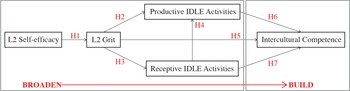
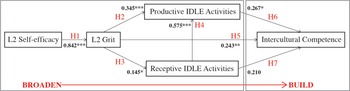
Fredrickson’s (Reference Fredrickson1998, Reference Fredrickson2001) broaden-and-build theory provides a compelling lens to interpret the proposed relationships among L2 self-efficacy, grit, IDLE engagement, and ICC. According to this theory, positive emotions broaden individuals’ momentary thought–action repertoires, encouraging them to explore new ideas, actions, and social bonds (“broaden”), which over time helps them develop enduring personal and social resources (“build”). Applying this framework to the current study, learners with high L2 self-efficacy (H1) are more likely to demonstrate L2 grit, reflecting a broadened mindset toward challenges and sustained effort. This grit then drives learners to actively engage in informal digital learning environments, leading to greater participation in both productive (H2) and receptive (H3) IDLE activities. Moreover, the broadened engagement in receptive IDLE is expected to support productive output (H4), showing how digital input can scaffold output. Over time, these sustained engagements “build” higher-order communicative resources, such ICC (H5–H7). In this way, the broaden-and-build theory offers a cohesive explanation of how emotional and motivational resources catalyze language learning and intercultural development through informal digital practices. This conceptual model is illustrated in Figure 1.
Conceptual model.

3. Methodology
3.1. Participants and context
The participants consist of 416 Chinese EFL students (85.8% female). Most participants are first-year (42.8%, 178) and second-year (35.3%, 147) students, with fewer in their third (17.3%, 72) and fourth (4.6%, 19) years. The mean age is 19.58 years, with a standard deviation of 1.36, and most fall within the 18 to 20 age range. With ethical review committee approval (Ref. no. 2022-2023-0346), we used purposeful sampling to recruit Chinese EFL students from one university in Guangzhou. All participants had passed China’s National College Entrance Examination (Gaokao), demonstrating a foundational proficiency in English listening, speaking, reading, and writing. None of them had lived abroad for an extended period, and their educational background was exclusively shaped by the Chinese academic system. The participants were recruited through WeChat (a multifunctional social media and communication app in China). All the participants in the questionnaires were volunteers and were invited into a WeChat group and given necessary information and appreciation.
3.2. Explanatory mixed-methods approach
To gain a well-rounded understanding of the research questions, this study adopts an explanatory mixed-methods design (Greene, Caracelli & Graham, Reference Greene, Caracelli and Graham1989). This approach blends the strengths of both quantitative and qualitative methods to explore not only what is happening but also why it happens. The quantitative phase captures measurable patterns, such as how often, how strongly, or how long certain behaviors occur, through structured questionnaires. These results are then deepened in the second phase through semi-structured interviews, which offer rich insights into the learners’ thoughts, values, and motivations (Castleberry & Nolen, Reference Castleberry and Nolen2018). By first identifying trends and then unpacking the personal stories behind them, this two-phase design helps bring the data to life with both breadth and depth.
3.2.1. Questionnaire
The survey was divided into five parts: (a) demographic information, including gender, age, academic year; (b) L2 self-efficacy; (c) L2 grit; (d) IDLE; and (e) intercultural communication competence.
The L2 self-efficacy questionnaire, adapted from Zadorozhnyy and Lee (Reference Zadorozhnyy and Lee2025), included four items (α = .88), such as “I’m confident I can become proficient in English with enough effort and practice.” Responses were rated from 1 (strongly disagree) to 5 (strongly agree) on a 5-point Likert scale.
The L2 grit questionnaire, based on Lee (Reference Lee2022a), also features four items (α = .81), such as “I work hard to learn English.” A 5-point Likert scale ranging from 1 (strongly disagree) to 5 (strongly agree) was employed.
The IDLE questionnaire, drawing from Lee and Drajati (Reference Lee and Drajati2019), is divided into two subscales: (a) receptive IDLE (n = 4, α = .76; e.g. “I read content written in English on digital devices [e.g. phone, computer, pad]”) and (b) productive IDLE (n = 4, α = .86; e.g. “I communicate orally with others in English on digital devices [e.g. phone, computer, pad]”). Likert-type scales ranging from 1 (never) to 6 (very often) were employed.
Lastly, the ICC questionnaire, revised from Peng, Wu and Fan (Reference Peng, Wu and Fan2015), consists of 15 items (α = .88), such as “Understanding native history.” Participants responded using a 5-point Likert scale ranging from 1 (very low) to 5 (very high).
3.2.2. Semi-structured interview
To gain deeper insight into the quantitative results, follow-up semi-structured interviews were conducted in Chinese. To ensure linguistic accuracy and cultural relevance, the English-to-Chinese translations of the interview questions were reviewed by three experienced English teachers. Interviews were held online via Tencent Meeting, providing a convenient and comfortable platform for student participants. With their consent, each session, lasting approximately 30 minutes, was recorded for later analysis. In total, 15 students (three males and 12 females) volunteered to take part, each responding to around 10 open-ended questions. To thank them for their time and input, each participant received a 60-yuan incentive.
4. Data analysis
SPSS and R’s lavaan package (Rosseel, Reference Rosseel2012) were employed to analyze data collected from the questionnaire. SPSS was employed to present demographic information including age, the percentage of male and female participants, and the percentage of participants from grade one to four. The lavaan package in R was used to conduct confirmatory factor analysis (CFA) with maximum likelihood robust (MLR) estimation. Last, structural equation modeling (SEM) was used to test the hypothesized model. Subsequently, the model evaluation was conducted by assessing the chi-square to degrees of freedom ratio (χ2 /df), comparative fit index (CFI), root-mean-square error of approximation (RMSEA), and standardized root-mean-square residual (SRMR). In light of our sample size (n = 416), the number of observed variables (m = 31), and the model fit indices guidelines established by Hair, Tatham, Anderson and Black (Reference Hair, Tatham, Anderson and Black1998), a model is considered to be well fitting if the chi-square to degrees of freedom ratio is less than 3, CFI and Tucker–Lewis index (TLI) exceed .90, RMSEA is less than .07, and SRMR is equal to or less than .08. In addition, we employed 5,000 bootstrapping resamples with a 95% confidence interval to assess the indirect paths, following the methodology suggested by Preacher and Hayes (Reference Preacher and Hayes2008).
For the follow-up qualitative phase, deductive thematic analysis was carried out using Boyatzis’s (Reference Boyatzis1998) three-stage framework. Two independent external coders analyzed the data separately, and any disagreements were resolved through discussion, resulting in over 90% intercoder agreement. To address potential researcher bias – since the researcher also conducted the interviews and analyzed the data (Miles & Huberman, Reference Miles and Huberman1994) – all transcripts were returned to the participants for member checking, ensuring the accuracy and trustworthiness of the findings.
4.1. Quantitative findings
4.1.1. Initial analysis
To begin the process, the initial focus was on examining the data to identify and eliminate any outliers, errors, or participant misconduct that could potentially affect the subsequent analysis (Collier, Reference Collier2020). Initially, we collected 428 questionnaires, all complete with no missing data. After removing outliers (identified with the Z-score method) and questionnaires with 80% repetitive answers, we reserved 416 effective questionnaires. All items displayed skewness and kurtosis well within the recommended limits of |3.0| and |8.0| (Kline, Reference Kline2015), confirming that the data were normally distributed. The mean scores for L2 self-efficacy items fell between 3.65 and 3.86, with standard deviations ranging from 0.78 to 0.85. L2 grit items showed means from 3.25 to 4.18 and standard deviations between 0.76 and 0.92. For receptive IDLE, means ranged from 3.04 to 3.36 (SD = 1.01–1.07), while productive IDLE items had means from 1.93 to 2.46 (SD = 0.94–0.97). Regarding ICC components, “knowledge of self” items reported means of 3.81 to 4.05 (SD = 0.77–0.83), “knowledge of others” items ranged from 2.75 to 2.88 (SD = 0.92–0.95), “intercultural communicative skills” items spanned from 2.88 to 3.92 (SD = 0.80–1.11), and “intercultural cognitive skills” items ranged from 3.17 to 3.36 (SD = 0.84–0.86). These results illustrate consistent distributions and provide a clear picture of participants’ responses across all measured constructs.
4.1.2. Validity and reliability checks
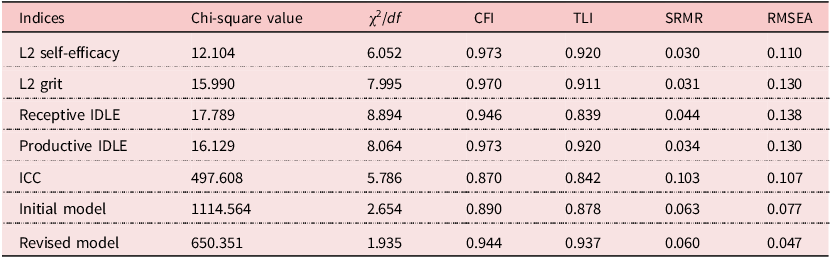
The original questionnaire consisted of 31 items, each measuring one of the constructs: L2 self-efficacy (4 items, with factor loadings ranging from 0.78 to 0.85), L2 grit (4 items, loadings from 0.64 to 0.79), receptive IDLE activities (4 items, loadings from 0.63 to 0.74), productive IDLE activities (4 items, loadings from 0.71 to 0.85), and intercultural competence (15 items, loadings from 0.26 to 0.94). To assess the validity of each scale, separate CFAs were conducted for each construct. Detailed results, including the range of factor loadings and model fit indices, are presented in Table 1.
CFA fit indices for the constructs, initial and revised models

Note. CFA = confirmatory factor analysis; CFI = comparative fit index; TLI = Tucker–Lewis index; SRMR = standardized root-mean-square residual; RMSEA = root-mean-square error of approximation; IDLE = informal digital learning of English; ICC = intercultural competence.
We preserved the items with standardized factor loadings above 0.6 and deleted the items with low factor loadings. Upon examination, it was determined that ICC1, ICC2, and ICC6 did not meet the desired factor loading criteria and therefore were eliminated. There are 28 final items for the eight constructs. The fit indices of the revised model are presented in Table 1. All the models were estimated using MLR to account for potential non-normality. Although the separate CFA for individual constructs and the initial model did not demonstrate satisfactory model fit, the revised model demonstrated significantly improved fit after removing items with factor loadings below 0.6.
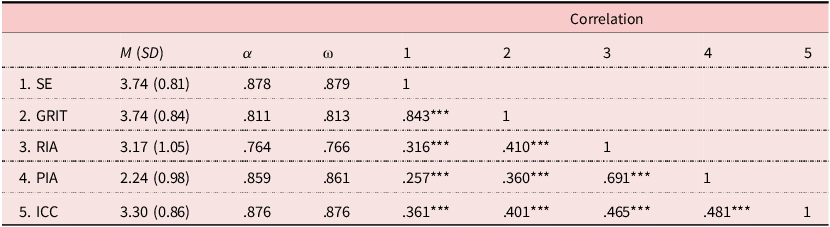
The removal of low factor loadings serves as a crucial basis for conducting subsequent SEM analysis and mediation analysis. Table 2 presents descriptive statistics and correlations. The α-values and ω-values for the eight constructs exceeded the recommended threshold value of .7. This confirms satisfactory internal consistency, with all indicators exceeding the threshold, demonstrating reliability. Although the correlation between self-efficacy and grit (r = .843) was relatively high, further analysis indicated no concern for multicollinearity. Variance inflation factors for all variables remained well below the commonly accepted threshold of 5, confirming that these correlations did not adversely affect the model.
Descriptive statistics and correlations (n = 416)

Note. SE = L2 self-efficacy; GRIT = L2 grit; RIA = receptive IDLE activity; PIA = productive IDLE activity; ICC = intercultural competence.
***p < .001. **p < .01. *p < .05.
4.1.3. Model testing
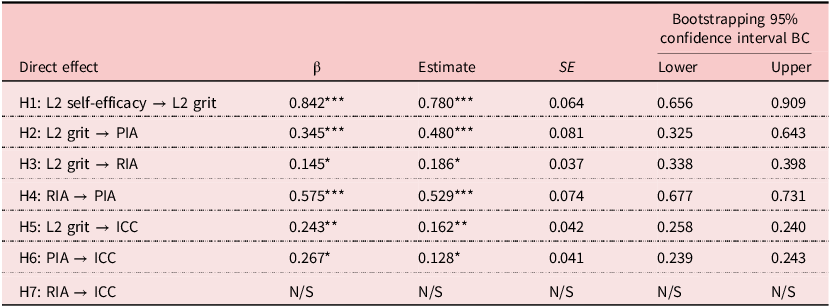
As is presented in Table 3, the final model’s fit indices indicated a strong alignment with the data and satisfied the suggested criteria. Figure 2 presents the results of SEM of the mediation model. The path estimates for the structural models are presented in Table 4. To assess the proposed relationships between the latent constructs, we used standardized coefficients (β), significance levels, and standard errors (SE).
Goodness-of-fit indices of the final model

Note. CFI = comparative fit index; TLI = Tucker–Lewis index; SRMR = standardized root-mean-square residual; RMSEA = root-mean-square error of approximation; N/S = non-significance.
The final version of the research model
***p < .001. **p < .01. *p < .05.

Path estimates of the model

Note. β = standardized coefficients; SE = standard errors; N/S = non-significance.
***p < .001. **p < .01. *p < .05.
The analysis revealed that L2 self-efficacy had a strong positive effect on L2 grit (β = 0.842***, SE = 0.064), supporting H1. L2 grit, in turn, significantly predicted both PIA (β = 0.345***, SE = 0.081) and RIA (β = 0.145*, SE = 0.037), confirming H2 and H3. RIA also positively influenced PIA (β = 0.575***, SE = 0.074), validating H4. Additionally, L2 grit showed a significant positive relationship with ICC (β = 0.243**, SE = 0.042), supporting H5. PIA further contributed positively to ICC (β = 0.267*, SE = 0.041), affirming H6. However, the link between RIA and ICC was not statistically significant, leading to the rejection of H7.
4.2. Qualitative findings
In line with the explanatory mixed-methods design, we purposefully selected qualitative insights that directly complement the quantitative findings, particularly those supporting Hypotheses H1 through H6. Since the data collection did not specifically explore the rejected hypothesis (H7), we addressed this non-significant relationship in the discussion using previous research as supporting context.
4.2.1. H1: L2 self-efficacy → L2 grit
The interviews revealed a strong, direct link between learners’ self-efficacy, defined as their belief in their own ability to succeed, and the development of grit, or their determination to keep learning English despite obstacles. Students described how feeling confident gave them the emotional fuel to persist:
With greater confidence, you may also become grittier and motivated to keep learning. Before entering high school, my academic performance was below average. During one summer vacation, I made an effort to practice reading every day, even if it was just small passages. After the break, my grades improved significantly, and I even ranked among the top students in the class. Many of my classmates were impressed by my change. This experience boosted my belief in learning well and made me more willing to learn. (Judy)
Regarding the relationship between self-efficacy and grit, I believe there is a strong connection. Only when I am mentally convinced that I can learn something well will I have the motivation to persist. Therefore, self-efficacy plays a very important role for me. (Wendy)
4.2.2. H2 and H3: L2 grit → PIA and RIA
The interviews revealed how learners’ L2 grit, reflected in their perseverance and sustained effort, actively shaped their engagement in IDLE activities. Students described how their determination pushed them to explore various forms of IDLE, such as watching TV shows, using language apps, and seeking interaction with native speakers, even when facing setbacks or limited immediate results:
I agree that grit has helped me expand my informal learning practices. I practice English every day by watching American TV shows and studying authentic expressions. Even when I don’t get replies from native speakers on HelloTalk, I keep trying because I’m determined to improve. (Molly)
I think perseverance does have an impact. Activities like listening to music or watching movies are naturally entertaining, so I’m willing to do them on my own. I often look for films that interest me, sometimes even less popular ones. When I want to improve my listening skills, I tend to watch the same parts multiple times if I don’t understand them at first. I feel I’ve learned a lot through this process, and it also reflects the influence of grit. (Dora)
Yes, I believe that perseverance is key to making the most of IDLE. I use apps like Duolingo and watch foreign movies to improve my English. When I feel tired, I push myself to keep learning because I know it will pay off in the long run. (Bonnie)
4.2.3. H4: RIA → PIA
The interviews demonstrated a direct link between learners’ receptive IDLE and the development of productive IDLE. Students described how accumulated input gave them the linguistic resources and confidence to produce language naturally:
These two types of activities are closely connected. I believe that receptive IDLE activities serve as a knowledge reservoir for productive ones. The vocabulary, grammar, and authentic expressions learned and accumulated through receptive activities directly influence the accuracy and fluency of productive tasks such as writing, translation, and speaking. (Cara)
There is an impact. Based on my daily learning experience, receptive IDLE through watching TV shows, listening to songs, and reading articles has helped me accumulate a lot of language input. For example, when I watch American TV series, I naturally remember common vocabulary and expressions after hearing and seeing them repeatedly. Later, when chatting with people, I sometimes use these phrases without even thinking. (Anne)
Receptive IDLE input provides both linguistic resources and confidence for productive output. It helps me develop a sense of language, accumulate diverse ways of expression, and reduce my psychological barriers to speaking. It feels like filling a reservoir – the more input I store, the more naturally and fluently the output flows. (Bonnie)
4.2.4. H5: L2 grit → ICC
The interviews revealed a clear connection between learners’ L2 grit and the development of ICC. Students described how their perseverance helped them persist in understanding unfamiliar cultural behaviors and communication styles, even when facing misunderstandings and cultural barriers. Their grit provided the motivation to seek out resources and learning opportunities to bridge cultural gaps:
I think it does have an impact because of my interactions with foreigners. My learning, especially in terms of language, relies on my perseverance. If I can’t communicate smoothly or fully understand their culture, regardless of different cultural backgrounds, I will keep striving to understand their culture. So, even though I don’t understand it at first, I want to learn more about it. The challenges posed by my interactions with them make me feel that I need to constantly learn through perseverance. (Mary)
I think grit has an impact. In my process of learning about different cultures, there are many times when I struggle to understand certain language expressions or behaviors because we don’t share the same cultural background. Sometimes it’s really difficult to grasp their ways of speaking or acting. When this happens, I try to use different learning resources to better understand their cultural differences. Even when I face challenges, I feel it’s my perseverance that drives me to keep exploring and seeking explanations for these differences, so I can better understand the cultural gap between us. (Dora)
4.2.5. H6: PIA → ICC
The interviews demonstrated that PIA contributed meaningfully to their developing ICC. Students described how engaging in real-time conversations with foreigners, adapting their language use for cultural appropriateness, and building personal language corpora helped them better understand cultural differences, enhance their communication flexibility, and improve their sensitivity to diverse cultural norms:
For productive IDLE activities, I usually use social apps where I can chat with foreigners through text. By engaging in conversations with them, I improve my English expression skills. During these chats, we talk about various aspects of daily life, which helps me learn about different countries’ policies, cultures, daily habits, and even religious beliefs. Having foreigners personally share their life experiences allows me to better understand and respect their cultures, and it broadens my horizons, enhancing my intercultural competence. For example, when chatting with a girl from the Philippines, I learned that many Filipinos are multilingual due to their historical background. I also discovered that some Filipinos have the habit of eating with their hands. (Lily)
Productive types of informal digital English learning have helped me communicate more appropriately and flexibly in English, enhancing my cultural sensitivity in expression. For example, I’ve learned to use phrases like “I’d love to, but …” instead of simply saying “No,” making my responses not just grammatically correct but also culturally appropriate. In addition, these experiences have improved my ability to understand diverse accents and strengthened both my listening skills and adaptability in communication. (Ella)
Productive IDLE has helped me become more familiar with the language used in intercultural communication, including daily spoken expressions, grammatical usage, and translation between Chinese and English. Over time, I have also built my own personal corpus of useful language resources through these experiences. (Molly)
5. Discussion
Unlike earlier studies that examined components of ICC in isolation (e.g. Liu et al., Reference Liu, Ma, Bao and Liu2025), this study offers a holistic analysis of how L2 self-efficacy, L2 grit, and IDLE work together to influence ICC among Chinese EFL learners, integrating both quantitative and qualitative evidence.
First, L2 self-efficacy significantly predicts L2 grit (H1). Qualitative evidence illustrates how students’ belief in their language abilities gives them the confidence to persevere through difficulties. As Judy shared, gaining self-efficacy through progress made her more determined to keep learning, demonstrating how self-efficacy fuels grit. This mechanism is explained by Bandura’s (Reference Bandura1997) theory of self-efficacy. When learners believe they can succeed at specific language tasks, they are more likely to invest sustained effort and remain resilient in the face of setbacks. Fredrickson’s (Reference Fredrickson1998, Reference Fredrickson2001) broaden-and-build theory also offers a complementary lens: a strong sense of self-efficacy generates the positive emotions that “broaden” a learner’s mindset, allowing them to “build” the enduring personal resource of grit. Consequently, learners with high self-efficacy do not just hope to succeed; they are equipped to endure the journey required to do so. This finding echoes earlier work (Sun & Mu, Reference Sun and Mu2023; Yang et al., Reference Yang, Azari Noughabi and Jahedizadeh2024; Zheng et al., Reference Zheng, Heydarnejad and Aberash2022), reinforcing the pivotal role of self-efficacy in nurturing persistent learning behavior – or grit – among EFL students.
Second, L2 grit is positively associated with both receptive and productive IDLE engagement (H2 and H3). Qualitative narratives illustrated how students with high grit consistently pursued informal English learning, such as watching English media, using language apps, or practicing with native speakers online, despite obstacles. As Dora described, grit enhances IDLE by motivating learners to persistently engage with challenging content, such as rewatching movie scenes multiple times, thereby turning entertainment into effective learning. This process is explained by the two core components of grit, as defined by Duckworth et al. (Reference Duckworth, Peterson, Matthews and Kelly2007). Learners with higher L2 grit possess perseverance of effort – the sustained drive to work toward long-term goals – and consistency of interest – the ability to maintain focus and passion over years, not just weeks. Together, these traits enable students to persistently engage with English through diverse digital activities. This finding aligns with the established view of L2 grit as a critical trait for success in language learning (Teimouri et al., Reference Teimouri, Plonsky and Tabandeh2022). Furthermore, the mechanism can be understood through Fredrickson’s (Reference Fredrickson1998, Reference Fredrickson2001) broaden-and-build theory. The positive emotions associated with grit essentially broaden a learner’s mindset, making them more likely to explore and build skills through a wider range of IDLE activities. While previous studies in other contexts have hinted at this relationship (e.g. Barkati et al., Reference Barkati, Kiyanfar, Noughabi and Ershadi2025; Lee & Drajati, Reference Lee and Drajati2019), this evidence compellingly extends it to the population of Chinese EFL learners.
Third, we found a significant positive link between receptive IDLE (e.g. watching, listening, reading) and productive IDLE (e.g. speaking, writing), supporting H4. Interview data supported this connection, showing that passive exposure often led to more active language use. As Anne demonstrated, receptive IDLE through watching shows and reading naturally translates into productive IDLE, with vocabulary and grammar patterns emerging effortlessly in her speech and writing. This is in line with Lee, Kiaer and Jeong (Reference Lee, Kiaer and Jeong2025), who reported that Korean language learners transitioned from binge-watching K-dramas to actively using the expressions they picked up with native speakers online. Similarly, previous work with Indonesian EFL learners (Lee & Drajati, Reference Lee and Drajati2019) showed this input–output progression, but our study provides the first evidence of this pattern among Chinese learners.
Fourth, L2 grit was positively linked to ICC (H5). Qualitative insights reinforced these quantitative results, revealing how L2 grit actively supports the development of ICC. As Mary’s experience illustrates, L2 grit cultivates ICC by motivating learners to persistently decode unfamiliar cultural behaviors, overcome communication barriers, and work through misunderstandings. This suggests that students who persisted through linguistic and cultural challenges reported deeper engagement in cross-cultural interactions. As intercultural interactions often require quick thinking and navigating complex situations, maintaining motivation and flexibility is crucial (Deardorff, Reference Deardorff2006; Wu et al., Reference Wu, Fan and Peng2013). Learners with high L2 grit tend to possess perseverance of effort – the unwavering commitment to pursue long-term goals – and consistency of interest – the ability to remain focused and passionate over extended periods (Duckworth et al., Reference Duckworth, Peterson, Matthews and Kelly2007; Teimouri et al., Reference Teimouri, Plonsky and Tabandeh2022). These qualities may enable EFL students to fully participate in intercultural communication and strengthen their competence. Significantly, while earlier studies (e.g. Lee, Reference Lee2022a; Liu & He, Reference Liu and He2024) explored grit’s indirect links to WTC or ICC, our findings present direct empirical evidence that students with higher grit are better equipped to navigate and thrive in intercultural settings.
Fifth, a significant relationship was found between productive IDLE and ICC (H6). This suggests that learners who actively used English online, whether by joining digital communities, engaging in real-time conversations, or exchanging cultural perspectives, frequently immersed themselves in intercultural experiences. According to Fredrickson’s (Reference Fredrickson1998, Reference Fredrickson2001) broaden-and-build theory, such productive IDLE not only encourages genuine participation in cross-cultural exchanges but also gradually fosters ICC over time. Qualitative accounts further illustrate this connection. For example, Lily described how chatting with foreigners on social platforms gave her firsthand insight into different cultural traditions, beliefs, and lifestyles, which greatly enhanced her intercultural understanding. While Liu et al. (Reference Liu, Ma, Bao and Liu2025) found a general link between IDLE and ICC, they did not distinguish between receptive and productive activities. By contrast, our study makes this distinction and provides nuanced evidence that productive IDLE, in particular, plays a vital role in promoting intercultural growth.
Lastly, we did not find a significant link between receptive IDLE and ICC, thus rejecting H7. While receptive activities can enhance cultural awareness and sensitivity by exposing learners to diverse perspectives, this does not necessarily translate into communicative competence. ICC requires interactive, experiential engagement with speakers from different cultural backgrounds – something that receptive input alone cannot provide. It is important to note, however, that our measure of ICC relied on self-reported surveys, which may not have fully captured its complexity. To strengthen these findings, future research should consider using more robust tools or methods to assess ICC in greater depth.
To interpret these interconnected relationships, Fredrickson’s (Reference Fredrickson1998, Reference Fredrickson2001) broaden-and-build theory offers a conceptual framework. The theory posits that positive emotions expand individuals’ attention and engagement (broaden), which in turn cultivates long-term personal and social resources (build). Applied to this study, learners with higher L2 self-efficacy are more likely to adopt a resilient mindset (L2 grit), pushing them to explore and persist in informal learning environments. This sustained engagement supports both receptive and productive language use, which eventually builds higher-order communicative skills like ICC. Notably, the theory also explains the gap found in H7: while passive input broadens awareness, it is intentional, active participation that ultimately builds ICC.
In summary, our study contributes a comprehensive model linking motivation, informal learning, and intercultural development, offering both theoretical depth and practical insights for supporting Chinese EFL learners in digitally mediated environments.
6. Implications and limitations
This study offers theoretical insights into the complex connections between L2 self-efficacy, L2 grit, IDLE (PIA and RIA), and ICC in Chinese EFL learners. This research uses a mixed-methods approach to analyze the relationship between psychological traits and IDLE practices in ICC, combining quantitative data with qualitative insights. Quantitative data shows the relationships, while qualitative insights explain the mechanism. This emphasizes the value of a mixed-methods approach in understanding learners’ experiences and validating theories related to IDLE activities. The qualitative data enriches the theoretical understanding by illustrating how L2 grit drives continuous engagement in both RIA and PIA, enhancing ICC in the end. This research enhances the theoretical understanding of L2 self-efficacy, L2 grit, IDLE activities, and ICC among Chinese EFL learners through a mixed-methods approach. The study also demonstrates that the principles of the “broaden-and-build theory of positive emotions” are applicable to the field of positive psychology in L2 acquisition.
Pedagogically, this study emphasizes the need to cultivate positive psychological traits in language education and encourage Chinese EFL learners to participate in IDLE activities. By focusing on cultivating L2 self-efficacy and L2 grit, and by introducing balanced and diverse IDLE activities, educators could enhance Chinese EFL learners’ language skills and promote their ICC development. These pedagogical strategies help L2 learners effectively engage in a globalized world by encouraging intercultural communicative skills and valuing intercultural diversity.
Our study has a few limitations that offer directions for future research. First, our participants were over 400 Chinese EFL learners from a single university. Although this is a sizable sample, the lack of diversity in institutional backgrounds means our findings might not fully represent the wider population of EFL learners in China. Future studies should include participants from a variety of regions and institutions to enhance generalizability. Second, the gender distribution in our sample was notably uneven, with females (n = 357) greatly outnumbering males (n = 59). This imbalance was also evident in the semi-structured interviews (12 females compared to three males). Future research would benefit from a more balanced gender representation to provide a broader perspective on the findings. Lastly, our assessment of ICC relied on self-reported surveys, which might not have captured the full complexity of this construct. To gain deeper insights, future studies should employ more comprehensive tools or methods for measuring ICC.
7. Conclusion
This study investigated the relationship between positive psychology and intercultural communicative competence among Chinese EFL learners, with IDLE acting as a mediator. SEM supported six out of seven hypotheses. Specifically, L2 self-efficacy was found to significantly predict L2 grit, which in turn was positively associated with both receptive and productive IDLE engagement. Receptive IDLE activities (e.g. watching, listening, reading) were positively linked to productive ones (e.g. speaking, writing), and both L2 grit and productive IDLE were significantly related to ICC. However, no significant relationship was found between receptive IDLE and ICC. These quantitative findings were further enriched by qualitative data, offering deeper insights into learners’ experiences and perspectives.
The study was framed by Fredrickson’s broaden-and-build theory, which suggests that positive emotions expand individuals’ attention and engagement, ultimately building lasting personal and social resources. In this context, learners with higher L2 self-efficacy are more likely to develop L2 grit, enabling them to persist in informal learning environments. This sustained engagement supports both receptive and productive language use, which contributes to the development of ICC. Pedagogically, the findings highlight the importance of fostering positive psychological traits in language education and promoting diverse IDLE activities. By cultivating L2 self-efficacy and grit, educators can help EFL learners enhance their language proficiency and ICC, preparing them to thrive in a globalized world.
Supplementary material
To view supplementary material for this article, please visit https://doi.org/10.6084/m9.figshare.30446192
Data availability statement
Data not available due to privacy/ethical restrictions.
Authorship contribution statement
Jiana Liu: Writing – original draft, Data curation, Formal analysis, Investigation, Resources, Visualization, Project administration; Ju Seong Lee: Conceptualization, Methodology, Project administration, Supervision, Visualization, Writing – review & editing.
Funding disclosure statement
This research did not receive any specific funding.
Competing interests statement
The authors declare no competing interests.
Ethical statement
This research was approved by the ethical review committee of The Education University of Hong Kong (Ref. no. 2022-2023-0346). Informed consent was secured from all interview participants, who were given comprehensive details regarding the study’s objectives, procedures, and any potential risks or benefits involved. Each participant was assigned a pseudonym to ensure confidentiality.
GenAI use disclosure statement
We utilized ChatGPT-4 to enhance the readability and clarity of the manuscript; however, the literature review, data analysis, interpretation of findings, and formulation of implications are entirely the authors’ original work and intellectual contribution.
About the authors
Jiana Liu is affiliated with the Department of Foreign Languages at Guangzhou Xinhua University, Guangdong, China. Liu’s research interests include intercultural communication, willingness to communicate, and informal digital learning of English (IDLE).
Ju Seong Lee is an associate professor in the Department of English Language Education at the Education University of Hong Kong. Lee’s research focuses on IDLE and its social impact.


 Open access

