

Faith in international organizations has long been a cornerstone of liberal thinking about world order. Following World War II, and informed by key lessons in institutional design, liberal optimism coalesced around the creation of new international organizations. Among these, international financial institutions (IFIs) became central to fostering a more prosperous, open, and peaceful global economy. The core idea was straightforward: by channeling substantial financial resources—often tied to conditions emphasizing economic liberalization, the rule of law, and human rights—IFIs would set developing countries on a path toward sustainable economic development. This economic progress was expected to support the spread of democratic norms and institutions, ultimately contributing to global peace and security. Despite these theoretical expectations, the empirical record on IFI lending remains mixed, particularly regarding whether these institutions effectively target aid to promote political and economic liberalization.Footnote 1
In this paper, we present two core arguments to bridge the gap between theoretical expectations and empirical findings: one empirical and the other theoretical. First, even though international organizations have traditionally been viewed as a “liberal” project, autocracies have demonstrated a strong capacity for meaningful international cooperation, including in the sphere of international development. As we demonstrate, there are now more than eighteen autocratic IFIs, composed largely, and in many cases entirely, of authoritarian members. Second, we contend that the goals and effects of international financial institutions critically depend on whether their members are democracies or autocracies. Institutions led by democracies have markedly different objectives and outcomes compared to those governed by autocracies.
We argue that autocratic IFIs serve as instruments for reinforcing authoritarian rule, channeling aid to regimes facing acute threats to their survival.Footnote 2 This allocation strategy reflects a shared interest among authoritarian members in these IFIs: reinforcing the stability of their own regimes and those of like-minded autocratic governments by addressing key threats such as internal political conflicts that challenge the authority and stability of the regime and external threats such as democracy promotion. By leveraging their control over financial flows, autocratic IFIs do not only provide direct material support with the goal of fostering regime stability, but they also try to mitigate external pressures, thereby cultivating a global environment that is less insistent upon liberalization and more accommodating of authoritarian governance.Footnote 3
Empirically, we introduce a new data set detailing the lending activities of eighteen IFIs with predominantly autocratic memberships, covering 143 recipient countries from 1967 to 2021. Our quantitative analysis shows a marked expansion of lending by autocratic IFIs since the mid-2000s and supports our argument that these IFIs support authoritarian regimes that face domestic or international threats to their rule. While our core argument centers on IFI lending to authoritarian regimes, we also extend the analysis to examine whether similar patterns emerge among democratic aid recipients. In our exploratory analysis, we find little evidence that autocratic IFIs direct loans to bolster political stability in democracies. An exploratory comparison between autocratic and democratic IFIs further underscores their divergent behavior. While democratic IFIs tend to allocate more aid to larger, poorer recipients—and are more responsive to recipients’ alignment with Western norms—there is no consistent relationship between their lending and domestic conflict in autocracies. The findings remain robust to various operationalizations of our key variables, alternative definitions of autocratic IFIs, and different model specifications.
Our findings contribute to the existing literature on lending decisions by international financial institutions, which has highlighted a gap between IFIs’ official rhetoric about conditioning loans on good governance and their actual track record in considering these norms when allocating resources.Footnote 4 A prominent explanation in this literature focuses on the geopolitical interests of IFIs’ major shareholders, emphasizing donor intent as a key determinant of aid and loan decisions.Footnote 5 Our analysis focuses on another critical dimension: the regime type of IFI membership and how it shapes lending priorities toward autocratic regimes. With this framework, we complement donor intent theories and offer new insights into reconciling mixed results from the literature.Footnote 6
Although the rise of authoritarian cooperation in international development—highlighted in the media, especially in relation to the Asian Infrastructure Investment Bank (AIIB)—has garnered significant attention, scholarly efforts to systematically catalog and investigate autocratic development lending remain limited. Some researchers have used case studies to explore why autocrats establish new IFIs.Footnote 7 To date, most data collection has centered on individual autocratic IFIs or the lending behavior of autocratic bilateral lenders, such as China.Footnote 8 Our data set builds on and significantly extends existing data from AidData and the OECD, covering ten autocratic IFIs,Footnote 9 and provides entirely new data on lending decisions for eight additional autocratic IFIs. This comprehensive data set provides novel insights into the motivations behind autocratic lending and facilitates comparisons between the lending practices of autocratic and democratic IFIs, with important implications for bilateral lending research.
The emphasis on how autocratic governments leverage international organizations for their own objectives lends further support to an emerging body of research examining the role of autocrats within these institutions,Footnote 10 as well as the broader emergence and impact of autocratic international organizations.Footnote 11 Collectively, this research challenges the long-standing belief that autocratic governments cannot sustain cooperation and that international organizations are fundamentally geared toward embracing liberal norms and values. While earlier work demonstrated that regional organizations anchored by democratic members had positive effects on democracy and human rights domestically,Footnote 12 more recent research underscores the distinct goals and effects of international organizations dominated by autocratic states.Footnote 13 Faced with mounting democratic pressures, autocratic states in organizations characterized by a high density of authoritarian members have compelling incentives to cooperate on stabilizing and legitimizing their regimes,Footnote 14 undertaking cross-border collective actions,Footnote 15 and engaging in policy learning,Footnote 16 including efforts against terrorism and other nontraditional security threats.Footnote 17 Broadly, these organizations have worked together to resist demands for human rights protections and democratization. Our findings reveal that autocratic cooperation within international financial institutions is specifically aimed at supporting autocratic resilience.
The Rise of Authoritarian Financial Institutions
At the Bretton Woods conference, the Western allies, led by the United States, established the International Bank for Reconstruction and Development to aid the reconstruction of war-torn Europe following World War II. However, the organization’s mandate soon expanded beyond Europe, transforming it into the first multilateral development bank dedicated to eradicating global poverty. Over the years, the number of international financial institutions grew significantly. In addition to the establishment of the International Development Association and the International Finance Corporation, which became part of the World Bank Group, the end of colonization spurred the creation of numerous multilateral and regional development banks, such as the Inter-American Development Bank, the African Development Bank, the Asian Development Bank, and the European Bank for Reconstruction and Development. According to a recent overview by AidData, today’s development landscape features a multitude of regional and multilateral organizations, each committed to promoting sustainable economic and social development in the world’s poorest regions.
Authoritarian regimes have often found themselves heavily dependent on democracies and Western-dominated international institutions for development aid and investment. The financial resources provided by these institutions are frequently crucial to the stability of recipient economies. This dependency becomes particularly problematic for autocrats facing acute threats to regime stability, where loan conditions that require them to reduce public spending by cutting subsidies or privatizing state-owned companies can potentially trigger defections and cause political instability to snowball.Footnote 18 Moreover, when aid conditions emphasize transparency and accountability, they limit autocrats’ ability to divert or manipulate funds at will. This curtailment of aid fungibility undermines the stabilizing effects that autocrats typically derive from discretionary resource allocation, making aid less useful when their power is threatened.Footnote 19 The post-Cold War period offers numerous examples where autocratic regimes, especially those of limited geopolitical significance to major democratic donors, have struggled to misuse foreign aid and loans to maintain authoritarian control. Without the strategic value to shield them from donor scrutiny, these regimes were often compelled to implement reforms, inadvertently hastening political liberalization in some cases.Footnote 20 This dynamic underscores the influence that Western aid conditions can exert on the political trajectories of authoritarian regimes—and particularly authoritarian regimes that already face significant domestic instability.Footnote 21
Because many IFIs were established as part of the post-World War II liberal project, they are widely seen as advancing liberal economic and political goals—such as market-oriented reforms and good governance—and as willing to impose stringent conditions to promote these aims. However, this view overlooks the emergence of autocratic IFIs in the 1960s and 1970s. To conceptualize autocratic IFIs, we focus on the regime type of IFI member states, which shapes their identities, priorities, and preferences. We define autocratic IFIs as regional and cross-regional IFIs that have predominantly authoritarian regimes as members. This definition is based on the assumption that member state governments act as the principals within these institutions, making decisions and delegating authority, and that the nature of the membership significantly influences the objectives and outcomes of international cooperation.Footnote 22
To collect information on autocratic IFIs, we start with the Correlates of War IGO Dataset Version 3.0,Footnote 23 and identify international organizations that engage in project financing or lending as their primary function. We limit our focus to regional and cross-regional IFIs, and exclude truly universal lending institutions, such as the United Nations Development Program and the World Bank.Footnote 24 Since the COW IGO data set does not capture some regional development banks, we also cross-checked with the existing foreign aid datasets from the OECD and AidData, and we conducted internet searches to identify several new regional lending institutions.Footnote 25 In line with common practice in the literature, we use the Variety of Democracy Project (V-Dem) Polyarchy index to calculate average member democracy scores for each organization annually.Footnote 26 Our initial sample includes 27 regional and cross-regional IFIs.Footnote 27 We denote IFIs as autocratic if their average member polyarchy scores are below 0.5, which is a common threshold to categorize a regime as autocratic.Footnote 28
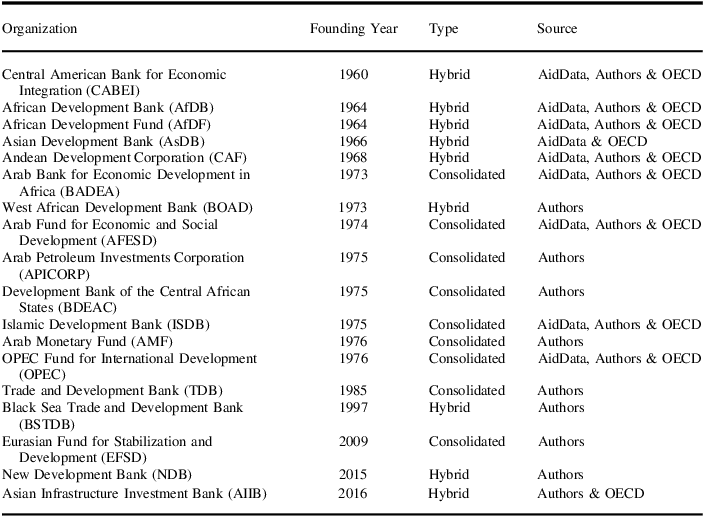
We identify three main types of IFIs. First, consolidated democratic IFIs are organizations where the average member democracy score is consistently above 0.5. This includes IFIs such as the European Bank for Reconstruction and Development and the Caribbean Development Bank. Second, hybrid IFIs are IFIs that have experienced periods in which membership is largely democratic and periods in which the membership is largely autocratic; the average member democracy scores are sometimes above and sometimes below 0.5. This includes IFIs such as the African Development Bank and the Andean Development Corporation. Third, consolidated autocratic IFIs are IFIs whose average member democracy scores are consistently below 0.5, indicating that IFI members have been predominantly authoritarian throughout their lifetime. IFIs such as the Arab Petroleum Investments Corporation and the Development Bank of the Central African States belong to this category.Footnote 29
Table 1 lists the eighteen IFIs that are either consolidated authoritarian or hybrid. The African Development Bank and Central American Bank for Economic Integration are examples of hybrid IFIs that were autocratic in their initial years but became dominated by democratic shareholders in the 1990s.
Autocratic international financial institutions

Note: International financial institutions are sorted by year of foundation.
Figure 1 separately graphs the IFI democracy scores for consolidated autocratic IFIs (Figure 1(a)) and hybrid IFIs (Figure 1(b)) over time.Footnote 30 Figure 2 further shows that autocratic-led IFIs operate in various regional contexts including Africa, the Middle East, Asia, and Eurasia.Footnote 31 Overall, the number and spread of autocratic IFIs suggests that they have become a common feature of the IFI landscape. Several of the most deeply authoritarian consolidated IFIs—including the Arab Monetary Fund, Arab Petroleum Investments Corporation, Islamic Development Bank, and OPEC Fund for International Development—include a majority of Middle Eastern member states.
IFI democracy score of consolidated and Hybrid IFIs, 1967–2021

Headquarters locations of consolidated and hybrid IFIs

An important feature of regional and cross-regional IFIs is that many of them are borrower-led, meaning that their borrower countries retain the majority of voting power, exercising significant influence over lending decisions and strategic priorities.Footnote 32 These features often result in institutions that are more responsive to the political and economic needs of their recipients. For example, the New Development Bank (NDB) is explicitly borrower-owned and governed, with founding members committed to regional membership rules limiting donor influence.Footnote 33 However, not all such banks are purely borrower-led. Some have mixed-shareholder structures that include wealthier nonborrower states, which may contribute capital and influence institutional strategy. Moreover, some predominantly borrower-led institutions, such as the Trade and Development Bank (TDB), sometimes lend beyond their own membership.Footnote 34
Even though we don’t have a good understanding of autocratic IFIs’ lending practices yet—this is something that we will explore in this paper—the bilateral lending behavior of autocratic governments has been studied elsewhere and offers insights for our argument about the different objectives these donors might pursue. In particular, “new” donors have pursued alternative approaches to foreign aid and investment that eschew unattractive political conditions.Footnote 35 Authoritarian lenders, and the regional lending institutions they anchor, have promised a growing number of recipient states that they will not interfere in their domestic politics. Preliminary evidence also suggests that in general, China does not prioritize lending based on regime type.Footnote 36 Similar to the foreign aid decisions of democratic lenders, autocracies use bilateral development finance not simply as a means to reduce global poverty, but as a strategic tool to support particular policy goals abroad.Footnote 37
We argue that autocratic and democratic lending organizations differ in practice because of the different priorities and goals of their shareholders, many of which are also borrowers in these IFIs. Scholars of international organizations have already offered empirical evidence that IO policies and their effects are dependent on the political composition of IO memberships.Footnote 38 The goals and objectives of the membership, especially as member states become more homogeneous in their objectives,Footnote 39 have important implications for what international organizations do. Most obviously, if the members of regional lending organizations—the principals—are authoritarian regimes, we do not expect that these IFIs will prioritize liberal goals when allocating foreign aid. Instead, these IFIs may seek to foster the resilience of autocratic regime as needed.
Explaining IFI Support for Autocratic Stability
We now develop a theory of how autocratic IFIs help sustain authoritarian rule in the face of acute threats. These institutions are not purely neutral technocratic lenders. Rather, their lending decisions reflect the strategic priorities of their principals—predominantly authoritarian regimes themselves—who are motivated to preserve regime stability among aligned autocratic governments. When such regimes confront serious challenges to their survival, whether from domestic conflict or international pressure, they frequently seek and receive external financial support from autocratic IFIs to reinforce their hold on power.
Understanding these dynamics requires attention not only to the preferences of autocratic lenders but also to the incentives of borrowers. IFI lending typically arises from a negotiation process initiated by recipient governments, who often approach the institution as they face economic or political challenges. Especially in borrower-led IFIs—where member governments hold shares and influence institutional governance—recipients may play a central role in shaping lending priorities, terms, and timing. Thus the strategic deployment of aid to stabilize authoritarian regimes is shaped by mutual interests: embattled autocrats demand support to weather political crises, and autocratic IFIs, guided by like-minded principals, are often willing to supply it.
Authoritarian regimes face threats arising from both domestic and international sources. While not exhaustive, our analysis draws on prominent and often interrelated threats identified in the literature on authoritarian survival. Among the most serious are those that escalate into acute instability, particularly when actors opposed to the regime resort to violent attacks. Internally, civil wars, insurgencies, and other forms of organized coercion present violent challenges to state authority.Footnote 40 These conflicts can directly undermine regime survival by enabling opposition forces to seize control or by weakening the regime’s authority and eroding elite confidence.Footnote 41 Such dynamics increase the risk of regime change not only through prolonged unrest but also by triggering elite defection or coordinated actions—most notably military coups—that forcibly remove incumbent leaders.Footnote 42 For autocrats, these risks are especially severe because ousted leaders often face imprisonment, exile, or worse.Footnote 43
Domestic threats to autocratic regime stability are compounded by external threats. These include efforts of leading Western governments, NGOs, and international organizations to promote liberal institutions and norms. After the fall of the Berlin Wall, the geopolitical rationale for supporting authoritarian regimes weakened, and belief in a “liberal peace” pushed Western governments to promote democracy. In the United States, democracy promotion became a cornerstone of foreign policy under the administrations of George W. Bush and Bill Clinton.Footnote 44 International organizations dominated by democracies quickly adopted this emphasis on promoting democratic governance. In the late 1990s, the World Bank and other development organizations began applying broad good governance conditionality to their programs. The European Bank for Reconstruction and Development even enshrined in its charter a commitment to operate only in countries that uphold principles of multiparty democracy and pluralism.Footnote 45 Although these conditions have been enforced inconsistently,Footnote 46 democracy promotion efforts and other forms of socialization have contributed to democratization in various contexts, particularly when driven by international organizations rather than individual donors.Footnote 47 At the very least, these initiatives have increased pressure on some autocrats to adopt democratic practices.
In the midst of political pressures and regime instability, material support becomes crucial for regimes seeking to consolidate power. Extensive research on foreign capital flows has shown that financial aid can fortify the resilience of authoritarian regimes, whether or not this is the donors’ intent.Footnote 48 External financial assistance serves several key functions for autocrats. First, it can provide short-term budget support, helping regimes manage fiscal deficits and stabilize the economy to prevent recurrence of significant public unrest. Second, funding for high-visibility development projects, such as infrastructure improvements, can enhance public approval by creating the perception of effective governance and boosting the regime’s legitimacy. These projects often become tools for propaganda, showcasing the regime’s ability to deliver tangible benefits to citizens.Footnote 49 Beyond public-facing initiatives, external financial support is also crucial for managing internal political stability. Autocrats often distribute resources through clientelism and patronage systems to reward loyalists and secure the backing of key elites, military leaders, or influential interest groups.Footnote 50 This strategic allocation of financial resources ensures continued support from critical segments of society that are necessary for the regime’s survival. Moreover, autocrats can weaponize foreign aid to neutralize political opposition. They may co-opt opponents by offering financial incentives or lucrative contracts, thereby reducing the incentive to resist or to collaborate with anti-government groups.
While any form of foreign assistance can bolster autocratic regimes, aid from autocratic IFIs should be particularly valuable in protecting authoritarian leaders facing domestic upheaval. Unlike traditional democratic lenders, authoritarian lenders often impose few or no political or economic conditions on their loans and can disburse funds more swiftly—even in contexts marked by ongoing conflict or serious human rights abuses. In contrast to democratic IFIs that typically require loans to pass many bureaucratic hurdles, including extensive institutional compliance processes, authoritarian IFIs tend to be less bureaucratic, demand less transparency, and institute fewer procedural safeguards before disbursements.Footnote 51 Moreover, politically aligned relationships, which are common between authoritarian borrowers and lenders, are associated with more rapid disbursement timelines.Footnote 52 For lower-income autocracies heavily dependent on external financing, authoritarian IFIs thus offer a valuable channel of support, especially when access to democratic lenders is constrained. These institutions may function independently of Western donor control, even as they at times co-finance projects alongside more traditional actors.
One pertinent example is the support BDEAC provided to the government of Michel Djotodia in the Central African Republic (CAR) during the civil war in 2013. As Séléka rebels led by Djotodia overthrew the administration of Francois Bozizé in March 2013—within a year of Bozizé falling out with important Central African neighbors and losing their support—CAR was plunged into a civil war involving rebel and militia groups and faced near-collapse of the state.Footnote 53 The final communiqué from an emergency meeting of Central Africa’s heads of state in June announced the necessity of providing assistance to CAR’s new authorities to restore and strengthen internal stability.Footnote 54 In October 2013, at the direction of the Central African leaders, BDEAC signed a protocol with CAR to reactivate its sovereign lending portfolio, reclassifying CAR’s status with the bank from frozen (due to prior nonrepayment) to active and authorizing new financing for the interim government.Footnote 55 In contrast, the World Bank responded to the 2013 coup and conflict in CAR by suspending disbursements to the country.Footnote 56 Later, in January 2014, the World Bank announced an emergency USD 100 million financing package for CAR but said that the money would be released “only in line with a steadily improving peace and security situation in the country” over the course of 2014.Footnote 57
Another example is the engagement of autocratic IFIs with Egypt, where external debt has played a crucial role in consolidating President Abdel Fatah al-Sisi’s authoritarian regime.Footnote 58 From 2022 through mid-2023, the Egyptian government faced anti-government protests sparked by an economic crisis, which forced the government to raise subsidized bread prices for the first time since 1988. Tough negotiations over conditionality with the IMF also threatened economic prerogatives of al-Sisi’s key military backers. The IMF had delayed its review of Egypt’s request for the second tranche of a USD 3 billion rescue package, citing the need for more substantial reforms, including new financial reporting requirements for state-owned enterprises (often linked to the military) and currency reforms. These conditions, by the IMF’s own admission, faced “resistance from vested interests” and could provoke significant “political and social pressure to reverse course.”Footnote 59 Several IFIs with predominantly authoritarian members intervened to support Egypt. The African Development Bank contributed approximately USD 405 million to help Egypt deal with macroeconomic instability in 2022 and 2023,Footnote 60 while the Arab Monetary Fund provided Egypt with a loan of USD 615.8 million in 2023.Footnote 61 In contrast to the IMF, the AMF expressed support for Egypt’s financial reforms but did not condition its loan disbursement on these changes.Footnote 62 The AFDB also facilitated Egypt’s debt sustainability by providing a partial credit guarantee of RMB 2.48 billion (approximately USD 350 million) for the issuance of Panda Bonds in Chinese capital markets.Footnote 63
With fewer transparency requirements and looser conditionality, loans from autocratic IFIs offer authoritarian governments greater flexibility in how funds are used, often with the implicit understanding that oversight will be minimal. Leaders are thus more likely to believe they can deploy these resources for politically opportunistic purposes, such as coup-proofing or expanding patronage networks.Footnote 64 For borrowers, faster disbursements and the ability to sidestep constraints commonly imposed by democratic donors make autocratic IFIs an attractive source of support during periods of political vulnerability.Footnote 65
At the same time, autocratic IFIs, and the governments behind them, have strategic incentives to offer support when fellow autocratic regimes face acute political threats. These motivations extend beyond the interests of individual borrowers to autocracies that are usually creditors. First, autocratic leaders may act out of reciprocity, anticipating that governments they support now will be much more likely to offer political backing should their own regimes come under threat.Footnote 66 Second, authoritarian governments have a vested interest in preventing the spread of instability within their regions, as domestic unrest or democratization in one country can increase pressure on neighboring regimes. Democratic diffusion—amplified during episodes like the Color Revolutions or the Arab Spring—can embolden opposition movements, destabilize elite coalitions, and provoke wider calls for reform.Footnote 67 Third, destabilizing shocks can undermine the interests of authoritarian governments that are closely aligned, whether through political alliances, economic partnerships, or shared ideological commitments. Many autocratic regimes have cultivated strategic ties with like-minded governments, including through security cooperation, investment initiatives, and diplomatic support in international fora. When a partner regime is threatened, lending support can help preserve these relationships and prevent the erosion of influence. Even when instability occurs outside their immediate region, autocratic IFIs may act to protect allied regimes, viewing their survival as essential to maintaining a broader network of authoritarian solidarity and influence.
While autocrats can provide bilateral aid to at-risk regimes, offering support through authoritarian IFIs is particularly appealing for several reasons. These institutions pool and collectively manage resources, amplifying the influence autocratic lenders can exert during critical moments and increasing autocratic donor coordination. They also provide a layer of legitimacy that bilateral aid often lacks. By channeling support through multilateral organizations, autocrats can present their assistance as part of broader regional development cooperation efforts. This helps autocrats ensure that aid reaches the most politically critical areas without drawing undue attention to its potentially controversial uses, thereby mitigating some backlash from democratic states or global watchdogs. For example, the Arab Monetary Fund (AMF), a suborganization of the Arab League, channeled liquidity from the Gulf region’s oil exporters to Bahrain’s monarchs to quickly stabilize their rule during the Arab Spring uprisings.Footnote 68
This logic leads to our hypothesis that autocratic IFIs are more likely to allocate foreign aid to authoritarian regimes when those regimes face substantial internal or external threats to their political survival.
Research Design
We now turn to a quantitative analysis of autocratic IFI lending decisions to examine whether these institutions are more likely to provide aid to authoritarian regimes when these regimes face significant domestic and international challenges to their rule. Our unit of analysis is the IFI-autocratic recipient country-year. The sample comprises the foreign aid decisions of the eighteen autocratic IFIs listed in Table 1 to eligible recipient countries from 1967 to 2021.Footnote 69 We collected data on lending activities for each IFI to recipients identified starting from the year of the IFI’s founding year, for all years where each organization made data available.
To test our theory about how domestic and international challenges might drive allocation of aid to autocratic recipient countries, our main analysis focuses on autocratic recipients, measured as countries that score less than 0.5 on the V-Dem Polyarchy score.Footnote 70 Many of the IFIs in our sample do not publish explicit eligibility lists for recipient countries. To define the set of potential recipients, we restrict the sample to countries that have received at least some aid from a given IFI during its lifespan. Additionally, we limit our analysis to low- and middle-income countries, following the Development Assistance Committee’s (DAC) classification. In our robustness section, we show that this choice does not affect the main results.Footnote 71
Dependent Variable
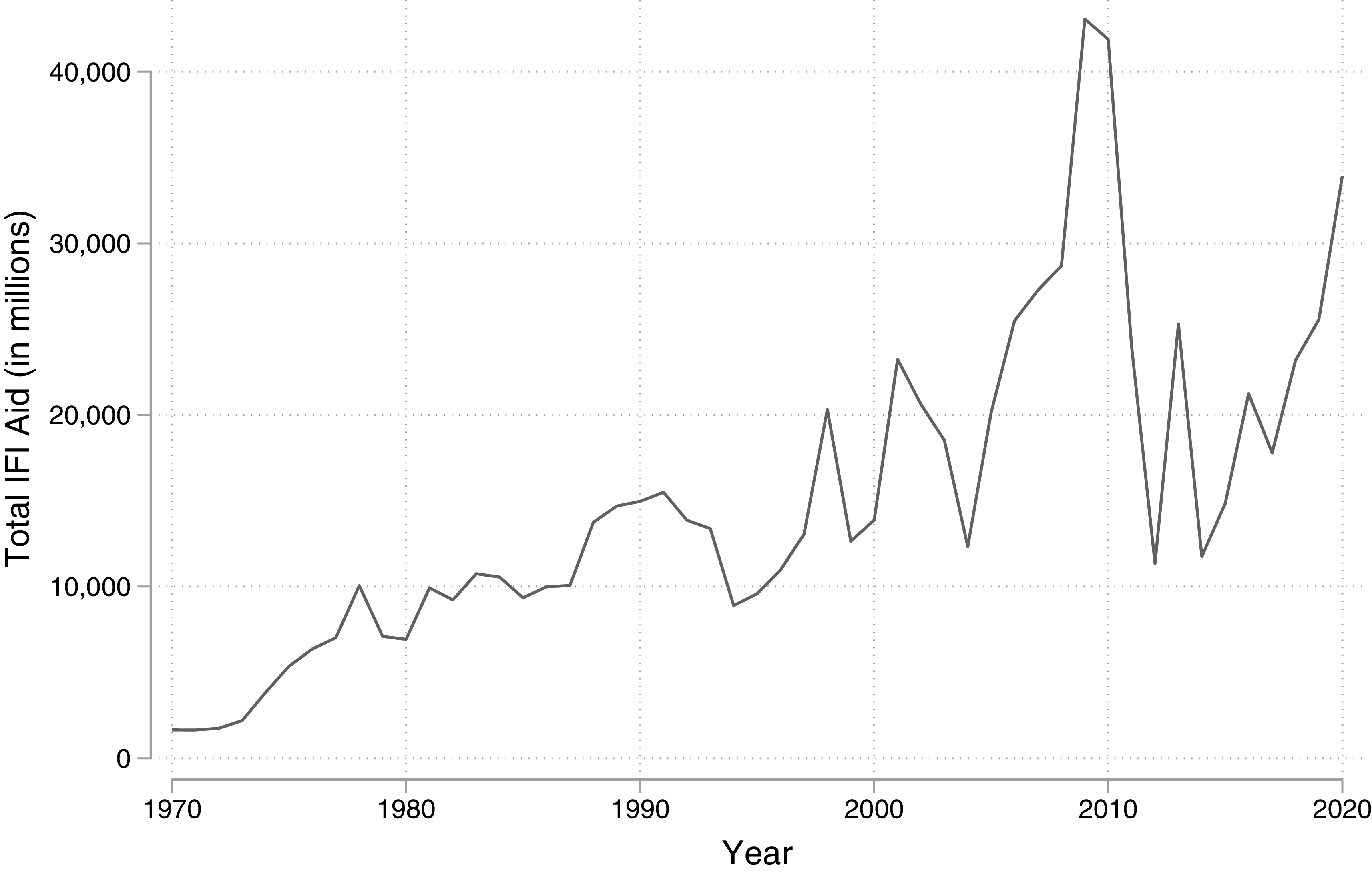
Our main dependent variable is the log of foreign aid commitments to each country, each IFI-year in constant 2011 US dollars.Footnote 72 AidData offers lending data for nine of our eighteen autocratic IFIs from their foundation to 2013. The OECD offers some lending data for ten of our autocratic IFIs from their founding until 2022, but is missing significant amounts of lending data. We sourced lending information directly from each IFI website, wherever possible. We then supplemented our lending data with other data sources, such as AidData and the OECD. For each IFI, we aggregate commitment amounts in constant 2011 US dollars at the IFI-recipient-year level.Footnote 73 Figure 3 illustrates the increased role of autocratic IFIs by graphing total IFI commitments to recipient countries across all eighteen autocratic IFIs over time. Since we are missing some data due to the lack of reporting for certain IFIs in some time periods, and excluded multi-country commitments that we could not attribute to particular recipient countries, the figure underestimates the overall aid provided.Footnote 74 Despite this underreporting, and even though lending by autocratic IFIs is less in volume than lending by democratic IFIs, Figure 3 illustrates that autocratic IFIs lend billions of dollars to recipients each year.
Lending by autocratic international financial institutions, 1970–2020
Note: This figure includes the sum of lending by hybrid and consolidated IFIs each year.

Figure 4 underscores the magnitude of aid commitments from consolidated autocratic IFIs to their top thirty recipient countries. Each of these recipient countries received (cumulatively) commitments of over USD 1 billion from 1967 to 2021. At the high end of the range, consolidated autocratic IFIs committed over USD 10 billion each to Egypt, Morocco, and Qatar over this time frame. Recent increases in autocratic IFI lending coincide with increasing bilateral lending activities of the so-called “nontraditional” or “new” donors, including China and the Gulf monarchies. These aid amounts are oftentimes significant contributions to the domestic budgets in lower-income countries.
Sum of aid commitments by country for 1974–2021
Note: Consolidated autocratic international financial institutions to top thirty recipient countries.

The median annual aid commitment from (consolidated and hybrid) autocratic IFIs to recipient countries is about USD 48 million, but commitment amounts vary widely, with some of the largest projects ranging into billions of US dollars. Of course, individual IFI commitments vary by recipient country and depend on the instruments. The NDB annually allocates USD 871 million to its recipients on average, the AFESD allocates USD 89.5 million on average, while BADEA spends only about USD 13.3 million on average.
Aid commitments also vary significantly depending on the type of project. For instance, the Islamic Development Bank allocates an average of USD 12 million per project annually, but the size of individual projects ranges widely—from as little as $1,432 to as much as $439 million. Smaller loans have often supported renewable energy initiatives, such as solar projects, while one of the largest loans in our data set was a USD 183 million line of finance provided to Turkey in 2017. The OPEC Fund for International Development further illustrates how project type influences commitment amounts. The Fund has issued numerous small loans (under $1 million) in response to emergencies, such as natural disasters. In contrast, infrastructure projects receive significantly higher funding. For example, the Fund financed a road construction project in Albania in 2011 and another in Bangladesh in 1987. One of its largest commitments was a $215 million grant to Syria in 2016 to support the OFID scholarship program.
Main Explanatory Variables
Our theoretical framework centers on the idea that authoritarian regimes have strong incentives to seek increased support from autocratic IFIs when confronted with serious internal or external threats to their rule. We hypothesize that autocratic IFIs, in turn, are more likely to allocate aid to authoritarian regimes facing acute political challenges—whether domestic or international—that endanger their hold on power.
Consistent with our theoretical emphasis on the destabilizing effects of acute political threats, we measure domestic threats to authoritarian regimes using an indicator of violent Anti-Government Conflict derived from the Uppsala Conflict Data Program (UCDP).Footnote 75 This variable captures the number of armed conflicts involving the state and domestic nonstate actors in a given year, ranging from 0 to 12 (mean = 0.74).Footnote 76 We treat this as our preferred measure of domestic threat because it encompasses a broad set of violent challenges to regime stability, including from insurgencies, militias, and other armed opposition groups. By focusing on episodes of organized violence and confrontation with the state, this measure directly taps into the types of high-stakes conflicts that are most likely to provoke both demand for external support and strategic responses from autocratic IFIs.
Our primary measure of external regime pressure is Democracy Promotion Aid, which we define as the logged sum of annual aid disbursed to a recipient country from democratic bilateral donors and democratic IFIs for projects categorized in the “government and civil society” sector.Footnote 77 While authoritarian regimes may face a range of foreign pressures—including sanctions, diplomatic isolation, and military threats—we center democracy promotion aid in our main analyses because it constitutes a direct, sustained, and well-documented challenge to authoritarian rule. Beginning in the 1990s, democratic donors increasingly made political liberalization a central feature of their foreign assistance, explicitly targeting electoral processes, opposition parties, and civil society in authoritarian contexts.Footnote 78 Multilateral institutions such as the EU, World Bank, and EBRD have similarly conditioned funding and market access on progress toward democratic governance.Footnote 79 Even though democratizing aid does not always succeed in undermining autocratic resilience, it has frequently contributed to episodes of regime liberalization and democratic transition.Footnote 80 For this reason, we treat it as a systematic and institutionally embedded external threat to autocratic survival. We source this data from the OECD, which provides information on aid’s targeted sectors under DAC reporting directives.Footnote 81 As shown in Appendix H, our findings remain robust when we substitute alternative measures of domestic and international risk.
We also include a battery of control variables that are standard in foreign aid models. These include economic indicators such as the GDP Per Capita of the recipient country and the recipient country’s GDP (log). Data are from the World Bank. We also include a measure of the voting similarity of the recipient country with the United States in the UN General Assembly to measure a recipient’s Support for the Liberal International Order (LIO).Footnote 82 To account for the possibility that IFIs’ priorities depend on variations in the regime type of their membership, and that the prevailing regime type in the membership could influence the threat environment, we include the average IFI democracy score where higher values indicate that the membership is less authoritarian. Finally, since most IFIs have a regional focus, we include a variable for Distance (log) between the IFI headquarter country and the recipient country. Dyadic distance data are from Miller.Footnote 83
Appendix F presents descriptive statistics for all variables for our sample of autocratic recipients. To facilitate interpretation, we standardize our explanatory variables, as they are measured on significantly different scales.
Model Specification
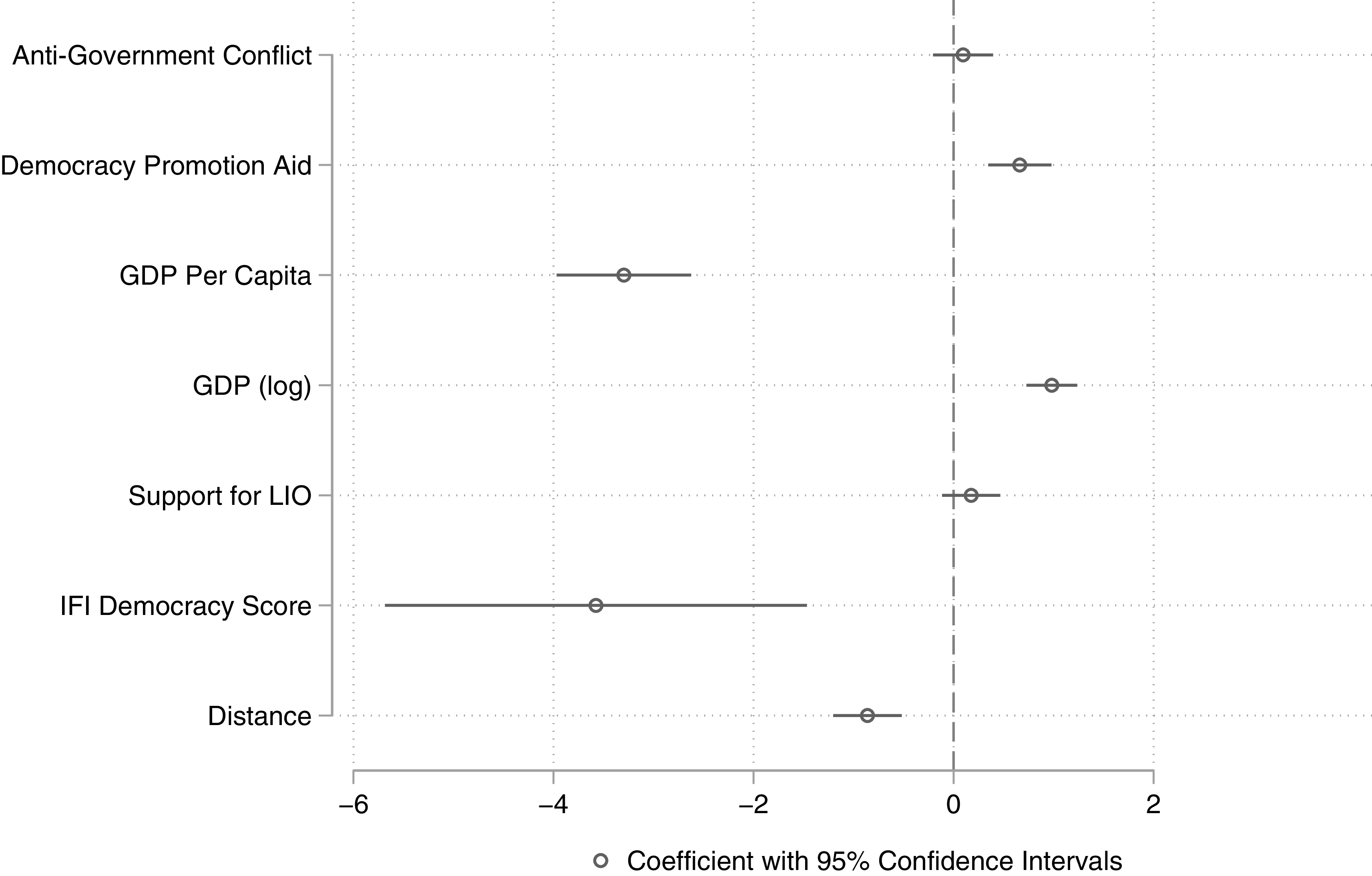
For our main analysis, we estimate time-series cross-sectional models with IFI and region-year fixed effects (Figure 5). IFI fixed effects absorb all time-invariant institutional characteristics—such as governance structure, mandate, and typical lending portfolio—ensuring that identification relies on variation within the same institution over time. Region-year fixed effects capture unobserved shocks and trends that are shared across countries within a region in a given year, including commodity cycles, regional conflicts, and coordinated donor behavior.Footnote 84 This specification is theoretically appropriate because most autocratic IFIs are regionally focused and respond to region-specific demand pressures and geopolitical dynamics. This strategy allows us to compare how IFIs allocate resources across their region as they consider conditions in all candidate recipient countries.
Regime threats and autocratic IFI foreign aid decisions
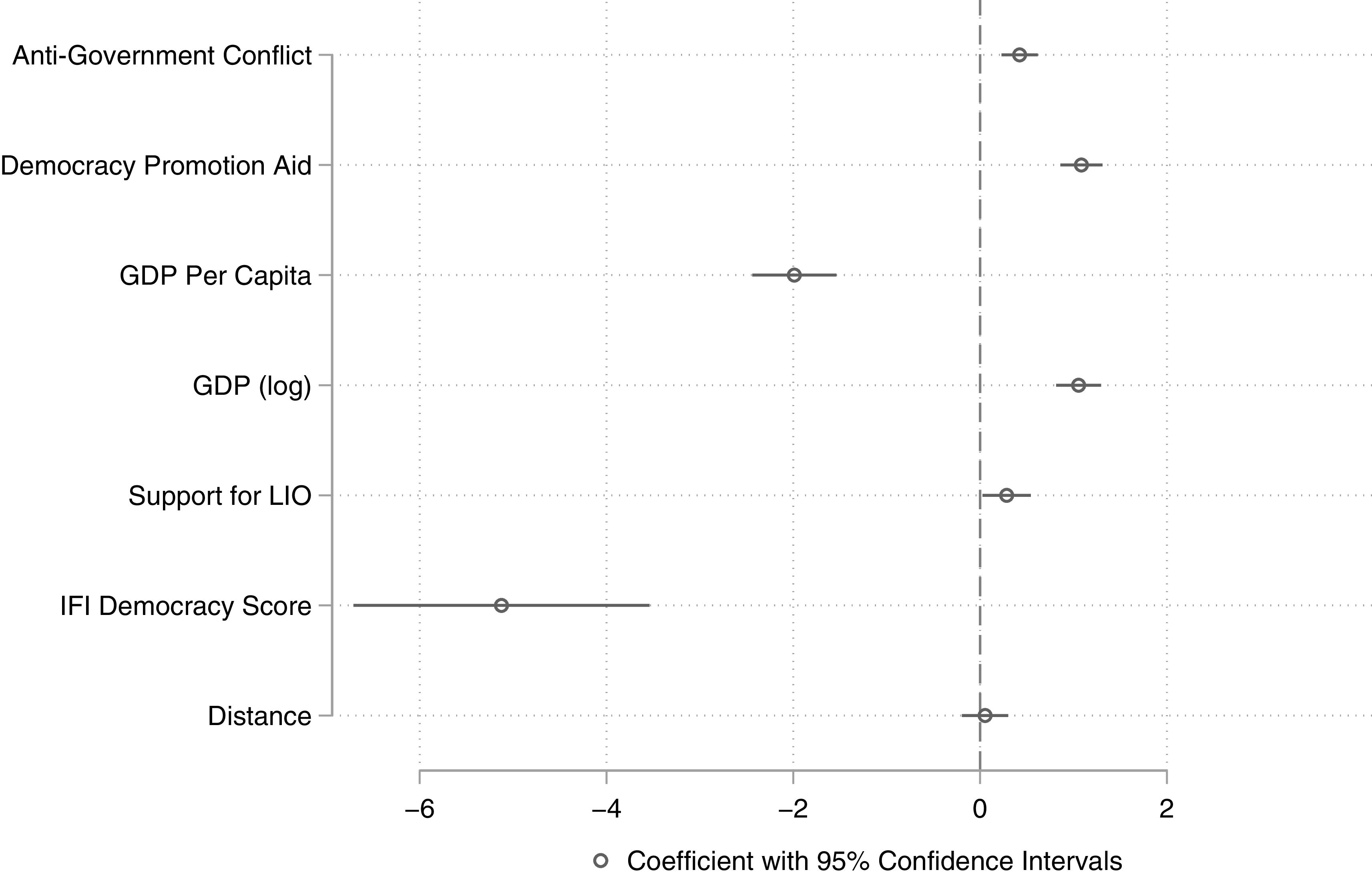
Notes: The dependent variable is the log of aid commitments from hybrid and consolidated autocratic IFIs to autocratic recipient countries. The model is estimated with OLS and high-dimensional fixed effects. IFI and region-year fixed effects and constant omitted.

In Appendix M, we show that the main results are robust to specifications that include a linear time trend, to models that lag the main explanatory variables, and to alternative fixed-effects structures.Footnote 85 We also present results from Tobit, conditional two-stage, and Heckman selection models. Our main specification is as follows:

where Y is the autocratic IFI i’s aid commitments to recipient country j in year t; X jt are explanatory and control variables variables that vary at the recipient-year level, α i is the IFI fixed effects, γ rt are the region-year fixed effects, and ϵ represents the error term.
Results
Figure 5 presents our main results.Footnote 86 The models fit the data reasonably well. The highly significant F-test indicates that the variables are jointly important to explaining the variation in autocratic IFIs’ aid commitments.
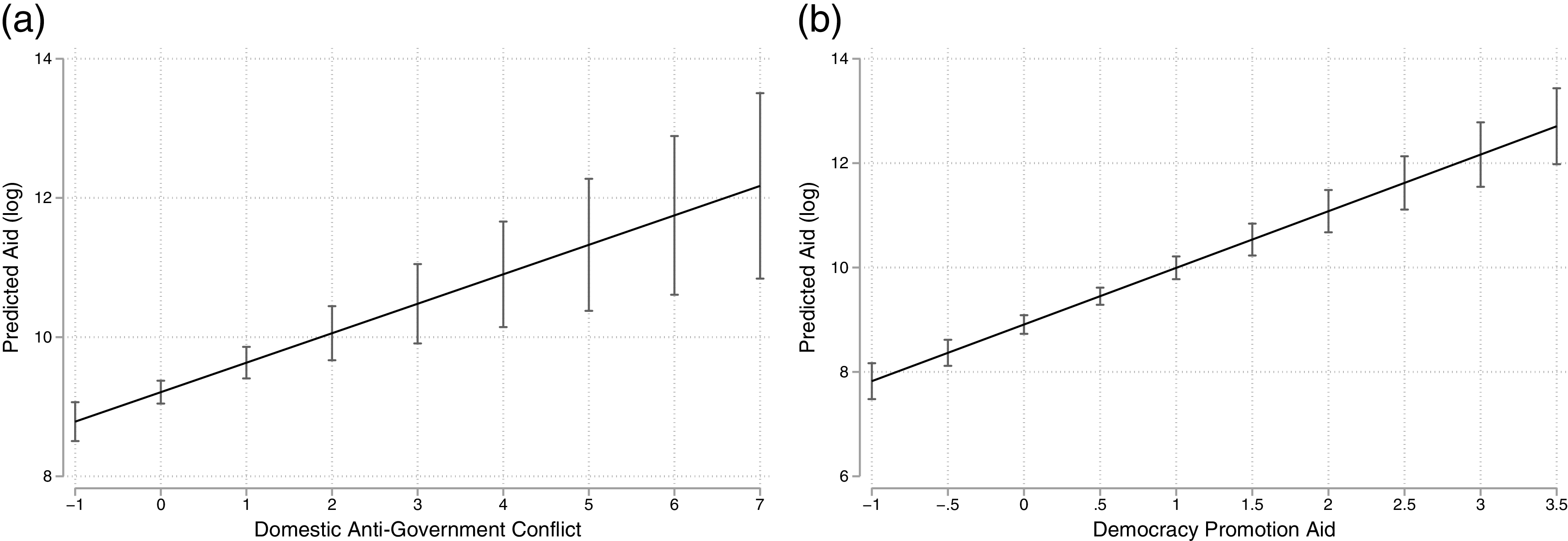
Moving to the substantive effects, we find support for our argument that autocratic IFIs should allocate more aid to authoritarian governments that face significant threats to their regime stability. The results indicate that Anti-Government Conflict and Democracy Promotion Aid have a significant positive association. A one standard deviation increase in Anti-Government Conflict is associated with a 42.3 percent increase in aid from autocratic IFIs. In addition, a one standard deviation increase in logged Democracy Promotion Aid is associated with a doubling of autocratic IFI commitments to autocratic recipients. Figure 6 further illustrates the impact of threats on foreign aid commitments. Whereas autocracies with low conflict propensity or democracy promotion aid inflows receive limited aid from autocratic IFIs, those that have high conflict propensity or receive significant amounts of democracy promotion aid have a significantly higher inflow of foreign aid from autocratic IFIs.
Predicted effects of internal and external threats
Notes: The graphs show the predicted effects of Anti-Government Conflict and Aid from Democracies on autocratic IFI aid, together with 95 percent confidence intervals. The graphs are based on the estimation presented in model 1 of Table 5.

Overall, our main results indicate that IFIs that are primarily driven by autocratic shareholders are more likely to allocate foreign aid to autocratic recipients when they face domestic and international challenges to their rule. We now discuss a series of analyses that address the robustness of our results.
Robustness Checks
Although our main explanatory variables capture central domestic and international threats to autocratic survival, in Appendix H we assess the robustness of our findings to a broader set of risk indicators that represent different facets of regime vulnerability. These alternative measures are not theoretical substitutes for our core variables but offer a useful diagnostic of whether the results generalize across related, though narrower, forms of risk. Model 1 includes a measure of Coup Risk. One of the most robust indicators of coup risk is whether a country has previously experienced coups, and in particular, its recent coup history.Footnote 87 Coup attempts tend to cluster in time, with each attempt setting an example for other military personnel in the same country.Footnote 88 To measure coup risk, we therefore use an indicator of the number of years since a country’s last coup attempt (successful or not). We use the CAM data set from Albrecht, Koehler, and Schutz, which defines coups as attempts by members of the military to overthrow the government.Footnote 89 We invert this variable so that high values indicate more coup risk.Footnote 90 Model 2 introduces a variable for Democracy Mobilization in the prior year using data from V-Dem. The variable measures the frequency and size of mass mobilization events for pro-democratic aims.Footnote 91 Model 3 uses an alternative measure for democracy promotion aid. Aid from Democracies is measured as the logged sum of all aid commitments from democratic IFIs and democratic bilateral donors to each recipient in a given year. We source this data from the OECD and AidData, ensuring comprehensive coverage of aid flows that could influence the strategic calculations of authoritarian regimes. In model 4 Regional Instability measures diffusion threats with a dummy variable that equals 1 if at least one neighboring country experienced a coup in the last year, as calculated by Bjørnskov and Rode.Footnote 92 Finally, model 5 measures diffusion threats as the percentage of neighboring countries that are democracies (Democracies in the Region (%)), also calculated by Bjørnskov and Rode.Footnote 93 Our core results are robust to the use of alternative measures of domestic and international threats to regime stability. One notable exception is Democracy Mobilization, which does not show a statistically significant association with aid from autocratic IFIs. This may suggest that authoritarian regimes—and the institutions aligned with them—do not perceive many nonviolent pro-democracy protests as immediate threats requiring IFI interventions. Unlike armed conflict or coups, which directly challenge regime control, peaceful mobilization may be viewed as more manageable until it escalates to violent conflict. Second, we probe the robustness of our results to different sample choices. Model 1 in Appendix J uses the V-Dem regime type classification to define autocratic recipients,Footnote 94 while model 2 relies on the Boix-Miller-Rosato dichotomous measure of democracy for an alternative delineation.Footnote 95 Model 3 restricts the sample to IFIs that also lend to non-member countries, allowing us to evaluate whether our results hold for institutions where borrowers are likely to exert less influence over lending decisions. Models 4 and 5 apply alternative criteria to classify IFIs as “autocratic,” based on GDP-weighted democracy scores. Model 6 adds the Inter-American Development Bank and the Asian Forest Cooperation Organization to the main model.Footnote 96 Model 7 includes autocratic IFIs only in years where their average democracy score is less than 0.5. Model 8 restricts the sample to IFIs with a majority-autocratic membership, and model 9 includes the AMF and EFSD. Across all specifications, we find consistent support for our core argument: autocratic IFIs allocate more aid to authoritarian regimes facing acute threats.
Appendix K replaces our dependent variable with a variable that measures IFI aid as a share of the recipient’s GDP in that year (model 1). We also use a binary dependent variable that takes the value 1 if a recipient receives any aid from an autocratic IFI, and 0 if not (model 2). In model 3, we include all countries that received at least some aid during the lifespan of the organization, independent of their income status. Model 4 restricts the sample to low and low-middle income countries, as defined by the World Bank. Model 5 further shows that the results are robust including the entire time period for which we have at least some data on Democracy Promotion Aid. Finally, in model 6 we exclude autocratic IFIs that have the United States as a major shareholder.
Appendix L presents models with additional explanatory variables. In model 1, we include Financial Crisis as an additional control, and it is interesting to note that on average, autocratic IFIs may be less likely to lend to recipients during financial crises, though this is not statistically significant.Footnote 97 This may indicate that autocrats use other mechanisms, like bilateral aid or credit swaps, to stabilize authoritarian regimes during purely economic crises or rely on the heightened willingness of democratic IFIs to aid autocrats during financial crises, while autocratic IFIs focus primarily on stabilization of authoritarian regimes facing political unrest and security challenges, which may still have greater capacity to assume new loans.Footnote 98 Model 2 presents the results for our main specification after controlling for the polyarchy score of each recipient, with no changes to our main results.
While our main results are based on parsimonious OLS regressions, in Appendix M we demonstrate that the findings are robust across alternative specifications. In model 1, we replace year fixed effects with a linear time trend to capture gradual temporal dynamics. Model 2 introduces lagged values of our main explanatory variables to address potential simultaneity between regime threats and aid commitments.Footnote 99 We further test the robustness of our results to different estimators by estimating a Tobit model in model 3, a conditional two-stage model in model 4, and a Heckman selection model in model 5 to account for potential censoring and selection bias in aid allocation.
Models 6 to 11 in Appendix M extend these analyses by systematically varying the fixed-effects structure to assess the sensitivity of the results to different identification strategies. Specifications with region-year fixed effects help absorb common regional shocks—such as region-wide political or economic crises—while country and year fixed effects control for unobserved, time-invariant heterogeneity across countries and for global shocks that affect all countries simultaneously (for example, changes in commodity prices or global liquidity). This consistency between the sources of potential confounding and the corresponding fixed-effects choice helps clarify the logic behind our design. Across these alternative specifications, the coefficients for Anti-Government Conflict and Democracy Promotion Aid remain positive and statistically significant, indicating that the observed relationships are not sensitive to model choice and reflect a stable association between regime vulnerability and autocratic IFI support.
Overall, the results robustly support our main hypotheses that autocratic IFIs have used lending as an instrument to assist authoritarian regimes facing domestic and international challenges to their rule.
Exploratory Extension 1: Do Autocratic IFIs Lend Differently to Democracies?
Given that many autocratic IFIs also provide aid to democracies—33 percent of the recipients in our sample are democracies—we conducted separate analyses for democratic recipients as an exploratory extension. While we do not have explicit hypotheses regarding how autocratic IFIs should lend to democracies, our theory suggests that these IFIs are less likely to prioritize aid to democratic regimes experiencing threats to their stability. We define democracies as countries scoring above the 0.5 threshold on the V-Dem Polyarchy index.
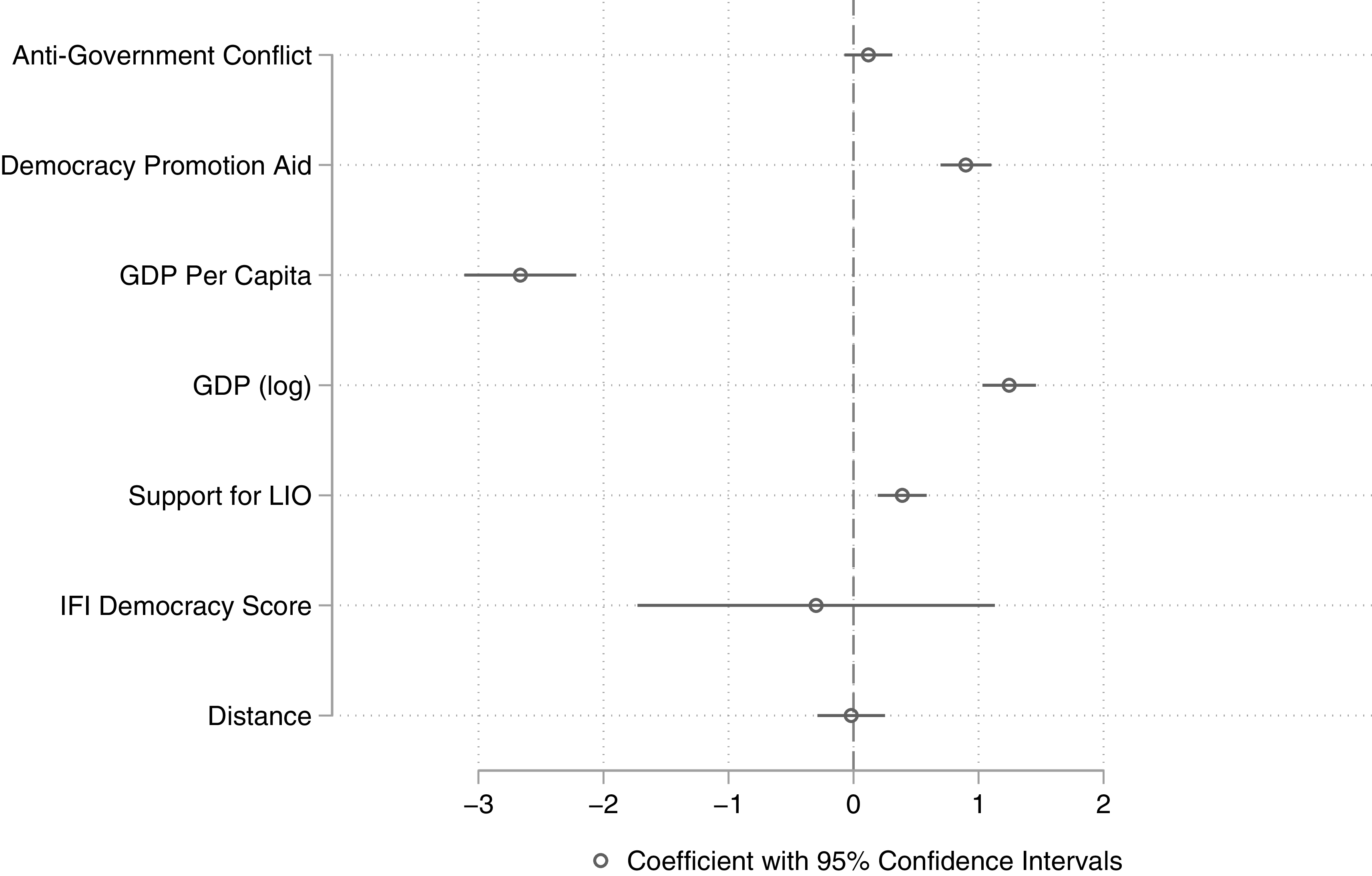
Figure 7 presents the results from re-estimating our main models with a sample of democratic recipients.Footnote 100 Comparing the findings to allocation decisions toward autocratic recipients provides some interesting insights. First, there is no significant association between Anti-Government Conflict and aid commitments from autocratic IFIs to democratic recipients. At the same time, Democracy Promotion Aid continues to have a positive and significant correlation with foreign aid from autocratic IFIs.
Regime threats and autocratic IFI foreign aid decisions to democratic countries
Notes: The dependent variable is the log of aid commitments from hybrid and consolidated autocratic IFIs to democratic recipient countries. The model is estimated with OLS and high-dimensional fixed effects. IFI and region-year fixed effects and constant omitted.

We further probe these results by using the full sample of autocratic and democratic recipients but interact our main explanatory variables with the democracy score of the recipient countries. The results are presented in tabular and graphical form in Appendix I. These results suggest that the effect of Anti-Government Conflict on aid allocation is concentrated among autocratic regimes, with the marginal effect turning statistically insignificant as countries cross the 0.5 threshold on the democracy scale. This finding reinforces our argument that autocratic IFIs are particularly attuned to regime instability in authoritarian settings. At the same time, the coefficient on Democracy Promotion Aid remains significant across the regime spectrum, though it declines with increasing levels of democracy. This pattern suggests that autocratic IFIs also provide aid to certain electoral democracies—perhaps especially when those democracies are located within the same region—due to concerns over the spillover effects of economic and political disruption, as outlined in our theoretical framework.
Importantly, these findings offer suggestions to further theorizing and empirical research on the relationship between autocratic IFIs and democratic recipients. While our core framework centers on regime-aligned support, the evidence suggests that lending decisions may also be shaped by strategic dynamics such as regional stability concerns or even competition with Western donors. Developing a more explicit theory of when and why autocratic IFIs choose to support democratic regimes—particularly during moments of crisis—would be a valuable next step for understanding the full scope of their behavior and the broader geopolitical implications of their aid strategies.
Exploratory Extension 2: Are Democratic IFIs Different?
Although our focus is on the lending practices of autocratic IFIs to autocracies, and we do not have strong theoretical priors, our data also allow us to compare autocratic IFI decisions to the decisions of IFIs when their membership is democratic. Figure 8 re-estimates our main models, but with a sample of democratic IFIs lending to autocratic recipients.Footnote 101
Regime threats and democratic IFI foreign aid decisions to autocratic countries
Notes: The dependent variable is the log of aid commitments from democratic IFIs to autocratic recipient countries. The model is estimated with OLS and high-dimensional fixed effects. IFI and region-year fixed effects and constant omitted.

The results provide interesting insights on the diverging interests of democratic and autocratic IFIs. Whereas autocratic IFIs are more likely to allocate foreign aid to autocracies that face various domestic and international challenges, democratic IFIs are not significantly more likely to provide resources to autocracies that experience greater Anti-Government Conflict. At the same time, they do prioritize autocratic recipient countries that receive larger amounts of Democracy Promotion Aid from democratic donors. This finding is consistent with expectations of a degree of coordination and shared priorities among democratic lenders, whose foreign aid strategies tend to converge around the promotion of liberal governance norms. Other notable differences are that democratic IFIs are significantly more likely to provide aid to recipients that are supportive of the Liberal International Order, and that IFI Democracy Score and Distance does not have an effect on lending. For both types of IFIs, however, we see an effect of GDP per capita and GDP.
The divergent patterns highlight the distinct strategic logics that underpin democratic and autocratic IFI behavior, offering important complementary evidence to our core analyses. While democratic IFIs tend to channel aid in line with liberal objectives, autocratic IFIs exhibit a markedly different approach by allocating resources to authoritarian regimes confronting acute threats to their survival. This asymmetry underscores that regime type shapes not only the normative goals of foreign aid, but also the geopolitical and regime-preserving functions that such aid can serve for different type of IFIs. Although we view these findings as highly tentative—given that they are not grounded in a developed theoretical framework and the analysis has not yet been validated through robustness or sensitivity analyses—the results point to promising avenues for future research on how international institutions operate and interact.
Conclusion
International financial institutions have widely been regarded as creations of democratic lenders. By providing foreign aid, and linking aid to political and economic reforms, international financial institutions—such as the World Bank—have been central pillars of the US-led Liberal International Order. Despite this perception, many international financial institutions are made up primarily of autocratic shareholders. These autocratic IFIs have played an increasingly significant role in the international development finance landscape. In this paper, we argue that autocratic IFIs’ foreign aid allocation decisions are often not driven by liberal goals. Rather, autocratic governments can use autocratic IFIs to promote autocratic resilience from domestic and international challenges to their rule. We develop an argument about autocratic IFI lending, which puts front and center the political calculus of autocratic resilience.
Our findings offer new insights into the nature and outcomes of cooperation in international organizations. Whereas an earlier generation of scholarship has focused on analyzing international organizations under the assumption that they were meant to support liberal economic and political values, our paper offers a theoretical framework that takes into account the regime type of the membership. This theoretical framework complements the donor intent arguments, and helps synthesize the mixed findings in the aid allocation literature. By taking into account the priorities and goals of the IFI membership, we can provide more fine-grained insights into these dynamics.
While systematic data on autocratic cooperation has been scarce, our data set on autocratic IFIs opens important avenues for analyzing the political economy of such cooperation. Our analysis is a first step toward understanding how autocratic IFIs allocate aid, but we still lack systematic evidence on whether, and under what conditions, this lending actually strengthens autocratic resilience, and which types of projects are most likely to be funded for that purpose. Future research could examine the political, economic, and developmental outcomes of autocratic IFI lending, including whether certain forms of assistance (for example, budget support versus infrastructure) are more effective in stabilizing regimes.
A second set of questions concerns additional drivers of demand and supply. On the demand side, future work might investigate whether autocratic governments also turn to autocratic IFIs when other financing channels—such as democratic IFIs, bilateral donors, or private capital markets—contract. This could include assessing whether some variation in demand reflects global capital and commodity cycles, in which autocrats face tighter borrowing constraints or declining resource rents. On the supply side, more research is needed on how internal governance structures shape lending incentives, particularly in borrower-led institutions where member governments are also shareholders.
The opacity of autocratic IFIs underscores this point. Initial research suggests that, at least in some cases such as the AIIB, technical staff have limited authority to apply borrower classification or eligibility assessments—functions that are routine in IFIs dominated by democracies, like the World Bank.Footnote 102 This enhances the influence of governing boards and reinforces principals’ preferences for opacity, a pattern also reflected in narrower disclosure practices.Footnote 103 Understanding the internal dynamics of these organizations, where staff must balance financial imperatives such as maintaining credit ratings with political directives to lend in unstable contexts, would greatly enrich our knowledge of both the supply of, and demand for, autocratic IFI lending.
The finding that autocratic IFI lending does not merely complement democratic IFI lending also has implications for the effectiveness of traditional IFIs that value economic and political liberalism. The rise of autocratic IFIs can be viewed through the lens of competitive regime creation, as autocratic IFIs lend to recipients of democratic aid but attach fewer conditions to their loans.Footnote 104 Autocratic IFIs therefore provide outside options of growing importance, which potentially enable states that are dissatisfied with traditional lenders’ conditions to challenge the status quo in development finance.Footnote 105 This dynamic may, in turn, induce adaptation among democratic IFIs themselves. As recent work suggests, organizations such as the World Bank have begun adjusting their practices in response to competition from autocratic counterparts like the AIIB, potentially relaxing conditionality or shifting lending priorities to remain attractive to borrowers.Footnote 106 Such feedback effects highlight that the rise of autocratic IFIs may reshape not only patterns of aid allocation but also the behavior of traditional institutions within the liberal order. More broadly, the growing interaction between autocratic and democratic IFIs underscores that the international development landscape is far more complex than typically assumed. Just as liberal democracies once used IFIs to advance their material and ideational interests, authoritarian regimes now use theirs to pursue analogous goals; reshaping the balance of influence and contestation within global economic governance.
Acknowledgments
For constructive feedback on earlier versions of the manuscript, we thank the editors, three anonymous reviewers, Tetsekela Anyiam-Osigwe, Konstantin Ash, Rachel Beatty Riedl, Sheri Berman, Dina Bishara, Sam Brazys, Lawrence Broz, Valerie Bunce, Stephen Chaudoin, Mengfan Cheng, Michael Coppedge, Maria Debre, Lisa Dellmuth, Simone Dietrich, Antoaneta Dimitrova, Daniela Donno, Axel Dreher, Lauren Ferry, Katharina Fleiner, Robert Gulotty, Julia Gray, Seda Gurkan, Steph Haggard, Mirko Heinzel, Tobias Hofmann, Alice Iannantuoni, Ayse Kaya, Christopher Kilby, Gabby Levy, Phillip Lipscy, James Long, Elena McLean, Laura Meinzen-Dick, Anna Meyerrose, Bernhard Reinsberg, Marine Roux, Miguel Rueda, Tal Sadeh, David Samuels, Burcu Savun, Henning Schmidtke, Matthew Stephen, Sue Stokes, Randy Stone, Jonas Tallberg, Dan Thomas, Alex Thompson, Mike Tierney, Carl Vikberg, Erik Voeten, Geoff Wallace, Lucan Way, Shiming Yang, Noah Zucker, and workshop participants at Leiden University, Cornell University, the 2024 Political Economy of Aid Conference, the 2024 Workshop on International Financial Institutions, University of Pennsylvania, University of Washington, the David Lake Academic Family Reunion, the 2025 Political Economy of International Organizations conference, and Washington University in St Louis. Anya Van Noord, Matt Kumar, Michael DeCicco, and Jordan Ernstsen provided excellent research assistance.
Funding
We thank the UC Institute on Global Conflict and Cooperation and the Smith Richardson Foundation for financial support.
Data Availability Statement
Replication files for this article may be found at <https://doi.org/10.7910/DVN/OF98YH>.
Supplementary Material
Supplementary material for this article is available at <https://doi.org/10.1017/S0020818325101276>.




 Open access

