


In the United States, most people desire information and guidance as to what foods are healthy without being told what they must or must not eat(Reference Patterson, Satia and Kristal1). Designing effective health communication messages around diet is, however, a particularly complex task. There is a large volume of scientific evidence, and a lack of consensus within the scientific community as to what constitutes sufficient evidence to establish dietary recommendations(Reference Patterson, Satia and Kristal1–Reference Verbeke, Sioen and Pieniak4).
The news media are consistently ranked by the public as a primary source of nutrition information(Reference Borra, Kelly and Tuttle5), including diet-related health benefits and risks(Reference Brown and Walsh-Childers6). News coverage also serves to shape the boundaries of debates around scientific issues(Reference Nelkin7, Reference Nucci and Kubey8) and the development of public perception of safety and risk for complex issues such as diet(Reference Nucci and Kubey8, Reference Slovic, Peters and Finucane9). The news media’s presentation of guidelines for fish consumption is a current example of the complexity involved in simultaneously presenting both health benefits and safety concerns, as fish contain both beneficial nutrients such as fish oils (long-chain omega-3 polyunsaturated fatty acids (n-3 PUFA)) and contaminants such as methylmercury (CH3Hg+). Fish oils’ beneficial effects include protection from depression(Reference Osher and Belmaker10, Reference Parker, Gibson and Brotchie11) and CVD(Reference Albert, Hennekens and O’Donnell12–Reference Iso, Rexrode and Stampfer16), improved maternal nutrition and neonatal and infant brain development(Reference Arnold, Lynn and Verbrugge17, Reference Genuis and Schwalfenberg18). However, high concentrations of mercury can lead to mercury poisoning, compromise fetal development and cause neurological damage, particularly in young children, and possibly cause CVD(Reference Weil, Bressler and Parsons19–Reference Mergler, Anderson and Chan22). The presence of both benefits and risks from eating fish complicates effective consumption guidance.
History of fish advisories
As an outgrowth of the 1990 Clean Air Act, the Environmental Protection Agency (EPA) has been responsible for drafting several national advisories over fish consumption because of the health risks posed by methylmercury contamination. In September 1994, the EPA made their database, National Listing of Fish Consumption Advisories, publicly available. In January 2001, the Food and Drug Administration (FDA) and the Department of Health and Human Services advised pregnant women and those of childbearing age on the hazards of consuming fish that may contain high levels of Hg.
On 19 March 2004, the FDA and the EPA issued for the first time a joint advisory on fish consumption that combined information on the risks and benefits of fish, acknowledging the importance of maintaining fish as part of the general diet and underscoring the importance of omega-3 fatty acids for neurological development. The advisory also warned women of childbearing age and those who are pregnant or nursing about the risks of eating any shark, tilefish, swordfish and king mackerel and advised that other fish consumption should be limited to 12 oz/week and albacore tuna to 6 oz/week.
State-level advisories about fish consumption have also grown. In 2003, thirty-one states had statewide advisories, and sixteen states had ‘safe eating’ guidelines for fish from specific waterways or statewide(Reference Nesheim and Yaktine23). By 2008, all fifty states, the district of Columbia, the US territories of American Samoa and Guam and five native American tribes had fish consumption advisories(24).
Although efforts to communicate with the public about fish consumption have improved or expanded over time, how the news media cover and translate these guidelines and other research on the safety and benefits of fish is not well known. In the present study, we consider the presentation of fish as a health issue in the US news media over 15 years – from the year preceding the EPA release of the National Listing of Fish Consumption Advisories until the end of 2007. Our study is a case study of how the news media cover an inherently complex issue in terms of health benefits and risks. We ask how ‘news events’ (such as release of new studies linking fish consumption to a particular outcome as well as fish consumption advisories) are contextualised for the public audience. Our text analysis is shaped by the following research questions:
• What aspects of fish as a health issue are most newsworthy and how does this differ across media? Has this changed over time?
• How are the health benefits and health risks of fish described? Does this change over time?
• What sources of evidence are cited in news coverage of fish as a health issue?
• Does news coverage of fish as a health issue convey scientific uncertainty?
Methods
We tracked news coverage of fish as a health issue over a period of 15 years (1993–2007) from ten US news media sources (five print and five television (TV) news sources). Data were compiled using two sources of archived news data (LexisNexis Academic and the Vanderbilt Television News Archive). Our news sample consisted of the three main TV networks (ABC, CBS and NBC) as well as Fox and CNN cable news for the later yearsFootnote *. For print, we compiled a sample of three ‘national’ newspapers (The New York Times, Washington Post and USA Today) and two major newspapers from regions where fishing is an important industry (Seattle Times and Louisiana’s Times-Picayune). The inclusion of two regional newspapers was intended to facilitate comparison of the volume and content of coverage in newspapers where fishing is a major contributor to the economy (if only even symbolically), with those where it is not. The final analytic sample included news stories, editorials, columns and letters to the editor in which at least half of the story content discussed fish in relation to human health.
We conducted a qualitative text analysis(Reference Altheide26) to systematically extract thematic elements from each news story. Our analysis was largely descriptive, supplemented by statistical analyses where appropriate. The development of the coding schema was based initially on four rounds of independent coding by authors Greiner and Smith, followed by repeated consensus building discussions to develop the final coding structure. As coding rules developed, all previously coded articles were reviewed and updated. As an iterative process, the coding schema was refined to focus on key issues surrounding policy, fish consumption recommendations and the presentation of risk and benefit information.
A subset of twenty-five news stories was double-coded to calculate inter-rater reliability. For this subset, per cent agreement ranged from 85 % to 100 % and Cohen’s κ (a more robust measure of inter-rater reliability)(Reference Wood27) ranged from 0·65 to 1·0(Reference Landis and Koch28). Final coding variables are set out in Table 1.
Coding framework
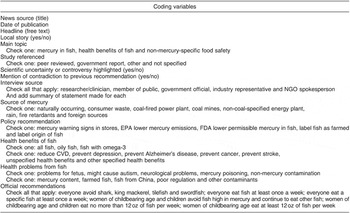
NGO, non-governmental organisation; EPA, Environmental Protection Agency; FDA, Food and Drug Administration.
Articles were coded for measures of topic (mercury, health benefits or food safety), local focus, reference to a scientific study, mention of government guidelines or warnings and individuals directly quoted. Articles coded with the ‘health benefits’ topic were further coded for details as to the benefits mentioned. Articles coded with the mercury topic were coded for discussion of the source of the mercury and any potential health problems associated with mercury consumption. We performed descriptive analysis primarily involving frequencies and percentages, and χ 2 analysis in selected cases. Analyses were performed using the STATA 9 statistical software package (STATA Corp., College Station, TX, USA).
Results
Our sample of ten news outlets produced a total of 310 news stories on fish and health over a period of 15 years. The vast majority of the coverage (285 stories, 92 %) appeared in newspapers, with the Times-Picayune contributing more than one-third of the stories (n 109). TV news yielded little coverage. The three network news stations yielded a total of twenty stories in the 15-year period. Although the two cable stations were not initially covered, they aired only five stories between them in their combined 16 years of coverage in the archive (12 years for CNN and 4 years for Fox).
Fish as health risk v. health benefit
Over 15 years, 212 stories focused on the issue of mercury in fish (68 % of all stories), sixty-two stories focused on the health benefits of eating fish (20 %) and thirty-six stories described food safety concerns that were not mercury specific (12 %). For analytic purposes, we created a single ‘health risk’ frame variable by combining the ‘food safety’ and ‘mercury in fish’ topic variables and compared it to the ‘health benefits’ frame. There were no statistically significant differences in the framing of the stories (for benefits or risk) between news media type (newspaper or TV), χ 2 = 10·9 (P < 0·3). There was, however, a significant difference in the framing of the coverage by year, χ 2 = 36·5 (P < 0·001; see Table 2).
News content: local focus, main topic and health benefits frame

N/A, not applicable.
Coverage over time
The volume of coverage of fish as a health issue generally increased over time, with fewer than ten stories per year from 1993 to 1995 and peaking at forty-seven stories in 2003 (see Fig. 1).
Distribution of news stories by source and year ( , Washington Post;
  , USA Today;
  , Times-Picayune;
  , Seattle Times;
  , The New York Times;
  , NBC;
  , FOX;
  , CNN;
  , CBS;
  , ABC)
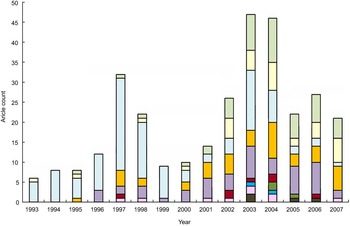
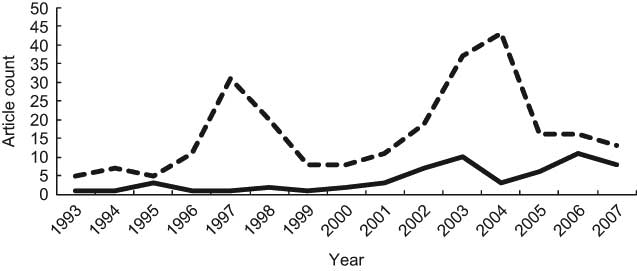
The volume of coverage moved from heavy coverage in only one publication (Louisiana’s Times-Picayune) in the earlier years to a more equal coverage across all of the news outlets since 2002. The pattern of coverage is also defined by two distinct spikes in 1997–1998 and in 2003–2004 (see Fig. 1). The first spike was driven almost entirely by coverage in the Times-Picayune following the EPA’s release of the Mercury Study Report to Congress in December 1997. The second spike followed the publishing of studies in 2002 about the protective benefits of omega-3 fatty acids as well as the joint FDA–EPA advisory on 19 March 2004. Topics varied somewhat from year to year, with some smaller spikes in coverage for each of the topics. Mercury dominated coverage consistently throughout the study period, with the topic of health benefits of fish really emerging from 2002 onwards. This trend is clear in Fig. 2.
Health benefits ( ) and health risk (
 ) framing by year
Fish becomes a national news story
We were interested in examining the extent to which stories on fish as a health issue were applied equally to a national audience or were generated and focused locally. Although we defined three of the newspapers as having ‘national reach’, in fact all of the newspapers except USA Today also had an explicit local focus and connection. This provided us with the capacity to consider whether fish and health stories were constructed as a local issue (focusing on an event that occurred/is occurring in the local area). We excluded the TV networks and USA Today as they are conceptualised as national news sources. Of the 252 stories published in the four daily newspapers with a potentially local focus, 109 (43 %) were coded as local stories; of which the Times-Picayune was responsible for eighty stories (73 %). The extent to which fish as a health issue was constructed in local terms changed considerably over this time period. Before 2000, the majority of stories in each year were consistently local in focus, whereas from 2000 onwards the majority of stories did not focus on local events or issues (see Fig. 3).
Local ( ) v. national (
 ) focus of print media news

Description of health benefits and risks over time
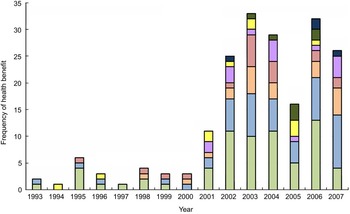
In total, there were 195 separate health benefit messages included in the 310 news stories. After 2001, health benefits appeared in the coverage with greater frequency and variety (Fig. 4). Over the 15 years of coverage, prevention or reduction of CVD was the most commonly featured health benefit (sixty-nine mentions, 35 % of all health benefit messages), followed by depression (twenty-one mentions, 11 %) and by benefits to fetal development (sixteen mentions, 8 %). Each article or story could be coded for multiple benefits and/or risks.
Frequency and type of health benefit associated with fish consumption by year ( , prevent cancer;
  , prevent Alzheimer's;
  , prevent stroke;
  , fetal development (brain and general);
  , unspecified health benefits;
  , prevent depression;
  , other specified health benefits (eye, health, etc.);
  , reduce CVD)
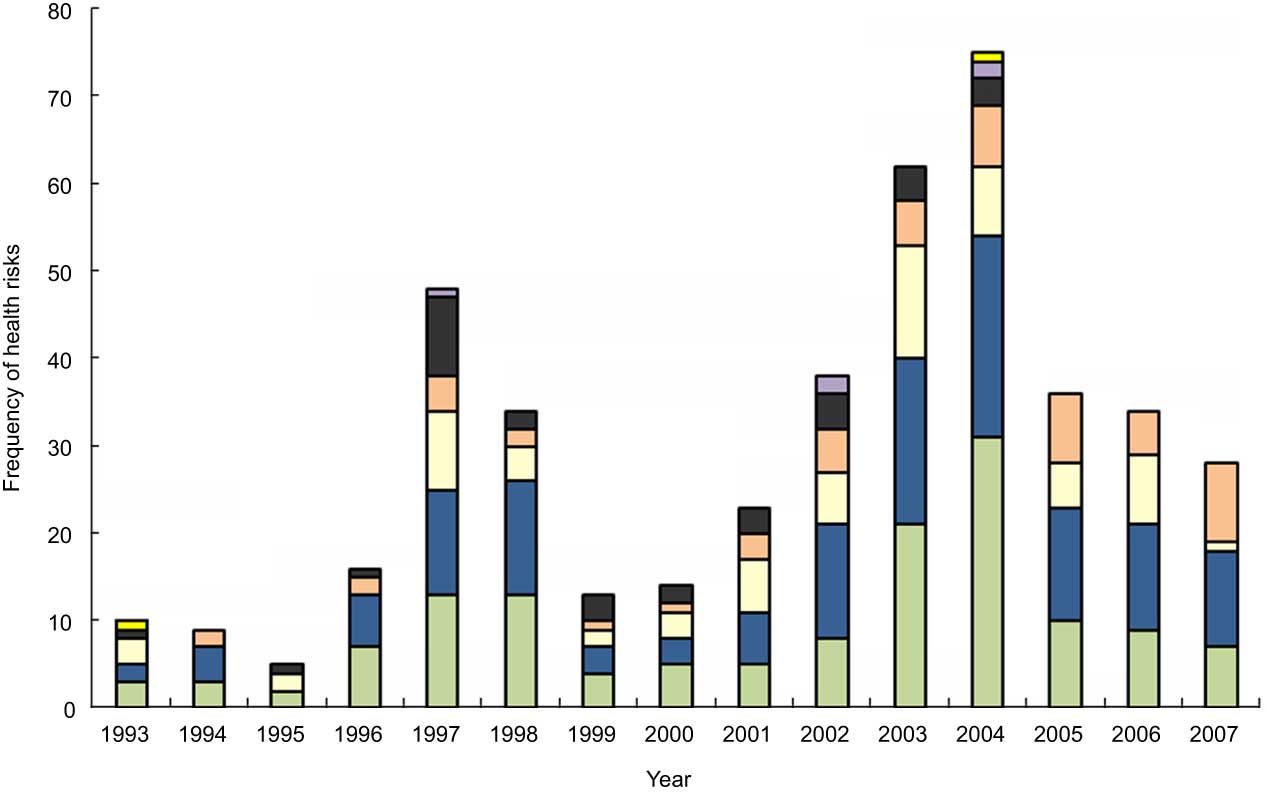
A variety of risks were mentioned from the beginning of the data collection period (unlike health benefits; Fig. 5), but the reporting of health risks closely followed the release of the EPA report to Congress in 1997 and then the joint EPA–FDA guidelines. The reporting of risks fell away quickly after the immediacy of the new guidelines had passed. Over the years, concerns about fetal development (141 mentions, 32 %) and general neurological problems (not fetus specific; 140 mentions, 32 %) garnered the most attention.
Frequency and type of health risk associated with fish consumption by year ( , cause heart problems;
  , cause cancer;
  , contaminated (non-mercury specific);
  , cause mercury poisoning;
  , ‘it’s bad for you’;
  , neurological problems;
  , problems for fetus)
Evidence and reporting on fish
In total, 131 stories (41 %) made some reference to a scientific study (118 of the newspaper stories (41 %) and thirteen of the TV stories (52 %)). There were no significant differences by media type (TV v. newspaper) for likelihood to refer to scientific studies. In the stories that made reference to a specific study, peer-reviewed studies (n 53, 17 %) and government/non-governmental organisation reports (n 52, 16 %) were equally likely to be referenced.
Reference to a scientific study, however, varied significantly depending on how the story was framed. ‘Health benefit’ stories were significantly more likely to refer to a scientific study than those with a ‘health risk’ frame (χ 2 = 46·8, P < 0·001). In addition, among stories that made reference to a specific study, TV news stories were significantly more likely to include references to studies from unnamed or other sources than newspaper stories (eight stories (62 %) v. eighteen stories (7 %), respectively; χ 2 = 15·8, P < 0·001).
Fish, news media and scientific uncertainty
Finally, we coded for any direct mention or implication of uncertainty about fish consumption studies and guidelines. We found that 26 % (n 81) of stories conveyed a sense of uncertainty about the benefits and/or risks of fish consumption, with no statistically significant difference between TV and print media (χ 2 = 1·4, P < 0·24) or by the frame of the article (χ 2 = 0·001, P < 0·975). However, expressions of uncertainty were found to be associated with the study sources being referenced; peer-reviewed study (n 28, 52 %), government report (n 12, 23 %), unnamed source (n 8, 44 %) or other (n 2, 25 %; χ 2 = 10·7, P < 0·01).
Discussion
A consideration of the history of federal and state consumption advisories shows that combining information on risks and benefits of eating fish has evolved over time. The variation in the messages is clear: the source, the type of water the fish come from (freshwater or marine), geographic variation and differences based on the consumer (women of childbearing age v. sports fishermen) are key components of messaging. Despite these complexities, guidelines – and the communication of them – play an important function in promoting public health. To the extent that fish consumption advisories provide the public with information on what fish are most problematic, how much of which to eat, what waters are most contaminated and who should not eat particular types of fish, consumers can be helped to access the health benefits of fish while minimising the potential health threats(Reference Jardine25).
Over the 15-year period of our study, 310 news stories on fish and health appeared in ten selected news sources. This level of coverage suggests that fish has been somewhat newsworthy, with coverage growing in recent years. Messages pertaining to the risks associated with eating fish outweighed benefit messages about eating fish by four to one. This imbalance may mean that the benefits of fish may get lost among the risk messages. One factor in the preponderance of risk messages is that health benefit messages only consistently appeared beginning in 2002 (and advisories only mention benefits beginning in 2004). Thus, this ‘imbalance’ may be a product of the time period in which this research was conducted and may even out in time. We suggest, however, that such a balance is somewhat unlikely given that the risk–benefit stories continue to dominate even after the publication of studies detailing evidence of considerable health benefits. It may be that ‘risk’ stories are deemed to be more newsworthy than stories about the growing evidence of long-term health benefits. The journalistic adage, ‘If it bleeds, it leads’ may be translating here into fear about the mercury content of someone’s catch from a local river or sushi takeout from their favourite restaurant.
The implication of the domination of risk messages in the news is significant. Risk-only messaging results in negative perceptions of seafood and reduced intention to consume fish, and even balanced information that presents both risks and benefits may still worsen the overall perception of seafood consumption(Reference Verbeke29). Those trained in communication could play a greater role upstream by helping governmental agencies draft guidelines and press releases that are clearly tailored to populations of interest based on the potential risk of consuming fish (women of childbearing age and children) and emphasise not only which fish to avoid, but which low-risk fish can be safely consumed. Similarly, messages for low-risk groups (men, women over the age of 40 years) could emphasise the benefits of fish to help counteract the pervasiveness of risk-laden messages. Communicators can aid in developing easy-to-interpret charts that can be readily adapted for the newspaper, Internet or TV and included within the coverage of all fish issues so as to help the audience contextualise new information. Such efforts would create the opportunity to have a visual and auditory means of accessing information, and help increase consumer self-efficacy by identifying not only problematic fish to avoid but also healthful fish to pursue.
Another dimension of tailoring messages to consumers is considering the intersection of human health and fishery/ecological health as it pertains to fish consumption. Messages that can highlight which fish are safe to eat for varying populations and which fish are caught or raised in sustainable methods can help guide consumers who are interested in both human and ecological health.
Brossard(Reference Brossard30) argues that ‘In times of crisis such as during a controversy, science communication can be a more convoluted, interwoven process with mass media assuming a central place’. As competing studies and advisories continue to be released, the news media has a role in creating effective communication. At the most basic level, if a study or federal notice is released that emphasises both benefits and risks, then both elements should be communicated to the public, and framed as something other than a ‘new warning about fish’, as this construction further eclipses important health messages. Framing new information about fish consumption as a guideline, as opposed to an advisory, may better prime a consumer to receive both positive and negative dimensions of the information. Finally, news agencies could easily provide links to sources that have more information on the benefits and risks of fish consumption, further providing an aspect of control and efficacy for consumers.
One of the striking findings in the present study was that fish moved from being a predominantly localised issue to being one of national significance around 2000. While discussions of risks were initially focused on local pollution sources, portrayals of contamination source and solutions increasingly assumed national and even international focus in the coverage. This change was parallel with a growing awareness of the global nature of the United States’ food supply and the rise of the country-of-origin labelling efforts, labels that address fishing methods (e.g. dolphin-free) and scares about contamination associated with a particular place (e.g. mad cow disease). While a national focus and attention from the FDA and EPA may lead to a different scale of intervention, the loss of a local focus for risk messages about fish consumption added a layer of complexity. Local fish advisories tend to identify particular waterways, whereas national advisories present relatively ‘placeless’ fish, a status that can increase a consumer’s uncertainty about the safety and sustainability of the catch.
Our study reveals that news messages on fish are relatively complex and have changed over time. Given the progressive understanding of contaminants such as methylmercury alongside the growing scientific literature on the beneficial effects of omega-3 fatty acids, voluminous and inconsistent health messages may in turn have an impact on consumer perception of risk and their resulting food choice behaviour. A glut of risk messages not appropriately accompanied by efficacy-building content promotes fatalistic beliefs about prevention, particularly among the less educated populations(Reference Niederdeppe and Levy31). Using fetal health as an example, unclear messaging about fish consumption can be problematic. The omega-3-rich fish can play a key role in promoting healthy fetal development. Conversely, consuming the wrong kind of fish – those that are high in mercury – can damage developing babies. Messages must be created so that consumers do not avoid fish out of fear of the problems fish consumption may cause for their babies. Such messages must make clear and easy to understand which fish provide an important source of nutrients for a developing fetus and which are to be avoided.
Finally, our analysis suggests that news coverage of both health and risk messages pertaining to fish intake had limited ability to deal with uncertainty – particularly in relation to stories calling upon peer-reviewed science as sources. Future research may fruitfully consider the impact portrayal of uncertainty and conflict has on consumer understanding of and behaviour in fish consumption, the source of messages within news, what perspective the utilised sources represent and how to communicate about the intersection of human and ecological health in terms of fish consumption.
Limitations
This textual analysis is subject to considerable limitations, many of which are the result of our decisions regarding source sampling and focus decisions. Our decision to purposively sample for regional newspapers from areas in which fishing is a major economic factor left the Midwest unrepresented. Our specific search terms of ‘mercury’ and ‘omega-3’ in addition to ‘fish’ greatly shaped the nature of the data collected and reflect the prioritisation of a specific notion of risk or benefit. Other environmental risks or benefits associated with fish intake, for instance those related to aquaculture, have not been addressed. Finally, our data are limited to news media content and not audience interpretation or other sources of dietary information (i.e. blogs and magazine content). Although we can suggest the possible impact of the complex, risk-focused messaging in the news, our data do not allow us to empirically examine any such association.
Conclusion
A role for health communicators exists in the creation of actionable messages within agencies, effectively disseminating research about the positive and negative implications of fish consumption, and educating those delivering the news on preferred construction of messages and impacts of skewed presentations. Given the previous research on fish messaging, however, messages not delivered at the point of sale may do little to encourage informed fish consumption, particularly as consumers are likely to attend only to messages that already fit within their beliefs(Reference Verbeke29). Further, as news organisations are rating driven and seek more sensationalised news, it is unlikely to expect that a potential threat to health – even if it is only a part of the picture – will be reframed in a more neutral way. Tailored information at the point of sale that addresses the various audiences (women of childbearing age, children, those not in either category and those interested in human and fishery health) may be more likely to deliver information when it is most needed. Health communication efforts that address the many levels at which consumers do and should receive information about eating fish are more likely to result in informed consumption and better health.
Acknowledgements
The study was funded by a grant from the Centers for Disease Control and Prevention to Dr Smith (5K01DP001129-03, Roles of the news media in knowledge dissemination around nutritious diet). The authors declare that they have no conflict of interest pertaining to the present study. A.G. and K.S. led the creation of these data from conceptualisation, to sampling and coding, helped the analysis, interpreting the meaning of the findings and the writing and editing of the paper. E.G. was involved in the initial conceptualisation of this project and the formulation of research questions; he also provided extensive contributions to the implications of the findings and was integral to the revisions of the paper.



