

Introduction
This paper was inspired by the debate regarding the conceptualisation of the firm and the corporation (Deakin et al., Reference Deakin, Gindis and Hodgson2021; Reference Deakin, Gindis and Hodgson2022; Robé, Reference Robé2021) – what may be termed the ‘firm-corporation linkage debate’ (FCLD) – that unfolded in the Journal of Institutional Economics between legal institutionalism (LI) (e.g., Deakin et al., Reference Deakin, Gindis, Hodgson, Huang and Pistor2017; Hodgson, Reference Hodgson2015, Reference Hodgson2025a, Reference Hodgson2025b) and world power system theory (WPS) (e.g., Robé, Reference Robé2011, Reference Robé, Robé, Lyon-Caen and Vernac2016, Reference Robé2020, Reference Robé2023).Footnote 1 The objective of this paper is to examine this debate through the lens of comparative institutional analysis (CIA) (e.g., Aoki, Reference Aoki2001, Reference Aoki2010; Taniguchi, Reference Taniguchi2024, Reference Taniguchi2025a, Reference Taniguchi2025b), approaching the corporation from the perspectives of associational cognition and governance to derive implications for the firm-corporation linkage (FCL).
Drawing on CIA, this paper focuses on institutional coevolution conditioned by complementarities among institutions emerging within ‘domains’ (e.g., Aoki, Reference Aoki2001, Reference Aoki2010). The research question is: How do the firm and the corporation function as institutions, interact with one another, and coevolve? To seek a multilevel understanding of institutional coevolution, I adopt the scepticism toward agency theory (e.g., Jensen and Meckling, Reference Jensen and Meckling1976) shared by LI, WPS, and CIA, rejecting the view that global institutions merely reflect dominant capitalist interests (e.g., Coccia, Reference Coccia and Farazmand2023a).
Three distinct perspectives on the institutional coevolution of the FCL emerge. First, LI presents the ‘emergentist view’, where long-term coevolution allows the firm to gain legal recognition and merge with the corporation (e.g., Hodgson, Reference Hodgson2002). Second, WPS offers the ‘separation view’, identifying the corporation as a legal instrument that structures the firm’s organised economic activities (e.g., Robé, Reference Robé2011, Reference Robé2020). Third, CIA provides the ‘representational view’, capturing the linkage as a pair consisting of organisational architecture (OA) and corporate governance (CG) (e.g., Aoki, Reference Aoki2010, Reference Aoki, Aoki, Binmore, Deakin and Gintis2012). To synthesise (Poole and Van de Ven, Reference Poole and Van de Ven1989) these views, I incorporate corporate actor theory (e.g., Coleman, Reference Coleman1974; Teubner, Reference Teubner1988) into the institutional process (IP) of CIA (e.g., Aoki, Reference Aoki2001, Reference Aoki2010, Reference Aoki2017; Taniguchi, Reference Taniguchi2025b) to elucidate the generative mechanisms of the FCL.
Jean-Philippe Robé, the primary advocate of WPS, titled his insightful paper ‘Firms versus corporations’ (Robé, Reference Robé2021). While the word ‘versus’ might suggest a strict dichotomy between these two institutions, I contend that coevolutionary dynamics can operate in a more flexible manner that transcends the oppositional framing inherent in such a term.
While LI, WPS, and CIA share affinities with Elinor Ostrom’s institutional economics (e.g., Ostrom, Reference Ostrom1990, Reference Ostrom2005, Reference Ostrom, Batie and Mercuro2008), her design-based theories cannot fully explain why formal rules sometimes fail to produce intended outcomes (Coccia, Reference Coccia and Farazmand2023b). Applying the CIA concept of enforcement (e.g., Aoki, Reference Aoki2001, Reference Aoki2010) addresses this gap, yielding policy implications for achieving institutional coherence (IC) between business practices and societal rules.
The fact that generations of economists, starting with the founder of firm theory, Ronald Coase, have conflated the firm with the corporation – what I call the ‘Coase confusion’ – was first highlighted by WPS (Robé, Reference Robé2011). Coase (Reference Coase1992) viewed an ‘organization’ dependent on ‘administrative decisions’ as a ‘firm’ and further identified this with a ‘corporation’ (714). Problematising this confusion, I identify three theoretical characteristics of the firm: (1) ‘multidomain characteristics’ consisting of complementary institutions across different domains, (2) ‘multitemporal characteristics’ evolving continuously at the national level, and (3) ‘ecosystem characteristics’ enabling transnational platform utilisation.
Finally, I identify a fourth attribute – ‘regenerative characteristics’ – required of modern firms addressing grand challenges (e.g., Howard-Grenville, Reference Howard-Grenville2021; Taniguchi et al., Reference Taniguchi, Huang and Fruin2023), implying complex problems that are highly unpredictable and lack clear solutions. This axiological property drives a sustainability transition that enriches the transnational global commons. Building on the cooperative game theory of the firm (e.g., Aoki, Reference Aoki1984), I propose an ideal CG type that facilitates this change.
This paper is organised as follows. This section provides an overview of LI and WPS as the theoretical foundations of the FCLD, clarifying the Coase confusion and the three characteristics of the firm. The section on CIA of the FCL organises the respective arguments of LI and WPS within the FCLD and presents a new understanding of the FCL from the perspective of CIA. Finally, I conclude by indicating future research agendas.
Legal institutionalism and world power system theory as the theoretical foundations of the firm-corporation linkage debate
Penrose (Reference Penrose2008) highlighted the corporation’s 19th-century emergence as a turning point with ‘enormous consequences for management and control, for finance, and for the legal position of the firm’ (1118: emphasis added). Understanding the firm’s legal position lagged in economics even in the ‘corporate age’ (Penrose, Reference Penrose1959: 33). Masten (Reference Masten1988) noted that neglecting differences between commercial and employment rules obscured the theoretical basis for firm authority, information access, and internal governance. From an LI perspective, Gindis and Hodgson (Reference Gindis and Hodgson2024: 1) formulated ‘Holmström’s puzzle’, arguing that explaining why the firm constitutes an entity (Holmström, Reference Holmström1999) requires reference to law and the firm as a legal person.
Even Coase, despite elucidating the firm’s raison d’être, faced limitations. Confined to an Anglo-American context, he overlooked diverse OAs beyond classical top-down models (e.g., Taniguchi, Reference Taniguchi2025b). Consequently, Coase missed two critical characteristics prevalent in distinct institutional environments: ‘multidomain characteristics’ evolving as complementary institutional systems, and ‘multitemporal characteristics’ coevolving with a permanent corporation. Firms tackle evolutionary design through the coevolution of organisational structure and production technology, centring on uncertainty buffering (Langlois, Reference Langlois2007; Nelson, Reference Nelson1994). This uncertainty buffering drives the firm’s evolution into an FCL, generating the third, ‘ecosystem characteristics’, which enable exponential growth via digital technologies and platform development.
LI, WPS, and CIA possess relative strengths in understanding these characteristics. LI emphasises the inseparability of economy and law, viewing law as constitutive and essential for explaining capitalist economies (Hodgson, Reference Hodgson2015, Reference Hodgson2025a). Drawing on CIA’s cognitive conceptualisation of institutions (Aoki, Reference Aoki2010), LI interprets law as ‘historically accumulated common knowledge’ (Deakin and Markou, Reference Deakin and Markou2021: 694) that provides stability, while legal evolution balances operational closure and cognitive openness (e.g., Deakin, Reference Deakin2002, Reference Deakin2011, Reference Deakin2015, Reference Deakin2023a).
Deakin et al. (Reference Deakin, Gindis, Hodgson, Huang and Pistor2017) represents a seminal work that catalysed the FCLD. Their arguments can be synthesised into ten primary claims: (1) law consists of a combination of the public and private order (ibid.: 188); (2) law forms a constitutive part of power structures and serves as a fundamental means for exercising power (ibid.: 189); (3) the corporation is a specific type of firm characterised by a structure stipulated under corporate law (ibid.: 194); (4) shareholders merely own shares, whereas asset ownership belongs exclusively to the corporation (ibid.: 194–195); (5) agency theory fails to recognise how the firm persists as a stable entity beyond individual human lifespans (ibid.: 196); (6) the attribution of legal personality provides the necessary flexibility to navigate systemic uncertainty (ibid.: 197); (7) managers owe their fiduciary duties to the corporation as an entity rather than to the shareholders (ibid.); (8) the legitimacy of legal orders can be evaluated by the degree and impact of corruption (ibid.: 198); (9) law must be viewed as an experimental and evolutionary process (ibid.); and (10) legal evolution, understood as IP, is of paramount significance (ibid.: 199).
LI excels in understanding multitemporal characteristics, viewing the firm as a continuous association (Demsetz, Reference Demsetz1988) where corporate law secures stable long-term transactions (Deakin, Reference Deakin, Baars and Spicer2017b). The firm’s essence lies in evolving capabilities and power over assets (Deakin, Reference Deakin2012; Deakin and Slinger, Reference Deakin and Slinger1997), unified by legal ‘ontological glue’ (Gindis, Reference Gindis2009) and corporate culture (Hodgson, Reference Hodgson and Groenewegen1996). LI also addresses ecosystem characteristics by analysing platform firms and capitalist crises (Deakin, Reference Deakin2023a, Reference Deakin, Arestis and Sawyer2023b).
On the other hand, WPS analyses the world power system – a global system lacking a global state – which requires the ‘constitutionalization’ of corporate power (Robé, Reference Robé, Robé, Lyon-Caen and Vernac2016: 33). WPS critiques the concentration of productive property in large corporations that exploit locational competition among states using administered prices (Robé, Reference Robé2020, Reference Robé2021, Reference Robé2023).
WPS primarily puts forward seven claims: (1) economists have problematically conflated the firm and the corporation (Robé, Reference Robé2011), namely, the Coase confusion; (2) to resolve this confusion, it emphasises the fundamental distinction between the two, arguing that ‘the firm is an organization performing an economic activity. … The corporation is a form of legal person which can be used to legally structure firms’ (Robé, Reference Robé2020: 199, emphasis in original); (3) company law can be regarded as a firm resource (Robé, Reference Robé, Robé, Lyon-Caen and Vernac2016); (4) the shareholder primacy underlying the premise that ‘the social responsibility of business is to increase its profits’ (Friedman, Reference Friedman1970) masks corporate realities (Robé, Reference Robé2012); (5) enforceable property rights are key to understanding this system (Robé, Reference Robé2020); (6) law politically structures the economy via the LPE (law of political economy) approach (Robé, Reference Robé2022); and (7) the gargantuan power of corporations requires constitutionalisation to prevent ecological collapse (Robé, Reference Robé2023).
WPS shows relative strength in understanding ecosystem characteristics. In the digital age, ‘Big Tech’ monopolies (e.g., Petit and Teece, Reference Petit and Teece2021; Pitelis, Reference Pitelis2024) dominate surveillance capitalism, operating globally through subsidiaries and exceeding national GDPs. Thus, observing transnational institutions is critical (Coccia, Reference Coccia2018). Multinational enterprises (MNEs) connect through a ‘World Wide Web of Contracts’ (Robé, Reference Robé2020: 211). These platforms risk abusing economic power to dominate the polity domain, triggering ‘Medici’s vicious cycle’ (Zingales, Reference Zingales2017: 114), where economic and political dominance mutually reinforce. Therefore, what is called for is an institutional economics that prioritises monopoly over perfect competition.
Comparative institutional analysis of the firm-corporation linkage
The contrast between the emergentist view and the separation view within the firm-corporation linkage debate highlights distinct modes of institutional coevolution between the firm and the corporation
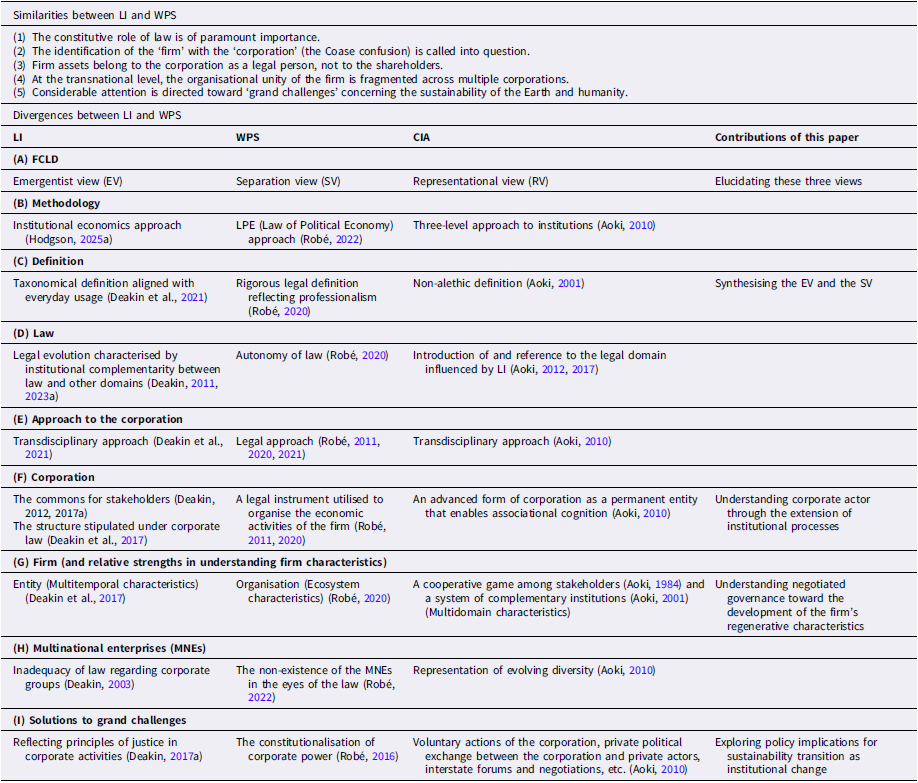
Hardman (Reference Hardman2022) argues that there is no ‘irredeemable gap’ (14) between LI and WPS. Supporting this reconcilability, I exploratively bridge them. This section clarifies the similarities and differences between the two (Table 1), focusing on papers directly engaging in the FCLD.
Examination and extension of the firm-corporation linkage debate (FCLD) between legal institutionalism (LI) and world power system theory (WPS)

Table 1. Long description
A table comparing similarities and divergences between legal institutionalism and world power system theory. The table has 9 rows and 5 columns. The columns are labeled LI, WPS, CIA, and Contributions of this paper. The rows are labeled with different aspects such as FCLD, Methodology, Definition, Law, Approach to the corporation, Corporation, Firm, Multinational enterprises, and Solutions to grand challenges. Each cell contains specific details about the aspects for each theory and their contributions. The table provides a detailed comparison of the views, methodologies, definitions, and approaches of LI, WPS, and CIA, along with the contributions of the paper in elucidating these views and synthesizing different perspectives.
First, both emphasise law’s constitutive role, agreeing that law constitutes power structures and serves as a means for exercising power (Deakin et al., Reference Deakin, Gindis, Hodgson, Huang and Pistor2017; Robé, Reference Robé2021). However, WPS constrains this by insisting that ‘the term “corporation” must … be used in its technical sense only’ (Robé, Reference Robé2021: 4). This strictness reflects the professional pride of Robé, an international lawyer, who asserts that ‘the legal language is technical and not easily accessible by non-specialists’ (Robé, Reference Robé2020: 197).
Second, regarding law, WPS adopts the LPE approach based on legal systems theory (e.g., Luhmann, Reference Luhmann1995; Teubner, Reference Teubner1989). Kjaer (Reference Kjaer and Kjaer2020) argues that law simultaneously separates and reconnects societal domains; a social system must be coupled with law. Law acquires autonomy via the coevolution of law and society through recursive self-referentiality (Teubner, Reference Teubner1984). Conversely, LI posits that while law gains autonomy through self-referential closure during self-replication (Deakin, Reference Deakin2015), its inherent cognitive openness enables mutual influence among domains (Deakin, Reference Deakin2011, Reference Deakin2023a). Emphasising legal autonomy, WPS’s ‘strictly legalistic definition of the corporation’ (Deakin et al., Reference Deakin, Gindis and Hodgson2021: 862) creates inconsistency with LI’s taxonomic definition, which stays ‘close to everyday meanings’ (ibid.: 863) by parsimoniously specifying minimal characteristics for shared understanding (Hodgson, Reference Hodgson2019).
Third, both problematise the Coase confusion (Deakin et al., Reference Deakin, Gindis, Hodgson, Huang and Pistor2017; Deakin et al., Reference Deakin, Gindis and Hodgson2021; Deakin et al., Reference Deakin, Gindis and Hodgson2022). WPS first critiqued this confusion (Robé, Reference Robé2011), asserting that ‘firms have no “legally recognized capacity to produce goods or services for sale.” Only legal persons have this capacity and firms as economic organizations coordinating resources in the pursuit of an economic activity are not legal persons. … Firms are not creatures of the law. They are creatures of business practice, which is making use of the law to structure them. Corporations are creatures of the law, and they are used to structure many firms’ (Robé, Reference Robé2021: 2). WPS strictly assigns the firm to the economic domain and the corporation to the legal domain. LI interprets this as ‘mutual exclusivity’ (Deakin et al., Reference Deakin, Gindis and Hodgson2022: 1) and a ‘strict separation between economic and legal phenomena’ (Deakin et al., Reference Deakin, Gindis and Hodgson2021: 869). Sceptical of treating the corporation as the ‘sole property of lawyers’ (ibid.: 862), LI prefers a transdisciplinary approach incorporating ‘political, economic, ethical and cultural aspects’ (ibid.) over WPS’s autonomous legal approach.
Fourth, both acknowledge that firm assets are owned by the corporation, not shareholders. LI states that ‘the corporation itself is an owning agent’ (Deakin et al., Reference Deakin, Gindis, Hodgson, Huang and Pistor2017: 194–195); as a legal person, it is not a thing (res) owned by shareholders, who merely own shares. WPS similarly argues that shareholders only own shares issued to ‘collect the equity capital’, making it misleading to view managers as agents of firm-owning shareholders (Robé, Reference Robé2020: 67–68).
Fifth, LI positions the firm beyond the ‘sole property of economists’ (Deakin et al., Reference Deakin, Gindis and Hodgson2021: 862), noting that ‘firms operate in a legal system’ (Deakin et al., Reference Deakin, Gindis and Hodgson2022: 2). LI argues that ‘we use the term firm to apply to individuals or organisations with the legally recognised capacity to produce goods or services for sale. A corporation is a kind of firm; It has a structure as designated under company law’ (Deakin et al., Reference Deakin, Gindis, Hodgson, Huang and Pistor2017: 194, emphasis in original). WPS critiques this entity-based definition, arguing that treating the firm as an entity is a conceptual ‘convenience … to be avoided’ (Robé, Reference Robé2020: 210), lacking independent legal existence. Nevertheless, since ‘entity’ frequently appears in case law (Deakin, Reference Deakin, Gagliardi and Gindis2019), the entity-based conceptualisation utilised by LI (e.g., Deakin et al., Reference Deakin, Gindis, Hodgson, Huang and Pistor2017; Deakin and Slinger, Reference Deakin and Slinger1997; Hodgson, Reference Hodgson2002) and CIA (e.g., Aoki, Reference Aoki2010) remains analytically coherent. I contend that the firm is both an autonomous actor and a collective entity, akin to markets or communities (King et al., Reference King, Felin and Whetten2010).
Sixth, both recognise the fragmented unity of MNEs. For WPS, while group subsidiaries contract internally, the firm legally does not exist, bearing no responsibility and decomposing into property rights and contracts in positive law (Robé, Reference Robé2003, Reference Robé2022). Economic exchanges occur among different legal persons structured by the firm (Robé, Reference Robé2021). In LI, corporations are utilised for liability avoidance (Deakin, Reference Deakin2012). Without a ‘generally accepted legal concept of the corporate group’ (Deakin, Reference Deakin2003: 98), law struggles to distinguish justifiable entity shielding from tax avoidance and regulatory arbitrage. In the context of MNEs, whereas LI highlights the legal deficiencies of globalised corporate groups and argues that management has not entirely disappeared as a social reality, WPS underscores the legal non-existence of MNEs, emphasising that management remains a highly visible and undeniable social reality in organising their economic activities.
Seventh, both prioritise grand challenges but diverge on policy. LI pursues IC, aligning organisational activities with societal rules to reflect efficiency and justice over time (Deakin, Reference Deakin2017a). Conversely, WPS demands the constitutionalisation of corporate power (Robé, Reference Robé, Robé, Lyon-Caen and Vernac2016) to ensure accountability, opposing fundamental rights to exercised power and demanding capability evolution (CE) in corporate rule-making (Robé, Reference Robé2003; Robé et al., Reference Robé, Robé, Lyon-Caen and Vernac2016).
Since conceptualising institutions is a ‘matter of the theorist’s taste and not a matter of right or wrong’ (Aoki, Reference Aoki2001: 14), I examine the FCLD to clarify the relative strengths of LI and WPS. LI presents the emergentist view, where the firm gains legal recognition and merges with the corporation over time under uncertainty, ‘acting openly or tacitly as a “legal person”’ (Hodgson, Reference Hodgson2002: 56, emphasis in original). According to the emergentist view, the LI-IC mode predicates the FCL on economy-law inseparability (Hodgson, Reference Hodgson2015). This inseparability implies that the legal domain, associated with law in general and company law in particular, is essential for explaining the rules and structures emerging in the economic domain, and vice versa. Thus, the two domains can coevolve, overlap, or merge.
On the other hand, the separation view of WPS is summarised in the claim: ‘A corporation is a legal instrument, with a separate legal personality, which is used to legally structure the firm; A firm is an organized economic activity’ (Robé, Reference Robé2011: 3). This view regarding the relationship between the firm and the corporation holds that ‘they are mutually exclusive categories’ (Deakin et al., Reference Deakin, Gindis and Hodgson2021: 869). This paper interprets that the separation view clarified another mode of institutional coevolution, the WPS-IC mode, where the firm in the economic domain, separated from the legal domain, links through activity by utilising the legal personality of the corporation in the autonomous legal domain.
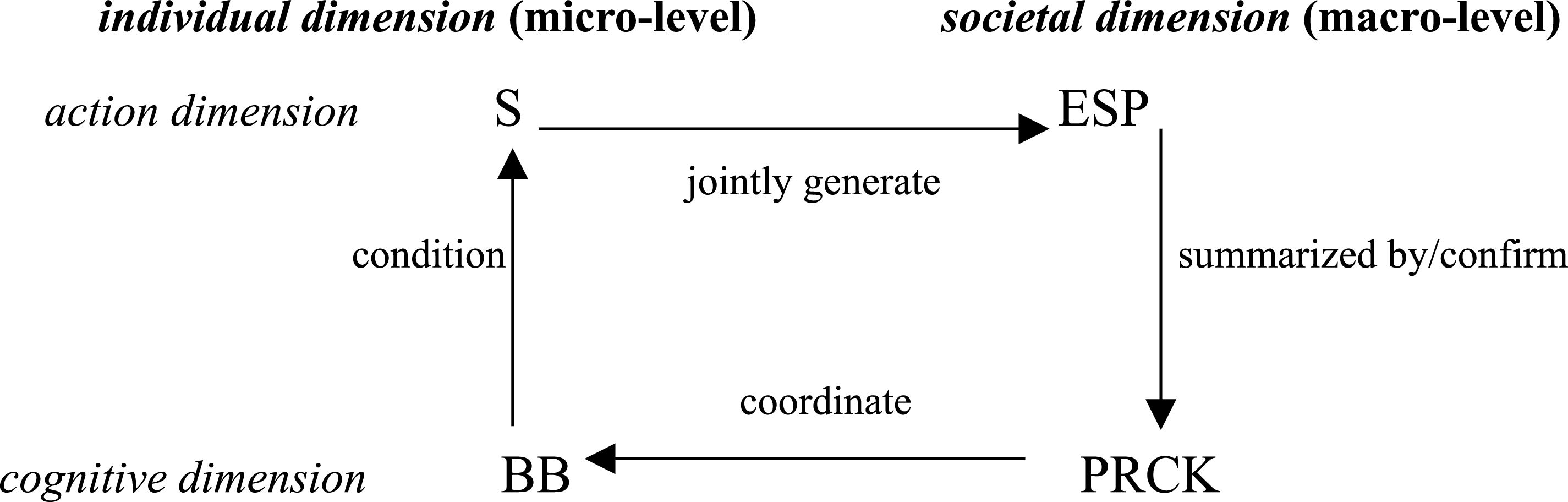
Relying on ‘synthesizing’ as one of the ‘methods for dealing with paradox’ (Poole and Van de Ven, Reference Poole and Van de Ven1989: 565) to resolve this tension, this paper treats the emergentist view and the separation view as complementary, extending the IP (Figure 1) of CIA (e.g., Aoki, Reference Aoki2001, Reference Aoki2010, Reference Aoki2017). The IP conceptualises how boundedly rational actors – Aoki’s ‘homo ludens’ (2010: 13) – form behavioural beliefs (BB) regarding others’ strategic choices (S). Aggregating these rational S produces an equilibrium state of play (ESP), summarised as a public representation of common knowledge (PRCK). In this way, institutions are endogenously generated across single or multiple domains, and this process persists over time (⇒). Thus, the IP of ‘BB → S → ESP → PRCK⇒’ is driven (e.g., Aoki, Reference Aoki2001, Reference Aoki2010; Taniguchi, Reference Taniguchi2025b).
The prototypical IP.

In a specific domain, the ESP – generated as a result of the formation of BB and the S based on those BB by actors – is shaped in a quasi-endogenous manner, determined by the institutional environment defined by the endogenous rules of surrounding domains. This ‘quasi-parametric’ nature (Greif and Laitin, Reference Greif and Laitin2004) refers to a process that is both exogenous and endogenous, where parameters that are stable as exogenous factors in the short term gradually change over time as the endogenous changes in various variables accumulate. Therefore, even if a law is enacted and enforced with the aim of inducing a specific institution x, it is difficult to achieve the intended induction of x without the existence of a complementing institution y and the capabilities of the subjects who support y (Aoki, Reference Aoki, Kornai, Mátyás and Roland2008).
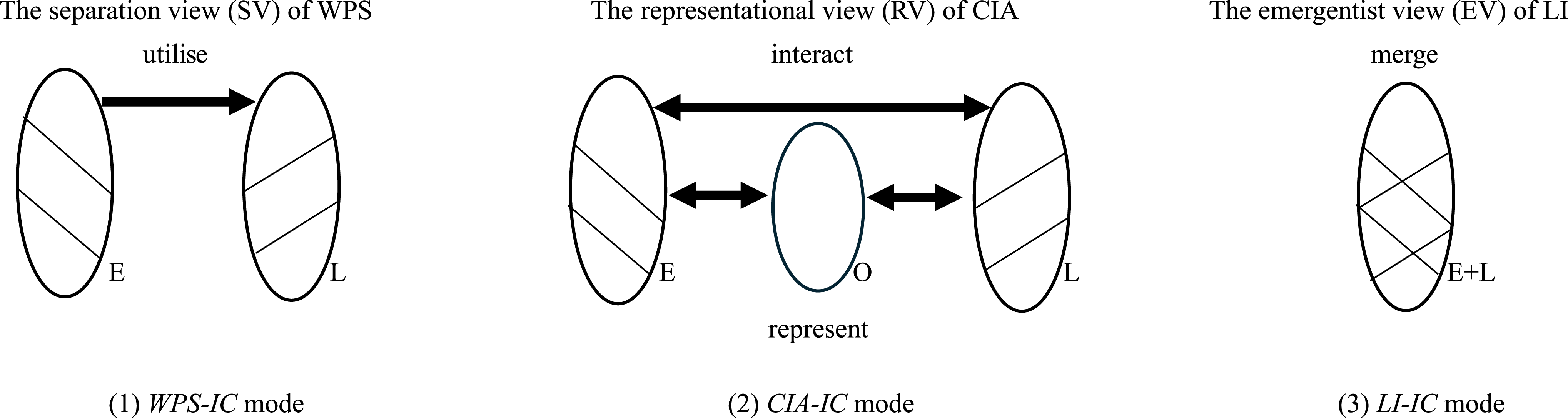
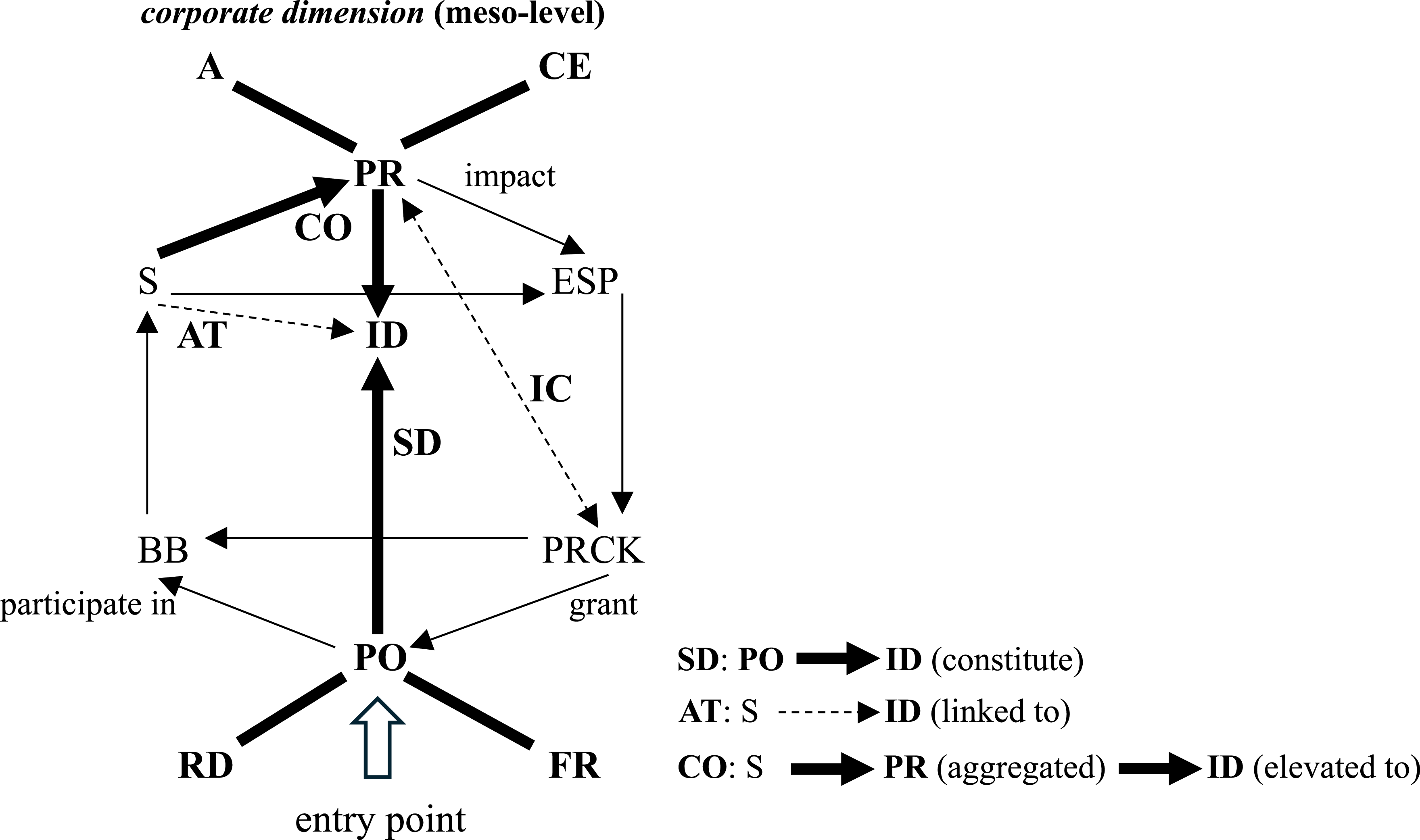
Below, I intend to deepen the understanding of the FCL based on CIA, but before that, let us organise the three modes of institutional coevolution depicted by LI, WPS, and CIA, respectively, based on Figure 2.
Three distinctive modes of institutional coevolution. Note. (1) WPS-IC mode: The ‘organisation’ enters the economic domain (E) and is socially granted the PO of a ‘firm.’ By ‘utilising’ the legal personality of a ‘corporation’ from the legal domain (L), institutional coevolution occurs, mediated by the activities of the firm; (2) CIA-IC mode: The firm develops its organisational architecture (OA) within the organisational domain (O) and forms its corporate governance (CG) at the intersection of O and E. This develops an OA-CG linkage mode representing the FCL. Interactions occur not only between O and E but also between these domains and L; (3) LI-IC mode: When the ‘firm’ enters E under company law (L) and acquires the PO of a ‘corporation,’ E and L ‘merge,’ resulting in institutional coevolution through the generation of the FCL. It should be noted that ‘PO’ in the preceding discussion refers to ‘positions,’ a concept that will be elaborated upon later in the context of the corporate actor (see also Figure 3).

Figure 2. Long description
The flowchart illustrates the extended institutional process (IP) of a firm becoming a corporate actor. The firm enters the extended IP through an entry point and is granted the position (PO) of a corporation by law (PRCK). If the firm, as a corporate actor, succeeds in effectively generating a cyclical linkage between its activities (A) and identity (ID) through temporal practices (PR) via the process of collectivisation (CO), it can then evolve into a firm-corporation linkage (FCL) entity. In this entity, appropriate corporate governance (CG) is required to realise institutional coherence (IC) between business practices (PR) generated within the organisation and societal rules or law (PRCK). Bold text and arrows indicate the process through which a corporate actor emerges in this diagram.
Emergentist view (LI-IC mode)
Institutional coevolution occurs through the inseparable ‘merging’ of the economic and legal domains. In this view, the firm enters the economic domain and subsequently gains the formal position of a corporation granted by company law emerging from the legal domain. Through this inherent integration of legal constitution and economic function, the FCL natively emerges as a unified entity.
Separation view (WPS-IC mode)
Institutional coevolution unfolds through a distinct, sequential process in which an organisation first enters the economic domain to engage in productive activities, thereby acquiring the position of a firm. Subsequently, this firm actively ‘utilises’ the legal personality of the corporation within the autonomous legal domain as a structural tool to secure and advance its economic objectives.
Representational view (CIA-IC mode)
Institutional coevolution is driven by the dynamic interaction among three distinct yet interdependent domains: the legal, economic, and organisational. Within this complex nexus, the firm internally develops its OA within the organisational domain, while simultaneously generating its CG at the intersection of the organisational and economic domains – particularly within the context of financial transactions. Consequently, institutional coevolution crystallises in a form where the specific linkage mode between OA and CG effectively embodies the overarching FCL.
Comparative institutional analysis contributes to the understanding of the firm-corporation linkage
CIA differs from LI and WPS in its theoretical orientation by targeting a wider range of perpetual associations beyond the business corporation. Furthermore, its originality lies in the ‘three-level approach to institutions’ (e.g., Aoki, Reference Aoki2010, Reference Aoki2014; Taniguchi, Reference Taniguchi2025b), which synthesises essential theory at the ontological level, substantial theory at the comparative-historical level, and policy theory at the policy level to theorize the nature of institutions and institutional change. I wish to highlight the primary claims of CIA, focusing on three key points. First, reflecting the theory of legal evolution by LI (e.g., Deakin, Reference Deakin2002, Reference Deakin2011; Deakin and Carvalho, Reference Deakin, Carvalho, Zumbansen and Calliess2011), CIA treats law as an independent domain. Compared to the original six domains – commons, economic, organisational, organisational field, polity, and social exchange domains (e.g., Aoki, Reference Aoki2001, Reference Aoki2010) – it was only at a relatively late stage that CIA mentioned and introduced the legal domain (e.g., Aoki, Reference Aoki, Aoki, Binmore, Deakin and Gintis2012, Reference Aoki2014, Reference Aoki2017; Taniguchi, Reference Taniguchi2025b).
Second, moving beyond previous economic conceptualisations of the firm, CIA initially introduced the ‘corporate organizational domain’ (Aoki, Reference Aoki2001: 280) as a linkage between the organisational domain (which generates OA) and the financial transaction domain (a subset of the economic domain) to view CG as equilibria of these linked games. Ultimately, however, it integrated OA and CG by adopting a cognitive approach to the corporation as a perpetual entity, including business corporations (Aoki, Reference Aoki2010). In this process, it presented the conceptualisation of an associational cognitive system. Specifically, ‘corporations are voluntary, permanent associations of natural persons engaged in some purposeful associative activities, having unique identity and embodied in rule-based, self-governing organizations’ (Aoki, Reference Aoki2010: 4, emphasis in original). Furthermore, among the various corporations that emerged in relation to religion, academia, and politics, the business corporation is regarded as a ‘highly developed form’ (ibid.).
Third, CIA examines the institutional diversity of the OA-CG linkage mode in a corporate economy. In terms of an associational cognitive system, the cognitive assets of stakeholders are significant for the functioning of OA. Specifically, investors provide physical assets (PHA) – cognitive assets that function as tools for associational cognition, or extended cognitive assets. Using these non-human physical assets, managers and workers carry out cognitive activities based on their respective human cognitive assets: management’s cognitive asset (MCA) and worker’s cognitive asset (WCA).
CIA introduced the ‘essentiality’ of cognitive assets to represent whether they contribute to generating complementarity with PHA, as a key variable determining the diversity of the OA-CG linkage. However, MCA is considered essential to varying degrees because it can present corporate strategies to WCA and motivate appropriate actions; without a strategy in OA, WCA cannot create value (e.g., Aoki, Reference Aoki2010, Reference Aoki, Sacconi, Blair, Freeman and Vercelli2011, Reference Aoki, Aoki, Binmore, Deakin and Gintis2012).
To identify the basic modes of OA, CIA first focuses on three basic modes of associational cognition between two actors (Aoki, Reference Aoki2010: ch. 2): (1) assimilated cognition or cognitive sharing (S), where two actors observe their respective environments, share information, and reach a consensus on decision-making; (2) hierarchical cognition (H), where one actor specialises in observing the common environment and transmits that information to the other; and (3) encapsulated cognition (E), where the two actors face environments with few commonalities and conduct cognitive activities independently.
Next, it clarifies the OA mode (X), which combines the vertical cognitive association (VCA) – representing the relationship between the MCA and WCA – with the horizontal cognitive association (HCA) – representing the relationship among WCAs – to reflect their essentialities. Then, the CG mode (Y) suitable for each OA mode is identified, revealing the institutional diversity of the OA-CG linkage modes, expressed as [(OA) X, (CG) Y], within real-world corporate economies (Aoki, Reference Aoki2010: ch. 2; Taniguchi, Reference Taniguchi2024: 70–72). Specifically, five linkage models are identified: the AA model (Anglo-American model), the G model (German model), the J model (Japanese model), the SV model (Silicon Valley model), and the STK-S model (stakeholder society model) (Aoki, Reference Aoki, Sacconi, Blair, Freeman and Vercelli2011: 37–44).
Consequently, drawing on institutional observations from not only the Anglo-American context but also Japan and Germany, CIA has elucidated the institutional diversity of the OA-CG linkage (e.g., Aoki, Reference Aoki2010, Reference Aoki, Sacconi, Blair, Freeman and Vercelli2011, Reference Aoki, Aoki, Binmore, Deakin and Gintis2012). This linkage, representing the PRCK of the FCL affected by company law in the legal domain, is conceptualised as a complementary pair: OA, which pertains to associational cognition reflecting essentiality in the organisational domain, and CG, which relates to finance and employment in the economic domain.
The corporate actor lies at the core of the extended institutional process
Position and capability are deeply intertwined. In CIA, actors enable institutions to be enforced and sustained over time by forming BB based on their ‘positions … in associational cognition’ (Aoki, Reference Aoki2010: 32) and driving CE through practices (PR). Particularly in the organisational domain of the firm, a public representation of ‘distinct roles expected for agents occupying different positions’ (Aoki, Reference Aoki2001: 27) is generated. LI views actors as holding multiple positions with various capabilities (Hodgson, Reference Hodgson2025b). WPS conceptualises the firm based on organised activity enabled by contracts over resources controlled via formal positions (Robé, Reference Robé2011).
LI, WPS, and CIA incorporate Ostromian concepts like the ‘commons’ and the ‘nesting of rules within rules’ at multiple levels (e.g., Ostrom, Reference Ostrom1990, Reference Ostrom2005, Reference Ostrom, Batie and Mercuro2008). LI conceptualises the corporation as a stakeholder ‘commons’ (e.g., Deakin, Reference Deakin2012, Reference Deakin2017a, Reference Deakin, Baars and Spicer2017b, Reference Deakin, Gagliardi and Gindis2019) and explores rule-nesting concerning the legal actor (Gindis and Micheler, Reference Gindis and Micheler2024). WPS argues that MNEs’ profit-maximising property rights exploit the Earth’s ‘commons’, causing climate change (e.g., Robé, Reference Robé2020). CIA positions the ‘commons’ domain as one subsystem of the overall social system, where the generation or loss of social capital occurs based on social norms unique to the community (e.g., Aoki, Reference Aoki2001; Reference Aoki2010).
CIA’s focus on ‘domains’ aligns closely with the Ostromian IAD (institutional analysis and development) framework’s ‘action arena’, consisting of actors and action situations. Both utilise game theory and fieldwork to comprehend institutional diversity. I introduce ‘positions’ (PO) within the IAD’s action situation as the primary source of diverse BB in the FCL. For Ostrom, the assigned PO dictate actors’ choices within an action set, thereby rendering the PO the crucial link between actors and actions (Ostrom, Reference Ostrom2005).
Coleman (Reference Coleman1974) noted that law requires elements like ‘persons, actions, events, resources, interests, and rights and duties’ (13) to recognise organisations. He defined ‘intangible’ legal persons as ‘corporate actors’ (14–15) comprised of PO filled by ‘substitutable’ natural persons (ibid.: 36). State-established company law grants the firm the position of a corporate actor – a source of rights and duties (RD) – while imposing organisational-specific PO on natural persons. This demands CE through PR, enabling actors to execute broader and more complex tasks (e.g., Taniguchi et al., Reference Taniguchi, Shi and Takabe2024; Winter, Reference Winter2013).
However, PO are absent in Aoki’s prototypical IP, which analyses actions based on BB regarding others’ S. In IAD, actors base their actions on situational beliefs. On the other hand, WPS conceptualises the firm based on activity (e.g., Robé, Reference Robé2020). What, then, is the difference between the actions and the activities? And how do actions transform into activities? Previous studies seem to have neglected to give sufficient consideration to these questions. Following ubiquitous computing studies (e.g., Liu et al., Reference Liu, Nie, Liu and Rosenblum2016), I define activity as temporally linked actions, often interleaved or concurrent. These patterned activities become institutionalised and attributed to the corporate actor.
For a firm to engage in activities, it cannot produce any goods or services without the capabilities of its actors – such as experience, knowledge, and skills (e.g., Langlois and Robertson, Reference Langlois and Robertson1995; Richardson, Reference Richardson1972). Thus, capabilities are indispensable for the core activities of value creation, value capture, and value distribution of the firm (e.g., Bapuji et al., Reference Bapuji, Husted, Lu and Mir2018). Note that this term essentially represents the ability to redeploy various resources for the realisation of desired goals and outcomes (e.g., Amit and Shoemaker, Reference Amit and Shoemaker1993; Helfat, Reference Helfat and Nelson2018). Organisational capabilities of the firm can evolve as actors practice the functions and roles (FR) prescribed by contracts (Adelstein, Reference Adelstein2010).
To gain a multilevel understanding of the FCL, I reinterpret CIA’s corporation using Gunther Teubner’s (Reference Teubner1988) corporate actor theory: (1) self-description (SD) establishing collective identity (ID); (2) attribution (AT) linking individual actions to that identity; (3) collectivisation (CO) elevating individual actions to organisational activities (A); and (4) the corporate actor as a social reality maintained by the ‘cyclical linkage of action and collective identity’ (ibid.: 139).
In particular, Teubner (Reference Teubner1988) argues that a corporate actor is regarded as a social reality only to the extent that actions are ‘institutionalized’ (ibid.: 138) by being oriented around SD as a guide. From this viewpoint, he emphasises SD, which represents ‘reflexive communication in the action system, communication on its own identity and its capacity for action’ (ibid.: 137–138). The corporate actor is a ‘semantic artifact, as a linguistically condensed perception of group identity’ (ibid.: 138) – a definition that possesses a high affinity with the CIA conceptualisation of the corporation as an associational cognitive system.
In a firm that has acquired the position of a corporation under company law, ‘natural persons’ are granted specific PO with certain RD and act by fulfilling the FR attached to those PO. However, the corporation must perform SD within its internal communications, establish an ID as a cognitive PRCK, and ensure this identity is shared among its constituent members. Through this process, AT is established, whereby the actions of an individual are linked to the ‘unique identity’ of that corporate actor. Furthermore, as the actions of various natural persons are coordinated within the organisation by themselves or by managers, they are aggregated and elevated into A – ‘purposeful associative activities’ – and become fully linked to the corporate actor as a ‘voluntary, permanent association.’ As a result of this CO, the cyclical linkage of action and ID is generated. If this linkage operates effectively over time and the CE is successfully realised, the corporate actor can persist. However, in this process, it also becomes necessary to maintain IC between the internal PR generated and the societal rules or laws prevailing in society. Consequently, the ‘rules’ for operating the corporation as a ‘self-governing organization’ become a central issue. I intend to discuss in detail the nature of these rules and the CG that governs them later in this paper (The terms in italics above represent the building blocks of Aoki’s (Reference Aoki2010: 4) conceptualisation of the corporation).
Based on the extended IP that I propose, the corporate actor is regarded as an ‘intermediary entity’ (Coleman, Reference Coleman1974: 27) that emerges between the state and its law at the macro-level and the individual at the micro-level. In this manner, the FCL can be generated (Figure 3).
The extended IP. Note. This generates the firm as a corporate actor endowed with social reality. The firm enters the extended IP through an entry point and is granted the position (PO) of a corporation by law (PRCK). If the firm, as a corporate actor, succeeds in effectively generating a cyclical linkage between its activities (A) and identity (ID) through temporal practices (PR) via the process of collectivisation (CO), it can then evolve into a firm-corporation linkage (FCL) entity. In this entity, appropriate corporate governance (CG) is required to realise institutional coherence (IC) between business practices (PR) generated within the organisation and societal rules or law (PRCK). Bold text and arrows indicate the process through which a corporate actor emerges in this diagram.

Figure 3. Long description
The first diagram shows the separation view of WPS where an organisation enters the economic domain and utilises the legal personality of a corporation from the legal domain, resulting in institutional coevolution. The second diagram illustrates the representational view of CIA where a firm develops its organisational architecture within the organizational domain and forms corporate governance at the intersection of the organisational and economic domains, with interactions occurring between these domains and the legal domain. The third diagram depicts the emergentist view of LI where a firm enters the economic domain under company law and merges with the legal domain, resulting in institutional coevolution through the generation of the firm-corporation linkage.
Negotiated governance can contribute to the realisation of institutional coherence by the firm-corporation linkage
The Friedman doctrine’s shareholder primacy, challenged primarily by WPS (e.g., Robé, Reference Robé2012), strongly aligns with agency theory – the ‘dominant “reference point” among company law scholars’ (Gindis and Micheler, Reference Gindis and Micheler2024: 400). It fails to achieve a proper balance between profit for shareholders and purpose for society (e.g., Mayer, Reference Mayer2016). As LI argues, no country’s company law mandates shareholder value maximisation (Deakin, Reference Deakin2012). Yet, agency theory yields a narrow CG that merely justifies shareholder primacy (e.g., Chiu, Reference Chiu2018). WPS critiques this ‘shareholder value ideology’ (Robé, Reference Robé2023: 598), noting that it drives excessive profit maximisation, which generates negative externalities such as climate change.
The reason why the Coase confusion is problematic is that it seems to have hindered the emergence of doubts regarding shareholder primacy. According to LI, in a Coasean firm – an organisation run by an ‘entrepreneur-coordinator’ (Coase, Reference Coase1937: 389) consisting of ‘one or more people’ (Deakin et al., Reference Deakin, Gindis, Hodgson, Huang and Pistor2017: 194) – while management functions and employment contracts were considered significant, the RD attached to ownership was downplayed. This led to a neglect of the reality that the firm is the locus of legal responsibility. Consequently, a detailed examination of the firm as a legal entity and the ownership of its assets was hindered; it was perhaps impossible even to harbour doubts about the ideology of shareholder primacy, which suppressed awareness of the diversity of OA and drove an excessive pursuit of profit for shareholders who are nothing more than owners of shares.
Countering this, LI proposes a ‘corporation as a commons’ model (e.g., Deakin, Reference Deakin2012, Reference Deakin2017a, Reference Deakin, Baars and Spicer2017b, Reference Deakin, Gagliardi and Gindis2019). It advocates multi-stakeholder governance, internal rule-making autonomy, and respect for democratic choices over regulatory arbitrage (Deakin, Reference Deakin2012). Furthermore, like CIA, it views the sustainability of the corporation as depending not only on the participation of stakeholders in the formation of governance rules and the CE regarding associational cognition – the ‘ontological glue’ à la Gindis – but also recognises that the corporate form plays a crucial role not only within the legal domain but also across the diverse domains that constitute the broader societal game.
Within the FCL, Aoki’s comprehensive theory of the firm captures the corporation as the firm’s ‘typical form’ (Aoki, Reference Aoki1984: 3), bridging legal and economic theories. This clarified the manager’s role in core activities, fair value distribution, and IC, inspiring legal research such as the team production theory of company law (Blair and Stout, Reference Blair and Stout1999), which views the board as mediating stakeholder interests to protect relation-specific capital.
Furthermore, Aoki treated the fair value distribution of quasi-rents generated by cooperation among firm stakeholders as one of his most important research themes, continuing to work on this consistently even after pioneering CIA (e.g., Aoki, Reference Aoki2010, Reference Aoki, Aoki, Binmore, Deakin and Gintis2012). He emphasised Alfred Marshall’s triad: custom, fairness, and bargaining (e.g., Aoki, Reference Aoki1975, Reference Aoki1984). Marshall argued that the quasi-rents collectively realised by the firm are divided among stakeholders through ‘bargaining’ complemented by the ‘custom’ of ‘fairness’ (Marshall, Reference Marshall1961: 626).
Drawing on classic research on bargaining processes (Harsanyi, Reference Harsanyi1977; Nash, Reference Nash1950; Zeuthen, Reference Zeuthen1930), Aoki (Reference Aoki1984) characterised the stable distribution of quasi-rents generated through the cooperation of shareholders and employees under a neutral manager. He demonstrated that the resulting organisational equilibrium is formally equivalent to the Nash bargaining solution (Taniguchi, Reference Taniguchi2026). This solution is an organisational equilibrium generated in a two-person cooperative game where shareholders and employees have a common interest in forming a prior agreement regarding the distribution of quasi-rents. In other words, it is regarded as a stable state of power balance representing the equilibrium of each side’s ‘boldness’ (Aoki, Reference Aoki1984: ch. 5).
Furthermore, after pioneering CIA, Aoki conceived a model applying ‘potential games’ (Monderer and Shapley, Reference Monderer and Shapley1996), where the change in individual members’ payoffs is perfectly represented by the change in a single function, to the context of value distribution among stakeholders in the firm. In this model, if a belief is generated that the value distribution of organisationally generated quasi-rents will be conducted according to the custom of fairness reflected in the ‘Shapley value’ – representing the degree of contribution to the sum of payoffs in an n-person cooperative game – the associational cognitive system is shaped in a way that maximises the potential function (Aoki, Reference Aoki, Aoki, Binmore, Deakin and Gintis2012: 155–158).
Relying on Marshall, Aoki paid attention to the necessity of cooperation under shared values in the firm (Aoki, Reference Aoki1975). Marshall believed that while sharing of profits and losses occurs between the firm and its employees, the alignment of interests among stakeholders collaborating in the organisation can arise as a result of shared values embodying a spirit of ‘fraternity’, rather than through a contract (Marshall, Reference Marshall1961: 627). Thus, CG in the tradition of Marshall and Aoki can be understood as what Anna Grandori (Reference Grandori and Grandori2013: 285) terms ‘negotiated governance’. This mode of governance is characterised by ‘bargaining’ among stakeholders, guided by the ‘custom’ of ‘fairness’ and realised through the firm’s shared values. Such a framework presupposes continuous interactions among actors, suggesting that the firm benefits from linking and coevolving with the corporation over time. This synergy, in turn, serves as a fundamental raison d’être of the FCL.
Because CG dictates value distribution and power dynamics, it is inherently political (e.g., Cioffi, Reference Cioffi2000; Ferner and Tempel, Reference Ferner, Tempel, Almond and Ferner2006; Gourevitch and Shinn, Reference Gourevitch and Shinn2005; Mesure, Reference Mesure2008). This is an aspect that WPS also emphasises regarding resource allocation (Robé, Reference Robé2003). Effective negotiated governance requires operationalising marginal contributions, using concepts like boldness, essentiality, and the Shapley value, to distribute quasi-rents. It also demands IC between law and the firm’s business PR (e.g., Aoki, Reference Aoki2010; Deakin, Reference Deakin2012; Reference Deakin2017a; Robé, Reference Robé and Teubner1997), reconciling exogenous ‘law in books’ with endogenous ‘law in action’ (e.g., Aoki, Reference Aoki2001; Reference Aoki2010; Coccia, Reference Coccia and Farazmand2023b; Gindis and Hodgson, Reference Gindis and Hodgson2024; Pound, Reference Pound1910). As the bedrock of corporate existence, law provides the fundamental structure for internal governance and external accountability (Orts, Reference Orts2013).
While states constrain corporate activity via law (e.g., Willke and Willke, Reference Willke, Willke, Scherer and Palazzo2008), transnational grand challenges persist. Issues such as platform capitalism harms and inequality (Deakin, Reference Deakin2023a, Reference Deakin, Arestis and Sawyer2023b), climate change exacerbated by distorted accounting (Robé, Reference Robé2020; Reference Robé2023), and global commons crises (Aoki, Reference Aoki2010) stem from institutional incoherence. National legal failures cause transnational negative externalities, raising prescriptive jurisdiction issues over regulatory power (Trachtman, Reference Trachtman1997).
Solving these challenges via negotiated governance requires coupling public and private orders (Deakin et al., Reference Deakin, Gindis, Hodgson, Huang and Pistor2017) or ‘essential hybridity’ (Pistor, Reference Pistor2013: 312). State capacity is crucial (Acemoglu et al., Reference Acemoglu, García-Jimeno and Robinson2015). Without it, organisations developing distinctive internal logics – like the Augustan principatus or the ‘winner-take-all distinctive internal logic’ (WINTADIL) of tech monopolies – can abuse power beyond societal control.
Therefore, negotiated governance must prescriptively demand new axiological characteristics to achieve IC. I propose a fourth firm attribute: ‘regenerative characteristics.’ This denotes values oriented toward sustainability transitions and CE, enabling firms to address transnational grand challenges, restore the global commons via IC, and enhance planetary sustainability.
To achieve this, human actors must transcend self-interest for global intrinsic values (e.g., Lindenberg and Foss, Reference Lindenberg and Foss2011; Taniguchi and Fruin, Reference Taniguchi and Fruin2022; Taniguchi et al., Reference Taniguchi, Shi and Takabe2024). Joint production via team reasoning (Bruni and Sugden, Reference Bruni and Sugden2008) requires an agreement of joint responsibility (Deakin et al., Reference Deakin, Gindis, Hodgson, Huang and Pistor2017). Ultimately, it is an ethical practice demanding standards of excellence (Bernacchio et al., Reference Bernacchio, Foss and Lindenberg2024) to dictate appropriate action.
Conclusion
Drawing on CIA, this paper examined LI and WPS – the theoretical foundations of the FCLD – to explore the institutional coevolution of the firm and the corporation. It demonstrates that: (1) the contrast between the emergentist and separation views within the debate delineates distinct institutional coevolutionary modes; (2) CIA enhances a multilevel understanding of the FCL; (3) the corporate actor is at the core of the extended IP; and (4) negotiated governance is pivotal for achieving IC through the FCL.
Theoretical implications for institutional economics are threefold. First, the law provides the fundamental social structure for flexible coevolution via a dual framework for internal governance and external accountability. Second, joint production via team reasoning is essential; stakeholders committing to an agreement of joint responsibility establish standards of excellence aligning firm performance with transnational sustainability. Third, negotiated governance requires human growth, developing internal capabilities and customs of fairness, thereby shifting the theoretical focus from mere incentive alignment to actors’ capability evolution. These findings demand a departure from shareholder primacy-based CG paradigms. Policy frameworks must facilitate negotoated governance, empowering stakeholder bargaining based on customs of fairness.
Policy implications are threefold. First, legal corporate recognition must depend on external responsibilities, ensuring firms drive sustainability rather than mere profit extraction. Second, fostering education is needed for cultivating the complex capabilities required for interleaved organisational activities and moral judgement. Third, supranational norms should incentivise regenerative characteristics, aligning organisational excellence with global ecosystem flourishing.
Nevertheless, several issues remain for future research. First, this synthesis is primarily conceptual; major concepts require operationalisation into verifiable standards. Future research must empirically validate ‘regenerative characteristics’ via longitudinal case studies or quantitative analyses of firms transitioning toward negotiated governance.
Second, while human growth is a prerequisite for negotiated governance, mechanisms to foster and measure internal capability evolution remain underdeveloped. The psychological and pedagogical dimensions of how actors transcend self-interest toward ‘team reasoning’ require deeper investigation to construct a more robust actor model.
Third, the generalisability of the coevolutionary model across different legal and historical contexts warrants further investigation. Implementing negotiated governance within diverse political economies – characterised by varying levels of state intervention, the strength of civil society, and the pervasiveness of the WINTADIL manifested by tech monopolies – remains a central task for empirical comparative and historical analysis.
Fourth, regarding methodological accessibility, CIA historically faced high entry barriers due to rigorous mathematical formalism, incremental assumptions, and fragmented historical data presentation (e.g., Dow, Reference Dow2003; Greif, Reference Greif2015; Seabright, Reference Seabright2003; Taniguchi, Reference Taniguchi2025b). However, CIA’s transdisciplinary ‘three-level approach to institutions’ remains a critical evolutionary axis for institutional economics. Reviving this transdisciplinary legacy through continuous dialogue is indispensable for analysing complex themes such as the FCL and ensuring Aoki’s methodology remains a vital framework for understanding global institutional coevolution.
To conclude, this paper hopes to serve as a catalyst for institutional economists to advance research on LI, WPS, and CIA. By engaging with these diverse theoretical perspectives, we may further deepen the theoretical and policy implications of a new CG – one that directs the FCL toward a sustainability transition and endows it with regenerative characteristics.
Acknowledgements
An earlier version of this paper was presented at the International Scholars’ Keynote Speeches session, held on September 6, 2025, during the 2025 International Conference on Corporate Governance at the School of Economics and Management, Tsinghua University, Beijing, China. I would like to thank the late Masahiko Aoki, Simon Deakin, Mark Fruin, Shigeharu Kawahara, Richard Langlois, Weian Li, Christos Pitelis, the late Masahiko Shimizu, the late Hirokuni Sogawa, and the late Teruhisa Uetake for their insights and support, as well as Esther-Mirjam Sent and the anonymous reviewers for their valuable comments and suggestions. Any remaining errors are entirely my own.
Funding statement
This research was generously supported by the Matsushita Institute of Government and Management in 2025 and 2026. I am especially grateful to Masaaki Hieda, Kotaro Nakajima, Tadashi Nakamura, Kenji Ozeki, and Takashi Toyama for their kind and invaluable support.

 Open access

