

Introduction
Welfare state research has long dealt with the question of how welfare states redistribute resources among their citizens (Titmuss, Reference Titmuss1974; Korpi and Palme, Reference Korpi and Palme1998). According to leading social rights and citizenship approaches (Marshall, Reference Marshall1950; Esping-Andersen, Reference Esping-Andersen1990), welfare states can best be characterised by their institutional design and the social rights they grant citizens. Concrete regulations and their combinations set the conditions for rights over resources, and these conditions may differ for social groups (Frericks et al., Reference Frericks, Harvey and Maier2010). This differentiation in rights over resources is what we call the redistributive logics of a welfare state. The most prevalent redistributive logics discussed in the literature are the ‘Robin Hood’, ‘Matthew’, ‘equality’ (referring to the concept of universalism), and ‘differentiation’ (closely connected with ‘deservingness’) logics. However, the identification of these redistributive logics has two limitations. First, research has mainly focused on redistribution based on the principles of work, residency, or need. By contrast family has been analysed as a social unit or societal institution affected by these redistributive principles. We argue instead that the family is an explicit regulative unit of its own and therefore also a redistributive principle of its own. Since this perspective is unconventional, little is known about the redistributive principle of the family and whether and how much redistributive logics based on other redistributive principles correspond to those based on the family. Second, studies that have analysed redistribution in terms of family have focused on specific family-related welfare regulations, or single redistributive logics, and asked how much family-related benefits follow the Matthew logic (e.g. Pavolini and Van Lancker, Reference Pavolini and Van Lancker2018). A broader perspective including not only benefits but also a wide range of welfare regulations on redistribution, and in particular, obligations, is lacking. Indeed, financial obligations imposed on the family remain an often overlooked area in welfare state redistribution analysis. Our study contributes to filling this research gap by analysing the redistributive logics in relation to the family as laid down in welfare regulations, and by answering the question of how far the redistributive logics based on other well-studied principles may also be derived from the redistributive principle of the family.
To answer this question, we calculated the degree of regulated family-related redistribution for a large number of family forms. We used the tax-benefit microsimulation tool of the European Union (EUROMOD) and its Hypothetical Household Tool (HHoT) to generate forty-two different family forms that vary as to the parents’ marital status, situation as single-parent or couple family forms, number of children, earner model, and income level. With EUROMOD we simulated the disposable household income of the family forms under study to analyse redistribution based on benefits, taxes, obligations, and social insurance contributions, and compared it to the reference point of a household of individual(s) without family and with the same gross income. In doing so, we determined the degree of regulated family-related redistribution to the different family forms to verify the prevalence of the redistributive logics based on other redistributive principles. We analysed the redistributive logics for all EU member states to do justice to the identified country variations in redistributive logics (see Korpi and Palme, Reference Korpi and Palme1998, or Gugushvili and Laenen, Reference Gugushvili and Laenen2021).
The article is structured as follows. The next section discusses the state of the art of redistributive logics in welfare state research and family-related redistribution. The third section presents the analytical approach, and the fourth section clarifies the applied method. We then present the findings of our empirical analysis. A brief discussion and some conclusions end the contribution.
State of the art
Two of the most researched aspects of the welfare state are the conditions on entitlements and the amount of resources redistributed among citizens. This is especially true for country-comparative welfare state analyses, which aim to capture the characteristics of different welfare states. In his influential typology, Titmuss (Reference Titmuss1974) differentiated between three welfare state models based on different ideas of redistribution: the residual, achievement-performance, and institutional-redistributive models. These three models, which inspired Esping-Andersen’s later welfare regime typology (Reference Esping-Andersen1990) and recent research (see Powell et al., Reference Powell, Yörük and Bargu2020 for an overview), centre on the concepts of universalism and selection (Titmuss, Reference Titmuss, Pierson and Castles2006). Although universalism is a complex and far-from-coherent concept, in general, universalism and selection refer to whether all citizens in the same situation are treated equally (Anttonen et al., Reference Anttonen, Häikiöö, Stefánsson, Sipilä, Anttonen, Häikiöö and Stefánsson2012) or whether social benefits and services focus on specific groups. Welfare states differ in how much each of these two concepts shapes their welfare regulations.
While later research has advocated universalism as the conceptual basis for the study of equality in the redistribution of resources (Korpi and Palme, Reference Korpi and Palme1998; Brady and Bostic, Reference Brady and Bostic2015; Jacques and Noël, Reference Jacques and Noël2018), concepts other than selection have been used to analyse the inequality of redistribution. In their ‘paradox of redistribution’, Korpi and Palme (Reference Korpi and Palme1998) differentiated welfare state institutions as being on a continuum between universalism and targeting. For them, the former means that all citizens are eligible for welfare benefits, and the latter implies that the benefits are only for the poor. More recent studies have adopted a more nuanced perspective on the inequality of redistribution, differentiating between selectivity and universalism as opposite concepts for coverage (i.e. asking who are the addressees of welfare benefits), while targeting refers to the benefit level (Marx et al., Reference Marx, Salanauskaite and Verbist2016; Van Oorschot and Roosma, Reference Van Oorschot, Roosma, Van Oorschot, Roosma, Meuleman and Reeskens2017; Marchal and Van Lancker, Reference Marchal and Van Lancker2019). This conceptualisation allows for more complex policy designs, such as the notion of ‘targeting within universalism’ (Skocpol, Reference Skocpol, Jencks and Peterson1991).
Despite their different foci, targeting and selectivity present general concepts to capture unequal redistribution. In addition to these very general concepts, more specific lines of inequality have been identified, both in terms of addressees and the degree of redistribution. Many authors have highlighted that it is the middle class or middle-income earners who are most advantaged by welfare state redistribution (Titmuss, Reference Titmuss1965; Esping-Andersen, Reference Esping-Andersen1990; Korpi and Palme, Reference Korpi and Palme1998; Barr, Reference Barr2001), an effect that has been labelled - picking up on Merton - the ‘Matthew Principle’ (Gal, Reference Gal1998). In this context Titmuss (Reference Titmuss1965) pointed to the relevance of fiscal welfare in redistribution, which often works in favour of the middle class. Interestingly, he highlighted this for the UK, a country classified as prioritising the poor in its welfare regulations and therefore labelled as a country applying the typical ‘Robin Hood strategy’ (Korpi and Palme, Reference Korpi and Palme1998; Gugushvili and Laenen, Reference Gugushvili and Laenen2021). This strategy describes redistribution from the rich to the poor – the opposite of the Matthew Principle (Barr, Reference Barr2001). The general redistributive logics of universalism, targeting, and selectivity, and the more specific concepts, overlap. For example, targeting within universalism might work as a Robin Hood strategy, but one can also imagine a policy that provides benefits to all, but higher benefits to those with higher income.
While the ‘Matthew Principle’ and ‘Robin Hood strategy’ focus on the effects redistribution has on citizens with different incomes, the reasons for redistribution have also been broadly discussed, mainly in terms of ‘legitimacy’ (Van Oorschot, Reference Van Oorschot2010), ‘moral economy of the welfare state’ (Mau, Reference Mau2003), and ‘deservingness’ (Van Oorschot and Roosma, Reference Van Oorschot, Roosma, Van Oorschot, Roosma, Meuleman and Reeskens2017). Historically, the most deserving had been the non-able-bodied, in particular wounded soldiers, widows, orphans of war, and poor families (Skocpol, Reference Skocpol1995; Polanyi, Reference Polanyi2001; Obinger et al., Reference Obinger, Petersen, Starke, Obinger, Petersen and Starke2018). Current research on deservingness and the legitimate degree of redistribution is mainly based on an analysis of citizens’ attitudes. Despite country differences, it is most often the elderly, disabled, and children who are considered by citizens the most deserving of redistribution.
Indeed, welfare states have always aimed to reduce family poverty through a wide range of family-related benefits. Current welfare states offer numerous family-related welfare provisions, not only for poverty-preventing benefits, but for children, care-dependent family members, single parents and families with low income (Saraceno, Reference Saraceno and Greve2016). Family has thus always been an important redistributive principle of welfare states. The above classic works on welfare state redistribution discuss the family and how it is affected by redistribution. However, they do not consider family a redistributive principle itself, but only as indirectly affected by other redistributive principles (Frericks, Reference Frericks2023a).
Feminist researchers have criticised this shortcoming (e.g. Lewis, Reference Lewis1992; Orloff, Reference Orloff1993), and in his later work, even Esping-Andersen extended his analysis with the concept of defamilialisation (Esping-Andersen, Reference Esping-Andersen1999), originally introduced by Lister (Reference Lister, Baldwin and Falkingham1994) and McLaughlin and Glendinning (Reference McLaughlin, Glendinning, Hantrais and Mangen1994) to capture the individual’s, and especially women’s, independence from the family. Lister (Reference Lister, Baldwin and Falkingham1994: 37) defined it as ‘the degree to which individual adults can uphold a socially acceptable standard of living, independently of family relationships, either through paid work or through the social security system’. Research using the defamilialisation concept has revealed valuable insights into welfare states’ designs and outcomes with regard to the family. However, due to its analytical focus, research on defamilialisation has limitations for the analysis of family-related redistribution. First, such research often applied a one-dimensional perspective on the family because the early approaches to defamilialisation referred to the patriarchal family (Zagel and Lohmann, Reference Zagel and Lohmann2021), and therefore not considered that family-related welfare regulations often differ across family forms. Second, due to its focus on societal outcomes, such research often mixed welfare state regulations, which constitute the redistributive logics, and welfare state outcomes. Such outcomes are, however, affected by various factors, such as culture, citizens’ attitudes, or labour market structures (Pfau-Effinger, Reference Pfau-Effinger2005). Lastly, research on defamilialisation has dealt with individuals’ complete independence from the family, while we are interested in the gradual differences in redistribution.
One strand of literature on family-related redistribution refers to the above-mentioned concepts of universalism and targeting (Morissens, Reference Morissens, Nieuwenhuis and Maldonado2018; Marchal and Van Lancker, Reference Marchal and Van Lancker2019), as well as the ‘Matthew effect’ (Pavolini and Van Lancker, Reference Pavolini and Van Lancker2018). Unlike studies on defamilialisation, this research considers the consequences of redistribution for different family forms, but focuses on specific family policies such as child benefits or formal childcare, and analyses policy outcomes such as poverty and inequality, using quantitative methods. That is, it offers only partial pictures of welfare state redistribution by skipping a wide range of redistributive regulations. And similar to research on defamilialisation, the above studies analyse factual outcomes instead of the redistributive logics laid down in welfare regulations.
Finally, with their specific foci, both above strands of family-related research have dealt only with welfare benefits (i.e. the redistribution of resources to families). There is however another side to redistribution that concerns redistribution from the family in the form of obligations that the welfare state imposes. An empirical example of such obligations is means-testing that can impose an obligation on the family to support a family member before being entitled to a welfare benefit. Although some authors have devoted attention to this aspect (Millar, Reference Millar2004; Daly and Scheiwe, Reference Daly and Scheiwe2010), the combination of the ‘plus and minus’ of redistribution in terms of family and its impact on family-related redistributive logics has rarely been studied. The studies by Frericks and colleagues (e.g. Reference Frericks, Gurín and Höppner2023) combined this ‘plus and minus’ without, however, comparing redistributive logics for the family and other redistributive principles of the welfare state.
To summarise, our systematic research on redistribution as regulated in terms of family is original and helps identify welfare state differences in redistributive regulations that stipulate financial inequalities between families. To address this issue, we refer to the concept of redistributive logics (Esping-Andersen and Myles, Reference Esping-Andersen, Myles, Nolan, Salverda and Smeeding2009; Brown and Kahn Best, Reference Brown and Kahn Best2017; Marchal and Van Lancker, Reference Marchal and Van Lancker2019).Footnote 1 The term describes the underlying rationale of welfare regulations on redistribution. In this article we define the unequal allocation of rights over resources as laid down in welfare regulations, i.e. stipulated inequalities, as redistributive logics, and we aim to understand how far identified lines of inequality, such as the Matthew logic, can be observed in analysing family as the redistributive principle. Thus, the article seeks to show how far redistributive logics based on other redistributive principles are also found for the redistributive principle of the family. Our analysis of family-related redistribution thus makes an important contribution to the broader literature on welfare state redistribution.
Analytical approach
Redistributive principles take a concrete form in welfare state regulations determining citizens’ eligibility for welfare benefits. Next to redistribution based, for instance, on the principle of work (e.g. unemployment benefits), there is also redistribution based on the principle of family (e.g. child benefits). Thus far, obvious facts. But redistributive principles are translated into concrete welfare regulations in highly differentiated ways. Hence, redistributive logics can be understood as group-specific, unequal allocations of rights over resources that result from the concretisation of redistributive principles into specifically combined welfare regulations. We can identify redistributive logics by studying the concrete differences in the stipulated redistribution that includes both the addressees and the level of redistribution.
Drawing on the state of the art, we distinguish four redistributive logics: the Matthew, Robin Hood, equality, and differentiation logics.
The first two logics are built on differences in income. Focusing on stipulated redistribution, we identify
-
the Matthew logic — if the family-related redistribution based on all welfare regulations are higher for better-off families than for low-income families;
-
the Robin Hood logic — if the family-related redistribution based on all welfare regulations are higher for low-income families than for better-off families.
Since these two redistributive logics present logical opposites, we studied them in a combined analysis.
The equality logic refers to the concept of universalism, characterised in the literature as offering welfare benefits and services to all citizens (Korpi and Palme, Reference Korpi and Palme1998; Gugushvili and Laenen, Reference Gugushvili and Laenen2021), often at an equal level for all (e.g. Marchal and Van Lancker, Reference Marchal and Van Lancker2019). However, if not single welfare benefits but the sum of all relevant measures are of interest, operationalising universalism is more difficult because a single benefit can be either universal or not, but the combined redistribution requires a relational concept. Jacques and Noël (Reference Jacques and Noël2018) have proposed measuring the degree of universalism by the share of means-tested benefits in a country and the proportion of private spending. However, this is problematic, as the latter is not an institutional indicator but a factual outcome, and means-testing alone does not capture equality of redistribution adequately. Therefore we measured equality of redistribution not by the concept of universalism but by the differences in the degree of redistribution between family forms. We assumed therefore the following:
-
The lower the differences in family-related redistribution among family forms, the closer the regulations approach equality.
In contrast to the equality logic, which aims for equality between family forms overall, the differentiation logic deals with the question of which family forms receive higher or lower redistribution compared to others. We studied the degree of redistribution as depending on the marital status of a couple in a family, the number of children, and the status as single- or dual-parent family. Previous research has shown that several welfare states provide a comparatively higher level of financial support to families when the couple is married (Daly and Scheiwe, Reference Daly and Scheiwe2010). Moreover, there are welfare states like France that provide special financial support to families with many children (Bouvard, Reference Bouvard2021). Numerous countries in Europe provide special financial support to single-parent families in the form of benefits, tax deductions, or lower social insurance contributions (Bradshaw et al., Reference Bradshaw, Keung, Chzhen, Nieuwenhuis and Maldonado2018). Finally, some welfare states aim to support specific earner models. The Nordic countries are well known for supporting the dual-earner model, while (Western) Germany is known to be oriented towards the supplementary earner model (Pfau-Effinger and Smidt, Reference Pfau-Effinger and Smidt2011). Based on these observations, we identify
-
the differentiation logic, where family-related redistribution differs between particular family forms.
Method
Our analysis is based on the tax-benefit microsimulation model EUROMOD (version I4.109+) (ISER, 2022) and HHoT. We used the most recent policy data (from 2021). EUROMOD can simulate how welfare regulations on redistribution, including tax regulations and obligations, affect a family’s income. Thus, we identified legally stipulated welfare state redistribution. Furthermore, HHoT can model different hypothetical family forms that can then be used in EUROMOD (Hufkens et al., Reference Hufkens, Goedemé, Gasior, Leventi, Manios, Rastrigina, Recchia, Sutherland, Van Mechelen and Verbist2019). This makes EUROMOD and HHoT excellent analytical tools for our study. We decided to model hypothetical family forms ‘for a comparative analysis of the institutional structure of tax-benefit systems that isolates the effect of tax-benefit policies from the composition of the population’ (Hufkens et al., Reference Hufkens, Goedemé, Gasior, Leventi, Manios, Rastrigina, Recchia, Sutherland, Van Mechelen and Verbist2019: 69). To capture the variety of redistributive logics, we analysed all countries’ data included in EUROMOD (currently twenty-seven EU member states). This allowed us to adopt the broadest perspective in terms of available data on the differences between family-related redistributive logics and those based on other redistributive principles.
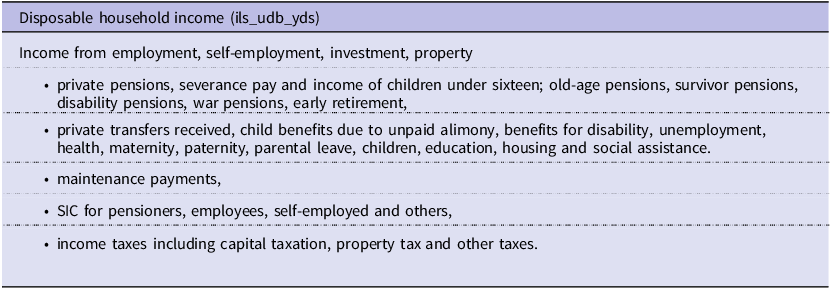
EUROMOD covers all existing benefits, taxes and social insurance contributions in the countries under study. Taking the disposable household income of the hypothetical family forms as the starting point of our analysis (see below and, for a bias and sensitivity check, the supplemental material), we included the whole set of regulations provided in EUROMOD (see Table 1 for an overview). Notably, there were country differences in the regulations and their exact compositions.
Overview of the regulations

Table 1 Long description
A textbox containing a list of components that make up disposable household income. The text includes income from employment, self-employment, investment, property, private pensions, severance pay, old-age pensions, survivor pensions, disability pensions, war pensions, early retirement, private transfers received, child benefits due to unpaid alimony, benefits for disability, unemployment, health, maternity, paternity, parental leave, children, education, housing, and social assistance, maintenance payments, SIC for pensioners, employees, self-employed and others, and income taxes including capital taxation, property tax, and other taxes.
Source: the authors, based on EUROMOD (2020)
We studied family forms with single parents, married and unmarried couples, couples with different earner models, different numbers of children, and income levels. For all family forms, we assumed the parent(s) to be of working age, earning declared income on the labour market, and the children to be dependent.
Regarding earner models, we assumed that a couple organises their paid work after either the ‘dual-earner’, ‘supplementary-earner’, or ‘single-earner’ model. These are the established forms of shared paid work (Ciccia and Bleijenbergh, Reference Ciccia and Bleijenbergh2014) (i.e. the distribution of a couple’s income from employment). We operationalised them as follows: in a single-earner couple, one partner earns the entire income; in a supplementary-earner couple, one partner earns twice the amount of the other partner; in a dual-earner couple, both partners earn the same amount of income.
Moreover, for family forms with children, we included those with one and three children. Their age was eleven if there was one child in the family, and six, eleven, and fifteen in a family of three children. Thus we considered only children of school age and intentionally excluded younger children because there are often specific, highly complex welfare regulations regarding care and parental leave for younger children. Although tax deductions coincide with childcare in several countries, childcare cannot be simulated in HHoT. Therefore, simulating redistributive logics for families with young children was beyond the scope of EUROMOD and this article.
For different income levels, we used three categories: low, medium, and high. Low income is defined as the average minimum wage in EU member countries; in 2021, in the member states with minimum wage regulations, this was 46 per cent of the country-specific average gross income (Eurostat, 2023). Medium income was defined as 100 per cent of the average gross income, and high income, 200 per cent. The latter has been used in the literature as a cut-off point between middle-class and affluent individuals (Törmälehto, Reference Törmälehto2017). Importantly, for family forms with lower income, flat-rate benefits play a relatively greater role in redistribution than for family forms with higher income. In contrast, taxes and social insurance contributions with a proportional or even progressive character are, in absolute amounts, more relevant in redistribution to family forms of higher income.
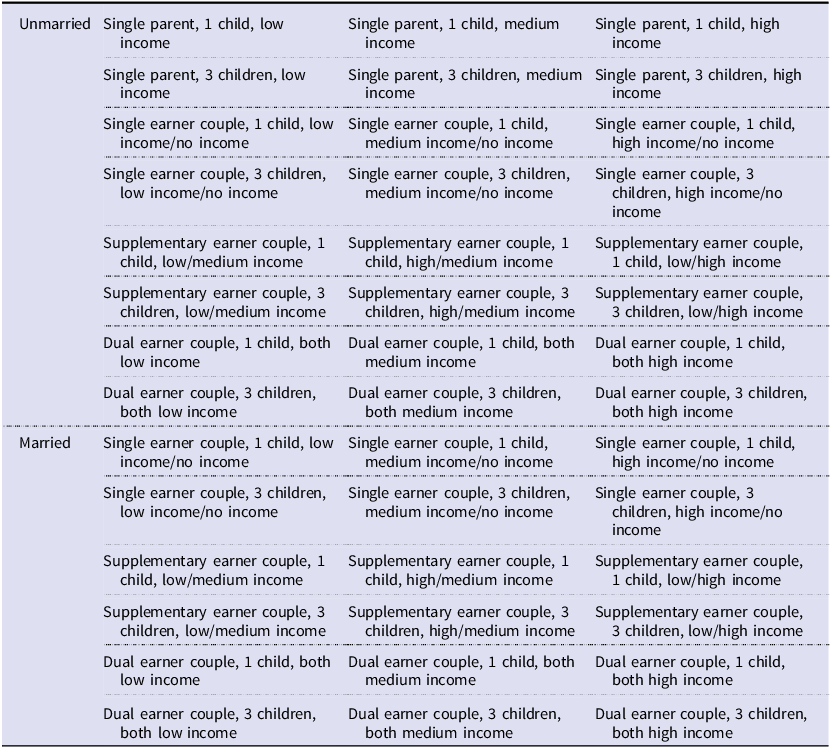
Combining these five characteristics resulted in forty-two family forms. Table 2 provides an overview of these.
Overview of the family forms studied
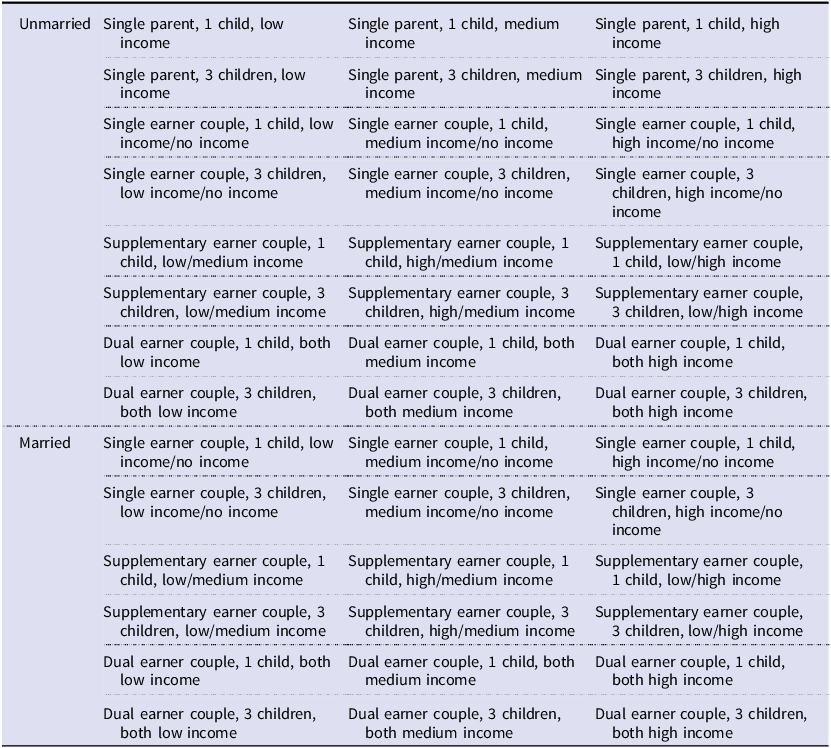
Table 2 Long description
A table categorizing family forms based on marital status, income, and family structure. The table is divided into two main sections: Unmarried and Married. Each section is further divided into rows based on the number of children, income levels, and the employment status of the parents. The table has 42 rows and 3 columns. Column headers are Unmarried, Single parent, 1 child, low income, Single parent, 1 child, medium income, Single parent, 1 child, high income, Single parent, 3 children, low income, Single parent, 3 children, medium income, Single parent, 3 children, high income, Single earner couple, 1 child, low income/no income, Single earner couple, 1 child, medium income/no income, Single earner couple, 1 child, high income/no income, Single earner couple, 3 children, low income/no income, Single earner couple, 3 children, medium income/no income, Single earner couple, 3 children, high income/no income, Supplementary earner couple, 1 child, low/medium income, Supplementary earner couple, 1 child, high/medium income, Supplementary earner couple, 1 child, low/high income, Supplementary earner couple, 3 children, low/medium income, Supplementary earner couple, 3 children, high/medium income, Supplementary earner couple, 3 children, low/high income, Dual earner couple, 1 child, both low income, Dual earner couple, 1 child, both medium income, Dual earner couple, 1 child, both high income, Dual earner couple, 3 children, both low income, Dual earner couple, 3 children, both medium income, Dual earner couple, 3 children, both high income, Married, Single earner couple, 1 child, low income/no income, Single earner couple, 1 child, medium income/no income, Single earner couple, 1 child, high income/no income, Single earner couple, 3 children, low income/no income, Single earner couple, 3 children, medium income/no income, Single earner couple, 3 children, high income/no income, Supplementary earner couple, 1 child, low/medium income, Supplementary earner couple, 1 child, high/medium income, Supplementary earner couple, 1 child, low/high income, Supplementary earner couple, 3 children, low/medium income, Supplementary earner couple, 3 children, high/medium income, Supplementary earner couple, 3 children, low/high income, Dual earner couple, 1 child, both low income, Dual earner couple, 1 child, both medium income, Dual earner couple, 1 child, both high income, Dual earner couple, 3 children, both low income, Dual earner couple, 3 children, both medium income, Dual earner couple, 3 children, both high income.
Source: Authors
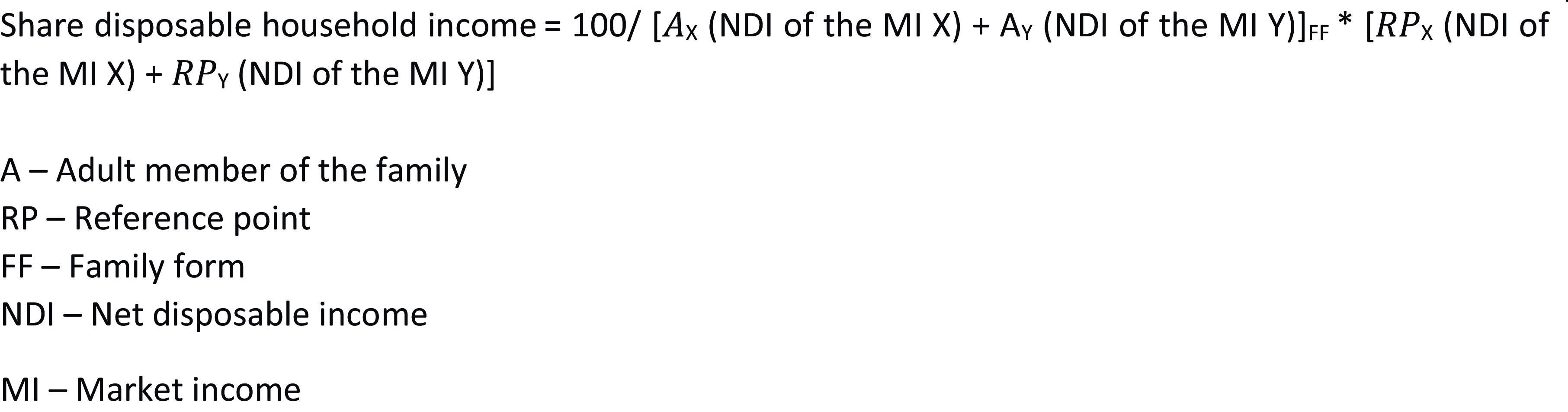
To verify the prevalence of the four redistributive logics, we analysed the stipulated redistributive outcomes of the combined family-related welfare regulations relevant to the studied family forms. Using EUROMOD we calculated the disposable household income for each family form and compared it with the respective reference point (i.e. the disposable household income of the added incomes of individuals without family and with the same gross income). We then computed the share of the family form’s disposable household income in the respective reference point. This indicated the degree of stipulated family-related redistribution, as it shows which differences in disposable household income are caused by family-related redistribution. Thus we studied family-related redistribution in relative terms. For example, for a couple in which both adults earned the country-specific average gross income, we simulated disposable household income. We then simulated the disposable household income of a single adult without family earning the country-specific average gross income and multiplied it by two (two adults). This served as our reference point for the couple. Figure 1 illustrates this procedure. We used the family’s disposable household income as the basis of our analysis because it includes all relevant benefits, taxes, and social insurance contributions. We did not use equivalised income, since correcting for the household size by using equivalence scales would conceal the degree of family-related redistribution as regulated. However, we controlled for bias and sensitivity by repeating our analysis with equivalised income. Our findings based on disposable income were very robust.
Calculation formula for the share of the family form’s disposable household income.
Source: Authors

The stipulated outcomes of family-related redistribution per family form were then used to verify whether and to what extent the assumptions on redistributive logics presented in the previous section hold true. To confirm the equality logic, we computed the standard deviation of the forty-two family forms for the twenty-seven countries to capture the dispersion of family-related redistribution in the study countries. We assumed that the higher the standard deviation, the lower the degree of equality between the family forms.
To test for the Matthew and Robin Hood logics, we investigated the relationship between the family forms’ total gross income and share of the disposable household income of the respective reference point. The latter is an indicator of the degree of family-related redistribution. If the degree of family-related redistribution is lower for family forms with a higher gross income, this indicates Robin Hood logic. If the opposite is true, we find the Matthew logic.
Finally, to verify the differentiation logic, we compared the mean of the family forms with different marital statuses, earner models, the number of children and the number of parents. Thus we highlighted differences in the degree of family-related redistribution, which depends on the family forms’ characteristics. If the degree of redistribution is higher for family forms with specific characteristics, this indicates a differentiation logic in favour of those family forms.
Findings
Equality logic
Figure 2 presents the mean share of the disposable household income of the reference point (points) and the standard deviations (error bars) for all forty-two family forms per country. We found the highest standard deviations in Hungary, Cyprus, Slovenia, Poland, and Denmark. Ireland, Luxemburg, and Germany also showed rather high standard deviations. In contrast, Spain, Bulgaria, Croatia, Sweden, the Netherlands, Romania, the Czech Republic, and Finland showed the lowest standard deviations among the twenty-seven countries.
Mean and standard deviation of the share of disposable household income of the reference point.
Source: Authors, based on EUROMOD
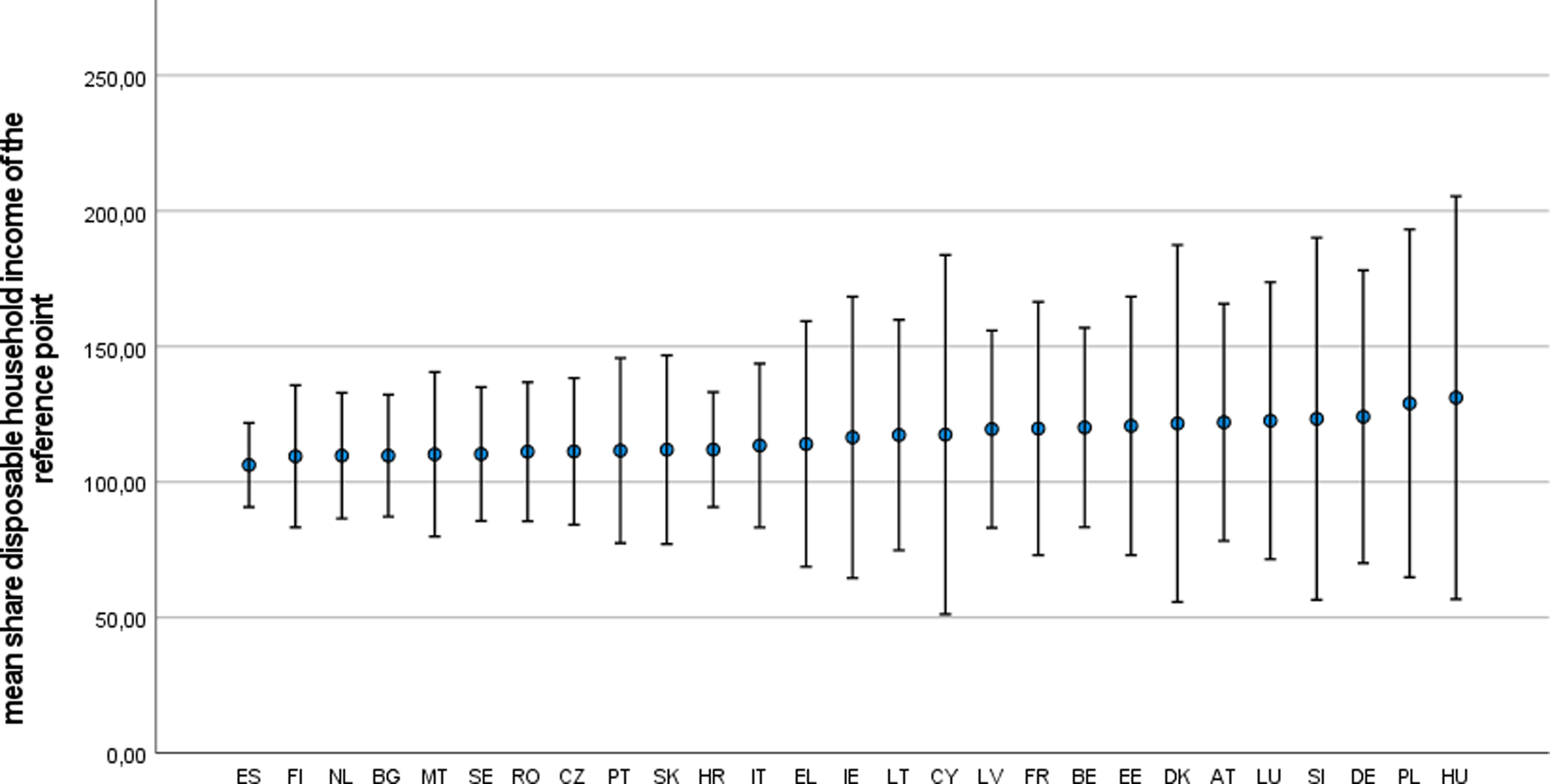
Thus, in the countries with a comparatively high standard deviation, there were larger differences in the degree of family-related redistribution (as regulated) among the family forms. Hence, these countries were further from equal redistribution than those with lower standard deviations. The mean values provided further insights. Strikingly, the countries with a comparatively high standard deviation also showed rather high mean values. Hence the larger differences in the family-related redistribution between the family forms were due to higher maximum values (i.e. in those countries with a comparatively high standard deviation, there was an exceptionally high degree of family-related redistribution to some family forms). The highest degree of family-related redistribution were to low-income, single-earner couples with three children, regardless of whether they were unmarried (Cyprus), married (Denmark, Hungary), or of either status (Slovenia), and to low-income single parents with three children (Poland).
The literature on welfare state redistribution has often argued that the social-democratic countries of Northern Europe are more strongly oriented towards equality than countries belonging to the conservative, the Southern European, and especially, the liberal welfare regime (Esping-Andersen, Reference Esping-Andersen1990; Gugushvili and Laenen, Reference Gugushvili and Laenen2021). However, we did not find such a patter n. Among the countries with both comparatively high and low standard deviations were several Central and Eastern European countries and a Nordic country. This is an important finding because, for stipulated family-related redistribution, we found neither the well-known country clustering nor other clearly regional country groupings.
The Matthew and Robin Hood logics
Our findings for the Matthew and Robin Hood logics are presented together, as they indicate opposite forms of redistribution. Figure 3 shows the relationship between the nine gross income groups resulting from the combination of the three income levels, the characteristics of the single parent/couple, the different earner models (low income, average income, low/low income, average/low income, double average income, average/average income, low/double average income, average/double average income, and double average/double average income) and the share of the family form’s disposable household income of the respective reference point.
Relationship between share of disposable household income of the reference point and the household’s gross income.
Source: Authors, based on EUROMOD

The overall picture for the twenty-seven analysed countries indicates that, as for stipulated family-related redistribution, the Robin Hood logic is dominant. This is because family forms with a higher gross income showed a lower share of disposable household income compared to the respective reference point. Family forms with only one person earning a low income showed the highest degree of family-related redistribution. Hence, the Matthew logic is clearly irrelevant in stipulated family-related redistribution in EU member states.
However, the relationship between the gross income groups and the share of the family form’s disposable household income at the respective reference point is not linear. Although family forms with average income or both adults earning low income showed a higher degree of family-related redistribution than family forms with higher income, these differences were not as pronounced compared to family forms with only one person earning a low income. Moreover, some countries such as France and Denmark showed a higher degree of family-related redistribution for one-earner family forms with double the average income compared to family forms with two earners and an overall lower gross income. Other countries such as Croatia and Poland provide a higher degree of family-related redistribution to family forms with two adults earning low incomes, compared to family forms with only one average income.
Differentiation logic
The differentiation logic concerns the different characteristics of the family forms. Regarding marital status, the largest group of countries (thirteen) showed the same degree of family-related redistribution between married and unmarried couples and only negligible differences (single parents were excluded; see Fig. 4). However, this was not the case for ten other countries (Belgium, Germany, Luxemburg, the Czech Republic, Estonia, Spain, France, Ireland, Poland, and Portugal), where family forms with married couples receive a higher degree of family-related redistribution. The smallest group of countries (Cyprus, Denmark, Italy, and Romania) showed greater family-related redistribution to family forms with unmarried couples than to those with married couples. Overall, the differences between married and unmarried family forms are fairly small compared to the other characteristics of interest to the differentiation logic.
Mean share of disposable household income of the reference point by marital status (couples only).
Source: Authors, based on EUROMOD

The second relevant characteristic in the differentiation logic is the status of single-parent or couple family form (Fig. 5). In this study, differences between single parents and couples were larger than those between married and unmarried family forms. In almost all countries, single parents showed greater family-related redistribution than couple family forms. The only exception was Cyprus, where single parents received less family-related redistribution than couples. In Denmark, being a single parent or couple did not affect the degree of family-related redistribution, while the differences between them were particularly large in Poland, Hungary, the Netherlands, Germany, and France.
Mean share of disposable household income of the reference point by status as a single parent.
Source: Authors, based on EUROMOD

Figure 6 shows the relationship between the number of children and the degree of family-related redistribution. We found the same pattern for all twenty-seven countries: Family forms with three children showed greater family-related redistribution than family forms with one child. The countries differed only in the extent of redistribution. In Hungary, Poland, Slovenia, Estonia, Latvia, Lithuania, Germany, Austria, and Belgium, family forms with three children received more redistribution than family forms with one child. This was less pronounced in the Netherlands, Malta, Spain, Finland, and Bulgaria.
Mean share of disposable household income of the reference point by number of children.
Source: Authors, based on EUROMOD

The last relevant characteristic of the differentiation logic is the earner model (Fig. 7). The data used were restricted to couple family forms. A distinctive similarity between the countries was that single-earner family forms showed the greatest family-related redistribution. This redistributive logic is linked to the naturally lower income levels of single-earner family forms compared to two-income earner family forms. The greatest family-related redistribution we observed in Denmark, Cyprus, Slovenia, France, Luxemburg, and Poland. Differences between the three-earner models in the degree of family-related redistribution were smallest in the Netherlands and Spain. A surprising result is also that, in most countries, dual-earner couples received more family-related redistribution than supplementary-earner couples. This was not the case, though, in Portugal, Croatia, and France, where supplementary-earner family forms received more family-related redistribution, and in Spain and Ireland, where there was no difference between the earner models with two incomes. However, the differences between the dual and supplementary-earner models were rather small in all countries.
Mean share of disposable household income of the reference point by earner model.
Source: Authors, based on EUROMOD

We found strong similarities between the study countries: sizable family-related redistribution to single parents, family forms with three children, and single-earner couples. As to marital status, however, there are more differences between the countries: EU member states redistribute to families according to a differentiation logic that financially supports families with sizeable care tasks (single parents or three children), as well as to families with comparatively low total gross incomes (single-earner couples), more than other family forms. In doing so, the countries differ more in the degree of family-related redistribution than they do in the kind of family forms they support. However, marital status also plays a significant role in many countries.
Discussion and conclusion
We attempted to answer the question of how far redistributive logics based on usual redistributive principles are also found for the redistributive principle of the family. To analyse the redistributive logics as laid down in welfare regulations, we focused on stipulated redistribution as simulated by EUROMOD, with which we could not only study benefits (as most studies on redistribution do) and taxes (rarely included in studies), but also financial obligations imposed on families (generally ignored in studies).
We identify four central redistributive logics in the welfare state literature: the Robin Hood, Matthew, equality, and differentiation logics. To verify whether and how much these are found in family-related redistribution, we studied the degree of family-related redistribution to distinctive family forms. We distinguished forty-two hypothetical family forms with a wide range of characteristics based on marital status, number of children, status as a single parent or couple, and the earner model.
Our results do not point to the Matthew logic. This is important, since previous research has identified this logic in general welfare state redistribution (Gal, Reference Gal1998; Bonoli and Liechti, Reference Bonoli and Liechti2018) and in childcare services (Pavolini and Van Lancker, Reference Pavolini and Van Lancker2018). Regarding financial redistribution, conceptualised as the stipulated redistributive outcomes of family-related welfare regulations, we did not identify this logic in any of our study countries. Instead, this study shows that in European welfare states it is the Robin Hood logic that prevails, with a particularly high degree of family-related redistribution provided to families with a lower total gross income. Further research might address whether this Robin Hood logic, as regulated, properly translates into redistributive outcomes in various European countries.
Our empirical findings further reveal a more complex pattern than just a pure Robin Hood logic. This is because a second redistributive logic, the differentiation logic, is highly relevant to family-related redistribution in EU member states. All of them provide greater (though differing in degree) family-related redistribution to families with three children than to those with one child. Moreover, all welfare states show greater redistribution to single-earner families in contrast to supplementary and dual-earner family forms, and almost all welfare states provide more family-related redistribution to single parents than to couple family forms. Hence, welfare states in the EU consider these family forms more ‘deserving’ (i.e. more legitimately receiving public means than other families).
This article aimed not to deliver an international comparison, although some of our findings verify known country differences. For instance, we found the greatest redistribution to single parents in countries such as Poland and Hungary which otherwise support a traditional family model (Saxonberg, Reference Saxonberg2013), and in Germany and the Netherlands, which had long been oriented towards the male breadwinner model (Pfau-Effinger, Reference Pfau-Effinger2004). These countries compensate single parents, mostly mothers, for the lack of a breadwinner. In contrast, Denmark, characterised as a dual-earner country, does not differentiate between single-parent and couple family forms in terms of the amount of family-related redistribution (see also Ciccia and Bleijenbergh, Reference Ciccia and Bleijenbergh2014). The findings for Denmark are puzzling though with regard to the different earner models since it shows a rather generous family-related redistribution to single-earner couples compared to family forms with two incomes while the other countries with this pattern (Cyprus, Slovenia, France, Luxemburg, and Poland) are known to give only some support to dual-earner family forms and female employment (Thévenon, Reference Thévenon2011; Ciccia and Bleijenbergh, Reference Ciccia and Bleijenbergh2014).
The remaining redistributive logic we analysed, the equality logic, differs from the other three logics, as it presents a relational concept. Therefore we studied the dispersion of family-related redistribution between the family forms. Our findings reveal large country differences in the achievement of equality between the family forms, mainly caused by country differences in the maximum values of family-related redistribution (i.e. some family forms receive a rather generous family-related redistribution in some countries, especially Hungary, Cyprus, Slovenia, Poland, and Denmark). Our findings are not in line with research on universalism because in our study, those countries with a comparatively high or low achievement of equality in stipulated family-related redistribution were not among those identified as showing high or low levels of commitment to universalism (e.g. Jacques and Noël, Reference Jacques and Noël2018). Another relevant aspect of the equality logic is that, despite variations in family-related redistribution among countries, low-income families with one income and three children showed the highest family-related redistribution. In contrast, in most countries, dual-earner couples with both partners earning high incomes and with one child emerged as the family form with the lowest redistribution. This is very much in line with the Robin Hood logic, since family-related redistribution is highly related to families’ gross income in all EU member states.
Given these results and the offered conceptual and methodological innovations for analysing family-related redistribution, we can claim to have generated new insights into the redistributive logics of welfare states. We now mention some important limitations and propose an outlook for further research.
In this analysis of family-related redistribution, the large variety of family forms was only insufficiently accounted for in the survey data. However, as a matter of course, further characteristics of families can and need to be distinguished. In some countries, family forms of same-sex couples, for instance, are not at all, or only partly, included in family-related regulations. We also did not include family forms with small children. Furthermore, we intentionally focused on redistributive logics and therefore studied redistribution as stipulated in welfare regulations. This systematic analysis of stipulated redistribution might inform research efforts to better understand why the mechanisms delivering the actual outcomes of welfare state redistribution differ, in part, from stipulated redistribution (see Frericks and Höppner, Reference Frericks and Höppner2024). Lastly, although EUROMOD is the most suitable tool for revealing the redistribution of financial resources, it excludes the redistribution of welfare services – a second part of redistribution that is highly relevant to families (Frericks, Reference Frericks, Daly, Pfau-Effinger, Gilbert and Besharov2023b). Future research should deal with these aspects for an even more nuanced analysis of how welfare states actually redistribute to different family forms.
Supplementary material
For supplementary material accompanying this paper visit https://doi.org/10.1017/S1474746425000181
Acknowledgements
The results presented here are based on EUROMOD version I4.109+. Originally maintained, developed, and managed by the Institute for Social and Economic Research (ISER), since 2021 EUROMOD has been maintained, developed, and managed by the Joint Research Centre (JRC) of the European Commission in collaboration with EUROSTAT and national teams from the EU countries. We are indebted to the many people who have contributed to the development of EUROMOD. The results and their interpretation are the authors’ responsibility.
Financial support
This paper is a result of the research project FaSo (‘The relevance of family for social rights in international comparison: between family allowances and legally obliged family solidarity’, 2020–2024) which was led by Patricia Frericks and financed by the German Research Foundation (DFG), Grant Number: FR 2687/14-1.


 Open access

