

Implications
Iberian hams are labelled according to the pigs’ diet and the percentage of the pigs’ Iberian ancestry, with an acorn diet and pure-bred Iberians being most desirable. In order to confirm authenticity of a carcass chemical analysis of the fat and genotyping are required from off-site laboratories, adding time to the final verification. There is a clear need for a method of analysis that is rapid, accurate and applied to the carcass online to differentiate the Iberian ham production systems. Using a handheld near infrared machine in the abattoir to accurately classify carcasses based on feeding regimes would markedly improve consumer confidence in the authenticity of the provenance of this premium product.
Introduction
Iberian ham is a dry cured product originating from Spain and is considered a luxury food item. The most highly valued Iberian ham, ‘Iberico de bellota’ is derived from a purebred black Iberian pig, farmed in free range systems, and fed on acorns and grass during the finishing period to live weights of 150 to 160 kg. Iberian pig meat has high levels of intramuscular fat which is considered a quality trait by consumers and provides the enhanced taste due to aroma development that occurs during the curing process (Muriel et al., Reference Muriel, Andres, Petron, Antequera and Ruiz2007). To satisfy the rising demand for Iberian ham, modified production systems have evolved and include crossbreeding, indoor rearing and dietary modifications. These additional farming systems have led to a decrease in the sensory quality of the dry cured products and difficulties in identifying the provenance of the product (Muriel et al., Reference Muriel, Ruiz, Martín, Petron and Antequera2004). In 2014, Spain phased in a classification system for Iberian ham that identified the dietary regime and the percentage of Iberian ancestry. This system was implemented to restore confidence in the market place and to prevent mislabelling and fraud.
The most common methods used for assessing quality and authenticity of Iberian hams are analysis of the fatty acid composition of subcutaneous fat using gas chromatography (GC) and DNA analysis for verification of genotype. Recently the near infrared spectroscopy (NIRS) has been applied to accurately predict parameters of interest, markedly reducing analysis times from days to minutes. Many natural products absorb near infrared (NIR) radiation at specific wavelengths; in particular N–H, O–H and C–H bonds are strongly absorbed by NIR radiation. A sample’s NIR spectrum is a composite of all the absorbances from all the molecular bonds in the sample. Calibrations can be developed using two sets of data, the spectra produced by scanning a set of samples on an NIR machine and the reference data consisting of the chemical analysis of the samples. Research conducted at the University of Cordoba (De Pedro et al., Reference De Pedro, Garrido, Lobo, Dardenne, Murray, Batten, Flinn, Welsh and Blakeney1995) confirmed the potential of NIRS as a method of identifying carcasses based on the feeding regime. However, benchtop NIR machines are immobile, and their applications in commercial environments are limited. Recent advances in instrumentation have led to a number of portable handheld instruments appearing in the market. While the reduction in size of the NIR instruments allows for portability and application within the commercial environment, the miniaturisation of the machine reduces wavelength range and resolution which may impact the accuracy of some calibrations.
The objective of this research was to compare the accuracy of a handheld portable NIR machine operated within the abattoir to measure fatty acid profile of fat samples with a conventional benchtop machine. Applying NIR technology within the abattoir could provide rapid and accurate assessment on the quality and authenticity of the individual carcasses and markedly enhance customer confidence.
Materials and methods
Adipose tissue samples collected for near infrared scanning and reference analysis
The main data set used to generate models for the MN1700 comprised 495 samples from 45 different producers, collected over 2 years at a commercial slaughterhouse between 2015 and 2017. Samples of subcutaneous adipose tissue were taken from the tail insertion area in the coxal region. Sixty-six samples were collected between 2015 and 2016, and the remaining 429 were analysed in the same way in 2017. Samples were classified as either premium grade (bellota) or non-premium grade. A subsample (50 g) of each adipose tissue sample was analysed by NIR using the following instruments:
1. Benchtop NIR machine used in laboratory: FOSS NIR Systems 6500 (FNS6500) monochromator spectrometer (FOSS-NIR Systems Inc., Silver Spring, MD, USA), equipped with an interactance-reflectance fibre optic and covering the spectral range 400 to 2500 nm, with a spectral interval of 2 nm, and running WINISI 1.5 software (Infrasoft International, State College, PA, USA).
2. Portable handheld NIR machine used in the abattoir: a MicroNIR Onsite Lite (MN1700) produced by Viavi Solutions Inc. (formerly JDSU Corporation, Santa Rosa, CA, USA) was used. The MN1700 covers the range 900 to 1700 nm with an approximate spectral interval of 6.2 nm.
After scanning the samples were then melted in a microwave oven and the fatty acid composition of each sample was determined by GC following the methodology outlined in De Pedro et al. (Reference De Pedro-Sanz, Serrano, Zamora-Rojas, Garrido-Varo, Guerrero-Ginel, Pérez-Marín, Núñez-Sánchez and García-Casco2013).
On the initial 66 samples collected in 2015, two different scanning approaches were taken with the MN1700. One technique involved averaging five scans moving the probe continuously over the sample in a ‘W’ pattern. The second technique involved averaging 20 spot measurements taken in a predefined pattern across the sample. Spot measurements were 12 times more variable than the continuous movement method. Therefore, the continuous movement technique was used to collect the data for the quantitative and qualitative work.
Improving spectrum quality
The signal to noise ratio (S/N) is another important parameter to be considered when aiming to acquire a high-quality spectrum. The signal to noise ratio varies from one spectrometer to another, and system design and software settings can help to maximise this ratio. One solution to improve the S/N ratio is averaging over repeat measurements. Several measurements were made to establish the number of spectra to be averaged for every scan. A compromise between high S/N and a rapid spectral acquisition was achieved by averaging 200 scans for each spectrum. This allows the analysis of every pig carcass even if high processing speeds of 100 or more carcasses per hour are achieved. Therefore, forcing the acquisition of 5 × 200 spectra to be collected, and averaging these for the final spectrum to be predicted, would increase the accuracy of prediction. Setting the number of scans to average can be done in the Viavi software, while averaging the five spectra was done in the WinISI software.
Quantitative models
The determination of the fatty acid profile has a high relevance for the quality control of Iberian pig meat products. Fatty acid profile of the subcutaneous adipose tissue performed by GC has been traditionally used for classifying and/or authenticating animals in different commercial categories, with acorn-fed Iberian ham having more unsaturated fats than those fed on compound feed. Before the FOSS spectra were used to develop calibrations, they were trimmed to the MN1700 range (908 to 1676 nm) and interpolated using cubic splines to give absorbances at the same 125 wavelength points as the MN1700. Six pre-treatments were investigated: raw absorbance spectra, first derivative, and second derivative, each tried without and with Standard Normal Variate (SNV) pre-processing. In the case of two treatments, the SNV was applied after the derivative. The numbers of factors were chosen based on the plot of Root Mean Square Error of Cross-Validation (RMSECV) versus number of factors, observing where curve starts to flatten out, giving the best RMSECV for the optimum number of factors.
Qualitative models
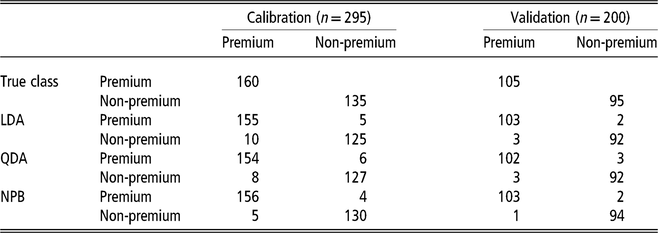
The objective with qualitative models is to use the spectral data to make a direct classification of the carcass as either premium or non-premium, without the need for a quantitative prediction of the fatty acids. Given that there will be samples for which the classification is uncertain, it is important to select methods that are able to quantify that uncertainty. Therefore, the initial focus is on algorithms whose output has the form of probabilities of class membership. Of the 495 samples, 265 were premium grade (bellota) and 230 were non-premium grade. Three Bayesian methods have been applied: linear discriminant analysis (LDA), quadratic discriminant analysis (QDA) and a nonparametric approach, all with the same underlying structure. The principle is to reduce the spectral data, to scores or principal components, with the scores scaled so that each has a variance of one over the training samples. Then, the multivariate distributions of these scores, conditional on class membership, are modelled by fitted probability distributions. The difference between the three methods lies in the probability models used for the within-class distributions of the spectral data. Linear discriminant analysis (McLachlan, Reference McLachlan1992) uses two multivariate distributions with different means but a common covariance matrix. Quadratic discriminant analysis also uses two multivariate normal distributions, but now with different covariance matrices (McLachlan, Reference McLachlan1992). The third approach, based on the method for quantitative calibrations described in Fearn et al. (Reference Fearn, Pérez-Marín, Garrido-Varo and Emilio Guerrero-Ginel2010), uses more flexible kernel density estimates to model the within-group distributions of the spectral data. All three methods were programmed in MATLAB, using routines from the partial least squares (PLS) Toolbox (Eigenvector Research Manson, WA, USA) to implement pre-treatments. For purposes of validation, the sample set was divided randomly into a calibration set of 295 samples (160 premium, 135 non-premium) and a validation set of 200 samples (105 premium, 95 non-premium). The approaches were tuned on the calibration set by cross-validation, and then the selected model for each approach was evaluated on the validation set.
Results
Quantitative models
The best calibrations used second derivative, calculated by a Savitzky-Golay filter with a second-order polynomial and a widow width of five points, which is around 30 nm with these 125-point spectra, and then SNV. The Root Mean Square Error of Cross-Validation values, using leave-out-one-producer, and numbers of factors were recorded. The same pre-treatments (second derivative + SNV) were used for the MN1700 and the RMSECV and PLS factors were recorded. Table 1 compares outputs from the FSN6500 and MN1700 for this calibration exercise.
Numbers of partial least squares (PLS) factors, root mean square error of cross-validation (RMSECV) and ratio of predicted to deviation (RPD) for separate PLS calibrations for four fatty acids developed on Iberian pig adipose tissue

Qualitative models
The confusion matrices for LDA, QDA and Nonparametric Bayes (NPB) are shown in Table 2. The overall error rates for LDA are 5.0% on the calibration set and 2.5% on the validation set. For QDA the error rates of 4.7% on the calibration set and 3.0% on the validation set are almost identical to those of LDA. Both have 20 errors out of 495, overall. Interestingly, it is not necessarily the same samples that are misclassified. Comparing the two lists of 20 misclassified samples, only 5 appear in both lists. Finally the overall error rates for NPB of 3.1% on the training set and 1.5% on the validation set are like those of LDA and QDA. Nonparametric Bayes gives slightly better classification although all the error numbers are small for all three techniques.
Confusion matrices for Linear Discriminant Analysis (LDA), Quadratic Discriminant Analysis (QDA) and Nonparametric Bayes (NPB) using principal components derived from raw spectra of Iberian pig adipose tissue for both calibration (using cross-validation) and validation sets
Discussion
Quantitative models
For the quantitative calibrations, comparisons have been made between the FSN6500 and the MN1700 (Table 1). As expected the FSN6500 gave better results in terms of the RMSECV and ratio of predicted to deviation (RPD). However, while the MN1700 shows a deterioration in accuracy, the results still show promise. Further work, including investigating different nonlinear approaches, will be needed to improve them.
Qualitative models
For the qualitative approach, the three Bayesian methods all give acceptable results in terms of classification success. To properly compare probabilities will require more samples due to the low error rates overall; comparing errors in probability bins on this small dataset is subject to considerable random error. More samples would also be desirable if more producers could be included. Although 45 producers are represented, many of these only contribute a small number of samples, while some contribute 40 or 50.
Conclusions
This work undertaken as part of the European Food Integrity Network clearly shows the application of NIRS in the food chain, using Iberian hams as an example. The emergence of portable handheld NIR instruments strengthens this potential by allowing in situ measurements to be made along the supply chain. The work reported here clearly demonstrates the feasibility of using the MN1700 for on-site classification of carcasses, linked to the quantitative fatty acids’ calibration, and provides a tool that can be used in slaughterhouses. More work needs to be undertaken on the portable instrumentation to improve the accuracy and robustness of the calibrations, but the current study provides a strong foundation. Only if the method is adopted commercially will the cost of collecting many more samples be justified.
Acknowledgements
This project has received funding from the European Union’s Seventh Framework Program Food Integrity.
C. Piotrowski 0000-0003-4311-5783
Declaration of interest
No potential conflict of interest is reported by the authors.
Ethics statement
This paper was written within the guidelines produced by the ethics committee.
Software and data repository resources
None of the data were deposited in an official repository.



