


Malnutrition is detected frequently among patients with inflammatory bowel disease (IBD) and its pathophysiology is complex and multifactorial. Several mechanisms that contribute to malnutrition in IBD patients may be caused by low dietary intake, changes in metabolism, increased intestinal protein loss and nutrient malabsorption(Reference Flora and Dichi1, Reference Ling and Griffiths2).
In the active phase there is a decrease in the oral intake of nutrients because of abdominal pain and anorexia. The mucosal inflammation and associated diarrhoea lead to a loss of protein, blood, minerals, electrolytes and trace elements. Alterations in energy metabolism may result in increased resting energy expenditure and lipid oxidation in IBD patients(Reference Flora and Dichi1, Reference Wild, Drozdowski, Tartaglia, Clandinin and Thomson3).
Previous studies(Reference Royall, Greenberg, Allard, Baker and Jeejeebhoy4–Reference Teahon, Pearson, Smith and Bjarnason6) that investigated hospitalized IBD patients or subjects with active disease showed an increased prevalence of malnutrition among those subjects; however, improvement of disease activity was associated with an increase in fat-free mass content in patients with active disease.
Recently the effect of the inflammatory cytokines in the metabolism of nutrients of patients with Crohn's disease (CD) has been subject to investigation. TNF, IL-1 and IL-6, which are pro-inflammatory, have demonstrated significant deleterious effects on protein metabolism. When TNF levels are increased the protein synthesis for nutrition purposes is affected by the deviation of amino acids for the synthesis of inflammatory proteins(Reference Passos, Santana, Andrade and Benedito7).
Although nutritional status changes have been reported in IBD patients, differences between CD and UC in active and remission phases have seldom been investigated and identified. The aim of the present study was to compare the body composition of patients with IBD in remission and active phases.
Methods and materials
Study population
The study protocol was approved by the Ethics Committee of the University Hospital Professor Edgard Santos and all subjects gave their informed consent to participate in the study.
In total 102 outpatients diagnosed with IBD were selected from August 2005 to September 2006 at the Gastroenterology Clinic, Federal University of Bahia, Brazil.
Patient evaluation
Disease activity was assessed according to the Crohn's Disease Activity Index (CDAI)(Reference Best, Bectel, Singleton and Kern8) for CD and the Lichtiger's Index(Reference Lichtiger, Present, Kornbluth, Gelernt, Bauer, Galler, Michelassi and Hanauer9) for ulcerative colitis (UC), and patients were divided into two groups: those in the active phase (CDAI ≥ 150 or Lichtiger's Index>10) and those in the remission phase (CDAI < 150 or Lichtiger's Index ≤ 10). All patients received medical treatment during the study.
Anthropometric measures included body height (in cm) measured using a scale-integrated stadiometer and body weight (in kg) measured in light clothing without shoes(10). BMI was calculated from weight and height (kg/m2)(11), and malnutrition was defined as BMI < 18·5 kg/m2 in adults(11) and BMI ≤ 22·0 kg/m2 in the elderly(Reference Lipschitz12). Skinfold thickness measurements were taken in duplicate from the non-dominant side of the body at two different sites (triceps and subscapula) using a skinfold caliper (Langer). Circumference measurement of the upper arm was measured with arm muscle area (AMA) and the sum of the skinfold thickness, calculated by standard equations. Patients were classified as having fat mass and muscle mass depletion when anthropometrical measures, triceps plus subscapula skinfold thickness (TST+SST) and AMA were below the 15th percentile of Frisancho's reference values, respectively(Reference Frisancho13).
Statistical analysis
Results are expressed as means and standard deviations, percentage and absolute values. Differences in nutritional status between CD and UC patients were analysed by Student's t test. Categorical variables were compared with the χ2 test and Fisher exact test. The Statistical Package for the Social Science program version 9.0 (SPSS, Chicago, IL, USA) was used for these analyses.
Results
In total 102 patients were evaluated: fifty with CD and fifty-two with UC; among them sixteen (32·0 %) and twelve (23·1 %), respectively, had active disease at the moment of the evaluation. The majority of patients were women (sixty-eight out of 102) and those with CD were younger than those with UC (mean age 37·4 (sd 13·4) and 45·0 (sd 12·1), respectively; P < 0·05).
Eighteen patients with CD had fistula and none had small-bowel resection. Disease duration and steroid requirement had no correlation with anthropometric parameters.
Anthropometric parameters in Crohn's disease patients
According to BMI, seven (14·0 %) patients with CD had malnutrition. Eighteen (36·0 %) had fat mass depletion according to TST+SST and thirty-one (62·0 %) had muscle mass depletion according to AMA (Table 1).
Correlation between anthropometrical nutritional parameters in patients in the active and remission phases of inflammatory bowel disease‡

AMA, arm muscle area; TST+SST, triceps plus subscapula skinfold thickness.
Malnutrition (BMI) was significantly associated with the active phase (Fisher exact test): *P < 0·01.
Fat mass depletion (TST+SST) was significantly associated with the active phase (Fisher exact test): †P < 0·05.
‡ For details of subjects and procedures, see Methods and materials.
Were observed a statistically significant association between malnutrition (BMI), fat mass (TST+SST) depletion and disease activity in patients with CD (Table 1). Also patients with active CD had BMI, TST+SST and AMA values significantly lower than those found during the remission phase (Table 2).
(Mean values and standard deviations)
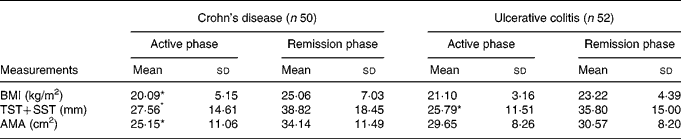
AMA, arm muscle area; TST+SST, triceps plus subscapula skinfold thickness.
Mean values were significantly different from those of the remission phase (t test for independent samples): *P < 0·05.
‡ For details of subjects and procedures, see Methods and materials.
Anthropometric parameters in ulcerative colitis patients
In patients with UC, TST+SST value was significantly lower in patients with active disease when compared with those in remission phase (Table 2) and fat mass (TST+SST) depletion was significantly associated with active phase disease (Table 1).
The BMI and AMA values were not significantly different between the two phases of the disease in UC patients (P>0·05; Table 2).
Three (5·7 %) were malnourished, nineteen (36·5 %) had fat mass depletion and twenty-nine (55·8 %) had muscle mass depletion according to BMI, TST+SST and AMA, respectively (Table 1).
Anthropometric parameters and presence of fistula in Crohn's disease patients
In CD patients with fistula, five (10 %) were malnourished, six (12 %) had fat mass depletion and thirteen (26 %) had muscle mass depletion according to BMI, TST+SST and AMA, respectively. The presence of fistula in CD patients did not have a significant correlation with anthropometric parameters (P>0·05).
Discussion
Nutrition plays a significant role in the management of IBD. This includes the prevention and correction of malnutrition. Patients with IBD are often found to have nutrient deficiencies at the time of diagnosis, whereas others develop features of malnutrition over the course of their illness. Employing nutrition support strategies complements the pharmacologic therapy of these patients(Reference Stokes5, Reference Rasack and Seinder14).
In the present study the majority of the patients were women, although other studies showed that IBD affects equally both sexes. In previous studies from our group, Oliveira et al. (Reference Oliveira, Almeida, Mello, Dantas, Queiroz, Fernandes, Lyra, Paes and Lyra15) found that 73 % out of 100 UC patients were female and 61·5 % of sixty-five CD patients were female(Reference Santana, Lyra, Santana, Dos Reis, Guedes, Toralles and Lyra16). In the present study the mean age of patients with CD was lower than those with UC. Other authors have reported a greater frequency of CD diagnosis under the age of 40 years among Afro-descendent patients(Reference Deveaux, Klimberg and Galandiuk17). It seems that the increased frequency of CD in young female patients is associated with hormonal and race factors(Reference Santana, Lyra, Santana, Dos Reis, Guedes, Toralles and Lyra16, Reference Loftus18, Reference Nguyen, Torres and Regueiro19).
Malnutrition was more common among patients with CD than UC patients. The present finding is in agreement with the ones previously described by other authors(Reference Capristo, De Gaetano, Mingrone, Addolorato, Greco, Castagneto and Gasbarrini20, Reference Jahnsen, Falch, Mowinckel and Aadland21) and probably occurs due to the small bowel involvement with impaired absorptive function and loss of nutrients by the fistulas. In CD there is a predominance of hypoalbuminaemia, protein intestinal loss and a negative nitrogenous balance, while in UC there is a greater prevalence of anaemia due to blood loss and the fact this is a disease limited to the colonic mucosa(Reference Flora and Dichi1).
Of note, malnutrition according to BMI was not as frequent in the present study as in others. This could be explained by the presence of a greater number of patients in the remission phase. A low BMI may reflect poor nutritional status as well as poorly controlled disease. Filippi et al. (Reference Filippi, Al-Jaouni, Wiroth, Hébuterne and Schneider22), studying CD patients found similar data during the remission phase.
However, muscle mass depletion was found in the majority of CD and UC patients, also occurring in those in the remission phase. Other studies observed that the evaluation of the body composition allows one to identify IBD patients who are not malnourished but may be at nutritional risk, including subjects who are in the remission phase and in whom muscle mass depletion is found frequently(Reference Loftus18, Reference Nguyen, Torres and Regueiro19, Reference Harries and Rhodes23–Reference Lanfranchi, Brignola, Campieri, Bazzocchi, Pasquali, Bassein and Labo25). Vaisman et al. (Reference Vaisman, Dotan, Halack and Niv26) detected nutrient malabsorption in malnourished patients with CD during remission and Capristo et al. (Reference Capristo, Mingrone, Addolorato, Greco and Gasbarrini27) showed that CD patients in clinical remission and without steroid therapy or nutrition support also had a lower fat mass than control subjects.
The anthropometric parameters BMI, TST+SST and AMA were significantly lower in patients with CD who had active disease. Reimund et al. (Reference Reimund, Arondel, Escalin, Finck, Baumann and Duclos28) showed an inverse correlation between anthropometric measures and activity of the disease in patients with CD. BMI appears to be lower in CD patients when compared to controls(Reference Geerling, Badart-Smook, Stockbrügger and Brummer29).
In the present study the frequency of anthropometric alterations was not greater in CD patients with fistula. Several studies showed that nutritional therapy is important to close the fistula of malnourished IBD patients and the closure of the fistula is also important to improve the nutritional status(Reference Teahon, Pearson, Smith and Bjarnason6, Reference Passos, Santana, Andrade and Benedito7).
Although muscle mass depletion was detected in UC patients, there was no correlation between AMA and the activity of the disease. Several studies have shown more evident anthropometric alterations in CD patients when compared with UC patients and controls(Reference Harries and Rhodes23, Reference Harries and Rhodes24, Reference Capristo, Mingrone, Addolorato, Greco and Gasbarrini27, Reference Yamazaki, Fukushima, Sugita, Takemura and Tsuchiya30, Reference Harries, Jones, Heatley and Rhodes31).
The detailed evaluation of the nutritional status of patients with IBD even during the remission phase is very important to determine the correct nutritional management at the moment the disease becomes active and improve the depleted nutritional status. A good nutritional status represents a key factor in improving the quality of life of IBD patients.
In summary, malnutrition was more frequently detected among patients with CD than UC, however, muscle mass depletion was a common feature of both diseases during the active and remission phases. Fat mass depletion occurred sharply in the active phase and partially recovered during the remission phase, however, depleted muscle mass remained in the remission phase indicating slow recovery of this body compartment or a greater sensitivity to IBD. The present results suggest that CD and UC during the remission and active phases seem to have some similarity from an anthropometric point of view. More studies are necessary to understand the pathophysiology and consequences of malnutrition in IBD patients.
Acknowledgements
This study had no funding sources and the authors have no conflicts of interest. Each author made an important scientific contribution to the study: R. R. and G. O. S. planned and researched the data, and all the authors contributed to the discussion, and wrote and reviewed/edited the manuscript.



