

INTRODUCTION
Heightened tensions over territorial issues have been a flash point of militarized conflict between Japan and China. Since the purchase of the Senkaku/Diaoyu Islands by the Japanese government in September 2012, a substantial number of Chinese vessels have entered the territorial waters near the Senkaku/Diaoyu Islands.Footnote 1 Academic pundits and the news media have been forecasting an accidental collision over the disputed Senkaku/Diaoyu Islands, which could escalate into serious militarized conflict (e.g., BBC 2013, 2014, 2017; The Economist 2013). Along with the concurrent dispute in the South China Sea, the prospect of détente remains slim in the short term.
With rapid growth in its military expenditure and economic power, China has made issue-based territorial claims in neighboring seas. The Chinese government has put pressure on Japan over the Senkaku/Diaoyu issue and has even attempted to broaden the territorial dispute by suggesting a challenge to Japan's sovereignty over the Okinawa Islands (McCurry Reference McCurry2013). The conservative Japanese Prime Minister (PM) Shinzo Abe, often recognized as hawkish in his political stance, has stood firm against such territorial challenges from China. While consolidating his conservative political basis, PM Abe recently reinterpreted Article IX of the Constitution and passed security legislation for further military cooperation with the US, thereby signaling Japan's strong resolve for national security and territorial integrity.
The ongoing bilateral tension brings significant impacts on domestic politics and public opinion. Given China's growing appetite for territorial expansion, do persistent tensions influence the Japanese public's perception of the threat from China and support for the uncompromising political leader? If so, does such territorial threat elicit broad-based support for the Japanese leader or heterogeneous responses depending on their political positions or historical beliefs? This study aims to unpack the mechanisms of public opinion shift alongside the public's awareness of territorial threats.Footnote 2
Previous experimental work suggests that two existing theories account for such threat-induced public opinion shift. First, the “rally ’round the flag” effect (henceforth, the “rally effect”) is a conventional theoretical framework to explain the impacts of threat perception on incumbent support—that is, voter approval of political leaders will increase when the country is under threat (Gaines Reference Gaines2002; Hetherington and Nelson Reference Hetherington and Nelson2003; Mueller Reference Mueller1973). More specifically, social psychological studies have demonstrated that the key mediator of the rally effect is anger, and that public support for the leader will be enhanced if they are provoked regardless of their partisanship and ideology. The rally effect has also been a focal point for the study of nationalistic responses to external threats in international relations, ranging from economic sanctions to interstate conflict (Allen Reference Allen2008; Drezner Reference Drezner1999, Reference Drezner2001; Galtung Reference Galtung1967; Gibler Reference Gibler2010; Kuperman Reference Kuperman2003; Lai and Reiter Reference Lai and Reiter2005; Marinov Reference Marinov2005; Mastanduno Reference Mastanduno1999).
In contrast, the reactive liberal hypothesis places more weight on the heterogeneity of the rally effect. Conservatives are relatively insensitive to threats from out-groups because they tend to be chronically vigilant to threatening information (Jost et al. Reference Jost, Glaser, Kruglanski and Sulloway2003), whereas liberals are more responsive to perceived threats and consequently demonstrate greater conservative shifts because they are normally less attentive to threats than conservatives (Nail et al. Reference Nail, McGregor, Drinkwater, Steele and Thompson2009). Therefore, unlike the universalistic anger-based rally effect, the reactive liberal hypothesis predicts that the perceived threat would be effective only among liberal people.
In post-war Japan–China relations, historical beliefs about Japanese colonial rule in China during World War II have remained the ideological cleavage that divides Japanese public opinion (Gries et al. Reference Gries, Zhang, Masui and Lee2009; Lind Reference Lind2008). Throughout the post-war period, Japanese intellectuals and liberals have embraced apologetic views of Japan's invasions and colonial rule in China and other neighbors. In line with liberal views on Japanese colonization, the Japanese government has issued official statements on war responsibility and formal apologies for decades.Footnote 3 Japanese conservatives, in contrast, tend to justify Japan's colonial rule in an attempt to revise the post-war apologetic stance. Such historical revisionism has recently gained momentum against the backdrop of the rise of China and recurring wartime history issues. This study defines liberal–conservative ideology in terms of the historical beliefs about Japanese colonial rule in China during World War II. As such, the reactive liberal hypothesis predicts that perceived territorial threats boost support for the conservative prime minister among those Japanese with liberal historical beliefs, but not among those with conservative historical beliefs.
Using these two competing predictions, the rally effect hypothesis and the reactive liberal hypothesis, our study conducted two survey experiments to investigate the effect of Chinese territorial threats on Japanese support for their PM, with an online article reporting a provocative Chinese statement on newly claimed territorial rights over Okinawa as the treatment. The results of our study did not support the anger-based rally effect. While the feeling of anger toward China was significantly higher in the treatment group than in the control group, there was no difference in the approval rating for the PM between groups. However, our results did lend support for the reactive liberal hypothesis. The treatment effect on support for conservative PM Abe was significantly moderated by the participants’ belief in historical Japanese colonization. Specifically, perceived threat increased support for the PM among those with liberal historical beliefs rather than among their conservative counterparts.
The follow-up experiment overall replicated the first results apart from one point: contrary to a prediction based on the rally effect literature, a priming passage inserted to highlight the role of the PM as the supreme commander of the Self-Defense Forces (SDF) had a significantly detrimental effect on public support for the PM. Despite reactive liberals’ support for the prime minister under external threats from China, priming with an image of the prime minister as the supreme commander completely eliminated the gain in approval rates among liberals. This counterintuitive result reconfirmed the strong antimilitarism that developed in Japan over the post-war period (Berger Reference Berger1993, Reference Berger1998; Katzenstein Reference Katzenstein1996) and indicated less incentive to wage a diversionary war for the Japanese political leader in the hope of a potential rally effect. Our study of the rally effect in the face of growing territorial threats verifies a domestic political incentive for the Japanese PM to maintain his uncompromising stance. However, lingering domestic antimilitarism still constrains the Japanese leader from taking belligerent postures for effective deterrence. A resulting moderate position would not be sufficient to deter and may even invite China's further territorial claims against Japan in the long run.
THE ANGER-BASED RALLY EFFECT
The rally effect refers to the increasing support for an incumbent political leader triggered by an external threat perception (Baker and Oneal Reference Baker and Oneal2001; Mueller Reference Mueller1970). A classic example is the effect of the September 11 attacks. The approval rating for President Bush jumped from 50 percent to 90 percent within the two days following the attacks. The rating gradually declined, but the rally effect may have worked advantageously in the long run for Bush's reelection in 2004 and the establishment of the Patriot Act (Huddy and Feldman Reference Huddy and Feldman2011; Lambert et al. Reference Lambert, Scherer, Schott, Olson, Andrews, O'Brien and Zisser2010).
Although the rally effect is most notably manifested in sudden security crises such as the September 11 attacks, the contexts in which this effect is triggered are not limited to severe, dramatic crises. In fact, the rally effect is also observed in various international conflicts. Economic sanctions are a classic illustration; the rally effect is triggered as a reaction to an external threat invoked by another state's intention to coerce or infringe upon its sovereignty (Krasner Reference Krasner1999). An oft-cited example is the unsuccessful economic sanctions imposed on Rhodesia by the United Nations in the 1960s, when threatened white settlers were motivated to support the home government for nationalistic reasons; consequently, Rhodesia's economy prospered despite the sanctions (Galtung Reference Galtung1967). Similar cases of the rally effect are found in economic sanctions on Cuba (Allen Reference Allen2008) and Iraq (Inglehart, Moaddel, and Tessler Reference Inglehart, Moaddel and Tessler2006). Territorial conflicts also often generate the rally effect. Compared with other conflict issues, salient threats to the homeland territory generate stronger incentives for opposition parties to support the incumbent, which often leads to domestic centralization (Gibler Reference Gibler2010). In a typical territorial dispute, British PM Margaret Thatcher garnered increased public support in the wake of the Falklands War. As epitomized by territorial conflicts and economic sanctions, external threats are often utilized as a means of building up domestic support (Gibler Reference Gibler2010; Lai and Reiter Reference Lai and Reiter2005; Oneal and Bryan Reference Oneal and Bryan1995). The rally effect provides a useful framework for explaining domestic centralization in response to an external threat while considering leaders’ domestic incentives to stand firm against such threats in an interstate conflict.
These previous studies indicate that military actions are not a necessary condition for the rally effect. Economic sanctions or other nonmilitary actions could also trigger the rally effect. However, historical US presidential approval rates illustrate that the rally effect has not always been observed at the time of military conflicts in which the US has been involved in the past 70 years; spikes in the presidential approval rating did not occur at the onset of the Korean War or the Vietnam War (the Gulf of Tonkin incident). Given these mixed findings, pinpointing causal mechanisms of the rally effect in various interstate conflicts helps to develop its theoretical and empirical foundations.
What is the underlying common mechanism that connects perceived threats from out-groups and support for incumbent political leaders? Although several mechanisms have been proposed to explain the rally effect, including political leadership, patriotism, and uncertainty management (for a review, see Lambert, Schott, and Scherer Reference Lambert, Schott and Scherer2011), the present study pays special attention to the roles played by emotions that potentially explain the rally effect, regardless of conflict types/phases. Affective aspects of public opinion have not only been studied in political psychology but have also attracted growing attention from international relations scholars (e.g., Renshon, Lee, and Tingley Reference Renshon, Lee and Tingley2017). We specifically focus on anger, which is a universal affective reaction to a perceived threat from out-groups in human society and is expected to play an important role in triggering the effect (Lambert et al. Reference Lambert, Schott and Scherer2011).
One explanation of the anger-based rally effect is that attacks on and threats to the in-group evoke anger, which in turn increases support for the incumbent military leader as a means of retaliation and retribution. Lerner et al. (Reference Lerner, Gonzalez, Small and Fischhoff2003) conducted an experiment in which participants wrote on aspects of terrorist attacks that “made them angry” or “made them afraid.” The results indicated that experimentally induced anger lowered risk perception, but fear increased it. Moreover, those with primed anger more strongly favored revenge-oriented policies and were less likely to support reconciliation-oriented policies. Similarly, Lambert et al. (Reference Lambert, Scherer, Schott, Olson, Andrews, O'Brien and Zisser2010) conducted an experiment using a CNN video of the September 11 attacks. They found that images of the terrorist attacks induced both anger and anxiety, but only anger had increased support for President Bush, hawkish policies, and patriotic symbols such as the flag (see also Huddy, Feldman, and Cassese (Reference Huddy, Feldman, Cassese, Russell Neuman, Marcus, Crigler and MacKuen2007) for the contrasting effect of anger and anxiety). Interestingly, Lambert et al. (Reference Lambert, Scherer, Schott, Olson, Andrews, O'Brien and Zisser2010) replicated the rally effect by eliciting anger, even when the source of anger was completely unrelated to politics. This result implies a universal psychological mechanism where people's support will increase for the in-group military leader so long as they are provoked. In summary, previous studies indicate that the mechanism of the rally effect is generated by a perceived external threat that evokes anger and subsequently increases support for the military leader as a means of counterattacking (Lambert et al. Reference Lambert, Schott and Scherer2011). Therefore, if the perceived threat from China evokes anger, the rally effect would predict increased support for the PM as the supreme commander of the SDF.
Hypothesis 1
A perceived threat from China over territorial issues will boost anger toward China.
Hypothesis 2
The boosted anger will mediate the effect of a perceived threat on support for conservative PM Abe; Increased anger from a perceived threat will lead to increased support for PM Abe.
REACTIVE LIBERAL HYPOTHESIS
The anger-based rally effect predicts that, on average, the perceived threat will increase support for the incumbent leader. For instance, previous studies of the rally effect have specified only political knowledge as a stable moderating factorFootnote 4 and claimed that the rally effect is generated independently of ideology or partisanship (Huddy et al. Reference Huddy, Feldman, Taber and Lahav2005; Huddy and Feldman Reference Huddy and Feldman2011; Kam and Kinder Reference Kam and Kinder2007). However, recent social psychological studies on the reactive liberal hypotheses have indicated important heterogeneity in terms of the reaction to threats.
Somewhat counterintuitively, the reactive liberal hypothesis predicts that it is liberals, rather than conservatives, who become attitudinally more conservative following situational threats (Nail et al. Reference Nail, McGregor, Drinkwater, Steele and Thompson2009). Based on a motivated sociocognitive perspective (Jost et al. Reference Jost, Glaser, Kruglanski and Sulloway2003), Nail et al. (Reference Nail, McGregor, Drinkwater, Steele and Thompson2009) demonstrated that the liberal–conservative gap in patriotism, psychological conservatism, and antigay sentiment was eliminated when the situational threat was experimentally induced. Conservatives are less reactive to experimental manipulation of threat because they feel constantly under threat. Liberals, on the other hand, become more psychologically motivated to defend against the threat, resulting in a larger conservative shift among liberals than conservatives. Similar findings have been reported by Hetherington and Suhay (Reference Hetherington and Suhay2011), Landau et al. (Reference Landau, Solomon, Greenberg, Cohen, Pyszczynski, Arndt, Miller, Ogilvie and Cook2004), Van der Toorn et al. (Reference Van der Toorn, Nail, Liviatan and Jost2014), and Van de Vyver et al. (Reference Van de Vyver, Houston, Abrams and Vasiljevic2016).
As described above, historical beliefs about Japanese colonial rule in China during World War II remain the ideological cleavage that divides Japanese public opinion on bilateral relations. Gries et al. (Reference Gries, Zhang, Masui and Lee2009) conducted a study of undergraduate students in Japan, China, and South Korea using comparable questionnaires, and demonstrated that their beliefs concerning previous historical issues correlated with current threat perceptions. Conservative Japanese undergraduate students who positively evaluated Japanese colonial policy in China in the past expressed a belief in a higher degree of perceived threat from China and support for hardline foreign policies, as well as more unyielding attitudes over the Senkaku/Diaoyu Islands issue. These results suggest historical beliefs are an appropriate dimension that divides liberals and conservatives in the context of Japan–China relations, especially when the generic “progressive vs. conservative” measurement of ideology is losing validity in Japan (Jou and Endo Reference Jou and Endo2016; Takenaka Reference Takenaka2014). Therefore, based on the reactive liberal hypothesis, we predict that those with liberal historical beliefs who acknowledge the damage that Japanese colonial policy caused to China will be more susceptible to the perceived threats from China than their conservative counterparts.
Hypothesis 3
Those with liberal historical beliefs are more susceptible to the rally effect than their conservative counterparts.
METHODS
In February 2014, we conducted an online experiment on panels of participants registered with Macromill, a leading online survey company in Japan. First, we recruited 2,400 Japanese adults and randomly assigned them to either a treatment group or a control group (NTreatment = 1,200 and NControl = 1,200). We excluded those who were registered with multiple online survey companies to eliminate so-called “professional participants” who regularly take many online surveys and are likely to engage in survey satisficing. We requested participation in the experiment on February 13 and closed it on February 14. The number of effective responses was 1,562 (NTreatment = 775 and NControl = 787).
Demographic variables and historical beliefs about past Japanese colonial policy in China were measured when the 2,400 participants were recruited. Other covariates were measured as pretreatment variables in the experiment in the following order: media trust, party identification, ideology, nationalism, and political knowledge. See OA1 in the Online Appendix for details of the measurements.Footnote 5 Next, the participants received the treatment, which manipulated the perceived threat from China over territorial issues. The treatment was an article published online by Nihon Keizai Shimbun (Nikkei Shimbun) on May 13, 2013; “People's Daily report entitled ‘Discussion Needed on Okinawa Attribution Issue’ asserts China's territorial rights: Japanese Chief Cabinet Secretary dismisses the claim as ‘completely injudicious’.” The article reports that China had raised the Okinawa issue as a warning to Japan over the Senkaku/Diaoyu Islands issue.Footnote 6 Because this article suggests that China regards the Okinawa attribution issue as historically unresolved, it is expected that the perceived threat from China over territorial issues will increase among readers. As a placebo, the control group read an article in Nihon Keizai Shimbun on smartphone technology, which was completely unrelated to China or territorial issues.Footnote 7 Using the actual newspaper article is suitable in this case not only because it is a realistic stimulus but also because the magnitude of the rally effect has been shown to increase when the ongoing threat is played up in a newspaper (Oneal and Bryan Reference Oneal and Bryan1995).
The treatment and placebo articles were designed to open in a pop-up window, and participants could not proceed to the next page until 30 seconds had passed to ensure that they had read the content thoroughly. When translated from Japanese to English, the main body of the treatment article had roughly 430 words, while that of the control article had 490 words, both of which took approximately 40 seconds to read carefully. Following each article, two basic questions about the content were presented to check the participants’ attention to the articles. We subsequently measured the subjective evaluation of credibility and persuasiveness of the articles to conceal the true intention of the experiment. After these filler items, we measured dependent variables in the following order: emotions toward China, the perceived threat from China (manipulation check), support for PM Abe, and 12 other issue attitudes that were not used in the present study.
The perceived threat from China was measured using a scale developed by Gries et al. (Reference Gries, Zhang, Masui and Lee2009). Responses to five items such as “The world would be a safer place if China was weaker” and “China is a threat to Japan” were measured with a five-point scale, and were averaged and standardized to a scale ranging from 0 to 1 (Cronbach's alpha = 0.73). Anxiety and anger toward China were measured as described in Huddy et al. (Reference Huddy, Feldman, Cassese, Russell Neuman, Marcus, Crigler and MacKuen2007). Three items for each emotion (“anxiety,” “fear,” and “concern” for anxiety; “anger,” “hostility,” and “hatred” for anger) were measured with a seven-point scale, and were averaged and standardized to a scale ranging from 0 to 1 (Cronbach's alpha was 0.85 for anxiety and 0.87 for anger). Support for PM Abe was measured with a single item “Do you support PM Abe?” with two choices: 1: “Yes” and 0: “No.”
ANALYSIS
To target the participants who had received the treatment, we classified participants as either noncompliers or compliers. Noncompliers were participants who answered either of the two attention-checking questions incorrectly after the treatment and/or participants with less than 40 seconds of reading time. After excluding noncompliers from the entire sample, a total of 939 compliers remained (NTreatment = 531 and NControl = 408). However, the proportions of correct answers to the attention-checking questions following the articles were different between the treatment and control groups, and the treatment and the placebo articles were not exactly the same length.Footnote 8 For these reasons, there is a possibility that the definition of compliers differed between the treatment and control groups. Accordingly, we estimated both the intention-to-treat (ITT) effect with the entire sample (N = 1,562) and the complier average causal effect (CACE) with compliers (N = 939) to address any biases arising from the definition of compliers. Covariate balance was sufficient, both in the entire sample and in compliers (OA3 and Table A1 in the Online Appendix for details of the covariate balance). A manipulation check indicated the treatment successfully boosted the perceived threat from China (see OA4 in the Online Appendix for details of the manipulation check).
To test Hypothesis 1, we employed anger toward China as the dependent variable and tested the effect of treatment. Based on the finding that anger is more relevant than anxiety in the rally effect (e.g., Lambert et al. Reference Lambert, Scherer, Schott, Olson, Andrews, O'Brien and Zisser2010), we also estimated the effect on anxiety. We estimated both the ITT effect and CACE using ordinary least-squares models with and without covariates.
A perceived threat from China enhanced anger toward China, which supports Hypothesis 1 (Model 1 to 4 in Table 1). In contrast, there was no treatment effect for anxiety (Model 5 to 8 in Table 1). This result is inconsistent with the US study that reported sudden spikes in both anger and anxiety in the aftermath of September 11 (Huddy et al. Reference Huddy, Feldman, Cassese, Russell Neuman, Marcus, Crigler and MacKuen2007). The absence of the effect on anxiety may be attributable to the difference in severity between the two cases. Despite the increased tension, there have been no actual militarized escalation or casualties between Japan and China, which would account for the significant treatment effect for anger and the absence of a similar effect for anxiety.
Treatment Effects on Affect toward China
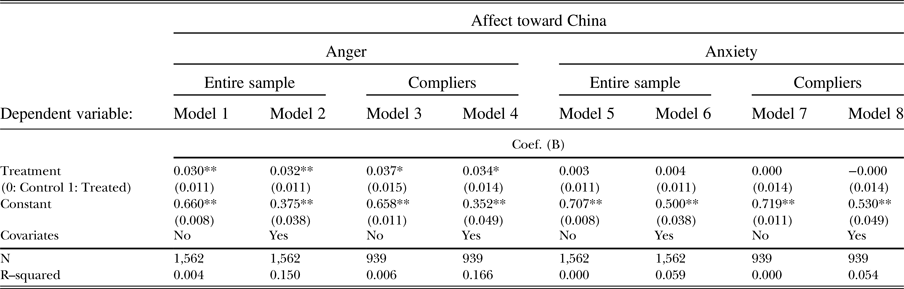
Note: Standard errors in parentheses. Covariates include sex, age, education, ideology, party identification, nationalism, political knowledge, media trust, and historical beliefs.
** p < 0.01, * p < 0.05, + p < 0.1
To test Hypothesis 2, we employed support for PM Abe as the dependent variable and tested the effect of treatment, which was intended to test the direct average treatment effect (ATE). If the treatment did not have a direct effect on the dependent variable, the mediation-by-anger hypothesis does not hold even when the treatment causally affects the mediator—that is, anger toward China (Baron and Kenny, Reference Baron and Kenny1986). The estimation scheme was the same as for Hypothesis 1 and the results are presented from Models 1 to 4 in Table 2. ATEs were not significant across all models and thus Hypothesis 2 was not supported. As expected, CACE was larger than the ITT effect, but was not statistically significant. To explore the potential mediation effect, we employed the average causal mediation effect (ACME) approach with bootstrapping (Imai et al. Reference Imai, Keele, Tingley, Yamamoto and Vinod2010). Based on the CACE with covariates model (Model 4 in Table 2), this approach with 1,000 bootstrap resamples suggested that 7 percent of the total effect of the treatment was mediated by anger, which is statistically indistinguishable from zero (p = 0.74). In summary, although perceived threat from China provoked the Japanese public as expected, this provocation did not lead to increased support for PM Abe.
Treatment Effects on Support for PM Abe
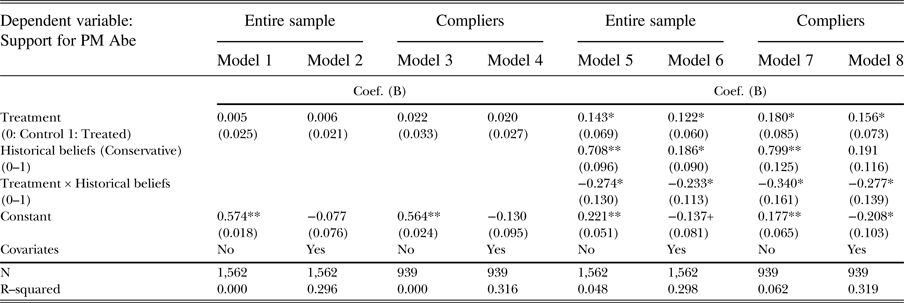
Note: Standard errors in parentheses. Covariates include sex, age, education, ideology, party identification, nationalism, political knowledge, and media trust.
** p < 0.01, * p < 0.05, + p < 0.1
Next, to verify the basic assumption of the reactive liberal hypothesis, the baseline levels of perceived threat from China were compared using only the control group. When the entire sample was divided into liberal, moderate, and conservative subsamples based on their historical beliefs,Footnote 9 the mean values of perceived threat from China were 0.651, 0.621, and 0.731, respectively, corroborating the reactive liberal hypothesis assumption that conservatives are more chronically threatened by the out-group than liberals. The same was true for anger; the mean values of the perceived threat from China among liberals, moderates, and conservatives were 0.653, 0.625, and 0.764, respectively, indicating that conservatives are more chronically provoked by China.
To test Hypothesis 3, we examined the interaction effects between the treatment and historical beliefs. Models 5 to 8 in Table 2 show consistent negative interaction effects between the treatment and historical beliefs. We also illustrate predicted values based on the estimated model with covariates for compliers (Figure 1).
Moderating Effect of Historical Beliefs

Figure 1 illustrates the predicted values of the outcome for three levels of historical beliefs: liberal (mean –1 SD), moderate (mean), and conservative (mean + 1 SD). Liberal historical beliefs reflect the view that Japan harmed China by its colonial rule in World War II. In contrast, those with conservative historical beliefs hold the view that Japanese colonial policy provided benefits for China.
The treatment effect was null among those who had moderate historical beliefs (ATE = 0.02, p = 0.51), as expected from the results of testing Hypothesis 2. We found that the treatment decreased support for the PM among conservatives by 3 points, although this effect was not statistically significant (ATE = –0.03, p = 0.38). However, despite the less stringent experimental controls than those in laboratory experiments, the treatment increased support for the PM by 7 points among liberals, which was marginally significant (ATE = 0.07, p = 0.06). As Model 7 in Table 2 shows, this effect increases support by up to 18 points among the most liberal people, which is highly significant. The predicted approval rating for PM Abe among the treated liberals is 60 percent (Figure 1), which is the same level for the conservatives in the control group, indicating that threatened liberals “catch up with” conservatives in terms of support for PM Abe. This result supports Hypothesis 3. With the growing threat perception, liberals indeed “rally ’round the flag” while conservatives turn their back slightly on PM Abe. Thus, the heterogeneous treatment effects offset each other, resulting in a null ATE in the testing of Hypothesis 2. Further analysis indicates the rally effect observed among liberals was not mediated by anger. More specifically, the significant interaction effect between the treatment and historical belief in Models 5 to 8 in Table 2 did not disappear even when anger was added as an independent variable. In summary, the rally effect in Japan is not mediated by anger but rather is moderated by historical beliefs.
ADVERSE EFFECT OF STRONG MILITARY LEADERSHIP
Our null findings for the anger-based rally effect in Japan raise a question: How did participants view the PM in the presence of perceived threats? In contrast to the US president, Japanese political leaders may not be widely recognized among the general public as the supreme commanders of the SDF.Footnote 10 If a Japanese PM is not well recognized as a military leader, then he or she may not be perceived as a means of retaliation and retribution in the face of a threat from China. This would have disconnected the link between anger and support for PM Abe. Therefore, in the second experiment, we aimed to ascertain whether priming participants with an image of the PM as the supreme commander would gain their support. If the priming with this image of the PM were successful, then it was more likely that the rally effect would be manifested among the Japanese public, who would recognize that Japan's SDF would play a potentially crucial role in the territorial dispute between Japan and China.
Hypothesis 4
The rally effect is strengthened by priming participants with an image of the PM as the supreme commander of the SDF.
METHODS
We conducted the second online survey experiment in March 2014. Except for the priming, which is described below, the methods and questions of the second experiment followed those of the first experiment. The combination of threat manipulation and priming resulted in a 2 × 2 factorial design, and 1,540 Japanese adults were randomly assigned to one of the four conditions. The experiment began on March 6 and ended on March 7. There were 1,111 responses.
The sole difference in the second experiment was the inclusion of a priming passage in the measurement of support for the PM. To highlight the role of the PM as the supreme commander, we inserted either one of the following two passages immediately above the question asking about their support for PM Abe where: (a) The head of the cabinet is the PM (placebo); or (b) The supreme commander of the SDF is the PM (prime).
ANALYSIS
Before considering the main results, we examined the covariate balance (i.e., sex, age, education, ideology, party identification, nationalism, political knowledge, media trust, and historical beliefs about Japanese colonial policy in China; see Tables A4 and A5 in the Online Appendix). Slight imbalances among compliers were observed with regard to ideology, trust in Asahi Shimbun, and historical beliefs (Table A3). Nevertheless, joint probability tests indicated that the predictive power of covariates was insignificant, both for the entire sample (p = 0.774), and for only the compliers’ indicators (p = 0.127) (Table A4), suggesting that covariate balance was largely maintained despite some sample attrition and noncompliance.Footnote 11 As in the first experiment, we estimated both models with and without the covariates to address any potential biases arising from covariate imbalances.
By comparing the baseline levels of perceived threat and anger toward China in the control group, we verified the assumption of the reactive liberal hypothesis in the same way as we did in the first experiment. The mean values of perceived threat from China among liberals, moderates, and conservatives were 0.646, 0.627, and 0.732, respectively, corroborating the assumption of the reactive liberal hypothesis that conservatives are more chronically threatened by the out-group than liberals. The same was true for anger: the mean values of the perceived threat from China among liberals, moderates, and conservatives were 0.646, 0.640, and 0.769, respectively, indicating that conservatives are more chronically provoked by China.
In the second experiment, we successfully replicated the main results of the first experiment. While our threat manipulation enhanced participants’ anger, which supports Hypothesis 1, the treatment failed to stir their anxiety (see Table A5 in the Online Appendix). Moreover, our threat manipulation did not significantly increase support for PM Abe, which means that Hypothesis 2 was not supported this time either (see Table A6 in the Online Appendix). Causal mediation analyses with 1,000 bootstrap resamples suggested that 2 percent (p = 0.76) of the total effect of the treatment was mediated by anger when the participants were not primed with an image of the PM as the supreme commander, suggesting that anger-based mediation was not at work. The replicability of the basic findings allowed us to reconfirm the conclusion that perception of an increased threat from China provoked participants, but, on average, their anger did not significantly boost their support for the incumbent.
The main results of the estimation are presented in Table 3. Given the moderating effect of historical beliefs, we included the three two-way interaction terms between threat, priming, and historical beliefs as well as a three-way interaction term between them. We also illustrate the predicted outcomes based on the estimated model with covariates for compliers (Figure 2).
Three-Way Interaction Between Threat, Prime, and Historical Beliefs

Effect of Priming an Image of the PM as the Supreme Commander

Note: Standard errors in parentheses. Covariates include sex, age, education, ideology, party identification, nationalism, political knowledge, and media trust.
*** p < 0.01, ** p < 0.05, * p < 0.1
The left-hand side of Figure 2 illustrates the predicted outcomes when participants were not primed and shows consistent results in the first experiment regarding the heterogeneous treatment effects between the liberals and conservatives in their historical beliefs. No significant treatment effects were observed among moderates (ATE = 0.079, p = 0.096) or conservatives (ATE = 0.021, p = 0.759). However, we still found strong evidence of the rally effect for liberals. Among liberals who were not primed, the treatment increased the support for PM Abe by 13.8 points (ATE = 0.138, p = 0.024), giving more credence to the reactive liberal hypothesis.Footnote 12 When they were not primed with an image of the PM as the supreme commander, 45 percent of liberals who were not threatened supported PM Abe. However, liberal support rose to 59 percent after they read the threatening news article about the territorial dispute, which is even higher than the figure for threatened conservatives (58 percent). Again, this clearly shows that historical beliefs play an important moderating role in the rally effect in the East Asian context and that threatened liberals “catch up with” conservatives in terms of support for the hawkish PM.Footnote 13 This finding is remarkable given that Japanese liberals are widely antipathetic toward conservative PM Abe, especially in regard to his foreign policy and revisionist policy agendas. This rally effect among the liberals was investigated in Hypothesis 4 as the main focus of the second experiment.
Our inclusion of the prime provided results that have not been reported in previous studies of the rally effect. Surprisingly, the priming worked against our prediction; i.e., PM Abe's image as the supreme commander undermined or even completely erased the support for the incumbent boosted by the manipulation of participants’ threat perception. Contrary to expectations for the rally effect, the supreme commander prime brought participants’ support back to the baseline rates. The right-hand side of Figure 2 highlights this adverse effect, particularly among the liberals. Because participants were primed at the very moment their support for the PM was measured, support for the PM among liberals who had been threatened and primed should have been at the same level as the support from liberals who were threatened but not primed. However, when primed, the former group demonstrated a significantly lower level of support than the latter group (45 percent vs. 59 percent). That is, liberals’ support for the PM that had originally increased to roughly the same level as that of the conservatives receded to its baseline level (45 percent) by priming. This finding is the opposite of the prediction made in Hypothesis 4. In contrast, conservative support for PM Abe seems to be well established and was not amenable to either a perceived threat or priming.
Why did the supreme commander prime decrease the support for the incumbent, especially among liberals? Japan's pacifism and deep-rooted antimilitarism developed over the post-war period would adequately account for this unique finding. Article 9 of the Japanese Constitution, which prohibits any use or possession of armed forces, has remained the linchpin of Japan's post-war policy. Indeed, it has been suggested that the concept of “peace” is one of the most important symbols for the Japanese, as much as that of “democracy” is for Americans (Massey Reference Massey1976). In a similar vein, liberal opposition to the recent re-interpretation of Article 9 of the Constitution and the subsequent passage of the security legislation for effective defense cooperation with the US lends additional credence to the decline in incumbent support, particularly among liberals. Moreover, strong leadership by the prime ministerial office has advanced its gradual presidentialization of prime ministers in Japanese politics (e.g., Takenaka Reference Takenaka2006). In foreign policy, the National Security Council established in 2014 under the Abe administration effectively centralized national security authority in the prime ministerial office. Alongside such moves for presidentialization, the prime of the SDF supreme commander might have triggered liberals’ strong aversion to the PM's leadership in security policy.
DISCUSSION
Applying the framework of the rally effect to Japan–China relations, this study experimentally manipulated a perceived territorial threat from China among the Japanese public and made the following noteworthy findings.
First, although a perceived territorial threat provoked anger toward China among participants, this anger was not related to participant support for PM Abe. Given the potential theoretical generalizability of the anger-based explanation of the rally effect, which is supported by the universality of human emotion, it is remarkable that anger did not show mediation effects. Lambert et al. (Reference Lambert, Scherer, Schott, Olson, Andrews, O'Brien and Zisser2010) note that not all effects of threat perception that increased support for the US president were mediated by anger, and there were still effects unmediated by emotions. Although they did not identify the mechanism of the effects unmediated by anger, the possibility of threat perceptions leading to support for a leader through cognitive routes such as policy evaluation has not been precluded even in studies in the US. In Japan, threat perceptions from China are chronic in nature and differ from those generated by sudden terrorist attacks. A cognitive schema on the territorial issue has presumably already developed to a high degree because of the large volume of constant news coverage. For example, details of the nationalization of the Senkaku/Diaoyu Islands by the Japanese government in 2012 (i.e., the previous Noda administration) and the subsequent Chinese responses are widely known among the Japanese public. Rich sources of information for cognitive processing may overshadow the process of emotional mediation. To circumvent this issue, the present study provided participants with a relatively unknown news article about a Chinese territorial claim on Okinawa. Future studies need to identify the mediating factors that connect threat perception and support for the PM, especially among Japanese liberals.
Second, historical beliefs regarding Japanese colonial rule in China were an important moderating factor. Specifically, this study demonstrated that threat perception increased support for the PM among those with liberal rather than conservative historical beliefs, which corroborated the reactive liberal hypothesis (Nail et al. Reference Nail, McGregor, Drinkwater, Steele and Thompson2009). When becoming aware of China's territorial desire for Okinawa in addition to the Senkaku/Diaoyu Islands, liberals who had previously favored actively developing amicable relationships with China reconsidered their conciliatory attitude and turned to the incumbent conservative leader. However, support for the incumbent leader among conservatives did not increase, or even slightly declined, in response to the treatment.
A potential alternative interpretation of these heterogeneous responses is that these are the result of a ceiling effect; i.e., conservatives had highly supported PM Abe already and thus there was not much room for the perceived threat to boost their support. However, as can be seen from Figures 1 and 2, the approval rate of PM Abe among conservatives was about 60 percent and there was still plenty of room for an increase. Furthermore, it has not been unusual to observe approval rates of the cabinet extending beyond 60 percent. For instance, from PM Abe's inauguration until June 2013, the mean approval rate of the Abe cabinet was over 60 percent according to the monthly survey by NHK,Footnote 14 which suggests the approval rate of the conservative segment of the population during that time was higher than 60 percent. The previous approval rates, therefore, confirm that our results are not the artifacts of the ceiling effect and suggest that liberals and conservatives react differently to perceived threats from China.
The heterogeneous responses in the study imply that comparative perspectives are needed in the study of the rally effect; combinations of leaders’ characteristics and the publics’ ideological and foreign policy preferences could matter significantly in determining the emergence of the rally effect. While the recent experimental findings of the US rally literature have largely relied on the September 11 attacks, as examined in the Japanese case, leaders in different countries may experience varying degrees of the rally effect in times of national crises. As an illustration, Weiss (Reference Weiss2014) demonstrated that the Chinese public would react to foreign threats in a more patriotic manner, which would presumably elicit an enormous rally effect. In summary, we cannot assume the universal effects of foreign threats on public reactions but should consider specific contexts, particularly leaders’ characteristics and public preferences.
Third, contrary to our expectation that the rally effect would be magnified by priming participants with an image of the PM as the supreme commander, the priming in fact completely erased the effect regardless of participants’ historical beliefs. The reminder that PM Abe was the supreme commander of the SDF had the effect of pulling public support for the PM back to its baseline level. On the one hand, the Japanese public's antimilitarism and pacifist norms, which have developed over decades (Berger Reference Berger1993, Reference Berger1998; Katzenstein Reference Katzenstein1996), would reasonably account for this unexpected priming effect. Recent massive public demonstrations against the security legislation in Japan are in line with the traditional pacifist norms and public anxiety over potential entrapment in armed conflicts. On the other hand, such a priming effect calls into question the empirical robustness of the rally effect. For a similar finding on the September 11 terrorist attacks, Huddy et al. (Reference Huddy, Feldman, Taber and Lahav2005) found geographic variation in the rally effect; physical proximity to the New York metropolitan area was positively associated with anxiety, which significantly reduced approval for Bush and military action in Afghanistan. Those with increased anxiety were less likely to rally, even after the massive terrorist attacks. Consistent with Huddy et al. (Reference Huddy, Feldman, Taber and Lahav2005), the findings of the present study show that further testing is required to confirm the commonly assumed relationship between strong leadership and public support in the presence of external threats.
What would the unique findings in this study imply for Japanese foreign policy and the bilateral relations in East Asia? The Japanese public's heterogeneous responses to the threat seemingly indicate that the conservative leader has an incentive to maintain his hardline position during bilateral tensions. Doing so will garner extra support from liberals while largely maintaining solid support from conservatives. However, this experimental study also reveals that the gain from such a hardline position would disappear once conceivable risks of an armed conflict loom on the horizon. Such antimilitaristic but reactive public preferences over foreign policy have been prevalent in post-war Japan. A recent computational analysis of Japanese parliament records shows that fears of entrapment have dominated Japanese parliamentarians’ alliance policy discussions over 70 years regardless of their party affiliation (Katagiri Reference Katagiri2017). Under the domestic constraints, it is imperative for PM Abe and other leaders to manage the reconciliation of domestic antimilitarism to maintain the public support and security policy for effective deterrence. Japan's self-constraining security policy has influenced and will have impacts on bilateral dynamics as well. Japanese domestic antimilitarism has slowed down its own military build-up (e.g., Chai Reference Chai1997; Soeya Reference Soeya and Alagappa1998) and may prevent dramatic crisis escalation in a future bilateral conflict. Nevertheless, as long as China embraces a desire for territorial expansion, such a moderate position would not be sufficient to deter, and may even invite, China's further territorial claims. Future escalations over disputed territories are therefore almost certain in the long run.
Several limitations remain to be addressed. First, the measurement of the support for PM Abe was dichotomous. Although it makes our interpretation of the results easier, a multi-point measurement would have revealed the nuances of the effect of the perceived threat and the priming. Second, we did not measure post-treatment variables such as the perceived competence and bellicosity of PM Abe. Considering the deep-rooted pacifist norm in Japan, we believe that our interpretation of the unexpected priming effect is reasonably sound. However, including such post-treatment variables could have been useful in probing our surprising finding and further corroborating our reasoning. Finally, the territorial threat manipulated in our experiments was an issue-based threat that does not entail sudden, military attacks. On the one hand, we see several merits in using ongoing territorial disputes between Japan and China to provide insightful bilateral implications. On the other hand, future studies could test the effects of external threats in other forms or to different degrees so that we could dig deeper into the rally effect in Japan. Growing concerns over North Korea's nuclear missile issue are an obvious and significant case for testing and clearly indicate our next step in this direction.
This experimental study clarified the micro-foundations regarding whether and how the Japanese public would endorse the conservative leader in the face of growing military tensions with its neighbor. As the regional security environment intensifies, such empirical approaches help us to understand the links between public opinions and democratic leaders’ policy positions in interstate conflicts.
SUPPLEMENTARY MATERIAL
To view supplementary material for this article, please visit https://doi.org/10.1017/jea.2018.21.



