


Introduction
To encourage household savings, many countries offer tax-sheltered savings plans (Croy et al., Reference Croy, Gerrans and Speelman2010). These plans tend to take on two forms: front-loaded and back-loaded. In a front-loaded plan, contributions are tax-deductible and withdrawals (including investment income) are taxed. In a back-loaded plan, contributions are made from after-tax income and are not tax-deductible but withdrawals (including investment income) are not taxable.Footnote 1 A few countries offer both types of tax-sheltered savings plans, with the intention to entice taxpayers to increase their overall savings. In Canada, for instance, the front-loaded savings plan (the Registered Retirement Savings Plan; RRSP) was introduced in 1957 to encourage retirement savings.Footnote 2 The back-loaded savings plan (the Tax-Free Savings Account; TFSA) was introduced in 2009 to complement the existing front-loaded plan as well as to satisfy short- to medium-term savings needs.Footnote 3 The United Kingdom (UK) and United States (US) also have similar plans: the Self-invested Personal Pension (SIPP) and Individual Savings Account (ISA) in the UK, and the Individual Retirement Account (IRA) and Roth IRA in the US. These plans are available to all taxpayers.
Specific to Canada, there is archival research showing that an increase in back-loaded savings plan contributions (in TFSAs) coincides with a decline in front-loaded savings plan contributions (in RRSPs) (Messacar, Reference Messacar2017; Berger et al., Reference Berger, Farrar and Zhang2019). This pattern does not appear to be fully explained by economic rationale. That is, individuals facing higher-income tax rates upon withdrawal than at contribution should choose the back-loaded TFSA and individuals facing higher tax rates at contribution than at withdrawal should choose the front-loaded RRSP. While the popularity of the TFSA has increased since its inception, Canadian income tax rates have remained stable. Cross-sectionally, Berger et al. (Reference Berger, Farrar and Zhang2019) find that Canadian taxpayers in all income groups (with different current tax rates) partially substitute RRSP savings with TFSA savings. These patterns suggest that psychological factors may also play an important role in individuals’ choices of tax-sheltered savings accounts. This substitution pattern is concerning because the decrease in long-term savings (typically found in front-loaded plans) may increase citizens’ financial insecurity in retirement and ultimately increase reliance on public pensions rather than self-funded savings. A significant substitution effect may also diminish the government's policy goal to increase overall savings. Given the limited role of economic rationale in explaining the substitution pattern, this research sets out to investigate psychological factors that may help us understand why this pattern may occur.
Literature on substitution effects tends to be archival. Prior studies investigate if savings in company-sponsored retirement savings plans are affected by other forms of savings (e.g., Poterba et al., Reference Poterba, Venti and Wise1995; Gelber, Reference Gelber2011; Chetty et al., Reference Chetty, Friedman, Leth-Petersen, Nielsen and Olsen2014; Beshears et al., Reference Beshears, Choi, Laibson and Madrian2017; Messacar, Reference Messacar2018; Goodman, Reference Goodman2020). However, this literature tends not to focus on possible substitution effects among front-loaded and back-loaded savings plans available to all taxpayers. Berger et al. (Reference Berger, Farrar and Zhang2019), Lavecchia (Reference Lavecchia2019) and Messacar (Reference Messacar2017) are exceptions, as they investigate, in the Canadian context, how savings in the back-loaded TFSA impact savings in the front-loaded RRSP. Using broad Canadian taxpayer samples, Messacar (Reference Messacar2017) and Berger et al. (Reference Berger, Farrar and Zhang2019) find evidence of partial substitution, whereas using a narrower survey sample, Lavecchia (Reference Lavecchia2019) does not find evidence of substitution. We are unaware of similar empirical research on the equivalent tax-sheltered savings plans in the UK or US.
Given the mixed archival evidence, the first goal of this research is to establish experimentally that substitution occurs between tax-sheltered savings plans available to all taxpayers. Psychology plays an important role in individuals’ tax-related decisions, especially when the decisions are complex, as is the case with tax-sheltered savings (e.g., Fujii & Hawley, Reference Fujii and Hawley1988; Rupert & Fischer, Reference Rupert and Fischer1995; Rupert & Wright, Reference Rupert and Wright1998; Boylan & Frischmann, Reference Boylan and Frischmann2006; Fochmann et al., Reference Fochmann, Hemmerich and Kiesewetter2016).
Cuccia et al. (Reference Cuccia, Doxey and Stinson2022), a US-based study, investigates if economic considerations matter to individuals’ choice of front-loaded and back-loaded retirement accounts in an experimental setting. They find weak evidence that taxpayers prefer back-loaded retirement plans to front-loaded retirement plans when prompted with information about current and future tax rates. Cuccia et al. (Reference Cuccia, Doxey and Stinson2022) also find generally strong associations with four psychological variables on individuals’ choice of back-loaded plan. Their results suggest that psychological considerations may be key to understanding the substitution phenomenon among tax-sheltered plans. Unlike the back-loaded retirement savings account in the United States (the Roth IRA), the back-loaded account in Canada (the TFSA) was designed as an all-purpose savings account. Our context is therefore different from that of Cuccia et al. (Reference Cuccia, Doxey and Stinson2022).
The second goal of this research is to identify psychological or behavioral factors that may be relevant considerations when individuals choose between front-loaded and back-loaded tax-sheltered savings options, and to investigate the extent to which these factors can explain the substitution phenomenon. Rational taxpayers should consider the difference between current and future income tax rates to make utilitarian choices among front-loaded and back-loaded savings plans. In the Canadian context, A TFSA (an RRSP) is preferable for individuals with lower (higher) current marginal tax rates than future marginal tax rates.Footnote 4 There are four reasons why we do not expect tax rates to be the only determinant of individuals’ savings choices: (1) archival research using Canada data shows a partial substitution effect between the front-loaded RRSP and the back-loaded TFSA across all income quartiles (Berger et al., Reference Berger, Farrar and Zhang2019), which suggests that differences in current tax rates do not explain the substitution effect documented archivallyFootnote 5; (2) Tax literacy surveys suggest that individuals struggle to understand marginal tax rates (Pham et al., Reference Pham, Genest-Grégoire, Godbout and Guay2020) and lack confidence in their ability to understand marginal tax rates (Chardon et al., Reference Chardon, Freudenberg and Brimble2016); (3) Cuccia et al. (Reference Cuccia, Doxey and Stinson2022) find that tax rate considerations are only marginally effective at predicting individuals’ preferences for one tax-sheltered savings account over the other, and then only when individuals are explicitly prompted with information about tax rates and given an accompanying explanation pertaining to the tax rates; and (4) psychology theory about temporal distance (Trope & Liberman, Reference Trope and Liberman2003) suggests that the more distant in the future an event is, the more abstract that object is mentally construed. Thus, individuals may find it challenging to use an abstract concept like future marginal tax rates to facilitate current savings decisions.
To address our research goals, we conduct three experimental studies. In the first study, we establish a substitution effect in a controlled experiment. The experiment mimics the sequence of the introduction of the two tax-sheltered savings plans in Canada and tests whether the newly introduced savings plan leads to a decline in savings in the existing savings plan. Ninety-seven adult Canadian participants are initially given a savings amount to allocate to an RRSP and an ordinary savings account (not tax-sheltered). Then, in a subsequent savings round, some participants are given these same two options with the same initial amount to save, whereas other participants are given these same two options with the same initial amount as well as a third savings option (the TFSA). We find that the amount of RRSP savings for participants with the TFSA option is significantly less than the amount of RRSP savings for participants without the TFSA option, consistent with TFSA substituting for RRSP savings.
In the second study, we investigate whether individuals’ preferences for specific features of tax-sheltered savings plans might explain substitution in these plans. If individuals prefer features of both plans, that could explain the tendency to partially divert savings away from one plan into the other. Accordingly, we examine two key features of the RRSP and TFSA that might have contributed to individuals’ preference: the tax treatment (front-loaded or back-loaded) and the determination of the contribution limit (fixed at a set dollar value or variable as a percentage of income). In our experiment, 400 adult Canadian participants were asked to choose among four savings options that offer different combinations of tax treatments and contribution limits. We observe that participants prefer a back-loaded tax treatment (of the TFSA) and a variable contribution limit (of the RRSP). Since participants’ preferred features do not currently exist in a single tax savings plan in Canada, they may partially substitute savings in one plan for savings in another plan to satisfy their preferences for features in both plans.Footnote 6
In the third study, we draw upon mental accounting theory (Thaler, Reference Thaler1999) to determine if tax-sheltered savings plans are categorized similarly. Mental accounting simplifies financial decisions by allowing individuals to monitor and evaluate their financial positions by ‘mental account’ rather than by individual transactions (Thaler, Reference Thaler1999; Antonides et al., Reference Antonides, de Groot and van Raaij2011). If Canadians mentally classify the RRSP and the TFSA similarly, they are likely to consider the two savings choices as substitutes to each other, leading to a decline in savings in one account but an increase in savings in the other account. In this study, 364 adult Canadians were asked to categorize 16 household expenditure items, including the TFSA and RRSP. We find the majority of the participants (68.1%) placed both types of tax-sheltered savings in the same category, suggesting that participants view savings in the two accounts interchangeably and may divert savings across accounts to satisfy the preferences established in our second study.
Taken together, the three studies provide experimental evidence that substitution between two tax-sheltered savings plans can occur and that this effect may be related to preference trade-offs for product features and mental accounting.
This research makes several contributions. Our primary contribution is to provide behavioral insights into individuals’ savings preferences for complementary tax-sheltered savings plans. Existing research on substitution specific to tax-sheltered savings available to all members of the general public (non-employees) is limited, with one study providing archival evidence of partial substitution (Berger et al., Reference Berger, Farrar and Zhang2019), another study documenting a large-scale trend in contributions indicative of partial substitution (Messacar, Reference Messacar2017), and a third study providing survey evidence that does not show substitution (Lavecchia, Reference Lavecchia2019). Our first study provides experimental evidence consistent with archival studies by Messacar (Reference Messacar2017) and Berger et al. (Reference Berger, Farrar and Zhang2019).
Our research is among the first to identify specific behavioral explanations regarding how people choose between tax-sheltered savings plans. While the literature on behavioral considerations for savings in general is extensive, much remains unknown regarding savings decisions in tax-sheltered savings plans (Bettman et al., Reference Bettman, Luce and Payne1998; Cuccia et al., Reference Cuccia, Doxey and Stinson2022). Our second and third studies provide evidence that psychological factors – consumer preferences and mental accounting – play an important role in choosing between front- and back-loaded savings plans. Our studies extend Cuccia et al. (Reference Cuccia, Doxey and Stinson2022), which show other psychological factors that may be important to the tax-sheltered savings decision (temporal distance, dread of future tax payments, uncertainty of future tax payments and dislike of future payments). Our second study shows that individual preferences for front-loaded and back-loaded accounts are influenced by how the contribution amount is determined. Our third study finds that individuals mentally categorize tax-sheltered plans similarly, although the two tax-sheltered plans in Canada were designed for different purposes (the RRSP only for retirement, the TFSA for all types of savings).
This research also provides insights for practitioners in financial advisory roles as well as tax policy makers responsible for designing tax-sheltered savings plans. Our research identifies factors that will help practitioners and policy setters in understanding why individuals prefer certain savings plans over others and in designing savings plans that may be more effective at increasing overall savings.
In the next section, we review the relevant literature and propose the research questions. Then, we present the three studies with the results of each. We conclude with a discussion of the implications of our findings.
Literature review
Rational theories on savings decisions are based on life-cycle consumption models (Modigliano & Brumberg, Reference Modigliano, Brumberg and Kurihara1954; Ando & Modigliano, Reference Ando and Modigliano1963), which suggest that individuals make optimal savings to maximize their lifetime utility. However, behavioral theories suggest that, in addition to rational thinking, savings decisions can be affected by a number of socio-psychological factors. Prior studies show that savings decisions are related to personal characteristics such as self-control (Laibson et al., Reference Laibson, Repetto, Tobacman, Hall, Gale and Akerlof1998), risk tolerance (Barsky et al., Reference Barsky, Juster, Kimball and Shapiro1997; Van Rooij et al., Reference Van Rooij, Kool and Prast2007) and time preferences (Bernheim et al., Reference Bernheim, Skinner and Weinberg2001; Finke & Huston, Reference Finke and Huston2013). Savings decisions can also be affected by psychological factors including mental accounting (Thaler, Reference Thaler1999), default enrollment (Madrian & Shea, Reference Madrian and Shea2001) and saving choices of peers (Duflo & Saez, Reference Duflo and Saez2003).
Specific to tax-sheltered savings plans, a growing literature attempts to estimate the extent of substitution in a context of company-sponsored tax-sheltered retirement savings plans. In the US context, Poterba et al. (Reference Poterba, Venti and Wise1995) compare financial assets of individuals eligible for 401(k) plans to individuals ineligible for 401(k) plans and find no evidence of 401(k) savings substituting for other forms of savings, including IRA contributions. Gelber (Reference Gelber2011) investigates savings decisions of employees who become eligible for 401(k) contributions and finds that eligibility increases 401(k) balances and does not lead to substitution of forms of savings, and instead substitutes for IRA savings. Beshears et al. (Reference Beshears, Choi, Laibson and Madrian2017) investigate employee contributions to tax-sheltered savings plans in 11 companies that introduced back-loaded plans in addition to existing front-loaded plans. They find no difference between the contribution amounts of employees hired before and after the introduction of the back-loaded plans. Goodman (Reference Goodman2020) investigates whether one-time ‘catch-up’ contributions to 401(k) retirement savings plans substitute for non-retirement savings and does not find evidence of substitution. In the Danish context, Chetty et al. (Reference Chetty, Friedman, Leth-Petersen, Nielsen and Olsen2014) investigate savings decisions involving employer-provided pension plans and find that declines in other savings occurs for active savers but not for passive savers. In a Canadian context, Messacar (Reference Messacar2018) finds that contributions to employer-sponsored pension plans partially substitute for contributions to RRSPs. Overall, there is mixed evidence of substitution between employer-sponsored pensions and other forms of savings, with the balance of the evidence suggesting that substitution is possible but occurs outside the US.
Several Canadian studies investigate savings in two complementary tax-sheltered savings plans available to everyone, the RRSP and the TFSA. Messacar (Reference Messacar2017) documented the decline in aggregate RRSP savings coinciding with the increase in aggregate TFSA savings since 2009 (when the TFSA was introduced). Berger et al. (Reference Berger, Farrar and Zhang2019) examine individual tax filing data of 20% of all Canadian taxfilers from 2009 to 2015. After controlling for demographic characteristics, they find RRSP contributions are significantly and negatively correlated with TFSA contributions for all income levels and age groups. This finding suggests that the substitution effect is universal and not attributable to income or age (as well as gender and marital status, other demographic variables controlled for in this study). Lavecchia (Reference Lavecchia2019) investigates TFSA usage based on a smaller Canadian household sample from the Canadian Survey of Financial Security (SFS) and finds that a higher TFSA balance is associated with a lower balance of taxable financial assets but not the RRSP balance. We are unaware of archival research on the equivalent tax-sheltered savings plans in the UK or US.
Our research is related to Cuccia et al. (Reference Cuccia, Doxey and Stinson2022), which provides experimental evidence about individuals’ choice of back-loaded vs front-loaded savings plans for retirement savings in the US. In their study, participants chose to save in two otherwise identical tax-sheltered savings plans, one front-loaded and the other back-loaded. By setting the current tax rate (15%) the same for all participants and by varying their future tax rate (10%–20%), they found limited evidence that temporal tax rate changes affect participants’ plan preferences. This finding suggests that marginal tax rates are not key determinants of individuals’ retirement savings choices. Furthermore, they find that an education intervention (an explanation of the impact of tax rate changes on each plan's relative after-tax returns) improves individuals’ decision-making based on marginal tax rate changes, suggesting that participants’ decisions may be driven by non-economic or psychological factors due to their lack of understanding of income tax rates. Their follow-up experiments indeed show that psychological factors, including temporal proximity of tax consequences, dread of future tax payments, uncertainty of future tax payments and dislike of future payments are positively associated with individuals’ preferences for the back-loaded plan.
Cuccia et al. (Reference Cuccia, Doxey and Stinson2022) differ from our research in several ways. First, in Canada, the back-loaded plan is a savings plan for multiple purposes. Individuals can save for the short-term or long-term. The front-loaded plan is typically considered a savings plan for retirement. However, in Cuccia et al.'s (Reference Cuccia, Doxey and Stinson2022) study, set in a US context, both the front-loaded and the back-loaded plans are for retirement savings. The substitution between the long-term and the short-term savings in the Canadian context may have more significant implications in public and personal finances. Second, our Study 1 is the first to provide direct experimental evidence of the substitution effect between the front-loaded and back-loaded savings plans. The experiment design mimics the introduction of the TFSA as a second tax-sheltered savings plan in addition to the RRSP in the Canadian context. In contrast, Cuccia et al. (Reference Cuccia, Doxey and Stinson2022) investigate individuals’ preference for the tax-sheltered savings plans, primarily for economic reasons. Also, we excluded information about investment returns and type of investment, as this additional information can potentially bias the responses. Third, our second study investigates how differentiating features of the two plans – the determination of the contribution amount and the tax consequences – simultaneously impacts individuals’ preferences. The MaxDiff analysis methodology, not used by other researchers, is ideal for examining preference trade-offs (Orme, Reference Orme2010). While Cuccia et al. (Reference Cuccia, Doxey and Stinson2022) demonstrated individuals’ preference for a back-loaded savings plan, our study shows that the preference is an outcome of trade-off between the preferred tax treatment and the determination of contribution limit. Lastly, our Study 3 investigates mental accounting as a new psychological factor that may explain the substitution effect. Our findings complement other psychological factors that help explain the preference for the back-loaded plan in Cuccia et al. (Reference Cuccia, Doxey and Stinson2022).Footnote 7
This research contributes to the above literature by providing experimental evidence of the substitution effect between complementary tax-sheltered savings plans. Unlike archival research, the controlled experiments allow us to draw inference about causality. In addition, we are able to identify two behavioral factors – consumer preferences and mental accounting – that can help explain the economic phenomenon of substitution between front-loaded and back-loaded tax-sheltered savings plans.
Methodology and results
Participants
Online participants were recruited by a consumer research firm and were incentivized with a point system unique to the firm. Each study contained a brief description of the purpose of the study, which was followed by an informed consent screen, simple instructions, the actual study, comprehension check questions and finally demographic questions. No individual participated in more than one study.
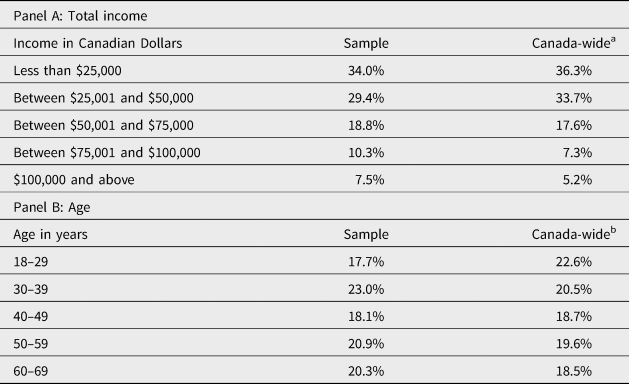
To streamline the reporting of the demographic characteristics, we provide an aggregate summary. In total, 861 Canadian taxpayers between the ages of 18 and 69 participated in our research studies (97 in Study 1; 400 in Study 2; 364 in Study 3). We report these aggregate results in Table 1 and compare them to the broader Canadian population. As Table 1 shows, our sample is consistent with the Canadian population in terms of age and income. 50.2% of our aggregate sample was female.Footnote 8
Demographics

Notes:
a Per Statistics Canada (Table 11-10-0008-01, ʻTax filers and dependents with income by total income, sex and age’. https://doi.org/10.25318/1110005001-eng).
b Per Statistics Canada (Table 17-10-0005-01, ‘Population estimates on July 1st, by age and sex; year 2019’. https://doi.org/10.25318/1710000501-eng).
Study 1
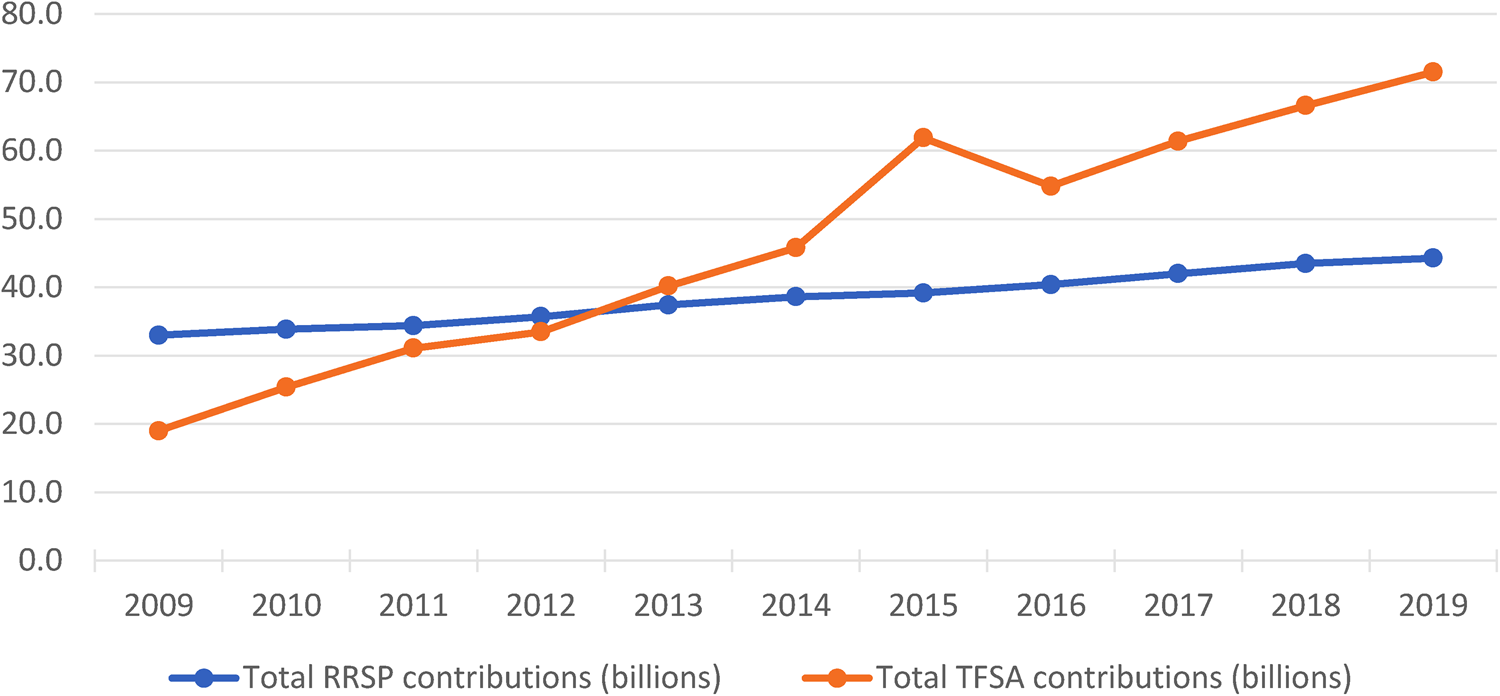
Figure 1 shows the aggregate RRSP and TFSA contributions made by Canadians from 2009 (when the TFSA was introduced) to 2019. While RRSP contributions increased modestly over the past decade, TFSA contributions have nearly tripled over the same period and annual TFSA contributions have overtaken RRSP contributions since 2013. Similar trends are observed in Messacar (Reference Messacar2017) and Berger et al. (Reference Berger, Farrar and Zhang2019). We thus formulate the following hypothesis:
Hypothesis 1: Individuals will decrease savings in their RRSP if they also have the choice to save in a TFSA.
Aggregate annual RRSP and TFSA contributions, 2009 to 2019.

Study 1 Procedures
In our experiment, participants make hypothetical savings decisions over two periods. In period one, an RRSP and a regular (non-tax-sheltered) savings account are available saving choices for all participants. In period two, participants are randomly assigned into two conditions: TFSA Introduced, where a TFSA becomes a third savings option (in addition to the existing savings choices), and TFSA Not Introduced, where participants have the same savings choices as in the first period. In each period, participants are given $10,000 to allocate between the available accounts. Participants in both conditions have the same allocation decision in period one. However, participants in the TFSA Introduced condition have an additional saving choice (the TFSA) in period two. After making their allocation decisions, participants answered tax comprehension questions and demographic questions.
Study 1 Results
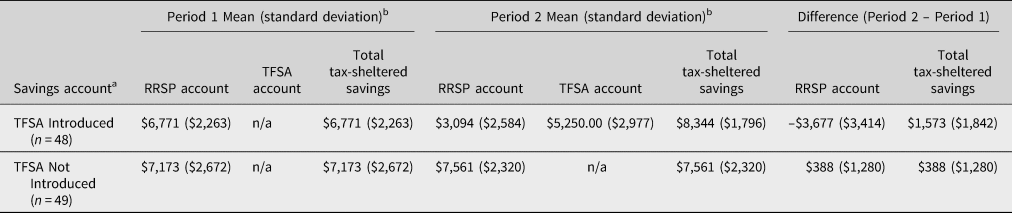
Table 2 summarizes the findings of Study 1. In period one, prior to the introduction of the TFSA, participants on average put about 2/3 of the $10,000 in the RRSP and the rest in the non-tax-sheltered savings account. The average savings between the TFSA Introduced ($6,771) and TFSA Not Introduced ($7,137) conditions (in the second period) do not differ significantly (F = 0.64, p = 0.42, two-tailed).
Study 1 – Displacement between the TFSA and the RRSP

Notes:
a Participants were assigned to one of two potential savings portfolios. In the TFSA Introduced condition, participants were able to allocate funds to the RRSP in Period 1 and the TFSA and RRSP in Period 2. In the TFSA Not Introduced participants were able to allocate funds to the RRSP in Period 1 and Period 2. In both conditions, $10,000 per period was available to allocate.
b Standard deviations are in parentheses.
In period two, when the TFSA becomes a third savings option available to half of the participants, i.e., the TFSA Introduced condition, participants on average choose to save $5,250 in the TFSA and only $3,094 in the RRSP. The average RRSP contributions reduced by 55% (t = 7.64, p < 0.01). In contrast, the average RRSP contributions increased from $7,137 in period one to $7,561 in period two (t = 2.12, p = 0.04), or 5.4%, in the TFSA Not Introduced condition. Across groups, the average RRSP contributions in the period two is $4,467 lower in the TFSA Introduced condition than in the TFSA Not Introduced condition (F = 457.07, p < 0.01, one-tailed).
Lastly, participants in the TFSA Introduced condition increase their total tax-sheltered savings (RRSP and TFSA combined) significantly more in period two ($1,573) than those in the TFSA Not Introduced condition ($388, F = 13.59, p < 0.01).
Our results support Hypothesis 1 in that individuals reduce savings in their RRSPs if they also have the choice to save in TFSAs. This finding is consistent with the aforementioned archival observations and provides causal evidence of a partial substitution effect of TFSA savings on RRSP savings.Footnote 9 Study 1 provides experimental evidence of the aggregate substitution phenomenon that has been documented archivally (Messacar, Reference Messacar2017; Berger et al., Reference Berger, Farrar and Zhang2019), but does not explain why this pattern may occur. The next two studies explore behavioral reasons that may help explain why individuals may divert savings from the RRSP to the TFSA.
Study 2
Although participants in Study 1 demonstrated a strong preference for the TFSA over the RRSP, it is unclear which feature(s) of the TFSA drive(s) their decisions. If individuals prefer certain features in each account, a partial substitution could occur as individuals allocate their savings across multiple accounts to satisfy their preferences.
We draw on psychology literature in consumer decision-making that seeks to understand how consumers cope with decisions involving trade-offs. This literature suggests that individuals do not always have well-defined preferences. Preferences can be highly context-dependent, and the value of one choice depends not only on the characteristics of that choice but also on the characteristics of other options in the choice set (Bettman et al., Reference Bettman, Luce and Payne1998). Therefore, in a tax-sheltered savings plan context, individuals who initially had one choice with certain characteristics (e.g., a front-loaded plan) and were subsequently given another choice with other characteristics (e.g., a back-loaded plan) might divert some of savings to the plan with their preferred features.
One distinction between back-loaded and front-loaded plans relates to the timing of the tax treatments. In a front-loaded plan, contributions are made with pre-tax income and withdrawals are taxable, whereas in a back-loaded plan, contributions are made with after-tax income and withdrawals are not taxable. There are several reasons that individuals may prefer a back-loaded tax treatment. Construal level theory (Trope & Liberman, Reference Trope and Liberman2003) suggests that people engage in high-level construal or abstract thinking for distant events and reply on low-level construal or concrete features to think about events in the near future. The back-loaded plan has immediate tax consequences, allowing individuals to tailor their savings decisions to specific needs. In contrast, the tax consequences of the front-loaded plan are temporally distant, usually upon withdrawing savings at retirement. The savings decisions are likely to reply on abstract ideas about retirement planning. A second reason is uncertainty avoidance. Prior studies show that people dislike uncertainty (Tversky & Kahneman, Reference Tversky and Kahneman1974). The back-loaded plan with immediate tax consequences provides more certainty than the front-loaded plan with future tax consequences. Lastly, previous studies show that people's negative attitude about paying taxes extends beyond economic reasons (e.g., Sussman & Olivola, Reference Sussman and Olivola2011). The ‘pain’ of paying taxes may appear less obvious in back-loaded plans because contributions are made from after-tax income and there are no future tax payments. The ‘dread’ of paying taxes at an unknown future point at an uncertain tax rate may make the front-loaded plans less attractive. Consistent with these literature streams, Cuccia et al. (Reference Cuccia, Doxey and Stinson2022) provide evidence that taxpayers’ preference for back-loaded plans is significantly associated with the temporal proximity of the tax consequences, reduction of uncertainty and dread of paying taxes in the future.
However, what remains to be investigated is how a second feature of tax-sheltered plans – the determination of the contribution limit – impacts trade-offs among tax-sheltered plans. In Canada, the front-loaded plan (the RRSP) has a contribution limit based on a percentage of income (indexed to a maximum threshold), whereas the back-loaded plan (the TFSA) has a contribution limit that is a fixed annual amount that does not vary with income. One challenge of a fixed contribution limit is that it may be perceived as unfair, as it hampers savings for higher-income individuals with a greater ability to save. Like the notion of vertical equity, which suggests that individuals with higher incomes should pay more in income taxes than individuals with lower incomes (e.g., Farrar et al., Reference Farrar, Massey, Osecki and Thorne2020), the same principle could apply to saving. Thus, it could be that taxpayers favor the variable contribution limit over a fixed contribution limit, as the variable contribution limit provides opportunity for more savings as one's income increases, consistent with a fairness argument.
Synthesizing these arguments, we hypothesize that individuals prefer a tax-sheltered savings plan that is back-loaded and has a variable contribution limit over other combinations of features. Our next hypothesis is:
Hypothesis 2: Individuals prefer a tax-sheltered savings account with back-loaded tax treatment and a variable contribution limit over other combinations of features.
Study 2 Procedures
We measure participants’ preferences for features of tax-sheltered savings accounts using a Maximum Difference Scaling (MaxDiff) analysis technique. This technique has been predominantly used in marketing research to establish preference/utility scores of multiple product features. An advantage of MaxDiff analysis is that participants are asked to evaluate the utility of an item as a package of different features, mimicking the real-life decision-making process. The trade-off effect is neglected in traditional experiments where respondents are asked to evaluate one feature at a time.
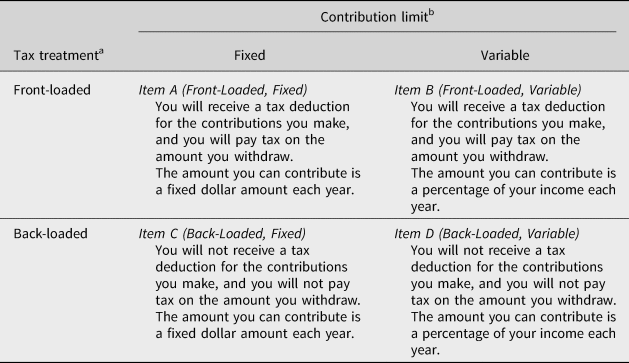
We ask participants to indicate their preferred choices among four tax-sheltered savings accounts with variations in tax treatment (front-loaded vs back-loaded) and contribution limit (fixed amount vs variable amount). Table 3 illustrates the four savings ‘products’ generated from the two-by-two combinations. Participants were randomly presented with one pair of items at a time and asked to indicate their preferred choice. The process was repeated until each participant had ranked all six pairs of items.Footnote 10 The ranking results were then used to estimate their part-worth utility from each item using a hierarchical Bayes model (Orme, Reference Orme2010).
Study 2 – Possible combinations of tax savings plan features

Notes:
a In a front-loaded savings plan, contributions are made with pre-tax income and withdrawals are taxable. In a back-loaded savings plan, contributions are made with after-tax income and withdrawals are not taxable.
b In a fixed contribution limit savings plan, the contribution limit of the plan does not vary with the taxpayer's income. In a variable contribution limit savings plan, the contribution limit varies with the taxpayer's income.
Study 2 Results
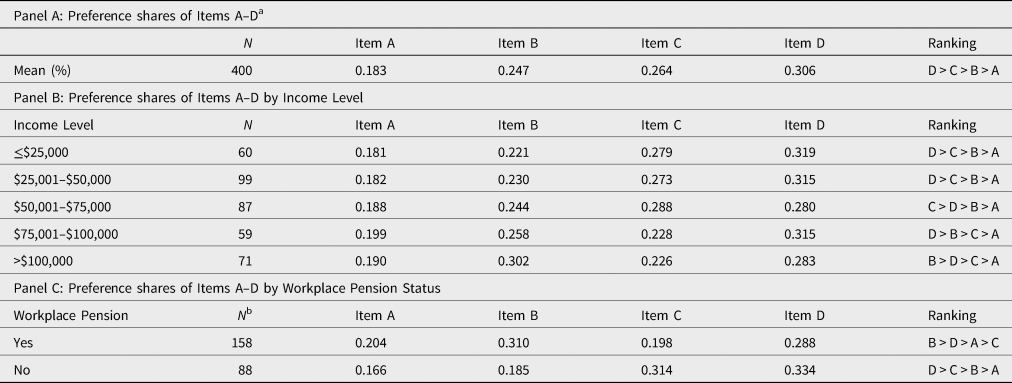
Table 4, Panel A, shows the relative preferences of each item calculated from the raw utility scores. The preference share of an item can be interpreted as the probability that the item is the most preferred choice among all the items presented to the participants. The preference shares of all the available items sum to one.
Study 2 – Analysis of preferences

Notes:
a Savings Plan A features are a front-loaded tax treatment and fixed contribution limit, Savings Plan B features are a front-loaded tax treatment and a variable contribution limit, Savings Plan C features are a back-loaded tax treatment and fixed contribution limit, and Savings Plan D features are a back-loaded tax treatment and a variable contribution limit.
b Panel C includes only participants that were employed (N = 246).
We first compare individuals’ preference shares for the back-loaded plans (Items C and D) and the front-loaded plans (Items A and B). A significant Friedman's test (Χ 2 = 32.49; p < 0.01) shows that participants strongly prefer the back-loaded tax treatment (57%; 26.4% from Item C plus 30.6% from Item D) to the front-loaded tax treatment (43%; 18.3% from Item A plus 24.7% from Item B).Footnote 11 Thus, we find evidence that individuals prefer a back-loaded tax treatment to a front-loaded tax treatment.
Next, we compare individuals’ preferences for a fixed contribution limit with a variable contribution limit. The total preference share of 55.3% for savings plans with a variable contribution limit (Items B and D) is significantly higher than the total preference share of 44.7% for savings plans with a fixed contribution limit (Items A and C) (Χ 2 = 31.36; p < 0.01). Within the front-loaded plans, a significantly higher percentage of participants preferred the variable contribution limit (Item B, 24.7%) to the fixed contribution limit (Item A, 18.3%) (Χ 2 = 14.44; p < 0.01). Similarly, within the back-loaded plans, a significantly higher percentage of participants preferred the variable contribution limit (Item D, 30.6%) to the fixed contribution limit (Item C, 26.4%) (Χ 2 = 21.16; p < 0.01). Thus, we find evidence that individuals prefer a variable contribution limit to a fixed contribution limit.
Next, we consider how individuals prioritize their preferences for tax treatment and contribution limit determination simultaneously. As shown in Table 4, Panel A, Item D (back-loaded tax treatment and variable contribution limit) is the most preferred item, as there is a 30.6% probability that Item D would be chosen over the other three items. Of note is that the two features of the existing RRSP or the existing TFSA are not the most preferred combination. Rather, one feature from each account comprises the most preferred bundle of features, consistent with a substitution effect. In contrast to Item D, Item A (i.e., the savings plan offering front-loaded tax treatment and a fixed contribution limit) is the least preferred item, as there is only an 18.3% probability that Item A would be chosen over the other three items. The difference between the most preferred, Item D, and the least preferred, Item A, is highly significant (Χ 2 = 25.00; p < 0.01).Footnote 12 These findings support Hypothesis 2.
Lastly, we compare Items B and C for insights into whether individuals have a clear preference of one preferred feature over another. Items B and C each include one desirable feature and one undesirable feature of the savings plans. Item B offers the desirable variable contribution limit but the undesirable front-loaded tax treatment, whereas Item C offers the undesirable fixed contribution limit but the desirable back-loaded tax treatment. Differences in the preferences between these two choices can provide insights into how individuals prioritize items in their preference set when an item that satisfies both preferences is not available. Importantly, this situation is analogous to the Canadian tax planning options where the TFSA offers individuals the desirable front-loaded tax treatment, but the RRSP offers individuals the desirable variable contribution limit. Results of the MaxDiff analysis indicate that while the preference share for Item C is slightly higher (26.4%) than for Item B (24.7%), the difference between the two is marginally significant (Χ 2 = 2.56; p = 0.11). Thus, it appears that when participants select items that either have one or the other desirable feature, they are marginally more likely to prioritize the item with the desirable tax treatment (back-loaded) to the item with the desirable contribution limit calculation (variable).
In sum, our results provide evidence regarding individuals’ preferences for back-loaded tax treatments and variable contribution amounts. We show that the combination of back-loaded tax treatment and variable contribution limit is the most preferred bundle of features. That one of these features is present in the RRSP and the other is present in the TFSA can help explain why partial substitution may have occurred when both accounts became available to Canadian taxpayers, as Canadians may have reallocated their savings from RRSPs to TFSAs in part to accommodate their preferences.
Study 3
This study builds on mental accounting theory to examine how individuals mentally categorize different tax-sheltered savings plans. Mental accounting is, ‘the psychological separation of economic categories’ (Antonides et al., Reference Antonides, de Groot and van Raaij2011: 546). According to mental accounting theory, individuals categorize their financial activities into separate and distinct mental accounts with a set of cognitive rules to code and evaluate their financial activities (Thaler, Reference Thaler1999). For example, all expenses related to a house may be categorized into a single ‘house account’ rather than specific types of expenses or transactions (such as mortgage, heating, renovations, water and property taxes). Mental accounting frees up individuals’ cognitive resources by enabling them to monitor and evaluate financial activities by category rather than by specific transactions. As a result, the mental categorization of money influences individuals’ savings and consumption behaviors.
In the Canadian context, TFSAs are multi-purpose and can be used for all types of savings (including retirement) but are generally used for short-term savings. In contrast, RRSPs are used for retirement savings.Footnote 13 Thus, it is possible that individuals will mentally categorize savings in both plans differently if they view the purpose of savings differently. However, if they view tax-sheltered savings similarly, they will categorize them similarly, despite possible different purposes in saving in each plan.
Mental accounting could help explain substitution between front-loaded and back-loaded plans if savings in both plans are considered to serve a single purpose. If so, they can substitute for one another. Since individuals tend to have difficulty in understanding marginal tax rates (Chardon et al., Reference Chardon, Freudenberg and Brimble2016; Pham et al., Reference Pham, Genest-Grégoire, Godbout and Guay2020), and seem unable to process tax-related differences in both plans unless specifically prompted (Cuccia et al., Reference Cuccia, Doxey and Stinson2022), we expect that individuals would categorize tax-sheltered savings plans similarly and will not distinguish between savings in a front-loaded plan and savings in a back-loaded plan. As a result, an increase in savings in one plan may lead to the decrease in savings in the other, at least partially. Our hypothesis is:
H3: Individuals are more likely to classify tax-sheltered savings plans in the same mental account than into separate mental accounts.
Study 3 Procedures
We developed an online survey in which participants performed a categorization task of 16 common household expenditure items, following the approach of Medin et al. (Reference Medin, Lynch, Coley and Atran1997). The list of items was based on Statistics Canada's Survey of Household Spending,Footnote 14 consisting of the following: mortgage/rent, RRSP, car maintenance, food, TFSA, utilities, clothing, car payment, vacation, savings account at the bank, TV cable/internet, cell/home phone bill, gym membership, personal care products, public transit and employer pension contributions. In this list of items, four pertained to savings (RRSP, TFSA, savings account at the bank and employer pension contributions).
In the survey, 364 Canadian participants were asked to group these items into up to 8 budgeting categories. They were instructed to create one category at a time by dragging the item(s) that they consider belonging to the same budgeting category into a box labeled with a category number. The process is repeated until all 16 items are allocated. Participants were informed that they did not need to use all eight categories. Once all items are categorized, participants were asked to provide a name for each category that they placed item(s) into.
Study 3 Results
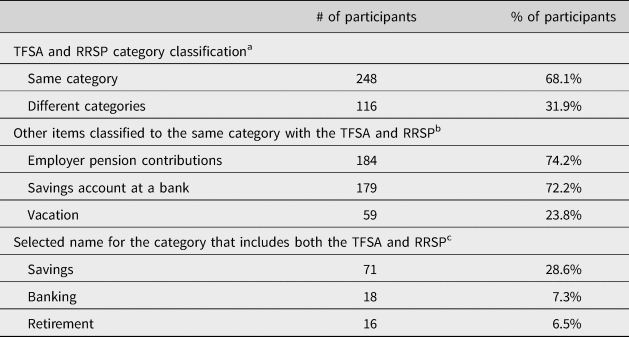
Table 5 summarizes how participants categorized the TFSA and/or the RRSP. 68.1% of participants (248 of 364) put the TFSA and RRSP into the same budgeting category. A binomial test with the probability of 50% indicates that participants are significantly (p-value < 0.01) more likely to allocate savings in the two plans into the same budgeting category than separate categories.Footnote 15 This finding supports Hypothesis 3 by showing that individuals are more likely to classify tax-sheltered savings plans in the same mental account than into separate mental accounts.Footnote 16
Study 3 – Budgeting categories of the TFSA and RRSP accounts

Notes:
a Participants classified as ‘same category’ allocated both TFSA and RRSP to the same category of budget items. Participants classified as ‘different categories’ did not allocate both TFSA and RRSP to the category of budget items.
b Of the participants that allocated TFSA and RRSP to the same category (n = 248), this analysis lists other budget items frequently allocated to this category.
c Of the participants that allocated TFSA and RRSP to the same category (n = 248), this analysis lists the most common category name selected.
Table 5 also lists the most common items that participants put in the same category with both the TFSA and RRSP as well as common names assigned to that category. Among the 248 participants who grouped the TFSA and RRSP together, 74.2% placed employer pension contributions in the same category and 72.2% placed savings in a bank account in the same category. The most common names for the categories in which the TFSA and RRSP accounts were placed are ‘Savings’, ‘Banking’ and ‘Retirement’. Our results indicate that participants tend to allocate the RRSP, the TFSA and other types of savings in the same mental account rather than distinguish savings for different purposes. Participants may not only substitute savings between the two tax-sheltered savings accounts but also substitute savings between the tax-sheltered and non-tax-sheltered accounts, both of which could result in suboptimal savings decisions.
These results complement the importance of the consumer preferences observed in Study 2, as individuals are likely to reallocate their savings within the same category based on their preferences for different features of the savings plans rather than making separate savings decisions for each plan.
Conclusion
We first set out to examine whether an archivally substantiated substitution effect between two tax-sheltered savings plans can be demonstrated experimentally. Using the Canadian context, which has two primary tax-sheltered savings plans (RRSP and TFSA), we provide experimental evidence that the introduction of the TFSA diverts savings away from the RRSP, complementing prior archival findings.
We then investigate individuals’ preference for two distinctive features of the plans. Building on marketing literature about consumer preferences, we conduct a study which considers the trade-off of the front-loaded vs back-loaded tax feature and the fixed vs variable contribution limit feature. We find that participants prefer the back-loaded tax treatment (i.e., contributions are made from after-tax income and withdrawals are not taxable) and a variable contribution limit based on income level. These findings help explain the popularity of the back-loaded TFSA as well as the diversion of savings from the RRSP to the TFSA, as individuals can save in both accounts to satisfy their preferences. Finally, we show that individuals tend to categorize savings in the RRSP and TFSA in the same mental account, grouped as one combined savings stream rather than distinct savings streams for different purposes. This finding provides another possible explanation for the substitution effect.
Our research contributes to the academic literature on tax-sheltered savings plans by providing causal evidence for a substitution effect as well as providing two psychology-based explanations for its occurrence. Our findings also extend research highlighting the importance of behavioral considerations in using tax-sheltered savings plans.
This research provides public policy implications. Notably, Study 2 finds that the determination of the contribution limit (fixed vs variable amount) and the plan's structure (front-loaded vs back-loaded tax) both influence taxpayers’ preferences for a tax-sheltered plan. Our results suggest that taxpayers prefer the combination of a back-loaded tax structure and a variable contribution limit. For a government planning to introduce a new tax-sheltered plan or wishing to encourage savings in an existing tax-sheltered plan, this preferred combination should be considered. Study 3 shows that taxpayers find it difficult to mentally distinguish between different types of savings plans, suggesting that offering more savings plan types may not always be beneficial. Governments should consider providing more financial education to help potential savers better understand the relative merits of multiple types of savings plans. Given the steady decline in household savings among many OECD countries (OECD, 2020), these policy implications can be extended outside Canada.
We encourage additional research to understand pragmatic ways in which governments can increase take-up in multiple tax-sheltered savings plans. We also encourage research on substitution effects on non-tax-sheltered savings when tax-sheltered savings are introduced and how other demographic influences could explain the substitution effect. Finally, we encourage research to investigate relative preferences for tax rate considerations vis-à-vis psychological considerations.
Acknowledgements
The authors acknowledge funding from the Social Sciences and Humanities Research Council of Canada (SSHRC) and the CPA Centre for Capital Markets and Behavioural Decision Making (Lazaridis School of Business, Wilfrid Laurier University) and the KPMG Accounting Fellowship Fund. The authors thank Zhuoyi Zhao for research assistance and Thomas Farrar for statistical advice. The authors are unaware of any conflicts of interest. Ethics approval was obtained at our respective institutions prior to collecting data.
Funding statement
The authors gratefully acknowledge funding from the Social Sciences and Humanities Research Council (SSHRC) of Canada.
Competing interests
The authors declare none.
Data availability statement
Data available on request from the corresponding author, upon reasonable request.
Ethical statement
All three studies were granted research ethics board approval by our respective institutions.

 Open access

