


Introduction
Corruption is a primary obstacle to public governance, eroding state capacity and social welfare (OECD, 2016). While petty bureaucratic corruption is often dismissed as minor, it remains particularly pernicious as it directly shapes citizens’ everyday interactions with the state (Mungiu-Pippidi and Dadašov, Reference Mungiu-Pippidi and Dadašov2016; OECD, 2015). Such street-level corruption creates self-reinforcing traps that normalise non-compliance and undermine the legitimacy of public institutions. Despite a vast array of anti-corruption interventions, ranging from strict enforcement and monitoring to wage incentives and moral appeals, their efficacy remains inconsistent. Policies that succeed in one administrative context often fail in another, suggesting that standard best practices ignore the complex, adaptive nature of corruption systems.
Understanding these failures requires moving beyond static evaluations to examine how interventions interact within a multi-level system. While existing research is robust, it remains theoretically fragmented across deterrence-based economic models, psychological social-norm theories, and institutional focus. This fragmentation results in misaligned policies that rely on isolated, single-level interventions with little regard for cross-level dynamics.
Institutional economics frameworks, whether incentive-based principal-agent models (Rose-Ackerman, Reference Rose-Ackerman1999) or layered accounts of formal rules and informal norms (North, Reference North1990; Ostrom, Reference Ostrom2005), typically conceptualise corruption as a linear outcome of rule design. These approaches struggle to capture the non-linear, adaptive transitions observed in practice. As a result, they cannot fully explain why: (i) strong enforcement fails when it interacts with entrenched norms; (ii) isolated interventions are absorbed without cross-level coordination; and (iii) corruption systems display tipping points rather than gradual change.
This study addresses these limitations by developing a Dynamic Corruption Equilibrium (DCE) Framework that models corruption as a multi-level adaptive system. Integrating incentives, norms, and institutional feedback, the framework explains cross-level intervention effects, tipping dynamics, and the conditions under which corruption equilibria shift, thus advancing institutional economics beyond static incentive models.
To build this framework, we conduct a Bibliometric-Systematic Literature Review (B-SLR) of laboratory corruption experiments. Focusing on methodologically comparable laboratory studies enables the synthesis of behavioural findings, the identification of recurring mechanisms, and the development of an integrated model of feedback, multi-level interactions, and system bistability, features largely absent from standard approaches. Laboratory experiments are uniquely suited to this task because they allow controlled manipulation of incentives, norms, and institutional conditions, making cross-study mechanism identification possible.
This study makes three contributions. First, it provides the first bibliometric-systematic mapping of laboratory corruption research, clarifying the field’s intellectual structure, dominant intervention logics, and theoretical lineages. Second, by consolidating fragmented behavioural evidence, it identifies six classes of anti-corruption interventions across institutional, social, and individual levels, and documents the boundary conditions under which their effects vary. Third, drawing on institutional economics, behavioural theory, and complex systems approaches, it develops the DCE Framework, which conceptualises corruption as a multi-level institutional system characterised by feedback loops, conditional pathways, and bistability.
The framework explains how corruption stabilises in high-or low-integrity equilibria, why marginal reforms often fail, and how coordinated interventions can shift systems away from corruption traps. It offers a diagnostic basis for analysing dynamic institutional change and outlines a research agenda centred on interaction effects, transitions, and context-dependent configurations.
The experimental approach
Corruption’s secrecy makes observational data scarce, and macro-level indices often fail to capture the micro-foundations of corrupt behaviour (Olken and Pande, Reference Olken and Pande2012). Survey methods frequently also suffer from social desirability and legal risk biases (Abbink and Serra, Reference Abbink, Serra, Serra, Wantchekon, Isaac and Norton2012). As a result, behavioural and experimental approaches have become essential for observing decision-making in controlled, ethical settings.
Laboratory experiments offer a unique window into how individuals respond to corruption opportunities (Serra and Wantchekon, Reference Serra, Wantchekon, Serra and Wantchekon2012). They allow precise manipulation of incentives and institutional conditions, simulate corrupt environments without legal risk, and provide a cost-effective diagnostic tool for policy design. Experimental paradigms range from sequential bribery to procurement and embezzlement games, enabling researchers to integrate individual-level motivations with situational and institutional variables (Abbink, Reference Abbink2004; Guerra and Zhuravleva, Reference Guerra and Zhuravleva2021; Lambsdorff and Frank, Reference Lambsdorff and Frank2011; Niu et al., Reference Niu, Li, Ding, Fan, Zhou and Cheng2024; Ryvkin and Serra, Reference Ryvkin and Serra2019).
While laboratory studies isolate behavioural mechanisms, their external validity depends on alignment with observational evidence and institutional theory. Co-citation patterns (Co-citation analysis) show that the experimental literature is not epistemically isolated, it is anchored in field-based evidence (Reinikka and Svensson, Reference Reinikka and Svensson2004), cross-country observational research (Mauro, Reference Mauro1995; Treisman, Reference Treisman2000), and foundational conceptual frameworks (Klitgaard, Reference Klitgaard1988; Rose-Ackerman, Reference Rose-Ackerman1978). The DCE Framework therefore functions as a bridge, integrating experimentally identified causal pathways with the broader empirical and conceptual literature to ensure that laboratory rigour remains connected to real-world governance dynamics.
Methodology
This study employs a B-SLR approach (Marzi et al., Reference Marzi, Balzano, Caputo and Pellegrini2025), combining quantitative bibliometrics with qualitative thematic synthesis to map the field’s intellectual structure and identify causal mechanisms for theory development.
Search strategy and study selection
Following a pre-registered protocol on the Open Science Framework,Footnote 1 we conducted an iterative search on Scopus and Web of Science (May 2025) using identical search strings. Scopus returned more relevant results (8,066 vs. 5,933 documents) and provided more consistent metadata for bibliometric processing; it was therefore selected as the primary database. The search targeted experimental studies of petty corruption using Boolean combinations of corruption-related terms, experimental methods, and public-sector role descriptors.Footnote 2
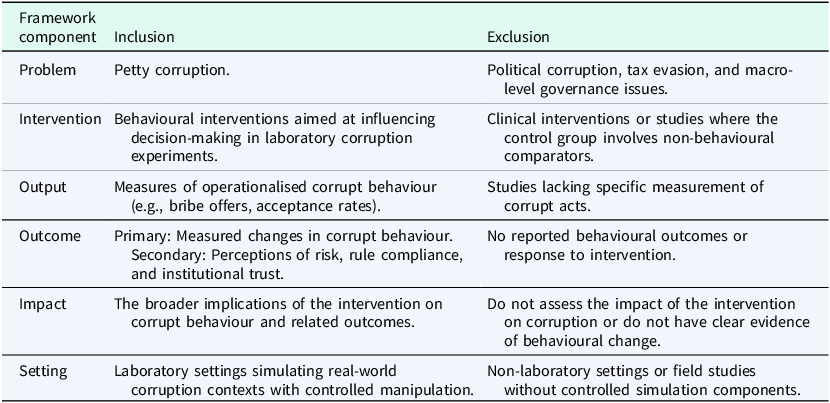
After filtering for journal articles in English, 5,017 documents remained. Title, abstract, and keyword screening against predefined eligibility criteria (Table 1) produced 132 studies for bibliometric analysis (Stage 1). Full-text screening of these studies ensured methodological comparability, yielding 60 studies for thematic synthesis (Stage 2). Studies were excluded when essential experimental parameters such as bribe-to-payoff ratios or detection probabilities were insufficiently reported for cross-study comparison. Screening was conducted manually to maintain a transparent and replicable audit trail.
Eligibility criteria

Table 1. Long description
The table presents eligibility criteria for including and excluding studies on corruption interventions. It is structured with six columns: Framework component, Inclusion, and Exclusion. The framework components include Problem, Intervention, Output, Outcome, Impact, and Setting. For the Problem, inclusion focuses on petty corruption, while exclusion covers political corruption, tax evasion, and macro-level governance issues. The Intervention column includes behavioral interventions aimed at influencing decision-making in laboratory corruption experiments for inclusion, and excludes clinical interventions or studies with non-behavioral comparators. The Output column specifies measures of operationalized corrupt behavior for inclusion, and excludes studies lacking specific measurement of corrupt acts. The Outcome column includes measured changes in corrupt behavior and perceptions of risk, rule compliance, and institutional trust for inclusion, and excludes studies with no reported behavioral outcomes. The Impact column includes the broader implications of the intervention on corrupt behavior and related outcomes for inclusion, and excludes studies that do not assess the impact on corruption or lack clear evidence of behavioral change. The Setting column includes laboratory settings simulating real-world corruption contexts with controlled manipulation for inclusion, and excludes non-laboratory settings or field studies without controlled simulation components.
Data extraction and synthesis
We extracted data using a standardised form capturing core attributes, intervention details, conceptual elements, and theoretical lenses. The form was pilot-tested and refined before systematic application to the 60 studies. Therefore, thematic synthesis followed a five-step coding process: (i) coding intervention types; (ii) identifying theoretical foundations; (iii) recognising cross-study patterns; (iv) synthesising contextual moderators, interaction effects, and sequencing; and (v) integrating findings into the DCE Framework.
Quality and validity assessment
To ensure methodological integrity, we applied a tailored quality and validity assessment focused on experimental rigour. Studies were included only if they demonstrated clear operationalisation of the corruption proxies, incentive compatibility, and robust internal validity evidenced by adequate control groups. The PRISMA flow chart (Figure 1) illustrates the study selection process of the reviewed studies.
PRISMA flow chart of search strategy and included studies. Notes: Figure 1 illustrates the study selection process for the B-SLR. It outlines the number of records identified, screened, assessed for eligibility, and included in the final analysis. The process follows PRISMA 2020 guidelines.

Figure 1. Long description
The flowchart begins with the identification of 8,066 records from SCOPUS. Before screening, 534 non-English articles, 2,451 papers not classified as articles, and 64 articles not published in journals are removed. This leaves 5,017 records for screening. Of these, 4,885 records are excluded for not being related to administrative corruption, not being laboratory experiments, or being unrelated studies. 132 reports are sought for retrieval, with none not retrieved. All 132 studies are included in the bibliometric analysis. For thematic synthesis, 15 game-theoretic and analytical models, 12 computational and agent-based simulations, 8 field experiments and survey-based studies, 4 conceptual and review papers, and 33 empirical studies without intervention design or behavioral measures are excluded. This results in 60 studies included in the thematic synthesis.
Bibliometric findings: mapping the research domain
Performance analysis
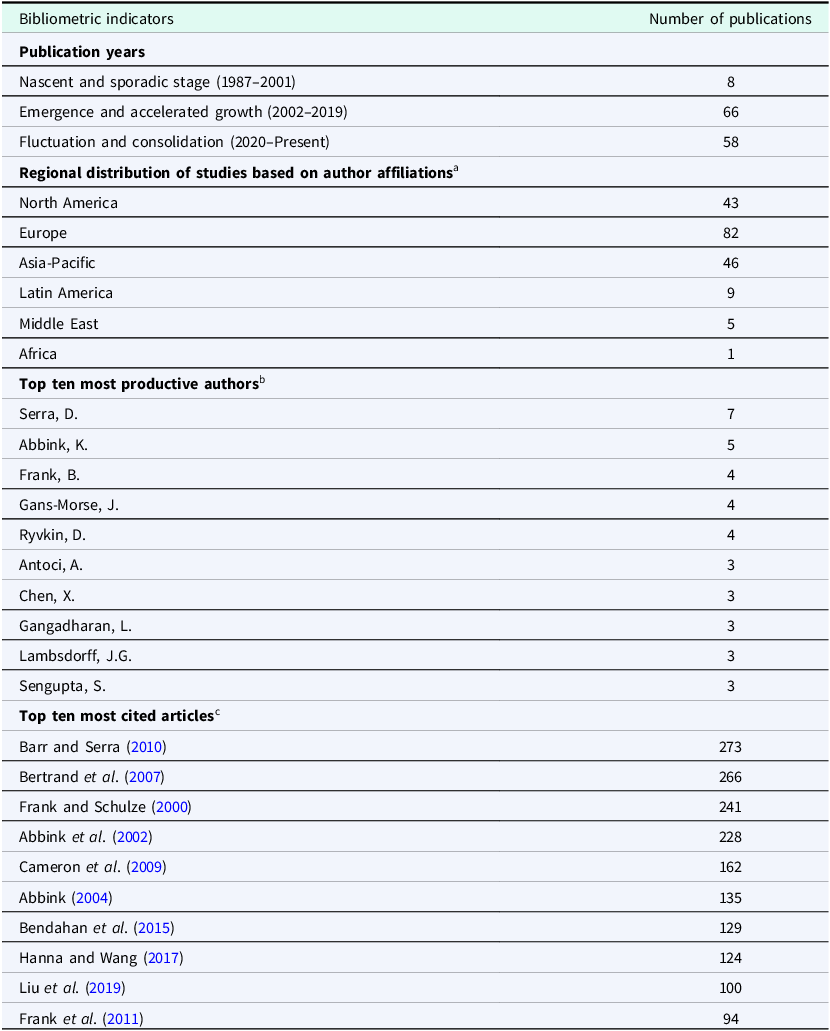
The performance analysis highlights key trends in the evolution of laboratory experimental corruption research (Table 2).
Summary of performance analysis

Table 2. Long description
The table presents bibliometric indicators of laboratory experimental corruption research, divided into three main sections: publication years, regional distribution of studies based on author affiliations, and top ten most productive authors and cited articles. The publication years are categorized into three stages: Nascent and sporadic stage (1987-2001) with 8 publications, Emergence and accelerated growth (2002-2019) with 66 publications, and Fluctuation and consolidation (2020-Present) with 58 publications. The regional distribution shows the number of studies from different regions: North America with 43, Europe with 82, Asia-Pacific with 46, Latin America with 9, Middle East with 5, and Africa with 1. The top ten most productive authors are listed with their respective number of publications: Serra, D. with 7, Abbink, K. with 5, Frank, B. with 4, Gans-Morse, J. with 4, Ryvkin, D. with 4, Antoci, A. with 3, Chen, X. with 3, Gangadharan, L. with 3, Lambsdorff, J.G. with 3, and Sengupta, S. with 3. The top ten most cited articles are also listed with their respective number of citations: Barr and Serra (2010) with 273, Bertrand et al. (2007) with 266, Frank and Schulze (2000) with 241, Abbink et al. (2002) with 228, Cameron et al. (2009) with 162, Abbink (2004) with 135, Bendahan et al. (2015) with 129, Hanna and Wang (2017) with 124, Liu et al. (2019) with 100, and Frank et al. (2011) with 94.
Notes: aRegional distribution (N = 132 studies, 186 affiliations) is based on Scopus metadata. The total number of affiliations (186) exceeds the number of unique studies (132) due to multi-authored and multi-affiliated publications. Regional classification follows standard geopolitical groupings.
b The ten most productive authors were derived based on the highest number of publications on Scopus-indexed records.
c The ten most cited articles as indexed in Scopus. Citation counts reflect the number of times each article has been cited by other publications.
Three phases emerge: a nascent stage characterised by sporadic output and the absence of a shared experimental paradigm; an accelerated growth phase, following the introduction of the first standardised bribery game protocol (Abbink et al., Reference Abbink, Irlenbusch and Renner2002) and reinforced by major global anti corruption initiatives; and a consolidation phase marked by stable productivity and a shift towards examining how institutional, social, and behavioural interventions disrupt corruption equilibria. This periodisation reflects substantive methodological and conceptual evolution rather than simple chronology.
The regional distribution of author affiliations reveals a strong geographic concentration. Europe, Asia-Pacific, and North America dominate the field, while Africa, Latin America, and the Middle East remain significantly under-represented. This imbalance suggests that much of the experimental evidence is generated in contexts characterised by relatively strong institutions and lower corruption levels, with implications for external validity in high-corruption environments.
International collaboration remains robust (41%), and the most cited studies are foundational works that have shaped the field’s theoretical and methodological trajectory.
Science mapping
We use standard science mapping techniques (Donthu et al., Reference Donthu, Kumar, Mukherjee, Pandey and Lim2021; Zupic and Cater, Reference Zupic and Cater2015) to trace the structural and thematic evolution of experimental corruption research.
Co-citation analysis
Co-citation analysis (threshold ≥ 3 citations) identifies four foundational clusters that constitutes the field’s intellectual heritage (Figure 2).
Network visualisation of the intellectual heritage. Note: The analysis applied a minimum threshold of 3, a minimum cluster size of 10, and identified 4 clusters.

Figure 2. Long description
A network visualization of intellectual heritage with four clusters of interconnected nodes and labeled authors. The clusters are color-coded and labeled as Theoretical Economics & Policy Foundations, Experimental Economics & Behavioural Corruption Studies, Experimental Designs & Social Mechanisms, and Evolutionary Game Theory & Co-operation Models. Each node represents an author, with lines indicating connections or collaborations between them. The visualization shows the relationships and interactions within and between the clusters, highlighting the intellectual heritage and collaborative network in the field.
The red cluster represents the experimental economics tradition, anchored by Abbink et al. (Reference Abbink, Irlenbusch and Renner2002) and strengthened by Abbink and Hennig-Schmidt (Reference Abbink and Hennig-Schmidt2006). This cluster established the core experimental paradigm and generated evidence on behavioural drivers of corruption, including cross-cultural variation, gender effects, social preferences, and externalities. Alongside this behavioural tradition, the green cluster reflects the theoretical and policy foundations of corruption research, anchored by Shleifer and Vishny (Reference Shleifer and Vishny1993) model of organised corruption, supported by Treisman’s (Reference Treisman2000) comparative framework, and complemented by seminal contributions on corruption’s economic consequences (Mauro, Reference Mauro1995), optimal enforcement (Polinsky and Shavell, Reference Polinsky and Shavell2001), and classic texts on corruption control (Klitgaard, Reference Klitgaard1988; Rose-Ackerman, Reference Rose-Ackerman1978, Reference Rose-Ackerman1999). This cluster established corruption as a legitimate domain of economic inquiry and shaped subsequent policy debates.
The blue cluster captures social mechanism and norm-based approaches, including experimental designs on peer effects, punishment, information sharing, and cultural variation, with methodological advances exemplified by Alekseev et al. (Reference Alekseev, Charness and Gneezy2017), and incorporating influential field evidence (Reinikka and Svensson, Reference Reinikka and Svensson2004) and laboratory-field comparisons (Armantier and Boly, Reference Armantier and Boly2013).
Finally, the yellow cluster draws on evolutionary game theory and complex systems approaches, grounded in mathematical models of cooperation and defection (Nowak, Reference Nowak2006) and extended by applications from statistical physics and network science (Perc et al., Reference Perc, Jordan, Rand, Wang, Boccaletti and Szolnoki2017), offering tools for understanding how corruption spreads, stabilises, or shifts at the system level. These clusters reveal an intellectual tradition that is rich but fragmented, with behavioural, institutional, social-mechanism, and evolutionary perspectives evolving largely in parallel.
Bibliographic coupling
Bibliographic coupling (documents sharing ≥ 5 references) identifies five active research fronts (Figure 3).
Network visualisation of the current research front. Note: The analysis applied a minimum threshold of 5, a minimum cluster size of 4, and identified 5 clusters.

Figure 3. Long description
A network visualization of current research front with clusters and connections between authors and studies. The visualization includes various clusters representing different research topics such as Enforcement Mechanisms and Anti-Corruption Policy, Reciprocity and Social Exchange, Cultural and Institutional Determinants, Network Effects and Evolutionary Dynamics, and Microeconomic Foundations and Behavioural Economics. Each node represents an author and their publications, with lines indicating connections and collaborations between them. Key authors such as Serra, Abbink, Frank, and others are prominently featured, showing their influence and the extent of their research impact.
The red cluster represents the most theoretically grounded stream, combining game-theoretic models of bribery intermediation (Hasker and Okten, Reference Hasker and Okten2008) with experimental tests of behavioural deviations from rational choice (Azfar and Nelson, Reference Azfar and Nelson2007; Barr et al., Reference Barr, Lindelow and Serneels2009; Cooter and Garoupa, Reference Cooter and Garoupa2014; Zhang, Reference Zhang2015). Alongside this, the green cluster examines how cultural, institutional, and normative environments shape corrupt behaviour, with strongly coupled contributions on wage incentives and enforcement complementarities (van Veldhuizen, Reference van Veldhuizen2013), transparency and accountability reforms (García-Gallego et al., Reference García-Gallego, Georgantzis, Jaber-López and Michailidou2020), and cultural determinants of bribery (Barr and Serra, Reference Barr and Serra2010).
In parallel, the blue cluster focuses on governance design and enforcement mechanisms, drawing on optimal enforcement and mechanism-design principles to analyse how competition, punishment, and administrative rules influence corruption outcomes (Cameron et al., Reference Cameron, Chaudhuri, Erkal and Gangadharan2009; Ryvkin and Serra, Reference Ryvkin and Serra2019, Reference Ryvkin and Serra2020). Complementing these perspectives, the yellow cluster applies evolutionary game theory and network models, showing how corruption spreads through hierarchical structures (Huang et al., Reference Huang, Chen and Wang2018), evolves under corrupt enforcement (Liu et al., Reference Liu, Chen and Szolnoki2019), and emerges in regular and complex networks (Verma et al., Reference Verma, Nandi and Sengupta2017, Reference Verma, Nandi and Sengupta2018).
Finally, the purple cluster explores socio-psychological mechanisms, including reciprocity norms, gift-exchange practices, and relational obligations (Banerjee and Mitra, Reference Banerjee and Mitra2018; Frank and Schulze, Reference Frank and Schulze2000; Lambsdorff and Frank, Reference Lambsdorff and Frank2010, Reference Lambsdorff and Frank2011) highlighting the social embeddedness of corrupt behaviour. These clusters reveal a research landscape that is empirically rich but theoretically fragmented, with behavioural, institutional, governance, evolutionary, and socio psychological approaches advancing largely in parallel.
Keyword co-occurrence
Keyword co-occurrence analysis (keywords ≥ 3) a clear conceptual shift from punitive and enforcement-focused terms toward behavioural, normative, and meso-level themes (Figure 4).
Network visualisation of the conceptual evolution. Note: Keyword co-occurrence network visualisation based on included studies. The analysis applied a minimum threshold of 3, a minimum cluster size of 15, and identified 4 clusters.

Figure 4. Long description
The image presents a network visualization of keyword co-occurrence based on included studies. The visualization is divided into four clusters: Corruption & Experimental Economics, Game Theory & Policy, Co-operation & Punishment, and Human Behavior & Social Norms. The central node, labeled ‘corruption,’ is connected to various related terms such as enforcement, transparency, institutions, and experimental economics. Other notable nodes include cooperation, game theory, social norms, and human behavior. The connections between these nodes illustrate the relationships and conceptual evolution within these fields. The visualization uses different colors to distinguish between the clusters and highlights the interconnectedness of various concepts related to corruption and behavioral studies.
The red cluster centres on corruption, bribery, experiments, and public goods, reflecting the methodological core of laboratory research. The green cluster highlights psychological and sociological dimensions such as social norms, gender, and individual behaviour, indicating growing attention to normative influences on corrupt decision-making.
The yellow cluster links cooperation, punishment, and public-goods games, capturing work on enforcement, reciprocity, and strategic interaction. The blue cluster groups theoretical and computational approaches, including game theory and evolutionary models, with applications to organisational and regulatory contexts.
These clusters illustrate a transition from narrow punitive framings to a richer behavioural and normative orientation, reinforcing the need for a multi level framework such as the DCE, which integrates micro behavioural, meso normative, and macro institutional mechanisms.
Bibliometric synthesis: identifying scholarly fragmentation
The co-citation and bibliographic-coupling analyses reveal a structurally fragmented field in which governance design (macro), social-norms research (meso), behavioural experiments (micro), and evolutionary system approaches develop largely in isolation. This siloed evolution reflects a tendency to test discrete mechanisms rather than integrated systems, providing the empirical motivation for the multi-level lens adopted in the thematic synthesis.
The behavioural and experimental economics tradition offers the micro-foundations of corrupt decision-making, showing where rational-choice predictions break down due to reciprocity, guilt aversion, and social preferences. The governance and mechanism-design literature conceptualise corruption as an incentive-design problem, showing how institutional rules shape administrative behaviour and why deterrence often fails when honesty is costlier than corruption.
Evolutionary and network-based research treats corruption as a dynamic social dilemma, demonstrating how corrupt behaviour spreads, stabilises, and generates system-level bistability. Cultural and social norms research shows how collective beliefs, reciprocity norms, and cultural expectations shape the meaning and acceptability of corrupt acts, though typically examined separately from behavioural and governance dynamics.
Altogether, these traditions depict corruption as a complex adaptive system shaped by interacting micro behaviours, meso norms, macro incentives, and system-level feedback, providing the conceptual foundation for the multi-level thematic synthesis and the DCE Framework.
Systematic literature review
Following bibliometric mapping, full-text screening was conducted to identify studies suitable for thematic synthesis. Eligibility required: (i) empirical laboratory experiments with human subjects; (ii) clear reporting of intervention design and behavioural outcomes; and (iii) sufficient methodological detail for assessing validity and comparability. Of the 132 studies analysed bibliometrically, 60 met these criteria. The remaining 72 were excluded because they were non-empirical in the behavioural sense required (theoretical models, simulations, or judgement studies; n = 39) or lacked essential experimental parameters for cross-study comparison (e.g. payoff structures, detection probabilities; n = 33). Screening followed the preregistered criteria to ensure transparency and replicability.
Coding scheme
A structured coding scheme was applied across five domains: metadata, study context, methodological approach, conceptual elements, and findings, following established systematic review guidance (Snyder, Reference Snyder2019). For studies without explicit contribution statements, contributions were inferred through appraisal of design, analytical framing, and alignment with the corruption literature and coded into categories such as theoretical advancement, methodological innovation, and policy relevance (Snyder, Reference Snyder2024).Footnote 3
Study characteristics
The review adopts a configurative approach (Gough et al., Reference Gough, Oliver, Thomas, Gough, Oliver and Thomas2017), emphasising interpretive synthesis and theory development rather than aggregation. A hermeneutic perspective (Boell and Cecez-Kecmanovic, Reference Boell and Cecez-Kecmanovic2014) guided iterative engagement with the studies and the broader conceptual landscape.
Thematic synthesis
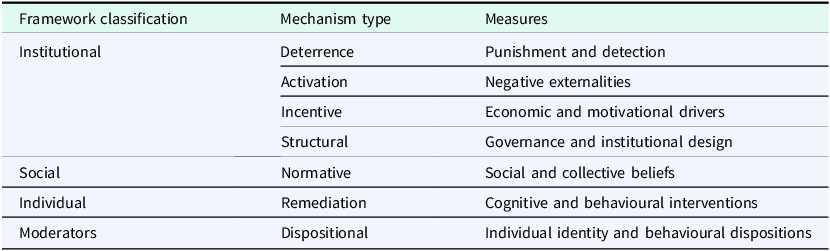
Building on the theoretical traditions and fragmentation identified in the bibliometric synthesis (Bibliometric synthesis: identifying scholarly fragmentation), the thematic synthesis organises the sixty laboratory experiments around three interacting levels of influence: institutional (macro), socio-cultural (meso), and individual (micro). Although the original studies do not explicitly adopt this structure, the multi-level pattern emerged inductively during the review process and provides a coherent lens for interpreting how interventions operate within and across layers of the corruption system. This structure also integrates the six intervention themes and the identity-and-disposition moderators into a unified analytical framework, enabling clearer identification of cross-level mechanisms and informing the development of the DCE Framework (Table 3).
Summary of thematic classification

Table 3. Long description
The table categorizes framework classification, mechanism type, and measures into four rows and three columns. The framework classification includes Institutional, Social, Individual, and Moderators. The mechanism types are Deterrence, Activation, Incentive, Structural, Normative, Remediation, and Dispositional. The measures listed are Punishment and detection, Negative externalities, Economic and motivational drivers, Govance and institutional design, Social and collective beliefs, Cognitive and behavioural interventions, and Individual identity and behavioural dispositions.
Theme 1: punishment and detection
Deterrence mechanisms draw on neo-classical models that assume rational actors weigh expected costs against expected benefits (Becker, Reference Becker1968). Across sixteen comparable studies, however, deterrence proves non-linear, its effectiveness depends on institutional legitimacy, and detection probability thresholds.
Three design parameters consistently shape outcomes. First, the penalty structure matter. Low detection paired with high sanctions often outperforms high detection with low sanctions (Banerjee and Mitra, Reference Banerjee and Mitra2018). Second, administrative symmetry is critical, hence sanctioning only one side of a corrupt exchange creates moral hazard, whereas equitable punishment disrupts reciprocal trust between actors (Engel et al., Reference Engel, Goerg and Yu2016). Third, temporal sustainability matters because short-term crackdowns yield temporary reductions, while durable effects require embedding deterrence as a stable administrative feature (Banuri and Eckel, Reference Banuri and Eckel2015).
Even with optimal design, deterrence is constrained by contextual boundary conditions. Weak or selectively applied legal institutions can reinforce moral hazard, especially when enforcement targets low-level actors while shielding elites. Cultural attitudes towards authority and justice also shape how punishment is perceived and internalised (Cameron et al., Reference Cameron, Chaudhuri, Erkal and Gangadharan2009; Harri et al., Reference Harri, Zhllima, Imami and Coatney2020), and different occupational or social groups respond unevenly to sanctions (Alatas et al., Reference Alatas, Cameron, Chaudhuri, Erkal and Gangadharan2009). Enforcement also depends on perceived legitimacy because when citizens distrust the enforcing body, resistance, and non-compliance increase (Boly et al., Reference Boly, Gillanders and Miettinen2019). Furthermore, stakeholder positioning affects enforcement, especially when indirect victims are less likely to impose or support sanctions (Guerra and Zhuravleva, Reference Guerra and Zhuravleva2021). Even robust punishment mechanisms may fail if the enforcing body lacks perceived legitimacy, leading to resistance or non-compliance.
These boundary conditions challenge the assumption of a straightforward deterrence effect, revealing that punitive interventions alone may fail to recalibrate corrupt norms unless embedded within a broader framework of equitable governance (Banerjee and Mitra, Reference Banerjee and Mitra2018; Jiang et al., Reference Jiang, Wei and Zhao2024). This conditional effectiveness of punishment challenges universal deterrence models, necessitating context-specific implementation strategies that address cultural, institutional, and design factors simultaneously rather than relying on standalone punitive measures. Effective anti-corruption strategies require a context-specific, multi-level enforcement that aligns formal sanctions with social norms and institutional credibility. Punitive measures alone rarely shift entrenched equilibria without complementary reforms in governance and civic oversight (Dasgupta and Radoniqi, Reference Dasgupta and Radoniqi2023; Jiang et al., Reference Jiang, Wei and Zhao2024; Zhang, Reference Zhang2018).
Theme 2: negative externalities
Negative externality interventions seek to reduce corruption by activating moral salience and highlighting harm to third parties. Across ten comparable studies, however, standalone awareness campaigns consistently fail when private benefits outweigh societal costs (Abbink et al., Reference Abbink, Irlenbusch and Renner2002; Balafoutas et al., Reference Balafoutas, Sandakov and Zhuravleva2021).
The synthesis identifies several boundary conditions. In many administrative settings, reciprocal trust and strategic social ties mute externalities because actors prioritise personal or in-group gains over abstract societal harm, especially where institutional monitoring is weak (Finocchiaro Castro, Reference Finocchiaro Castro2021). Cultural sensitivity is also critical, since individuals from low-corruption cultures may respond to harm cues, but in high-corruption environments entrenched norms often neutralise moral activation (Barr and Serra, Reference Barr and Serra2010). Specifying victim vulnerability or loss magnitude can increase psychological costs, though these effects are strongest when combined with formal enforcement (Guerra and Zhuravleva, Reference Guerra and Zhuravleva2021; Senci et al., Reference Senci, Hasrun, Moro and Freidin2019).
Effective implementation therefore requires cultural pre-assessment and enhanced visibility of harm through transparent, real-time demonstrations of third-party costs (Ahloy et al., Reference Ahloy, Gilland and Hamman2024; Finocchiaro Castro, Reference Finocchiaro Castro2021; Guerra and Zhuravleva, Reference Guerra and Zhuravleva2021). Overall, moral nudges are not standalone solutions, rather externality-based interventions function as conditional pathways that requires institutional legitimacy and disruption of reciprocal social networks to reach a behavioural tipping point.
Theme 3: economic and motivational drivers
Economic interventions are grounded in principal-agent theory, assuming corruption responds predictably to optimal incentive structures (Groenendijk, Reference Groenendijk1997; Rose-Ackerman, Reference Rose-Ackerman1999). Across eleven comparable studies, however, isolated financial incentives consistently underperform because behavioural interactions undermine purely rational predictions.
The synthesis identifies three design elements that shape the effectiveness of economic interventions. Primarily, strategic bundling is essential because wage increases and bonuses are largely ineffective alone (Azfar and Nelson, Reference Azfar and Nelson2007; Barr et al., Reference Barr, Lindelow and Serneels2009); their deterrent effect emerges only when combined with robust oversight and active monitoring (van Veldhuizen, Reference van Veldhuizen2013). Also, higher wages can generate selection perversity, attracting candidates with higher corruption propensities and weakening long-term administrative integrity (Barfort et al., Reference Barfort, Harmon, Hjorth and Olsen2019; Boly and Gillanders, Reference Boly and Gillanders2018). Furthermore, intrinsic motivation dominance frequently overrides extrinsic rewards. In such cases, financial incentives may crowd out ethical commitments or professional identity, reducing compliance when interventions conflict with an internalised public service values (Frank and Schulze, Reference Frank and Schulze2000; Markussen et al., Reference Markussen, Sharma, Singhal and Tarp2021).
These findings demonstrate that economic incentives are conditional mechanisms depend. Their success depends on institutional legitimacy, alignment with intrinsic motivations, and careful design to avoid backfire effects.
Theme 4: governance and institutional design
Governance interventions, rooted in institutional theory, aim to reduce corruption by altering the administrative rules to constrain discretion and strengthen oversight (Klitgaard, Reference Klitgaard1988). Across seventeen comparable studies, structural reforms show strong cultural dependency, requiring multi-level integration to avoid administrative decay.
Staff rotation and network disruption function as safeguards against the capture of administrative discretion, but their effectiveness depends on relationship structures. In settings where governance relies on interpersonal trust, rotation can disrupt cooperation and erode expertise without reducing corruption (Abbink, Reference Abbink2004; Bühren, Reference Bühren2020). Equally, monitoring effectiveness depends more on its structural design than on intensity. Vertically integrated oversight combined with bottom-up citizen engagement consistently outperforms isolated monitoring strategies (Jiang et al., Reference Jiang, Wei and Zhao2024; Serra, Reference Serra2012). Timing of monitoring is critical; pre-emptive bribes can undermine monitoring effort (Lowen and Samuel, Reference Lowen and Samuel2012), requiring simultaneous increases in the cost of non-compliance to remain effective (Finocchiaro Castro, Reference Finocchiaro Castro2021).
Using transparency as interventions exhibits non-linear effects depending on the corruption types. While it deters embezzlement by increasing visibility, it can be counterproductive in bribery contexts by normalising corrupt exchanges through increased information about market rates (Parra et al., Reference Parra, Muñoz-Herrera and Palacio2021).
These findings challenge universalistic institutional design assumptions. Within the DCE Framework, governance mechanisms operate as macro-level levers that achieve system-level stability only when adapted to local relationship structures and paired with complementary social-norm interventions.
Theme 5: social norms and collective beliefs
Norm-based interventions draw on social identity theory (Tajfel and Turner, Reference Tajfel, Turner, Austin and Worchel1979) and Bicchieri’s (Reference Bicchieri2006, Reference Bicchieri2017) framework of empirical and normative expectations. Across sixteen comparable studies, the synthesis reveals asymmetric norm conformity and cultural specificity, challenging linear models of social influence and highlighting the complexity of shifting entrenched corrupt cultures.
The synthesis identifies critical social mechanisms. First, contagion and inhibition: descriptive norms generate strong contagion effects, where perceived widespread corruption triggers self-reinforcing cycles of increased bribery. Crucially, this effect is asymmetric, as individuals adjust upwards towards corrupt behaviour more readily than they adjust downward towards honesty when observing low corruption. Meanwhile, prescriptive norms like moral cues can inhibit corruption, but their effects are culturally contingent and often neutralised in high-corruption environments (Schram et al., Reference Schram, Zheng and Zhuravleva2022; Senci et al., Reference Senci, Hasrun, Moro and Freidin2019; Tian et al., Reference Tian, Zhao and Zhang2024).
Second, identity salience and trust: activating cultural, partisan, or professional identities can reduce bribery behaviour on social stigma, in-group favouritism, and identity depth (Zhang, Reference Zhang2015; He and Jiang, Reference He and Jiang2020). Conversely, interpersonal relationships and social ties can increase bribe acceptance by fostering reciprocal trust that bypasses formal rules, creating anticipatory corruption cycles (Armand et al., Reference Armand, Coutts, Vicente and Vilela2023; Niu et al., Reference Niu, Li, Ding, Fan, Zhou and Cheng2024).
Third, messaging paradoxes: anti-corruption messages that emphasise high prevalence often backfire by normalising corrupt behaviour (Falisse and Leszczynska, Reference Falisse and Leszczynska2022). Effective messaging instead requires high source legitimacy and moral appeals that align with existing justice beliefs (Dasgupta and Radoniqi, Reference Dasgupta and Radoniqi2023; Incio and Seifert, Reference Incio and Seifert2024).
Within the DCE Framework, social and normative mechanisms operate as meso-level stabilisers, generating the normative cohesion that anchors systems in high-corruption equilibria. Shifting these equilibria requires precise messaging and identity-based interventions capable of disrupting entrenched expectations.
Theme 6: cognitive and behavioural interventions
Cognitive interventions, grounded in the heuristics-and-biases tradition (Tversky and Kahneman, Reference Tversky and Kahneman1974) and nudge theory (Thaler and Sunstein, Reference Thaler and Sunstein2008), aim to promote ethical behaviour by addressing information processing failures. The limited experimental evidence shows temporal decay and professional asymmetry, challenging the long-term effectiveness of standalone cognitive remediation. Across the studies, critical designs such as occupational framing, temporal decay, and reinforcement, as well as proximity dependent impacts, were considered.
Decision-making is shaped by role-specific cognitive processing, such as semantic framing of bribes versus gifts produces different responses across professional groups (Lambsdorff and Frank, Reference Lambsdorff and Frank2010), requiring occupational tailored interventions rather than universal ethical appeals. Likewise, ethics education and nudges can reduce corruption in the short-run, but effects often diminish rapidly (Banerjee and Mitra, Reference Banerjee and Mitra2018). Sustained reinforcement and integration with formal institutional incentives are necessary to counteract behavioural decay.
Additionally, Information delivery also matters. Social media or news exposure produces proximity-dependent effects because local political corruption news can reduce moral costs and increase bribe-giving, whereas news of accusations against citizens or officials increases moral costs and reduces bribery. Effective strategies must therefore optimise proximity and leverage existing social networks (Goto et al., Reference Goto, Kurosaki and Mori2022).
Cognitive interventions thus represent an underdeveloped but important micro-level lever within the DCE Framework. Their effectiveness depends on institutional coupling to support transitions towards low-corruption equilibria.
Moderators: individual identity and behavioural dispositions
Individual identity and behavioural dispositions function as stable moderators that shape the effectiveness of all intervention types. Across six key studies, these traits act as gatekeepers of systemic reform by filtering how incentives, norms, and institutional signal are interpreted and enacted. The dispositional dimensions include self-selection, integrity, reciprocity, gender orientation, and bio-social interactions.
Self-selection dynamics create persistent differences in corruption propensity. Some contexts attract altruistic or honest individuals, while others draw candidates more tolerant of corruption (Barfort et al., Reference Barfort, Harmon, Hjorth and Olsen2019; Gans-Morse, Reference Gans-Morse2022; Gans-Morse et al., Reference Gans-Morse, Kalgin, Klimenko, Vorobyev and Yakovlev2021; Hanna and Wang, Reference Hanna and Wang2017), emphasising the need for selection-responsive intervention design.
Additionally, bio-social interactions also matter. Elevated testosterone combined with positional authority predicts higher corruption propensity (Bendahan et al., Reference Bendahan, Zehnder, Pralong and Antonakis2015), illustrating how biological factors interact with institutional status.
These findings confirm that individual characteristics are not noise but conditional pathways within the DCE Framework. They define the boundary conditions of all the levels, requiring diagnostic tools that account for heterogeneity to ensure intervention robustness.
Multi-level intervention synthesis
The thematic synthesis confirms that anti-corruption interventions do not operate in isolation but function within an interdependent multi-level system. Their effectiveness depends on how institutional (macro), socio-cultural (meso), and individual (micro) factors align or conflict. Consistent with the hermeneutic and configurative approach adopted in this review, the synthesis revealed a distinction between the explicit findings reported in the original studies and the implicit systemic dynamics embedded within them. The interpretive lens that underpins the DCE Framework emerged inductively from this process, enabling behavioural outcomes to be understood as manifestations of broader institutional and normative mechanisms.
In the economic incentive literature, for example, van Veldhuizen (Reference van Veldhuizen2013) and Azfar and Nelson (Reference Azfar and Nelson2007) show that wage increases have conditional effects on bribery. Viewed through the DCE lens, these findings illustrate institutional complementarity, where micro-level incentives interact with meso-level expectations about monitoring and detection. The behavioural response is therefore part of a cross-level feedback loop rather than a standalone effect.
Similarly, studies on moral appeals and negative externalities often conclude that moral salience fails in high-corruption environments. Interpreted through the DCE lens, this reflects system bistability, revealing that once a corrupt equilibrium is established, meso-level descriptive norms overpower micro-level ethical cues. What appears as a null effect becomes evidence of a stable systemic configuration.
By making these latent dynamics explicit, the DCE lens does not override the original studies but reveals the deeper institutional logic embedded within them. This interpretive step provides the conceptual bridge to the formal development of the framework.
We identify four interaction typologies that shape the net effect of multi-intervention strategies:
-
i. Complementarity and Sequencing: Most interventions require multi-level bundling. Formal deterrence (macro) is amplified when paired with integrity norms (meso) and prosocial dispositions (micro). Effective reform requires sequencing such as establishing institutional legitimacy and baseline monitoring before deploying moral appeals or transparency measures.
-
ii. Substitution and Displacement: Single-level interventions can trigger unintended consequences. Extrinsic financial rewards can crowd out intrinsic ethical motivation (substitution), while localised monitoring can shift corruption to less-monitored channels (displacement).
-
iii. Interference and Backfire: Misaligned interventions can undermine one another. Excessive top-down oversight can erode the administrative psychological contract, generating resistance rather than compliance. Transparency initiatives may normalise corruption when descriptive norms signal widespread bribery.
-
iv. Threshold and Non-linear Effects: Intervention efficacy is rarely linear. Many mechanisms operate or rather are only effective after crossing credibility thresholds (e.g., minimum detection probability) or reaching tipping points where social norms shift from high-to low-corruption equilibria.
These interactions confirm that corruption is a locally embedded, systemic phenomenon rather than a universal behavioural problem. This necessitates a shift from prescriptive best practices to diagnostic best fits, where policy design is calibrated to the specific institutional quality, cultural orientations, and the configuration of cross-level mechanisms.
Research gaps and theoretical contribution
The synthesis demonstrates a vibrant and maturing field of experimental corruption research. Existing studies offer valuable insights into diverse intervention logics and consistently show that contextual factors such as institutional quality, social norms, cultural values, and individual characteristics, shape how interventions are interpreted, implemented, and sustained. These contextual moderators cut across all intervention types.
Despite this progress, the review identifies three critical gaps that limit the development of robust, context-sensitive anti-corruption strategies. First, the performance analysis reveals a marked geographic and epistemic asymmetry. Author affiliations are heavily concentrated in Europe and North America, with minimal representation from Africa, Latin America, and the Middle East. Because these dominant research environments are characterised by relatively strong institutions and lower corruption levels (Transparency International, 2025), the generalisability of findings to high-corruption contexts remains constrained.
Second, research remains fragmented across analytical levels. Macro-level institutional studies often overlook how their effects are subverted at the micro level, while meso-level studies on norms and culture frequently underestimate the constraints imposed by the broader governance environment. These silos obscure the dynamic feedback loops through which interventions interact and produce system-level outcomes.
Third, although individual studies occasionally note that interventions behave differently in combination than in isolation, the interaction effects remain under-theorised. There is limited systematic examination of complementarity, substitution, interference, and threshold dynamics, despite the fact that reform effectiveness often hinges on sequencing and cross-level alignment.
The DCE Framework responds directly to these gaps. Rather than treating interventions as isolated causal levers, it conceptualises corruption as a complex adaptive system. The framework provides a theoretically grounded platform to model cross-level feedback across individual, social, and institutional domains; specify context-dependent boundary conditions under which interventions may succeed or fail; and incorporate individual dispositions as active moderating pathways. By embracing this complexity, the DCE Framework shifts the field from universalistic practices to a diagnostic science of administrative integrity, capable of tailoring interventions to institutional quality, cultural orientations, and behavioural heterogeneity.
The Dynamic Corruption Equilibrium (DCE) Framework
While existing corruption research provides a strong evidence base for specific interventions, prevailing theoretical models rarely integrate governance levels or capture the reciprocal dynamics between institutional rules and individual behaviour. This obscures the adaptive interdependencies that characterise corruption as a system. The link between the thematic synthesis and the DCE Framework is detailed in Table S2 of the supplementary materials.
Drawing on complex systems theory (Byrne and Callaghan, Reference Byrne and Callaghan2022; Meadows, Reference Meadows2008; Sterman, Reference Sterman2000), institutional feedback mechanisms (Mahoney and Thelen, Reference Mahoney and Thelen2009; Pierson, Reference Pierson2000), and multi-level governance literature (Ostrom, Reference Ostrom2005, Reference Ostrom2015), we propose the DCE Framework (Figure 5). The framework conceptualises corruption not as a series of isolated acts, but as a dynamic system in which persistence and reform depend on the recursive alignment of behavioural (micro), normative (meso), and institutional (macro) domains. By integrating the micro-foundations of individual decision-making with macro-structural constraints, the DCE Framework offers a diagnostic platform for designing context-sensitive interventions.
The DCE Framework. Note: This framework integrates micro (individual), meso (social), and macro (institutional) intervention levers to diagnose and disrupt corruption dynamics.

Figure 5. Long description
The diagram illustrates the DCE Framework, which integrates micro, meso, and macro intervention levers to diagnose and disrupt corruption dynamics. The framework is divided into three main sections: Institutional, Social/Cultural, and Economic & Motivational Drivers. The Institutional section includes Deterrence Mechanisms and Governance Structure, highlighting elements like probability of detection, severity of punishment, negative externalities, monitoring system, transparency mechanism, and staff rotation. The Social/Cultural section encompasses Social Norms and Collective Beliefs, focusing on descriptive norms, injunctive norms, shared understandings, and cultural narratives. The Economic & Motivational Drivers section addresses resource allocation, incentive systems, and wage policy. At the center of the diagram is the Individual, surrounded by Cognitive & Behavioural Interventions. The diagram also shows transitions between a High-Corruption State and a Low-Corruption State, indicating the flow of interventions. Additionally, the diagram includes labels for Behavioural (Micro), Normative (Meso), and Institutional (Macro) categories, listing specific factors like illicit demand frequency, consensus, and public trust respectively.
The framework specifies three core mechanisms that govern the stability and transition of administrative systems:
-
1. Cross-level Feedback Loops: Administrative systems are shaped by bidirectional feedback flows that connect the macro-policy with micro-level action. Intervention outcomes reshape the conditions under which future interventions operate, explaining both the entrenchment of corrupt equilibria and the fragility of reform. Visible behavioural integrity strengthens prosocial norms, which in turn amplify the perceived legitimacy of enforcement. Conversely, retaliation against whistleblowers generates negative feedback loops that entrench corruption.
-
2. Conditional Pathways: Causal influence is non-uniform across levels. Some pathways are robust, while others are fragile and highly contingent. Micro-level honesty rarely produces systemic change unless reinforced by meso-level norm shifts. The framework identifies three boundary conditions that moderate pathway strength: institutional quality, cultural orientation, and individual dispositions.
-
3. System Bistability: Administrative systems tend towards bistability, settling into either high-or low-corruption equilibrium. Transitions between these states are non-linear and governed by tipping point dynamics (Centola et al., Reference Centola, Becker, Brackbill and Baronchelli2018; Scheffer et al., Reference Scheffer, Bascompte, Brock, Brovkin, Carpenter, Dakos, Held, van Nes, Rietkerk and Sugihara2009). Because cross-level feedback loops create path dependency, isolated reforms are often absorbed without altering system trajectory. Sustainable transition requires multi-level coherence, where interventions are sequenced and bundled to trigger aligned responses across individual, social, and institutional levels.
The DCE Framework advances standard institutional economics by moving beyond the conventional classification of formal rules, informal norms, and individual agency (North, Reference North1990; Ostrom, Reference Ostrom2005). Rather than treating these levels as independent or linearly determined, the framework emphasises institutional endogeneity and non-linear feedback loops across levels. While existing approaches identify the layers of an institution, the DCE Framework specifies the mechanisms through which these layers interact to generate bistability, consistent with Myrdal (Reference Myrdal1968) theory of circular and cumulative causation.
These mechanisms were inferred inductively from the thematic synthesis, which consistently revealed that the effect of a macro-level intervention depends on meso-level reciprocity norms and micro-level cognitive dispositions, while the implication of bistability arises deductively from how these mechanisms interact. These complementarities create reinforcing feedback loops that can stabilise either integrity or corruption.Footnote 4
By integrating these levels, the framework explains why identical anti-corruption best practices yield divergent outcomes across contexts. A low-corruption equilibrium is not simply the result of high detection probabilities but a self-enforcing configuration in which micro-level behavioural nudges reinforce meso-level integrity norms, which in turn reduce the enforcement costs of macro-level governance. These theoretically inferred mechanisms extend existing institutional economics concepts of path dependence, complementarity, and equilibrium by specifying how cross-level feedbacks produce non-linear system dynamics.
Discussion
The DCE Framework represents a shift in anti-corruption theory, moving beyond static accounts of administrative failure toward a dynamic system shaped by multi-level feedback loops. By synthesising the behavioural logic of sixty laboratory experiments, the framework specifies how micro-level dispositions, meso-level norms, and macro-level institutional rules interact to generate path dependence, institutional complementarities, and equilibrium dynamics. While the mechanisms identified are strongly supported by patterns in the experimental literature, their magnitude and boundary conditions remain empirically under-explored, particularly in high-corruption environments. The framework should therefore be interpreted as a conceptual model that clarifies the structural conditions under which interventions succeed or fail, rather than a predictive tool.
Across the experimental corpus, individual behaviour emerges as far more complex than a simple response to material incentives. Studies shows that visible honest behaviour and individual dispositions shape the effectiveness of norm based interventions (Barr and Serra, Reference Barr and Serra2010; Hanna and Wang, Reference Hanna and Wang2017), while retaliation and punishment studies demonstrate that short-term sanctions weaken future compliance (Banuri and Eckel, Reference Banuri and Eckel2015). Identity-based experiments further reveal that professional and partisan identities, as well as fairness concerns, moderate responsiveness to enforcement and messaging (Falisse and Leszczynska, Reference Falisse and Leszczynska2022; He and Jiang, Reference He and Jiang2020). In Northian terms, these findings show that informal constraints such as beliefs, identities, and internalised norms shape how individuals interpret and respond to formal rules. Micro-level dispositions a precondition for institutional change. These substantiate the DCE claim that micro-level dispositions act as gatekeepers for institutional policy and that reforms relying solely on deterrence are unlikely to succeed without complementary behavioural and normative levers.
At the meso-level, interventions that alter social norms, such as public disclosure, peer comparison, or integrity signalling, produce effects that depend heavily on existing normative climates. Monitoring and auditing are most effective when combined with bottom-up accountability and institutional arrangements that do not inadvertently lower moral costs (Drugov et al., Reference Drugov, Hamman and Serra2014; Serra, Reference Serra2012), while norm-based interventions interact with pre-existing normative orientations, with public servants showing stronger norm internalisation than students (Alatas et al., Reference Alatas, Cameron, Chaudhuri, Erkal and Gangadharan2009). In relationship-oriented and identity-salient contexts, interventions that leverage rather than disrupt social networks and group loyalties perform better (He and Jiang, Reference He and Jiang2020; Lan and Hong, Reference Lan and Hong2017). These patterns illustrate the DCE mechanism of cross-level interference that macro-level levers can undermine micro-level compliance unless aligned with meso-level expectations.
At the macro-level, several experiments reveal non-linear responses to changes in incentives and institutional rules. Manipulations of detection probability and leniency show threshold-like dynamics, with higher detection reducing bribery but also triggering strategic adaptation when leniency is available (Banerjee and Mitra, Reference Banerjee and Mitra2018; Christöfl et al., Reference Christöfl, Leopold-Wildburger and Rasmußen2017). Norm-based and transparency interventions can produce uneven behavioural cascades, shifting some dimensions of behaviour such as fairness or reporting, without consistently reducing bribery (Falisse and Leszczynska, Reference Falisse and Leszczynska2022; Parra et al., Reference Parra, Muñoz-Herrera and Palacio2021; Schram et al., Reference Schram, Zheng and Zhuravleva2022). Short-term or manipulable enforcement can also generate decay and legitimacy effects, with compliance gains disappearing once sanctions are removed or when deterrence is set by self-interested officials (Banuri and Eckel, Reference Banuri and Eckel2015; Boly et al., Reference Boly, Gillanders and Miettinen2019). These dynamics mirror North’s account of path dependence, where small shifts in incentives or expectations can tip systems between multiple equilibria. While the empirical patterns do not directly demonstrate bistability, they are consistent with how corruption systems can stabilise in either high-or low-integrity equilibria depending on how feedback loops between incentives, norms, and institutional design align.
These patterns highlight both the promise and the limits of the current experimental evidence base. Because most studies are conducted in low-corruption, high-capacity settings, the behavioural mechanisms identified here may operate differently in environments where institutional complementarities reinforce corruption rather than integrity. As Henrich et al. (Reference Henrich, Heine and Norenzayan2010) caution, behavioural findings derived from Western, Educated, Industrialised, Rich, and Democratic populations are not globally representative, this asymmetry has direct implications for the DCE Framework. In high-corruption contexts, institutional quality thresholds may be higher, reciprocity norms may favour, and feedback loops may be more resistant to disruption. These contextual asymmetries suggest that the DCE mechanisms should be treated as theoretically informed hypotheses requiring further empirical testing, particularly in settings where corruption is systemic rather than episodic. This recognition does not weaken the framework; rather, it clarifies its role as a generative model that identifies the structural conditions under which interventions are likely to succeed or fail.
Conclusion
This review combined a bibliometric mapping of 132 studies with a thematic synthesis of 60 methodologically comparable laboratory experiments. The analysis reveals a field that has generated robust evidence on specific incentive structures but remains theoretically fragmented. The DCE Framework addresses this gap by specifying the mechanisms of cross-level feedback, conditional pathways, and system bistability, thereby moving the field from a descriptive categorisation towards a formal theoretical understanding of institutional steady states. In doing so, it builds on, but extends beyond, North’s foundational distinction between rules, norms, and agency by showing how these layers interact dynamically to generate reinforcing equilibria.
For policymakers, the implications are structural rather than prescriptive. The identification of marginal interaction effects, including substitution, complementarity, interference, and thresholds, demonstrates that anti-corruption efforts must move beyond isolated regulatory shocks. Effective reform requires mechanism design that accounts for temporal sequencing and alignment of individual utility with social welfare across governance levels. Because the DCE Framework is conceptual rather than predictive, its policy relevance lies in clarifying the structural conditions under which interventions succeed or fail, not prescribing specific reforms.
Future inquiry must move from isolated intervention testing towards econometric modelling of the interaction effects identified in the framework. Experimental designs should prioritise these strategic synergies while expanding research into high-corruption environments to validate these mechanisms in settings where institutional complementarities reinforce corruption rather than integrity. Lab-in-the-field experiments can examine how cross-level feedback operates under genuine institutional pressures; framed field experiments and administrative data can capture behavioural responses under varying enforcement regimes; and participatory stakeholder workshops can illuminate meso-level dynamics that shape system transitions. These approaches would allow researchers to assess the external validity of the DCE mechanisms, identify context-specific boundary conditions, and refine the framework for application in high-corruption settings.
While the Bibliometric-Systematic Review approach ensures methodological rigour, this study shares limitations common to evidence synthesis. The framework is grounded in laboratory experiments that, despite high internal validity, cannot fully capture the stochastic complexity of real-world political economies. The bibliometric component is constrained by Scopus indexing practices and the exclusive use of English-language journal articles, which limits representation of experimental corruption research conducted in non-English-speaking regions or published in local outlets. Finally, as the mapping shows, the current evidence base is heavily skewed toward developed, low-corruption nations; overcoming this geographic concentration is essential for building a globally representative political economy of corruption.
Supplementary material
The supplementary material for this article can be found at https://doi.org/10.1017/S1744137426100642.
Data availability statement
The data supporting the findings of this study, including the coding framework, comprehensive thematic categorisation and the full study characteristics table are provided in the supplementary materials available at https://osf.io/7rj8g.
Funding statement
This research received no specific grant from any funding agency, commercial, or not-for-profit sectors. The author declares no financial or non-financial competing interests.





 Open access

