


Located along the China–Nepal border, Qomolangma National Nature Reserve is a protected area of c. 33,810 km2, which contains the world's highest mountain, Mount Everest. The Reserve provides an important habitat for the Endangered snow leopard Panthera uncia, and serves as a potential corridor link to snow leopard habitat in Nepal, thus creating a transfrontier conservation area (Jackson et al., Reference Jackson, Mallon, Mishra, Noras, Sharma and Suryawanshi2014). In the 1990s there were estimated to be > 100 snow leopards in the Reserve, based on three brief surveys (Jackson et al., Reference Jackson, Wang, Lu, Chen, Fox and Du1994). There had previously been no further studies since then. During May–September 2014 we carried out an evaluation of the status of snow leopards in the Reserve as the basis for formulating a conservation framework.
We surveyed line transects using the Snow Leopard Information Management System (Jackson & Hunter, Reference Jackson and Hunter1996) at four study sites (Fig. 1): Zhalong (112 km2), Qudang (32 km2), Rongxia (96 km2) and Riwu (48 km2). These sites were selected based on topography, local expert knowledge, and reports of livestock depredation. We surveyed for putative signs of snow leopards (e.g. faeces, scrapes, pug-marks). We also set up camera traps along well-defined travel routes to determine the minimum number of snow leopards. We carried out semi-structured interviews to understand local attitudes towards snow leopard conservation, and collected economic data from the Rikaze Bureau of Statistics to examine changes in the socio-economic environment of the four counties (Jilong, Nielamu, Dingri and Dingjie) in the Reserve during 2000–2014.
The four study sites (Zhalong, Rongxia, Qudang and Riwu) in Qomolangma National Nature Reserve along the border of China and Nepal, where transect surveys for snow leopard Panthera uncia sign were conducted during May–June 2014.

We surveyed 14 transects, covering a total distance of 93.4 km. We located 287 snow leopard signs at 138 sites (Table 1), with a mean density of 1.9 sign sites km–1 and 3.8 signs km–1. Faeces was the most frequently detected sign (n = 174, 2.2 km–1), followed by scrapes (n = 96, 1.4 km–1). These signs were found at 3,914–5,106 m elevation, and 50.7% were at 4,200–4,700 m. We observed 22 groups (190 individuals) of blue sheep Pseudois nayaur (also known as naur or bharal), which are the main prey of snow leopards in the Reserve (Jackson et al., 1994), with a median group size of 5.5 (range 1–40).
Results of transect surveys for snow leopard Panthera uncia sign conducted at four sites within Qomolangma National Nature Reserve (Fig. 1) during May–June 2014.

Forty-one camera traps were set during May and June, 33 of which were retrieved in September. The remaining eight were lost as a result of bad weather or human interference. The cameras operated for a mean of 38 ± SE 6.63 trap-nights, and took 72,291 photographs. Of these, 1,891 (2.6%) were of mammal species, including the snow leopard, Pallas's cat Otocolobus manul, the red fox Vulpes vulpes, the blue sheep, the Himalayan marmot Moschus chrysogaster, and the plateau pika Ochotona curzoniae. A total of 122 photographs of snow leopards were recorded during 28 capture events by 14 (42%) of the camera traps. This represents a capture success of 2.6 events per 100 trap-nights. Seven individuals were identified from 50 photographs of sufficient quality based on their distinct pelage patterns (two in Zhalong, two in Rongxia, and a group of three in Riwu).
Semi-structured interviews were carried out with 46 randomly selected households in Zhalong and Rongxia, accounting for 59% of the total number of households in the area. Most households (89%) had lost livestock to predation by snow leopards in the previous 3 years. Seventy percent of respondents supported snow leopard protection, 4% asserted that snow leopards should not be protected, and the remaining 26% chose not to answer or said they did not know. Pro-conservation interviewees mentioned a variety of reasons for snow leopard protection: 59% referred to official laws and regulations for wildlife protection, 34% mentioned the financial compensation programme for livestock depredation, 28% emphasized that snow leopards were rare and endemic, and 10% regarded the snow leopard as the incarnation or pet of a deity.
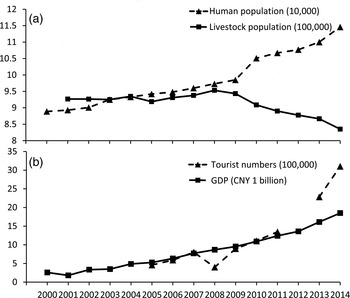
Trends in human and livestock populations, tourist numbers and the gross domestic product are presented in Fig. 2. During 2000–2014 the total human population in the four counties increased from 88,900 to 114,600, at an annual rate of 2.6%. The total livestock population remained steady from 2001 (n = 0.93 million) to 2008 (n = 0.95 million) but had decreased to 0.84 million by 2014. The number of visitors to the city of Rikaze (primarily to see Mount Everest and other attractions in Qomolangma National Nature Reserve) in 2014 (n = 3,103,000) was c. 6.8 times higher than in 2005 (n = 458,400). The gross domestic product increased at an annual growth rate of 15%, from CNY 2.59 billion in 2000 to CNY 18.51 billion in 2014.
Temporal socio-economic trends in Qomolangma National Nature Reserve (Fig. 1) during 2000–2014: (a) human and livestock populations; (b) tourist numbers and gross domestic product (GDP). Source: Rikaze Bureau of Statistics
Although the snow leopard has been studied extensively on the southern slopes of Mount Everest in Nepal (e.g. Oli et al., Reference Oli, Taylor and Rogers1994; Ale et al., Reference Ale, Yonzon and Thapa2007; Lovari et al., Reference Lovari, Minder, Ferretti, Mucci, Randi and Pellizzi2013), little is known about the species in Qomolangma National Nature Reserve, on the mountain's northern aspect. Our investigation confirmed for the first time the presence of wild snow leopards there. The mean sign density (Table 1) was comparable to that reported for the Sagarmatha (Mount Everest) National Park (2.5 sign sites km–1, 4.2 signs km–1, and 2.5 scrapes km–1: Ale et al., Reference Ale, Yonzon and Thapa2007; 2.2 sign sites km–1, 3.2 signs km–1, and < 1 scrapes km1: Ale et al., Reference Ale, Thapa, Jackson and Smith2010) but slightly lower than that recorded in other protected areas in Nepal, such as Annapurna (2.8 sign sites km–1, 5.8 signs km–1, and 1.4 scrapes km–1: Ale et al., Reference Ale, Shrestha and Jackson2014) and Kangchenjunga (12.6–18.6 signs km–1: Khatiwada & Chalise, Reference Khatiwada and Chalise2006; Khatiwada et al., Reference Khatiwada, Chalise and Kyes2007). Dividing the minimum numbers of individuals by the study areas, we estimated a native snow leopard density of 1.8–2.5 per 100 km2. This is similar to estimated densities in neighbouring protected areas (1.8 per 100 km2, Sagarmatha; 1.5 per 100 km2, Rolwaling; 2.6 per 100 km2, Kangchenjunga; Dhakal et al., Reference Dhakal, Thapa, Bhandari and Nepal2012). We recognize, nevertheless, that our assessment is preliminary, given the low number of camera trap locations and captures. Further detailed investigation is necessary to establish a more robust density estimate.
In the 1990s, poaching for pelts and bones and retribution for livestock loss posed a major threat to snow leopards in the Reserve (Jackson et al., Reference Jackson, Wang, Lu, Chen, Fox and Du1994). However, our findings suggest that poaching and the illegal trade have decreased substantially since then. This may be largely attributable to the implementation of conservation efforts such as confiscation of firearms, law enforcement, public education, and ecological compensation programmes (Kang et al., Reference Kang, Zhang, Zhang, Guo, Ji and Shen2015; Chen et al., Reference Chen, Gao, Lee, Cering, Shi and Clark2016). Although the snow leopard is a major predator and causes conflict with local residents, the depredation rate tends to be low in most areas (Chen et al., Reference Chen, Gao, Lee, Cering, Shi and Clark2016). Our respondents generally supported snow leopard conservation, with only a small minority holding negative attitudes towards the species. However, there could be a resurgence of retaliatory killing if the conflict between people and snow leopards is not mitigated. Religious belief motivates local residents to protect the snow leopard, as seen in other areas inhabited by Tibetan Buddhists (Ale et al., Reference Ale, Yonzon and Thapa2007; Li et al., Reference Li, Wang, Yin, Zhaxi, Jiagong and Schaller2014), but the role of religion in this regard does not appear to be as significant as economic and legislative concerns. Conservation education that addresses the various values of the local community is necessary to foster positive attitudes towards snow leopard conservation.
The socio-economic status of people living within the Reserve has changed significantly since the 2000s, giving rise to new, emerging threats. The human population is increasing, whereas the livestock population is decreasing largely as a result of the government's grazing restriction policy for rangeland protection. The increase in local gross domestic product indicates that the area is experiencing rapid economic development, primarily in the areas of tourism and related service industries. Meanwhile, construction of new infrastructure (i.e. road building) and exploitive activities (i.e. quarrying and sand excavation) have increased in both scope and severity. These changes may have caused disturbance to the fragile alpine ecosystem inhabited by snow leopards. Other threats that merit attention include climate change and ineffective management of protected areas (Kang et al., Reference Kang, Zhang, Zhang, Guo, Ji and Shen2015).
To ensure the viability of snow leopards in Qomolangma National Nature Reserve, it is essential to address the threats through conservation actions based on applied and interdisciplinary studies. As a partnership initiative of Qomolangma National Nature Reserve Administration and Vanke Foundation, the Everest Snow Leopard Conservation Center, with scientific support from the Wildlife Institute, Beijing Forestry University, is making efforts to ensure that the findings of our research will be used as an evidential basis for the formulation of effective conservation policies and programmes.
Acknowledgements
This project was funded primarily by the Everest Snow Leopard Conservation Center. We appreciate the support from the Second National Survey of Terrestrial Wildlife in China, China State Forestry Administration. We thank the staff of Qomolangma National Nature Reserve, particularly Ciwang, Daqiong, Yajun, Gesangzhuoma, and Suolun. We are grateful to Jingjing Li, Zhiwen Huang, Li Xie, Xianhua Xie, Weixiong Song, Youling Bao, Xiushan Wu, and Ying Hui for their field assistance. We thank the local residents for participating in this research and sharing their knowledge. Justine Alexander provided valuable suggestions and comments. The interviews conducted during this research were approved by the Qomolangma National Nature Reserve Administration and conformed to the policies and procedures of Yale University's Human Research Protection Program.
Biographical sketches
Pengju Chen’s research focuses on the conservation of snow leopards and wild ungulates on the Tibetan Plateau. Yufang Gao is a conservationist and anthropologist whose current research focus is on human–wildlife coexistence and illegal wildlife trade. Jun Wang’s research focuses on the ecology of snow leopards in high-elevation areas of China. Pu Qiong and Lhaba Cering devote themselves to the preservation of biodiversity within the Qomolangma Nature Reserve. Huijian Hu is an ecologist who has conducted biodiversity inventory in Tibet. Jian Xu is a wildlife photographer and is passionate about conservation education. Kun Shi initiates and translates academic research into conservation practice through training local wildlife managers, building a collaborative network, and applied research.



