



Body weight and body image concerns are common among adolescents( Reference Ricciardelli and McCabe 1 – Reference Neumark-Sztainer, Story and Hannan 3 ) and various strategies can be used to achieve an ‘ideal’ body weight or shape. Unhealthy dieting practices among adolescents are associated with numerous physical, psychological and emotional negative outcomes, including poor nutritional status, depressive symptoms, low self-esteem and risk of eating disorders( Reference Crow, Eisenberg and Story 4 – Reference Neumark-Sztainer and Hannan 8 ). High levels of body dissatisfaction and body image disturbances are also predictive of depressive mood, psychosomatic complaints and disordered or inappropriate eating behaviours( Reference Stice, Hayward and Cameron 9 – Reference Paxton, Neumark-Sztainer and Hannan 12 ).
Research on body weight concerns has focused on girls rather than boys and has concentrated on weight-control behaviours such as dieting and mechanisms to lose weight. Dieting is highly prevalent among adolescent girls( Reference Crow, Eisenberg and Story 4 , Reference Kann, Kinchen and Shanklin 13 – Reference Ojala 15 ) and is described as a normative behaviour for girls( Reference Cooper and Goodyer 16 ). Boys do not report or openly discuss weight and body image concerns( Reference Bearman, Presnell and Martinez 17 – Reference McSharry 22 ) and dieting is not described as normative for boys. As such, weight concerns and dieting among boys may result in different or increased risks to physical and emotional health compared with those experienced among girls.
The prevalence of reported weight concerns and related behaviours among boys varies by study, ranging from 9 % to 34 %( Reference Neumark-Sztainer, Story and Hannan 3 , Reference Crow, Eisenberg and Story 4 , Reference Neumark-Sztainer and Hannan 8 , Reference Kann, Kinchen and Shanklin 13 , Reference Ojala 15 , Reference Nemeth 23 ). Differences in methodology and whether weight gain, weight loss or body dissatisfaction is the primary area of interest may explain such variations. Nevertheless, there exists a clear gender difference in the type of weight concerns reported. Compared with girls, boys are more likely to desire an increase in weight gain related to an increase in muscle mass( Reference Field, Austin and Camargo 24 ) and, indeed, muscle-enhancing behaviours are higher now than in the past among boys( Reference Eisenberg, Wall and Neumark-Sztainer 25 , Reference Westmoreland Corson and Andersen 26 ).
Family mealtimes are considered fundamental to the health of adolescents. Family meal frequency is positively associated with dietary outcomes( Reference Fulkerson, Larson and Horning 27 ) and, in general, an inverse relationship between frequency of family meals and (unhealthy) weight-loss behaviours among girls has been found( Reference Neumark-Sztainer, Wall and Story 28 – Reference Fulkerson, Story and Mellin 30 ). However the relationship is not clear among boys( Reference Skeer and Ballard 31 ). Moreover, the influence of family meals on types of weight concerns among boys is not evident in the literature.
While family meals provide an opportunity for parents to provide healthy foods and model healthy behaviours, frequent family meals may also reflect the broader family environment or family dynamics( Reference Welsh, French and Wall 32 ). Previous research suggests the importance of considering family environment in adolescent dietary behaviours( Reference Sweeting and West 33 , Reference Pearson, MacFarlane and Crawford 34 ). Dimensions of family dynamics such as parent–child relations( Reference von Soest and Wichstrom 35 , Reference Saling, Ricciardelli and McCabe 36 ), family cohesion( Reference Hill and Franklin 37 ), connectedness( Reference Pesa 6 ) and communication( Reference Al Sabbah, Vereecken and Elgar 38 , Reference Vander Wal 39 ) have been explored as factors involved in the development of dieting, disordered eating and weight-control behaviours among adolescents. However, these studies have focused on dieting and weight loss rather than on weight-gain behaviours. Family structure and maternal employment, both of which are likely to affect family dynamics, have not previously been the focus of studies on dieting and weight concerns. Mothers and fathers play different roles in young people’s development and differences in mother–child and father–child relationships should also be considered. Among thirty-eight countries, boys reported easier communication with their fathers than did girls( Reference Brooks, Zaborskis and Örkényi 40 ). Relationship quality between fathers and sons may be important for weight concerns among boys.
From existing research, it is evident that much less is known about weight concerns and weight-control behaviours among boys than girls. The present study explores weight concerns among 10–17-year-old boys in Ireland, in the context of the family, as well as the health outcomes of reporting weight concerns. The present study aimed to: (i) explore the prevalence of weight concerns among boys in Ireland; (ii) describe physical and emotional symptoms in boys reporting weight concerns; and (iii) investigate the relationship between family factors and weight concerns among boys.
Methods
Sample
The present study utilised data from the 2010 Irish Health Behaviour in School-aged Children study, a part of the WHO collaborative study (WHO-HBSC; www.hbsc.org). Sampling was conducted to be representative of the proportion of children in each geographical region of the Republic of Ireland. Children in primary (aged 10–12 years) and post-primary (12–17 years) schools were randomly selected and individual classrooms within these schools were subsequently randomly selected for inclusion. A total of 256 schools took part in the survey and further details on the sampling methodology and recruitment strategy are available( Reference Gavin, Molcho and Kelly 41 ). The student response rate was 85 %. The geographical location and social class of respondents were compared with the 2006 Census and found to be representative of the population distribution across regions. Slight variations were noted but were expected for social class because the census reports all persons by social class, not all of whom would be parents or guardians of children in the age groups of interest in the study( Reference Gavin, Molcho and Kelly 41 ). Ethical approval was obtained from the National University of Ireland, Galway Research Ethics Committee.
The current study focuses on the data collected from 6295 boys. There were 108 cases with missing data on weight concerns, resulting in 6187 boys (mean age 14·2 (sd 1·81) years) in the sample for analysis. The percentages of male respondents by age group and social class are shown in Table 1.
Distribution of male respondents by age group and social class; 2010 Irish Health Behaviour in School-aged Children study
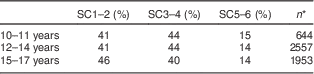
SC, social class.
* The number of boys is less than the sample used in the present paper due to missing or incomplete social class data.
Measurements
Weight concerns
To identify participants who had weight concerns, students were asked ‘At present are you on a diet or doing something else to lose weight?’, with response options ‘yes’, ‘no, because I need to put on weight’, ‘no, but I should lose some weight’ and ‘no, my weight is fine’. Students who answered ‘yes’ and who answered ‘no, but I should lose some weight’ were classed as having a weight ‘loss’ concern. Those who answered ‘no, because I need to put on weight’ were defined as having a weight ‘gain’ concern. Information on height and weight was also collected to calculate BMI (kg/m2), but self-reported BMI was not included in the present analyses because of the high rate of missing data (60 % among boys aged 11–17 years).
Self-rated health and life satisfaction
Self-rated health was assessed by the question ‘Would you say your health is…?’ and the response options were dichotomised at ‘excellent’ v. ‘good’, ‘fair’ or ‘poor’. Self-reported happiness was measured by the question ‘In general, how do you feel about your life at present?’ and the responses were dichotomised at ‘very happy’ v. ‘quite happy’, ‘don’t feel very happy’ and ‘not happy at all’. Children were also asked to rank themselves from 0 to 10 on a life satisfaction ladder( Reference Levin and Currie 42 , Reference Cantril 43 ). This scale was used to identify those with high life satisfaction (response >6).
Physical and emotional symptoms
Psychosomatic symptoms were measured using the HBSC symptom checklist( Reference Ravens-Sieberer, Erhart and Torsheim 44 ). Children were asked to report the frequency, in the six months prior to the survey, that they experienced a variety of emotional (feeling low, bad temper, feeling nervous, sleeping difficulties) and physical symptoms (headache, stomach-ache, backache, feeling dizzy). Response options were ‘about every day’, ‘more than once a week’, ‘about every week’, ‘about every month’ and ‘rarely or never’. Children were characterised as symptomatic if they reported two or more symptoms at least once per week (physical and emotional symptoms were analysed separately).
Family factors
Students were asked ‘How often do you have breakfast together with your mother or father?’ and ‘How often do you have an evening meal together with your mother or father?’ Response options were: ‘never’, ‘less than once a week’, ‘1–2 days a week’, ‘3–4 days a week’, ‘5–6 days a week’ and ‘every day’. Responses were categorised as daily v. less than daily.
Communication with mother and father was assessed separately with two items: ‘How easy is it for you to talk to your mother/father about things that really bother you?’ Response options were: ‘very easy’, ‘easy’, ‘difficult’, ‘very difficult’ and ‘don’t have or see this person’. Ease of communication variables were dichotomised into ‘very easy’/‘easy’ and ‘difficult’/‘very difficult’, while the response ‘don’t have or see this person’ was recoded to missing.
Maternal employment was determined by children answering ‘yes’ to the following question: ‘Does your mother have a job?’ Children were also asked about who they live with in their main home with the following list to choose from: ‘mother’, ‘father’, ‘stepmother’, ‘stepfather’, ‘grandmother’, ‘grandfather’, ‘I live in a foster home or children’s home’ and ‘with someone or somewhere else’. Children were dichotomised into those whose father lived in the main family home and those where the father did not.
Statistical analyses
All analyses were conducted separately for those who reported a weight ‘gain’ and a weight ‘loss’ concern. Data were analysed by age group, to reflect the developmental literature, and are in line with early, middle and older adolescence( Reference Shaffer and Kipp 45 ). All associations were examined with logistic regression analysis and were expressed by odds ratios. Regression analyses were adjusted for age group and for social class. Associations with weight concerns were investigated for each health indicator (self-rated health, emotional symptoms, physical symptoms, life satisfaction and happiness). Bivariate and multivariate analyses were performed to explore the associations between family factors and weight concerns. The multivariate models were adjusted for all family factors, age group and social class. Confidence intervals were computed at the 95 % level and statistical significance was established at 5 %. All analyses were conducted using the statistical software package IBM SPSS Statistics 20·0. The reference group was children who reported that their weight was fine.
Results
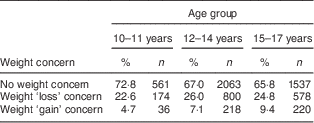
Overall, 67·3 % of boys reported their weight to be fine, 25·1 % reported a weight ‘loss’ concern and 7·7 % reported a weight ‘gain’ concern (Table 2). Weight concerns were associated with age group (P<0·000; Pearson χ 2=27·065).
Prevalence of weight concerns among Irish boys by age group (n 6187); 2010 Irish Health Behaviour in School-aged Children study
Health indicators and weight concerns
Table 3 shows the association between health indicators and weight ‘loss’ and weight ‘gain’ concerns as reported by participating boys. Those who expressed body weight concerns were more likely to report negative health outcomes. Weight ‘loss’ and weight ‘gain’ concerns were associated with lower levels of self-rated health, life satisfaction and happiness, as well as with more frequent emotional and physical symptoms. In addition, the associations between all health indicators studied and weight concerns were similar between boys who reported a weight ‘loss’ concern and those who reported a weight ‘gain’ concern, with the exception of self-rated health.
Association between health indicators and weight concerns among Irish boys aged 10–17 years (n 6187); 2010 Irish Health Behaviour in School-aged Children study

† The reference category is the group of boys who reported their weight was fine (OR=1·00); adjusted for age group and social class.
Family factors and weight concerns
In Table 4, crude and adjusted odds ratios between family factors and weight concerns are presented. Except for maternal employment and weight ‘gain’ concerns, an inverse association between all other family factors and weight concerns was evident. In unadjusted analyses all associations were statistically significant, except for the relationship between frequent evening meals and concerns about weight ‘loss’.
Logistic regression models predicting weight concerns (crude and adjusted odds ratios) among Irish boys aged 10–17 years (n 6187) with different family factors; 2010 Irish Health Behaviour in School-aged Children study

*P<0·05, **P<0·01, ***P<0·001;
† Adjusted for all family factors, age group and social class.
In the full model, frequent family breakfasts and evening meals were inversely associated with concerns about weight ‘loss’ and weight ‘gain’, respectively. Ease of communication with mother was inversely associated with weight concerns. A similar pattern was evident for father–son communication and weight concerns, albeit the statistical significance was lost in the full model for concerns about weight ‘gain’.
Weight concerns were not associated with maternal employment in the adjusted analysis, while boys whose fathers were present in the home were less likely to report a weight ‘loss’ concern in the adjusted analysis.
Discussion
The main objectives of the present study were to explore weight concerns among boys in Ireland, to describe physical and emotional symptoms among those with different weight concerns and to investigate the association between family characteristics and weight concerns among boys. It was important to differentiate between weight ‘loss’ and weight ‘gain’ concerns because increasing muscle and gaining weight is particularly pertinent to boys( Reference Ricciardelli and McCabe 1 , Reference Field, Austin and Camargo 24 , Reference Jones and Crawford 46 ).
Overall, 32·8 % of Irish boys aged 10–17 years reported weight concerns. Weight ‘loss’ concerns (dieting or desire to lose weight; 25·1 %) are in line with dieting prevalence among boys reported elsewhere( Reference Neumark-Sztainer, Story and Hannan 3 , Reference Crow, Eisenberg and Story 4 ). Weight ‘gain’ concerns (8 %) were lower than in studies in the USA (22 %), even though the age groups (14·2 (sd 1·8) years v. 14·9 (sd 1·7) years) were comparable( Reference Neumark-Sztainer, Story and Hannan 3 ). Concerns about muscularity are reported to emerge in mid-adolescence (14–16 years)( Reference Polce-Lynch, Myers and Kilmartin 47 , Reference Cortese, Falissard and Pigiani 48 ) and an association with age was evident in the present study.
Lower self-rated health, life satisfaction and levels of happiness, in addition to more frequent emotional and physical symptoms, were significantly more likely to be reported by boys with weight concerns, regardless of the type of concern. Thus boys appear to experience similar types of negative consequences to girls who diet( Reference Crow, Eisenberg and Story 4 – Reference Neumark-Sztainer and Hannan 8 ). Future research is needed to explore both the type and healthiness of weight-control behaviours employed, particularly as unhealthy dieting among adolescents has been shown to cluster with other health-comprising behaviours( Reference Crow, Eisenberg and Story 4 , Reference French, Story and Downes 5 , Reference Neumark-Sztainer, Story and Dixon 49 ). Whether this association would hold for younger age groups is also worth exploring.
There is no single solution to addressing adolescent weight concerns. Several different and complementary preventive approaches are necessary, such as public policies, school and computer programmes, all of which can play a role in promoting healthy behaviours, reducing weight stigma and building self-esteem among young people( Reference Cash and Smolak 50 ). The present paper demonstrates the need for public health action to focus on family factors in addressing weight concerns of boys.
In general, the findings indicate that regular family meals are inversely associated with weight concerns among boys. Our findings are not easily comparable to existing studies, which focused on specific weight-loss behaviours among boys, such as purging, and are in fact equivocal for an effect of frequent family meals on such behaviours( Reference Neumark-Sztainer, Eisenberg and Fulkerson 29 , Reference Skeer and Ballard 31 , Reference Haines, Gillman and Rifas-Shiman 51 ). Nevertheless, family mealtimes are an opportunity to develop strong relationships and a sense of belonging and connectedness. Thus the weakening of the association between mealtimes and weight concerns when other family factors such as communication were included in the analyses may not be surprising. Indeed, this mirrors other work exploring the influence of family connectedness on associations between boys’ extreme weight-control behaviours and family meal frequency( Reference Neumark-Sztainer, Wall and Story 28 ). Given the potential positive relationship between regular family meals and weight concerns, efforts to promote and support frequent mealtimes should be endorsed. The barriers to frequent joint mealtimes for both young people and their parents should be explored as the facilitators required may differ for adults and their children.
Ease of communication with father and mother was inversely associated with weight concerns. While statistical significance was lost in the adjusted analysis for communication with father and weight ‘gain’ concerns, the direction and magnitude remained. Parental support is related to the well-being of adolescents and lack of support is predictive of a range of negative behaviours and outcomes( Reference Sweeting and West 33 , Reference Parker and Benson 52 – Reference Young, Berenson and Cohen 54 ). An open relationship between parents and their sons may be another mechanism for protecting against weight concerns. Cross-nationally, poor communication with fathers was positively associated with a desire to lose weight, after controlling for communication with the other parent, age and BMI, among adolescent boys in fourteen out of twenty-four countries examined( Reference Al Sabbah, Vereecken and Elgar 38 ). However, poor communication with mothers was rarely associated with a desire to lose weight among boys. Desire to gain weight has not been explored cross-nationally. The potential protective role of an open mother–son relationship on weight concerns, observed here, may reflect the ease with which adolescents share information or indeed teenage concerns with their mothers and that they perceive their mothers as trustworthy( Reference Tamara, Afifi and Aldeis 55 ). Clearly mother–son and father–son relationships are important for weight concerns among adolescent boys in Ireland.
The presence of the father in the home was inversely associated with weight ‘loss’ concerns, but not weight ‘gain’ concerns in the full model. The same pattern was found for communication with fathers. Perhaps the mechanisms through which fathers influence concerns about weight ‘gain’ differ from those about weight ‘loss’. Exploring father’s own body image, weight-control behaviours and attitudes to body shape and muscle building may shed some light on the nuances of these relationships. The impact of family structure on adolescent health could be affected by the stability or a recent change in family structure, which was not captured here. In a Swedish study relational content was more important for adolescent well-being than family structure( Reference Låftman and Östberg 56 ); and among 13- and 15-year-old adolescents in Scotland, family structure was of less importance than the quality of the parent–child relationships on adolescent life satisfaction, although the impact of family structure on life satisfaction did persist for boys( Reference Levin and Currie 57 ). The strong and consistent relationship between communication and weight concerns observed in the present study suggests that this aspect of child–parent relationships should be the focus going forward.
Limitations of the current study include the cross-sectional design, making it impossible to determine causality, and the reliance on self-report data; however, students’ responses were anonymous and therefore participants had no reason to misreport their responses. The health indicators used in the study such as life satisfaction, a cognitive aspect of well-being, and happiness, a facet of well-being, can be influenced by many life experiences and relationships in addition to school-related factors( Reference Diseth, Danielsen and Samdal 58 , Reference Levin, Inchley and Currie 59 ). An exploration of other variables contributing to these outcomes as well as physical and emotional symptoms was not possible here. Strengths include the large sample size, inclusion of children at a national level and the focus on boys.
To conclude, body weight concerns are associated with negative health outcomes as reported by adolescent boys in Ireland. The type of weight-control behaviours used by boys in Ireland deserves further attention particularly in light of the emphasis on muscularity in recent times. Boys reporting an open communication with their fathers and mothers and regular family meals were, for the most part, less likely to report a weight concern. The dimensions of relations between parents and adolescent boys deserve further attention so that particular relationship skills can be targeted if required. Qualitative research with fathers and mothers on their perceived role in influencing weight concerns among their sons would also prove insightful.
Acknowledgements
Acknowledgements: The authors acknowledge all of the parents and children who consented and participated, as well as the management authorities, principals and teachers in all schools who participated. HBSC is an international study carried out in collaboration with WHO/EURO. The International Coordinator of HBSC is Professor Candace Currie (University of St. Andrews, Scotland); Data Bank Manager is Professor Oddrun Samdal (University of Bergen). For details, see http://www.hbsc.org/. Financial support: This work was supported by the Department of Health, Ireland. The Department of Health, Ireland had no role in the design, analysis or writing of this article. Conflict of interest: None. Authorship: C.K. participated in the design and data collection for the study, conceived of the study questions and drafted the manuscript. A.F., M.S. and J.G. contributed to the statistical analysis. M.M. and S.N.G. participated in the design and data collection for the study and edited the manuscript. All authors have read and approved the final manuscript. Ethics of human subject participation: Ethical approval was obtained from the National University of Ireland, Galway Research Ethics Committee.



