




Introduction
Consumers have developed a curiosity about the origin, characteristics and methods of production of food products. In this sense, a Geographical Indication (GI) has the potential to respond to these demands by protecting and identifying the origin of a product and the characteristics of its production process. GI recognizes and protects tradition, biodiversity, local knowledge and the link between the product and its region of origin (Giesbrecht and Minas, Reference Giesbrecht, Minas, Vieira, Lourenzani, Bruch and Gaspar2019).
GI are linked to the concept of terroir, which has, as its main foundation, the idea that the special characteristics of a product are defined by its place of origin (Gade, Reference Gade2004). These products are the result of the interaction between people and natural resources in a certain territory (Barham, Reference Barham2003). Therefore, GI can be seen as a collective differentiation strategy that develops over time, guided by the habits and routines of consumers and producers, which provides the basis for establishing the reputation of a place (Fronzaglia et al., Reference Fronzaglia, Salles-Filho, Raynaud, Vieira, Lourenzani, Bruch and Gaspar2019).
The control of production and its commercialization is ensured by GI so that they remain in the region, and yet, at the same time, it allows local agents to access other markets outside the geographical delimitation. Hence, they provide means for local producers to make use of globalization to conserve their culture and environmental resources (Bowen, Reference Bowen2012). Thus, GI can help in the development of the region. Although there are very few available economic data on the economic effects of GIs, as shown by Török and Moir (Reference Török and Moir2018) and Török et al. (Reference Török, Jantyik, Maró and Moir2020), their potential to benefit the economy cannot be ignored. According to a study conducted by AND international (2021), GIs were responsible for €74.76 billion in 2017, what corresponds to around 7% of market share.
Although GI can offer benefits to local agents, some factors can make it difficult for producers to access the benefits provided by that sign, since the chances of GI of being a development instrument depends on how local actors use their intangible assets (Niederle, Reference Niederle2009; Cei et al., Reference Cei, Defrancesco and Stefani2018). The success of these distinctive signs also depends on factors linked to national legislation, the way GI is established, as well as the way agents in the production system interact with each other (Bowen, Reference Bowen2012).
In this sense, it is important to understand what benefits and barriers producers deal with to access a GI. Therefore, this article aims to identify the barriers and benefits of GI to producers. Henceforth, a Systematic Literature Review (SLR) was carried out. In addition to describing the benefits and barriers of a GI to producers, this review also shows that they are not absolute and cannot be generalized to all GIs.
The current SLRs on GI
To better understand where this review is placed among the other previously published reviews, Chart one shows the authorship, title and the objective/contribution of literature reviews that are already published and that used a systematic methodology to analyze the scientific works, such as integrative reviews, meta-analysis and bibliometric analyses.
As shown in Table 1, many reviews focus on consumers' behavior and decision-making (Grunert and Aachmann, Reference Grunert and Aachmann2016; Leufkens, Reference Leufkens2018; Glogovețan et al., Reference Glogovețan, Dabija, Fiore and Pocol2022), on economic issues like prices (Deselnicu et al., Reference Deselnicu, Costanigro, Souza-Monteiro and McFadden2013; Lis-Gutierrez et al., Reference Lis-Gutierrez, Gaitan-Angulo, Moros, Lis-Gutierrez and Viloria2017) and market size (Török and Moir, Reference Török and Moir2018, Török et al., Reference Török, Jantyik, Maró and Moir2020) and on ways to map GI's products characteristics (Kamilari et al., Reference Kamilari, Tomazou, Antoniades and Tsaltas2019; Cassago et al., Reference Cassago, Artêncio and Giraldi2021). Although some reviews also address how GI can promote development and the benefits that this sign can offer (Cei et al., Reference Cei, Defrancesco and Stefani2018; Török et al., Reference Török, Jantyik, Maró and Moir2020; Medeiros and Passador, Reference Medeiros, Passador and Passador2021), this review innovates in focusing on a specific agent of the supply chain, which is the producer and what are the benefits and barriers that this agent might deal with while acceding a GI.
Summary of SLRs on GI

Source: Prepared by the authors.
Methodology
A SLR brings more reliability and strictness to a literature review due to its systematic approach. Among the main benefits offered by a SLR are the methodological analysis and synthesis of quality literature, the firm theoretical foundation for a research topic, as well as a new contribution to an already existing body of knowledge (Levy and Ellis, Reference Levy and Ellis2006; Conforto et al., Reference Conforto, Amaral and da Silva2011). A SLR was carried out as suggested by Levy and Ellis (Reference Levy and Ellis2006) and Conforto et al. (Reference Conforto, Amaral and da Silva2011). This review was conducted through several stages that are divided into three steps, as shown in Figure 1.
Steps of the SLR.
Source: Adapted from Levy and Ellis (Reference Levy and Ellis2006) and Conforto et al. (Reference Conforto, Amaral and da Silva2011).

During the Input step, after defining the objective of this review, primary sources were consulted. According to Conforto et al. (Reference Conforto, Amaral and da Silva2011), primary sources are papers, journals or databases that must be consulted in order to generate familiarity with the subject under analysis and identify the main keywords used in the literature of a certain topic. In this sense, sources like Bruch (Reference Bruch2008), Bowen and Valenzuela Zapata (Reference Bowen and Valenzuela Zapata2008), Niederle and Vitrolles (Reference Niederle and Vitrolles2010) and Vieira et al. (Reference Vieira, Lourenzani, Bruch and Gaspar2019) were consulted due to its importance to the body of knowledge of GI, as well as because these works address the relationship of GI with producers in different contexts. After that, the search string was defined according to the main keywords identified in the primary sources. The string is shown in Figure 2. The words that form the string were used to perform the initial searches in the title, abstract or keywords of the documents from Scopus and Web of Science.
String search adopted for the SLR.
Source: Prepared by the authors.

Only articles that were published from 2011 to 2021Footnote 1 were selected from the two databases. Also, the articles selected had to be written in English, Portuguese and Spanish. Based on primary sources, the journal areas in each database were also selected. In Web of Science, the selected areas were agriculture; food science technology; business economics; environmental sciences ecology; geography; government law; science technology; development studies; sociology; plant sciences; engineering; social issues; veterinary sciences and also a category called ‘other topics’. In the Scopus database, the selected areas were agricultural and biological sciences; social sciences; environmental science; economics, econometrics and finance; business, management and accounting; engineering; energy; earth and planetary sciences; veterinary; arts and humanities and decision sciences.
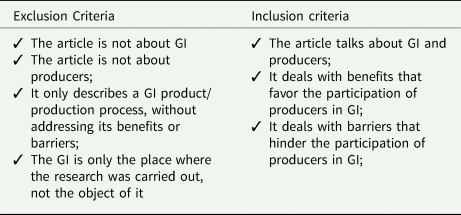
The inclusion and exclusion criteria of this review are presented in Table 1. Only articles that address in some way the relationship between producers and GI, as well as the possible impacts of these labels on producers, were selected for this review. Therefore, articles that discuss different topics related to GI were excluded, like the ones that describe GI production process or region, GI consumers' behavior, or that analyze the chemical characteristics of GI products. Regarding the methods and tools, the StArt software version 3.0.3. was used for managing and selecting articles' information downloaded from the databases, the Mendeley software for managing references and Microsoft Excel for organizing results.
Figure 3 shows the number of articles that remained after finishing the Processing step of this review. It is important to note that, during the complete reading of the articles, a cross-search was performed, in which the cited articles that are aligned with the inclusion and exclusion criteria and could contribute to the SLR were also added to the synthesis.
Results of the processing step.
The inclusion and exclusion criteria were used to select or exclude the articles during this step.
Source: Prepared by the authors.

At the end of the Processing step, 46 articles remained for the synthesis phase. During the Output step, the main information gathered from the articles was registered and summarized using Excel software. A content analysis was conducted at this stage according to the model suggested by Bardin (Reference Bardin2016), to identify the main barriers and benefits of GI to producers. After that, a Theoretical Framework that shows the relationships between the benefits and barriers was developed.
Results
Data description
Of the articles analyzed in this SLR, 48% were carried out through case studies, and 17% were literature reviews. Most of the articles (78%) did not take a theory as a basis to conduct the analysis. Those that did adopt theories like Game Theory, Resource-Based View, Transaction Cost Economics, New Institutional Economics and Convention Theory. Table 2 presents the main information of the selected articles.
Inclusion and exclusion criteria adopted in the study
Source: Prepared by the authors.
The results suggest that there is a trend of growth in publications that address the benefits and/or difficulties of GI to producers over the years, considering that most of the selected articles were published in 2020. Of the total number of countries covered in the articles, 43% are part of the European Union, and only 11% focused on Latin America and the Caribbean, which highlights the need for GI research in other regions (Table 3).
Articles selected for the SLR

Note: the symbol ‘–’ indicates that such information is not present in the article.
Source: Prepared by the authors.
Benefits of GI to producers
GI can increase the visibility of products and promote higher returns on the investments made by the producers. Given this possibility, producers have incentives to improve their production. Therefore, GI products tend to have higher quality than products from individual signs (López-Bayón et al., Reference López-Bayón, Fernández-Barcala and González-Díaz2020). Participating in a GI is seen as a way to increase quality and add value to production, thus creating a competitive advantage by offering a product that has unique characteristics that come from its place of origin (Dentoni et al., Reference Dentoni, Menozzi and Capelli2012; Lamarque and Lambin, Reference Lamarque and Lambin2015; Mcmorran et al., Reference Mcmorran, Santini, Guri, Gomez-y-Paloma, Price, Beucherie, Monticelli, Rouby, Vitrolles and Cloye2015; Egelyng et al., Reference Egelyng, Bosselmann, Warui, Maina, Mburu and Gyau2017; Rahmah, Reference Rahmah2017).
The incentive to increase the quality of production after getting the GI is shown in several articles (Quiñones-Ruiz et al., Reference Quiñones-Ruiz, Penker, Belletti, Marescotti, Scaramuzzi, Barzini, Pircher, Leitgeb and Samper-Gartner2016; Hoang et al., Reference Hoang, Le, Nguyen and Dao2020; Ingram et al., Reference Ingram, Hansen and Bosselmann2020; López-Bayón et al., Reference López-Bayón, Fernández-Barcala and González-Díaz2020). GI also helps to improve products' image and marketing communication (Bryła, Reference Bryła2018; Chalupová et al., Reference Chalupová, Rojík, Kotoučková and Kauerová2021). However, it should be noted that most of these studies were conducted in European countries. Problems related to product quality due to inefficient institutions were identified by Bowen (Reference Bowen2012) in her research conducted about Tequila in Mexico, and by Zhao et al. (Reference Zhao, Finlay and Kneafsey2014), in their analysis of a GI in China, and by Neilson et al. (Reference Neilson, Wright and Aklimawati2018) in a coffee GI in Indonesia.
By offering higher quality products, producers can more easily access markets, which is one of the reasons to adopt GI (Mcmorran et al., Reference Mcmorran, Santini, Guri, Gomez-y-Paloma, Price, Beucherie, Monticelli, Rouby, Vitrolles and Cloye2015; Egelyng et al., Reference Egelyng, Bosselmann, Warui, Maina, Mburu and Gyau2017; Bryła, Reference Bryła2018; Blatnik and Bojnec, Reference Blatnik and Bojnec2020; Oledinma and Roper, Reference Oledinma and Roper2021). Traversac et al. (Reference Traversac, Rousset and Perrier-Cornet2011) highlighted, in their article that GI wines are highly valued in the final market, which allows higher prices and faster sales. For Ghosh (Reference Ghosh2016), GI can be adopted by smallholders to improve their competitiveness.
Furthermore, higher prices are constantly seen as one of the main benefits that producers can have access to by participating in a GI (Traversac et al., Reference Traversac, Rousset and Perrier-Cornet2011; Jena and Grote, Reference Jena and Grote2012; Lamarque and Lambin, Reference Lamarque and Lambin2015; Mcmorran et al., Reference Mcmorran, Santini, Guri, Gomez-y-Paloma, Price, Beucherie, Monticelli, Rouby, Vitrolles and Cloye2015; Mesić et al., Reference Mesić, Božić and Cerjak2017; Bryła, Reference Bryła2018; Blakeney et al., Reference Blakeney, Krishnankutty, Raju and Siddique2020; Ingram et al., Reference Ingram, Hansen and Bosselmann2020). That is because consumers tend to be willing to pay more for a higher quality product (Ghosh, Reference Ghosh2016; Quiñones-Ruiz et al., Reference Quiñones-Ruiz, Penker, Belletti, Marescotti, Scaramuzzi, Barzini, Pircher, Leitgeb and Samper-Gartner2016; Quiñones-ruiz et al., Reference Quiñones-Ruiz, Penker, Belletti, Marescotti and Scaramuzzi2017; Hoang et al., Reference Hoang, Le, Nguyen and Dao2020; Mattas et al., Reference Mattas, Baourakis, Tsakiridou, Hedoui and Hosni2020).
However, the price of a GI product is not always an advantage (Nizam, Reference Nizam2017; Chalupová et al., Reference Chalupová, Rojík, Kotoučková and Kauerová2021). Zhao et al. (Reference Zhao, Finlay and Kneafsey2014) found in their research in Australia that the lack of strict quality control and, consequently, the lack of quality guarantee led producers to not receive a higher revenue for their products. Pensado-Leglise and Sanz-Cañada (Reference Pensado-Leglise and Sanz-Cañada2018), in their research on beef from the Sierra de Guadarrama, Spain, demonstrated that even after two decades of GI establishment, this product does not receive a higher price due to the lack of recognition of its qualities and the lack of organizational capacity of the producers, which make negotiations with other agents in the supply chain difficult. Lower prices and difficulties by producers in accessing higher products value were also mentioned by Kizos and Vakoufaris (Reference Kizos and Vakoufaris2011) and Neilson et al. (Reference Neilson, Wright and Aklimawati2018), Nizam (Reference Nizam2017).
Another benefit that is worth mentioning is the increased production, which was also cited in some articles as a benefit from the GI (Mcmorran et al., Reference Mcmorran, Santini, Guri, Gomez-y-Paloma, Price, Beucherie, Monticelli, Rouby, Vitrolles and Cloye2015; Carbone, Reference Carbone2017; Ingram et al., Reference Ingram, Hansen and Bosselmann2020). Mesić et al. (Reference Mesić, Božić and Cerjak2017), verified in their article that, in the three years before the survey, 49% of producers of traditional products increased the volume of their production.
Because GI demand collective management to achieve success, they can coordinate different local actors, as well as strengthen the organizations present in the territory, which can lead to a bigger supply of the product and more price control, thus contributing to rural development (Mcmorran et al., Reference Mcmorran, Santini, Guri, Gomez-y-Paloma, Price, Beucherie, Monticelli, Rouby, Vitrolles and Cloye2015; Durand and Fournier, Reference Durand and Fournier2017). Therefore, GI can encourage collaboration among local actors.
Organization helps producers to achieve greater profits, reduce the power of intermediaries, protect them against counterfeiters and other opportunistic behaviors, and help them to promote their businesses (Bowen and De Master, Reference Bowen and De Master2011; Anson and Pavithran, Reference Anson and Pavithran2013). Organization also increases the power of smallholders in the supply chain (Carbone, Reference Carbone2018). Also, when there is a producers' organization before the GI, it is easier to empower producers and build trust and social cohesion, common rules are more easily accepted, and producers tend to participate more in the GI after its register (Quiñones-Ruiz et al., Reference Quiñones-Ruiz, Penker, Belletti, Marescotti and Scaramuzzi2017).
Some authors also claim that access to knowledge is one of the benefits offered by GI. López-Bayón et al. (Reference López-Bayón, Fernández-Barcala and González-Díaz2020) found, in their research, that wine producers who were part of the GI offered a higher quality product than other producers. According to the authors, this is because by participating in the GI there is more sharing of knowledge among the agents in the supply chain. The transmission of knowledge about production and quality inside the GI context was also mentioned by Quiñones-Ruiz et al. (Reference Quiñones-Ruiz, Penker, Belletti, Marescotti, Scaramuzzi, Barzini, Pircher, Leitgeb and Samper-Gartner2016), Lamarque and Lambin (Reference Lamarque and Lambin2015), Ingram et al. (Reference Ingram, Hansen and Bosselmann2020) and Oledinma and Roper (Reference Oledinma and Roper2021).
GI is also a way to reduce transaction costs and information asymmetry within the production chain, benefiting both producers and consumers (Jena and Grote, Reference Jena and Grote2012; Ghosh, Reference Ghosh2016; Mesić et al., Reference Mesić, Božić and Cerjak2017; Cei et al., Reference Cei, Defrancesco and Stefani2018; Bashir, Reference Bashir2020; Van Caenegem and Nakano, Reference Van Caenegem and Nakano2020). Cei et al. (Reference Cei, Defrancesco and Stefani2018) highlight that when there is information asymmetry, some producers can take advantage of the territory's reputation to sell lower-quality products.
Since to participate in a GI producers undergo quality assessments, not many more checks are necessary, which leads to a reduction in costs. In addition, consumers have guarantees of the high quality of the product and that it was produced in a traditional way (Blatnik and Bojnec, Reference Blatnik and Bojnec2020; Mattas et al., Reference Mattas, Baourakis, Tsakiridou, Hedoui and Hosni2020). Therefore, GI is a way for producers to increase consumer confidence in their products (Mesić et al., Reference Mesić, Božić and Cerjak2017). They can promote improvements in the vertical coordination of the supply chain, through more efficient communication between the actors, as shown by Quiñones-Ruiz et al. (Reference Quiñones-Ruiz, Penker, Belletti, Marescotti, Scaramuzzi, Barzini, Pircher, Leitgeb and Samper-Gartner2016). However, it is worth noting that inappropriate communication and lack of cooperation between agents were mentioned in some articles as factors that hinder GI development (Menozzi, Reference Menozzi2014; Ghosh, Reference Ghosh2016), which demonstrates that this benefit is not present in all GI.
GI is capable to contribute to sustainable development (BE8) (Hoang et al. (Reference Hoang, Le, Nguyen and Dao2020). Neilson et al. (Reference Neilson, Wright and Aklimawati2018) explain that, in developing countries, GI can stimulate rural development and alleviate poverty. GI values the social and cultural characteristics of a territory, thus contributing to the development of the local agricultural activity (Rahmah, Reference Rahmah2017). GI also contributes to the survival of rural communities that are dependent on agricultural activity, not only adding value to the incomes of producers but also fostering local industries and job generation (Van Caenegem and Nakano, Reference Van Caenegem and Nakano2020). In this sense, GI also help in the preservation of cultural identity.
The value created by a GI can lead to an improvement in the economic conditions of the region (Cei et al., Reference Cei, Defrancesco and Stefani2018). In addition, the production of traditional goods can foster other economic activities inside the territory, such as rural tourism (Ghosh, Reference Ghosh2016; Quiñones-Ruiz et al., Reference Quiñones-Ruiz, Penker, Belletti, Marescotti, Scaramuzzi, Barzini, Pircher, Leitgeb and Samper-Gartner2016; Nizam, Reference Nizam2017; Rahmah, Reference Rahmah2017; Cei et al., Reference Cei, Defrancesco and Stefani2018; Ingram et al., Reference Ingram, Hansen and Bosselmann2020). However, it is worth noting that a GI solely does not guarantee rural development. Other factors, such as coordination, institutional support, and the way local agents deal with other global and extra-local agents must be considered (Cei et al., Reference Cei, Defrancesco and Stefani2018; Neilson et al., Reference Neilson, Wright and Aklimawati2018).
Barriers of GI to producers
Conformity costs can be a factor that hinders participation in a GI. Extremely strict rules end up by excluding some producers, especially the less efficient ones, who may prefer to sell their products in the traditional market than to deal with high production costs (Niederle and Gelain, Reference Niederle and Gelain2013; Di Fonzo and Russo, Reference Di Fonzo and Russo2015; Mcmorran et al., Reference Mcmorran, Santini, Guri, Gomez-y-Paloma, Price, Beucherie, Monticelli, Rouby, Vitrolles and Cloye2015; Mattas et al., Reference Mattas, Baourakis, Tsakiridou, Hedoui and Hosni2020; Oledinma and Roper, Reference Oledinma and Roper2021). Cei et al. (Reference Cei, Defrancesco and Stefani2018) explain that costs may originate from the traditional nature of production, which is normally less intensive in the use of technology.
Furthermore, there are monetary expenses related to the establishment of the GI, the price of raw materials and of consulting and laboratory analysis to verify products' characteristics (Quiñones-Ruiz et al., Reference Quiñones-Ruiz, Penker, Belletti, Marescotti and Scaramuzzi2017; Ingram et al., Reference Ingram, Hansen and Bosselmann2020). There are also costs related to participation fees and quality inspections (Blatnik and Bojnec, Reference Blatnik and Bojnec2020). However, there may be cases in which costs does not necessarily increase and the production costs of products with and without GI are similar (Cei et al., Reference Cei, Defrancesco and Stefani2018).
Even though there is research showing that it is possible to increase the volume of production, producers may face difficulties in matching supply and demand. In the article by Menozzi (Reference Menozzi2014), olive oil producers indicate that, despite large processors showing interest in acquiring their products, the sale is not possible due to their production scale, which is only able to serve a niche market. Bowen and De Master (Reference Bowen and De Master2011) have observed that demand greater than supply capacity motivated the review of production rules to increase the production volume.
To access a GI, it is necessary to meet certain requirements collectively, which means that producers must interact with each other (Ghosh, Reference Ghosh2016). However, the lack of a representative organization or the existence of organizational problems is frequently seen as one of the challenges for GI’ success (Bowen, Reference Bowen2012; Dentoni et al., Reference Dentoni, Menozzi and Capelli2012; Mancini, Reference Mancini2013; Menozzi, Reference Menozzi2014; Ghosh, Reference Ghosh2016; Nizam, Reference Nizam2017; Quiñones-Ruiz et al., Reference Quiñones-Ruiz, Penker, Belletti, Marescotti and Scaramuzzi2017; Filipovic, Reference Filipović2019). Among the factors that can help to form these barriers are the lack of trust among producers, the high fragmentation and heterogeneity of agents in the territory, as well as the existence of opposing interests (Bowen, Reference Bowen2012; Dentoni et al., Reference Dentoni, Menozzi and Capelli2012; Ghosh, Reference Ghosh2016; Filipovic, Reference Filipović2019).
The heterogeneity of agents and their different perspectives can affect their level of cooperation and consequently, negatively influence the governance of the GI, especially concerning how restrictive the defined rules are, which, in the future, may affect the reputation of the region (Dentoni et al., Reference Dentoni, Menozzi and Capelli2012). It is difficult for a GI to develop sustainably and equitably if producers do not have an adequate form of representation (Bowen, Reference Bowen2012).
There are also difficulties in reaching consensus among local agents. Agents may have contradictory ideas about the strategies that should be adopted by the GI, which affects the level of cooperation in the future, as well as the performance of the GI and its ability to generate benefits (Dentoni et al., Reference Dentoni, Menozzi and Capelli2012; Nizam, Reference Nizam2017; López-Bayón et al., Reference López-Bayón, Fernández-Barcala and González-Díaz2020). The heterogeneity of the agents interested in the GI can increase the need for efforts in the registration process (Quiñones-Ruiz et al., Reference Quiñones-Ruiz, Penker, Belletti, Marescotti, Scaramuzzi, Barzini, Pircher, Leitgeb and Samper-Gartner2016). However, it is worth noting that conflicts between agents in the territory, when mediated, can result in a bigger circulation of local history, and generate differentiation, as shown by Rinallo and Pitardi (Reference Rinallo and Pitardi2019).
Appropriation of value and power asymmetry is another barrier frequently mentioned in the literature. Although being a differentiation strategy that leads to higher prices, some research show that it is possible that the economic benefits generated by the GI do not reach producers due to the appropriation of value by more powerful actors in the supply chain (Kizos and Vakoufaris, Reference Kizos and Vakoufaris2011; Anson and Pavithran, Reference Anson and Pavithran2013; Mancini, Reference Mancini2013; Anson, Reference Anson2018).
According to Galtier et al. (Reference Galtier, Belletti and Marescotti2013), the asymmetry of power and access to information between different stakeholders, during the establishment of a coffee GI in the Dominican Republic, led to the design of a flawed set of rules that had little emphasis on local production and excluded some producers. Mancini (Reference Mancini2013), in turn, describes the case of a GI in Nicaragua, in which broad rules regarding quality left producers exposed to the appropriation of value by more powerful agents. Inadequate rules can lead to the production of low-quality products that can lead to low prices, since the consumer may not identify reasons to pay a premium price for the GI product.
However, it is possible that the institutional apparatus of the GI also leads to value appropriation. In Australia, GI is seen from the perspective of collective marks and powerful agents can register a geographic name, thus appropriating the value generated even without having a strong relationship with the region (Van Caenegem and Nakano, Reference Van Caenegem and Nakano2020). It is also worth noting that the larger the size of the GI, the greater the difficulty in establishing an appropriate form of governance, which can lead the geographic region to be under the control of powerful firms, and farmers who produce traditional products tend to be marginalized (Carbone, Reference Carbone2017; Rinallo and Pitardi, Reference Rinallo and Pitardi2019).
Strict rules regarding traditional production methods can lead to inhibition of innovation, resulting in higher costs (Rinallo and Pitardi, Reference Rinallo and Pitardi2019). Among the possible negative consequences of strategies such as the GI are the reduction of the diversity of available products and the establishment of static forms of production. Cultural preservation strategies are always involved in a tension between the continuity of traditional forms of production and change (Bowen and De Master, Reference Bowen and De Master2011). In this context, Niederle and Gelain (Reference Niederle and Gelain2013) emphasize the importance of GI remaining flexible, so that it can adapt to changes in the ecosystem.
Van Caenegem and Nakano (Reference Van Caenegem and Nakano2020), in turn, argue that the idea that GI hinders innovation is a matter of perspective. One of the producers interviewed by the authors stated that the form of production employed by GI is environmentally sustainable, allowing life in the community to remain picturesque and peaceful, something that would not be allowed with a high level of industrialization.
Nevertheless, it is worth highlighting the research by Durand and Fournier (Reference Durand and Fournier2017), in which the authors found that the GI are used in Vietnam and Indonesia to modernize local agriculture. In these countries, GI is used by the government to encourage producers to adopt innovative methods.
Lack of information is another recurrent problem mentioned in the literature. Many producers do not know what a GI is or do not correctly understand the way it works, as well as the benefits it can offer (Mancini, Reference Mancini2013; Mesić et al., Reference Mesić, Božić and Cerjak2017; Bustamante, Reference Bustamante2019; Fraga et al., Reference Fraga, de Oliveira, da Cruz, dos Santos, de Vasconcelos and de Santana2019; Bashir, Reference Bashir2020; Blakeney et al., Reference Blakeney, Krishnankutty, Raju and Siddique2020; Oledinma and Roper, Reference Oledinma and Roper2021). In addition to affecting the access of producers to the GI, lack of information also hinders the GI establishment process (Galtier et al., Reference Galtier, Belletti and Marescotti2013; Quiñones-Ruiz et al., Reference Quiñones-Ruiz, Penker, Belletti, Marescotti and Scaramuzzi2017; Blakeney et al., Reference Blakeney, Krishnankutty, Raju and Siddique2020). There is also a lack of knowledge on the part of the consumers about GI (Conneely and Mahon, Reference Conneely and Mahon2015; Lamarque and Lambin, Reference Lamarque and Lambin2015; Fraga et al., Reference Fraga, de Oliveira, da Cruz, dos Santos, de Vasconcelos and de Santana2019).
Carbone (Reference Carbone2018) highlights that market failures and lack of information have a significant impact on the success of a product that has its special qualities derived from its place of origin. From the consumers' perspective, reliable information about the origin of goods is essential when making a purchase decision. On the supply side, this information provides the basis for competition among producers (Carbone, Reference Carbone2018). Disseminating information about GI is important because, as demonstrated in Mesić et al. (Reference Mesić, Božić and Cerjak2017), those producers who have more information about the sign tend to have positive expectations about the GI. They also demonstrate a greater willingness to start the GI process and produce following its rules.
The inefficient institutions that regulate the GI are also repeatedly pointed out as a problem for producers. In Australia, for example, the trademark law, which is responsible for the GI in the country, is not able to protect and precisely regulate the connection between the product and its territory. As a result, producers feel unmotivated to invest in the sign (Zito, Reference Zito2019; Van Caenegem and Nakano, Reference Van Caenegem and Nakano2020). In India, Anson (Reference Anson2018) identified conceptual problems in GI laws, which treat intermediaries as producers, which makes room for the commercialization of low-quality products with the GI label and appropriation of value.
Some articles demonstrate that the GI's rules hinder the ability of producers to modernize and adapt to new markets (Bowen and De Master, Reference Bowen and De Master2011; Galtier et al., Reference Galtier, Belletti and Marescotti2013; Mancini, Reference Mancini2013; Niederle and Gelain, Reference Niederle and Gelain2013; Durand and Fournier, Reference Durand and Fournier2017). The attempt to create rules that are too broad to favor the interests of all agents, or the most powerful agents can lead to weak institutions that fail to protect the product's connection with the terroir, in addition to making it difficult for producers to access the value created in the territory (Bowen, Reference Bowen2012; Mancini, Reference Mancini2013; Neilson et al., Reference Neilson, Wright and Aklimawati2018; Oledinma and Roper, Reference Oledinma and Roper2021). Problems related to the institutional environment and GI's rule were also mentioned by Conneely and Mahon (Reference Conneely and Mahon2015), Zhao et al., (Reference Zhao, Finlay and Kneafsey2014), and Hoang et al. (Reference Hoang, Le, Nguyen and Dao2020).
In addition to the problems already mentioned, some articles pointed to the lack of incentives and support as one of the difficulties of the GI. Conneely and Mahon (Reference Conneely and Mahon2015) interviewed lamb producers in Ireland and identified the lack of support during the GI establishment process. Nizam (Reference Nizam2017), in an article on the positioning of olive oil producers with GI in the global market, found that a considerable part of the producers claims that there is a lack of public support for marketing. The lack of governmental support is not only mentioned by Nizam (Reference Nizam2017), but also by Pensado-Leglise and Sanz-Cañad (Reference Pensado-Leglise and Sanz-Cañada2018) and Chalupová et al. (Reference Chalupová, Rojík, Kotoučková and Kauerová2021). Among the problems mentioned in the literature related to the lack of support, are the lack of financial and informational support (Filipovic, Reference Filipović2019; Chalupová et al., Reference Chalupová, Rojík, Kotoučková and Kauerová2021).
Bureaucracy is an issue that can hinder the process of GI, as well as the participation of producers, burdening the processes and demanding too much time from agents in the territory (Mcmorran et al., Reference Mcmorran, Santini, Guri, Gomez-y-Paloma, Price, Beucherie, Monticelli, Rouby, Vitrolles and Cloye2015; Bustamante, Reference Bustamante2019; Zito, Reference Zito2019). However, Quiñones-Ruiz et al. (Reference Quiñones-Ruiz, Penker, Belletti, Marescotti, Scaramuzzi, Barzini, Pircher, Leitgeb and Samper-Gartner2016) highlight the importance of the process of getting a GI to not be a bureaucratic process, but a form of collaborative learning, in which interested agents can increase their knowledge about the product characteristics and develop strategies to use these qualities.
Although GI aims to offer protection against free-riders and against the sale of counterfeits and, therefore, they can guarantee the authenticity and traceability of products (Mesić et al., Reference Mesić, Božić and Cerjak2017; López-Bayón et al., Reference López-Bayón, Fernández-Barcala and González-Díaz2020; Oledinma and Roper, Reference Oledinma and Roper2021), some articles show that some producers take advantage of the established reputation in the territory to sell lower quality products at higher prices. Zito (Reference Zito2019), for example, explains that, due to some problems in the Australian legislation, regional names are used in products that have no connection with the territory. Problems in dealing with free riders related to legislation and policies were also identified by Traversac et al. (Reference Traversac, Rousset and Perrier-Cornet2011) in a wine GI in France, and by Oledinma and Roper (Reference Oledinma and Roper2021) in a cider GI from the United Kingdom. The sale of counterfeit products can lead to income losses for GI producers (Bashir, Reference Bashir2020).
The greater the area of protection under a GI, and the greater the number of producers, the greater the difficulties are in agreeing on the form of governance, as well as in avoiding conflicts and offering protection against opportunistic behavior, which can reduce trust and the advantages offered by a GI (Carbone, Reference Carbone2017; López-Bayón et al., Reference López-Bayón, Fernández-Barcala and González-Díaz2020). When the geographical limits of a GI are expanded, producers who did not contribute to the development of the GI and who offer inferior quality products start to enjoy the benefits of the territory's reputation (Rinallo and Pitardi, Reference Rinallo and Pitardi2019).
Discussion and implications for future research
Figure 4 shows a theoretical framework that summarizes the main benefits and difficulties of GI to producers, as well as the relationship between these variables.
Relation between the main benefits and barriers of IM for producers.
Note: elements indicated by ‘ + ’ are seen as benefits, while those indicated by ‘−’ are understood as difficulties.
Source: Prepared by the authors.

GI can lead to higher quality products, which allows access to higher-priced markets. This is because GI is seen as a differentiation strategy (Fronzaglia et al., Reference Fronzaglia, Salles-Filho, Raynaud, Vieira, Lourenzani, Bruch and Gaspar2019). Consumers are willing to pay a higher value for a GI product when they recognize its special characteristics (Ghosh, Reference Ghosh2016; Quiñones-Ruiz et al., Reference Quiñones-Ruiz, Penker, Belletti, Marescotti, Scaramuzzi, Barzini, Pircher, Leitgeb and Samper-Gartner2016; Quiñones-Ruiz et al., Reference Quiñones-Ruiz, Penker, Belletti, Marescotti and Scaramuzzi2017; Hoang et al., Reference Hoang, Le, Nguyen and Dao2020; Mattas et al., Reference Mattas, Baourakis, Tsakiridou, Hedoui and Hosni2020). Another issue related to quality is the preservation of cultural identity, which also influences the consumer perception of the product since it identifies its place of origin. This leads to the reduction of information asymmetry, which is better transmitted throughout the entire supply chain.
GI are strategies of collective nature, and the organization of producers is essential for their success (Bowen, Reference Bowen2012; Ghosh, Reference Ghosh2016; Gal and Jambor, Reference Gal and Jambor2020). Therefore, they are an incentive for producers to organize themselves, which can bring benefits, such as more access to knowledge, as well as a bigger production scale, which facilitates market access (Tierling and Schmidt, Reference Tierling and Schmidt2016). More knowledge leads to better product quality (Lamarque and Lambin, Reference Lamarque and Lambin2015; López-Bayón et al., Reference López-Bayón, Fernández-Barcala and González-Díaz2020). Due to all the benefits GI can offer, they are seen as a tool to foster development (Rahmah, Reference Rahmah2017; Neilson et al., Reference Neilson, Wright and Aklimawati2018).
However, it is worth noting that there are barriers related to the GI that can hinder the development. Certain benefits of the GI can lead to some of these challenges. When trying to preserve cultural identity, for example, it is possible that static rules are established in a way that impedes modernization (Bowen and De Master, Reference Bowen and De Master2011; Niederle and Gelain, Reference Niederle and Gelain2013; Rinallo and Pitardi, Reference Rinallo and Pitardi2019). The high quality of traditional production, on the other hand, can lead to higher costs (Cei et al., Reference Cei, Defrancesco and Stefani2018).
Inefficient institutions are also a challenge that producers may have to deal with. There are, for example, rules that allow the production of low-quality products (Bowen, Reference Bowen2012; Mancini, Reference Mancini2013) which, in turn, result in lower prices, as consumers do not recognize the product's value (Zhao et al., Reference Zhao, Finlay and Kneafsey2014). Institutions may also not provide sufficient protection against free riders, as well as make room for the appropriation of value by more powerful agents (Traversac et al., Reference Traversac, Rousset and Perrier-Cornet2011; Anson, Reference Anson2018; Zito, Reference Zito2019). Appropriation of value also results in lower revenues for producers (Kizos and Vakoufaris, Reference Kizos and Vakoufaris2011).
The difficulty in reaching consensus among agents can lead, among other problems, to organizational difficulties (Dentoni et al., Reference Dentoni, Menozzi and Capelli2012; Nizam, Reference Nizam2017), which hinder access to the benefits that a producer's organization can offer, such as access to more information (Tierling and Schmidt, Reference Tierling and Schmidt2016). Organizational problems can also allow the appropriation of value by more powerful agents since there is no protection against opportunistic behavior that an organization, as pointed out by Bowen and De Master (Reference Bowen and De Master2011), can provide.
The lack of information can have its origin in organizational problems and the lack of support. According to Mesić et al. (Reference Mesić, Božić and Cerjak2017), to reduce information problems, besides providing informational and financial support for producers, local authorities must inform them about the benefits of a GI. In addition, difficulties in matching supply and demand, as well as a large amount of bureaucracy, were also identified as GI challenges for producers.
Considering the findings of this review, it is possible to conclude that the benefits that a GI can offer are not absolute, and their effectiveness may vary. Issues such as higher prices and quality, for example, are not present in all GI and vary from region to region. Therefore, it is necessary to be careful and not draw general conclusions about the impacts of these signs based only on specific realities, as previously pointed out by Van Caenegem and Nakano (Reference Van Caenegem and Nakano2020). Thus, the existence of a GI alone does not guarantee rural development.
Hence, this review corroborates the idea of Bowen (Reference Bowen2012), that GI must be adapted to the resources, objectives and contexts of each case. GI in Europe have a long history, but they are still a recent phenomenon in developing countries, and more research is needed in these regions, as the impacts of the geographic sign can vary from place to place (Jena and Grote, Reference Jena and Grote2012; López-Bayón et al., Reference López-Bayón, Fernández-Barcala and González-Díaz2020). It is important to highlight that, in developing countries, as explained by Bowen (Reference Bowen2012), GI faces a specific set of challenges, such as the lack of adequate legislation to regulate and incentivize them, and little tradition of collective actions. These characteristics can lead to a set of obstacles capable of hindering producers' access to the potential benefits of a GI.
It is worth noting that articles available in databases other than those analyzed here may have addressed difficulties and barriers of GI that were not discussed. Despite this limitation, this review still has the potential to contribute to future research on GI and to the development of policies and strategies that aims to support producers during and after the registry of a GI, since it summarizes the main benefits and barriers of this label to producers. It also offers some paths for future research based on gaps identified in the literature.
Firstly, most of the articles are about GI of the European Union. Therefore, more research about the benefits and barriers to producers is needed in other locations, especially in developing countries. Secondly, it is necessary that studies consider the sociocultural characteristics of producers and how they influence their access to the benefits of GI. Such issues were not addressed in depth in the articles selected for review. Studies about family farming and GI can help fill this gap.
Finally, most of the articles selected are case studies. Although this method can offer a lot of contributions to the literature, it has also the limitation that its results usually cannot be generalized. In this sense, it is important future research uses different methodological approaches that analyze a broader context and that allows identifying how these benefits and barriers behave in different scenarios.
Acknowledgements
This work was supported by the São Paulo Research Foundation (FAPESP) [grant number 2019/24420-5], the National Council for Scientific and Technological Development [grant number 426189/2018-3] and the Coordination for the Improvement of Higher Education Personnel CAPES/DS [grant number 88881.593696/2020-01].
Conflict of interest
The authors declare none.


 Open access

