




Crossref Citations

This article has been cited by the following publications. This list is generated based on data provided by Crossref.
KALELİ CAN, Gizem
MUTLU, Selma
and
MUTLU, Mehmet
2019.
Plasma Polymerized Films for Mass Sensitive Biosensors.
Natural and Applied Sciences Journal,
Vol. 2,
Issue. 1,
p.
1.
Özgüzar, Hatice Ferda
Can, Gizem Kaleli
Kabay, Gözde
and
Mutlu, Mehmet
2019.
Quartz tuning fork as a mass sensitive biosensor platform with a bi-layer film modification via plasma polymerization.
MRS Communications,
Vol. 9,
Issue. 2,
p.
710.
Can, Gizem Kaleli
Kömürcü, Pelin
Özgüzar, Hatice Ferda
Kabay, Gözde
and
Mutlu, Mehmet
2019.
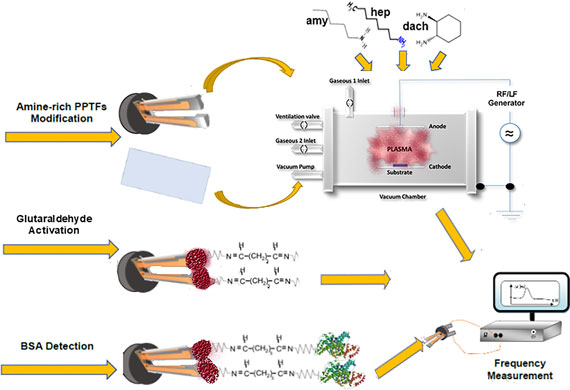
Erratum to: Simultaneous insulation and modification of quartz tuning fork surface by single-step plasma polymerization technique with amine-rich precursors–ERRATUM.
MRS Communications,
Vol. 9,
Issue. 3,
p.
1124.
Demir, Derya
Gundogdu, Sude
Kilic, Seyda
Kartallioglu, Tugce
Alkan, Yusuf
Baysoy, Engin
and
Kaleli Can, Gizem
2021.
A Comparison of Different Strategies for The Modification of Quartz Tuning Forks Based Mass Sensitive Sensors Using Natural Melanin Nanoparticles.
Journal of Intelligent Systems with Applications,
p.
128.
Özgüzar, Hatice Ferda
Meydan, Ahmet Ersin
Göçmen, Jülide Sedef
and
Mutlu, Mehmet
2021.
Single-step amphoteric surface modification through plasma polymerization: Antifouling coating for titanium substrate.
MRS Communications,
Vol. 11,
Issue. 4,
p.
523.
Kaleli-Can, Gizem
Özgüzar, Hatice Ferda
and
Mutlu, Mehmet
2021.
Development of mass sensitive sensor platform based on plasma polymerization technique: Quartz tuning fork as transducer.
Applied Surface Science,
Vol. 540,
Issue. ,
p.
148360.
Kaleli-Can, Gizem
Özgüzar, Hatice Ferda
and
Mutlu, Mehmet
2022.
Development of QTF-based mass-sensitive immunosensor for phenylketonuria diagnosis.
Applied Physics A,
Vol. 128,
Issue. 4,
Özgüzar, Hatice Ferda
Evren, Ebru
Meydan, Ahmet Ersin
Kabay, Gozde
Göçmen, Julide Sedef
Buyukserin, Fatih
and
Erogul, Osman
2023.
Plasma‐Assisted Surface Modification and Heparin Immobilization: Dual‐Functionalized Blood‐Contacting Biomaterials with Improved Hemocompatibility and Antibacterial Features.
Advanced Materials Interfaces,
Vol. 10,
Issue. 6,
Durukan, Barkan Kagan
Sagdic, Kutay
Kockar, Benat
and
Inci, Fatih
2024.
Modifying NiTi shape memory alloys to reduce nickel ions release through ethylenediamine plasma polymerization for biomedical applications.
Progress in Organic Coatings,
Vol. 189,
Issue. ,
p.
108158.
KALELİ CAN, Gizem
2024.
Molecularly Imprinted Chitosan Modified Quartz Tuning Fork Sensors for Real Time Biosensing in Liquid Environment.
Düzce Üniversitesi Bilim ve Teknoloji Dergisi,
Vol. 12,
Issue. 1,
p.
337.
Gürcan, Dilhan
Baysoy, Engin
and
Kaleli-Can, Gizem
2024.
Anti-IgG Doped Melanin Nanoparticles Functionalized Quartz Tuning Fork Immunosensors for Immunoglobulin G Detection: In Vitro and In Silico Study.
Sensors,
Vol. 24,
Issue. 13,
p.
4319.
Alanazi, Nadyah
Almutairi, Maram
and
Alodhayb, Abdullah N.
2025.
Fundamental properties and sensing performance of quartz tuning forks in biological and chemical detection applications.
Discover Electrochemistry,
Vol. 2,
Issue. 1,
Wang, Chunyang
Yin, Chunyan
Dou, Guangbin
and
Sun, Litao
2026.
Quartz tuning forks as versatile sensing platforms: A review on design, optimization, and hybrid integration.
Materials Science in Semiconductor Processing,
Vol. 206,
Issue. ,
p.
110425.