

1. Absolutism under comparativist fire
A physical quantity, such as mass,Footnote 1 is a determinable property that is associated with two different arrays of determinates: monadic, “absolute” masses (“being 3 kg in mass”) and dyadic, “comparative” mass-relations (“being thrice as massive as”) (Dasgupta Reference Dasgupta, Bennett and Zimmerman2013). Absolutism is the view that mass-relations are (metaphysically) dependent on the more fundamental distribution of absolute masses among objects. Comparativists deny this and take mass to be fundamentally relational: mass-relations are all that (fundamentally) exists, and absolute masses, if real, depend on them. Here, my aim is to defend absolutism by putting comparativism under the pressure of a new argument, “the squared mass-ratios puzzle” (section 2). I show, basically, how the main argument against absolutism, based on a principle of economy, backfires and gets comparativists into deep trouble. To set the scene for this argument, it will be useful, in section 1, to replay the comparativist attack on absolutism. Sections 3 and 4 will then be devoted to examining and rejecting possible exit strategies.
Let me first outline the position known as “absolutism (about mass),” before turning to the comparativist attack. In speaking of absolute masses, first, I posit a set M of monadic properties m i with cardinality ℵ1, that is as many absolute masses as positive values in our common mass scales. Aristotelian absolutists, like Armstrong (Reference Armstrong1988), refuse to admit uninstantiated absolute masses, while Martens (Reference Martens2021) and Platonist absolutists like Mundy (Reference Mundy1987) readily do. But nothing in what follows crucially pivots on this in-house dispute.Footnote 2
Second, I assume that M is endowed with the canonical structure of extensive measurement: a total weak order (≿A) and a weakly associative, monotonous concatenation relation (∘A), interpreted as addition.Footnote 3 I won’t ask whether these relations supervene on the intrinsic nature of the absolute masses (Armstrong Reference Armstrong1988) or are genuine, second-order relations (Mundy Reference Mundy1987; Eddon Reference Eddon2013); nor whether absolute masses have a quiddistic identity (Martens Reference Martens2021) or are only individuated through second-order relations (Wolff Reference Wolff2020; Jacobs Reference Jacobs2023). But I will assume that absolute masses have transworld identities to help formulate the interworld Leibniz rescaling scenarios.
Absolute masses thus have a structure 𝒜 = ⟨M, ≿A, ∘A⟩ that allows M to be numerically represented by a function φ: M → ℝ +, unique up to multiplication by a scalar, interpreted as unit change (Krantz et al. Reference Krantz, Luce, Suppes and Tversky1971, 74). Following Stevens’s typology, the quantity M is then said to have a ratio scale, in which the ratios among mass-values are preserved through the admissible transformations φ’ = kφ (k > 0) (Reference Stevens1946). In the following, I call “additive” quantities that have such ratio scales. Finally, under a fixed φ, mass-values (“3 kg”) are taken to represent the corresponding absolute masses m i .
I take absolutism to be the conjunction of the three following claims:
(1A) Absolute masses M are real and form the structure 𝒜.
(2A) In a world W, an object x has its mass in virtue of the absolute mass m i it instantiates. Mass-absolute facts of the form “m i x” are the fundamental mass-facts.
This has a nice consequence regarding the distribution of mass-values. Call m a function that attributes to any x in W a mass-value in a unit. Once a scaling φ for the absolute masses is chosen (by a unit-definition),Footnote 4 then for any x in W and any m i of M, if m i x then m(x) = φ(m i ).
(3A) In a world W, mass-relational facts depend on mass-absolute facts. Noting “r i xy” the fact that x is in the mass-relation r i with y, r i xy obtains in virtue of m i x and m j y.
This means that absolutists don’t need primitive mass-relations: With a mosaic of mass-absolute facts and the structure 𝒜, determinate mass-relations among objects come for free. Now, call m R the function that attributes to any two x and y in W a real, positive value corresponding to just how much more massive x is than y. Then, for a fixed φ, if m i x and m j y then m R (x,y) = φ(m i )/φ(m j ). The mass-ratio m R (x,y) can be directly expressed as the ratio of the values for their respective absolute masses.
Absolutism is under heavy comparativist attack. Dasgupta (Reference Dasgupta, Bennett and Zimmerman2013) argues that because monadic mass-values (“3 kg”) only express disguised mass-relations to a chosen standard, absolute masses are metrically undetectable (at least, prior to dynamic considerations)Footnote 5 and altogether dispensable. This translates into what Martens calls “Kinematic Comparativism”: Because mass is a dimensionful quantity with unit-dependent values, the mass of an object “can only be reported or expressed, non-dynamically, in terms of how this magnitude relates to the magnitude of another particle having the same determinable property” (2021, 2520). From a representational viewpoint, it means that the mass-values m(x) entirely depend on the choice of a φ and are not invariant under φ’ = kφ (k > 0) (passive rescalings, i.e., unit changes). Because only the mass-ratios m R (x,y) are preserved, only these ratios should be considered as representing something physical, that is the mass-relations. Then, by virtue of a principle of economy that Martens calls the “Occamist norm” (2021, 2522), absolute masses are considered redundant surplus and eliminated from the fundamental ontological furniture.
There is another way of framing the same argument, that will prove useful later on. Call an “initial world” W0 the complete state of a world at a given time, conventionallyFootnote 6 chosen as “t0”; an “initial world” is typically what is described in the initial conditions of a problem of physics: a distribution of fundamental properties and relations on a given set of objects. Because they consider absolute masses as fundamental, absolutists hold that two initial worlds W0 and W’0 that differ only by a (uniform) doubling of absolute masses fundamentally differ. Comparativists deny this. To put this more precisely, define:
Active Leibniz (Mass) k -rescaling: for all x of W0, with m i x, give its counterpart x’ in W’0 the absolute mass m j such that φ(m j ) = kφ(m i ) (k > 0), to the effect that m’(x’) = km(x), ceteris paribus.Footnote 7
Absolutists hold that active k-rescalings generate distinct initial worlds (Martens Reference Martens2021). Starting from W0, uniformly multiplying all mass-values in the same unit mirrors a redistribution of fundamental absolute masses and thus makes for a distinct initial world W’0. Comparativists deny this: Uniform multiplications of mass-values only make for representational differences, that is, different numerical descriptions (in different units) of fundamentally the same initial world. This can be put in the form of a reductio: first, suppose an active k-rescaling, yielding two different distributions of mass-values m(.) and m’(.), and second, if it can be compensated by an appropriate change of units, so that any metric difference is canceled out and the mass-ratios preserved, then the rescaling doesn’t generate a distinct initial world (or equivalently, it is not an active one). To put this more formally, define:
Passive Absorption: For any active k-rescaling (k > 0), there is a passive rescaling φ → φ’ = φ/k such that m’(x’) = φ’(m j ) = φ(m j )/k = kφ(m i )/k = km(x)/k = m(x), to the effect that the change in mass-values is absorbed by a change of unit.
Because all active Leibniz k-rescalings correspond to metrical symmetries of mass, that is, a symmetries of its ratio scale, they can all be passively absorbed as mere unit changes. Then, define:
Comparativist Razor: Any active rescaling that can be passively absorbed shall not be taken as generating fundamentally distinct possible initial worlds.
The “Razor” is a close cousin to Martens’s “Occamist norm.” It relies on the very same principle that only that which is invariant (under admissible transformations) should be considered fundamental, this time applied to the world possibilities generated by Leibniz k-rescalings. It dictates to treat metrical symmetries as “ontic symmetries” (Baker Reference Baker2020), that is, transformations that leave the fundamental structure of the world untouched.Footnote 8 By applying this Razor (or this chainsaw, one might say), comparativists significantly reduce the range of possible initial worlds by numerically identifying all those that differ only by Leibniz k-rescalings.
Absolutists have several responses at their disposal. Following Jacobs (Reference Jacobs2024), they can argue that absolute masses, although metrically idle, are relevant to (metaphysically) explain why mass-relations obey the “Ratio Multiplication Principle” (Roberts Reference Roberts2016): for any x, y, z, mR(x,y).mR(y,z) = mR(x,z). Mass-relations behave “as if” they were ratios of underlying absolute masses, which would be a conspiracy on a cosmic scale if mass-relations were all there (fundamentally) is. Absolutists can also argue that, pace Martens, dimensionfulness doesn’t imply “Kinematical Comparativism” (Jacobs Reference Jacobs2021; Tricard Reference Tricardforthcoming). Or, following Martens, they can fall back on dynamic considerations.
Taking Newtonian Dynamics (ND) as a sample theory, it is argued that absolute masses are indispensable in determining the dynamics of a system (Baker Reference Baker2020; Martens Reference Martens2021). Because the equations of ND are traditionally formulated in terms of monadic mass m(x), applying an active Leibniz k-rescaling on W0 does generate an (initial) world W’0 that evolves differently, in an empirically detectable way. For example, particles that escaped their gravitational pull in W0 now collide in W’0. But initial worlds that evolve differently should be counted as fundamentally distinct,Footnote 9 which comparativists cannot do.
In response, comparativists may retort that relying on the text-book version of ND is question begging. If one first believes that mass is fundamentally relational, then one can argue that a “reduced” version of ND should first be formulated, one that quantifies over mass-relations as the fundamental ingredients (Dasgupta Reference Dasgupta, Bennett and Zimmerman2013; Roberts Reference Roberts2016; Jalloh Reference Jacobs2024). If this can be done—and I will assume it can—then k-rescalings are restored as dynamic symmetries, thus taking the wind out of the absolutist argument.Footnote 10
The dynamic turn in the debate will not play a major role in what follows. My focus is on undermining the initial victory of comparativism at the kinematic level, which largely rests on the Comparativist Razor. The puzzle I will now present shows how it can be used against comparativism.
2. The squared mass-ratios puzzle for comparativism
Let me first outline the basic tenets of comparativism. First, consider a set R of mass-relations r i , also with cardinality ℵ1,Footnote 11 endowed with a total weak order (≿R) and a weakly associative, monotonous concatenation relation (∘R). This time, ∘R is interpreted as multiplication, which means, intuitively, that mass-relations behave like ratios.Footnote 12 Note also that ∘R is a closed operation on R, has an identity element (the mass-relation “being as massive as”) and includes an inverse for each mass-relation. Thus, the structure ℛ = ⟨R, ≿R, ∘R⟩ is a totally ordered group isomorphic to the multiplicative positive reals (Martens Reference Martens2024). It is often assumed that mass-relations are uniquely represented: for any two representation functions ψ, ψ’ from R to ℝ +, ψ = ψ’. As will shortly become clear, this is the crux of the problem that I intend to pose to comparativism.
I take comparativism to be the conjunction of these three claims:
(1C) Mass-relations R are real and form the structure ℛ.
(2C) In a world W, the mass-relational facts r i xy are the only fundamental mass facts.
This implies that, once a ψ is chosen on R, if r i xy then m R (x,y) = ψ(r i ).
(3C) In a world W, absolute masses (if real) depend for their instantiation on the underlying network of instantiated mass-relations.
This requires some clarification, for the status granted to absolute masses in comparativism is not easy to grasp. For sure, comparativism in its basic form is simply an “Anti-realism about absolute masses” (Martens Reference Martens2024), and there is simply no need of a claim such as (3C). But for others like Dasgupta, absolute masses are real but depend on mass-relations, which raises a problem of metaphysical underdetermination: many distributions of absolute masses are compatible with a given network of mass-relations (Martens Reference Martens2016, 10). This is reflected in the fact that, for a fixed ψ, if r i xy then there is a function m such that ψ(r i ) = m(x)/m(y) that is unique only up to multiplication by k > 0. The choice of m can be done by setting m(S) = 1 for some object S that is designated as the mass-standard.Footnote 13 So, if mass-values m(x) represent absolute masses, then an object can possess many different absolute masses, one for each mass-relations that it bears with any possible standard. So, the network of mass-relations seems to metaphysically underdetermine the distribution of absolute masses.
I see three possible options. First, one may adopt a very thin view according to which a x has an absolute mass whenever it can be attributed a mass-value m(x), relative to a standard S. Just as a same object has several profiles depending on the point of view taken on it, it has several “monadic mass-profiles” depending on the chosen comparison point. But comparativists may wish to recover a thicker concept of absolute mass, so that an object can only have one absolute mass (at the same time). A second option, then, is to adopt Dasgupta’s specific brand of structuralism, where absolute mass-facts are collectively grounded on the whole relational network (Dasgupta Reference Dasgupta2014). A third option is the view that Martens coined “Regularity Comparativism,” where facts about absolute masses supervene on the entire world mosaic and are selected together with the lawlike dynamic regularities (Martens Reference Martens2017). Because nothing in my argument depends on this, I will take “absolute masses” to refer to anything that corresponds to monadic mass-values in a comparative framework, be it nothing more than mass-relations, thin monadic profiles or thicker absolute masses.
So, here is the puzzling case. Suppose a comparativist initial world W0, that is a fundamental distribution of mass-relations r i among objects and a ψ such that, for any objects x and y, if r i xy then m R (x,y) = ψ(r i ). Then, generate a candidate for a distinct possible world W0* by applying:
Active Leibniz β-power-transformation: For all x, y of W0 with r i xy, duplicate them such that their counterparts x* and y* in W0* are in a mass-relation r j with ψ(r j ) = ψ(r i )β (β > 0), to the effect that m R *(x*,y*) = m R (x,y)β, ceteris paribus.
With β = 2, this generates W0* by redistributing mass-relations such that all the mass-ratios are uniformly squared. The question is: Are W0 and W0* to be counted as two fundamentally different initial worlds?
The immediate answer is that they obviously are because W0 and W0* differ in the distribution of fundamental mass-relations, in a way that is even metrically detectable: Two objects that previously were measured as being twice as massive as one another are now four times as massive, and the difference doesn’t seem to depend on representational choices. Also, besides being apparently the case, comparativists are required to treat W0 and W0* as two distinct initial worlds for dynamic reasons. Suppose indeed that both worlds obey the same comparativist ND in which the laws govern mass-ratios. Then W0 and W0* have different dynamic evolutions. Just like scalar multiplications are not dynamic symmetries of an absolutist ND, power transformations are not symmetries of a comparativist one. So, if comparativism, with its fundamental ontological furniture, failed to distinguish between W0 and W0*, the same problem would arise once again, as in the classical doubling scenario of Baker (Reference Baker2020) and Martens (Reference Martens2021).
I claim that, despite appearances, comparativism precisely fails to do just that. The core issue is the assumption that mass-relations have a unique numerical representation, each expressed by a single ratio.Footnote 14 This is unproblematic in absolutism: Fundamental absolute masses, endowed with a primitive additive structure, admit a ratio scale with invariant mass-ratios. But in comparativism, mass-relations are fundamental. Hence, to determine how uniquely they are represented, and by which type of scale, one must first and foremost look at their primitive structure. So, let me start with that, unfold the problem, before seeing how comparatists might respond to it.
By hypothesis, mass-relations are primitively imposed with a total weak order ≿R and a weakly associative, monotonous, multiplicative concatenation relation ∘R, that on R is closed, has an identity element and includes an inverse. Given this structure ℛ, they admit many numerical representations, that are unique only up to power transformations ψ* = ψβ (β > 0), which form their metrical symmetry group. Define a function ψ* = f(ψ) with f(x) = x 1/β (β > 0). Then:
-
(i) ψ(r i ) ≥ ψ(r j ) iff ψ*(r i ) ≥ ψ*(r j ) because f is strictly increasing;
-
(ii) ψ(r i ∘R r j ) = ψ(r i )ψ(r j ) iff ψ*(r i ∘R r j ) = ψ(r i ∘R r j )1/β = ψ(r i )1/βψ(r j )1/β = ψ*(r i )ψ*(r j );
-
(iii) ψ* has the same identity element as ψ and includes an inverse for all relations of R.
So ψ* is also an equally good representation of R. Contrary to what is usually assumed, mass-relations are uniquely represented only up to power transformations, by what may be called “log-ratio scales,”Footnote 15 in which only the ratios logψ(r i )/logψ(r j ) are meaningful.
Given this, one can see the “squared mass-ratios puzzle” unfold. Simply redescribe the world W0* by using ψ* instead ψ as the conventional function for the mass-relations. Then for all x* and y* that stand in the relation r j :
m R *(x*,y*) = ψ*(r j ) = ψ(r j )1/β = (ψ(r i )β)1/β = ψ(r i ) = m R (x,y)
So, by changing the representation from ψ to ψ*, it is possible to describe W0* and W0 with the same numerical ratios but in different “scales”: Objects in W0* that were previously described as being four times as massive as one another are now twice as massive, just like in W0. The difference between W0* and W0 can be “passively absorbed.” Hence, by virtue of the Comparativist Razor, they don’t fundamentally differ. With its own tools, comparativism is prima facie unable to distinguish between the two worlds W0 and W0*.
To borrow Wüthrich’s (Reference Wüthrich2009) witty term, this is abysmally embarrassing (for comparativists). First, I assumed that comparativists were able to formulate a version of ND with active Leibniz k-rescalings as dynamic symmetries. But obviously, power transformations are not symmetries even of a comparativist ND. Initial worlds W0 and W0* are predicted by the theory to have different dynamic evolutions. Now, comparativists find themselves again in the situation of being unable to distinguish two worlds, W0 and W0*, that should be counted as distinct for dynamical reasons.
Here is a second, most undesirable consequence. If all this were true, then (monadic) mass would simply not be the additive quantity that we (empirically) know. Remember the function m such that, if r i xy then m R (x,y) = ψ(r i ) = m(x)/m(y). For a fixed “scaling” ψ, m is unique up to multiplication by k > 0. But ψ admits power transformations of the form ψ* = ψβ (β > 0). This implies that, m is unique only up to transformations of the form: m* = km β (k, β > 0). If those transformations were admissible, then monadic mass wouldn’t have a ratio scale anymore, but what Stevens (Reference Stevens1959, 31) calls a “log-interval scale.” In log-interval scales, only the ratios of log-intervals (logm(x) – logm(y))/(logm(w) – logm(z)), and not the ratios m(x)/m(y), are meaningful. And to measure monadic mass, it would then require to fix not one, but two points: the unit (the kilogram) and a free exponent β; mass simply wouldn’t be an additive quantity anymore. So, one dimension of the puzzle is: How come empirical, monadic masses admit of a ratio scale, if all there fundamentally is the structure ℛ of mass-relations? This is a metaphysical problem: Fundamental mass-relations with their primitive structure don’t provide a sufficient ground for monadic masses with a strong ratio scale.
Comparativists would never accept such damaging consequences. To solve the puzzle, they can tackle one of the two premises of the puzzle:
-
(a) Mass-relations, given their structure ℛ, admit of a “log-ratio” scale with power transformations as their metrical symmetry group.
-
(b) Applying the Comparativist Razor, no active transformation that corresponds to a metrical symmetry can generate a fundamentally distinct world.
So, comparativists can either attack premise (b) and deny that the Comparativist Razor applies, or attack premise (a) and insist that mass-relations do have a unique numerical representation. Let me consider these strategies in turn.
3. Is comparativism an undeclared absolutism (about mass-relations)?
One strategy is to accept (a) but deny that (b) the Comparativist Razor applies, insisting that an active β-transformation makes for a distinct world possibility. A redistribution of the mass-relations makes a fundamental difference even if it preserves their structure. In other terms, comparativists now become “absolutists about mass-relations.”Footnote 16 This is Robert’s (Reference Roberts2016) expression, which can be confusing because “absolutism” is usually defined as the commitment to monadic mass properties.Footnote 17 But it is dialectically useful to keep the term in a generalized sense, as the claim that two worlds that differ only by a relevant Leibniz transformation (here, a power transformation) are numerically distinct, being different in their fundamental, substructural ingredients (here, “absolute” mass-relations). Although this sounds like a solution, it is a very weak position from a dialectical viewpoint. In fact, why should this absolutist move be considered legitimate now, when it comes to mass-relations, when it wasn’t earlier with absolute masses?
First, the very same reason for using the Comparativist Razor applies here. Remember that comparativists argued that the metrical symmetries of the ratio scale make mass-values representationally redundant and, prior to dynamic considerations, absolute masses uneconomical surplus. Because only the mass-ratios were meaningful, only the mass-relations that they represent were to be counted as fundamental. The same applies here: The symmetries of the “log-ratio” scale make the values of mass-ratios representationally redundant and “absolute mass-relations” uneconomical surplus. Then, by virtue of the Razor, comparativists should be asked to get rid of them, and to admit relations among mass-relations as the only fundamental ingredients, masswise (again, before the dynamics dictates otherwise). If not, then it is up to them to explain why suspend now their own principle of economy.
As a matter of fact, comparativists do have a good reason not to apply the Razor. According to their own comparativist ND, mass-relations do play a determinative and empirically detectable role in the subsequent evolutions of W0 and W0*, so they are right to be absolutist about mass-relations. But then, they must justify why dynamic considerations now prevail, to make their case, when they did not deem it sufficient to defend the absolutists’ absolute masses—or, equivalently, they must explain why they no longer find it necessary to seek a reformulation of ND, one that quantifies on relations among mass-relations only. Without answers to these questions, they are in a dialectically weak spot.
Comparativists may also argue that the Razor, although legitimate, cannot be applied indefinitely without entering into a vicious regress. After all, there is no principled reason to stop here: Once relations among mass-relations only are admitted at the fundamental level, one may look at their own structure, find out that they have nontrivial symmetries too, apply the Razor once again and climb the ladder of algebraic abstraction one rung higher, and so on ad infinitum. This obviously has to stop somewhere, as recognized by Roberts (Reference Roberts2016, 5). But why stop here, and be absolutist about mass-relations, and not before as the absolutists claimed we should? Again, I am afraid that any good reason for the comparativists to stop here will only recycle an equally good reason for the absolutists to stop one step earlier: either by relying on dynamic relevance à la Martens, or explanatory relevance à la Jacobs, and so forth (section 1).
So, the comparativists cannot without some inconsistency (or bad faith) resist the application of their own principle of economy in the at-hand case. Perhaps their hope then lies in the other strategy, in attacking the puzzle at its root: The fact that (a) the structure ℛ of mass-relations has a “log-ratio” scale with power transformations (ψ* = ψβ, β > 0) as its metrical symmetries.
4. Are mass-relations uniquely representable?
The rejection of (a) is motivated by the persistent idea that mass-relations should be “kinematically absolute” (Martens Reference Martens2024), expressed by unique and constant numerical ratios, independent of any free parameter such as a unit choice (Roberts Reference Roberts2016, 6–7). In what follows, I consider three ways in which this can be more precisely articulated: by claiming the scale-independence of mass-relations (4.1), or their kinematic absoluteness (4.2), or by arguing that mass-relations have more structure than ℛ, so as to suitably restrict their symmetries (4.3).
But let me first make a quick answer, which will set the direction for subsequent, more elaborate responses. As it is widely admitted, calling mass-relations “ratios” may be misleading (Martens Reference Martens2016; Jacobs Reference Jacobs2024). As Roberts also admits, “the dyadic relational quantity we call ‘mass-ratio’ is…a ‘ratio’ by courtesy only. Really, it’s just a fundamental 2-place relational quantity,…for there is nothing for them to be ratios of” (Reference Roberts2016, 13). But if that is the case, I don’t see where fundamental mass-relations get enough structure to be uniquely representable. Calling them “ratios” won’t change the fact that their structure ℛ is not uniquely representable. Surely, one can impose that any function m representing monadic masses be such that m R (x,y) = m(x)/m(y). But for m R to be unique, one also has to assume that m is a ratio scale (and not a log-interval scale), unique up to scalar multiplications only. That is, the monadic masses must be endowed with an additive structure, that nevertheless they cannot inherit from more fundamental mass-relations. So, the comparativist must either admit that mass-relations are not uniquely representable, and crash into the puzzle, or assume that monadic masses are additively structured independently of mass-relations, which is a serious concession to absolutists. Let me now unfold this dialectic.
4.1. Scale-independent mass-relations?
First, one may argue with Baker (Reference Baker2020) that mass-relations are scale-independent, and if it’s the case, that their numerical representation doesn’t rely on any scaling convention and is simply unique. As Baker sees it, scale-independence is an ontic notion, closely linked to the existence of ontic symmetries. If absolute masses were to be actively and uniformly doubled, then the mass-relations would admittedly remain the same. They are independent of how mass is “scaled” in reality. Ontic scale-independence is mirrored, on the representational side, by a value invariance: “[A] comparative relation for a quantity like mass is scale-independent iff, when the quantity is represented numerically, multiplying its values by a constant cannot change whether the relation holds” (Reference Baker2020, 81). Mass-ratios are preserved by any k-rescaling of the mass-values, so they represent scale-invariant aspects of reality.
Yet, Baker plainly relies on the (familiar but) crucial assumption that the admissible transformations of the mass-values are of the right, multiplicative sort, that preserves mass-ratios. If, however, power transformations were allowed, then mass-values could be transformed in many ways that do not preserve the ratios. So, what decides the scope of the legitimate transformations? The answer, unsurprisingly: The structure of what is to be transformed, and the usual reason to admit the multiplicative sort only is that monadic masses have an additive structure. Now, this is of course unproblematic for absolutists, who posit fundamental absolute masses with the suitable structure 𝒜. But how could comparatists do the same?
Take basic comparativism first, that is antirealism about absolute masses. Fundamental mass-relations with the structure ℛ are all there is. And ℛ allows for a transformation group much broader than multiplications by a positive scalar (the similarity group). Because there are simply no absolute masses, there is nothing else to rely on to further reduce the group. Monadic mass-values can therefore be redistributed according to power transformations: m’ = km β (k, β > 0), under which mass-ratios are scale-variant.
However, comparativists may admit absolute masses, as long as they depend on the underlying mass-relations. But to solve the present puzzle, the comparativist needs absolute masses be delivered with their additive structure. Because this additive structure puts additional constraints on the way absolute masses can be distributed over the network of mass-relations, the additive structure excludes certain arrangements that are nevertheless permitted by the underlying ℛ structure. Therefore, the latter simply cannot determine the former.
Here is another, last attempt. The additivity of monadic masses has an empirical meaning. The concatenation relation ∘A can be operationally interpreted, for instance, as the placing of two massive objects on the same pan of a balance, to compare them with a third. More generally, it is an empirical law that monadic masses behave in a regular, additive way (Mundy Reference Mundy1987). So, perhaps the required restriction (to multiplicative transformations) can be obtained, if not by dependence on the structure of fundamental mass-relations, then by “piggy-backing” on the additive behavior of empirical masses. By analogy with Martens’s (dynamical) “Regularity Comparativism” (Reference Martens2017), the strategy may be called “Kinematical Regularity Comparativism,” where the required kinematic properties of monadic mass, such as its additivity, are provided by the regularities selected by the theory that “best systematizes” the global mosaic.
However, on top of the problems from which “Regularity Comparativism” generally suffers,Footnote 18 this specific brand of comparativism has one major explanatory flaw. The additive behavior of masses is treated as a brut fact, left unexplained. Of course, any theory is allowed some unexplained primitives. But here, the brut, unexplained fact involves entities (absolute masses) that are not primitive, but supposedly dependent on mass-relations. And as already explained, the structure of mass-relations is not rich enough to force masses to behave in an additive way.Footnote 19 So, although nothing fundamental forces them to do so, they behave as if constrained by a structure of absolute masses. Here, comparativism is plagued with another sort of “cosmic conspiracy” (Jacobs Reference Jacobs2024). Or, as Martens notes, “there is an obvious cry for inference to the best (i.e. only!) explanation: the comparativist worlds are constrained as if there were fictitious absolute masses exactly because there are absolute masses!” (Reference Martens2016, 111).
Thus, I simply don’t see how comparativists could endow monadic masses with the required additive structure, for mass-relations to be scale-independent in Baker’s sense. This road to representational uniqueness for mass-relations is closed off.
4.2. “Kinematically absolute” mass-relations?
Comparativists may also argue that mass-relations are “kinematically absolute.” Whereas absolute masses (if real) can only be numerically reported by being compared one to another (Martens Reference Martens2021, 2520), mass-relations are measured noncomparatively. For instance, the relation “being 5 times as massive as” between x and y is detected by balancing, on a pan balance, 5 exactly similar copies of y with x, without any standard or comparison point. Therefore, just like in the number of fingers of a glove (Martens Reference Martens2021, 2521), there is really something “5-ish” in “being 5 times as massive as,” and this is why mass-relations have a unique numerical representation.
In response, I will argue that mass-relations are indeed kinematically absolute, but again, only if absolute masses are posited and endowed with an independent additive structure.
First, let me consider this commonly held notion that, in ordinary measurement systems, it is mass-relations that are measured (Roberts Reference Roberts2016, 4). Is it truly the case? To directly measure mass-relations would require devising an operation that associates a (positive) real with any pair of objects (x,y). This simply is not what is done with common mass-measurement systems: They associate a (positive) real with pairs of (x,S), with “x” the only variable and “S” a logical constant, holding for a chosen mass-standard that remains the same within a same scaling. In other words, what is operationalized here is monadic mass (“the mass of x”) with its traditional ratio scale. To obtain a value for the mass-relation between any x and y, one has to make two distinct measurements m(x,S) and m(y,S) within the same scaling and then take the ratio m(x,S)/m(y,S). This ratio is undeniably constant across all change in the standard S. Therefore, the kinematical absoluteness of mass-relations here can only be secured if monadic masses are first granted the suitable, additive structure. This brings the comparativist back to the previous impasse: It is not possible to grant this without positing independently structured absolute masses.
Comparativists might object that the measurements m(x,S) still stand for mass-relations. True enough, they can be expressed by relational predicates: “being k times as massive as S” instead of traditional monadic values (“being k S in mass”).Footnote 20 Strictly speaking though because “x” is the only variable in m(x,S), “being k times as massive as S” expresses relational properties (of the x) rather than relations. So comparativists would then need to argue that these relational properties ultimately depend on the mass-relations (between the x and S), rather than on their absolute masses, so that very little is gained.
Yet, one may object that there are ways to uniquely measure mass-relations from (ratios of) quantities, such as velocity or acceleration, without assuming additive monadic mass. For instance, Martens declares that the structure ℛ of mass-relations “corresponds nicely to Weyl’s operational definition of (inertial) mass” (Reference Martens2021, 2519; Reference Martens2024, 16). So, let’s have a look at it, to see if they really provide an operationalization of mass-relations.Footnote 21
Consider this experimental set-up: two bodies a and b (inertially) moving with inward velocities v a and v b (top box in Figure 1), before colliding inelastically and coalescing into the aggregate a+b, with velocity v a+b (bottom box).
Weyl’s operationalization of mass.
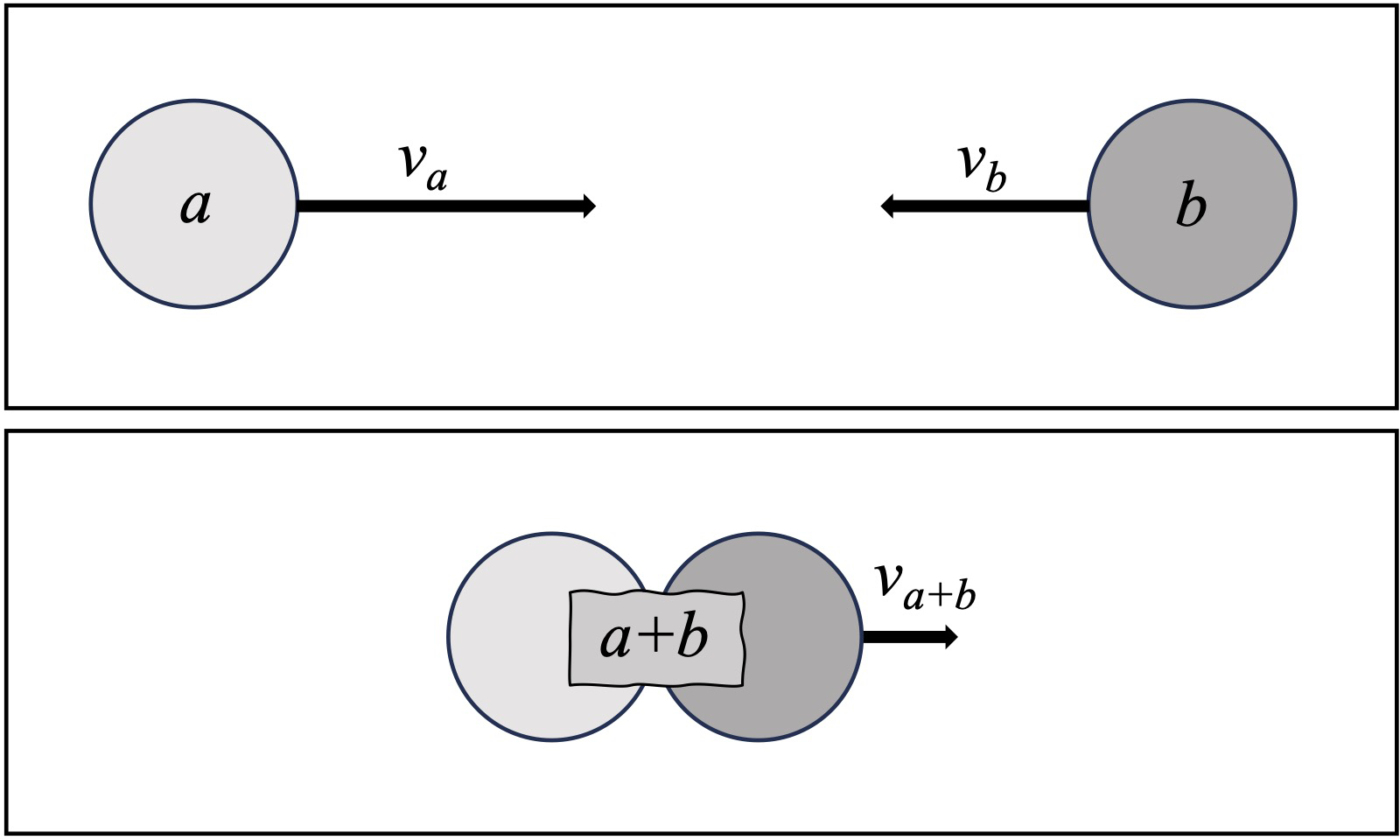
Figure 1 Long description
The diagram consists of two parts. In the top part, two entities labeled a and b are shown moving towards each other with velocities va and vb respectively. In the bottom part, the entities a and b are combined into a single entity labeled a plus b, which moves with a velocity labeled va plus b. The diagram visually represents the concept of combining two entities and their resulting velocity.
Weyl’s operationalization of mass proceeds first by defining equality and order in mass (Weyl Reference Weyl1949, 139):
-
(1) a is as massive as b iff, with equal (opposite) velocities v a = −v b , v a+b = 0
-
(2) a is more massive than b iff, with v a = −v b , v a+b ≠ 0 and sign(v a+b ) = sign(v a )
Then Weyl defines a concatenation operation that “consists simply in joining the two bodies” (Weyl Reference Weyl1949, 139), which clearly shows that he is building nothing more than a traditional additive scale of monadic masses. As such, this in no way constitutes an operationalization of mass-relations. I suspect that Martens referred to Jammer’s account of Weyl’s ideas (Reference Jammer2000, 10). Instead of a concatenation operation, Jammer defines the mass-ratios m R (a,b):
-
(3) If v a+b = 0, m R (a,b) =—v b /v a
This relies on the principles of conservation of mass and momentum: m a v a + m b v b = (m a + m b )v a+b , with m a and m b the monadic masses of a, b. By imposing v a+b = 0, one easily obtains m a /m b = −v b /v a . Then, for all x and y, by independently measuring the velocities v x and v y , one is able to obtain a unique, positive real value for m R (x,y), thus providing the structure of mass-relations with a unique numerical representation. Values for monadic masses m(x) can then be defined by choosing a as the mass standard (m(a) = 1), such that for all x, m(x) = m R (x,a). And m(x) is unique only up to a multiplicative factor, typical of ratio scales.
So, runs the objection, the Weyl–Jammer definition provides a way to measure and uniquely represent mass-relations, without making any explicit assumption about the additive structure of monadic masses, but recovering it as a by-product. What more could one ask for?
First, remark that (pace Martens) the Weyl–Jammer definition is not, strictly speaking, an operationalization of the structure ℛ because it does not provide ways to compare mass-relations. In fact, because (1) and (2) reduce to (3), it is nothing but a method to measure mass-relations derivatively from independent velocity measurements (with their own ratio scale). Still, the core of the objection remains: It provides a unique representation of mass-relations without explicitly assuming an additive structure for monadic mass.
But it does, implicitly. To see this, let me compare it with another way to measure mass-relations, which provides them with just the required “log-ratio scale” that fits their structure ℛ. What follows is adapted from what Luce and Tukey (Reference Luce and Tukey1964) invented under the name “Simultaneous Conjoint Measurement.”Footnote 22 The idea is to measure mass and velocity conjointly as components of a third quantity, momentum. This is done, basically, by building an ordering of momenta that allows to match mass-relations with velocity-relations. First, one must be able to order masses (with Weyl’s (1) and (2)) and velocities:
-
(4) a goes as fast as b iff if they collide exactly in the middle of the segment defined by their initial positions
-
(5) a goes faster than b iff, if a is as massive as b, then v a+b ≠ 0 and sign(v a+b ) = sign(v a )
Next, by varying the velocities and masses of bodies a and b, one produces an ordering of momentum ≿ p :
-
(6) a has more momentum than b (p a ≿ p p b ) iff v a+b ≠ 0 and sign(v a+b ) = sign(v a )
If these qualitative axioms are satisfied, then there are two positive-real-valued functions χ m et χ v such that:
-
(7) p a ≿ p p b iff χ m (a)χ v (a) ≥ χ m (b)χ v (b)
Such representation functions are unique up to power transformations: χ’ m = α1.χ m β and χ’ v = α2.χ v β (α1, α2, β > 0). Therefore, a conjoint measurement of mass and velocity yields log-interval scales for both quantities.Footnote 23 Now, instead of functions for monadic masses and velocities, one may want functions for mass- and velocity-relations. To that end, simply define m R (x,y) = χ m (x)/χ m (y) and v R (x,y) = χ v (x)/χ v (y), such that:
-
(8) p a ≿ p p b iff m R (a,b) ≥ v R (b,a)
Such functions are unique up to power transformations of the form m R ’ = m R β and v R ’ = v R β (β > 0), which characterize them as (what I called) “log-ratio scales,” which is exactly the type of scale that suits the structure ℛ. So, I take conjoint measurement of mass-relations (and velocity-relations) to provide just the type of operationalization required by their assumed structure.
Three remarks are in order. First, as Luce and Tukey insist, this method provides a fundamental measurement of the conjoint quantities (here, mass and velocity). This is the main difference with Weyl’s method, where mass is measured derivatively, from velocity. Second, because mass (and velocity) can also be fundamentally measured with the traditional extensive methods, this means that a same quantity can be fundamentally measured in different ways.Footnote 24 So, the question naturally arises of how the conjoint measurements (of mass and velocity) χ m and χ v relate to their extensive measurements m and v. Krantz et al. (Reference Krantz, Luce, Suppes and Tversky1971, 485) show that:Footnote 25
-
(9) χ m = γ1.m β and χ v = γ2.v β (γ1,γ2,β > 0)
This means that the traditional ratio scale for monadic mass (velocity), obtained when extensively measured, is a special case (with β = 1) of the log-interval scale obtained when it is measured conjointly with velocity (mass) (Wolff Reference Wolff2020, 86). This also entails that:
-
(10) m R (x,y) = (m(x)/m(y))β and v R (x,y) = (v(x)/v(y))β (β > 0)
So, the apparently unique mass- and velocity-ratios obtained by taking the ratios of monadic masses and velocities is also a special case (with β = 1) of m R (x,y) and v R (x,y) when obtained by a conjoint measurement.
Third, one crucial condition (for the representation and uniqueness theorems) is of particular interest. Indeed, it has to be assumed that mass and velocity independently contribute to momentum, in the sense that a measure of momentum χ p is a noninteractive function of χ m and χ v :Footnote 26
-
(11) χ p = χ m βχ v β (β > 0)
This differs from the way momentum is traditionally defined, as p = mv, where no free exponent β appears. But, as Krantz et al. explain, “[T]his difference is only apparent since we could rewrite all physics in terms of p’ = p β = m β v β, where β > 0. It is pure convention that we choose β = 1” (Reference Krantz, Luce, Suppes and Tversky1971, 267).Footnote 27 What is not conventional, but physically meaningful, is that the exponent is the same for mass and velocity, that is that “the ratio of their exponents is 1 rather than some other number. This ratio establishes the trading relation…between m and v in their contributions to momentum” (ibid.). By conventionally setting β = 1, one ensures that the conjoint measurements of mass and velocities just match those obtained when both quantities are independently measured and represented by ratio scales—and therefore, that m R (x,y) just matches the unique ratios m(x)/m(y) of additive mass. As Narens and Luce write:
By selecting the exponent β to be 1 (or equivalently, by identifying [χ v ] with [v]), we have by fiat altered what is really a log-interval representation [of momentum] into one that appears to be a ratio scale. (This means that in order to force [momentum] actually to be a ratio scale, more physical structure than the ordering of the mass-[velocity] pairs is needed.) (1986, p. 172)Footnote 28
This last point allows me to fully meet the challenge posed by the Weyl–Jammer operationalization of mass-relations. Remember that it is a method to derivatively measure mass-ratios from velocity-ratios. Apparently, it does recover unique mass-ratios (and a ratio scale for monadic masses) without making any assumption about the structure of monadic masses. But it makes an equivalent assumption! In Jammer’s (3), momentum p is implicitly defined as mv, that is by setting β to 1 in (11). As Narens and Luce suggest, this is assuming that momentum has a ratio scale rather than a more general log-interval scale. Now, this can be justified in only two ways: either by the (independent) assumption that both velocity and mass have ratio scales or by assuming that momentum has an extensive structure, with a definable concatenation operation.
In the first case, assuming that both velocity and mass have ratio scales automatically sets β to 1. But clearly, this entails that, even though no extensive structure for masses has been explicitly posited in the Weyl–Jammer procedure, the ratio scale for masses is not a by-product of the measurement, but its precondition. This was presupposed as soon as momentum were defined as mv. In the second case, momentum is endowed with more structure than it has in conjoint measurement. Actually, the principle of momentum conservation that Jammer mobilizes can be interpreted as a concatenation operation: The momentum of the aggregate a+b is the sum of a’s and b’s momenta. But this is empirically sound only if the masses are also conserved, that is the mass of a and b add up to the mass of the aggregate. So, this already presupposes that mass has an extensive structure and therefore, once again, a ratio scale.
I conclude that the Weyl–Jammer operationalization of mass-relations only yields unique numerical ratios because of a hidden assumption (β = 1) that, one way or another, imposes a ratio scale on monadic mass. As discussed in section 4.1, this assumption is not accounted for in a comparativist framework: From fundamental mass-relations exhibiting the structure ℛ, it simply doesn’t follow that monadic masses have the structure required by ratio scales.
4.3. Enriching the structure of mass-relations?
There is one last road to explore: Why not enrich the structure ℛ of mass-relations to restrict their metrical symmetries from the power group (ψ* = ψβ, β > 0) to the identity (ß = 1), so that each mass-relation corresponds to a unique real?
The most straightforward way is, I think, to rely on what is known as “Hölder’s theorem”; but it is traditionally formulated in an absolutist framework, so let’s see if it can be twisted for comparativist purposes. Basically, one assumes that the monadic masses M satisfy a total weak order (≿A), a weakly associative, monotonous, additive concatenation relation (∘A), plus two qualitative conditions of order density and unboundedness, to reach “Dedekind-completeness.” It is then possible to build infinite, additive standard sequences for all m i of M: S(m i ) = < m i , 2m i , 3m i ,… >, so that the ratio m i /m j is uniquely determined as a relation (the “Dedekind cut”) between S(m i ) and S(m j ). Hölder’s theorem states that the set of such ratios is isomorphic to the positive reals, so that each corresponds to a unique real number.Footnote 29
To twist this adequately, comparativists need to identify the ratios m i /m j with the fundamental mass-relations. This implies reversing the order of dependency traditionally assumed, with the ratios determined by additive standard sequences of monadic masses. In the reversed view, mass-relations come first and primitively determine pairs of standard sequences, so that absolute masses be delivered with their additive structure.
Yet, on closer analysis, the problem encountered in section 4.1 “appears only to have been wished away.”Footnote 30 The fact remains that the underlying ℛ structure is still not rich enough to uniquely determine monadic masses with the required additive structure.Footnote 31 Simply saying that it does so “primitively” is not illuminating because it is not clear by virtue of what additional primitive structure.
Returning to the problem: To secure that mass-relations are uniquely represented by the positive reals, comparativists need to add more primitive structure to ℛ. Intuitively speaking, mass-relations need to be endowed with some sort of a “distance metric” that ℛ, as a multiplicative structure, lacks. This is certainly the most promising option for comparativists. Because it can be tried in many ways, I go with the simplest, hoping that my general answer will also cover the others.
The idea is to embrace Bigelow and Pargetter’s “three levels theory” of quantities (Reference Bigelow and Pargetter1988), which posits (1) particular objects, standing in (2) whole arrays of mass-relations, themselves bearing (3) second-order proportion relations—a theory that (now) qualifies as a brand of comparativism.Footnote 32 That two mass-relations r i and r j stand in the n:m proportion means intuitively that r i m (r i concatenated m times) amounts to r j n . Together these proportions determine a metric for mass-relations: Because “being as massive as,” the identity element, is invariantly associated with the number 1, any relation r i standing in the n:1 proportion with it is associated with the real n.Footnote 33
Note, however, that these (second-order) proportions are external, superimposed on mass-relations.Footnote 34 But given their structure ℛ, the mass-relations can receive many different geometries. For instance, r i and r j may stand in the n/m but also in the (n/m)ß proportions (ß > 0). It is the same problem, over and over again. Why should one contingent mass-geometry, the one with ß = 1, be posited rather than another? One good reason is, again, to best explain the empirical additive behavior of monadic masses, and this time (compared to section 4.1), comparativists are equipped to do so.
I accept this as consistent way out of the puzzle, one which comparativists can take. But note that now, comparativists are far from their initial, economical stand of positing (as fundamental) only the mass-relations expressed by the invariant ratios of empirical masses. Now, faced with the fact that empirical masses exhibit constant numerical ratios, both absolutists and comparativists posit fundamental structures with unobservable ingredients: either absolute masses with their structure 𝒜 (Mundy Reference Mundy1987), or mass-relations with their second-order geometry. It is then sufficient for my purpose to conclude that comparativists have lost all their initial advantage at the kinematic level.
5. Conclusion
That comparativists run into the problem I have presented here and are prima facie unable to distinguish between a world W and its duplicate W* where all mass-relations have been uniformly squared, is deeply puzzling. Until now, the picture seemed pretty clear. On the table were absolute masses, with their ratio scale, and mass-relations, represented by unique numerical ratios. Comparativists considered it more economical to posit only the latter, at the fundamental level, and to have them mirrored by the constant empirical ratios. What I showed, basically, is that comparativists had it too easy by assuming that these ratios were unique. As it happens, mass-relations with their structure ℛ admit of many equivalent representations depending on the conventional choice of a free exponent.
To evade the puzzle, comparativists may become absolutist about mass-relations, but then have to explain why they have the right to do so. Or they may endow monadic masses with an additive structure, which they cannot inherit from the underlying mass-relations, and must thus possess primitively—which is precisely what comparativism initially rejected. Unless, of course, they supply their fundamental relations with more primitive, unobservable structure. But then, on what grounds do this, if not to account for the constant ratios of monadic masses, which absolutism does just as well?
Acknowledgments
My sincere gratitude goes to the two anonymous referees who helped me to significantly improve this article. I also extend my warmest thanks to Alexandre Guay and the entire CEFISES team at the Catholic University of Louvain for their helpful comments on earlier versions of this article.
Funding Statement
This work was supported by the Fonds de la Recherche Scientifique—FNRS under Grant(s) n°[40016838].
Declarations
None to declare.

 Open access

