

I begin by acknowledging that Toronto is in the “Dish with One Spoon Territory.” The Dish with One Spoon is a treaty between the Anishinaabe, Mississaugas, and Haudenosaunee that bound them to share the territory and protect the land. Subsequent Indigenous Nations and Peoples, Europeans and all newcomers have been invited into this treaty in the spirit of peace, friendship and respect.
Dans une association bilingue canadienne, la question du « choix » de la langue parlée est complexe, comme l'a souligné Alain Noël en 2014. Je vais surtout parler en anglais parce que c'est dans cette langue que je me sens le plus à l'aise. Même si je parle en anglais, j'espère l'esprit de mes propos saura rejoindre les francophones du Québec xet d'ailleurs.
Introduction
The 150 mark for Confederation and the founding of the modern Canadian state comes at a moment when at universities across Canada it is now routine to acknowledge traditional territory, and in so doing to recognize a longer history, dating before 1867 and the establishment of European colonies (Canadian Association of University Teachers, 2016). Territorial acknowledgements also give recognition to the Indigenous peoples who lived and continue to live on the land, as well as the ways in which land figures into Indigenous identities and ontologies in ways that are typically very different than settlers (Battell Lowman and Barker, Reference Battell Lowman and Barker2015: 48–68). Such acknowledgements are also happening at cultural events and even hockey games, with a Fall 2016 Heritage Classic Game on the home turf of the Winnipeg Jets believed to be the first (Lambert, Reference Lambert2016). As a consequence, we are living in a moment in which we are being reminded about buried and unacknowledged history, as well as about the colonial past and the colonial present. Moreover, the Canadian government devoted $500 million to celebrate the 150th anniversary of Confederation in 2017, (“Why Exactly Are We Spending?” 2017), but clashing historical narratives have also given rise to the question of whether Confederation is actually something to rejoice (Slowey, Reference Slowey2016). Consider here the striking name of the new book by Kiera Ladner and Myra Tait (Reference Ladner and Tait2017) entitled Surviving Canada: Indigenous Peoples Celebrate 150 Years of Betrayal.
In this address I want to turn the question of narrative inward to the discipline and consider how the history of Canadian political science might be narrated in light of the discipline's organizational and ideational foundations and complexity. Graham White is no doubt correct in saying that no single account of Canadian political science can please everyone (White, Reference White2017a: 1), and therefore my goals are modest. The first goal is to present one rendition or narrative of Canadian political science in the hopes of kick-starting more discussion and debate about our “Canadian” discipline as part of the North American and international development of political science in countries of both the global North and South. The second goal is to invite more mindful consideration of what the present offers—and by extension the future.
At some level in all parts of the world and in all times there have been people who have been interested in something we can call politics, but Canada has the world's second oldest association formally devoted to the study of political science. The Canadian Political Science Association (CPSA) was founded in 1912, just after the American Political Science Association (APSA) was founded in 1903. In most other parts of the world, including Europe, professional organizations devoted specifically to political science were largely the product of the post-Second World War era. Moreover, many countries await their own national association. Therefore, there is a distinctive longevity to the organization of political science in North America. Moreover, there was an inherently national logic to the CPSA as clearly contained in the words of Adam Shortt, who gave the first Presidential address to the Association in 1913. In Shortt's words, the aim of the CPSA was “a thorough, first-hand study of our own conditions and institutions and acquiring a larger perspective of ourselves and our affairs” (Shortt, Reference Shortt1913: 18).
Given this evident national focus permeating the founding vision of the CPSA, it is peculiar that a foreign narrative dominates many disciplinary overviews. To put my concern in the starkest of terms I would say many of us have absorbed and taught our students what can be called the dominant narrative of political science. This is based on a clearly American-centred, Kuhnian-inspired revolutionary history involving behaviouralism as a “paradigm” with the actual phrase “the behavioural revolution” coming into wide circulation since 1968 (Berkenpas, Reference Berkenpas2016: 241; Kuhn, Reference Kuhn1962). So omnipresent is the narrative around the behavioural revolution that I would go as far as to say that it not only references a method, or stance around the possibility of a science of politics, but a way we tell time in political science. This of course was helped when David Easton memorably signalled the so-called post-behavioural turn in his Reference Easton1969 APSA Presidential Address because the discipline could be divided into a “before” and “after” behaviouralism in both the US and Canada (see Lucas, Reference Lucas2013: 92).
On the northern half of the 49th parallel there have been efforts to “Canadianize” the story of the behavioural revolution. Simply claiming the Canadian birthplace of one of behaviouralism's greatest proponents, David Easton, is a simplified version of this (Stevenson, Reference Stevenson2013). The dominant narrative may also be “Canadianized” through efforts to highlight particular Canadian tendencies that are presented as a counter to behaviouralism (and by extension American political science). For example, it has been noted that behaviouralism was relatively weaker in Canadian political science because scholars have been more sensitive to institutions and history (Vipond, Reference Vipond, White, Simeon, Vipond and Wallner2008: 9). Others have suggested that the French language offered a shield against Americanizing/behavioural influences (Lalande, Reference Lalande1971: 5) and relatedly so did accessing graduate training outside the US in countries of Europe (Noël, Reference Noël2013). It has also been observed that the Canadian political economy tradition provided a homegrown, Canadian-made counter to behaviouralism (read Americanization) (Fierlbeck, Reference Fierlbeck2005). However, whether claiming Easton's Canadian roots, or highlighting the spaces of Canadian political science that were somehow immune to behavioural/Americanizing elements, the dominant narrative may be tempered but it is not fully dislodged. On the contrary, the relevance of behaviouralism (and the behavioural revolution) in narrating the story of the discipline of political science is still referenced and in this sense reinforced.
The case for decentring the behavioural narrative is not to ignore the impact of quantitative techniques and important contributions in the field of political behaviour since the 1960s, including John Meisel's foundational piece on the 1957 general election (Reference Meisel1962) right through to various iterations of the Canadian Election Study (Meisel, Reference Meisel1962; Canadian Election Study/Étude Électoral Canadienne). However, qualitative and quantitative approaches co-mingle in the discipline, a reality made clear in a 50 year review of articles published in Canadian Journal of Political Science/Revue canadienne de science politique. (Héroux-Legault, Reference Héroux-Legault2017: 139). Moreover, the very split between qualitative and quantitative approaches may be seen to be exaggerated (Halperin and Heath, Reference Halperin2017: 6–7). Not least, many political scientists might agree that there is potential benefit to mixed methods approaches and triangulation.
Given the peaceful coexistence of methods evident in the Canadian political science discipline, it is curious that the dominant revolutionary narrative about behaviouralism carries such traction. One explanation may be that it makes for an exciting story; in US political science the narrative is even punctuated by disciplinary “rebellions” as evidenced by the Perestroika movement of the early 2000s in the APSA (Monroe, Reference Monroe2005). The revolutionary narrative also echoes Seymour Martin Lipset (Reference Lipset1990) who popularly depicts America's more revolutionary political culture, especially in contrast to Canada's evolutionary one. Indeed, Canada had no revolution with Confederation, and in fact the preamble of the British North America Act held that Union was to “promote the interests of the British Empire.” No small wonder that British parliamentarians were said to be bored and silent during the so-called Canada debate that brought the British North America Act to fruition, only springing back to life when the House subsequently turned to consider a proposed dog tax and weigh the relative merits of its being reduced for poodles and greyhounds (Hopper, Reference Hopper2017). However, the exciting nature of the revolutionary disciplinary narrative, and its easy resonance with American history itself, has not prevented skepticism from American political scientists who are now beginning to ask why American political science is so invested in this revolutionary narrative (Berkenpas, Reference Berkenpas2016).
In the case of Canada, I contend that the dominant revolutionary disciplinary narrative is ill-suited for understanding many of the developments, striking features, and innovative advances we might find when we start to actually address the evolving organizational and ideational features of Canadian political science. In what follows I offer the outlines of a different narrative about Canadian political science that is less about revolution than evolution. This is not an evolutionary account that argues that dominant ideas and advances shift mainly because of generational or cohort differences (Berkenpas, Reference Berkenpas2016: 246). Rather, inspired by postcolonial theory, my reading is also attuned to structural power, as well as to individual agency and choice.
I argue the organizational and ideational evolution of political science is closely interconnected with Canada's history and unequal social relations since Confederation. This is because organized political science in Canada was really at heart a national venture. As a consequence, in order to understand the ideas animating early political scientists we have to consider Canada's foundational status as a settler colony in the North American space, with a privileged place in the British Empire. This perspective may also help to highlight the distinct features of the colonial present which, I would suggest, are giving rise to multiple sites of knowledge production—or multiple knowledges.
To illustrate this argument I will take a threefold approach which very roughly corresponds with fifty-year blocks of time relating to the semicentennial, centennial, and sesquicentennial of Confederation. First, drawing from the postcolonial perspective associated with Edward Said, I will consider the semicentennial foundation of modern political science as a national project in which knowledge and power were closely interconnected with settler colonialism. Second, I will review the centennial transition of Canadian political science, beginning in the late 1950s and 1960s, as one expressing decolonizing impulses as well giving voice to less powerful groups. Finally, I conclude by addressing our sesquicentennial moment and better potentiating the reality of multiple knowledges. I believe we are at the threshold of a new era that carries with it exciting possibilities, especially if we are collectively more mindful about our past and about our real choices for the future.
Power/Knowledge and the Founding of Canadian Political Science at the Semicentennial of Confederation
As a national project, the establishment of the CPSA could very easily be presented as a semicentennial Confederation project. As summed by one enthusiastic academic observer to the very first CPSA conference, “the fruits of confederation are ripening rapidly,” with the foundation of the CPSA providing “the most recent evidence of this national development and the feeling of nationality that accompanies it” (Donald, Reference Donald1913: 762). The goal of this project was to provide knowledge. As articulated by the first President Adam Shortt, the CPSA was to “contribute thoroughly original and effective solutions for many of our specifically Canadian problems and conditions,” as well as to bring “Canada into the realm of original contributors to the world's store of ideas and achievements” (Shortt, Reference Shortt1913: 19).
However, the linkages between knowledge and power can be especially visceral in colonial contexts, a point elaborated by the late Palestinian-American literary critic Edward Said, and worth considering in relation to both Canada and Canadian political science. Remembered by his students as a conservatively attired professor at Columbia University (Davis, Reference Davis, Aruri and Shuraydi2001: 3), Said was associated with what is now being called the Arab American left (Pennock, Reference Pennock2017) and therefore concerned about racism and resistance to it (Dua, Reference Dua, Bakan and Dua2014). Said, in particular, came to both give voice in English to the experience and perspectives of the Palestinians as a dispossessed people (Said, Reference Said1979), and with the publication of the now classic book Orientalism in 1978, he built upon Michel Foucault's understanding that there was an interrelationship between knowledge and power by considering how the so-called Orient was studied and understood in the academy and in the corridors of power (Said, Reference Said1979). For Said, Orientalism is a manner of thinking and style of scholarship based on an ontological and epistemological distinction between the East/Orient and West/Occident. This form of “knowledge” provided a justification for “power” in the form of colonialism and the continued domination by the West. In other words it was a form of “knowledge” that was really about “power” over “the other,” such as the societies and peoples found in North Africa and the Middle East. Although there may be many points of origin for postcolonial thought both geographically and intellectually, Orientalism is credited with ushering in a new field of studies around colonial discourse and postcolonial theory (Said, Reference Said1979; Williams and Chrisman, Reference Williams and Chrisman1994: 5).
Said's book Orientalism, along with its companion book Culture and Imperialism (Reference Said1994) have been widely taken up globally across disciplines (Abu-Laban, Reference Abu-Laban, Aruri and Shuraydi2001). However, it is the way Said's work has been taken up by Canadian political scientists that is both fascinating and revealing. Of course, Said's work has been used by Canadian political scientists concerned with the Middle East, and critiquing the late Samuel Huntington's “clash of civilizations” thesis (Reference Huntington1993; Abu-Laban, Reference Abu-Laban, Aruri and Shuraydi2001; Mahdavi and Knight, Reference Mahdavi, Knight, Mahdavi and Knight2013). However, Said's Orientalism has also been utilized to cover a variety of other topics and jurisdictions, for example by: Laura Macdonald (Reference Macdonald1995) to address the relationship between Canada and the developing world; Elaine Stavro (Reference Stavro2014) to examine how the SARS epidemic inspired a discourse in which Torontonians were contrasted positively with “bad” Chinese global citizens; Abigail Bakan (Reference Bakan, Bakan and Dua2014) to offer a fresh consideration of the so-called “Jewish question”; Linda Cardinal, Claude Couture and Claude Denis to critique conventional understandings and historiography on Quebec's Quiet Revolution (Reference Cardinal, Couture and Denis1999); and Chantal Maillé (Reference Maillé2007) to anchor an exploration of feminism in light of the complexity of relations of domination and “the national question” in Quebec. Joyce Green has also drawn on Said's work as a tradition inspiring a critical approach to Indigeneity as well as attending to the voices of Indigenous women in Canada (Green, Reference Green1995, Reference Green2001, Reference Green and Green2007). While the list of topics covered by Canadian political scientists using postcolonial theory could no doubt continue, what is important is that it makes very clear that there are potentially multiple “others” in Canada and continuing processes of hierarchical differentiation.
Arguably, this in itself is rooted in Canada's formation as a settler colony where complex and unequal relations have played out, and continue to play out, around race, ethnicity, class, language, region, gender and other forms of differentiation such as (dis)ability (Orsini, Reference Orsini2012; Stasiulis and Jhappan, Reference Stasiulis, Jhappan, Stasiulis and Yuval-Davis1995; Stasiulis and Yuval-Davis, Reference Stasiulis, Yuval-Davis, Stasiulis and Yuval-Davis1995). Canada's distinct formation as a settler colony also stands out for its particular combination of differences including those between settlers and Indigenous populations, those between two European-origin groups (British and French), those between racialized minorities and a “white” majority, and those between the foreign and Canadian-born, springing from repeated waves of immigration (Dhamoon and Abu-Laban, Reference Dhamoon and Abu-Laban2009).
As a consequence, if we apply postcolonial theory inwards toward the organizational and ideational foundation of political science, the construction of “self” and (multiple) “others” stemming from Canada's foundational status as a British settler colony in the North American space becomes readily apparent. As such, the easy influence of British intellectual thought and tradition in late nineteenth-century Canada (Lucas, Reference Lucas2013: 92), and the eventual distancing from British academic life (Cairns, Reference Cairns1975: 195) can be understood to relate to Canada's privileged place, and relative political autonomy, as a “white settler colony” in the British empire (Stasiulis and Jhappan, Reference Stasiulis, Jhappan, Stasiulis and Yuval-Davis1995). As noted, the first meeting of the Canadian Political Science Association was in 1913 but notably the idea for the organization was hatched by eight Canadians who had attended the American Economic Association meetings in Boston in 1912 (Newton, Reference Newton2017: 38). CPSA was therefore at base a national project of the “not American” variety. The CPSA involved a lexiconal assertion of a Canadian self against an American other, or non-Canadians in general. Moreover, it signaled a Canadian-specific understanding of the field. As observed at the time of the very first CPSA meeting, “the term political science has in Canada a broad meaning corresponding to the term social science in the United States and elsewhere” (Donald, Reference Donald1913: 762).
However, the distance between the Canadian self and the American other, while present, was not large in comparison with those stemming from perceived civility and race. Adam Shortt viewed select associations addressing political, economic and social issues as models for the fledgling CPSA. Hence, for Shortt, the Statistical Society, the Royal Economic Society, the American Economic Association and the American Political Science Association were inspiring exemplars that could be adapted for Canada (Shortt, Reference Shortt1913: 9). These model associations were “to be found in the more civilized countries” and even more specifically “among our kindred in Britain and the United States” (Shortt, Reference Shortt1913: 9). Later interventions of Shortt, in the context of summarizing Canada's foreign relations, suggest why the language of kin (so associated with blood relations) may have been chosen. This is because Shortt's core explanation for Canada's closeness to the US and British Empire rested on what he called “certain inherent qualities of race” (Shortt, Reference Shortt1930: 59). While not specifying it explicitly, it can be inferred from the context of his writing, as well as Shortt's abiding commitment to Protestant Christianity (Dembski, Reference Dembski and Paul Dembski2017: 1–12), and his sense that French Canadian culture was backwards (Ferguson, Reference Ferguson1993: 83–84) that by “race” Shortt really meant white Protestant English speakers of British origin.
Notably as well, even if the Canadian state itself did not play an active funding role in the development of political and social science in Canada until after 1950 (Trent and Stein, Reference Trent, Stein, Easton, Gunnell and Graziano1991: 68), the distance between foundational CPSA leaders and the Canadian state was not great. Adam Shortt himself moved in 1908 from being a professor at Queen's University to serving as the first chair of the Canadian Civil Service Commission. The first CPSA secretary-treasurer, and the organization's second president, O.D. Skelton, also played a major role in the development of Canada's Department of Foreign Affairs (Newton, Reference Newton2017: 50–51). Not least, the first meeting of the CPSA in Canada was attended by then prime minister Robert Borden, who welcomed CPSA as the Canadian alternative to the “large leisure class as is found in England, whose members can afford to devote much of their time to the study of the science of politics” (Borden, Reference Borden1913: 7).
As a national project aimed at providing knowledge, it is the articulation of Canadian “problems” and Canadian “conditions” that provides great clues into who the most distant “others” were, and hence the point at which knowledge clearly intersects with power. In this case power is expressed in the form of assimilation/Angloconformity in a country presented without any reference to Indigenous peoples. Speaking at the inaugural CPSA meeting, and near the semicentennial of Confederation, Prime Minister Borden averred:
In the political field, perhaps the most important issue is the problem of binding in a strong harmonious whole the men of the different creeds and races of which the Canadian nation is built up. Few realize how great was the task that faced the men who grappled with this problem in building up our Confederation nearly fifty years ago; wonderful as has been their success, we have still our share of the problem to solve. So in the social field. No country has ever been called upon to face so relatively great a task of assimilation as is imposed upon Canada by the large accessions to her population. (1913: 7)
Borden's fixation on assimilation also helps to better understand who exactly Adam Shortt meant when he highlights Canada's “absorption of so many new and strange elements into its population” to be among the factors compelling a need for a Canadian-based political science association (1913: 18). Indeed, this was the period of settlement expansion into western Canada, and a period of heavy immigration from the (then) “new” source countries in eastern and southern Europe who differed from the preferred potential immigrants: white British-origin Protestants.
Because of the First World War, after its inaugural 1913 meeting the Canadian Political Science Association did not formally convene the same way again until 1930. Nonetheless echoes of the concerns identified by Shortt and Borden are clearly evident in the published papers delivered at the first CPSA meeting through the Second World War. For example, in a separate paper given at the first meeting of CPSA in 1913, the concern with immigration and a lack of concerted policy, particularly in housing, ends with an impassioned pitch: “the salvation of our national life depends upon the Canadianizing of these newcomers through their children who are Canadian born” (Stewart, Reference Stewart1913: 111). A Reference Hurd1930 paper by W. Burton Hurd makes the case for restricting “Oriental” immigration. (The term “Orient” was generally used to reference the entire eastern hemisphere outside of Europe). It opens as follows:
Canada is faced with two distinct classes of population problems: first, those arising out of unfortunate geographic distribution of her different racial elements, and second, those occasioned by the mere presence of racial and cultural diversity. (48)
Similar to how Indigenous peoples were made to be invisible from the land through state policies like residential schools, as Kiera Ladner notes, they were practically invisible in political science itself save for occasional interventions, such as a 1937 paper on Manitoba's “half-breed problem” (Reference Lambert2017: 168) which appeared in The Canadian Journal of Economics and Political Science (the official journal of CPSA from 1935 to 1967).
The justifications for immigration restriction effectively continue in the 1940s with the presidential address by C.A. Dawson in Reference Dawson1943. At this point, some years since the arrival of southern and eastern European immigrants, Dawson observes that the French, British and Slavic populations can make peace or live peaceably together. However, he identifies a new problem because “the item of central importance is high racial visibility in terms of colour and feature” (296). More specifically, Dawson singles out those of Chinese and Japanese origin, who purportedly “bear a physiological badge that destines them to be in some sense perpetually strange and alien to the rest of us” (296). Dawson's specific intervention meshes with Prime Minister Mackenzie King's well-known Reference King1947 statement on immigration in which he argues against immigration from “the orient” and assumes this will carry easy and widespread agreement with “the people of Canada”(2646).
Conference at Québec in 1864, to settle the basics of a union of the British North American Provinces. Copy of a painting by Robert Harris, 1885.
Credit: Library and Archives Canada/Robert Harris fonds/ C-001855

How can we understand this history of political science at the dawn of the semicentennial of Confederation and in the decades that followed? Here it might be worth recalling the lead-up to Confederation itself, as captured in the 1885 painting by Robert Harris. Harris’ rendition has inspired other artists,Footnote 1 even though the original painting was destroyed in the 1916 fire in the Canadian Parliament and all that remains is a photographic image. The conferences in Charlottetown and Quebec City that led to Confederation were marked by the complete absence of Indigenous representatives (Papillon, Reference Papillon and Gagnon2009). Female and working class representatives and perspectives were also absent from the Confederation debates (Heron, Reference Heron2016; McPherson, Reference McPherson2016). Moreover, despite what has been called the moral vision of George-Etienne Cartier (see LaSelva, Reference LaSelva1996: 25) and the tenets of a pluralist federalism (Gagnon and Iacovino, Reference Gagnon and Iacovino2007: 57–90; Papillon, Reference Papillon, White, Simeon, Vipond and Wallner2008) in practice there was grudging and limited attention to the rights of French speakers, especially outside Quebec (Martel, Reference Martel2016).
Given this history, it is perhaps not surprising to observe that the social relations of inequality permeating the foundation of the modern Canadian state at Confederation are also reflected in the foundation and early history of organized political science. The superb account by Janice Newton (Reference Newton2017) of the formative decades of CPSA underscores that leaders and members of the CPSA were hardly representative. As Newton judges from its establishment in 1912–1913 through the 1930s, the organization was composed of men who were elites not only in academe, but to a lesser extent business and government: discussions were in English; members from Ontario and to a lesser extent Quebec dominated numerically and efforts to capture other regions faint; there was limited representation from francophone Quebec and limited interest evidenced in getting more; there were few from the labour, health or social fields; and less than 2 per cent of members were women and they were absent when it came to who gave learned papers (Newton, Reference Newton2017). Newton's account, which draws on archived meeting minutes, also makes it clear that not only were race and immigration initially framed in troubling ways, but the 1923 Census served as a rallying point for a call to study “the racial constitution of the Canadian people” (30).
In short then, just as difference is foundational to Canada, the fixation on difference was a central plank in the ideational construction of Canadian political science, which was all about identity politics. In fact, it was identity politics par excellence. The most distant “others” (especially as determined by distance from ideas of whiteness) were treated as problems, and the goal was to build knowledge in service of a nation that was being built, namely a white settler colony whose institutions, practices and language derived from Britain.
Decolonizing Impulses and the Evolution of the Discipline at the Centennial of Confederation
The period from the 1967 centennial of Confederation is not a mere replica of the earlier era, but rather features some novel developments. Thus, while the Canadian state may at heart remain colonial (see Coulthard, Reference Coulthard2014), it clearly moves from policies discursively embracing Angloconformity to ones expressing cultural pluralism and human rights. Political science also becomes more voluminous as well as more layered and complex. As a consequence, it is much more difficult to identify a clear effort to produce a single source of knowledge in service of colonial power as was evident in the semicentennial era.
Moreover, the post-centennial era involves expressions of, and attention to, what might be called decolonizing struggles. These have taken the form of interest in and sometimes strong solidarity with francophones, assertions of Canadian independence from Britain and/or the United States, and more forcefully in recent years, assertions of Indigeneity. Relatedly, rather than merely overlapping with the state, the work of some political scientists also came to question state power, to consider the empowerment of less powerful social groups, such as women, workers, racialized minorities, and LGBTQ2+ minorities—and the social movements that may articulate their aspirations. As a consequence of all of this, the way Canadian political science expresses itself ideationally and organizationally moves from being merely national to multinational (that is, signaling more than one national aspiration) and from being univocal to being clearly multivocal.
These developments are strongly rooted in the living legacy cast by Canada's settler colonial foundation and unequal social relations of power. Still, not everything maps neatly onto 50-year blocks from Confederation. In my accounting, the 1950s and early 1960s are important, but not because of behaviouralism per se. Rather these years are important for revealing the earliest of impulses towards decolonizing and diversification of the discipline. To illustrate this, I will focus on three Presidential addresses given to the CPSA that were harbingers of the ways in which decolonizing impulses and social relations of inequality came to shape the organizational and ideational features of the discipline. These are the addresses of J. Douglas Gibson in Reference Gibson1956, Eugene Forsey in Reference Forsey1962, and Mabel Timlin in Reference Timlin1960. None discuss behaviouralism; indeed, as Jack Lucas (Reference Lucas2013) notes in his excellent overview of all CPSA presidential addresses, there actually has never been one devoted to behaviouralism.
J. Douglas Gibson (1909–1988) and Canadian sovereignty
Attention to Canada's place in North America was clearly signaled in the address of banker J. Douglas Gibson in Reference Gibson1956 who argued that since the Second World War the US had overtaken Britain to become Canada's predominant external influence. In his words, “Certainly in the economic sphere the United States constitutes the only real threat to Canadian independence and it will remain our chief economic preoccupation as far ahead as one can see” (421). Over the past 50 years since the 1967 Centennial, political economists and international relations (IR) specialists of Canada have struggled and debated how best to understand Canada's place in North America and in the international system. Likewise Quebec's place in North America and the world is also an increasing focus for scholars of Quebec (Cardinal, Reference Cardinal and Lecours2005). Paul Kellogg's Reference Kellogg2015 work, Escape from the Staple Trap, nicely illustrates these kinds of academic debates. These debates find more popular expression in Canada in the angst that attends discussions of NAFTA, the dispute over softwood lumber, and even media scrutiny of the power plays at work in the handshake between Prime Minister Justin Trudeau and President Donald Trump at their first meeting in 2017. Clearly the role of the US in the economic sphere has been a preoccupation giving a prophetic character to Douglas Gibson's observation. This preoccupation, which at base is about Canada's sovereignty and independence, is reflective of the uncertainty of power and place in settler colonies, and particularly Canada where it is difficult to ascribe any one date to independence.
The same uncertainty of place was also evident in the “Americanization” debate concerning the academy (Cairns, Reference Cairns1975), which still reverberates in academic hirings in Canada. Following from the logic of decentring the behavioural narrative, this arguably was not so much about methods since, after all, American political science makes use of quantitative and qualitative methods (Albaough, Reference Albaugh2017: 244). Rather, what dominates is something about Canada's place in North America and in the world, a kind of impulse against being subordinated. It is a kind of impulse that also permeates the complex relations of power that are typically expressed in settler colonies.
Similarly, and lest we forget, assertions of sovereignty from Britain were also part and parcel of the very quest to patriate the Canadian constitution, with the entire process, its aftermath and the new Charter animating work on federalism, constitutional politics and the constitution from the 1960s. Peter Russell (Reference Russell2004) has even helpfully highlighted constitutional sovereignty as one dimension of sovereignty in Canada's constitutional odyssey—an idea that only makes sense if we consider Canada's settler-colonial foundation and the control exercised by Britain. The failure to achieve the consent of Quebec in the patriated constitution and other exclusions relating to federalism and the constitution has also animated much work in the discipline.
Eugene Forsey (1904–1991) and the multinationalization of Canadian political science
Another clear example of a decolonizing impulse evident in the 1950s and early 1960s has to do with francophone and French-language representation as well as attention to Quebec (bearing in mind that in 1960 Jean Lesage became Premier of Quebec, with his tenure in office and philosophy of “maître chez nous” marking the Quiet Revolution). In 1952 the very first francophone President of CPSA, Father Georges Henri Lévesque, gave the first Presidential address published in French on the topic of humanism and the social sciences (Lévesque, Reference Lévesque1952). Father Lévesque was also instrumental in the 1954 creation of the first full-time department of political science in Quebec at Laval University (Trent and Stein, Reference Trent, Stein, Easton, Gunnell and Graziano1991: 65). The CPSA becoming officially bilingual is highlighted in Eugene Forsey's (Reference Forsey1962) bilingual address. Describing Quebec as “a cauldron whose lid has just blown off” (498), Forsey also called on English-speakers to learn French, and for an “Anglo-French partnership” in the tradition of Cartier and Macdonald (501).
The 1960s, of course, comes to be marked by the dramatic expansion of universities and the growth of PhD programmes in Canada. This period also sees a decision to support the formal splitting away of economists from political scientists in 1966, followed in 1968 by a newly named journal, The Canadian Journal of Political Science/Revue canadienne de science politique defined from the start as bilingual (White, Reference White2017b: 19). CJPS/RCSP replaced The Canadian Journal of Economics and Political Science, which had first appeared in 1935 and had a less robust embrace of French-language materials (White, Reference White2017b: 19).Footnote 2 Questions relating to cultural pluralism, language politics and linguistic minorities also stem from this period and are reflected also in discussions about multiculturalism, citizenship and pluralist federalism in the contemporary work of political scientists (for example, Banting, Reference Banting2010).
In any case, even as the CPSA moved to embrace bilingualism (in the same period that the Canadian state had launched the Royal Commission on Bilingualism and Biculturalism), the face of organized political science was widening with the formation of the 1963 foundation of what is now known as the Société Québécoise de Science Politique (SQSP) (Abu-Laban, Reference Abu-Laban2016: 496). At the ideational level, it was also deepening. Consider the 1982 rationale given by Denis Monière for the then new journal of the SQSP, La Revue québécoise de science politique. Here, the journal is presented as a reflection of the growth of interest in Quebec in many areas of political science from the 1950s and the market for a specifically French-language journal to meet the needs of Quebec-based political science instructors and others interested in politics in the French language (Monière, Reference Moniére1982: 5). The rationale for shifting the same journal's title from La Revue québécoise de science politique to Politique et Sociétés is equally notable for signaling a clear embrace of comparative and international dimensions (Éditorial, 1995), and part of why it is interesting to consider the relevance of a comparative turn for discussions of where one lives (Noël, Reference Noël2013).
Another notable aspect relating to Eugene Forsey that captures an extreme, as well as unfair, response to the more uncertain relationship between political scientists and state power than is evident in the semicentennial period is surveillance. Declassified documents obtained through access to information by The Toronto Star in 2012 show that Forsey was under surveillance by the Royal Canadian Mounted Police. This surveillance was because of his perceived left-wing views in the Cold War context, and it occurred from the time of his days as a young academic at McGill right through the first year of his becoming a senator in 1970 (Smith, Reference Smith2012).
Yet another decolonizing impulse that was impossible to ignore relates to Indigenous peoples, a grouping famously surveyed for Indian and Northern Affairs by anthropologist Harry Hawthorn in the mid-1960s. However, it is only since the 1990s that there has been growing attention paid by political scientists to Indigenous peoples and politics, a feature Kiera Ladner ties to media attention given over to protests like the 1990 resistance at Oka/Kanehsatà:ke (Reference Ladner2017:181). This is perhaps the most blatant and obvious example of a decolonizing impulse—if ever there was one—in political science and in Canada. As Daniel Saleé has shown us, the struggles of Indigenous peoples make for a complicated conversation and politics in Quebec (Reference Salée, Beaulieu, Gervaois and Papillon2013) but it is also so for all those who might be defined as settlers outside Quebec (Battell Lowman and Barker, Reference Battell Lowman and Barker2015). Indigenous scholars, in particular, have been building a body of work on Turtle Island, and its northern component now called Canada, that is also in conversation with other postcolonial thinkers and world regions and alerts us to other forms of knowledge. Here I think of the critical interventions made by Taiaiake Alfred, Isabel Altamirano, Glen Coulthard, Joyce Green, Kiera Ladner, Sheryl Lightfoot and Rauna Kuokkanen among others. These scholars often straddle political science and Indigenous governance/Native studies programmes, suggesting a new kind of organizational complexity developing in the discipline, and new approaches to comparison based on “third world” and “fourth world” dialogues and experiences.
Mabel Timlin (1891–1976) and the diversification of political science
Mabel Timlin is important for thinking about organizational and ideational elements of political science both for what she accomplished in advance of the second-wave of feminism, as well as a kind of harbinger of growing demographic and content diversification of the academy and the discipline. This diversification stemmed both from growing numbers of women who entered universities and the paid workforce after the Second World War, as well as the formal removal of barriers to immigration from countries outside of Europe in 1967 which led to growing numbers of racialized minorities.
Timlin was one of the first women to be granted tenure in Canada, and her remarkable research work has been recently credited by economic historian Robert Dimand as bringing Keynesian economics into the Canadian scholarly community at a time when there was resistance (Dimand, Reference Dimand, Forstater and Wray2008). Her family's and her own poverty may also have played a role in her unique interest in theories of employment (Ainley, Reference Ainley1999: 30).
In 1959, Mabel Timlin became the first female president of the CPSA. It also appears that she was first woman to lead a national association of political science anywhere in the world, judging from the most recent gender monitoring report of the International Political Science Association (IPSA) (Lindroos et al., Reference Lindroos, Cardinal, Sawyer and Laurent2014:9). The view of Canada from the vantage point of international comparison is notable because this date was well ahead of the US (1989), Britain (1993), France (2005) and IPSA itself (1991). In fact, while it took many years before Caroline Andrew came to serve as the second female president of CPSA in 1983, Canada was still ahead of many sister organizations having ever had a female president.
Not least, Timlin was interested in different policies and her presidential address on immigration evinces more attention to discrimination based on race than the interventions of earlier decades (Reference Timlin1960: 532) perhaps confirming a form of defying conventions in research focus (Tolley, Reference Tolley2017: 152). Although there is debate over whether Timlin considered herself a feminist, she was sympathetic to many tenets, and she was definitely not conventional, starting her career at the University of Saskatchewan as a secretary, getting formal university degrees while working or taking leaves, and finally becoming an assistant professor at the age of 50 (Ainley, Reference Ainley1999).
Timlin clearly serves as an exemplar of the growing demographic diversity of the profession that followed from the 1970s, in terms of gender, language, race/ethnicity and other demographic characteristics of members (CPSA Diversity Task Force Reference Abu-Laban, Everitt, Johnston, Papillon and Rayside2012). With her basis in western Canada, Timlin also serves as an early exemplar of the regional diversification of political science in organizational terms. For example, in addition to the 1963 foundation of SQSP, more recently regional associations in BC, the Prairies and Atlantic Canada have followed, and since 2007 these three associations joined together to have their own English-language journal, Canadian Political Science Review (Abu-Laban, Reference Abu-Laban2016: 496). Not least, in her unconventional contributions, from Keynesianism to racial discrimination, she foreshadows the diversification of the discipline in relation to the topics, modes, and vocabulary of research. This would include the large and growing body of work done on gender, disability, LGBTQ2+ rights, and race, racism and racialization.
Given the post-centennial ideational and organizational diversification evident in Canadian political science identified through the examples of Douglas Gibson, Forsey and Timlin, a summary of the past fifty or so years of Canadian political science might be to say that it is organized in many different ways, and that there is a degree of theoretical and methodological pluralism that has allowed for the creation of multiple knowledges.
In highlighting the multinational and multivocal dimensions of these knowledges, it should be noted that they stem more from Canada's history and evolution as a settler colony, and unequal relations of power, than they do from responses to behaviouralism. In metaphoric effect, what all this has led to is the creation of a tree of multiple knowledges. However, to continue the metaphor, it is not always clear that we can see the tree for the branches we may hang on. It is then to history, power and knowledges that I turn to consider the sesquicentennial moment.
Political Science at the Sesquicentennial: Power, Multiple Knowledges and the Lessons of History
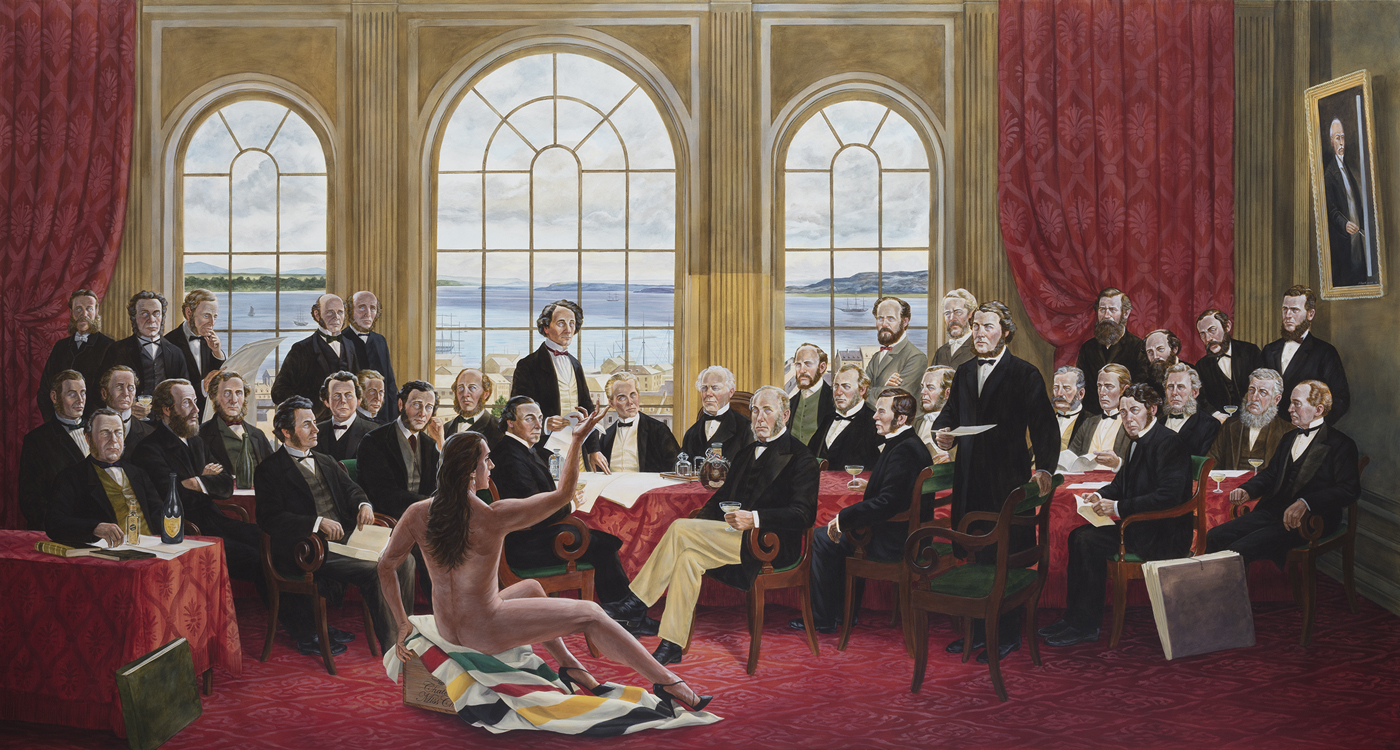
As Cree Artist Kent Monkman's stunning 2016 painting The Daddies reminds us, with its insertion of a trickster drag queen among a familiar portrait of the Fathers of Confederation, Indigenous representatives were not to be found among them. As Monkman describes the remarkable work:
It was a pretty deliberate effort to have people reflect on the last 150 years in terms of the Indigenous experience…. Canada's 150 years old—what does that mean for the First People? When I thought about it, I thought it includes the worst period, because it goes all the way back to the signing of the treaties, the beginning of the reserve system, this legacy of incarceration, residential schools, sickness, the removal of children in the ’60s, missing and murdered women. (cited in Morgan-Feir, Reference Morgan-Feir2017)
In making graphically visible that which has been absented and suppressed from the leading image of Confederation, Monkman's painting provides great insight into the kinds of issues that will confront us in the teaching and research of Canadian politics in the decades ahead, just as these issues will confront the Canadian state.
The Daddies, by Kent Monkman (2016) is a 60” by 112.5” acrylic on canvas.
Credit: Kent Monkman
Whether we are prepared or not may really depend not only on how we narrate the history of Canadian political science in light of the complicity of CPSA's foundational leaders in settler-colonial and racialized power in the way “knowledge” was framed, but also in whether and how we engage with multiple knowledges. As I have tried to describe, Canadian political science has become increasingly heterogeneous in organizational, ideational and even demographic terms. We still act as if it has a core, because we still talk about Canadian political science, and in fact the March 2017 special issue of Canadian Political Science/Revue candienne de science politique is devoted to just that. However, what is concerning is how the knowledges of, or about, those who were absented from the foundation of organized Canadian political science are often seen to have not made a serious dent in the core of the discipline in Canada. In other words, there are lingering ideational hierarchies that may bring to mind the founding era of Canadian political science.
Consider the following. In her recent 2015 presidential address, Jill Vickers argued that despite growing numbers of women in the profession, and a body of feminist knowledge, little has changed in what she terms conventional political science (Vickers, Reference Vickers2015: 747–48). Erin Tolley (Reference Halperin2017) echoes this in relation to CPSA conferences, where work on gender appears to operate in a silo. This is concerning because feminist scholarship has been distinctly attuned to multiple forms of difference and intersectional theorizing and therefore human complexity (see, for example, Hankivsky, Reference Hankivsky2014; Vickers and Issac, Reference Vickers and Issac2012).
Concerns are also voiced with respect to the place of other bodies of knowledge. Addressing the period 1995–2005, François Rocher (Reference Rocher2007) finds that the knowledge produced by francophone scholars, which analyzes more than Quebec, is rarely incorporated in English-language articles or books dealing with Canada. This can produce a kind of cultural imperialism in which an entire body of scholarship is ignored in the representation of Canadian society (Rocher, Reference Rocher2007: 838). In 2017, Jean-François Godbout, the French language editor of Canadian Journal of Political Science/Revue canadienne de science politique, noted that the most cited article in English since the journal's inception has more than four times the number of citations as the most cited one in French (4–5). While he suggests reasons for publishing in French, he also notes that English-speaking political scientists cannot be relied upon to cite in French (10). François Rocher and Daniel Stockemer also highlight the strategic choice francophones face and negotiate between publishing in their mother tongue and English because citations are likely to be higher if presented in the lingua franca of English (Reference Godbout2017: 97–101). Since citations now affect university rankings in the current era of a globalization of indicators, such pressure may feed a form of monolingualism in the discipline that squelches knowledge at both the domestic and international levels (Rocher and Stockemer, Reference Rocher and Stockemer2017). This also may also feed into older practices that favour angloconformity in Canada.
Back in Reference Wilson1993 Vince Wilson drew attention to the salience of race and racism in the study of Canadian political science, yet still well into the new century Debra Thompson (Reference Thompson2008) and Nisha Nath (Reference Nath2011) were observing gaps and silences in how the discipline deals with race.
Yet another example, that is especially pertinent in Canada as a settler colony, is the place of Indigenous knowledges. This is because how we engage with Indigenous knowledges is critical to avoiding the reinscription of Orientalist logics in new ways. However, Rauna Kuokannen has highlighted how reigning epistemological practices in the Western academy have deep roots in modernity, colonialism and liberalism, and work to exclude other epistemologies and ontologies, and in particular Indigenous worldviews and philosophies. In her striking words “At one time, colonial racial ideology postulated that indigenous peoples were intellectually inferior; now it is indigenous epistemes that are considered inferior, not worthy of serious intellectual consideration” (Kuokannen, Reference Kuokkanen2007 :3).
What really counts as “knowledge” in Canadian political science? This is, of course, a question that may have epistemological, methodological and theoretical dimensions. It may have ideological dimensions. It may also have dimensions relating to structures and power that pose manifold barriers and constraints, as well as potential consequences that may be unevenly born by political scientists depending on their position in academic and social hierarchies. While recognizing all these real features of power and control, still in the final analysis the reality is that what counts as “knowledge,” as well as what venues are valued in the dissemination of knowledge and who is served by knowledge, are all governed by choices. Even in the neoliberal university we still choose what we read, whom we talk to, whom we listen to and whom we cite. We can challenge ourselves to read in another language, or hang out on a different branch (in that tree of multiple knowledges) than that to which we are accustomed.
Intellectual curiosity is central to our agency.
Intellectual curiosity enhances the research process.
And intellectual curiosity can also form a starting point for saying no to power.
Conclusion
I will conclude by returning to the history of Canadian political science, which has a distinctive longevity in global terms, and one that should and will continue as far as I can see. Because of this, I believe acknowledging the exclusions or racism of some foundational leaders or certain formative ideas can be constructive. So too is thinking about what historical ideas may still inspire. The CPSA was founded with the still compelling goals of providing insight into Canada and contributing ideas to the world. Attending to both the shortcomings and the vision may serve as a gateway to more mindfulness about our present and future.
At the sesquicentennial we now have access to multiple ways of knowing Canada, including ones based on comparative work, ones attuned to globalization and the international system and ones finding inspiration from the many lived experiences individuals may have before they even enter a political science course.
One challenge going forward is to actually see the many branches of knowledge, and from there to consider how they connect to each other and what this says about social and political life. This challenge is not unique to Canadian political science. There are parallels in other political science traditions and internationally.
If Canadian political science was at heart a national venture that came to be defined by multiple knowledges, then mindfully making space for new conversations across branches of Canadian political science is actually central to understanding Canada now. New conversations within the discipline are always possible because we have choice and because what we do is ongoing. Collectively thinking about and enabling processes that may foster and reflect on such exchanges is exciting. And if we can do it more consciously and better, this may even provide a roadmap for elsewhere in the world.
In short then, at the dawn of the sesquicentennial era of political science, our multiple knowledges are there. They beckon. They demand serious engagement and exchange. And multiple knowledges are also key to potentiating the original aim of organized political science: to understand Canada and to contribute to the world.

 Open access

