

Introduction
In recent years, the world’s attention was gripped by mass protest movements agitating for social and political change. From the Arab Spring to Black Lives Matter to the Yellow Vests, large crowds mobilized to demand greater representation, equality, and social justice. Inspired by such events, scholars of conflict processes have turned to the systematic analysis of the determinants and consequences of nonviolent resistance (Chenoweth and Cunningham Reference Chenoweth and Cunningham2013; Chenoweth and Stephan Reference Chenoweth and Stephan2011; Nepstad Reference Nepstad2011). The central, oft-cited finding of this literature is that nonviolent campaigns are far more effective than violent campaigns in achieving their stated goals (Chenoweth, Pinckney, and Lewis Reference Chenoweth, Pinckney and Lewis2018; Chenoweth and Stephan Reference Chenoweth and Stephan2011). The primary explanation for this finding is that nonviolent campaigns possess what Chenoweth and Stephan (Reference Chenoweth and Stephan2011, 24) call a “participation advantage”—barriers to mass participation in nonviolent resistance are much lower, leading to larger and more resilient movements, making opposition more costly and, consequently, increasing their likelihood of success. The policy implications of this finding are significant: if nonviolence is a far more effective means of social and political change, then reduction in violence becomes not only a moral choice but a strategic imperative.
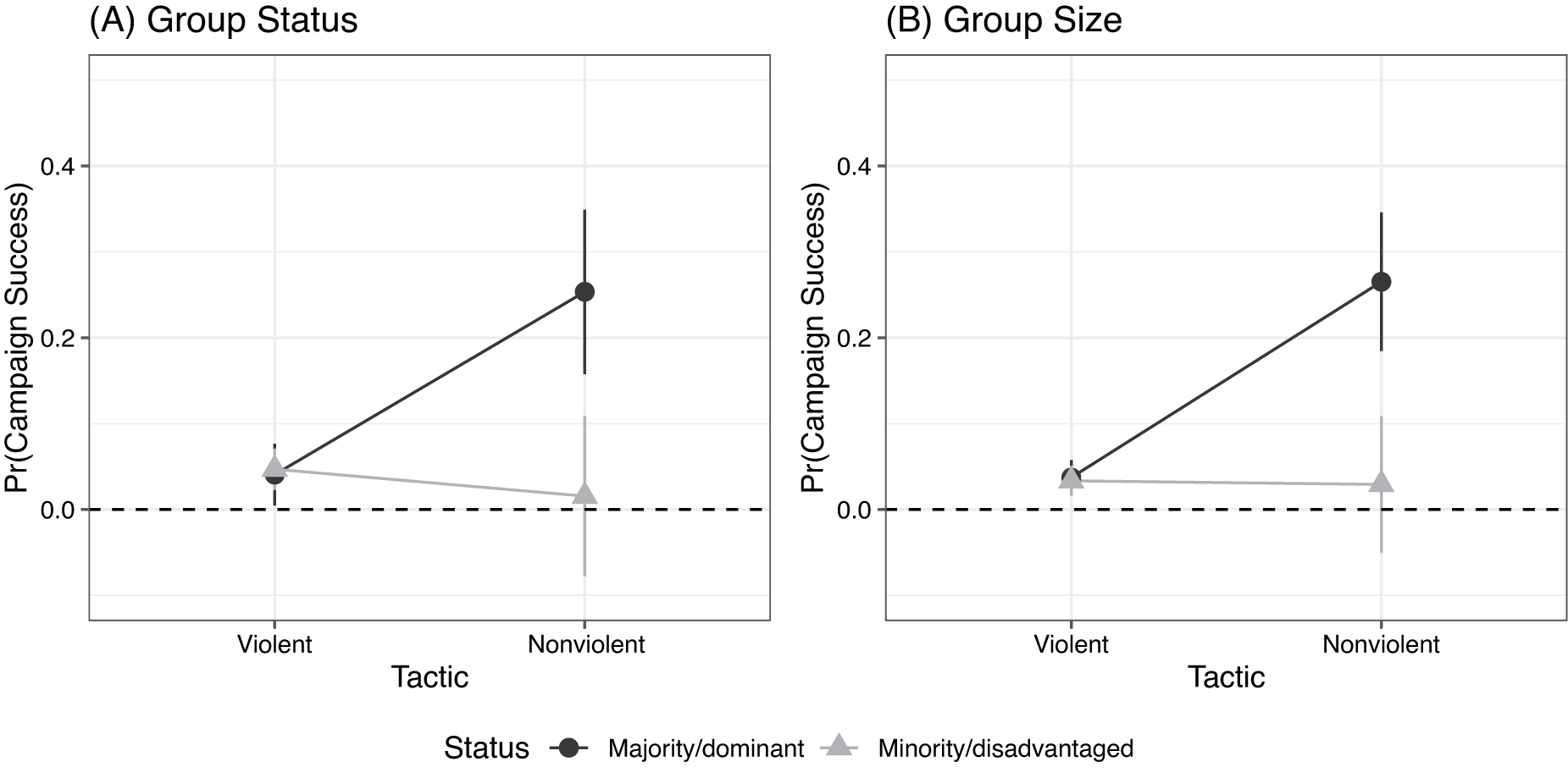
Yet a closer look at the data used to produce these findings reveals that nonviolent resistance is not equally effective for everyone. Figure 1 presents our results when we replicate the analysis in Chenoweth and Lewis (Reference Chenoweth and Lewis2013), adding one additional variable, ethnic group identity, and interacting it with campaign tactic (violent vs. nonviolent). Drawing on the Ethnic Power Relations (EPR) dataset (Vogt et al. Reference Vogt2015), we use two alternative indicators to measure ethnic group identity: group political status (included vs. excluded), shown in Panel A, and group size (majority vs. minority), shown in Panel B.Footnote 1 The figure shows that the effectiveness of nonviolent resistance crucially depends on group ethnicity, with minority/disadvantaged ethnic groups far less likely than majority/dominant groups to successfully achieve their goals using nonviolent campaigns.Footnote 2 Though a shift to nonviolence provides a large advantage to majority groups, for minority groups violent and nonviolent strategies have similarly low likelihoods of success. These patterns pose an important challenge to the growing empirical literature on the strategic benefits of nonviolence in mass mobilization. Our findings suggest that these benefits may not accrue to some groups, raising a major empirical puzzle: for whom is nonviolence more effective, and why?
Probability of Campaign Success by Ethnic Group Identity and Tactic
Note: The figure plots the probability of success of violent and nonviolent campaigns by group status and size (see Footnote footnote 1 for description of data).
The answer, we argue, lies in the important but understudied role of ethnic group identity in shaping public perceptions of nonviolent resistance. Drawing on an extensive literature on negative racial and ethnic stereotyping in social psychology, which finds that members of minority ethnic groups are often associated with violence and threat, we argue that when such groups engage in nonviolent resistance, they may nevertheless be perceived by observers as more violent than their dominant-group counterparts, thereby alienating audiences rather than mobilizing them and undermining what is posited to be the key advantage of nonviolent campaigns—their attraction of widespread participation. Consequently, the ability of minority groups to capitalize on the theorized benefits of nonviolence is reduced, raising questions about the availability of nonviolent resistance strategies to disadvantaged groups and suggesting caution regarding general, optimistic claims as to their efficacy.
Yet despite the important implications of this argument, it has not yet been examined directly. The literature on the effects of race and ethnicity on political and criminal justice outcomes is vast, but its insights have rarely been engaged in the recent empirical literature on nonviolent campaigns and civil resistance. A recent exception is Pischedda (Reference Pischedda2020), who, consistent with the argument here, shows that when nonviolent challengers belong to a different ethnic group than the incumbent regime, they are far less likely to succeed. Similarly, Svensson and Lindgren (Reference Svensson and Lindgren2011) find that, in nondemocracies, unarmed insurrections are less likely to succeed when the insurgent movement’s ethnic identity differs from the government’s, or when a state is ethnically polarized. These studies highlight the important role of ethnicity in contributing to campaign outcomes. However, they focus on structural ethnic cleavages rather than ethnic power hierarchies and do not show the conditional effect of tactics on outcomes, focusing on nonviolent campaigns instead. More directly related to our study is Thurber (Reference Thurber2018), who finds that politically excluded and small ethnic groups are less likely to initiate nonviolent campaigns due to pessimism about their ability to attract mass participation or induce elite defections. While the theoretical logic is related, that study examines campaign onset rather than campaign effectiveness. More generally, these studies rely on analysis of cross-national observational data, and so have not been able to provide direct evidence of a negative stereotyping mechanism that could inhibit the success of nonviolent campaigns by minority groups.
The core finding in Figure 1, showing that the effects of campaign tactics on outcomes depend crucially on ethnic power hierarchies, motivates our study. Proceeding from this observation, we present and test our argument that nonviolent resistance by minority or disadvantaged ethnic groups is perceived by the observing public as more violent and requiring more repression than nonviolent resistance by majority or dominant groups. We draw on two experimental studies in the United States and Israel, conducted in very different circumstances in terms of the salience of racial and ethnic protests. In Study 1, conducted in early 2019, we presented respondents with a hypothetical protest vignette and manipulated two of its features: protester identity and protest tactic. In the US, we randomized whether the protesters were Black or white, and in Israel, we randomized whether they were Arab Palestinian citizens of Israel, Jewish Israelis of Ethiopian origin, or white Israeli Jews.Footnote 3 In both settings, we randomized three tactic levels: marching in the streets, marching and blocking traffic, and destroying property.
Study 2 was conducted over a year later, in June 2020, during the wave of racial justice protests that swept across the United States following the police murder of George Floyd. This protest wave allowed us to test whether group identity affects perceptions of protesters even when they mobilize around the same goals. Extending Study 1, Study 2 focuses on nondisruptive tactics only (marching in the streets) and in addition to protester identity randomizes two additional factors: the goals of the protest (against racism and police brutality or against layoffs) and whether or not protesters explicitly state their commitment to nonviolence.
We find a strikingly similar pattern for all groups examined. Results from Study 1 show that when protesters are depicted as violent (destroying police cars or garbage cans), their ethnic identity has no significant effect on audience perceptions. However, when tactics are peaceful, minority protesters, whether African American, Ethiopian Israeli, or Arab Israeli, are perceived as more violent and requiring more police action than members of the majority group. Study 2 replicates these results, finding strong and significant negative effects when minorities mobilize against racism and police brutality issues and, in Israel, also when minorities mobilize around general issues, such as protesting layoffs. It further finds that emphasizing protester commitment to nonviolence has a positive influence on public perceptions, but this effect applies mostly to majority groups. Taken together, these findings underscore how the mobilizing power of nonviolence varies considerably by group identity.
In both studies we also empirically investigate our proposed mechanism—namely, that negative stereotyping drives disparate attitudes toward minority and majority protesters. After asking respondents whether they approve or disapprove of the way the protesters expressed their concerns, we asked them to explain their decision in an open-ended format. This technique has two advantages: First, it allows respondents to explicitly state the mechanism driving their choice in their own words. Second, we believe it presents advantages in terms of social desirability bias, notoriously challenging in the measurement of racial prejudice (Huddy and Feldman Reference Huddy and Feldman2009). The open ended-format is less direct than a specific close-ended one, yet it arguably allows for more “authentic” associative reasoning. Using both qualitative and automated text analysis to study these responses, we find that attitudes toward nonviolent protests by minority and majority groups are associated with significantly different descriptions, which generally attribute violence to minorities. This revealing evidence provides additional support for our argument.
Our findings contribute most directly to the rapidly growing empirical literature on nonviolent resistance (Braithwaite and Braithwaite Reference Braithwaite and Braithwaite2018; Chenoweth and Cunningham Reference Chenoweth and Cunningham2013; Chenoweth and Stephan Reference Chenoweth and Stephan2011). Recent studies in this field have highlighted various factors that are linked with the onset of nonviolent campaigns (Chenoweth and Ulfelder Reference Chenoweth and Ulfelder2017), government responses to them (Chenoweth, Perkoski, and Kang Reference Chenoweth, Perkoski and Kang2017), and their effectiveness (Celestino and Gleditsch Reference Celestino and Gleditsch2013; Chenoweth and Stephan Reference Chenoweth and Stephan2011). We contribute to this literature by focusing on the moderating role of ethnic identity in shaping perceptions and effectiveness of nonviolent resistance. In line with recent calls to disaggregate the study of nonviolent campaigns (Braithwaite and Braithwaite Reference Braithwaite and Braithwaite2018), we turn to the micro level for causal leverage, employing an experimental design that allows us to isolate the effects of ethnic identity while ruling out potential confounders.
The findings in this article also contribute to the literature on ethnic conflict more broadly, by revealing an important contrast between violent and nonviolent ethnic mobilization. Scholars of civil war have found that ethnic groups are more likely to initiate civil conflict than other types of groups (Blattman and Miguel Reference Blattman and Miguel2010; Denny and Walter Reference Denny and Walter2014). Denny and Walter (Reference Denny and Walter2014) attribute this pattern to the greater ease with which ethnic-based rebel groups are able to mobilize support and maintain cohesion by drawing on shared ties with their coethnics. Yet while in-group ties can facilitate violent mobilization, nonviolent mobilization is more likely to be sustained and succeed through mass, cross-cutting support, creating challenges for activists seeking to address ethnic grievances.
Our findings also add to a literature on the political consequences of negative stereotyping and prejudice. This literature builds on extensive research in social psychology, which has for decades documented a stereotype of Black Americans as associated with violence and crime (e.g., Eberhardt et al. Reference Eberhardt, Phillip, Valerie and Paul2004). Lab experiments have shown, for example, that Black people are perceived as more violent or threatening than whites when perpetrating the same mildly aggressive behavior (Duncan Reference Duncan1976) and that they are more likely to be shot at (and shot faster) in shoot/don’t shoot simulations (Correll et al. Reference Correll, Park, Judd and Wittenbrink2002). Political scientists have drawn on such findings to examine how racial stereotypes affect outcomes such as support for political candidates (Krupnikov, Piston, and Bauer Reference Krupnikov, Piston and Bauer2016; Weaver Reference Weaver2012) and attitudes toward policies on crime, welfare, and education (Feldman and Huddy Reference Feldman and Huddy2005; Gilens Reference Gilens1996; Peffley and Hurwitz Reference Peffley and Hurwitz2002). We expand this literature to the domain of nonviolent resistance, a particularly pressing issue for both scholars and activists, and add a comparative case to the existing focus on the United States.
Finally, our results point to the importance of analyzing public opinion as a mechanism for the effectiveness of nonviolent mobilization (see also Wasow Reference Wasow2020). As Davenport, McDermott, and Armstrong (Reference Davenport, McDermott, Armstrong and Bonner2018, 169) observe, “the narratives that emerge from contentious events can profoundly influence future notions of what is acceptable and what is not, as well as of who should be held accountable for what transgressions and how.” The implicit or explicit influence of ethnic identity on public perceptions of nonviolent campaigns can thus have a far-reaching effect on the movement’s ability to mobilize support and, ultimately, on its likelihood of successfully achieving its goals.
Protester Identity and Nonviolent Resistance
Until recently, the study of nonviolent resistance had largely been neglected by conflict scholars. As Chenoweth and Cunningham (Reference Chenoweth and Cunningham2013, 272) observe, scholarship on nonviolent struggle tended to be “primarily applied, descriptive, or normative” rather than empirical. In recent years, however, a wave of empirical research has emerged on nonviolent strategies (see Nepstad Reference Nepstad2015; Schock Reference Schock2013 for reviews). An important finding from this research, based on the pathbreaking work of Chenoweth and Stephan (Reference Chenoweth and Stephan2011), is that nonviolent campaigns are far more likely than violent ones to succeed in achieving their goals. This effectiveness is posited to be a consequence of the increased appeal of nonviolent campaigns, which engenders a participation advantage: nonviolent resistance, the logic goes, attracts more domestic and international support, winning over bystanders and causing defections among status quo supporters (Chenoweth and Stephan Reference Chenoweth and Stephan2011, Reference Chenoweth and Stephan2014).
Though much of the work in this area has relied on aggregate, cross-national data and therefore could not provide direct evidence for this mobilization mechanism, recent experimental work has generated a wealth of evidence in a range of empirical contexts (Arves, Cunningham, and McCulloch Reference Arves, Cunningham and McCulloch2019; Feinberg, Willer, and Kovacheff Reference Feinberg, Willer and Kovacheff2020). Huff and Kruszewska (Reference Huff and Kruszewska2016), for example, conduct a survey experiment in Poland and find that respondents are less supportive of government negotiations with groups that bomb government buildings than groups that employ nonviolent tactics. Simpson, Willer, and Feinberg (Reference Simpson, Willer and Feinberg2018) find that the use of violent protests by otherwise popular groups (antiracist protests against white nationalists) reduces their public support and increases support for their opponents. Muñoz and Anduiza (Reference Muñoz and Anduiza2019) find that violent riots reduced support for the Spanish 15-M movement, primarily among those who were not core supporters. This growing body of work provides compelling support for the mobilizing effects of nonviolence, widely considered to be the key mechanism underlying the success of nonviolent campaigns.
Yet while the average effects of nonviolent protests on public attitudes are important, we argue that a focus on average effects obscures the important moderating role of group identity. Minority and disadvantaged ethnic groups often contend with biases and negative stereotypes that can limit their ability to attract public support, even through nonviolent means. Though the content of particular group stereotypes is context specific, a large literature suggests that numerous disadvantaged ethnic groups are stereotyped as violent or criminal (cf. Stewart et al. Reference Stewart, Ramiro, Eric and Marc2015). We focus on such stereotypes here.
The Effect of Ethnic Identity on Perceptions of Protester Violence
Though nonviolence is generally viewed in the empirical literature as a stable, objective category, a large literature suggests that perceptions of violence vary by identity group due to negative stereotyping. In the United States, for example, numerous studies have identified a prevalent automatic stereotype associating Black Americans with violence and criminality (Devine and Elliot Reference Devine and Elliot1995; Johnson and King Reference Johnson and King2017). Lab experiments show that individuals are more likely to misidentify benign objects as weapons and shoot suspects when primed to think of Black people (Correll et al. Reference Correll, Park, Judd and Wittenbrink2002; Greenwald, Oakes, and Hoffman Reference Greenwald, Oakes and Hoffman2003; Payne Reference Payne2001). Outside the lab, Peffley and Hurwitz (Reference Peffley, Hurwitz, Hurwitz and Peffley1998) find, using nationally representative survey data, that one in two Americans agree that most Black people are aggressive. Survey data show that prejudiced attitudes remain prevalent two decades later (Hutchings Reference Hutchings2009; Kinder and Ryan Reference Kinder and Ryan2017; Yadon and Piston Reference Yadon and Piston2019).
Negative stereotypes in the United States are not limited to African Americans. A number of studies have identified a stereotype of Muslims and Muslim Americans as violent and untrustworthy (D’Orazio and Salehyan Reference D’Orazio and Salehyan2018; Sides and Gross Reference Sides and Gross2013), and there is some evidence that Latino men are also stereotypically associated with violence and criminality (Welch et al. 2011). Relatedly, Timberlake and Williams (Reference Timberlake and Williams2012) find that immigrants from Middle Eastern and Latin American countries are rated as significantly more violent than immigrants from European and Asian countries.
Prejudice and negative stereotypes of minority ethnic groups extend, of course, far beyond the US (Dixon and Telles Reference Dixon and Telles2017; Pettigrew Reference Pettigrew1998). In the European context, much of the research has focused on analyzing public opinion toward immigrants, documenting various stereotypes associated with different groups (Hellwig and Sinno Reference Hellwig and Sinno2017). A number of studies, for example, find that anti-Muslim prejudice in Europe is significantly higher than prejudice against other foreigners or immigrants (Adida, Laitin, and Valfort Reference Adida, Laitin and Valfort2016; Spruyt and van der Noll Reference Spruyt and van der Noll2017; Strabac and Listhaug Reference Strabac and Listhaug2008). And in Latin America, studies have found evidence for negative stereotypes of Black people (Lehmann et al. Reference Lehmann, Cecilia, Alexa, Jessica and Marc2020; Peña, Sidanius, and Sawyer Reference Peña, Sidanius and Sawyer2004).
Returning to nonviolent resistance, we build on the large literature documenting the pervasiveness of negative stereotypes associating minority and disadvantaged ethnic groups with violence and hostility to formulate the following hypothesis:
H1: Nonviolent protests by members of minority ethnic groups are perceived as more violent than identical protests by members of majority ethnic groups.
The Effect of Ethnic Identity on Punitive Attitudes Toward Protesters
We expect the ethnic identity of protesters to also affect support for state repression. An extensive literature links stereotypes of minority groups as violent and criminal with support for more punitive policies (see Unnever Reference Unnever, Bucerius and Tonry2014, for a review). In the US, research finds that beliefs about race are the “single largest and most consistent predictor of crime policy preferences” (Lerman and Weaver Reference Lerman, Weaver, Bucerius and Tonry2014, 52), with majority whites more supportive of punitive justice policies than racial and ethnic minorities (Bobo and Johnson Reference Bobo and Johnson2004) and racial animus consistently associated with support for harsher criminal justice measures (e.g., Peffley and Hurwitz Reference Peffley and Hurwitz2002). Much of this work builds on group-based threat theories, which posit that the association between subordinate groups and criminality is a powerful means of maintaining dominant group power, allowing dominant group members to justify harsh policies that primarily target minority groups by claiming they are necessary to protect the innocent (Unnever Reference Unnever, Bucerius and Tonry2014).Footnote 4 A link between racial and ethnic animus and punitive attitudes has also been documented in Europe, Canada, Japan (Ousey and Unnever Reference Ousey and Unnever2012; Unnever and Cullen Reference Unnever and Cullen2010; Unnever, Cullen, and Jonson Reference Unnever, Cullen and Jonson2008), and Latin America (Lehmann et al. Reference Lehmann, Cecilia, Alexa, Jessica and Marc2020).
Of particular interest here is the study of public attitudes toward policing. In the United States, there is a substantial and growing race gap in opinions of the police (Weitzer Reference Weitzer2017). Studies show that race is a significant predictor of support for police use of force (Thompson and Lee Reference Thompson and Daniel Lee2004) and that racial prejudice among whites is associated with increased support for such force (Carter and Corra Reference Carter and Corra2016; Johnson and Kuhns Reference Johnson and Kuhns2009). Conversely, African Americans and, to a lesser extent, Latinos, are more likely to hold negative opinions of the police than whites (Weitzer Reference Weitzer2014) and to believe that police use excessive force frequently (Weitzer and Tuch Reference Weitzer and Tuch2004). These attitudes reflect real-life disparities: Black Americans are significantly more likely than whites to be stopped by the police, searched, and arrested (Braga, Brunson, and Drakulich Reference Braga, Brunson and Drakulich2019; Knox, Lowe, and Mummolo Reference Knox, Lowe and Mummolo2020).
Though less studied, racial and ethnic identity also matters for protest policing. In one of the few exceptions, Davenport, Soule, and Armstrong (Reference Davenport, Soule and Armstrong2011) analyze data on more than 15,000 protest events, finding that African American protests are more likely to involve police and that police are more likely to make arrests and use violence, though these effects vary over time. Moving beyond the US, the growing literature on repression of nonviolent protest has also largely neglected ethnic identity. A recent review of this literature highlights the broad finding that nonviolent dissent is likely to lead to less intense repression than violent dissent, but the question of whether and how ethnic power hierarchies affect these dynamics is not raised (Chenoweth, Perkoski, and Kang Reference Chenoweth, Perkoski and Kang2017). A handful of very recent studies have begun to uncover how ethnic exclusion can affect repression dynamics (Hendrix and Salehyan Reference Hendrix and Salehyan2019) and, in turn, the tactics of protesters (Rørbæk Reference Rørbæk2019).
Even less research addresses how the ethnic identity of protesters affects pubic opinion regarding protest policing. In an important exception, Davenport, McDermott, and Armstrong (Reference Davenport, McDermott, Armstrong and Bonner2018) argue that the identities of protesters, police, and the public matter in shaping attitudes toward confrontations between dissidents and the state. Drawing on a survey experiment that manipulates the identities of protesters and police officers, they find that whites are less likely than Blacks to blame police for a confrontation with protesters when the police are white and the protesters are Black. All of these findings suggest that observers will be more supportive of policing of peaceful minority protesters, generating the following hypothesis:
H2: Nonviolent protests by members of minority ethnic groups are perceived as requiring more police action than identical protests by members of majority ethnic groups.
Research Design
To test our hypotheses, we conducted two studies using online survey experiments in the United States and Israel. Study 1 was administered in the US in three waves between November 2018 and January 2019 on a sample of 2,269 respondents. The Israeli survey was conducted in two waves between February and March 2019 on a sample of 3,063 respondents. Study 2 was administered in June 2020 to a sample of 3,013 respondents in the US and 3,465 respondents in Israel.Footnote 5 The timing of the study allowed us to leverage what would become the largest wave of protests in US history to test our hypotheses at a dramatic historical moment.Footnote 6 Since public support for the protests was relatively high, it presents a hard case for our argument on racial stereotyping of peaceful protest.Footnote 7
We fielded the survey in two countries to increase the external validity of our study and ensure our findings are not artifacts of a particular case. We chose the US and Israel because both have recently witnessed nonviolent campaigns with varying levels of success by different ethnic groups with diverse histories of marginalization. In the US, the Black Lives Matter movement has organized protests since 2013 to protest police violence and racial injustice more broadly (Williamson, Trump, and Einstein Reference Williamson, Trump and Einstein2018). Though a salient case—most of the literature on negative stereotyping and punitive attitudes has focused on African Americans—it is arguably also a unique one given the legacy of racial oppression in America. The argument that we make is general and should thus apply to any context in which minority groups are negatively stereotyped as threatening.
Therefore, we also examine two minority groups in Israel: Israeli Arabs and Jewish Israelis of Ethiopian origin. The relationship of the two groups to the white Jewish majority differs considerably. The Arab minority is mostly Palestinian and, therefore, though holding Israeli citizenship, also relates to the Jewish majority through the lens of the Israeli-Palestinian conflict. In contrast, the Ethiopian minority is Jewish and immigrated to Israel with substantial government investment and support. Nevertheless, both groups have been involved in longstanding nonviolent resistance campaigns. Arab Israelis have organized to protest discrimination by the Israeli government, especially related to land expropriation and house demolitions.Footnote 8 Ethiopian Israelis have mobilized against police violence and discrimination.Footnote 9 Given the many differences between these three groups, consistent findings across all cases would strengthen the generalizability of our experimental findings.
Study 1: Ethnic Group Identity and Protest Tactic
Experimental Design
We presented respondents with simulated news articles, based on real articles, describing nonviolent activism. In the articles, we randomly varied the identity of the protesters between dominant and disadvantaged groups as well as the tactics employed in the campaign. In the US survey, protester identity included two conditions: white (majority) and Black (minority); in the Israeli survey there were three conditions: white Jews (majority), Ethiopian Jews (minority), and Israeli Arabs (minority). In both surveys, the tactics arm consisted of three levels that varied from least to most intense: marching in streets, shutting down traffic, and destroying property.Footnote 10 This generated a 2 × 3 factorial design for the American survey and 3 × 3 design for the Israeli survey. Balance tests, reported in Section 3.4 of the SI, indicate that demographic covariates are balanced across conditions.
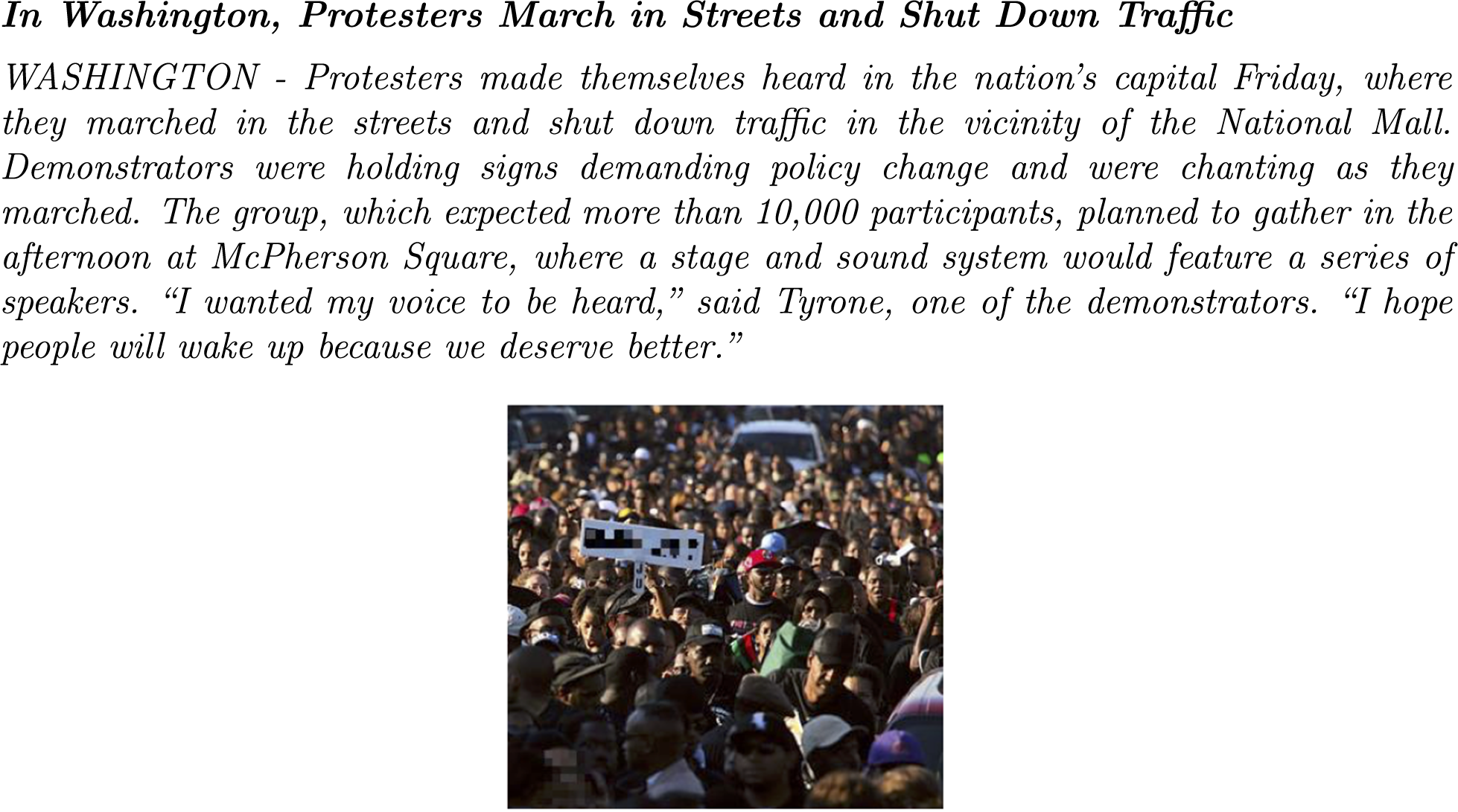
In the US survey the vignette signaled racial identity by using distinctive namesFootnote 11 as well as a photo of a protesting crowd.Footnote 12 In the Israeli survey, reflecting news coverage of actual protests, the group’s identity is noted in the article title. We manipulate tactic because nonviolent resistance can refer to a wide repertoire of behaviors, some of which may be considered nonviolent by those who campaign and violent by audiences (Chenoweth Reference Chenoweth and Johnston2019). Figure 2 shows an example of a vignette from the American survey, where the identity condition was Black protesters and the tactic was shutting down traffic.Footnote 13
Example of a News Article Vignette
We then asked questions relating to our two outcomes: perceptions of protester violence and perceptions of the extent to which police action is required. We measure perceptions of protester violence with two indicators. First, we ask respondents to indicate, on a scale of 0–10, where 0 is completely nonviolent and 10 is extremely violent, how violent they would say the protest was. Second, after asking all our outcome measure questions, we provided respondents with a list of tactics and asked them to check all the tactics that were used by the protesters.Footnote 14 The advantage of this measure is that it allows us to indirectly probe whether audiences actually remember minority protesters as more violent than their majority counterparts. To measure perceptions of whether police involvement is required, we ask respondents to indicate, on a scale of 0–10, to what extent they believe police action is required to address this protest.
Study 1 Results
Table 1 reports the main effects of our two treatments, ethnic identity and tactic, on each of our dependent variables.Footnote 15 The base categories in all regressions are whites (ethnic identity) marching in the street (tactic). Thus the “intercept” row in each panel reports the baseline level of each condition. Unsurprisingly, the main effects of tactic are substantial and significant: as tactics become more violent, perceptions and recollections of violence increase as well as belief that police action is required. More importantly for our purposes, though, we find a positive and significant main effect for minority identity.
Group Identity and Protest Tactic
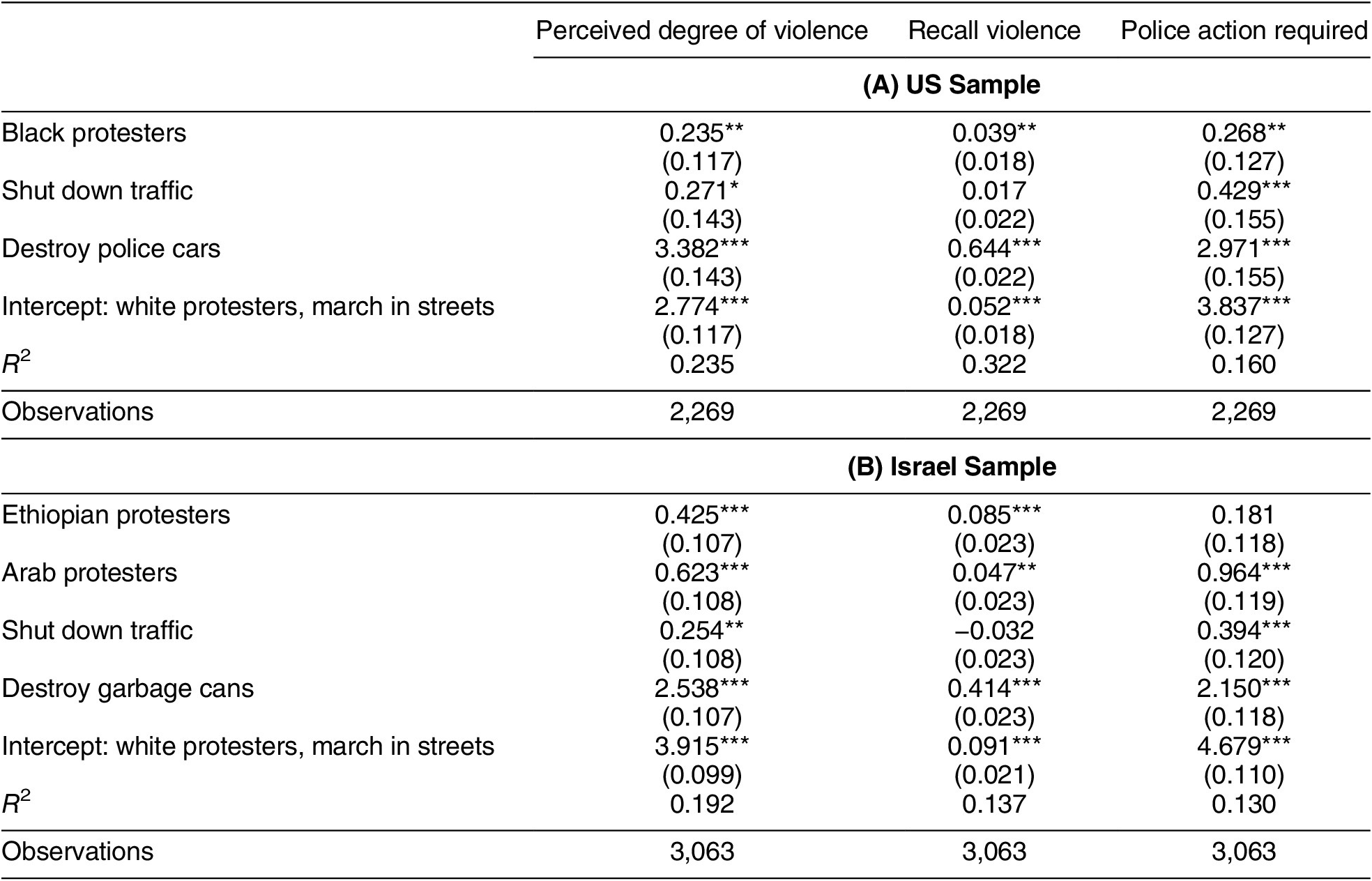
Note: OLS regressions of the dependent variables reported in the columns on protesters’ ethnic identity and tactic. *p < 0.10, ** p < 0.05, *** p < 0.01.
Panel (A) presents the results for the US sample. We find that, on average, Black protesters significantly increase the degree to which nonviolent protests are perceived as violent. Moving from the baseline condition, which reflects white protesters marching in the streets, to Black protesters marching in the streets, increases perceptions that protests are violent by 8.5% (0.235/2.774 = 8.5%). We find even stronger results for our violence recollection measure, with Black protesters marching in the streets recalled as being significantly more violent than whites engaging in the same activity, a 75% change (0.039/0.052 = 75%). Column (3) shows that respondents are also significantly more likely to believe that police action is required against nonviolent Black protesters.
Panel (B) reports results for the Israeli sample. We find patterns similar to those in the US sample, whereby minority protesters significantly increase perception and recollection of the protests as violent. When compared with white protesters marching in the streets, Ethiopian and Arab protesters engaging in the same activity are seen as 11% and 16% more violent and are 93% and 52% more likely to be recalled as violent, respectively. As in the US sample, public support for police action against the protesters is significantly higher when protesters are Arab, an increase of 21%. For Ethiopian protesters, the effect is in the expected direction but is not statistically significant.
Though the patterns in both samples are generally similar, the size of the effects differs across minority groups. In Israel, Arab protesters exercise a larger effect on perceptions of violence and, especially, on belief in the necessity of police action, than Ethiopian protesters. This is not surprising, as we would expect effect sizes to vary depending on stereotype content and the particular configuration of exclusion experienced by different groups.
In order to evaluate whether the tactics employed by protesters affect how identities shape public perceptions, we next examine the interaction of ethnic identity and tactic. Figure 3 reports the conditional effects of ethnic identity and tactic on perceptions of violence, where the baseline is the dominant group in each country. The overall pattern that emerges is that ethnic identity exercises a greater effect as the tactic becomes less violent. Beginning with the US sample (top panel), we find that when protesters are destroying police cars there are differences neither in the levels of violence attributed to Black and white protesters nor in the degree to which they require police action. Rather, identity exercises the strongest effect when the protest is peaceful. We do not find significant effects of identity on recalling violence in the US sample.
Conditional Effects of Ethnic Identity and Tactic (Baseline: White Majority Group)
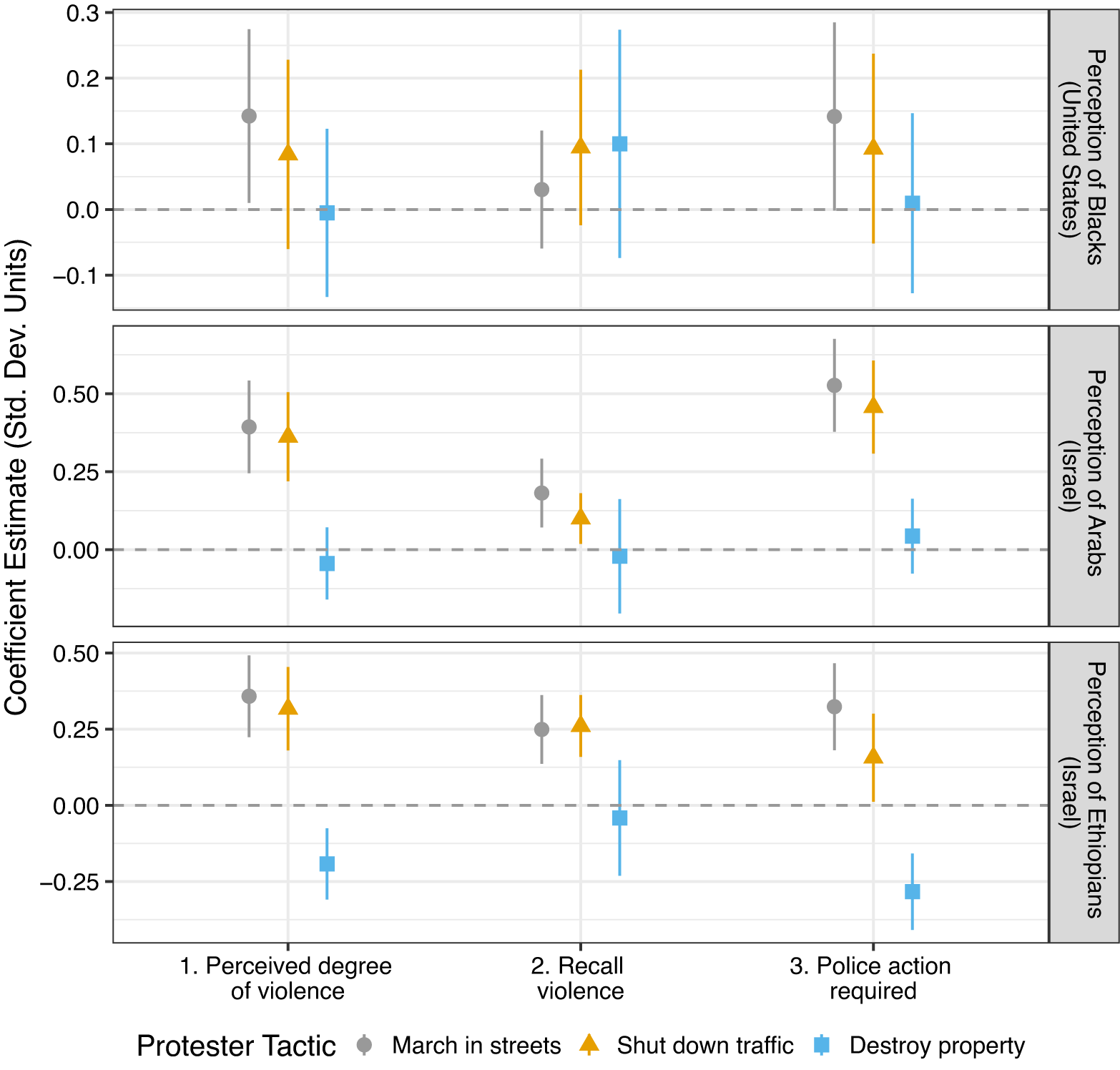
We find even stronger effects of ethnicity in the Israeli sample. Both Ethiopian and Arab Israelis are perceived as more violent, recalled as more violent, and believed to require more police attention than the white Jewish majority when protesting peacefully. The effects are strongest for the least disruptive tactic—marching in the streets—and just slightly smaller for shutting down traffic. The effects diverge somewhat for the more violent protests—destroying property. For Arab protesters, the pattern is similar to African Americans in the US—ethnic identity has no influence on perceptions of more violent protests. For Ethiopian Israelis, we find that protesters who destroy property are perceived as less violent and requiring less police action than white protesters. We delve deeper into this finding when we use open text responses to gain insight into the mechanisms driving these effects.
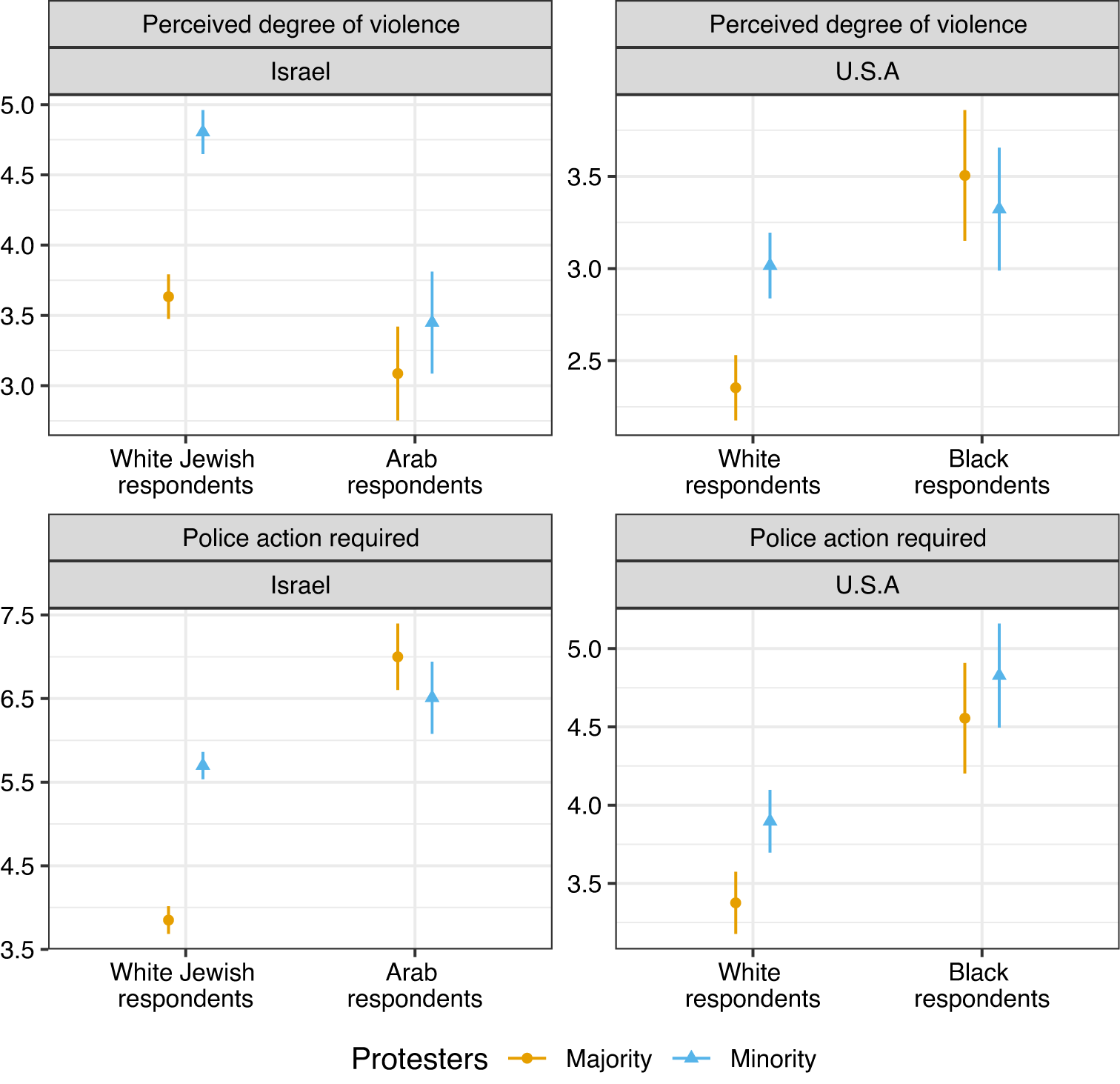
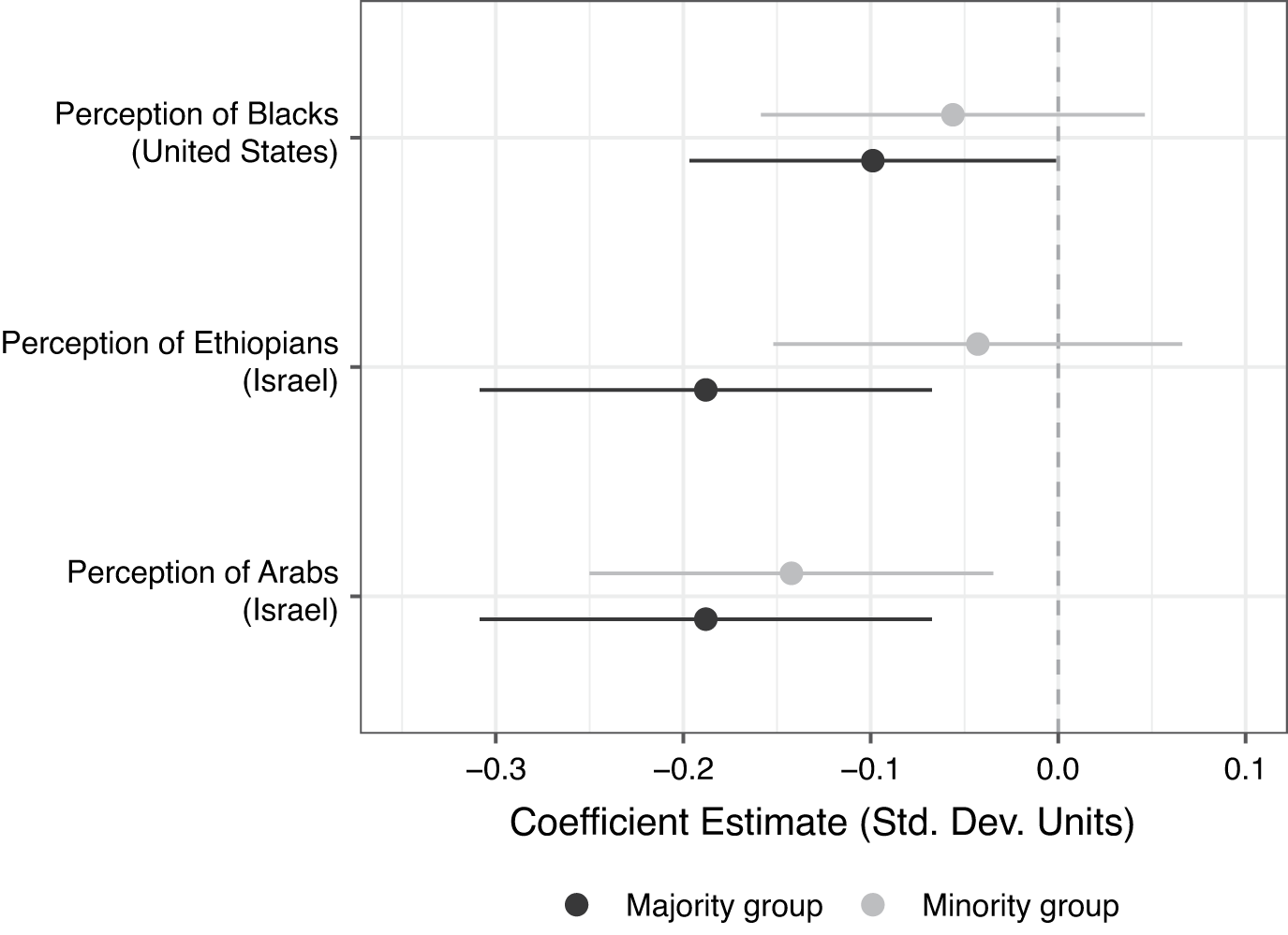
The results presented thus far report findings for the pooled sample. However, it is likely that the effects of ethnicity of the protesters vary based on the ethnic identity of respondents. Focusing on the nonviolent “march in streets” condition, Figure 4 shows the heterogeneity in perceptions of nonviolent protests by minority and majority groups.Footnote 16 We find a clear pattern, where protester ethnicity exercises significant influence on the perceptions of respondents from majority groups but not from minority groups.Footnote 17
Perceptions of Nonviolent Protests by Respondent Subgroup
Study 2: Ethnic Group Identity, Group Goals, and Commitment to Nonviolence
Study 2 was designed to complement Study 1 by addressing two questions raised by the experiment. One potential concern is that because the vignette in Study 1 did not specify what the protest was about, our findings may be driven not by the identity of the protesters but by the protest’s goal.
While analytically distinct, in practice this is somewhat of a false dichotomy. Though as individuals, minority group members are likely to hold grievances on a variety of issues, some of which doubtless overlap with grievances held by majority group members, when ethnic groups mobilize as a group, it is often around group-based issues. For example, in the merged NAVCO and EPR dataset (see Footnote footnote 1), excluded ethnic groups are seven times more likely to protest against occupation and for greater autonomy than dominant groups.Footnote 18 Thus, it is often difficult to separate the identity-based goal of the protest from the identity of the protesters. Nevertheless, from an empirical standpoint, we take a “bundle of sticks” approach to ethnic identity (Sen and Wasow Reference Sen and Wasow2016) and disaggregate it into two components for the purposes of experimental testing: group identity and group goals.
Ordinarily, it would be difficult to design an experiment examining whether majorities and minorities are perceived differently when protesting for minority-group goals because majority group members don’t often mobilize as a group around minority issues. However, this changed dramatically in the US in June 2020, when Black and white protesters mobilized, both separately and together, to protest police brutality and racial discrimination. We were thus able to examine this question directly.
A second question we investigate in Study 2 is whether protesters can shape public opinion by emphasizing their commitment to nonviolence. Our vignette in Study 1 described nonviolent tactics but did not explicitly note whether protesters claimed they were peaceful. If signaling commitment to nonviolence can reduce negative stereotypes of ethnic minority protesters, this offers both an avenue for change and can explain why some minority groups have historically taken great efforts to highlight their commitment to nonviolence.
Experimental Design
As in Study 1, we present respondents with simulated news articles. Respondents read a description of a protest in which we randomly varied the identity of the protesters, the protest goal, and whether protesters explicitly stated their commitment to nonviolence. As previously, in the US survey, protester identity was randomly assigned as white (majority) or Black (minority), and in the Israeli survey it was randomly assigned as white Jews (majority), Ethiopian Jews (minority), and Israeli Arabs (minority). Protest goal was randomly assigned as either general (protesting layoffs) or group-based (protesting racial prejudice and police brutality). Commitment was randomly assigned as either no explicit commitment or explicit commitment to nonviolent resistance.
In the US survey, as explained previously, we were able to leverage actual protest events so that both white and Black protesters could be depicted protesting general and group-based goals. In Israel (as would typically be the case elsewhere), we did not include a condition where white Israeli Jews protested, on their own, for Ethiopian or Arab minority goals, as that would not be a realistic scenario. Consequently, our US survey was a 2 × 2 × 2 factorial design, whereas the Israeli survey was a 3 × 2 × 2 factorial design with two conditions omitted (white Jews protesting for minority group-based goals with commitment, white Jews protesting for minority group-based goals without commitment), for a total of 10 experimental conditions. Balance tests, reported in Section 3.4 of the SI, indicate that demographic covariates are balanced across conditions.
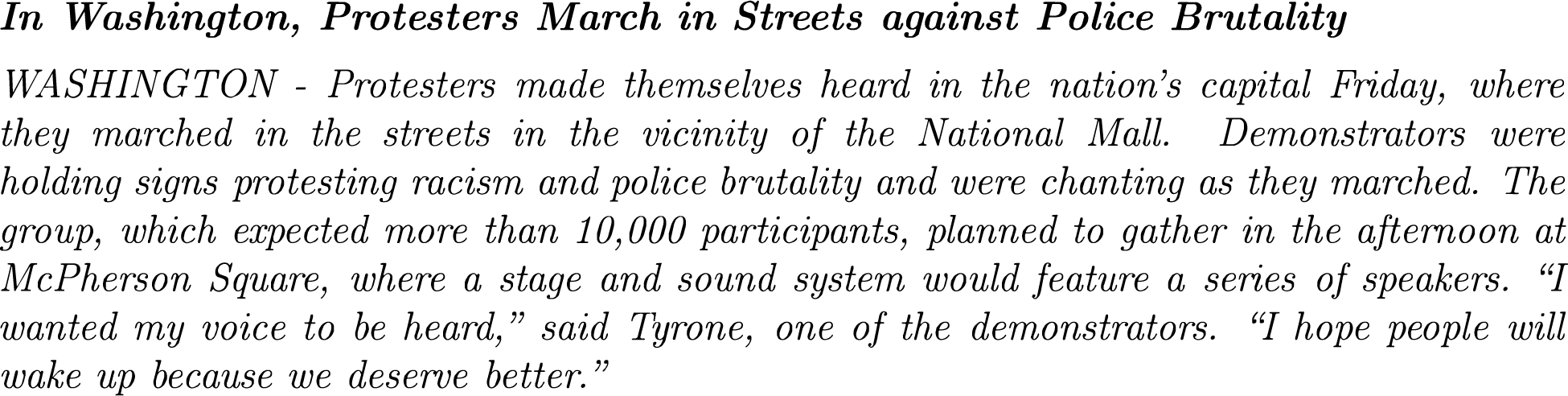
The vignettes were very similar to those used in Study 1, and they were accompanied by the same photos. Figure 5 shows an example of a vignette from the American survey in Study 2, where the identity condition was Black protesters, the goal was group-based, and protesters did not explicitly state their commitment to nonviolence.Footnote 19 All outcome measures are identical to Study 1.
Example of a News Article Vignette, Study 2
Study 2 Results
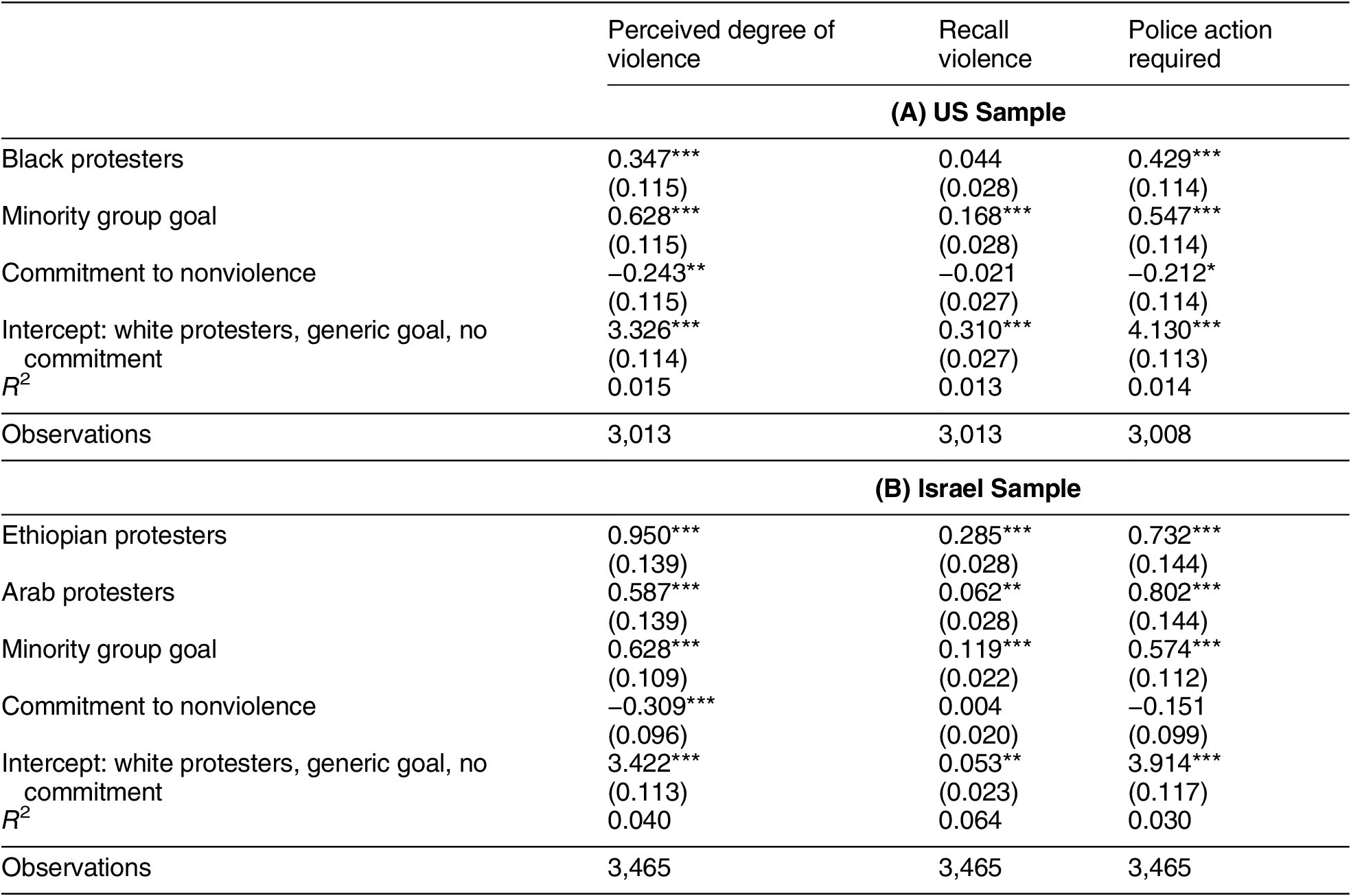
Table 2 reports the main effects of ethnic identity, protest goal, and protester commitment.Footnote 20 The base categories in all regressions are whites (ethnic identity) protesting layoffs (goal) without explicit commitment to nonviolence. Notably, we replicate our finding from Study 1, finding an identical pattern: ethnic minorities protesting nonviolently are seen as significantly more violent and requiring more police action than majorities engaged in the same activity. In the US, the change amounts to about 10% increase in the perceptions of Black protesters as violent, and in Israel the increase reflects a 17–28% change.
Group Identity, Protest Goal, and Commitment to Nonviolence
Note: OLS regressions of the dependent variables reported in the columns on protesters’ ethnic identity, protest goal, and protester commitment to nonviolence. *p < 0.10, ** p < 0.05, *** p < 0.01.
Moving to the effect of group goals, we find that protests about racial prejudice and police brutality are viewed as significantly more violent, recalled as more violent, and seen as requiring more police action than non-group-based protests about layoffs. In other words, both minority identity and minority issues are perceived as more violent and requiring more policing. The magnitude of the effect of group goal is almost identical in both the US and Israel, reflecting an 18% change. We also find that on average, commitment to nonviolence decreases perceptions of violence in both samples, but the effect is weaker and not statistically significant for some of the outcomes.
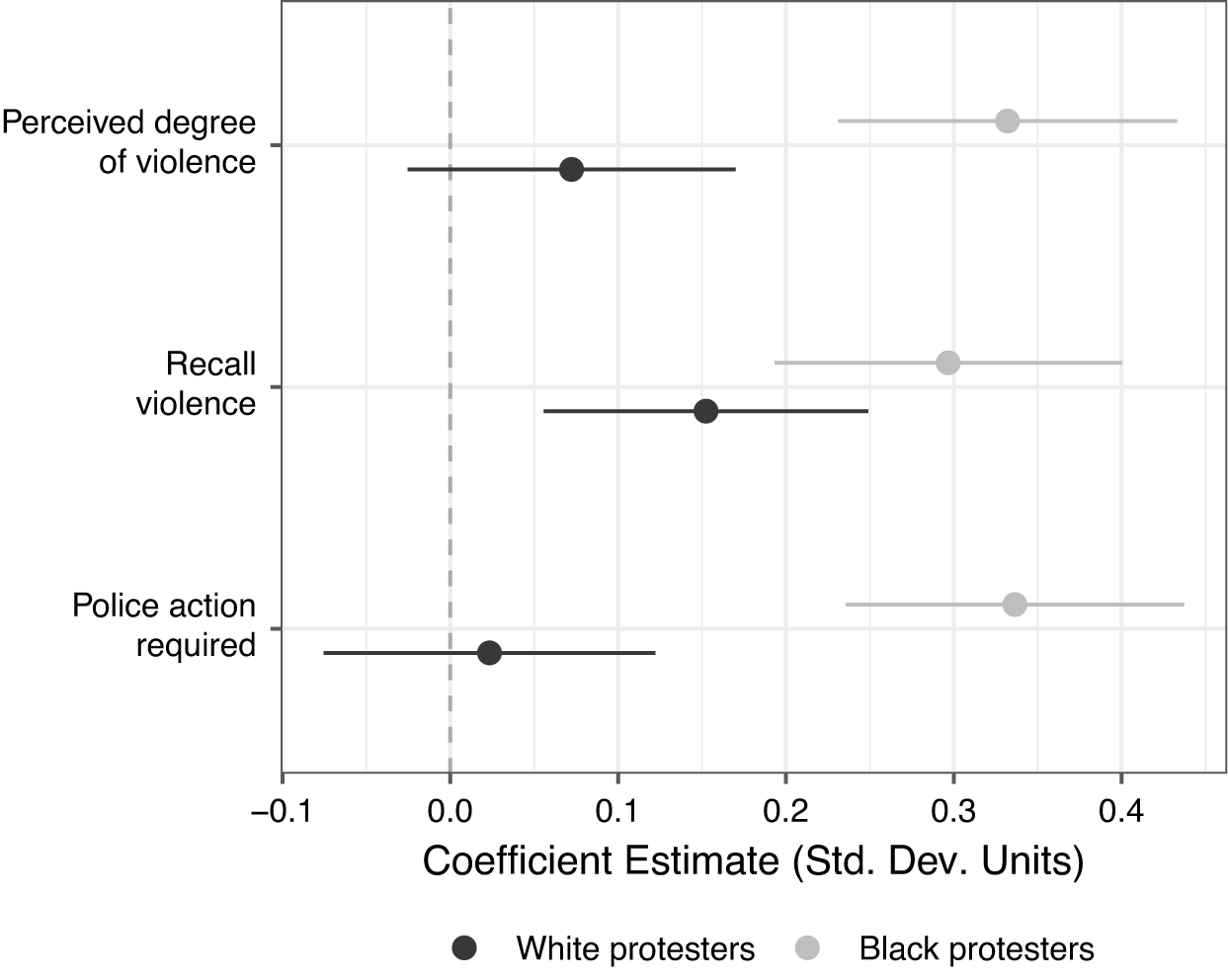
To assess how ethnic identity shapes perceptions while holding the goals of the protest constant, we examine the interaction of ethnic identity and goal. Focusing on the US, Figure 6 reports the effects of protesting for racial justice by ethnicity for each of our outcomes. We find that protesting for minority group issues does not significantly affect how white protesters are perceived: they are perceived neither as more violent nor as requiring more policing when protesting for racial justice. Black protesters, in contrast, are perceived as significantly more violent and requiring more policing when protesting nonviolently for the very same goals. This finding provides strong support for our argument, even in a context where majority-group members mobilized in large numbers to support Black Lives Matter.Footnote 21
Effects of Protesting for Racial Justice by Ethnic Identity
Next, we turn to the interaction between ethnic identity and commitment to nonviolence in order to examine whether explicitly emphasizing commitment to peaceful change has different effects for minority and majority group protesters. Figure 7 shows that signaling commitment is indeed an effective tool for white protesters (as well as for Arab protesters in Israel), significantly reducing the degree to which they are perceived as violent. However, for Black protesters in the US and Ethiopian protesters in Israel, this signaling effect, though in the expected direction, is not statistically significant. The results thus indicate that emphasizing the peacefulness of protests is of limited utility for at least some stereotyped groups. The effect of commitment to nonviolence on our other outcomes, recalling violence and the need for policing, does not follow a clear pattern and is reported in Section 3.5 of the SI.
Effects of Commitment to Nonviolence by Ethnic Identity
Mechanisms
The evidence presented in the previous sections supports both of our hypotheses, showing that, in general, minority groups are perceived as more violent and recalled as more violent than majority groups and are believed to require more policing. In this section, we illuminate the mechanisms underlying these effects by analyzing responses to an open-ended survey question. In both studies, we asked respondents whether they approve or disapprove of the way the protesters expressed their concerns. Consistent with our theory, we find that approval of nonviolent protests is higher for white protesters than Black protesters in the United States (59% vs. 55%) and higher for white protesters (87%) than Ethiopian or Arab protesters in Israel (83% and 48%, respectively). Next, we asked respondents to explain their response, in a sentence or two.
Focusing on reactions to nonviolent protest, we pool the open-ended responses in the two studies, using them as an indirect way to test our proposed mechanism that negative stereotyping drives attitudes toward minority nonviolent protesters. First, we illustrate via several qualitative examples the kinds of descriptions respondents used to explain their attitudes toward nonviolent protests by minorities. Table 3 shows that across all groups, respondents viewed nonviolent protests by minorities as violent, even though the vignette showed only nonviolent tactics. Respondents frequently justified their lack of support with statements such as “these were violent protests, and I do not support violence.” While some respondents acknowledged that the vignette that they read described a nonviolent protest, they nonetheless argued that minority protests tend to turn violent, as can be seen, for example, in a description of nonviolent protests by Arab Israelis, “Unfortunately, protests by the Arab population tend to escalate into violence and property damage,” or in the description of nonviolent protests by Black Americans, “These things always start with good intent and end in violence and people getting hurt.”
Descriptions of Minority Protesters Marching in the Streets
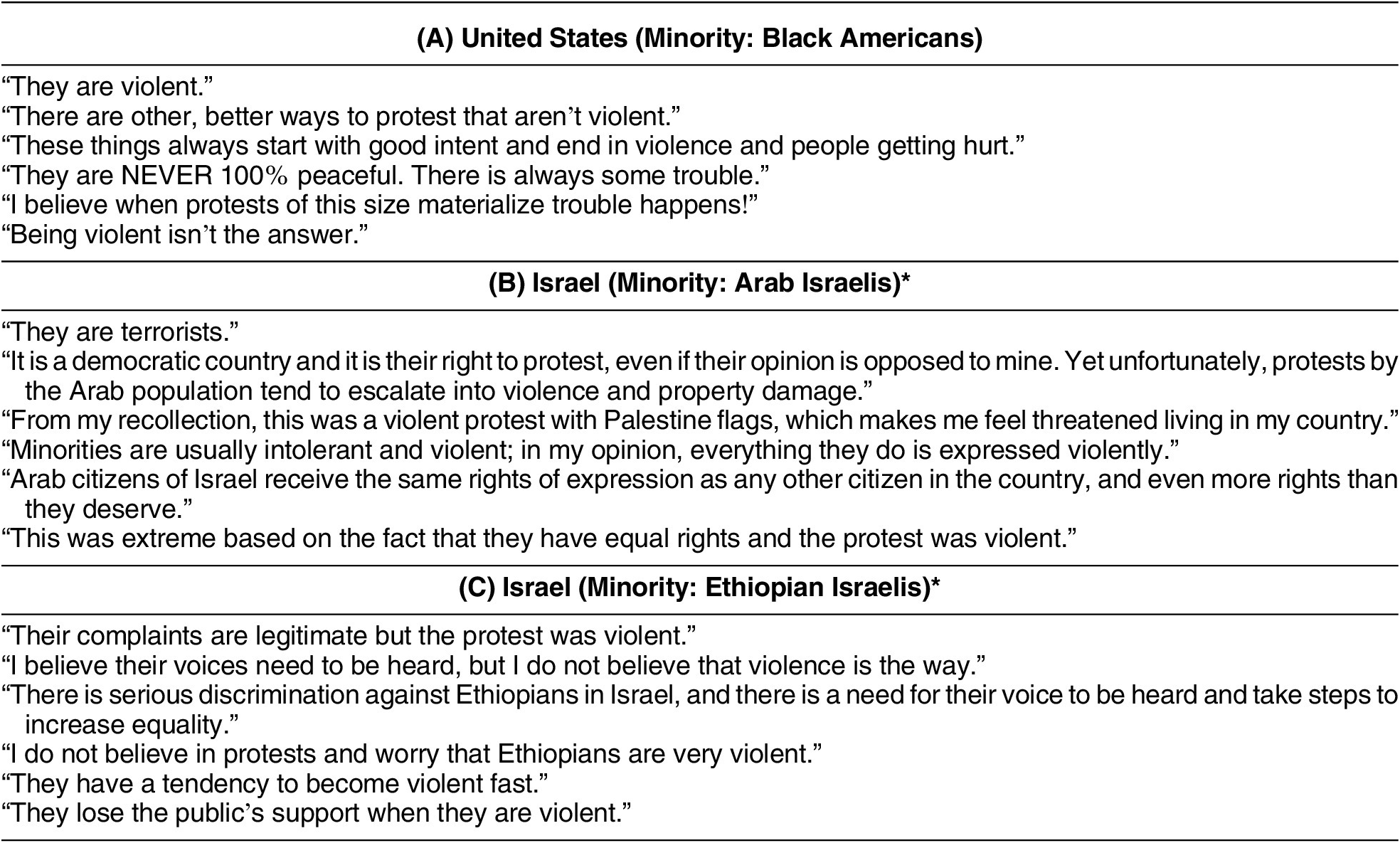
Note: *Translated from Hebrew to English by the authors.
Examining the open-ended responses also sheds light on the unique way Israeli respondents viewed Ethiopian protesters in Study 1. On the one hand, many respondents acknowledged that there is widespread discrimination against Ethiopians in Israel, which merits protest. On the other hand, many also said that the protests shown to them in the vignette were violent and therefore not justified. In other words, even though the cause of Ethiopian protesters seemed legitimate in the eyes of many Israeli respondents, they nonetheless viewed Ethiopian protesters as more violent than whites.
To systematically examine differences in reactions to nonviolent protests by minority and majority groups, we analyze the text of the open-ended responses with a structural topic model (STM). An STM is a model that inductively discovers themes in a corpus of text by drawing on document structure and word frequencies. Unlike many other topic models, the STM allows incorporating document-level metadata, such as whether the respondent was exposed to minority or majority protesters, as a covariate in the model (Blei, Ng, and Jordan Reference Blei, Ng and Jordan2003; Lucas et al. Reference Lucas, Richard A., Margaret E., Brandon M., Alex and Dustin2015; Roberts et al. Reference Roberts, Brandon, Dustin, Christopher, Jetson, Shana, Bethany and David2014). This is useful here, as it allows us to statistically test whether descriptions of nonviolent protests significantly differ by protester ethnicity. We estimate STMs with 10 topics to examine the relationship between document metadata—namely, the identity of the protesters in the vignette—and topic prevalence.
Figure 8 shows results for the US sample. The coefficients reflect the change in the proportion of a topic when moving from white protesters to Black protesters. Positive values mean that a topic was used more frequently in descriptions of Black nonviolent protesters, while negative coefficients mean that the topic was more prevalent in descriptions of white nonviolent protesters. The words next to each coefficient represent the top words associated with each topic. We find that while descriptions of white nonviolent protesters frequently include words such as “express,” “peacefully,” and “nonviolent,” descriptions of Black protesters engaging in the same activity include words such as “riot,” “violence,” and “destruction.” In terms of substantive significance, the coefficients in the figure reflect a change of about 10% from the baseline proportion of these topics in the corpus, which is about 0.1 (0.01/0.1 = 10%).
Topic Prevalence by Group Identity, US Sample
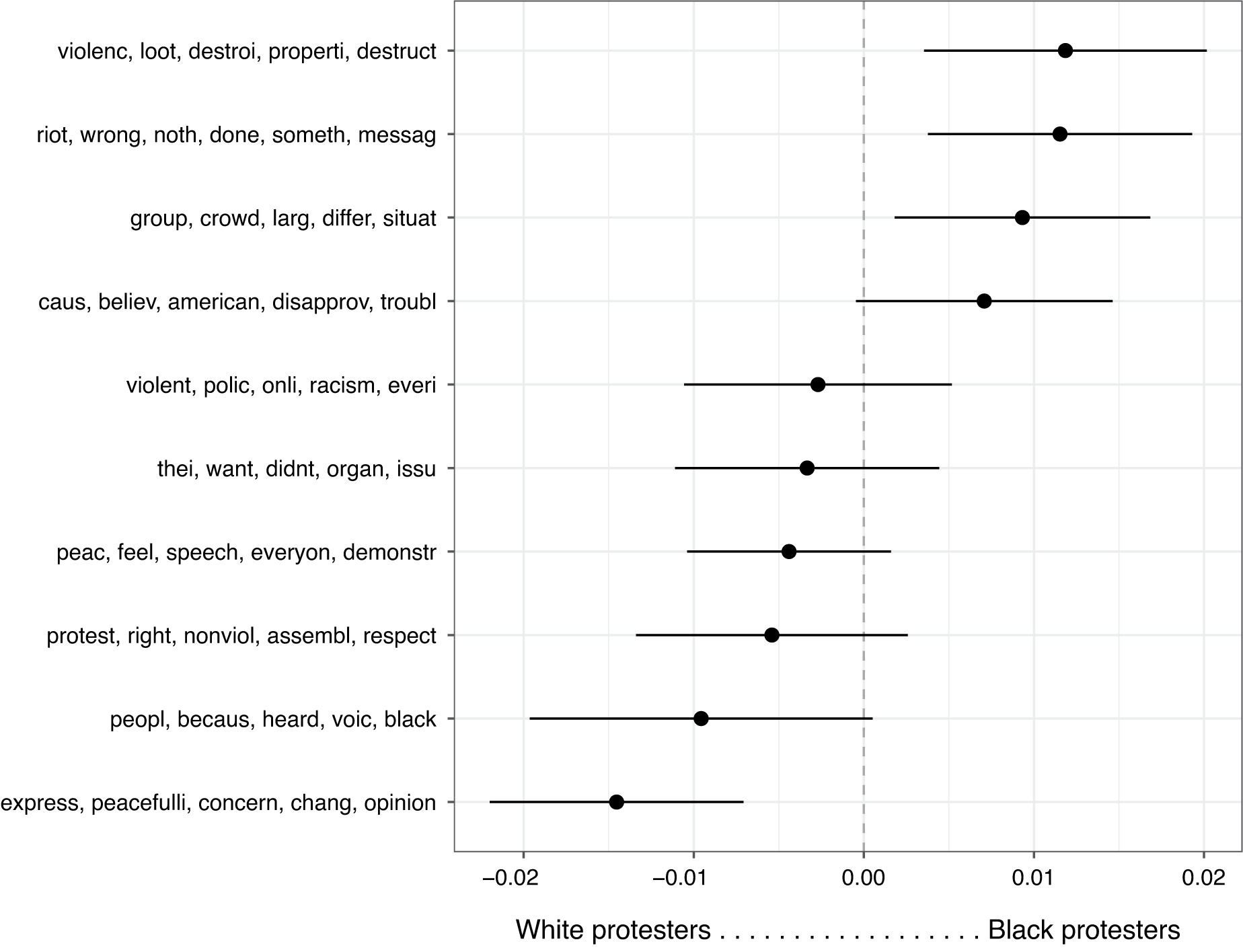
We further find that Black protesters are described with words relating to large crowds (“group,” “crowd,” “large”), which in some responses reflected a view associating large crowds with danger. For example, one respondent explained their disapproval of Black nonviolent protests by saying, “I believe when protests of this size materialize trouble happens!” This highlights an important caveat to arguments about nonviolent resistance emphasizing protest size as a determinant of success. It suggests that, in a climate of pervasive negative racial and ethnic stereotypes, large campaign size can actually compound the sense of threat felt by observers, compromising the mobilizing power of nonviolence for ethnic minorities.
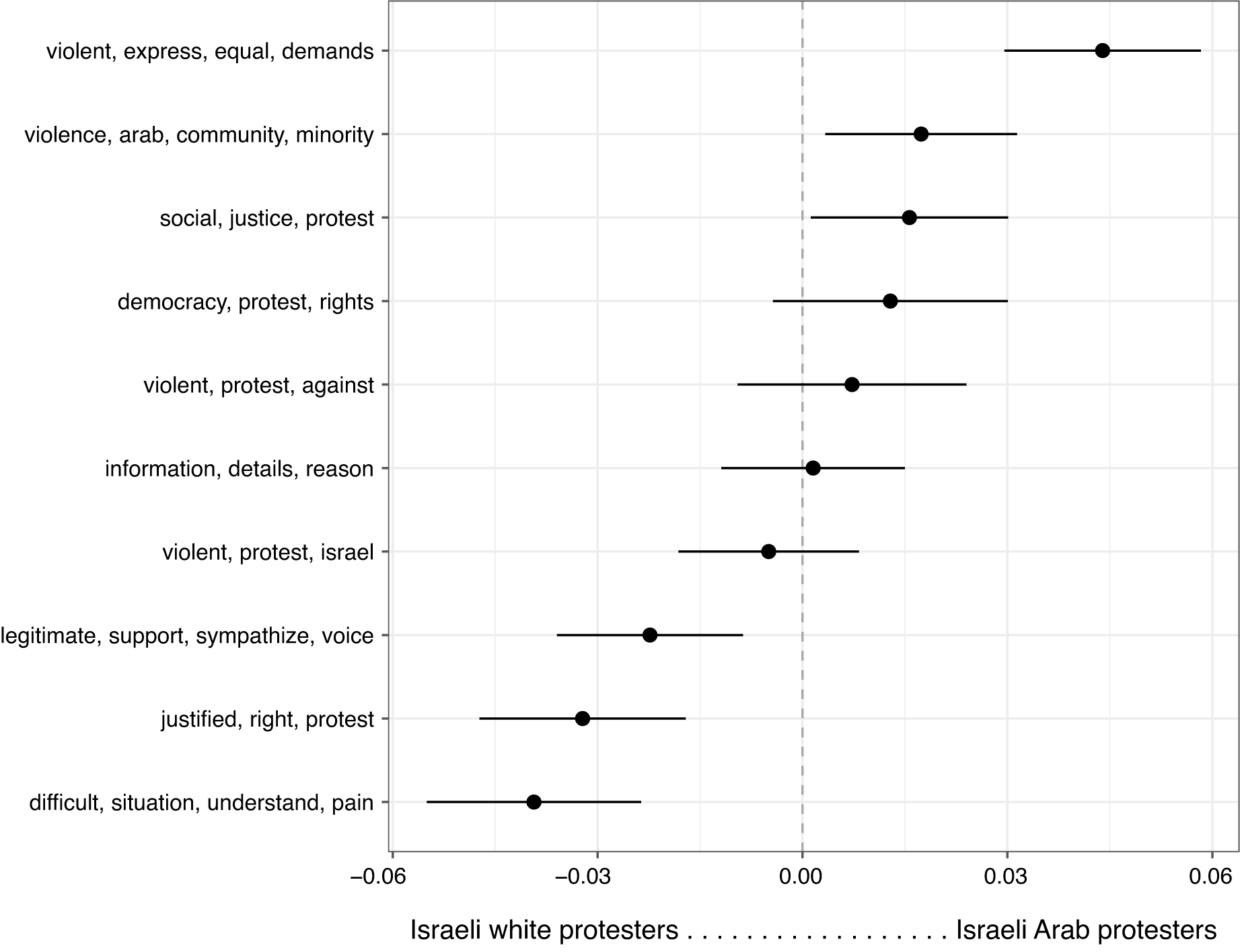
We find a similar pattern in Figure 9, which shows the differences in respondents’ descriptions of nonviolent protests by white Jewish and Arab protesters in Israel. The figure shows that descriptions of nonviolent protests by the Jewish majority use words such as “legitimate,” “sympathize,” and “justified,” whereas nonviolent protests by the Arab minority are described with words related to violence. The baseline proportion of the topics in the Israeli sample is about 0.1, which means that the coefficients presented in Figure 9 reflect a 10–40% change from the baseline (0.04/0.1 = 40%). This is a larger effect than we find in the US sample.
Topic Prevalence by Group Identity, Israel Sample, Arab Minority
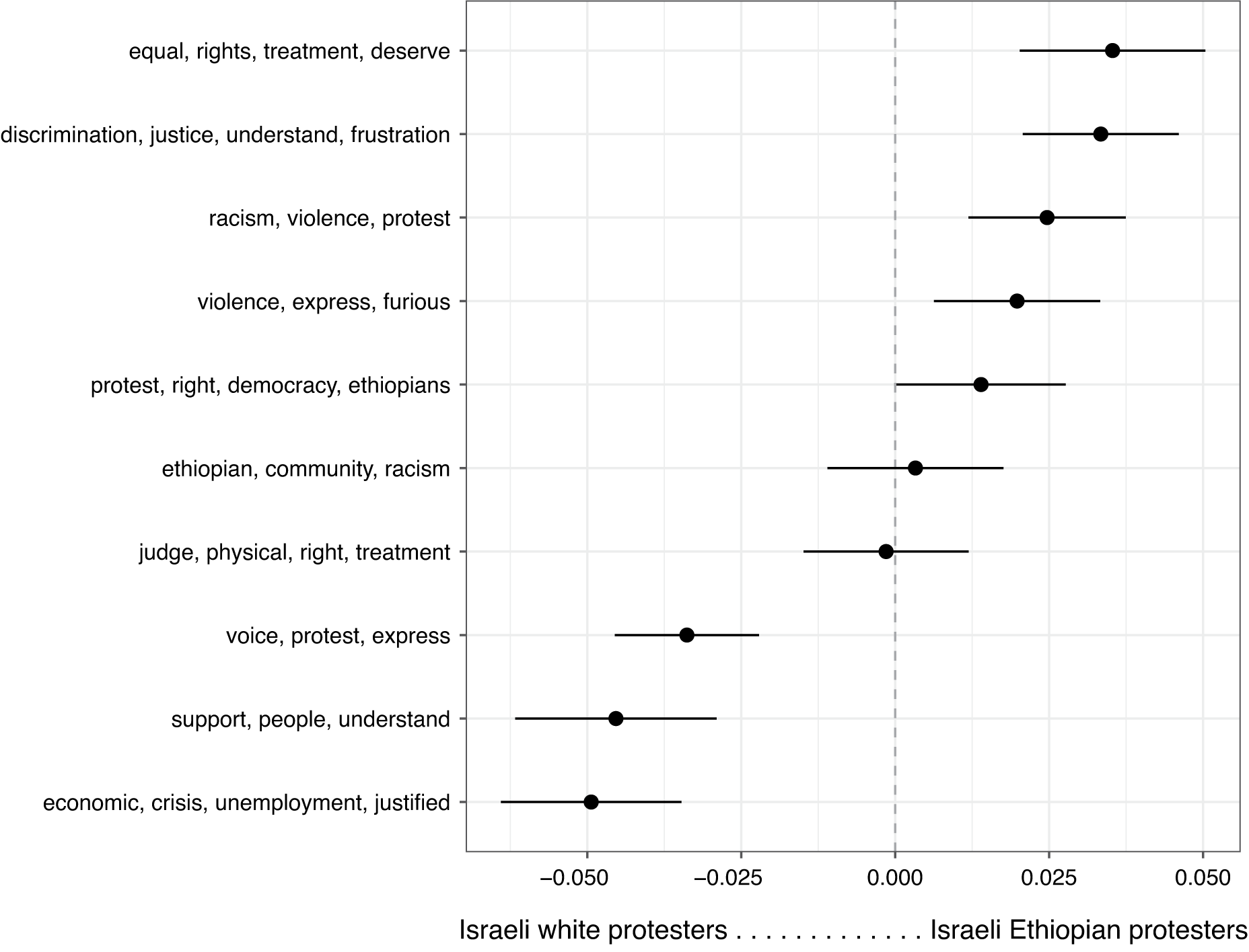
When examining descriptions of Ethiopian protesters in Israel (Figure 10), we find that the topics most distinctively associated with Ethiopian protesters relate to racism and discrimination. Like other minority groups, we find that topics associated with violence are more likely to appear in descriptions of Ethiopian protests, but their prevalence is lower than the content referring to discrimination. This pattern is consistent with our earlier finding that Israelis are less likely to support police action against violent Ethiopian protesters than for whites (see Figure 3). This finding points to the importance of variation in stereotype content. As noted earlier, although we expect many ethnic minorities to be stereotyped as more violent or threatening, stereotype content nevertheless varies across groups, with some groups perceived more negatively along more dimensions than others.
Topic Prevalence by Group Identity, Israel Sample, Ethiopian Minority
Discussion and Conclusion
A growing empirical literature finds that nonviolent resistance campaigns are far more successful in achieving their goals than violent campaigns because of their mobilizing advantage. We have argued that this overall trend, while important, obscures the central role of ethnic identity in shaping campaign perceptions and outcomes. Drawing on the same data used to demonstrate the effectiveness of nonviolence, we show that nonviolent campaign success is significantly moderated by ethnic identity such that campaign strategy (violent or nonviolent) has little influence on the success of minority groups. Between 1946 and 2006, only one in five nonviolent campaigns by ethnic minority groups resulted in success, compared with one in two nonviolent campaigns by majority groups.Footnote 22
We theorize that the lower success rate of nonviolent resistance by ethnic minorities is due to the prevalence of negative stereotypes that associate many minority groups with violence and hostility and lead to support for more punitive policies that are far more likely to target minorities. Evidence from a diversity of contexts supports our argument. African Americans, Arab Israelis, and Ethiopian Israelis, though experiencing different configurations of exclusion, are all perceived by the general public as more violent than the majority group when engaging in nonviolent resistance, and as requiring more policing. This is true even when majorities and minorities mobilize around minority group-based issues, as evidenced by our data from the June 2020 Black Lives Matter protests. Tellingly, across countries and survey waves, respondents associate nonviolent protests by majorities with words relating to peace, nonviolence, and free expression while generally associating nonviolent protests by minority ethnic groups with words relating to violence, destruction, or threat. Moreover, the prevalence of words relating to protest size when describing minority protests suggests that mass participation, which scholars consider a key asset for nonviolent protesters, can become a liability for minority protesters if it activates negative ethnic stereoptypes of threat.
The results also show that ethnic identity exercises little influence on perceptions of violent protests, but rather it becomes more influential as resistance tactics become less violent. Put differently, our study suggests that minority groups pay a “public opinion tax” when turning to nonviolent resistance, which can offset some of the benefits that have been associated with it in the literature. Specifically, it is likely to hinder the ability of ethnic minority groups to successfully achieve their political goals, consistent with what we find in the observational data. Expressing commitment to nonviolence does not appear to provide a significant benefit to minority groups, and if anything, it seems to serve dominant majorities better.
Our experimental study examines three groups in two empirical contexts, raising natural questions about scope conditions and generalizability. The US and Israel are both countries in which societies are highly stratified ethnically. They are also settings in which public opinion can matter a great deal in shaping government policy. Nevertheless, we do not view our results as limited to these settings. Democratic countries are not unique as settings for nonviolent resistance campaigns.Footnote 23 Negative racial and ethnic stereotypes are prevalent worldwide; we thus expect their effects to contribute to perceptions of resistance movements in many places.Footnote 24 Our expectation is supported by our observational results, which indicate that nonviolent tactics do not contribute to minority campaign success globally. These results join recent work by Pischedda (Reference Pischedda2020) and Thurber (Reference Thurber2018), who also rely on cross-national data to show how ethnic identity dramatically affects campaign outcomes and onset.
In addition, our focus on public opinion in general may obscure variation across various subgroups of the population. We have already shown, for example, that ethnic identity of the respondent matters, mitigating (though not necessarily reversing) the effects of protester identity on perceptions. Other factors, such as the gender, age, and political ideology of respondents, may also condition their reactions. Another open question is the extent to which our findings might extend to other identity-based mobilizations such as gender, sexuality, or class. While we leave questions about the role of other identities, both separately and as they interact with race and ethnicity, for future research, the key implication of our findings is that violence is not a simple, objective category but rather is often subjectively shaped through biased human perceptions (Hipp Reference Hipp2010; Sampson and Raudenbush Reference Sampson and Raudenbush2004).
Our findings should not be interpreted as a critique of nonviolent resistance, nor do they imply that violent tactics are more effective in achieving political change. On the contrary, the vast majority (93%) of violent campaigns initiated by minority groups end in failure.Footnote 25 Beyond the moral and philosophical justifications for nonviolence (see Howes Reference Howes2013; Nepstad Reference Nepstad2015, for discussion), nonviolent campaigns by minorities have in some instances led to remarkable achievements. In particular, a number of recent studies in American politics have documented the successes of the Civil Rights Movement (Wasow Reference Wasow2020) and of Black Lives Matter (Mazumder Reference Mazumder2019) in influencing public opinion.
This raises an important question for future research: under what conditions does success become more likely even in the presence of prevalent negative stereotypes? For one thing, public opinion is not the only channel through which movements can achieve substantial gains. In the US context, scholars such as Gause (Reference Gause2020) and Gillion (Reference Gillion2013) have shown that minority mobilization can shape elite politics directly. But even when focusing on public opinion, there may be additional factors that intervene to affect public perceptions of ethnic minority protests. We offer three preliminary thoughts here based on prior work as well as on our own analysis. The first of these is the response of the state. In an important recent study about the success of the American civil rights movement, Wasow (Reference Wasow2020) argues that when nonviolent dissenters are violently repressed, they are more likely to attract positive mainstream media coverage and ultimately to tilt public opinion and policy making in their favor. The role of repression and how it interacts with the role of ethnicity merits further investigation in additional contexts. A second, related factor is the role of media framing, and particularly of sympathetic media coverage, which can independently shape elite and mass attitudes (Arora, Phoenix, and Delshad Reference Arora, Phoenix and Delshad2019; Edwards and Arnon Reference Edwards and Arnon2021; Wasow Reference Wasow2020).Footnote 26
An additional avenue for further research is whether ethnic coalitions, or allies from dominant/majority groups, can shift public perceptions. Given that dominant group members are perceived more favorably even when protesting for minority issues, their greater participation might contribute to increased effectiveness of such campaigns. However, the experiences of activists and studies of social movements suggest that such involvement can be fraught, causing tensions within the movement (see Oliver Reference Oliver2017 for a review). The conditions under which members of different groups can effectively mobilize together are a fruitful avenue for future research.
Minority groups engaged in campaigns for social and political change are often urged to adopt nonviolent tactics or chided for not doing so. Our study shows that such tactics, even when adopted, are often perceived as more violent than they are and as requiring more repression by the state. From a policy perspective, our findings thus suggest a shift in focus from the activists to the broader public, underscoring the importance of greater awareness of when nonviolent resistance is interpreted as violent activity and of the implicit and explicit biases that shape these interpretations.
SUPPLEMENTARY MATERIALS
To view supplementary material for this article, please visit http://dx.doi.org/10.1017/S0003055421000940.
DATA AVAILABILITY STATEMENT
Replication files, including R code and data, are available at the American Political Science Review Dataverse: https://doi.org/10.7910/DVN/SHHVCA.
ACKNOWLEDGMENTS
We thank Scott Gates, Noam Gidron, Milli Lake, Megan Stewart, and Yamil Velez, and participants in seminars at the Hebrew University of Jerusalem and the Hertie School for valuable feedback and suggestions.
FUNDING STATEMENT
Devorah Manekin thanks the Israel Science Foundation (Grant 1919/17) for its support of this research.


 Open access


Comments
No Comments have been published for this article.