

Hostname: page-component-76d6cb85b7-2r2wp Total loading time: 0 Render date: 2026-07-22T02:56:42.963Z Has data issue: false hasContentIssue false

Template-assisted synthesis of porous TiO2 photoanode for efficient dye-sensitized solar cells

Published online by Cambridge University Press:  17 June 2020

Chunmei Lv
Affiliation:
College of Physics and Optoelectronics Engineering, Harbin Engineering University, Harbin150001, China
Xiuwen Wang
Affiliation:
College of Physics and Optoelectronics Engineering, Harbin Engineering University, Harbin150001, China
Qun Li
Affiliation:
College of Materials Science and Engineering, Qiqihar University, Qiqihar161006, China
Chunyan Li
Affiliation:
College of Materials Science and Engineering, Qiqihar University, Qiqihar161006, China
Qiuyun Ouyang
Affiliation:
College of Materials Science and Engineering, Qiqihar University, Qiqihar161006, China
Yongjun Liu
Affiliation:
College of Materials Science and Engineering, Qiqihar University, Qiqihar161006, China
Lihong Qi*
Affiliation:
College of Materials Science and Engineering, Qiqihar University, Qiqihar161006, China
*
a)Address all correspondence to this author. e-mail: lihongqi@hrbeu.edu.cn
Get access

Abstract

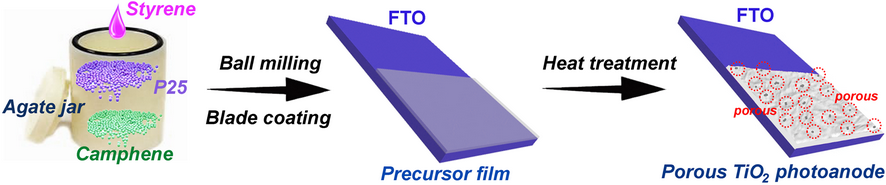
As for the efficient dye-sensitized solar cells (DSSCs), one of the important goals is to increase the light harvesting efficiency to further improve the photoelectric conversion efficiency (PCE). The excellent photoanode materials should possess a uniform porous structure, a large surface area, high crystallinity, and good stability. Herein, the porous TiO2 electrode (named as S-1.5) with the above merits had been prepared by the simple template-assisted method with camphene as the pore-forming reagent. The surface area of the porous TiO2 electrode can be tailored by introducing the amount of camphene. The porous TiO2 layer with the optimal surface area directly adhered on the top of the ultra-thin P25 dense layer had been constructed and this unique electrode with a “double layers structure”, which named as S-1.5/P25. When DSSCs assembled with this photoanode, a desirable PCE of 8.31% had been achieved, which was obviously higher than that of the commercial P25 (7.62%) in parallel. The improved PCE can be attributed to the improved utilization of sunlight, the facilitated photo-generated electron transfer, and the reduced interface resistance. Meanwhile, the related characterization including electrochemical impedance spectroscopy, intensity-modulated photovoltage spectroscopy, and intensity-modulated photocurrent spectroscopy was characterized to explore the possible mechanism.

Information

Type
Article
Copyright
Copyright © Materials Research Society 2020

Access options

Get access to the full version of this content by using one of the access options below. (Log in options will check for institutional or personal access. Content may require purchase if you do not have access.)

Article purchase

Temporarily unavailable

Supplementary material: File

Lv et al. supplementary material

Lv et al. supplementary material

Download Lv et al. supplementary material(File)
File 58.9 KB