





Introduction
Bangladesh, with a current population of 165 million, is largely self-sufficient in rice production, but to sustain self-sufficiency by 2030 and to feed a projected population of 186 million people, an increase of 20% in rice production will be necessary (Timsina et al. Reference Timsina, Wolf, Guilpart, van Bussel, Grassini, van Wart, Hossain, Rashid, Islam and van Ittersum2018). An additional challenge is that the extra rice must be produced with a lower environmental footprint, with fewer resources such as land, labor, water, and agricultural chemicals in a changing climate. One approach to meet future rice demand is to close the existing rice yield gap, which ranges from 48% to 63% in rainfed rice and about 50% in irrigated rice systems (Timsina et al. Reference Timsina, Wolf, Guilpart, van Bussel, Grassini, van Wart, Hossain, Rashid, Islam and van Ittersum2018).
In Bangladesh and much of tropical and subtropical Asia, rice is predominantly established under wet-tilled or “puddled” soil conditions followed by transplanting of seedlings (PTR). Rice is cultivated throughout the year with three distinct growing seasons popularly known as pre-monsoon or ‘Aus’ rice grown from April to August, monsoon or ‘Aman’ rice from June to November, and winter or ‘Boro’ rice from December to May, covering 9%, 49%, and 42% of total rice area, respectively (BBS 2017).
Weeds are among the main biological constraints to realizing attainable rice yield potential. They also significantly reduce profitability (Ahmed et al. Reference Ahmed, Salim and Chauhan2014; BRRI 2018; Chauhan Reference Chauhan2012; Kumar et al. Reference Kumar, Singh, Chhokar, Malik, Brainard and Ladh2013). Worldwide, it is estimated that the yield losses due to weeds in rice under farmers’ current weed management practices are about 10% (Oerke 2006). In tropical Asia, yield losses due to weeds in lowland rice range from 10% to 20% (Savary et al. Reference Savary, Ficke, Aubertot and Hollier2012). In Bangladesh, the climate and edaphic conditions are highly favorable for weed growth (Ahmed et al. Reference Ahmed, Salim and Chauhan2014; Mitra et al. Reference Mitra, Karim, Haque, Ahmed and Bari2005). This can lead to significant yield losses without adequate weed management. In the absence of weed control, rice yield losses due to weeds ranged from 15% to 40% in PTR and 40% to 100% in direct-seeded rice (Ahmed and Chauhan Reference Ahmed and Chauhan2014; Mamun et al. Reference Mamun, Shultana, Rana and Mridha2013; Mazid et al. Reference Mazid, Jabbar, Riches, Robinson, Mortimer and Wade2001; Rashid et al. Reference Rashid, Alam, Rao and Ladha2012). Yield losses due to weeds are reported higher in the Aman season than the Boro season, with losses ranging from 30% to 40% in Aman and 22% to 36% in the Boro season (Mamun et al. 1990).
The types of weed management practices employed can directly influence the weed control cost and farm income. In tropical and subtropical Asia including Bangladesh, manual weeding using hand-pulling or uprooting using a ‘Niri’ hoe has traditionally been the most common practice of weed control in rice (Ahmed et al. Reference Ahmed, Awan, Salim and Chauhan2015; Islam et al. Reference Islam, Popy, Hasan and Anwar2017). Although manual weeding can be effective, because of the rising scarcity of labor at critical times, weeding can either be delayed or insufficient, resulting in increased yield losses (Hasanuzzaman et al. Reference Hasanuzzaman, Islam and Bapari2008; Rashid et al. Reference Rashid, Alam, Rao and Ladha2012). Bangladesh is also in a phase of economic transition and rapid growth of non-farm employment options; the resulting scarcity of labor is driving increasing rural labor costs, making manual weed control progressively less attractive (Kashem et al. Reference Kashem, Faroque and Bilkis2009; Zhang et al. Reference Zhang, Rashid, Ahmad and Ahmed2014). Herbicide-based weed control is consequently becoming more popular, as it can reduce overall costs by minimizing costly labor (Hasanuzzaman et al. Reference Hasanuzzaman, Islam and Bapari2008; Islam et al. Reference Islam, Popy, Hasan and Anwar2017). In the last three decades, the use of herbicides in Bangladesh has increased 37-fold (BBS 2017). Yet although herbicides can effectively control rice weeds, sole dependence on chemical control measures poses both environmental and economic risks (Kumar et al. Reference Kumar, Opeña, Valencia, Thi, Son, Donayre, Janiya and Johnson2017). The former include the evolution of herbicide resistance in weeds and negative effects on non-target organisms, whereas the latter include additional costs involved in controlling new weed species that may result from shifts in weed flora with use of chemical control methods (Boutin et al. Reference Boutin, Strandberg, Carpenter, Mathiassen and Thomas2014; Galhano et al. Reference Galhano, Gomes-Laranjo, Fernández-Valiente, Videira and Peixoto2011; Heap Reference Heap2021; Hossain et al. Reference Hossain, Gathala, Timsina, Johnson and Krupnik2020; Kumar et al. Reference Kumar, Opeña, Valencia, Thi, Son, Donayre, Janiya and Johnson2017; Qi et al. Reference Qi, Li, Guan, Yan, Fu, He, Du, Zhao and Zhang2020).
These factors warrant integrated approaches to manage weeds while reducing the environmental hazards associated with herbicides, and high costs associated with manual weeding (Chauhan et al. Reference Chauhan, Ahmed, Awan, Jabran and Manalil2015; Juraimi et al. Reference Juraimi, Uddin, Anwar, Tengku, Mohamed, Ismail and Man2013). Estimates indicate that farmers spend about US$100 to 300 ha–1, which is about 10% to 20% of total production cost for controlling weeds in rice fields (Hasanuzzaman et al. Reference Hasanuzzaman, Islam and Bapari2008; Islam et al. Reference Islam, Popy, Hasan and Anwar2017). Hence, herbicide-based IWM could be an effective strategy to reduce weed control costs, reduce yield gap, and increase yield and profits from PTR production.
IWM can be defined as the integration of more than one approach involving cultural, physical, biological, and chemical methods (Harker and O’Donovan Reference Harker and O’Donovan2013). It consists of both chemical and nonchemical approaches and focuses on keeping weed populations below a certain threshold level by optimizing control measures in a strategic and holistic way (Wilkerson et al. Reference Wilkerson, Wiles and Bennett2002). Herbicides are used as a last resort in IWM, although where they are required, they should be used in an integrated management approach, such as integration of soil-active preemergence and postemergence herbicides, rotation of herbicides with different modes of action (MOAs), or mixing of herbicides with different MOAs with best application practices (Harker et al. Reference Harker, O’Donovan, Blackshaw, Beckie, Smith and Maxwell2012; Harker and O’Donovan Reference Harker and O’Donovan2013; Kumar et al. Reference Kumar, Opeña, Valencia, Thi, Son, Donayre, Janiya and Johnson2017). For the PTR system in tropical and subtropical Asia, several cultural practices including appropriate land preparation by puddling and leveling, uniform crop establishment as assured by transplanting method, early flooding, and transplanting larger seedlings with potential to develop groundcover faster constitute an integral part of IWM (Kumar et al. Reference Kumar, Singh, Chhokar, Malik, Brainard and Ladh2013). Along with these practices, the use of safer and effective herbicides with manual or mechanical weeding could provide both economical and environmental advantages where weed control is constrained in PTR.
Adequate knowledge on the safe handling of herbicides is lacking among most smallholder farmers in Bangladesh (Shammi et al. Reference Shammi, Sultana, Hasan, Rahman, Islam, Bodrud-Doza and Uddin2020). It is therefore important to identify herbicides that are less toxic, pose less risk to human health, are relatively safe for the environment, and are effective for weed control. Based on 12 pesticide risk analysis factors, the US Agency for International Development (USAID) has issued the Pesticide Evaluation Report and Safer-Use Action Plan (PERSUAP) and listed safer pesticides including herbicides for use in Bangladesh (USAID 2015). In this study, we evaluated herbicides that are approved in the PERSUAP in different combinations with different MOAs, applied as preemergence, postemergence, or both pre- and postemergence, or used as mixtures (see Table 1) by integrating manual and mechanical weeding to identify effective, affordable, and safer options for weed control in PTR as compared to farmers’ current weed management practices.
Table 1. Description of different integrated weed management treatments evaluated at farmers’ fields in two agroecological zones of Bangladesh. a
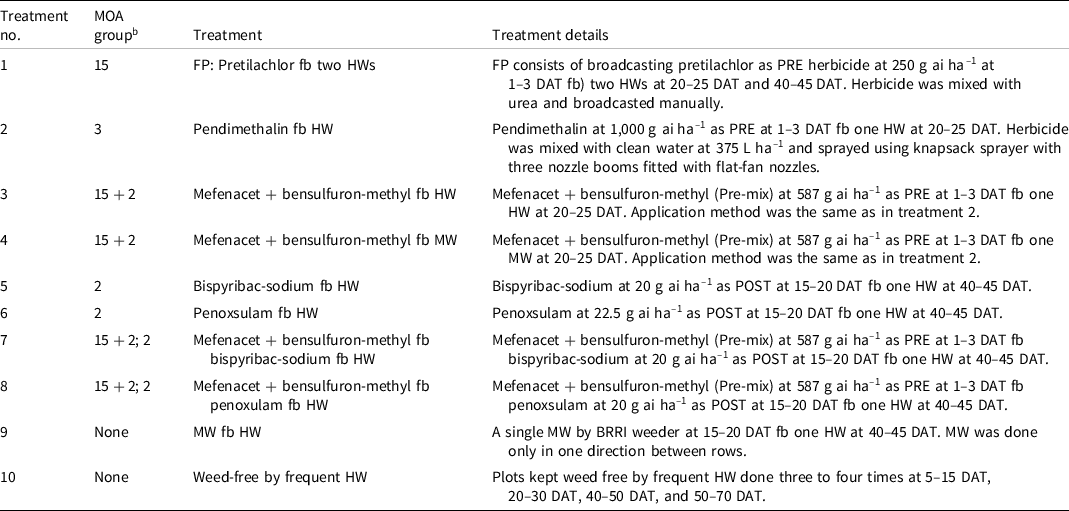
a Abbreviations: ALS, acetolactate synthase; FP, farmers’ practice; DAT, days after rice transplanting; fb, followed by; HW, hand-weeding; MOA, mode of action; MW, mechanical weeding; POST, postemergence; PRE, preemergence; VLCFA, very-long-chain fatty acid; WSSA, Weed Science Society of America.
b MOA grouping based on WSSA herbicide classification; MOA Group 2 = ALS inhibitor; Group 3 = microtubule assembly inhibitor; Group 15 = VLCFA inhibitors.
Although several researchers have evaluated the performance of herbicides for their effects on weed control and grain yield as compared to weedy checks in PTR under on-station settings, there have been comparatively few assessments of herbicide-based IWM options under on-farm conditions that consider not only weed control, but also yield, weed control cost, net income, and labor use. Therefore, the specific objective of this study was to evaluate the performance of different herbicide-based IWM practices with respect to yield, economics, and labor use as compared to current farmers’ weed management practices in PTR under diverse environmental and on-farm conditions. We hypothesized that integration of preemergence or postemergence herbicides with manual and mechanical weeding or the integration of both preemergence followed by postemergence herbicides with manual weeding would control weeds better in transplanted Aman and Boro rice, and thereby increase rice yield and reduce weed control cost as compared to farmers’ current weed management practices.
Materials and Methods
On-farm experiments were conducted for three consecutive seasons—Aman/wet season from June-July to November in 2016 and 2017, and Boro/dry winter season from December to April-May in 2016–2017 in 14 villages spanning two distinct AEZs of southwest Bangladesh. AEZs are broad units based on physiography, soil, depth and duration of seasonal flooding, and agroclimatology. Out of 14 villages, four were in Kaliganj upazila (a subunit of a district) of Jhenaidah District (23.41°N, 89.13°E), three in Chuadanga Sadar upazila (23.64°N, 88.86°E) and two in Alamdanga upazila (23.76°N, 88.95°E) of Chuadanga District ; and four in Rajbari Sadar upazila (23.75°N, 89.65°E) and one in Pangsa upazila (23.79°N, 89.41°E) of Rajbari District. All the villages in Jhenaidah and Chuadanga districts belong to AEZ 11, whereas the villages in Rajbari District belong to AEZ 12. These AEZs were selected because of differences in soil type, topography, and hydrology leading to differential summer monsoon season field inundation depths in AEZ 11 and AEZ 12, which can have an influence on weed infestation and efficacy of weed management treatments (Chauhan and Johnson Reference Chauhan and Johnson2010; Dorji et al. Reference Dorji, Chauhan, Baltazar and Johnson2013).
Land in Bangladesh is classified by a system that considers differences in monsoon season land inundation depth and duration (Emran et al. Reference Emran, Krupnik, Kumar, Ali and Pittelkow2019). The land typopology in AEZ 11, called High Ganges River Floodplain, is dominated by “highland”, covering 43% of the area where field inundation depths range from 0 to 30 cm during the summer monsoon; to 32% “medium land” where inundation depths range from 30 to 90 cm; and the remainder by 12% “medium lowland” with inundation depths of 90 to 180 cm (FRG 2012). The soils are silty loam and silty clay loam on upper floodplain ridges, whereas in basins they tend to be Calcareous Dark Grey Floodplain and Calcareous Brown Floodplain soils. Organic matter content in brown ridge soils tends to be poor, but slightly greater in dark grey soils. The Lower Ganges River Floodplain, designated as AEZ 12, on the other hand, is composed predominantly of medium lowland to medium land, with 14% “lowland” with >300 cm inundation depth, 31% medium lowland, 29% medium highland, and 13% highland. Silty clay loams to heavy clays are found on lower landscapes, with silt loams and silty clay loams on ridges (FRG 2012). Seasonal rainfall is monomodal, with a pronounced monsoon (Figure 1). The AEZ classification is being extensively used for national and local level agricultural production planning purposes, technology transfer, and resource utilization program activities.

Figure 1. Monthly and cumulative rainfall during Aman and Boro seasons in the agroecological zones (AEZs) 11 and 12 during 2016–2017 and 2017–2018.
Trials were established in farmers’ fields in a randomized complete block design with one complete set of 10 weed management treatments in each farmer’s field. The experimental area of each field had uniform soil type and similar past management practices, though plot sizes differed depending on farmers’ field availability. The size of each experimental field ranged from 1,200 to 1,500 m2, with the plot size of each treatment varying from 120 to 150 m2. Each participant farmer was considered as a replication, with all fields co-located within a radius of 2 km. The number of replications varied among seasons. A total of 20 replications across nine villages were included during the 2016 Aman season, and among them 10 were in AEZ 11 and 10 in AEZ 12. In both Boro 2016–2017 and Aman 2017 seasons, there were 12 replications, of which 6 each were in AEZ 11 and AEZ 12. Farmers’ fields were selected based on their willingness to participate in trials, representing marginal, small, and medium-sized farmers, as determined through focus group discussions conducted in each village, to ensure that crop management practices of selected farmers were representative of the respective villages. The farmers and the trial plots were not always the same in the second season, but the numbers of farmers in each season in each AEZ were similar.
Trials were researcher-designed but farmer-managed. Treatments consisted of seven herbicide-based IWM options, one combination of mechanical and manual hand-weeding, and two checks: farmers’ current weed management practice and weed-free (Table 1). Farmers’ current weed management practice (FP) was identified based on the focus group discussions with the village farmers, and the most widely/common practice used by farmers was included in FP. Mechanical weed control was done using a weeder developed by Bangladesh Rice Research Institute. This is a single-row push type manually operated weeder weighing 3.5 kg, with a rotor width of 15 cm and 12 spikes with coverage 20 cm wide in a single pass, and thus suitable for operation with row spacing of 20 cm. The price of the weeder is around US$12, with operational efficiency four to five times faster than hand-weeding (Huda et al. Reference Huda, Bhuiyan, Hossen and Rahman2019).
The MOA of preemergence herbicides selected for this study includes a root growth inhibitor/microtubule assembly inhibitor (pendimethalin), two inhibitors of shoot growth and very-long-chain fatty acid synthesis (mefenacet and pretilachlor), and an acetolactate synthase inhibitor (ALS)/amino acid synthesis inhibitor (bensulfuron-methyl). Conversely, the MOA of the postemergence herbicides bispyribac-sodium and penoxsulam is as ALS inhibitors. For the preemergence herbicides, standing water at 3- to 5-cm depth was maintained during spraying, with herbicides applied uniformly throughout the plot.
In both rice growing seasons, rice was established by seedling transplanting in puddled soil. The Aman rice was grown mostly as rainfed with supplementary irrigations when required; therefore, rice fields underwent considerable fluctuation in water depth, and even periods without standing water. The Boro rice was grown under irrigation, and fields were mostly flooded, though it occasionally underwent alternate wetting and drying. In both seasons, soils were puddled through four to five passes with a power tiller followed by two to three passes with a bamboo ladder for leveling. The high-yielding semi-dwarf rice cultivars ‘BRRI dhan49’, 135 to 140 d duration, and ‘BRRI dhan28’, 140 to 145 d duration, were used in the Aman and Boro seasons, respectively. Three or four 30-d-old seedlings were transplanted per hill between August 15 and 30 in Aman and 40-d-old seedlings between January 10 and 25 in Boro across the villages. Rice was transplanted with crop geometry of 20-cm inter-row spacing by 15-cm hill to hill/plant-to-plant spacing. Crop management practices from land preparation to harvesting except weed control were identical in all treatment plots and followed the local farmers’ management practices. The timing and doses of weed management treatments are given in Table 1.
Weed count and biomass by class (i.e., grasses, sedges, and broadleaves) were recorded from the randomly fixed four permanent quadrats each measuring 0.4 m by 0.75 m in each treatment plot after application of preemergence herbicide. Weed count data were recorded from these permanently established quadrats at 15 to 20 d after transplanting (DAT) prior to application of postemergence herbicides or mechanical weeding or hand-weeding and at 40 to 45 DAT, which was around 20 d after postemergence herbicide application. Weed biomass data were recorded only at 40 to 45 DAT from the same permanently established quadrats. Weeds were uprooted, grouped by class, cleaned, and oven-dried at 70 C for 72 h before weighing.
Grain yield was obtained from a central 4.0-m by 3.0-m harvest area in each treatment plot. Grain moisture content was recorded at the time of yield estimation using a moisture meter (Model GMK-303RS; G-WON Hitech Co. Ltd., Seoul, Korea). Rice grain yield was adjusted to 14% grain moisture content. Human labor used for herbicides application, hand-weeding, and mechanical weeding were recorded for each treatment during each operation. The time required to complete each operation was recorded for each treatment and expressed as person-days ha–1, considering 8 h to be equivalent to one person-day. The labor costs were calculated using the current labor wage reported by farmers. Herbicide cost was calculated using the current retail market prices. Total weed management costs were estimated by summing herbicide and labor costs. The rainfall data during the trial period were collected from the Bangladesh Meteorological Department of Chuadanga and Rajbari stations.
Gross income was calculated by multiplying grain yields by the market price of grain in the local market. Treatments were evaluated based on weed management cost, weed infestation level as determined by weed count and weed biomass, grain yield, and added net economic returns from weed control relative to FP. Added net return is the difference between added gross return and added cost for a treatment contrasted with FP. Added gross return was calculated by multiplying additional yield as rough rice with the market price of rough rice. Additional yield was calculated by subtracting grain yield of a given treatment from grain yield in FP. Added cost was estimated by subtracting total weed control cost of a given treatment from the total weed control cost in FP. The prices of herbicides, rough rice, and labor wage used in economic analysis were as follows: pretilachlor, US$8.2 ha–1; pendimethalin, US$34.4 ha–1; mefenacet plus bensulfuron-methyl, US$12.7 ha–1, bispyribac-sodium, US$19.3 ha–1; penoxsulam, US$28.8 ha–1; rough rice, US$0.24 kg–1 (‘BRRI dhan 49’) and US$0.26 kg–1 (‘BRRI dhan 28’), and labor wage, US$4.27 to 5.49 person-day–1. A conversion rate of US$1 to 82 Bangladesh Taka was used.
The data were subjected to ANOVA and were analyzed using the mixed-model procedure in Statistical Analysis System (SAS Institute 2013). The data were tested for normality and homogeneity of variance before conducting the ANOVA. As weed data were not normally distributed, the Box-Cox transformations, which provide a value of λ that maximizes a log-likelihood function, were used to identify the best transformation (Sokal and Rohlf Reference Sokal and Rohlf1995). Based on this procedure, non-normal data were square-root transformed. For weed counts and biomass, yield, labor use, weed management cost, and added net return over FP data in the mixed-model procedure, weed management treatments were considered as fixed effect, whereas replication nested in site (AEZ), site nested in year, year, and their interactions (i.e., treatment by site; treatment by year) were considered as random effects. Data were analyzed separately for the Aman and Boro seasons. Treatment-by-year-by-site, and site-by-year interactions were nonsignificant for all parameters. For parameters with significant interactions (i.e., treatment by year or treatment by site), weed management treatment means are presented year-wise or site-wise. Treatment means are separated using the Tukey’s HSD test at ∝ = 0.05. To compare the effect of treatments on added net return as compared to FP as a control, Dunnett’s test was used. Linear contrasts were used to compare treatments with preemergence and without preemergence herbicides for weed density and biomass.
Results and Discussion
Weed management treatments significantly influenced weed density at 15 and 45 DAT in both seasons (Tables 2 and 3). At 15 DAT, weed density of grasses, broadleaves, and sedges was 70% to 80% and 50% to 70% lower in Aman and Boro seasons, respectively, in treatments that received the preemergence herbicides pendimethalin, pretilachlor, or mefenacet plus bensulfuron-methyl, than those that did not, as demonstrated by linear contrast P ≤ 0.0001. Among treatments with preemergence herbicide, pendimethalin was more effective than pretilachlor in controlling grasses, but these two herbicides did not differ in controlling broadleaves and sedges. Mefenacet plus bensulfuron-methyl did not differ from pendimethalin or pretilachlor in controlling grasses, broadleaves, or sedges.
Table 2. Weed density (individual plants m–2) at 15–20 and 40–45 DAT under different weed management options during the Aman season. a,b

a Within columns, means followed by the same letter are not statistically different according to Tukey’s HSD test at α = 0.05.
b Abbreviations: AEZ, agroecological zone; DAT, days after rice transplanting; fb, followed by; HW, hand-weeding; MW, mechanical weeding; NS, nonsignificant; PRE, preemergence at 1–3 DAT.
Table 3. Weed density (individual plants m–2) at 15–20 and 40–45 DAT under different weed management options during the Boro season. a,b

a Within column, means followed by the same letter are not statistically different according to Tukey’s HSD test at α = 0.05.
b Abbreviations: AEZ, agroecological zone; DAT, days after rice transplanting; fb, followed by; HW, hand-weeding; MW, mechanical weeding; NS, nonsignificant; PRE, preemergence at 1–3 DAT.
In Aman season, at 40 to 45 DAT, the effect of weed control treatments varied with year for grasses and total weed density, and with site for broadleaves, as demonstrated by significant treatment-by-year and treatment-by-site interaction, respectively (Table 2). Therefore, treatment means are presented year-wise for grasses and total weed density, and by location for broadleaf density. Total weed density was almost half in the second year than in the first. In both years, total weed density was highest in bispyribac-sodium fb hand-weeding, and penoxsulam fb hand-weeding and in mechanical weeding fb hand-weeding, and was lowest in the weed-free check. As compared to FP, weed management treatments did not differ in total weed density except treatments that received either bispyribac-sodium or penoxulam fb hand-weeding and mechanical weeding fb hand-weeding, which had 66% to 89% and 154% to 238% higher total weed density in year 1 and year 2, respectively. Among grasses, weed density was highest in mechanical weeding fb hand-weedingin both years, followed by penoxsulam fb hand-weeding and mefenacet plus bensulfuron-methyl fb penoxsulam fb hand-weeding in year 1 and bispyribac-sodium fb hand-weeding in year 2, whereas grass density in other treatments did not differ from FP. As with grasses, weed treatments did not differ in broadleaf density, excepting penoxsulam fb hand-weeding and mechanical weeding fb hand-weeding, which had higher density than FP in both AEZs 11 and 12. Among the treatments, sedge density varied from 7 to 10 plants m–2 but with no significant differences.
In Boro season, at 45 DAT, treatments did not differ in grass and broadleaf weed density except for the weed-free treatment (Table 3). Sedge density, in both AEZs 11 and 12, was almost twice in treatments with bispyribac-sodium or penoxsulam fb hand-weeding, and in nonchemical treatment with mechanical weeding fb hand-weeding, as compared to FP. Total weed density followed the same trend as did sedge density.
In Aman season, total weed biomass at 45 DAT was 70% to 110% higher in treatments with bispyribac-sodium or penoxsulam fb hand-weeding and nonchemical treatment with mechanical weeding fb hand-weeding than FP, whereas other treatments suppressed weed biomass to a similar extent as under FP (Table 4). Irrespective of treatments, overall total weed biomass was higher in year 1 than in year 2 (P < 0.0001, data not shown). Compared to FP, grass weed biomass was equally suppressed by all treatments except by mechanical weeding fb hand-weeding in both years. Similar to total weed biomass, irrespective of treatments, grass weed biomass was higher in year 1 than in year 2 (P value < 0.0001). For broadleaf weeds, irrespective of treatments, AEZ 12 had higher biomass than AEZ 11 (P < 0.0012 for site), and broadleaf biomass was higher in year 2 than in year 1 (P = 0.0109). In AEZ 11, mefenacet plus bensulfuron-methyl as preemergence fb bispyribac-sodium as postemergence fb hand-weeding was more effective in suppressing broadleaf weeds than only postemergence application of bispyribac-sodium or penoxsulam fb hand-weeding. In AEZ 12, weed biomass suppression of broadleaf weeds was 80% lower in penoxsulam fb hand-weeding and mechanical weeding fb hand-weeding than FP, whereas other treatments did not differ. For sedges, biomass did not differ among IWM treatments tested as compared to FP.
Table 4. Weed biomass at 40 to 45 DAT under different weed management options during the Aman (average of 2016 and 2017) and the Boro 2017 seasons.a,b

a Within columns, means followed by the same letter are not statistically different according to Tukey’s HSD test at α = 0.05.
b Abbreviations: AEZ, agroecological zone; DAT, days after rice transplanting; fb, followed by; HW, hand-weeding; MW, mechanical weeding; NS, nonsignificant; PRE, preemergence at 1–3 DAT.
In Boro season, total weed biomass at 45 DAT was recorded highest in bispyribac-sodium fb hand-weeding and was higher than any of the other treatments, except penoxsulam fb hand-weeding and mechanical weeding fb hand-weeding (Table 4). The sedge biomass constituted the major share of the total biomass, as grass and broadleaf biomass was negligible and did not differ among treatments. The sedge biomass was highest in postemergence application of bispyribac-sodium or penoxsulam fb hand-weeding followed by nonchemical treatment with mechanical weeding fb hand-weeding, and these three treatments had 1.5 to 2.6 times higher sedge biomass than any of the other treatments.
The effectiveness of preemergence herbicide in this study was consistent with previous studies, indicating that the sole application of preemergence herbicide reduced weed infestation by 50% to 90% depending on the group number of preemergence herbicide applied, types of weed species, application time and methods, and flooding depth at application (Bari Reference Bari2010; Hasanuzzaman et al. Reference Hasanuzzaman, Islam and Bapari2008; Islam et al. Reference Islam, Popy, Hasan and Anwar2017; Kiran et al. Reference Kiran, Subramanyam and Sumathi2010; Shultana et al. Reference Shultana, Mamun, Rezvi and Zahan2011). In controlling grasses, pendimethalin performed better than pretilachlor and mefenacet plus bensulfuron-methyl, which is also consistent with previous findings (Ahmed and Chauhan Reference Ahmed and Chauhan2014; Awan et al. Reference Awan, Cruz and Chauhan2016; Das Reference Das2008; Islam et al. Reference Islam, Popy, Hasan and Anwar2017). The performance of preemergence herbicides in weed control was better in the Aman season than in Boro season. This result could be attributable to (i) the low temperature at the time of preemergence application in Boro, which may have delayed the emergence of weeds, resulting in escape from preemergence efficacy (Ahmed and Chauhan Reference Ahmed and Chauhan2014); and (ii) deeper floodwater depths in Aman compared to the Boro season, contributing positively to preemergence efficacy (Dorji et al. Reference Dorji, Chauhan, Baltazar and Johnson2013). Bari (Reference Bari2010) also reported that weed control efficiency of preemergence herbicides oxadiazone and pretilachlor was 68% and 93%, respectively, in Aman season; however, these values were 31% and 86%, respectively, in the Boro season.
In the Aman season, lower weed infestation in the second year than in the first was likely also attributable to the high amount of rainfall received in the second year (Figure 1). The grass, sedge, and total weed biomass was lower in year 2 than in year 1, but biomass of broadleaf weeds was higher in year 2 than in year 1. This result could have arisen because broadleaf weeds such as pickerelweed [Monochoria vaginalis (Burm.f.) C.Presl.] and gooseweed [Sphenoclea zeylanica (Gaertn.)] are more adapted under flooded conditions, whereas grasses and sedges are more sensitive to flooding (Kent and Johnson Reference Kent and Johnson2001; Pons Reference Pons1982; Rao et al. Reference Rao, Brainard, Kumar, Ladha and Johnson2017). The differential effect of sites on weed density and biomass at 40 to 45 DAT could also be attributable to differences in field inundation period and depth. For example, AEZ 12 is dominated by medium to lowland topography in contrast to AEZ 11, dominated by highland to medium land; hence AEZ 12 undergoes deeper field water depths. This could help to explain the lower grass, sedge, and total weed density and biomass and higher broadleaf density and biomass in AEZ 12 than in AEZ 11 during Aman. Grass weed density and biomass and total weed biomass at 45 DAT in Aman season in mefenacet plus bensulfuron-methyl as preemergence fb penoxsulam fb hand-weeding was higher than mefenacet plus bensulfuron-methyl fb one hand-weeding or pendimethalin fb one hand-weeding, despite one extra postemergence herbicide application. This result could be due to the relatively poor efficacy of postemergence herbicide than hand-weeding and timing of hand-weeding. The hand-weeding in the treatments with preemergence herbicide fb hand-weeding was done at 20 to 25 DAT, whereas in preemergence fb postemergence fb hand-weeding, it was done at 40 to 45 DAT. Similarly, weed pressure at 15 to 20 DAT and 40 to 45 DAT was higher in mechanical weeding fb hand-weeding. This may have resulted because mechanical weeding and hand-weeding in this treatment was done after weed sampling timing of 15 DAT and 45 DAT, and weeds in pathways between rows of rice hills were not controlled by mechanical weeding.
The application of mefenacet plus bensulfuron-methyl as preemergence fb bispyribac-sodium or penoxulam as postemergence fb hand-weeding, provided better broad-spectrum weed control than only postemergence application of bispyribac-sodium plus penoxsulam fb hand-weeding. Islam et al. (Reference Islam, Hia, Sarkar and Anwar2018) and Hia et al. (Reference Hia, Islam, Sarkar and Anwar2017) reported that the highest weed control efficiency was observed when both preemergence and postemergence herbicides were applied. They also observed higher weed control efficiency in preemergence herbicide fb hand-weeding than postemergence herbicide fb hand-weeding, as observed in this study. Use of a single herbicide could not control the weeds throughout the crop growing season; therefore, other appropriate tactics are required to control weeds for a longer period (Khaliq et al. Reference Khaliq, Matloob, Shafique, Farooq and Wahid2011).
In both seasons, rice grain yields were affected by herbicide-based IWM treatments (Table 5). During the Aman season, treatments did not differ in yield, except treatments with postemergence application of either bispyribac-sodium or penoxsulam fb hand-weeding, which produced 13% lower yields than weed-free and FP, and 10% to 12% lower than treatments with mefenacet plus bensulfuron-methyl as preemergence fb bispyribac-sodium or penoxsulam as postemergence fb hand-weeding. Similarly, during the Boro season, treatments based on the total postemergence application such as bispyribac-sodium or penoxsulam fb hand-weeding were lowest yielding, followed by treatment with mefenacet plus bensulfuron-methyl as preemergence fb mechanical weeding. Compared to weed-free, FP, mechanical weeding fb hand-weeding, and treatments with preemergence fb postemergence fb hand-weeding, yields were 12% to 14% lower in postemergence application of bispyribac-sodium or penoxsulam fb hand-weeding. As compared to preemergence application of pendimethalin or mefenacet plus bensulfuron-methyl fb hand-weeding, yields in postemergence application of bispyribac-sodium or penoxsulam fb hand-weeding were 8% to 10% lower. Mefenacet plus bensulfuron-methyl as preemergence fb mechanical weeding gave 7% to 8% lower yield than weed-free, FP, and treatments with preemergence fb postemergence fb hand-weeding and mechanical weeding fb hand-weeding, but did not differ from treatments with pendimethalin or mefenacet plus bensulfuron-methyl as preemergence fb hand-weeding. In both seasons, rice grain yields in mechanical weeding fb hand-weeding, where weeds were managed completely by nonchemical methods, were similar to that in weed-free or FP.
Table 5. Effect of weed management options on grain yield of transplanted rice during the Aman season (average of 2016 and 2017), and the Boro 2016-17 season. a,b

a Within column, means followed by the same letter are not statistically different according to Tukey’s HSD test at α = 0.05.
b Abbreviations: AEZ, agroecological zone; DAT, days after rice transplanting; fb, followed by; HW, hand-weeding; MW, mechanical weeding; NS, nonsignificant; PRE, preemergence at 1–3 DAT. N/A indicates not applicable.
These results indicate that either preemergence fb hand-weeding or preemergence fb postemergence fb hand-weeding can be effective weed management options and can assist in achieving yields similar to the weed-free treatment. However, this result cannot be applied to the postemergence fb hand-weeding treatments, because the lower yields and poor weed control are demonstrated by higher weed density and biomass (Tables 2, 3, and 4). The lower yields could be due to early weed competition before application of postemergence herbicides as well as poor weed control by these herbicides. Bhuiyan and Ahmed (Reference Bhuiyan and Ahmed2010) and Kim and Im (Reference Kim and Im2002) have also reported that preemergence application of mefenacet plus bensulfuron-methyl can be effective in controlling complex weed flora in transplanted rice in Bangladesh and in Korea, respectively. Kiran et al. (Reference Kiran, Subramanyam and Sumathi2010) also reported that grain yield of transplanted rice was higher in preemergence fb postemergence than preemergence-only or postemergence-only treatments. The differential response of preemergence fb mechanical weeding with yield similar to weed-free and FP in the Aman but lower in the Boro season might be due to more deeply flooded fields in Aman than Boro season, as frequent rains in Aman can facilitate sustained weed suppression during and after mechanical weeding. Additionally, escaped weeds in mechanical weeding or new flushes of weeds after weeding may have competed with rice for a longer period of time in Boro than in the Aman season, because of the longer crop duration due to lower temperatures in Boro season (143 ± 5 d) than in Aman season (133 ± 3 d) (data not shown).
In both Aman and Boro seasons, labor requirements for weed control were affected by AEZ/site, and weed management treatments (Table 6). The influence of weed control treatments varied with sites, as demonstrated by a significant treatment-by-site interaction; treatment means are therefore presented for each site (Table 6). In general, and irrespective of weed management treatments, labor required for weeding was 39% and 20% higher in AEZ 11 than in AEZ 12 during the Aman and Boro seasons, respectively. In both seasons, labor use was highest in the weed-free treatment, followed by FP. During the Aman season, in AEZ 11, labor use in all the herbicide-based IWM treatments 2 to 8 was 19 to 32 and 12 to 25 person-days ha–1 lower than in weed-free and FP, respectively. Similarly, in AEZ 12, the labor use in all the herbicide-based IWM treatments 2 to 8 was 13 to 21 and 7 to 15 person-days ha–1 lower than in weed-free and FP, respectively. Labor use in the nonchemical treatment with mechanical weeding fb hand-weeding did not differ from FP in AEZ 11 but it was 9 person-days ha–1 lower in AEZ 12. The labor use was lowest in treatments where preemergence with mefenacet plus bensulfuron-methyl was followed by mechanical weeding or where both preemergence and postemergence herbicides were applied followed by one hand-weeding.
Table 6. Effect of weed management options on human labor use to control weeds in transplanted rice during the Aman season (average of 2016 and 2017) and the Boro 2016–2017 season.a,b
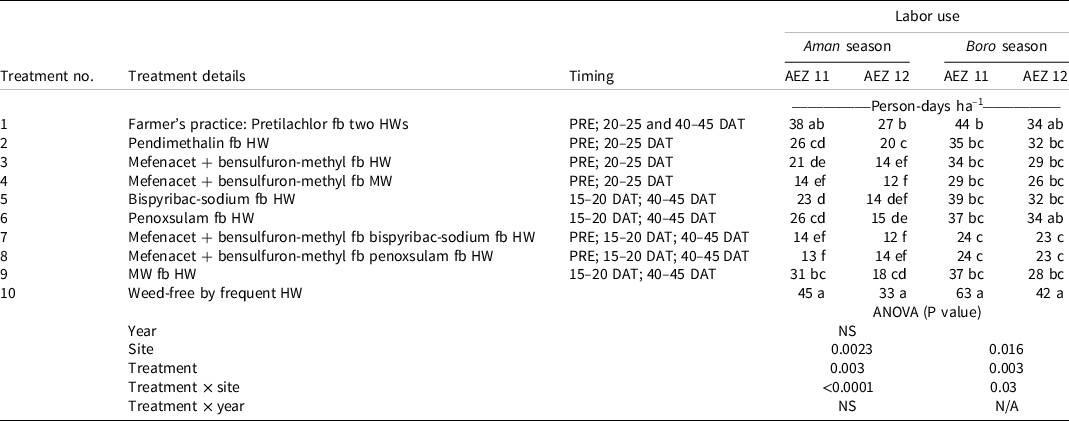
a Within column, means followed by the same letter are not statistically different according to Tukey’s HSD test at α = 0.05.
b Abbreviations: AEZ, agroecological zone; DAT, days after rice transplanting; fb, followed by; HW, hand-weeding; MW, mechanical weeding; NS, nonsignificant; PRE, preemergence at 1–3 DAT. N/A indicates not applicable.
During the Boro season, the amount of labor applied in all the IWM treatments did not differ from FP, except in treatments with preemergence fb postemergence fb hand-weeding, where labor use was 45% and 32% lower than in FP in AEZ 11 and AEZ 12, respectively (Table 6). The amount of labor applied in FP was lower in AEZ 11, but did not differ in AEZ 12 from the weed-free treatment. However, labor use was 25 to 40 and 10 to 19 person-days ha–1 lower in all IWM options when compared with the weed-free treatment in AEZ 11 and AEZ 12, respectively. The lower labor use in AEZ 12 compared to AEZ 11 could arise from a combination of the predominance of lower landscape positions and higher rainfall than observed in AEZ 11, which resulted in deeper field water depths (data not shown) and therefore a lower level of weed infestation––leading to a lower labor requirement for hand-weeding.
The greatest amount of labor was unsurprisingly applied to the weed-free treatment, as plots were regularly weeded manually to keep them free from weed competition. The high quantity of labor used in FP was due to the application of two manual weedings by hired laborers. In the Boro season, as mentioned earlier, the low temperature in the early season likely resulted in escape of weeds from the preemergence herbicide treatments, resulting in higher weed infestation and higher labor use for manual weeding than in the Aman season. Application of both preemergence and postemergence herbicides controlled weeds in the early as well as late crop growth stages, resulting in the lowest labor requirement among treatments.
Weed control costs were influenced by weed control treatments and sites in both the Aman and Boro seasons (Table 7). In the Aman season, weed control treatment-by-site interaction was also significant, but not in the Boro season. Therefore, weed control treatment means are presented for both sites for the Aman season. Similar to labor use, in both seasons, weed control cost was highest in the weed-free treatment followed by FP, both of which relied on repetitive manual weeding. Weed control costs were lowest in treatments 7 and 8, with preemergence fb postemergence fb hand-weeding in the Boro season and in AEZ 11 in the Aman season, or in treatment with mefenacet plus bensulfuron-methyl as preemergence fb mechanical weeding in AEZ 12 in the Aman season.
Table 7. Total weed control cost and added net return under different herbicide-based integrated weed management regimens in transplanted rice during the Aman and Boro seasons. a,b
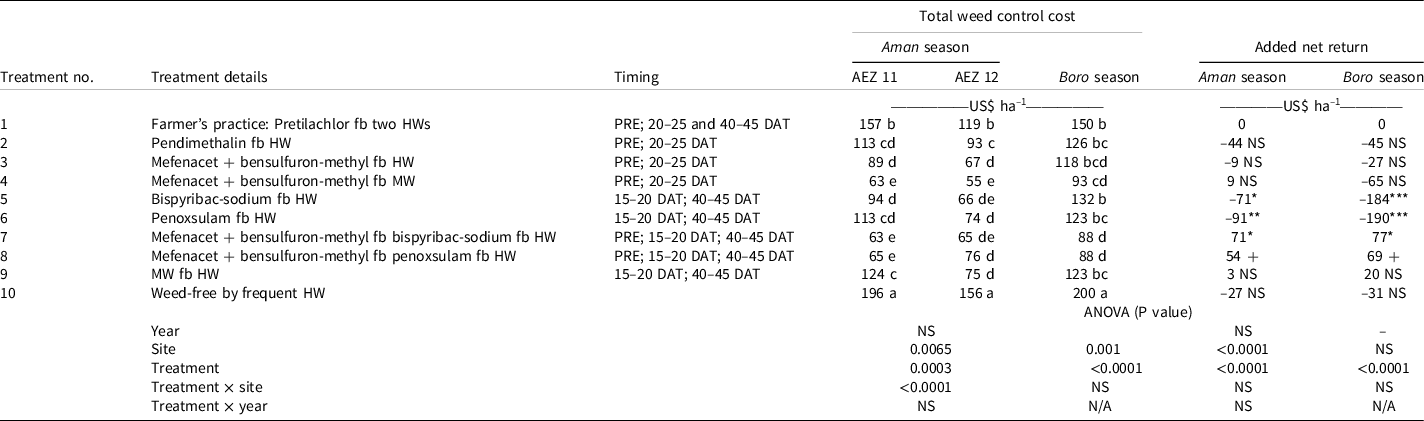
a Within columns, means followed by the same letter are not statistically different according to Tukey’s HSD test at α = 0.05.
b Abbreviations: AEZ, agroecological zone; DAT, days after rice transplanting; fb, followed by; HW, hand-weeding; MW, mechanical weeding; N/A, not applicable; NS, not significant; PRE, preemergence at 1–3 DAT.
cFor added net return, treatments means were compared with farmer’s practice using Dunnett’s test with significance at + P < 0.10; * P < 0.05; ** P < 0.01; *** P < 0.001; NS = non-significant (P > 0.10). Negative values would indicate that net return was lower than farmers’ practice; positive values indicate that net return was higher than farmers’ practice.
In the Aman season, the total weed control costs for all IWM treatments 2 to 9 were lower than for the FP and weed-free treatments (Table 7). Compared to FP, costs in AEZ 11 were US$92 to 94 ha–1 lower in treatments with preemergence fb postemergence fb hand-weeding or preemergence fb mechanical weeding, followed by US$44 to 68 lower in treatments with pendimethalin or mefenacet plus bensulfuron-methyl as preemergence fb hand-weeding or postemergence application of bispyribac-sodium or penoxsulam fb hand-weeding, and US$33 ha–1 lower in mechanical weeding fb hand-weeding. In AEZ 12, compared to FP, the reduction in weed control cost was lowest in pendimethalin fb hand-weeding with US$26 ha–1 lower, whereas in the remaining treatments, the reduction in control costs ranged from US$43 to 64 ha–1. Similarly, mefenacet plus bensulfuron-methyl fb mechanical weeding and treatments 7 and 8 with preemergence fb postemergence fb hand-weeding in the Boro season resulted in a US$57 to 62 ha–1 reduction in weed control cost compared to FP (Table 7). Yet in contrast, other IWM treatments did not differ from FP in total weed control cost.
The variation in weed control cost was mainly influenced by the quantity of manual labor recorded. The lowest weed control cost in treatments with preemergence fb mechanical weeding and preemergence fb postemergence fb hand-weeding was mainly due to lower labor use in these treatments. This result suggests that at current market prices, herbicide use and mechanical weed control options are cost-effective compared to manual weeding in transplanted rice. In Bangladesh, it has been observed that herbicide-based weed control can help maintain yield on par with three rounds of hand-weeding, with significant reduction in labor requirement and weed control cost (Ahmed et al. Reference Ahmed, Hassan, Mridha, Jabbar, Riches and Robinson2001). The cost of preemergence herbicides used was 38% to 46% cheaper than the cost incurred for one hand-weeding in rice in Bangladesh (Mazid et al. Reference Mazid, Jabbar, Riches, Robinson, Mortimer and Wade2001). Islam et al. (Reference Islam, Popy, Hasan and Anwar2017) observed that mechanical weeding reduced weed control costs by 74% to 78% compared to hand-weeding because of reduction in labor requirement by 74% to 85%. Narwariya et al. (Reference Narwariya, Tiwari and Shrivastava2016) also observed 19% to 68% lower weed control cost in mechanical weeding compared to hand-weeding. Yet as prices for agricultural inputs can vary in time and by location, further research should consider potential price variability fluctuations––both for labor as well as in market prices for herbicides––through sensitivity analysis to determine the point at which higher herbicide prices might render labor more attractive (Bagchi et al. Reference Bagchi, Rahman and Shunbo2019).
Added net return was influenced by weed control treatments in both seasons, and across sites, but interaction effects were nonsignificant; therefore, data for added net returns were pooled over AEZs (Table 7). In the Aman season, as compared to FP, treatments with preemergence as mefenacet plus bensulfuron-methyl fb postemergence as bispyribac or penoxsulam fb one hand-weeding provided added net returns of US$54 to 71 ha–1, whereas returns were negative, ranging from US$71 to 91 ha–1 in treatments with postemergence as bispyribac or penoxsulam fb hand-weeding. Similarly, in the Boro season, treatments with preemergence fb postemergence fb hand-weeding provided additional net returns of US$69 to 77 ha–1, but treatments with postemergence fb hand-weeding reduced returns by US$184 to 190 ha–1 as compared to FP.
The higher net returns in treatments with preemergence fb postemergence fb one hand-weeding compared to FP or weed-free treatment during both Aman and Boro despite similar yields were mainly due to a reduction in total weed control cost facilitated by reduced labor use. Nagarjun et al. (Reference Nagarjun, Dhanapal, Sanjay, Yogananda and Muthuraju2019) also reported higher net returns with sequential use of preemergence and postemergence herbicides. The reduction in net returns despite reductions in weed control costs in treatments with postemergence fb hand-weeding as compared to FP was mainly due to lower yields than in the FP. This reduction in weed control cost, however, was not sufficient to compensate for economic losses caused by reduction in yield.
Results clearly demonstrated that treatments with mefenacet plus bensulfuron-methyl as preemergence fb postemergence application of either bispyribac or penoxsulam fb hand-weeding are a better alternative to current farmers’ practices for weed control in transplanted rice for smallholders in Bangladesh, as these options reduce weed control cost and labor requirement for weed control and enhance farmer’s income. Alternate herbicides are less toxic to humans as compared to pretilachlor, the most commonly used herbicide in FP. Pretilachlor is reported to potentially cause skin and eye irritation and respiratory tract irritation (PPDB 2020). In contrast, no eye or skin irritations have been reported with alternate herbicides used in IWM options 6 and 7 such as mefenacet, bensulfuron-methyl, bispyribac-sodium, and penoxsulam (PMEP Cornell 2020; PPDB 2020; USAID 2015; US EPA 1997 a;US EPA 2001a, 2001b, 2004). The environmental toxicity profiles of bispyribac-sodium and penoxsulam are also more favorable for both terrestrial and aquatic animals (US EPA 2001a, 2001b, 2004), as compared to pretilachlor. Identification of herbicides that are less toxic, pose less risk to human health, and offer a better environmental profile is especially important in countries like Bangladesh, where adequate knowledge on the safe handling of herbicides is lacking among most smallholder farmers (Shammi et al. Reference Shammi, Sultana, Hasan, Rahman, Islam, Bodrud-Doza and Uddin2020).
The study also identified a nonchemical method of weed control that provided yields similar to FP and weed-free treatment, with lower or similar weed control cost and similar or lower labor requirement as compared to FP. Despite no herbicide use, the weed control cost or labor requirement in the nonchemical method was not higher than FP. This could be due to the integration of labor-efficient mechanical weeding. Islam et al. (Reference Islam, Hia, Sarkar and Anwar2018) observed that labor requirements were reduced from 616 person-days ha–1 when weeds were controlled with two hand-weedings, to 380 person-days ha–1 when weeds were controlled using one mechanical weeding with a manually operated BRRI weeder fb one hand-weeding. Despite the labor-saving benefits of mechanical weeder use as compared to hand-weeding, the adoption of such weeders has been low, possibly because manually operated weeding is still tedious. Moreover, line geometry is a prerequisite for the use of mechanized weeding. Motorized weeders can overcome the problem of drudgery involved in manually operated weeding and would further improve labor and weed control efficiencies (Islam et al. Reference Islam, Hia, Sarkar and Anwar2018). Therefore, motorized weeders would be more likely to be accepted by farmers than manually operated weeders. Motorized weeding, being less laborious and tedious, would also enable farmers to use the machine on custom hiring, as opposed to purchasing the machine (CSISA 2017).
In summary, our study provides evidence that the use of less toxic herbicide-based IWM options with sequential application of the preemergence herbicide mefenacet plus bensulfuron-methyl and postemergence application of bispyribac-sodium or penoxsulam fb one hand-weeding can be cost-effective and profitable alternatives to the predominant use by farmers of pretilachlor as preemergence followed by two hand-weedings, all without compromising on rice yields. The nonchemical option with mechanical weeding fb one hand-weeding can also be an alternative to FP; this treatment generated similar yields and profits for farmers who have no access to, or have no knowledge and skills in safely using the herbicides. The integration of nonchemical methods such as manual or mechanical weeding with the rotational use of effective yet lower toxicity herbicides is critical in delaying and/or preventing evolution of herbicide resistance while also mitigating the potential environmental trade-offs associated with weed control in intensive rice production systems in South Asia. This work provides an important contribution toward the identification of cost-effective mechanical weeding options that can be used in isolation or in combination with safer molecules with different MOAs to effectively control complex weed flora in transplanted rice, while also achieving reduced herbicide and labor use to mitigate weed-inflicted yield and profit-loss risks.
Data Availability Statement
The data that support the findings of this study are openly available in the CSISA data repository at https://data.cimmyt.org/dataset.xhtml?persistentId=hdl%3A11529%2F10548600
No conflicts of interest have been declared.
Acknowledgments
This study was conducted under the Cereal Systems Initiative for South Asia program (https://csisa.org) funded by the United States Agency for International Development (USAID) and the Bill and Melinda Gates Foundation (BMGF). The contents and opinions expressed herein are those of the author(s) and do not necessarily reflect the views of USAID or BMGF. The authors gratefully acknowledge all farmers and field technicians who were directly involved in this study.


 Open access

