


Introduction
The global burden of mental disorders is high, with around one-third of the adult population suffering from some kind of mental disorder [Reference Aguilar-Gaxiola, Alonso, Chatterji, Kessler, Lee and Ormel1]. In Germany, a 12-month prevalence of mental disorders of 27.8% has been reported [Reference Jacobi, Hofler, Strehle, Mack, Gerschler and Scholl2, Reference Jacobi, Hofler, Strehle, Mack, Gerschler and Scholl3]. Driven by the pandemic and economic crises, population-level mental health in Germany may have declined, as indicated by recent representative surveys reporting evidence on population-based indicators of mental health [Reference Mauz, Walther, Junker, Kersjes, Damerow and Eicher4]. Knowing and recognizing symptoms of mental health problems, as well as knowing about available treatment, is described by the term mental health literacy [Reference Jorm5].
Mental health literacy in the general public has been reported to be poor, for example, when individuals are asked to recognize mental health problems based on a case vignette [Reference Jorm5, Reference Furnham and Swami6]. Better mental health literacy may be associated with greater willingness to seek help. This is supported by findings from a longitudinal study, in which mental health literacy, positive attitudes toward help-seeking, and perceived need for treatment independently predicted increased service use [Reference Bonabi, Muller, Ajdacic-Gross, Eisele, Rodgers and Seifritz7]. Epidemiological studies have consistently shown that most individuals with mental health problems do not seek treatment for these problems, or only do so after a considerable delay [Reference Wang, Aguilar-Gaxiola, Alonso, Angermeyer, Borges and Bromet8]. Only one in five young people with mental health problems has accessed mental health services [Reference Malla, Iyer, McGorry, Cannon, Coughlan and Singh9–Reference Wittchen and Jacobi11] depicting the service use gap. This may lead to symptom exacerbations and long-term effects on quality of life and suffering. Another barrier to help-seeking may be stigmatizing attitudes towards individuals with mental health problems [Reference Gulliver, Griffiths and Christensen12–Reference Schomerus and Angermeyer14]. While stigmatizing attitudes have slightly declined with respect to depression since 1990 in Germany [Reference Schomerus, Schindler, Sander, Baumann and Angermeyer15–Reference Angermeyer and Matschinger17] stigma and social distance towards individuals with schizophrenia have increased further [Reference Schomerus, Schindler, Sander, Baumann and Angermeyer15]. By improving mental health literacy, erroneous beliefs about the development, maintenance, and treatment of mental disorders may be discarded, leading to a reduction in stigmatizing attitudes and social distance.
Thus, there is a strong need for easily accessible, evidence-based mental health literacy programs. Mental Health First Aid (MHFA) is a structured training program that has been developed to educate members of the public about mental health and how to support someone in an immediate mental health crisis including risk factors and preventive strategies. The aim is to empower individuals so that they can support their friends and relatives, which may ultimately lead to a more rapid transition into professional care pathways. So far, MHFA has been implemented in many countries [Reference Hart, Jorm, Kanowski, Kelly and Langlands18, Reference Jorm, Kitchener and Reavley19]. As reviewed recently, there is evidence on the effectiveness of MHFA training for increasing mental health literacy and confidence in providing help as well as for reducing stigmatizing attitudes [Reference Morgan, Ross and Reavley20]. In addition, in some studies evidence for increased mental health of MHFA trainees has been reported [Reference Kitchener and Jorm21]. However, most studies on the effects of MHFA training have been carried out in Australia and other English speaking countries. Only recently, MHFA has been started to be implemented in Germany, but it remains unclear whether findings reported in previous studies translate to the German context and, if so, what the effect sizes are that can be expected in this context. The overall aims of the current study were to show feasibility and initial effects of the MHFA training. The specific objectives were to investigate the feasibility based on recruitment, assessment of outcomes, retention, satisfaction, and acceptability as well as initial effects of MHFA training on (i) mental health literacy and confidence in MHFA actions, (ii) stigmatizing attitudes towards individuals with mental health problems, (iii) social distance, (iv) mental health, and (v) quality of life in German adult MHFA trainees at post-training and 6-month follow-up. To this end, the following hypotheses were tested in an uncontrolled pilot study:
-
1) Mental health literacy (Hypothesis 1a) and confidence (Hypothesis 1b) are increased at post-training and at 6-month follow-up compared to baseline,
-
2) Social distance (Hypothesis 2a) and stigmatizing attitudes (Hypothesis 2b) are reduced at post-training and at 6-month follow-up compared to baseline, and
-
3) Mental health (Hypothesis 3a) as well as quality of life (Hypothesis 3b) are increased at post-training and at 6-month follow-up compared to baseline in adult MHFA trainees.
Methods
Design
In an uncontrolled pilot study, individuals aged 18–75 years participating in MHFA courses held in Germany were recruited for this pilot study via advertisements on the MHFA website and emails to newly registered course participants. Outcomes were assessed at three points in time: at baseline (t0), post-training (t1), and 6-month follow-up (t2) (see Figure 1).
Study design of the uncontrolled pilot study. Data were collected at baseline (t0), post-training (t1), and 6-month follow-up (t2).

Participants
Eligible individuals were recruited from MHFA courses and invited to participate in the study. Participation in the study had no influence on receipt of MHFA training. Besides registration for the MHFA course, further inclusion criteria were: age between 18 and 75 years, and speaking the German language. Participants were not able to participate if their course date had not yet been confirmed.
Intervention
The host organization for MHFA in Germany is “‘MHFA Ersthelfer,” based at the Central Institute of Mental Health (CIMH), Mannheim. In close collaboration with MHFA Australia, the program was translated and modified for the German context. Instructors had a background as healthcare professionals. The MHFA training was advertised using a dedicated webpage and in press releases and newspapers. In addition, companies and healthcare institutions were approached, resulting in about 44% of MHFA courses held in a company setting. The course was held in person or, since April 2020, via videoconference tools (due to infection control measures during the COVID-19 pandemic). The 12-hour training focuses on symptoms, causes, and evidence-based treatments for depression, anxiety, psychosis, and substance use disorders [Reference Kitchener and Jorm22], as well as an action plan addressing possible crisis situations. Participants of the MHFA training received a printed version of the manual.
Procedure
MHFA instructors informed their participants about the study at enrollment for the MHFA training. Interested individuals contacted the study team. They received the study information and, after providing informed consent, were invited to complete the baseline survey prior to the first training session. We used Research Electronic Data Capture (REDcap, Harris, Taylor [Reference Harris, Taylor, Thielke, Payne, Gonzalez and Conde23]), a web-based software platform hosted at CIMH servers, for data collection. Participation in the study was not remunerated.
Measures
Feasibility
Feasibility of the study procedures was assessed based on the number of participants successfully recruited to the study and the collection of measures at baseline as well as at post-training and 6-month follow-up. Satisfaction with the course was assessed at post-training and follow-up using a rating scale from 1 (very much satisfied) to 5 (not at all satisfied). Acceptability of the course was assessed by asking participants whether they learnt something from the course, how useful the course was, and whether they would recommend the course. These questions were rated on a scale from 1 (very much) to 4 (not at all).
Mental health literacy
We used the 35-item Mental Health Literacy Scale [Reference O’Connor and Casey24] to assess mental health literacy. The items were rated on a 4-point and a 5-point scale. A sum score was created, which showed a high internal consistency, with Cronbach’s α = 0.84 at all time points. Please see Supplementary Material 1 for a more detailed description of this measure, including psychometric properties. In addition, participants were presented with two vignettes: one describing an individual with lived experience of depression and one describing someone with lived experience of psychosis [Reference Kitchener and Jorm22]. The vignettes were presented in alternating order across time points, and participants either received the depression vignette at baseline or the psychosis vignette. Problem recognition was assessed by asking participants to identify what was wrong with the person described.
Social distance and stigmatizing attitudes towards individuals with mental health problems
In order to assess social distance, we asked participants to rate five items on a scale from 1 (definitively, yes) to 4 (definitively, no). The situations covered in the items were, for example, whether they could imagine to move to someone, or whether they want to work with someone like the individual with mental health problems described in the vignettes [Reference Link, Phelan, Bresnahan, Stueve and Pescosolido25]. A total score for social distance towards someone with depression and someone with psychosis was created. The social distance measure showed a high internal consistency, with Cronbach’s α ranging between 0.74 and 0.88 across time points.
In addition, participants were asked to respond to nine questions assessing personal stigma towards the individual described in the vignette, using a scale (1 = “strongly disagree” to 5 = “strongly agree”), in line with Griffiths, Christensen [Reference Griffiths, Christensen, Jorm, Evans and Groves26]. A total score was created for stigma towards someone with depression or someone with psychosis. Cronbach’s α for the stigma measure ranged between 0.63 and 0.75 across time points.
MHFA intentions and behaviors
Confidence in providing MHFA was assessed by asking how confident participants felt in helping the individual described in the vignette, rated on a scale from 1 (not at all) to 5 (very much). In a multiple-choice item, participants could indicate what helping behavior they would pursue. In addition, we used an open-text item asking what they would do in order to help the individual described in the vignette.
At baseline and at 6-month follow-up, we asked participants whether they had talked to someone about mental health problems in the past 6 months. The answer was rated on a scale from never (1), once (2), several times (3), to often (4). Three further questions were shown in case they indicated that they had talked to someone about their mental health problems. First, participants rated how confident they were in their help on a scale from 1 (not at all) to 5 (very). Second, they rated how confident they were with the extent of their help on a scale from 1 (very unconfident) to 4 (very confident). Third, they rated how they thought the recipient of their help felt, rated on the scale from 1 (not better at all) to 5 (very much better).
Mental health and quality of life
We used the 18-item version of the Brief Symptom Inventory (Derogatis [Reference Derogatis27]) assessing symptoms in the last 7 days, rated on a scale from 0 (not at all) to 4 (very strong). The sum score yields a global severity index (GSI). In the present study, the internal consistency of the GSI was Cronbach’s α = 0.90 at all time points.
We assessed quality of life using the WHOQOL-BREF questionnaire [Reference Skevington, Lotfy, O’Connell and Group28], which includes four domains: physical health, mental health, social relationships, and environment. Domain scores were calculated by multiplying the mean of all items included within a domain by four. Internal consistencies for domain scores have been reported to range from 0.74 to 0.91 [29]. In the present study, Cronbach’s α ranged from 0.71 to 0.82 at baseline.
Statistical analysis
All statistical analyses were conducted using Stata 17. Descriptive statistics were calculated for basic sample characteristics and measures of satisfaction and feasibility. Wilcoxon rank-sum tests were calculated for ordinal measures. To test Hypothesis 1, on the effect of training on mental health literacy or confidence, we fitted a linear mixed model using the Stata command “mixed,” with literacy or confidence as dependent variable and time (baseline, post-training, follow-up) as the independent variable. This model included order of vignette assignment, age, and gender as covariates to control for potential confounding by these variables. To test Hypothesis 2, on the effect of training on social distance (2a) and stigmatizing attitudes (2b), linear mixed models were fitted with the respective outcome as the dependent variable and time as the independent variable and the same covariates as in the previous model. To test Hypothesis 3, on the effect of training on mental health (3a) or quality of life (3b), linear mixed models were fitted with the respective outcome as dependent variables and time as independent variable, including the same covariates. All models were fitted using restricted maximum likelihood estimation, that is, using all available data under the assumption that data are missing at random and if all variables that are associated with missingness are included to the model [Reference Mallinckrodt, Clark and David30]. Please see the Supplementary Materials for sensitivity analyses in a per-protocol sample that provided data at all time points, as well as sensitivity analyses controlling for additional potential confounders. Further, we calculated Cohen’s d effect sizes.
Results
Feasibility
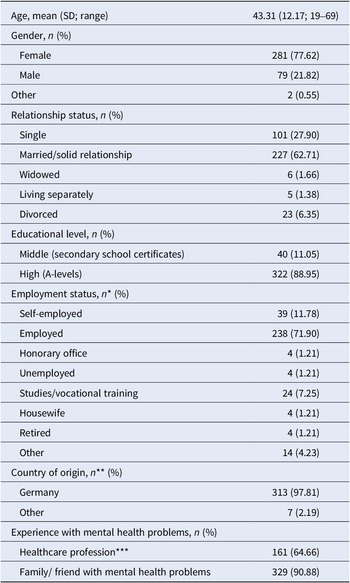
Recruitment started in August 2019, and data collection continued until August 2023. In total, 389 participants were enrolled in the study (mean recruitment rate: eight participants/month), and 362 completed the baseline assessment (t0). Table 1 depicts the sample characteristics. Participants were, on average, 43.31 years old, mostly female (77.62%), in a stable relationship (62.71%), employed (71.90%) and had a high educational level (88.95% A levels). Most participants had prior experience with mental health problems within their family or friends (90.88%) or as they worked in healthcare professions (64.66%). Please see Supplementary Table S4 for baseline characteristics of the per-protocol sample.
Sample characteristics (N = 362)

Note: *n = 331; **n = 320, ***n = 249 (variable was added at a later point in time).
As for retention, 191 participants (53%) did not complete the assessment at post-training (t1). Individuals that were lost to post-training were, on average, 43.2 years old, mostly female (74.35%) and reported lower confidence in helping behavior at baseline compared to the per-protocol sample (see Supplementary Table S7). However, the retention rate at the 6-month follow-up (t2) was higher than at post-training, with 227 participants (62.71%) completing the assessment at t2 (see Figure 2). Supplementary Table S8 depicts the baseline characteristics of the sample that did not provide data at follow-up.
Study flowchart.
Notes: n denotes the total number of participants.

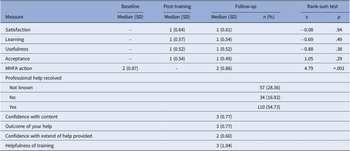
Table 2 shows the findings from the subjective evaluation of the MHFA course program by participants. At post-training, participants were very much satisfied (Median = 1, SD = 0.64) with the course and reported that they learnt a lot (Median = 1, SD = 0.57). Further, participants indicated that they would recommend the course (Median = 1; SD = 0.54). Also at 6-month follow-up, participants were still highly satisfied with the course program.
Satisfaction with the course program, mental health first aid intentions, actions, and confidence at time points

Note: n, sample size.
Satisfaction: “How satisfied were you with the course?” rated on a scale from 1 = very much to 5 = not at all; Learning: “Did you learn something at the course?” rated on the scale from 1 = very much to 4 = not at all; Usefulness: “How useful was the course?” rated on the scale from 1 = very much to 4 = not at all.
Acceptance: “Would you recommend the course?” rated on the scale from 1 = very much to 4 = not at all.
MHFA action: “Did you talk to someone about their mental health problems in the past 6 months?” rated on a scale from 0 = never to 3 = often.
Confidence in content of helping behavior: “In case you provided mental health first aid, how confident were you in your help?” rated on a scale from 0 = no confidence to 4 = very confident.
Outcome of your help: “In case you provided mental health first aid, how do you think did the recipient of your help feel after you talked to him?” rated on a scale from 1 = not better at all to 5 = very much better.
Confidence in extend of your help: “In case you provided mental health first aid, how confident were you with the extent of your help?” rated on a scale from 0 = very unconfident to 4 = very confident.
Helpfulness of training: “How much have the contents of the MHFA training helped you in the meantime when dealing with stressed individuals?” rated on a scale from 0 = very little to 4 = very much.
Effects of MHFA training at post-training and 6-month follow-up
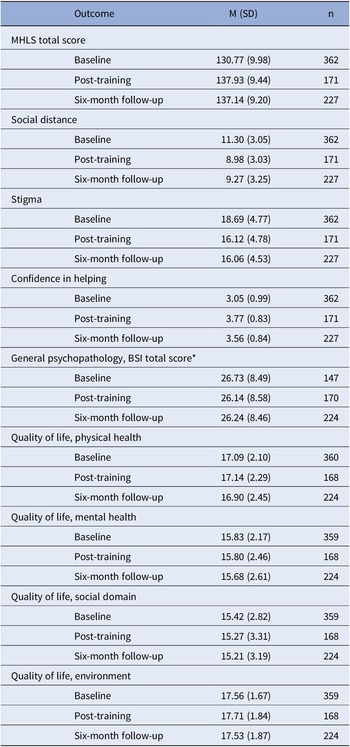
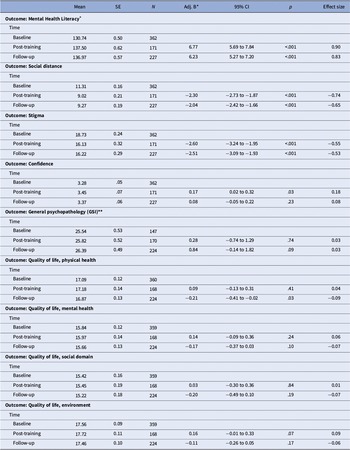
As can be observed in Tables 3 and 4, participants’ mental health literacy increased at post-training (adjΒ = 6.77, 95% CI = 5.69 to 7.84, p < .001, d = 0.90) and follow-up (adjΒ = 6.23, 95% CI = 5.27 to 7.20, p < .001, d = 0.83) with large effect sizes. In addition, participants’ confidence in providing help as described in the vignettes increased at post-training (adjΒ = 0.17, 95% CI = 0.02 to 0.32, p = .03, d = 0.18). There was evidence on a reduction in social distance at post-training (adjΒ = −2.30, 95% CI = −2.73 to −1.87, p < .001, d = −0.74) and follow-up (adjΒ = −2.04, 95% CI = −2.42 to −1.65, p < .001, d = −0.65), as well as on a reduction in stigmatizing attitudes at post-training (adjΒ = −2.61, 95% CI = −3.25 to −1.97, p < .001, d = −0.55) and follow-up (adjΒ = −2.51, 95% CI = −3.09 to −1.93, p < .001, d = −0.53). We observed no effects on trainees’ mental health at both time points. Similarly, most quality of life subscales yielded no effect. There was some evidence suggestive of a reduction in trainees’ physical quality of life at 6-month follow-up (adjΒ = −0.21, 95% CI = −0.41 to −0.02, p = .03).
Measures at baseline, post-training, and 6-month follow-up

Note: *Reduced dataset at baseline due to technical error. Confidence in helping assessed with respect to a vignette on a scale from 1 (no confidence in helping at all) to 5 (very confident).
Outcome measures at time points

Note: The table presents average marginal means. *adjusted for vignette order, age, and gender; **reduced dataset in arm 1 at baseline; and +p-value will only be reported for mental health literacy: Wald test: ꭕ2 = 229.14 p < .001.
MHFA actions
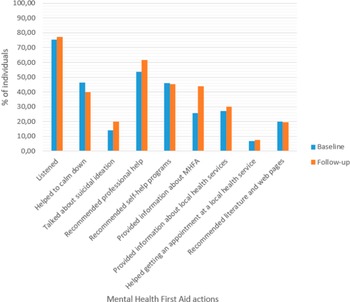
Most individuals participating in the course reported, at baseline and at follow-up, that they repeatedly spoke to someone about their mental health problems in the past 6 months. In case where they provided MHFA, most participants felt quite or very confident (Median = 3), and were confident or very confident about the extent of their help provided (Median = 3). In 55% of these cases, recipients of their help were reported to receive professional help (see Table 2). Figure 3 shows the MHFA actions at baseline and follow-up.
Mental health first aid actions at baseline and at 6-month follow-up (selection of multiple items was possible).

Discussion
The results of this uncontrolled pilot study support feasibility and suggest initial beneficial effects of the structured MHFA training in a German adult population. First, feasibility of study methodology could be demonstrated, including an adequate recruitment rate, outcome assessment, and a moderate retention. Participants were satisfied with the course program, learned a lot, and would recommend the course. Second, we found initial evidence of (i) increased mental health literacy and confidence in MHFA actions, as well as (ii) reductions in stigmatizing attitudes and social distance towards individuals with depression or psychosis at post-training and at 6-month follow-up compared to baseline. All these effects showed medium-to-large effect sizes. However, (iii) there was no evidence of an effect on trainees’ mental health or quality of life, except for a reduction in the physical domain of quality of life at 6-month follow-up.
Limitations
When interpreting the findings, the following limitations need to be considered. First, the study was an uncontrolled pilot study focusing on feasibility of methodology and initial effects. Thus, the quality of evidence is limited and results must be interpreted with caution.
Although we found evidence for the feasibility of the methodology, we observed a modest retention rate at post-training. This needs to be addressed by improving recruitment and retention strategies, as well as sample size calculation of subsequent research. Reasons for the modest retention may be the online-format with limited contact with the study team and may also relate to online delivery of MHFA courses, or to the fact that study participation was not remunerated. However, a higher retention rate of 65% was observed at 6-month follow-up, a retention rate similar to that observed in previous online studies. By assuming data to be missing at random and including covariates associated with missing values in the models, linear mixed models provided unbiased estimates based on all available data.
Second, measures of mental health literacy have been noted to focus only on problem recognition and thus strengthening an illness focused mental health concept and stigmatizing labels [Reference Mansfield, Patalay and Humphrey31]. This is also the case for the applied mental health literacy scale and future research may include concepts of positive mental health. In the same line, future studies could, for example, apply the recently published Mental Health Support scale [Reference Morgan, Wright, Mackinnon, Reavley, Rossetto and Jorm32] instead of vignettes for assessing MHFA actions, as vignettes usually depict a prototype of someone with a mental health condition and thereby can contribute to the spread of a deficit-orientated image.
Third, the sample of trainees was not representative of the German population, for example, the majority of participants were female, which may indicate a selection bias. However, in prior studies and routine delivery of MHFA courses [Reference Morgan, Ross and Reavley20], the majority of trainees were also female. Hence, the sample selected here may be similar to those reported before. In addition, the sample was highly educated and largely consisted of healthcare professionals, which highlights the interest in mental health in the general population as well as from other health professions. Nevertheless, strategies should be developed to reach more diverse communities with MHFA courses and, for example, also assess socioeconomic status. This would help in identifying target groups that may benefit more from the MHFA training [Reference Hadlaczky, Hokby, Mkrtchian, Carli and Wasserman33].
Fourth, data were collected during the COVID-19 pandemic, which involved various infection control measures in Germany, including lockdowns, social distancing, and home schooling. These measures, as well as the pandemic itself, had negative effects on mental health [Reference Mauz, Walther, Junker, Kersjes, Damerow and Eicher4]. As the present study is an uncontrolled study, we cannot rule out that our findings were confounded, for example, by factors that affected the German population, such as the COVID-19 pandemic. This may, at least in part, explain the reduction in quality of life related to physical health reported at the 6-month follow-up, which is in line with findings on reduced quality of life, particularly in women, during the pandemic [Reference Eicher, Pryss, Baumeister, Hovener, Knoll and Cohrdes34].
Comparison with previous research
To our knowledge, this pilot study is the first to provide evidence on feasibility of training delivery in Germany and among the first to show effects of courses held via videoconferencing tools [Reference Russell, Kelly, Polman and Warren-James35]. Although the structured course program originally has been developed for other contexts, it has been implemented in various settings including workplaces [Reference Kitchener and Jorm21], at nursing schools and universities [Reference Costa, Sampaio, Sequeira, Ribeiro and Parola36]. The present findings are in line with previous research on MHFA [Reference Kitchener and Jorm22].
Furthermore, there is good evidence on the effects of the MHFA training on knowledge about mental health problems, confidence in helping behavior, and reduced stigmatizing attitudes from randomized controlled trials [Reference Morgan, Ross and Reavley20, Reference Kitchener and Jorm37]. Meta-analytic evidence further indicates moderate mean effect sizes for a change in knowledge, in stigmatizing attitudes and in helping behavior between baseline and later post-training time points [Reference Hadlaczky, Hokby, Mkrtchian, Carli and Wasserman33]. Similarly, the present study suggests that the effects on knowledge, social distance and stigmatizing attitudes remained, while no effect was evident for confidence at 6-month follow-up. This is in line with the limited evidence on long-term effects reported elsewhere [Reference Morgan, Ross and Reavley20] and highlights the importance of refresher courses.
Only some studies reported positive effects on trainees’ mental health (e.g., Kitchener and Jorm [Reference Kitchener and Jorm21]). As reviewed recently, evidence on effects of MHFA training on trainees’ mental health is very limited [Reference Morgan, Ross and Reavley20, Reference Richardson, Dale, Robertson, Meader, Wellby, McMillan and Churchill38]. No adverse effects of the training have been documented so far. As supporting individuals with mental health needs may be challenging, the evaluation of side effects of the training may be part of future studies. Further areas that need to be investigated in future studies include the impact of MHFA training on recipients’ mental health and service use [Reference Morgan, Ross and Reavley20]. To this end, future research should focus on recipients in order to address the question whether increased knowledge of trainees has an effect on actual care-seeking behavior in recipients.
Conclusions
Evidence from this uncontrolled pilot study on feasibility and preliminary evidence on the effects of the MHFA course program implemented in Germany tentatively suggests that this course may be a promising strategy for increasing mental health literacy and reducing stigmatizing attitudes and social distance towards individuals with mental health problems. There is a pressing need for increased knowledge about mental health and pathways to care in the general population due to current societal crises and transformations. MHFA courses, with their train-the-trainer principle, are scalable and, thereby, can reach a large proportion of the population. In order to obtain evidence on the efficacy of MHFA training in Germany, a well-designed confirmative RCT is warranted.
Supplementary material
The supplementary material for this article can be found at http://doi.org/10.1192/j.eurpsy.2025.10114.
Data availability statement
Data acquired during this study will not be publicly available. The data, protocol, and statistical code, are available from the corresponding author on reasonable request.
Acknowledgements
The authors would like to thank all individuals participating in the study and are very grateful to the MHFA course instructors and the organizing team of MHFA Ersthelfer Germany. Endorsed by the German Center for Mental Health (DZPG).
Author contribution
UR designed the study, is PI, and has managerial responsibility for the successful completion of the study. AS, UR, and MD drafted the manuscript. AS, CH, TS, SM, MD, and UR were involved in writing, have read, and approved the final manuscript.
Financial support
This work was funded by the Beisheim Stiftung to MD, TS, and SM and a DFG Heisenberg professorship (no. 389624707) to UR.
Competing interests
AS, CH, and UR declare that they have no conflicts of interest. MD, TS, and SM are organizers of MHFA Ersthelfer Germany.
Sponsor
The primary sponsor of this study is the Central Institute of Mental Health, Mannheim.
Role of sponsor and funders
The sponsor and funding agency did not have any role in the trial design, data collection, statistical analysis, interpretation of data, writing the manuscript, or the decision to submit reports for publication.
Ethics approval and consent to participate
The study has received ethical approval by the local Ethics Committee of the Medical Faculty Mannheim of Heidelberg University (2019-679N). All participants provided written informed consent before inclusion to the study.




 Open access


Comments
No Comments have been published for this article.