Introduction
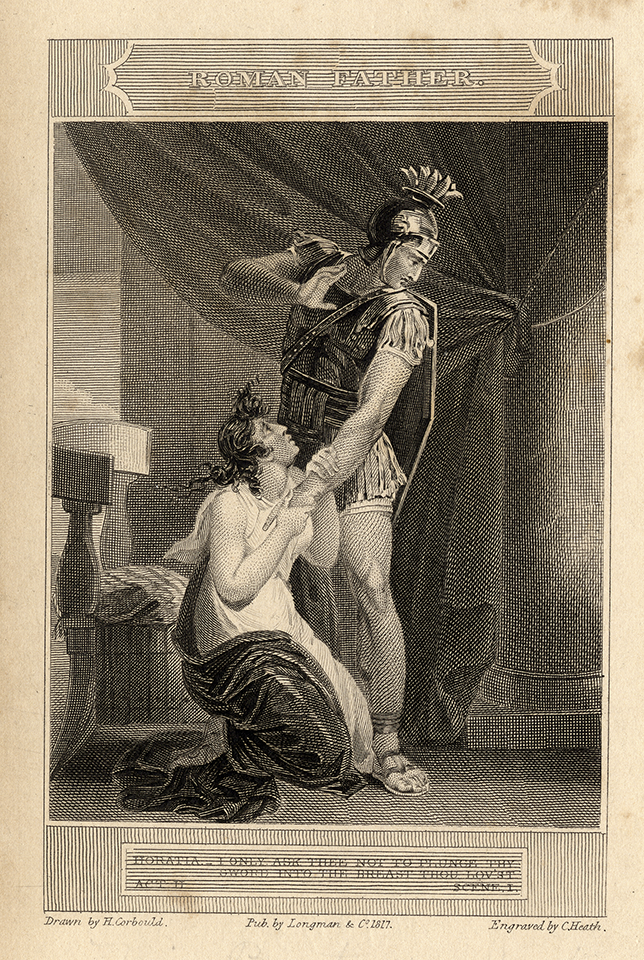
William Whitehead’s The Roman Father, first staged in 1750, was one of the most popular tragedies in late eighteenth-century Britain. Like many other plays of the time, it dramatised ancient Roman history, and deployed the tropes that British audiences associated with Roman characters. Patriotic rhetoric, virtuous behaviour, plumed helmets, skirted tunics, invocations of Roman deities and historical figures: all this and more made its customary appearance.
Nonetheless, the play was unusual. It was the only eighteenth-century play to be set in Rome’s Regnal period (traditionally dated 753–509 BC), when the city was ruled by kings; and it eschewed the paradigm typical to its contemporaries, in which the true, virtuous Romans had to redeem their city from internal corruption. Instead, Whitehead focused on the conflict between Romanness and human nature within his main characters, and, morally speaking, left the conflict unresolved. He picked a famous martial episode from Roman history, but rendered it as domestic tragedy, emphasising the struggles of the non-combatants. His play was built on the recognition that Roman history held cultural value, but also that it could be viewed with different attitudes: exemplary, historicist, or sentimentalist. Because of the way that he handled his material, Whitehead created a tense, arresting play, with a powerful female lead.
Moreover, even his play’s success was unusual. Fifty-five different dramas featuring Romans were staged at London’s patent winter theatres in the eighteenth century, accumulating some 1400 performances between them.Footnote 1 Of all historical peoples, only the Medieval English were depicted more often. Yet these headline figures mask ambivalent fortunes. Performance numbers declined over the period. Even in the early eighteenth century, most new Roman plays disappeared after a single theatrical season; older plays, first staged before 1700, loomed disproportionately large in the repertory. The Roman Father was the only unqualified success written between Joseph Addison’s Cato (Reference Addison1713) and the end of the century, and Cato’s heyday had passed by 1750. Thus a subgenre that has been considered distinct, significant, and popular by eighteenth-century Britons and modern scholars alike crystallised, between 1750 and 1800, into (more or less) a single successful play: The Roman Father. Clearly, the play deserves study. But so too do its fascinating dynamics vis-à-vis other Roman plays, and vis-à-vis British historical culture concerning ancient Rome.
In this Element, my focus is the play’s titular Romanness, and what drama reveals about how eighteenth-century Britons engaged with Roman history. I survey eighteenth-century Roman plays in general, then explore The Roman Father’s text, its reception, its performance history, and its relationship to other genres of historical culture. My analysis is guided by three key questions:
1. How did eighteenth-century British people view Roman history?
2. How did plays fit into the wider landscape of historical culture on Rome?
3. Why did The Roman Father gain an enduring success that was denied to most other Roman plays?
By answering these questions, I aim to contribute to eighteenth-century British cultural history, and to the studies of historical culture, classical reception, and history onstage.
The Play
On 6 February 1750, the General Advertiser gave first notice of the play: ‘There is now Rehearsal at the Theatre Royal in Drury-lane, a new Tragedy call’d the Roman Father.’Footnote 2 Two weeks later, the same paper reported that it would be staged on the coming Friday, and subsequent playbills further advertised its premiere.Footnote 3 Anticipation grew over this time: the play ‘employ’d the attention, and engross’d the conversation of the town’.Footnote 4 The public tried to establish whether the titular father was ‘Romulus, Virginius, or Cato, or who; but in the height of the impatience of the curious and inquisitive on this interesting subject, comes out for six-pence the story on which the Roman Father is founded’, a pamphlet apparently published at noon on Friday 24 February, hours before the play’s premiere.Footnote 5 It revealed that the play was by Whitehead, and dramatised one of the best-known episodes from early Roman history: that of the Horatii and the Curiatii. This involved a combat between three Roman brothers (the Horatii) and three Alban brothers (the Curiatii) to settle which of their cities would have dominion over the other. One Roman survived and killed his three opponents, but then killed his own sister, too, because she lamented the death of one of the Curiatii, to whom she had been engaged.
That February night, an excited audience gathered in the auditorium. Candlelight illuminated them and the stage alike. After some pieces of music from the orchestra, one of Drury Lane’s leading actors, Spranger Barry, stepped out in Roman costume. He set the scene with a prologue, beginning, ‘BRITONS, To-night in native Pomp we come,/ True Heroes all, from virtuous ancient Rome’.Footnote 6 The play began, starring David Garrick and Hannah Pritchard alongside Barry. Garrick co-owned the theatre, and had selected the play for production; he played Horatius, father of the three Horatii. Barry played one of his sons, Publius, and Pritchard his daughter, Horatia. Neither Publius’s two brothers nor the Curiatii appeared onstage.
In fact, most of the play was set in Horatius’s house. Act I began with Horatia onstage, a soldier informing her that the Roman and Alban armies were ready to join battle. Once he departed, Horatia revealed to the audience the crux of her worries, upon which her subsequent grief, and the play’s action, would hinge: her engagement to one of the Curiatii. Further news then arrived from the frontline. The Roman and Alban armies had refused to fight each other, and the Roman king, Tullus, had therefore proposed a combat of champions, with three on each side. Horatia was delighted at the reprieve, but not for long: her three brothers were chosen as Rome’s champions, and their opponents were to be the Curiatii. She would suffer an insupportable loss either way: her country and brothers, or her fiancé, would be destroyed. By contrast, Horatius was overjoyed that his sons had been chosen.
The combat began. News filtered through to Horatius’s house, suggesting that Publius’s two brothers had been slain and Publius himself had fled. Horatius was enraged at his son’s cowardice, but further news arrived: Publius’s flight had been a ploy, and he had killed all three Curiatii. While Horatius celebrated, Horatia sunk into dull, resolute grief. Having so far been reactive and ineffectual, she summoned up her Roman fortitude and drove the climactic action of the play. She set out to confront Publius, interrupting his victorious entry into the city, and railed against him and Rome. Offstage, he stabbed her. The final scene showed her at home again, bandaged, with Horatius and Publius attending her. She revealed that she had intentionally provoked Publius to stab her, authoring her own death, and she compounded the act by tearing off her bandages. A crowd of Romans then began to break in, intent on bringing Publius to justice. Horatia exhorted her father to protect Publius, then died. Partly on the strength of her advice and testimony, Horatius persuaded his countrymen to spare his son.
The play delighted the audience, who received it ‘with Extravagant applause’.Footnote 7 It was performed twelve times in its debut season. Three pamphlets appeared in response to the play: The Story on Which the New Tragedy, Call’d The Roman Father, Is Founded, mentioned above, which quickly went to a second edition;Footnote 8 Remarks on the New Tragedy, Call’d The Roman Father, published March 1750;Footnote 9 and the seventy-two-page A Comparison Between the Horace of Corneille and The Roman Father of Mr. Whitehead, published c.15 March.Footnote 10 The play itself was published on 6 March, and a second edition on 13 March.Footnote 11 The London Magazine for March 1750 opened with a long review of the play, the Monthly Review reviewed it at some length, and the Universal Magazine reviewed it across two issues and printed a large image of ‘The Scene of the Tragedy of the Roman Father’.Footnote 12 Of these reviews, only the Monthly Review’s was negative. But the reviewer felt obliged to explain the play’s success and attributed it to the prevalent influence of ‘the author’s friends, and some people who constitute what is on these occasions call’d the Town’, who had declared in favour of it, and also to its being ‘well acted’.Footnote 13 By contrast, Remarks expressed agreement with the general opinion that it was ‘a very ingenious piece, and worthy the applause it receiv’d’.Footnote 14
Arguably, then, The Roman Father was the biggest theatrical event of the 1749–50 season. Thereafter, as mentioned above, it became one of the most successful tragedies, and the most frequently performed eighteenth-century Roman play, of the second half of the century at London’s patent theatres, with fifty-nine performances before 1800.Footnote 15 It was also popular in Ireland, colonial North America, and English provincial theatres, and was performed as Harrow School’s Christmas play in 1752.Footnote 16 General theatrical writings continued to refer to it for over fifty years; Arthur Murphy gave it its own, laudatory chapter in his 1801 Garrick biography.Footnote 17 It was sometimes quoted in political discussions, and one of its passages was included in a four-page ‘Spouter’s Medley’.Footnote 18
The success was something that its author, William Whitehead (1715–85), had not been accustomed to, nor ever experienced again. Whitehead was an English writer whose output consisted mostly of lyric poetry.Footnote 19 In 1745 he had been appointed tutor to George Bussy Villiers, eldest son of the Earl of Jersey, and relocated to London, where he began attending the theatre and writing drama. According to his friend, William Mason, Whitehead wrote The Roman Father several years before it was staged, consciously favouring ‘scenical effect’ over ‘elevated’ writing, as suited the taste of Garrick; but Whitehead nonetheless had to edit the play still further in that direction before Garrick would accept it, which Mason felt ‘hurt’ the play ‘not a little’.Footnote 20 The rest of Whitehead’s life was spent in the Jersey household, passing between their residences in London and the countryside. He became poet laureate in 1757, and three more of his plays were staged at Garrick’s Drury Lane after The Roman Father, each moderately successful. But by 1800, The Roman Father would probably have been his only well-known production.
However, the play’s success did not persist much thereafter. In London it was performed only three more times, at Covent Garden in 1809. Two of those performances came during riots against Covent Garden’s new admission prices (the Old Price Riots) and were thus ill-attended. The third was well-attended, but was wrecked by the inebriation of George Frederick Cooke. Playing the titular role, he ‘came on the stage merely to expose himself – he was incapable of speaking, and was led off amidst … tumultuous marks of disapprobation’.Footnote 21 The timeline is appropriate: having been arguably the definitive Roman play of the late eighteenth century, The Roman Father disappeared in ignominy at the dawn of the nineteenth.
Previous Scholarship
Despite its eighteenth-century popularity, The Roman Father has never attracted much scholarly attention. Theatre scholars have sometimes mentioned it as an example of a repertory piece, or in relation to a mid century vogue for Roman plays, but have treated it briefly and/or dismissively.Footnote 22 Its most insightful treatment is by Jean Marsden, who, over several pages, analyses the play alongside three mid 1750s plays on the story of Appius and Virginia, framing them as ‘plays depicting the father-daughter bond’ that ‘envision filial piety in the public arena, with daughters who define themselves jointly as Romans and daughters, and who, through their deaths, promote the liberty of their fatherland’.Footnote 23 The play has never featured in discussions of eighteenth-century historical culture or attitudes to Roman history.
Indeed, there have never (to my knowledge) been any extended surveys of eighteenth-century British views of, or plays about, ancient Rome. But various scholars have addressed aspects of these subjects. Literary scholars have given much attention to the ways in which eighteenth-century writers, especially poets, engaged with the classical inheritance.Footnote 24 Perhaps the most sophisticated debate on this topic has centred on British views of Augustus, Horace, and Virgil.Footnote 25 Such work is relevant to my own, but I operate on different terrain: rather than analysing Britons’ value judgements about ancient Rome, or their use of Roman literature, I analyse their engagement with Roman history, and the historical culture concerning Rome that they produced. In particular, I am interested in the attitudes that Britons brought to Roman history.
As such, my work responds primarily to scholarship on eighteenth-century historical theory and practice, genres of historical writing, and historical culture. There has been much insightful scholarship in these areas, and it has sometimes addressed British history-writing on ancient Rome, especially Gibbon’s, although typically not as its central subject.Footnote 26 The most important scholarship to focus on British prose histories of Rome has been Frank M. Turner’s, but his thematic focuses have been fairly circumscribed, while his chronological scope has extended beyond the eighteenth century.Footnote 27 Of most relevance to my own work, certain scholars have identified two main attitudes to history in early modern and eighteenth-century Britain: the ‘exemplary’, which was the standard attitude in the early modern period, and the ‘historicist’, which existed in practical and sometimes even theoretical terms by the seventeenth century, but which only gained theoretical dominance, and usurped the exemplary, at some point around 1800.Footnote 28 The exemplary attitude held that history was a literary, rhetorical, and philosophical enterprise, written to instruct people – especially men in public office – how to live and behave. Readers of history should seek good examples to emulate, and bad examples to avoid. By contrast, the historicist attitude was rooted in antiquarian studies often scorned by opponents as pedantic or boring, such as numismatics and chorography. It was more concerned with factual detail, the full depiction of historical societies, and history for history’s sake; and, because it held that historical societies were each distinct, rather than sharing a universal human nature, it precluded the possibility of deriving moral or practical lessons from them.
The exemplary attitude had a special connection to Roman history, partly because the attitude was rooted in texts from ancient Rome (or from Greece, about Rome), partly because Roman history tended to be viewed as that which most warranted an exemplary perspective. During the same period in which exemplarity was at its height, the history of Rome was privileged above that of other societies, due to the (supposed) noble deeds and virtue of the Romans, and the empire that Rome had attained as a result. Roman history (it was felt) furnished the best examples and taught the most useful lessons. By contrast, the historicist attitude was relativising, even provincialising. It posited Rome as one historical society amongst many, with manners, customs, and institutions particular to itself and neither similar nor relevant to modern Britain’s. The question of exemplarity/historicism was thus particularly pointed where Rome was concerned. From the point of view of modern scholarship, then, Roman history is the key case study for understanding the transition from one attitude to the other.
However, some scholars have addressed another important development, which has not thus far been incorporated into the exemplarity/historicism dynamic. They have identified a process by which eighteenth-century history writing became increasingly sentimental, emotive, and feminine, as appropriate to a readership with an increasingly middle-class and feminine makeup.Footnote 29 Following Mark Phillips, I refer to this emergent attitude to history as ‘sentimentalist’.Footnote 30 It was of increasing importance for eighteenth-century British people’s engagement with history, but does not fit neatly with either the exemplary or historicist attitude. For example, while the timing of its emergence, and its tendency towards the depiction of a fuller historical picture than hitherto provided, might suggest it to be an aspect of historicism, it was in at least one way closer to exemplarity: it often posited a universal human nature, allowing eighteenth-century Britons to relate to, and sympathise with, peoples from other societies. Indeed, several theatre scholars – albeit referring to the representation of individual characters, rather than of history, onstage – have argued that early eighteenth-century British tragedy developed in a manner that was concomitantly sentimental and exemplary: characters became more realistic, affecting, and relatable, thus rendering them models to be emulated.Footnote 31
On the other hand, the evidence of The Roman Father and its reception suggests that the exemplary and historicist attitudes could sometimes be in sync with each other, and at odds with the sentimentalist attitude. Thus it is reasonable to schematise British engagement with history as comprising three distinct attitudes: the exemplary, the historicist, and the sentimentalist. Scholarship suggests that the former declined, the latter two became more prevalent, over the course of the eighteenth century. In this Element, I analyse The Roman Father by reference to this tripartite scheme. I use the play and its reception to assess what attitude(s) Britons brought to the subject of Roman history, and how the makeup of attitudes changed over time.
I also analyse the play within the framework of historical culture. There has been growing awareness that British people engaged with the past via a number of different genres – written and non-written, factual and fictional – the borders between which could be porous. Although observers typically identified formal, traditional prose history books as the quintessential or highest form of historical representation, this genre was not isolated from other genres.Footnote 32 Paulina Kewes and Martha Vandrei have given particular emphasis to plays, arguing that drama was one of the key means by which Britons engaged with history, and that it influenced prose history books, particularly by fostering the sentimentalist attitude.Footnote 33 But the study of historical culture, especially as developed by Daniel Woolf and Vandrei, has also looked beyond discrete, concrete productions. It has traced the ‘ambient cultural noise’, and all those ‘habits of thought, languages, and media of communication’ that involved a sense of the past, or a sense of time; or, as Vandrei argues, that were distinguished by an ideal of historical truth.Footnote 34
By comparison to such work, the ‘historical culture’ I analyse is restrictive. I focus on discrete written works, the network of discernible products that constituted Roman history in eighteenth-century Britain, and the ways in which different genres conveying the Roman past interoperated. This, I feel, is an appropriate conceptual scope for a study of Roman history and eighteenth-century plays. After all, Woolf delineates an early modern historical culture concerned with England/Britain’s own national past and local pasts, and states that ‘the media for commemorating the past were hierarchically arranged by the end of the seventeenth century, such that oral tradition and popular memory lost the status of authority that they had as sources of history’.Footnote 35 Given that this hierarchical arrangement had occurred by the start of my period, and that Britons necessarily engaged with the Roman past in a less pervasive way than they did with their own past(s), it is fitting that I employ a more restrictive notion of historical culture, based around specific representations of Roman history.
Structure and Findings
This Element is divided into five sections. The first gives a background survey of Roman plays in eighteenth-century Britain. This provides necessary context to The Roman Father, but should also be of value in its own right. There have been no previous studies of the eighteenth-century Roman play as a whole, and my analysis of those plays offers more broad-based support to my arguments than could have been advanced on the strength of a single play alone. The second section analyses the text of The Roman Father; the third, initial reviews in pamphlets and periodicals; the fourth, The Roman Father’s performance history down to 1800; the fifth, The Roman Father’s relationship to prose history books, and its place in the broader historical culture concerning ancient Rome.
Together, the evidence supports several arguments about attitudes to Roman history in eighteenth-century Britain. First, attitudes in the theatrical context centred on what I call the ‘transhistorical Roman’ character. For convenience, I will often refer to this character as ‘Romanness’ (a more familiar term to scholars, but not normally used with quite the sense I attribute it here). The transhistorical Roman character was a set of moral, mental, and aesthetic qualities that were inherently exemplary, and were in large part separate from the details and developments of history. In Roman plays, it typically manifested in the leading male characters, and was set against the backdrop of a more temporally specific image of Rome at a certain point in its history, which was often portrayed negatively, and which the transhistorical Roman characters had to battle against and seek to reshape in their image. Nonetheless, transhistorical Romanness also had historicist elements. It was the character of a particular historical society: the ancient Roman. Moreover, it existed not just in contrast to but in dialogue with the passage of Roman history. This dialogue was evident in prose history books – even Ferguson’s and Gibbon’s – as well as in plays, although the form necessarily differed. Because the transhistorical Roman character, and its position vis-à-vis Roman history, was integral to British views of Rome, it is to some extent futile to distinguish the exemplary from the historicist attitude in the eighteenth century. Yet transhistorical Romanness was more of an exemplary than a historicist phenomenon, and its declining appeal towards the end of the century suggests a decline in the exemplary attitude.
My second main argument is that attitudes to Roman history transcended genre in broad outline, but were genre-specific in the forms that they took. Different genres – plays, paintings, political analogies, and so on – interacted with each other, and collectively created British people’s sense of the past. But each also had clearly defined roles within the broader historical culture, and existed in discrete conceptual compartments. Moreover, as Woolf has stated, those compartments were hierarchically arranged by 1700. Roman history onstage was viewed not as Roman history per se – as an authoritative, or even a particularly accurate portrayal of the past – but as drama based upon Roman history. History inhered in prose history books, the quintessential bodies of historical truth, and perhaps the only genre considered to be entirely truthful and serious (at least in aim). Drama drew upon those books, to some degree represented and disseminated their information, and was, in part, to be assessed and enjoyed as historical representation; but it was subsidiary, not authoritative, and its purpose was dramatic, not historical. The attitudes to Roman history active in the theatrical context were those which were held in the reading of prose history books, but filtered through the particular demands of the theatre. As a result, the evidence suggests that neither the exemplary, historicist, nor sentimentalist attitudes active in the theatre were especially meaningful; other than in the 1750 reviewers’ articulations of sentimentalism, they come across as more cursory than would have been the case in the writing and reading of prose histories.
As such, it seems unlikely that plays would have much influenced the attitudes brought to Roman history outside the theatre, at least after 1700. But, because of their dependent relationship, plays can at least testify to those broader attitudes. This is particularly the case when we find attitudes in the theatrical context shifting over time. Hence my third main argument is that the configuration of attitudes to Roman history changed over the course of the late eighteenth century, both within and without the theatre. When The Roman Father was written, each of the three attitudes – exemplarity, historicism, and sentimentalism – factored into Britons’ engagement with Roman history, and were generally considered legitimate. The play succeeded because it used these attitudes for dramatic capital, staging a compelling, open-ended dialectic between them. In particular, it pitched transhistorical Romanness against human nature and left the outcome to the audience’s preference. It remained popular until the end of the century, and was still performed in London and elsewhere after 1800, partly because it was so adaptable and open-ended in this respect. By 1800, though, it was clearly falling from favour. Its appeal was based on ideas that were becoming less viable: that the exemplary, as well as the historicist and sentimentalist attitudes were each potentially legitimate, and that transhistorical Romanness could be admired even when antithetical to human nature.
Thus The Roman Father, arguably the most important Roman play in late eighteenth-century Britain, did not continue to prosper after 1800. Attitudes to Roman history in general had changed, and the play no longer made sense to British theatregoers. The Roman Father showed transhistorical Romans, with exemplary pretensions, parading before audiences who did not care for such things. Theatregoers no longer viewed Roman history through an exemplary perspective, nor felt that perspective to be legitimate. Transhistorical Romans could teach them little, for Romans of any kind were historical personages, their habits, quirks, and failings peculiar to themselves. Worse still, Roman virtue was antithetical to the claims of human nature and of sentiment. Even a play that attempted to balance the exemplary against the sentimental, the Roman against the human, would be objected to. By the end of the eighteenth century, such a balance was untenable. With its outmoded solicitude for preserving that balance, The Roman Father became obsolete.
1 Roman Plays in Eighteenth-Century Britain
Roman plays were popular on the eighteenth-century stage. I have identified fifty-five dramas featuring ancient Romans performed at London’s patent winter theatres between 1700 and 1799, performed some 1400 times in total. Thirty-eight were first performed in the period, seventeen had been performed before 1700. This section will analyse their performance data and main features, thus delineating the genre and its fortunes over the course of the century. It will show that The Roman Father was unusual, and will identify the sorts of historical and dramatic material that Whitehead deployed to such successful ends.
1.1 Performance Data
Before examining the data, some definitions are needed. Most of the dramas I consider are mainpieces – the pieces which constituted the theatres’ main offerings on the night they were staged, as opposed to short afterpieces – and most are spoken plays. For that reason, I typically use the term ‘Roman plays’. However, I also include four mainpiece operas and one musical afterpiece: Barton Booth and Johann Christoph Pepusch’s 1716 masque, The Death of Dido. They were staged only twenty-four times between them. I have not looked into eighteenth-century afterpieces as much as I have mainpieces, and therefore may have missed some representations of ancient Romans in pantomimes, burlettas, and suchlike (if there were any), where their presence is not indicated by the piece’s title.
I use the term ‘Roman plays’ to refer to all dramas featuring ancient Roman characters, including even Shakespeare’s Cymbeline, in which Romans feature little. For this reason, I identify some of these plays as only ‘partial-Roman’. I have demarcated ‘full’ from ‘partial’ plays according to whether they meet at least two of the following three criteria: the play is set in Rome or Constantinople; the majority of characters are Roman; the main characters(s) is/are Roman. These criteria are necessarily loose, and I have exercised some discretion. Overall, though, those plays identified as partial-Roman do form a fairly consistent group, with characteristics that distinguish them from full-Roman plays but that nonetheless justify their consideration here. They are each set in locations distant from Rome and Constantinople, and feature only a minority of Roman characters; yet the Roman characters usually have important roles, and the plays usually engage with questions about the nature and power of Rome. Even in Zenobia – which technically does not feature a Roman character speaking onstage – the main character spends most of the play dressed as a Roman, parading a Roman nature that is not entirely inconsistent with his real nature, and the other characters continually address him as a Roman and discuss Rome with him.
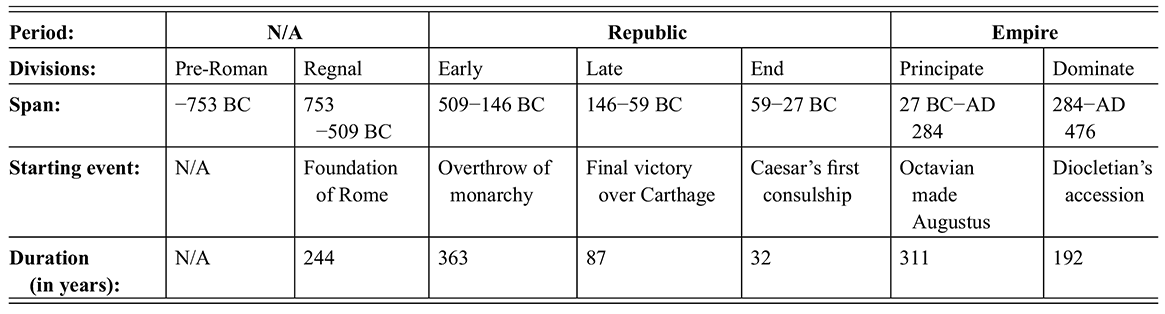
I have also classified each play by period, using seven divisions of Roman history, as outlined in Table 1.Footnote 36 ‘Pre-Roman’ was the period before Rome’s foundation, and essentially refers to plays about Dido and Aeneas. ‘Regnal’ covers the period when Rome was ruled by kings, of whom there were supposedly seven (753–509 BC). There followed the Republican period (509–27 BC), divided along the following rationale: ‘Republic (Early)’ gave way to ‘Republic (Late)’ when Rome defeated Carthage in the Third Punic War (146 BC), which established the Romans as rulers of the Mediterranean, and, according to the traditional historical narrative, granted Rome an influx of luxury, which sapped Roman virtue. ‘Republic (End)’ was the period in which Caesar, Cicero, Pompey, Antony, and Octavian were active, here starting with Caesar’s first consulship (59 BC). The ‘Empire’ period began with Octavian’s establishment as Augustus in 27 BC. It is divided into ‘(Principate)’, extending to AD 284, at which point the structure of the empire was fundamentally changed; and ‘(Dominate)’, extending to AD 476, when the last Western emperor was deposed.
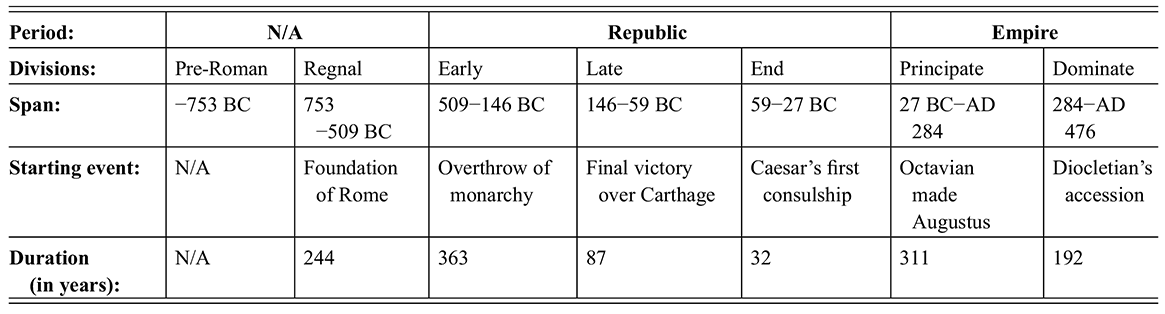
Table 1 Long description
The table setting out the 7 periods into which Roman history is divided, each with its dates, starting event, and duration. They are as follows: Pre-Roman (prior to 753 B C); Regnal (753 to 509 B C, starting with the foundation of Rome, lasting 244 years); Early Republic (509 to 146 B C, starting with the overthrow of the Roman monarchy, lasting 363 years); Late Republic (59 to 27 B C, starting with Rome's final victory over Carthage, lasting 87 years); End of the Republic (59 to 27 B C, starting with Caesar's first consulship, lasting 32 years); the Principate (27 B C to 284 A D, starting with Octavian being made Augustus, lasting 311 years); and the Dominate (284 to 476 A D, starting with Diocletian's accession, lasting 192 years). The third, fourth, and fifth periods are grouped under the broader heading of Republic, the last two are grouped under Empire.
The performance data was gathered from the London Stage Database, which is built on the calendars of the five-volume The London Stage. I searched for each play and counted its performances. This method was subject to certain pitfalls. Most notably, evidence of performances in the first decade of the century is incomplete; The Fate of Capua almost certainly exceeded the single performance attributed to it here. I also cross-referenced the post-1732 plays in the Theatronomics database, which focuses on the finances of Drury Lane and Covent Garden theatres 1732–1809; its performance data was drawn from the London Stage Database but was checked against The London Stage, and it revealed three additional performances (including one of The Roman Father, on 9 January 1786). My date range spans 1 January 1700 to 31 December 1799, rather than encompassing the entire 1699–1700 and 1799–1800 theatrical seasons.
As for the patent theatres involved, that too is a potentially slippery subject.Footnote 37 Essentially, though, there existed two theatrical patents from 1663, granting two theatre companies exclusive rights to perform spoken drama in public; and, various qualifications notwithstanding, this situation continued in London down to 1843, with Drury Lane hosting one of the companies, Lincoln’s Inn Fields (until 1732) and Covent Garden (thereafter) hosting the other. Performance data for these theatres is completer and more continuous than for any other British theatre. For these reasons, I have focused on Drury Lane and on Lincoln’s Inn Fields/Covent Garden, but have ignored any performances that occurred at Lincoln’s Inn Fields after Covent Garden opened. I have also ignored the Queen’s Theatre’s performances of spoken drama at the start of the century – which arguably fell under the umbrella of the patent system – but have included the Drury Lane company’s performances at the two Haymarket theatres in the early 1790s. Both decisions have negligible effects on the data.
There are two tables. Table 2 covers plays first performed in the eighteenth century. Table 3 covers pre-1700 plays that were still performed in the eighteenth century. There are several features of note. First, the Republic was the most popular period onstage. Republic (Early) was especially popular in terms of the number of plays (18), but Republic (End) in performance numbers (505). The Empire’s performance numbers exceeded the Republic’s in the second half of the century, but largely due to the surge in popularity of Cymbeline. Other than The Roman Father, there were no Regnal plays.
| Title | Author | Publication Date | Adapted From/Inspired By | Partial Roman? | Period | First Performance | Last c18th Performance | Perfs. (1700−49) | Perfs. (1750−99) | Perfs. (Total) |
|---|---|---|---|---|---|---|---|---|---|---|
| The Fate of Capua | Thomas Southerne | 1700 | - | - | Rep. (Early) | 11−25/04/1700 | 11−25/04/1700 | 1 | 0 | 1 |
| Perolla and Izadora | Colley Cibber | 1706 | - | Partial | Rep. (Early) | 03/12/1705 | 02/01/1706 | 7 | 0 | 7 |
| Appius and Virginia | John Dennis | 1709 | - | - | Rep. (Early) | 05/02/1709 | 09/02/1709 | 4 | 0 | 4 |
| Cinna’s Conspiracy | Anon. | 1713 | Pierre Corneille, Cinna ou la Clémence d’Auguste | - | Principate | 19/02/1713 | 23/02/1713 | 3 | 0 | 3 |
| Cato | Joseph Addison | 1713 | - | - | Rep. (End) | 14/04/1713 | 31/05/1797 | 187 | 27 | 214 |
| The Death of Dido | Barton Booth (words), Johann Cristoph Pepusch (music) | 1716 | - | Partial | Pre-Roman | 17/04/1716 | 15/05/1716 | 5 | 0 | 5 |
| Cato of Utica | John Ozell [?] | 1716 | François-Michel-Chrétien Deschamps, Caton D’Utique | - | Rep. (End) | 14/05/1716 | 21/12/1716 | 4 | 0 | 4 |
| Scipio Africanus | Charles Beckingham | 1718 | - | - | Rep. (Early) | 18/02/1718 | 25/02/1718 | 4 | 0 | 4 |
| Title | Author | Publication Date | Adapted From/Inspired By | Partial Roman? | Period | First Performance | Last c18th Performance | Perfs. (1700−49) | Perfs. (1750−99) | Perfs. (Total) |
|---|---|---|---|---|---|---|---|---|---|---|
| The Invader of his Country; Or, The Fall of Coriolanus | John Dennis | 1720 | William Shakespeare, Coriolanus | - | Rep. (Early) | 11/11/1719 | 13/11/1719 | 3 | 0 | 3 |
| The Briton | Ambrose Philips | 1722 | - | Partial | Principate | 19/02/1722 | 03/04/1722 | 8 | 0 | 8 |
| Mariamne | Elijah Fenton | 1723 | - | Partial | Dominate | 22/02/1723 | 14/03/1774 | 36 | 10 | 46 |
| The Roman Maid | Robert Hurst | 1725 | - | - | Dominate | 11/08/1724 | 18/08/1724 | 3 | 0 | 3 |
| Caesar in Aegypt | Colley Cibber | 1725 | - | - | Rep. (End) | 09/12/1724 | 15/12/1724 | 6 | 0 | 6 |
| The Fall of Saguntum | Philip Frowde | 1727 | - | Partial | Rep. (Early) | 16/01/1727 | 18/05/1727 | 12 | 0 | 12 |
| Sophonisba | James Thomson | 1730 | - | Partial | Rep. (Early) | 28/02/1730 | 17/03/1730 | 9 | 0 | 9 |
| The Tuscan Treaty: Or, Tarquins Overthrow | Anon. (‘a gentleman’), William Bond | 1733 | - | - | Rep. (Early) | 20/08/1733 | 21/08/1733 | 2 | 0 | 2 |
| Junius Brutus | William Duncombe | 1735 | Voltaire, Junius Brutus | - | Rep. (Early) | 25/11/1734 | 24/02/1735 | 7 | 0 | 7 |
| Arminio | Antonio Salvi (words), Handel (music) | N/A | - | Partial | Principate | 12/01/1737 | 12/02/1737 | 6 | 0 | 6 |
| Title | Author | Publication Date | Adapted From/Inspired By | Partial Roman? | Period | First Performance | Last c18th Performance | Perfs. (1700−49) | Perfs. (1750−99) | Perfs. (Total) |
|---|---|---|---|---|---|---|---|---|---|---|
| Didone | Handel (arrangement) | N/A | primarily Metasasio (words), Leonardo Vinci (music), Didone abbandonata | Partial | Pre-Roman | 13/04/1737 | 01/06/1737 | 4 | 0 | 4 |
| Berenice | Antonio Salvi (words), Handel (music) | N/A | - | Partial | Rep. (Late) | 18/05/1737 | 15/06/1737 | 4 | 0 | 4 |
| Regulus | William Havard | 1744 | - | - | Rep. (Early) | 21/02/1744 | 18/04/1744 | 7 | 0 | 7 |
| Coriolanus | James Thomson | 1749 | - | - | Rep. (Early) | 13/01/1749 | 24/01/1749 | 10 | 0 | 10 |
| The Roman Father | William Whitehead | 1750 | Pierre Corneille, Horace | - | Regnal | 24/02/1750 | 02/12/1794 | 0 | 59 | 59 |
| The Brothers | Edward Young | 1753 | - | Partial | Rep. (Early) | 03/03/1753 | 17/03/1753 | 0 | 8 | 8 |
| Boadicia | Richard Glover | 1753 | - | Partial | Principate | 01/12/1753 | 13/12/1753 | 0 | 10 | 10 |
| Constantine | Philip Francis | 1754 | Thomas Corneille, Maximian [?] | - | Dominate | 23/02/1754 | 28/02/1754 | 0 | 4 | 4 |
| Virginia | Samuel Crisp | 1754 | - | - | Rep. (Early) | 25/02/1754 | 02/04/1754 | 0 | 11 | 11 |
| Coriolanus; Or, The Roman Matron | Thomas Sheridan | 1755 | James Thomson, Coriolanus; William Shakespeare, Coriolanus | - | Rep. (Early) | 10/12/1754 | 27/02/1797 | 0 | 30 | 30 |
| Title | Author | Publication Date | Adapted From/Inspired By | Partial Roman? | Period | First Performance | Last c18th Performance | Perfs. (1700−49) | Perfs. (1750−99) | Perfs. (Total) |
|---|---|---|---|---|---|---|---|---|---|---|
| Appius | John Moncrieff | 1755 | - | - | Rep. (Early) | 06/03/1755 | 15/03/1755 | 0 | 6 | 6 |
| Cymbeline | William Hawkins | 1759 | - | - | Principate | 15/02/1759 | 19/04/1759 | 0 | 7 | 7 |
| The Siege of Aquileia | John Home | 1760 | - | - | Principate | 21/02/1760 | 10/03/1760 | 0 | 9 | 9 |
| Dido | Joseph Reed | N/A | - | Partial | Pre-Roman | 28/03/1767 | 28/04/1797 | 0 | 4 | 4 |
| Zenobia | Arthur Murphy | 1768 | Crébillon père, Rhadamiste et Zénobie | Partial | Principate | 27/02/1768 | 31/10/1787 | 0 | 26 | 26 |
| Caractacus | William Mason | 1759 | - | Partial | Principate | 06/12/1776 | 17/11/1778 | 0 | 18 | 18 |
| The Roman Sacrifice | William Shirley | N/A | - | - | Rep. (Early) | 18/12/1777 | 22/12/1777 | 0 | 4 | 4 |
| Philodamus | Richard Bentley | 1767 | - | Partial | Rep. (Late) | 14/12/1782 | 14/12/1782 | 0 | 1 | 1 |
| Dido, Queen of Carthage | Prince Hoare (words), Stephen Storace (music) | 1792 | Metasasio (words), Didone abbandonata | Partial | Pre-Roman | 23/05/1792 | 11/06/1792 | 0 | 5 | 5 |
| Conspiracy | Robert Jephson | 1796 | Caterino Mazzolà (words), Mozart (music), La Clemenza di Tito | - | Principate | 15/11/1796 | 17/11/1796 | 0 | 2 | 2 |
| – | – | – | – | – | – | – | Totals: | 332 | 241 | 573 |
| Title | Author | First Performed | Adapted From/Inspired By | Partial Roman? | Period | First c18th Performance | Last c18th Performance | Perfs. (1700−49) | Perfs. (1750−99) | Perfs. (Total) |
|---|---|---|---|---|---|---|---|---|---|---|
| The Prophetess; Or, The History of Dioclesian | Thomas Betterton (words), Henry Purcell (music) | 1690 | John Fletcher and Philip Massinger, The Prophetess | - | Dominate | 21/11/1700 | 17/05/1784 | 92 | 23 | 115 |
| All For Love; Or, The World Well Lost | John Dryden | 1677 | William Shakespeare, Antony and Cleopatra | - | Rep. (End) | 07/01/1701 | 01/11/1793 | 70 | 48 | 118 |
| The History and Fall of Caius Marius | Thomas Otway | 1679 | William Shakespeare, Romeo and Juliet | - | Rep. (Late) | 12/04/1701 | 22/08/1735 | 28 | 0 | 28 |
| Cymbeline | William Shakespeare | by 1611 | - | Partial | Principate | 07/10/1702 | 13/05/1800 | 3 | 166 | 169 |
| Theodosius; Or, The Force of Love | Nathaniel Lee | 1680 | - | - | Dominate | 05/06/1703 | 28/01/1797 | 56 | 59 | 115 |
| Title | Author | First Performed | Adapted From/Inspired By | Partial Roman? | Period | First c18th Performance | Last c18th Performance | Perfs. (1700−49) | Perfs. (1750−99) | Perfs. (Total) |
|---|---|---|---|---|---|---|---|---|---|---|
| Dido and Aeneas | Nahum Tate (words), Henry Purcell (music) | 1689 | - | Partial | Pre-Roman | 29/01/1704 | 08/04/1704 | 2 | 0 | 2 |
| Julius Caesar | William Shakespeare | 1599 | - | - | Rep. (End) | 14/02/1704 | 27/04/1780 | 130 | 27 | 157 |
| Valentinian | John Wilmot, Earl of Rochester | 1684 | John Fletcher, Valentinian | - | Dominate | 03/02/1704 | 14/06/1715 | 7 | 0 | 7 |
| Titus Andronicus; Or, The Rape of Lavinia | Edward Ravenscroft | 1678 | William Shakespeare, Titus Andronicus | - | Dominate [?] | 23/08/1704 | 25/04/1724 | 16 | 0 | 16 |
| Mithridates, King of Pontus | Nathaniel Lee | 1678 | - | Partial | Rep. (Late) | 14/10/1704 | 19/12/1738 | 21 | 0 | 21 |
| Sophonisba; Or, Hannibal’s Overthrow | Nathaniel Lee | 1675 | - | - | Rep. (Early) | 03/11/1704 | 15/03/1735 | 22 | 0 | 22 |
| Bonduca; Or, The British {Heroine/Worthy/General} | George Powell (words) [?], Henry Purcell (music) | 1695 | John Fletcher, Bonduca | Partial | Principate | 12/02/1706 | 24/04/1795 | 13 | 1 | 14 |
| Title | Author | First Performed | Adapted From/Inspired By | Partial Roman? | Period | First c18th Performance | Last c18th Performance | Perfs. (1700−49) | Perfs. (1750−99) | Perfs. (Total) |
|---|---|---|---|---|---|---|---|---|---|---|
| The Destruction of Jerusalem by Titus Vespasian. Part II | John Crowne | 1677 | - | Partial | Principate | 01/07/1712 | 01/07/1712 | 1 | 0 | 1 |
| The Injured Princess; Or, The Fatal Wager | Thomas D’Urfey | 1682 | William Shakespeare, Cymbeline | - | Principate | 23/10/1718 | 20/03/1738 | 12 | 0 | 12 |
| Coriolanus | William Shakespeare | c.1605–10 | - | - | Rep. (Early) | 13/12/1718 | 22/04/1755 | 9 | 9 | 18 |
| The History and Fall of Domitian; Or, The Roman Actor | Philip Massinger | 1626 | - | - | Principate | 13/06/1722 | 23/05/1796 | 5 | 1 | 6 |
| Antony and Cleopatra | William Shakespeare | c.1607 | - | - | Rep. (End) | 03/01/1759 | 18/05/1759 | 0 | 6 | 6 |
| – | – | – | – | – | – | – | Totals: | 487 | 340 | 827 |
Second, there were significantly fewer pre-1700 than post-1700 Roman plays performed in the eighteenth century, but the pre-1700 plays between them had hundreds more performances than the post-1700 plays (827 against 573). Third, it appears that the popularity of Roman plays lessened over time. Performances of both pre- and post-1700 works dropped off from the first to the second half of the century, while the number of new Roman plays performed post-1750 was smaller than pre-1750. Moreover, throughout the century, most individual examples failed to gain a place in the repertory. Other than Cato, The Roman Father, and the hybrid Coriolanus – Thomas Sheridan’s merger of Thomson’s and Shakespeare’s plays of that name – the only post-1700 play that had any staying power was the partial-Roman Zenobia. The vast majority of post-1700 works were seen only for a single season, at a single theatre. They should not necessarily be considered failures, because a playwright’s remuneration was largely based on a play’s performances in its first season. Nonetheless, the statistics make for unimpressive reading: twenty of the post-1700 plays (over half) reached no more than six performances.
Were these trends specific to Roman plays, or were they typical of tragedies more broadly?Footnote 38 A comprehensive answer is beyond the remit of this Element, and neither the London Stage Database nor Theatronomics are set up in such a way as to provide one.Footnote 39 But it seems that the decline of Roman plays was more extreme than, and in some ways contrasted with, the broader fate of tragedies. For example, twenty different Roman plays were first staged between 1700 and 1737, when the Licensing Act (which adversely affected the production of all new plays, for a time) was implemented; none for the rest of the 1730s, only two in the 1740s, eight in the 1750s, and three in the 1760s. This trajectory seems typical of the broader genre, at least from the 1730s onwards: of the plays that Theatronomics classifies ‘History’ or ‘Tragedy’, fifteen were first performed 1732–39 (of which nine came before the Act, six after); then ten in the 1740s, twenty-two in the 1750s, thirteen in the 1760s. But from that point on, the paths diverged. New plays in all genres proliferated in the 1770s–90s. For Theatronomics’s ‘History’ and ‘Tragedy’ plays, thirty were first staged in the 1770s; and though the numbers then fell to twenty in the 1780s and sixteen in the 1790s, these were decent figures in comparison to the preceding decades. The apparent decline is also somewhat misleading: due to late-century generic innovation, there were an increasing proportion of new plays that had tragic elements, but that Theatronomics classifies as something else, such as ‘Melodrama’ (e.g. The Iron Chest) or ‘Romance’ (e.g. The Castle Spectre). Roman plays, meanwhile, played virtually no part in the 1770s boom, nor in the more modest flourish of the 1780s–90s.
In terms of performance numbers per decade, the story is similar. Theatronomics shows great consistency for ‘History’ and ‘Tragedy’ plays (again, taken together). From the 1730s to the 1780s (inclusive), they were staged about 1100–1200 times each decade, with an exceptional spike of 1609 performances in the 1750s, and a modest spike of 1272 in the 1770s. They then fell markedly to 723 in the 1790s, again due (at least in part) to generic diversification.Footnote 40 By contrast, although I have not calculated performance numbers of Roman plays per decade, the drop-off in numbers of new Roman plays staged per decade and the general drop-off in Roman plays’ performance numbers post-1750 suggest that their per-decade numbers would follow a more negative trajectory than tragedies’ in general. Overall, then, the post-1750 decline of Roman plays seems to have been a discernible phenomenon in its own right, rather than a symptom of a wider decline in tragedy. In many respects, tragedy showed enduring vitality after 1750, and only lost prominence in the 1790s because its progeny was pushing up around it, while Roman plays limped and faltered. The divergence seems to have become most critical from, or originated in, the 1770s.
These trends emphasise just how successful The Roman Father was, and how unusual a success. It was the only play set in Rome’s Regnal period, and it succeeded during a period when Roman plays were of declining interest to British audiences. Of its fifty-nine performances, twenty-six came in the 1770s–90s. It was the seventh most often-staged Roman play after Cato (214), Cymbeline (169), Julius Caesar (157), All for Love (118), The Prophetess (115), and Theodosius (115). But each of those plays were pre-Hanoverian, and most of them accrued their performances in the first half of the century, when Roman plays were still riding high and before The Roman Father had been written. In the second half of the century, only Cymbeline (166) was performed more often than The Roman Father, and only Theodosius (59) matched it. The only post-1750 plays to achieve anything like The Roman Father’s success were the hybrid Coriolanus (30 performances) and Zenobia (26). The only other post-1700 play to achieve any enduring success was Cato, and even that fell away after 1750 (with only 27 performances). In comparison to non-Roman tragedies, The Roman Father never matched the absolute favourites: it was performed significantly less often than the pre-Hanoverian staples, such as Shakespeare’s Macbeth (273 performances between 1750 and 1799) and Nicholas Rowe’s The Fair Penitent (156), and also than its near-contemporary, The Grecian Daughter (131 performances between its debut in 1772 and the end of the century).Footnote 41 But it was comfortably more popular than most tragedies first staged c.1750 onwards, including those that became repertory staples for a time: for example, Mahomet (1744) had thirty-five performances in the period 1750–99, The Earl of Warwick (1766) had thirty-three, Braganza (1775) had twenty-two, The Orphan of China (1759) had twenty-six, and The Countess of Salisbury (1767) had twenty-four. Perhaps, if the times had been more auspicious to Roman plays in general, The Roman Father would have challenged The Grecian Daughter, too.
Jonathan Sachs has argued that, due to the lack of competition, ‘the dominant image of Rome on the British Romantic stage was Coriolanus’, and that John Philip Kemble, in the title role, ‘was Rome from 1789 to 1817’.Footnote 42 But if the timeframe is moved to 1750–99 – or, even more so, 1750–89 – The Roman Father has the strongest claim to that accolade. Of its main competitors, most of Cymbeline was set in Britain, and Theodosius was set in Constantinople.
1.2 The Transhistorical Roman Character
Before seeking to analyse The Roman Father, and understand its success, we must survey the main characteristics of Roman plays written in the eighteenth century, particularly in light of the exemplarity, historicist, and sentimentality question. The following survey will cover post-1700 plays only, including some that were published without having been performed in London, or anywhere (and which therefore do not feature in Table 2). It will not cover pre-1700 plays or post-1700 musical pieces, because they are less relevant to The Roman Father, and the nature of their appeal was, in part, qualitatively different from that of post-1700 spoken plays.
Each of these plays was a tragedy and did not much deviate from the typical features thereof: they tended to combine affairs of state with at least one romantic plotline, and their leading characters tended to be either virtuous or villainous. However, Roman plays were distinguished from other tragedies in certain important ways, due to two main reasons. First, as discussed above, Roman history was tightly bound up with the exemplary view of history, and was considered to be particularly worth knowing. Second, though, Roman history was considered to be already well-known. It formed a uniquely prominent part of school- and university-education, prose histories of Rome were popular, and Roman subjects had been regularly dramatised on London stages since the late sixteenth century. This foreknowledge meant that the playwright of a Roman play was comparatively free of the need to explain the historical background, and was granted a set of shared reference points to engage with, but was also subjected to a more exacting scrutiny as to how closely they remained within the parameters of Roman history. In practice, these various potentials and pitfalls resolved themselves into one major demand on a Roman play: that it would stay consistent to a certain paradigm that had developed on the British stage by 1700 and would to some degree endure for the rest of the century.
That paradigm centred on what I call the transhistorical Roman character (or ‘Romanness’ for short). This was a set of moral, mental, and aesthetic characteristics that eighteenth-century Britons perceived as typifying ancient Romans: particularly men, particularly those of the early Republic and Regnal period, and particularly the famous heroes of Roman history. Romanness was mostly portrayed onstage in a positive light, and held to be the main reason for Rome’s rise to greatness. It was transhistorical in the sense that it existed throughout Roman history, its nature unchanging and unrelated to the stages and events of that history; it predated the foundation of Rome and predestined the city for greatness; it inhabited fewer and fewer historical Romans as the Republic lapsed into luxury and faction, then fewer still once Augustus extinguished the Republic, but kept its place in the city thereafter as a ghost and an ideal, still occasionally manifesting in particular individuals, and still partly responsible for Rome’s continuing military strength in the Imperial period. It was exemplary, because it was borne along in a cycle of emulation, with transhistorical Romans always looking back to their forebears for virtuous examples to follow, and always conscious of setting examples for the future; and because, after the fall of Rome in AD 476, it endured as a potent, relevant example for Europeans, and was regularly invoked in that sense by eighteenth-century Britons. In the prologues and epilogues of plays, eighteenth-century Britons were often cast as the heirs or vessels of Romanness.
Although I have called it ‘transhistorical’ for those reasons, it also had historicist elements. It was the character of a specific past society which, although it had existed for over a millennium and undergone many changes, was nonetheless considered an identifiable whole: the ancient Roman. It was also felt to have driven the major developments of Roman history, at least until the end of the Punic Wars. Nonetheless, in Roman plays, the typical paradigm was for Romanness to manifest in certain virtuous characters, who were set against a backdrop of a more historically specific version of Rome, which they often had to struggle against. The more villainous characters would exhibit only superficial aspects of Romanness (such as the costume), and would instead show the characteristics typical of villains in non-Roman tragedies, and characteristics appropriate to the historically specific version of Rome in which the play was set. The historical Rome suited an exemplary attitude to Roman history in that it provided the foil for the transhistorical Roman characters’ exemplary behaviour, but also suited a historicist attitude in offering viewers a more detailed, specific vision of a period, and an episode, of Roman history.
This paradigm – transhistorical Romanness against historical Rome – defined the Roman plays written in eighteenth-century Britain. Playwrights could use it for partisan political ends, but its ideological aspects were largely uncontroversial (for the first half of the century, at least), and it did not inherently suit one political outlook better than another. Its popularity suggests the prevalence of the exemplary attitude to Roman history, but also shows that the historicist attitude existed too, and that there was a certain interdependence between them. The importance of transhistorical Romanness onstage throughout the eighteenth century thus complicates the idea of an exemplary attitude giving way to a contradictory historicist attitude. It also flags up the genre-specificity of attitudes to Roman history: onstage, it was possible to combine the exemplary and historicist attitudes more easily than was the case in writing and reading history books. However, as this Element’s last section will show, an idea of transhistorical Romanness, combining exemplarity and historicism, was present in eighteenth-century history books too.
The most obvious characteristics of Romanness were aesthetic, with Roman characters dressed in so-called ‘Roman shapes’.Footnote 43 Practices here were not entirely straightforward.Footnote 44 In early seventeenth-century masques, thence Restoration tragedies and certain other genres, a style of Roman dress had been favoured due to its supposed grandeur and timelessness, even in works not set in ancient Rome. For men, it was Roman military dress, comprising a plumed helmet, cuirass (the lorica), skirted tunic, an overskirt and epaulettes adorned or made up of leather strips (the pteruges), and sometimes buskins. Middling male characters wore less impressive plumes than the leading men, and did not necessarily wear the cuirass. By the eighteenth century, in spoken drama, this style of dress had become mostly restricted to ancient Roman characters, and to some extent ancient Greeks. The exact nature, cut, and accessories changed over time, in accordance with broader developments in fashion: for example, hoops were incorporated, then phased out. But the main features remained largely unchanged until about 1800, when the military dress began to be replaced by civilian togas.
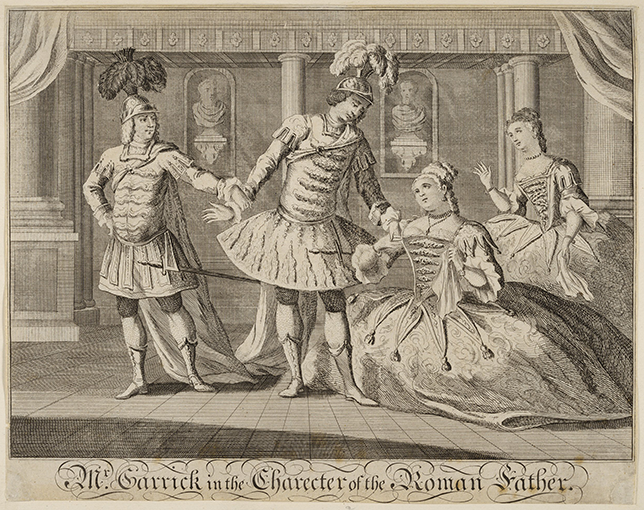
For women, Roman dress centred on tiered skirts, typically white, with lappets on the waist and shoulders. However, even in Roman plays staged in the Restoration period, female dress tended strongly towards contemporary fashion and to general magnificence. A style of tragic dress, and certain sartorial conventions, developed with little reference to ancient Roman clothing, or even to the particular historical setting in which a play might be set. Although white, tiered skirts in an identifiably Roman style appeared in many, perhaps most Roman plays throughout the eighteenth century, sometimes the Roman qualities of women’s dress were very cursory. Thus in the print shown here, based on the earliest performances of The Roman Father, the men appear in identifiably Roman costume, but the only elements that distinguish the women’s dress from that of other tragedies is the tasselled tabs at their waists and shoulders (see Figure 1).
Mr. Garrick in the Character of The Roman Father (n.d.). ART Vol. d94 no.79a, Folger Shakespeare Library
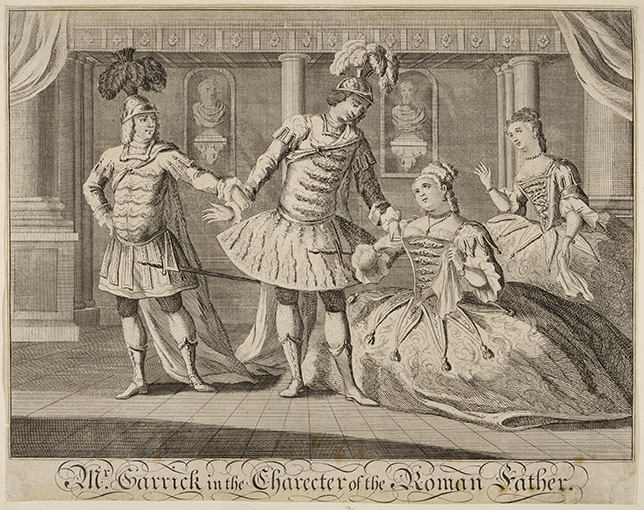
Figure 1. Long description
A print portraying a scene from the initial run of The Roman Father, with David Garrick as Horatius, Hannah Pritchard as Horatia, Spranger Barry as Publius, and Sarah Ward as Valeria. The men wear standard male Roman costumes, comprising plumed helmets, cuirasses, epaulettes, skirts, and leather pteruges. They both have scabbards hanging from their waists. The women wear dresses which are not distinctively Roman, except that they feature tasselled tabs at their waists and shoulders, and both hold handkerchiefs. The backdrop is comprised of recognisable aspects of Roman architecture, such as columns and busts in niches. The caption on the image reads, Mr. Garrick in the Charecter of the Roman Father, yet the central figure appears to be Barry’s Publius, who wears a hooped skirt; Garrick’s Horatius, who does not wear a hoop, stands beside him and holds his wrist, apparently trying to lead him away from Pritchard’s Horatia, who kneels imploringly at Publius’s other side and holds his wrist. Publius’s posture is quite indecisive, torn as he is between the two other figures. Ward’s Valeria stands behind Horatia, adopting something of a dismayed or plaintive gesture.
As the print shows, scenery in Roman plays was also transhistorically Roman, consisting of grand marble edifices, columns, porticoes, sculptures in niches, and other familiar features of Roman architecture.Footnote 45 Sachs has observed that, when Kemble staged Coriolanus, the scenery depicted an imposing, imperial Rome that was entirely inappropriate for the early days in which the play was set, but that audiences did not mind.Footnote 46 It seems likely that this was the case for most or all Roman plays, even if few of them would have matched the scale or splendour of Kemble’s Coriolanus scenery. The Roman Father, for example, was set long before the architectural elements shown in the print above had been developed. There was, then, little historicism to the clothing and scenery: the purpose was to depict, even merely to denote, Romanness.
Similarly, transhistorical Romans had a standard vocabulary. They regularly invoked the Roman gods, and such famous Roman symbols as the Tiber River, the Tarpeian Rock, and the Sabines (whether as the quintessential enemies of Rome’s early years, or in terms of the rape of the Sabine women).Footnote 47 Likewise, specific Roman offices, institutions, laws, and customs were regularly mentioned, depicted onstage, or used as part of the plot.Footnote 48 Few of these references were flagrantly anachronistic. Yet there were occasional prescient looks forward to future figures; predictions, and casual statements made, concerning Roman’s future greatness; and mentions of ‘imperial Rome’ in plays set before Rome had even subdued its closest Italian neighbours.Footnote 49 Moreover, the invocations of gods, offices, symbols, and suchlike were highly generic, and based primarily in the writings of the late Republic and early Imperial period; there was little attempt to recreate a different, inchoate, or immature set of reference points for the early Republic.
The transhistorical Romans’ most important characteristics were mental and moral. A Roman was a paragon of virtue, and keen to recognise virtue in others and to declaim against its absence. ‘Virtue’ could mean different things, depending on the character and the play: it might be a bland and undifferentiated virtue, or might cohere in such qualities as modesty, fortitude, asceticism, self-discipline, disregard for one’s own life, generosity, and mercifulness.Footnote 50 It could also manifest as a restrained civility: Romans were not excessively refined (as modern French people were felt to be), but were more polite and civilised than most of their contemporaries, and brought civility to the rest of the world.Footnote 51 To some degree, this virtuousness represented a historicist view of Roman history, particularly when it was most extreme: prologues and epilogues, in particular, tended to emphasise the difference between ancient Roman virtue and modern British behaviour and/or notions of virtue; sometimes the difference was lamented, sometimes made fun of, sometimes expressed with ambivalence.Footnote 52 The prologue to Dennis’s Appius and Virginia asked, ‘While Britain seems to all that’s soft inclin’d,/ What welcome here can our rude Romans find?’Footnote 53
Yet Roman virtue was primarily represented in an exemplary light. Characters within plays often emphasised or glossed the virtuous behaviour of other characters for the benefit of the audience, or modelled the appropriate response, as when Addison’s Juba said of Cato, ‘I’m charm’d when e’er thou talk’st! I pant for Virtue!/ And all my Soul endeavours at Perfection.’Footnote 54 Most plays ended with what contemporaries called a ‘tag’ – a sententious speech delivered by a virtuous character – offering broad moral lessons on the basis of the play’s events.Footnote 55 The overall sense given by plays concerning such figures as Lucius Junius Brutus (who ordered his own sons’ execution) and Virginius (who killed his own daughter to prevent her enslavement and concubinage) was that such cases were extreme, specific to Roman history, and neither possible nor desirable in modern Britain; but that the characters were nonetheless admirable, and modern Britons could learn from, and emulate, the virtue that had inspired those acts.
Transhistorical Romans loved their country, and loved personal and national liberty. They counted it their highest glory to die in the cause of patriotism and freedom.Footnote 56 Cato was full of statements to this effect: ‘in Cato’s Judgment,/ A Day, an Hour of virtuous Liberty,/ Is worth a whole Eternity in Bondage … what Pity is it/ That we can die but once to serve our Country!’Footnote 57 This was highly exemplary. Eighteenth-century Britons’ patriotism and love of liberty was regularly held up as the equal of Romans’. The Appius and Virginius prologue quoted above, after first suggesting a discrepancy between ancient Rome and modern Britain, then asserted that the two were in fact similar: ‘Why should not you Rome’s manly Joys persue,/ When all that Fire that could the World subdue,/ Yes, all the Roman Spirit lives in you’.Footnote 58 The epilogue to Havard’s Regulus – arguably the most po-faced of all Roman plays – demanded,
In manifesting his characteristics, the transhistorical Roman existed in a cycle of exemplarity. He continually referred back to the virtuous heroes who had come before him: learning from their examples, modelling himself on them, and seeking to match their glory.Footnote 60
Equally, as the remark about ‘exend[ing] our fame’ suggests, the transhistorical Roman was conscious of forming examples for future generations.Footnote 62 ‘Nor shall our Country lose the great Example;/ The noble Deed which we to Night perform,/ Shall blast a thousand Tyrants in the Bud’.Footnote 63 This theme was most emphatic in Regulus, in which the hero’s struggles were repeatedly interpreted as part of a providential plan, designed to illustrate virtue and create an inspiring example for future generations.Footnote 64 Moreover, the characters who in one play invoked previous exemplars and hoped to become exemplary themselves would be rewarded in another Roman play, when they in turn would be invoked, perhaps alongside the same exemplars whom they themselves had first invoked.Footnote 65
Again, this showed both an exemplary and a historicist attitude. For one thing, it modelled exemplarity to audiences, showing how to read Roman history for practical, inspiring examples to emulate; for another, it often contained allusions to future, non-Roman societies as the recipients of the examples being formed. But it was also a mostly Roman frame of reference, with each generation of Roman characters using a narrow range of former Roman examples, blinkered to any other society (except, on occasion, the Greek). Moreover, the examples were sometimes not only extreme – such as Brutus’s or Virginius’s – but clearly negative. The rape of the Sabine women was sometimes invoked as the original sin of the Roman people, which had formed a negative cycle that had conditioned Roman behaviour ever since.Footnote 66 One character in Philodamus jested, ‘A rape in other nations may sound vile. – / In us, ’tis to commem’rate our progenitors.’Footnote 67 In Constantine, a virtuous woman, Fulvia, was mistreated, tortured, and almost killed by both her husband (Constantine) and her father (Maximian), each of whom interpreted their own behaviour as particularly Roman, emulating the behaviour of their ancestors (including Virginius).Footnote 68 This was a purely historicist take on Roman history: it depicted characteristics and errors that were particular to ancient Rome, and that Britons did not even need to be taught to shun, because they were so garish and so inherently Roman. However, such examples were rare. In most plays, the transhistorical Roman was a highly, even unambiguously, positive character: somewhat historical, but firmly exemplary.
1.3 Historical Rome, Non-Historical Women
Romanness was often contrasted with the more temporally specific period of Rome’s history in which the play was set. The resulting conflict, and the effort of the transhistorical Romans to change or withstand their society, typically formed the play’s plot. In this sense, transhistorical Romanness sometimes correlated with the ‘last of the Romans’ figure: a description or trope used by certain ancient and modern writers for those few people – such as Julius Caesar’s assassins, Marcus Junius Brutus and Cassius – who supposedly embodied the Republican spirit after its heyday had passed.Footnote 69 Thus plays set during the Republic (End) period portrayed a Roman society that, through widespread loss of virtue and the actions of a few mighty, power-hungry men, was on the verge of collapse; only a few transhistorical Romans remained, desperately seeking to maintain and/or restore the Republic, and, failing that, to maintain their Romanness in an inhospitable world. The classic example was Addison’s Cato.Footnote 70 The case was even more extreme in Imperial plays, when the Republic was irredeemably gone, and transhistorical Romans had to navigate a world of tyrants, slaves, corruption, and vice.Footnote 71
However, the same paradigm was frequently used in plays set in the early Republic: the period in which the transhistorical Roman spirit was believed to have infused Rome in general, and carried the Romans to glory. Playwrights achieved this by focusing on those episodes in early Republican history when Rome had fallen victim to a temporary, oppressive government. Hence the popularity of the Appius and Virginia episode (portrayed in four eighteenth-century plays, one of which was published but never staged): it came during the brief rule of the decemvirate, when ten men, led by Appius, threw off the restrictions of office and became arbitrary rulers. Less often, playwrights depicted the Republic in a healthier state, but compromised by internal turpitude and/or treachery, which the Roman hero(es) had to stamp out: examples included Regulus and the three plays about Lucius Junius Brutus and/or Tarquin. Such episodes allowed playwrights and audiences to experience the heyday of Romanness, while also showing it threatened by, and struggling against, antithetical forces, and eventually emerging victorious. Even in partial-Roman plays, the conflict between Romanness and historical Rome was usually apparent, and was sometimes central to the plot.Footnote 72 Romanness could thus be portrayed as exemplary to eighteenth-century Britons, some of whom felt that the transhistorical Roman characteristics in their own society were threatened or dampened.
However, the paradigm of transhistorical Romanness against historical Rome was a predominantly male phenomenon. As suggested by their clothing, female characters were only loosely linked to Romanness; instead, they tended to share characteristics with the women in non-Roman tragedies. In Cato, Marcia portrayed herself as distinctively Roman, whereas her friend Lucia said of herself, ‘Nature form’d me of her softest Mould,/ Enfeebled all my Soul with tender Passions,/ And sunk me ev’n below my own weak Sex:/ Pity and Love, by turns, oppress my Heart.’Footnote 73 But, in practice, both women behaved similarly to each other, and indeed to most virtuous young women in early eighteenth-century tragedies, throughout the play, with Marcia making such comments as, ‘When Love once plead’s Admission to our Hearts/ (In spight of all the Virtue we can boast)/ The Woman that Deliberates is lost.’Footnote 74
Thus the female characters tended to represent a more sentimental presence in the plays, and embodied the idea of a universal human nature, with passions that were felt to be relatable and affective to modern British audiences. The epilogue to Duncombe’s play glossed its leading female character along those lines:
Although Lucia had killed herself at the end of the play, and attributed the act to her Romanness, the epilogue interpreted her as a typical ‘enamour’d Maid’ rather than as a Roman, and in that light offered her to British women as a relatable, sympathetic object. Male characters were generally presented as admirable for their particularly Roman characteristics, but female characters for generic female characteristics: ‘Is she not all her Sex’s Pride would aim at,/ Their various Arts of charming?’Footnote 76 In post-1750 plays, some of the female characters became more evidently Roman, but still not as much as the male characters. Their Romanness was often portrayed as a reserve of strength, which they could draw upon at critical moments, but which would soon subside again; or as a hard, yet fragile crust atop an essentially feminine nature. Brooke’s Virginia, mostly a typical woman but sometimes manifesting or claiming Roman characteristics, stated towards the end of the play, ‘I wou’d be more than Woman/ To meet approaching Fate; but thy fond Tears,/ Have soften’d me, Icilia, to an Infant.’Footnote 77
This sentimental presence and this gendered dynamic were integral to Roman plays’ plotlines. Eighteenth-century critics sometimes argued that tragedies should feature both ‘Sublime’ and ‘Tender’ circumstances, ideally in conflict with each other.Footnote 78 In Roman plays, a ‘Sublime’ premise was formed by the conflict between the transhistorical Roman and historical Rome, while the ‘Tender’ plotline(s) of love, lust, and family sentiment were erected on that premise, and set in continual conflict with the characters who were busy trying to execute that first conflict. The women and their sentimental passions would often serve as obstacles to the men and their Roman considerations at the start of the play, but then reconcile with, and/or somehow aid them at the play’s conclusion. Sometimes, the women would also stimulate sentimental feelings in the men, or expose the men’s inner sentimentality. Yet the sense of contrast between the masculine Roman and the feminine sentimental was not often dispelled, or at least could not be forgotten after agitating most of the play’s plot. This contrast, and the presence of the ‘Tender’ in general, fit well with the sentimentalist attitude to Roman history: playwrights and audiences were looking for a recognisable, sympathetic human nature amongst the events of Roman history.
Throughout the eighteenth century, then, Roman history onstage was viewed in an exemplary, historicist, and sentimentalist light. Roman plays were based on the paradigm of transhistorical Romanness versus historical Rome, qualified by the presence (and demands) of universal human nature. This dynamic was genre-specific. It suited the requirements of the theatre, and involved a developing tradition of stage depictions of Romanness that extended back to Shakespeare. Thus the attitudes that were active in a theatrical context were not necessarily those that were active for history books, or other genres. Nonetheless, the viability of this dynamic onstage is suggestive of the attitudes that Britons may have held in other contexts, too. Given that Roman plays were commonly structured around conflict between the material that was most appropriate to each of the three attitudes, the plays’ appeal must have rested – at least in part – on the sense that each of those attitudes was a viable means of understanding Roman history, but also on the recognition that the attitudes did not sit easily together. This supports the notion that, in the eighteenth century, attitudes to Roman history were in transition. Perhaps it also explains why so many Roman plays were staged, but so few succeeded: eighteenth-century Britons had multiple potential reasons to engage with Roman history, but struggled to find a stable perspective through which to view it. By contrast, as the following sections will show, Whitehead handled those attitudes in a more dramatically effective manner. Thus a genre – the Roman play – which held such high theoretical valence, and which in some respects was highly popular, crystallised into almost a single successful work in the late eighteenth century.
2 The Text of The Roman Father
The text of The Roman Father was first published on 6 March 1750, during the play’s initial run, and was regularly republished throughout the century.Footnote 79 This section will focus on the first edition, to which all references pertain unless otherwise stated. It will explore what the text reveals about the three attitudes towards Roman history – exemplary, historicist, and sentimentalist – and how Whitehead used them for dramatic capital. On this basis, it will suggest why The Roman Father succeeded where so many other Roman plays failed, and became the most prominent Roman play on the late eighteenth-century stage.
It will offer the following arguments. Like most Roman plays, The Roman Father evinces all three attitudes, and sets them in conflict with each other; and it depicts transhistorical Romanness. However, it does so in certain unusual ways. First, it avoids the paradigm of transhistorical Romanness against historical Rome. Instead, the play is set in an early Rome that is suffused with the transhistorical Roman spirit. The characters are all virtuous and patriotic, Rome is free and has a wise, good king, and there is no hint of internal treachery or turpitude. The only threat exists beyond Rome’s walls, offstage, and is extinguished at the start of Act IV. If the early Republic was the natural habitat of Romanness, then Whitehead’s Regnal Rome was its Garden of Eden. This setting allowed Whitehead to portray Romanness in particularly vivid form.
Moreover, by eschewing the conventional conflict between Romanness and historical Rome, Whitehead was able to focus instead on the conflict between Romanness and human nature. Normally in Roman plays, this conflict held a secondary importance and was clearly resolved at the play’s conclusion. But in The Roman Father, this conflict structured the play and was left open-ended, allowing audiences to judge of the play’s action according to their preferred perspective on Roman history. Perhaps Whitehead’s most important decision, though, concerned the role of gender in this conflict. To an extent, he split the conflict along gender lines, as other playwrights did: exemplary, transhistorical Roman men, sentimental women evincing a universal human nature. Yet, particularly in the latter acts of the play, he also displayed the men’s human nature and invited sympathy for them, and showed his heroine to be a strong Roman woman. By his deft combination of affective masculinity, sentimental femininity, and Romanness, he created two powerful characters – Horatius and Horatia – who were largely responsible for the play’s enduring success.
2.1 The Horatii Episode
The Roman Father dramatised the story of the Horatii and Curiatii, which appears in several surviving ancient sources. It was recounted at greatest length by the Greek-language historian Dionysius of Halicarnassus, but has always been best-known from Livy’s history of Rome, Ab urbe condita, where it is recounted at some length, early in Book I (specifically, I.xxii-xxvi).Footnote 80 Almost all eighteenth-century British prose histories of early Rome featured the Horatii story.Footnote 81
The episode purportedly occurred during the reign of Tullus Hostilius, Rome’s third king, when Rome was at war with its parent city, Alba Longa. In the story, three champions were chosen from each city to fight against each other: the Horatii brothers for Rome, the Curiatii brothers for Alba. Two of the Horatii were killed, but the remaining one (Whitehead’s ‘Publius’) killed the three Curiatii, thus granting Rome dominion over Alba. However, as Publius returned to Rome, he was met by his sister (‘Horatia’), who had been betrothed to one of the Curiatii. Seeing Horatius wearing, as a spoil, a cloak that she herself had made for her fiancé (a scarf in The Roman Father), she burst into tears and called out the dead man’s name, whereupon her brother rebuked her for disloyalty and stabbed her dead. He was then put on trial for the deed, but exonerated due to the testimony of his father (‘Horatius’), who also condemned his dead daughter for her disloyalty.
The story was dramatised by Pietro Aretino (in Italian, first published 1546), Pierre de Laudun d’Aigaliers (French, 1596), and Lope de Vega (Spanish, 1623; probably written 1598-1600Footnote 82), but these plays were little known in eighteenth-century Britain. Its most famous treatment was Pierre Corneille’s Horace (French, 1640), which was translated three times into English in the late seventeenth century.Footnote 83 The Roman Father is similar to Horace in many respects: both plays take place in Rome, mostly in Horatius’s house, and closely follow the three unities (action, time, and place). Whitehead’s cast list is similar to Corneille’s, but sparser. But although Horace inspired The Roman Father, Whitehead denied that his play was an imitation. As his prefatory advertisement explains, Whitehead would not have written The Roman Father ‘if I had not first read the justly celebrated Horace of Mr. Corneille’. But other than at the end of Act III and start of Act IV, ‘I am hardly conscious to myself of having borrowed even a Thought from him.’Footnote 84
Whitehead’s choice of subject was telling. Because the story concerns the clash between public and private affairs, it lent itself well to the depiction of exemplary and sentimental matters, and allowed Whitehead to set them in conflict. However, his alterations to Livy and Corneille were equally revealing. He raised both the father and the daughter to new prominence, and foregrounded the relationship between them. Horatius became the main male character, granting the play its title. Years later, when Whitehead edited his advertisement, he stated that it had been ‘his endeavour to make the Father his principal personage, and to shew him in every light his peculiar situation, and variety of distress, would allow of’.Footnote 85 It was Horatia, though, who became Whitehead’s main onstage agent. As described in this Element’s introduction, the first three acts show Horatius and Horatia responding to events happening elsewhere. But after Horatia hears of her fiancé’s death in Act IV, she drives events for the rest of the play. Unlike in any previous version of the story, she causes and transcends her own death: intentionally provoking Publius to stab her, lingering on in bandages, giving advice and testimony that will help to have Publius exonerated after she is dead, and tearing off her bandages. Her interpretation of the murder/suicide is unequivocal: ‘’Tis on me, not him [Publius],/ That thou should’st look with Horror; ’twas my Act,/ Not his.’Footnote 86
Meanwhile, Publius’s sororicide appears more justifiable than in the historical sources and Horace, because provoked and desired by the sister, and because he first shows forbearance, then weeps as he stabs her.Footnote 87 By tilting the story towards an old man and a young woman, and by rendering the most firmly transhistorical Roman character – Publius – more sympathetic and less culpable, Whitehead was able to interrogate the relationship between Romanness and human nature, and to leave the preference between them to the audience. He was also able to fashion two complex, powerful characters: Horatius and Horatia.
2.2 Doubtless Virtue
Throughout the play, transhistorical Romanness is strongly in evidence. As in other plays, it is both exemplary and historicist in nature: demonstrating ideals that modern Britons should emulate, but based in an abstract notion of ancient Roman society. Publius is the most straightforwardly Roman character. He embodies and espouses the Roman ideals, and makes such stirring, Cato-like pronouncements as ‘a Patriot’s Soul,/ Can feel no humbler Ties, nor knows the Voice/ Of Kindred, when his Country claims his Aid.’Footnote 88 Meanwhile, other characters in the play signpost Publius’s virtues, holding him up as an exemplar to the audience.Footnote 89 His father commonly glosses his behaviour with such statements as ‘O virtuous Pride!’Footnote 90
Horatius is himself a transhistorical Roman, although aged, and wishes he could still fight for his country.Footnote 91 When in Act II his sons are chosen to be Rome’s champions, he is overjoyed, and expresses little concern for their lives: ‘by Heaven/ I could not hope that they should all survive./ No, let them fall; if from their glorious Deaths/ Rome’s Freedom spring, I shall be nobly paid/ For every sharpest Pang the Parent feels.’Footnote 92 The combat between the Horatii and Curiatii then happens offstage, and, in the two scenes closely based on Corneille’s, is relayed to Horatius and Horatia in partial updates. Initially, Valeria (Horatia’s confidante) reports that Publius’s two brothers have been killed and he has fled the combat, and Horatius curses and condemns him; then, when Valerius (Valeria’s brother, in love with Horatia) arrives and tries to explain what happened next, Horatius impetuously talks over him, before eventually letting him speak and learning that Publius only feigned flight, and turned and killed each of the Curiatii as they caught up with him, whereupon Horatius exults. This quickly became one of The Roman Father’s most celebrated passages.
The appeal of these scenes lies in the portrayal of Horatius’s Roman spirit, expressed with passion and poetic language, as it wheels through different emotions. The scenes rely on the audience’s familiarity with, and – to some degree – admiration of, the stern, filicidal Roman virtue associated with the likes of Lucius Junius Brutus. Whitehead did not expect his audiences to murder their errant children; in that sense, Horatius was a historical Roman, and the audience’s pleasure lay in witnessing Roman behaviour at its most flagrant. But Whitehead did expect them to recognise such behaviour, in a Roman context, to be good and just, and the manifestation of certain characteristics that modern Britons should share: patriotism, self-sacrifice, perseverance, a desire for virtuous fame.
The play’s minor characters, too, continually show or congratulate each other for their Romanness. An unnamed soldier says, ‘Conquest’s self would lose its Charms to me,/ Should I not share the Danger’, and Horatius praises Horatia’s confidante, Valeria, for being ‘truly Roman’ because she wishes that her brother could have died for his country.Footnote 94 Valeria herself frames Roman history in terms of its ‘glorious Battles’ and the prophecy made to Aeneas, ‘That [Rome] should rise the Mistress of the World’.Footnote 95 There are also standard exemplary invocations of well-known Roman figures: Horatius, for example, compares Publius to ‘Rome’s Founder’, Romulus, both when celebrating and when exonerating him.Footnote 96 None of this is historically-specific to the Regnal period: it is the transhistorical Rome, which predated Rome’s own founding, is carried on by cycles of exemplarity, and is forever defined by certain qualities. The main importance of the Regnal period for The Roman Father is that it provides a hospitable environment for the parade of Romanness.
However, the play’s Roman men are never too belligerent. They exhibit the qualities of civility, too, even in defiance of recorded history. Ancient and eighteenth-century historians portrayed Tullus as a warlike king; and in Livy’s account the Alban dictator proposed the truce that laid the groundwork for the combat of champions. But Tullus in the play has the opposite character, and proposes the truce himself. When Horatia hears of his proposal, her praise compares Tullus favourably to just the sort of kings as the historical Tullus was elsewhere portrayed as: ‘There spoke his Country’s Father! this transcends/ The Flight of Earth-born Kings, whose low Ambition/ But tends to lay the Face of Nature waste’.Footnote 97 Whitehead’s characterisation also contradicts Livy’s narrative of Rome’s constitutional development, in which each king contributed something of their own character to the city: Tullus his belligerence. But it maintains the sense of Romanness, appropriate to a more abstract notion of ancient Rome, and exemplary to modern Britons. Like Whitehead’s Rome, Britain enjoyed the ideal balance of military prowess and civility under a patriotic, high-minded king. It is therefore fitting that Tullus speaks the play’s tag, summarising the action and expressing the play’s most overt message:
The tag’s opening words are as much an address to British audiences as to ‘ye Romans’, and the message is generalised and exemplary. It suggests that the play has been a lesson in patriotism, and in valuing patriotism above all other principles; audiences will leave the theatre inspired by the sight of Roman patriotism, and seek to emulate it.
2.3 Flesh and Blood
In fact, though, the play’s message is not so clear-cut. The play also suggests that an exemplary attitude to Roman history may be inappropriate, and that Romanness is flawed. It offers a sentimentalist perspective on Roman history and places it in conflict with the exemplary.
The prologue, for example, begins by emphasising Roman virtue and the similarity between ancient Rome and modern Britain:
But it immediately undercuts such notions, acknowledging instead the incompatibility between the two societies: ‘Yet from such Times, and such plain Chiefs as these,/ What can we frame a polish’d Age to please?’ The notion here expressed, although to some degree typical of tragedies’ prologues and epilogues, is nuanced: it emphasises the practical business of needing to ‘please’ the audience (whereas the first, exemplary sentiment remained on the level of abstract principle, involving no such practical concern); and it suggests a mock-epic disjuncture between Rome and Britain, in which modern society’s superior ‘polish’ contrasts to ancient plainness, somewhat in favour of the latter, but only teasingly so. The prologue then converts plainness into a source of affect: ‘Where to your Hearts alone the Scenes apply,/ No Merit their’s but pure Simplicity.’ Thus the prologue decides the question of how to please ‘a polish’d Age’ by abandoning any pretence that Romanness might be exemplary, and instead offering up the play as something to be enjoyed on an emotive level because of the raw human nature on show.
The play itself bears out this promise, giving a strongly sentimentalist take on Roman history, focused on the feelings of long-dead peoples, and on the ability of modern audiences to empathise with them. On occasion, those feelings are specific to the transhistorical Roman character, as when Horatius erroneously believes his son prioritised life over his country, and becomes enraged. But the overall tendency is to reveal a universal human nature, unchanged between historical periods, embodied in relatable characters. It is most evident in Horatia. Her feelings are often inspired not by her identity as a Roman but by her identity as a young woman in love. Before the Curiatii are even chosen as the Alban champions, Horatia worries about whether her fiancé (one of the Curiatii) still loves her, to which Valeria replies: ‘Think, my Horatia,/ That you’re a Lover, and have learn’d the Art/ To raise vain Scruples, and torment yourself/ With every distant Hint of fancied Ill.’Footnote 99 Thus her behaviour is characteristic of a universal type, the ‘Lover’. Then, over the course of the play, as she learns that her brothers and fiancé have been chosen to fight each other, then learns that Publius has killed her fiancé, Horatia’s passions become increasingly extreme. Twice in the script, her speeches are denoted by stage directions as being spoken ‘Wildly’. The first of those speeches begins by signposting the untrammelled emotion it is about to exhibit: ‘Alas, had Reason ever yet the Power/ To talk down Grief, or bid the tortur’d Wretch/ Not feel his Anguish?’Footnote 100 The use of the word ‘ever’ here and the reference to an archetypal ‘Wretch’ indicate that this comment, too, is a generalisation, pertaining to a universal human nature.
Likewise, her relationships with other characters are often based on a sense of universal human nature. The love triangle between Horatia, her fiancé, and Valerius is governed by the sort of generic love tropes, and standard concepts of male and female behaviour, that could have been seen in any tragedy – even comedy – of the time. On Valerius’s love for Horatia, Valeria asks, ‘Did I not press you still to urge your Suit,/ Intreat you daily to declare your Passion,/ Seek out unnumber’d Opportunities,/ And lay the Follies of my Sex before you?’Footnote 101 Valerius then asks her to continue encouraging Horatia in his favour, in a manner that explicitly privileges universal human qualities over particularly Roman ones:
With such lines, Whitehead exposed the feelings of history to his audience’s view, and revealed them to be the same feelings, determined by the same gender norms, with which his audience was already familiar, requiring no historical knowledge to appreciate: the follies and inclinations of women, the desire of men to woo them, and the effectiveness of jealousy as a tool to that end.
This sentimentalist attitude to Roman history is set in conflict with the exemplary, somewhat along gendered lines. Horatius and Publius are transhistorical Romans, demonstrating heroic virtue and saving their country; Horatia is a universal female, concerned more with personal relationships than with her country. While Horatius and Publius relish the prospect of a heroic combat for the sake of their country, in which their own family will suffer, Horatia dreads it. One of the play’s climactic scenes is when the emotional Horatia assails Publius during his triumphal entry into the city, following his victory over the Curiatii and the resultant subjugation of Alba. Although later playbills tended to call this entry a ‘triumph’ or ‘ovation’ – referring to the public ceremonies by which victorious Roman generals sometimes re-entered Rome – properly speaking it was neither of those things; but Whitehead (and theatre managers) did render it a pseudo-triumph, with a procession, a song, and ‘Branches of Oak, Flowers, &c.’Footnote 103 As such, it symbolised the zenith of Romanness and Roman power. For Horatia to undercut it, and use it as the occasion for her pro-human, anti-Roman tirade, was no less symbolic:
Her depiction of Roman virtue as a sham and her use of such evocative vocabulary as ‘Slaves’, ‘the first, great Law within us’, and ‘unsocial State’ place humane principles in conflict with Roman ones. The reference to Helen of Troy suggests that women, and affairs of the heart, are consistently antithetical to public affairs. And the vision of a burning Rome serves as a kind of anti-triumph, in which Horatia, replacing her brother in the central role, enters not an imperial city but the blazing ruins that Rome was destined to become. Nor does Whitehead suggest that Horatia’s perspective is inappropriate, here or elsewhere in the play. The other characters rarely rebut her statements, and Valerius outright agrees with her.Footnote 105 When she lies dying, after being stabbed, she reveals that her tirade was feigned, as she wished to provoke Publius into killing her; but, even then, she expresses the hope of joining her fiancé in an ‘Elysium’, where ‘Nor Rome, nor Alba, shall disturb us more!’Footnote 106 Few audience members could have left the theatre without having recognised the power of her arguments against Roman virtue.
On the other hand, the play advances arguments in favour of Roman virtue that obliquely answer Horatia’s points, but are not usually voiced in direct debate with her.Footnote 107 Indeed, the most resounding articulation of the exemplary case comes in the play’s tag, quoted above, after Horatia is dead.Footnote 108 The epilogue then makes a conventional address to the ‘LADIES’ on behalf of ‘our courteous Author’ and encourages them to pardon Publius and endorse patriotism: ‘A Spirit which once rul’d the British Nation,/ And still might rule– would you but set the Fashion.’ Coming in the tag and epilogue of the play, such advocacy of male, Roman virtue could easily be taken to represent Whitehead’s and the play’s overall message. Yet even this epilogue serves to validate, or prescribe, an emotive female interpretation that undercuts that message. Whitehead, says the epilogue,
Tears, not admiration or emulation, are the currency that the epilogue solicits, and it is on account of their human nature and passions – tears, flesh and blood – that the female audience members are cast as Publius’s enemies. Although the epilogue tries to convince these women to look at the play differently, and to help cultivate Publius’s patriotic virtue, the attempt is largely tongue-in-cheek: exemplarity is reduced to the level of a female-led ‘Fashion’.
Whether Whitehead leaned more towards the claims of Romanness or human nature is debatable. But this is because he tried not to lean too far either way; the unresolved tension between exemplary and sentimentalist perspectives was key to the play’s appeal. Even the tag identifies ‘COUNTRY’s LOVE’ as a ‘Passion’, and the epilogue’s identification of the female audience as a ‘Tribunal’ emphasises the fact that audiences were expected to judge the play’s conflicts for themselves, indefinitely. This contrasts with most other Roman plays, which usually reconcile the transhistorical Roman with the sentimental in the end, or show the clear superiority of the former over the latter.
2.4 Roman Father, Roman Daughter
In part, then, the dichotomy between Roman and human runs along gendered lines. Yet Whitehead also complicated the picture, humanising the male characters and Romanising the female, and portraying the conflicts within, as well as between those characters. Publius, the staunchest Roman, is not immune to the calls of human nature. He says that he feels the force of ‘the Bonds of Nature … strongly’ and emphasises that he loves his sister and the Curiatii.Footnote 110 However, the conflict is particularly evident in the two main characters. Horatius is not just a stern patriot but a tender father. Horatia is not just a fond, emotional young woman but a brave Roman virgin who, like Cato, sacrifices her own life.
Hence Horatia states early on, ‘A Roman Virgin should be more than Woman./ Are we not early taught to mock at Pain … ?’ She adds that, if required, she would fearlessly leap into the Tiber or from the Tarpeian Rock.Footnote 111 Her character and behaviour are thus determined by her Roman upbringing, and her frame of reference comprises famous Roman symbols. When she feels herself caught between her family and her fiancé, she interprets her predicament as a peculiarly Roman one, woven into the fabric of the Roman character: ‘Look here, Valeria, where my Needle’s Art/ Has drawn a Sabine Virgin [in the scarf she is making for her fiancé] … I am that Maid distress’d, divided so/ ’Twixt Love and Duty.’Footnote 112 This self-conscious comment evokes a frame of reference appropriate to a Roman mentality and calls to mind other Roman plays, where references to the Sabines are routine. Like some of those plays, it also suggests that there are certain negative patterns of behaviour intrinsic to Roman society and that Romanness is potentially inhospitable to women and to sentimental considerations. But The Roman Father’s depiction is especially striking, because expressed by a female Roman – a daughter of the Sabine rape – as she weaves that story into the scarf that she will give to her fiancé, and that will be taken by her brother as a spoil.
Indeed, Whitehead’s characters continually struggle with the tension of being both Roman and human. Horatius, confronted with Horatia’s grief, states that she has ‘unman’d my Virtue./ Yet can I see her thus, and not remember/ Her thousand little tender Arts, which sooth’d/ The Cares of Age, and led me gently through/ The Evening of my Days?’Footnote 113 His nostalgic vision is poignant and would have resonated with eighteenth-century Britons’ ideals of the father-daughter relationship as it existed in their own day.Footnote 114 The phrase, ‘Yet can I see her … and not …?’ suggests that such sentiments are entirely natural. Yet those sentiments also undermine his virtue, and he is conscious of their feminine associations: they ‘unman’ him. Similarly, Horatia says in the play’s first scene, ‘Ev’n while my Country’s Fate, the Fate of Rome,/ Hangs on the Conqueror’s sword, this Breast can feel/ A softer Passion, and divide its Cares.’Footnote 115 This phrase sets out the conflict that defines her psychology.Footnote 116
Yet there is more to Horatia’s character than just conflict, and her Romanness is not invariably at odds with her humanity. In the last two acts of the play, it is the combination of her Romanness and humanity that transforms her into an active heroine. Her fortitude in assailing her brother, and her suicidal acts, are those of an exemplary Roman, but are motivated by grief at her fiancé’s death. She is herself inspired by her brother’s exemplary Roman virtue, even as he stabs her broken heart: describing the event retrospectively, she says, ‘Heav’n! with what Transport I beheld him mov’d,/ How my Heart leap’d to meet the welcome Point,/ And leave its Sorrows there!’ Her act of assailing him and her heart’s movement towards the blade are physical representations of the motion of Roman virtue, which is ever attracted to, and seeks to reach, exemplary figures.
Thus Horatia balances the Roman and the human in creative tension. Sometimes she is soft and tender, eliciting the audience’s compassion; sometimes she is strong and Roman, eliciting admiration; early in the play, she labours under events, and struggles with her own internal conflict; later, her emotions combine with her Roman spirit, inspiring her to go on the warpath, thunder down words on her enemy, cause her own death, and save her brother, all in the name of love. She became one of the most compelling female characters in late eighteenth-century British tragedy, and – as the following sections will show – the single most important reason for The Roman Father’s enduring success. In that respect she surpassed Horatius, who, performed by Garrick, was probably more integral to the play’s initial success, but receded somewhat thereafter.
Both characters, though, embody the play’s fundamental dynamic: a complex tangle of Romanness and human nature, each appealing to different understandings of Roman history that were equally legitimate, but that did not sit easily together. Whitehead accentuated this dynamic by emphasising transhistorical Romanness at the expense of historical specificity, by structuring the play’s plotline around the conflict between Romanness and human nature, and by leaving the interpretation of events open to theatregoers. But he also problematised the conflict, locating it within, rather than solely between different characters, and showing that Romanness and human nature could sometimes pull in the same direction.
It therefore seems that, in 1750, Whitehead and theatregoers felt the exemplary and sentimentalist attitudes to be appropriate in a theatrical context, and were capable of viewing Roman history through either perspective. The Roman Father answers somewhat to a historicist attitude too, but suggests that it was less important in the theatre than the other two attitudes. By sublimating historicism, and playing off exemplarity and sentimentalism in a complex manner, Whitehead created a play, and two characters, that proved compelling to late eighteenth-century audiences.
3 Written Reviews
The Roman Father’s first performances, and the publication of its text, elicited a large number of published responses: three pamphlets, and extended reviews in at least three periodicals (the London Magazine, the Monthly Review, and, across two issues, the Universal Magazine). Most were reviews; the exception was The Story on Which the New Tragedy, Call’d The Roman Father, Is Founded, which focused on historical background information. The majority were positive, especially A Comparison between the Horace of Corneille and The Roman Father of Mr. Whitehead, which was structured as a dialogue between two men, Freeman and Bromley. Freeman greatly enjoyed The Roman Father, but felt Corneille’s Horace a better play, whereas Bromley – whose argument occupied the bulk of the seventy-two-page pamphlet – felt that The Roman Father was emphatically superior. However, the Monthly Review argued that the play was unrealistic, ‘impertinent’, and ‘tedious’, and that its effective parts were due only to Corneille and/or Garrick.Footnote 117 Meanwhile Remarks on the New Tragedy, Call’d The Roman Father approved of the play as a whole but was primarily concerned with making facetious suggestions for improvement. Together, this body of material allows for greater insight into how audiences responded to the play, and how critics judged it, than is available for most other Roman plays.
However, the objectivity of such material is questionable. It was a commonplace of late eighteenth-century discourse that commentary on plays (printed and spoken) often had a hidden agenda (friendly or malicious). Particular attention was given to ‘puffing’, when interested parties, especially theatre managers or their hirelings, would anonymously praise, or build anticipation for their plays.Footnote 118 Moreover, the pamphlets published on The Roman Father have certain suspicious details. The Story was published on the day of The Roman Father’s premiere, before the play’s subject was generally known; its writer must therefore have received a tip, at least, from someone in the know. If so, the same may have been true of Remarks, as both pamphlets were printed and sold by W. Reeve and A. Dodd. The most gushing pamphlet, Comparison, was ‘Printed for M. Cooper’, who also appeared on The Roman Father’s title page: ‘Printed for R. Dodsley … and sold by M. Cooper’.
Some of the reviews, then, may have been ‘puffs’. But this does not disqualify them as evidence. For one thing, The Story did not show any knowledge of The Roman Father beyond its subject matter, and Remarks included much gentle mockery. For another, few new plays spawned such a large printed response as The Roman Father; the puffers (if puffers there were) obviously believed the play worth puffing and believed their puffs would be plausible. Moreover, printers and booksellers would only have handled these pamphlets if they felt they would sell. Even political propaganda rarely survived on subsidies alone in the eighteenth century: writers, printers, and booksellers needed commercial revenues too, and consumers needed to have some predisposition towards the opinions that they were reading.Footnote 119 In addition, The Roman Father was a greatly popular play. Clearly, many theatregoers had positive opinions of it: thus, when we find positive opinions expressed in printed sources, it is fair to believe that some, at least, of those opinions reflected the wider opinions of the theatregoing public.
3.1 Historical Accuracy
One of the key criteria on which the play was judged was as a portrayal of Roman history. The periodical reviewers each described the story on which the play was based at some length, suggesting that such knowledge was considered important for appreciating the play, or that readers’ decisions whether to see it might be influenced by the historical subject matter.Footnote 120 Both periodicals and pamphlets articulated theories as to how history should be depicted onstage, and judged The Roman Father accordingly.
On the most basic level, reviewers praised the play’s historical accuracy. One observed, ‘To the persons mentioned by the historian [i.e. Livy], the author of this play has added only Valerius, a young Patrician, and his sister Valeria … and as to the several facts, he differs very little from those related by the historian.’Footnote 121 On this account, the reviewer compared The Roman Father favourably to Horace: unlike Corneille’s, Whitehead’s major characters were all ‘warranted from history’ and his events ‘appear probable from history’.Footnote 122 Similar terms appeared elsewhere: ‘The Spirit old Horatius shews in that noble speech in Livy … will justify the heightening his Character in the beautiful Manner our English Poet has done it.’Footnote 123 By contrast, a play that deviated from history was potentially objectionable. The London Magazine, comparing The Roman Father to Horace, said of the latter, ‘what auditor of any knowledge in history can bear to hear Sabina talking of the Pyrenean mountains, of the river Rhine, or of Hercules’s pillars?’Footnote 124
However, there were limits to the demand for historical accuracy. The reviewers’ observations that history ‘justif[ied]’ or ‘warranted’ Whitehead’s work suggest that historical accuracy was considered the basis of realism, but also the basis for invention, allowing the playwright to create convincing characters that might differ – be ‘heighten[ed]’, for example – in some particulars from the words and deeds attributed to them in historical sources. This was because a Roman play needed to succeed as drama, and a playwright was granted poetic licence to achieve this end. Comparison made the typical argument that a playwright ‘has undoubtedly the Liberty of adding any Characters that he shall think proper, not inconsistent with the Story, either for the adorning his Piece, or forming it into a Dramatic Performance; and also any Actions or Incidents not inconsistent with the Characters, or contradictory to the known Facts; yet he has certainly no Right to change the real Characters, or alter the Story’.Footnote 125 History thus consisted of ‘known Facts’ and ‘real Characters’, which were immutable if the authenticity of history was to be maintained; but drama had its own specific requirements, and a playwright was to meet them by using their creativity within the bounds set by historical knowledge, and by fleshing out those characters.
Nor did reviewers mind that Whitehead’s portrayal of Tullus deviated from recorded history, or that Whitehead had shown Tullus, rather than the Alban dictator, proposing the truce. Comparison said, ‘I know [Tullus’s] general Character in History is that of a warlike Prince; but as the Horatii must be the warlike Heroes of the Tragedy, I think it was very judicious to let the King appear in no other Light than as a Lover of his People’. The reviewer also explained that, since Tullus appeared onstage, it was appropriate to attribute actions and good qualities to him, rather than to an unseen character like the Alban dictator, and added, ‘Livy wrote a History, and not a Tragedy; nor can it be properly called departing from the History … where one Person proposes, and the other readily agrees to [the truce].’Footnote 126 The reviewer was at pains to emphasise that Whitehead had not departed from ‘the History’, but this meant the spirit of history, rather than the details. Moreover, the demands of history could, at times, contradict those of drama, and it would be a matter for the playwright’s judgement which best to follow. The reviewer felt that Whitehead had judged well: he had managed the comparatively minor character, Tullus, according to the dictates of stagecraft rather than those of historical scrupulosity, and, by so doing, had emphasised the Horatii’s status as ‘warlike heroes’.
Nor did most commentators on The Roman Father have a sure grip on the historical details anyway. The Story, Remarks, and the Universal Magazine all referred to the Albans as ‘Sabines’, whereas in fact the Albans were a Latin people, located on the other side of the Anio from the Sabine lands.Footnote 127 Perhaps the writers of those pieces simply assumed that Rome’s most famous early enemies, and the source of the their first wives, must have been Rome’s enemies on this occasion too; or they thought that the story would resonate more with their readers if it included the familiar enemy; or they were misled by Horatia’s remark about the ‘Sabine Virgin’ on her scarf. In any case, what such comments point to is an interest not in the historical details of Regnal Rome, or of Tullus’s reign, but in transhistorical Romans: still at war with the Sabines, still harping on their Sabine daughters.
Thus, although reviewers showed a comparatively relaxed attitude to historical accuracy in terms of specific events and persons, they showed much greater concern for the depiction of transhistorical Romanness. They recurrently praised the play’s depiction of ‘Roman’ characteristics, unconcerned with the applicability of those characteristics to the time of Tullus. One stated approvingly that Horatia behaved ‘like a true child of Rome’ and ‘[kept] up the character of a child of Rome’, while Horatius ‘[kept] up the character of a Roman Patriot’.Footnote 128 Another singled out the soldier’s lines on conquest for special praise, describing them as ‘a sentiment worthy an old Roman’.Footnote 129 In Comparison, Freeman suggested that Publius’s sororicide was unaccountable unless he was as ‘brutal’ and inhumane a character as Corneille had painted him. But Bromley argued, ‘I should agree … did I not consider this Story as a Roman Story, and the Hero of it as a Roman, whose Religion was the Love of his Country’.Footnote 130 Bromley did not consider whether this patriotic religion would have been firmly rooted in a settlement that was, at the time of the Horatii episode, only eighty years old; ‘a Roman Story’ was a story about the transhistorical Rome.
Thus reviewers’ attitude to Romanness appears to have been partly historicist: they sought the accurate portrayal of Roman history and historical Romans. But it was a limited historicism, little concerned with specifics. The exemplary attitude was more important: reviewers wanted to see ideal qualities that were relevant and universal. Hence they commonly focused on the virtue, patriotism, and love of liberty expressed by the play’s characters. One reviewer noted ‘a scene full of noble sentiments between Tullus and Publius, upon a man’s sacrificing every thing to the good of his country’; quoted a comment about ‘The patriot’s breast’, dubbing it a ‘virtuous sentiment’; and stated that the play ‘ends with a speech made by Tullus, which he beautifully concludes thus’, then quoted the tag about patriotism.Footnote 131 Roman characters onstage were considered interesting not because they were alien, or because their appearance and vocabulary were superficially attractive, but because they were imbued with, and expressed, exemplary moral qualities. Comparison said of Horatius’s joy at having his sons chosen for the combat, ‘every Word he utters in this scene is noble, and places before us a true Roman Hero.’Footnote 132 It was noble sentiments, not Roman costumes, that made Roman characters believable and valuable.
Even the negative Monthly Review admitted the impact of such sentiments on the audience. It described the scene in Act III when Horatius is enraged at Publius for apparently fleeing the Curiatii, and Valeria asks what else Publius could have done in that situation; and it stated, ‘it is true, indeed, the sentiment could not but call forth a thunder of applause, when we heard He might have dy’d!’Footnote 133 Although the critic argued that the line’s power was due to Corneille and Garrick, not Whitehead, it is telling that even a negative witness described the audience responding with such enthusiasm to a savage, almost filicidal expression of Roman virtue. The critic went on to praise and quote the scenes in which Horatius responds to the news of his son’s apparent flight, then his actual victory, with patriotic zeal, unfatherly sentiments, and statements about virtue; and noted that the audience applauded them (although, again, insisting that their merit came from Corneille and Garrick).Footnote 134
However, as with the historicist attitude, there were limits to the exemplary attitude articulated in the reviews. For all their praise of virtuous sentiments, it is hard to find evidence that reviewers genuinely expected anyone to learn from The Roman Father’s characters, or even to inculcate the qualities that they expressed. The most consistent message was that the virtuous Roman character was pleasurable to behold. ‘THE thing that first struck me in this act, was, the coming on of Horatius in joy that his three sons were chosen for the combat … this gave me great pleasure.’Footnote 135 Similarly, ‘As the young man [Publius] answers with the spirit becoming a Roman … I felt great pleasure in the scene.’Footnote 136 Moreover, it was not a pleasure that should be indulged to excess; it worked best when mixed with other pleasures, in accordance with the demands of drama. Thus Comparison felt that Whitehead had denied Valerius ‘the Characteristick of a Roman’, and praised him for this decision, as ‘it would have been too great a Sameness’ for Valerius and Horatius to have both been staunchly Roman.Footnote 137
Of course, it may be the case that reviewers felt no need to explain how exemplarity worked, any more than they felt the need to reiterate the standard moral principles of drama in general – that it promoted virtue by presenting it in a pleasing form, and discouraged vice by lashing or ridiculing it – or the dictums in Horace’s Ars poetica on mixing pleasure with utility. Nonetheless, it is notable that the reviewers generally suggested Romanness to have no more active an effect on audiences than to please them. Although they viewed Romanness onstage via more of an exemplary than a historicist perspective, even the exemplarity was fairly cursory: it allowed for pleasurable admiration of exemplary qualities, without implying that anyone need learn from or emulate them. This was because, as suggested in the introduction, a Roman play like The Roman Father was viewed as a work based upon Roman history, rather than as an authoritative historical text. As such, although those attitudes appropriate to the reading of history books were present and influential in the way that reviewers assessed The Roman Father, they took a less meaningful form in the theatrical context. Ultimately, reviewers looked for a depiction of transhistorical Romanness that was well-adapted to dramatic ends, and little more.
3.2 Human Nature
For the sentimentalist attitude, though, reviewers showed less ambivalence. Indeed, they suggested that sentimentalism in the theatre was of vital importance, and even defined the role of Roman plays vis-à-vis prose history books. Whereas those books – often called ‘history’ or ‘histories’ – described what had happened in the past, tragedies communicated what people in the past had felt. Comparison stated,
there is a wide Difference between altering a Story, and adding to that Story, the Sensations naturally produc’d by such Situations, and such Matters of Fact as the Historian relates. It is the proper Business of History to relate Matters of Fact, it is the proper Business of Tragedy to convey to our Minds such Sensations as the principal Persons concerned in such Transactions may be supposed to have felt on such Occasions … if it can be proved, as I really think it may, that as Livy told us what the Horatii did, the English Play has told us what they felt; then I think its Beauties must be incontestable.Footnote 138
Similarly, the Universal Magazine described the history of the Horatii and then stated, ‘From the premisses you may collect what the Horatii did. But now we are entering upon the same story, as it was felt by that family, which should be the great end of all tragedy.’Footnote 139 The binaries drawn here – altering versus adding to, facts versus feelings – defined what critics expected from Roman plays as an aspect of historical culture, and what they felt The Roman Father had achieved.
Human nature, expressed passionately and affectingly, was judged central to the play’s appeal. Thus the London Magazine praised ‘a very moving scene … a most natural and well adapted dialogue … a most affecting scene … ’Footnote 140 Comparison quoted a speech from Horatia which, it said, by ‘expressing her great Wretchedness, more powerfully excite my Tears, than I have Words to describe’.Footnote 141 Moreover, the reviewers often judged the play’s characters not as Romans but as familiar human beings. The Universal Magazine described the conversation between Valerius and Valeria on his attempts to woo Horatia as ‘an admirable dialogue upon the art of love’, and italicised Valeria’s line, ‘And lay the follies of my sex before you’ and Valerius’s line, ‘No matter whom, that sighs to call you sister.’Footnote 142 Meanwhile Comparison praised The Roman Father because Horatius acted ‘with a Characteristic old Man’s Loquacity’, and because Horatia behaved ‘such as we must have expected from a Woman in her Situation’.Footnote 143 The writer did not question whether modern British audiences should have been able to recognise the loquacity of Roman geriatrics or to guess how Roman maidens would have behaved in any given situation. They assumed that a playwright would fill out the factual details of history with universal human nature, relatable to modern Britons. Romanness was not insignificant here, but was less important than human nature. Comparison stated,
Old Horatius, whilst he was on the Stage, made me almost a Roman, and I could sympathize with him in his Rapture, and in his Griefs, even whilst the Love of Glory was his only Motive; but when he is divided between his Love of Glory and his paternal Affection, my whole Heart was rent, I felt myself a Father, and for the Moment I knew no other Sensations, but what his Agonies inspired.Footnote 144
An audience member could almost feel Roman, but could feel entirely like a father.
This quotation also flags up another feature of the reviews: they noticed that the play placed Romanness in combination, and in conflict, with human nature, and praised the play accordingly. One review made such repeated remarks as ‘Horatius … retaining as much of the parent, as the hero …’Footnote 145 Comparison dwelt at length on the conflict in Horatia between her Roman virtue and her love for her fiancé, and declared, ‘here in Horatia … is the Contention of Passions, necessary to make a Tragedy’.Footnote 146 It is apparent that the characters who mixed the Roman with the human were central to the play’s success. And Comparison went on to praise the manner in which those contending passions transformed Horatia into a raging, assertive character:
had she not fix’d in her Mind, as the first Principle of her Religion a strong Love for her Country, had Affection and Softness wholly possess’d her; she would have wept her Husband’s Fall, but could not have work’d herself up to that Rage, in which she pours forth all those Curses on Rome, which very naturally brought on her Death by her Brother’s Hand.Footnote 147
This was exactly what Whitehead had intended in his characterization of Horatia.
To some degree, there is evidence in the reviews of the conflict being conceived in gendered terms: Publius and Horatius praised for manly Roman qualities, Horatia for her human emotions.Footnote 148 But for the most part, the reviews suggest audience responses to have transcended gender. The reviews were probably all written by men, and Comparison was presented as a dialogue between two men; yet they discussed emotional matters at length, sympathised with Horatius’s emotions, and claimed to have been moved to tears by Horatia (as in the foregoing quotations). Comparison stated,
I cannot express what I felt [in response to] the sudden Turn of the old Man’s Mind, from the Thoughts of his Son’s Glory, to the softer Thoughts of a Parent for his Daughter’s Afflictions … [in the last scene, Publius] become[s] the Object of our Pity, whilst he is the Object of our Admiration, when speaking of his Sister’s Tears and Entreaties …Footnote 149
The reviewer’s flitting between intensely personal responses, formulated with singular first-person pronouns, and statements as to the general audience effect, formulated with plural first-person pronouns, is especially notable. The effect of the conflict between the Roman and the human was to provoke deeply personal emotions in individual members of the audience, which, however, were the same in everyone, irrespective of gender. Theatregoers could partake variously of an exemplary attitude to Roman history, a historicist attitude, or a sentimentalist attitude; or they could feel those attitudes conjointly, balance the different responses appropriate to each, and struggle with pleasurable tension.
In conclusion, it appears that The Roman Father’s popularity was due to Whitehead’s balancing of the different attitudes to Roman history, as adapted to the theatrical context. Reviewers looked for a Romanness and a human nature that were appropriate to the theatre, and they experienced sentiments that would not necessarily persist once the play had ended. The exemplarity and historicism they espoused was limited: the exemplarity often reduced to the level of a pleasurable commodity, its broader import left ambiguous; the historicism fairly loose, fairly functional. Nonetheless, attitudes in the theatre were indicative of attitudes that existed outside that context, too. The conflict between Romanness and human nature onstage would not have worked unless theatregoers brought exemplary, historicist, and sentimentalist attitudes to the viewing of Roman history, or were at least willing to acknowledge the legitimacy of those attitudes. Indeed, the reviewers expressed theories on how Roman plays related to the broader historical culture about Rome, particularly to prose history books, which they regarded as the star around which other aspects of historical culture gravitated. While prose books described the facts of history, plays ought to convey the feelings. The sentimentalist attitude was therefore particularly bound up with plays, and established their place vis-à-vis other genres. The Roman Father succeeded not just because of its ability to use the three different attitudes, and the tension between them, for dramatic capital, but because, in conveying the feelings of the ancient Romans to audiences, it met the key criterion enjoined on Roman plays as an aspect of historical culture.
4 Performance History
This section will trace The Roman Father’s performance history over the late eighteenth century. After a narrative outline, it will analyse certain performers and trends in printed reviews. In particular, it will interpret the celebrity phenomenon of Anne Brunton as Horatia in the light of themes and methodologies developed by theatre scholars over the last two decades. Those scholars have revealed theatre’s importance to Georgian society in four main respects: as a site of sociability for Britons of differing backgrounds; as a locus of ‘theatricality’, a set of practices that transcended theatre and played out across society, culture, and politics more broadly; as one aspect of a multimedia landscape, in which different media operated conjunctively; and as a forum in which key issues of the day, especially regarding empire, governance, and identity, were worked out. They have achieved this by giving new attention to such aspects of theatre as celebrity, spectacle, and the role of newspapers.Footnote 150 Their agenda will prove illuminating for the Brunton–Horatia phenomenon.
More broadly speaking, this section will reveal a marked change in attitudes to the play and to Roman history over time, with transhistorical Romanness and the exemplary attitude falling from favour. It will also follow the previous section in emphasising that the attitudes towards Roman history in evidence were often fairly cursory, and specific to the theatrical context. Indeed, even as sentimentalism became more prevalent in responses to the play, it became more limited in form and implications. Whereas the 1750 reviewers had espoused theories of sentimentalism that defined Roman plays’ role within historical culture, and had viewed them as opening up the past in ways that history books could not, later reviewers showed little such sense. The Roman Father prospered merely because it facilitated the performance of wild, varied, and affecting passions, irrespective of the historical society to which those passions were supposed to pertain; and because, in the 1780s, it provided a fitting public persona for Brunton and allowed her to fulfil a certain public role at a time of national crisis and self-doubt. Nonetheless, this section will argue that the shift in attitudes in a theatrical context indicates a broader shift in attitudes towards Roman history in late eighteenth-century Britain.
4.1 In the Repertory
The Roman Father was performed twelve times in its debut season, with a cast starring Garrick as Horatius, Pritchard as Horatia, and Barry as Publius.Footnote 151 Drury Lane performed it three more times in the 1750–51 season with a similar cast to the original, the main change being Barry’s replacement by John Sowdon, who had previously played Tullus. Theatregoers remained keen on the play: the General Advertiser explained that it had ‘often been desired this Season’, and that only ‘the Indisposition of some of the Performers’ had prevented it being played more often.Footnote 152 However, the play then disappeared for several seasons. It was revived again in 1757–58 for a five-night run, with Garrick reprising Horatius, and Pritchard’s daughter, Hannah Mary Pritchard, playing Horatia. Over the next ten years it appeared only thrice, on actors’ benefit nights (when the actors themselves chose the fare), and never featured Garrick or the Pritchards. This suggests that some actors enjoyed it and regarded it as a decent draw, but that Garrick was unwilling to mount a full-scale revival. Perhaps Garrick’s general dislike of Roman roles (apparently because his stature was ill-suited to the costumes) was a factor.Footnote 153
Two of those benefits starred Mary Ann Yates as Horatia, and thus laid the groundwork for the second phase in the play’s staging history. When George Colman (a playwright) and William Powell (an actor) became co-proprietors of Covent Garden in 1767, they enticed Yates to their theatre.Footnote 154 There, they staged The Roman Father ten times across the 1767–68 and 1768–69 seasons with an almost entirely unchanging cast, led by Yates, Powell himself (Horatius), and William Smith (Publius). It provided strong financial returns during a troubled period for Covent Garden and was specified in this light during legal proceedings between Colman and another co-proprietor, Thomas Harris.Footnote 155 Powell’s death in 1769 was probably responsible for the play’s disappearance thereafter, although Robert Bensley staged it for his benefit in 1770, playing Horatius. It next appeared in 1775–76, when Thomas Sheridan presided over two performances, one for his benefit, and took the title role himself. Sheridan’s Horatia was Ann Barry, as Yates had by that point moved back to Drury Lane. There, Yates played Horatia four times in the 1776–77 season. Bensley and Smith had also moved there, and likewise reprised Horatius and Publius. Yates and Smith then played The Roman Father twice in 1777–78, now with John Henderson as Horatius. She hopped across to Covent Garden again before her final performance as Horatia, this time as part of a benefit for the author of that night’s afterpiece, so perhaps at his request. Thus ended the second, Yates-led phase of The Roman Father’s existence. During that time, the play had become dissociated from any one theatre, and identified more firmly, though not exclusively, with Yates.
The play did not reappear at a London patent theatre until the 1785–86 season, which commenced the third phase of its performance history. However, it had continued to be performed at provincial theatres in the interim and had evidently become a favourite for ambitious young tragediennes. Sarah Siddons played Horatia at provincial theatres in the early part of her career (1777–82);Footnote 156 but the most important actress to take the role after Yates was Anne Brunton, who defined this third phase. When Brunton was only sixteen years old, she debuted on the Bristol and Bath stages as Euphrasia in The Grecian Daughter, then played Horatia in The Roman Father, then Palmira in Mahomet. Her performances caused a stir, and Harris engaged her at Covent Garden, where she debuted on 17 October 1785 in The Roman Father.Footnote 157 Henderson, now also at Covent Garden, reprised Horatius, while Alexander Pope (the actor, 1763–1835) played Publius. The play was staged seven times that season, but Henderson died after the fourth; William Farren, having performed Valerius those four times, received a battlefield promotion into Henderson’s shoes. That change aside, the cast remained largely consistent for the next few years, during which time the play featured thrice in 1786–87, twice in 1787–88, and once in 1788–89. Throughout those years, Brunton also took summer engagements outside London and played Horatia as far afield as Belfast (in August 1787). She married Robert Merry in August 1791 and retired a year later, but later moved to the USA and resumed acting there, including as Horatia.Footnote 158
Drury Lane had been planning its own revival of The Roman Father in the 1785–86 season, with Siddons as Horatia, Bensley reprising Horatius, and Siddons’s real-life brother, Kemble, playing her fatal stage-brother, Publius.Footnote 159 However, this plan was shelved when Brunton made her Covent Garden debut, reportedly because Siddons and the Drury Lane managers did not wish to ‘interfere with the efforts of a promising young performer’.Footnote 160 After Brunton was gone, Drury Lane revived the play in 1794–95, with the three leading roles filled as originally intended. But the play was only staged three times that season, to diminishing receipts. After three more performances at Covent Garden in 1809, it was never staged again at a London patent theatre.
Over the course of its history, the play’s text evolved. Whitehead planned or attempted revisions from 1764 onwards, but apparently to little effect.Footnote 161 The play was published in Whitehead’s Plays and Poems (1774) with several minor edits, but they were not carried into The Roman Father’s next publication (1776) – the final edition of the original text – and were never staged. Instead, two post-Whitehead versions of the play appeared in the theatres. One was essentially an acting version, having various cuts, but no additions or great changes; it was used at Drury Lane in 1776–77, and either originated there and then, or had been developed over the course of the Yates phase (but not by Whitehead). It was first published in 1777, Marked with the Variations in the Manager’s Book, at … Drury-Lane. I shall call it the Yates version, because of its association with her. The other version was a somewhat more thoroughgoing adaptation, first staged at Crow Street in 1767. Thomas Sheridan was probably the adaptor: he had previously created the hybrid Coriolanus, was acting at Crow Street in May 1767, and certainly introduced the Crow Street text to London with his 1775–76 performances, when the play was advertised as ‘With ALTERATIONS’.Footnote 162 This same, Crow Street text was used at Drury Lane in 1777–78, when Whitehead and the Morning Chronicle linked the ‘alterations’ to Sheridan;Footnote 163 it was then chosen for all subsequent performances at both Drury Lane and Covent Garden. The Crow Street text was first published in John Bell’s edition of 1778, and both versions were then frequently republished for the rest of the century, despite the fact that the Yates version had ceased to be staged in London.Footnote 164 Although publications of the Yates version called Whitehead the author, those of the Crow Street version stated that the play was ‘Altered from’, rather than written by, Whitehead.
4.2 Leading Actors
Thus The Roman Father was strongly associated with particular actors, and became only weakly associated with its author. In 1788, Mason stated that the play ‘is well calculated for the actor’s delivery’, and ‘has shewn so many actors and actresses to advantage’.Footnote 165 Contemporary responses to those actors’ performances are highly revealing as to the nature of the play’s appeal and to late eighteenth-century attitudes to Roman history.
The play was hailed as an actors’ vehicle from the start. Even the negative Monthly Review and the facetious Remarks praised the main scenes of the third and fourth acts for providing material for great acting.Footnote 166 Pritchard became strongly associated with Horatia in the 1750s, but it was Garrick that attracted most attention, and Horatius became one of his trademark roles.Footnote 167 These roles also influenced the writing, staging, and reception of other plays featuring Garrick and/or Pritchard, including Whitehead’s next play, Creusa, and the Appius and Virginia plays of the 1750s.Footnote 168 With Garrick’s famous versatility, and ability to switch between passions, he and Pritchard were able to maintain the balanced conflict between human nature and Romanness that was crucial to the play’s appeal, and that suited the configuration of attitudes that existed towards Roman history onstage in the middle of the century.
However, when Yates became Horatia, the balance tilted. Across her career, Yates’s acting was commonly described by contemporaries as majestic, haughty, and fierce.Footnote 169 Indeed, Elaine McGirr has argued that Yates created a new model for female tragic roles, with more agency and assertiveness than hitherto, and more concern for family and state affairs than for romance: the femme fort.Footnote 170 Yates, Colman, and Powell evidently noticed those aspects of Horatia’s character that fitted Yates’s style, and realised that audiences would enjoy a Yates-led The Roman Father. Newspaper reviews show that they judged wisely. Sometimes those reviews alluded to her ability to convey a range of passions, but mostly they focused on her fierceness.Footnote 171 A 1777 review stated, ‘Mrs. Yates’s Horatia was always, in our opinion, one of her most correct, and principal performances; we always attended her through it with infinite pleasure, but never more so than last night, when her capital scene … was the true enthusiasm of acting!’Footnote 172 That ‘capital scene’ was the bitter, forceful speech she made to Publius that provoked him to stab her. Another stated, ‘Mrs. Yates was inimitable in Horatia: it is a character in which, we conceive, she must stand unrivalled; – she marked the progressive workings of Horatia’s passions, by some of the finest touches of nature, and at last made the whole house tremble at the following grand climax of her sufferings, addressed to Publius.’Footnote 173 Both reviewers, and others, quoted the relevant speech at length. A letter printed in the General Evening Post in 1772 said of the same scene, ‘Mrs. Yates is unspeakably capital, and perhaps it is one of the finest [scenes] ever exhibited in a theatre.’Footnote 174
These reviewers differed from their 1750 forebears not only in presenting a fiercer Horatia but in separating that fierceness from the character’s Romanness. Indeed, they mostly ignored her Romanness, and, by focusing on her anti-Roman speech, suggested her fierceness was antithetical to, instead of rooted in, Rome. One reviewer attributed the fierceness to her sentimental human nature: ‘It was … the loud, the animated, the despairing extravagance of the unhappy widow of Curiatius [Horatia’s fiancé], that struck our ears, and arrested our senses. We joined in her madness, knowing the cause, and thought it natural.’Footnote 175 Such commentary suggests a wild, rageful Horatia, which the reviewer enjoyed watching, but which did not come across as Whitehead had intended: her actions now stemmed from a purely ‘natural’ cause – her fiancé’s death – and not from her Romanness.
The same tone was struck in the Yates text, as testified by the 1777 publication: it sacrificed some of Horatia’s complexity and character development, and accentuated her forcefulness. Thus the text excised (inter alia) a speech from Tullus about Horatia’s female softness, an instruction from Horatius to a servant to ‘Lead her in[side]’, and some of Horatia’s excessively fretful lines about Valerius and her fiancé.Footnote 176 Like the Crow Street version (but not in the same way), it also curtailed Act V drastically, thus moving the play’s climax to Horatia’s blistering confrontation with Publius – Yates’s ‘capital scene’ – and reducing the length of time between her stabbing and the play’s end. The upshot was that, in the Yates phase, the play’s emphasis shifted from the infantile, passive, dying, or dead Horatia, towards the active, resolute heroine. Horatia became a display of strident emotion, testifying to the flexibility of the character that Whitehead had created. But her emotion was no longer firmly grounded in the girlish softness and Romanness in which Whitehead had planted it. Rather, it was nourished more by the force of the actress’s personality. It was probably on this account – the character’s flexibility, and its facilitation of the actress’s personality and powers, as proven by Yates – that the role appealed to Siddons and Brunton, and became the main vehicle for Brunton’s sensational entrée into London theatre.
4.3 Brunton’s Britain
Felicity Nussbaum has argued that, throughout the eighteenth century, star actresses cultivated a form of performative personhood, in which external actions – especially the characters they played and the epilogues they spoke onstage – produced an ‘interiority effect’, and audiences came to feel that they knew the actresses’ lives and personalities. Nussbaum posits Sarah Siddons as the apotheosis of this trend: Siddons became her characters fully, and rendered her offstage life unimportant to theatregoers.Footnote 177 The Brunton–Horatia phenomenon seems to have partaken of both the Siddonian and pre-Siddonian models, as suggested by a newspaper published in the midst of Brunton’s first Horatia performances in London, comparing her to Siddons: ‘Miss Brunton was Horatia until she finished the Tragedy, and returned home. Mrs. Siddons is the Actress no longer than she passes the Wing of the Stage. With the step behind the scenes, she throws off the Queen of Tears’.Footnote 178 According to this report, Brunton was her character both in and around the theatre, only returning to her own, distinct self in the confines of her home. Horatia was Brunton’s public self: the persona chosen not just for her introduction to the London stage but to London society. It seems likely that Brunton and her father – John Brunton, also an actor at Bristol and Bath, and also hired by Covent Garden in 1785, evidently on Anne’s account – were largely responsible for choosing Horatia. Yet from almost the time she set foot in London, the Brunton–Horatia celebrity burgeoned across a multimedia landscape in a manner that, although probably encouraged by John Brunton (and Harris), took on a life of its own, and ran according to more deep-seated mechanics.Footnote 179
Newspapers and the theatre operated in tandem to foster her celebrity, to the financial benefit of all.Footnote 180 For example, the newspapers literally created crowds, building upon readers’ taste for exciting new actresses, and also for crowds themselves. This process followed a relentless logic: the newspapers (and word-of-mouth) drummed up anticipation before Brunton’s debut, then described the ensuing crowds, then used those crowds to drum up further anticipation. The relevant items in newspapers ranged from formal advertisements placed by theatre personnel (i.e. playbills) to (presumably) reportage from sources unaffiliated with John Brunton or the theatre, with a murky range of items in between. And the process was often explicit. Thus in the build-up to Brunton’s first Covent Garden performance, the Morning Post reported, ‘Places were taken sufficient to fill the theatre every night at Stourbridge Fair, in expectation of her [Brunton] performing there, according to the erroneous accounts which were circulated through the London papers; but we are convinced that she was then in London, where she has remained ever since.’Footnote 181 The idea of misreportage, and the narrative of desperate crowds following false clues, were tropes of celebrity culture, used here by the Morning Post to stimulate further anticipation amongst its readers, redirect their attention to Brunton’s (supposedly) true location, and redirect their faith to the Morning Post. Once Brunton began performing in London, various newspapers commented on the fact that the crowds present in the theatre had been fostered by prior reports.Footnote 182 For her second performance, ‘The Papers having spoke highly of the merit of this young Actress, it was not to be wondered that the House, as on her entrée, was thronged in every part by six o’clock’.Footnote 183 The workings of publicity were explicit, but all the more effective for it.
Moreover, the newspapers’ reporting of crowds tended to be theatrical in tone; theatregoers themselves became the spectacle. There was a specific lexicon for describing crowds – ‘overflowing’, ‘thronged’, ‘numerous’, ‘brilliant’, ‘crowded’, ‘confusion’, ‘expectation’, ‘disappointed’ (for those turned away) – which was shaped into simple but evocative storylines of crowd behaviour.Footnote 184 These descriptions conjoined two discrepant qualities: crowds were tumultuous yet elegant. They were ‘brilliant and numerous’;Footnote 185 ‘brilliant and over-flowing’;Footnote 186 ‘elegant and crouded’.Footnote 187 The heaving hordes, even when confused and disappointed, contained graceful, attractive people whose qualities transcended – perhaps even subdued – the potentially worrying implications of tumult. This formulation gestured to an ideal of British society spanning different social levels, as befitted the mixed society of the theatre: tumult representing the freeborn plebeians, elegance the sparkling patricians. Newspapers’ descriptions were often based around a sense of mobility – crowds moved, thronged, overflowed – which potentially called to mind the idea of the ‘mob’, the ‘mobile vulgus’. Yet the same audience could also contain royalty: on 25 October the General Advertiser reported that ‘The next [royal] command [performance] at Covent Garden is to be the Roman Father, that their Majesties may form their opinion of Miss Brunton.’Footnote 188 No such command performance ever came to pass, but it is significant that newspapers hinted at the idea of the entire British nation gathering together – mobile, noble, and royal – to attend to Brunton–Horatia. Through such descriptions, newspapers engaged their readers with her celebrity. They fed their interest in the public itself and in what was fashionable; encouraged them to partake vicariously of the elegant swarm surrounding her; and encouraged some of them to physically partake of the next crowd, which would duly be reported in turn.
In some ways, the Brunton–Horatia phenomenon was similar to that of Siddons, five years prior, when she had made her triumphant return to London.Footnote 189 Yet there was an important difference. Siddons had been already married, with four living children, and her acting style had been somewhat like Yates’s: strident and majestic. Brunton–Horatia, by contrast, was portrayed as young, virginal, and innocent, making a social as much as an acting debut, and chaperoned rather by a parent than a spouse. ‘Old Brunton makes his entre with his daughter’;Footnote 190 ‘her entré will be in Horatia—her father the old man in the drama.’Footnote 191 John Brunton did not in fact play Horatius (though he subsequently played Anne’s father in The Grecian Daughter), which makes it all the more significant that a newspaper should have jumped to the idea that her real-life parental escort would chaperone her onstage, too. Newspapers described her as ‘young and little’;Footnote 192 ‘the young adventurer … the representative Child of sorrow’;Footnote 193 ‘this young heroine … the young Lady’.Footnote 194 They often mentioned that she was under seventeen years old, and diminutive, and that her costume onstage was simple.Footnote 195 Although they commended her acting highly, they also repeatedly described her as ‘promising’, and noted the improvements she made and the growth of her confidence from one performance to the next.Footnote 196 She ‘promises to be one of the first-rate actresses upon the London theatres’, stated the London Chronicle.Footnote 197
The nature of Brunton’s acting fit this characterisation, too. She came across as a more tender, pathetic actress than Siddons or Yates, partly but not solely because of her youth.Footnote 198 Thus her Horatia was more sentimental than Yates’s. One review of her first Covent Garden performance described her voice as ‘beautifully feminine, and extremely melodious’, but said that her powers were not yet adequate for conveying ‘the violent passions’. It singled out her scene with the scarf for special praise.Footnote 199 Another observed,
But what above all deserves praise, is the artlessness and simplicity of her manner, which is all found in pure nature … The passage in which she most distinguished herself was the scene in the third Act, where she enters with the Scarf. Her address to Valerius beginning, “To Curiatius bear this Scarf,” was delivered in a most persuasive and affecting style.Footnote 200
If Yates’s ‘capital scene’ had been her tirade against Publius, then Brunton’s was her naïve, pathetic scene with the scarf. Moreover, newspapers identified the actress with the character: the phenomenon was Brunton–Horatia, not merely Brunton. This was partly because no other actress had played Horatia in London since Yates, but more so because Brunton and Horatia were felt to share certain qualities, especially those typical of young women.Footnote 201
This phenomenon also manifested in another aspect of the multimedia landscape: prints, puffed and advertised in newspapers. Only two days after her first London performance, the Morning Herald reported, ‘We understand that Mr. Cosway, who is distinguished for his liberal attention to rising merit … has made an elegant Drawing of Miss Brunton, in the character of Horatia … this portrait of the young Heroine is nearly ready for publication, and it certainly must afford pleasure in the contemplation to all who have witnessed her extraordinary abilities.’Footnote 202 Again, different media cultivated the same phenomenon for mutual gain: a newspaper fed its readers, eager for Brunton–Horatia news, the report of an upcoming print. Thereafter, newspapers regularly printed more formal adverts for prints of Brunton–Horatia, and, less than a month after her London debut, adverts for ‘THE LONDON LADIES MEMORANDUM BOOK; or FASHIONABLE POCKET REPOSITORY for the Year 1786’, which included the ‘Prologue on Miss Brunton’s first appearance at Covent-garden Theatre’.Footnote 203
Although the publicity around Brunton subdued after her first season, her association with Horatia did not dissipate. She featured as Horatia in at least five distinct prints from the late eighteenth and early nineteenth centuries, some of which spawned additional variations (see below). Moreover, seven editions of The Roman Father were published in London over the years 1786–97 (eight, if Bell’s two 1792 editions are counted separately), typically naming Brunton in the dramatis personae and/or including a print of her. Generally, these prints bear out the idea that the role of Horatia was heavily associated with Brunton, and was defined by her youthful, tender qualities. See, for example, the original Cosway print (Figure 2).
Ann Brunton Merry as Horatia in ‘The Roman Father’ (1785). The Rare Book & Manuscript Library, University of Illinois at Urbana-Champaign.
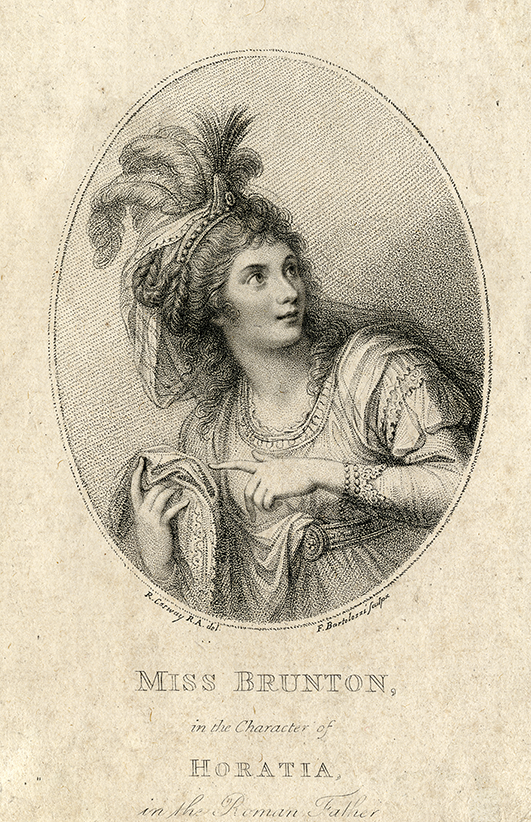
Figure 2 Long description
A print depicting Ann Bruton as Horatia. The frame is a cream rectangle, captioned MISS BRUNTON, in the Character of HORATIA, in the Roman Father, above which is an oval containing the image. The image is finely drawn, giving a detailed and realistic picture. Brunton is shown in three-quarter view, from about her torso upwards. One hand holds a scarf, the other points to it. Her face is young, her expression is hopeful and ingenuous, and she seems to crouch towards the scarf, away from whatever she is looking at, in a posture of vulnerability. She wears a relatively simple dress, apparently white, with multiple, slightly tasselled layers over her shoulders, as befits female Roman costume. She has a somewhat elaborate coiffeur and wears plumed, but not extravagant headwear, with a veil falling from it over the back of her shoulders.
The image was clearly popular, appearing in several different forms in the following years, sometimes as a full-body portrait (see Figure 3). The caption to the latter reads, ‘Yes, thou dear pledge, design’d for happier hours.’ Another version of the print is captioned, ‘By this we’ll swear a Lasting Love’.Footnote 205 The images depict Horatia pointing to the scarf, in the scene singled out by reviewers. Her expression is ingenuous, charming, and hopeful, her body language vulnerable. The same scene is also depicted in an undated print of a different design.Footnote 206 Another print shows her begging Publius not to kill her fiancé in the impending battle. She is on her knees, hanging onto his strong arm and almost visibly sapping his manly, Roman valour (see Figure 4). Not all prints share this tenor: some show her in a more statuesque posture, and one depicts her assailing Publius (in Yates’s ‘capital scene’).Footnote 207 Overall, though, the prints accord with the reviews, suggesting Brunton’s most effective scenes to have come early in the play, when she was still a tender, passive lover, inspiring pathos in her fellow characters and in the audience alike.
Ann Brunton Merry as Horatia in ‘The Roman Father’ (1792). The Rare Book & Manuscript Library, University of Illinois at Urbana-Champaign.Footnote 204
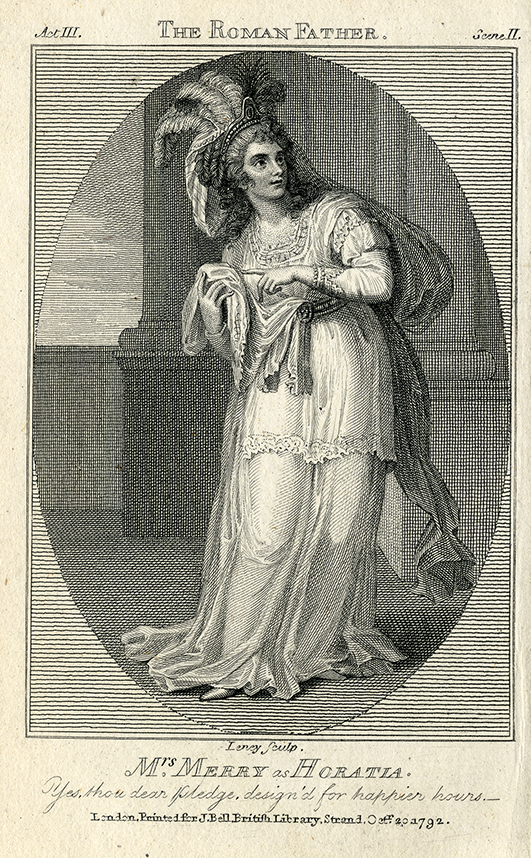
Figure 3 Long description
A full-body version of a depiction of Ann Brunton as Horatia, drawn with less fineness and clarity. The rectangular cream frame encloses another rectangular frame, this filled in with horizontal lines, which encloses a large oval, depicting Ann Brunton as Horatia from top to toe. A caption at the top, against the cream frame, reads, Act III. The Roman Father. Scene II. A caption at the bottom, also against the cream frame, reads Leney sculp. Mrs Merry as Horatia. Yes, thou dear pledge, design’d for happier hours. London, Printed for J. Bell British Library, Strand, Octr. 20 1792. The description of Brunton given for figure 2 pertains here also, except that her dress now appears more clearly in a light shade, and her facial expression is less distinct, but appears slightly more helpless and alarmed. Her bottom half here is shown garbed in an overskirt with a frilly edge, as appropriate to female Roman dress, over a white skirt that falls to the floor, with only a glimpse of a shoe poking from underneath it. The veil falling over her back descends almost to the floor as well. Her body language is vulnerable and indecisive. The background has been drawn here: it comprises one or more large columns, and perhaps the sky outside.
Ann Brunton Merry as Horatia and Alexander Pope as Publius in a scene from ‘The Roman Father’ (1817). The Rare Book & Manuscript Library, University of Illinois at Urbana-Champaign.
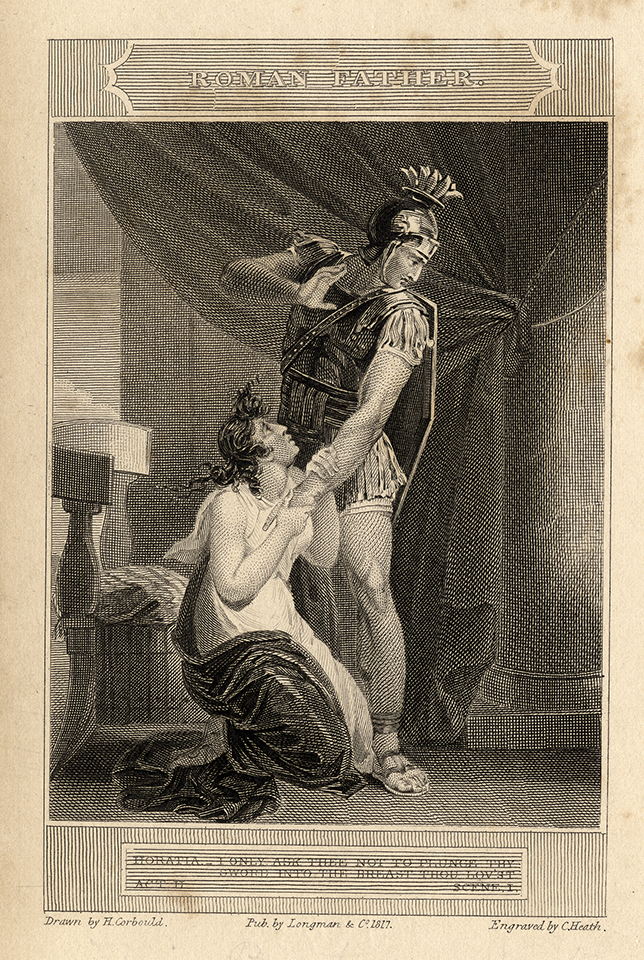
Figure 4 Long description
A print depicting a scene from The Roman Father. The image itself is rectangular and takes up most of the space. Above and below it are horizontal blocks, filled in with lines, the top one bearing the caption, ROMAN FATHER, the bottom one reading, HORATIA._ I ONLY ASK THEE NOT TO PLUNGE THY SWORD INTO THE BREAST THOU LOV’ST. ACT II. SCENE. I. A cream frame encloses the image and the horizontal blocks, with further captions at the bottom: Drawn by H. Corbould. Pub. by Longman & Co. 1817. Engraved by C. Heath. The image shows Ann Brunton’s Horatia kneeling at the feet of Alexander Pope’s Publius, grabbing his arm with both hands and looking up at him imploringly. Her mouth is open, presumably to speak the words given on the lower horizontal block. Her dress is much simpler than in other prints of Brunton’s Horatia: she wears a stark white dress, which stands out against the general darkness of the image, and it is very plain in design. It appears to be sleeveless, and to have a small white cape at the back, and it extends at least to her knees. A longer, black cape emerges from the white cape, wrapping around the front of her knees and trailing across the floor. She has no headwear and her black hair appears quite loose and wild. Pope’s Publius stands tall and erect, taking up almost the full height of the image. He is turned away from her, with his free arm recoiling upwards from her, and his open palm tilted away from her, suggesting weakness and disgust: it is almost as if he has raised his hand to push her away, but can only lift it vaguely towards his own face, ready to swat at any threat to his face. His face is not drawn particularly expressively, or perhaps is not intended to depict expressiveness, but it too suggests disgust. He wears the standard male Roman costume, but his plumes are only small. In a notable departure from standard eighteenth-century practice, his tunic skirt and the overskirt covered with, or comprised of, leather pteruges are both very short, extending only to the top of his thigh, and he does not wear breeches, meaning that his legs are bear. One long, muscular leg is visible in the image, and one sandalled foot. The backdrop appears to be a scene inside, with one or two large columns, a dark curtain, and some sort of furniture or other domestic features, but there is also perhaps an open sky visible on the left-hand side of the image.
To understand more fully what was happening here, it is necessary to consider the broader context of British public life and discourse at the time. As O’Quinn has shown, the last few decades of the century were a time of crisis, doubt, and self-reflection in Britain, with contemporaries using the theatre to work through the pain of losing the American colonies and to work out a new vision of Britain’s place in the world. Eventually, this led to a more assertive bourgeois imperial identity, predicated on the Asian empire; while the old parallel with Republican Rome, based around such ideals as liberty and virtue, was mostly jettisoned, and British governance became more authoritarian. But that result did not become visible overnight, and the 1780s was a time of transition, in which Britons sought comfort, consolation, and hope.Footnote 208
The Brunton–Horatia phenomenon, it seems, was part of this process. As shown above, it involved the self-conscious gathering of socially-mixed crowds, which vicariously included newspaper readers. Thus it created a version of the entire British public, focused on a young woman from Rome’s Edenic early days, before Rome had even become a Republic, let alone gained an empire. Whitehead had pitched a (valid) human nature against a (valid) Romanness, with its Republican and Imperial connotations anachronistically present but not egregious; Brunton and her audiences, though, privileged the humanness, sidelining the freight of Roman history. Brunton’s Rome was a sort of nursery, combining present innocence with future potential. It suggested that Britain was free to chart a new imperial course, or no imperial course at all; and that whichever course it chose would be better, less encumbered, than that of the American conflict.
The staging, too, emphasised this trajectory. Whitehead’s original text, and the Yates version, placed Publius’s triumphal entry and sororicide in Act IV. But the Crow Street text used in the 1780s placed both events in Act V. Partly as a consequence, the time between Horatia’s stabbing and the final curtain was severely curtailed; and the main loss was the debate around Publius’s punishment, which in the original text had provided a substantial, meaningful coda after Horatia’s death, but which was arguably the most cerebral part of the play, and which relied on the legitimacy of the Romanness versus humanness conflict for its valence. Moreover, the Covent Garden theatre of the mid to late 1780s was larger than any in which The Roman Father had yet been performed, allowing for greater scenic spectacle than ever before, and the staging exploited this potential. In particular, Publius’s triumphal entry was made more spectacular than ever before, featuring a large crowd of people marching across the stage, a glittering array of military paraphernalia, new music composed by William Shield, and the voices of all the theatre’s ‘principal singers’.Footnote 209 Reportedly, ‘The Ovation produced a good effect, and added much to the merit of the representation.’Footnote 210
Brunton’s audiences, then, witnessed a play with a clearer trajectory, a more powerful climax, and less intellectual substance than hitherto. Act V opened with a great spectacle of sound and vision, followed swiftly by Horatia’s passionate confrontation with her brother, then her death, then the final curtain. This trajectory would have dovetailed well with Horatia’s own personal journey within the play. Moreover, by shearing her death of consequences and ratiocination, the dramaturgy would have encouraged a less cerebral, more visceral experience. Audiences would probably not have dwelled on the fact that the spectacular ‘Ovation’ represented a Romanness that Horatia set herself against; they would have enjoyed the spectacle for its own sake, and may even have vaguely associated it with Horatia, as part of a general impression of a dazzling, powerful climax.
Again, this was perfectly fitting for Britain in the 1780s. The Brunton–Horatia phenomenon held forth the sense of a trajectory for Britain: from youth, innocence, and promise, towards a vague but glorious climax. Simplicity – a lack of encumbrances – defined this trajectory throughout. Britons did not want to deal with the American situation again, either in its ideological or disputational aspects, or in its final outcome; nor did they want, or could even perhaps imagine, a specific future for their polity, with all the issues and implications that that might have entailed. They only wanted to be reassured that the future was bright. Brunton-Horatia, with all her youthful potential, and with a grand spectacle to decorate her final scene, offered them (in)exactly that.
4.4 Room for Rome?
However, there was a problem here. This version of Roman history barely warranted the name. The transhistorical Roman, with his Republicanism and imperialism, was being softened almost to dissolution, in favour of a sentimental young woman and vague utopias. Different as Brunton was from Yates, she continued a trend visible in the Yates years: Horatia becoming more human, less Roman. Indeed, newspaper critics of the 1780s commonly grouped Horatia together with other Yates and Siddons roles – typically those of the minor repertory staples written in the Georgian period, such as Mahomet and Braganza, mentioned in Subsection 1.1 – and gave no hint that Horatia’s Romanness made her special or different from them.Footnote 211 This suggests a sentimentalist attitude to Roman history, but only in a limited sense: audiences were interested in human sentiment wherever they might find it, rather than being especially interested in viewing it in a Roman context, or (as had been suggested in the 1750 reviews) in accessing and understanding Roman history via relatable human characters. Amongst the crowds, the prints, and the newspaper reports gathered around Brunton-Horatia in search of consolation and hope, did Roman history really matter?
During the Yates phase, the picture had been mixed: newspapers had sometimes voiced conventional sentiments about Roman figures, approved of Horatius’s Roman virtue, and showed interest in the conflict between human nature and Romanness.Footnote 212 But they had expressed less interest in Roman characteristics than their 1750 forebears. In Brunton’s time, this tendency went still further. Reviewers began to express discontent with Romanness and its spurious virtue. One described The Roman Father as ‘a Play that tramples upon the ties of nature, and aims to deaden the force of those passions that dignify human nature—the inculcation of Roman patriotism being … repugnant to morality … [and] better calculated for a Burletta than a Tragedy’.Footnote 213 Then, for the Drury Lane revival of 1794, the reaction was yet more extreme. One review began,
In a Play built upon Roman manners we seldom find much gratification. Shakespare, whose individuals have no country, affords the pleasure which springs from general nature. A Roman is a factitious being, strutting over the ruin of every fond relation of kindred, and aiming to be great by the violation of humanity … So much for a play, which, revolting by its story, is rendered languid and tedious by the most prosaic dialogue.Footnote 214
The same reviewer later claimed that, following the sororicide, ‘a piercing hiss’ from the audience ‘announced the triumph of Nature over Roman Virtue!!’Footnote 215 Moreover, as the ‘languid and tedious’ remark suggests, an increasing number of reviewers in the 1780s–90s simply did not think the play was any good.
The flurry of published editions 1786–97 shows that there were still many fans of The Roman Father. Yet performances were fizzling out between the late 1780s and 1809, and it seems likely that the negative reviews articulated a wider distaste, and a wider change in dispositions towards the play. The play’s appeal rested on the sense that both Romanness and human nature were valid, and that audiences would bring exemplary as well as sentimentalist attitudes to their viewing of the play. If not – if human nature alone was prized, Romanness rejected – then there was no real tension to the play, and its action would appear ‘revolting’, or as ridiculous as ‘a Burletta’.
Thus the exemplary attitude seems to have been steadily fading from late eighteenth-century reviews of The Roman Father. So too historicism: the reviewers who criticised the play did not even allow that its characters’ behaviour might have been warranted, or tolerable, as a depiction of an historical people. Meanwhile, the sentimentalist attitude towards Roman history onstage became, in a sense, more important to the play as the decades passed; yet it also became more cursory. Still more than in 1750, it appears that Britons of the following decades engaged with The Roman Father as a drama based upon Roman history, rather than as an authoritative historical text for which exemplary, historicist, or sentimentalist attitudes might be truly meaningful. They assessed it in dramatic terms, and looked for Yates and Brunton to perform human nature, and relatable passions, for their own sake, or (in the 1780s) for the sake of the consolatory dynamic described above, rather than as a means of opening up Roman history.
Nonetheless, it is fair to see the change in attitudes within the theatre as indicative of broader changes. It cannot have been shifts in theatrical practice and dramatic theory alone that caused reviewers of the 1780s–90s to trumpet human nature over Romanness so resoundingly, or to reject The Roman Father for its depiction of Romanness, where their forebears had voiced such different opinions. If the transhistorical Roman character and the exemplary attitude were losing viability, and an interest in sentiment and human nature were coming to the fore, in the ways that The Roman Father was staged and received, then surely some such change in attitudes to Roman history was occurring outside the theatre too. Moreover, the play’s fate accords with the arguments of other scholars, and with the statistics on Roman plays provided in the first section, in showing that interest in Roman history tout court, viewed through any lens, was on the decline amongst Britons as the century wore on. In the words of Horatius, audiences were beginning to doubt The Roman Father’s virtue.
5 Views of Roman History
The preceding sections have argued that The Roman Father and its reception demonstrate the relative viability of the three different attitudes to Roman history in a theatrical context, and of how that configuration changed over time. They have suggested that the attitudes on show were, to a significant degree, genre-specific and present in less meaningful forms than they would have been with regard to prose history books. However, they have also argued that the evidence is indicative of how typical those attitudes may have been outside the theatrical context, too.
This final section will test these arguments further, by situating the play in the broader historical culture of late eighteenth-century Britain. It will continue to emphasise that different genres occupied their own distinct spaces, and were subject to their own demands and considerations, such that the attitudes to Roman history that were active in the theatre were not necessarily active elsewhere. There was a strong degree of compartmentalisation: Britons were able to keep the different genres, and the different perspectives appropriate to them, fairly separate. However, it will also show that different genres were connected to each other; works in one could influence those in another, and the attitudes to history that were active in one context could be informed by the experiences of a different context. This process was mostly hierarchical, but not entirely: The Roman Father may have influenced the rewriting of one mid-century prose history of Rome. In any case, this section will reveal that the foregoing analyses of Roman plays can be highly fruitful for a reading of eighteenth-century prose history books, including Ferguson’s and Gibbon’s.
This section will conclude by summarising the Element’s arguments as a whole.
5.1 Historical Culture
The Roman Father and other Roman plays were linked to a wider historical culture about ancient Rome, manifesting across different genres. As shown in previous sections, Roman plays drew upon their forebears, portraying an idea of Romanness that had been developed onstage over centuries. They also drew upon prose history books, the central, most authoritative elements of historical culture, which were often simply referred to as ‘history’ or ‘histories’. Thus the 1750 reviews assessed The Roman Father’s historical accuracy and creative usage of the past, as determined by prose histories; and they articulated a particular relationship between prose histories and tragedies, in which the former supplied the facts, the latter the feelings of the past. However, those reviews also show that the demand for historical accuracy was relatively weak, and that the feelings which audiences wished to see were those of a universal human nature, for which Roman history supplied the circumstances, but not the substance.
In turn, a successful play like The Roman Father spawned historical products in other genres, such as prints illustrating the play. These generated further engagement with Roman history, but only with the transhistorical Roman character. They depicted architecture, costumes, behaviour, and quotations that were appropriate to an abstract notion of ancient Rome, rather than to a specific period or event of Roman history; and their depictions of female characters had little historical accuracy. Perhaps the most substantial historical products generated by Roman plays were the short historical accounts intended to contextualise them. Reviews of new Roman plays in periodicals often began by detailing the historical episode on which the play was based.Footnote 216 Even during the Brunton phase, when the play was already well-known and its Romanness was diminishing, one newspaper supplied the ‘Story on which the Play of the ROMAN FATHER is founded’.Footnote 217 Many, perhaps most, new Roman plays over the century were accompanied by a dedicated pamphlet explaining the historical background. Examples include The History of Marcus Attilius Regulus (1744) for Havard’s Regulus, and The Life of Coriolanus (1749) for Thomson’s Coriolanus. As was standard, both proclaimed on their title pages that they were ‘collected’ or ‘extracted’ from ancient Roman historians, emphasising prose histories’ central role in historical culture.
This was not an invariable gesture: the title page to The Roman Father’s historical pamphlet, The Story, did not make any such comment. But in other respects, The Story indicates how the play was believed to stand vis-à-vis Roman history. The Story was based on Livy, apparently with some reference to Dionysius for additional material, or perhaps on an eighteenth-century work that had drawn upon those sources. But it was a creative, theatrical retelling that included entirely original material, not drawn from any historian or playwright. It emphasised the affinity between Romans and Albans in an affecting, tragic manner, even inventing episodes to this end. For example, it made the Alban dictator personally congratulate Publius after his victory.Footnote 218 Most pointed was The Story’s treatment of the daughter (The Roman Father’s Horatia). Whereas ancient and modern historians tended to bring her into view after Publius’s victory, merely for the purpose of dying, The Story introduced her early on, as appropriate to a dramatic narrative, and described her theatrically: she was ‘no less famous for her beauty, than the sons [the Horatii] were for their valour’, and she and her fiancé would have ‘long since been join’d by the priests, had not the commotions of the jarring states prevented it’.Footnote 219 Then, during the clash between the brothers, ‘the pious daughter of Horatius retir’d to her chamber, and spent the dreadful interim of time with confus’d prayers for her country’s liberty, and for her lover’s life, one opposite to the other.’Footnote 220 When her reaction to Publius’s victory enraged him, it was partly because ‘he dearly lov’d’ her’.Footnote 221 The Story was an idiosyncratic, yet theatrical take on the Horatii.
A number of motives lay behind The Story. It was an attempt to advertise The Roman Father and allow potential audience members the chance to feel that they possessed the requisite historical knowledge to watch it. But rather than providing a dry, solid bedrock of historical fact upon which an entertaining play could be built, The Story smoothed out the path between history and theatre: it began the process of converting historical material into entertainment and whetting the audience’s appetite for the specific play. At the same time, The Story’s author and publisher made money by selling a story that readers had a topical motive for buying, and that readers were already predisposed to regard as theatrical and entertaining, because it had been considered fit material for dramatization by Whitehead and Garrick (and Corneille).
Thus The Story illustrates how Roman plays tended to operate symbiotically with a wider historical print culture. Again, though, historical accuracy seems to have been a minor concern. Moreover, The Story and other such pamphlets were ephemeral productions. It is hard to believe that The Story influenced Britons’ views of Roman history in any way beyond encouraging a few more Londoners to watch the first run of The Roman Father, and allowing some of the play’s first audience members to have a better understanding of the action than they might otherwise have done. In terms of historical culture, then, the pamphlets and prints filtered historical truth – originally derived from prose histories – still further than Roman plays had already filtered it. The only aspect of Roman history that remained clear to consumers at the end of this process was the transhistorical Roman character, and even that became increasingly superficial.
5.2 Influence on History Books
However, it is possible that The Roman Father and other Roman plays may have influenced the genre from which they derived their sense of historical truth: prose histories. The tale of the Horatii had always been well-known, and typically appeared near the beginning of eighteenth-century British histories of Rome. The historians’ treatment of the episode can therefore be compared to The Roman Father’s. The most relevant work here is Nathaniel Hooke’s The Roman History, the first volume of which appeared in 1738, then in a second edition in 1751, soon after The Roman Father’s appearance. Hooke’s was a vast, detailed work, with many extensive footnotes. The first edition gave a lengthy account of the Horatii episode, detailing the political and constitutional implications of the events, mentioning the characters’ emotions, but not giving much moral judgement on the sororicide.Footnote 222 However, the second edition’s account of the Horatii was significantly altered. For example, the first edition prefaced the sororicide with the comment, ‘he [the brother] met with an accident that occasioned him a severe mortification.’Footnote 223 The second edition was more scathing and emotional: ‘he fell into a crime, that obscured the lustre of his exploit, brought disgrace upon him, and even merited, in strictness of justice, a much severer punishment.’Footnote 224
The second edition then gave the meeting between brother and sister a more dramatic, sadder treatment than previously. In the first edition, the brother ‘saw, with some surprize, his sister, in the crowd, unattended, and without her mother’.Footnote 225 In the second edition, this became ‘he, to his great surprize, beheld his sister, unaccompanied by her mother, and without any attendance, hurrying forward in the promiscuous crowd to meet him.’Footnote 226 The change of ‘some surprize’ to ‘great surprize’ accentuated the emotional charge; the expansion of the phrase ‘unattended’ to ‘without any attendance’, and of the description of the crowd surrounding the sister, made her a more active, plaintive character. The first edition stated that the brother imputed her behaviour to ‘her impatience to see a victorious brother’, which, again, was expanded and made more emotive in the second edition.Footnote 227 To the first edition’s phrase, ‘But the zeal which had brought her from home’, the second edition added a newly tragic note: ‘But, alas! the zeal … ’Footnote 228 The phrase ‘running like one distracted’ became ‘running like a distracted creature, to learn the certainty of his [her fiancé’s] fate’.Footnote 229 When the brother stabbed her, the first edition stated that he ‘went on strait to his father’s house’, to which the second edition added ‘without longer stay, without sign of pity or remorse’.Footnote 230 Where before the father ‘approved of the action’, he now ‘approved of the cruel deed’.Footnote 231
Evidently, Hooke did not rewrite the episode along the lines of The Roman Father: his descriptions and emotional judgements differed markedly from Whitehead’s. Moreover, Hooke may have been ignorant of the play, or rewritten his Horatii account before 1750. Nonetheless, he clearly rewrote the account in a more emotive, dramatic manner, seeking to evoke readers’ pity for the sister. And his condemnation of the father and brother, although not advocated by Whitehead, was one of the reactions that (as The Roman Father’s epilogue shows) Whitehead knew that audiences might legitimately have to his play. Most suggestively of all, Hooke does not seem to have edited his entire book in this new manner, but only the Horatii episode.Footnote 232 It therefore seems possible that the play influenced Hooke’s treatment of the Horatii; and, more broadly speaking, that it encouraged historians and readers to view the story with an additional emotive charge, and with a more actively judgemental perspective, than they had hitherto brought to it. Potentially, the play stimulated a sentimentalist attitude that creators and audiences then applied to Roman history in prose books, and perhaps other genres.
After Hooke, though, it is hard to find any hints of the play’s impact on prose histories. Goldsmith’s (Reference Goldsmith1769) was a lighter work than Hooke’s, avowedly aimed at the casual reader.Footnote 233 His take on the Horatii was sentimentalist and historicist: he portrayed the episode as a poignant tragedy, but also as typical of ‘these barbarous times’.Footnote 234 Richard Johnson’s history for young readers (1770) covered the Regnal period in six pages, Gibbon’s history (1776) commenced with the Principate, and Ferguson’s (Reference Ferguson1783) was a sociologically minded history that ignored Rome’s earliest and most fabulous tales; hence none of the three dealt with the Horatii. Charles John Ann Hereford’s history (1792) took a fairly historicist view of the Horatii, presenting the episode as typical of fierce Roman virtue, understood primarily as the transhistorical type that predestined Rome to grandeur, but also as a more specific type appropriate to Rome’s primitive state.Footnote 235 Hereford also noted that ‘the names of the Curiatii and Horatii have not only been preserved in history, but have been adorned by the tragic muse’. But his phraseology clearly posited history and drama as separate entities, and the latter (‘the tragic muse’) as something comparatively airy, which only ‘adorned’ what history ‘preserved’. William Godwin’s History of Rome for schoolchildren (1809) then took a firmly historicist attitude, showing little evidence even of sentimentalism. Godwin used the Horatii episode as a metonym for the reign of Tullus Hostilius, illustrating that prince’s ‘martial spirit’, and prefaced the sororicide thus: ‘We may judge of the ferocious character of these times by what followed.’Footnote 236
Whitehead’s play, then, had no apparent influence on late eighteenth-century historians, except perhaps Hooke in 1751. Moreover, the attitudes brought to Roman history in prose histories were different to those brought to it onstage. From the 1780s onwards, while sentimentalism became the most important attitude in determining the staging and reception of The Roman Father, and historicism somewhat declined, the history books’ perspective on the Horatii moved in the opposite direction: it became less sentimentalist and increasingly historicist. This historicism held Regnal Rome to be a rough, barbarous society. Nonetheless, history books do help us to understand the play’s reception. If historians were coming to eschew the exemplary attitude towards Horatii and Roman history in general, it is no wonder that stagings and reviews of The Roman Father showed less and less of an inclination towards transhistorical Romanness, and that the play eventually lost favour on the London stage.
5.3 Illumination of History Books
However, it is notable that Hereford still showed some interest in a transcendent Roman virtue in 1792. And if history books can tell us something about Roman plays, then so too can Roman plays tell us something about history books. One of this Element’s arguments is that eighteenth-century Roman plays centred on transhistorical Roman characters, and often their struggle to redeem historical Rome. This dynamic is clear in plays because of the nature of the genre; but, once identified there, it can also be found in prose histories too, structuring the way that historians understood Rome’s history. Thus all British histories tended to view Rome’s early history through a bipartite perspective, in which Rome was, at one and the same time, historical – a primitive society, with basic manners, basic buildings, and basic rites, squabbling with its neighbouring tribes – and transhistorical – a civilisation predestined for greatness, imbued with remarkable virtue and valour from the time of its founding, and quick to set up the laws, customs, and institutions that would endure until the end of the Republic, or further.Footnote 237
Even those most sceptical historians, Ferguson and Gibbon, sometimes employed this perspective. Ferguson portrayed the earliest Romans as ‘a horde of ignorant barbarians’, similar to other peoples at that stage of social development (including those of ‘the lately discovered islands in the Southern or Pacific Ocean’).Footnote 238 Yet he also felt that they were distinguished from their neighbours ‘in consequence of some superiority of institution or character’ and ‘by their genius, magnanimity, and national spirit’.Footnote 239 He noted that the classic Roman character and institutions ‘existed in very early times, and served as the foundation of that policy which distinguished the Roman state’, leading Rome to become ‘the metropolis of [a] little empire’ and ‘one of the principal states of Italy’ a mere century after Tarquin’s expulsion.Footnote 240 Thus Ferguson’s early Rome was both a typical primitive society, and a special society comprising the distinctive Roman character and institutions that predestined it for greatness. Transhistorical Romanness inspired the historical Rome from the very beginning.
Gibbon’s perspective was different, as he started his account in the principate; yet he evinced a similar attitude. Looking back to the rise of Roman power during the Republic, he attributed it to ‘the policy of the senate, the active emulation of the consuls, and the martial enthusiasm of the people’;Footnote 241 the ‘ancient virtue of patriotism’, based on liberty;Footnote 242 and the ‘republican spirit’.Footnote 243 Even after the principate took hold, Gibbon argued,
The minds of the Romans were very differently prepared for slavery [than those of the servile Persians]. Oppressed beneath the weight of their own corruption and of military violence, they [the Romans] for a long while preserved the sentiments, or at least the ideas of their freeborn ancestors … The history of their own country taught them to revere a free, a virtuous, and a victorious commonwealth.Footnote 244
For Gibbon, there was nothing numinous about this: he had clear explanations for why the early Romans had developed such virtue and valour, and for how those deep-rooted qualities had endured, in some form, into the principate. Nonetheless, his idea that there was a quintessential Romanness, which had emerged in the earliest times, powered Rome to greatness, then been choked, but not entirely extinguished, by the emperors, was the historical equivalent of the playwrights’ transhistorical Romanness.
Gibbon even invoked the idea of transhistorical Romans struggling against their debased historical times: under Tiberius and like-minded emperors, ‘the last of the Romans were condemned for imaginary crimes and real virtues’ by the senate.Footnote 245 Such victims were the ‘last’ Romans because, in Gibbons’s eyes, there was only one possible version of Romanness. The original Roman identity was not, and could not be, replaced by a Roman identity appropriate to the principate, or by a new national identity; it was replaced by a lack of identity, by un-Romanness. Similarly, Ferguson stated that ‘the national character declined’ after the emperors took power.Footnote 246 This was an ambiguous statement; Ferguson may have meant that Roman identity remained, but evolved into something less admirable. Yet he was certainly at least hinting that Roman identity declined in the sense of disappearing, and leaving behind it a vacuum. Even for Gibbon and Ferguson, then, there was something transhistorical about Romanness; it had inspired the historical Republic, then existed in opposition to the historical Empire, occupying a diminishing space over time but never changing in nature. Playwrights had used this dynamic to accentuate the exemplary aspects of their heroes, and to provide compelling, stirring plots for their plays. Historians were doing something different: they were trying to explain why it was that Rome had risen from a village to the greatest imperial power of all time, then stagnated and eventually collapsed. But perhaps plays, by propagating the idea of the transhistorical Roman, had influenced the historians’ explanations.
The Roman Father’s own take on the transhistorical Roman can also illuminate prose histories. The Roman Father had set up an unresolved conflict between Romanness and human nature, and, partly for this reason, had appealed strongly to mid century audiences, as well as creating a character, Horatia, who continued to appeal to audiences for the rest of the century. Historians, too, had to grapple with that conflict, and had no easy answers. They were impressed by Rome’s greatness, and by the transhistorical Roman qualities that they felt to be responsible. Hooke described his work not as a history of Rome but as an ‘Attempt towards a History of Roman Virtue and Patriotism’.Footnote 247 Even the late-century historians acknowledged Rome’s greatness, attributed it to admirable qualities, and argued that Roman history was therefore particularly worthy of study.Footnote 248 However, eighteenth-century historians also recognised a fundamental conflict between Romanness and human nature; and, as the century wore on, their unease grew, and they came to feel that the claims of human nature ought to be preferred.Footnote 249 This was the conflict that The Roman Father had dramatised, and thrown to the judgement of audiences. Perhaps, again, the play did influence historians in this respect; perhaps not. In any case, the play and the history books illuminate each other: The Roman Father showing one of the conflicts that historians grappled with, prose histories helping to explain why The Roman Father succeeded – because its central conflict was of fundamental concern to eighteenth-century Britons – and why it gradually faded from the stage – because opinions on that conflict tilted decisively, and rendered the play’s even-handedness unsatisfactory.
5.4 Conclusion
‘Attitudes’ are a nebulous concept, and it would be wrong to be too schematic about them. A single individual could have had different attitudes at different times, depending not only on the genre with which they were engaging but with their personal mood, or other contextual factors. Moreover, the idea of one attitude falling, another two rising, is too neat. This Element’s timeframe, too, may be misleading. O’Quinn has suggested that the post-American War period was one of transition, in which Britons moved away from the old Republican parallel towards a more authoritarian from of governance and a more strident imperialism,Footnote 250 and Sachs has described a boom in new Roman plays in the years immediately following Kemble’s retirement (1817).Footnote 251 Perhaps, then, Roman plays only lost favour for a time because Britons were trying to work out what they thought of Rome, and because the old model of Roman play had become unsuitable but had not yet been replaced by a new model. If this study had been extended to 1850, its narrative may have been more convoluted. Nonetheless, and whatever happened next, it is clear that attitudes to Roman history shifted between 1700 and 1800.
To return, then, to one of my original questions: why did The Roman Father gain an enduring success that was denied to most other Roman plays? Such questions are always difficult to answer. Yet it appears that Whitehead handled Roman history, and answered to the three different attitudes, in a more resonant way than other playwrights did, which rendered his play popular with both audiences and actors. He avoided the conventional setup of transhistorical Roman characters against a historical Roman setting, instead choosing an essentially transhistorical Roman setting too. This allowed him to construct the play around a conflict between Romanness and human nature, and to create compelling tension between the exemplary and sentimentalist attitudes, based on the understanding that both of those attitudes were legitimate, and that theatregoers may well have sympathised with one side or the other, or have had divided sympathies.
Perhaps most crucially of all, Whitehead set up the conflict not just between characters, but within them. Thus he created Horatius, a role so well-suited to a versatile actor like Garrick that it became one of his trademark roles; and Horatia, whose varied, powerful passions endeared her to tragediennes and audiences for the rest of the century. The Roman Father’s final years of popularity, and its decline, also reveal the change in attitudes to Roman history over time. Theatregoers and performers became less inclined to view the play in an exemplary light, and to accept its exemplary aspects; but they also became less interested in Roman history in general, no longer valuing the play for its portrayal of ancient Rome, no longer necessarily valuing the play at all. The Roman Father became subject to an increasingly sentimentalist attitude, but only in a limited, negative sense: audiences and actors wanted expressions of sentiment wherever they might find them, with little concern for the historical society in which they were supposedly situated.
To an extent, these developments were particular to the theatre. Plays were assessed and enjoyed on dramatic terms; they were regarded as drawing upon history, but not as authoritative historical texts in their own right. The traditional prose history book was the genre in which historical truth inhered, and for which the exemplary, historicist, and sentimentalist attitudes were most meaningful in eighteenth-century Britain. Plays, and most other aspects of historical culture, were only moons, reflecting the light of historical truth, and comprehensible according to more trivial forms of the three attitudes. As such, the configuration of attitudes to Roman history found vis-à-vis The Roman Father was to some degree genre-specific, but also testifies to non-theatrical attitudes, if only because of Roman plays’ dependency on prose histories. The decline in exemplary responses to the play, and the declining appeal of its transhistorical Romanness, indicate the decline of the exemplary attitude and of interest in Roman history in non-theatrical contexts too (even if Rome was still, in absolute terms, one of the most popular historical topics).
Ultimately, because The Roman Father was based on a configuration of attitudes to Roman history that no longer prevailed by the end of the century – within or without the theatre – the play’s appeal lessened. It was maintained onstage into the nineteenth century mainly by Horatia; but the writing was on the wall by the 1780s. Late eighteenth-century observers sometimes stated that Cato had disappeared from the stage because it lacked sentimental interest, dramatised a struggle ‘for laws and institutions that bear no very near resemblance to our own’, and celebrated a Roman virtue that was improper and inhumane.Footnote 252 The Roman Father had outlasted it, and most other eighteenth-century Roman plays, partly because it had occupied different moral and emotional terrain from Cato. But the tide which had crept up the beach between 1713 and 1750, and swallowed Cato, crept up still further from 1750 onwards, and eventually drowned The Roman Father too.
Acknowledgements
This project took a few different forms, or intended forms, along the way to becoming an Element. I am grateful to the people who gave help, feedback, and encouragement at various stages. Martha Vandrei was a great support, discussing the project with me and giving feedback on my early ideas. David O’Shaughnessy read multiple pre-Element drafts and my Element proposal, giving perceptive advice each time, as well as heading the Theatronomics project on which I learned much about eighteenth-century British theatre. I presented a paper on The Roman Father at the 2023 ASECS conference and benefited greatly from the Q&A that followed. I would particularly like to thank the panel convenor Brett D. Wilson, my fellow panellist Jason Shaffer, and Joseph Roach for their discussions afterwards; as flagged in this Element’s footnotes, the latter provided me with a fascinating archival source on the performance of Whitehead’s next play, Creusa. Also mentioned in the footnotes, but worth repeating here, is my gratitude to Rebecca Morrison for discussing theatrical costume with me, and explaining it in detail.
If I did not begin this project with a view to producing an Element, I am delighted that this has been the outcome; my work could not have appeared in any better guise. The series editors, Eve Tavor Bannet and Markman Ellis, have been responsive, prompt, supportive, and insightful throughout. I have enjoyed working with them, and their feedback has made the Element continuously better. The two anonymous reviewers also gave helpful, stimulating feedback that has improved the final text. I believe I know who one of the reviewers was, and that he had already served as an anonymous reviewer to one, perhaps two of my recent outputs, so along with Martha and David I must thank him for putting up with so much of my writing. (Or maybe I’m wrong, and should stop trying to peer beyond the veil of anonymity.) I am also thankful to Cambridge University Press as a whole and to everyone involved in the production process, including those who were not anonymous: Adam Hooper and Vibhu Prathima.
Lastly, I am grateful to my parents, brother, and Maeve. They have been unfailingly supportive throughout this process, and always interested to hear about my research, the topic, and the journey of publication. Thanks for that, and for everything.
Series Editors
Eve Tavor Bannet
University of Oklahoma
Eve Tavor Bannet is George Lynn Cross Professor Emeritus, University of Oklahoma and editor of Studies in Eighteenth-Century Culture. Her monographs include Empire of Letters: Letter Manuals and Transatlantic Correspondence 1688–1820 (Cambridge, 2005), Transatlantic Stories and the History of Reading, 1720–1820 (Cambridge, 2011), and Eighteenth-Century Manners of Reading: Print Culture and Popular Instruction in the Anglophone Atlantic World (Cambridge, 2017). She is editor of British and American Letter Manuals 1680–1810 (Pickering & Chatto, 2008), Emma Corbett (Broadview, 2011) and, with Susan Manning, Transatlantic Literary Studies (Cambridge, 2012).
Markman Ellis
Queen Mary University of London
Markman Ellis is Professor of Eighteenth-Century Studies at Queen Mary University of London. He is the author of The Politics of Sensibility: Race, Gender and Commerce in the Sentimental Novel (1996), The History of Gothic Fiction (2000), The Coffee-House: a Cultural History (2004), and Empire of Tea (co-authored, 2015). He edited Eighteenth-Century Coffee-House Culture (4 vols, 2006) and Tea and the Tea-Table in Eighteenth-Century England (4 vols 2010), and co-editor of Discourses of Slavery and Abolition (2004) and Prostitution and Eighteenth-Century Culture: Sex, Commerce and Morality (2012).
Advisory Board
Linda Bree, Independent
Claire Connolly, University College Cork
Gillian Dow, University of Southampton
James Harris, University of St Andrews
Thomas Keymer, University of Toronto
Jon Mee, University of York
Carla Mulford, Penn State University
Nicola Parsons, University of Sydney
Manushag Powell, Purdue University
Robbie Richardson, University of Kent
Shef Rogers, University of Otago
Eleanor Shevlin, West Chester University
David Taylor, Oxford University
Chloe Wigston Smith, University of York
Roxann Wheeler, Ohio State University
Eugenia Zuroski, MacMaster University
About the Series
Exploring connections between verbal and visual texts and the people, networks, cultures and places that engendered and enjoyed them during the long Eighteenth Century, this innovative series also examines the period’s uses of oral, written and visual media, and experiments with the digital platform to facilitate communication of original scholarship with both colleagues and students.