


Introduction
Old World fruit bats (Family Pteropodidae, Order Chiroptera) are phytophagous and feed almost exclusively on fruits, leaves, nectar and pollen (Fleming & Kress, Reference Fleming and Kress2011). They typically have broad diets and eat a wide range of native, introduced and cultivated plant species (Lobova et al., Reference Lobova, Geiselman and Mori2009; Fleming & Kress, Reference Fleming and Kress2011), and they can consume large quantities of fruits (50–250% of their body mass daily; Izhaki et al., Reference Izhaki, Korine and Arad1995). Fruit bats are essential for pollination and seed dispersal of at least 289 species of plants, of which 186 provide economically important resources and products (Fujita & Tuttle, Reference Fujita and Tuttle1991; Lobova et al., Reference Lobova, Geiselman and Mori2009; Aziz et al., Reference Aziz, Clements, McConkey, Sritongchuay, Pathil and Abu Yazid2017; Vincenot et al., Reference Vincenot, Florens and Kingston2017). However, negative attitudes towards fruit bats are widespread among the general public (Vincenot et al., Reference Vincenot, Collazo, Wallmo and Koyama2015; Kingston, Reference Kingston, Voigt and Kingston2016). Old World fruit bats commonly feed on cultivated fruits, and therefore they are frequently shot, persecuted and even legally culled as agricultural pests (Bumrungsri et al., Reference Bumrungsri, Sripaoraya, Chongsiri, Sridith and Racey2009; Epstein et al., Reference Epstein, Olival, Pulliam, Smith, Westrum and Hughes2009). A study in Madagascar found that the Madagascan rousette Rousettus madagascarensis prefers native and commercially unimportant fruit to commercially farmed fruit, including lychees Litchi chinensis, and maintaining supplies of native fruit may be a way of limiting damage at orchards (Andrianaivoarivelo et al., Reference Andrianaivoarivelo, Jenkins, Petit, Ramilijaona, Razafindrakoto and Racey2012).
The Mauritian flying fox Pteropus niger is endemic to the Mascarene Islands (the large islands of Mauritius, Réunion and Rodrigues and nearby smaller islets in the south-west Indian Ocean), and in the past occurred throughout the archipelago. However, it is restricted now to the island of Mauritius (with records of a few individuals on Réunion Island) as a result of habitat destruction and hunting (Cheke & Dahl, Reference Cheke and Dahl1981; Cheke & Hume, Reference Cheke and Hume2008). The species plays a disproportionately large ecological role as a seed disperser on Mauritius, especially in dispersing the seeds of large trees that are important in forest canopies (Florens et al., Reference Florens, Baider, Marday, Martin, Zmanay and Oleksy2017).
In 1974 the population of P. niger was estimated to comprise 10,000 individuals (Cheke & Dahl, Reference Cheke and Dahl1981). Its range is limited by habitat destruction and it is negatively affected by tropical cyclones, which can potentially decimate populations (Cheke & Dahl, Reference Cheke and Dahl1981; Pierson et al., Reference Pierson, Elmqvist, Rainey and Cox1996; Grant et al., Reference Grant, Craig and Trail1997; Cheke & Hume, Reference Cheke and Hume2008). In common with many bat species it typically produces only a single offspring each year, and occasionally twins, and therefore recovery after decline is slow. The bats have been protected by law since 1983, when hunting them for food and sport shooting, once a common practice, was made illegal. The population had increased to an estimated 100,000 by 2015 (Republic of Mauritius, 2016, 2017), although this estimate was based on disturbance counts, which are considered to be inaccurate and often result in double counting. In 2016 the population was estimated to comprise 62,500 (± 7%) individuals (Kingston et al., Reference Kingston, Florens, Oleksy, Ruhomaun and Tatayah2018). Increasingly, there are claims that the bats are damaging commercial fruit crops. Mauritian fruit growers estimate that fruit bats eat 50,000 kg of lychees per annum and such damage is increasing at a rate of 10% annually. It is estimated that 10–35% of fruit in orchards is damaged and, depending on market price and levels of depredation, the cost of this damage can amount to MUR 180 million (USD 5.24 million) annually. Mauritius produces > 42,000 tonnes of fruit annually from 3,000 ha, with lychees contributing 1,000–4,000 tonnes. An estimated 200–330 tonnes of lychees, worth MUR 45–50 million (USD 1.3–1.45 million), are exported annually (Agricultural Research and Extension Unit of the Food and Agricultural Research Council, pers. comm.; Republic of Mauritius, 2016).
Fruit growers have lobbied the Mauritian Government since 2002 (D. Sarjua, in litt. to Ministry of Agriculture, 18 December 2002, copied to Mauritian Wildlife Foundation) to remove the legal protection for P. niger so that it may be controlled in orchards. In 2015 this lobbying was successful, a cull was implemented and the official number of bats killed was 30,938, followed in 2016 by a further cull of 7,350 bats in an attempt to limit the damage caused to lychee and mango farms (Republic of Mauritius, 2017). The cull commenced despite the lack of clear evidence of the damage caused by the Mauritian flying fox to orchard fruit (Florens, Reference Florens2015). As a consequence of the culling, ongoing habitat loss and vulnerability to cyclones, P. niger was recategorized from Vulnerable to Endangered on the 2018 IUCN Red List, based on an estimated population decline of 50% in 2015 and 2016, and a projected decline of > 50% during 2015–2035 (Kingston et al., Reference Kingston, Florens, Oleksy, Ruhomaun and Tatayah2018). A further cull of 20% of the remaining population has been announced for 2018, and bats continue to be hunted illegally, with an estimated 5,000–6,000 individuals killed annually (Kingston et al., Reference Kingston, Florens, Oleksy, Ruhomaun and Tatayah2018).
In Mauritius the Food and Agricultural Research Council estimated that an overall mean of 10% of orchard lychees were damaged annually by the Mauritian flying fox. Ten trees were studied in each of three orchards, and the mean damage to individual fruit was 2, 7 and 17% (Aziz et al., Reference Aziz, Olival, Bumrungsri, Richards, Racey, Voigt and Kingston2016). In contrast, a smaller study of four longan Dimocarpus longan trees recorded damage to all fruit panicles. Mangoes (Mangifera spp.) were also damaged at a rate of 10–30% per year (Aziz et al., Reference Aziz, Olival, Bumrungsri, Richards, Racey, Voigt and Kingston2016). In contrast, a study in a lychee orchard found that high winds and introduced birds, but not bats, resulted in fruit losses of 30% and 9.5%, respectively (Ramlugun, Reference Ramlugun2013).
Netting is regarded as the only effective method for protecting orchards from damage by frugivorous bats, and has been used extensively in Australia (Bicknell, Reference Bicknell, Eby and Lunney2002; Ullio, Reference Ullio, Eby and Lunney2002). However, netting is expensive and therefore its implementation is sporadic, although it is cost-effective in the long term. Government subsidies are provided for netting in Australia, Israel and Thailand, and small net bags are used to protect fruit on young trees in Mauritius and Cambodia (reviewed by Aziz et al., Reference Aziz, Olival, Bumrungsri, Richards, Racey, Voigt and Kingston2016). During 2010–2018 MUR 75 million (USD 2.18 million) was spent on the netting subsidy scheme (Agricultural Research and Extension Unit of the Food and Agricultural Research Council, pers. comm.). As data on the damage caused to fruit crops by bats in Mauritius were contradictory and not always collected systematically, we aimed to assess how much damage bats and other animals cause to lychee, mango and longan trees, and evaluated whether netting of trees limits the damage.
Study area
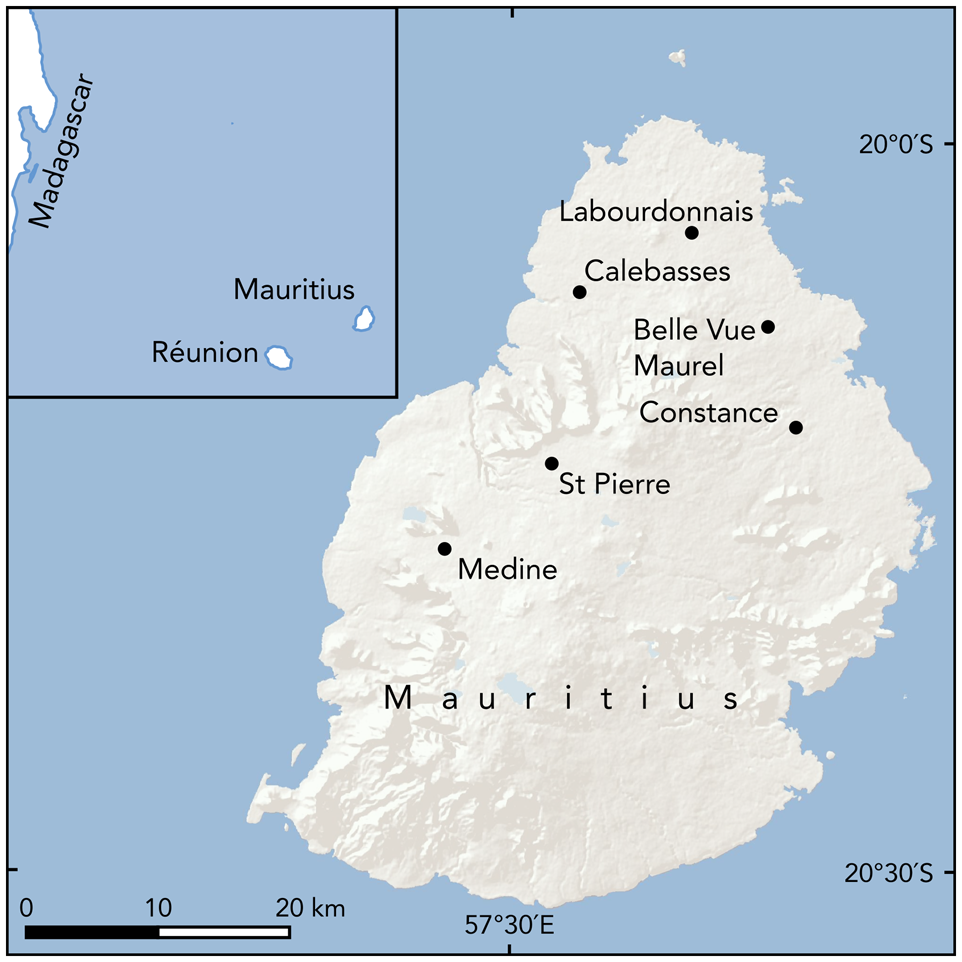
The study was conducted in Mauritius (Fig. 1), an island of 2,011 km2, which has retained < 2% of its high-quality native vegetation cover and has lost 46% of its native vertebrate species (Safford, Reference Safford, Fishpool and Evans2001; Cheke & Hume, Reference Cheke and Hume2008). The remaining native wildlife is strongly associated with native vegetation, which has become invaded by exotic species. At least 47 plant species are highly invasive and cause degradation of native habitat. Additionally, numerous exotic animal species cause destruction to native plants and their fruits or seeds, and also spread invasive plant species (Safford, Reference Safford, Fishpool and Evans2001; Cheke & Hume, Reference Cheke and Hume2008). The work was conducted during October 2015–February 2016 in four lychee orchards (Fig. 1), Calebasses, Medine (only large, > 6 m, trees present), Constance, and Belle Vue Maurel (only small, < 6 m, trees present), and at one mango orchard in Labourdonnais. Individual longan trees were assessed in St. Pierre village (Moka region), as there are no longer orchards of this fruit tree in Mauritius.
Locations of the six orchards in Mauritius where the effects of the Mauritian flying fox Pteropus niger on fruit crops were investigated.
Methods
Fruit assessment
Each orchard in Mauritius typically has trees of various sizes, 1–10 m in height. We categorized trees as large (> 6 m high) or small (< 6 m high). Ten small and 10 large lychee trees were chosen randomly and the number of fruits on each tree was assessed by counting the total number of panicles on the tree, using a tally counter, and taking the mean number of fruits per panicle from 20 randomly selected panicles. The total number of panicles was then multiplied by the mean number of fruits per panicle. The same method was applied to longan trees, and mango fruits (given their larger size) were counted individually.
Randomly marked lychee trees were visited daily and the number of fruits on the ground under the trees was assessed and counted. Based on the damage done to the fruits, they were categorized as bat damaged when bat canine marks (triangular shaped puncture wounds) or tooth scrape marks were visible on the fruit or seed; bird damaged when the seed was smooth or the fruit had peck holes in the outer covering, with no visible canine punctures; fungus infected when fruits had breaks in the skin and showed discoloration; rat damaged when marks of incisors were visible on the fruits or seed; and natural fall when intact, undamaged fruits were found on the ground.
It was not possible to make detailed counts of fallen fruits from longan trees because of accessibility problems and their location near roads. Therefore, the number of empty panicles was counted three times per week and damage was attributed to bats and birds combined.
Netting
In Calebasses lychee orchard three large trees were netted using an anti-bird net (nylon netting with a mesh of 3 × 3 cm) placed over a frame made of PVC pipes of 50 mm diameter. The pipes were manipulated over the tree to lift the net above the tree canopy. Three other trees were netted by placing the anti-bird net directly over the tree canopy without frame support. The damage to the netted trees was assessed in the same way as for unnetted trees. Medine lychee orchard had trees already netted, with anti-bird netting placed directly over the tree canopy, with no frame support, so the nets were in direct contact with the trees.
Statistical analyses
Statistical analyses were conducted using R v. 3.4.1 (R Development Core Team, 2017). We used generalized linear mixed models (function glmer in the lme4 package; Bates et al., Reference Bates, Mächler, Bolker and Walker2015) to test whether the number of fruits damaged at two lychee orchards (Calebasses and Constance) where both small (< 6 m high) and large (> 6 m high) trees occurred (and hence bats had a choice of foraging at large and small trees) differed between the two tree size categories. As only one small tree in the mango orchard was damaged by bats, confidence intervals were large and it was not possible to run a generalized linear mixed model to investigate whether damage varied according to tree size or fruit consumer. Given the nature of the response variable (count data), and to handle overdispersion, we fitted the models with negative binomial distributions. We included the two-way interaction between tree size (large vs small) and causes of fruit loss (bat, bird, rat, fungus, natural fall) as fixed effects in the models, and considered the tree ID nested within the orchard ID as random effects. We used DHARMa (Hartig, Reference Hartig2017) to build diagnostic plots and to validate the model fit. We then identified the most parsimonious model amongst a set of five models that included all possible variable combinations as well as the null model, using the second-order Akaike information criterion (AICc; Burnham & Anderson, Reference Burnham and Anderson2002). As our best model was the most complex (interaction between the two predictors; Supplementary Table 1), we conducted post-hoc contrast tests for the pairwise comparisons of interest, adjusting P values for multiple comparisons using the Tukey method (with package lsmeans; Lenth, Reference Lenth2016).
Bats caused more damage to large than small lychee trees, and therefore we evaluated the effectiveness of using nets on large trees in reducing fruit loss. We conducted separate analyses using generalized linear mixed models with negative binomial distributions for each orchard where the experiment took place (Calebasses and Medine), as different netting treatments were applied. The two-way interaction between netting system (unnetted vs netted without frame vs netted with frame for Calebasses, and unnetted vs netted without frame only for Medine) and causes of fruit loss (bat, bird, rat, fungus, natural fall) were treated as fixed effects, and tree ID was incorporated in the models as a random effect. We applied the same procedure for model validation and selection as described previously (Supplementary Table 1).
Results
The numbers of trees damaged in each orchard are detailed in Supplementary Table 2 according to fruit type, tree size and fruit consumer at unnetted trees. Lychee trees > 6 m high produced 2,000–5,000 fruits on average, and trees < 6 m high produced 1,500–4,000 fruits. Bell Vue Maurel was an exception, with trees < 6 m high producing only 400–900 fruits. There was substantial variation in fruit production among mango trees. Large trees (> 6 m high) produced 200–6,000 fruits, whereas small trees (< 6 m high) produced 200–700 fruits. Longan trees (n = 10) produced a mean of 3,239 ± SD 2,199 fruits. Overall levels of fruit loss to all causes were substantial (7–76%), with three sites having > 50% fruit damage (Supplementary Table 2).
Bat damage
At unnetted lychee trees at Calebasses bats damaged 9.4% of monitored fruit on large trees and 0.1% on small trees. At Constance bats damaged 15% of fruits on large trees and 5.3% on small trees. At Medine bats damaged 52.8% of fruit on large trees (no small trees were present). Bats damaged 6.7% of fruits on the small trees at Belle Vue Maurel (no large trees present). At mango trees bats damaged 31.3% of fruits on large trees and 0.4% of fruits on small trees. Bat damage was therefore more severe at large trees compared with smaller ones for both lychees and mangos (although statistical analysis was not possible for the latter). This height-dependent effect was significant for bat damage at lychee orchards, but damage by all other agents was not related to tree height (Fig. 2; Supplementary Table 4).
Predicted means and associated 95% confidence intervals of number of fruits damaged by bats and birds at large (> 6 m high; n = 20) and small (< 6 m high; n = 20) trees in two lychee Litchi chinensis orchards (Calebasses and Constance; Fig. 1). Model predictions arise from the most parsimonious generalized linear mixed model that included the interaction between the cause of damage (bat, bird, fungus, natural fall, rat) and tree size (large, small). P values adjusted for multiple comparisons are given for the pairwise comparisons of interest. The full description of these comparisons is in Supplementary Table 4.

Bird damage
Birds damaged 3.2% of fruit on large lychee trees at Calebasses, and 1.5% on small trees. The equivalent values at Constance were 6.7 and 12.2%, respectively. For the large lychee trees at Medine, 8.3% of fruits were damaged by birds. For the small lychee trees at Belle Vue Maurel, 6.5% of fruits sustained bird damage. When large and small lychee trees were present, bird damage was significantly lower than bat damage at large trees, although birds caused more damage than bats at smaller trees (Fig. 2; Supplementary Table 4).
At mango trees birds damaged 13.2 and 50.5% of fruits on large and small trees, respectively. Damage by birds at small mango trees was therefore substantial and considerably higher than that caused by bats. For longan trees, 32.8% of fruits were damaged by either birds and/or bats.
Other damage and natural fall
Damage by rats was negligible (< 1% of all fruits). Loss by fungal infection was generally small, although it reached 4–5% on lychee trees at Constance. Fruit loss by natural fall was typically < 10% for lychee trees, although it accounted for 26.3% of total fruits produced by the large mango trees and 50.5% at the small mango trees studied.
Effects of netting
The effects of netting were assessed at two lychee orchards, Calebasses and Medine (Supplementary Table 3). At Calebasses bats damaged only 0.4% of fruits at large trees netted over a frame (n = 3), whereas birds damaged 3.6% of fruits, compared with 9.4% bat damage and 3.2% bird damage at unnetted control sites. The total loss of fruits was 7.7% for trees netted with frames, compared with 21.4% at unprotected trees. At the trees netted with no frame (n = 3) bats accounted for 0.6% of damage to fruits, and birds for 3.6%. The total loss was 12.4% on netted trees with no frame, compared with 21.4% on unprotected trees. Model predictions (Fig. 3; Supplementary Table 5) indicated that netting both with and without frames at Calebasses significantly reduced fruit damage by bats but had no effect on bird damage. There was no significant difference in damage by bats according to whether the nets were on frames or not.
Predicted means and associated 95% confidence intervals of number of fruits damaged by bats and birds at large trees in one lychee orchard (Calebasses; Fig. 1) in relation to the netting system implemented: unnetted (n = 10), netted without frame (n = 3), netted with frame (n = 3). Model predictions arise from the most parsimonious generalized linear mixed model that included the interaction between the cause of damage (bat, bird, fungus, natural fall, rat) and the netting system. P values adjusted for multiple comparisons are given for the pairwise comparisons of interest. The full description of these comparisons is in Supplementary Table 5.

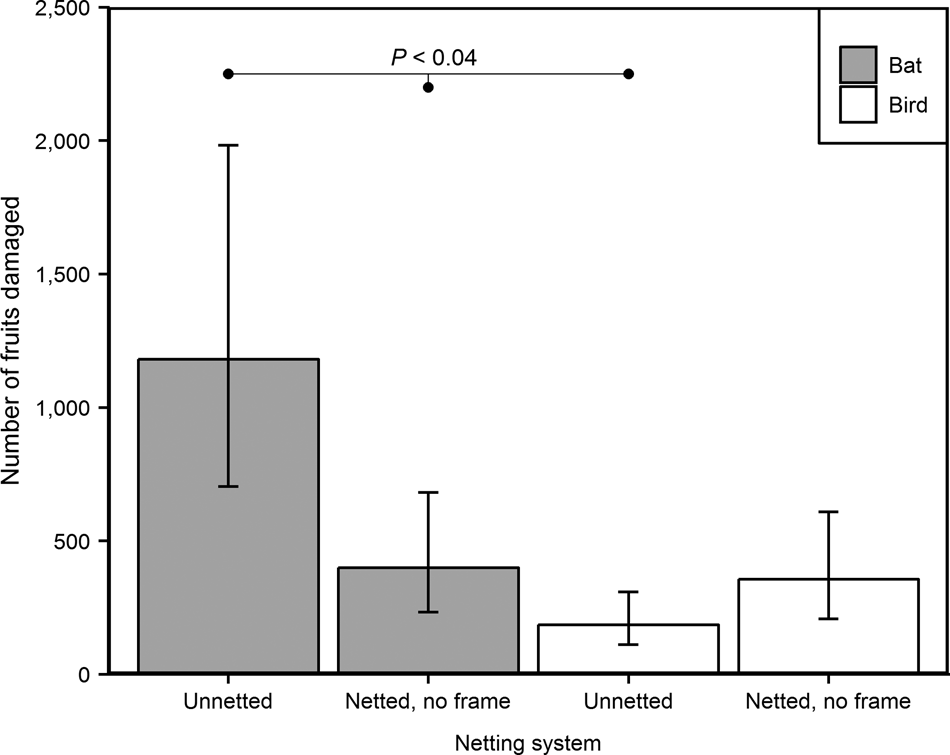
At trees netted without frames at Medine the damage caused by bats decreased to 12.5%, compared with 52.8% at unnetted trees (Supplementary Table 3). Birds accounted for 11.5% of damage at netted trees without frames, compared with 8.3% at unnetted trees at Medine. Netting trees without frames had no significant effect on bird damage but had a large and significant effect on reducing bat damage (Fig. 4; Supplementary Table 6). The total damage to fruits at Medine was 35.0% on trees netted without a frame, compared with 69.6% on unnetted trees.
Predicted means and associated 95% confidence intervals of number of fruits damaged by bats and birds at large trees in one lychee orchard (Medine; Fig. 1) in relation to the netting system implemented: unnetted (n = 10), netted without frame (n = 10). Model predictions arise from the most parsimonious generalized linear mixed model that included the interaction between the cause of damage (bat, bird, fungus, natural fall, rat) and the netting system. P values adjusted for multiple comparisons are given for the pairwise comparisons of interest. The full description of these comparisons is in Supplementary Table 6.
Discussion
The damage caused by bats and other animals varies from orchard to orchard. However, small trees (< 6 m) were less prone to damage by bats compared to large trees (> 6 m). Across the four lychee orchards studied, bats damaged 25.5% of fruits overall and 1.7% of fruits at small trees, on average, whereas birds damaged 5.8% of fruits overall and 4.5% of fruits at small trees. Bat damage was measured at the trees that we monitored, but bats can potentially carry fruit away to consume it elsewhere. However, from our observations we believe that in general the bats ate fruit at the trees from which they took it, and therefore we believe that our estimates of damage are realistic.
Pruning trees could minimize the impact bats have on fruit crops. However, in places such as Medine and Constance the damage caused by bats was pronounced and even small trees in those orchards suffer substantial fruit losses. Flying foxes often prefer to eat fruits that are too ripe to be sold (Singaravelan et al., Reference Singaravelan, Marimuthu and Racey2009), and therefore harvesting the fruit at an earlier stage could also reduce the attractiveness of orchards to bats and other frugivores (Aziz et al., Reference Aziz, Olival, Bumrungsri, Richards, Racey, Voigt and Kingston2016). Up to 10% of lychee loss in this study was as a result of natural falling of fruit. This loss was even higher at the mango orchard, exceeding 50% of total fruit at large trees. These losses could potentially be reduced by earlier harvesting.
Birds such as the invasive exotic red-whiskered bulbul Pycnonotus jocosus and common myna Acridotheres tristis, and to a lesser extent the ring-necked parakeet Psittacula krameri cause considerably more damage than bats to smaller trees across all the orchards (mango and lychee). Other animals, including rats, were found to have little to no impact on the fruits. This could be because rats may feed on fruits that are already on the ground. Fungal infection of lychee fruits is common in Mauritius. However, in all of the orchards assessed, fungicide was sprayed on the trees to protect the fruits against such infection, and loss to fungal infection was minimal.
Netting was successful in reducing the damage caused by bats 16–23-fold in Calebasses and more than 12-fold in Medine, compared with unnetted trees. It is therefore imperative to net trees, preferably using frames so that the net is held above the tree canopy. If nets are placed directly on the trees and in contact with fruits, bats can land on and feed through the net. Additionally, black nets placed directly over the trees are less visible to the bats and as a result bats occasionally becoming entangled in them. To avoid entangling of bats and fruit damage through the net, it is advised to make the net as conspicuous as possible against the tree. Use of white rather than black nets is recommended.
Bird damage on netted trees increased compared with unnetted trees, possibly because birds may become trapped after entering the canopy through gaps in the net. They cause more damage to the fruits in such cases because they continue feeding on them. To avoid gaps, wider nets (≥ 30 m) than those commonly available in Mauritius (which come in rolls 12 × 100 m) are desirable so that the whole tree can be covered without the need to join nets together, as is the typical practice in Thailand (Aziz et al., Reference Aziz, Olival, Bumrungsri, Richards, Racey, Voigt and Kingston2016). Alternatively, birds may fly under the nets if they are not secured around the base. The ideal is to have fruit trees entirely caged to exclude bats and birds.
In 2017 the Mauritian Government subsidized 75% of the cost of five nets (12 × 10 m) per backyard grower, and 50% of netting costs for orchards < 0.81 ha in area (Republic of Mauritius, 2017). Nets typically cost MUR 3,000–3,500 (c. USD 90–100), and are reusable across years if they are stored appropriately. Small-scale fruit growers can potentially recoup the investment in nets, and potentially even the full cost of the nets within the first year of use. The success of the scheme is demonstrable and it has been renewed annually since 2009. However, major orchards in Mauritius may have > 1,000 fruiting trees, and therefore the subsidy only meets the needs of small-scale growers. In Australia, where orchards can be as large as 90 ha (Aziz et al., Reference Aziz, Olival, Bumrungsri, Richards, Racey, Voigt and Kingston2016), full exclusion netting is used, which gives 100% protection against bats, birds and abiotic factors. The netting has a mesh size of c. 48 mm, is erected well above the height of the trees and is attached to the ground on the sides. A similar approach is used in Israel on mango, lychee and banana plantations. In many cases the initial reason for using exclusion netting was to reduce water evaporation, as irrigation in Israel is expensive; however, netting ultimately protects the crops against fruit bats and birds. Additionally, the trees are kept low and trimmed regularly, which makes netting easier (authors, pers. obs.). In some orchards in Mauritius, trees are pruned low because it makes them easier to harvest, a practice that should be applied to all mango and lychee trees. Plastic sheets are also used to protect longan orchards in Thailand, and may also accelerate fruit ripening (Aziz et al., Reference Aziz, Olival, Bumrungsri, Richards, Racey, Voigt and Kingston2016). It is likely that large-scale fruit growers in Mauritius may benefit from using netting in orchards even though they do not receive government subsidies, given the substantial reductions in fruit damage resulting from netting, and the relatively low cost of nets.
Currently, apart from netting, growers in Mauritius use a range of other methods, including burning leaves or tyres to create dense smoke, which the bats avoid; installing light bulbs on every tree to illuminate the area and make it less attractive to the bats; and using plastic flags placed above the tree canopy, firecrackers and shotguns to frighten the bats, and in the latter case sometimes to kill them. Additionally, a dead bat may be attached to a bamboo pole and placed over the tree canopy to deter other bats. None of these methods is known to be particularly effective in reducing the impact of bats on fruit, but fruit growers prefer them to netting because they are less time- and labour-intensive. Netting is not well accepted by farmers in Mauritius, and it is impractical to net tall trees (> 6 m high), which are common in backyards.
In Madagascar, Plantskydd deer repellent (Tree World Plant Care Products, Inc., Sechelt, Canada) was tested on lychee trees as a non-lethal taste deterrent against fruit bats (Raharimihaja et al., Reference Raharimihaja, Rakotoarison, Racey and Andrianaivoarivelo2016). The use of this deterrent was compared to waving of red flags and ringing bells. Plantskydd proved to be successful in mitigating bat damage to lychees. However, its composition of dried blood makes its use inappropriate in Mauritius because of religious beliefs and veterinary health restrictions on its import. However, alternative repellents that are not blood-based could be tested. Methods using decoy crops, light or sound, and advancing fruit harvest time may have potential for reducing fruit loss to bats (Aziz et al., Reference Aziz, Olival, Bumrungsri, Richards, Racey, Voigt and Kingston2016).
This work has shown the extent of fruit loss in Mauritian orchards as a result of bird and bat predation and other factors, and is a first step in documenting damage and suggesting solutions. It is important to monitor the orchards for more seasons, to establish the pattern of fruit loss over time. In years when natural food is scarce, bats may be forced to feed more extensively on commercial fruits, whereas during times when native fruits are available the damage may be less pronounced.
In conclusion, we are optimistic that netting fruit trees would reduce the loss of commercial fruit to birds and bats considerably if installed appropriately. The Mauritian Wildlife Foundation continues to promote the benefits of netting to the Government of Mauritius, which reviews and changes its Fruit Protection Scheme regularly, and a strong evidence base exists showing the causes of fruit loss at orchards, and how netting can reduce these losses substantially. Culling bats is unnecessary, and unwarranted given that P. niger is endemic and vulnerable to mass mortality during cyclones, and provides important ecosystem services, including seed dispersal for native plants.
Acknowledgements
The study was conducted in collaboration with the National Park and Conservation Service and the Food and Agricultural Research and Extension Institute in Mauritius. Academic direction and support were provided via the Universities of Bristol and Exeter (UK). The main sponsors of the study were The Rufford Foundation, and the IUCN through a Save Our Species Rapid Action Grant. JSPF was funded by a BBSRC SWBio DTP studentship. We thank all the people of Mauritius who were involved in the study and the data collection, and the fruit growers who allowed us to conduct the study in their orchards. Two anonymous referees provided helpful input.
Author contributions
Data collection and analysis: RZO; data collection: CLA; logistical support: VT, CJ; statistical analyses: JSPF; research conception and design, interpretation of the data, academic support and guidance, writing and revision: PAR, GJ; revision and approval of article: all authors.
Conflicts of interest
None.
Ethical standards
Our research complies with the Oryx Code of Conduct. The research was conducted under a permit granted by Ministry of Agro-Industry and Food Security in Mauritius (Permit No. 301791; Ref. 2013/M59/I341).


 Open access

