





Non-technical Summary
Blastoids were a very successful group of Paleozoic echinoderms. Their success was based in part on a unique respiratory structure, the hydrospire. Interpretation of the morphology of the hydrospires has been to divide the blastoids into two fundamental taxonomic groups. We present data that the entrances to blastoid hydrospires have three fundamentally different morphologies, not two, and propose a new taxonomic scheme based on this tripartite difference, suggesting that new phylogenetic analyses will be needed.
Introduction
Echinoderms are in the minority of extant phyla in that their greatest diversity (at the class level) occurred early in their evolutionary history (Rahman and Zamora, Reference Rahman and Zamora2024). Extant echinoderms are divided into two clades, the eleutherozoans (holothurians, echinoids, asteroids, and ophiuroids), which do not have a stalk at any stage in development, and the pelmatozoans (crinoids), which do have a stalk at some point in development. The blastoids are one of the most successful clades of Paleozoic pelmatozoan echinoderms and represent one of the major branches of Paleozoic diversity.
Blastoids are the longest-lived and most diverse members of the echinoderm subclass Blastozoa. Blastoids range from the Silurian to Permian and have been reported from every continent except Antarctica. They are often minor, but sometimes major, components of Paleozoic echinoderm communities.
Among the blastozoans, the glyptocystoids, hemicosmitoids, blastoids, coronoids, and Lysocystites Miller, Reference Miller1889 have respiratory structures that differ markedly in construction. Sheffield et al. (Reference Sheffield, Limbeck, Bauer, Hill, Nohejlová and Sumrall2022) presented a thorough review of the myriad of respiratory structures found in the blastozoans. Sumrall and Waters (Reference Sumrall and Waters2012) delineated these respiratory structures into two functional groups. Endothecal respiratory structures were characterized by external pores connecting internal thin stereom folds through which water circulates. These include pectinirhombs, cryptorhombs, cataspires, and hydrospires. Exothecal respiratory structures were characterized as having internal pores connecting canals within the thecal plates. Coelomic fluids circulated through the plates. These structures include epispires, diplopores, and coronal canals, and were delineated in works by Paul (Reference Paul1968, Reference Paul1972, Reference Paul2021).
Blastoids were set apart from other blastozoan clades by Sumrall and Waters (Reference Sumrall and Waters2012) by the presence of hydrospires. They characterized the blastoids as having incurrent pores along the edge of the ambulacra that connect to hydrospire canals that exit through slits or spiracles near the thecal summit. This characterization is only partially correct because blastoids have additional configurations for getting water into the hydrospires, as will be discussed herein.
Blastoids survived almost twice as long as the Rhombifera and the Diploporita, the next longest-lived groups of blastozoans (Paul, Reference Paul2021). Blastozoan groups vary in morphologies related to feeding and respiration. Hydrospires were likely the morphological feature most important in the longevity of blastoids compared to other blastozoans (Paul, Reference Paul2021).
In this paper, we redefine the key characters for blastoid classification by concentrating on the fundamental construction of the hydrospire system to reorganize blastoids into three fundamental taxonomic groups (superorders)—two newly defined and one elevated to superorder from ordinal status. This revised blastoid classification yields significant insight into the evolution of blastoids in the context of changing Paleozoic climates, extinction events, and Paleozoic echinoderm community faunal dynamics.
Hydrospire morphology
The basic structure of the hydrospire was conservative during the existence of the blastoids (Silurian–Permian). Hydrospires are lightly calcified structures beneath the deltoid and radial plates typically formed adjacent to the ambulacra. They can occur singly or in groups and can be reduced in number or absent in the anal interray (Breimer and Macurda, Reference Breimer and Macurda1972). Hydrospires have two closely spaced walls forming the hydrospire fold with a bulbous termination called the hydrospire tube (Beaver et al., Reference Beaver, Fay, Macurda, Moore, Wanner and Moore1968) or hydrospire bulb (Schmidtling and Marshall, Reference Schmidtling and Marshall2010).
The internal structures of hydrospires are revealed by thin sections of a theca, polishing the internal surface of the blastoid or making acetate peels of successive polished surfaces. Breimer and Macurda (Reference Breimer and Macurda1972) made significant use of acetate peels to characterize the internal morphology of fissiculate blastoids (those with exposed hydrospire slits). Complimentary internal studies were made of blastoids in which the entrance to the hydrospires was by a series of pores along the ambulacral margins, e.g., Beaver (Reference Beaver1961), Beaver et al. (Reference Beaver, Fay, Macurda, Moore, Wanner and Moore1968), Breimer and Joysey (Reference Breimer and Joysey1968), Breimer and Dop (Reference Breimer and Dop1975), Macurda and Breimer (Reference Macurda and Breimer1977), and Breimer (Reference Breimer1988a, Reference Breimerb). More modern techniques of nondestructive internal imaging, e.g., via synchrotron imaging, are not particularly useful for examining details of hydrospire morphology because the internal cavities of blastoids are often filled with calcite spar deposited in optical continuity with thecal plates.
Each individual hydrospire fold consists of two parallel hydrospire walls with a space between them, the hydrospire cleft. The bottom of each hydrospire has a bulbous hydrospire tube. The width of the hydrospire cleft appears to be nearly constant in all blastoids. Beaver (Reference Beaver1996) reported a meshwork fabric with a grid-like structure in the hydrospires of Pentremites Say, Reference Say1825. His figure 1.3 shows his interpretation of the calcite mesh, which is only present in the hydrospire walls. The mesh would provide a surface for osmotic exchange of oxygen from seawater and carbon dioxide from the internal coelomic fluids (Paul, Reference Paul2021). The functionality of hydrospires was enabled by the nervous system, which Breimer and Macurda (Reference Breimer and Macurda1972) showed was very extensive.
Each plate of a blastoid theca consists of a three-dimensional meshwork of high magnesian calcite trabeculae (rods). Growth of the thecal plates was holoperipheral and growth lines are well preserved in principal exterior plates (Macurda, Reference Macurda1966, Reference Macurda and Moore1968). All hydrospires grew ontogenetically by the addition of calcite along the internal part of the radiodeltoid suture, with calcite being added on the edges of the plates. The rate of addition on the radial is usually greater than on the deltoid. Hydrospires are largest along the radiodeltoid suture. As the blastoid grew, the internal volume of the hydrospires increased, keeping pace with expanded requirements for increased respiration, as documented by Beaver (Reference Beaver1961) and Macurda (Reference Macurda1965a) in Globoblastus Hambach, Reference Hambach1903.
Hydrospires in fissiculates
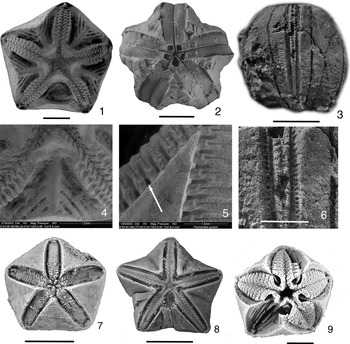
Breimer and Macurda (Reference Breimer and Macurda1972) and Macurda (Reference Macurda1983) provided monographic coverage of the fissiculate blastoids and insight into the growth and function of key biological systems using serial acetate peels and detailed observations of internal and external morphology. Breimer and Macurda (Reference Breimer and Macurda1972) documented the configuration of many of the hydrospires found in fissiculate genera. In fissiculates, individual hydrospire slits provide entrance to the hydrospires (Fig. 1). Each hydrospire is a separate circulatory cell and is open externally to the surrounding seawater. The fissiculates experimented with a variety of exposed hydrospire configurations. The presence of open hydrospire slits in fissiculates with no clear overall circulatory pathway, as in the spiraculate configuration, suggests that inefficient gas exchange across each hydrospire fold led to a proliferation of the number of hydrospires to provide an overall effective surface area to allow gas exchange to ventilate the coelom. A blastoid with exposed hydrospire slits constantly added new slits abmedial to the ambulacrum across the radiodeltoid suture. Some fissiculate genera, e.g., Hadroblastus Fay, Reference Fay1962a (Mississippian) and Austroblastus McKellar, Reference McKellar1969 (Permian), reached extreme numbers of hydrospires (Fig. 2), the former having more than 350 hydrospire slits per individual.
Blastoids with hydrospire slits, hydrospire pores, and hydrospire tubules: (1, 4) Heteroschisma alternatum (Lyon, Reference Lyon1857), USNM 54567, a fissiculate with exposed hydrospire slits; (2, 5) Pentremites robustus Lyon, Reference Lyon1860, USNM 380840, a spiraculate with hydrospire pores (arrow) and spiracles, now assigned to the Stomatoblastida; (3, 6) Ellipticoblastus ellipticus Sowerby, Reference Sowerby1825, NHMUK E8073, a spiraculate with hydrospire tubules (arrow) and spiracles, now assigned to the Tubuloblastida; (7) Troosticrinus renwardii Shumard, Reference Shumard1866, UTK M107336, a Silurian blastoid with spiracular clefts and indications of coronal canals; (8) Conuloblastus malladae (Etheridge & Carpenter, Reference Etheridge and Carpenter1883), RGM 353035, a Lower Devonian genus with morphologies intermediate between fissiculates and spiraculates; (9) Pentremoblastus conicus Fay and Koenig, Reference Fay and Koenig1963, UM 15180, a Lower Mississippian genus with morphologies intermediate between fissiculates and spiraculates. Scale bars = 2 mm (6, 9); 5 mm (2, 3, 7, 8).

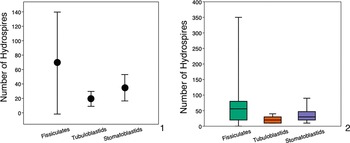
Number of hydrospires in fissiculates, tubuloblastids, and stomatoblastids. (1) Plot of means and standard deviations. A one-way ANOVA (PAST5) indicates that the difference between the means is significant at p < 0.001. The Tukey HSD test (PAST5) indicates that the mean number of hydrospires for fissiculates is significantly different (p < 0.001) from the mean number of hydrospires in the stomatoblastids and tubuloblastids, The mean number of hydrospires in the stomatoblastids is not significantly different from the mean number of hydrospires in the tubuloblastids. (2) Box and whisker plot of hydrospire number. Mean is horizontal line; Box is one standard deviation; whisker is 95% of hydrospire number.

Blastoids with hydrospire slits sometimes fill in the oldest portions of the slits as in the nymphaeoblastids. Hydrospire slits can become less efficient as they grow. Computer simulations suggest that 50% of available oxygen was exchanged in 1–2 mm and likely a length exists at which most of the available oxygen in the seawater filling the hydrospires has been exchanged (Paul, Reference Paul2021). Lengthening the slits beyond this point will not increase the amount of exchange. Filling in the oldest parts of the slits could keep the hydrospires within the length at which they are still efficient.
Development of spiracles
Fay and Wanner (Reference Fay, Wanner and Moore1968) defined spiraculates as blastoids with a theca having hydrospire slits that open into hydrospire canals, with definite spiracles and hydrospire pores. Water enters the hydrospire via hydrospire pores, which are located between the side plates and outer side plates and its bordering radial and/or deltoid. New pores are formed at the aboral end of the ambulacrum, where new side plates are added as the ontogeny of the blastoid proceeds.
Some fissiculate lineages developed spiracles and hydrospire pores by infilling the ambulacral sinus concealing hydrospire slits, and internalizing the hydrospires. Waters and Horowitz (Reference Waters and Horowitz1993) concluded that the spiraculate condition was polyphyletic and that spiraculate blastoids were an evolutionary grade rather than a clade. They concluded that fissiculate blastoids evolved into spiraculates in at least five separate lineages during the Silurian and Devonian. Four origins were given ordinal status based on thecal shapes, spiracular, deltoidal, and ambulacral morphologies: the Troosticrinida, the Nucleocrinida, the Granatocrinida, and the Pentremitida. A fifth order was recognized but remained unnamed pending taxonomic revision of the taxa involved.
The transition from fissiculate to spiraculate involved a complete change in the way respiration occurred. In fissiculates, seawater flowed outside the theca parallel to the oral-aboral axis through the hydrospire slits, In spiraculates, seawater flowed into the blastoid theca through pores into the hydrospire folds, respiratory gas exchange occurred perpendicular to the oral-aboral axis with seawater expelled out the spiracles.
Hydrospires in spiraculates laid under the edges of the ambulacra and were almost always fixed in number. By roofing over the external entrances to the thin slits of the hydrospires and providing an entrance via hydrospire pores, much greater respiratory efficiency was obtained. New pores were added at the aboral end of the ambulacrum between the side and outer side plates. Fluid was expelled via spiracles at the adoral summit of the blastoid. This new growth pattern provided a foundation for blastoid diversification in the Devonian and Mississippian. Some of the blastoids with hydrospire pores sealed pores along the deltoids, further separating input from output.
Breimer (Reference Breimer1988a) studied the internal anatomy of the Silurian spiraculate blastoid Troosticrinus Shumard, Reference Shumard1866 (Fig. 1.7) in a series of closely spaced peels. He commented that no lateral contacts of side plates and outer side plates with the deltoids were observed, so no hydrospire pores were formed there. Side plates did contact the radial laterally, so hydrospire pores were observed along the radial as simple gaps between side plates and outer side plates. As a consequence, spiracular slits or clefts were present along the deltoids. Adorally the clefts joined one another over the deltoid crest of regular deltoids, forming four groups of V-shaped spiracular clefts. Spiracle formation was incomplete because spiracle openings were absent.
Breimer (Reference Breimer1988a) observed a similar configuration in the Mississippian Metablastus lineatus Owen and Shumard, Reference Owen, Shumard and Owen1852 in several peels of spiracular slits along the deltoids and lack of hydrospire pores along the deltoids, V-shaped spiracular slits adorally, and the lack of true spiracles. He cited a similar configuration in the Devonian Schizotremites kopfi Reimann, Reference Reimann1945. We view Troosticrinus as an early evolutionary intermediate between the spiraculate and the fissiculate conditions that might retain coronal canals found in coronates (Sumrall and Waters Reference Sumrall and Waters2012).
Bohatý et al. (Reference Bohatý, Macurda and Waters2024) has shown another example of the transition from exposed hydrospire slits to hydrospire pores and spiracles in the transition from Pentremitidea d’Orbigny, Reference Orbigny1851 to Conuloblastus Breimer and Dop, Reference Breimer and Dop1975 (Fig. 1.8) to Hyperoblastus Fay, Reference Fay1961a and a mosaic of spiraculate genera including Hreggoblastus Bohatý, Macurda, and Waters, Reference Bohatý, Macurda and Waters2024; Altusoblastus Bohatý, Macurda, and Waters, Reference Bohatý, Macurda and Waters2024; Absensoblastus Bohatý, Macurda, and Waters, Reference Bohatý, Macurda and Waters2024; and Pentahedronoblastus Bohatý, Macurda, and Waters, Reference Bohatý, Macurda and Waters2024. The transition from Pentremitidea to Hyperoblastus was first hypothesized by Breimer and Dop (Reference Breimer and Dop1975) using a growth series of Hyperoblastus filosa (Whiteaves, Reference Whiteaves1889). Breimer in Breimer and Dop (Reference Breimer and Dop1975) found that the smallest specimens did not have complete closure of the exposure of the hydrospire slits at the aboral ends of the ambulacrum, with the hydrospire slits still being exposed. Closure occurred ontogenetically. Bohatý et al. (Reference Bohatý, Macurda and Waters2024) traced the transition of Conuloblastus, which Breimer and Dop (Reference Breimer and Dop1975) showed was neither completely fissiculate nor pore-bearing but a mixture of the two, into a high-pelved Devonian pore-bearing blastoid, Altusoblastus, by closure of the hydrospire slits by the ambulacra. This blastoid evolved into a low-pelved genus, Hyperoblastus, which has longer ambulacra and much more numerous pores. Growth in high-pelved blastoids added one new set of side plates and thus a hydrospire pore each second growth increment. In Hyperoblastus, one new side plate, an outer side plate, and a hydrospire pore were added in each growth interval.
Pentremoblastus Fay and Koenig, Reference Fay and Koenig1963 was originally described with the type species, Pentremoblastus conicus Fay and Koenig, Reference Fay and Koenig1963 (Fig. 1.9). Breimer and Macurda (Reference Breimer and Macurda1972) questioned the assignment of the type species to the spiraculates and suggested it could be a phaenoschismatid in transition to a pentremitid, although they did not change the generic assignment. Macurda (Reference Macurda1983) assigned the type species and thus the genus to the phaenoschismatids. A second species, Pentremoblastus subovalis Fay and Koenig, Reference Fay and Koenig1963, was briefly mentioned by Breimer and Macurda (Reference Breimer and Macurda1972, p. 216). Macurda (Reference Macurda1983, p. 65) stated that Pentremoblastus subovalis was apparently one of the earliest pentremitid blastoids and had functional hydrospire pores. In their discussion of the ordinal-level evolution of the Blastoidea, Waters and Horowitz (Reference Waters and Horowitz1993) listed Pentremoblastus subovalis as belonging to an unnamed genus, family, and order. In a work in progress, we plan to place Pentremoblastus subovalis in a new genus. Pentremoblastus subovalis is closely related to Pentremites and Strongyloblastus Fay, Reference Fay1962b.
Our understanding of the spiraculate blastoids has led us to differentiate two groups with major differences in the way that entrances to the hydrospires are formed (Fig. 1). Ambulacral pores are formed between a side plate and outer side plate at the aboral end of the ambulacrum as the blastoid grows. Hydrospire tubules are formed episodically along the radiodeltoid suture as ontogeny proceeds. Hydrospire tubules are constructed very differently from hydrospire pores and have no relationship with the ambulacrum as do the latter. Blastoids with hydrospire tubules were originally described as having a hydrospire plate (Etheridge and Carpenter, Reference Etheridge and Carpenter1886).
Spiraculates with tubules
The third significant change in water flow into the hydrospires occurred in the Late Devonian by the formation of hydrospire tubules. Thus, tubules were a late development in blastoid evolution. No longer were entrances to hydrospires formed at the aboral end of the ambulacra. Tubules pierced the radial and deltoid plate and lie marginal to the ambulacra.
Tubules formed at the radiodeltoid suture where, generally, the hydrospires are largest. Tubules increased the capacity of the respiratory system significantly as soon as they were formed. Pores were formed at the aboral end of the ambulacra where the hydrospires were smallest and initially increased respiratory capacity very little. A fissiculate could increase its respiratory capacity during growth by adding new hydrospire folds. In spiraculates, development of tubules was more efficient than development of pores in increasing respiratory capacity.
The transition from pores to tubules was accompanied by reduction in the number of internal hydrospires on each side of the ambulacrum, suggesting greater respiratory efficiency (Fig. 2). Hydrospire pores are located at the base of the brachioles with the ambulacra; entrance of fluids to the hydrospires was partially restricted by the convolutions of entry at the base of the brachioles. By moving the input area (the tubules) to an area adjacent to the ambulacra, entry was unimpeded to the hydrospire. Exit of fluid was by spiracles bordering or piercing the deltoid joining two hydrospire groups in each interambulacrum. This experiment resulted in an explosion of 15 or 16 genera in the Mississippian. The last representative was one species in the Permian.
The oldest blastoids with hydrospire tubules are Fammenian and are found in Xinjiangoblastus Lane, Waters, and Maples, Reference Lane, Waters and Maples1997; Houiblastus Lane, Waters, and Maples, Reference Lane, Waters and Maples1997; and Doryblastus Fay, Reference Fay1961b. Xinjiangoblastus was an experiment filling a deep ambulacral sinus, with a lanceolate ambulacrum, and exposing the lancet. Doryblastus developed four spiracles and an anispiracle but the spiracle did not pierce the deltoid. Houiblastus had a somewhat globose form in which the basals were conical. Xinjiangoblastus has no obvious descendants. Houiblastus is a possible ancestor to the orbitremitids and Doryblastus is a possible ancestor to some granatocrinids. Blastoids with hydrospire tubules underwent explosive differentiation in the Lower Mississippian (a ciclidian event) and then vanished from the world stage by the end of the Mississippian except for Orbitremites malainus Wanner, Reference Wanner1916 from the Permian of Timor.
Numbers of hydrospires
The number of hydrospires in a blastoid has historically been given as the number per side of the ambulacrum in taxonomic descriptions. However, this characterization masks the disparity in the total number of hydrospires in the theca. The number of hydrospires is known for adult specimens of 54 genera of fissiculates, 15 tubule-bearing genera, and 29 pore-bearing genera (see supplementary material on Morphobank). Fissiculate blastoids have many more hydrospires, on average, than pore-bearing genera, which have more hydrospires than tubule-bearing genera.
Fissiculates have the widest range of hydrospire numbers (Fig. 2). Three genera have no hydrospires (Breimer and Macurda, Reference Breimer and Macurda1972): Kazachstanoblastus Arendt, Breimer, and Macurda, Reference Arendt, Breimer and Macurda1968; Mastoblastus Arendt, Breimer, and Macurda, Reference Arendt, Breimer and Macurda1968; and Ceratoblastus Wanner, Reference Wanner1924, although Ceratoblastus has a structure called a hydrospire sac. The most extreme example of exposed hydrospire slits in fissiculates is found in two specimens of Hadroblastus sp. indet. described by Macurda (Reference Macurda1965b) from the Boone Chert (Mississippian) in Arkansas. An internal mold of Hadroblastus has ~ 30 hydrospire slits per ambulacral side (theca 35 mm high; 33 mm wide). A single enormous radial that is 30 mm in length bears ~ 43 hydrospire slits per ambulacral side (originally estimated at 60 sits per side). The reconstructed individual would have been ~ 60 mm in length, one of the largest blastoids known, with more than 350 hydrospire slits total. The mean number of hydrospires in a fissiculate blastoid is 68, with a standard deviation of 71, demonstrating their incredible variability.
Stomatoblastids (pore-bearing blastoids) have a mean of 35 hydrospires with a standard deviation of 18. Tubuloblastids (tubule-bearing blastoids) have a mean of 19 hydrospires with a standard deviation of 10 (Fig. 2). A one-way ANOVA (PAST5) indicates that the difference between these means is significant at p < 0.001. The Tukey HSD test (PAST5) indicates that the mean number of hydrospires for fissiculates is significantly different (p < 0.001) from the mean number of hydrospires in the stomatoblastids and tubuloblastids, The mean number of hydrospires in stomatoblastids is not significantly different from the mean number of hydrospires in tubuloblastids.
These data suggest that tubuloblastids had more efficient respiratory systems than did the stomatoblastids and the fissiculates. Waters and Horowitz (Reference Waters and Horowitz1993) concluded that fissiculate hydrospires represented the basal character state in blastoids with pores and spiracles being a derived character state. We infer that tubules are a more derived character state than pores. The impact on the number of hydrospires in the theca between spiraculates having pores versus tubules is as significant as the distinction between fissiculates and spiraculates.
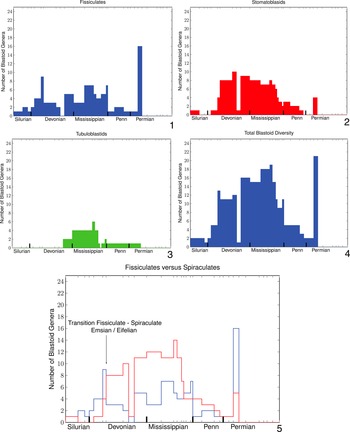
The development of hydrospire pores was a very successful respiratory innovation. Almost 60% of the known blastoid genera have hydrospire pores or tubules for the entry of seawater and spiracles for the expulsion of this seawater. Before the Middle Devonian anoxia and extinction events, including the Kačák Event, most blastoid faunas were dominated by fissiculates, either in terms of diversity or abundance. After these events, blastoid faunas were dominated by spiraculates, either in terms of diversity or abundance until the Permian (Fig. 3). We are unclear why (or if) this fundamental change in respiration benefitted from the ecological and environmental perturbations of these events (Bohatý et al., Reference Bohatý, Macurda and Waters2024).
Diversity of blastoid genera. Tick marks indicate Epoch boundaries (in Ma) for the Silurian-Llandovery, Wenlock, Ludlow, Pridoli, stage boundaries for the Devonian-Lochkovian, Pragian, Emsian, Eifelian, Givetian, Frasnian, Famennian, substage boundaries for the Mississippian part of the Carboniferous-Hastarian, Ivorian, Chadian, Arundian, Holkerian, Asbian, Brigantian, stage boundaries for the Pennsylvanian part of the Carboniferous-Serpukhovian, Bashkirian, Moscovian, Kasimovian, Gzelian, and stage boundaries for the Permian-Asselian, Sakmarian, Artinskian, Kungarian, Roadian, Wordian, Capitanian, Wuchipingian, Changhsingian. (1) Fissiculata. (2) Stomatoblastida. (3) Tubuloblastida. (4) Total blastoid diversity. (5) Total diversity showing transition in diversity dominance between fissiculates and spiraculates (= Stomatoblastida + Tubuloblastida).

Morphology that is basal phylogenetically does not always correspond to morphology that is functionally inferior. Spiraculate respiration is more complicated and evolved from fissiculate respiration more than once (Waters and Horowitz, Reference Waters and Horowitz1993), but fissiculate blastoid genera were among the longest lived, most widely dispersed geographically, and dominated the youngest blastoid fauna from the Permian of Timor and Australia in terms of diversity before the entire class went extinct. One pore-bearing blastoid found in the Permian, Deltoblastus Fay, Reference Fay1961a, occurred by the tens of thousands in southeastern Asia and achieved widespread geographic distribution. Fissiculates might have been more diverse, but Deltoblastus dominated Permian blastoid communities numerically.
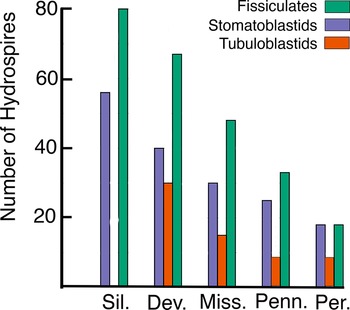
Blastoid hydrospires show another interesting trend. The median number of hydrospires in a genus decreased through time in fissiculates, stomatoblastids, and tubuloblastids (Fig. 4). We are using the median number in this analysis, rather than the mean, because of the large standard deviations in each group. The median number of hydrospires in Silurian fissiculates is 80 and 56 in stomatoblastids. Tubuloblastids do not occur in the Silurian. In the Devonian, the medians are 67, 40, and 30, respectively. In the Mississippian, the medians are 48, 30, and 15. Pennsylvanian fissiculates have a median of 33 hydrospires whereas stomatoblastids have 25. Tubuloblastids did not survive into the Pennsylvanian with the exception of one species, Orbitremites malanius, which is found in the Permian. In the Permian, the medians are 18 for both the fissiculates and stomatoblastids. The observed decrease in the number of hydrospires in the three groups of blastoids appears to coincide with the general trend of increasing atmospheric oxygen from the Silurian to the Permian (Mills et al., Reference Mills, Krause, Jarvis and Cramer2023). However, no statistical test of correlation has been performed, so a quantitative relationship cannot be confirmed.
Median number of hydrospires in fissiculates, tubuloblastids, and stomatoblastids plotted through time. Permian tubuloblastids are represented by a single species, Orbitremites malanius Wanner, Reference Wanner1916, which has 10 hydrospires. Pennsylvanian tubuloblastid numbers are a range through extrapolation between Mississippian and Permian occurrences of Orbitremites. The number of hydrospires decreased through time in all three groups, probably in response to increasing atmospheric oxygen levels.

Materials
Repositories and institutional abbreviations
Specimens examined in this study are deposited in the following institutions: NHMUK, Natural History Museum, London, UK; RGM, Breimer Collection of the Naturalis Biodiversity Center, Leiden, Netherlands; UM, University of Missouri, Columbia, USA; UTK, University of Tennessee, Knoxville, USA; USNM, National Museum of Natural History [U.S. National Museum], Washington, D.C.
Systematic paleontology
Subphylum Blastozoa Sprinkle, Reference Sprinkle1973
Class Blastoidea Say, Reference Say1825, emended Donovan and Paul, Reference Donovan and Paul1985
Subclass Eublastoidea Bather, Reference Bather1899
Superorder Fissiculata new superorder
Diagnosis
Blastoids characterized by open hydrospire slits; new slits are added ontogenetically across the full width of the radiodeltoid suture.
Occurrence
Africa, Asia, Australia, Europe, North and South America. Silurian–Permian.
Remarks
This comprises approximately two-fifths of the known blastoid genera, including genera monographed by Breimer and Macurda (Reference Breimer and Macurda1972) and Macurda (Reference Macurda1983).
Superorder Stomatoblastida new superorder
Diagnosis
Blastoids with hydrospire pores that are formed at the aboral ends of the ambulacra and fluid exits by spiracles at the apex of the blastoid. Number of hydrospires per ambulacrum most always fixed.
Occurrence
Africa, Asia, Australia, Europe, North and South America. Silurian–Permian.
Remarks
The term stomata applies to pores in the leaves of plants, and provides the root name for the superorder. This superorder comprises well over one-half of all known blastoid genera including Pentremites, Hyperoblastus, and Deltoblastus, which were diverse and geographically widespread.
Superorder Tubuloblastida new superorder
Diagnosis
Blastoids characterized by the formation of hydrospire tubules along the radiodeltoid sutures, which pierce the radial (and deltoid) plates. These are marginal to and completely set aside from the ambulacra.
Occurrence
Asia, Europe, North America. Devonian–Permian.
Remarks
The name of the superorder is taken from the word tubules. This superorder is represented by ~ 16 genera including Cryptoblastus Ethridge and Carpenter, 1886; Orbitremites Austin and Austin, Reference Austin and Austin1842; Ellipticoblastus Fay, Reference Fay1960; and Mesoblastus Ethridge and Carpenter, 1886.
Discussion
Our new classification system recognizes the fundamental differences in the respiratory system of blastoids, the hydrospires. Blastoids with open hydrospire slits, hydrospires with hydrospire pores and spiracles, and hydrospires with hydrospire tubules and spiracles have different evolutionary origins and different growth mechanisms. Open hydrospire slits appear to be phylogenetically basal and could be functionally less efficient than hydrospires with pores or tubules and spiracles, but they are found in the oldest and youngest blastoids known. Hydrospires with pores and spiracles have evolved in multiple blastoid lineages. They typically dominate blastoid communities in abundance or diversity after the Emsian/Eifelian boundary in the Lower Devonian. The primary exception is Permian communities, best known from Timor, where blastoids with hydrospire slits dominated in diversity, but blastoids with pores were significantly more abundant. Blastoids with tubules are only known from the Late Devonian and lower Carboniferous with the exception of a single species that survived into the Permian. Although short-lived as a group, individual taxa numerically dominated some faunas. Hydrospire systems with tubules have the lowest number of hydrospires per theca, on average, suggesting that they were somehow more efficient than other systems.
As Schmidtling and Marshall (Reference Schmidtling and Marshall2010) noted, collecting detailed morphological data on hydrospires is difficult and time consuming. They lamented that they were only able to collect data on a single specimen because of the time constraints. The last systematic effort to gather data on the internal morphology of hydrospires was by Albert Breimer and his technicians in the 1960s. Those acetate peels remain the best source of morphological information today. Nondestructive imaging modalities, e.g., synchrotron x-radiation, are currently hampered by a lack of discrimination between hydrospires and the internal thecal infilling and only produce low resolution data.
Acknowledgments
This paper is dedicated to the memory of a colleague and friend, Albert Breimer. By using and studying acetate peels, he revolutionized our understanding of the interiors of blastoids, for both respiration and reproduction. The authors thank the reviewers of this manuscript and journal editors for their insightful comments which greatly improved the manuscript.
Competing interests
The authors declare none.
Data availability statement
Supplementary material available on MorphoBank at https://www.morphobank.org/permalink/P6112

 Open access

