





The Production Effect is a phenomenon where items that are produced (e.g., read aloud) during learning or memorization are better remembered than under other conditions (e.g., read silently) (MacLeod et al., Reference MacLeod, Gopie, Hourihan, Neary and Ozubko2010). The advantage for produced items seen in the Production Effect has been explained by distinctiveness. Produced items are encoded with additional information, thereby creating a distinctive representation that is subsequently more easily retrieved and remembered (MacLeod et al. Reference MacLeod, Gopie, Hourihan, Neary and Ozubko2010). Other actions, such as writing, typing, whispering, gesturing, acting, and drawing also benefit word recognition and recall (Fernandes et al., Reference Fernandes, Wammes and Meade2018; Forrin et al., Reference Forrin, MacLeod and Ozubko2012; Mama & Icht, Reference Mama and Icht2016; Mathias et al., Reference Mathias, Waibel, Hartwigsen, Sureth, Macedonia, Mayer and von Kriegstein2021; Mayer et al., Reference Mayer, Yildiz, Macedonia and von Kriegstein2015; Wammes et al., Reference Wammes, Meade and Fernandes2018). Conversely, the Reverse Production Effect (Zamuner et al., Reference Zamuner, Strahm, Morin-Lessard and Page2018) is when production disrupts learning or memorization, such that items learned in tasks like listening show better memory than items produced aloud. Researchers have explored various aspects of the Production Effect and the Reverse Production Effect, including its underlying mechanisms (Icht & Mama, Reference Icht and Mama2015; MacLeod et al., Reference MacLeod, Gopie, Hourihan, Neary and Ozubko2010; Ozubko et al., Reference Ozubko, Major and MacLeod2014; Zamuner et al., Reference Zamuner, Morin-Lessard, Strahm and Page2016), factors influencing memory performance such as stimuli characteristics (e.g., Baese-Berk & Samuel, Reference Baese-Berk and Samuel2016; López Assef et al., Reference López Assef, Strahm, Boyce, Page and Zamuner2023); study design (e.g., Jones & Pyc., Reference Jones and Pyc2014), timing of actions performed during the experiment (e.g., Dauphinee et al., Reference Dauphinee, Roy, Guitard, Yearsley, Poirier and Saint-Aubin2024), among other manipulations. Research has also examined how the effects interact with participant-related characteristics, such as cognitive and attentional factors and the age of the learner (López Assef et al., Reference López Assef, Desmeules-Trudel, Bernard and Zamuner2021; Zamuner et al., Reference Zamuner, Strahm, Morin-Lessard and Page2018). However, compared to adult research, far less has been done with children, and with fewer variables examined. We investigated the nature of the Reverse Production Effect in children by comparing different types of actions to identify if the Reverse Production Effect is specific to speech production or also triggered by other actions.
While results with adults are fairly consistent in finding a Production Effect (although there are exceptions, see overview in López Assef et al. Reference López Assef, McDonald, Bernard and Zamuner2024), findings with children show a more complex picture. Some studies with children have shown a Production Effect when tested on a memorization task with real words (five-year-olds in Icht & Mama; Reference Icht and Mama2015) and in a reading task with familiar and novel words (seven-to-ten-year-olds in Pritchard et al., Reference Pritchard, Heron-Delaney, Malone and MacLeod2019). These contrast with López Assef et al. (Reference López Assef, Desmeules-Trudel, Bernard and Zamuner2021), which extended Icht and Mama’s study with a developmental approach and tested children ages two-to-six years old. Interestingly, López Assef et al. found a typical Production Effect for older children (five-to-six-year-olds), but the opposite with two-to-three-year-olds, who showed a memory advantage for items that had been heard compared to items that were produced aloud. This switch from a recall advantage for heard items to produced items between two-to-six years was explained in terms of task difficulty effects, which depend on the age of the learner, and cognitive and linguistic development. For younger children, producing while memorizing entails a more difficult task than for older children, whose cognitive skills are more developed and have more practice with speech production. As children age, their memory skills improve and they gain more experience with speech production and language, this allows them to take advantage of the distinctiveness for produced items.
In another study with word learning, Zamuner et al. (Reference Zamuner, Strahm, Morin-Lessard and Page2018) also appealed to task complexity and development-related factors to explain their results in which four-and-a-half-to-six-year-olds also showed a Reverse Production Effect. They used eye-tracking to measure participants’ recognition of newly learned words in two experiments: Experiment 1 had a mixed design (heard and produced trials combined) with 2 novel words learned under each training condition, and Experiment 2 used a blocked design to lower the task difficulty (separate blocks for the different training conditions) with 4 novel words learned under each training condition. Children showed a Reverse Production Effect in both experiments, suggesting that speech production disrupted learning. It was argued that the reversal stemmed from task and developmental factors, given that adults tested in a similar design showed a Production Effect (Zamuner et al., Reference Zamuner, Morin-Lessard, Strahm and Page2016). For children, the act of producing novel words during learning was argued to be cognitively demanding. Thus, more processing resources were spent producing items during training rather than learning the mapping between the novel word and referent, compared to just listening. While work with children has investigated familiar words, novel words, reading aloud versus reading silently, and naming images versus hearing the label for images, no studies have manipulated the overt task during the learning phase. This would identify if disruption effects are specifically linked to speech production or could extend to performing other tasks while learning. While this is a gap in the Production Effect literature pertaining to children, the effect of different types of actions on learning has been investigated with children, including multisensory learning and gesture. We now shift our focus to a discussion of this work.
Research on multisensory learning/multisensory enrichment has found that individuals learn more effectively when engaging multiple senses compared to unisensory processes (Andrä et al., Reference Andrä, Mathias, Schwager, Macedonia and von Kriegstein2020; Mayer et al., Reference Mayer, Yildiz, Macedonia and von Kriegstein2015; Shams & Seitz, Reference Shams and Seitz2008; von Kriegstein & Giraud, Reference von Kriegstein and Giraud2006). For example, infants’ learning benefits from having both visual and auditory sensory information (Gogate & Hollich, Reference Gogate and Hollich2016; Samuelson et al., Reference Samuelson, Smith, Perry and Spencer2011; Seidl et al., Reference Seidl, Indarjit and Borovsky2024), including sensory information such as touch (Nomikou & Rohlfing, Reference Nomikou, Koke and Rohlfing2017; Seidl et al., Reference Seidl, Indarjit and Borovsky2024; Tincoff et al., Reference Tincoff, Seidl, Buckley, Wojcik and Cristia2019). Similar to the contrasting results found for the Production Effect (i.e., the Reverse Production Effect), while multisensory learning can be helpful, the effect depends on multiple factors: it can either enrichen the encoding and retention of new words or it can impede learning with younger children due to their limited processing capacity (see Lewkowicz, Reference Lewkowicz2014).
Research on the effect of gestures on learning follows a similar pattern. Gestures have been shown to support learning across various domains. For instance, gestures can be beneficial during mathematical learning (Cook et al., Reference Cook, Yip and Goldin-Meadow2012) and facilitate word learning in both first language (Goodrich & Kam, Reference Goodrich and Hudson Kam2009; McGregor et al., Reference McGregor, Rohlfing, Bean and Marschner2009) and second language (Tellier, Reference Tellier2008). Incorporating gestures in educational settings has been shown to promote learning. For example, students benefit more from lessons that include gestures compared to those without (Alibali et al., Reference Alibali, Young, Crooks, Yeo, Wolfgram, Ledesma and Knuth2013), students learn more effectively when teachers use speech with gestures (Congdon et al., Reference Congdon, Novack, Brooks, Hemani-Lopez, O’Keefe and Goldin-Meadow2017; Singer & Goldin-Meadow, Reference Singer and Goldin-Meadow2005; Wakefield et al., Reference Wakefield, Novack, Congdon, Franconeri and Goldin-Meadow2018), and when students are encouraged to gesture during lessons (Broaders et al., Reference Broaders, Cook, Mitchell and Goldin-Meadow2007; Brooks & Goldin-Meadow, Reference Brooks and Goldin-Meadow2016; Goldin-Meadow et al., Reference Goldin-Meadow, Cook and Mitchell2009). However, the efficacy of gestures depends on several factors, including children’s cognitive development and the context in which gestures are used. For example, children with high phonological competence (sounding out novel words) benefit more from speech and gesture instruction compared to those with low phonological competence (Wakefield & James, Reference Wakefield and James2015). Thus, while gestures can be a powerful instructional tool, their efficacy may depend on children’s cognitive development and familiarity with the subject. Similar results with gesture and task (stimuli familiarity) have been found with adults (e.g., Kelly & Lee, Reference Kelly and Lee2011).
Overall, the effectiveness of multisensory learning and gestures for memory and learning depends on factors related to characteristics of the learner (cognitive skills and development), and characteristics of the material being learned (familiarity, complexity), similar to the Production Effect. However, to date, no research on children has looked at whether the disruption in learning associated with speaking extends to other learning situations. As such, the current study investigates whether the Reverse Production Effect is triggered primarily by linguistic factors, such as producing speech during learning, or whether it can be a consequence of overall task difficulty, caused by performing concurrent actions during learning. Children aged five-to-six years old were trained on novel words paired with nonce animals. During training, half of the novel words were Heard, while the other half belonged to one of three Action conditions. The Action conditions were designed to create a continuum for language specificity, to compare the effects of linguistic and non-linguistic actions on word learning. Participants were assigned randomly to one of Heard-Action Condition Pairs. One Action group was instructed to repeat the novel word aloud (Verbal/Speech condition), the second group to stick out their tongue (Verbal/Non-Speech condition, articulators are engaged without speech production), and the third group was told to touch their nose with their finger (Non-Verbal/Non-Speech condition, articulators are not engaged, no speech production).
Based on previous literature showing that the direction of the Production Effect is sensitive to linguistic and cognitive/task difficulty effects, one could expect that novel words learned under all Action training conditions would show lower recognition and lower recall rates than the Heard condition. However, within the Action training conditions, more demanding actions may lead to greater disruptions in learning. Under this scenario, we hypothesized that Verbal/Speech could cause the biggest disruption, due to the linguistic processes involved in speech production that are missing from the other two Action conditions: e.g., motor-related processes for articulation, activation, and retrieval of linguistic representations of the words to be spoken. On the other hand, Verbal/Non-Speech and Non-Verbal/Non-Speech may also be more demanding, as children are less familiar with the actions compared to Verbal/Speech. Children have daily experience with Verbal/Speech, also within the context of learning during school-based activities, and children will often spontaneously imitate (repeat) novel words (see review in Zamuner & Thiessen, Reference Zamuner and Thiessen2018). Lastly, another possibility is that if the Reverse Production Effect is caused by verbal factors (motor planning of speech articulators), then both the Verbal/Speech and Verbal/Non-Speech conditions should show lower recognition and recall rates compared to the Heard condition.
Methods
Participants
English-speaking children aged five-to-six years (N = 48) were randomly assigned to one of the three Condition Pairs: Verbal/Speech-Heard (n = 16, 8 males, 8 females, MAge = 71.3 months, SD = 8.4, range = 60–83), Verbal/Non-Speech-Heard (n = 16, 4 males, 12 females, MAge = 71.8 months, SD = 8.7, range = 60–83), and Non-Verbal/Non-Speech-Heard (n = 16, 6 males, 10 females, MAge = 71.8 months, SD = 5.4, range = 65–80). Participants had a minimum 70% lifetime exposure to English (M = 91.5%, SD = 8.3, range = 70–100). All children had learned English from birth, with no more than two consecutive years of 30+% exposure to another language, as estimated from a language background questionnaire completed by parents. All children were also reported to have normal hearing, normal-to-corrected vision, and no history of language impairment. Families were recruited on the museum floor at the uOttawa Living Lab located at the Canada Science and Technology Museum and children received a sticker for participating. Eighteen additional children were tested but not included in the analyses for having no video for off-line coding due to technical issues (n = 5), did not perform the task properly, e.g., produced all words in the Heard condition (n = 11), and not being able to code the actions because children were wearing a mask (n = 2).
Stimuli
There were 16 novel words paired with nonce images, divided into two lists for counterbalancing (List 1: wis, zel, vup, bos, gub, mig, das, rem; List 2: nis, kel, tup, los, fub, jig, has, pem). Each list had 4 items Heard and 4 items Action condition. Audio stimuli were recorded by a female native English speaker and controlled for pitch, length, and amplitude. The visual stimuli consisted of nonce animals developed by Ohala (Reference Ohala1996, p. 60). Audio and visual stimuli were the same as in Experiment 2 from Zamuner et al. (Reference Zamuner, Strahm, Morin-Lessard and Page2018). Audio stimuli were recorded by a native speaker of English, normalized for amplitude (70 dB). Stimuli were not controlled for their phonotactic probabilities and neighbourhood densities. However, the stimuli did not contain low-frequency sound patterns, calculated using Storkel’s (Reference Storkel2013) child-directed speech materials (see Zamuner et al., Reference Zamuner, Strahm, Morin-Lessard and Page2018, pp. 4–5).
Design
The design was adapted from Experiment 2 from Zamuner et al. (Reference Zamuner, Strahm, Morin-Lessard and Page2018). The experiment was blocked: the first block included practice training (4 trials), practice testing (4 trials), experiment training (16 trials) and experiment testing (16 trials), free recall for the Heard condition, which was then followed by the second block which included practice training, practice testing, experiment training, and experiment testing, free recall for one of the Action conditions. This was counterbalanced by participants for whether the Heard or Action condition was the in the first block. Practice had the same procedure as the experimental sections and was used to familiarize participants with the learning conditions, using real words paired with real images (fruits).
The design is illustrated in Figure 1. During training, participants saw a fruit (practice) or nonce animal (experiment) and heard the corresponding audio stimuli. After 1000 ms, the learning condition appeared below as an image. Participants were trained on the learning condition-image correspondence during the practice trials. With the picture of a woman gesturing “shh”, participants were asked to remain silent (Heard). With a picture of a finger pointing outwards, participants were instructed to repeat the word (Verbal/Speech). Two learning conditions were added to the original Zamuner et al. (Reference Zamuner, Strahm, Morin-Lessard and Page2018) study: a picture of a woman sticking out her tongue, (Verbal/Non-Speech) and a picture of a woman touching her nose (Non-Verbal/Non-Speech), in both cases participants were instructed to imitate the woman in the picture. Following Zamuner et al. (Reference Zamuner, Strahm, Morin-Lessard and Page2018)’s design, participants heard the audio stimuli a second time after the presentation of the learning condition for all conditions except for Verbal/Speech, in order to have an equal number of exposures to the stimuli across all learning conditions.
Example of training and testing trials for an item under the Heard training condition. All blocks for all training conditions followed the same procedure, with the exception of the Verbal/Speech condition in which novel words were not repeated during training, but instead were produced by children.

Following training, participants were tested on their recognition of novel words. Two nonce animals (target and distractor) were shown on the screen for 2000 ms, after which participants heard a novel word corresponding to one of the pictures on the screen. To keep participants’ attention on the images we also included phrases such as “Do you see it?” and “Can you find it?”. Each novel word appeared twice during training and twice as a target during testing. Afterwards, participants performed a free recall task in which they were asked to name all the novel words they remembered. For the second block, participants repeated the same procedure with the other learning condition. In Zamuner et al. (Reference Zamuner, Strahm, Morin-Lessard and Page2018), free recall was only done once, at the end of the entire experiment. This was modified so that participants did the free recall task twice – after the Heard and Action blocks.
Procedure
Children were tested in a sound-attenuated room at a museum-based lab. Parents remotely observed their child on an iPad from an adjoining waiting area. Eye movements were recorded using an Eyelink 1000 Plus eyetracker in monocular remote mode (SR Research, Ottawa). Children were audio and video recorded using a GoPro Hero7 camera.
Results
Coding
Each session was coded off-line by two researchers for children’s responses during training and recall. This ensured that children gave the correct response for the training condition (e.g., remaining silent during Heard items, saying the word aloud for Verbal/Speech trials, touching their nose for Non-Verbal/Non-Speech trials, and sticking out their tongue for Verbal/Non-Speech trials). Children’s pronunciation of words during training and recall were transcribed and coded for accuracy. To be counted as a correct pronunciation, participants had to correctly produce both consonants for each word. For example, for the item zel, [zʌl] was counted as a correct pronunciation, regardless of the vowel being pronounced incorrectly. Items with training errors were excluded from both recall and recognition analysis (n = 39, 5% of total trials): producing Heard items (n = 6), talking or noises during trials (n = 3), looking away from the screen (n = 1), producing the word more than once (n = 7), not performing the correct action (n = 8), mouthing words (n = 10) and mispronunciations during training (n = 4). Items incorrectly produced were excluded from recall analyses (but not recognition) if they had incorrect pronunciations during the recall task, following the same criteria as for training mispronunciations (n = 65 items). Words that were recalled more than once were counted as a single recall.
Free recall task
Our first analysis used generalized linear models (glmer()) to examine the effect of training condition on recall. Our dependent variable was recall (yes, no). Analyses were conducted separately for each Heard-Action pair. Our fixed effects were Training Condition (Heard, and the corresponding Action condition: Verbal/Speech, Verbal/Non-Speech, Non-Verbal/Non-Speech) and Training Order (i.e., order of Training Conditions in Blocks: Heard in Block 1, Action in Block 1). Training Order was included as a control variable to account for potential recency effects. Figure 2 illustrates the results for the recall task and Table 1 provides the average recall rates for each Train Condition Pair.
Proportion of Recall by Training Condition (Verbal/Speech – Heard, Verbal/Non-Speech – Heard, Non-Verbal/Non-Speech – Heard).
Note: Points are the condition means by participants with error bars indicating 95% confidence intervals.

Recalls and proportion of target fixations average and standard deviation by Training Condition (Verbal/Speech – Heard, Verbal/Non-Speech – Heard, Non-Verbal/Non-Speech – Heard)

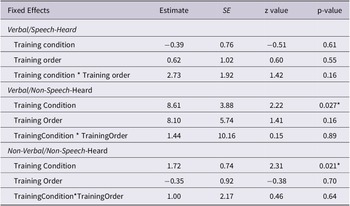
Statistical analyses were performed in R (v4.2.0, R Core Team) using the glmer() function from the lme4 package (v1.1-27.1, Bates et al., Reference Bates, Mächler, Bolker and Walker2015). We started from the most complex model structure, containing random by-participant intercepts, by-participant slopes for Training Condition, random by-item intercepts, and by-item slopes for Training Condition and Training Order, and their interactions. Models were simplified to account for convergence issues and singularity errors until a model converged. Table 2 provides results from the three models (corresponding to each condition pair), along with the final model structure for each Heard-Action pair.
Results from model estimating free recall by Training Condition (Verbal/Speech – Heard, Verbal/Non-Speech – Heard, Non-Verbal/Non-Speech – Heard) and Training Order (Heard in Block 1, Action in Block 1)

Note: The final models had the following syntax specified in the lme4 package:
Verbal/Speech-Heard: recalled ~ traincondition_sum*trainorder_sum + (1|participants) + (1+traincondition_sum|target)
Verbal/Non-Speech-Heard: recalled ~ traincondition_sum*trainorder_sum + (1 + traincondition_sum|participants) + (1 + trainorder_sum|target)
Non-Verbal/Non-Speech-Heard: recalled ~ traincondition_sum*trainorder_sum + (1 + traincondition_sum|participants) + (1 + trainorder_sum|target).
Statistical analyses did not show any significant effects in the Verbal/Speech-Heard group. No main effect of Training Condition was found (β = –0.39, SE = 0.76, p = 0.61), indicating no statistical difference in recall between Heard and Verbal/Speech items. For the Verbal/Non-Speech-Heard group, there was a significant effect of Training Condition (β = 8.6, SE = 3.88, p = <0.05). For the Non-Verbal/Non-Speech-Heard group, there was also a significant effect of Training Condition (β = 1.72, SE = 0.74, p = <0.05Post hoc comparisons were done on the final models with the emmeans package, using asymptotic estimations for degrees of freedom (v1.7.4-1; Lenth, Reference Lenth2020). Estimated marginal means back-transformed into proportions are reported. Post-hoc tests revealed a higher probability of recall for Heard words (M = 0.31, SE = 0.01, 95% CI [0–0.95]) than Verbal/Non-Speech words (M = 0, SE = 0, 95% CI [0–0.02]), and a higher probability of recall for Heard words (M = 0.46, SE = 0.16, 95% CI [0.19–0.75]) than Non-Verbal/Non-Speech words (M = 0.13, SE = 0.09, 95% CI [0.03–0.42]).
Recognition task
Recognition analyses were based on the proportion of looks to target, from 200 ms after word onset to allow time to initiate eye movements, and the window ended at 1500 ms, emulating the window of analyses used in Zamuner et al., (Reference Zamuner, Strahm, Morin-Lessard and Page2018). Figure 3 illustrates the results for the proportion of fixations to targets and Table 1 provides the averages for each Train Condition Pair.
Proportion of Looks to Target by Training Condition (Verbal/Speech – Heard, Verbal/Non-Speech – Heard, Non-Verbal/Non-Speech – Heard).
Note: Error bars indicate 95% confidence intervals.

Proportion of looks to the target was the dependent variable for the linear mixed-effects models performed in R (R Core Team) using the lmer() function from the lme4 package (version 1.1-26; Bates et al., Reference Bates, Mächler, Bolker and Walker2015). The methodology was the same as with recall analyses. Table 3 provides results from the three models (corresponding to each condition pair), along with the final model structure for each Heard-Action pair. Statistical models did not show significant effects for any of the Training Conditions and groups. Although there were no differences in the proportion of looking to targets in the different conditions, as seen in Table 1 and Figure 3, children looked above chance (50%) to the correct images.
Results from model estimating proportion of target fixations by Training Condition (Heard – Verbal/Speech, Verbal/Non-Speech, Non-Verbal/Non-Speech) and Training Order (Heard in Block 1, Action in Block 1)

Note: Wald F-tests with Kenward–Roger estimates for df. The final models had the following syntax specified in the lme4 package:
Verbal/Speech-Heard: Target_Proportion ~ traincondition_sum * trainorder_sum + (1|participants) + (1|target)
Verbal/Non-Speech-Heard: Target_Proportion ~ traincondition_sum * trainorder_sum + (1 + traincondition_sum | participants) + (1|target)
Non-Verbal/Non-Speech-Heard: Target_Proportion ~ traincondition_sum * trainorder_sum + (1 + traincondition_sum|participants) + (1|target).
Discussion
The present study investigated whether the Reverse Production Effect (López Assef et al., Reference López Assef, Desmeules-Trudel, Bernard and Zamuner2021; Zamuner et al., Reference Zamuner, Strahm, Morin-Lessard and Page2018) was caused by children’s speech productions or whether it could also be triggered by performing different types of concurrent tasks during word learning. Our free recall task shows an interesting pattern, which did not fully fit into any of our predictions. The Verbal/Non-Speech-Heard and Non-Verbal/Non-Speech-Heard condition pairs showed a significant effect of Training Condition: in both cases, children recalled more newly learned words from the Heard condition than the two Non-Speech Action conditions. No significant effects were found for the Verbal/Speech-Heard pair: repeating items aloud during the training task did not result in a learning disruption, nor a memory advantage.
Eye-tracking results show no differences across all three Heard-Action pairings (Verbal/Speech-Heard; Verbal/Non-Speech-Heard; Non-Verbal/Non-Speech-Heard). Participants were above chance for target looking in all Training Conditions (Figure 3), indicating successful learning in all Training Conditions. The contrast between our free recall results, which showed significant differences, and our eye-tracking results, which did not, may be attributed to the distinct nature of the tasks. Eye-tracking captures online processing, reflecting the ongoing activation of a word, whereas free recall is an offline task that assesses the outcome of this activation and processing. It is possible that similar patterns emerge during the activation and processing stages across all actions, but differences between training conditions emerge only at the final stage of retrieval. Further research is needed to better understand the differences between online and offline tasks and the Production Effect.
Our eye-tracking results are in line with Zamuner et al. (Reference Zamuner, Strahm, Morin-Lessard and Page2018) given that both did not find a Production effect; however, while the current study had null eye-tracking results, Zamuner et al. found a significant Reverse Production Effect in eye-tracking, with greater looking to targets in the Heard condition versus the Verbal/Speech condition. While the ages of our participants match those in Zamuner et al., data from the two studies were collected using different language background questionnaires, and after the roll-out of full-day kindergarten for four- and five-year-old children. Thus, it is possible that the same-aged children had slightly different language backgrounds and different experiences that map to the experimental task (e.g., learning and repeating novel words). This is relevant because the direction of the Production Effect depends on both developmental and linguistic factors, where familiarity and exposure have been identified as important variables. For instance, greater proficiency or amount of language exposure may increase the likelihood of a child exhibiting the Production Effect. Similarly, experience with structured learning tasks, such as those encountered in daycare or school, could reduce the overall difficulty of our experimental task, increasing the chances of observing the Production Effect. Additional factors that might contribute to a transition from a Reversal Effect to a Production Effect include improvements in language and cognitive skills. Thus, it is possible that children in the current study are at a transition stage of moving from a Reverse Production Effect to a Production Effect (recall that adults tested on the same materials showed the Production Effect). Regardless, the learning disruption caused by speech production was less pronounced in our participants compared to those in Zamuner et al. (Reference Zamuner, Strahm, Morin-Lessard and Page2018). Future work looking at longitudinal and language experience factors is needed to shed light on the direction of the production effect across development.
Going back to our research question, we asked whether speech production makes the word-learning task more difficult, or whether performing any action during learning disrupts encoding. The results from recall align most closely with the prediction that the Reverse Production Effect is influenced by the overall demands of the task; more challenging tasks lead to a greater disruption in learning. Similar results have also been found with adults: performing any action, in this case, both producing the experimental stimuli or producing random letters during training, can disrupt learning and lead to a Reverse Production Effect (Baese-Berk & Samuel, Reference Baese-Berk and Samuel2016). Both the Verbal/Non-Speech-Heard and Non-Verbal/Non-Speech-Heard groups showed better recall for novel words learned under the Heard condition compared to the Action conditions, suggesting that listening alone is less demanding compared to listening while sticking out your tongue or touching your nose. This disruption was not found in the Verbal/Speech-Heard condition pair, as children’s recall was the same across conditions. We postulated that Verbal/Speech may pattern differently as children have more experience with repeating words compared to the other actions. Verbal/Speech words may have received a Production-Effect-like boost, leading to them being more distinctive and easier to retrieve than words learned under the other Action conditions. Therefore, while there is still an overall difficulty effect, Verbal/Speech words received a memory boost from speech production, resulting in the memory advantage we see when comparing Verbal/Speech versus the other Action conditions (Figure 2). Thus, we hypothesize that children are at a transition stage, between a Reverse Production Effect and a Production Effect. See Richtsmeier et al. (Reference Richtsmeier, Gladfelter and Moore2024) for similar flat results in a novel word-learning task with three- and four-year-old children which manipulated both training conditions (Heard versus Verbal/Speech) and the presence or absence of semantic cues. Children’s mere above-chance performance on an identification task suggests that Richtsmeier et al.’s task and stimuli were more complex. They found no effect of Verbal/Speech in either direction. As noted by Richtsmeier et al., the field on the Production Effect and Reverse Production Effect with children is relatively new, and future work is needed to establish how the effects may or may not generalize across variables, such as the task and stimuli.
Our results are consistent with the multisensory learning literature and gesture literature, where the possible beneficial effect from these actions on learning and memorization will depend on cognitive-related factors, such that these actions can either aid in the encoding process and retention, or on the other hand, hinder the process by overwhelming learners due to limitations in their cognitive skills. Gaining a better understanding of the Production Effect and Reverse Production Effect and its intricacies has both theoretical and practical implications. This can inform psycholinguistic theories on the relationships between perception and production; and it can inform educational practices, as it has implications for how engaging in generating information during studying may and may not enhance learning outcomes.
Acknowledgements
We thank the Canada Science and Technology Museum, where our data was collected. We thank our participants and Rachel Miller, Daniela Gallardo, and members of the uOttawa Centre for Child Language Research who contributed to this research. This research was supported by Agencia Nacional de Investigación y Desarrollo (ANID, Chilean Government) under grant 72200366 awarded to Belén López Assef and by a Humanities Research Council of Canada (SSHRC) grant awarded to Tania S. Zamuner.
Competing interest
The authors declare none.
Disclosure of use of AI tools
The authors did not use AI tools.




 Open access

