


History of the site
The earliest record of imprisonment in Lamsdorf dates to 1870–1871 when numerous French soldiers were taken captive by Prussian troops in the Franco-Prussian War and a prisoner-of-war (PoW) camp was established on the outskirts of the village. A few decades later, the area was again employed to imprison soldiers, this time from the Triple Entente states during the First World War (1914–1918). Between 1921 and 1924, the camp infrastructure was used as a civilian resettlement camp for German immigrants who wanted (or were forced) to leave the region that became part of Poland. The use of Lamsdorf for imprisonment peaked during the Second World War when one of the largest German PoW camp complexes for soldiers operated near the village, namely Stalag 318/VIII F (344) and Stalag VIII B (344) (Figure 1). Up to 300 000 soldiers of the anti-Nazi coalition could have passed through the Lamsdorf camps. After the hostilities, some of the buildings that related to the artillery shooting ground in Lamsdorf were used by the communist Polish authorities as a forced labour camp (1945–1946) for German citizens from nearby territories.
Hospital of Stalag VIII B (344) Lamsdorf: A) view of two barracks in the area; B) British PoWs during work in the area; C–D) views of barracks and administrative buildings in the area (source Central Museum of Prisoners-of-War; figure by K. Karski).

Archaeology of the site
During desk-based research, the authors obtained various types of maps, plans, sketches and photos documenting the camps in various historical periods. The non-invasive archaeological research included analysis of aerial photographs which captured the topography of the PoW camps in the second half of 1944. In the first stage of the project, the researchers focused on Stalag VIII B (344) where mainly British PoWs were held—hence its common name of Britenlager (British camp). The team documented and georeferenced 170 buildings to locate them in the contemporary landscape (Figure 2).
Stalag VIII B (344) Lamsdorf: A) aerial photograph from 1944 (source National Archives and Records Administration); B) a visualisation of airborne laser scanning of the hospital site with the location of discovered artefacts (source Head Office of Geography and Cartography, Poland; figure by A. Lokś).

Another important non-invasive research method was airborne laser scanning. The analysis of airborne laser-scanning products for only the ‘British’ part of the Lamsdorf camp allowed registering and documenting over 1100 traces of human activity and shows the complexity of the campscape.
Today, the areas of the former camps in Lamsdorf are mostly forested. The natural heritage of the area is within our research interest as well because this was an inherent part of the campscape. Ground-penetrating radar surveys were carried out in the area adjacent to the monument dedicated to the Martyrdom of Prisoners-of-War in Łambinowice. According to the archival materials, it was constructed in the area around mass graves of Soviet prisoners. Their precise location is also not known at present. The measurements made it possible to register anomalies that may be related to the mass graves. Non-invasive archaeology also involved systematic recording of the campscape with aerial photographs using an unmanned aerial vehicle, which enabled preparation of photograms of excavated trenches. Minimally invasive metal-detector surveys were also carried out regularly with the help of volunteers (Figure 3).
Different stages and methods of field research: A) metal-detector survey; B) desk-based analyses of airborne laser scanning data; C) ground-penetrating radar survey; D) soil sampling for chemical analyses (source Central Museum of Prisoners-of-War; photographs by D. Frymark).

During the first phase of the project, more than 300 objects or artefact fragments were found and they show the history of the place and the people who were held behind the barbed wire in Lamsdorf. The items included military and civilian buttons, cartridge cases, coins, dog-tags, razors, elements of barbed wire and metal containers.
The last stage of the applied research methodology consisted of test excavations that had not only scientific objectives but also embraced a social dimension by including participation of volunteers in the archaeological work. Two trenches were dug in this phase which made it possible to identify the remains of the hospital barracks of Stalag VIII B (344) (Figure 4).
Hospital at Stalag VIII B (344) Lamsdorf: A) contemporary aerial image with overlay showing visualisation of airborne laser scanning (source Head Office of Geography and Cartography, Poland; figure by A. Lokś); B) an interpretation of aerial imagery and photographs taken in the hospital (source: National Archives and Records Administration, Central Museum of Prisoners-of-War; C) an interpretation of the excavated area (source: Central Museum of Prisoners-of-War; D) a reconstruction drawing of a barrack in the hospital (figures B–D by K. Karski).

Ethnography of the site
The final component of the project aimed to recognise the contemporaneous significance of the post-camp sites in Łambinowice for local communities. This involved surveying the attitudes and values of the volunteer participants towards the archaeology and the painful heritage being explored (Figure 5). The survey used a suite of qualitative methods including individual and group interviews with local residents and volunteers, participant observation and analysis of secondary data and visual data.
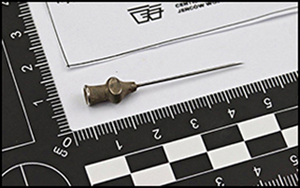
Field documentation of some artefacts found during research: A) a rifle cartridge, a fragment of the Polish eagle from a military helmet and a Polish military button; B) a needle; C) a fragment of horse tack; D) a Belgian military button (source Central Museum of Prisoners-of-War; photographs by E. Góra).

The results document people's attitudes towards the Site of National Remembrance in Łambinowice and reveal its twofold meaning. Most of the respondents perceive it as a site of ‘difficult’ heritage that, while containing painful histories, deserves commemoration. At the same time they see it as an important part of their everyday life and emphasise the richness of the natural environment surrounding the post-camp areas. The difficult side of the site's heritage was clear during a visit on 24 August 2022 to the excavation in the former hospital by families of Canadian PoWs for whom it was a deeply moving experience. In terms of the interviewed volunteers, their response revealed to us how participation in archaeological research changed their perceptions of the discipline itself with regard to its chronological and territorial scope. Moreover, they deeply appreciated this community-based initiative in which they could participate and, together with archaeologists, discover and experience the material remains of the past—a past that includes their own ancestors (Figure 6).
Community archaeology in practice: A) explaining the aims of excavations to children; B) explaining the reason for using an unmanned aerial vehicle in archaeological research; C–E) excavation of one of the barracks with the active participation of the volunteers (source Central Museum of Prisoners-of-War; photographs by D. Frymark).

Conclusion
This work is one of just a few community-driven projects in Polish archaeology to engage with painful heritage (see also Kobiałka et al. Reference Kobiałka, Kostyrko, Wałdoch, Kość-Ryżko, Rennwanz, Rychtarska and Nita2021) and has already gathered material and data of a high scientific, conservation and social value. Fieldwork will continue in 2023–2024. The project will finish with an exhibition in the Central Museum of Prisoners-of-War and a documentary presenting the work, discoveries and volunteers involved in the research.
Funding statement
The project was co-financed from the state budget under the programme of the Minister of Education and Science, Poland, called ‘Science for Society’ Poland number: NdS/545193/2022/2022. Amount of funding: PLN 560,740,00; total value: PLN 560,740,00.



