




[In the minds of] the majority of Jews in the current Eastern European countries, the “diamond city of Antwerp” has even surpassed the former paradise of America. […] “Antwerp” has become a kind of magic word: when it is conjured, all of a sudden parcels of diamonds appear ownerless on the streets which anyone can just pick up; one only has to take a little trouble to promptly become a rich man.Footnote 1
This quotation, which appeared in an article aptly titled “Antverpner gliken” (Antwerp's joys), in the Yidishe tsaytung, one of Belgium's Yiddish-language weeklies at the time, demonstrates the almost hypnotic attraction diamonds had as a pull factor for young Eastern European Jewish immigrants to Antwerp at the end of the 1920s. Antwerp, its Jewish presence, and diamonds have been intimately tied to each other since at least the late nineteenth century. Even today, this popular image lives on, at a time when the Jewish presence in the industry has been much diminished due to outsourcing of the production process to “low-cost” centres in India and the concomitant rise of a strong Indian diaspora in Antwerp, active in the commerce of diamonds.Footnote 2
The diamond industry has long been a subject of interest to historians. Its shifting boundaries and the role of diamonds as a luxury commodity within the global economic system have been explored and analysed.Footnote 3 Likewise, the labour conditions of workers in this interconnected global industry in faraway places such as Amsterdam, Antwerp, French villages in the Jura, and later, in the 1930s and 1940s, in the slipstream of Jewish refugees, in Mandatory Palestine, Cuba, and New York, have attracted the attention of historians.Footnote 4 The strong Jewish presence in the industry, both as important actors in transnational commercial networks in the early modern and modern period, and later as labourers, has also been explored.Footnote 5 It is therefore surprising that, despite Antwerp's dominance in the international diamond industry from the first decade of the twentieth century, the role of Jewish immigrant diamond workers in this city has been paid only scant historical attention.Footnote 6
The diamond industry in Antwerp during the interwar period offers a particularly interesting and unique case with regard to the labour conditions of foreign workers, their position within the industry, and relations with other “native” actors in it. Antwerp attracted Jewish immigrant workers from different socio-economic, cultural, and national backgrounds who performed a variety of functions in the production chain. The diamond industry in Antwerp was also the home of what would become one of the most powerful trade unions in Belgium in the interwar period: the Algemene Diamantbewerkersbond van België (ADB, General Diamond Workers Union of Belgium).Footnote 7 It is on the often fraught relations between Jewish immigrant workers and the union that this article focuses.
Since the mid-twentieth century, much has been written about the role of immigrant labour, the specific economic position it often occupied, and how ethnic and/or racial tensions played an important role in (immigrant) labour organization.Footnote 8 Since the onset of the Industrial Revolution and the growth of the nation state in the nineteenth century, trade unions – the most important institutions in organizing labour – have played a crucial role in the possibilities (positive or negative) for migrant workers to integrate within the general workers’ movement.Footnote 9 As has been suggested, a wide range of factors could determine the attitude of trade unions towards foreign labour: their overall strength; organizational density and internal structures; the condition of the economy and labour market at a given time in society; general attitudes towards migration and particular immigrant groups in the societies in which the trade unions were embedded; or the degree to which the unions themselves perceived different categories of immigrants as more or less suitable, depending on their economic station and the degree of cultural similarity.Footnote 10 All of these different aspects will be discussed in this article in relation to immigrant Jewish diamond workers.
Nevertheless, what has often been missing in the discussion of the relations between immigrants and union structures is a more holistic perspective, which not only takes into account the attitudes of unions towards immigrant workers, but places this subject in the wider perspective of immigrants’ presence in the industry as a whole. The diamond trade and industry in Antwerp during the interwar period offers a particularly interesting and unique case in the relations between foreign workers and union structures. Jewish immigrants in Antwerp did not only become active as diamond workers in the production chain. Initially, and preceding the large-scale entrance of Jewish workers into the industry, Jewish immigrants were at the core of the diamond trade's success in Belgium. In the subsequent decades, they came to dominate the commercial side, as well as the flow of rough diamonds into the country. Jewish diamond merchants thereby lay at the basis of a major export product in the Belgian economy, and directly or indirectly also provided work for tens of thousands of non-Jewish Belgian diamond workers. In many ways, the Jewish “hold” on the entire trade (and through it, the industry) corresponds to the hallmarks set out in classical Middleman Minorities theory, as described by Edna Bonacich.Footnote 11 Throughout the current article, this theory will be referenced and tested against the Antwerp historical case.
As I will argue, the dominant position of Jews in the diamond trade also influenced the attitudes of the union towards their coreligionist immigrant workers, and to the relations between native Belgians and Jews in the industry (and in trade more broadly). By painting the relations of the union with Jewish immigrant workers with a broad brush, and integrating the union's relations with “Jewish-dominated” employers’ organizations as part of the story, the article aims to broaden the scope of how both the unions and immigrant workers navigated the boundaries and conditions of their participation and integration. At times, comparisons will be drawn with diamond centres in other European countries, different trades, or subgroups of Belgian and Jewish workers, thereby placing the socio-economic position of immigrant (Jewish) diamond workers in Antwerp in a broader framework. In this way, the article aims to contribute to a deeper and more nuanced understanding of the various factors that regulated the success and failures of the integration of foreign workers within the labour movement.
Jews, Jewish Immigrant Workers, and the Diamond Trade and Industry in Antwerp
In the late nineteenth century, the arrival of Jewish diamond merchants from Austro-Hungarian Galicia and the Russian Empire (and to a lesser degree from the Ottoman Empire) gave the diamond industry in Antwerp an enormous impulse. Jewish diamond merchants came to play a dominant role in the Belgian diamond trade; from securing rough uncut stones on the international market, the raw material without which there would be no industry, to selling the finished cut and polished stones (a large proportion going to the American market). By using transnational ethnic and kinship ties – in particular with the emerging diamond centre in London, where the London Diamond Syndicate, established by ten prominent Jewish diamond enterprises, controlled the distribution of rough uncut stonesFootnote 12 – recently arrived Jewish immigrants established a quasi-monopoly over the trade and commerce of diamonds in Antwerp. As mentioned, the dominant role played by Jewish merchants in the Belgian diamond industry in many ways corresponds to the hallmarks of classical middleman minority theory.Footnote 13 That is, an (initially) immigrant group that plays a vital intermediary role within a certain economic sector (often easily liquidated or transportable occupations) in its host society by utilizing (transnational) ethnic ties of solidarity. Habitually, such minorities received sponsorship or special benefits from the country's elites or government, eager to secure the benefits this meant for their own gain or for the national treasury – in Belgium, for instance, the diamond industry accounted for 5–8 per cent of total Belgian exports and 2.07 per cent of the country's gross national income in the 1920s.Footnote 14 Such preferential treatment can also be discerned in the pains the Belgian government took, after both World Wars, to bring back the “foreign” Jewish diamond merchants to Antwerp from abroad, where they found refuge (or were forced to move to) at the beginning of the conflicts. This was achieved through enticing economic benefits or the promise of citizenship, in order to restore the Belgian diamond industry.Footnote 15
The success of these immigrant Jewish diamond merchants, brokers, and large-scale manufacturers catapulted them to the very socio-economic elite of Antwerp society. To illustrate the Jewish dominance: on the eve of World War II, some 80–90 per cent of the 3,500 members of the Federation of the Belgian Diamond Exchanges are estimated to have been Jews.Footnote 16 This federative organization comprised the four main diamond exchanges of the city, the Diamantclub, the Diamantbeurs, the Vrije Diamanthandel and the Diamantkring – the beating hearts of the Belgian diamond trade where parcels of stones were bought and sold (Figure 1). Next to the exchanges, Jewish diamond merchants, manufacturers (fabrikanten), and brokers (makelaars) also played a dominant role in the Syndicaat der Belgische Diamantnijverheid (SBD). Established in 1927, the SBD functioned as one of the most important employer organizations for the diamond industry in Belgium. The organization sought to defend the interests of the industry at the government level and internationally, and also negotiated with workers’ organizations.Footnote 17 Its president, Isidore Lipschutz, was a figurehead in Antwerp's Jewish community and a well-known and respected figure in the industry.

Figure 1. A photograph taken in the 1920s of the interior of the great hall of the Diamond Exchange located at the Pelikaanstraat 78, where parcels of stones are sold and bought. The large windows allow for plenty of natural light to evaluate the merchandise.
Source: De Stad Antwerpen, 12, 7 June 1929.
The Jewish presence in the diamond industry was nevertheless not limited to merchants, brokers, or commercial agents. Jews also became active in the manufacturing of diamonds and in the labour force. In 1923, the diamond industry employed a total of around 13,500 diamond workers (Jews and non-Jews) in Belgium; half a decade later, this number had grown to nearly 25,000.Footnote 18 Unlike the Jewish dominance in the commercial side of the business – or for that matter the situation in Amsterdam, where the majority of the workforce in the diamond industry consisted of Jews – in Belgium, Jewish labourers only made up a minority of the diamond workers. Concentrated in the urban area of Greater Antwerp, in the 1930s, estimates of the proportion of Jewish workers in the industry ranged from fifteen to thirty per cent, according to different sources, although exact numbers are hard to come by.Footnote 19 The majority of the labour force in Belgium consisted of native (Catholic) Flemish workers in the same part of Antwerp or in various localities in De Kempen, a rural area in the Province of Antwerp (next to a few smaller centres in other provinces). It is important to note that Jewish diamond merchants, brokers and manufacturers therefore not only provided work for recently arrived Jewish immigrant workers, but also (directly or indirectly) to native “Christian” Flemish workers and small-scale entrepreneurs. These diamond workers and entrepreneurs, as well as the union, were thus dependent on and came into contact with Jewish merchants, brokers, manufacturers, and employers and “their” organization, the SBD.
Jewish labour in the industry was almost entirely the result of migration to Belgium in the course of the late nineteenth and early twentieth century. During this period, the number of Jewish workers in the industry continued to grow in parallel with the Jewish community. Whilst some 400 Jewish labourers were employed in the diamond industry in 1897, by 1914 this number had grown to around 1,000. After World War I, in 1923, the number of Jewish workers was estimated at some 2,000 to 2,500.Footnote 20 By the mid-1930s, this number had grown to approximately 3,500 individuals.
Jewish diamond workers might have only formed a minority in the industry, but the precious little stones were of crucial importance to the local Jewish community of Antwerp. Contemporaries at the time estimated that some 50–60 per cent of the economically active Jewish population of the city (some 6,000–7,000 people, both foreign nationals and Belgian citizens) was in one way or another dependent on the industry: merchants; dealers; brokers; manufacturers; entrepreneurs; wage-labourers; homeworkers; apprentices; supply store owners for work tools for the industry, etc.Footnote 21 Government statistics present the following picture: In 1938, a total of 3,494 men (and 411 women) of foreign nationality over the age of fifteen worked in the diamond industry in Belgium. A further 1,806 men (and twenty-eight women), foreign nationals over the age of fifteen, made their living in various forms of commerce of these products.Footnote 22 The Jewish concentration in the diamond trade and industry meant that its overall situation and fortune was closely tied to the prosperity and vitality of the Jewish community in the city. When the diamond industry did well, so did the community. When crises hit, these were also immediately felt in local Jewish life.
Jewish (immigrant) diamond workers by no means represented a uniform monolithic bloc, but were as diverse as their community, which comprised Jews of different nationalities and linguistic groups, as well as ideologically and culturally distinct subgroups that, as a collective to the outside world (and to a lesser degree among themselves), came to be defined as “the Jewish community”. In Antwerp, immigrant Jewish diamond workers could roughly be categorized into two large groups based on nationality, cultural, and linguistic differences, and their distinct economic position within the industry. This was not only recognized within the Jewish community, but also in the perception of “native” Flemish workers, the union, and more generally in non-Jewish society.
The first group consisted of Dutch Jewish diamond workers who migrated from Amsterdam (and a smaller number from other localities in the Netherlands) to Antwerp. In the first two decades of the twentieth century, Antwerp gradually replaced Amsterdam as the principal international diamond centre, a process that, by the end of World War I, had become clear to everyone. Attracted by its opportunities, Dutch diamond workers – including many Jews – left their native Amsterdam and settled in Antwerp. In the period between 1910 and 1924, some 3,000 Dutch diamond workers made this move, escaping the restrictive tax system in the Netherlands.Footnote 23 In the subsequent decades, cross-border migration between Antwerp and Amsterdam remained common among Dutch (Jewish) labourers, who often responded with their feet when crises rocked the industry and opportunities seemed better elsewhere.
While it is difficult to determine the percentage of Jewish labourers among the immigrant Dutch diamond workers (recording religious affiliation is not allowed in Belgium), they probably represented the majority of Dutch nationals working in the industry in Antwerp. By the mid-1930s, Izak Prins, a Dutch Jewish historian and member of the Belgian local “Friends of YIVO Society” (Fraynt fun yidishn visnshaftlekhn institut), estimated the number of Dutch Jewish diamond workers in the city at some 1,500.Footnote 24 According to a writer in Antwerp's Dutch Jewish weekly, Ons Orgaan, at least eighty per cent of the “Dutch Jewish colony” in Antwerp were making a living from the diamond industry during the mid-1920s.Footnote 25 This not only included wage-workers, but also Dutch Jewish entrepreneurs. In the late 1930s, Dutch Jews operated twenty-four manufacturing businesses in the diamond industry.Footnote 26
Most Dutch Jewish immigrants were highly skilled, having practiced the trade in their native Amsterdam before moving to Antwerp with the purpose of finding employment in the diamond industry.Footnote 27 Unlike their Russian and Polish “cousins”, Dutch Jews were less active in the commercial side of the business (merchants or brokers) and instead were concentrated in the higher end, technically more demanding, and well-paid branches of the production process. The production process in the diamond industry was rigorously segmented, in which cleaving and sawing were highly specialized stages where the stone received a first cut. Cleaving remained an artisan skill performed at home or in small workshops, and in the first years after World War I, it remained the exclusive territory of the Dutch Jews. From the mid-1930s, more and more Eastern European Jews entered the profession, and Jews in general dominated this branch of the production process, representing around ninety per cent of the total number of cleavers. Cleaving was generally regarded as a perfect apprenticeship for a later career in commerce, as it demanded a profound understanding of a stone's structure. Sawing diamonds was a capital-intensive industrial endeavour, in which mostly Belgian labourers were employed in large workshops. The proportion of Jewish workers in this branch at the end of the interwar period can be estimated at forty per cent. At the lower end of the production process, diamond cutters gave the split or sawn diamond a first rough cut, after which they were set (versteld) in a special cement so that diamond polishers could tailor the different facets of the stone, giving it its final shape. In Antwerp, polishing was carried out in large workshops and factories (slijperijen) where the majority of the workforce comprised local Belgians – Jews only represented an estimated twenty per cent of the labour force in this sector. However, cutting the stones could be done at home or in small workshops. Jewish labour dominated this part of the production process, representing an estimated eighty per cent of diamond cutters at the end of the 1930s.Footnote 28 It is in this sector that the majority of the second, and slightly larger, group of Jewish immigrant diamond workers became employed.
Unlike their Dutch counterparts, most Eastern European Jewish immigrants did not come to Antwerp with the specific intention of working in the diamond industry. Instead, they were fleeing persecution, economic distress, and overpopulation in Eastern Europe. The position of Antwerp, a port city that served as a major transit hub for transatlantic emigration to the New World, meant that hundreds of thousands of Eastern European Jews passed through the city between the mid-1880s and the outbreak of World War I. Tens of thousands more would follow during the early 1920s.Footnote 29 Although the vast majority of transit migrants departed to the Americas after a short time, immigrant stragglers, or those stranded in Antwerp, counted on the city's Jewish community to provide them with work or a means of existence. Their unfamiliarity with the local language impeded easy access to the labour market, the solacing familiarity of shared cultural and religious identities mitigated the shock of immigration, and relatively easy access to lines of credit within the ethnic communal structures meant that most Jewish immigrants looked to other Jews (often earlier arrivals) for employment. Bound by moral and religious obligations, a keen sense of ethnic solidarity, and sometimes kinship ties (chain migration), Jewish diamond merchants, manufacturers, and entrepreneurs on their part offered these new arrivals opportunities in the diamond industry by taking them on as apprentices or selling them a first small batch of stones.Footnote 30 Less altruistic motives certainly also help to explain the eagerness with which these immigrants were welcomed. The new arrivals, ignorant of local conditions and prices, were often ruthlessly exploited as a readily available and constantly replenishable source of cheap labour.Footnote 31
Gradually, a small Eastern European Jewish workforce emerged, which can be estimated in the hundreds by 1910.Footnote 32 After World War I, as Jewish (trans)migration to Belgium picked up again, their numbers increased dramatically. While many Eastern European Jewish immigrant workers initially saw their work in the industry as only temporary, hoping to move on to the US soon after, the introduction of severe immigration restrictions later in 1924 meant that, for most, their stay became permanent. In the second half of the decade, Jewish migration to Belgium reached record numbers, and more and more Jewish immigrants entered the profession. By the mid-1930s, the number of Eastern European Jewish workers in the diamond industry was estimated at some 2,000.Footnote 33
Unlike their Dutch coreligionists, Eastern European Jews generally arrived in Antwerp with little to no prior skills. They often started out learning the trade of diamond cutting, technically the least demanding and one of the lower-paid parts of the production process. Cutting diamonds was labour intensive, but required little capital investment, as the only fixed investment was a snijmachine (cutting tool) that could be bought on credit and set up at home or in a small workshop.Footnote 34 Jewish immigrant labourers became specialized in the cutting of smaller, less valuable stones. One union leader estimated that eighty-five per cent of the “Polish” cutters in the late 1930s worked on small stones; work that most Belgian or Dutch cutters refused, as “nothing can be earned on these grains of sand”.Footnote 35 While many Belgian diamond cutters in Antwerp worked in larger polishing factories (slijperijen), recently arrived Jewish immigrant labourers worked at home or in tiny workshops in rooms, cellars, and attics in the Jewish neighbourhood of Antwerp in order to compete with the experienced Belgian cutters. Only from the turn of the decade did Eastern European Jews become employed or established businesses in the more technically demanding cleaving and sawing branches, and, from 1937, also in polishing diamonds.Footnote 36
Although most Eastern European Jewish immigrants who arrived in Antwerp in the 1920s thus ended up in the lower echelons of the production process, many nonetheless came with the ambition and expectation of soon earning a good living in the lucrative commerce of diamonds. As seen, the trade and distribution of rough and cut diamonds were in the hands of a select group of (predominantly Jewish) diamond merchants. The dominant Jewish presence in this sector naturally attracted other Jews to the industry, hoping to emulate their predecessors’ success. Conjuring dreams of “making it” in Antwerp and the “riches” that were at hand, the diamond industry served as a considerable pull factor for ambitious young Jews in the towns and shtetls of Eastern Europe at the end of the 1920s. Despite their lofty expectations, for many, such dreams proved to be just that: hopeful illusions that by no means corresponded with the local economic realities. Traffickers in Eastern Europe, hoping to earn fast money, skilfully cultivated such expectations and made “a real trade in Jewish illusions”, as the Yidishe tsaytung put it.Footnote 37
The desire and expectation of many recently arrived Eastern European Jewish immigrant diamond cutters to eventually become economically active in the commercial side of the industry meant that many regarded employment in the lower-end of the production process as only temporary. Many Jewish immigrant workers, often having learned only the most rudimentary aspects of the trade, therefore set up shop for themselves and became their “own boss”. The blurred lines between labourers and employers in the industry – where decentralization of the production process, small production units in the less technically demanding branches (cutters and verstellers), mobility and outwork were central features – greatly facilitated this process. An ambitious immigrant hoping to establish their own business could therefore take on a contract for a parcel of stones to be cut from a manufacturer or directly from a broker (makelaar) – a position in the lowest rung of the commercial aspect of the diamond industry; brokers supplied small parcels of stones in various stages of the production process, to manufacturersFootnote 38 – hire some helpers (often kin or landsleyt – the Yiddish term for people who heralded from the same town or region) to work alongside them, or even subcontract the work further, and thus join the ranks of immigrant entrepreneurs. The risk was relatively limited. If things went wrong or the trade experienced a slump, immigrant entrepreneurs could always revert back to their previous (home)worker status or work for one of the larger manufacturing companies for hourly wages. At the bottom of the pyramid, and wedged between the status of a worker and an entrepreneur, were the homeworkers, who were paid piecework for each cut stone. In Flemish, they were also known as eigenwerkmakers, although the term was equally applied to small-scale entrepreneurs and manufacturers with only a few workers.Footnote 39 Eastern European Jewish immigrant entrepreneurs and homeworkers often toiled long hours for small profit margins, ignoring health standards and union tariffs. This significantly reduced the cost of entry and kept their businesses afloat (Figure 2).
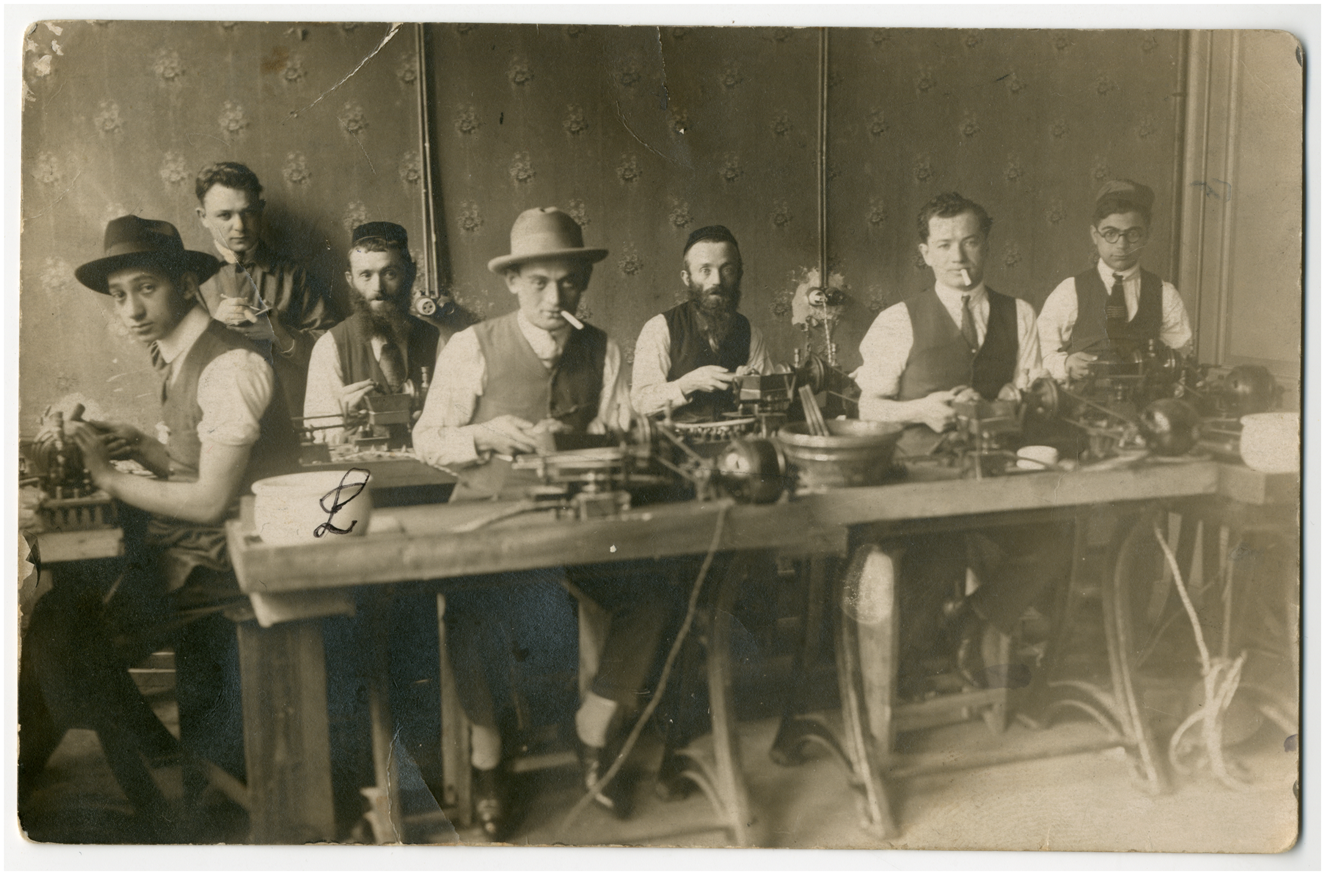
Figure 2. Jewish diamond workers during the interwar period at their trade in the workshop of Jacob Landau in Antwerp. Jacob Landau is the third man from the left, his brother Efraim Landau is the third man from the right.
Source: Kazerne Dossin: Memorial Museum and Documentation Centre on Holocaust and Human Rights; Archival reference: KD_00363_000035 - Fonds Landau-Blitzer family.
Such extremely flexible types of economic and labour organization bear a remarkable similarity to the “putting out” and “sweatshop” system that has been studied in detail in the garment industry. There, too, Jewish immigrants found employment in the US, Britain, France, and elsewhere in the Diaspora (including Belgium). This system has been described in the works of Nancy Green, Daniel Soyer, and others.Footnote 40 While it falls outside the scope of the current article to present a detailed comparison of the structural characteristics of the two industries, certain similarities – such as the low-cost, low-bulk technology required in the manufacturing process (at least for cutting and cleaving in the diamond industry), as well as rigorous segmentation of the production process – help to explain these types of economic organization.
In fact, the “putting-out” and “sweating” of Eastern European Jewish diamond workers in Antwerp was not an aberration at all, but can be regarded as a structural part within the global production chain of the diamond industry (especially in the production of smaller, less valuable stones) as it developed from the late nineteenth century. As Thomas Figarol has demonstrated in his recent work, the diamond industry in a number of mountain villages in the Haut Jura in France was also characterized by the flexibility of economic organization, small manufacturing units, and low costs, as well as a focus on small stones and relatively low-quality cuts.Footnote 41 Far closer to home, “sweating” became prolific among Flemish diamond workers in the rural area of De Kempen to the east of Antwerp – the Buitenindustrie, as it was known locally. Used as a source of cheap labour, after the last decade of the nineteenth century, small production centres were established in De Kempen that soon expanded.Footnote 42 Before World War I, sweatshops also became the norm there, as diamond labourers, mostly in the polishing branch, hired a seat at a mill in a diamond factory (usually set up by a former diamond worker) and performed piecework.Footnote 43 Similar to the French Jura or Eastern European Jewish workers in Antwerp, smaller and lower-quality stones were mostly produced in De Kempen. Due to the electrification of the Province of Antwerp, the diamond industry in De Kempen witnessed enormous growth in the 1920s. While the area counted some 864 factories (15,147 diamond mills) in 1926, by the end of 1929 this number had increased to 1,836 (23,406 mills). Technological innovations, such as the development of compact electric motors, meant that mills for polishing diamonds became smaller and more affordable. Many workers in De Kempen set up “miniature factories” in sheds and farms, where they worked in small family units or taught the trade to “apprentices”, who were also used as a form of cheap labour outside of any union structures. They in turn set up shop as soon as their “apprenticeship” ended, after which the cycle began anew. This was a process known in the industry as leerlingkwekerij (apprentice farming). Due to this, the number of factories with fewer than ten diamonds mills kept increasing: in 1927, they numbered 170, in 1928, some 230, and at least 329 in 1929.Footnote 44 In 1930, government statics reported 3,096 homeworkers (2,407 men, 689 women) in the Kunst en Precisiebedrijf (Arts and precision industries) – in addition to the diamond industry (by far the largest) watchmakers, jewellers, or telephone manufacturers were also included in this economic sector – in the province of Antwerp.Footnote 45
The same process can also be observed among the Eastern European Jewish diamond cutters in the urban agglomeration of Antwerp. To achieve the ambition of becoming their own “boss” and “ascending” to the commercial side of the business, many new Jewish immigrant entrepreneurs tried to cut costs and maximize profits, and engaged in aggressive trade practices such as apprentice farming, which became widespread during the 1920s.Footnote 46 Even recently arrived immigrants, who had just finished their own apprenticeship, soon took on one or several apprentices. The constant arrival of Eastern European Jewish immigrants meant that there was no shortage of newcomers willing (or coerced, due to necessity or lack of options) to work and try their luck in the industry. During the 1920s, a real business was created of supplying apprentices that gave rise to significant social problems. In the cities and shtetls of Eastern Europe, specialized brokers promised apprenticeships to youngsters who were eager to learn the trade and emigrate to Belgium.Footnote 47 These brokers charged their clients considerable sums of money for their services. In the late 1920s, a diamond cutter could charge a new apprentice between 1,000 and 2,000 Belgian Francs to learn the trade.Footnote 48 When these youngsters left for Belgium, they often did so without signing a contract stipulating the conditions of their apprenticeship. Placed with employers who had little time for them, they were left to their own devices and received neither proper training nor a decent wage. This problem was most pronounced for cleavers and cutters, where many apprentices faced such conditions.Footnote 49
The number of small-scale Jewish entrepreneurs in the business thus continued to grow. By the end of the interwar period, Eastern European Jews were operating some 420 businesses (of various sizes) engaged in the manufacturing process. Economically, however, these enterprises were far less valuable than Dutch or Belgian-owned Jewish counterparts.Footnote 50 Despite the challenges such trade practices raised for the overall health of the diamond industry, they did create an attractive and effective path for social mobility among a small but not negligible minority of the Jewish immigrant arrivals during the 1920s. Eric Laureys, for instance, mentions that, on the eve of World War II, the number of Jewish merchants and brokers was said to have increased sixfold compared with the late 1920s – a clear indication that Eastern European Jewish immigrant entrepreneurs could achieve their dreams.Footnote 51 This is also evident when browsing through the pages of De Diamantnijverheid in België, the periodical of the Syndicaat der Belgische Diamantnijverheid (SBD), the employer's organization of the Belgian diamond industry. Every few issues, lists were published of potential new members (many of them Jewish-sounding names); an indication of immigrant success stories, even if those remained a minority.
The influx of Eastern European Jewish immigrants in the mid-1920s and the growth of the industry in De Kempen led to a rapid expansion of the workforce and to a labour surplus. Even though wages in the industry remained relatively high – salaries in the diamond industry were the highest of all Belgian industrial sectors and diamond cutters earned twice the wage of coal minersFootnote 52 – they nonetheless experienced a large drop. According to one source in 1925, unionized Flemish (and Dutch Jewish) labourers saw their wages decrease by twenty-five per cent, while the wages of the estimated 1,500–1,800 (mostly non-unionized) Eastern European Jewish labourers dropped by almost sixty-five per cent.Footnote 53 This sharp reduction in incomes led to tensions between Eastern European Jewish immigrants and the Algemene Diamantbewerkersbond van België, ADB (General Diamond workers Union of Belgium).
The Algemene Diamantbewerkersbond van België and the Question of Foreign Labour in the 1920s
On 19 August 1895, a diamond workers union was founded in Antwerp: the Antwerp Diamond Workers’ Union (Antwerpse Diamantbewerkersbond), later renamed the General Diamond Workers Union of Belgium (Algemene Diamantbewerkersbond van België, ADB). Although it initially relied on strong support and guidance from its sister union in Amsterdam, by the end of the first decade of the twentieth century, the ADB was able to stand on its own.Footnote 54 In the decades following its creation, it developed into one of the strongest unions in Antwerp, where it received most of its support. By contrast, the diamond workers in the Buitenindustrie in De Kempen remained mostly impervious to the ADB's attempts to organize them. This can in part be explained by the initial lofty and even antagonistic approach of the ADB towards the Buitenindustrie, as well as the strong influence of the clergy on the local population, as they abhorred the attempts of the “socialist” union to gain influence in the Catholic agrarian communities. Diamond workers in De Kempen joined the Christian Belgian Diamond Workers Union (Christelijke Belgische Diamantbewerkersbond, CBD), created in 1907, if they became organized in a union structure at all.Footnote 55
In Antwerp, the ADB was aligned with the federative organization of the socialist unions, the Trade Union Commission (Syndikale Commissie/Commission Syndicale), which loosely organized the different socialist unions in different trades throughout the country.Footnote 56 While the ADB remained officially non-partisan in the internal struggles of the socialist labour movement, in practice close ties existed with the reformist Belgische Werklieden Partij (BWP). For example, Louis van Berckelaer, the president of the ADB, was elected as a member of the Belgian senate on a BWP ticket. The ADB, both in its policies and in its press organs and propaganda, took measures to curtail the influence of the small communist and Trotskyist opposition within the union.Footnote 57 The ADB struggled to find a coordinated approach to the large-scale arrival of Eastern European Jewish immigrants entering the industry during the early 1920s. These foreign workers forced down wages and threatened to undermine the achievements the union had secured in hard-fought battles during the previous decades. In fact, the question of “foreign labour” in the 1920s extended far beyond the diamond industry and was deemed to be an issue of national importance, so much so that the federal Trade Union Commission organized a special national congress aiming to address this question, crystallize its position, and devise a common strategy. In addition to the diamond industry, others with a substantial foreign presence were present, such as the Seafarers’ Union, the Miners’ Union, the Garment Workers’ Union, the Hotel Workers’ Union, and the Leather Workers’ Union.
Louis Van Berckelaer presented his colleagues with an “honest depiction” of the special conditions in the diamond industry, and ironically confided to his peers that the industry had the “dubious honour of attracting the special attention of the Jewish element”.Footnote 58 The problem of foreign labour in the diamond industry – as in the garment and other industries – continued Van Berckelaer, was further complicated by the very delicate “Jewish question”. The centuries-old oppression of the Jewish people, so he argued, had, at times, been handily used by the Jewish workers to defend themselves by labelling their opponents, and those who held other opinions, as anti-Semites. He himself, Van Berckelaer assured the delegates, was totally devoid of such suspicions as: “on several occasions I have defended the interest of Jewish labourers”.Footnote 59
Having carefully protected himself against accusations of anti-Semitism – a sensitive issue in the socialist movement – Van Berckelaer presented a broad analysis of the problems regarding Jewish workers in the diamond industry and drew a clear line setting out the conditions for (Eastern European) Jewish participation in the unions:
We must strongly resist all urges that exist among Jewish immigrants to organize separately, to form a state within a state. For everything, they want a Jewish equivalent: Jewish health associations, Jewish sport associations, etc. With health associations and sport associations they can do whatever they please. But everything that concerns labour conditions must be organized within the union, and in all the services that the union will provide.Footnote 60
Arguing that those who fled their countries of origin looking for better conditions had no business being fussy and should adapt to the local customs, Van Berckelaer's position (and with him, that of the union) was clear: Jewish labourers individually ought to organize within the existing union structures. While we will return to Jewish particularities and their tendency towards creating “separate” structures shortly, it is important to state that behind the resolute rejection of this possibility lay real and tangible fears of the creation of an independent rival Jewish union and the undermining of class solidarity along ethnic lines.
Like the rest of the socialist unions, the ADB adopted the official line set out by the national congress of the Commission Syndicale, which asserted that foreign labour should only be admitted to alleviate acute labour shortages and that a regulatory organization should be established to control further immigration. Immigrants who had already settled in the country had to be organized in the unions through propaganda campaigns in their own language and the establishment of “national groups” (which ran counter to Van Berckelaer's “inclusive argument”) that would popularize unionization among immigrant workers.Footnote 61 However, the ADB refused to follow this policy, and, in effect, its efforts to organize Jewish immigrant workers in the union were lacklustre at best until the very end of the decade. The generally positive economic outlook of the diamond industry during the 1920s, despite short-lived crises, meant that, for the most part, this question was ignored. At times, the ADB in its periodical De Diamantbewerker critically analysed the “Polish question”.Footnote 62 In general, these articles were written in a calm tone, although sharply condemning the practices of “Polish workers”.Footnote 63
Instead, the union attempted to alleviate some of the issues pertaining to “clandestine work” and apprentice farming through collective trade agreements. After World War I, the ADB became an example of what is often referred to as “modern unionism”. Through negotiations and collective bargaining with employer organizations, the union attempted to improve the situation of diamond workers. In this, they found a willing partner in the Syndicaat der Belgische Diamantnijverheid (SBD).
As previously noted, the SBD was established in 1927 as one of the most important employer organizations of the diamond industry in Belgium. The majority of its members consisted of Jewish manufacturers (fabrikanten), brokers, and merchants, many of whom had undoubtedly at one point started out in the production process. Its president, Isidore Lipschutz, was a well-known and respected figure in the industry and the local Jewish community. The late 1920s, a boom-period for the industry, can be regarded as a golden era of cooperation between the ADB and SBD – a relationship based on mutually recognized benefits.Footnote 64 The SBD shared many of the concerns of the union. It represented the “established” Jewish (immigrant) entrepreneurs and merchants, who, similar to the Belgian diamond workers, were concerned by the constant influx of new arrivals threatening the positions they had so painstakingly secured for themselves. The diamond industry could only prosper if supply was kept in check and the quality of the produced stones was acceptable. To ensure a qualified labour force, the SBD was willing to take into account workers’ concerns. On its part, the ADB recognized the importance of the SBD and the Jewish manufacturers, as well as their connections to the London Syndicate that ensured the flow of rough diamonds to Antwerp, providing work for the socialist diamond workers. Both organizations had a clear interest in prioritizing the trade and diamond industry in the city of Antwerp over the Buitenindustrie in De Kempen. In 1928, for instance, Louis Van Berckelaer intervened to stem the direct flow of rough diamonds from Congo to De Kempen, by making a deal that all Congolese diamonds passed through De Beers (and the London Syndicate) in London, thereby ensuring that Antwerp and its local industry became the bottleneck through which rough diamonds were traded in Belgium.Footnote 65 The ADB, holding little sway in De Kempen, in this way defended the interests of the diamond workers in Antwerp, and the Jewish merchants and manufacturers in the city strengthened their hold on the trade in rough diamonds.
Their interests tightly interwoven, the ADB and SBD reached some major agreements, such as a full set of regulations and methods in 1928 to limit the number of apprentices starting out in the business, as well as the creation of a joint commission to fight against “clandestine” and “home labour”. The SBD agreed that only workers with a valid union card (bondsboekje) could be employed by its constituent members, and regularly reminded them of that fact.Footnote 66 On its side, the ADB took strides to organize unaffiliated workers within the union structures. Despite their joint efforts, they were unable to stop the growth of “clandestine” and home labour, as many immigrant labourers ignored the regulations and both organizations experienced difficulties in enforcing them. The category of small-scale immigrant entrepreneurs in particular proved to be a difficult group to organize and control. Their extremely flexible economic organization and unclear status between “worker” and self-employed entrepreneur, led the SBD to argue that they “neither truly belonged to the SBD nor the ADB”.Footnote 67 The result of this failure was the continued growth of a labour surplus in the industry.
Jewish Workers and Their Attitudes towards the Union
Whilst the ADB found it difficult to reach and organize Eastern European Jewish immigrant diamond workers, from the latter's perspective, the benefits of joining the union were also not always clear. Before analysing the obstacles to, and attitudes of, Jewish workers concerning the union (and vice versa), it is important to distinguish between the two categories of immigrant Jewish workers: Dutch and Eastern European.
The former saw union work as an integral part of their position and role within the industry. Many Dutch Jews had been members of the Dutch diamond union in Amsterdam, the Algemene Nederlandse Diamant-Bewerkersbond (ANDB), before arriving in Belgium, and thus were familiar with union structures. The attitude towards union membership is also shown by the official numbers of the ADB. In the second half of the 1930s, some seventy-five per cent of Dutch diamond workers (around 1,200 individuals) were members of the union, representing about ten per cent of the ADB's total membership.Footnote 68 Despite the relative prominence of Dutch Jews within the membership, none served on the committees of the union in Antwerp throughout the interwar period; this is in stark contrast to the situation in Amsterdam, where the majority of the union membership and the leaders of the ANDB came from the local Jewish population.Footnote 69
On its part, the union regarded Dutch Jewish workers as loyal union members. One Belgian union leader described these workers as “exemplary”, who on arriving in Belgium “immediately joined the organisation [ADB] in Antwerp”.Footnote 70 In its rhetoric, the union consistently compared the positive role of its Dutch members with the negative role played by “Polish workers”, and insisted that both Belgian and Dutch workers had the right to be defended against the Polish. The union's “positive” attitude towards Dutch Jews cannot be separated from the generally positive perception of Dutch Jews in Antwerp's society at large. Socio-culturally, Dutch Jewish diamond workers were acculturated in Dutch (Jewish) culture, spoke Dutch, and established their own social and religious institutions in Antwerp, distinct from the rest of the Eastern-European-dominated Jewish communities. In a post-World War II interview, one Dutch Jew stated that many Flemish people saw them foremost as Dutchmen and not as Jews.Footnote 71 The fact that the acculturated Dutch Jews had many cultural similarities to their Flemish non-Jewish colleagues, together with their more elevated social positions within the industry, must have made them less “foreign” in the eyes of the average Flemish diamond workers, as well as the union.
Indeed, it is towards the conspicuously ethnically distinct Eastern European Jewish immigrant workers, generally referred to as “Poles”, that the ADB took a more forceful approach. While certain xenophobic attitudes (conscious or unconscious) cannot be ruled out, it was primarily the lacklustre attitude of Eastern European Jewish immigrants towards unionization and their disregard of union wage tariffs, regulations, and social labour conditions that underpinned the union's frustrations. It is therefore difficult to argue that in its approach to foreign labour the union was motivated by racial, let alone anti-Semitic attitudes (as will be seen later, the union actively combated such arguments), but adopted a strictly utilitarian approach concerning this question.
The reasons for the reluctance of Eastern European Jewish immigrants to join the union were manifold. Cultural factors played a role: whilst the customs and mentality of newly arrived immigrant workers were totally foreign to the ADB and Flemish workers, in the eyes of recently arrived Jewish immigrants, the union – and Flemish society more generally – were equally alien. The unfamiliarity of newly arrived immigrants with the local language further widened this gap, and served as a mental and psychological barrier. Next to this, the preference (or necessity) to work within the ethnic confines of Jewish society, with its small production units and the close and patriarchal relations between Jewish labourers and their employers (sometimes kinsmen and landsmen), meant that union membership at times came to be regarded as a personal betrayal. As Daniel Soyer has convincingly argued with regard to Jewish garment workers in the USA at the turn of the century, the fact that the lines between “workers” and “bosses” was blurred – bosses reverted to workers, and workers quickly climbed to become bosses, and all worked under the same poor conditions – not only gave rise to close relations between both, but it also complicated class distinctions and lessened a clear-cut class consciousness; often a prerequisite for political action and workers solidarity across ethnic or religious lines.Footnote 72 This also holds true for Jewish immigrant workers in the diamond industry in Belgium during the interwar period. Furthermore, those Jewish immigrants who, out of strong political convictions, did become vocal union activists, or engaged in any other political activity, risked being expelled from the country by the Belgian authorities.
Above all else lay the issue that it was unclear to many Eastern European Jewish arrivals how union membership could benefit them in the short term. Eager to make a name for themselves and anxious to climb the social ladder, Jewish workers often regarded union regulations, such as the union tariff and fixed working hours, as unnecessarily restrictive and impediments to their (expected) social mobility. True, the union supplied financial support during times of unemployment, and offered material support and the strength of collective bargaining with employers; however, given the general positive economic outlook of the industry in the mid to late 1920s, this did not outweigh the benefits of a more unshackled laissez-faire approach. The economic system in which many Eastern European Jewish immigrants were employed – piecework, subcontracting, and flexible labour organization – rewarded working long hours for small profit margins in order to remain competitive. Attempts to organize immigrant Jewish workers therefore had to overcome serious obstacles.
That does not mean attempts to organize Jewish workers were not made from within Jewish society. As with Jewish immigrant colonies in London, Amsterdam, or Paris prior to World War I, such efforts first and foremost came from Jewish workers’ organizations.Footnote 73 In the wake of the largescale Jewish immigration to Belgium after World War I, Jewish working-class political parties originating from Eastern Europe, such as the “Bund”, the Labour Zionist “Poale Zion” (both “Right” and “Left”), and “Jewish Communists” sections, were transplanted to local Jewish immigrant colonies. Although the Jewish left wing would remain internally divided and engaged in fierce disputes among themselves, they did play a significant role in the political, cultural, and social life of Eastern European Jewish immigrants in Belgium during the interwar period. Firmly embedded within the cultural and political world of Jewish Eastern Europe, Jewish working-class parties often held little appeal to Dutch Jews (or “native” Jews) in Belgium.
Left-wing Jewish political activists were both intimately at home in Eastern European Jewish immigrant life, and were dedicated socialists (whether reformist or revolutionary), who viewed the goals of the Belgian (and international) proletarian movement as part of their own. They acted as intermediators between the Jewish immigrant society and Belgium's labour movement. By the mid-1920s, ties had been formed between the small Jewish parties and Belgian proletarian counterparts, such as the Belgian Workers’ Party (Belgische Werkliedenpartij/Parti Ouvrier Belge) and the Belgian Communist Party (Parti Communiste de Belgique).Footnote 74 The organization of Jewish labourers within the framework of the socialist unions was therefore regarded by left-wing Jewish political (and unionist) activists as an integral part of their work, aimed at advancing workers’ solidarity to the benefit of the union, Belgium's labour movement, and the Jewish immigrant workers. The rank-and-file members of the Jewish political parties predominantly consisted of recently arrived immigrants. Avrom Tigel, for instance, a member of the Poale Zion, was a native of Warsaw, who arrived in Antwerp from Germany in 1919. He became a political and cultural activist and commentator, working as a journalist for Belgian and foreign Jewish periodicals, and was an outspoken voice for the unionization of Jewish diamond workers in the ADB.Footnote 75
In October 1925, the first (recorded) meeting between Jewish workers and the ADB was organized to discuss the rising tensions between them. The meeting took place at the arbeter-haym, the local party headquarters and cultural club of the Poale Zion party.Footnote 76 At the meeting, delegates from Poale Zion and the Kultur-farayn “Ansky” – a left-wing club where cultural activities and the political and cultural education of the Jewish working class took place – were present, as well as around a hundred Jewish diamond cutters.Footnote 77 The ADB was represented by Piet Schaumburg and Jan Bartels. The ADB had initially been reluctant to agree to attend the meeting, as it maintained a strict policy of not making a distinction between diamond workers on the basis of nationality, religion, or political orientation. However, given the gravity of the “Polish danger” to the industry, any hesitations were overruled.Footnote 78 Taking to the stage, Schaumburg and Bartels forcefully presented the grievances of the union towards the “Polish” diamond cutters and condemned the tendency of Jewish manufacturers to place “Polish solidarity” before the general interests of the industry by continuing to employ new arrivals. This solidarity, so Bartels argued, was too often used as a guise for the ruthless exploitation of newly arrived workers, who became victims of the situation and jeopardized the health and prosperity of the entire cutting industry. Those Polish diamond cutters already present, Bartels continued, had to become loyal union members, aware that Belgian and Dutch (Jewish) workers in the industry were also entitled to defend their interests.Footnote 79 Eastern European Jewish union activists who spoke at the meeting professed different opinions about how Jewish diamond cutters ought to be organized in the union. Some advocated the creation of a separate independent Jewish union, others called for integration into existing union structures.
During this first meeting, the main outlines of debates that would dominate the discussions between the Belgian union and Eastern European Jewish immigrant diamond workers for the next decade and a half were laid out clearly: How could Jewish immigrant workers be induced to join the union? Which structure was the Jewish labour organization to take: integration within the existing Belgian union or the creation of separate (Eastern European) Jewish unions? While no clear answers were provided or decisions taken, the scope of the issue became clear.
In the following months, further meetings between Jewish workers and the ADB took place, but instead of support solidifying among the immigrant workers, their deep suspicions, frustrations and bitterness towards the union quickly became obvious. Some claimed that the ADB was reluctant to accept Jewish workers and actively prevented them from joining. Many took offence at stinging accusations directed towards Jewish immigrant workers. Jewish delegates present at the meetings stated that the real culprits behind the diamond cutters’ dire situation were not Jewish immigrants, but unorganized Flemish workers in the countryside who were working for “starvation wages”.Footnote 80 Some went as far as to accuse the union of being anti-Semitic. The spectre of anti-Jewish boycotts in early twentieth century Poland, and anti-Semitism and pogroms in Eastern Europe during World War I still loomed large in the minds of many recently arrived Jewish immigrant workers. They viewed the harsh criticism and reluctance of the union to accept them through their “Eastern European” experiences.Footnote 81 On its part, the ADB vehemently rejected such accusations and emphatically stated that its position had nothing to do with any kind of prejudice, but that it was simply defending the interests of organized diamond cutters. Time and again, “Polish” union members had proven their disloyalty and lacklustre attitudes by neglecting to pay their union dues and by their total disregard of union regulations.Footnote 82 Moreover, the vast majority of Polish workers were not organized in the union at all and this “clandestine element” was causing damage to the work and salary conditions in the industry. The ADB therefore not only had the right, but also the duty to protect the interests of its members against this danger.
It was left to Jewish left-wing activists to try to break the stalemate and clarify the positions of the ADB to their peers. In a long opinion piece in Di yidishe prese in December 1925, Avrom Tigel attempted to offer a sober analysis of the situation of Jewish diamond workers in Antwerp.Footnote 83 He strongly argued against the rhetoric used by the ADB, as this would “never bring [the union] closer to the Jewish worker, and on the contrary, would only give rise to disgust”. Nevertheless, recently arrived Jewish immigrant diamond workers did not escape his scrutiny and shared a large part of the blame for this perilous situation, as they refused to see the value of the activities of the union. It was time, Tigel argued, for the Jewish worker to realize that the gates to America were “closed with a thousand locks”, and that their temporary stay in Belgium had become permanent.Footnote 84 Accordingly, Jewish workers had to become active union members and work loyally towards improving the situation of all the workers in the industry.
Despite the best attempts of both the ADB and Jewish immigrant activists to get Jewish immigrant diamond cutters involved in the union, no real progress had been made by the end of the first decade of the interwar period. As previously seen, the generally positive economic outlook in the industry in the late 1920s also meant that for the Jewish workers and the union alike, the issue was not at the forefront of their priorities. At times, when the issue became relevant (brief economic slumps), the ADB dedicated a page in its press organ to the “Polish question”, after which the same pattern repeated: in Jewish immigrant society, sensitive to any possible signs of anti-Semitism, the articles of the ADB were interpreted differently and sometimes provoked a strong response.Footnote 85 Time and again, left-wing Jewish political activists took on the role of mediator (and interpreter) between the union and Jewish immigrant society, strongly condemning (both in Dutch in the periodical of the union and in Yiddish in the local Jewish press) what they saw as unfair arguments made by the Belgian union, and urging the Jewish workers to unionize.Footnote 86 Only the occurrence of a shock of a magnitude no one had foreseen would break this stalemate and drive the unionization of Eastern European Jewish immigrant workers to the fore.
External Factors: the Economic Crisis and the First Serious Attempt towards Jewish Immigrant Integration in the ADB
The impact of the Wall Street crash of October 1929 was almost immediately felt in the diamond industry. The United States formed its largest export market and as its economy crashed almost overnight, the situation in the industry deteriorated drastically. The ADB and the SBD brought production to an almost complete standstill as a measure to prevent flooding the shrinking market with finished products or creating too large a stockpile.Footnote 87 In the following months, diamond firms and manufacturers in Antwerp went bankrupt and unemployment reached staggering proportions. Of the 25,000 diamond workers employed before the crisis, only an estimated 3,400 remained active by the end of 1930.Footnote 88 Some eighty-nine per cent of the members of the ADB relied on unemployment benefits provided by the union.Footnote 89 Chronic unemployment continued to plague the industry until 1935, when the economic situation of Belgium recovered briefly, although it remained unstable throughout the 1930s. The economic crises of the 1930s (known collectively as the Great Depression) once again pushed the question of Jewish labour organization to the fore.
For most Eastern European Jewish workers in the industry, the effects of the crisis were even more catastrophic than for their Belgian colleagues. Unaffiliated to the ADB, they could not take advantage of the unemployment benefits from the union's crisis fund. At the start of the depression, unemployed and without benefits, Jewish immigrant workers were forced to stay at home and rely on their meagre (for some non-existent) and rapidly depleting savings. During this period, many Dutch Jews returned to their native Amsterdam.Footnote 90 Eastern European Jewish labourers left the diamond industry altogether and turned to peddling and market trading, or looked for employment in heavy industry (for example, glass factories in Merksem and industrial centres in Wallonia), where the effects of the economic crisis would only be felt later.Footnote 91 However, the majority were unable or unwilling to do so, and remained in a highly precarious situation.
The organization of Jewish labourers was given heightened importance and became a hotly debated issue in the pages of the Jewish immigrant press, clearly reflecting the mood of the period.Footnote 92 The severe economic pressures on the workforce had finally led to the realization among large parts of the Jewish immigrant working-class population of the potential benefits of unionization; even if this entailed accepting fixed tariffs and adhering to a strict eight-hour workday. Both these factors in any case remained merely theoretical during a time when work was scarce and for most even non-existent. The more “opportunistic” attitudes concerning union membership and its coveted unemployment benefits were by no means confined to Jewish workers, as union membership rose dramatically in Belgium during the early 1930s.Footnote 93
It is in this context that, in December 1929, the first large-scale concerted effort was made to organize Jewish diamond workers in the ADB and to aid those unemployed.Footnote 94 Once again, the initiative came from a Jewish workers party. A provisional committee was established in the arbeter-haym of the Labour-Zionist party Poale Zion to coordinate the relief effort for the Jewish unemployed. Unlike their revolutionary communist working-class opponents in Jewish immigrant society, the Poale Zion had developed close ties to the “reformist” Belgian Workers’ Party (Belgische Werkliedenpartij), and actively sought to integrate the Jewish workers within the framework of the Belgian socialist labour movement. Unable to rely on the union's unemployment benefits, the committee looked towards traditional Jewish philanthropy to aid the many destitute Jewish workers. With the help of the Caisse Israélite de Secours (a Jewish welfare organization), financial assistance was given to unemployed workers with families to support who had registered at the committee. In the public kitchen of the “Centrale”, the central Jewish charity organization of Antwerp, a special room was reserved where those hit by the crisis were given a meal for a small fee.Footnote 95 Although some 500 Jewish labourers had initially registered at the provisional committee, by mid-January the association was reported to count 1,200 Jewish workers; even Dutch cleavers had joined.Footnote 96
The ultimate goal of the committee, which by January had taken the name Yidishe diamant-arbeter farband baym ADB (Jewish diamond workers association at the ADB), was to organize the Jewish workers within the framework of the union. At the first meeting held in the same month in the Bondsgebouw (union building) of the ADB, around 800 Jewish labourers came to vote on a permanent committee and listen to the goals set out by the new organization. Its programme consisted of the following points: to organize all Jewish workers in the ADB; to combat clandestine labour; to find a solution for the “apprentice question”; and to get Jewish representatives elected to the union's committees. Although the general meeting was tumultuous, the newly established committee – with Yacob Yerusalimski, secretary of the local Poale Zion, as its newly elected president – set to work.Footnote 97 To combat unemployment, the Yidishe diamant-arbeter farband established a labour office and sent delegates to the industrial centres of Liège and Charleroi to look for possible alternative places of employment.Footnote 98 Negotiations were opened with the ADB to discuss electing Jewish representatives in different trade sections and the establishment of a small Yiddish-language column in De Diamantbewerker.Footnote 99 A small meeting hall was opened where information could be gained about the state of the industry, newspapers could be read, and, from time to time, cultural events would be organized to keep unemployed Jewish labourers occupied.Footnote 100 However, almost immediately, the old problems and disagreements between left-wing Jewish parties and the ADB on how to unionize Jewish immigrant workers resurfaced and now took on far greater urgency.
Although the drive of the Yidishe diamant-arbeter farband in the Jewish quarter had been successful in organizing a large part of the Jewish workforce, the response of the ADB can be described as far less enthusiastic. In the pages of De Diamantbewerker, the action in Jewish immigrant society was barely mentioned except for a short note in Dutch and Yiddish calling on new “Israelite labourers” to urgently pay their union dues.Footnote 101 In the committee of the ADB, a growing unease could be discerned about the formation of a separate Jewish section within the organization. The establishment of such a subsection, with its own offices and clubhouse and its request for a Yiddish column in De Diamantbewerker, started to look like the “state within a state” that Van Berckelaer had warned against during the national conference of the Commission Syndicale in 1926. The critical situation in the industry and the bad blood between the ADB and “Polish workers” meant that the union was not particularly inclined to accede to Jewish concerns in any case.
Four months after the establishment of the Yidishe diamant-arbeter farband baym ADB, Van Berckelaer sent a letter in which he denied any formal link between the union and the Jewish association:
We call to remind you that we do not know of a “Jewish diamond workers association of the ADB” and will never recognize such an organization. The position of the ADB is that religion has nothing to do with trade organization. These are two different issues. We have also previously warned you [about this] and this is also known from our struggle against the Christian [labour union].Footnote 102
With this letter, Van Berckelaer once again reminded Jewish activists of the conditions for Jewish participation in the union. Jewish labourers had to organize within the existing framework of the union, adapt to the local circumstances and once and for all disavow their “separatist tendencies”. As previously seen, underlying fears of an influential Jewish subsection in the ADB motivated the union's refusal. In the Buitenindustrie in De Kempen, the ADB had had to come to terms with the creation of a rival Christian union in 1907; it was not going to repeat this mistake in its Antwerp stronghold.
Jewish syndicalist activists regarded the matter of the Jewish workers’ unionization differently. From their perspective, the ADB had repeatedly proven that it was not sufficiently attuned to the specific linguistic, economic, and social conditions of Jewish immigrant society, leading to estrangement, discontent, and even animosity towards the union. The creation of a specific Jewish subcommittee in the ADB, with a limited degree of autonomy, would offer the best of two worlds: unionization of Jewish workers within the ADB and a more comfortable environment for Jewish immigrant diamond workers. The flat-out refusal of the ADB to even consider this therefore came as a slap in the face.
In the committee of the Yidisher diamant-arbeter farband, fierce debates broke out as to what to do. Some members of the association argued that if the ADB was not willing to recognize a separate Jewish section, an autonomous Jewish diamond union should be formed. Others, such as Yerusalimski and various comrades, strongly argued against such a move, which could have undermined workers’ solidarity and even have led to anti-Semitism and further antagonism between Jewish and Belgian labourers.Footnote 103 In the end, the latter opinion won out and the association was disbanded. The Poale Zion, eager to maintain good relations with the union, was not willing to risk an open split with the Belgian labour movement that ultimately might have proved detrimental for the position of Jewish workers in the industry. Thus, after a brief four months, the experiment initiated by the party to organize Jewish labourers ended. After the brief recruitment drive initiated by the Poale Zion, the situation soon reverted back to its former state, as many Jewish workers left the union. This process greatly accelerated after the introduction of a new government policy in 1933. To relieve some of the pressures on the treasury, a law was passed that denied foreign workers (with the exception of nationals of countries that ensured reciprocity, including the Netherlands) the right to unemployment benefits.Footnote 104 In the Belgian system of voluntary unemployment insurance in the interwar period, the unions held a quasi-monopoly on providing unemployment benefits in a system co-financed by the state. Having lost an important incentive to join a union, foreigners abandoned them en masse after the law came into effect. The Jewish Communists periodical Der Veg (The Way) later reported that after 1933, hundreds of Jewish diamond workers left the union.Footnote 105 By 1934, the ADB counted only 439 foreign nationals of Eastern European origin (around four per cent of the total union members) in its ranks, a little less than one seventh of the total number of Eastern European Jewish immigrant workers then active in the industry.Footnote 106
The success of the ADB in warding off the creation of a separate Jewish subsection within the organization came at the price that the union lost the perspective of gaining any influence among the Jewish workers, and estranging their allies among the Jewish immigrant syndicalist activists of the Poale Zion. This left the door open for other political actors in Jewish immigrant society who advocated more radical measures. It is then perhaps ironic that in the mid-1930s, Jewish political activists and Jewish immigrant workers nonetheless became the core of a disruptive and influential opposition group within the ADB – not due to the presence of an outspoken separate Jewish organization, but due to faults and fissures in the structure of the ADB itself (and, more broadly, the socialist trade union movement in Belgium).
Institutional Factors: Immigrants at the Forefront of the Communist Opposition
The Belgian socialist movement emerged strengthened from the war with the introduction of universal male suffrage in 1919 according to the principle of “one man one vote”. The trade union movement witnessed an enormous expansion after the right to strike was recognized with the abrogation of article 310 from the penal law and the introduction of government subsidies for its unemployment funds. For the first time, the Belgian unions would become influential actors in the country's political and economic life, and through a combination of militant and moderate tactics, campaigned for the rights of the Belgian working class. Consisting of different federations organized by economic sectors (metallurgy, coal mining, garments, diamonds, etc.) loosely organized nationally in the Commission Syndicale, the unions varied greatly in size and influence, and jealously guarded their autonomy from the central organization. In Belgium, unlike other countries in Western Europe and beyond, the Communist Party had not succeeded in creating separate union structures as advocated by the Profintern in Moscow following the split in the worldwide socialist movement. In France, for example, a separate communist trade union (the Confédération Générale du Travail Unitaire, CGTU) had been established in 1921, and included most of the country's organized Eastern European Jewish immigrant workers in its ranks.Footnote 107 In Belgium, the weak position of the Communist Party (PCB-KPB) among the Belgian working class in the 1920s meant that revolutionary syndicalists tried to gain influence from within the socialist-dominated unions through pressure and opposition groups.Footnote 108
One group in Belgium's labour force that the KPB did manage to reach comprised immigrant workers. After the mid-1920s, the Communist Party had integrated immigrant political activists (and refugees) within its organizational structures, in the form of sections for foreigners (Main d'Oeuvre Etrangère, MOE). Divided into language groups (Italian, Yiddish, Hungarian, etc.), these sections were run by immigrant communist activists and active in both Belgian party life and their respective immigrant milieus. The Communist Party's strong internationalist principles of working-class solidarity and its position as an opposition movement within the socialist unions, unencumbered by any real responsibilities, meant that in its rhetoric and propaganda it was far more accommodating to foreign workers. The PCB-KPB thereby pitched itself as defender of the interests of foreign workers, in contrast to the often half-hearted approach adopted by the “reformist” socialist unions.
In kind, foreign activists had a prominent place in the PCB-KPB. Foreign workers and activists often provided the critical mass for strikes that the party initiated, and played an outspoken role in the “opposition groups” within socialist unions. In industries with a large Jewish presence in Belgium, such as the garment industry, Eastern European Jewish immigrants stood at the forefront of the communist opposition – and even created a short-lived secessionist rival union within the Garment Workers’ Union. This led to further strained relations between the union leadership and Jewish immigrant workers.Footnote 109 In the diamond industry, too, Jewish activists and immigrant workers would play a dominant role in the success of the communist opposition. As previously mentioned, a small opposition factor, internally divided between communists and Trotskyites, had existed in the committees of the ADB since the early 1920s. During the 1920s, the communist opposition had stood relatively isolated among the diamond workers of the city.Footnote 110 The KPB, through its Jewish MOE, actively attempted to recruit amongst Jewish immigrant workers in the diamond industry. For example, in a Yiddish pamphlet distributed in 1930, the PCB called on Jewish labourers to commence “a fierce struggle against the patrons and the reformist Van Berckelaer and company for higher wages”, and urged them to organize in the communist opposition in the ADB.Footnote 111 However, it seems that such attempts achieved only modest success.
The economic depression in the 1930s, and the mass unemployment and increasing pauperization of parts of the Jewish working class would induce a change in the perception of the communist opposition. Unlike the ADB, with its “modern unionism”, collective bargaining and intimate cooperation with the employer's organization (the SBD), the communist opposition called for more confrontational and militant methods, such as strikes and boycotts, to pressure employers for higher wages. Capitalizing on the frustrations and despair of the diamond workers, such views, grounded in the principle of a class struggle, found an increasingly appreciative audience. The growing appeal of the communists to Jewish workers also went hand in hand with an intensified propaganda campaign for the unionization of Jewish workers. In 1934, the intersindikaler komisiye (Inter-Union Committee) was established by Jewish communist activists in Antwerp, to popularize unionization among Jewish workers and to bridge the gap with their Belgian comrades.Footnote 112
In 1935, during a period when the industry made a tentative recovery, increasingly vocal calls for pay rises in line with the improved economic situation were made in diamond workshops and factories. Without the approval and knowledge of the ADB, a wildcat strike broke out that would go down as one of the biggest in the industry during the interwar period. While several communist union members (both non-Jewish and Jewish) played a leading role in the strike committee, it was the young Jewish communist activist Israel “Piet” Akkerman who came to personify the voice of the opposition in the union. The twenty-two-year-old Akkerman was a typical example of a second-generation immigrant Jewish communist activist. Born in Belgium to a family of Eastern European Jews and educated in Antwerp's public-school system, he was fluent in Yiddish, Dutch, French, English, and German. Active in both Belgian and Jewish (immigrant) society, he was neither fully at home nor fully estranged from either.Footnote 113 A timid but charismatic personality and a highly gifted orator, “Piet” Akkerman rapidly rose to prominence. In Dos arbeter lebn (The workers’ life), the periodical of the intersindikaler komisiye, the first strike in 1935 was triumphantly described as a struggle that “will be recorded with golden letters in the history of the class struggle of the Belgian proletariat”.Footnote 114 The author rejoiced that, for the first time, unorganized Jewish homeworkers had fought side by side with their Belgian comrades, and called on them to continue their efforts and join the union.Footnote 115 In the Belgian communist press, the ADB's modern unionism came under harsh attack and the communists vowed to form an organized opposition to it in the form of an Action Committee.Footnote 116
A year later, in the summer of 1936, a second wildcat strike for higher wages broke out. It was during this strike that the Jewish predominance in the communist opposition became obvious. In an article published in De Diamantbewerker, Van Berckelaer asserted that at the meeting held by the communist strike committee “of the twelve to thirteen hundred present last Saturday at the Rubenspaleis, some seven hundred Dutch and around two hundred organized and unorganized Poles [were present]”.Footnote 117 In particular, the presence of Dutch Jews (traditionally regarded as loyal members of the union) in the strike initiated by the communist opposition was met with shock and disbelief and regarded as a personal affront. Van Berckelaer fulminated that the Dutch sawyers had let themselves be “recruited” by the Polish workers, and reminded them of the detrimental role the latter had played in the industry.Footnote 118 The fact that Akkerman emerged as the principal leader in this non-union-regulated strike led to great tensions and a personal rivalry with the ADB's president Van Berckelaer.Footnote 119 For Van Berckelaer, the rising prestige of the young Akkerman had come to be perceived as a serious threat to the integrity of the union and as a personal insult to his authority. In De Diamantbewerker, edited by Van Berckelaer, Akkerman came under repeated attack. The ADB regarded the communist “fighting unionism” as irresponsible, not realistic, and out of place. It did not wish to jeopardize its relations with the SBD, at a time when it was negotiating a statutory minimum tariff and when it depended on the flow of rough diamonds through the goodwill of Jewish merchants.Footnote 120 In Jewish middle- and upper-class society in Antwerp (and among parts of the Jewish left wing) the radical political agitation of the communists within “their community” was regarded with apprehension and suspicion. The ADB's claim that the strike had been called by “extremist elements” was reiterated in Jewish periodicals such as Di yidishe prese, a non-partisan Jewish weekly published in Antwerp.Footnote 121
Sooner than expected, however, the tensions between the ADB and the communist opposition abated, as both protagonists of this fierce dispute disappeared from the scene. Van Berckelaer suddenly and unexpectedly passed away in September 1936, at the age of sixty-four. Akkerman, in the meantime, had left Antwerp to volunteer for the International Brigades in the Spanish Civil War. He was killed in a small village in the Guadalajara area on 1 January 1937 – one of the thirty-eight casualties of a contingent of almost 200 “Belgian” Jews who fought in the International Brigades.Footnote 122 After the death of Van Berckelaer, the presidency of the ADB passed to Alfons Daems, and Jan Bartels became chief editor of its periodical.Footnote 123 The general tone and rhetoric against the communist opposition in De Diamantbewerker and the union became far less hostile. The “foreigner” and “Polish question” nevertheless remained, and even took on greater importance. In the late 1930s, the first signs of a xenophobic and even ant-Semitic groundswell against both the Jewish presence in the trade and industry overall, and the Jewish workers in particular, complicated the position of the ADB towards Jewish immigrant workers.
The Union's Predicament: Jews between Undesirable Middleman and Economic Subverter
In the mid-1930s, following events in Europe elsewhere and after the first refugee crisis of German Jews who crossed the Belgian border in 1933, a xenophobic groundswell and, by the end of the decade, a small, but vocal, openly anti-Semitic movement entered Belgium's societal and political life. In the diamond industry, this came to the fore in two separate ways (although often presented as one and the same): a concerted campaign against the Jewish presence in the industry overall, and a resurgence of the “old question” of the position of Jewish labour, now more aggressively presented as a specific “Jewish question” and not under the nomenclature “Polish question” used previously.
In many ways, the first issue closely corresponds to the patterns outlined in Middleman Minorities theory as described by Edna Bonacich.Footnote 124 This theory posits that, because of the prominent, even monopolistic, position of middleman minorities in an economic sector, hostility will eventually arise from the “host population”. This hostility manifests in a variety of ways and among different classes in society. One is that competing “native” business groups that feel threatened by the established monopoly argue for government intervention to break it, and feel that such minorities are “disloyal” to the country. This describes exactly what occurred in the diamond industry in the second half of the 1930s. The Jewish monopolistic position in the commerce of cut diamonds and supply of rough stones came under intense scrutiny. The manufacturers in De Kempen became especially vocal critics of the Jewish dominance of the trade. In 1928, in part in protest against the previously mentioned manoeuvre of Louis Van Berckelaer to secure the flow of rough diamonds through Antwerp, the Algemene Christelijke Vereniging der Belgische Diamantnijverheid (ACVD, the General Christian Union of the Belgian Diamond Trade) was created. Later (in 1936), it changed its name to the Vereniging der Belgische Diamantnijverheid (VBD, Union of the Belgian Diamond Industry). The ACVD/VBD was meant to counter the Jewish-dominated Syndicaat der Belgische Diamantnijverheid (SBD). The ACVD/VBD represented the interests of the manufacturers in De Kempen and of the Buitenindustrie. Headed by Jos Hellings – a member of the Flemish nationalist party VNV and the anti-Semitic organization Volksverwering (People's Defence) – the VBD agitated against both the SBD and the “red union” (the ADB) that, as previously noted, worked closely together to secure the interests of the industry and trade in the city of Antwerp.Footnote 125 In 1937, for instance, Isidore Lipschutz, president of the SBD and a personal rival of Hellings, became the target of a smear campaign in the press.Footnote 126 Through government interventions, the VBD tried to stem the “Jewish influence” in the industry and break its monopoly on the trade in rough stones, and argued that the cosmopolite Jewish diamond merchants had no national loyalties to Belgium and at any time could relocate the industry elsewhere.Footnote 127
The ADB resolutely condemned such attacks against the Jewish manufacturers, as they went against its “socialist” and humanist principles, which abhorred racism and antisemitism. Failure to firmly denounce such accusations also risked undermining the relations with both its Dutch Jewish members and with the SBD and the Jewish diamond merchants who controlled the flow of rough diamonds. Jan Bartels, one of the leaders of the union, later clearly expressed such fears. He argued that “if the tempers of the [Belgian] unemployed would cause them to proceed to commit unjust acts”, then the foreigners “who through their capacities keep the trade and industry running would leave the country”. This would have had severe detrimental consequences for the diamond industry in Antwerp.Footnote 128 Together with the SBD, the ADB actively campaigned against the VDB in their press organs and propaganda. In a pamphlet distributed among diamond workers titled “Shall we tolerate race hatred in our midst?” they resolutely condemned the VDB's racist attitudes and attempts to divide “Belgians and foreigners, Christians and Jews”.Footnote 129 The disputes between the VBD on the one side and the ADB and SBD on the other can be seen as an extension of the trade and industry of Antwerp and the Buitenindustrie vying for influence. Yet in Antwerp, and also among the urban working-class base of the ADB, a growing xenophobic and antisemitic groundswell could be discerned.
After the economic crisis hit the industry hard in 1937, anti-Semitic organizations such as Volksverwering and New Order political movements such as Verdinaso actively tried to gain influence among the urban unemployed Belgian diamond workers in Antwerp.Footnote 130 In the subsequent years, these anti-Semitic associations drew on the despair, fears, and resentments of Belgian diamond workers: including the fear of the industry being deluged with German and later Austrian Jewish refugees escaping the Nazi regime after the Anschluss and Reichskristallnacht, but also the contempt shown by some Jewish diamond traders who (despite a boycott) sent rough diamonds to be cut in low-cost production centres in Germany.Footnote 131 The xenophobic and anti-Semitic views slowly gained a real following among a minority of Flemish diamond workers, and this found expression in the creation of the Actiecomiteit der Belgische Diamantbewerkers (Action Committee of Belgian Diamond Workers) in 1938. This committee, headed by the ADB union member August Celis, acted as a small pressure group within the ADB against the “Jewish problem” in the industry and was affiliated to the anti-Semitic organization Volksverwering.Footnote 132 While the importance of the Actiecomiteit should not be overestimated, its views could nevertheless count on the tacit approval of some Flemish diamond workers. In its rhetoric, it copied the “Jewish monopoly” argument, but also triggered an “old sore” that found a receptive ear among Flemish diamond workers: the detrimental role of unionized Jewish diamond workers who undermined the industry by driving down prices and ignoring labour regulations.
It is this second accusation that the ADB found difficult to refute. Indeed, the situation of the Eastern European Jewish diamond workers had worsened during the 1930s. Not being entitled to unemployment and other social benefits, many entered a state of “survival economy” and became dependent on charity, and those who were able to find work were forced into low wages due to intense competition. In this context, and without clear benefits, many eschewed the union and remained unorganized. New government regulations on foreign labour introduced in 1936 further complicated their position. As a protectionist measure against “unwanted” foreign labour, all foreign wageworkers living in Belgium had to apply for a work permit. Crucially, this work permit had to be requested from the Ministry of Labour by their future employer, leaving immigrant wage workers totally dependent on their employers for access to the labour market. Immigrants who had lived in Belgium for less than ten years and who were denied a work permit could be ordered to leave the country.Footnote 133 Employers now had a formidable weapon in their hands to ensure the obedience of “rebellious” workers. Although immigrant workers in the diamond industry (unlike Jewish garment workers) were initially largely spared the most severe consequences of the new legislation, it nonetheless undermined their economic and legal position in Belgium on an existential level.Footnote 134 Importantly, the new government regulations only targeted immigrant wage workers, whilst “self-employed” immigrant entrepreneurs fell out of the scope of such measures; further incentivizing Jewish workers to establish small enterprises of their own to become self-employed (Figure 3).Footnote 135 This combination of pressures, coupled with the worsening economic situation in the industry, resulted in increasing social issues among Eastern European Jewish immigrant workers.

Figure 3. Chaim Silber, a Jewish immigrant diamond worker, at his trade in the late 1930s.
Source: United States Holocaust Memorial Museum, courtesy of Bracha Silber Scheinman. https://collections.ushmm.org/search/catalog/pa1126192.
For the union, this represented a tangible problem. The real grievances of Belgian (and Dutch) workers against their Eastern European Jewish colleagues risked bringing a potentially powerful right-wing pressure group into its structures, and aggravated the possibility of introducing ethnic strife among its constituency (especially towards its loyal Dutch Jewish members). Furthermore, it risked undermining the already troubled relations with the SBD at the end of the 1930s. To counteract the root “causes” of such xenophobic sentiments, the ADB once again attempted to gain some control over Jewish immigrant workers. In its unionization efforts, it could count on the dedicated support of the United Jewish Socialist Party “Poale Zion-Zeire Zion” (JSP, the successor of the Poale Zion).Footnote 136 While its Jewish Communists rivals had played the most prominent role in the unionization campaign in the Jewish quarter in the mid-1930s, at the end of the decade the Labour-Zionists once again became involved. Since their earlier attempts to organize Jewish workers at the turn of the decade, Poale Zion (and later the JSP) had largely neglected the unionization efforts of Jewish workers, having been preoccupied with internal matters and political events far from Belgium's borders. This changed in the second half of the 1930s, when the JSP took a leading role in initiatives to organize and try to defend Jewish political and economic interests in Belgium.Footnote 137 The worsening xenophobic climate and open anti-Semitism in parts of Belgian society had convinced the Jewish community that action needed to be taken. Placing the “Jewish economy” on a healthy footing was regarded as one of the primary ways to do so, in the hope that this would reduce tensions and counteract the charges of “unfair competition” and reduce “economic nationalist fervour” (“Belgium for the Belgians…work for Belgians first!”).Footnote 138 Unionizing Jewish workers was regarded as a part of this effort. In the diamond industry in particular, JSP party activists took on a very active role.
In early 1937, the ADB in cooperation with the JSP embarked on a recruitment drive among unorganized Jewish diamond cutters. Long articles written by E. Sebrechts, one of the ADB leaders, were translated into Yiddish in the pages of Di yidishe prese, among Antwerp's longest-running and most widely read Jewish weeklies. In the articles, Sebrechts explained the work and importance of the union to the Jewish public.Footnote 139 JSP party militants made house calls to manufacturers and homeworkers in the Jewish quarter to persuade them to become organized in the union. JSP members also made up the Jewish propaganda committee of the ADB.Footnote 140 Although progress had been made according to the JSP (in a report on the activities of the party published in October 1937, some 600 new Jewish diamond workers were said to have joined the union) the ADB was far less enthusiastic about the results.Footnote 141 In March 1937, the ADB organized a special meeting to explain the new government measures against foreign labour.Footnote 142 Only a limited number of Jewish diamond workers bothered to show up. Jan Bartels, who had addressed the Jewish workers at the meeting, noted that to his regret the majority of those who had attended the meeting were already organized in the union and that “those who should have accorded the greatest importance to this meeting have remained absent”.Footnote 143 In his articles in Di yidishe prese, Sebrechts too expressed his frustration with the small number of newly unionized Jewish workers.Footnote 144
In hindsight, the recruitment campaign by the ADB was a resounding failure. While a few hundred Jewish unorganized workers did briefly join the union, old familiar patterns were soon repeated, and, after a short period of paying their weekly union dues, most workers again drifted away from the union and ceased making their contributions.Footnote 145 In a bitter article published in De Diamantbewerker in September 1937, Jan Bartels recalled that: “in the last few months we have seen many join the organization so as to comply with the foreign labour laws; as soon as through our efforts they had become regulated with the country's laws, many of them once again reneged on their obligations and abandoned us.”Footnote 146 Once again, the attempt to achieve unionization ended with bitter resentments of the union towards Jewish workers, in turn reciprocated by the latter. Pushed to the margins of the economy and having entered into the state of a survival economy, many Jewish workers in the lower echelons of the industry did not see any benefit in joining the union and accepting union conditions, apart from immediate short-lived gains. They remained impervious to the unionization attempts of both the ADB and Jewish immigrant syndicalist activists. The ADB, influenced by a vocal right-wing pressure group and sensitive to the grievances of Belgian workers, adopted a harsher and more combative tone to what it considered legitimate grievances at the end of the 1930s.Footnote 147 In its rhetoric, it carefully noted the constructive role Dutch Jews had played in the industry, but had to walk a fine line between strong condemnation of unorganized foreign workers and condemning anti-Semitism inside and outside of its own ranks.Footnote 148 In Jewish society, feeling embattled and insecure, the more severe tone adopted by the union at times led to accusations that it was pandering to “anti-Semitism”.Footnote 149
By the eve of World War II, relations between Jewish workers and the ADB had come full circle. It seemed that little to no progress had been made in the organization of Jewish workers in the union since the middle of the 1920s. Despite the best efforts of the union and Jewish working-class parties and activists, the majority of Eastern European Jewish immigrant diamond workers remained unaffiliated.
Conclusions
By integrating the ADB's relations with, and attitudes towards, the immigrant presence in the industry more broadly – workers, immigrant syndicalist activists, employers, and their associations – this paper has attempted to demonstrate new possibilities for a better understanding of the complex factors that influenced the relations between Jewish immigrant workers and the Belgian labour movement.
In literature on the integration of migrant workers within the general workers’ movement, several factors have been proposed to explain the success or failures of such attempts. One of the most important factors posited in explaining the relations between trade unions and foreign workers has been the roles different immigrant groups occupied within the industry. In Antwerp, too, this is obvious. Dutch Jews, active in the higher echelons of the production process and being loyal union members, were regarded by the ADB with esteem. By comparison, Eastern European Jewish immigrants, active at the lower end of the production process, economically organized in extremely flexible production units and often reluctant or unwilling to join the union structures, were regarded as a threat to the union and the industry more broadly. They drove down prices and undermined the achievements the union had managed to make regarding labour conditions, working hours, and minimum tariffs. As shown, such forms of cheap labour and flexible economic organization, focusing on the production of smaller and lower quality stones, were not exclusive to Eastern European Jewish immigrants, but instead were a structural part of the global production chain of the diamond industry. Flemish “Christian” diamond polishers in the Buitenindustrie in De Kempen performed a similar economic role. As a result of their economic position, the relations between the ADB and Eastern European immigrant Jews were strained, and the union had a very difficult time in its attempts to organize them.
Cultural factors, such as the general perception of different immigrant groups and the (perceived) degrees of cultural similarity, could also play a role in trade unions’ attitudes towards groups of newcomers in the industry. This, to a degree, can also be observed in Antwerp in the more generally positive outlook among society and among Belgian diamond workers towards Dutch Jewish immigrants, regarded foremost as culturally similar Dutchmen, as opposed to the more ethnically distinct Eastern European Jewish immigrant workers. However, this played a relatively minor role in the Belgian case, as the ADB in its rhetoric was always careful when using immutable ethnic or racial differences as a way to explain relations between itself and foreign workers. Cultural factors nevertheless had a major impact in that they influenced the institutional structures of both the ADB and the Belgian trade union movement more broadly.
In Belgium's pillarized society, the socialist ADB found it difficult to gain a foothold in De Kempen, where the church stood strong and the mentality of the local population made it not amenable to the union's message. Accordingly, a rival Christian Diamond Workers Union was created. Among Eastern European Jewish workers, too, the rhetoric, mentality, and overall culture of the ADB (and Flemish society) was regarded as foreign and not suited to its linguistic, cultural, and socio-economic experiences. Eastern European Jewish unionist activists – members of Jewish working-class parties who acted as the intermediators between the union and immigrant Jewish workers – tried to bridge this gap by arguing for the creation of a separate Jewish subsection within the institutional structures of the ADB. The union adamantly opposed this, fearing a loss of influence and control, and would only accept the unionization of immigrant Jewish workers individually. The refusal of the ADB to take stock of the “collective” sensitivities and particularities of immigrant workers, left it with little to no influence in Jewish immigrant society. This also helped create the conditions in which Jewish immigrants were able to assume an important role in the internal schisms within the union. Jews came to play a prominent role in the series of successful communist-led wildcat strikes, further complicating relations with the ADB.
Throughout the entire interwar period, the ADB and Eastern European Jewish immigrants remained trapped in a vicious cycle. On its part, the union – in order to alleviate the concerns of Belgian workers, break the “race towards the bottom” prices, and later out of concerns of a xenophobic groundswell that risked bringing dissenting right-wing voices within the union – unsuccessfully attempted to integrate immigrant Jewish workers as individuals in its structures with the help of Jewish working-class parties. On their part, Jewish diamond workers, due to their specific economic position, being targeted by government measures and the union's unwillingness to consider their socio-cultural particularities, were unwilling to heed the call. For them, the benefits of joining the union did not outweigh the penalties of doing so. Only during short periods when the advantages of joining the union were clear (unemployment benefits at the beginning of the 1930s, help with government regulations, etc.) did Eastern European Jews join in greater numbers, but they quickly left again when these benefits ceased or were taken away. The result was mutual frustration and increasingly antagonistic relations.
One factor in explaining the relations between immigrant workers and the general labour movement that has not been sufficiently taken into account in previous studies is the presence of immigrant groups in other positions within the economic sector. The dominant position of Jewish diamond merchants (many of them with a Polish or Russian background) as a linchpin of the diamond trade, and thereby of the entire industry, also affected the ADB's attitude towards Jewish immigrant workers. The close ties of the ADB with the “Jewish” SBD, as well as their shared interest in representing Antwerp's interests against those of the Buitenindustrie, acted as a kind of “check” or guarantee against the union adopting too harsh a rhetoric against their working-class immigrant coreligionists. In Belgian socialist unions, where immigrant merchants and manufacturers did not play such a dominant role (such as the garment industry), the tone of union leaders towards Eastern European Jewish immigrants who operated in a similar economic position as their diamond worker coreligionists was much harsher, and at times even bordered on the xenophobic.Footnote 150 The “monopoly” of Jewish merchants, however, also triggered a fierce reaction against the Jewish presence in the industry overall, which became especially pronounced among manufacturers and workers in De Kempen. Such sentiments, combined with the frustrations against Jewish labour, also found expression among a minority of the urban Flemish diamond workers who made up the constituency of the ADB, placing the union in the extremely uncomfortable position of having to tread a very delicate line.


 Open access

