


Introduction
If collections are improperly stored, excavation archives are not curated, or collections are not studied because their existence is unknown, then these human remains should perhaps not be collected or stored at all. (De Groote et al Reference De Groote2023: 5).
Bioarchaeology is a thriving discipline in the UK, with advanced scientific approaches enabling the interrogation of more sophisticated questions about life in the past. Data from human skeletal remains provide unique insight into past human mortality (rate of death in a population), morbidity (level of disease in a population) and social, climatic and environmental changes relevant to modern society. It has been argued that human remains represent the most important part of archaeology, as they represent the people who created the material culture we study; for example, “without humans we would have no past to excavate” (Roberts Reference Roberts and Giesen2013: 123). We have a moral obligation to track where excavated human remains are curated to ensure we protect and respect the remains of those who came before us and those who were disturbed to make room for modern living.
Human remains are a source of “collective memory and an instrument for historical and scientific study” (Council of Europe 1992: Article 1.1), but the long-term storage of an ever-increasing number of excavated human remains is a growing international challenge. In the UK, the growth of major infrastructure projects has resulted in the excavations of large-scale sites, and the amount of human remains that needs to be curated is increasing rapidly. Currently, many of those dating from prehistory to the nineteenth century can be found in museums, university departments, research laboratories, government agencies, county councils, private collections or archaeological contract firms. These remains are generally stored in the county in which they were discovered. Like most scientific disciplines, bioarchaeology is constantly evolving as new methods, theories and approaches are developed. Re-studying these collections is fundamental to advancing our knowledge of the past. The lack of a centralised database of human remains in the UK is hindering this endeavour.
This article does not aim to discuss the repatriation of human remains of international origin held in UK museums, or the structural violence and racism that often underlies medical collections; these important challenges have been discussed at length elsewhere (Fforde et al. Reference Fforde2020; Robbins Schug et al. Reference Robbins Schug2025). Here, we review the current state of play with regards to the exhumation, retention and reporting on human remains. While our focus is on remains excavated within the UK since the end of the nineteenth century, the issues raised here have wider international resonance. We present the results of a pilot study that examined how and whether the location of these remains can be traced and accessed, and assess the impact that lost or inaccessible collections is having on research. The scientific and ethical imperatives for better management of this vital aspect of our heritage are explained and we propose ways in which we can rectify the current situation.
Current management of data on human skeletal remains
As part of professional practice advocated by the Chartered Institute for Archaeologists (CIfA) (2014: 11, 13), archaeological contractors, who excavate the majority of human remains in the UK, are required to record developer-led projects via the online reporting tool OASIS (https://oasis.ac.uk/) (Aitchison Reference Aitchison2010). Conceived in 1999, OASIS has become the cornerstone of UK historic environment recording. Now jointly funded by Historic England, Historic Environment Scotland, the Royal Commission on Ancient and Historical Monuments of Wales and Jersey Heritage, OASIS has grown to allow users to record detailed information about their project and to upload their unpublished reports. So, while in principle all UK excavations that yield human remains are being recorded, in practice there is no imperative for non-commercially funded institutions or individuals (i.e. community groups or academics) to use the system.
Only those organisations registered to deposit data onto the platform can access OASIS, although grey literature (e.g. interim and excavation reports) are openly accessible through the Archaeology Data Service (ADS) Library. OASIS and ADS archives include legacy data for sites excavated between 1700 and 1998 (Evans Reference Evans2013), some of which relate to human remains, and it is possible for contractors to add new records for older excavations. The use of controlled vocabularies (e.g. the Forum on Information Standards in Heritage or FISH) has improved over the years and allows a search for keywords that are relevant to bioarchaeology (e.g. ‘human remains’, ‘inhumation’, ‘cremation’). While there is a function for depositors to record where the remains are curated, it is not commonly used. OASIS was not originally intended to record in-depth, specialist information, and its use to identify potential collections for research is limited. Without a central search facility for locating human remains, researchers frequently turn to the ad hoc Human Remains Database (HRD) compiled by Simon Mays.
In the 1980s, Mays, the then Human Remains Specialist for English Heritage, began recording the location of thousands of skeletons excavated at UK sites since the 1860s. Although not an official database, Mays’ spreadsheet remains a useful resource for identifying human skeletal collections. It includes details on the excavator, excavation date, site date, preservation status, reporting and location of 114 744 inhumations and 13 569 cremations excavated from 1014 UK sites between 1869 and 2008, when the HRD was last updated. Our review of the HRD showed that of 1014 entries, the location of the human remains from 350 (34.5%) sites is unrecorded. This equates to 22 133 inhumations and 3629 cremations, or 25 762 people. While 664 site entries do record the original place of curation, only 194 (29%) have a named contact for access. Even these details are questionable; collections move and institutional staff and contacts change. Currently, researchers can only locate 65.5 per cent of the human remains listed in the HRD, a list that is already an incomplete record of all human remains excavated and retained since the 1860s. There is no information on human remains never included in the HRD, or those listed without known locations, and we have limited information on human remains excavated, retained or moved since 2008. Numerous attempts to secure funding to develop the HRD into a central UK resource have been unsuccessful (Charlotte Roberts pers. comm. 2022).
Efforts to understand the quantity of human remains held in UK institutions have a long history, with most research focusing on museums. An early survey for the World Archaeological Bulletin (Ucko Reference Ucko1992), found that many collections were poorly catalogued (Fforde Reference Fforde1992). Additional surveys include: the Museums Association Survey in 1993, focusing on non-UK remains for repatriation purposes (Simpson Reference Simpson1994); the University Museums and Collections survey (Arnold-Forster Reference Arnold-Forster1999); the Archaeological Archives survey (Swain Reference Swain1998); and the Scoping survey of historic human remains in English museums for the Ministerial Working Group commissioned by the Department of Culture, Media and Sport (DCMS) in 2002 (Weeks & Bott Reference Weeks and Bott2003). Of the 146 institutions surveyed in the latter study, 132 held skeletal remains or bone elements of between 10 and 500 individuals, mostly from UK excavations. Respondent institutions provided information on any type of human tissue they held (e.g. objects made from human bone, hair, shrunken heads, mummified remains), and were not asked which archaeological sites their skeletal collections came from. Yorkshire Archaeological Trust was the only archaeological contractor listed in the survey. At that time, an estimated 61 000 human remains were being held in the UK (Weeks & Bott Reference Weeks and Bott2003). With the subsequent increase in large-scale cemetery excavations, this number has increased substantially.
These surveys preceded (or led to) the statement in the DCMS’s Guidance for the care of human remains in museums, which recommended that museums compile and make public an inventory of their holdings of human remains (DCMS 2005: Section 2.10). This should include information about the number of individuals being curated, their date and provenance, the circumstances of their acquisition, and whether they were on loan. This list of holdings is a prerequisite for accreditation (Museum Accreditation 2019), but the guidance does not stipulate that this documentation needs to be produced immediately. Instead, a plan to produce such an inventory is sufficient and there is no requirement to state when this plan will be implemented, or when it will be made public (Giesen et al. Reference Giesen and Giesen2013). Giesen and colleagues (Reference Giesen and Giesen2013: 55) outline the challenges faced by smaller museums, including staff with insufficient time or expertise in human remains and too few stored remains to make engagement with the process worthwhile. When human remains held by museums are located, researchers often find that a database does not exist or cannot be shared, or that remains thought to be held at that repository are no longer there, or only partially held there (Giesen et al. Reference Giesen and Giesen2013). In 2020, Honouring the Ancient Dead, a public-led initiative, provided a ‘Your Local Museum’ database listing museums that hold human remains. However, this still relies on curators knowing what they hold, and merely provides the number of bones held, not whether these are single bones or collections resulting from cemetery excavations, and they rarely provide the site name, period or site type.
We conducted a survey of 78 UK museums listed in the HRD as holding at least one collection of human remains (70 were accredited). For each museum we assessed what information was available on its website. Little has changed since the survey by Giesen and colleagues (Reference Giesen and Giesen2013) 12 years ago: 69.2 per cent (n = 54) of museums did not provide lists of their holdings; 30.8 per cent (n = 24) did, 58.3 per cent of these (n = 14) did not include information on their human remains, perhaps for reasons of sensitivity. It may be that museums view the Your Local Museum database as providing this service, and they may hold internal records, but these are available to researchers only if they already know where to look. For many small museums, limited shared information is driven by a lack of funding to create or maintain search interfaces for the public. Additionally, if a collection is moved, loaned out or, in the worst-case scenario, the museum closes, then museum records are rarely updated. Identifying the locations of collections is challenging and time consuming, both for the researcher and for museum curators.
Similar requirements to produce or publish inventories of human skeletal collections are not extended to other repositories, such as universities that curate skeletal remains of national and international importance (Caffell & Jakob Reference Caffell, Jakob and Squires2020). While not governed by the same guidelines as museums, there is an ethical responsibility to ensure access by external researchers, and to make others aware of their holdings. Managing research access is an important part of the curation of human remains, although this should be considered alongside the need to protect our heritage from too much handling or over-sampling (BABAO 2015, 2019). The standard procedure once skeletal remains are excavated by archaeological contractors is to ensure that they are deposited with the museum or another repository nearest to the excavation site, hence issues of long-term access should not apply. However, a lack of storage means some museums are refusing new depositions. Surveys commissioned by the Society for Museum Archaeology have indicated that by 2028, 65 per cent of the 119 museums surveyed will be full (Baxter Reference Baxter2023; Tsang et al. Reference Tsang2025).
Research implications
For human remains excavated since Planning Policy Guidance 16: conserving and enhancing the historic environment (PPG16) (https://www.gov.uk/guidance/national-planning-policy-framework/16-conserving-and-enhancing-the-historic-environment) came into effect in 1990, a basic report on the number, biological sex, age, stature and basic pathology of individuals forms part of the post-excavation requirement. More detailed, question-driven research is often carried out once the remains are deposited (Roberts Reference Roberts and Giesen2013). Data from a wide variety of individuals are essential for a better understanding of health and diversity across time. A lack of awareness about the quantity and variety of human remains that exist for study—or the lack of access to these collections—is skewing our understanding of past populations. This is often further curtailed by funding constraints including, for example, that postgraduate students and other researchers will access collections held by their own (or nearby) institutions to avoid travel costs and access charges.
Overuse and re-reporting
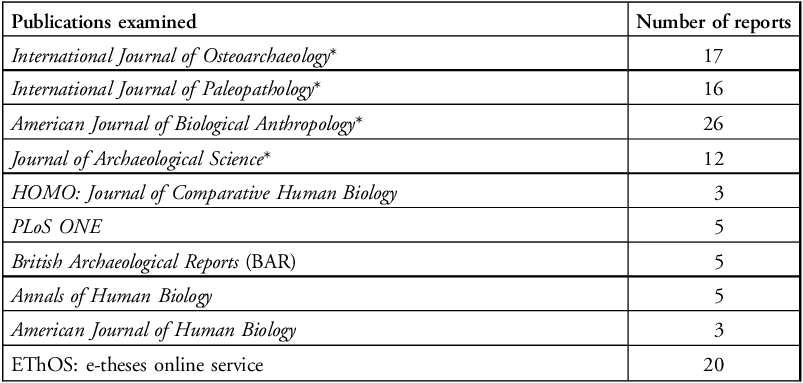
In 2011, Roberts and Mays reviewed 258 papers published between 1990 and 2009, that reported on the analysis of 352 prehistoric to post-medieval skeletal collections from across the UK. They recorded the location, period and size of the skeletal collections analysed and concluded that researchers were often attracted to large, urban medieval sites held in the south of England. We followed-up on this study, reviewing nine key bioarchaeology journals and PhD theses published between 2015 and 2023 (Table 1). This created a pool of 112 papers reporting on 380 instances when a skeletal collection had been researched. To avoid duplication, we removed multiple instances of the results using the same collection by the same authors being published (n = 140 instances), leaving us with a final dataset comprising 240 unique studies (Table S1). We did, however, note where additional chemical analyses from these sites were published.
Number of papers reporting on human remains.

Table 1 Long description
A table lists the number of reports from various publications examined. The table has two columns: Publications examined and Number of reports. The publications include International Journal of Osteoarchaeology with 17 reports, International Journal of Paleopathology with 16 reports, American Journal of Biological Anthropology with 26 reports, Journal of Archaeological Science with 12 reports, HOMO: Journal of Comparative Human Biology with 3 reports, PLoS ONE with 5 reports, British Archaeological Reports (BAR) with 5 reports, Annals of Human Biology with 5 reports, American Journal of Human Biology with 3 reports, and EThOS: e-theses online service with 20 reports.
* Journal also included in Roberts and Mays (Reference Roberts and Mays2011).
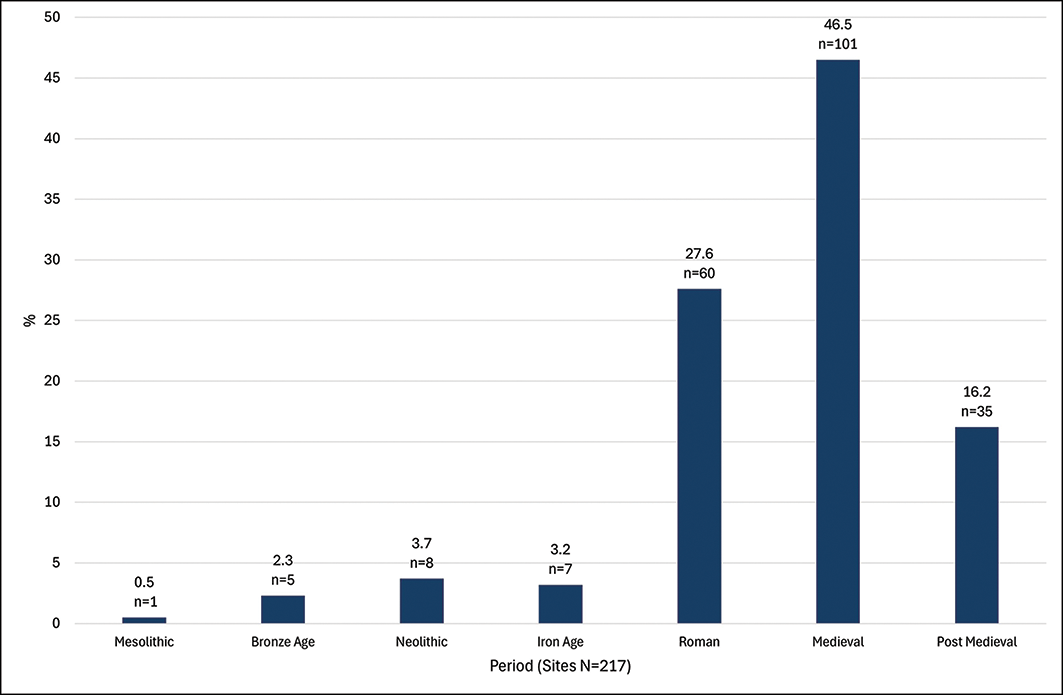
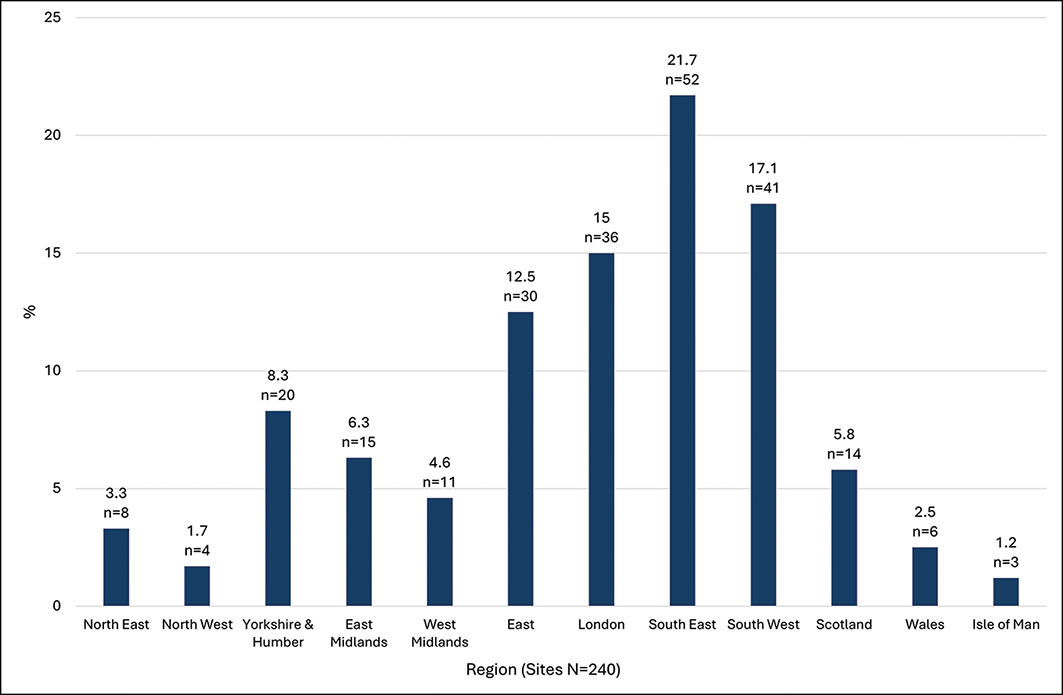
The sites selected for analysis paralleled Roberts and Mays’ (Reference Roberts and Mays2011) findings. The majority of the 240 studies (42.9%; n = 103) used medieval human remains (Figure 1). While the southern counties of London, the South East and South West made up 53.8 per cent (n = 129) of the study sites (Figure 2), slightly lower than the 60.6 per cent of southern sites calculated from the Roberts and Mays (Reference Roberts and Mays2011) data. The general continuation of this trend likely results from access to the same large collections. Resampling, usually for stable isotope or ancient DNA (aDNA) analyses, was similar. A total of 34.8 per cent of publications examined by Roberts and Mays (Reference Roberts and Mays2011) employed chemical techniques (the actual number was not stated) compared to 44.6 per cent (n = 107) of collections in our review, where 15 collections (6.3%) were resampled by different authors. While repeat sampling with the development of new techniques has value, it is important that this is driven by questions related to those specific sites, not just their availability.
The breakdown by period of sites identified in a review of papers published between 2015 and 2023. The majority date from the medieval period (figure by Rebecca Pitt).

Figure 1 Long description
The bar graph compares the percentage of sites identified in a review of papers published between 2015 and 2023 across different historical periods. The x-axis represents the periods: Mesolithic, Bronze Age, Neolithic, Iron Age, Roman, Medieval, and Post Medieval. The y-axis represents the percentage of sites. There are seven vertical bars, each representing a different period. The Mesolithic period has a bar at 0.5 percentage with 1 site. The Bronze Age has a bar at 2.3 percentage with 5 sites. The Neolithic period has a bar at 3.7 percentage with 8 sites. The Iron Age has a bar at 3.2 percentage with 7 sites. The Roman period has a bar at 27.6 percentage with 60 sites. The Medieval period has the highest bar at 46.5 percentage with 101 sites. The Post Medieval period has a bar at 16.2 percentage with 35 sites. The color scheme is a single dark blue color for all bars. The graph indicates that the majority of sites date from the Medieval period. All values are approximated.
The breakdown by geographic region of sites identified in a review of papers published between 2015 and 2023. More than half of sites (n = 129, 53.8%) are from southern counties (figure by Rebecca Pitt).

Figure 2 Long description
The bar graph compares the percentage of sites identified in various geographic regions of the UK, based on a review of papers published between 2015 and 2023. The x-axis lists the regions: North East, North West, Yorkshire and Humber, East Midlands, West Midlands, East, London, South East, South West, Scotland, Wales, and Isle of Man. The y-axis represents the percentage of sites, ranging from 0 to 25 percent. Each region has a vertical bar indicating its percentage, with the South East having the highest percentage at 21.7 percent and the Isle of Man the lowest at 1.2 percent. The bars are colored in dark blue, and each bar is labeled with the percentage and the number of sites (n) for that region. The graph highlights that more than half of the sites (53.8 percent) are from southern counties. All values are approximated.
Several improvements surrounding site use were identified. Roberts and Mays (Reference Roberts and Mays2011) noted that 91 per cent of analyses considered sites that contained over 100 inhumations, but this had declined to 42.9 per cent (n = 103) in our review, with researchers including smaller collections. Additionally, the frequency of ‘same site’ analysis widened: 14.8 per cent of publications (n = 52) used Christ Church Spitalfields, London, between 1998 and 2009, but the most frequently used site in our review (St Bride’s Farringdon, London) featured in just 2.4 per cent of publications (n = 9; Table S1). Researchers may be targeting a wider variety of sites deliberately to provide greater diversity, or this trend may be driven by necessity. Since 2011, several national museums have closed their collections while they move to new stores, and the Covid-19 pandemic delayed re-opening. This means many of the largest and most extensively studied collections have been unavailable for several years, potentially forcing bioarchaeologists to seek out lesser-known sites. Facilitating the research of regionally diverse and smaller sites is imperative if this trend is to continue once access to well-known collections is restored.
Lost collections
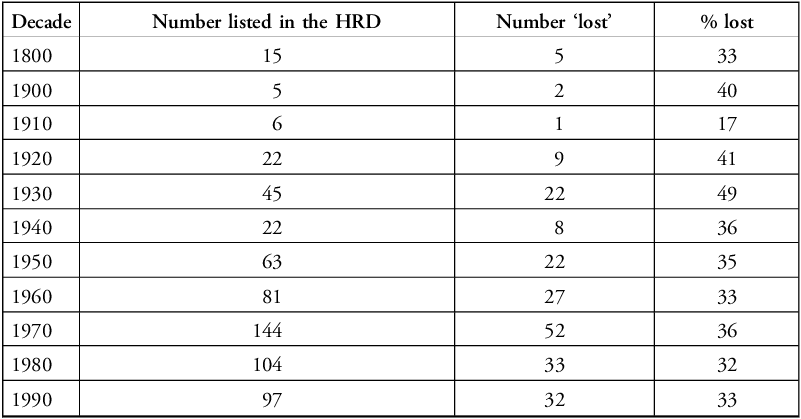
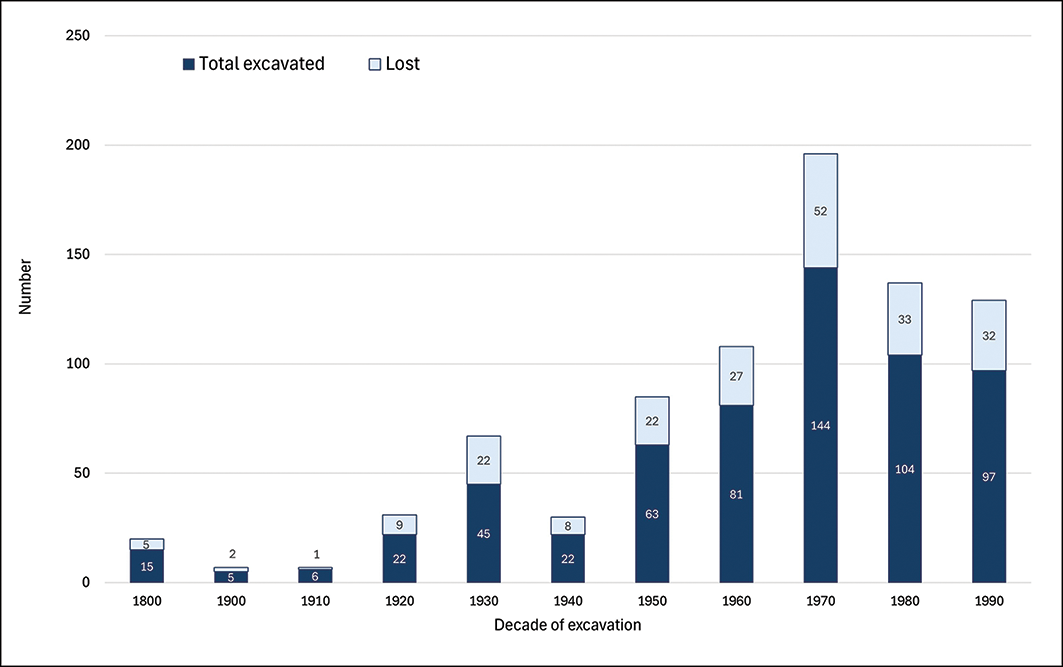
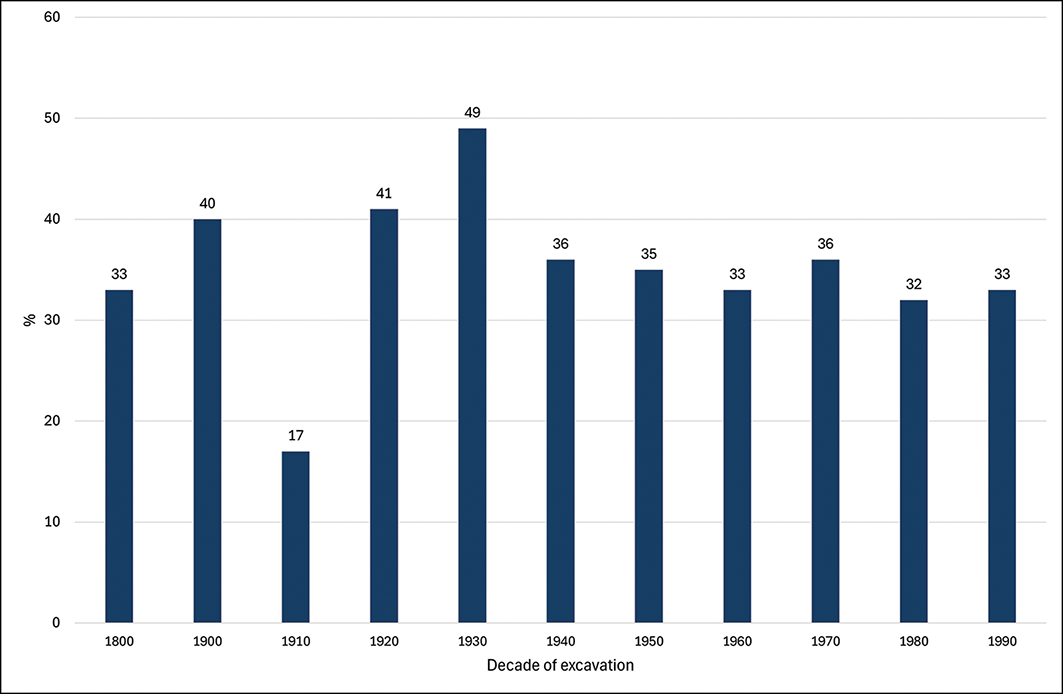
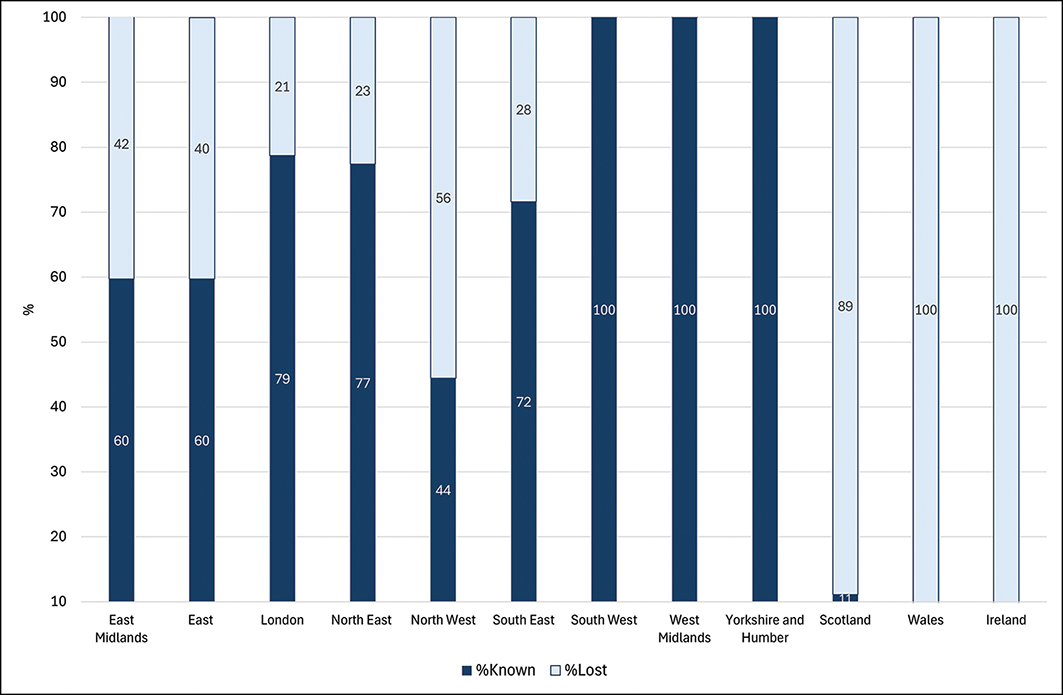
The number of collections included in the HRD categorised as ‘lost’ (e.g. lacking details of where they are located) were examined by decade and region to measure the impact on a comprehensive understanding of past lives in the UK (Table 2, Figures 3 & 4). Most sites listed in the HRD were excavated in the 1970s, corresponding to the rise of commercial archaeology. This pre-dates PPG16, which may explain why this period also has 52 (36%) lost collections out of the 144 excavated. It is excavations from the 1930s, however, that have the highest proportion of collections unaccounted for (49% or 22 of 45 collections missing). At least 20 per cent of collections from each UK region are lost, with 70 per cent of collections from Cumbria (North West) excavated before 2008 having no listed location in the HRD (Figure 5). A surprising result is for Kent in the South East, where the location of 52 per cent of collections (24 of 52 sites excavated) is missing. While sites in Scotland, Wales and Ireland are poorly represented, this likely reflects the origin of the database, which collated sites that came through the Ancient Monuments Laboratory in England.
Number and percentage of sites yielding human skeletal remains listed in the Human Remains Database (HRD), by decade of excavation (when known), with number and percentage of sites ‘lost’.

Table 2 Long description
The table presents data on the number and percentage of sites yielding human skeletal remains listed in the Human Remains Database (HRD) by decade of excavation and the number and percentage of sites lost. The table has 10 rows and 4 columns. The columns are labeled 'Decade', 'Number listed in the HRD', 'Number lost', and 'Percentage lost'. The decades range from 1800 to 1990. Notable trends include the highest percentage of lost collections in the 1930s (49%) and the largest number of lost collections in the 1970s (52). The data highlights significant gaps in the records, particularly in earlier decades and specific regions like Cumbria and Kent.
Sites listed in the HRD by decade of excavation (when known), with numbers excavated (total = 604) and ‘lost’ (total = 213). The 1970s saw more sites excavated and subsequently ‘lost’ than any other decade (see Table 2) (figure by Mary Lewis).

Figure 3 Long description
The bar graph compares the number of sites excavated and lost by decade from 1800 to 1990. The x-axis represents the decades of excavation, while the y-axis represents the number of sites. The graph features stacked bars, with the lower dark blue section indicating the total number of sites excavated and the upper light blue section showing the number of sites lost. Key decades include the 1970s, which saw the highest number of sites excavated and lost, with 144 sites excavated and 52 lost. Other notable decades include the 1980s and 1990s, with 104 and 97 sites excavated, respectively, and 33 and 32 sites lost. Earlier decades, such as the 1800s and 1900s, show significantly lower numbers, with only 15 and 5 sites excavated, respectively, and 5 and 2 sites lost. The graph highlights a trend of increasing excavation and loss of sites over time, with a peak in the 1970s. All values are approximated.
Percentage of ‘lost’ sites listed in the HRD by decade. Nearly 50 per cent of sites yielding human remains in the 1930s are missing (see Table 2) (figure by Mary Lewis).

Figure 4 Long description
The bar graph compares the percentage of lost sites listed in the Human Remains Database by decade from 1800 to 1990. The x-axis represents the decades of excavation, starting from 1800 and ending in 1990. The y-axis represents the percentage of lost sites, ranging from 0 to 60 percent. There are ten vertical bars, each representing a decade. The bars show the following percentages: 33 percent for 1800, 40 percent for 1900, 17 percent for 1910, 41 percent for 1920, 49 percent for 1930, 36 percent for 1940, 35 percent for 1950, 33 percent for 1960, 36 percent for 1970, 32 percent for 1980, and 33 percent for 1990. The highest percentage of lost sites is observed in the 1930s at 49 percent, while the lowest is in the 1910s at 17 percent. The color scheme of the bars is a solid dark blue. The graph highlights that nearly 50 percent of sites yielding human remains in the 1930s are missing. All values are approximated.
Percentage of ‘lost’ sites listed in the HRD by region. Only in the South West, the West Midlands and Yorkshire and Humber are all sites excavated up to 2008 accounted for (see Table S2) (figure by Mary Lewis).

Figure 5 Long description
The bar graph compares the percentage of known and lost sites listed in the Heritage Resource Database across different regions. The regions include East Midlands, East, London, North East, North West, South East, South West, West Midlands, Yorkshire and Humber, Scotland, Wales, and Ireland. The bars are vertical and stacked, with the x-axis representing the regions and the y-axis representing the percentage. The dark blue sections of the bars indicate the percentage of known sites, while the light blue sections indicate the percentage of lost sites. For example, in the East Midlands, 60 percentage of sites are known, and 42 percentage are lost. In the South West, West Midlands, and Yorkshire and Humber, all sites excavated up to 2008 are accounted for, showing 100 percentage known sites and 0 percentage lost sites. Scotland has 89 percentage known sites and 11 percentage lost sites. All values are approximated.
These gaps in site data align with our research article review, highlighting regional under-resourcing, with publications on human remains from the south of England outweighing those from the north or the Midlands. These data suggest that 10s of thousands of our uninterred predecessors are languishing somewhere in the UK having never been fully recorded. By contrast, a small fraction, mostly from the London or Yorkshire areas, are subject to repeated reanalysis (Roberts & Mays Reference Roberts and Mays2011). The profile of lost collections is stifling research on regional groups and contributing to the overuse of and damage to better-known ones. Bone is friable, and constant handling results in wear that increases with time (Caffell & Jakob Reference Caffell, Jakob and Squires2020). Researchers have a duty of care to analyse smaller regional sites, both to enrich our understanding of the human past, and to protect our non-renewable heritage.
Legal and professional implications
Acts of law pertaining to human remains in the UK include the Human Tissue Act (2004, 2006; https://www.legislation.gov.uk/ukpga/2004/30/contents), which defines how human tissues under 100 years old can be researched and displayed, and the Freedom of Information Act (2000) (https://www.legislation.gov.uk/ukpga/2000/36/contents), which requires the disclosure of information held by public institutions, including human remains. For exhumations, the Burial and Cremation (Scotland) Act 2016 (https://www.legislation.gov.uk/asp/2016/20/contents), Burial Grounds Regulations (Northern Ireland) 1992 Act (https://www.communities-ni.gov.uk/articles/revised-policy-guidance-exhumations) and the Burial Act (1857, Section 25) (https://www.legislation.gov.uk/ukpga/Vict/20-21/81/section/25) dictate that the excavation of human remains in the UK requires a licence. In England, these are issued by the Ministry of Justice and a Faculty is required if the remains are on land belonging to the Church of England. A Ministry of Justice licence requires a justification for the excavation and information on whether the human remains will be assessed, studied and/or reburied (Section E37a of the licence), or deposited in a named museum or similar institution long term (Section E37b), if known at the time of excavation (Section E37c). Licences cannot be applied for retrospectively if human bone is discovered during post-excavation processing (Mays & Payne Reference Mays and Payne2006). There is no requirement to report when remains are moved to a location other than that listed on the licence. A record of reburial at the end of the licence is not required, nor is there any obligation for osteological data to be freely available online (Open Access). The Ministry of Justice retains a record of the licence for five years, or 10 years when reburial is deferred under Section E37a (Ministry of Justice Coroner’s Office pers. comm. 2025), but that is where the trail ends. There is no permanent record of the fate of these human remains. The information required for a Faculty (via the Diocesan consistory courts) varies by Diocese. There is a general presumption against the disturbance of human remains, and that after a specified time for research, remains will be reburied as close as possible to their original resting place (APABE 2017: 7).
In September 2000, the UK ratified the Council of Europe’s (1992) Valetta Convention. This dictates that all archaeological heritage (including human remains) be protected, made available for scientific study, and that a basic report is produced prior to storage or reburial (Council of Europe 1992). Additionally, the UK’s National Planning Policy Statement 5: planning for the historic environment (2010: 30; https://www.legislation.gov.uk/ukia/2010/119/pdfs/ukia_20100119_en.pdf) dictates that “the ability to access comprehensive and up-to-date sources of information about the historic environment … is of direct benefit to … academic researchers, local societies, amateur historians/archaeologists, teachers, students and interested members of the public – as well as to historic environment professionals”.
A better understanding of current holdings of UK-derived human remains, and their use to further scientific knowledge about the past, should therefore be considered mandatory.
Ethical implications
Given recent debates around the excavation, analysis, curation and sale of human remains (Bennett & Cant Reference Bennett and Cant2024; Squires et al. Reference Squires2025a & Reference Squiresb), where, why and how they are curated is of ethical concern. The skeletal remains of past people require special care at every stage of their handling. As professionals, we have a duty to know where these remains are, to ensure they are being treated with dignity and respect, and to make certain they are protected.
Many guidelines govern ethical practice in the curation of human remains, both in the UK and internationally, although these are often not enforced by law. Professional bodies (e.g. the British Association for Biological Anthropology and Osteoarchaeology (BABAO), the American Association of Biological Anthropology, the Paleopathology Association, the Council for British Archaeology, the Advisory Panel on the Archaeology of Burial in England) have online codes of ethics and best practice, to provide advice about the treatment of human remains with dignity and care, and on their preservation for future research (e.g. BABAO 2019, 2025). In the UK, museum guidelines allow for remains to be retained to further public education through their study and display, and state that they are vital for the education of medical and osteology students (DCMS 2005: Section 2.10; SMA 2020). In addition, collections should be made as freely available as possible but not repeatedly sampled for the same type of study (Woodhead Reference Woodhead and Giesen2013; ICOM 2017). The curation of UK-derived human remains by museums without any public record that facilitates their analysis contravenes the requirement for these remains to be accessible as a provision of their retention.
While none of these current guidelines specify the need for skeletal data to be made Open Access, we have a moral obligation to ensure data are FAIR (findable, accessible, interoperable and reusable) and adhere to CARE (collective benefit, authority to control, responsibility and ethics) principles (Wilkinson et al. Reference Wilkinson2016; Nicholson et al. Reference Nicholson2023; Lien-Talks Reference Lien-Talks2024). Archaeologists and bioarchaeologists share a moral imperative to keep proper records of the excavation, analysis, movement and reburial of human remains.
Towards a centralised human-remains database
We currently lack a permanent central record of human remains excavated within the UK. Given the reliability and widespread use of OASIS in creating modules for specialised archaeological data (e.g. Roushannafas et al. Reference Roushannafas2024), the development of a centralised database for UK-derived human remains must proceed in co-ordination with OASIS and the ADS. The creation of an OASIS+ ‘Human Remains module’ would provide a bespoke, sustainable, updatable, searchable and comprehensive archive of human remains excavated in the UK, with an imperative that all our legacy data be included.
A robust data-management system will enable our heritage to be traced and registered, unlocking potential for future researchers, while protecting collections from damage due to resampling and reanalysis. It would facilitate high-quality research and funding applications, helping to maintain the UK’s reputation for research excellence and teaching. Better access to data will ensure inclusion and equity across research groups and institutions. It will also assist collaboration between museum, commercial and academic sectors. A centralised database will help inform planning processes and decisions on retaining or reburying collections, both immediately after excavation, and for those in long-term storage (McKinley Reference McKinley and Giesen2013; Roberts Reference Roberts and Giesen2013). The database should integrate regional databases, and eventually link aDNA and isotope datasets (e.g. IsoArcH) for these remains (Lien-Talks Reference Lien-Talks2024). A requirement to attach the Faculty or Ministry of Justice licence would mitigate the current loss of these records after five years.
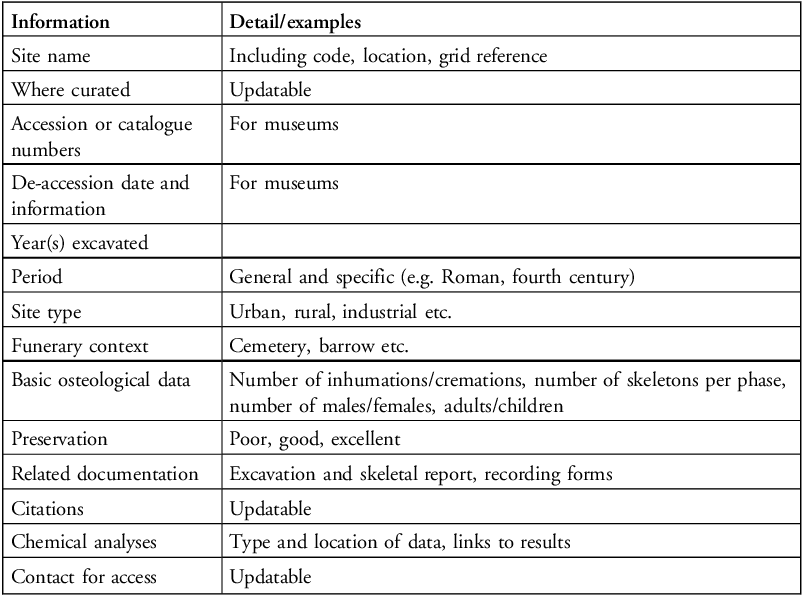
This is not a new suggestion. In 2013, Charlotte Roberts argued that there was a ‘desperate need’ for a centralised database to allow researchers to access more sites, and spread the load for curating organisations hosting popular collections. Roberts (Reference Roberts and Giesen2013: 228) called for relevant information to be freely accessible and updated regularly. Giesen and colleagues (Reference Giesen and Giesen2013: 60) added that such a database would need to be “robust enough to cater for multiple interests and needs”. The information to be included in the database was outlined by Roberts and Cox (Reference Roberts and Cox2003: 401–402, tab. 1) 10 years earlier (see Table 3).
Information needed in a centralised database for UK-derived human remains (after Roberts & Cox Reference Roberts and Cox2003: 401–402, tab. 1).

Table 3 Long description
The table presents a structured format for a centralised database designed to manage information about UK-derived human remains. It includes columns for various types of information such as site name, where curated, accession or catalogue numbers, de-accession date and information, year(s) excavated, period, site type, funerary context, basic osteological data, preservation, related documentation, citations, chemical analyses, and contact for access. Each row specifies the type of detail or examples required for each category, ensuring comprehensive data collection. For instance, the site name includes codes, locations, and grid references, while the period specifies general and specific timeframes like Roman or fourth century. The table aims to standardize the recording and accessibility of data related to human remains, facilitating research and curation efforts.
Such a dataset would be a great benefit to students, academics, commercial osteoarchaeologists, museum professionals, cultural communities, government and repository policy makers, grant applicants and international colleagues (Giesen et al. Reference Giesen and Giesen2013; Roberts Reference Roberts and Giesen2013). Currently, most research projects start with the time-consuming process of trying to locate collections. A centralised database would allow for more effective use of resources, and save time when searching for suitable skeletal remains for studentships and grant applications. Similar databases have been created in other countries. In Flanders, Belgium, De Groote and colleagues (Reference De Groote2023), managed to locate 70 (10%) missing collections. This collaborative effort now means that information is provided on whether recording sheets, excavation records and a basic skeletal report are available, if there are any retained soil samples relating to the skeleton, and whether any destructive analysis has occurred (MEMOR; www.memor.be).
The task of creating a centralised database for UK-derived human skeletons is, of course, huge, but there are ways to minimise the difficulties. Collection managers and archivists face many challenges and responsibilities when researchers attempt to locate lost skeletal collections. While this database would pertain to human remains from UK excavations that are not subject to possible repatriation, we need to ensure that institutional staff are not subjected to pressure, criticism or other harassment, which may arise in relation to the provision of information and access to holdings. To ease the workload, we must build links with existing frameworks (OASIS, ADS) and legacy datasets to help avoid duplication of effort. We could use our growing body of talented postgraduate researchers and funded PhD placements to help smaller museums identify and inventory their holdings. This would provide vital work experience, making bioarchaeologists more aware of pressures on the museum sector, promoting greater cross-sectoral understanding.
Should we succeed, the advantages are numerous. Curators could make researchers aware of their holdings and ensure they are better managed and accessed. Researchers working in the stores could monitor the state of curated material and environmental conditions, helping identify the need for upgrades or maintenance. This would keep catalogues current through consistent use and reinterpretation. While these are important goals, we should recognise the risk of misuse and misrepresentation of information in the database and take steps to ensure that it is accurate and current, providing a date for each entry and update. Procedures should ensure that information is used for legitimate purposes (planning or undertaking a relevant project) and treated respectfully.
Conclusions
Archaeologists, bioarchaeologists, lawmakers, museum professionals and local governments have a moral obligation to protect the remains of our predecessors. Human remains are a non-renewable resource, but are vital for training, education and research about humanity in the past. Local communities have the right to question why these remains are retained if they are not available to scientific analysis, a condition of their retention under the Ministry of Justice licence and the Valetta Convention. To fulfil our legal, ethical and research obligations, we need a robust regional research framework for human remains. To achieve this, we need to locate these vital parts of our heritage, and build a workable, sustainable, centralised national database that can store information about our legacy remains, and future cemetery excavations. Such a database would mitigate the overuse of specific collections, relieve curator burdens, save vital research time in tracking down collections and promote cross-sectoral collaboration. The skeletons in our care are people who were buried with due ceremony, perhaps by those who loved them. We exhume them to make room for our modern lives, and we must make efforts to better understand theirs.
Acknowledgements
We thank the Coroner’s Office for their kind response to our queries regarding exhumation licences, Louise Humphrey (Natural History Museum, past Chair of the Advisory Panel on the Archaeology of Burial in England) for her insights into the moral imperatives of a centralised HRD, and Hella Eckardt, Duncan Garrow and Alanna Cant (University of Reading) for their comments on previous drafts of this article.
Funding statement
This research was funded in part by an AHRC Accelerator Account awarded by the University of Reading.
Online supplementary material (OSM)
To view supplementary material for this article, please visit https://doi.org/10.15184/aqy.2026.10328 and select the supplementary materials tab.


 Open access

