





Policy Significance Statement
For policymakers, a digital rights-focused approach to urban data and night-time economy data might enable compliance with current data-related legislation, as well as provide tools to navigate an ever-changing technological landscape. The adoption of big data systems in cities raises questions and concerns about privacy, data protection, and inclusion. Here, a framework aimed at facilitating the principles policymakers should consider when dealing with urban and nightlife data is presented. Night-time economy is an emerging topic that draws increasing attention from local governments, offering an opportunity to work toward more inclusive cities in the age of datafication. This research invites policymakers, night-time economy advocates, and digital rights specialists to share lessons, learn together, and build bridges between often siloed practices and disciplines.
1. Introduction
As data becomes a pivotal component of urban governance, the night-time economy is still barely visible in datasets or in policies to improve urban life. In the last 20 years, over 50 cities worldwide appointed night mayors or other mechanisms of nocturnal governance (Seijas and Gelders, Reference Seijas and Gelders2020) to handle conflicts, foster innovation, and help the night-time economy sector to grow. However, the intersection of data, digital rights, and 24-hour cities still needs more studies, examples, and policies. Here, the key argument is that the increasing importance of the urban night in academia and local governments (Straw, Reference Straw2020) claims for much-needed responsible data practices and expansive definitions of “valid data” to support and protect nightlife ecosystems (Bélanger et al., Reference Bélanger, Reia and Straw2020). By better understanding these ecosystems and addressing data invisibilities, it is possible to develop a robust framework anchored in safeguarding human rights in the digital space, as well as create comprehensive policies that can help these ecosystems thrive.
The emergence of a field called “Night Studies” over the last two decades brought to light a set of reflections on how urban governance is applied to the 24-hour cycle (Gwiazdzinski and Straw, Reference Gwiazdzinski and Straw2015; Straw and Pearson, Reference Straw and Pearson2016; Gwiazdzinski et al., Reference Gwiazdzinski, Maggioli and Straw2020; Kyba et al., Reference Kyba, Pritchard, Ekirch, Eldridge, Jechow and Preiser2020; Mercado-Celis and González, Reference Mercado-Celis and González2020; Straw, Reference Straw2020), and there are calls for a “science of the night” (Acuto, Reference Acuto2019) that also informs evidence-based night-time policymaking. Even when the increasing datafication of urban spaces has impacted the city after dark, this aspect of urban life is rarely addressed by the overlapping debate of data and policy beyond public lighting and surveillance in smart cities. The importance of the cultural sector to the economic and social development of cities is still overlooked, lagging behind other areas of urban governance when it comes to open data.
Beginning in the 1990s, various actors had pushed cities to acknowledge the role of their night-time economies in fostering economic growth and attracting tourist spending (Talbot, Reference Talbot2007). From 2000 on, municipalities seeking to develop their nights or resolve the conflicts that increasingly made the urban night a contentious time had developed a range of governance instruments—from night mayors and night councils to comprehensive multisectoral policies (Seijas and Gelders, Reference Seijas and Gelders2020; VibeLab, 2021).
For years, discussions of the night have happened in isolation from discussions of data policy (Goelzer, Reference Goelzer2022) and frameworks of urban intelligence (Mattern, Reference Mattern2017). The lack of data focusing specifically on the night-time economy and broader analyses of the impact of a smart city agenda beyond daylight leave stakeholders—such as municipal governments, small business owners, neighbourhood associations, night-shifters, advocates, and communities—navigating challenging circumstances without crucial information.
As it will be portrayed throughout this article, the urban night is a complex ecosystem encompassing policies and data related to mobility, healthcare, media, culture, entertainment, service industries, social services, and much more. Following a decade in which the night of cities was a significant focus of interest for several stakeholders, the recent closing down of the night-time economy during the COVID-19 pandemic (Straw and Reia, Reference Straw, Reia, Denis, Régis and Weinstock2021; McCormack and Measham, Reference McCormack2022) increased the need to reshape policies around nocturnal data. In the context of post-pandemic recovery (Petrovics et al., Reference Petrovics, Seijas, Catherall, Reia and Straw2021), various efforts came together to rethink how to measure, understand, and evaluate the night, engaging specialists and advocates that include city administrators and urban planners, data practitioners, cultural institutions, independent artists, venue owners, and scholars.
While certain cities rely heavily on big data to understand and manage their territories in real-time,Footnote 1 the lack of reliable (open and public) government data assets to comprehend the night is still an issue and citizen-generated data is often dismissed as a relevant tool to improve nocturnal policies. However, as much as real-time data is needed, just making the night visible in open datasets or deploying data-centric automated systems in urban spaces—especially those focused on artificial intelligence (AI) systems—to improve efficiency is not enough. This process requires a robust digital rights (Taylor, Reference Taylor2017) framework and a responsible, just and ethical approach to big data (Davis et al., Reference Davis, Williams and Yang2021), to avoid over-policing (Maynard, Maynard, Reference Maynard2017) and controlling marginalized communities whose visibility as data points and subjection to thoughtless policies will reproduce historical inequalities (Benjamin, Reference Benjamin2019; Reia, Reference Reia, Fernandes, Reia and Gomes2021). The fear of being visible to law enforcement is more common among communities at the margins of our cities and regulatory systems, such as sex workers, LGBTQIA+ individuals, precarious labourers, and the unhoused (Talbot, Reference Talbot2007; Kolioulis et al., Reference Kolioulis, Siravo, Apostolidis, Kummer-Buléon, Matheou and Campani2021).
Considering this multifaceted context, the primary goal of this article is to present a digital rights-centred approach to using data for night-time governance in cities. It consists of an exploratory framework drafted based on fieldwork conducted in Montreal, Canada, with lessons in policy and practice that have the potential to be replicated (and redesigned) by local governments.
In an attempt to address some of the concerns in data justice for the night and create a roadmap to cities, this article is guided by three research and policy questions:
-
(1) What is night-time governance, and what is the role of data in its development?
-
(2) Why is night-time governance relevant to the data policy community?
-
(3) What are the main principles and practices for designing a digital rights framework for 24-hour cities?
The article is divided into four parts. The first part is a comprehensive discussion of the methodological framework that guided this work. The second presents a brief introduction to the interdisciplinary field of Night Studies, followed by a third part covering the various definitions and particularities of night-time data. The fourth and last part presents an exploratory framework for digital rights, data practices, and the night.
2. Methodological framework
The findings presented in this article are based primarily on fieldwork related to a three-year applied research project that aimed to understand responsible data science practices for night-time governance in Montreal.Footnote 2 It also benefited from the author’s two years of practice as a member of the MTL 24/24’s Night Council in the same city, allowing the engagement with various policies, such as the Digital Data Charter (LIUM, 2020), the nightlife policy (Ville de Montréal, Reference Ville de2024), and efforts to make datasets available through the city’s open data portal.Footnote 3
Given the scope and timeframe of the project and the challenge of studying a complex object, such as the nightlife ecosystem of a large city, a combination of research methods was the chosen approach. The research methods can be divided into four components:
-
(1) A comprehensive scholarly and grey literature review encompassing national and international analysis of night-time governance and nightlife scholarship and scholarship on data justice, critical data studies, and responsible data science. The sources used include refereed journal articles, books, edited volumes, essays, and news articles. This component was crucial to inform the principles guiding the digital rights framework.
-
(2) Legal and policy analyses of relevant official documents, laws, draft bills, roadmaps, frameworks, working groups, policy recommendations, white papers, and reports published by industry, government, and civil society. This component offered insights about the current status of open data portals and regulations regarding data that touch upon relevant topics for nighttime governance, as well as best practices that can be incorporated into the digital rights framework
-
(3) To fill in the gaps in the literature and understand the politics at the intersection of nighttime governance and data, fieldwork was carried out between mid-2019 and mid-2022. It involved semi-structured qualitative interviews with key actors and participant observation during policy design processes and at festivals, conferences, and other nighttime governance events. The findings related to this component helped to understand the kind of data that is considered valid and important by various stakeholders.
-
(4) A practice and applied approach based on the author’s involvement in night councils, working groups, and consultancy, which included policy recommendation, multi-stakeholder cooperation, and public interest advocacy. The practical experience acquired with the proximity to government representatives and residents was fundamental to drafting a framework rooted in the needs of the the nocturnal communities and decision-makers.
A significant part of this project was dedicated to translating research findings to broader audiences (Bélanger et al., Reference Bélanger, Reia and Straw2020; Petrovics et al., Reference Petrovics, Seijas, Catherall, Reia and Straw2021), including policymakers and citizen-centred initiatives. Navigating different contexts through a discussion anchored in data justice and digital rights allowed the author to contribute to policy recommendations and participate in drafting regulatory frameworks, reports, multisectoral panels, and best practices on how to make urban data available to multiple stakeholders without further harming historically marginalized communities.
There were many challenges and limitations in doing this work. The main challenges are related to external circumstances, ethical principles, and the responsibility of collecting and making data available to decision-makers. The project was deeply impacted by the COVID-19 pandemic; the lockdowns and curfews had a lasting effect in Montreal and Quebec, with the night-time economy coming to a halt for a long period. Many activities took place virtually, including the working groups organized by the city government. The paradox of co-creating a nightlife policy during a pandemic that paused most night-time activities is intertwined in this project, shaping interactions, research methods, and outcomes. Here, the concept of “data invisibility” frames the efforts to make data available to multiple stakeholders in accordance with ethical, just, and responsible guidelines that keep certain individuals and groups safely invisible. The night-time economy encompasses various marginalized communities and informal activities; making them visible should only be done with meaningful consent and a human rights-based approach. For instance, it was necessary to find ways to provide relevant data about alternative night cultures to the city government and, at the same time, not pinpoint such activities in a map or include identifiable information that could lead to the crackdown on such spaces.Footnote 4
3. Night studies: an interdisciplinary field of research, policy, and advocacy
The increasing relevance of the night in scholarship, conferences, summits, and policy (Straw, Reference Straw2020), is reflected by its presence in various spaces, from the Organization for Economic Co-operation and Development (Seijas et al., Reference Seijas, Barnett and Salihudin2024) to MasterCard’s City Possible and music festivals like SXSW.Footnote 5 The consolidation of “Night Studies” as an interdisciplinary field over the last 15 years brought to light a set of considerations on how urban governance is applied to the city after dark and who should be responsible for it. Since the 1990s, various efforts have pushed cities to acknowledge the role of their nightlife in fostering economic growth and attracting tourist spending (Hae, Reference Hae2012). From 2000 on, municipalities seeking to develop their nights or resolve the conflicts that increasingly made the night a contentious time had developed a range of governance instruments. Today, over 50 cities across the world have appointed night mayors (sometimes called night ambassadors, delegates, or czars), night councils, and special offices dedicated to the city after dark (Seijas and Gelders, Reference Seijas and Gelders2020).
Some of these night mayors became influential voices in night-time governance, such as Mirik Milan, who took office in Amsterdam in 2012, and came from the music and entertainment industry, viewing their role as raising awareness among public administrators about the relevance of the night for the cities. Typically, these individuals work with municipal authorities to reduce violence, mitigate noise, and mediate other sources of problems affecting the residents. In other cases, such as that of Amy Lamé, the night czar of London since 2016, these individuals are appointed by the government to oversee night-time culture, often in the context of concerns about the economic decline of the sector, making the nocturnal city more inclusive (Campkin and Marshall, Reference Campkin and Marshall2018).
In Canada, the first individual appointed to such a position was the “Night Economy Ambassador” in Toronto, created and filled in November 2019. Ottawa’s government hired a night mayor in 2024 and, according to the press at the time the job was posted, “one of the recommendations called for the establishment of a ‘Nightlife Commissioner Office,’ with the so-called ‘night mayor’ tasked with working with businesses, city officials, regulators, and the public to develop a plan to support Ottawa’s nightlife” (Pringle, Reference Pringle2024). In the United States, cities are quickly appointing night mayors or equivalent: Philadelphia has a director of night-time economy (Albertine, Reference Albertine2023), Washington D.C. has an Office of Nightlife and Culture,Footnote 6 and there is a Night Czar in Boston (Rex, Reference Rex2023).
Even if most of these cities are located in the Global North, it’ is worth noting that several cities in the Global South have other mechanisms for managing the night or have attempted to adapt this model to their territories. For instance, Valparaíso in Chile appointed a Nocturnal Delegate (“Delegado Nocturno”) in 2017, and Cali in Colombia had a Night Manager (“Gerente de la Noche”). Meanwhile, San Luis Potosí in Mexico has an independent “Night Mayor” (“Alcadesa de la Noche”). The city of Bogotá in Colombia wrote a comprehensive report about its night-time economy (Alcaldía Mayor, B de Alcaldía Mayor, 2019), including data from different sectors such as transportation, labour, tourism, and culture. Since 2022 Bogotá has been leading a network of 24-hour cities in partnership with industry and other municipalities.
Historical accounts of the night include research on the process of public lighting and electrification of streets (Nye, Reference Nye2018) that extended the time people could spend outside (Schlör, Reference Schlör2016), mobility at night (Beaumont, Reference Beaumont2016) and forms of nighttime sociability—such as those normally associated with bohemian or subcultural lifestyles (Chatterton and Hollands, Reference Chatterton and Hollands2003). The “[e]lectrification, industrialization, and capitalism have altered humanity’s experiences with night as both a time and place” (Kyba et al., Reference Kyba, Pritchard, Ekirch, Eldridge, Jechow and Preiser2020), and the urban night is becoming the subject of discussions around our future, from concerns about inclusion in public spaces to its relation to environmental issues like light pollutionFootnote 7 and climate change (Gwiazdzinski, Reference Gwiazdzinski and Straw2015).
Given the lack of accurate data about the night in many cities, policymakers, scholars, and practitioners have been resorting to archives (institutional and born-digital), police records, newspaper articles, and citizen-generated data for more consistent documentation of the night as a complex ecosystem. Humanistic perspectives on the city after dark are crucial to Night Studies, especially by bringing to light the voices of marginalized communities (DeGuzmán, Reference DeGuzmán2012; May, Reference May2014). In parallel, calls for a “science of the night” (Acuto, Reference Acuto2019) that informs evidence-based night-time policymaking emerge, with individuals and organizations seeking the authority of numbers—and, increasingly, big data—to justify investments and support of nightlife in cities. The claims for making more data-informed decisions for the night are increasingly polarized between “small” and “big” data, becoming more prominent in the context of post-pandemic recovery (Straw and Reia, Straw and Reia, Reference Straw, Reia, Denis, Régis and Weinstock2021; Petrovics et al., Reference Petrovics, Seijas, Catherall, Reia and Straw2021). For example, when Montreal appointed Deborah Delaunay as the “Commissioner of Noise and Night” (“Commissaire de Bruit & Nuit”), the position was located in the Department of Economic Development, and one of the first tasks was to create an inventory of all available data related to nightlife (Reia, Reference Reia, Fernandes, Reia and Gomes2021).
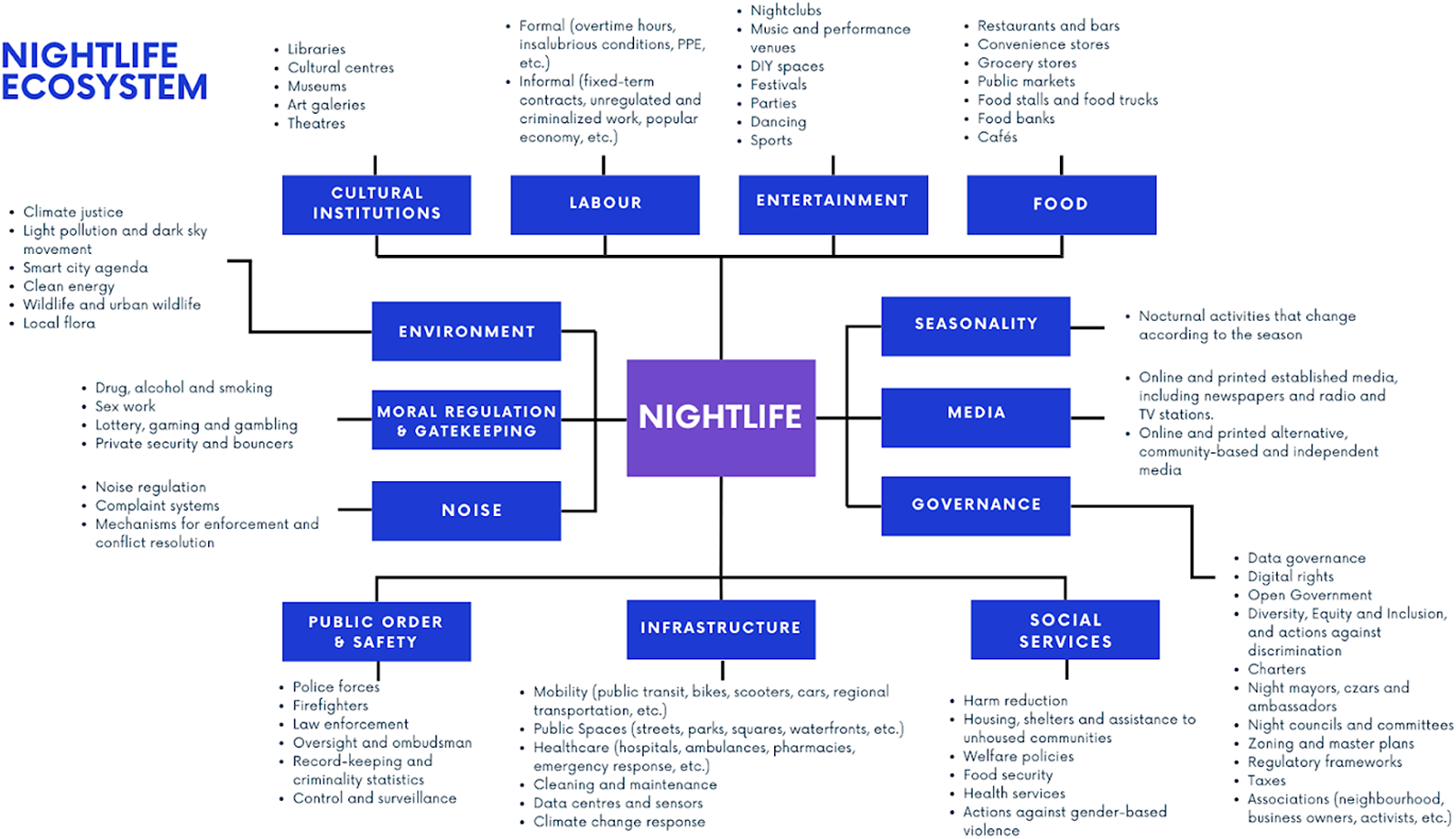
Figure 1 below details nightlife as a complex, ever-changing ecosystem. It was created over the years based on fieldwork and improved with feedback from city government representatives, scholars from different countries, and nightlife advocates. The nightlife ecosystem gives us a much-needed overview of how complex night-time data and governance are.
A systematization of the nightlife ecosystem. Created by the author.
4. Night-time data
The status of data concerning the nighttime of cities has been shaped by two real or perceived features of the urban night. One is the longstanding treatment of the night as a period defined principally through its associations with criminality, danger and moral transgression (Pulido Llano, Reference Pulido Llano2016). This has meant that many of the key sources of data on the nighttime activity of cities are to be found in police records, public investigations of morality, journalistic reporting on crime and other sources which emphasize the night’s supposed tendency to stimulate criminality (Talbot and Böse, Reference Talbot and Böse2007).
Another factor restricting the availability of data has been the ephemerality of nighttime activity, particularly in the cultural realm. The culture of the night is very often a culture of punctuated events rather than of enduring institutions. To recover a history of these events, one must typically search through the fleeting list of nighttime options published in specialized and often short-lived media. Early historians of LGBTQIA+ nightlife, for example, found themselves having to go through police records to identify places of queer sociability (Kunzel, Reference Kunzel2018), or looking for short-lived, often underground publications (Sermol, Reference Sermol2022) which were not, until recently, collected by official archives. This ephemerality has been magnified in the age of digital data, where apps offering lists of nighttime activity typically update and erase older data such that it can be recovered only through the use of internet archive platforms or forensic procedures.
The negotiations around the meanings and boundaries of “valid data” were crucial for those inhabiting the city after dark. Depending on individuals’ social identities, there is tension between being visible and remaining hidden from official counts—which I call “data invisibilities.” The fear of being visible to law enforcement is more common among communities at the margins of our cities and regulatory systems, such as sex workers, LGBTQIA+ individuals, precarious labourers, and the unhoused (Talbot, Reference Talbot2007; Kolioulis et al., Reference Kolioulis, Siravo, Apostolidis, Kummer-Buléon, Matheou and Campani2021). Different cities face the issues differently, but there are overarching questions that are relevant regardless of geography (Blum, Reference Blum and Sloan2007). As “Night Studies” and night-time governance mechanisms are put in place, there is an opportunity to reshape data policies from a new perspective, informing other areas of research and practice and engaging communities in the process.
Citizen-generated data and community-based data collection offer insights into data invisibility, where big data often cannot reach, therefore becoming an important resource for inclusive nocturnal governance in cities. The definition of “meaningful” or “valid” data is shaped by both the technologies used to collect, store, and analyze it—and who performs these tasks: community-based informal data collection (Ahluwalia et al., Reference Ahluwalia, Bean, Chachram, Chan, Cheang and Cheng2022) or governments pursuing the establishment of official numbers (Bouk et al., Reference Bouk, Ackermann and Boyd2022). Community-based informal data collection practices can be considered as one response to the absence of nighttime data. It relies on oral histories, fragmented datasets, and collaborative records to recover histories that otherwise have left few material traces. Works on queer nightlife (Khubchandani, Reference Khubchandani2020; Adeyemi et al., Reference Adeyemi, Khubchandani and Rivera-Servera2021) and queer mapsFootnote 8 feature experiences and information about the night, in which authors will use personal accounts to reconstruct maps of nightlife, timelines or other more conventional forms for organizing data, in what has been termed “technologies of memory” (Watson et al., Reference Watson, Kirby, Churchill, Robards and LaRochelle2024). Thus far, there have been few attempts to aggregate such data points into broader histories. At the same time, historians of night culture, particularly those studying racialized communities or sexual minorities, have engaged in a massive, if uncoordinated, effort to pull information from ephemeral, pre-digital media forms into systematic databases that offer overviews of night culture in particular territories.Footnote 9
Government data collection is performed by public agents, sometimes in collaboration with companies, resulting in information that is presented with authority and objectivity (Porter, Reference Porter1995), and part of a “data complex” (Murphy, Reference Murphy2022). Data points from census data (Bouk, Reference Bouk2022) and public services (Davis, Reference Davis2020) are combined into data-centric systems (such as sensors and facial recognition cameras), becoming more ubiquitous in the consolidation of narrow views of “urban intelligence” (Mattern, Reference Mattern2017). The expectations that artificial intelligence will render our cities better have captivated local governments eager to turn data points into policies and decisions (Brandusescu and Reia, Reference Brandusescu and Reia2022), especially by acquiring systems that promise to make nightlife safer. One example of data-centric surveillance technology relying on AI models that might pose risks to night-time communities is facial recognition technologies (FRT) in public and private spaces, from squares to nightclubs and music festivals.Footnote 10 These technologies are widely studied in different countries and have documented evidence of bias and discrimination, primarily harming Black individuals and communities (Raji et al., Reference Raji, Gebru, Mitchell, Buolamwini, Lee and Denton2020; Silva, Reference Silva and Silva2020; Nunes, Reference Nunes2022; Reia, Reference Reia2023). Another example is predictive systems (Babuta and Oswald, Reference Babuta and Oswald2019; Hao, Reference Hao2019) and AI emotion recognition technologies (Kang, Reference Kang2023). These technologies are often biased and can increase discriminatory actions against marginalized individuals (Raji et al., Reference Raji, Gebru, Mitchell, Buolamwini, Lee and Denton2020; Scheuerman et al., Reference Scheuerman, Pape and Hanna2021).
A more constructive example of data usage by local governments is the Night-Time Data ObservatoryFootnote 11 in London, UK. The user-friendly platform draws together data from other open government data assets to measure the night in categories such as Vibrancy, Vitality, Safety, and Livability. It also offers guidance, a report on London at night and GIS information. By relying on an evidence-based approach and leveraging existing government data in a way that can be easily accessed by residents and researchers, London sets an example that could be replicated by other cities. Along with more conventional uses of open data, innovative approaches have been developed by consultancy firms and think tanks are taking this opportunity to suggest data-driven analyses of cities’ cultural “footprint” and night-time economy, being created in partnership with researchers, data practitioners, and local governments (VibeLab, 2023). In these efforts, economic numbers and big data might overshadow community-based data collection efforts, but they are still offering a novel way to look at nocturnal data. In addition, these advancements come with concerns and reflections about safeguarding human rights in the digital context (Digital Freedom Fund, 2020) when fostering data visibility to avoid turning entire communities into targets.
As much as the urban night is seen as “an open platform for innovation” (Gwiazdzinski, Reference Gwiazdzinski and Straw2015, p. 4), it is still a niche topic in the education, research, and practice of data science. Just recently, the night became a subject marginally discussed in major urban forums and smart city expos. For instance, while the City of Montreal was celebrated as the “New Silicon Valley” by European media (Raybaud, Reference Raybaud2019), with massive investments in AI and data-centric systems (Brandusescu, Reference Brandusescu2021), it lagged behind on open data portals, digital rights frameworks, and night-time economy governance.
In 2020, the City of Montreal released its Digital Data Charter (LIUM, 2020), led by the Urban Innovation Lab (“Laboratoire de l’innovation urbaine de Montréal”—LIUM), followed by a period of public consultation, along with recent efforts to improve the availability of open data. That same year, the Economic Development Department in Montreal, Canada, appointed its first Commissioner of Noise and Night (Straw and Reia, Reference Straw, Reia, Denis, Régis and Weinstock2021), equivalent to a “night mayor,” following the emerging trend in cities across the world. In 2023, the City of Montreal publicized its commitment to improving its open data portal,Footnote 12 but it is still far from where it could be in terms of transparency, accountability, and variety.
Montreal is a city known for its vibrant nightlife and festivals all year round. Just a couple of months after the COVID-19 pandemic shut down most of the urban nightlife, Montreal witnessed significant developments in the area of night-time governance. MTL 24/24 is a non-profit organization that has been around since 2017 advocating for the interests of various stakeholders related to nightlife. In June 2020, MTL 24/24 introduced the city’s first “Night Council” (“Conseil de Nuit”), a multi-sectoral body bringing together 12 representatives from various backgrounds. Despite the pandemic and closures, the City of Montreal began to develop a new and comprehensive nightlife policy in mid-2020 in consultation with researchers, advocates, civil servants, and business owners. The first mechanisms for night-time governance were announced, including economic recovery plans to mitigate the more severe impact of the pandemic—however, one of the most common complaints at the time was related to the lack of reliable data about the night-time sectors to even start mapping the losses or planning for post-pandemic growth.
One of the first initiatives taken by Déborah Delaunay, the new “night mayor,” was to commission reports and data collection efforts that involved researchers and advocates from different organizations working together to provide more data and context to the city government (e.g. Bélanger et al., Reference Bélanger, Reia and Straw2020). Throughout the second half of 2020, the Commissioner organized diverse working groups for the “reinvention” of Montreal’s nights that would inform a nightlife policy. The groups contributed to discussions on the night-time economy, cultural policy, health, safety, diversity, and mobility.Footnote 13 Despite efforts to bring together representatives from multiple sectors of the city, many historically marginalized communities were not invited to formally contribute. To get more data and contextual information, the Commissioner also requested a public consultation in the form of focus groups to better understand the needs of residents, artists, and youth in relation to the night-time economy (see Reia and Rouleau, Reference Reia and Rouleau2021).
Among the various recommendations outlined in the public consultation report submitted to the City of Montreal City, some relevant to the purposes of this essay are: allow access to data on the night by aligning it with Montreal’s Digital Data Charter, cooperate with LIUM, and create an “Observatory of the Night” to optimize data collection and analysis, define best practices, and share knowledge. The need to conduct more studies on nightlife was also highlighted (Reia and Rouleau, Reference Reia and Rouleau2021).
Despite the collective efforts to co-create a nightlife policy for the city, most of the information and data collected during the process were never released publicly. When the Commissioner of Noise & Night left, not long after the end of the consultations, the promises to regulate and promote the night-time economy came to a halt. In 2023, Montreal decided to pick up the project of a nightlife policy, calling experts to contribute. January 2024 saw the first draft of the “Projet de politique de la vie nocturne montréalaise”—in the 18 pages of the policy, data occupies one short paragraph within the goal to create an adaptable governance model. Open data is not included, and the language implies the focus on data collection and archival to document nightlife and its economic impact (Ville, de Ville, Reference Ville de2024), but not its publicization. The policy was then made available for public contributions,Footnote 14 and the new version presented to the municipal council in June 2024 included some of the comments received, such as the very brief mention of to need to collect data about nocturnal cultural practices and mobility and to understand the impact of nightlife and noise on residents (Ville de Montréal, Reference Ville de2024a). Still, the policy is far behind in terms of open data practices and digital rights.
Another pressing issue often overlooked by both the night-time economy and big data enthusiasts is climate change. With the increasing impact of climate change on cities, environmental justice is at the center of global negotiations and concerns, from the UN Conference of the PartiesFootnote 15 to the widely discussed Sustainable Development Goals (SDG).Footnote 16 Despite studies that have been conducted for years (Hogan, Reference Hogan2018), only now the environmental impact of big data and its infrastructures is being officially acknowledged in the Global North—see, for example, the Artificial Intelligence Environmental Impacts Act of 2024 in the United States—and turned into policy. From the perspective of data availability, reliable and open climate data might also be hard to find. In January 2024, Creative Commons published its “Recommendations for Better Sharing of Climate Data,”Footnote 17 informed by major government and intergovernmental climate agencies.
In Montreal’s first draft of a Nightlife Policy, climate and sustainability were not a matter of concern. The urban night is not exempt from the consequences of climate change. Thus, a policy that is comprehensive should at least commit to an agenda that considers SDGs and climate justice as integral parts of the night-time economy, now and in the future. Beyond the well-documented areas that study the impact of climate change in cities, an emergent trend also looks at the environmental impact of big data, AI, data centresFootnote 18 (Edwards et al., Reference Edwards, Cooper and Hogan2024), and digitization (Fritsch et al., Reference Fritsch, Jansen and Richman2023). Given the prominent place Montreal occupies in AI and data science and the growing demands for more data about night and night-time economies, a perspective that takes into account the hidden environmental costs of these technologies and infrastructures is fundamental. The next section proposes an exploratory digital rights framework for the night that builds on existing studies and frameworks, adapting them to the night-time governance of cities and considering environmental justice as a crucial part of it.
5. Digital rights and the urban night
Creating a digital rights framework for 24-hour cities involves addressing various aspects of data policy. Beyond the commitment to open data and citizen-generated data, cities must have a human rights-based approach to how they deploy technologies. The potential for discrimination and harm caused by the adoption of certain technologies is widely documented (Benjamin, Reference Benjamin2019; Raji et al., Reference Raji, Gebru, Mitchell, Buolamwini, Lee and Denton2020; Silva, Reference Silva and Silva2020), and night-time governance should consider digital rights in its conception and implementation. Simply put, digital rights are human rights (Digital Freedom Fund, 2020). Digital rights include (but are not limited to) rights in the digital space, such as the right to freedom of expression, privacy, assembly and association, work, health, and participation in cultural life. Openness and digital rights in local governments should be built together.
In 2018, the cities of Amsterdam, Barcelona, and New York launched a network called “Cities Coalition for Digital Rights” (CCDR). It has over 50 cities worldwide as members, “helping each other in the greenfield of digital rights-based policy-making.”Footnote 19 One of the outcomes of this network was a Digital Rights Governance Framework, released with UN-Habitat, outlining how cities can uphold a human rights-based approach with regards to the digitalization of their services and to some extent the digitalization of the city” (CCDR, 2021). It is a useful guide with a people-centred approach offering insights, structures, foundations, and tools to improve digital rights in urban spaces.
Based on the aforementioned Digital Rights Governance Framework, fieldwork conducted in Montreal, and academic and grey literature, the Digital Rights for the Night (DR4N) framework is proposed below. It is the first attempt to integrate scholarship, policy, and practice related to data and the night into night-time governance, centring on human rights in the digital space. The framework has five guiding questions (Figure 2) and is conceptualized in a way that can be readapted by cities and stakeholders according to local needs.
Digital rights for the night framework. Created by the author.

5.1. A digital rights framework for the night
The framework below is a first attempt at building bridges between the digital rights advocates, night-time governance practitioners, and night studies specialists. Besides the principles listed, there are transversal topics that are fundamental to this exercise, such as taking intersectionality (with race, ethnicity, age, class, disability, gender identity, and sexual orientation) into account. Data sovereignty, especially the principles of Indigenous data sovereignty (Carroll et al., Reference Carroll, Garba, Figueroa-Rodríguez, Holbrook, Lovett, Materechera, Parsons, Raseroka, Rodriguez-Lonebear, Rowe, Sara, Walker, Anderson and Hudson2020), is also factored in, as well as digital self-determination (Verhulst, Reference Verhulst2023). The framework has nine principles:
-
(1) Open data. Usually refers to “data that can be freely used, re-used and redistributed by anyone - subject only, at most, to the requirement to attribute and sharealike.”Footnote 20 Deeply connected to movements such as free and open source software, free culture, and internet freedom, open data has various principles. It is guided by its availability in modifiable form, providing access to any and everyone interested in the information (universal participation); it also must be provided under terms that permit re-use and redistribution; and, overall, it must be interoperable. Making data available for free does not necessarily mean those are open datasets, as it can be just openwashing (Thorne, Reference Thorne2009; Villum, Reference Villum2014; Pomerantz and Peek, Reference Pomerantz and Peek2016). Open data improves transparency and accountability (Mayernik, Reference Mayernik2017).
-
(2) Data protection and privacy: One of the fundamental pillars of digital rights, safeguarding privacy and data protection (Belli and Doneda, Reference Belli, Doneda, Reia and Belli2021; Wong et al., Reference Wong, Henderson and Ball2022) needs to be a priority for inclusive and equitable night-time governance in the age of big data. The night is inhabited by various historically marginalized communities whose visibility in datasets plays two roles (Reia, Reference Reia, Fernandes, Reia and Gomes2021, Reference Reia2022). On the one hand, it allows the government to see them and develop evidence-based policies; on the other, visibility might come with threats and harms—especially for the most vulnerable communities at night. Establishing guidelines for responsible data collection, usage, and availability at the local level, valid for both public and private entities, is a starting point even in countries without robust data protection legislation. Encryption standards are also part of this process.
-
(3) AI and Automation: The automation of public services is not new (Eubanks, Reference Eubanks2018; Zuiderwijk et al., Reference Zuiderwijk, Chen and Salem2021). However, big data’s “techno-optimism” (Issaka, Reference Issaka2023) and promises to turn cities smarter, more efficient, and futureproof keep on enticing different administrations around the globe (Ranchordás, Reference Ranchordás, Blanco, Ferreira Mendes and Vesting2022). AI, broadly understood (predictive algorithms, computer vision, large language models, and generative AI), plays a role in cities that is well-documented (Brandusescu and Reia, Reference Brandusescu and Reia2022) but whose long-term consequences are still understudied. For digital rights-respecting night-time governance, the development and deployment of AI should be kept to a level of necessary solutions instead of technosolutionism (Morozov, Reference Morozov2013) that seeks quick answers to historical and systemic issues, especially safety. AI should not be used for surveillance and control of nocturnal communities via systems such as facial recognition and predictive technologies that affect those at the social margins. AI systems adopted for night-time governance must have features such as privacy by design,Footnote 21 meaningful participatory governance (Birhane et al., Reference Birhane, Isaac, Prabhakaran, Diaz, Elish, Gabriel and Mohamed2022), and rely on principles of transparency, accountability, justice, and ethics.
-
(4) Multistakeholder and global collaboration: Cities face different challenges depending on their context, historical inequalities, investments, and policies. One-size-fits-all solutions for technology and night-time governance are rarely the best answer, but it is important to consider the similar issues that local governments must address and establish networks of cities to share expertise, resources, lessons learned, best practices, and pitfalls to avoid.Footnote 22 Collaboration with other cities and multiple stakeholders (academia, government, civil society organizations, grassroots movements, advocates, and industry) might offer some insights and answers to longstanding questions. The process of co-production needs to engage individuals and organizations with different experiences, opinions, and interests, especially those rooted in social justice and equity—which can use channels that meet the needs of people, instead of whatever is more convenient or conventional for governments. Standards and norms to safeguard digital rights in the context of the urban night are also an additional step, as is the participation of city representatives and advocates in international forums and initiatives.
-
(5) Community engagement and participation: Nighttime governance affects the entire territory of cities, as does digitization and datafication. Decision- and policymaking at the intersection of these two areas must be built on a relationship of trust (Dwork and Minow, Reference Dwork and Minow2022), with plenty of opportunities to be in a dialogue with residents (instead of adopting top-down approaches), understand their needs and priorities, and plan accordingly. Beyond just extracting information and data from communities, giving them a seat at the (decision-making) table and purposely using their principles (Carroll et al., Reference Carroll, Garba, Figueroa-Rodríguez, Holbrook, Lovett, Materechera, Parsons, Raseroka, Rodriguez-Lonebear, Rowe, Sara, Walker, Anderson and Hudson2020) can help to understand the reach of automation and big data, as well as the many gaps left behind. Data stewardship efforts (Ada Lovelace Institute, 2021) can be a pathway combined with involving residents in the co-creation and implementation of digital rights and night policies. The support for grassroots initiatives, community-led projects, and co-production as a method to advance urban equality (Castán Broto et al., Reference Castán Broto, Ortiz, Lipietz, Osuteye, Johnson, Kombe, Mtwangi-Limbumba, Cazanave Macías, Desmaison, Hadny, Kisembo, Koroma, Macarthy, Mbabazi, Lwasa, Pérez-Castro, Peña Díaz, Rodríguez Rivero and Levy2022) can leverage digital technologies to address local challenges and promote more inclusive cities.
-
(6) Freedom and autonomy: Safeguarding freedom and autonomy in public spaces and online, in the 24-hour cycle, while also combatting misinformation and harmful content is a good starting point. Developing venues where people can address their concerns without the fear of repression or retaliation is crucial in contexts where many marginalized communities work, transit, and survive. Additionally, mechanisms should be created that allow people “[…] to control what happens to the data generated by and about themselves, who gets to see and use it, and for what purposes” (CCDR, 2021)
-
(7) Digital public infrastructure and connectivity: The digital divide is still an issue around the world,Footnote 23 with specific groups carrying the burden of not being connected (or properly connected). With the digitization of public services and the importance given to data and numbers, connectivity assumes a central role. Guaranteeing cities have robust digital public infrastructure operating according to the public interest, especially in historically underserved areas, is an integral part of the datafication of the night and its policies.
-
(8) Climate justice: Normally not a part of the digital rights equation, the climate crisis and environmental issues are increasingly intertwined with big data, AI, and automation in cities of all sizes. From the environmental impact of data centers and supercomputers that leave a significant carbon footprint (Brierley, Reference Brierley2023) to the resource-intensive extraction that has consequences beyond borders (Argento and Slipak, Reference Argento and Slipak2021), night-time governance must consider climate change as one of its components—and how the technologies deployed in cities at night contribute to improving or worsening the situation. On a planet experiencing alarming temperature rises and climate crises (Obringer and Nateghi, Reference Obringer and Nateghi2021), there is an urgency to include concrete actions around data, night, and urban planning.
-
(9) Digital inclusion and literacy: Promoting digital literacy programs for citizens to effectively utilize digital technologies and participate in the digital economy is important, but it must be done in a way that respects their knowledge of the city and leverages the skills they bring to the table. Bridging the gap between technical communities, data practitioners, advocates, and night-time workers (Kolioulis et al., Reference Kolioulis, Siravo, Apostolidis, Kummer-Buléon, Matheou and Campani2021) can foster community exchanges and solutions aligned with the residents’ needs.
This framework is not exhaustive (Figure 2), and other components are transversal to its design and implementation. Finding ways in which data governance and night-time governance overlap can improve accountability mechanisms, especially if one considers the lesson learned from data governance on how to hold organizations accountable when something goes wrong.
By asking these questions and implementing such a framework, 24-hour cities can progress toward digital and nightlife ecosystems built on principles of equity, inclusion, transparency, and accountability, to safeguard human rights in the digital space and after dark. More studies and lessons learned from practice can help improve this framework.
6. Conclusion
Night-time governance matters for the data policy community for three reasons. First, it brings together issues covered in the fields of digital rights, data governance, urban planning, and public policy. We need to build bridges between these various sectors to avoid having a siloed view of data governance in urban spaces. As the global urban population grows, connecting data policy to night-time governance can impact the lives of several people living in cities across the globe. Second, thinking about data in urban spaces also means considering the social, economic, and cultural impact of smart city projects—especially those focused on AI deployment—on a 24-hour cycle. By creating a digital rights framework for the night, we seek to put into practice principles of public interest technology, justice, ethics, and responsibility. Third, as an emerging field of research, policy, and advocacy, there is an opportunity to help shape how, why, and when data about the night is collected and made available to society.
Transnational networks of stakeholders collaborating to rethink data ethics, trust, and policy in the 24-hour city have reflected the growing interest in ways to measure, understand, and assess the urban night. This fact points out an opportunity to further discuss responsible data policy interactions across sectors and interests. Often, local governments already have a variety of datasets about the operation of their territories, day and night. However, these are not always openly available, deemed less relevant, or hard to identify. Frequently, these datasets are not labelled or understood as crucial to night-time economy stakeholders. Integrating databases across departments while respecting digital rights is a major challenge. Civil servants may have questions and concerns about regulations and grey areas of emerging technologies, especially about how to safeguard digital rights. Given the scarcity of mechanisms for civic engagement in data and policy (broadly) for the night (specifically), the Digital Rights Framework for the Night fills in gaps in urban data policy and offers the opportunity for a more consistent exchange among different stakeholders on responsible policy data interactions.
Data availability statement
The data that support the findings of this study are openly available at https://osf.io/4xyvk. The secondary data collected during public consultations and report preparation can be found at: https://www.mtl2424.ca/publications-2/.
Acknowledgments
I would like to thank Will Straw, Pedro Francisco, and MTL 24/24’s team for their help and insights offered to this work. The author is also grateful for feedback from colleagues at Data for Policy 2022, night studies conferences, and other venues where the preliminary findings of this project were presented. The extended abstract presented at Data for Policy 2022 is available here: https://doi.org/10.5281/zenodo.7272288.
Author contribution
Conceptualization: J.R.; Data curation: J.R.; Funding acquisition: J.R.; Investigation: J.R.; Methodology: J.R.; Project administration: J.R.
Funding statement
This work was made possible by the Mellon Foundation and the BMO Fellowship at CIRM/McGill University. The funder had no role in study design, data collection and analysis, decision to publish, or preparation of the manuscript.
Competing interest
None.


 Open access


Comments
No Comments have been published for this article.