


New technologies can aid conservation efforts, but their success hinges on user adoption. Wildlife law enforcement rangers (hereafter referred to as rangers) are a key end-user group for adoption of new conservation technologies. This case study focuses on the adoption of ranger-based technologies that can aid in combatting wildlife crime.
Ranger-based technologies have been used for decades to gather information on patrol effort (e.g. person-hours), poaching and other illegal activity, and trends in wildlife populations (Jachmann, Reference Jachmann2008). The digital capture of standardized spatial data has facilitated new ways of maximizing the value of such data; for example, using technologies such as global positioning system (GPS) devices for recording geo-tagged photographs (Lemieux, Reference Lemieux2015), and the Spatial Monitoring and Reporting Tool (SMART), rangers can record data digitally while on patrol. Such information can enhance ranger effectiveness and potentially reduce illegal activity (Hilborn et al., Reference Hilborn, Arcese, Borner, Hando, Hopcraft and Loibooki2006; Jachmann, Reference Jachmann2008; Critchlow et al., Reference Critchlow, Plumptre, Alidria, Nsubuga, Driciru and Rwetsiba2016). Although there is an increasing body of literature on ranger experiences (Jachmann, Reference Jachmann2008; Eliason, Reference Eliason2011; Filteau, Reference Filteau2012; Moreto et al., Reference Moreto, Lemieux and Nobles2016), little is known about factors that contribute to the adoption of conservation technology. In this study we developed and tested an educational intervention that aimed to promote adoption of a new patrol technology, the Protection Assistant for Wildlife Security (PAWS).
We tested variables from the Technology Acceptance Model (Venkatesh & Bala, Reference Venkatesh and Bala2008), which describes the decision-making process in adopting information technologies, emphasizing perceived usefulness (the extent to which one believes technology will be useful) and perceived ease of use (the extent to which one believes technology will be easy to use) as two key determinants of adoption. Although an abundance of literature supports the Technology Acceptance Model in explaining technology adoption in traditional office settings (King & He, Reference King and He2006), and there is a burgeoning literature on the impacts of technology on crime rates and law enforcement organizations (Manning, Reference Manning2008; Garicano & Heaton, Reference Garicano and Heaton2010), we identified only two studies that focused on technology adoption among law enforcement officers (Colvin & Goh, Reference Colvin and Goh2005; Lindsay et al., Reference Lindsay, Jackson and Cooke2011). Most germane to our investigation, Lindsay et al. (Reference Lindsay, Jackson and Cooke2011) concluded that low awareness of benefits of technology was a key barrier to adoption amongst police officers, recommending that future work highlight a technology's benefits to increase its perceived usefulness.
Although not covered in the Technology Acceptance Model, technology adoption may be hindered by technology resistance. For instance, in workplace settings some employees fear that innovations may interfere with routines, affect relationships with colleagues, reduce workplace autonomy, or increase workloads (Lapointe & Rivard, Reference Lapointe and Rivard2005). Educational interventions have been recommended to reduce resistance (Venkatesh & Bala, Reference Venkatesh and Bala2008), but we identified no evidence of their utility in this regard.
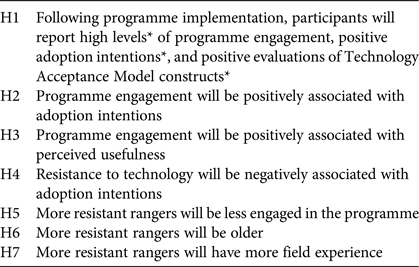
We aim to build on the Technology Acceptance Model by evaluating the role of educational intervention as well as resistance in rangers’ perceptions of and willingness to adopt a new patrol technology. The study hypotheses are outlined in Table 1. Our study focuses on Sumatra because it has the highest concentration of threatened vertebrate species in Indonesia (Murray et al., Reference Murray, Grenyer, Wunder, Raes and Jones2015).
Study hypotheses.
* Defined as > scale medians
A 3-day workshop was developed and hosted in collaboration with WWF in Bandar Lampung, Sumatra, in May 2015, to introduce PAWS (Yang et al., Reference Yang, Ford, Tambe and Lemieux2014), which was developed to protect terrestrial wildlife from poaching. Rooted in computational game theory, PAWS employs security games, or game-based models of strategic interactions between two players, a defender (e.g. ranger) and an adversary (e.g. poacher). It uses data from protected areas (e.g. past poaching activity, topography, species distributions) to generate suggested patrol routes (e.g. route maps, heat maps, GPS waypoints; Tambe, Reference Tambe2011). Other game-theoretic applications have been developed to combat poaching (Park et al., Reference Park, Serra, Snitch and Subrahmanian2015; Haas & Ferreira, Reference Haas and Ferreira2017), suggesting that such tools may become more available to conservation efforts. WWF invited employees of the five primary groups responsible for protecting wildlife on Sumatra to participate in the programme: the Indonesian National Park Service, WWF, the Wildlife Conservation Society, the Indonesian Rhino Foundation, and the Indonesian Prosecution Office. There were 29 participants (27 males, 2 females), with a mean age of 35 ± SD 7.5 years.
The programme included three modules: (1) lectures, in which instructors introduced theoretical foundations and examples relevant to PAWS, along with its benefits; (2) discussions, in which participants exchanged ideas about challenges in wildlife protection; and (3) computer and board games, which participants played as a hands-on tutorial in security games. For more details, see Sintov et al. (Reference Sintov, Kar, Nguyen, Fang, Hoffman, Lyet and Tambe2016). Participants completed surveys on the final day, which assessed basic demographics, Technology Acceptance Model constructs, technology resistance, and programme engagement (see Table 2 and Supplementary Material 1 for variable coding and construction). All procedures were approved by the University of Southern California Institutional Review Board (Study ID# UP-15-00727).
Key variables, with survey questions and descriptive statistics. For each independent variable, individual items were averaged and the resulting mean scale score used in all analyses. Unless otherwise indicated, response scales are 1 (strongly disagree)–7 (strongly agree).
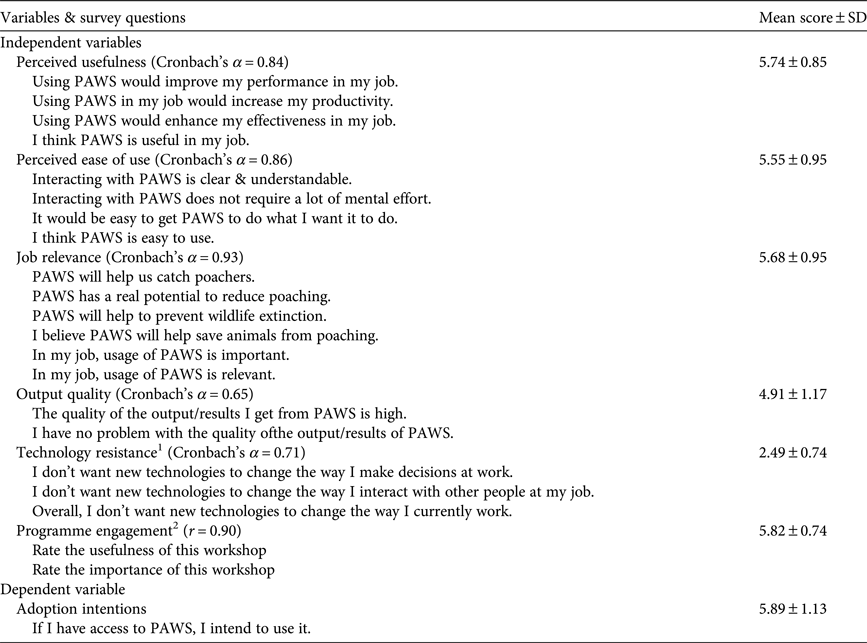
1 Reverse scored: 1 (strongly disagree)–5 (strongly agree)
2 Response scale: 1 (extremely useless/unimportant)–7 (extremely useful/important).
To test H1 (Table 1) we computed mean values for relevant variables (Table 2). Confirming our H1 predictions, rangers evaluated PAWS positively following the programme, with a mean adoption intentions score of 5.89 ± SD 1.13. Scores on other relevant technology acceptance variables, including perceived usefulness, ease of use, job relevance, and output quality were also positive (above Likert scale midpoints; Table 2).
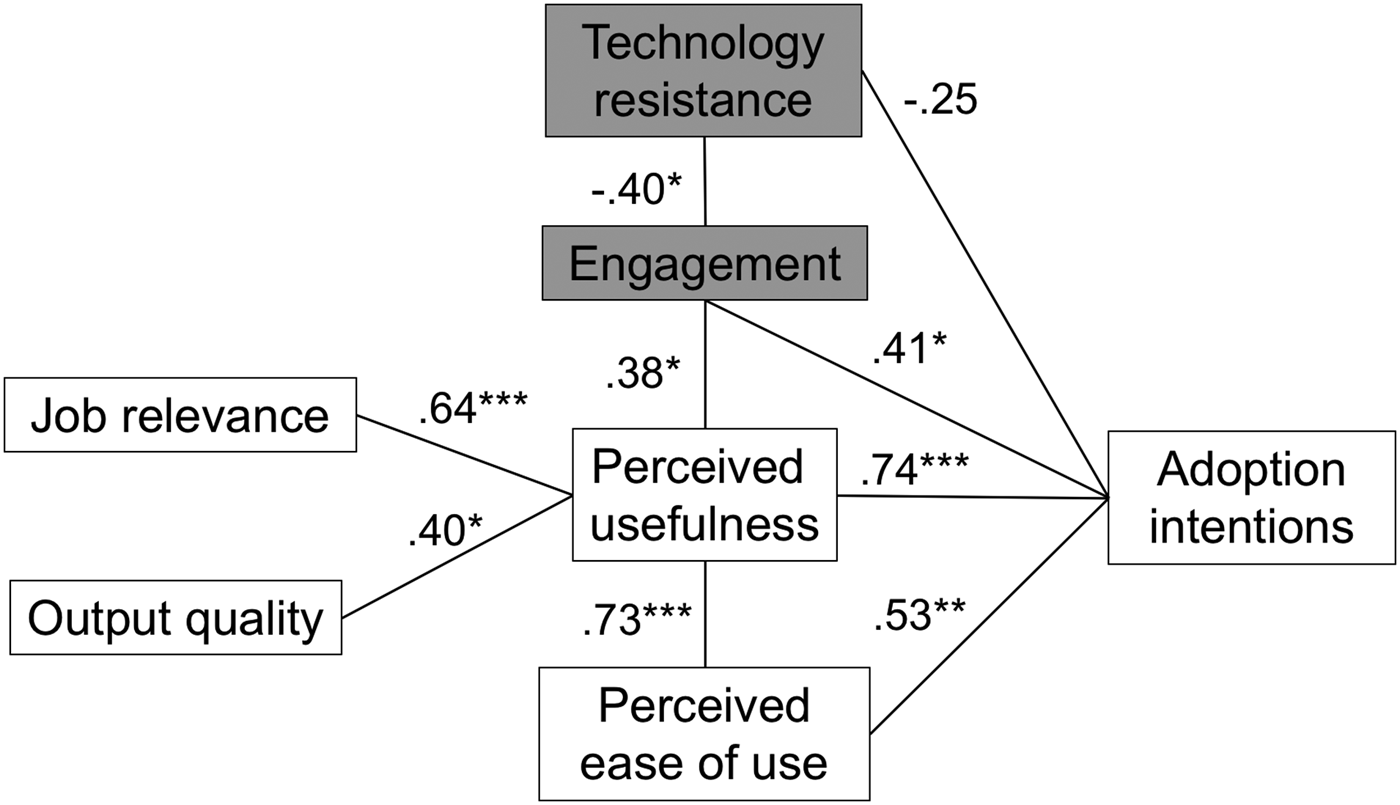
Several variables had non-normal distributions; hence, H2, H3 and H4 (Table 1) were tested using Spearman correlations. Correlation results (Table 3) suggested support for a modified version of the Technology Acceptance Model informed by our hypotheses (Fig. 1). Specifically, in line with the Technology Acceptance Model, perceived usefulness and perceived ease of use were both positively associated with adoption intentions; job relevance and output quality were positively associated with perceived usefulness. Building on the Technology Acceptance Model, programme engagement was significantly and positively correlated with adoption intentions and perceived usefulness, supporting H2 and H3, respectively. The relationship between technology resistance and adoption intentions trended in the predicted direction but was not significant, failing to support H4.
Model constructs with bivariate correlations. Technology Acceptance Model variables are in white boxes; variables added in this study are in grey. ***P < 0.001, **P < 0.01, *P < 0.05.
Spearman correlations among key variables.
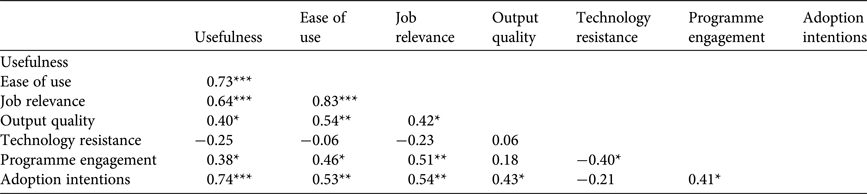
***P < 0.001, **P < 0.01, *P < 0.05
To test H5–H7 (Table 1) regarding characteristics of technology resistors, the sample was split into two groups based on median technology resistance score, categorizing users as low (score ≤ 2) or high (score > 2) resistors. Independent samples t-tests evaluated possible group differences in age (normally distributed), whereas their non-parametric analog, the Wilcoxon–Mann–Whitney test, was used for non-normal outcomes (years of work experience, programme engagement). Supporting H5, engagement was significantly higher (z = 2.02, P < 0.05) among the low (mean = 6.12 ± SD 0.30) vs high (mean = 5.57 ± SD 0.90) resistance groups. Contrary to our H6 prediction, the low resistance group was significantly (z = 2.68, P < 0.01) older (mean = 39.91 ± SD 4.57 years) than the high resistance group (mean = 31.31 ± SD 7.26 years). We observed no relationship between years of work experience and resistance, thus failing to support H7.
In summary, our results support and extend the Technology Acceptance Model, thus advancing the technology adoption literature. Specifically, whereas previous studies have merely recommended employing interventions to foster technology adoption (Venkatesh & Bala, Reference Venkatesh and Bala2008), we provide preliminary evidence that supports the utility of these types of interventions in the field. Building on previous work showing that learner engagement is a key driver of learning outcomes (Carini et al., Reference Carini, Kuh and Klein2006), and that opportunities for learning contribute to ranger job satisfaction (Moreto et al., Reference Moreto, Lemieux and Nobles2016), we found the more engaged rangers were in our programme, the stronger their intentions to adopt PAWS and the more useful they perceived it to be. Regarding resistance, rangers who were more resistant to technology in general were younger and less engaged in the programme. One possibility for this finding is that younger rangers may have perceived PAWS as reducing their autonomy in making decisions, a theme that aligns with previous work (Lapointe & Rivard, Reference Lapointe and Rivard2005; Lindsay et al., Reference Lindsay, Jackson and Cooke2011). Alternatively, younger rangers may have had less confidence and/or trust in the accuracy of the models underlying PAWS than older rangers. Both themes were supported by qualitative data (not reported here). Reaching resistors in the first place may be particularly challenging, highlighting the importance of understanding and addressing sources of technology resistance (Venkatesh & Bala, Reference Venkatesh and Bala2008).
Our findings should be considered in light of several limitations. Firstly, given the study's cross-sectional design, results are not causal. Future research should use experimental designs and control groups with pre/post measures to discern causal processes, and should also include validity checks (e.g. by assessing learning comprehension). Secondly, this study had a small sample size drawn from a relatively small population, which limited statistical modelling. Future studies should attempt to replicate these results using larger, multi-site samples and more advanced statistical techniques.
In conclusion, consistent with previous work (Gore, Reference Gore2011; Bennett et al., Reference Bennett, Roth, Klain, Chan, Clark and Cullman2016), this case study, which brought together several fields that do not traditionally intersect (i.e. psychology, wildlife management, criminology and computer science) as well as experts from the academic, government and NGO sectors, highlights the importance of including social science in conservation efforts. The study makes several contributions. In addition to extending the technology adoption literature, we also provide evidence that educational interventions can benefit the introduction of conservation technology. Whereas work on human dimensions of wildlife management tends to focus on local communities (Moreto et al., Reference Moreto, Lemieux and Nobles2016), our study highlights an understudied, yet critically important group: the dedicated individuals working at the forefront of wildlife protection. Rangers will continue to play a key role in the success of conservation technologies, making the study of this group essential. Other work on frontline perspectives has yielded invaluable insights to improve conservation efforts (Jachmann, Reference Jachmann2008; Eliason, Reference Eliason2011; Filteau, Reference Filteau2012; Moreto et al., Reference Moreto, Lemieux and Nobles2016). We urge further work in this area.
Acknowledgements
We thank J. Charles, R. Mahmud and C. Ayu Wardani for their integral roles in planning and implementing the workshop, and S. Aratoon, J. Barash and E. Wezerek for their assistance with preparing the data. This work was supported by the U.S. Department of Defense Multidisciplinary University Research Initiative (grant # W911NF-11-1-03) and WWF (PAWS anti-poaching grant).
Author contributions
All authors conceived and designed the research. NS analysed the data and wrote the initial draft of the article. VS reviewed several drafts and made significant revisions. AL reviewed and provided substantial feedback on several drafts.
Biographical sketches
Nicole Sintov is an environmental psychologist whose research focuses on developing and evaluating interventions to change behaviour, particularly related to the adoption and use of conservation technologies. Viviane Seyranian is a social/conservation psychologist whose research employs insights from social psychology to design and test communications and educational interventions that seek to promote sustainable lifestyles and increased well-being. Arnaud Lyet is a conservation scientist who focuses on analysis and management of animal populations and is especially interested in the monitoring and conservation of rare, elusive and threatened large mammal species.



