

The educational value of play has long been acknowledged. During recent decades, much attention has been paid to video games and the multifarious ways in which they can promote and enhance learning. Μy main objective in this study is to weave game principles, learning and the notion of playfulness into assessment principles, in an attempt to investigate how what I call ‘Game-Informed Playful Assessment’ (GIPA) can affect student learning and particularly students’ experience of learning. The GIPA was designed with a view to promoting students’ agency, autonomy, collaboration and playfulness, and was introduced in an undergraduate course on Archaic Greek Lyric poetry at a Greek-speaking university. My data was generated through in-depth interviews with ten of the students that attended the course. While the GIPA was favourably and even enthusiastically received by students, the research also brought to the fore several other issues that call for attention, such as the stress that innovative assessment may provoke in students, and the readiness of students to be playful within an academic framework that typically contrasts serious work with playfulness and play in general.
Part I
Introduction
‘I find no point in knowing this Sapphic distich by heart.’ I once received this response to a relevant question on a final exam paper from one of my students. When I emailed the student emphasising the importance of the distich, the student apologised, but stressed nevertheless that he would have preferred to be asked to reproduce a distich that meant something to him. Considering that throughout the semester students had been given several opportunities to express themselves freely and communicate their ideas in class, I found this remark somewhat unfair. The incident, however, problematised me and made me ponder more deeply on the design of my assessment. What quality was I rewarding through my question on the Sapphic distich, and what meaning was I communicating to my students? Was the design of my assessment methods responsive to my teaching? How might I have designed the final exam differently, and how would this have affected the student experience? This article is primarily about assessment. Its main objective is to weave assessment principles, games, learning and the notion of playfulness together in an attempt to investigate how what I define as ‘Game-Informed Playful Assessment’ (GIPA) can affect student learning and, more particularly, student experience of learning.
The research presented here was conducted within the framework of an undergraduate course on Archaic Greek Lyric at a Greek-speaking university. The ancient Greek language holds a prominent and central position in the educational curricula of Greece and Cyprus. For instance, all secondary-school students in Cyprus have to attend 50 teaching hours of ancient Greek language for each of the three years of gymnasium and the first year of lyceum; for humanities majors, the ancient Greek language workload rises to 75 teaching hours during the second and third years of lyceum Footnote 2. On this basis, one would naturally expect Greek and Cypriot students entering university to have a relatively good command of ancient Greek. In reality, the level of the great majority is not very satisfactory. Even more alarmingly, during their secondary education many students also come to harbour strong negative feelings about the ancient Greek language, considering it to be inaccessible, difficult, and even useless and parochial. Although there is no consensus on the causes of this phenomenon, all stakeholders in Greece and Cyprus agree that there should be a radical change in the way ancient Greek is taught in both secondary and tertiary education (Maronitis, Reference Maronitis2001).
Although in many other countries the study of ancient Greek (and Latin) has undergone an innovative shift during the last few years (Bodard & Romanello, Reference Bodard and Romanello2016; Hill, Reference Hill2003), in Greece and Cyprus ancient Greek is still typically—but thankfully not exclusively—taught in a rather conservative and old-fashioned way that offers little, if any, scope for exploration, creativity and playfulness. Even ancient Greek literature courses are often language-centred and place excessive emphasis on form, leaving little space for interpretation and meaning (Tsafos & Seranis, Reference Tsafos, Seranis and Giannakis2013; Chatzimavroudi, Reference Chatzimavroudi2007). As Maronitis (Reference Maronitis2001) succinctly put it, ancient Greek texts are often still approached with a feeling of reverence and awe, as if they hid valuable meanings awaiting discovery; only if we remove them from this iconostasis, can we make a firm step forwards.
The methods used for the assessment of ancient Greek language and literature courses are of a similar nature. To be in position to pass their exams, students typically have to memorise hundreds of declensional and conjugational patterns and various grammar and syntax rule exceptions, must learn to recite long lists of regular and irregular verbs, and must even learn by heart extensive chunks of modern Greek translations of ancient Greek texts. Although there are a few exceptions to the rule (e.g. at the Open University of Cyprus ancient Greek is assessed though open-book examinations), students are still mostly assessed through high-stakes methods: mid-terms and final written exams. As a graduate of both a Cypriot secondary school and a Greek university, and having personal experience in teaching ancient Greek at university level, I know first-hand the negative implications of this method of assessment for both student learning and student experience.
When I enrolled on the University of Edinburgh's postgraduate programme in Digital Education some years ago, I was intrigued by the vivid discussions we had on games and learning, and by how educators often try to leverage the great potential of video games for their teaching. Although these discussions had been in circulation for many years, especially in the UK and the US, they were new to me—indeed, they are still relatively new in Greece and Cyprus. Accordingly, for my MSc dissertation I felt intrigued to build upon this new knowledge and connect it to the other issue I was troubled by, that of assessment, in order to examine whether and how assignments informed by play principles might affect the student experience of assessment and, by extention, of learning. This seemed to be a potentially fruitful area for research, considering that student experience apropos ‘innovative assessment’ (Hounsell et al., Reference Hounsell, Blair, Falchikov, Hounsell, Huxham, Klampfleitner and Thomson2007) had not yet been adequately investigated (Bevitt, Reference Bevitt2015). Furthermore, whereas Game-Based Learning (GBL) had been broadly used in a number of disciplines, in Classics—but for a handful of exceptions—the educational potential of games had not been an issue of wide concern (Pike, Reference Pike2015; Evans, Reference Evans2016). Last but not least, the timing was also apt for such a research project, as at that time I was asked to undertake an undergraduate ancient Greek course which I had taught twice in the past and which I felt was ‘mature’ enough for such a radical experimentation.
Bearing all the above in mind, my research question was formulated as follows: how is Game-Informed Playful Assessment (GIPA) received by students enrolled on an ancient Greek poetry course at a Greek-speaking university?
My main objectives were to investigate:
• Whether students had experienced other innovative forms of assessment before.
• The differences that students would identify between GIPA and traditional forms of assessment.
• How students would articulate and describe their experience with GIPA in terms of enjoyment and learning.
For the purposes of this research I designed a number of activities that were underpinned by game principles and that could also allow some scope for playfulness. I also tried to leverage the affordances of new technologies through the use of my Institute's Virtual Learning Environment and the students’ smartphones, so as to add a digital dimension to the course.
The theoretical background of the research, along with my methodology and results, will be presented in two separate articles as Parts I and II. In the current article (Part I), I discuss some of the seminal literature on assessment practices and the use of games in education, also touching upon the notions of motivation, engagement and playfulness. In addition, I provide background information about the context in which my research was carried out and the rationale underpinning the GIPA I designed, so as to provide a clearer idea of my intervention, and to enable some transferability of my research and future application of my findings to similar environments/situations. In Part II, I lay out my methodology (method of approach, research tools used to generate my data, and process followed for the data analysis), quote several extracts from the interviews I conducted with ten of my students, and offer a condensed discussion of my findings.
Games, Play, Playfulness and Learning
Let me open my discussion with a reference to Plato's Theaetetus, a dialogue which in my view masterfully interweaves many of the themes I am concerned with in this study. Theaetetus is the Platonic dialogue par excellence that centres on and seeks to scrutinise the nature of knowledge (Burnyeat, Reference Burnyeat, Levett and Burnyeat1990). The participants in the dialogue are Socrates, a promising Athenian lad called Theaetetus, and Theaetetus’ teacher Theodorus, a stuffy mathematician who is a fervent advocate of instructional teaching and has no sense of humour (145c, 146a–b; 162b). We know that a lad called Socrates—a friend of Theaetetus and student of Theodorus—is also present, even though he remains silent throughout the dialogue. The scene is set at the palaestra, a semantically significant venue, which predisposes us to perceive the ensuing conversation as a wrestling match or, according to Caillois’ ([1958] Reference Caillois2001) classification, as an agon: a game that is competitive and entertaining, and which requires sustained attention, discipline, training and perseverance.
The question of the nature of knowledge is posed by Socrates, who claims to have long been troubled by it and expresses the desire to investigate it with those present (145e–146a). In his attempt to get everyone actively involved in the discussion, Socrates suggests that they cast their conversation in the form of a children's ball game; anyone who makes a mistake should sit down and be ‘donkey’, and anyone who comes through without a miss will be ‘king’ and can make the others answer any questions he likes (146a). The others remain silent at Socrates’ unexpected proposal: how would it be possible to pursue such a difficult philosophical question as the nature of knowledge by playing a children's game? Would not it be inappropriate for a teacher (Theodorus) and his students (Theaetetus and young Socrates) to play a game together? In any case, who wants to be called a ‘donkey’ and be exposed for making a mistake? Pondering on his audience's silence, Socrates asks Theodorus whether he has been ‘boorish’ in his eagerness for them all to engage in conversation together and become friends who talk to each other (146a). The question is evidently imbued with irony, considering that Theodorus is the teacher of both Theaetetus and young Socrates; it also makes an implicit criticism of Theodorus’ relationship with his students. Theodorus reassures Socrates that his request is not ‘boorish’ but encourages him to address all his questions to Theaetetus, claiming that he himself is not used to this kind of dialectical conversation and is too old to become so. Theaetetus, Theodorus asserts, might be an excellent interlocutor, because ‘youth truly gives room for improvement in everything’ (146b).
Socrates’ suggestion about the ball game may draw a blank; the discussion that follows, however, is repeatedly cast in terms of play/games, with Socrates adopting a playful stance towards several of the demanding and serious issues with which they grapple. So, even though actual play is put aside, playfulness is evident throughout the dialogue and goes hand in hand with seriousness, a noticeable combination that runs counter to modern discussions of philosophy which are typically conspicuous for their gravityFootnote 3.
In order to pursue their goal—that is, to provide an answer to the question of knowledge—Socrates, pleading complete ignorance of the issue under investigation and taking on the role of Theaetetus’ co-learner and companion rather than his instructor, exhorts Theaetetus to formulate his own definitions of knowledge. Socrates then puts these definitions under scrutiny, so as to help his young interlocutor to assess for himself what he really knows and to straighten out his beliefs. Although several of the philosophical issues that come up during the discussion are quite challenging, Socrates constantly encourages Theaetetus to dare to express his opinion and ‘play’ with possibilities and potentialities. For his part, Socrates constantly varies his style and mode of approach, thereby rendering their philosophical ‘game’ more joyful and intriguing: he impersonates other thinkers, makes extreme hypotheses, presents Theaetetus with puzzles, narrates stories, uses metaphors—and all without losing his sense of humour. As he declares to Theaetetus—who confesses that he experiences dizziness and is in a quandary whenever he finds himself dealing with issues that problematise established norms and ideas—wonder is the beginning of philosophy: μάλα γὰρ φιλοσόφου τοῦτο τὸ πάθος, τὸ θαυμάζειν; οὐ γὰρ ἄλλη ἀρχὴ φιλοσοφίας ἢ αὕτη (155d). In other words, wonder is what stimulates deep thinking and reflection. Of course, this comes with the proviso that one should know how to deal effectively with one's own wonder, without feeling overwhelmed and tongue-tied by it or ending up in sheer confusion, like several of Socrates’ interlocutors in other dialoguesFootnote 4. Socrates constantly emphasises to Theaetetus that the effectiveness of their discussion depends on their genuine and mutual willingness to keep ‘playing’, that is, to keep asking questions and trying to provide answers. If they reach a dead end, neither of them should stop—the game needs more than one player; rather, they should form a different hypothesis together and take an alternative route, that is, play the ‘game’ differently. The main point is not to lose sight of their ultimate goal: to find the truth.
The stance adopted by Socrates throughout the dialogue is noteworthy, for as well as showing how a philosophical dialogue should be pursued, it also delineates what it means to be a good ‘player’ in what might be called the ‘game’ of learning. Among other things, a good ‘player’ should:
• Be in a state of constant wonder, and not readily accept anything as knowledge, but put everything under scrutiny, even things that are deemed unquestionable, straightforward and well-established (179c–d; 190e–191a).
• Be willing to consider and explore all views, even those to which one does not have a personal commitment (157c–d; 164d–e).
• Not get frustrated easily but welcome every new obstacle and puzzle as a challenge rather than a burden; see failure positively (151d, 152d, 154e–155d; 190e–191a).
• Defend one’s arguments and not succumb in the face of the first sound criticism (162c–d; 169b–c).
• Be ready to ‘expose’ oneself without feeling embarrassed (155d, 160e–161a).
• Be willing to experiment with things and give them a try, even when one cannot be sure of the outcome (187b–c; 200e–201a).
• Seek knowledge for the sake of truth, not for the sake of ‘victory’ and self-aggrandisement (154d–155a).
• Respect one’s interlocutors, not seeking to defeat them with contentious arguments, but rather entering into conversation with them in order to seek the truth. The game should always be played on fair terms (154d–e).
The dominant features that characterise a good ‘player’ also include a complete indifference to time (154e–155a). This last point comes to a climax in the middle of the dialogue, where Socrates juxtaposes the philosopher, whom he portrays as a free man of scholê (leisure)Footnote 5, against other wise men, particularly litigants and orators, who are depicted as slaves of time (172c–173b).
The portrait of the philosopher as a man entirely immersed in the serious play of learning, and as experiencing what in modern terms we would call ‘flow’ (Csikszentmihalyi, Reference Csikszentmihalyi1990), eloquently reflects the immersion that educators seek to achieve for their students. Could academic learning and assessment (i.e. ‘work’) be experienced by students as leisure in the Platonic sense of the word? Could it sustain constant wonder and support students to become good (not necessarily victorious) ‘players’ in the ‘game’ of learning? What role can or should play and playfulness have in the learning process? In what ways can we enhance student engagement, that is students’ investment of time, effort and interest in their learning (Trowler, Reference Trowler2010)?
During the last few decades, an answer to the above questions has been sought in computer and video game play (Squire, Reference Squire2003). To be sure, the educational value of play and its impact on children's cognitive development in general was first recognised by Plato in the fourth century BCEFootnote 6; it was once again spotlighted in the 20th century through the work of educators and psychologists such as Vygotsky ([1930] Reference Vygotsky1978) and Piaget (Reference Piaget1962). The recent upsurge in the video games industry has rekindled this interest but has refocused it on digital games and their affordances. Logo, the educational programming language designed by Feurzerig, Papert and Solomon, constituted one of the first attempts to leverage the power of computers to help children with geometry (Papert, Reference Papert1999). Since then, video games have been extensively used for educational purposes. The various attributes occasionally attached to certain categories of video games and the terms they are couched in, however, betray an anxiety on the part of educators and game designers to promote such games as not merely fun, and to present them as respectable. Thus, from the ‘educational games’ of the 1980s, designed primarily to meet specific educational purposes, we then moved on to ‘serious games’, whose gamefulness was not sacrificed to their educational orientation (Deterding et al., Reference Deterding, Dixon, Khaled and Nacke2011). Two other terms in use today are ‘transformative games’ (McGonigal, Reference McGonigal2011) and ‘persuasive games’ (Bogost, Reference Bogost2007). The former term seeks to present video games as drivers of social change; the latter to advance them as an expressive medium that can influence and persuade its players.
Although the use of actual games in education—a practice known as ‘Game-Based Learning’ (GBL)—has several encouraging results and many enthusiasts, it is also in many respects problematic and difficult to implement in terms of time, cost and pedagogy (Kapp, Reference Kapp2012; Dicheva et al., Reference Dicheva, Dichev, Agre and Angelova2015). Apart from video games specifically designed to meet the purposes of particular courses, in all other cases video games are used mainly in a supplementary way; as extrinsic motivators and stimuli for learning, instead of being a central aspect of the learning experience (Begg et al., Reference Begg, Dewhurst and Macleod2005). It is therefore not surprising that many educators have tried to take advantage of the educational value of video games in ways that do not require the use of actual games. One such example is gamification, ‘the integration of elements of game design into non-gaming contexts’ (Deterding et al., Reference Deterding, Dixon, Khaled and Nacke2011). To date, most attempts to apply gamification to an educational context have concentrated on the use of game vocabulary and mechanics, such as points and reward systems (Hamari et al., Reference Hamari, Koivisto and Sarsa2014; Dicheva et al., Reference Dicheva, Dichev, Agre and Angelova2015). This has led to the criticism that gamification offers a superficial experience—a game veneer—instead of a real game with a backstory and a design that caters to specific learners’ needs (Jagoda, Reference Jagoda2013; Bogost, Reference Bogost, Walz and Deterding2015; Mak, Reference Mak2013). A game is a system and its gamefulness depends on a range of factors that go far beyond the use of external rewards and game lexis. It is on these terms that Bogost castigates gamification as ‘bullshit’ (2015) and ‘exploitationware’ (Reference Bogost2011), and the term ‘gamification’ is often pejoratively referred to as ‘pointsification’ (Robertson, Reference Robertson2010). For all its drawbacks, gamification continues to be a buzzword today, and there have been some serious recent discussions of how it might become more sophisticated and meaningful (Fuchs, Reference Fuchs, Fuchs, Fizek, Ruffino and Schrape2014)Footnote 7.
Like gamification, game-informed learning (GIL)—a term coined by Begg, Dewhurst and Macleod (Begg et al., Reference Begg, Dewhurst and Macleod2005)—does not presuppose the use of actual games or game worlds. However, whereas current practices of gamification typically employ game mechanics to offer a game veneer, GIL focuses mainly on game principles, such as role-playing, collaboration and storytelling, with a view to rendering learning more fundamentally game-like. GIL draws its rationale from James Paul Gee, whose seminal book What Video Games Have to Teach Us About Learning and Literacy (2007) extensively discusses the intriguing ways in which video games facilitate learning whenever a game player encounters and attempts to master a new game. According to Gee, good video games can provide numerous insights into how people learn, because they build a theory of learning into their design. Following from this, Gee put together a list of 36 principles which, according to him, underpin good video games and represent central truths about the human mind and human learning in general (Gee, Reference Gee2007; see also Whitton, Reference Whitton2009; Deterding, Reference Deterding, Fuchs, Fizek, Ruffino and Schrape2014).
Although educators’ attempts to leverage the potential of games as learning tools—whether through GBL, gamification or GIL—have been quite extensive, what is surprisingly often absent from discussions of games and learning but seems to be one of the biggest challenges is that game-playing is first and foremost a voluntary act (Nicholson, Reference Nicholson2012). Although it is true that in many good video games gamers are allowed to move around freely, explore various environments, and extend their reach to unforeseen spatial localities (Gee, Reference Gee2007), the satisfaction emanating from this internal autonomy is largely premised on the gamers’ external autonomy and the simple fact that game play, like any other form of play, is a free and voluntary act performed for its own sake (Suits, Reference Suits1978; Deterding, Reference Deterding, Fuchs, Fizek, Ruffino and Schrape2014). The gamer is the one who chooses when to play, which game to play, for how long, where and with whom (Deterding, Reference Deterding, Fuchs, Fizek, Ruffino and Schrape2014). Even in cases where a game is not played recreationally but serves rather as a means to a specific end (e.g. to facilitate social interaction at a gathering), the gamer still retains some control over their decision to play (Whitton, Reference Whitton2009).
The external autonomy enjoyed by gamers raises a host of questions: would a gamer enjoy a video game if they were forced to play it? Would they feel the same pleasure, enjoyment and fun if someone else had decided what and how they were going play? How free would they feel within a game space that allowed them to make several choices if they had been coerced into playing that particular game in the first place? Inevitably, although the immersive nature of video games results from a complex of elements and techniques (Shute & Ke, Reference Shute, Ke, Ifenthaler, Eseryel and Ge2012), their appeal is largely premised on the fact that game-playing is a leisure activity. No matter how engaging a video game is supposed to be, if it is imposed and not freely chosen it might quickly lead to a cessation of participation (Mollick & Rothbard Reference Mollick and Rothbard2014) and even be perceived as a kind of ‘electronic whip’ (Deterding, Reference Deterding, Fuchs, Fizek, Ruffino and Schrape2014, pp. 308–10). Consequently, any application of GBL, gamification and GIL should also be orchestrated in a way that at least partly redeems the loss of external autonomy.
Mollick and Rothbard (Reference Mollick and Rothbard2014) have argued that the detrimental effects of an externally imposed game can be alleviated if the game is consented to, a condition fulfilled if the participants have choices (Nicholson, Reference Nicholson2012). As well as providing a range of options, however, students should also be given the opportunity to customise their learning and even design activities meaningful to them (Nicholson, Reference Nicholson2012). By allowing students to become ‘co-designers’, not only do we enable them to take ownership of their learning and enjoy some autonomy—an important reinforcer of intrinsic motivation (Lepper Reference Lepper1988)—but we also contribute to the formation of what Kolb and Kolb have defined as a ‘ludic learning space’, namely a ‘free and safe space that provides the opportunity for individuals to play with their potentials and ultimately commit themselves to learn, develop and grow’ (Kolb & Kolb, Reference Kolb and Kolb2010). Provided that they contain the appropriate tools, triggers and stimuli, such ‘ludic spaces’ can also foster the development of a playful attitude, and I use ‘playful’ here to indicate ‘a state of mind in which an individual can think flexibly, take risks with ideas (or interactions), and allow creative thought to emerge’ (Youell, Reference Youell2008, p. 122)Footnote 8. As Whitton has recently put it, ‘playfulness is about being open to new experiences. It's about imagining, a spirit of make-believe, exploring possibilities’ (Whitton, Reference Whitton2018b). As well as helping to recast failure from a necessarily negative outcome to a constructive learning condition, this experimentation with possibilities and potentialities rather than with mere actualities and facts, may also lead to fun, an element that is ignored surprisingly often in discussions of learning (Fizek, Reference Fizek, Fuchs, Fizek, Ruffino and Schrape2014).
At this point, a plausible question would be: how playful can students be with their learning? Or even better, do students feel free enough to be playful with their learning? Can an activity that allows space for play and experimentation readily and inherently elicit a playful attitude on the students’ part as well? The complexity of the notion of playfulness is illustrated in the two following experiments, both of which constitute attempts to apply game elements to a non-game context. The first example concerns the installation of an exergame aboard a public tram, in order to motivate users to do pull-ups. While the installation of the exergame would justify its use, people did not use it, because they found it embarrassing and inappropriate to play-exercise aboard a tram (Toprak et al., Reference Toprak, Platt, Ho and Mueller2013; Deterding, Reference Deterding, Fuchs, Fizek, Ruffino and Schrape2014). The second example concerns an experiment carried out in Odenplan underground station in Stockholm, where the Fun Factory team, seeking to encourage people to use the stairs rather than the escalators, turned the staircase next to the escalators into a piano. In this case not only were people willing to use the musical staircase, but they also played with it in various playful ways. Why were the outcomes so different in these two cases? Why was embarrassment not an issue in the second example? Some conjectures:
• The piano staircase did not require any musical knowledge and could be easily used by anyone, regardless of age, size or gender. For the exergame, however, we can assume that it might have been inaccessible to certain groups such as small children, the old and the unfit.
• Whereas in order to get out of the underground people had to use either the piano stairs or the escalators, the exergame did not form an indispensable part of the passengers’ travelling experience, in so far as people did not have to use the exergame in order to reach their destination.
• Even though the exergame was placed on a tram, one could not be really playful with it, but had to use it properly in order to justify its use—otherwise one might have been accused of showing off. In the case of the piano staircase, however, people could adopt a playful attitude, because the very appearance of the staircase evoked the impression of something playable and therefore justified such a behaviour.
• Whereas the piano steps could be used simultaneously by a number of people, the exergame could only be used by one person at a time, a particularity that might have heightened the ‘exposure’ of its user to the eyes of other passengers.
One further ponders what might have happened if passengers had been offered a reward for using the exergame, or if the exergame had been accompanied by a note stating that, when a total of 1000 pull-ups were reached, a certain amount of money would go to a charity. Would people dare to be more playful in those circumstances? If so, would they be extrinsically or intrinsically motivated, or both? What would happen to the feeling of embarrassment in that case, and why? And what about the musical staircase? Would more people use it if there were a reward, or would this have a detrimental effect? One last crucial question: did the use of the musical staircase have merely ad hoc or wider implications? In other words, has this ‘intervention’ served to change people's broader attitude and mindset with regards to escalators and stairs?
These questions are more easily asked than answered. What the abovementioned examples illustrate, though, is that the appeal of a game, even its perception as a game, is not inherent to the game alone. Rather, it is subjective and situational, and depends both on the interaction between the game and the player and on the conditions within which game-playing takes place. One player may thoroughly enjoy a video game, another may not, while the same player may experience diverse feelings even when playing the same video game, depending on the situation in which they find themselves each time. As Fuchs (Reference Fuchs2012) notes, if we were to drop some Lego bricks into a 1970s European child's room, in an Egyptian temple in 2000 BCE and in front of the curator of a contemporary design museum in central Tokyo, those bricks would be perceived differently in each case (as a toy, a sacred object and a piece of design respectively), owing to the different context in which they were placed. A game exists as a game only when it becomes one in somebody's mind (Philippettee, Reference Philippettee, Fuchs, Fizek, Ruffino and Schrape2014). Accordingly, a player's disposition towards a game and their willingness to play with it are essential for a game to reach its full potential (Deterding, Reference Deterding, Fuchs, Fizek, Ruffino and Schrape2014).
This observation gains in significance if we think of the role that play holds today in formal education and its usual conceptualisation as a purposeless, silly and frivolous activity. To quote Kolb and Kolb:
In reality, play has been devalued and continues to be squeezed out of our formal education institutions under the misguided view that learning is reserved to the classrooms and play should be confined to the playgrounds. (Kolb & Kolb, Reference Kolb and Kolb2010, pp. 26–27)
The marginalisation of play in academia raises crucial questions, as it might be detrimental to a student's willingness to play qua student. Having been attuned to an educational system where the work / play, seriousness / playfulness dichotomies prevail, students are very likely to be apprehensive about the idea of mixing play with education or readily adopting a playful stance towards their material (Whitton, Reference Whitton2009).
Assessment and Learning
Assessment has always been an indispensable part of the educational system. Especially nowadays, with the growing commercialisation of higher education, the need for apparent objectivity in metrics on the performance and competencies of students, academics and institutions is more urgent than ever (Nørgård et al., Reference Nørgård, Toft-Nielsen and Whitton2017). Yet, far from being merely a means for measuring performance, assessment also circumscribes the behaviour of all stakeholders. As Rowntree (Reference Rowntree1987) notes with reference to student assessment: ‘If we wish to discover the truth about an educational system, we must look into its assessment procedures… The spirit and style of student assessment defines the de facto curriculum’ (Rowntree, Reference Rowntree1987, p.1). Indeed, assessment can have a profound effect on the way that students learn (Russell et al., Reference Russell, Elton, Swinglehurst and Greenhalgh2006) and can largely shape what and when students study, how much work they do, and the approach they adopt towards their learning (Εntwistle & Entwistle, Reference Entwistle and Entwistle1991; Swan et al., Reference Swan, Shen and Hiltz2006; Struyven et al., Reference Struyven, Dochy and Janssens2005). It is therefore not surprising that students very often skip or devote little time and effort to non-assessed tasks, tailoring their study to what is assessed and mainly to what is graded (Gibbs & Simpson, Reference Gibbs and Simpson2005; Elton, Reference Elton1988).
In the past, assessment was mostly seen as a measurement of factual knowledge, normally occurring after learning had been completed. This kind of assessment, known as ‘summative assessment’, is typically juxtaposed against so-called ‘formative assessment’, whose overarching objective is to improve and support learning and teaching (Sadler, Reference Sadler1989). Although these two modes of assessment are often treated as forming a binary, their character is rather situational. What really differentiates summative from formative assessment is not so much the practice as the intention (Knight, Reference Knight2002). If a facilitator designs an assessment with the intention to use it merely for validation, the assessment has a summative function; if the same assessment is used with the intention to create feedback that will be used for the promotion of students’ learning, then its function is formative (Knight, Reference Knight2002; Shepard, Reference Shepard2000; Black et al., Reference Black, Harrison, Lee, Marshall and Wiliam2004). Of course, to fulfil its ends, feedback should meet certain conditions: it should be timely, specific and targeted (Gibbs & Simpson, Reference Gibbs and Simpson2005), functions which have nowadays been optimised by the affordances of technology (Russell et al., Reference Russell, Elton, Swinglehurst and Greenhalgh2006).
Nevertheless, the final word on whether formative assessment is true to its name rests with students, who very often may ignore the feedback (no matter how timely, specific and targeted) and focus on the grade (Rowe, Reference Rowe, Carless and Bridges2017; Black & William, Reference Black and William1998). Feedback is also liable to generate strong emotions, thus making students feel overwhelmed and discouraged (Rowe, Reference Rowe, Carless and Bridges2017; Deterding, Reference Deterding, Fuchs, Fizek, Ruffino and Schrape2014). As studies have shown, a good way to acculturate students to feedback is by means of peer- and self-assessment activities (Race, Reference Race2001), by getting students involved in the creation of their own assessment (Carless, Reference Carless2007) and by building on their ability for self-regulation (Nicol & MacFarlane-Dick, Reference Nicol and Macfarlane-Dick2006).
Although discussions of assessment often concern the quality of feedback and ways of motivating students to act upon it, another crucial factor is the design of assessment itself. Assessment should be designed in a way that promotes intrinsic motivation and sustains engagement: it should be authentic, involve collaboration, promote autonomy and higher-order thinking skills, and allow students to retain some control over their material. It should also be relevant (Lepper, Reference Lepper1988; Trowler, Reference Trowler2010). As many researchers have pointed out, as well as contributing to knowledge acquisition and understanding, assessment should also be geared towards the needs of the 21st century by helping students to develop the attributes and skills required to deal successfully with a complex and rapidly-changing world: to be creative, be capable of learning independently, take risks, be flexible, have the capacity to use particular knowledge in context etc (Dolin & Evans, Reference Dolin and Evans2018). Drawing on the way in which assessment works in good video games, Shute & Ke (Reference Shute, Ke, Ifenthaler, Eseryel and Ge2012) have also argued that assessment should not be isolated from context and focus merely on the final product, but rather should take into account the whole process and even be invisible. In other words, assessment should be designed in a way that would make students forget that they are being assessed and shift their attention to their performance instead.
In light of all the above, I find the term ‘assessment for learning’ useful and quite handy, to the degree that it refers both to the intentions and the design of assessment (Wiliam, Reference Wiliam2011). According to the definition provided by Black and colleagues: ‘assessment for learning is any assessment for which the first priority in its design and practice is to serve the purpose of promoting students’ learning’ (Black et al., Reference Black, Harrison, Lee, Marshall and Wiliam2004, p. 10; see also Taras, Reference Taras2010).
GIPA
In deciding upon the assessment methods for my Archaic Greek Lyric course, I drew on the theories of games, learning and assessment discussed above, and on the notion of playfulness. My overarching concern was to design activities that would not only record student achievement (assessment of learning), but would also promote learning (assessment for learning) by increasing intrinsic motivation and enhancing student engagement. Accordingly, in addition to taking account of several game principles, I also tried to allow some scope for student autonomy, so as to compensate for the fact that, unlike games, graded assessment is not a voluntary activity. Moreover, I designed the activities in a way that might foster a ludic attitude and might therefore encourage students to visualise the world's structures as opportunities for playful engagement, thus also helping them to change their perceptions of learning (Zimmermann, Reference Zimmermann, Wolf and Perron2009).
Field of Study and Procedure
Before I lay out my methodology for collecting, processing and analysing my data, it is essential to provide some background information regarding my field of study and the procedure I followed in deciding on the assessment methods for my course. As already noted, the GIPA model was applied within the framework of a course on Archaic Greek Lyric that I facilitated at a Greek-speaking university. My class consisted of 72 students: 59 females and 13 males. All were either from Greece or Cyprus, with the exception of two Erasmus students from Italy and Spain. The course was weighted with five credits in the European Credit Transfer and Accumulation System (ECTS) and was predominantly a face-to-face course, even though I also attempted to blend my teaching with Blackboard, the university's virtual learning environment. It was offered at undergraduate level and was a core module for second-year students studying Classics; however, it could also be taken as an elective by second-, third- and fourth-year students studying history, archaeology, Modern Greek and Byzantine studies, or philosophy.
The overarching aim of the course, as formulated in the programme handbook, was to provide an introductory overview of archaic lyric poetry (i.e. from the seventh to fifth centuries BCE) through a range of representative fragments in the original. The main objectives of the course were for students to:
• Get to know the main representatives of archaic lyric poetry.
• Get an overview of the lyric genres and their main features (themes, musical instruments, modes of performance etc.).
• Familiarise themselves with a number of lyric metres (elegiac couplet, iambic trimeter etc.)
• Familiarise themselves with and be able to use the main critical editions of archaic lyric poetry.
• Appreciate the close and complex relationship between lyric and epic poetry.
• Reflect upon the socio-political framework within which the lyric poets lived and worked.
• Appreciate the public orientation and performative character of archaic lyric poetry.
• Appreciate the difficulties in the study of the archaic lyric poetry owing to its fragmentary nature.
• Appreciate the diachronicity of archaic lyric poetry and its relevance to the 21st centuryFootnote 9.
Before my intervention the course had been assessed in accordance with the methods typically followed at my institution: a midterm (40%) and a final exam (60%). This was more or less the method I also adopted the first two times I taught the course, the only difference being that in both cases I allocated 30% to the midterm and 10% to a different form of assessment (presentation in class/creation of blog, alternative assessment). The changes that I introduced during the third round, when I intervened with the GIPA, were more radical. Bearing in mind that formal assessment is a direct indicator of importance to students (Keppell et al., Reference Keppell, Au, Ma and Chan2006; Russell et al., Reference Russell, Elton, Swinglehurst and Greenhalgh2006), I substituted the course's high-stakes midterm exam with two alternative forms of assessment: 20% was allocated to the GIPA, while the remaining 20% was allocated to another form of innovative assessment, which is not, however, discussed here (see Table 1).
Methods of Assessment for the Archaic Greek Lyric Poetry course in 2017/18.
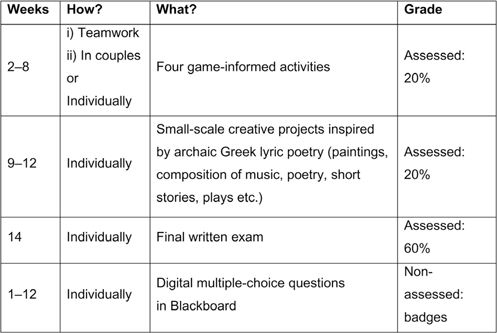
The GIPA comprised four small-scale activities, each accounting for 5%. The activities were allocated between Weeks 2 and 8, so that student engagement could be spread equally across the first half of the semester (Gibbs & Simpson, Reference Gibbs and Simpson2005). The activities were also scaffolded, so that the experience gained from one activity could be applied to the next; in this way, feedback could also fruitfully function as feedforward (Hounsell et al., Reference Hounsell, Blair, Falchikov, Hounsell, Huxham, Klampfleitner and Thomson2007).
While designing the four GIPA activities, I made sure to align them with the objectives and intended outcomes of the course. A valuable compass during the design stage was James Paul Gee's list with the 36 learning principles that underpin good video games. Of these principles I singled out and laid particular emphasis on the eight that I deemed most appropriate for the objectives of my course. More specifically, I tried to provide students with opportunities to get actively and critically involved with their material (‘the active, critical learning principle’), to work and learn with their peers (‘the affinity group principle’), to evaluate their peers (‘the peer-review principle’), to use and reflect upon modalities other than words (‘the multimodal principle’), to make choices (‘the multiple routes principle’), to have small-scale embodied experiences (‘the situated meaning principle’), to use the skills and knowledge they gained from one activity in the next (‘the transfer principle’), and to have the autonomy to customise the various activities according to their own interests and concerns (‘the insider principle’). Seeking to encourage students to engage with the activities adopting a playful attitude, I also drew upon motivational theory (Malone, Reference Malone1981; Lepper, Reference Lepper1988) and included tasks that could stimulate students to look at their surrounding environment inside and outside the university in alternative and new ways, and to even associate things with no obvious relevance (Carse, Reference Carse1986).
Below I provide the instructions given for each of the four activities, along with further information concerning their allocation during the semester, the mode of work for each activity (in teams, couples or individually), and the Gee learning principles leveraged in each case.
Activity 1
Weeks 2–3, teamwork
Gee's learning principles: Active and critical learning principle, multimodal principle, multiple routes principle, situated meaning principle, affinity group principle.
Instructions: Read closely all the fragments of Archilochus included in your Corpus of Archaic Greek Lyric Fragments and try to complete the following tasks:
1. Choose 10 words that in your view best describe Archilochus’ poetry, themes, vocabulary and writing style.
2. Use all or some of these words to compose a poem about Archilochus. The poem can be in either rhyme or free verse, and can be written in either modern Greek or the Cypriot dialect. Limitation: The poem must be composed in the iambic dodecasyllable, the modern equivalent of the ancient iambic trimeter which was extensively used by Archilochus himself Footnote 10.
3. Associate Archilochus’ poetry with one of the following six paintings (Figure 1) and explain the rationale for your association in a short paragraph of approximately 300 words.
Paintings used for Activity 1. From left to right: Wanderer Above the Sea of Fog (Caspar David Friedrich); The Scream (Edvard Munch); Death and Life (Gustav Klimt); The Starry Night (Vincent van Gogh); Guernica (Pablo Picasso); The Persistence of Memory (Salvador Dalí).

Activity 2
Weeks 3–4, teamwork
Gee's learning principles: Affinity group principle, multiple routes principle, situated meaning principle, multimodal principle, insider principle.
Instructions: You are in the final year of your studies and, as part of your internship in a secondary school, you have been asked to teach to 16–17 year-old students Archilochus’ fragment 128 (West):
θυμέ, θύμ’, ἀμηχάνοισι κήδεσιν κυκώμενε,
†ἀναδευ δυσμενῶν† δ᾽ἀλέξεο προσβαλὼν ἐναντίον
στέρνον †ἐνδοκοισιν† ἐχθρῶν πλησίον
κατασταθεὶς
ἀσφαλέως⋅ καὶ μήτε νικέων ἀμφάδην ἀγάλλεο,
μηδὲ νικηθεὶς ἐν οἴκῳ καταπεσὼν ὀδύρεο,
ἀλλὰ χαρτοῖσίν τε χαῖρε καὶ κακοῖσιν ἀσχάλα
μὴ λίην, γίνωσκε δ᾽ οἷος ῥυσμὸς ἀνθρώπους ἔχει.
Even though you will have only 10–15 minutes at your disposal, and although you know that the majority of students are afraid of ancient Greek and find it boring, you want to capture their attention. Accordingly, you decide to adopt an alternative mode of teaching by using 1–2 photos or a short video. Your aim is for students to learn 3–4 important words in ancient Greek, to comprehend the meaning of the passage, to reflect on it and to appreciate its diachronicity. Limitation: Both the video and the photo(s) have to be shot within the university campus. Photos can be taken with a digital camera or your smartphone; the same applies to the video. If you wish, you may edit your photos/video with relevant software.
Activity 3
Week 5, teamwork
Gee's learning principles: Peer review principle, affinity group principle.
Instructions: Each group will receive two anonymised files containing the assignments submitted by one or two other groups for Activities 1 and 2. Go through the assignments carefully and provide constructive feedback to your peers, taking as a yardstick the instructions provided for each assignment (e.g. does the poem on Archilochus meet the requirements specified? Is the association of Archilochus’ poetry with a painting adequately explained?)
Make sure that you open your review by singling out what your team deems to be the strongest aspect of the assignments under review, and then continue with the least successful parts. Make sure that your feedback is specific, targeted and clear. Your peer assessment will be assessed and commented on by the facilitator. The comments of each group will be forwarded (anonymously) to the initial group, along with the facilitator's feedback.
Activity 4
Weeks 6–8, in couples or individually
Gee's learning principles: Multimodal principle, multiple routes principle, situated meaning principle, transfer principle, insider principle, affinity group principle.
Instructions: From the Corpus of Archaic Greek Lyric Fragments choose one set of verses that impress, perplex or even anger you and compose a text up to 350 words, where you address the lyric poet in question in the second person singular. Structure your text by adopting the perspective of a person of your own age living in Greece/Cyprus today. Your text must be accompanied by a photo you have taken. For this activity you do not have to explain your choice of photo but merely accompany it with a snappy caption, that will encapsulate the main point of your text. The ten best assignments will be printed out as A3 size colour posters and exhibited within the framework of a public poetry event coordinated by the facilitator within the next month.
Even though the four activities had specific rules and limitations, none of them had a factual orientation. Rather than encouraging students to search for model answers, the various tasks were designed to invite them to formulate their own answers driven by their personal interests, concerns, and social and cultural backgrounds. The activities were also small-scale for two main reasons. On the one hand, I wanted students to spend more time reflecting on their material, brainstorming and discussing it with their peers, rather than being concerned with the number of words required for each assignment—in other words, I wanted them to pay more attention to the process than to the product (Drew, Reference Drew2001; Levy, Reference Levy2007). On the other hand, I also wanted students to boil down their answers to the essence, and to submit concise and focused responses.
For three of the four activities, students had to work in groups of four or five, which they were allowed to form on their own. I put any remaining students into groups alphabetically. For each group, a forum for discussion was created in Blackboard, in order both to facilitate asynchronous communication and to enable me to monitor the learning in progress for the provision of continuous formative feedback (Russell et al., Reference Russell, Elton, Swinglehurst and Greenhalgh2006). Teams were encouraged to use these fora. However, this was not set as a requirement, owing to a contingency: although first-year students were not eligible to enrol on the course, due to a system error one quarter of my students were freshers. This not only radically increased the size of the class, thus leading to considerable workload implications for me, but it also raised serious questions about these students’ readiness and maturity to get to grips with the GIPA, considering that they had only experienced one full term of higher education (i.e. the winter semester). Given that most freshers were not even familiar with Blackboard, I deemed it necessary to allow students to use more familiar means of communication if they wished. The implication of this was that I was not able to monitor their discussions and provide immediate feedback—a significant motivational reinforcer that might have had an impact on the students’ overall experience of the GIPA.
All assignments had to be submitted in digital form via Blackboard. Detailed guidelines for each activity were published in Blackboard along with relevant material and were also automatically sent to the students’ university email addresses. The four Activities were revealed to the students one at a time, in order to provoke a feeling of suspense and curiosity. Students received ample timely feedback on all their assignments with the use of ‘track changes’ in Microsoft Word. In an attempt to increase engagement with the feedback, the grades for each activity were withheld until the completion of all the activities in Week 9 (Boud & Falchikov, Reference Boud and Falchikov2007). What needs to be stressed at this point is that my intervention in the course's assessment method presupposed the redesign and tailoring of the whole course, so that both my teaching and the informal formative activities carried out in class during Weeks 2–8 would scaffold and support the GIPA.
Description of my methodology, extracts from the interviews and discussion of my findings will be laid out in Part II.
Biographical Note
Maria Pavlou is Lecturer of Ancient Greek Language and Literature at the Theological School of the Church of Cyprus. She read Classics at the Aristotle University of Thessaloniki (BA, 1997–2002) and Leeds University (MA, 2003), and received her PhD from Bristol University, UK (2003–2007) with a thesis titled ‘Time in Pindar’. She has recently received an MSc in Digital Education from the University of Edinburgh (2018). From 2005 onwards she worked as a Teaching Fellow / Adjunct Lecturer at the University of Bristol (2005–2009), the University of Cyprus (2014–2018), and the Open University of Cyprus (2010–2013 & 2018), and was involved in a number of research projects at the University of Cyprus (2010–2011) and the Open University of Cyprus (2012–2015). Dr Pavlou has published several articles in peer-reviewed journals and collective volumes and is the co-editor (with Prof. Vayos Liapis and Prof. Antonis Petrides) of Debating with the Eumenides (Cambridge Scholars, 2018). She has also co-edited (with Prof. Antonis Tsakmakis and Dr Eleni Kaklamanou) the collective volume Framing the Dialogues: How to Read Openings and Closures in Plato, to be published by Brill in 2020.


 Open access

