


Introduction
Conversations about past experiences are one way in which people forge, transmit, and transform individual and collective memories (Bietti and Stone Reference Bietti and Stone2019; Coman et al. Reference Coman, Momennejad, Drach and Geana2016; Edwards and Middleton Reference Edwards and Middleton1986; Hirst and Echterhoff Reference Hirst and Echterhoff2012; Hirst et al. Reference Hirst, Yamashiro and Coman2018; Middleton and Brown Reference Middleton and Brown2005; Middleton and Edwards Reference Middleton and Edwards1990; Sutton et al. Reference Sutton, Harris, Keil and Barnier2010). Conversational remembering means recalling together shared and distributed past experiences. Conversations are joint activities (Clark and Brennan Reference Clark, Brennan, Resnick, Levine and Teasley1991) in which partners have to “share or synchronize aspects of their private mental states and act together in the world” (Brennan et al. Reference Brennan, Galati, Kuhlen and Ross2010, 304).
Remembering together in conversations entails that people engage in recalling past experiences, which may themselves have been shared. Sometimes people went through the same events as a group (John and Marie saw the movie Memento together in a Los Angeles theatre when they started dating in April 2001); sometimes they experienced the same event separately (John and Marie saw Memento, but John saw it with friends in a Los Angeles theatre in April 2001 whereas Marie watched it alone on video cassette at home a year later in Paris). Regardless of the situation, they can still talk about the movie when they meet and remember together what it is about.
Conversational remembering in the wild occurs in situated interactions, embedded in social and material environments. It unfolds while interacting with other people in a wide range of settings and interactional contexts. It also sometimes happens in interaction with various types of artefacts, from desktop computers and laptops, to notes, diagrams, and sketches drawn quickly and spontaneously in post-its. Conversational remembering in the wild is ubiquitous and multimodal, highly situated and driven by a history of interactions and involving the coordination of social, cognitive, bodily, and material resources over time (Bietti and Sutton Reference Bietti and Sutton2015).
Conversational remembering frequently takes place in face-to-face interactions, ranging from ordinary discussions during family meals at home and reminiscing about shared experiences with friends at social gatherings, to more significant events like memorial services where family members and friends come together to commemorate the lives of those who have passed away. It is also a part of both formal and informal conversations with colleagues and coworkers in professional settings. However, the COVID-19 lockdowns and social distancing measures disrupted these vital collective activities that are integral to human social interaction.
In 2020, COVID-19 lockdown policies and social distancing measures significantly affected social interactions (i.e., face-to-face conversations) where conversational remembering in the wild occurs (e.g., interactions in social gatherings). The aim of this study was to explore how WhatsApp group chat messages supported conversational remembering in a large group of friends (n = 26) living in Buenos Aires where a complete lockdown was established between 19 March 2020 and 6 November 2020.
In the subsequent section of the introduction, we delineate the distinctive features of conversational remembering in natural settings, distinguishing it from memory research relying on interviews and specially designed group discussions (Bietti Reference Bietti2012, Reference Bietti2013, Reference Bietti2014; Brescó de Luna and Wagoner Reference Brescó de Luna and Wagoner2022; Cienki et al. Reference Cienki, Bietti and Kok2014; Cordonnier et al. Reference Cordonnier, Bouchat, Hirst and Luminet2021; Reavey and Brown Reference Reavey and Brown2007; Tschuggnall and Welzer Reference Tschuggnall and Welzer2002; van der Haegen et al. Reference van der Haegen, Stone, Luminet and Hirst2022; Woods et al. Reference Woods, Bruce, Edwards, Hounsome, Keady, Moniz-Cook, Orrell and Russell2009). We also delve into the dynamics and functions of conversational remembering (e.g., Bietti and Stone Reference Bietti and Stone2019) and demonstrate their presence in our dataset. Additionally, we explore the impact of group size and various characteristics typical of larger groups, such as community type and social network parameters, on the shaping of collective memories through conversation (e.g., Coman et al. Reference Coman, Momennejad, Drach and Geana2016). We then provide an overview of the limited studies examining conversational remembering in online and virtual chat environments (Greeley et al. Reference Greeley, Chan, Choi and Rajaram2023; Guazzini et al. Reference Guazzini, Guidi, Cecchini and Yoneki2020) that resemble the conversational patterns seen in text-messaging apps. Notably, to the best of our knowledge, prior research has not investigated conversational remembering within the context of text-messaging apps.
Conversational remembering within text-messaging apps represents a localized phenomenon within broader interactional sequences with varied objectives (e.g., from navigating a break-up conversation to deciding where to dine based on past experiences). Consequently, we developed a method to isolate these interactional sequences in which conversational remembering takes place within our dataset of WhatsApp group chat messages. In the final section of the introduction, we introduce the analytical unit we devised for the systematic identification and examination of conversational remembering in natural settings.
Conversational remembering in the wild
Several disciplinary traditions in the interdisciplinary field of memory studies have examined how people remember together from naturalistic perspectives in their everyday lives, that is, in the social and material contexts in which they live (e.g., Bietti and Baker Reference Bietti and Baker2018; Forsblad Reference Forsblad2016; Goodwin Reference Goodwin1987; Hutchins Reference Hutchins1995; Hydén Reference Hydén2014; Middleton Reference Middleton1997; Wu et al. Reference Wu, Birnholts, Richards, Baeker and Massimi2008). These studies relied to a much lesser degree on the use of interviews or focus group methodologies. Interviews and focus groups may resemble ordinary conversations but still represent artificial forms of data collection where a researcher takes participants out of their daily lives and asks them to reflect on their experiences (Knott et al. Reference Knott, Rao, Summers and Chana2022). By situating research in the often intricate and dynamic settings of everyday life, the study of conversational remembering in the wild offered a practical and contextually grounded approach that engages with people's practices within their natural environments. It remained sensitive to unforeseen issues, enabling a more responsive and adaptive exploration and also capturing social forms of memory in its unfolding complexity. Ultimately, research on conversational memory in the wild demonstrated that remembering in real-life settings needs to be thought of more as a situated activity or resource to achieve specific goals, rather than as an instantiation of a storage device or archive located in people's brains (Manier Reference Manier2004). Prior research on conversational remembering in real-world contexts has not delved into the dynamics of these collaborative activities during a global crisis or explored them longitudinally. These are topics that we addressed in our study.
Dynamics and functions
Conversational remembering consists of specific dynamics (e.g., the roles speakers and listeners may undertake during the conversation) that can have specific mnemonic and functional consequences (e.g., forging social bonds) in individuals and groups (Bietti and Stone Reference Bietti and Stone2019). Conversations about past situations, events, and actions are driven by interactive processes where humans take on and adopt complementary roles as narrators, mentors, and monitors (Hirst et al. Reference Hirst, Manier and Apetroaia1997). Conversational partners who assume a narrator role take the lead in the conversation about past situations, events, and actions and tend to also talk about situations, events, and actions that were not shared by other members of the group. Those who take a mentor role support narrators by providing them with memory prompts to elaborate further, while partners who assume a monitor role oversee whether the narratives being told are accurate and whether it is the case that specific elements are missing.
Conversational remembering is used to create a feeling of connection and intimacy with partners (Pasupathi et al. Reference Pasupathi, Lucas and Coombs2002) and provide social benefits (e.g., building trust) for the person telling the narrative and the one receiving it (Alea and Bluck Reference Alea and Bluck2003). Jointly retrieving shared memories develops and strengthens friendships (Bluck et al. Reference Bluck, Alea, Habermas and Rubin2005), fosters entertainment (Demiray et al. Reference Demiray, Mischler and Martin2019), consolidates group identity (Bietti and Galiana-Castelló Reference Bietti and Galiana Castelló2013; Hirst et al. Reference Hirst, Yamashiro and Coman2018), and allows individuals to re-evaluate the shared event, test the strength of their social bonds, and, in turn, either repair or weaken them (Bietti Reference Bietti2010; Pasupathi et al. Reference Pasupathi, Lucas and Coombs2002). Several social functions of conversational remembering, such as its role in consolidating identity, are highly pertinent to our study, given that our data were derived from a group of friends who have shared a 20-year history (see Methods section).
Group size
Group size has not been a major concern in the study of conversational remembering in natural settings, where groups were often small, ranging from dyads or triads in flight operations (Hutchins Reference Hutchins1995) to groups with a median size of nine members in healthcare settings (Middleton Reference Middleton1997). The primary objective of these studies was to capture and systematically examine everyday instances of joint and collaborative remembering in collective activities within authentic environments. The specific characteristics of these collective activities, such as the number of healthcare professionals attending weekly meetings at a neonatal intensive care unit (Middleton Reference Middleton1997), determined the size of the groups under investigation. Thus, the size of the group (n = 26) we investigated constitutes an additional methodological innovation of our study.
Recently, experimental psychologists started to investigate how group size affected the formation of collective memories (Coman et al. Reference Coman, Momennejad, Drach and Geana2016; Luhmann and Rajaram Reference Luhmann and Rajaram2015; Momennejad et al. Reference Momennejad, Duker and Coman2019) using computer simulations and experimental studies in the laboratory. For example, Luhmann and Rajaram (Reference Luhmann and Rajaram2015) observed as group size increases so does collaborative inhibition in agent-based models. Collaborative inhibition refers to situations in which seeing or hearing other people's responses disrupts the way each individual organizes his/her retrieval sequences and strategies, thus causing the collective failure to achieve potential (Rajaram Reference Rajaram2011). Luhmann et al. also reported that memories diffused across social networks in the computer simulations. Additionally, Coman et al. (Reference Coman, Momennejad, Drach and Geana2016) further found that, in a chat environment, mnemonic convergence (the general degree of overlap among community members’ memories; see Coman et al. Reference Coman, Momennejad, Drach and Geana2016, 8171) increases after a conversation, especially in non-clustered networks, as the degree of separation between individuals is lower than in clustered networks, and mnemonic convergence is thus more likely to emerge. Furthermore, mnemonic similarity may more rapidly increase if information is first shared between individuals that bridge between clusters, and then within clusters (Momennejad et al. Reference Momennejad, Duker and Coman2019). A follow-up study Geana et al. (Reference Geana, Duker and Coman2019) using the chat environment presented by Coman et al. (Reference Coman, Momennejad, Drach and Geana2016) suggested that real-world human communities are naturally well suited for forming collective memories, and network structures could potentially be leveraged in contexts like classrooms or organizations to encourage specific memory dynamics. Although findings cannot be used to understand conversational memory practices in the wild, these studies showed that the size (e.g., number of individuals), type of community (e.g., insular groups vs. distant groups), and social network parameters (clustered vs. non-clustered networks) can be used to predict the formation of collective memories in large groups (>100 individuals).
Text-messaging apps
The ways in which conversational remembering occurs in text-messaging apps have not been investigated from a naturalistic perspective (i.e., in the wild) yet. A handful of experimental studies have done it using virtual environments and chat platforms specifically designed for research purposes but closely resembling the chat tools commonly used in everyday communication (Greeley et al. Reference Greeley, Chan, Choi and Rajaram2023; Guazzini et al. Reference Guazzini, Guidi, Cecchini and Yoneki2020). For example, Greeley et al. found that chat-based collaborative recall could create collective memory, similar to in-person collaboration. Collaborative memory performance in this virtual setting matched in-person performance. However, there was a drop in individual recall in the virtual context due to reduced motivation resulting from working alone remotely. In another recent study, Guazzini et al. found that collaborative groups in a virtual environment performed exceptionally well, indicating a collaborative facilitation effect. Collaborative facilitation refers to cases in which the performance of groups is better than the sum of the performances of each of their members working separately (Meade et al. Reference Meade, Nokes and Morrow2009). Task complexity played a role, with collaboration being more effective in simpler tasks but inhibiting performance in more complex ones. Surprisingly, group size did not significantly impact performance. The analysis of chat interactions revealed that greater participation, more messages, use of negations, and communication directed to all group members correlated with better group performance. Constructing datasets collected from text-messaging apps presents important ethical challenges (e.g., data anonymization) but researchers are finding innovative and effective techniques to overcome them (e.g., rotate first names in the chat messages, and remove numbers with three and more digits; see: Ueberwasser and Stark, Reference Ueberwasser and Stark2017 for a detailed description of WhatsApp data anonymization techniques) while ensuring readability.
Collaborative remembering sequences
The study of conversational remembering in naturally occurring data presents several methodological challenges. Hence, we had to develop a way to single out the interactional sequences of conversational remembering in our dataset of WhatsApp group chat interactions.
One way in which conversational remembering is initiated in joint activities whose primary aim is not remembering together is by means of reminders (Bietti Reference Bietti, Wagoner, Brescó and Zadeh2020). Reminders can take various shapes and forms, from general objects (e.g., photographs) and souvenirs owned by other people to personal possessions endowed with high emotional significance for the owner (van den Hoven et al. Reference van den Hoven, Orth and Zijlema2021). In conversations about autobiographical situations, events, and actions, reminders often take linguistic forms (e.g., questions). In face-to-face and video-mediated interactions, they may co-occur with gestures (e.g., pointing gesture) to direct the addressee's attention to specific objects (e.g., photographs). Reminders like “do you remember when … ?” may bring a shared past into the present, in relation to a specific goal (e.g., to remember the name of the Italian restaurant where we had dinner 2 weeks ago) and seek information from someone who is assumed to know about situations, events, and actions that occurred in the past. Reminders may take different forms depending on the affordances provided by the context where the interaction unfolds. For example, in text-based interactions on mobile phones (e.g., WhatsApp), conversational partners (users) assume that the chat space is the most relevant environment for the collaborative activity to unfold successfully. There is no need to negotiate a shared focus of visual attention (i.e., looking at the mobile phone screen is a necessary condition to participate in the interaction) unless users are in the same physical environment. Instances of conversational remembering in a chat environment can occur without being triggered by explicit questioning; they may well be initiated by sharing photographs, videos, audio files, etc., with reference to an individual or shared past for the users. Thus, reminders in a chat environment may take several forms, and their success depends on their capacity to generate sequences of collaborative remembering in conversations.
We define a collaborative remembering sequence (CRS) as a multimodal unit for collaborative information retrieval and memory reconstruction triggered by the compliance with cooperative rules to respond with information related to the past, in relation to the semantic content of reminders, and to collaborate in the elaboration of such information in a manner that is satisfactory to the conversational partners (Bietti, Reference Bietti, Wagoner, Brescó and Zadeh2020; Bietti and Baker Reference Bietti and Baker2018). Even when conversational partners are arguing about a specific topic (e.g., sharing opposing views on an event they experienced together in the past), the CRS would follow cooperative rules. Thus, the cooperative rules that govern the dynamics of conversations and the achievement of mutual conversational goals should not be confused with instances of cooperation, in which mutual benefits as a result of a joint action are expected (e.g., Tomasello and Vaish Reference Tomasello and Vaish2013). In principle, cooperative rules refer to the fact that contributions in conversation should be informative, relevant, true, and unambiguous (e.g., Grice Reference Grice, Cole and Morgan1975). CRSs are recipient-designed and oriented towards conversational partners, and their end is marked by either an acknowledgement or a change in topic.
CRSs come to fill an important methodological gap in the literature on how to detect and analyse instances of conversational remembering in the wild. The advancement of computational approaches (e.g., natural language processing and closed-vocabulary dictionaries software) in autobiographical and collective memory research in the social sciences and the humanities (Rouhani et al. Reference Rouhani, Stanley and Adolphs2023; Sheldon et al. Reference Sheldon, Sheldon, Zhang, Setton, Turner, Spreng and Grilli2023) can contribute to the development of analytical tools to (semi) automatically detect and examine CRSs in large datasets of naturally occurring conversations taken from text-messaging apps. Our study represents a first step towards the systematic identification of recurrent linguistics (e.g., questions, use of past tense, repetition of specific lexical items, and syntactic structures).
The present study
The aim of this study was to explore how WhatsApp group chat messages supported conversational remembering in a large group (n = 26) living in Buenos Aires where complete COVID-19 lockdown was established between 19 March 2020 and 6 November 2020. The data consisted of 32,810 WhatsApp group messages collected over a period of 700 consecutive days, from 13 April 2019 to 13 March 2021. To our knowledge, no research has been carried out to date on the analysis of conversational remembering in a large group (n = 26) multiparty interaction using WhatsApp group chat messages from a longitudinal perspective (700 consecutive days). Another particularity of the study is that these WhatsApp group chat messages were exchanged before, during, and after the COVID-19 lockdown, which drastically affected human social interactions at a massive scale. Our study sought to answer the following research questions:
(1) What were the interactive resources (e.g., questions) that initiated collaborative remembering sequences (CRSs) in the WhatsApp group chat messages?
(2) What were the topics recalled in CRSs and the timescales of the situations, events, and actions that they referred to?
(3) How were CRSs, topics, and timescales associated with the lockdown period, compared with prior to it and after?
(4) Was there an increase in the number of WhatsApp group messages produced among the members of the large group between 19 March 2020 and 6 November 2020, i.e., during the lockdown period compared with prior to it and after?
(5) Did messages sent during the lockdown have a greater probability of containing CRSs compared to those sent before or after the lockdown?
We used qualitative and quantitative methods to give answers to these questions, and thus, accomplish the general aim of the study. In the next subsections, we present all the relevant methodological aspects of our study.
Methods
Participants
We collected 32,810 WhatsApp group messages produced by 26 members of a large group between 13 April 2019 and 13 March 2021 (700 consecutive days). WhatsApp group members were all men (mean age = 43.25), and they had known each other for more than 20 years. The participants (users) were players of the same amateur football team, and some had attended the same secondary school. The messages (N = 32,810) were written in Spanish. They all lived in Buenos Aires and their places of residence were less than 20 km apart (Figure 1). WhatsApp is the messaging app with the largest number of active users worldwide (Porter Reference Porter2020). Ninety-three per cent of 34 million active users of social media in Argentina have installed and use the messaging app on their mobile phones (Kemp Reference Kemp2020).
Map of the City of Buenos Aires (Google Maps). Red dots indicate the approximate place of residence of the members of the large group. Numbers do not correspond to the codes they were given for anonymization. The black square shows the location of the park where participants met to play football.

A complete lockdown was established in Buenos Aires between 19 March 2020 and 6 November 2020 during which governmental authorities authorized social gatherings of up to 10 people in indoor spaces. Until the end of the period of data collection, 13 March 2021, the city government reported 377,800 cases of COVID-19, 330,377 patients who recovered, and 8,486 COVID-19-related deaths. The city has a network of 14 public general hospitals and one teaching university hospital. All the inhabitants of Buenos Aires (and Argentina) are entitled to receive healthcare, free of charge, in public facilities (Rubinstein Reference Rubinstein2018).
Users reported having physically met an average of 20.5 times in 2019. Users agreed to donate their WhatsApp group chat history from 13 April 2019 to 13 March 2021 (700 consecutive days) to the researchers and for research purposes only. One of the authors had a personal connection with a member of the network (participant U6), which facilitated the acquisition of the data. U6 played a vital role as a “gatekeeper” for the researchers, granting them access to the data and providing invaluable insights into the nature of the conversations. Through informal conversations held between June and September 2021, U6 shared contextual and biographical information about the network members, enhancing the researchers' understanding of the data. The conceptualization of the study took place in May 2021, at which point the participants willingly consented to contribute their data, completed surveys assessing their closeness, and signed consent forms. The data generated by the participants predated the study's conceptualization, ensuring that U6's involvement was not influenced by the research. U6 was responsible for exporting the chat history without multimedia resources and sent the file to the researchers in an encrypted form. All users had 2 weeks to check the personal data they would want to share with the researchers. Users could correct or delete personal information from the data in text format that has been already exported from the instant messaging application before anonymization. None of the participants tested positive for COVID-19 during the period of data collection.
Individual surveys (Supplementary materials 1) showed that it was a heterogeneous group in terms of level of education, job security, property ownership, and income. A subset of them often met for birthday parties including their partners and children too), as well as more general celebrations (e.g., housewarming parties, graduation parties, New Year's Eve celebrations), events (such as going to music concerts, attending football matches, watching football matches on TV, participating in political manifestations, etc.), and occasions of grieving (e.g., the death of parents). This was the norm before the introduction of lockdown measures on 19 March 2020. It was a large group with strong affective bonds given by a shared life history.
Analysis
We conducted qualitative analyses to answer research questions 1–3. To address research question 1, we identified the specific elements (e.g., questions, use of verbs in the past tense, etc.) that initiated CRSs in WhatsApp group messages. For research questions 2 and 3, we employed thematic analysis (Braun and Clarke Reference Braun and Clarke2022), coding, and theme development in NVivo 12. This was done to (i) analyse the content of each CRS and determine their main topics (e.g., trips, football, and parties); (ii) establish whether CRSs referred to a recent past (e.g., yesterday's barbecue) or a distant past (trip to Brazil in 2006); and (iii) associate the topics of CRSs and their reference to recent or distant pasts with the period they were produced – pre-lockdown, lockdown, and post-lockdown.
For research questions 4 and 5, we performed statistical analysis (i.e., mixed-model regressions) using R. To address research question 4, we tested whether there was an increase in the number of messages produced among users between 19 March 2020 and 6 November 2020, during lockdown, compared to before and after. While this might have been expected due to mobility restrictions imposed by the national government and the popularity of WhatsApp in Argentina (Kemp Reference Kemp2020), we aimed to confirm that group members were indeed using the messaging app to maintain social and emotional connections with friends. To answer research question 5, we examined whether there was an association between the lockdown period and the odds of a WhatsApp group message being about past shared experiences.
We used CRSs as the unit of analysis to systematically identify interactive sequences where users collaborated in conversational remembering within WhatsApp group messages. We coded messages for CRSs, and the time period was categorized as follows: messages sent before 19 March 2020 were labelled as “pre-lockdown” (8149 messages) messages sent after 6 November 2020 were labelled as “post-lockdown” (5315 messages), and the remaining messages were labelled as “lockdown” (19,346 messages). Twenty-five per cent of all messages were double-coded. Inter-rater agreement (Cohen's kappa) for codes (number of messages, number of words, presence of multimedia, questions, use of verbs in the past tense, etc.) was good (kappas ≥ 0.72). Disagreements between coders were resolved through discussion.
To answer research questions 4 and 5, we ran mixed-model regressions (with random intercepts). Depending on the tested hypothesis, we considered the following variables as dependent variables: count of messages per day and count of words per message. The time period (pre-lockdown, lockdown, and post-lockdown; with the lockdown period as the reference category) was used as the independent variable, and the participants' ID was used as the clustering variable. Linear mixed models were employed for counting dependent variables and generalized linear mixed models with a binomial family were used for dichotomous ones.
In nested data, variance can exist at both the observation level (e.g., messages) and the cluster level (e.g., participants in the conversation). Variance measures the degree of dispersion or variability in a dataset, indicating how much individual data points differ from the mean. Ordinary least squares regression and logistic regression do not adequately address the nesting of observations, potentially leading to misleading results. Linear mixed models and generalized linear mixed models partly account for cluster-level variance, ensuring that results are not influenced by such issues. As a hypothetical example within this study, we can imagine a participant who contributes the most to CRSs and posts predominantly during the lockdown. Failing to account for participant variance would result in an undue and disproportionate impact of this particular participant on the study's outcomes.
Results
We initially identified CRSs in the dataset. In total, we found 129 CRSs in the WhatsApp group messages, and these were initiated by (i) verbs in the past tense (45 per cent); (ii) multimedia (e.g., photos and videos) (20.2 per cent); (iii) verbs in the past tense and questions (14.7 per cent); (iv) verbs in the present tense (10.1 per cent); and (v) verbs in the present tense and questions (2.3 per cent) of cases (research question 1; see Table 1).
Description of collaborative remembering sequences (CRSs) found in the dataset.

The table includes information about the resource that initiated CRSs, the date on which it was produced, the starting and ending time, whether it occurred pre-, during, or post- COVID-19, number of messages per CRS, number of users (friends) who contributed with messages, whether CRSs referred to a recent or distant past, and their general and specific topic.
Subsequently, we individually analysed each of the 129 CRSs and extracted their general and specific topics (research question 2). We identified the presence of seven general topics within the CRSs, which were categorized as trips (23.6 per cent), football (18.9 per cent), parties (12.3 per cent), friends (9.4 per cent), history (8.5 per cent), concerts (6.6 per cent), places (5.7 per cent), and others (15.1 per cent) (see Table 1 for a description of general and specific topics). Trips referred to travels undertaken as a group (e.g., a summer vacation six of them spent in Bolivia and Peru in 2002). Football included matches played against other teams in tournaments and among themselves in public parks and rented football grounds, as well as references to football matches, they attended or watched on television (e.g., 2010 FIFA World Cup). Parties described barbecues, birthday parties, bachelor parties, weddings, and other group gatherings they participated in. Friends referred to situations, actions, and events associated with a group member who died from cancer at the age of 26 in July 2007. History included mentions of their intention to document the history of the group and their friendship. Concerts described music concerts they attended, both by popular rock bands and by music bands whose members were part of the group. Places referred to CRSs that focused on describing places where they regularly met for football, parties, and other social activities. Other encompassed mentions of situations, actions, events, and individuals that did not fit into the previous topics and occurred less than five times (e.g., stealing alcoholic beverages from a supermarket, etc.) (Table 1).
We determined whether the topics we identified referred to situations, events, and actions that occurred in the recent or distant past. The recent past category included descriptions of situations, events, and actions that occurred from several hours (e.g., yesterday's night barbecue) to a few months (e.g., the most recent group member's birthday party) before the WhatsApp group interactions from which we identified and extracted CRSs. The distant past category encompassed descriptions of situations, events, and actions that occurred further back in the past. Some CRSs contained information about the year when these situations, events, and actions occurred. The earliest event that four group members collaborated to remember was dated back to 1993 (see Table 1, CRS 3.11). For CRSs that lacked temporal information, the participant who aided us in accessing the data contacted two users who contributed with CRSs and asked them to estimate the year when the presented situations, events, and actions occurred. Disagreements between friends were resolved through discussion.
We found that 88 per cent of CRSs described distant situations, events, and actions, which was as expected due to the inability to meet in person and the higher number of CRSs during the lockdown period (see Table 1 for descriptions and below for statistical confirmation). Twelve per cent of CRSs referred to a recent past and the topics were football, party, and other. All occurrences of other were mentioned in previous conversational actions in the WhatsApp group chat. We associated the topics of CRSs and their reference to recent or distant pasts with the period when they were produced – pre-lockdown, lockdown, and post-lockdown (RQ3). We found that 14.7 per cent of CRSs occurred pre-lockdown, 73.6 per cent during the lockdown, and 11.6 per cent post-lockdown. Pre-lockdown CRSs described recent (52.6 per cent) and distant (47.4 per cent) situations, events, and actions. Lockdown CRSs predominantly referred to distant situations, events, and actions (96.8 per cent). Post-lockdown CRSs described recent (33.3 per cent) and distant (66.7 per cent) situations, events, and actions. The topics that friends remembered together in conversation during the pre-lockdown period were trips (distant), parties (recent + distant), football (recent + distant), concerts (distant), places (distant), and other (distant). During lockdown, the topics included friends (distant), places (distant), concerts (distant), trips (distant), football (distant), parties (distant), history (distant), and other (recent + distant). Post-lockdown, the topics were parties (recent), friends (distant), concerts (distant), trips (distant), football (recent + distant), and other (distant). The only topics consistently present in CRSs throughout pre-lockdown, lockdown, and post-lockdown periods were parties, football, and other. Other (recent) referred to previous conversational actions, whereas other (distant) encompassed situations, events, and actions across a variety of topics (e.g., secondary school) that occurred less than five times.
Table 1 illustrates that football (including games played against other teams in tournaments and among themselves in public parks and football grounds, as well as references to football matches attended or watched on television) and parties (encompassing barbecues, birthday parties, bachelor parties, weddings, and other group meetings) are recurring topics where users recalled situations, events, and actions in both pre-lockdown and post-lockdown periods. Other topics such as trips, concerts, friends, places, and history are associated with unique and temporally bounded situations, events, and actions from the distant past. Other refers to miscellaneous situations, events, and actions (e.g., discussions about adding honey to low-quality whisky) also situated in the distant past. Instances of other in the recent past denote cases where users recalled previous messages within the WhatsApp chat interaction.
Here we present a qualitative analysis of the longest CRS we found in WhatsApp group messages (first 20 messages only; see Supplementary information 2 for the complete CRS and analysis). This CRS started on 2 August at 23:28:16 (GMT-3) and ended on 3 August at 12:28:14 and had 182 messages (See Table 1, CRS 5.10). Taking place during the middle of the lockdown period, this example illustrates the conversational dynamics observed within CRSs. Names and phone numbers were replaced with U1, U2, U3, respectively. Names of individuals mentioned in the group chat who were not part of the group have been replaced with E1, E2, E3, respectively.
Longest CRS (First 20 messages only; see Supplementary information 2 for the complete CRS).
1.[23:28:16] U16: I'm going to write how that story of going to the forests of Palermo to play soccer began, the first who came were the kids of my school, can it be? @U2 do you remember? Those kids who lived there in Colegiales closed to Cabildo avenue.
2. [23:28:38] U2: Yes, U16
3. [23:28:51] U2: We went with the schoolboys
4. [23:29:22] U2: And little by little U13 and people from Saavedra joined us
5. [23:29:44] U16: Yes, I was writing about that
6. [23:30:18] U16: I think I still remember the first day that U13 went, you remember U13? I think you caught only
7. [23:30:40] U2: The goalie was U13
8. [23:30:50] U13: With glasses and a total star
9. [23:31:09] U16: Yeaaah! That was in 96
10. [23:31:10] U2: That was the first time you fucked the knee
11. [23:31:20] U13: E1 came once…I remember that he almost broke my nose…
12. [23:31:23] U1: The field on the side the first
13. [23:31:33] U13: Yes, I broke my nose there but some years later
14. [23:31:34] U2: Nooo hahahahahaha
15. [23:31:36] U13: Right…
16. [23:31:43] U1: You rock U16!! I admire people with memory!!
17. [23:32:01] U13: I was catching, I left the goal and he gave it to me… I think it was him
18. [23:32:06] U16: Hahaha! It was possible him
19. [23:32:54] U16: Yes yes, it seems to me that E1 came more than once, E2 invited him
20. [23:33:05] U13: Right
The CRS was initiated by WhatsApp group member U16, who is a historian and expressed his intention to write the history of how they began gathering and playing soccer in Forests of Palermo in Buenos Aires every Saturday afternoon (message 1). In this instance, we observed an explicit attempt to forge a shared memory within the group of friends. Users did not exchange images (e.g., photographs) as reminders in this CRS, possibly due to the spontaneous nature of the conversation and the rapid exchange of conversational turns among friends. This spontaneous exchange may have limited participants' ability to search for photographs, which, if available, would likely be in physical format considering that the events being recalled took place in the late 1990s and early 2000s. This short fragment from the longest CRS found in the dataset showcases how friends collaborated in co-constructing utterances (U2 in message7 and U13 in message8) that refer to their shared past. The fragment also demonstrates the distribution of conversational roles, with friends dynamically transitioning between being dominant narrators (e.g., U16 in message1 and U13 in message11) to adopting the role of mentors in a matter of seconds (e.g., U16 in message 18; U13 in message 20).
After conducting the qualitative analyses, we aimed to confirm whether there was an increase in messages and CRSs during lockdown (research questions 4 and 5). To achieve this, we complemented the qualitative analyses with statistical analyses (i.e., mixed-model regressions) in R. First, we examined whether there was an increase in WhatsApp group messages during lockdown (research question 4). As expected, we observed a rise in group chat activity between 19 March 2020 and 6 November 2020. The number of posts per day was lower pre-lockdown (B = −2.27, SE 12 = 0.11, t = −20.41, p < 0.001) and post-lockdown (B = −1.57, SE = 0.14, t = −10.87, p < 0.001) compared with the reference category lockdown (Figure 2). The word count per message did not vary between pre-lockdown and lockdown: B = 0.05, SE = 0.10, t = 0.446, p = 0.656, but was lower post-lockdown compared with during the lockdown: B = −0.41, SE = 0.12, t = −3.335, p < 0.0001). We also found that the odds of a message containing multimedia components were lower before the lockdown (LnOdds = −0.12, SE = 0.04, OR = 0.88, z = −3.196, p = 0.001) and higher after the lockdown (LnOdds = 0.26, SE = 0.04, OR = 1.30, z = 6.268, p < 0.001) compared to during the lockdown period. The multilevel regression tables for these results are presented in Table 2.
Number of messages through time. Vertical lines indicate the beginning and end of the lockdown period.

Linear mixed models and generalized linear mixed models
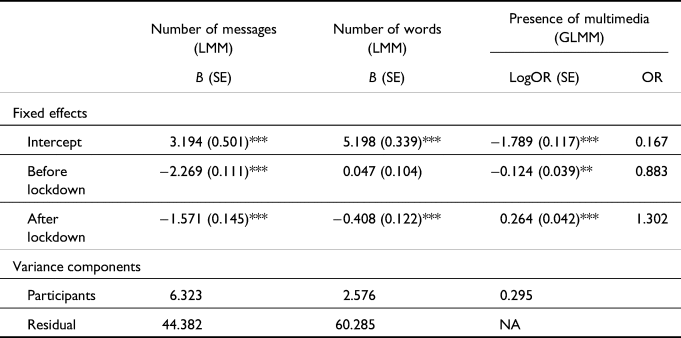
DVs: number of messages, number of words, presence of multimedia.
Note: The lower-level variance component is not available in mixed-effects logistic regression summaries with lmer (GLMM). B, regression coefficient; GLMM, generalized linear mixed model; LMM, linear mixed model; LogOR, log Odds ratio; OR, Odds ratio; SE, standard error.
*p < 0.05; **p < 0.01; ***p < 0.001.
Regarding research question 5, our findings aligned with our expectation, indicating that the probability of messages containing CRS was higher during the lockdown compared to the periods preceding and following it. In other words, the likelihood of individual posts containing CRS significantly increased during the lockdown compared to pre-lockdown, but then notably decreased in the post-lockdown period. We observed lower odds of CRS pre-lockdown (LnOdds = −1.78, SE = 0.06, OR = 0.17, z = −28.12, p < 0.001) and post-lockdown (LnOdds = −1.11, SE = 0.06, OR = 0.328, z = −19.04, p < 0.001) compared to the lockdown period (Figure 3 and Table 3).
Proportion of messages in CRSs, before, during, and after the lockdown period. Error bars represent the standard error of the mean.

Generalized linear mixed models
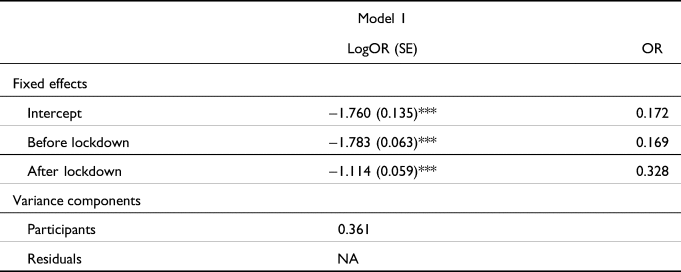
DV: Presence of CRS.
Note: The lower-level variance component is not available in mixed-effects logistic regression summaries with lmer (GLMM). LogOR, log Odds ratio; OR, Odds ratio, SE, standard error.
*p < 0.05; **p < 0.01; ***p < 0.001.
Discussion
Our study demonstrated how members of a large group with strong ties used WhatsApp chat group messages to remain connected during the COVID-19 lockdown. This investigation employed a longitudinal approach, analysing real life, naturally occurring conversations. Consequently, we were unable to design and manipulate conditions to control the type of information shared within the WhatsApp group messages. We defined the period of data collection to examine the effects of COVID-19 lockdown policies on conversational remembering.
We found consistent evidence that group members used WhatsApp to sustain regular interactions (in terms of the messages produced) throughout the lockdown period. Interestingly, interaction patterns increased before the implementation of lockdown measures and subsequently decreased prior to the relaxation of the lockdown (see Figure 2). The notable increase in the number of messages just prior to the initiation of the lockdown could potentially be attributed to the surge in COVID-19 cases within the metropolitan area and the circulation of speculations regarding a complete lockdown for the city. Conversely, the gradual decline likely mirrors the growing mobility of individuals, observable several weeks prior to the termination of the lockdown (Apple 2021; Google 2021).
The data collection for this study was specific to a large group with friends, all of whom were men. Gender differences in how people remember autobiographical events have been found in previous studies (Bloise and Johnson Reference Bloise and Johnson2007; Davis Reference Davis1999; Grysman and Hudson Reference Grysman and Hudson2013; Loftus et al. Reference Loftus, Banaji, Schooler and Foster1987). For example, in a seminal study where participants were asked to remember real-life experiences, it was found that women exhibited greater recall of emotional childhood memories compared to men (Davis Reference Davis1999). A more recent review study (Grysman and Hudson Reference Grysman and Hudson2013) reported that women, compared to men, included more emotions and specific details in their memory narratives. They also exhibited greater accuracy in recalling events and reported more interdependent memory narratives. The characteristics of our study (i.e., naturally occurring conversations taken from WhatsApp group messages) did not allow us to establish correlations between users' recall performance and memory accuracy or make valid comparisons to the studies that have examined gender differences in autobiographical memories in experimental settings (e.g., Davis Reference Davis1999). In our dataset, CRSs primarily revolved around the group's shared identity as an amateur football team and close-knit friends, spanning both pre and post-COVID-19 lockdown periods, encompassing recent and past experiences.
The online communication and interaction behaviours of a group comprising digital immigrants, individuals born before the widespread use of personal computers and cell phones, potentially influenced the conversational patterns observed in the WhatsApp dataset. Notably, there have been criticisms of the stark contrasts in digital communication patterns between digital natives and digital immigrants (see digital fluency, Wang et al. Reference Wang, Myers and Sundaram2013). However, it is important to recognize that differences in online communication and interaction behaviours between these two groups exist (Prensky Reference Prensky2012). They should be considered in future studies in conversational remembering in WhatsApp and other messaging apps (Messenger, WeChat, etc.), alongside considerations of gender differences. We identified the conversational resources that initiated CRSs in WhatsApp group messages. Group members used verbs in the past tense, multimedia (e.g., photos and videos), and verbs in the present tense to initiate 75.3 per cent of CRSs (see Table 1). These are placing-for-actions (Clark Reference Clark and Kita2003) instances where users established shared attention (Eilan et al. Reference Eilan, Hoerl, McCormack and Roessler2005) by introducing objects (i.e., messages in the past and present tense and multimedia resources with past reference) into the visual field of others, assuming that they are also interacting with the WhatsApp user interface. The use of questions had a similar function (i.e., bring a shared past into the present). But questions are different kinds of objects. The user posting a question assumed that other users had the information about shared past situations, events, and actions he requested. However, questions display less epistemic authority (Mondada Reference Mondada2013) than statements. While questions seek information about a shared past, messages in the past and present tenses along with multimedia resources imposed a shared past in the conversation.
The general topics that were mostly recalled in CRSs also reflected the group identity and their strong ties, both as an amateur football team and as a group of friends. Football and parties were the only general topics of CRSs that were present before, during, and after the COVID-19 lockdown, describing both recent and distant situations, events, and actions. These two general topics go across the life history of the group, and because of their frequency, (except during the lockdown) constitute a continuum between the time they began playing football and having parties together in the mid/late 1990s and the present. Other general topics recalled in CRSs, such as trips, friends, and concerts refer to specific situations, events, and actions, encapsulated in a distant past with well-defined temporal boundaries. These general topics also make the identity of the group. Losing a close friend too soon at the age of 26 because of cancer appears to have shaped the identity of the group: almost 10 per cent of CRSs were about their friend who died in 2007. To our knowledge, there has been no prior research conducted on the social functions of conversational remembering within text-messaging apps. However, among the limited studies that have systematically explored the social functions of conversational remembering in everyday conversations, Demiray et al. (Reference Demiray, Mischler and Martin2019) found that conversations, aimed at connecting with conversational partners and fostering entertainment, were more prevalent when engaging with friends. In our study, we observed a significant overlap between the functions of identity and conversation. For instance, our data revealed that activities like discussing football tournaments and parties played a crucial role in reinforcing the group's identity. Most of CRSs centred around general topics linked to a distant past were about unique situations, events, and actions that occurred during the friends’ late adolescence and early adulthood. Research on autobiographical memory (Conway et al. Reference Conway, Wang, Hanyu and Haque2005; Janssen et al. Reference Janssen, Chessa and Murre2005; Koppel and Berntsen Reference Koppel and Berntsen2016; Rubin Reference Rubin2015) demonstrated the presence of a reminiscence bump in middle-aged and elderly people. That is, adults over 40 years of age remember more autobiographical memories from youth and early adulthood. We speculate that the reminisce bump could have influenced the general topics recalled within CRSs; however, further research especially designed to address this phenomenon should be needed.
In less than 2 months after the government of the city of Buenos Aires had established the lockdown, one of the friends came up with the idea of making a written history of the group (see Table 1, CRS 2.8). Over 8 per cent of all CRSs were driven by the explicit intention to remember the situations, events, and actions that they believed should be included in their written history. We presented a fragment of the longest CRS found in the dataset, which was about the shared past situations, events, and actions that friends wanted to be included in their written history (see Supplementary information 2 for the complete CRS). The analysis showed the conversational roles that users adopted during the interaction and how these changed over time. The alternation of roles occurred spontaneously, possibly reflecting the strong ties that the group members have as well as the fact that those ties are regulated by symmetric relationships, as no social hierarchies were manifested in the WhatsApp group conversations. The unplanned alternation of conversational roles combined with the co-construction of utterances referring to a shared past reflect the social and cognitive distribution of memories about those shared experiences. The CRSs embedded in the WhatsApp group chat history are now part of a digital archive that friends may consult to recall the situations, events, and actions that they may want to include in their written history.
And finally, our study revealed that the odds that posts contained CRS sharply increased during the lockdown period and strongly decreased towards its end (research question 5), aligning with the previous findings, i.e., increase mobility led to a reduction in the exchange of messages (research question 4). This was a result we expected, considering the constraints on in-person interactions and the essential social functions that conversational remembering has in groups. This phenomenon shows how the group spontaneously adapted to new social norms and the importance that remembering together a shared past had for them. Conversational remembering recent and distant shared situations, events, and actions may probably be a collaborative activity they do when they meet in-person. We do not have data to support this claim but there is no reason to believe otherwise.
This study has several limitations. Since the dataset only contains the online interactions over WhatsApp, we were not able to discover whether CRSs were constant, when considering all participants’ interaction modalities (e.g., face-to-face interactions) before and after lockdown, when they did have the opportunity to meet in person and collaborate to remember shared past situations, events and actions.
One limitation of our study involving naturally occurring conversations was the inability to control variables and manipulate conditions that could have influenced the collaborative reconstruction of shared memories dating back to late adolescence/early adulthood. Thus, the methodological design of our study did not enable us to confirm the influence of the reminiscence bump in the CRSs we extracted from the WhatsApp group messages and analysed.
Upon careful examination of CRSs, we found instances of embedded CRSs. These were short CRSs embedded in the CRSs we coded where users briefly co-elaborated a specific sub-topic of the CRS (e.g., place of residence of someone they invited to play football) and then returned to the main topic of the CRS (e.g., playing football in the park). We considered these brief embedded CRSs to be part of the CRSs we coded and analysed. Multiparty interactions increase the chances of having embedded CRSs because a sub-group of users may be inclined to jointly recall particular aspects introduced in the main CRSs in parallel and for short time. Qualitative micro-analyses will be necessary to systematically identify embedded CRSs within main CRSs and determine their function in WhatsApp group interactions.
Simultaneous written computer-mediated communication via WhatsApp or any other chat platform does not adhere to the same conversational rules as face-to-face communication (Dillenbourg and Traum Reference Dillenbourg and Traum2006). Face-to-face conversations rely on a universal turn-taking system, which organizes speakers’ turns to minimize overlap and is not affected by the number of speakers or the duration of turns (Levinson Reference Levinson2016). The turn-taking system relies on predictive processes to a great extent (Levinson Reference Levinson2016) making conversations easy and almost without effort for speakers. These basic and universal features of face-to-face face conversation could not be reproduced in WhatsApp group messages. Conversational interaction in WhatsApp required considerably more effort (e.g., type messages rather than simply utter them) for users and could not be explained by applying turn-taking models originally developed for face-to-face conversation. Consequently, our findings may not be generalizable to face-to-face conversations about past, shared experiences. However, there was a significant advantage for WhatsApp users: the persistence of displayed information. This allowed friends to review and reflect on previous messages, and thus, to expand working memory capacity. It also enabled them to create an archive of situations, events, and actions that may be included in the history of the group they planned to write. The expansion of working memory capacity is an outcome that cannot be found in everyday conversations in which speakers’ utterances are ephemeral. Users offload cognitive task demands onto the chat system load, impacting individual and group performance during conversational remembering. WhatsApp enhances the storage capacity of memory systems (e.g., working memory, semantic memory, and episodic memory). Memory systems in interaction with the chat system could create the conditions for the emergence of hybrid memory networks formed by interwoven neural capacities and external memory devices. Examples of how individual memory has adapted to new computing and communication technology have already been reported (e.g., Sparrow et al. Reference Sparrow, Liu and Wegner2011).
This was a case study, and the results reported here may not reflect how other large groups with strong ties living in large metropolitan areas collectively remember shared experiences in WhatsApp group chats. Case studies like ours have the potential to generate new studies on how conversational remembering occurs in and it is shaped by the affordances that WhatsApp and other messaging apps (Messenger, WeChat, etc.) provide. We hope our study to be part of an evolving dialogue with future research on these topics.
Conclusion
This study is the first to analyse how conversational remembering in a large group of friends adapted to the COVID-19 lockdown and social distancing measures in one of the largest metropolitan areas in Latin America. The WhatsApp group chat facilitated friends' communication and allowed them to do what any other tightly knit group likely would: collaborate to remember situations, events, and actions they experienced together. In our study, most of the situations, events, and actions collaboratively recalled were associated with the identity of the group. This study has described and analysed one particular way in which digital platforms like WhatsApp may support prosocial behaviours like conversational remembering during the COVID-19 lockdown period, an unprecedented global moment in modern human history.
Supplementary material
The supplementary material for this article can be found at https://doi.org/10.1017/mem.2023.5.
Ethical statement
Informed consent from participants was obtained for the study. The Norwegian Centre for Research Data (NSD) approved the research (reference number: 422609)
Funding statement
The authors received no specific funding for this work.
Data availability statement
The data and the R code that support the findings of this study are openly available at the Open Science Framework (OSF): https://osf.io/ugr3k/?view_only=0a96bcf73bb64a869ba791ed6c11ea7a
Competing interest
Competing interest statement: We do not have any conflicts of interest and the study detailed in the manuscript has been approved by The Norwegian Centre for Research Data (NSD).
Lucas M. Bietti (Norwegian University of Science and Technology) is an associate professor of psychology at the Norwegian University of Science and Technology in Trondheim, Norway. His research interests include the study of cognition in interaction combining ethnographic and experimental methods, collective memory in small groups and social networks, storytelling, and embodied communication.
Eric Mayor (University of Basel) is a postdoctoral researcher at the Division of Clinical Psychology and Epidemiology of the Department of Psychology at the University of Basel, Switzerland. His research interests include the study of emotion and behaviour during the COVID-19 pandemic relying upon naturalistic and survey data as well as the study of coordination in natural and ad hoc groups.


 Open access

