


Evidence suggests that mental health services have historically ignored the needs of female patients. Reference Aitken and Noble1 In the 1990s, concerns regarding the lack of privacy and safety for women in psychiatric services led to calls for change. Reference Tonks2 According to Bartlett & Hassell, Reference Bartlett and Hassell3 these concerns were most evident in in-patient settings, where women were always in the minority, security levels were inappropriately high, and equality was not valued. These failings were investigated by the Department of Health, 4 which led to the publication of policy guidelines on the provision of gender-sensitive care and women-only services. 5 This was driven not only by safety concerns, but also by a growing body of evidence demonstrating gender differences within pathways into services, treatment needs, and treatment responses. 5 These guidelines emphasised the development of services where women can feel safe, understood, and where staff are skilled in responding appropriately to issues such as violence, abuse, parenting roles, poverty and isolation. 6
Studies have shown that single-gender wards are not necessarily safer or more gender-sensitive. Reference Mezey, Hassell and Bartlett7 The provision of a gender-sensitive approach requires staff attitudes to change and treatment programmes to be tailored to the needs of the women they are treating. Reference Bartlett and Hassell3 However, research into what this should look like has been scarce, and there remains no clear, single approach to issues of gender, despite the government guidance. Reference Davies, Waterhouse, Nasser, Baistow and Treasure8 This is especially the case in secure and acute settings where the difficulties faced by female patients may be more subtle, and the hierarchical environment may feed into their feelings of powerlessness, exacerbating their illness. Reference Bartlett and Hassell3 There is evidence that the needs of women in these services may have been particularly overlooked. Reference Perkins and Rowland9 This is worrying, given that women with a serious mental illness are considered to be more vulnerable to abuse and exploitation. 10
Psychiatric intensive care units (PICUs) were developed to treat acutely disturbed patients whose behaviour could not be contained on general wards. Reference Beer, Pereira and Paton11 A national audit of 33 adult PICUs (the majority were mixed-gender) found that they are not unique in the number of reports of sexual harassment and assaults against women. Reference Warner and Ford12 National minimum standards for PICUs 13,Reference Cresswell, Beavon and Glover14 have included such gender-related issues as the provision of gender-specific areas, ensuring equality of all treatments and assessment tools, ensuring self-care needs are met, and providing gender-sensitive groups. However, implementing these recommendations has presented practical issues, as the majority of PICU patients are male. Reference O'Brien, Cramer, Rutherford and Attard15 Furthermore, the impact of these policies on building more gender-sensitive services has not yet been properly evaluated. Reference Newbigging, Paul and Kohen16 Even more concerning is that there is no clear picture in the literature of what the specific needs of women admitted to PICU are. This paper will therefore review the existing literature on the characteristics and needs of women admitted to psychiatric in-patient services, with a particular focus on women admitted to secure units and PICUs.
Method
PubMed, Embase and PsycINFO were systematically searched using the following key terms: ‘PICU’, ‘psychiatric intensive care unit’, ‘secure’, ‘ward’, ‘gender’, ‘gender-sensitive’, ‘difference*’, ‘women’, ‘female*’, ‘psychiatric’, ‘serious mental illness’, ‘acute mental disorder’. Using these terms, a manual search of the Journal of Psychiatric Intensive Care was also conducted to identify further relevant articles. Researchers from a feminist perspective have suggested that using a variety of research methods leads to a more holistic portrayal of the subject in question. Reference Clifford-Walton and Romans17 In keeping with this perspective, the current review included the findings from both qualitative and quantitative studies. Specifically, studies that have focused on investigating gender differences in adult psychiatric in-patient services, in particular any studies that have investigated gender differences in PICU wards. This includes studies that have collected data from service users, staff and services in general. This was not limited to UK studies in order to obtain a more international picture of women's needs in these types of services. It is therefore acknowledged that, although PICU is a generally well-known term, in some countries the term emergency psychiatry may be used as a synonym for PICU.
Results
The results of the database searches were manually screened and we removed articles that did not fit the selection criteria or had inappropriate content (Fig. 1). We found 7 articles that specifically related to PICU and 20 that concerned gender issues in general psychiatric in-patient settings. These were based in a variety of settings including low, medium and high secure units, general psychiatric hospitals, acute wards and forensic psychiatric wards. The relevant studies found in this review are listed in Table 1. The studies used both quantitative and qualitative methods and were not limited to the UK, although all were based in high-income Western countries. To understand the findings in more depth, the studies were divided into four categories relating to the different care pathways: admission characteristics, treatment needs, risk management and outcomes after discharge. This was so that the findings could be considered within the context of the relevant care pathway, as each has different implications for assessment and treatment. Within each category, findings from general and secure wards are discussed first, followed by the findings from articles specifically relating to PICU.
Study attrition diagram

Summary of results from literature search
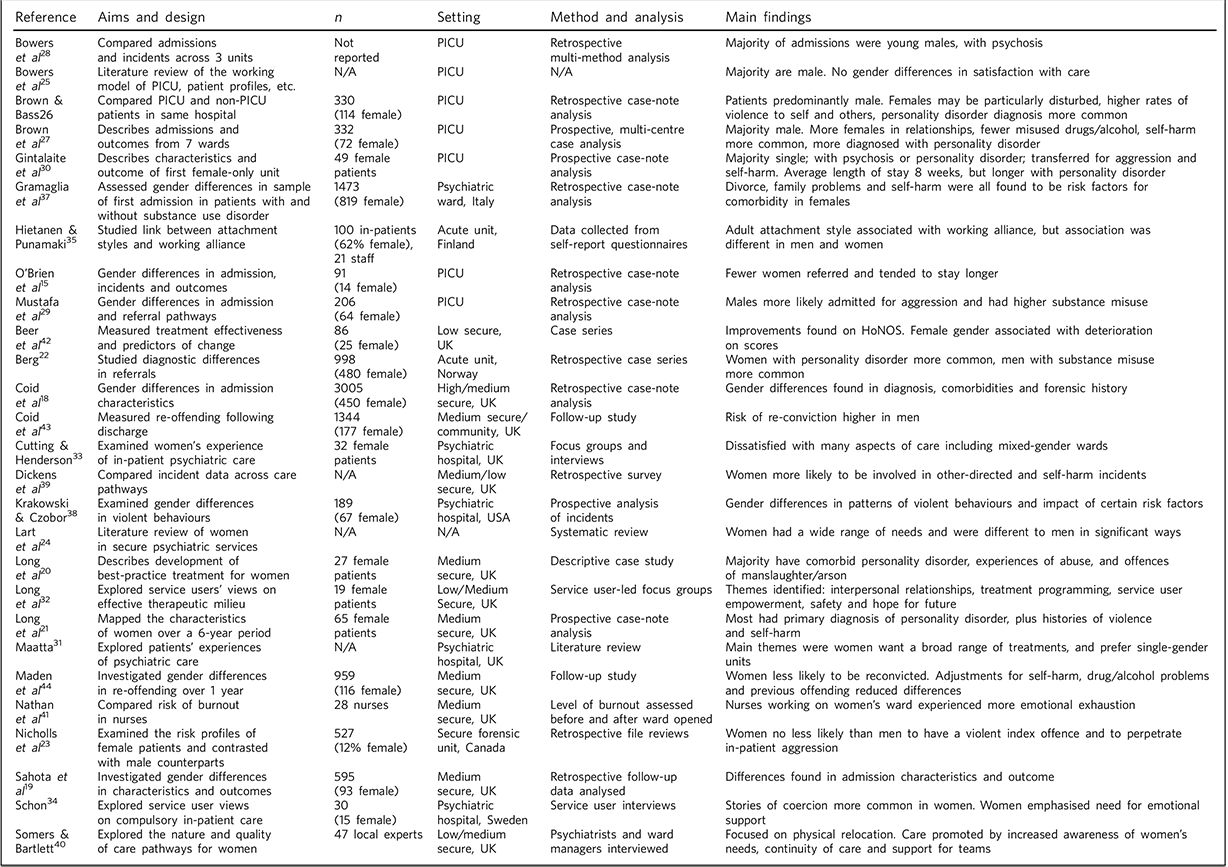
| Reference | Aims and design | n | Setting | Method and analysis | Main findings |
|---|---|---|---|---|---|
| Bowers et al Reference Bowers, Simpson, Nijman and Hall28 |
Compared admissions and incidents across 3 units |
Not reported |
PICU | Retrospective multi-method analysis |
Majority of admissions were young males, with psychosis |
| Bowers et al Reference Bowers, Jeffery, Bilgin, Jarrett, Simpson and Jones25 |
Literature review of the working model of PICU, patient profiles, etc. |
N/A | PICU | N/A | Majority are male. No gender differences in satisfaction with care |
| Brown & Bass26 |
Compared PICU and non-PICU patients in same hospital |
330 (114 female) |
PICU | Retrospective case-note analysis |
Patients predominantly male. Females may be particularly disturbed, higher rates of violence to self and others, personality disorder diagnosis more common |
| Brown et al Reference Brown, Chhina and Dye27 |
Describes admissions and outcomes from 7 wards |
332 (72 female) |
PICU | Prospective, multi-centre case analysis |
Majority male. More females in relationships, fewer misused drugs/alcohol, self-harm more common, more diagnosed with personality disorder |
| Gintalaite et al Reference Gintalaite-Bieliauskiene, Tandon and Woochit30 |
Describes characteristics and outcome of first female-only unit |
49 female patients |
PICU | Prospective case-note analysis |
Majority single; with psychosis or personality disorder; transferred for aggression and self-harm. Average length of stay 8 weeks, but longer with personality disorder |
| Gramaglia et al Reference Gramaglia, Bert, Lombardi, Feggi, Porro and Siliquini37 |
Assessed gender differences in sample of first admission in patients with and without substance use disorder |
1473 (819 female) |
Psychiatric ward, Italy |
Retrospective case-note analysis |
Divorce, family problems and self-harm were all found to be risk factors for comorbidity in females |
| Hietanen & Punamaki Reference Hietanen and Punamäki35 |
Studied link between attachment styles and working alliance |
100 in-patients (62% female), 21 staff |
Acute unit, Finland |
Data collected from self-report questionnaires |
Adult attachment style associated with working alliance, but association was different in men and women |
| O'Brien et al Reference O'Brien, Cramer, Rutherford and Attard15 |
Gender differences in admission, incidents and outcomes |
91 (14 female) |
PICU | Retrospective case-note analysis |
Fewer women referred and tended to stay longer |
| Mustafa et al Reference Mustafa, Bayatti and Faruqui29 |
Gender differences in admission and referral pathways |
206 (64 female) |
PICU | Retrospective case-note analysis |
Males more likely admitted for aggression and had higher substance misuse |
| Beer et al Reference Beer, Tighe, Ratnajothy and Masterson42 |
Measured treatment effectiveness and predictors of change |
86 (25 female) |
Low secure, UK |
Case series | Improvements found on HoNOS. Female gender associated with deterioration on scores |
| Berg Reference Berg22 | Studied diagnostic differences in referrals |
998 (480 female) |
Acute unit, Norway |
Retrospective case series | Women with personality disorder more common, men with substance misuse more common |
| Coid et al Reference Coid, Kahtan, Gault and Jarman18 |
Gender differences in admission characteristics |
3005 (450 female) |
High/medium secure, UK |
Retrospective case-note analysis |
Gender differences found in diagnosis, comorbidities and forensic history |
| Coid et al Reference Coid, Hickey, Kahtan, Zhang and Yang43 |
Measured re-offending following discharge |
1344 (177 female) |
Medium secure/ community, UK |
Follow-up study | Risk of re-conviction higher in men |
| Cutting & Henderson Reference Cutting and Henderson33 |
Examined women&s experience of in-patient psychiatric care |
32 female patients |
Psychiatric hospital, UK |
Focus groups and interviews |
Dissatisfied with many aspects of care including mixed-gender wards |
| Dickens et al Reference Dickens, Picchioni and Long39 |
Compared incident data across care pathways |
N/A | Medium/low secure, UK |
Retrospective survey | Women more likely to be involved in other-directed and self-harm incidents |
| Krakowski & Czobor Reference Krakowski and Czobor38 |
Examined gender differences in violent behaviours |
189 (67 female) |
Psychiatric hospital, USA |
Prospective analysis of incidents |
Gender differences in patterns of violent behaviours and impact of certain risk factors |
| Lart et al Reference Lart, Payne, Beaumont, MacDonald and Mistry24 |
Literature review of women in secure psychiatric services |
N/A | N/A | Systematic review | Women had a wide range of needs and were different to men in significant ways |
| Long et al Reference Long, Fulton and Hollin20 |
Describes development of best-practice treatment for women |
27 female patients |
Medium secure, UK |
Descriptive case study | Majority have comorbid personality disorder, experiences of abuse, and offences of manslaughter/arson |
| Long et al Reference Long, Knight, Bradley and Thomas32 |
Explored service users' views on effective therapeutic milieu |
19 female patients |
Low/Medium Secure, UK |
Service user-led focus groups | Themes identified: interpersonal relationships, treatment programming, service user empowerment, safety and hope for future |
| Long et al Reference Long, Hall, Craig, Mochty and Hollin21 |
Mapped the characteristics of women over a 6-year period |
65 female patients |
Medium secure, UK |
Prospective case-note analysis |
Most had primary diagnosis of personality disorder, plus histories of violence and self-harm |
| Maatta Reference Määttä31 | Explored patients' experiences of psychiatric care |
N/A | Psychiatric hospital, UK |
Literature review | Main themes were women want a broad range of treatments, and prefer single-gender units |
| Maden et al Reference Maden, Skapinakis, Lewis, Scott, Burnett and Jamieson44 |
Investigated gender differences in re-offending over 1 year |
959 (116 female) |
Medium secure, UK |
Follow-up study | Women less likely to be reconvicted. Adjustments for self-harm, drug/alcohol problems and previous offending reduced differences |
| Nathan et al Reference Nathan, Brown, Redhead, Holt and Hill41 |
Compared risk of burnout in nurses |
28 nurses | Medium secure, UK |
Level of burnout assessed before and after ward opened |
Nurses working on women's ward experienced more emotional exhaustion |
| Nicholls et al Reference Nicholls, Brink, Greaves, Lussier and Verdun-Jones23 |
Examined the risk profiles of female patients and contrasted with male counterparts |
527 (12% female) |
Secure forensic unit, Canada |
Retrospective file reviews | Women no less likely than men to have a violent index offence and to perpetrate in-patient aggression |
| Sahota et
al Reference Sahota, Davies, Duggan, Clarke, Huband and Owen19 |
Investigated gender differences in characteristics and outcomes |
595 (93 female) |
Medium secure, UK |
Retrospective follow-up data analysed |
Differences found in admission characteristics and outcome |
| Schon Reference Schön34 | Explored service user views on compulsory in-patient care |
30 (15 female) |
Psychiatric hospital, Sweden |
Service user interviews | Stories of coercion more common in women. Women emphasised need for emotional support |
| Somers & Bartlett Reference Somers and Bartlett40 |
Explored the nature and quality of care pathways for women |
47 local experts | Low/medium secure, UK |
Psychiatrists and ward managers interviewed |
Focused on physical relocation. Care promoted by increased awareness of women's needs, continuity of care and support for teams |
Admission characteristics
Within secure in-patient settings, men are consistently more likely to be admitted than women. Reference Coid, Kahtan, Gault and Jarman18 Women who are admitted tend to have fewer previous convictions, more previous psychiatric admissions, and are more likely to be admitted from hospital than prison. Reference Coid, Kahtan, Gault and Jarman18,Reference Sahota, Davies, Duggan, Clarke, Huband and Owen19 Women with a forensic history are significantly more likely to have been charged with or convicted of arson. Reference Coid, Kahtan, Gault and Jarman18,Reference Long, Fulton and Hollin20,Reference Long, Hall, Craig, Mochty and Hollin21 Female patients are more likely to have a diagnosis of major depressive disorder and personality disorder, borderline personality disorder in particular, Reference Coid, Kahtan, Gault and Jarman18,Reference Sahota, Davies, Duggan, Clarke, Huband and Owen19,Reference Long, Hall, Craig, Mochty and Hollin21–Reference Lart, Payne, Beaumont, MacDonald and Mistry24 whereas male patients are more likely to have a diagnosis of schizophrenia, and to have comorbid substance misuse. Reference Sahota, Davies, Duggan, Clarke, Huband and Owen19,Reference Berg22 Women are also more likely to present with a range of other conditions, such as eating disorders and anxiety disorders. Reference Coid, Kahtan, Gault and Jarman18 In terms of their histories, they are more likely to present with a history of self-harm and physical and/or sexual abuse. Reference Sahota, Davies, Duggan, Clarke, Huband and Owen19,Reference Long, Fulton and Hollin20 A review of women in secure services concluded that they represent a diverse group with individual personal, psychiatric and forensic histories. Reference Lart, Payne, Beaumont, MacDonald and Mistry24 However, the current review revealed some trends that have implications for assessment and treatment, such as that women are more likely to be diagnosed with a personality disorder, and to have histories of physical and/or sexual abuse.
Female patients admitted to PICU are also consistently in the minority. Reference Bowers, Jeffery, Bilgin, Jarrett, Simpson and Jones25 Most studies in this area have not included gender in the analysis, which means that the findings mainly describe male PICU patients. These studies show that the majority of PICU patients are typically male, White, in their thirties, and have a primary diagnosis of schizophrenia. Reference O'Brien, Cramer, Rutherford and Attard15,Reference Bowers, Jeffery, Bilgin, Jarrett, Simpson and Jones25–Reference Bowers, Simpson, Nijman and Hall28 Patients often have histories of substance misuse, violence and aggression. Reference Brown and Bass26,Reference Brown, Chhina and Dye27,Reference Mustafa, Bayatti and Faruqui29 Where studies have included gender in the analysis, there is the problem of small sample sizes and thus a lack of power. Brown et al's Reference Brown, Chhina and Dye27 study had a relatively large cohort (n = 332), but of these only 72 (21.5%) were female. Another study Reference Mustafa, Bayatti and Faruqui29 had a smaller sample size (n = 206), but assessed a higher percentage of female in-patients (n = 64, 31%). We can tentatively suggest that women admitted to a PICU may be more likely to be in a relationship, self-harm is more common but no more severe than in men, and fewer women than men misuse drugs or alcohol. Reference Brown, Chhina and Dye27,Reference Mustafa, Bayatti and Faruqui29 No gender differences have been found in symptom severity. Reference Brown and Bass26 There was disagreement about whether there are gender differences in primary diagnosis within the three studies found that investigated this. Two studies suggested that female PICU patients may be less likely to have a primary diagnosis of schizophrenia, and more likely to be diagnosed with personality disorder. Reference Brown and Bass26,Reference Brown, Chhina and Dye27 The other study found no differences. Reference Mustafa, Bayatti and Faruqui29 One study that looked exclusively at the characteristics of female PICU patients found that the majority were White, and had diagnoses of either schizophrenia or personality disorder; Reference Gintalaite-Bieliauskiene, Tandon and Woochit30 77% of the total sample (n = 49) had histories of physical aggression and severe self-harm, and had a number of previous admissions to mental health wards. Another study suggested that female patients may have significantly higher rates of violence and self-harm before their PICU admission than male PICU patients. Reference Brown and Bass26 However, this study had a small sample size (n = 165) and only 37 patients (22.5%) were female. It also used a retrospective design and data were taken from only one unit, which significantly limits the generalisability of these findings. Overall, these studies suggest that women are as unwell as men on admission to a PICU, but there may be differences in diagnosis and presentation.
Treatment needs
We found a limited number of studies that directly compared the treatment needs of men and women. However, a number of qualitative studies have conducted in-depth explorations of what women want from services. A systematic review Reference Määttä31 of male and female experiences in a psychiatric ward found only five relevant articles. These findings suggested that women prefer to have a broad range of treatment options, including therapy groups, complementary therapy and writing activities. Women also preferred being in a single-gender environment, as they felt safer and more able to talk to other women about their experiences. Long et al Reference Long, Knight, Bradley and Thomas32 conducted a focus group with women (n = 19) who were volunteers from medium and low secure units. Most of the patients had a dual diagnosis of personality disorder (mainly borderline personality disorder) and mental illness. Thematic analysis revealed five factors to which the patients attached greatest importance: the development of good interpersonal relationships with staff, who are understanding, empathetic, have insight, and get to know the patients beyond their mental illness; well-planned and meaningful activities; acknowledgment of progress; having clear rules; and a dual emphasis on physical and mental needs. Reference Long, Knight, Bradley and Thomas32 Other important factors included an individualised approach that promotes empowerment, a safe and settled environment with emphasis on de-escalation, and the importance of instilling hope by having future-oriented goals. Reference Long, Knight, Bradley and Thomas32 These findings have been supported by qualitative studies of women's experiences in general in-patient psychiatric services. Reference Cutting and Henderson33,Reference Schön34 One study that compared the experiences of men and women recovering from a severe mental illness found that women are more likely to emphasise the need for emotional support and trusting relationships with staff. Reference Schön34 Another study found that women on an acute in-patient ward with an insecure attachment style had more difficulties forming emotional and relational bonds than securely attached men and women, as well as insecurely attached men. Reference Hietanen and Punamäki35 This suggests that having an understanding of attachment theory Reference Bowlby36 and how this may influence the therapeutic alliance may be important when working with women. A study comparing male and female in-patients with comorbid substance use disorder found that having family problems and being divorced was a risk factor for women but not for men. Reference Gramaglia, Bert, Lombardi, Feggi, Porro and Siliquini37 The authors suggested that a treatment approach focusing on distress, family problems and relational issues may be more beneficial for women.
No studies were found that explored the treatment needs of women, specifically within PICU. A literature review of the working model of PICU suggests that patients generally prefer structure, routine and a good number of activities to keep them occupied. Reference Bowers, Jeffery, Bilgin, Jarrett, Simpson and Jones25 Staff interactions with patients were also noted as important aspects of care in PICU, including enabling the patient to feel heard, understood and treated with respect. O'Brien et al Reference O'Brien, Cramer, Rutherford and Attard15 found that women tended to receive longer-term care than men. However, this study is limited by a small sample size (n = 91), and is based in only one London trust. Gintalaite-Bieliauskiene et al Reference Gintalaite-Bieliauskiene, Tandon and Woochit30 found that some patients with personality disorder had excessively long in-patient stays in PICUs. Research needs to be carried out to investigate the needs of women in PICU to address this gap in the literature. It may also be necessary to investigate the question of why some patients with a personality disorder may be staying in hospital longer than is appropriate, as PICUs are not designed for long-term care.
Risk management
A number of quantitative studies have analysed incidents of violence and aggression on in-patient wards. It is generally found that female in-patients are aggressive at similar rates and severity levels as male in-patients, although they may be less likely to cause injury to others. Reference Nicholls, Brink, Greaves, Lussier and Verdun-Jones23 Krakowski & Czobor Reference Krakowski and Czobor38 found that women had a much higher level of verbal assaults and early physical assaults. Difficulties with ward routine and social interactions were found to be more highly associated with aggression in these women. A more recent survey of incidents on medium and low secure units Reference Dickens, Picchioni and Long39 found that women were more likely to be involved in other-directed and self-harm incidents, but that men were involved in the most severe incidents. The higher level of intensive observations required for women who self-harm, as well as the smaller number of women in services, means that caring for women is generally considered more resource intensive than for men. Reference Somers and Bartlett40 This may contribute to the feeling often reported by staff that female patients are more demanding to work with, and may help explain the higher level of burnout and emotional exhaustion associated with working on a female-only ward. Reference Nathan, Brown, Redhead, Holt and Hill41
The literature on gender differences in risk management in PICUs is extremely scarce. One study has suggested that, compared with men, women in PICUs present with significantly higher rates of violence towards themselves and others during their admission; they may also be more likely to be placed in seclusion and to be prescribed antidepressants and mood stabilising drugs. Reference Brown and Bass26 However, this study is limited as it had a relatively small sample size (n = 165), uses a retrospective design, and is based on only one unit.
Outcomes after discharge from in-patient services
Gender differences have been found in outcomes at the point of discharge for women in psychiatric in-patient settings. A study analysing Health of the Nation Outcome Scales (HoNOS) found that on discharge, deterioration in scores was associated with female gender. Reference Beer, Tighe, Ratnajothy and Masterson42 This implies that women may not show the same improvements that men do. Another study found that women have a significantly higher chance of being readmitted to a psychiatric hospital than men. Reference Sahota, Davies, Duggan, Clarke, Huband and Owen19 In contrast, the risk of reconviction for committing a criminal offence is higher for men. Reference Sahota, Davies, Duggan, Clarke, Huband and Owen19,Reference Coid, Hickey, Kahtan, Zhang and Yang43 However, once history of self-harm, substance misuse and previous criminal histories were adjusted for, the gender differences in reconviction rates were reduced. Reference Maden, Skapinakis, Lewis, Scott, Burnett and Jamieson44 There are no studies directly relating to outcomes for female patients discharged from PICU.
Discussion
This review has identified a number of characteristics that women in in-patient psychiatric settings tend to present with. First, the evidence presented here suggests that the need for good interpersonal relationships with staff is a central aspect of caring for women admitted to psychiatric wards. Numerous qualitative studies have highlighted this issue, Reference Long, Knight, Bradley and Thomas32–Reference Schön34 and emphasise that staff should be understanding, empathetic, insightful, and should get to know the patient beyond their illness. This may be linked to the finding that there is a higher co-occurrence of personality disorders and histories of abuse or trauma in female in-patients. Therefore, developing a good therapeutic alliance could be a crucial part of treatment for patients who are more likely to be sensitive to feelings of abandonment and rejection. Reference Somers and Bartlett40 Previous research has suggested that women are more socially oriented than men. Reference Mosley and Romans45 However, social interactions were found to be more highly associated with aggression in females than in males. Reference Krakowski and Czobor38 Therefore, in order to maintain a therapeutic environment, good interpersonal relationships with staff, who also have an awareness of attachment difficulties, may be more valuable for women in the acute phases of mental illness. This has been supported by studies showing that positive perceptions of the ward environment were associated with higher levels of therapeutic alliance. Reference Long, Anagnostakis, Fox, Silaule, Somers and West46
Second, this review suggests that a clear routine and structure within the ward, as well as a full activity programme, is important in order to maintain a safe and settled environment. This was supported in a number of qualitative studies focusing on the experiences of women in secure settings. This may also be equally important for men in secure settings. However, evidence has suggested that there is a stronger link between female aggression and ward routine. Reference Krakowski and Czobor38 Therefore, having a clear routine may be especially important for women in helping to reduce violence and aggression rates. This may also link to the increased prevalence of personality disorder in female in-patients, as studies have suggested that a structured, goal-oriented approach, with consistent treatment boundaries, is effective for treating personality disorder. Reference Bateman and Fonagy47
Third, this review suggests that women tend to present with higher rates of comorbidity with other mental health problems (including personality disorders, eating disorders and anxiety disorders), as well as a higher occurrence of trauma, abuse and self-harm. Evidence suggests that these factors are all significant predictors of poor outcomes in longitudinal studies. Reference Stone48 The increased prevalence of personality disorder and the fact that women are more likely to have been victims of violence in the past have also been linked to higher rates of aggression in female patients. Reference Flannery, Juliano, Cronin and Walker49 This complex constellation of problems may contribute to the finding that women tend to have longer lengths of stay at PICUs; Reference O'Brien, Cramer, Rutherford and Attard15,Reference Gintalaite-Bieliauskiene, Tandon and Woochit30,Reference Berg50 and may also be linked to the higher levels of burnout reportedly experienced by staff working on female wards. Reference Nathan, Brown, Redhead, Holt and Hill41 Previous researchers have made recommendations for increased relational security due to the higher level of risk (to staff, other patients and themselves) than that found in men. Reference Lart, Payne, Beaumont, MacDonald and Mistry24,Reference Wootton, Maden and Kohen51 Relational security emphasises more individualised levels of security, skilled nursing care and psychological therapies. This highlights the importance of services providing a high level of staff support and training so that they are able to safely contain and manage these complex problems while also providing access to appropriate therapeutic interventions. Reference Copperman and Knowles52 Researchers have found that providing staff with gender-informed training can greatly improve the experience and recovery process for patients. Reference Johnson, Bingham, Billings, Pilling, Morant and Bebbington53 Therefore, the findings of this review also highlight the need for staff training, supervision and competence in dealing with these complex issues sensitively.
It has been argued that, despite 20 years of research in this area, evidence that there is a clear understanding of what works for this group remains scant. Reference Blanchette and Brown54 This was found to be the case in this review, especially in terms of the number of articles available on gender differences in PICU. Although it is possible to make some suggestions and recommendations about women in secure or general in-patient wards based on the current evidence base, this is not possible about women in PICUs. This suggests that there is a lack of awareness about the characteristics and needs of this group. For example, one of the main findings from the present review was regarding the gender differences in diagnosis and the higher prevalence of personality disorder in women in secure and general in-patient wards. However, there is no strong evidence to support this difference in PICU due to the lack of robust studies. In the past, research findings from men in PICU have been generalised to women, and treatment or care pathways were applied to women in the same way as they were to men. It has also been argued that mental health services have often failed women by ignoring the sources of their distress, medicalising what are in fact social difficulties, and failing to recognise their roles as mothers. Reference Nicholson, Geller, Fisher and Dion55,Reference Wright and Owen56 PICUs have struggled to address these issues, and there is evidence that this has been due to practical problems. Reference O'Brien, Cramer, Rutherford and Attard15 However, there is also the possibility that the higher emphasis placed in PICU on medical and behavioural management of symptoms means that a focus on the specific needs of women can be easily lost.
Services have made progress since then, and new national minimum standards for PICUs and low secure units 57 have now been published. These standards recognise that women do have different needs to men in a number of areas including the physical environment, risk management, assessment and staffing. However, there remains a need for the characteristics of this population to be mapped out clearly, so that treatment can be adapted to meet their needs. Reference Long, Hall, Craig, Mochty and Hollin21 Developing services that are tailored to meet the needs of men and women, and evaluating the impact of these treatment programmes, are seen as a research priority by the government. 5 The continuation of research in this area is therefore crucial if services are to develop gender-sensitive treatment programmes.
Strengths and limitations
This review provides a fresh overview of a topic that may have been overlooked until now. The findings can be utilised by services interested in developing a more gender-sensitive approach. However, the findings also highlight the fact that this group of women is not homogenous. Reference Lart, Payne, Beaumont, MacDonald and Mistry24 There may also be many similarities between male and female patients; what is important for female in-patients may also be important for the care of male in-patients. However, this article is part of a wider research project aimed at addressing this issue by gathering more evidence on what factors may be more important for women in PICUs compared with men.
The main limitation of this review is that the ability to draw any firm conclusions based on the current academic literature, particularly regarding PICU, is extremely limited. Most of the articles found focus on admission profiles of women, but are limited by small sample sizes. This indicates a pressing need for more robust studies to be carried out on admission characteristics, and for further research to be conducted on outcomes and effective treatments. For example, analysing gender differences in risk profiles and outcomes within PICU, or interviewing staff and service users to gather their views on what women requiring intensive psychiatric care need. Finally, this review did not include searches for relevant policy reports, which present a resource that could be utilised in future reviews of the needs of female in-patients.


 Open access


eLetters
No eLetters have been published for this article.